Article

How Does the National Intellectual Property Strong County Program Improve County-Level Air Quality? Evidence from Chinese Counties

School of Public Finance and Administration, Harbin University of Commerce, Harbin 150028, China
*
Author to whom correspondence should be addressed.
Sustainability 2025, 17(20), 9213; https://doi.org/10.3390/su17209213
Submission received: 23 August 2025 / Revised: 29 September 2025 / Accepted: 13 October 2025 / Published: 17 October 2025
(This article belongs to the Section Air, Climate Change and Sustainability)

Abstract

Intellectual property protection systems play a critical role in fostering technological innovation, and their potential influence on environmental governance warrants further exploration. This paper utilizes data from 2607 counties in China spanning from 2000 to 2022 and employs the Multiple Timepoint Difference-in-Differences (MT-DID) model to investigate the impact of the National Intellectual Property Strong County Program (NIPSC) on air quality at the county level. The results reveal that NIPSC contributes to reducing SO2 and NH3 concentrations, highlighting the positive role of intellectual property protection policies in enhancing environmental quality. Further mechanism analysis shows that NIPSC effectively reduces pollution emissions through mechanisms such as fostering technological innovation, upgrading industrial structures, and promoting economic agglomeration. Heterogeneity analysis indicates that the NIPSC policy yields more pronounced improvements in air quality in regions that are not traditional industrial bases, possess international airports, or hold higher administrative status. This study offers a novel analytical perspective on county-level air pollution governance and presents new empirical evidence on the relationship between the NIPSC policy and environmental governance.

1. Introduction

Air pollution control at the county level in China has become a key challenge in achieving regional environmental equity and sustainable development [1,2]. The economic structure, characterized by a dependence on traditional energy sources and agriculture, has led to typical county-level pollution features, particularly sulfur dioxide (SO2) and ammonia (NH3) emissions [3]. SO2 primarily originates from coal combustion and industrial processes, posing direct threats to public health [4,5]. Additionally, it undergoes atmospheric conversion to generate sulfate, significantly contributing to acid rain and smog pollution [6]. On the other hand, NH3, originating from agricultural activities, reacts with acidic substances in the atmosphere to form secondary inorganic aerosols, which significantly drive the generation of fine particulate matter (PM2.5), exacerbating regional air quality fluctuations [7,8]. Although national policies such as the Air Pollution Prevention and Control Action Plan, the Three-Year Action Plan to Win the Battle for Blue Sky, and the Action Plan for Continuous Improvement of Air Quality have been implemented, achieving significant results at the urban level [9,10,11], these efforts have encountered the challenge of “last-mile” implementation in many county-level regions. The rigidity of the industrial structure, limitations in environmental regulatory capacity, and fiscal constraints at the local level together form a bottleneck to the sustained improvement of air quality in counties. In this context, the National Intellectual Property Strong County Project (NIPSC), which is a policy tool driven by innovation incentives, offers new possibilities for controlling direct pollutants at the county level.
The NIPSC represents a significant initiative in China’s grassroots governance system, aimed at strengthening the strategic role of intellectual property in regional innovation, industrial upgrading, and environmental governance [12]. This policy transcends the traditional top-down intellectual property governance model by granting county-level governments greater institutional autonomy to develop local intellectual property systems, promote the construction of patent alliances, and facilitate the commercialization of patent outcomes. This institutional arrangement closely integrates innovation governance with regional development, providing innovative policy tools to address the challenges of insufficient grassroots regional innovation, industrial path dependence, and environmental externalities [13]. Through institutional incentives and capacity building, the NIPSC is expected to enhance the supply capacity of green technologies at the county level, thereby reinforcing the influence of institutional governance in steering ecological performance [14]. Currently, few studies have examined the impact of NIPSC on direct air pollution governance at the county level. Can this policy improve air quality? What are the mechanisms involved? Is there regional variation in the effectiveness of direct air pollution control? Addressing these questions is crucial for enhancing the county-level intellectual property governance model and achieving green, sustainable development at the county level.
The literature most relevant to this paper can be categorized into two key areas: one focuses on the role of the intellectual property system in economic growth and innovation, and the other on the relationship between intellectual property and environmental governance. First, scholars generally hold two perspectives regarding the role of the intellectual property system in the economy and innovation. Existing literature generally supports the positive effects of the intellectual property system on economic growth and innovation output [15,16]. However, some scholars argue that reducing intellectual property protection may be more beneficial to innovation and economic growth [17]. After analyzing the relevant literature, Neves [18] concluded that intellectual property has an overall positive impact on innovation and economic growth, with stronger effects in developed countries than in developing countries. Using panel data from listed companies, Song [19] found an inverted U-shaped relationship between intellectual property protection and corporate innovation performance in the Chinese market. Second, some empirical studies have increasingly examined the environmental externalities of the intellectual property system. Lv [20] investigated the impact of intellectual property protection on air pollution using panel data from Chinese cities and found that the National Intellectual Property Demonstration City policy significantly reduced urban PM2.5 concentrations, effectively improving air quality. Nie [21] conducted empirical analysis based on the NIPSC policy and found that intellectual property protection improved carbon emission efficiency in pilot regions. Mao [22] examined the role of intellectual property in regional carbon reduction using provincial-level data from China and found that intellectual property protection policies are an important tool for reducing carbon emissions, with regional differences in their impact on carbon reduction.
While the relationship between intellectual property systems and environmental governance has been preliminarily explored, there are still important gaps in the current research: First, existing studies mostly focus on the urban level, while the county-level, as an important component of China’s governance system, has been largely overlooked in the evaluation of intellectual property protection policies. Counties, with limited governance resources, diverse industrial structures, and significant disparities in innovation capabilities, are ideal units for observing the “tail-end effects” of policies. Second, in terms of pollutant selection, current research tends to focus on macro-level emissions or indirect indicators, lacking dynamic tracking of direct pollutants such as SO2 and NH3, and policy identification, thus weakening the explanatory power of actual environmental improvement pathways. Third, in terms of mechanism identification, current research generally views technological innovation as an important transmission path, neglecting the potential for intellectual property protection to improve air quality through indirect mechanisms such as adjusting industrial structures and promoting economic agglomeration. Fourth, there is insufficient analysis of the heterogeneity of policy effects across different regional characteristics. Existing studies have yet to systematically examine how factors such as industrial base, degree of openness, and urban hierarchy shape the differential impacts of policy implementation.
Therefore, this paper focuses on the NIPSC, which was initiated and implemented by the former State Intellectual Property Office in 2009. It systematically evaluates the policy effects of the NIPSC on improving air quality at the county level, exploring its mechanisms and regional heterogeneity. The main contributions of this paper are as follows: First, it expands the spatial scope of environmental studies on intellectual property systems from urban areas to county-level regions, thereby filling the gap in research on the impact of grassroots institutional innovation on environmental performance. Second, current research tends to focus on macro-emission or indirect indicators when selecting pollutants, while the lack of dynamic tracking and policy identification of direct pollutant concentrations, such as SO2 and NH3, limits the ability to effectively explain the actual environmental improvement pathways. Third, regarding mechanism identification, current studies generally view technological innovation as a key transmission pathway, often overlooking the potential for intellectual property protection to improve air quality through indirect mechanisms, such as adjusting industrial structure and promoting economic agglomeration. Fourth, by identifying policy heterogeneity, this paper explores the differential impact of the NIPSC policy on county-level air quality and proposes corresponding policy recommendations.

2. Policy Background and Research Hypotheses

2.1. Policy Background

The evolution of the global intellectual property system can be traced back to the informal protection of crafts and technologies in ancient civilizations and was continued in the regulations of medieval European craft guilds. In modern times, the 19th century saw countries such as the United Kingdom and France taking the lead in enacting patent and trademark laws, laying the foundation for the modern intellectual property legal system. In the 20th century, with the signing of international agreements such as the Paris Convention (1883) and the Berne Convention (1886), as well as the establishment of the World Intellectual Property Organization (WIPO) in 1967, global intellectual property protection was significantly strengthened. Entering the 21st century, the digital age has introduced new challenges and opportunities, and the field of intellectual property protection has expanded to include new directions such as digital rights management and open innovation.
China’s evolution of intellectual property protection has similarly evolved from its inception to systematization. In ancient times, the protection of crafts and technologies relied primarily on informal means such as apprenticeship. During the late Qing Dynasty and the Republican period, modern intellectual property ideas were introduced, and initial laws on trademarks and patents were enacted, laying the foundation for the establishment of the modern intellectual property system. Since the reform and opening-up, especially in the 1980s, China has successively enacted laws such as the Patent Law, Trademark Law, and Copyright Law, gradually developing a more comprehensive intellectual property legal system, and continuously strengthening protection through multiple revisions. After joining the World Trade Organization (WTO), China further enhanced its intellectual property protection to align with international standards, and in 2008, issued the National Intellectual Property Strategy Outline, focused on enhancing the intellectual property system, promoting the creation and utilization of intellectual property, strengthening protection, and cultivating an intellectual property culture, thereby constructing a comprehensive intellectual property system. At the same time, China established specialized institutions such as intellectual property courts and internet courts to enhance judicial protection efficiency and specialization. The implementation of the National Intellectual Property Strategy Outline marked the beginning of a new phase in China’s intellectual property development, driven by government initiatives, as China gradually transitioned from adhering to international frameworks to autonomously improving its domestic intellectual property governance. Overall, since the reform and opening-up, especially after joining the WTO, China has made significant progress in intellectual property protection through legal and institutional improvements, establishing a strong foundation for innovation-driven development.
It is worth noting that in the past, China’s intellectual property policies have traditionally followed a “top-down” model, where policies were formulated and implemented by the central government or relevant authorities. This top-down approach helped to swiftly coordinate actions, centralize resource allocation, and ensure consistency and coordination of policies nationwide. However, its drawback was that it did not fully consider the specific circumstances at the local level, which may result in inconsistencies in implementation at the grassroots level and, to some extent, restrict the space for local autonomous innovation. In response to this, the Chinese government started adopting “bottom-up” policy practices, promoting policy innovation through grassroots pilot programs. A key manifestation of this shift in the field of intellectual property is the NIPSC, which conducts pilot projects at the county level. This bottom-up policy model effectively mobilizes local enthusiasm, ensuring that policy measures are better aligned with the actual needs at the grassroots level, and improving the targeting and effectiveness of policy implementation.
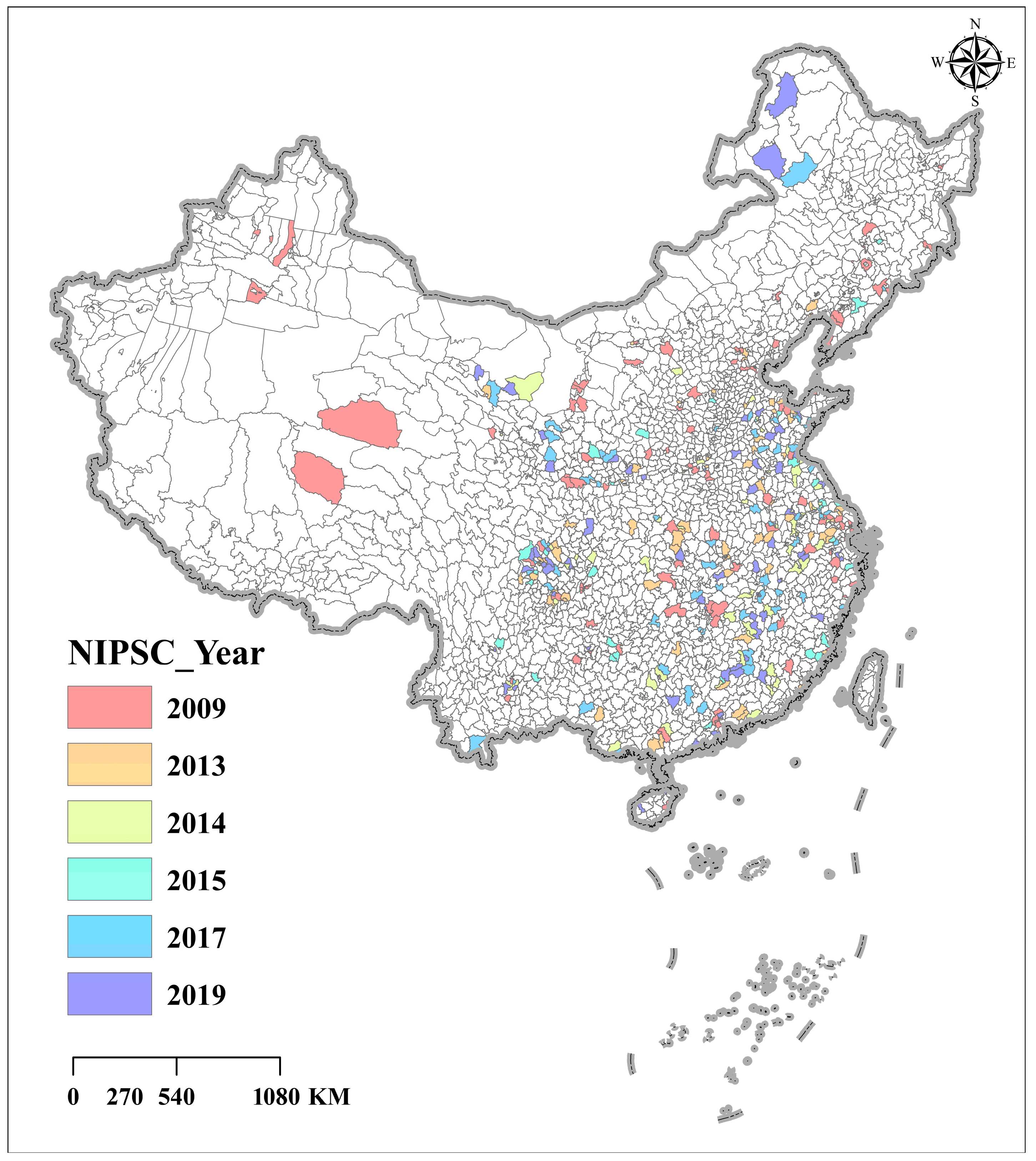
To effectively implement the National Intellectual Property Strategy and fully leverage the role of intellectual property in county-level economic development, the former State Intellectual Property Office launched the NIPSC in 2009. The Program adopts the operational principles of “voluntary application, selective recommendation, centralized evaluation, and tracking management”. County-level governments voluntarily apply, provincial intellectual property management departments selectively recommend, and the national level evaluates and determines the list of pilot or demonstration counties. The first batch of pilot counties selected as part of the first batch in 2009 included 40 counties (cities, districts) from across the country. The Program adopts a “pilot + demonstration” implementation model, granting selected counties greater institutional autonomy while encouraging continuous improvement of their intellectual property systems and management frameworks through strict construction acceptance and evaluation mechanisms. As a new practice in China’s county-level intellectual property governance reform, the key elements of the NIPSC are as follows: (1) Strengthening the construction of county-level intellectual property systems: Developing and enhancing county-level intellectual property management systems, implementing the national intellectual property strategy, and enhancing comprehensive innovation capacity. (2) Promoting industry intellectual property alliances: Guiding key industries in counties to establish intellectual property alliances, with a focus on strengthening intellectual property protection and promoting the role of both traditional and emerging intellectual property in local economic development. (3) Improving the industrialization of patented technologies: Encouraging and facilitating patent applications and authorizations and promoting the transformation and application of patented technologies to drive innovation and technological progress at the county level. Since 2009, the State Intellectual Property Office has conducted evaluations for seven batches of pilot counties under the NIPSC. By the end of 2019, 425 counties (cities, districts) across the country had been included in the list of pilot counties under the program. With the gradual nationwide implementation of this policy, the capacity for intellectual property protection and innovation at the local level has been significantly enhanced. This paper uses the mapping software ArcMap 10.8 to create Figure 1, visually illustrating the distribution of the pilot counties.
The NIPSC encourages local governments to improve their technological innovation and industrialization support systems, facilitating the adoption of patented technologies in local key industries. This, in turn, promotes the technological transformation and upgrading of high energy-consuming and heavily polluting sectors, while also stimulating the introduction of green and low-carbon innovation projects. In the pilot counties, as intellectual property protection and commercialization mechanisms are strengthened, enterprises are more likely to adopt efficient desulfurization and ammonia removal processes and clean production technologies, thus reducing SO2 and NH3 emissions. Additionally, the demonstration effect of the Program and its performance evaluation mechanism drive local fiscal and social capital toward environmental innovation, further improving the precision of air quality management. As a result, the NIPSC effectively improves SO2 and NH3 concentrations at the county level through a synergy of technological diffusion and institutional incentives.

2.2. Research Hypotheses

2.2.1. Direct Effect

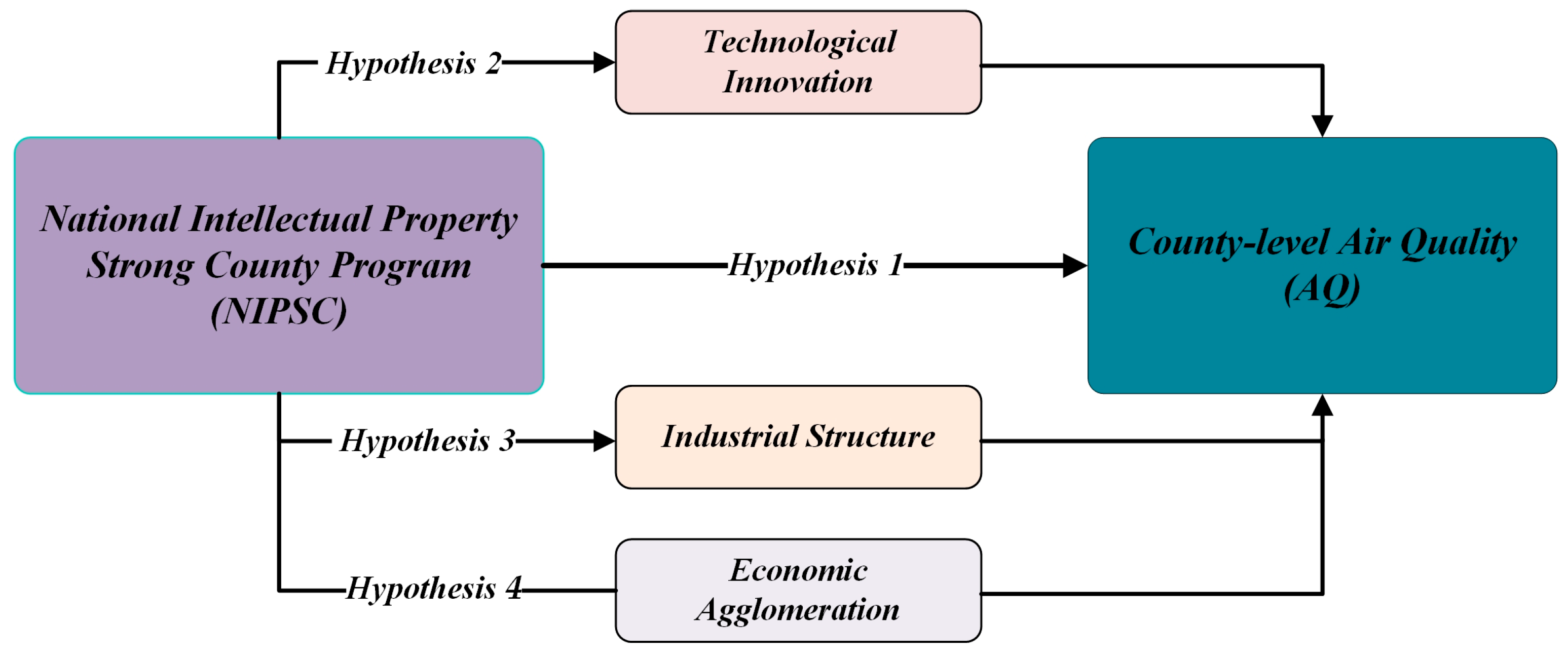
Within the framework of institutional economics, environmental pollution control is not solely dependent on coercive interventions; instead, it can be influenced through institutional adjustments that affect the behavior of local governments and market expectations, thereby achieving “indirect pollution control” [23,24]. As an embedded institutional reform practice, the NIPSC is not primarily aimed at environmental protection. However, it may indirectly improve regional air quality through pathways such as optimizing governance structures, reshaping institutional incentives, and enhancing innovation capabilities. First, NIPSC promotes the establishment of intellectual property management systems at the county level and improves patent application and commercialization systems, which helps build an innovation-oriented institutional environment and increases the marginal returns from green technology research and diffusion [25]. Within a framework where property rights are clear and protection is in place, green innovators are more likely to expect long-term returns on investment, thus encouraging investment in environmentally friendly technologies [16,26,27]. This institutional incentive not only boosts the enthusiasm for green technology development but also improves the efficiency of its cross-regional diffusion, laying the technological foundation for cross-county pollution control. Second, the improvement of the property rights system enhances enterprises’ control over their technological assets, which in turn encourages them to adopt cleaner process routes and invest in cleaner equipment [13]. Lastly, at the local governance level, NIPSC provides pilot county governments with greater authority in intellectual property policy formulation and resource allocation. This “decentralization of autonomy” not only encourages local governments to implement targeted innovation incentives but also facilitates their ability to incorporate green development indicators into their performance evaluation logic [28]. In counties with limited fiscal autonomy and weak pollution control capacity, the institutional support provided by NIPSC may help overcome the limitations of traditional environmental regulation and promote the coordinated progress of environmental governance and economic development. Based on the above analysis, this study proposes the following hypothesis:
Hypothesis 1:
The NIPSC can improve county-level air quality.

2.2.2. Indirect Effects

Technological innovation, particularly green technology innovation, is a crucial factor influencing air quality [29,30,31]. Previous studies have shown that technological advancements can significantly contribute to achieving emission reduction targets by improving resource efficiency and reducing pollutant emissions [32,33]. The impact of the NIPSC on corporate innovation and air pollution control is primarily reflected in the following aspects: First, by strengthening intellectual property protection, enterprises receive stronger incentives for innovation, reducing the risk of unfair external competition, and thus lowering the risks involved in the innovation process [34]. After obtaining intellectual property protection, enterprises are more likely to invest resources in the research and development of new products and processes, thereby reducing pollutant emissions in traditional production processes. For example, the promotion of clean energy technologies, wastewater and exhaust gas treatment technologies, and green manufacturing processes can significantly reduce pollutant emissions at the source [35,36]. Second, the implementation of the NIPSC contributes to improving the conversion rate of innovation outcomes at the county level and accelerates the adoption of green technologies. In this process, local governments, by strengthening intellectual property protection, facilitate the implementation of green technology innovations and environmental policies, thus enhancing the environmental protection capacity of counties. In light of the above analysis, this paper proposes the following hypothesis:
Hypothesis 2:
The NIPSC can improve county-level air quality by strengthening technological innovation at the county level.
Industrial structure upgrading is a crucial path for the sustainable development of regional economies and environmental quality improvement [37,38,39]. As an important policy tool for promoting county-level economic innovation and technological progress, the NIPSC can support the improvement of county-level air quality by driving the optimization of county-level industrial structures. Specifically, intellectual property protection incentivizes the development of high-tech and green industries, reducing the county’s dependence on resource-heavy and polluting industries, and providing the necessary support for the green transformation of industries [40,41]. First, with the support of this policy, county-level enterprises are more willing to invest in the research and development of green technologies, clean energy, and low-pollution processes, thus fostering the upgrading or elimination of traditional pollution-intensive industries. Meanwhile, advancements in environmental technologies enable various industries to gradually adopt low-carbon, green production methods, leading to a reduction in pollutant emissions at the source. Second, through policy incentives, the NIPSC facilitates the transition of county-level traditional industries with low added value and high pollution to high added value and low pollution industries. With the optimization of the industrial structure, county governments and enterprises are better able to adapt to market demand and encourage the efficient allocation of resources. This industrial transformation not only promotes the growth of high-tech industries but also brings more employment and technological development opportunities to the county, while enhancing the environmental protection capacity of the county’s governance system. As green industries and environmental protection technologies continue to grow, county governments can more effectively implement environmental protection policies and advance pollution control efforts in a more systematic and integrated manner, further reducing pollutant emissions. Based on the above analysis, this paper proposes the following hypothesis:
Hypothesis 3:
The NIPSC can improve county-level air quality by promoting industrial structure upgrading.
Economic agglomeration is a crucial driver of local economic growth, particularly in the areas of innovation and technology application [42,43]. The NIPSC facilitates the clustering of local innovative enterprises and research institutions by improving the intellectual property protection system, encouraging innovation investment, and enhancing technology commercialization. With the increase in innovative enterprises, the economic structure of the county is optimized, and the efficiency of capital, technology, and talent flow is improved. This process supports the sustainable growth of the local economy and the improvement of environmental quality [44,45]. First, the NIPSC draws numerous innovative enterprises and research institutions into counties by optimizing intellectual property protection and innovation policies. As these enterprises cluster, technology resources at the county level are more effectively shared and utilized. This optimized resource allocation not only enhances production efficiency but also promotes the adoption and application of green production methods. Second, economic agglomeration facilitates economies of scale and fosters collaborative innovation [46,47]. In an agglomerated economic environment, local enterprises can more effectively share innovation outcomes, reduce R&D costs, and improve the efficiency of technology commercialization and application. This agglomeration effect not only accelerates the spread of green technologies but also stimulates the innovation of the environmental protection industry, thereby promoting the application of pollution control technologies. Finally, economic agglomeration enhances the enforcement capacity of county governments in pollution control. With the concentration of technology and resources, county governments can better integrate and optimize environmental protection facilities, implement environmental policies, and enhance governance efficiency through integrated regulatory mechanisms. Therefore, the NIPSC, by fostering economic agglomeration, can improve the efficiency of resource allocation and the application of environmental protection technologies within counties, thereby indirectly improving air quality. Based on the above analysis, this paper proposes the following hypothesis:
Hypothesis 4:
The NIPSC can improve county-level air quality by enhancing economic agglomeration.
As illustrated, this paper outlines the theoretical analysis and research framework, as shown in Figure 2.

3. Research Design

3.1. Research Methods

3.1.1. Direct Effect Model

The Multiple Timepoint Difference-in-Differences (MT-DID) model is an econometric method designed to assess the heterogeneous effects of policies or external shocks on treatment and control groups at multiple different initiation time points [48,49,50]. The core idea is to introduce multiple intervention time points and, using panel data, track and more precisely estimate policy effects by analyzing the dynamic changes in the treatment and control groups before and after the policy implementation. At the same time, it can adjust for biases arising from potential time trends and group differences introduced by different regions or time periods. The MT-DID model is commonly applied to situations where specific policies or projects are implemented in stages or batches. Given that the NIPSC has been piloted in multiple provinces and cities since its inception, with different timeframes for each batch, this study adopts the MT-DID method to characterize the differences in policy effects at different time points. Based on existing studies [49,51], the following model is constructed in this paper:
C A Q i t = β 0 + β 1 T r e a t e d i × P o s t i t + λ C o n t r o l s i t + ν i + τ t + ε i t
C A Q i t represents the concentrations of SO2 and NH3. T r e a t e d i is a grouping variable, where T r e a t e d i = 1 if county i belongs to the treatment group and T r e a t e d i = 0 if it belongs to the control group. P o s t i t is a binary variable for the treatment period, where P o s t i t = 1 if county i is a pilot county of the National Intellectual Property Strong County Program in year t , and P o s t i t = 0 otherwise. Controls include all C o n t r o l s i t variables in this study. ν i , τ t , and ε i t represent county fixed effects, time fixed effects, and the random error term, respectively.

3.1.2. Mechanistic Effect Model

To systematically explore the channels through which the National Intellectual Property Strong County Program indirectly influences county-level air pollution, this paper follows the framework established by Casson [52] and constructs the following model:
M i t = β 0 + β 1 T r e a t e d i × P o s t i t + λ C o n t r o l s i t + ν i + τ t + ε i t
In model (2), M denotes the mechanism variable, which mainly encompasses technological innovation, industrial structure upgrading, and the level of economic agglomeration.

3.2. Variable Description and Data Sources

3.2.1. Explained Variable

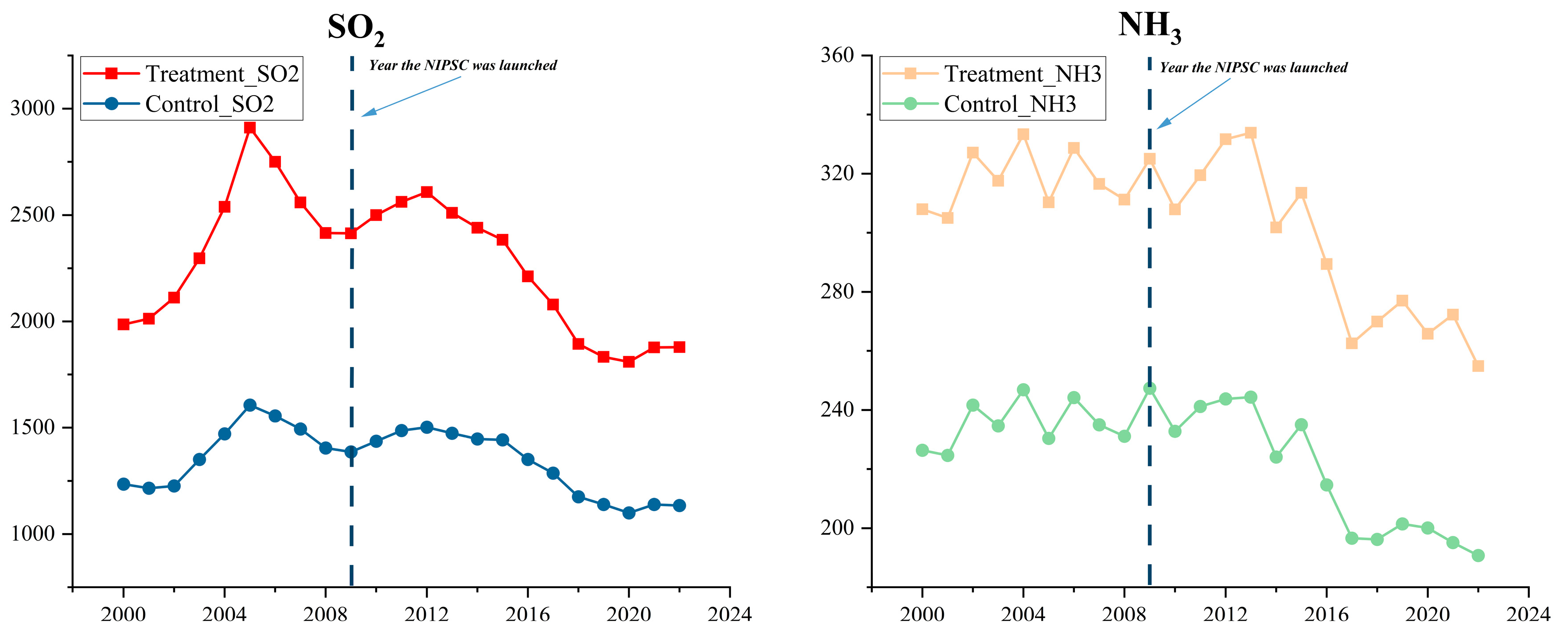
This paper selects SO2 and NH3 as the dependent variables to reflect direct air pollutants at the county level. Moreover, SO2 and NH3 represent the pollution characteristics of the two major source regions, industry and agriculture, at the county level. These pollutants are highly available in data and reliable in monitoring accuracy, making them suitable for accurately depicting air pollution conditions at the county level. Based on this, this paper incorporates the annual average concentrations of SO2 and NH3 at the county level into the analysis model as core indicators for measuring air quality, providing a solid environmental variable foundation for subsequent multi-period difference estimations. From Figure 3, two conclusions can be drawn: First, the overall trend of SO2 and NH3 concentrations during the sample period is downward. Second, after the implementation of the NIPSC policy, the air quality improvement in the pilot counties significantly outpaced that in non-pilot counties. This suggests that the NIPSC may play an important role in improving county-level air quality.

3.2.2. Explanatory Variable

To accurately quantify the effect of the implementation of the NIPSC policy, this paper constructs the following dummy variable in the model. Counties selected for the NIPSC policy list are assigned to the treatment group, while those not selected are assigned to the control group. Specifically, when a county is officially approved as a NIPSC pilot in year t , the dummy variable for that year and subsequent years is set to 1. If the county has not been approved or is still awaiting approval, the corresponding year is assigned a value of 0.

3.2.3. Control Variables

To control for the influence of other factors on the conclusions of this study, control variables are selected from two perspectives: county-level economic characteristics and county-level environmental characteristics. The specifics are provided in Table 1.

3.2.4. Data Sources

In terms of data cleaning, this study is based on the data for the dependent variable, imputes missing data for the control variables, and removes observations that are difficult to complete or exhibit abnormal values. After this process, a panel dataset for 2607 counties in China from 2000 to 2022 is obtained, with descriptive statistics presented in Table 2.
The data for county-level air quality comes from EDGAR2. The original data, in NC format, covers global emissions. For ease of use, statistics for each gas are compiled based on China’s provincial, municipal, and county administrative divisions, including the maximum, minimum, average, and total values, with the data measured in tons. This is organized into a panel dataset showing emission flux for each province, municipality, and county. Data for the NIPSC are manually compiled by the author from documents issued by the State Intellectual Property Office. The data for economic control variables come from sources such as the China County Statistical Yearbook. The ventilation coefficient data is derived from ERA5 monthly averaged data on single levels from 1940 to present. NDVI data is obtained from the China 250 m Normalized Difference Vegetation Index (NDVI) dataset.

4. Empirical Results

4.1. Benchmark Regression Analysis

This study uses Model (1) to evaluate the impact of the NIPSC on county-level air quality, with the results reported in Table 3. Columns (1) and (4) present the regression results for SO2 and NH3, respectively, with NIPSC coefficients of −2.850 and −0.104, both statistically significant at the 1% level. This indicates that the NIPSC can effectively reduce SO2 and NH3 concentrations, thereby improving county-level air quality. After incorporating control variables for county-level economic and environmental characteristics, the coefficients and t-values show only marginal changes. Columns (3) and (6) present the results with both sets of control variables included, with NIPSC coefficients of −2.523 and −0.092, respectively. This suggests that, even after controlling for other factors, the NIPSC can improve county-level air quality, thereby confirming Hypothesis 1.

4.2. Parallel Trend Test

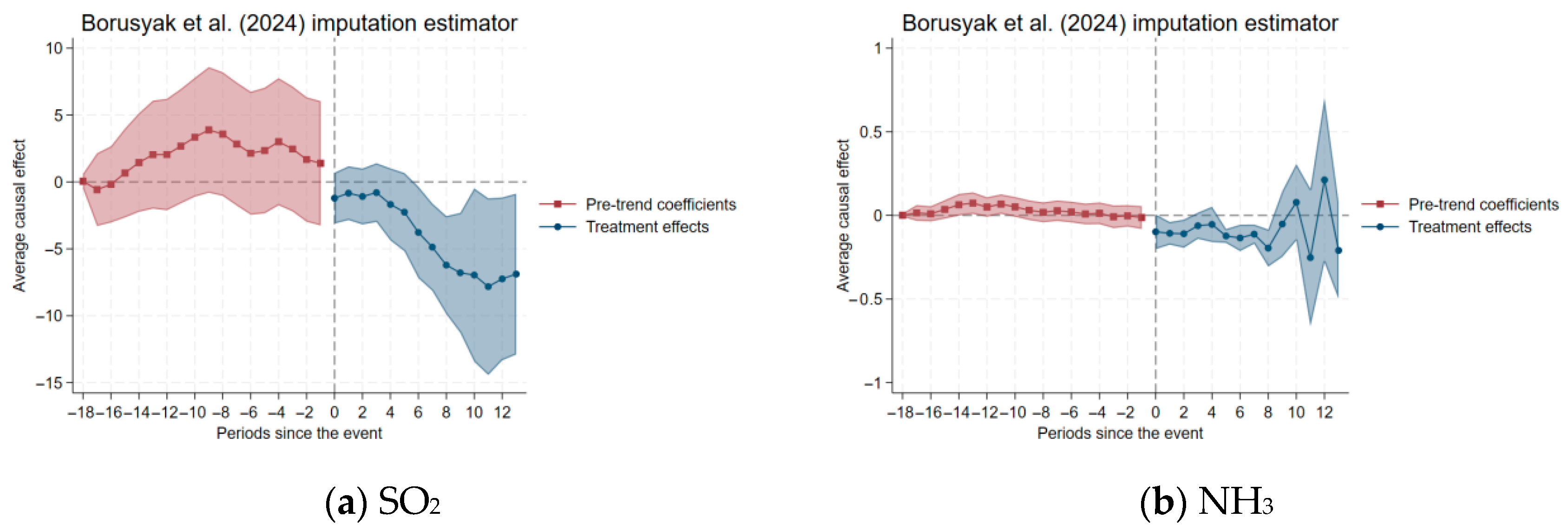
The parallel trend test is used to verify the core assumption of the difference-in-differences (DID) model—namely, that prior to the intervention, the outcome variables for the treatment and control groups must exhibit parallel movements over time [50,53,54] (Card and Krueger, 2000; Roth et al., 2023; Rambachan and Roth, 2023). Only when the two groups show no systematic differences before the policy can post-intervention differences be reasonably attributed to the policy itself. This study employs the “imputation-based counterfactual” parallel trend testing approach proposed by Borusyak [55], which imputes a counterfactual control value for each unit during untreated periods. This method not only flexibly addresses the challenges of staggered adoption and missing samples but also reduces bias in estimating the expected trajectory and yields more precise confidence intervals. As shown in Figure 4, for SO2 (first panel), the pre-treatment coefficients (red) from periods −18 to −2 fluctuate around zero, with confidence intervals overlapping zero, indicating no statistically significant differences between the treatment and control groups prior to policy implementation. After the intervention (blue), the coefficients remain consistently negative and are statistically significant in most periods, reflecting a robust decline in SO2 concentrations following the implementation of the NIPSC. Similarly, for NH3 (second panel), the pre-treatment coefficients remain stable without any discernible trend, supporting the parallel trend assumption. Although the coefficients during and after the intervention display some fluctuations, they generally remain below the initial zero baseline, further confirming the policy’s effectiveness in reducing NH3 concentrations. Therefore, the parallel trend assumption is satisfied.

4.3. Robustness Test

4.3.1. Placebo Test

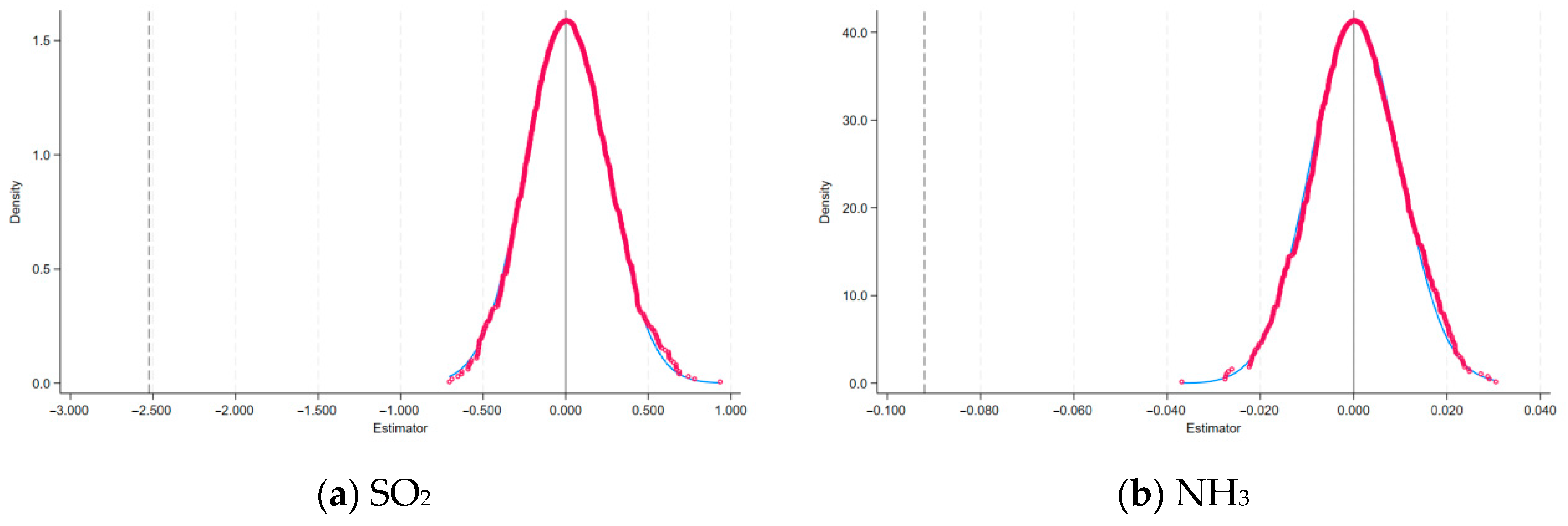
The placebo test is a robustness check used to assess the reliability of the estimated results by artificially shuffling the labels of “treatment” and “control” groups, thereby simulating a scenario with no actual policy intervention [56,57,58]. In this study, we conducted 1000 random reallocations. In each iteration, the identities of NIPSC pilot and non-pilot counties in the panel dataset were randomly reassigned, and the policy’s effect on air pollution was re-estimated to generate a distribution of placebo effect estimates [59,60,61]. The density curve, plotted as a red solid line that overlaps the blue curve, indicates that the estimates from these random assignments are tightly clustered around zero. In contrast, the actual NIPSC estimate, depicted by the gray dashed line in Figure 5, lies far from the main body of the distribution, positioned in the extreme tail. This finding suggests that the observed true effect is unlikely to result from random variation, thereby validating the placebo test.

4.3.2. PSM-DID

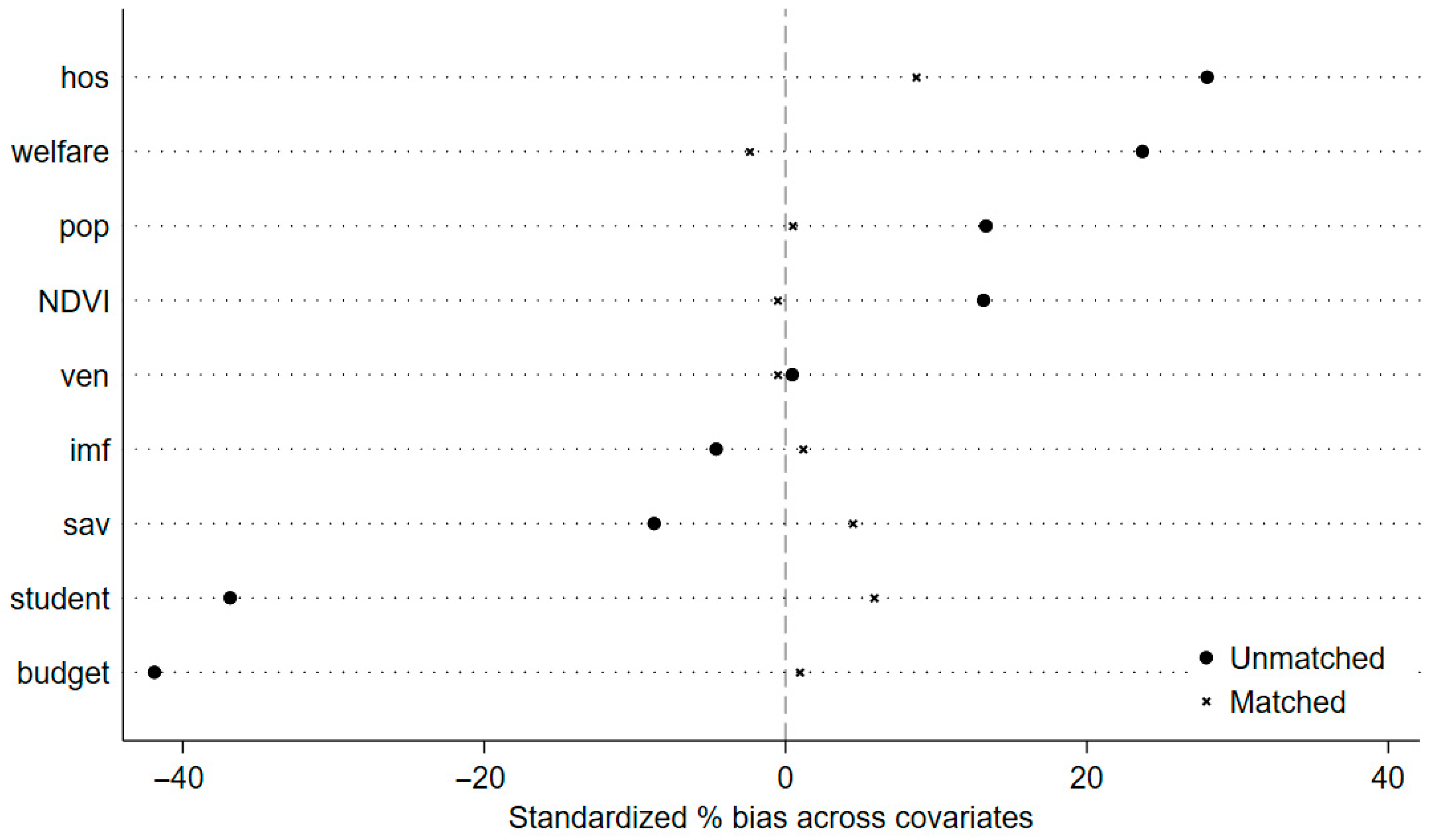
Propensity Score Matching (PSM) is widely employed as a quasi-experimental design method [62,63,64]. In this study, we first estimate each county’s “propensity score” of becoming an NIPSC pilot based on a range of economic and environmental covariates. Using caliper nearest-neighbor matching, counties in the treatment and control groups with similar scores are paired, thereby mitigating the influence of observable heterogeneity on causal effect estimation at the sample level. Combining PSM with the Difference-in-Differences (DID) model not only helps address selection bias through matching but also enables the capture of pre- and post-policy differences in the balanced sample, thus enhancing the internal validity of the causal estimates. As illustrated in Figure 6, before matching (●), the standardized bias for each covariate is widely distributed, whereas after matching (×), all variables fall within the acceptable ±10% range, demonstrating satisfactory covariate balance. After excluding unmatched samples, we re-estimate the DID regression on the matched subsample (columns (1) and (2) of Table 4). The coefficients of NIPSC for SO2 and NH3 are −2.431 and −0.081, respectively, both statistically significant at the 1% level. These results indicate that, even after controlling for observable differences, the finding that the NIPSC improves county-level air quality remains statistically robust.

4.3.3. Excluding Other Competing Hypotheses

To further eliminate the potential influence of other policy interventions on air quality, this study conducts a series of sample-exclusion tests for four types of pilot regions that may have overlapping effects, including Intellectual Property Courts (IPIP), National Innovative City Pilots (NICP), Smart City Development (SMART), and the “Broadband China” initiative (BC). Specifically, we first exclude counties participating in the IPIP pilot from the sample and re-estimate the multi-period DID model. The same procedure is then applied sequentially to exclude INNOVP, SMART, and BBC pilot counties. The regression results from these tests are presented in Table 5. The findings indicate that, regardless of which competing policy regions are excluded, the estimated coefficient for the NIPSC dummy variable consistently remains significantly negative, with magnitudes closely aligned with those of the baseline model. These robustness checks confirm that our core conclusion, namely that the NIPSC effectively reduces SO2 and NH3 concentrations and improves county-level air quality, is robust against the overlapping effects of other policies.

4.3.4. Replace Sample Intervals

To remove potential bias in air quality estimates arising from lockdowns and emission−reduction measures during the COVID-19 pandemic, we excluded all observations from 2019 and beyond from the sample. The multi-period DID model was then re-estimated using this refined dataset, as reported in columns (1) and (2) of Table 6. In the regression results restricted to the pre-pandemic period, the estimated coefficients of NIPSC for SO2 and NH3 concentrations are −1.699 and −0.075, respectively, and both are significant at the 1 percent level. These results indicate that, even after excluding data from this exceptional period, the estimated negative effect of the NIPSC on county-level air quality remains robust and statistically significant, further confirming the validity of our conclusions.

4.3.5. Changing the Clustering Level

In the baseline regression, we employed heteroskedasticity-robust standard errors to account for potential heteroskedasticity in the residuals. To further strengthen robustness checks, we incorporated clustered standard errors, which allow for arbitrary correlation of residuals within the same cluster, thereby relaxing the classical regression assumption that observations are independent and identically distributed. This approach effectively corrects for downward-biased standard errors that may arise from intra-group correlation along spatial or temporal dimensions. In our empirical analysis, residuals were clustered at three administrative levels: county (County_id), prefecture-level city (City_id), and province (Province_id). The corresponding results are reported in columns (3) through (8) of Table 6. Regardless of the clustering level applied, the estimated coefficients for NIPSC remain significantly negative. These findings indicate that, even when accounting for intra-group correlation at different administrative levels, the NIPSC contributes to reducing SO2 and NH3 concentrations and improving county-level air quality.

5. Mechanism Analysis and Heterogeneity Analysis

5.1. Mechanism Analysis

Drawing on the research hypotheses outlined above, this section employs Equation (2) to further assess whether the NIPSC improves county-level air quality through the promotion of technological innovation, industrial upgrading, and economic agglomeration, thereby providing an empirical test of the proposed hypotheses.

5.1.1. Technological Innovation Effect

We use the number of invention patents granted, as reported by the China National Intellectual Property Administration, as a proxy for technological innovation (innov), with the regression results presented in column (1) of Table 7. The estimated coefficient for NIPSC is 0.876 and statistically significant at the 1% level, indicating that the NIPSC substantially enhances technological innovation in pilot counties. By strengthening institutional support for patent application, confirmation, and enforcement, the program reduces the risk of imitation, improves firms’ expected returns, and raises the marginal returns on R&D investment, thereby motivating enterprises to pursue more groundbreaking invention activities. Moreover, through the establishment of county-level intellectual property service centers, patent navigation and commercialization platforms, and industrial patent alliances, the Program lowers the costs of technology search, evaluation, licensing, and transactions. In line with our theoretical framework, technological innovation contributes to improved county-level air quality. Taken together, these findings support Hypothesis 2, which posits that the NIPSC can indirectly enhance county-level air quality by fostering technological innovation.

5.1.2. Industrial Structure Effect

This study uses the share of value added in the tertiary sector relative to gross regional product as a proxy for industrial structure upgrading (is) to assess the impact of NIPSC on county-level industrial transformation. As shown in column (2) of Table 7, the multi-period DID regression yields a coefficient of 0.006 for NIPSC, which is statistically significant at the 5% level. This indicates that, on average, the tertiary sector’s share in pilot counties increased by 0.6 percentage points. The evidence suggests that the NIPSC accelerates the shift from traditional manufacturing toward service-oriented and knowledge-intensive industries, thereby fostering the growth of low-carbon and low-pollution sectors while enhancing the innovation capacity of local economies. Consistent with our theoretical framework, the intellectual property incentive mechanism strengthens firms’ incentives for technological innovation and commercialization, enabling service and high value-added industries to absorb patented technologies more rapidly and substitute them for high-emission heavy industrial processes. Through this structural upgrading process, county-level air quality improves. These findings provide empirical support for Hypothesis 3, which posits that the NIPSC can indirectly mitigate SO2 and NH3 emissions by promoting industrial structure upgrading.

5.1.3. Economic Agglomeration Effect

We measure economic agglomeration (ea) as the ratio of gross regional product to the administrative land area and report the corresponding multi-period DID regression results in column (3) of Table 7. The coefficient of NIPSC is 0.345 and statistically significant at the 1% level, indicating that pilot counties, on average, achieved 0.345 units higher GDP per unit of land area compared to non-pilot counties. This significant positive effect suggests that the NIPSC, by improving intellectual property protection systems, strengthening patent commercialization platforms, and incentivizing innovation investment, has not only attracted a greater concentration of innovative enterprises and R&D institutions but also enhanced the efficiency of regional factor flows, thereby accelerating the spatial clustering of capital, talent, and technology within counties. Consistent with our theoretical analysis, the economic agglomeration effect, while fostering economies of scale and collaborative innovation, also improves the organizational capacity for pollution control through centralized environmental infrastructure and coordinated regulatory mechanisms, effectively reducing SO2 and NH3 emissions. These findings confirm Hypothesis 4: the NIPSC can indirectly improve county-level air quality by enhancing economic agglomeration.

5.2. Heterogeneity Analysis

5.2.1. Industrial Base

Industrial base heterogeneity can significantly influence the policy effectiveness of the NIPSC. Specifically, old industrial bases often host historically entrenched energy-intensive sectors such as heavy chemical industries, steel, and cement. These regions face severe equipment depreciation, high capacity-replacement costs, and constraints on technological upgrading due to limited absorptive capacity and fiscal pressure. In contrast, non–old industrial bases have more diversified industrial structures dominated by light manufacturing, modern services, and emerging industries. Innovation resources are more evenly distributed, and firms can more rapidly absorb patent protections and imported technologies. To examine this heterogeneity effect, the sample is divided into two groups, old industrial bases and non–old industrial bases, according to the National Plan for the Adjustment and Transformation of Old Industrial Bases (2013–2022). Multi-period DID regression results are reported in columns (1) to (4) of Table 8. The findings indicate that in non–old industrial base regions, the NIPSC exhibits a highly significant suppressive effect on SO2 and NH3 concentrations. By contrast, in old industrial base regions, the policy effect is statistically insignificant. This suggests that non–old industrial bases, with lower industrial upgrading costs and smoother innovation diffusion pathways, can more effectively translate intellectual property advantages into clean production technologies, thereby improving air quality. In comparison, the path dependence and transformation bottlenecks of old industrial bases partially offset the environmental benefits of the NIPSC.

5.2.2. International Airport

The construction of international airports enhances a county’s level of openness and the connectivity of its transportation network, thereby accelerating the flow of technology, capital, and talent, which in turn has an important influence on the effectiveness of the NIPSC. Based on manually collected international airport data, the sample is divided into two groups: “counties with international airports” and “counties without international airports”, and multi-period DID regressions are conducted for each group. The results, presented in columns (1) and (2) of Table 9, show that in the SO2 regressions, the NIPSC coefficient for counties with international airports is −5.532 (p < 0.01), whereas for counties without airports it is −0.577 and not statistically significant. In the NH3 regressions (columns (3) and (4)), both groups display significant negative effects, although the reduction is larger for counties with airports. A subsequent Fisher permutation test, based on the coefficient differences between the two groups, yields a p-value of 0.000, providing strong evidence that the policy effects differ significantly between them. This heterogeneity analysis suggests that, compared with regions without airports, counties with international airport infrastructure can more effectively absorb external innovation resources and, leveraging the incentives of the NIPSC, accelerate technology introduction and process upgrades, thereby achieving larger reductions in SO2 and NH3 emissions.

5.2.3. County Administrative Level

Due to differences in administrative authority and decision-making mechanisms, cities of varying administrative levels in China exhibit significant heterogeneity in their responses to the NIPSC. To investigate this, the sample is divided into high-level cities (provincial capitals and sub-provincial cities, HC) and general cities (GC), and multi-period DID regressions are conducted for each group (see columns (1) to (4) in Table 10). All subgroup regression results are statistically significant at the 1% level. Fisher permutation tests are then applied to verify the differences in coefficients between groups, yielding p-values of 0.000 for both SO2 and NH3, providing strong evidence that the inhibitory effects of NIPSC on SO2 and NH3 concentrations are significantly stronger in high-level cities than in general cities. These findings suggest that in high-level cities, where decision-making power is more centralized and resource allocation is more efficient, NIPSC is better positioned to facilitate technology introduction and institutional innovation, thereby effectively improving county-level air quality.

6. Discussion

This paper empirically examines the positive impact of the NIPSC policy on reducing county-level SO2 and NH3 emissions by employing Chinese county-level data and a multi-period difference-in-differences model. Furthermore, the study demonstrates that the NIPSC policy enhances county-level air quality by influencing key mechanisms such as technological innovation, industrial restructuring, and economic clustering, and that its effects exhibit significant heterogeneity across counties with different industrial foundations and administrative hierarchies. Compared with the existing literature, the main theoretical contributions of this study can be summarized in three main dimensions: First, this study broadens the research scale. While most existing studies focus on cities or firms, this study extends the analysis to the county level, thereby broadening the spatial scope of research on the environmental impacts of intellectual property protection policies. Second, this study diversifies the selection of pollutants. By focusing on SO2 and NH3, it highlights the dual industrial–agricultural nature of county-level air pollution and provides deeper insight into the mechanisms through which the policy affects direct emissions. Third, this study deepens the identification of underlying mechanisms. Beyond the widely recognized technological innovation pathway, it substantiates the roles of industrial restructuring and economic clustering, thereby enriching the existing theoretical framework. In relation to prior research, the findings of this study align with city- and firm-level evidence, confirming the positive impact of the NIPSC policy on air quality [20,65]. While maintaining the consistency of the conclusions, this paper makes theoretical advancements in research scale, mechanism identification, and pollutant selection, thereby not only supplementing the existing literature but also advancing theoretical development.
Nonetheless, there are several limitations to this study. Firstly, while the policy effects were validated using the NIPSC policy and a multi-period DID model, the analysis did not sufficiently account for cross-regional effects across different areas. Specifically, in high-pollution regions, the impact of the policy may vary due to differences in resources, funding, and technological capabilities, leading to regional heterogeneity in policy effectiveness. As a result, future research could explore the spatial spillover effects of the policy, particularly the interactions between neighboring counties and cities. Secondly, this study did not distinguish the specific effects of different types of intellectual property protection measures on environmental quality. The empirical analysis treated intellectual property protection as a unified category; however, various types of patents—such as invention patents, utility model patents, and design patents—differ in their contributions to emission reduction. For example, invention patents related to green technologies may directly contribute to pollutant reduction, while patents related to energy-intensive industries may not necessarily result in environmental improvements. Additionally, the quality of patents (e.g., highly-cited versus low-quality patents) and their field-specific applications may also influence their environmental impact. Future studies could further refine the analysis by examining more detailed patent data, considering factors such as patent type, technological domain, and quality, in order to provide a more nuanced understanding of the relationship between intellectual property protection and air pollution control.

7. Conclusions and Policy Recommendations

This paper evaluates the impact of the National Intellectual Property Strong County Program on county-level air quality using a multi-period difference-in-differences model to rigorously assess the policy’s effectiveness. The results show that the NIPSC significantly improves air quality in pilot counties, most notably by lowering sulfur dioxide and ammonia concentrations. Specifically, after the policy’s implementation, SO2 levels in pilot counties fell by 2.850 units and NH3 levels dropped by 0.104 units. The result remains statistically significant after a series of robustness checks. Further mechanism analysis indicates that the NIPSC operates primarily through three channels. First, technological innovation promotes the adoption of green technologies and low-carbon production processes, thereby reducing emissions from pollution sources. Second, industrial upgrading fosters the growth of high value-added, low-pollution industries, reduces the share of traditional high-pollution sectors, and optimizes the overall economic structure. Third, economic agglomeration plays a crucial role, as the NIPSC enhances the concentration of innovation resources, improves local governance capacity, and further contributes to air quality improvement. In addition, the heterogeneity analysis indicates that policy effects vary across different locational contexts, with significantly stronger impacts observed in counties that are not part of traditional industrial bases, possess international airports, or hold higher administrative status.
Based on the above findings, this study offers the following policy recommendations. First, intellectual property protection at the county level should be further strengthened, particularly in supporting innovative enterprises and green technologies. This will help reduce legal risks during the innovation process and encourage more firms to increase R&D investment. Such measures not only foster technological innovation but also provide stronger legal safeguards for the growth of green industries. Second, efforts should be accelerated to optimize and upgrade the industrial structure, with a focus on promoting low-carbon and environmentally friendly industries, while encouraging traditional high-pollution sectors to transition toward greener production methods. By fostering the rise in high value-added, low-pollution industries, counties can effectively improve air quality and lay a solid foundation for sustainable economic development. Finally, local governments should adopt differentiated policies tailored to local conditions. In particular, resource-based cities and traditional industrial bases should be provided with greater technical support and assistance for industrial transformation.
In summary, this study provides new empirical evidence on the relationship between intellectual property protection policies and air pollution control, expands the analytical perspective on county-level ecological and environmental governance, and offers both theoretical and empirical support for the formulation and implementation of related policies.


Author Contributions

Conceptualization, methodology, software, funding acquisition, X.Z.; validation, formal analysis, data curation, writing—original draft preparation, X.S.; writing—review and editing, visualization, supervision, project administration, Y.F. All authors have read and agreed to the published version of the manuscript.

Funding

This study is supported by the Philosophy and Social Science Fund of China (Project Number: 22BSH019).

Institutional Review Board Statement

Not applicable.

Informed Consent Statement

Not applicable.

Data Availability Statement

The data involved in this paper can be obtained by contacting the corresponding author.

Conflicts of Interest

The authors declare no conflicts of interest.

References

  1. Liu, X.; Jin, X.; Luo, X.; Zhou, Y. Quantifying the Spatiotemporal Dynamics and Impact Factors of China’s County-Level Carbon Emissions Using ESTDA and Spatial Econometric Models. J. Clean. Prod. 2023, 410, 137203. [Google Scholar] [CrossRef]
  2. Namaiti, A.; Zeng, S.; Song, Y.; Shi, W.; Zeng, J. Decoding County-Level Air Quality in China: Spatio-Temporal Trends, Nonstationary Influencing Factors, and Management Zoning. J. Clean. Prod. 2025, 520, 146143. [Google Scholar] [CrossRef]
  3. Ai, Y.; Xue, L.; Li, Y.; Xu, Q.; Dai, X.; Wu, Y.; Kang, N.; Zhang, T.; Gou, J.; Tao, Y. Driving Forces of Agricultural Ammonia Emissions in Semi-Arid Areas of China: A Spatial Econometric Approach. J. Hazard. Mater. 2025, 488, 137484. [Google Scholar] [CrossRef] [PubMed]
  4. Khaniabadi, Y.O.; Polosa, R.; Chuturkova, R.Z.; Daryanoosh, M.; Goudarzi, G.; Borgini, A.; Tittarelli, A.; Basiri, H.; Armin, H.; Nourmoradi, H.; et al. Human Health Risk Assessment Due to Ambient PM10 and SO2 by an Air Quality Modeling Technique. Process Saf. Environ. Prot. 2017, 111, 346–354. [Google Scholar] [CrossRef]
  5. Orellano, P.; Reynoso, J.; Quaranta, N. Short-Term Exposure to Sulphur Dioxide (SO2) and All-Cause and Respiratory Mortality: A Systematic Review and Meta-Analysis. Environ. Int. 2021, 150, 106434. [Google Scholar] [CrossRef]
  6. Goyer, R.A.; Bachmann, J.; Clarkson, T.W.; Ferris, B.G.; Graham, J.; Mushak, P.; Perl, D.P.; Rall, D.P.; Schlesinger, R.; Sharpe, W.; et al. Potential Human Health Effects of Acid Rain: Report of a Workshop. Environ. Health Perspect. 1985, 60, 355–368. [Google Scholar] [CrossRef] [PubMed]
  7. Meng, F.; Zhang, Y.; Kang, J.; Heal, M.R.; Reis, S.; Wang, M.; Liu, L.; Wang, K.; Yu, S.; Li, P.; et al. Trends in Secondary Inorganic Aerosol Pollution in China and Its Responses to Emission Controls of Precursors in Wintertime. Atmos. Chem. Phys. 2022, 22, 6291–6308. [Google Scholar] [CrossRef]
  8. Liao, W.; Liu, M.; Huang, X.; Wang, T.; Xu, Z.; Shang, F.; Song, Y.; Cai, X.; Zhang, H.; Kang, L.; et al. Estimation for Ammonia Emissions at County Level in China from 2013 to 2018. Sci. China Earth Sci. 2022, 65, 1116–1127. [Google Scholar] [CrossRef]
  9. Chen, L.; Shi, M.; Li, S.; Gao, S.; Zhang, H.; Sun, Y.; Mao, J.; Bai, Z.; Wang, Z.; Zhou, J. Quantifying Public Health Benefits of Environmental Strategy of PM2.5 Air Quality Management in Beijing–Tianjin–Hebei Region, China. J. Environ. Sci. 2017, 57, 33–40. [Google Scholar] [CrossRef]
  10. Huang, J.; Pan, X.; Guo, X.; Li, G. Health Impact of China’s Air Pollution Prevention and Control Action Plan: An Analysis of National Air Quality Monitoring and Mortality Data. Lancet Planet. Health 2018, 2, e313–e323. [Google Scholar] [CrossRef]
  11. Feng, Y.; Ning, M.; Lei, Y.; Sun, Y.; Liu, W.; Wang, J. Defending Blue Sky in China: Effectiveness of the “Air Pollution Prevention and Control Action Plan” on Air Quality Improvements from 2013 to 2017. J. Environ. Manag. 2019, 252, 109603. [Google Scholar] [CrossRef] [PubMed]
  12. Yu, C.; Shen, B. Intellectual Property Policy and County Economic Growth: A Quasi-Natural Experiment from the Intellectual Property Powering County Project. China World Econ. 2024, 32, 35–67. [Google Scholar] [CrossRef]
  13. Nguyen, T.P.T.; Huang, F.; Tian, X. Intellectual Property Protection Need as a Driver for Open Innovation: Empirical Evidence from Vietnam. Technovation 2023, 123, 102714. [Google Scholar] [CrossRef]
  14. Mao, K.; Failler, P. Does Stronger Protection of Intellectual Property Improve Sustainable Development? Evidence from City Data in China. Sustainability 2022, 14, 14369. [Google Scholar] [CrossRef]
  15. Rapp, R.T.; Rozek, R.P. Benefits and Costs of Intellectual Property Protection in Developing Countries. J. World Trade 1990, 24, 75. [Google Scholar] [CrossRef]
  16. Pisano, G. Profiting from Innovation and the Intellectual Property Revolution. Res. Policy 2006, 35, 1122–1130. [Google Scholar] [CrossRef]
  17. Brüggemann, J.; Crosetto, P.; Meub, L.; Bizer, K. Intellectual Property Rights Hinder Sequential Innovation. Exp. Evid. Res. Policy 2016, 45, 2054–2068. [Google Scholar] [CrossRef]
  18. Neves, P.C.; Afonso, O.; Silva, D.; Sochirca, E. The Link between Intellectual Property Rights, Innovation, and Growth: A Meta-Analysis. Econ. Model. 2021, 97, 196–209. [Google Scholar] [CrossRef]
  19. Song, Y.; Xiu, Y.; Zhao, M.; Tian, Y.; Wang, J. Intellectual Property Protection and Enterprise Innovation: Evidence from China. Financ. Res. Lett. 2024, 62, 105253. [Google Scholar] [CrossRef]
  20. Lv, K.; Pan, M.; Huang, L.; Song, D.; Qian, X. Can Intellectual Property Rights Protection Reduce Air Pollution? A Quasi-Natural Experiment from China. Struct. Change Econ. Dyn. 2023, 65, 210–222. [Google Scholar] [CrossRef]
  21. Nie, S. Does Intellectual Property Rights Protection Matter for Low-Carbon Transition? The Role of Institutional Incentives. Econ. Model. 2024, 140, 106842. [Google Scholar] [CrossRef]
  22. Mao, H.; Qiao, Z.; Chen, G.; Khan, Y.; Khan, B. Intellectual Property Rights, Renewable Energy Innovation, and Carbon Emission Reduction: Insights from China’s Provincial Data. Energy Strategy Rev. 2025, 59, 101705. [Google Scholar] [CrossRef]
  23. North, D.C. Institutions, Institutional Change and Economic Performance; Cambridge University Press: Cambridge, UK, 1990. [Google Scholar]
  24. Acemoglu, D.; Aghion, P.; Bursztyn, L.; Hemous, D. The Environment and Directed Technical Change. Am. Econ. Rev. 2012, 102, 131–166. [Google Scholar] [CrossRef] [PubMed]
  25. Fan, H.; Yin, J.; Usman, M.; Li, Z. Intellectual Property Protection and Total Factor Productivity of Enterprises: A Quasi-Natural Experiment of Intellectual Property Courts. Finance Res. Lett. 2024, 70, 106236. [Google Scholar] [CrossRef]
  26. Han, H. Can Intellectual Property Rights Pilots Reduce Carbon Emissions? Evidence from China. Front. Environ. Sci. 2024, 12, 1336803. [Google Scholar] [CrossRef]
  27. Huang, K.; Huang, R.; Liu, Y.; Zhang, Z. When Will Companies Talk More about Innovation? A Natural Experiment of Intellectual Property Protection. Int. Rev. Econ. Financ. 2025, 101, 104209. [Google Scholar] [CrossRef]
  28. Lu, M.; Yi, B. The Impact of Environmental Decentralization on Corporate Green Innovation: Empirical Evidence from Local Governments. Financ. Res. Lett. 2025, 83, 107631. [Google Scholar] [CrossRef]
  29. Faucheux, S.; Nicolaï, I. Environmental Technological Change and Governance in Sustainable Development Policy. Ecol. Econ. 1998, 27, 243–256. [Google Scholar] [CrossRef]
  30. Zhang, Y.-J.; Peng, Y.-L.; Ma, C.-Q.; Shen, B. Can Environmental Innovation Facilitate Carbon Emissions Reduction? Evidence from China. Energy Policy 2017, 100, 18–28. [Google Scholar] [CrossRef]
  31. Lasisi, T.T.; Alola, A.A.; Muoneke, O.B.; Eluwole, K.K. The Moderating Role of Environmental-Related Innovation and Technologies in Growth-Energy Utilization Nexus in Highest-Performing Eco-Innovation Economies. Technol. Forecast. Soc. Change 2022, 183, 121953. [Google Scholar] [CrossRef]
  32. Xu, L.; Fan, M.; Yang, L.; Shao, S. Heterogeneous Green Innovations and Carbon Emission Performance: Evidence at China’s City Level. Energy Econ. 2021, 99, 105269. [Google Scholar] [CrossRef]
  33. Udemba, E.N.; Tosun, M. Moderating Effect of Institutional Policies on Energy and Technology towards a Better Environment Quality: A Two Dimensional Approach to China’s Sustainable Development. Technol. Forecast. Soc. Change 2022, 183, 121964. [Google Scholar] [CrossRef]
  34. Zhao, Q.; Wu, W.; Ge, Y.; Xu, J. Can Intellectual Property Protection Policy Enhance Enterprise Innovation Capability? Quasi-Natural Experimental Study. Int. Rev. Financ. Anal. 2025, 103, 104163. [Google Scholar] [CrossRef]
  35. Chau, K.Y.; Moslehpour, M.; Tu, Y.-T.; Tai, N.T.; Tien, N.H.; Huy, P.Q. Exploring the Impact of Green Energy and Consumption on the Sustainability of Natural Resources: Empirical Evidence from G7 Countries. Renew. Energy 2022, 196, 1241–1249. [Google Scholar] [CrossRef]
  36. Yu, Z.; Kamran, H.W.; Amin, A.; Ahmed, B.; Peng, S. Sustainable Synergy via Clean Energy Technologies and Efficiency Dynamics. Renew. Sustain. Energy Rev. 2023, 187, 113744. [Google Scholar] [CrossRef]
  37. You, J.; Zhang, W. How Heterogeneous Technological Progress Promotes Industrial Structure Upgrading and Industrial Carbon Efficiency? Evidence from China’s Industries. Energy 2022, 247, 123386. [Google Scholar] [CrossRef]
  38. Cheng, G.; Shi, Y.; Zhou, H. Analysis of the Effects of Green Technology Innovation and Industrial Structure Upgrading on Carbon Emission Intensity. Int. Rev. Econ. Financ. 2025, 102, 104163. [Google Scholar] [CrossRef]
  39. Huang, H.; Chen, Z.; Tan, C.; Liu, H. Using a Three-Tier Structural Decomposition Analysis to Assess Industrial Structure Transformation and Carbon Emissions in China. Energy 2025, 335, 137817. [Google Scholar] [CrossRef]
  40. Dussaux, D.; Dechezleprêtre, A.; Glachant, M. The Impact of Intellectual Property Rights Protection on Low-Carbon Trade and Foreign Direct Investments. Energy Policy 2022, 171, 113269. [Google Scholar] [CrossRef]
  41. Vimalnath, P.; Tietze, F.; Jain, A.; Gurtoo, A.; Eppinger, E.; Elsen, M. Intellectual Property Strategies for Green Innovations—An Analysis of the European Inventor Awards. J. Clean. Prod. 2022, 377, 134325. [Google Scholar] [CrossRef]
  42. Zheng, J.; Yuan, B.; Wu, J.; Chen, S. The Impact of Manufacturing Agglomeration on Green Development Performance: Evidence from the Yangtze River Economic Belt in China. J. Clean. Prod. 2024, 471, 143407. [Google Scholar] [CrossRef]
  43. Ma, X.; Li, C.; Li, Q.; Sun, Q. Toward Urban Agglomerations’ Sustainable Development: Impact of Economic Agglomeration on Green Economic Efficiency. Econ. Anal. Policy 2025, 87, 1342–1360. [Google Scholar] [CrossRef]
  44. Liu, J.; Qian, Y.; Song, S.; Duan, R. Industrial Symbiotic Agglomeration and Green Economic Growth: A Spatial Difference-in-Differences Approach. J. Clean. Prod. 2022, 364, 132560. [Google Scholar] [CrossRef]
  45. Ye, Z.; Li, J.; Chen, J. The Promotion Mechanism of Financial Agglomeration and Human Capital on Urban Economic Resilience: Based on the Moderating Effect of Industrial Structure. Int. Rev. Econ. Financ. 2025, 97, 103764. [Google Scholar] [CrossRef]
  46. Zeng, W.; Li, L.; Huang, Y. Industrial Collaborative Agglomeration, Marketization, and Green Innovation: Evidence from China’s Provincial Panel Data. J. Clean. Prod. 2021, 279, 123598. [Google Scholar] [CrossRef]
  47. Han, B.; Wu, H.; Diao, Y.; Han, D. Research on the Influence of the New Energy Industry Agglomeration on the Collaborative Governance of Pollution Reduction and Carbon Reduction. Energy Strategy Rev. 2024, 55, 101540. [Google Scholar] [CrossRef]
  48. Basile, R.; Giallonardo, L.; Iapadre, P.L.; Ladu, M.G.; Persio, R. The Local Labour Market Effects of Earthquakes. Reg. Stud. 2024, 58, 91–104. [Google Scholar] [CrossRef]
  49. Callaway, B.; Sant’Anna, P.H.C. Difference-in-Differences with Multiple Time Periods. J. Econom. 2021, 225, 200–230. [Google Scholar] [CrossRef]
  50. Roth, J.; Sant’Anna, P.H.C.; Bilinski, A.; Poe, J. What’s Trending in Difference-in-Differences? A Synthesis of the Recent Econometrics Literature. J. Econom. 2023, 235, 2218–2244. [Google Scholar] [CrossRef]
  51. Goodman-Bacon, A. Difference-in-Differences with Variation in Treatment Timing. J. Econom. 2021, 225, 254–277. [Google Scholar] [CrossRef]
  52. Casson, M.C.; Della Giusta, M.; Kambhampati, U.S. Formal and Informal Institutions and Development. World Dev. 2010, 38, 137–141. [Google Scholar] [CrossRef]
  53. Card, D.; Krueger, A.B. Minimum Wages and Employment: A Case Study of the Fast-Food Industry in New Jersey and Pennsylvania: Reply. Am. Econ. Rev. 2000, 90, 1397–1420. [Google Scholar] [CrossRef]
  54. Rambachan, A.; Roth, J. A More Credible Approach to Parallel Trends. Rev. Econ. Stud. 2023, 90, 2555–2591. [Google Scholar] [CrossRef]
  55. Borusyak, K.; Jaravel, X.; Spiess, J. Revisiting Event-Study Designs: Robust and Efficient Estimation. Rev. Econ. Stud. 2024, 91, 3253–3285. [Google Scholar] [CrossRef]
  56. Autor, D.H. Outsourcing at Will: The Contribution of Unjust Dismissal Doctrine to the Growth of Employment Outsourcing. J. Labor Econ. 2003, 21, 1–42. [Google Scholar] [CrossRef]
  57. Bertrand, M.; Duflo, E.; Mullainathan, S. How Much Should We Trust Differences-In-Differences Estimates? Q. J. Econ. 2004, 119, 249–275. [Google Scholar] [CrossRef]
  58. Galiani, S.; Gertler, P.; Schargrodsky, E. Water for Life: The Impact of the Privatization of Water Services on Child Mortality. J. Polit. Econ. 2005, 113, 83–120. [Google Scholar] [CrossRef]
  59. Lyu, Y.; Xiao, X.; Zhang, J. Does the Digital Economy Enhance Green Total Factor Productivity in China? The Evidence from a National Big Data Comprehensive Pilot Zone. Struct. Change Econ. Dyn. 2024, 69, 183–196. [Google Scholar] [CrossRef]
  60. La Ferrara, E.; Chong, A.; Duryea, S. Soap Operas and Fertility: Evidence from Brazil. Am. Econ. J. Appl. Econ. 2012, 4, 1–31. [Google Scholar] [CrossRef]
  61. Chetty, R.; Looney, A.; Kroft, K. Salience and Taxation: Theory and Evidence. Am. Econ. Rev. 2009, 99, 1145–1177. [Google Scholar] [CrossRef]
  62. Dehejia, R.H.; Wahba, S. Propensity Score-Matching Methods for Nonexperimental Causal Studies. Rev. Econ. Stat. 2002, 84, 151–161. [Google Scholar] [CrossRef]
  63. Rosenbaum, P.R.; Rubin, D.B. The Central Role of the Propensity Score in Observational Studies for Causal Effects. Biometrika 1983, 70, 41–55. [Google Scholar] [CrossRef]
  64. Rosenbaum, P.R.; Rubin, D.B. Constructing a Control Group Using Multivariate Matched Sampling Methods That Incorporate the Propensity Score. Am. Stat. 1985, 39, 33–38. [Google Scholar] [CrossRef]
  65. Hao, Y.; Ba, N.; Ren, S.; Wu, H. How Does International Technology Spillover Affect China’s Carbon Emissions? A New Perspective through Intellectual Property Protection. Sustain. Prod. Consum. 2021, 25, 577–590. [Google Scholar] [CrossRef]
Figure 1. Distribution of Pilot Counties under the National Intellectual Property Strong County Program Since 2009.
Sustainability 17 09213 g001
Figure 2. Framework of Theoretical Analysis and Research Hypotheses.
Sustainability 17 09213 g002
Figure 3. Temporal Trends of SO2 and NH3 (2000–2022).
Sustainability 17 09213 g003
Figure 4. Results of the Parallel Trends Test.
Sustainability 17 09213 g004
Figure 5. Results of the Placebo Test.
Sustainability 17 09213 g005
Figure 6. Results of the Balance Test.
Sustainability 17 09213 g006
Table 1. Definitions of Variables.
Variable TypeVariablesSymbolDefinition
Dependent VariableCounty-level Air QualitySO2
NH3
Independent VariableNational Intellectual Property Strong County ProgramNIPSCWhen a county is a pilot county, it is 1 in the current year and later years, otherwise it is 0.
Economic Characteristic Control VariablesFiscal expenditure budget.budgetGeneral budget expenditure of local finance/GDP
Resident savings.savSavings deposit balance of urban and rural residents/GDP
Social welfarewelfareNumber of beds in various social welfare adoption units/number of registered population
Level of educationstudentNumber of students in ordinary middle schools/number of registered population
Medical supporthosNumber of hospital beds/registered population
Information infrastructureimfNumber of fixed telephone users/registered population
Population densitypopRegistered population/land area of administrative region
Environmental Feature Control VariablesVentilation factorvenBoundary Layer Height × Surface Wind Speed
Normalized difference vegetation indexNDVINDVI is calculated as “ N I R R E D N I R + R E D ”. NIR and RED represent the reflectance of the satellite sensor in the near-infrared band and the red band, respectively.
Table 2. Description of related variables.
Control GroupTreatment GroupUnit
VariableNMeanSDNMeanSD
SO256,35513.2340.41360626.8654.67100 tons
NH356,3552.3565.28636062.9084.293
budget56,3550.2080.27436060.1190.108/
sav56,3550.5640.55736060.5210.499/
welfare56,3550.1760.22836060.2320.274Beds/100 people
student56,3550.4420.25836060.3490.266Students/10 persons
hos56,3550.2710.24436060.3520.344Beds/100 people
imf56,3550.09900.11336060.09200.139Household/person
pop56,3550.04700.19836060.06300.19610,000 people/km2
ven56,3551.2760.58536061.2790.524/
NDVI56,3554.6721.54136064.8671.407/
Table 3. Baseline Regression Results.
(1)(2)(3)(4)(5)(6)
SO2_MeanSO2_MeanSO2_MeanNH3_MeanNH3_MeanNH3_Mean
NIPSC−2.850 ***−2.505 ***−2.523 ***−0.104 ***−0.094 ***−0.092 ***
(−7.397)(−6.487)(−6.522)(−7.847)(−6.973)(−6.813)
budget 0.857 ***0.836 *** 0.130 ***0.132 ***
(2.748)(2.672) (5.050)(5.016)
sav 0.538 ***0.546 *** −0.030 ***−0.031 ***
(3.236)(3.249) (−4.808)(−4.801)
welfare 2.441 ***2.423 *** 0.076 ***0.078 ***
(7.745)(7.603) (4.805)(4.904)
student −3.604 ***−3.612 *** −0.016 *−0.013
(−7.618)(−7.683) (−1.729)(−1.465)
hos 5.900 ***5.905 *** 0.050 ***0.048 ***
(9.756)(9.783) (4.811)(4.613)
imf −1.736 **−1.754 ** 0.131 ***0.132 ***
(−2.437)(−2.461) (7.930)(8.017)
pop 2.0312.000 −0.065 ***−0.062 ***
(1.041)(1.025) (−3.037)(−2.898)
ven −0.672 0.024
(−1.289) (1.111)
NDVI −0.244 0.033 ***
(−0.780) (4.146)
_cons14.224 ***13.392 ***15.401 ***2.396 ***2.355 ***2.166 ***
(228.151)(59.132)(8.638)(1132.705)(359.413)(42.645)
CountyYESYESYESYESYESYES
YearYESYESYESYESYESYES
N59,96159,96159,96159,96159,96159,961
R20.8880.8890.8890.9890.9890.989
t statistics in parentheses. * p < 0.1, ** p < 0.05, *** p < 0.01.
Table 4. PSM-DID Result.
(1)(2)
SO2_MeanNH3_Mean
NIPSC−2.431 ***−0.081 ***
(−6.252)(−5.977)
budget1.785 **0.211 ***
(2.555)(9.963)
sav0.456 ***−0.034 ***
(2.711)(−4.931)
welfare2.334 ***0.072 ***
(7.047)(4.242)
student−4.204 ***−0.019 *
(−8.776)(−1.909)
hos6.738 ***0.056 ***
(10.539)(5.081)
imf−2.084 ***0.102 ***
(−2.844)(6.310)
pop1.944−0.065 ***
(0.997)(−3.014)
ven−0.7810.019
(−1.366)(0.767)
NDVI−0.1870.044 ***
(−0.587)(5.248)
_cons15.745 ***2.186 ***
(8.413)(41.055)
CountyYESYES
YearYESYES
N58,08058,080
R20.8890.989
t statistics in parentheses. * p < 0.1, ** p < 0.05, *** p < 0.01.
Table 5. Robustness Test: Excluding Other Competing Hypotheses.
(1)(2)(3)(4)(5)(6)(7)(8)
IPIPNICPSMARTBCIPIPNICPSMARTBC
SO2SO2SO2SO2NH3NH3NH3NH3
NIPSC−1.210 ***−2.369 ***−2.369 ***−0.803 *−0.069 ***−0.093 ***−0.093 ***−0.085 ***
(−3.098)(−4.716)(−4.716)(−1.932)(−4.578)(−10.929)(−10.929)(−9.782)
budget0.751 **0.798 ***0.798 ***0.658 **0.135 ***0.112 ***0.112 ***0.120 ***
(2.574)(2.615)(2.615)(2.489)(5.091)(4.322)(4.322)(4.575)
sav0.296 **0.410 ***0.410 ***0.111−0.029 ***−0.031 ***−0.031 ***−0.031 ***
(2.465)(2.678)(2.678)(1.246)(−4.651)(−4.422)(−4.422)(−4.613)
welfare2.598 ***1.088 ***1.088 ***2.232 ***0.049 ***0.133 ***0.133 ***0.095 ***
(9.193)(2.935)(2.935)(7.775)(3.386)(7.620)(7.620)(9.289)
student−2.756 ***−3.338 ***−3.338 ***−2.897 ***−0.002−0.015−0.015−0.014 *
(−6.343)(−6.006)(−6.006)(−6.356)(−0.276)(−1.276)(−1.276)(−1.933)
hos4.960 ***4.770 ***4.770 ***3.672 ***0.033 ***0.051 ***0.051 ***0.047 ***
(8.889)(7.004)(7.004)(6.806)(3.594)(4.728)(4.728)(5.132)
imf−0.842−0.038−0.0380.0530.134 ***0.097 ***0.097 ***0.161 ***
(−1.229)(−0.047)(−0.047)(0.070)(8.020)(6.399)(6.399)(8.124)
pop0.2669.509 ***9.509 ***−2.099−0.085 ***−0.037−0.037−0.097 ***
(0.093)(3.090)(3.090)(−1.086)(−3.792)(−1.448)(−1.448)(−4.499)
ven−0.596−0.868−0.868−0.774 *0.0200.0140.0140.026
(−1.229)(−1.562)(−1.562)(−1.735)(0.976)(0.648)(0.648)(1.471)
NDVI0.299−0.121−0.1210.0960.029 ***0.036 ***0.036 ***0.025 ***
(0.958)(−0.311)(−0.311)(0.292)(4.321)(3.282)(3.282)(3.737)
_cons10.257 ***13.010 ***13.010 ***10.382 ***2.083 ***1.903 ***1.903 ***1.920 ***
(5.804)(5.954)(5.954)(5.682)(46.911)(28.272)(28.272)(40.511)
CountyYESYESYESYESYESYESYESYES
YearYESYESYESYESYESYESYESYES
N55,15440,11240,11241,23955,15440,11240,11241,239
R20.8820.8770.8770.8980.9920.9770.9770.988
t statistics in parentheses. * p < 0.1, ** p < 0.05, *** p < 0.01.
Table 6. Robustness Test: Changing the Sample Period and Clustering Level.
(1)(2)(3)(4)(5)(6)(7)(8)
SO2NH3SO2NH3SO2NH3SO2NH3
NIPSC−1.699 ***−0.075 ***−2.523 **−0.092 ***−2.523 *−0.092 ***−2.523 *−0.092 ***
(−3.331)(−3.925)(−2.132)(−5.214)(−1.963)(−4.447)(−1.833)(−2.827)
budget0.3210.101 ***0.8360.132 ***0.8360.132 ***0.8360.132 ***
(1.194)(4.393)(1.231)(4.378)(1.261)(3.988)(1.653)(4.424)
sav0.163−0.008 **0.546−0.031 **0.546−0.031 *0.546−0.031
(1.488)(−2.376)(1.506)(−2.566)(1.143)(−1.873)(1.041)(−1.612)
welfare2.241 ***0.051 **2.423 ***0.078 **2.423 ***0.078 *2.423 **0.078 *
(5.233)(2.319)(3.041)(2.061)(3.006)(1.949)(2.367)(2.029)
student−3.450 ***−0.037 ***−3.612 ***−0.013−3.612 ***−0.013−3.612 **−0.013
(−6.398)(−3.582)(−3.493)(−0.992)(−3.362)(−0.597)(−2.582)(−0.332)
hos5.879 ***0.048 ***5.905 ***0.048 **5.905 ***0.048 **5.905 ***0.048 *
(7.460)(4.339)(4.359)(2.463)(4.321)(2.138)(3.671)(1.723)
imf−0.1510.101 ***−1.7540.132 ***−1.7540.132 ***−1.7540.132
(−0.188)(6.143)(−1.092)(4.165)(−0.985)(3.007)(−0.869)(1.683)
pop−2.710−0.061 **2.000−0.0622.000−0.0622.000−0.062
(−1.357)(−2.413)(0.419)(−1.425)(0.437)(−1.283)(0.439)(−1.048)
ven−1.570 ***−0.020−0.6720.024−0.6720.024−0.6720.024
(−2.656)(−0.751)(−0.947)(1.086)(−0.882)(0.949)(−0.783)(0.654)
NDVI−0.1970.040 ***−0.2440.033 ***−0.2440.033 **−0.2440.033
(−0.549)(4.690)(−0.365)(2.933)(−0.371)(2.147)(−0.334)(1.075)
_cons17.262 ***2.270 ***15.401 ***2.166 ***15.401 ***2.166 ***15.401 ***2.166 ***
(8.543)(40.274)(4.352)(36.736)(4.485)(27.361)(4.628)(14.816)
CountyYESYESYESYESYESYESYESYES
YearYESYESYESYESYESYESYESYES
County_idNONOYESYESNONONONO
City_idNONONONOYESYESNONO
Province_idNONONONONONOYESYES
N49,53349,53359,96159,96159,96159,96159,96159,961
R20.8920.9890.8890.9890.8890.9890.8890.989
t statistics in parentheses. * p < 0.1, ** p < 0.05, *** p < 0.01.
Table 7. Results of the Mechanism Analysis.
(1)(2)(3)
innovisea
NIPSC0.876 ***0.006 **0.345 ***
(11.293)(2.125)(6.645)
budget−1.927 ***0.017 ***−0.207 ***
(−12.555)(3.316)(−4.255)
sav−0.070 ***0.028 ***−0.131 ***
(−3.425)(8.803)(−11.463)
welfare0.068−0.020 ***−0.119 ***
(1.199)(−9.377)(−5.932)
student0.798 ***0.032 ***0.154 ***
(7.502)(7.570)(4.351)
hos−0.225 ***0.0010.262 **
(−3.414)(0.379)(2.403)
imf−0.164−0.020 ***−0.087 **
(−1.230)(−4.337)(−2.459)
pop0.0350.084 ***3.955 ***
(0.451)(2.993)(4.014)
ven−0.470 ***0.018 ***0.003
(−4.279)(6.194)(0.107)
NDVI−0.328 ***0.002−0.069 ***
(−4.626)(0.853)(−2.828)
_cons2.687 ***0.316 ***0.339 ***
(6.895)(29.399)(2.651)
CountyYESYESYES
YearYESYESYES
N34,59152,29348,608
R20.6110.7500.680
t statistics in parentheses. * p < 0.1, ** p < 0.05, *** p < 0.01.
Table 8. Results of the Heterogeneity Analysis Based on Industrial Foundation.
(1)(2)(3)(4)
SO2_MeanSO2_MeanNH3_MeanNH3_Mean
NIPSC0.859−3.812 ***−0.052−0.110 ***
(0.321)(−2.714)(−1.387)(−4.502)
budget6.176−0.0670.158 **0.120 ***
(1.534)(−0.126)(2.588)(3.547)
sav0.3910.581−0.015 *−0.045 **
(0.669)(1.209)(−1.903)(−2.032)
welfare6.299 ***0.8010.085 *0.066
(2.943)(1.088)(1.664)(1.293)
student−9.404 ***−1.587−0.100 **0.013
(−3.064)(−1.636)(−2.128)(0.556)
hos12.067 ***2.615 *0.0250.038
(4.176)(1.855)(0.910)(1.254)
imf0.385−1.677−0.0070.174 ***
(0.113)(−0.891)(−0.117)(3.128)
pop−6.1405.867−0.120 *−0.025
(−1.059)(0.993)(−1.742)(−0.375)
ven−1.653−0.3980.139 *0.003
(−0.560)(−0.743)(1.838)(0.112)
NDVI1.441−1.140 *0.084 ***0.015
(1.026)(−1.702)(4.097)(0.757)
_cons15.206 **16.852 ***2.196 ***2.125 ***
(2.023)(4.706)(13.181)(22.494)
CountyYESYESYESYES
YearYESYESYESYES
N17,45742,50417,45742,504
R20.8750.9020.9870.990
t statistics in parentheses. * p < 0.1, ** p < 0.05, *** p < 0.01.
Table 9. Results of the Heterogeneity Analysis Based on International Airports.
(1)(2)(3)(4)
SO2_MeanSO2_MeanNH3_MeanNH3_Mean
NIPSC−5.532 ***−0.577−0.142 ***−0.061 ***
(−6.817)(−1.431)(−3.789)(−9.551)
budget8.386 ***0.3450.277 ***0.137 ***
(3.777)(1.384)(4.101)(4.822)
sav0.1310.686 ***−0.016 ***−0.078 ***
(0.714)(3.793)(−3.193)(−11.299)
welfare3.388 ***2.242 ***0.0740.081 ***
(3.812)(7.040)(1.273)(8.315)
student−3.125 ***−3.247 ***−0.031−0.004
(−2.648)(−6.786)(−0.909)(−0.584)
hos6.185 ***5.606 ***0.0430.052 ***
(3.821)(10.286)(1.258)(6.667)
imf−8.694 ***1.0710.067 *0.158 ***
(−5.223)(1.374)(1.660)(10.184)
pop5.517 **−8.184 ***−0.065 **−0.051 **
(2.306)(−2.726)(−2.217)(−2.285)
ven−1.200−0.6490.0770.010
(−0.931)(−1.229)(1.113)(0.565)
NDVI−1.668 ***0.3770.0200.039 ***
(−2.675)(1.056)(0.880)(6.195)
_cons31.476 ***9.162 ***2.851 ***1.936 ***
(8.654)(4.537)(21.106)(42.233)
CountyYESYESYESYES
YearYESYESYESYES
N15,06544,89615,06544,896
R20.9010.8780.9890.989
t statistics in parentheses. * p < 0.1, ** p < 0.05, *** p < 0.01.
Table 10. Results of the Heterogeneity Analysis Based on City Hierarchy.
(1)(2)(3)(4)
SO2_MeanSO2_MeanNH3_MeanNH3_Mean
NIPSC−4.466 ***−1.953 ***−0.142 **−0.077 ***
(−4.182)(−4.793)(−2.264)(−12.480)
budget5.9480.548 **0.0710.141 ***
(1.159)(2.001)(0.397)(4.969)
sav0.1270.891 ***−0.012 *−0.069 ***
(0.639)(4.866)(−1.859)(−10.541)
welfare2.554 *2.408 ***0.0700.079 ***
(1.758)(8.172)(0.653)(9.113)
student−2.760−3.400 ***−0.026−0.005
(−1.630)(−7.290)(−0.431)(−0.713)
hos4.701 **5.924 ***0.0420.050 ***
(2.298)(10.732)(0.821)(6.811)
imf−9.624 ***−0.0010.1070.140 ***
(−3.687)(−0.001)(1.496)(10.227)
pop5.364 *−4.023 *−0.037−0.099 ***
(1.897)(−1.697)(−1.069)(−4.304)
ven−0.522−0.7370.1560.007
(−0.247)(−1.489)(1.179)(0.458)
NDVI−2.362 ***0.3850.0160.039 ***
(−2.892)(1.166)(0.432)(6.934)
_cons41.350 ***9.584 ***3.643 ***1.929 ***
(8.167)(5.180)(15.721)(48.468)
CountyYESYESYESYES
YearYESYESYESYES
N823451,727823451,727
R20.8930.8840.9890.989
t statistics in parentheses. * p < 0.1, ** p < 0.05, *** p < 0.01.
Disclaimer/Publisher’s Note: The statements, opinions and data contained in all publications are solely those of the individual author(s) and contributor(s) and not of MDPI and/or the editor(s). MDPI and/or the editor(s) disclaim responsibility for any injury to people or property resulting from any ideas, methods, instructions or products referred to in the content.