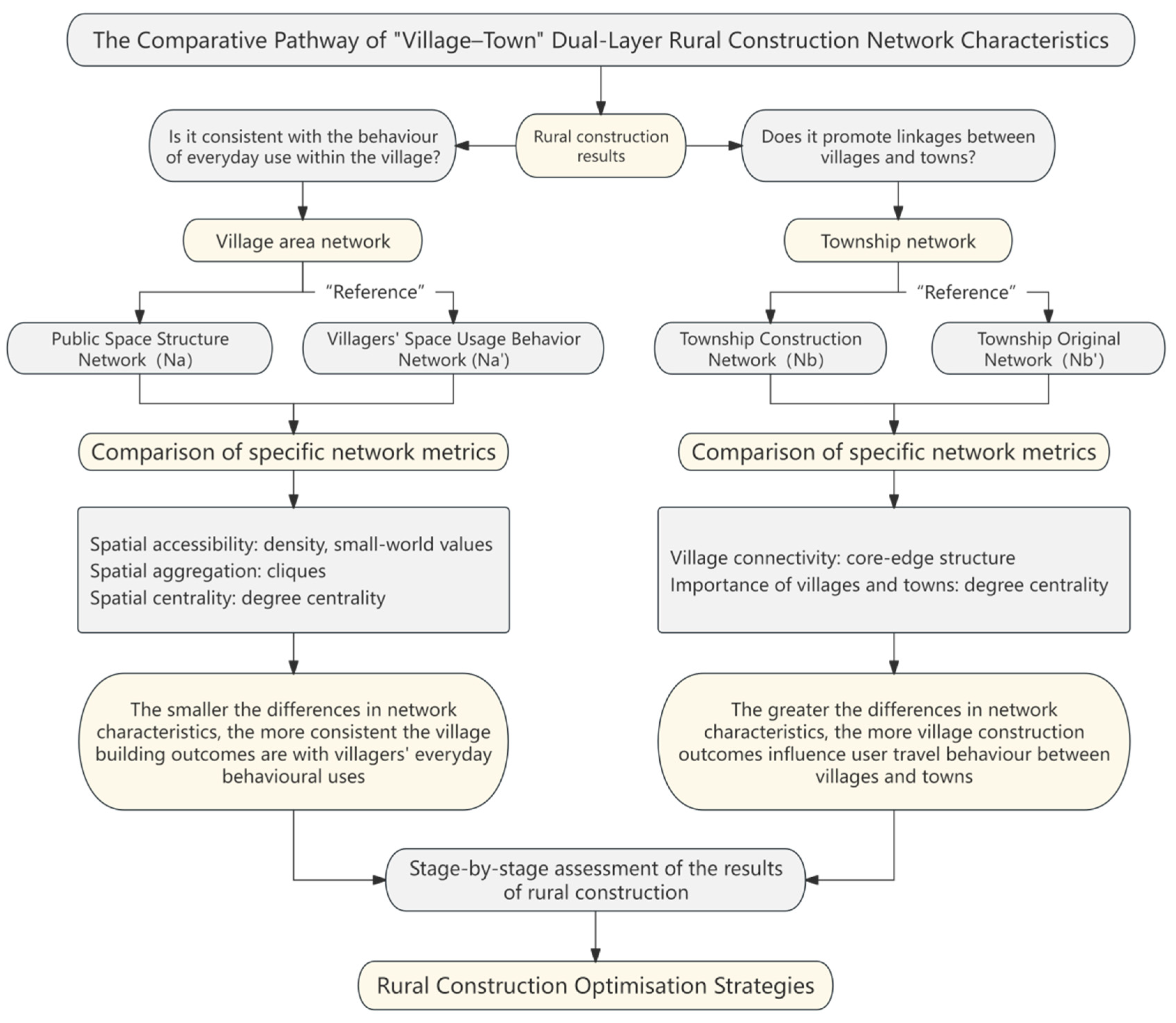
From Space–Behavior Mismatch to Regional Integration: A Cross-Scale Social Network Analysis of Sustainable Rural Construction in Suburban China

Abstract
1. Introduction
2. Literature Review
2.1. Application of Social Network Analysis at the “Village-Level” Scale in Rural Construction Evaluation
2.2. Application of Social Network Analysis at the “Township” Scale in Rural Construction Evaluation
2.3. Synthesizing the Cross-Scale Logic
3. Research Design
3.1. Research Area
3.2. Research Methods
- Step 1: Data Collection
- Step 2: Classification of Rural Public Spaces
- Step 3: Behavioral Survey of Villagers
- Step 4: GPS Trajectory Data Collection
- Step 5: Network Analysis
4. Results
4.1. Matching Analysis Between Public Space Construction and Villagers’ Behavior at the Village Scale
4.1.1. Overall Feature Comparison
4.1.2. Local Feature Comparison
4.1.3. Degree Centrality
4.2. The Reshaping of Tourist Sightseeing Behavior Networks at the Township Scale
4.2.1. Comparison of “Core-Periphery” Structural Characteristics in the Town Domain
4.2.2. Comparison of Degree Centrality in the Town Network
5. Discussion
5.1. Comparison with Existing Research
5.2. Practical Recommendations
5.2.1. Overall Reinforcement
5.2.2. Local Expansion
5.2.3. Individual Consolidation
5.3. Further Research
6. Conclusions
6.1. Village-Level: Mismatch Between Spatial Development Outcomes and Villagers’ Behavior Is the Key Constraint on the Effectiveness of Public Spaces
6.2. Town-Level: Activating a Single Node Can Trigger the Restructuring of the Regional Network
6.3. Cross-Scale Social Network Analysis Provides a “Bottom-Up” Perspective for Evaluating Urban–Rural Integration in Rural Areas
Author Contributions
Funding
Institutional Review Board Statement
Informed Consent Statement
Data Availability Statement
Acknowledgments
Conflicts of Interest
Appendix A

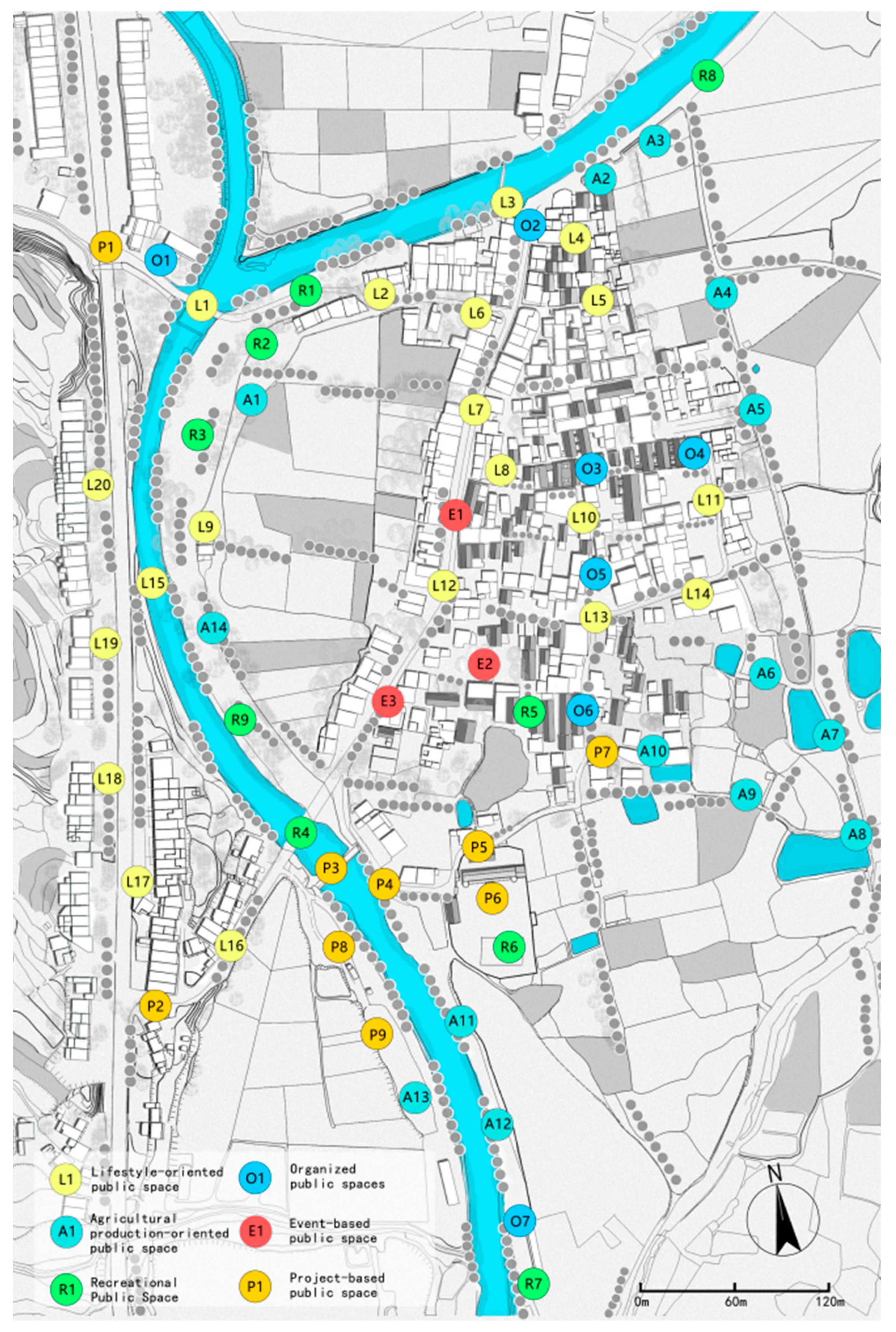
| No | Code | Public Space | Classification | No | Code | Public Space | Classification |
|---|---|---|---|---|---|---|---|
| 1 | A1 | West Village Threshing Field | Agricultural production-oriented public space: Spaces generated by Production-type public spaces: the production needs of villagers and closely related to their labor activities, such as threshing yards and ponds | 32 | L15 | “Shoulder pole” Bridge | |
| 2 | A2 | Sweet Potato Starch Processing Site | 33 | L16 | South Village Entrance Front Yard | ||
| 3 | A3 | Riverbank Threshing Field | 34 | L17 | Vacant Land on the East Side of the Highway | ||
| 4 | A4 | Intersection of Field Ridges | 35 | L18 | Vacant Land on the West Side of the Highway | ||
| 5 | A5 | Qianwan Field Embankment | 36 | L19 | New Residence Front Yard | ||
| 6 | A6 | Village East Threshing Field | 37 | L20 | Bus Stop | ||
| 7 | A7 | Qianwan Pond | 38 | O1 | Village Committee | Organized public spaces: Spaces such as village committees, ancestral halls, temples, and churches where villagers spontaneously organize activities. | |
| 8 | A8 | Old Dragon Bridge Pond | 39 | O2 | Riverbank Shrine | ||
| 9 | A9 | Eighth Group of Threshing Field | 40 | O3 | Jiuchong Ancient House | ||
| 10 | A10 | Eighth Group of Ponds | 41 | O4 | Jiuchong Ancient House Square | ||
| 11 | A11 | East River Field Ridges | 42 | O5 | Ancient Willow Tree Shrine | ||
| 12 | A12 | South Slope Field Ridge | 43 | O6 | Xuanrong Ruiying Ancient House | ||
| 13 | A13 | West River Threshing Floor | 44 | O7 | Baici Temple | ||
| 14 | A14 | Forest Underfield Ridge | 45 | P1 | North Village Gate Archway | Project-based public space: Spaces formed by rural construction projects carried out by governments or non-governmental organizations (NGOs). | |
| 15 | E1 | Wedding and Funeral Ceremony Gathering Place | Event-based public space: A temporary space formed by certain characteristic events. | 46 | P2 | South Village Gate Archway | |
| 16 | E2 | Old Primary School Site | 47 | P3 | Rolling Dam | ||
| 17 | E3 | Wedding and Funeral Ceremony Gathering Place | 48 | P4 | East River Embankment | ||
| 18 | L1 | North Village Entrance Bridge | Lifestyle-oriented public space: Spaces generated by villagers’ daily interactions and closely related to their daily lives, such as laundry docks and small shops. | 49 | P5 | Village History Museum | |
| 19 | L2 | North Alley Front Yard | 50 | P6 | Elementary School Renovation Site | ||
| 20 | L3 | Wuqiao Bridge | 51 | P7 | Renovation Square | ||
| 21 | L4 | Qiandian Vacant Land | 52 | P8 | West River Embankment | ||
| 22 | L5 | Garden Space | 53 | P9 | Parking lot | ||
| 23 | L6 | North Village Entrance Residential Area Open Space | 54 | R1 | Riverfront Square | Recreational Public Space: Spaces such as squares and activity rooms created to meet the recreational and entertainment needs of villagers, where they engage in leisure and recreational activities. | |
| 24 | L7 | Alleyway Entrance Front Yard | 55 | R2 | Basketball Court | ||
| 25 | L8 | Ancient Well | 56 | R3 | Glade | ||
| 26 | L9 | Courtyard in the Woods | 57 | R4 | Old Bridge Entrance | ||
| 27 | L10 | Former Site of the Hospital | 58 | R5 | Mahjong Room | ||
| 28 | L11 | Sixth Group of Vacant Land | 59 | R6 | Renovation of Basketball Court | ||
| 29 | L12 | Small Store | 60 | R7 | Senior Citizens’ Activity Center | ||
| 30 | L13 | Old Willow Tree Convenience Store | 61 | R8 | Qianwan Pedestrian Path Intersection | ||
| 31 | L14 | Ancient Willow Tree House Front Open Space | 62 | R9 | Intersection of Forest Walking Trails |
References
- Liu, Y.; Li, Y. Revitalize the world’s countryside. Nature 2017, 548, 275–277. [Google Scholar] [CrossRef] [Scilit]
- Han, J. Prioritizing agricultural, rural development and implementing the rural revitalization strategy. CAER 2019, 12, 14–19. [Google Scholar] [CrossRef] [Scilit]
- Li, Y.; Westlund, H.; Liu, Y. Why some rural areas decline while some others not: An overview of rural evolution in the world. J. Rural Stud. 2019, 68, 135–143. [Google Scholar] [CrossRef] [Scilit]
- United Nations Department of Economic and Social Affairs. The Sustainable Development Goals Report 2025; Sustainable Development Goals: New York, NY, USA, 2025. [Google Scholar]
- Ma, L.; Li, J.; Wang, X.; Zhang, W.; Tao, T.; Zhong, Y. Evolution and simulation optimization of rural settlements in urban-rural integration areas from a multi-gradient perspective: A case study of the lan-bai urban agglomeration in China. Habitat Int. 2024, 153, 103203. [Google Scholar] [CrossRef] [Scilit]
- Liu, Y. Rural transformation development and new countryside construction in eastern coastal area of China. Acta Geogr. Sin. 2007, 62, 563–570. [Google Scholar]
- Huang, H.; Song, D.; Wang, L.; Yang, G.; Wang, Y.; Fei, L.; Lynam, A. Enhancing urban–rural integration in China: A comparative case study of introducing small rural industries in huangyan-taizhou. Land 2024, 13, 946. [Google Scholar] [CrossRef] [Scilit]
- Xin, S.; Gallent, N. Conceptualising ‘neo-exogenous development’: The active party-state and activated communities in Chinese rural governance and development. J. Rural Stud. 2024, 109, 103306. [Google Scholar] [CrossRef] [Scilit]
- Li, Y.R.; Bu, Z.L.; Cao, Z.; Liu, J.H.; Liu, Y.S. Village classification system for rural vitalization strategy: Method and empirical study. J. Nat. Resour. 2020, 35, 243–256. [Google Scholar] [CrossRef] [Scilit]
- CPC Central Committee and the State Council of the PRC. Opinions on Establishing and Improving the Mechanisms and Policy System for Integrated Urban-Rural Development. Available online: https://www.gov.cn/gongbao/content/2019/content_5392288.htm (accessed on 15 April 2019).
- CPC Central Committee and the State Council of the PRC. Rural Revitalization Strategic Plan (2018–2022). Available online: https://www.gov.cn/zhengce/2018-09/26/content_5325534.htm (accessed on 26 September 2018).
- Sheng, Y.C.; Li, Q.; Xu, S. The evolution and dynamic mechanism of industry choicesamong city-suburb integrated villages. J. Chin. Ecotourism 2021, 03, 427–440. [Google Scholar]
- Song, L.M.; Xu, F.; Sun, L.; Meng, A. Research on the spatial form changes and space construction strategies of typical urban and suburban integrated rural communities in hunan. Mod. Urban Res. 2023, 2, 91–100. [Google Scholar]
- Zhou, G.H.; Tan, H.Y.; Yin, Z.X. Theoretical framework and important issues of rural attraction: Anintegrated geographical perspective. Acta Geogr. Sin. 2024, 79, 2460–2476. [Google Scholar]
- Long, H.; Tu, S.; Ge, D.; Li, T.; Liu, Y. The allocation and management of critical resources in rural China under restructuring: Problems and prospects. J. Rural Stud. 2016, 47, 392–412. [Google Scholar] [CrossRef] [Scilit]
- Zhang, S.; Sun, K.; Zhao, H.; Yao, H.; Shen, L. Research on the construction and practice of an urban–rural integration planning model from the perspective of element flow: A case study of xiuzhou district, jiaxing city. Land 2025, 14, 1067. [Google Scholar] [CrossRef] [Scilit]
- Ceng, X.J.; Lin, W.W.; Wang, S.F.; Peng, C.; Wu, L.Y. Compilation concept and practice of suburban integration village planning. Planners 2024, 40, 114–122. [Google Scholar]
- Chen, C.; Ao, Y.; Wang, Y.; Li, J. Performance appraisal method for rural infrastructure construction based on public satisfaction. PLoS ONE 2018, 13, e204563. [Google Scholar] [CrossRef] [Scilit]
- Wan, L.; Ng, E. Evaluation of the social dimension of sustainability in the built environment in poor rural areas of China. Archit. Sci. Rev. 2018, 61, 319–326. [Google Scholar] [CrossRef] [Scilit]
- Banick, R.; Heyns, A.M.; Regmi, S. Evaluation of rural roads construction alternatives according to seasonal service accessibility improvement using a novel multi-modal cost-time model: A study in Nepal’s remote and mountainous Karnali province. J. Transp. Geogr. 2021, 93, 103057. [Google Scholar] [CrossRef] [Scilit]
- McManus, P.; Walmsley, J.; Argent, N.; Baum, S.; Bourke, L.; Martin, J.; Pritchard, B.; Sorensen, T. Rural community and rural resilience: What is important to farmers in keeping their country towns alive? J. Rural Stud. 2012, 28, 20–29. [Google Scholar] [CrossRef] [Scilit]
- Lin, G.; Yu, X.; Li, Y. Social network dynamics in rural public spaces of multi-ethnic settlements: A case study from tongren, China. Alex. Eng. J. 2024, 102, 132–148. [Google Scholar] [CrossRef] [Scilit]
- Liu, J.; Zheng, B.; Tang, H. The science of rural human settlements: A comprehensive overview. Front. Environ. Sci. 2023, 11, 1274281. [Google Scholar] [CrossRef] [Scilit]
- Brass, D.J. New developments in social network analysis. Annu. Rev. Organ. Psychol. Organ. Behav. 2022, 9, 225–246. [Google Scholar] [CrossRef] [Scilit]
- Liu, S.; Chevallier, J.; Xiao, Q. Identifying influential countries in air pollution control technologies: A social network analysis approach. J. Clean. Prod. 2023, 389, 136018. [Google Scholar] [CrossRef] [Scilit]
- Sha, S.; Cheng, Q.; Lu, M. Building a “reservoir of social resilience:” A strategy for social infrastructure regeneration in shrinking cities based on social network analysis. Habitat Int. 2024, 143, 102991. [Google Scholar] [CrossRef] [Scilit]
- Zhang, J.; Li, S. Decoding rural connections: A comparative insight into social network analysis in rural communities of China and beyond. Chin. J. Popul. Resour. Environ. 2024, 22, 501–514. [Google Scholar] [CrossRef] [Scilit]
- Wang, M.; Han, P.; Li, X.; Bao, X.; Huang, J. Continuation and evolution of collective memory manifested in rural public space: Revealed by semi-structured interviews and emotional maps in three migrant villages in chaihu town. Habitat Int. 2024, 154, 103213. [Google Scholar] [CrossRef] [Scilit]
- Zhang, C.; Liu, Z.Y. The public dilemma of rural public space and lts reconstruction. J. Huazhong Agric. Univ. (Soc. Sci. Ed.) 2019, 2, 1–7. [Google Scholar]
- Xu, X.P. Opening up and embedding rural public space by cooperatives: Evidence from 876 member questionnaires in Zhengzhou, Henan province. Jiangsu Agric. Sci. 2017, 45, 288–291. [Google Scholar]
- Feng, J.; Zhao, N. Restructuring the rural public space in the context of rural hollowing: A case study of sangzhuang town in dengzhou. Hum. Geogr. 2016, 31, 19–28. [Google Scholar]
- Yang, C.; Xin, L.; Tian, F. Evaluation of community renewal based on social network theory: Taking gucun in baoshan district, shanghai as an example. City Plan. Rev. 2021, 45, 109–116. [Google Scholar]
- Ding, J.H.; Zhang, Y. An analysis of the spatial structure of traditional villages in southern jiangsu based on sna:a case study of dong ancient village in suzhou. Mod. Urban Res. 2022, 12, 1–8. [Google Scholar]
- Wei, P. Public space accurate optimization research of villages around cities based on sna----take the che village as an example in bailuyuan area. Chin. Landsc. Archit. 2024, 6, 91–96. [Google Scholar]
- Li, Q.; Lv, S.; Cui, J.; Liu, Y.; Chen, Z. Research on the public environment renewal of traditional villages based on the social network analysis method. Sustainability 2024, 16, 1006. [Google Scholar] [CrossRef] [Scilit]
- Zhang, M.M.; Xiao, C.; Tang, C.J. Research of shared space characteristics of southern hunan traditional clan-type villages based on social network analysis. Mod. Urban Res. 2024, 4, 78–85. [Google Scholar]
- Chen, Y.K.; Meng, S.Y.; Xiong, Y.M.; Zhang, C.Y.; Zhang, Y.L. Optimizing public space structure of traditional villages coupling sna and spatial syutax. Trans. Chin. Soc. Agric. Eng. 2024, 40, 304–314. [Google Scholar]
- He, Q.; Zhang, G.; Zhou, J.; Zhao, X.; Dong, R.; Hou, Q. Study on spatial adaptability of tangjia village in the weibei loess plateau gully region based on diverse social relationships. Land 2025, 14, 1290. [Google Scholar] [CrossRef] [Scilit]
- Liu, Y.S. Research on the urban-rural integration and rural revitalization in the new era in China. Acta Geogr. Sin. 2018, 4, 637–650. [Google Scholar]
- Zhou, Y.; Wei, B.Y.; Xie, L.F. Suggestions on the optimization of spatial coordinated planningunder the historical evolution of urban-rural relationship in China. J. Hum. Settl. West China 2019, 34, 25–31. [Google Scholar]
- Zhou, G.H.; Wu, G.H.; Liu, B.; Tang, C.L.; Dai, L.Y.; Chen, Z. Rural planning innovation under the background of urban-ruralintegration development. Econ. Geogr. 2021, 41, 183–191. [Google Scholar]
- Tian, L.; Cheng, Y. Town-village spatial restructuring in developed regions of China from the perspective of resident travel: A case of lin’an district, hangzhou. Hum. Soc. Sci. Commun. 2025, 12, 830. [Google Scholar] [CrossRef] [Scilit]
- Yue, Q.; He, J.; Liu, D. Identifying restructuring types of rural settlement using social network analysis: A case study of Ezhou city in Hubei province of China. Chin. Geogr. Sci. 2021, 31, 1011–1028. [Google Scholar] [CrossRef] [Scilit]
- Cui, J.; Luo, J.; Kong, X.; Sun, J.; Gu, J. Characterising the hierarchical structure of urban-rural system at county level using a method based on interconnection analysis. J. Rural Stud. 2022, 93, 263–272. [Google Scholar] [CrossRef] [Scilit]
- Cai, Y.H.; Wei, Q.Y.; Dai, Q.Q.; Huang, Z.; Li, L.N. Optimizing the spatial pattern of villages and towns based on social network analysis: Taking Shimen county, Hunan province as a case study. Chin. J. Agric. Resour. Reg. Plan. 2024, 45, 251–264. [Google Scholar]
- Liu, Q.; Hao, W.; Xia, M. Spatial association of coastal towns and villages in funing district, qinhuangdao: A study using social network analysis. J. Rural Stud. 2024, 107, 103261. [Google Scholar] [CrossRef] [Scilit]
- Wang, K.Y.; Chen, T. Geographical prospects of spatial governance through a review onadministrative divisions. Acta Geogr. Sin. 2018, 73, 688–700. [Google Scholar]
- Lenao, M.; Saarinen, J. Integrated rural tourism as a tool for community tourism development: Exploring culture and heritage projects in the north-east district of botswana. S. Afr. Geogr. J. 2015, 97, 203–216. [Google Scholar] [CrossRef] [Scilit]
- Bi, G.; Yang, Q. The spatial production of rural settlements as rural homestays in the context of rural revitalization: Evidence from a rural tourism experiment in a Chinese village. Land Use Policy 2023, 128, 106600. [Google Scholar] [CrossRef] [Scilit]
- Fan, J.; Liu, W.Y. Evaluation of China’s integrated urban-rural development and diagnosis of obstacle factors. Stat. Decis. 2025, 9, 111–116. [Google Scholar]
- Li, X.Y.; Sun, L. A case study the impact of public spaces on farmers’ social capital-of Huangxi village, Jiangxi province. J. China Aqricultural Univ. (Soc. Sci. Ed.) 2007, 82–97. [Google Scholar] [CrossRef]
- Haoying, H.; Xiaodong, Z.; Junying, L. Model construction and practical exploration of decentralized rural spatial planning pattern. Planners 2019, 35, 32–37. [Google Scholar]
- Jingyu, L.; Miaoxi, Z.; Ping, S. Clustering of rural hiking tourism communities in city outskirts based on gps data. Tour. Trib. 2019, 34, 129–140. [Google Scholar]
- Lu, F.; Wang, S. Route selection method for rural scenic byway based on integration of landscape resources and image semantics: A case study based on the water network in southern Jiangsu province. South Archit. 2024, 3, 58–67. [Google Scholar]
- Borgatti, S. The network paradigm in organizational research: A review and typology. J. Manag. 2003, 29, 991–1013. [Google Scholar] [PubMed]
- Ding, J.H.; Zhou, L. Research on micro-renewal of tourism rural public spacebased on social network model: Taking the mingyuewan village in suzhou as an example. Mod. Urban Res. 2021, 12, 48–55. [Google Scholar]
- Lixin, S.; Yilin, W.; Zhijian, L.; Shan, L. Review on public space research from the perspective of social networks. Urban. Archit. 2023, 20, 22–25. [Google Scholar]
- Watts, D.J.; Strogatz, S.H. Collectivedynamics of ‘small-world’ networks. Nature 1998, 393, 440–442. [Google Scholar] [CrossRef] [Scilit]
- Yu, C.; Lian, T.; Geng, H.; Li, S. Analyzing the structure of tourism destination network based on digital footprints: Taking guilin, China as a case. Data Technol. Appl. 2023, 57, 56–83. [Google Scholar] [CrossRef] [Scilit]
- Brass, D.J. Being in the right place: A structural analysis of individual influence in an organization. Adm. Sci. Q. 1984, 29, 518–539. [Google Scholar] [CrossRef] [Scilit]
- Polanco, A.; Newman, M.E.J. Hierarchical core-periphery structure in networks. Phys. Rev. E 2023, 108, 024311. [Google Scholar] [CrossRef] [Scilit]
- Borgatti, S.P.; Everett, M.G. Models of core/periphery structures. Soc. Networks 2000, 21, 375–395. [Google Scholar] [CrossRef] [Scilit]
- Sietchiping, R.; Kago, J.; Zhang, X.Q.; Augustinus, C.; Tuts, R. Role of urban-rural linkages in promoting sustainable urbanization. Environ. Urban. ASIA 2014, 2, 219–234. [Google Scholar] [CrossRef] [Scilit]
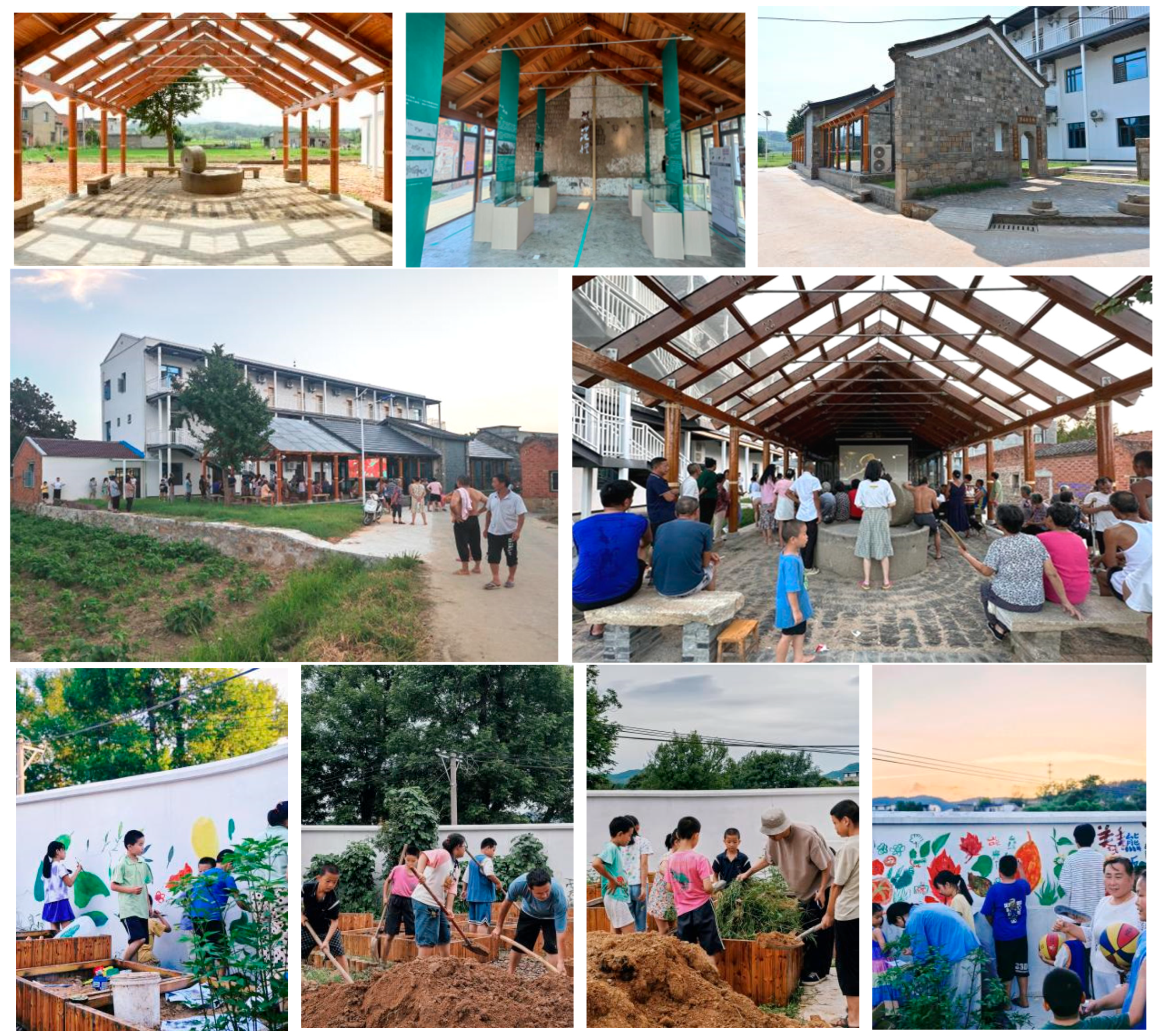

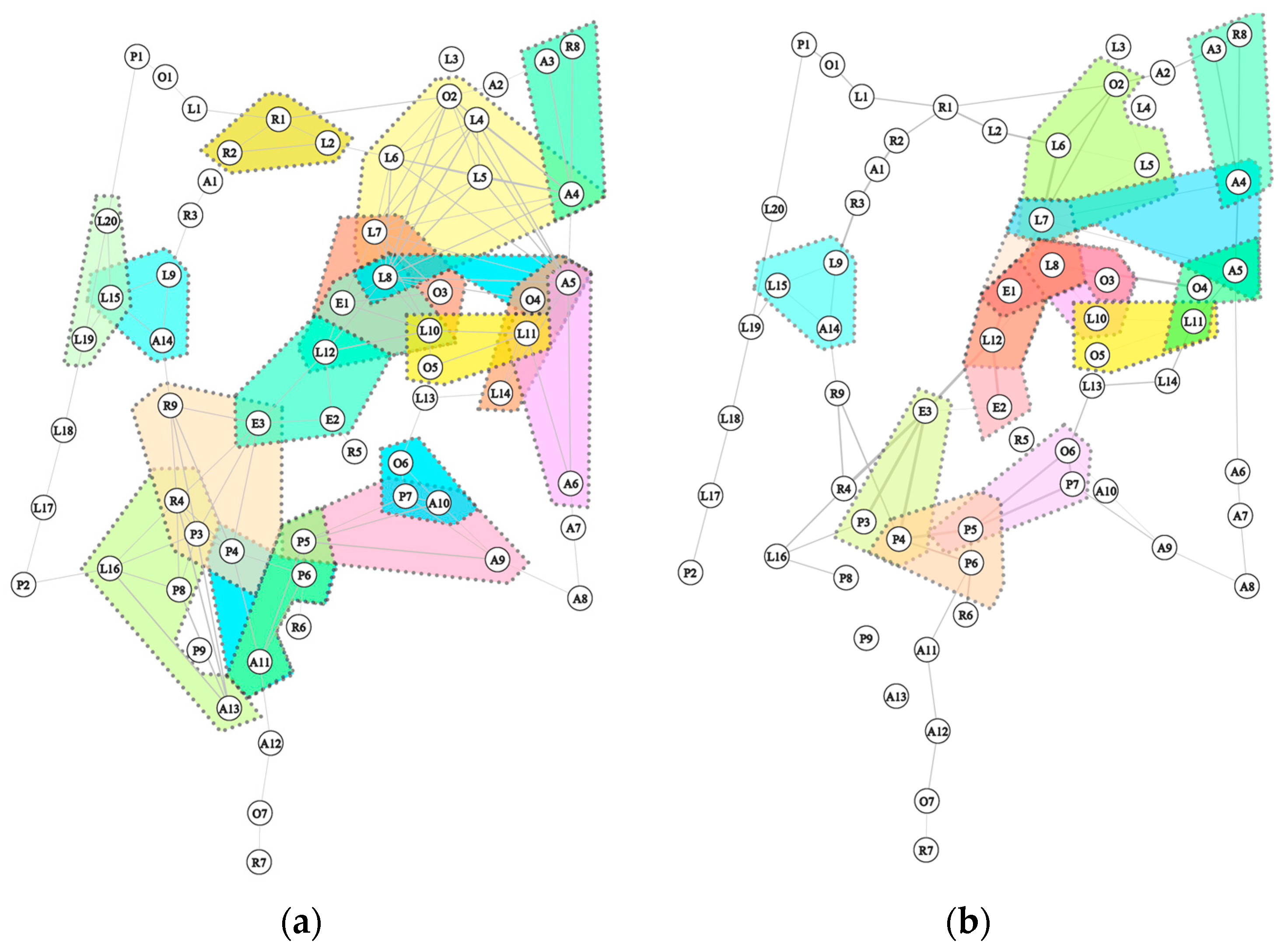
| Network Type | Number of Nodes | Number of Edges | Network Density | Clustering Coefficient | Average Path Length |
|---|---|---|---|---|---|
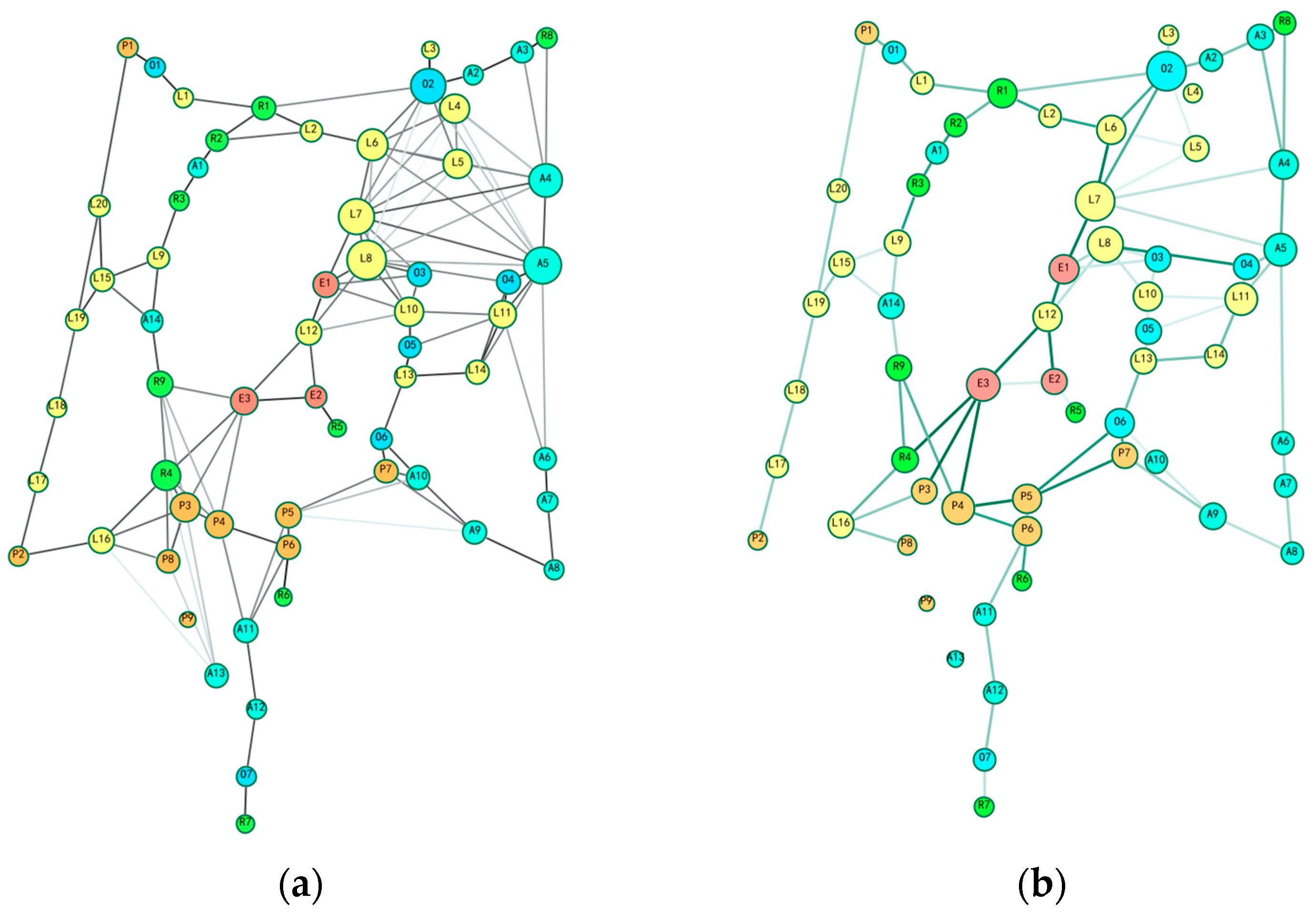
| “Public Space Structure Network” (Na) | 62 | 254 | 0.067 | 0.543 | 4.445 |
| “Villagers’ Space Usage Behavior Network” (Na′) | 62 | 169 | 0.045 | 0.227 | 5.65 |
| “Public Space Structure Network” (Na) | “Villagers’ Space Usage Behavior Network” (Na′) | ||
|---|---|---|---|
| Cliques | Cluster Nodes | Cliques | Cluster Nodes |
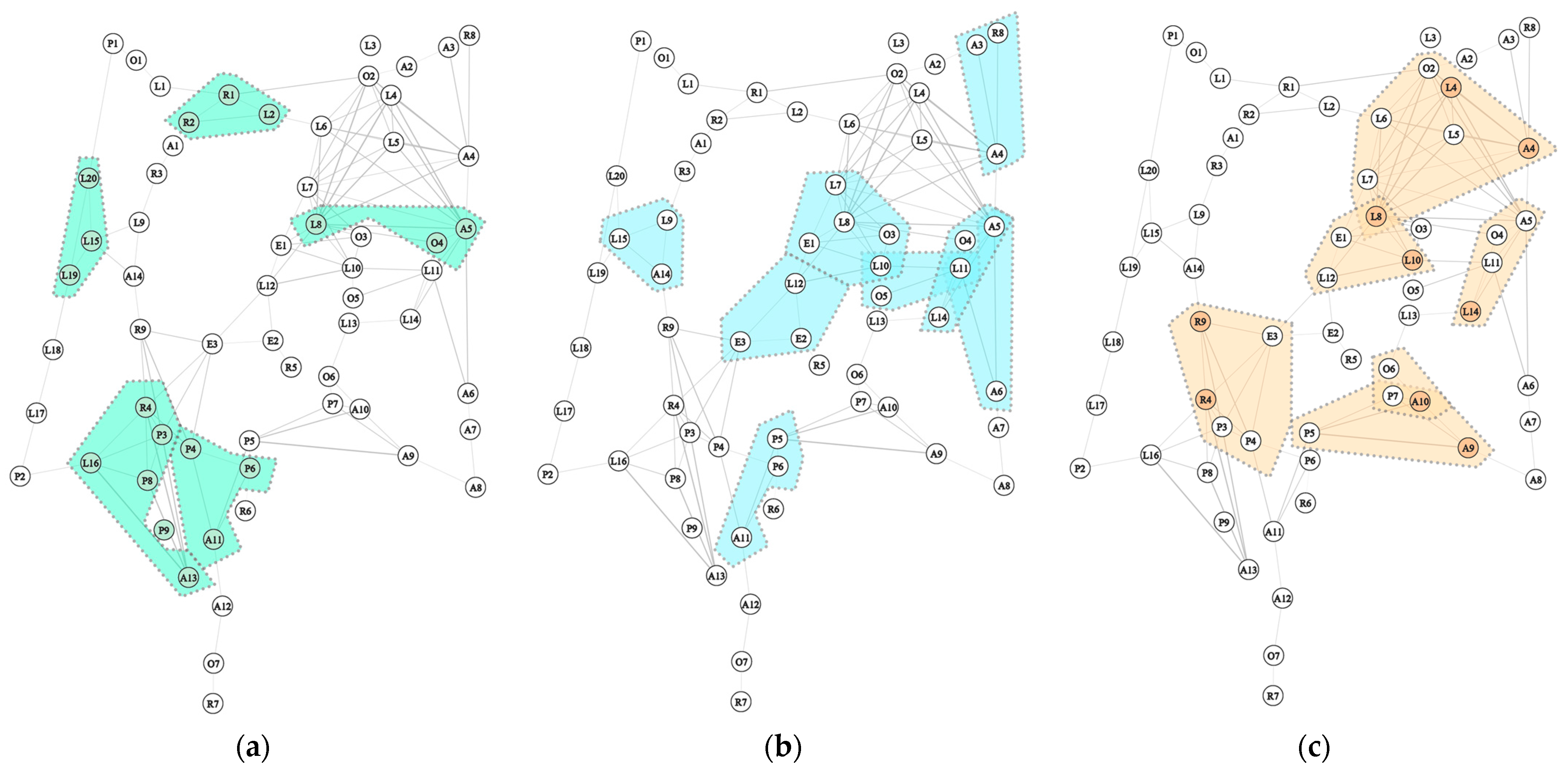
| 1 | L4 L5 L6 L7 L8 A4 A5 O2 | 1 | L5 L6 L7 O2 |
| 2 | L7 L8 L10 O3 E1 | 2 | L7 L8 E1 |
| 3 | L8 L10 L12 E1 | 3 | L7 A4 A5 |
| 4 | L8 A5 O4 | 4 | L9 L15 A14 |
| 5 | L2 R1 R2 | 5 | L8 L10 O3 |
| 6 | L9 L15 A14 | 6 | L10 L11 O5 |
| 7 | L11 L14 A5 O4 | 7 | L11 A5 O4 |
| 8 | L11 A5 A6 | 8 | L8 L12 E1 |
| 9 | L10 L11 O5 | 9 | L12 E2 E3 |
| 10 | L15 L19 L20 | 10 | A3 A4 R8 |
| 11 | L16 A13 R4 P3 P8 | 11 | L8 O3 E1 |
| 12 | A3 A4 R8 | 12 | O6 P5 P7 |
| 13 | A9 A10 P5 P7 | 13 | E3 P3 P4 |
| 14 | A10 O6 P7 | 14 | P4 P5 P6 |
| 15 | A11 P4 P6 | ||
| 16 | A11 P5 P6 | ||
| 17 | R4 R9 E3 P3 P4 | ||
| 18 | L12 E2 E3 | ||
| Na | Na′ | Na | Na′ | ||||||
|---|---|---|---|---|---|---|---|---|---|
| ID Public Space Points | Degree Centrality | Sort | Degree Centrality | Sort | ID Public Space Points | Degree Centrality | Sort | Degree Centrality | Sort |
| A1 West Village Threshing Field | 0.00 | 57 | 0.02 | 21 | L15 “Shoulder pole” Bridge | 0.02 | 31 | 0.01 | 46 |
| A2 Sweet Potato Starch Processing Site | 0.00 | 55 | 0.01 | 35 | L16 South Village Entrance Front Yard | 0.04 | 17 | 0.02 | 25 |
| A3 Riverbank Threshing Field | 0.01 | 36 | 0.02 | 23 | L17 Vacant Land on the East Side of the Highway | 0.01 | 46 | 0.01 | 41 |
| A4 Intersection of Field Ridges | 0.09 | 3 | 0.02 | 17 | L18 Vacant Land on the West Side of the Highway | 0.01 | 42 | 0.01 | 42 |
| A5 Qianwan Field Embankment | 0.10 | 2 | 0.03 | 14 | L19 New Residence Front Yard | 0.01 | 35 | 0.02 | 31 |
| A6 Village East Threshing Field | 0.02 | 27 | 0.01 | 47 | L20 Bus Stop | 0.01 | 38 | 0.01 | 44 |
| A7 Qianwan Pond | 0.01 | 52 | 0.01 | 48 | O1 Village Committee | 0.00 | 56 | 0.01 | 34 |
| A8 Old Dragon Bridge Pond | 0.01 | 49 | 0.01 | 49 | O2 Riverbank Shrine | 0.08 | 4 | 0.03 | 7 |
| A9 Eighth Group of Threshing Field | 0.03 | 20 | 0.01 | 43 | O3 Jiuchong Ancient House | 0.03 | 23 | 0.01 | 51 |
| A10 Eighth Group of Ponds | 0.03 | 25 | 0.00 | 56 | O4 Jiuchong Ancient House Square | 0.02 | 30 | 0.02 | 19 |
| A11 East River Field Ridges | 0.03 | 22 | 0.01 | 37 | O5 Ancient Willow Tree Shrine | 0.01 | 37 | 0.01 | 53 |
| A12 South Slope Field Ridge | 0.01 | 47 | 0.01 | 38 | O6 Xuanrong Ruiying Ancient House | 0.01 | 41 | 0.03 | 10 |
| A13 West River Threshing Floor | 0.06 | 9 | 0.00 | 61 | O7 Baici Temple | 0.01 | 51 | 0.01 | 39 |
| A14 Forest Underfield Ridge | 0.01 | 33 | 0.02 | 26 | P1 North Village Gate Archway | 0.01 | 53 | 0.01 | 40 |
| E1 Wedding and Funeral Ceremony Gathering Place | 0.03 | 24 | 0.03 | 8 | P2 South Village Gate Archway | 0.01 | 48 | 0.01 | 55 |
| E2 Old Primary School Site | 0.01 | 43 | 0.02 | 28 | P3 Rolling Dam | 0.05 | 10 | 0.02 | 18 |
| E3 Wedding and Funeral Ceremony Gathering Place | 0.04 | 16 | 0.07 | 1 | P4 East River Embankment | 0.05 | 14 | 0.05 | 2 |
| L1 North Village Entrance Bridge | 0.01 | 50 | 0.01 | 32 | P5 Village History Museum | 0.05 | 13 | 0.04 | 5 |
| L2 North Alley Front Yard | 0.01 | 34 | 0.02 | 24 | P6 Elementary School Renovation Site | 0.02 | 32 | 0.03 | 12 |
| L3 Wuqiao Bridge | 0.00 | 61 | 0.00 | 57 | P7 Renovation Square | 0.02 | 26 | 0.03 | 13 |
| L4 Qiandian Vacant Land | 0.08 | 5 | 0.00 | 60 | P8 West River Embankment | 0.03 | 19 | 0.01 | 54 |
| L5 Garden Space | 0.07 | 7 | 0.00 | 58 | P9 Parking lot | 0.00 | 62 | 0.00 | 62 |
| L6 North Village Entrance Residential Area Open Space | 0.06 | 8 | 0.03 | 6 | R1 Riverfront Square | 0.02 | 28 | 0.03 | 11 |
| L7 Alleyway Entrance Front Yard | 0.07 | 6 | 0.05 | 4 | R2 Basketball Court | 0.01 | 40 | 0.02 | 29 |
| L8 Ancient Well | 0.12 | 1 | 0.02 | 16 | R3 Glade | 0.01 | 54 | 0.02 | 22 |
| L9 Courtyard in the Woods | 0.01 | 39 | 0.02 | 20 | R4 Old Bridge Entrance | 0.05 | 11 | 0.03 | 9 |
| L10 Former Site of the Hospital | 0.05 | 12 | 0.01 | 50 | R5 Mahjong Room | 0.00 | 59 | 0.00 | 59 |
| L11 Sixth Group of Vacant Land | 0.04 | 18 | 0.02 | 27 | R6 Renovation of Basketball Court | 0.00 | 60 | 0.01 | 45 |
| L12 Small store | 0.03 | 21 | 0.05 | 3 | R7 Senior Citizens’ Activity Center | 0.00 | 58 | 0.01 | 52 |
| L13 Old Willow Tree Convenience Store | 0.01 | 45 | 0.02 | 30 | R8 Qianwan Pedestrian Path Intersection | 0.01 | 44 | 0.01 | 36 |
| L14 Ancient Willow Tree House Front Open Space | 0.02 | 29 | 0.01 | 33 | R9 Intersection of Forest Walking Trails | 0.04 | 15 | 0.03 | 15 |
| “Township Original Network” (Nb′) | “Township Construction Network” (Nb) | |
|---|---|---|
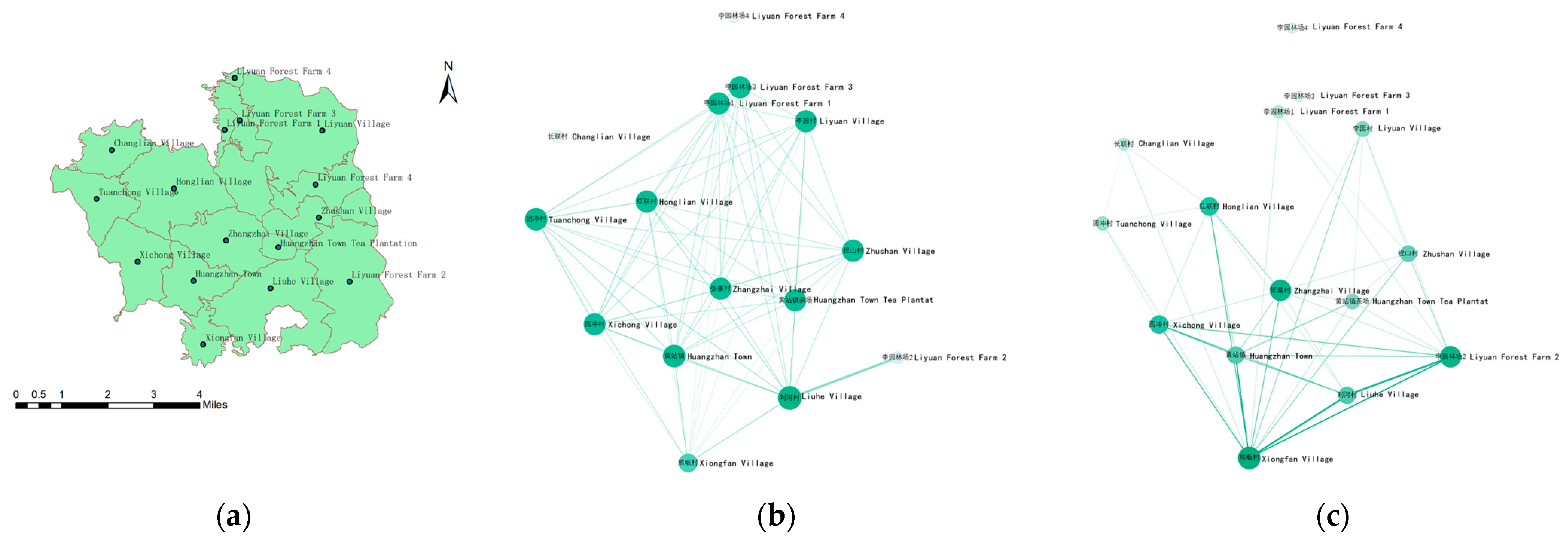
| Core Area Nodes | Liuhe Village, Liyuan Forest Farm 2 | Liuhe Village, Xiongfan Village, Huangzhan Town |
| Peripheral Area Nodes | Tuanchong Village, Zhangzhai Village, Liyuan Village, Liyuan Forest Farm 1, Liyuan Forest Farm 3, Xiongfan Village, Zhusan Village, Honglian Village, Xichong Village, Huangzhan Town, Huangzhan Town Tea Farm | Tuanchong Village, Zhangzhai Village, Liyuan Village, Liyuan Forest Farm 1, Liyuan Forest Farm 2, Zhushang Village, Honglian Village, Xichong Village, Changlian Village, Huangzhan Town Tea Farm |
| Nb′ | Nb | |||
|---|---|---|---|---|
| No | ID | Degree | ID | Degree |
| 1 | Liuhe Village | 49 | Xiongfan Village | 59 |
| 2 | Liyuan Forest Farm 2 | 30 | Liuhe Village | 43 |
| 3 | Xiongfan Village | 20 | Liyuan Forest Farm 2 | 38 |
| 4 | Huangzhan Town | 19 | Huangzhan Town | 35 |
| 5 | Tuanchong Village | 18 | Xichong Village | 19 |
| 6 | Honglian Village | 18 | Zhangzhai Village | 13 |
| 7 | Xichong Village | 18 | Huangzhan Town Tea Farm | 13 |
| 8 | Zhangzhai Village | 11 | Honglian Village | 11 |
| 9 | Liyuan Village | 11 | Zhushan Village | 10 |
| 10 | Liyuan Forest Farm 1 | 11 | Liyuan Village | 8 |
| 11 | Liyuan Forest Farm 3 | 11 | Tuanchong Village | 5 |
| 12 | Zhushan Village | 11 | Li Garden Farm 1 | 4 |
| 13 | Huangzhan Town Tea Farm | 11 | Changlian Village | 4 |
Disclaimer/Publisher’s Note: The statements, opinions and data contained in all publications are solely those of the individual author(s) and contributor(s) and not of MDPI and/or the editor(s). MDPI and/or the editor(s) disclaim responsibility for any injury to people or property resulting from any ideas, methods, instructions or products referred to in the content. |
© 2025 by the authors. Licensee MDPI, Basel, Switzerland. This article is an open access article distributed under the terms and conditions of the Creative Commons Attribution (CC BY) license (https://creativecommons.org/licenses/by/4.0/).
Share and Cite
Qian, Y.; Li, X. From Space–Behavior Mismatch to Regional Integration: A Cross-Scale Social Network Analysis of Sustainable Rural Construction in Suburban China. Sustainability 2025, 17, 9137. https://doi.org/10.3390/su17209137
Qian Y, Li X. From Space–Behavior Mismatch to Regional Integration: A Cross-Scale Social Network Analysis of Sustainable Rural Construction in Suburban China. Sustainability. 2025; 17(20):9137. https://doi.org/10.3390/su17209137
Chicago/Turabian StyleQian, Yi, and Xianfeng Li. 2025. "From Space–Behavior Mismatch to Regional Integration: A Cross-Scale Social Network Analysis of Sustainable Rural Construction in Suburban China" Sustainability 17, no. 20: 9137. https://doi.org/10.3390/su17209137
APA StyleQian, Y., & Li, X. (2025). From Space–Behavior Mismatch to Regional Integration: A Cross-Scale Social Network Analysis of Sustainable Rural Construction in Suburban China. Sustainability, 17(20), 9137. https://doi.org/10.3390/su17209137