Article

Assessment and Mapping of Water-Related Regulating Ecosystem Services in Armenia as a Component of National Ecosystem Accounting


1
Biodiversity Conservation Center, BCC-Armenia, Jrvezh 2224, Armenia
2
NextGIS OÜ, 11213 Tallinn, Estonia
3
Institute of Geological Sciences, National Academy of Sciences of the Republic of Armenia, Yerevan 0019, Armenia
4
Scientific Center of Zoology and Hydroecology, National Academy of Sciences of the Republic of Armenia, Yerevan 0014, Armenia
*
Author to whom correspondence should be addressed.
Sustainability 2025, 17(17), 8044; https://doi.org/10.3390/su17178044
Submission received: 1 July 2025 / Revised: 31 August 2025 / Accepted: 3 September 2025 / Published: 6 September 2025
(This article belongs to the Section Sustainable Water Management)

Abstract

To promote sustainable development and guide the responsible use of natural ecosystems, the United Nations introduced the concept of ecosystem accounting. Ecosystem services are key components of ecosystem accounting. Water-related ecosystem services (ES) are of primary importance for Armenia due to relatively dry climate, and dependence on irrigation water for agriculture. This study aims to conduct a pilot-level quantitative scoping assessment and mapping of key water-related regulating ES in accordance with the SEEA-EA guidelines, and to offer recommendations to initiate their accounting in Armenia. We used three Integrated Valuation of Ecosystem Services and Trade-offs (InVEST) models—Seasonal Water Yield, Sediment Delivery Ratio, and Urban Flood Risk Mitigation. Input data for these models were sourced from global and national databases, as well as ESRI land cover datasets for 2017 and 2023. Government-reported data on river flow and water consumption were used to assess the ES supply–use balance. The results show that natural ecosystems contribute between 11% and 96% of the modeled ES, with the strongest impact on baseflow supply and erosion prevention. The average current erosion is estimated at 2.3 t/ha/year, and avoided erosion at 46.4 t/ha/year. Ecosystems provide 93% of baseflow, with an average baseflow index of 34%, while on bare ground it is only 3%. Changes in land cover from 2017 to 2023 have resulted in alterations across all assessed ES. Comparison of total water flow and baseflow with water consumption revealed water-deficient provinces. InVEST models show their general operability at the scoping phase of ecosystem accounting planning. Advancing ES accounting in Armenia requires model calibration and validation using local data, along with the integration of InVEST and hydrological and meteorological models to account for the high diversity of natural conditions in Armenia, including terrain, geological structure, soil types, and regional climatic differences.

1. Introduction

Sustainable development at various levels of governance is impossible without understanding of the conditions of ecosystems and the changes they undergo. This challenge is addressed by ecosystem accounting (EA), which has been rapidly evolving in recent years, following United Nations recommendations [1]. In particular, the INCA project has launched a pilot for an integrated system of ecosystem accounts for EU countries [2]. Ecosystem services (ES), alongside ecosystems themselves, are key components of EA.
A recent report by the World Meteorological Organization highlights growing shortfalls and increasing stress on global water resources [3]. Global climate change reinforces the importance of investigating water-regulating ES [4,5,6]. Out of the 16 regulating ES listed in the SEEA EA guidelines [1], six are related to water. Three of them—soil and sediment retention services; water flow regulation services; and flood control services—were of particular interest within this study. According to European EA data [2], the value of water-regulating ES (specifically water purification and flood control) accounted for 42% of all assessed services—despite the fact that not all water-regulating services were included.
The inclusion of estimates and maps of water-regulating ES into ecosystem accounting requires the harmonization of indicators for ecosystem extent and services in accordance with the overall SEEA EA framework. The issue of incorporating water-related ES into ecosystem accounting has been addressed in a number of studies [7,8,9,10].
Water-regulating ES are the result of numerous complex processes that integrate terrestrial ecosystems with hydrological, soil, atmospheric, and geological conditions. Inclusion of water-regulating ES in EA also requires the use of various GIS-based models. A wide variety of models for assessing water-related ES [9] can generally be divided into two main groups: traditional hydrological models and integrated ES tools. Hydrological models offer the most robust modeling options; however, they require significant time, effort, expert knowledge, and detailed input data, which may not always be available. The SWAT model is the most frequently used and widely recognized tool in this category, covering all aspects of water-related ES. In contrast, integrated ES modeling frameworks such as the popular InVEST toolkit require less data, time, and process-specific expertise [9,11,12].
Although the latest global assessment of Earth system boundaries for blue water classified the Kura-Araks as a basin having sufficient surface water to meet the basic needs of the population without depleting groundwater recharge [13], the World Resources Institute has placed Armenia among the countries with a medium to high baseline level of water stress [14]. Thus, water-related ES should be an essential component of EA in Armenia. In recent years, attention to Armenia’s ES has been increasing [15,16], including water-regulating ES [17] and soil erosion prevention [18,19,20]. However, quantitative assessment and mapping of water-regulating ES in Armenia have not been carried out so far.
Terrestrial ecosystems play a key role in regulating both the quantity and quality of freshwater on land. While attention has traditionally focused primarily on the functions of forests [21,22,23,24,25], grasslands play the primary role in water regulation in semi-arid regions [26,27,28]. Mountains also play a crucial role in regulating the water cycle, and due to that, they are often referred to as ‘water towers’ [29,30]. Thus, we refer to all three of these ecosystem types for water-related ES accounts in Armenia.
The study was carried out within the framework of the project “Ecosystem Accounting in Armenia: Setting the Scene” [31], which aimed to develop a prototype of national ecosystem accounting in Armenia in accordance with the SEEA-EA recommendations. The prototype includes a physical assessment of terrestrial ecosystems and the most important ES they provide. As a first step, we tested InVEST models, which allow for ES modeling and mapping with a limited amount of available data and relatively low effort.
This study aims to conduct a pilot-level quantitative scoping assessment and mapping of key water-related regulating ES in accordance with SEEA-EA guidelines, and to offer recommendations to launch their accounting in Armenia. The target audience for this assessment comprises experts and officials involved in preparing the launch of EA in Armenia. To do so, we applied three InVEST models—Seasonal Water Yield (SWY), Sediment Delivery Ratio (SDR), and Urban Flood Risk Mitigation (UFRM)—to model key water-related regulating ecosystem services under current and alternative land cover scenarios. We did not perform model calibration or verification, but only identified the main data requirements for the subsequent stages of developing ES accounting in Armenia. Based on the modeling results, we estimated the provided (potential) ES, their changes from 2017 to 2023, and the supply/use balance of ES. Then, at a qualitative level, we assessed the main discrepancies between the modeling results and real-world systems. Finally, we analyzed the main approaches that are most applicable to reliable ES accounting in Armenia.

2. Materials and Methods

2.1. Study Area

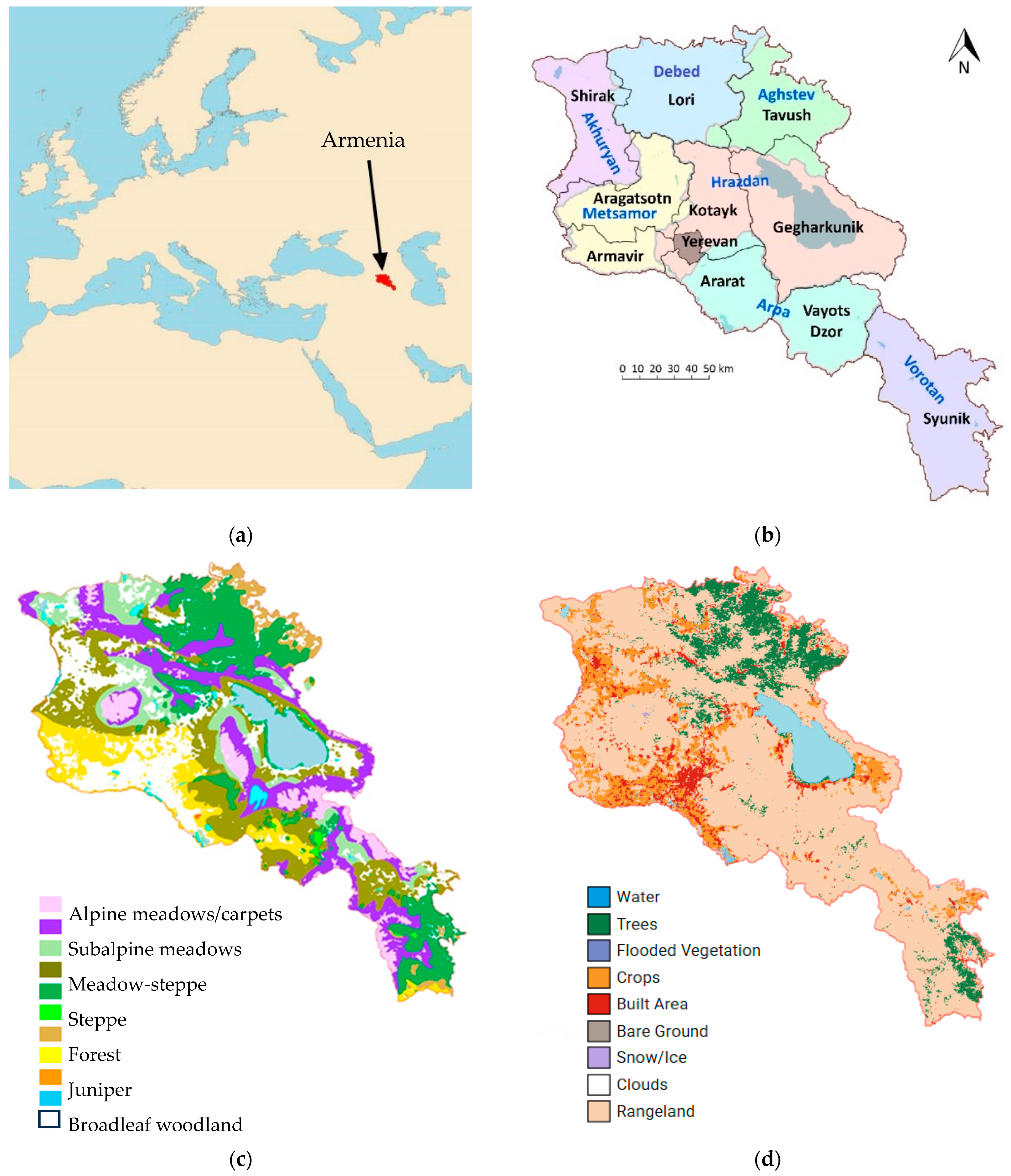
Modeling and mapping of ES covers the entire 29,743 km2 territory of the Republic of Armenia, with population of 2,932,731 people [32], which is located in the Caucasus mountain region (Figure 1a). Only 18% of the territory of Armenia are flat valleys and altitudes ranging between 375 and 4090 m.a.s.l., with an average altitude of 1800 m.a.s.l. The climate patterns follow a vertical zonation, with the range of average monthly temperatures in July and August from +9 to +26 °C and in January from +1.2 to −12.8 °C. The average annual precipitation is approximately 500 mm and varies across the territory from 230 to 1100 mm. Climate types range from arid subtropical to cold high-mountain climates [33].
Armenia consists of 10 administrative provinces—marzes (Figure 1b)—and the capital city Yerevan, which we excluded from our analysis.
Grassland prevails in land cover, while forests are concentrated mostly in the northeast and southeast of the country [34] (Figure 1c). According to ESRI land cover data, grasslands currently occupy 67% of Armenia’s area, forests account for 11%, and croplands and built-up areas—12% and 5%, respectively [35] (Figure 1d).
The semi-desert and steppe landscapes have been most heavily transformed by human activity, with croplands and built-up areas together occupying 43% of semi-desert and from 9% to 28% in different types of steppes. In the mountain forest landscape zone, croplands and built-up areas occupy 4% [36]. Higher mountainous areas are the least transformed because the upper limit of the settlement system is 2350 m a.s.l. Most of the semi-desert zone is being used for irrigated agriculture, which causes soil erosion, secondary salinization, and desertification. Steppes have been significantly replaced by croplands and are also used as pastures. The subalpine and alpine landscapes are used for haymaking and summer pastures. During the last century the forests of Armenia were significantly reduced due to excessive logging in 1930–1950 and 1990s.
Geology and climate have determined highly uneven spatial and temporal distribution of the surface water in Armenia. The northeast and southeast are receiving more precipitation, and sedimentary rocks are more widespread there; thus, drainage density is also tipping, while central regions and the western part are in the rain shadow and mostly covered by porous igneous rocks, which makes drainage density low. Overall, there are 379 rivers in Armenia of more than 10 km in length [33]. They flow into either the Kura or Araks rivers and are mostly transboundary. Peak discharge happens usually in May and can prolong until the first decade of June. All the rivers are grouped into six river basin management areas [37].
Figure 1. Study area: (a) The location of Armenia; image made with Natural Earth (https://naturalearthdata.com); (b) Provinces and main watersheds of Armenia, the boundaries and names of the provinces are shown in black (sourced from [38]; the watersheds are shown in different colors with blue labels, watershed boundaries were sourced from [39]; (c) The map of vegetation types of Armenia, created in the framework of the BCC project [34]; (d) Land cover, ESRI, 2023 [40].
Sustainability 17 08044 g001

2.2. Methods and Data Sources

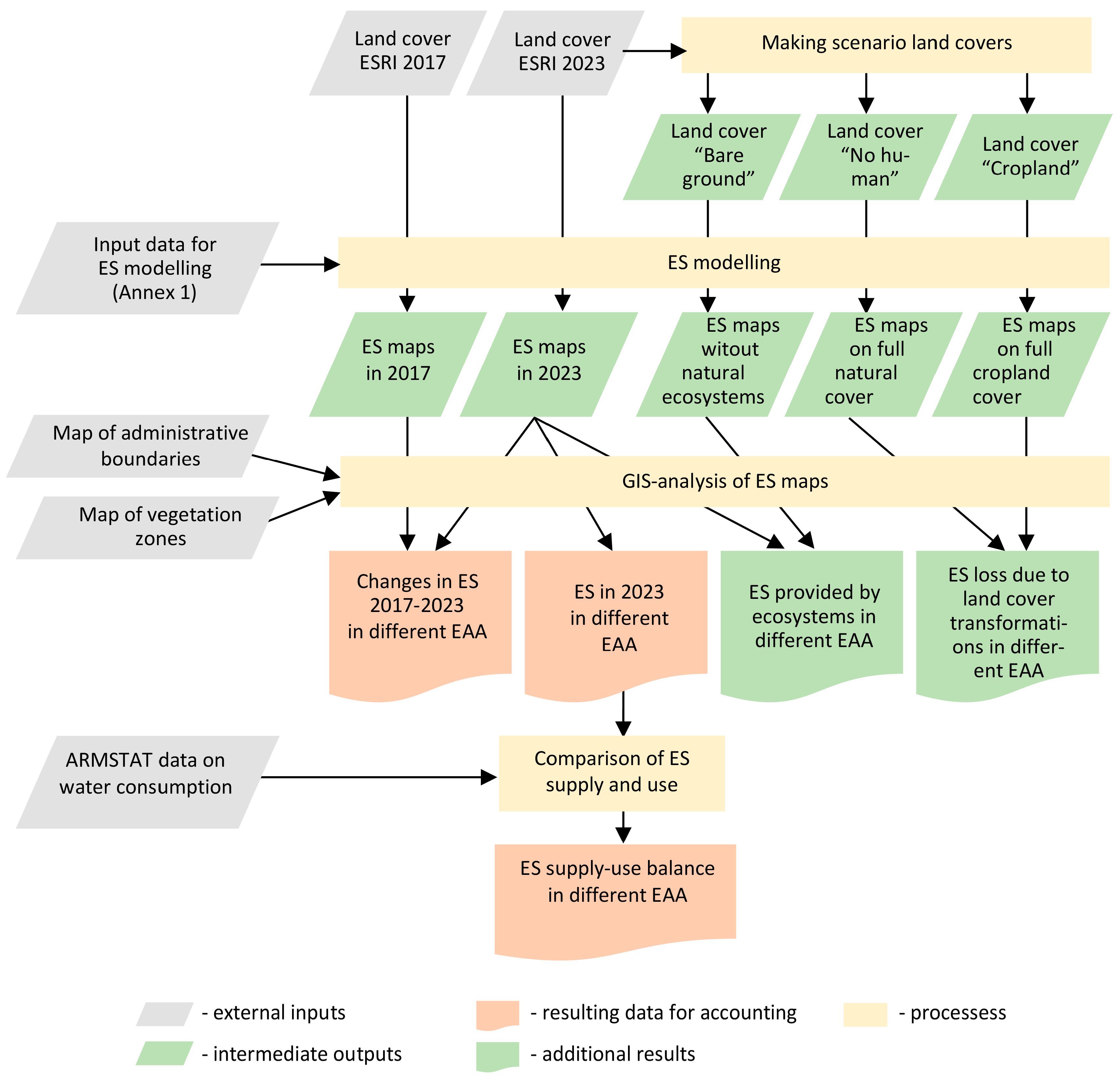
The methodological design of this study was guided by the objectives of a pilot national assessment of water-related ES, aimed at testing its operability and reliability for national-scale EA in Armenia and providing recommendations for launching ES accounting. The selection of InVEST models was guided by their relatively modest data and effort requirements, consistent with the objectives of the scoping phase and the current state of data availability in Armenia. The modeling process was structured to simulate both current (2023) and past (2017) conditions, as well as alternative land cover scenarios, in order to evaluate the models’ ability to capture ES provided by terrestrial ecosystems and to detect changes in ES within different ecosystem accounting areas (EAA)—including Armenia as a whole, its provinces, and vegetation zones (Figure 2). To calculate ES values across different EAA we used administrative boundary map from the Forest Atlas of Armenia [38], along with the vegetation zone map [34] developed within the framework of the project “Ecosystem Accounting in Armenia: Setting the Scene” [31], of which this study is a part.
A comparison of the modeling results with ARMSTAT water-use data [41] was conducted to assess the supply–use balance, thereby demonstrating the relevance of ES accounting data for evidence-based decision-making on water use and territorial development.
Since the baseflow and quick flow values computed by the SWY model are, in accordance with the InVEST User Guide [42], relative measures, the baseflow volume VB was calculated as follows: VB = BFI⋅Vtot where Vtot is the river discharge according to the data reported by the Government of Armenia [43] and ARMSTAT [41]; BFI is baseflow index, BFI = B/(B + QF), where B and QF are baseflow and quick flow values computed by SWY model.

2.2.1. Models Used to Estimate and Map ES

The Seasonal Water Yield (SWY) model estimates the impact of terrestrial ecosystems on the total amount of water flow and its seasonal redistribution. Based on monthly precipitation, reference evapotranspiration, soil permeability, topography, and the land use/land cover (LULC), the model calculates two key indicators: quick flow and baseflow. Quick flow represents the portion of precipitation that runs off during or shortly after a rain event (within hours to days). Baseflow is the portion of precipitation that gradually enters streams through subsurface flow with watershed residence times ranging from months to years. Baseflow plays a crucial role in maintaining water flow during dry periods and mitigating the impacts of drought.
The Sediment Delivery Ratio model estimates the impact of terrestrial ecosystems on soil water erosion and sediment export into streams. The model relies on the widely used Universal Soil Loss Equation (USLE) and Sediment Delivery Ratio that estimates the ratio between the amount of sediment eroded from each land pixel, the amount of sediment that is trapped along the flow path downslope from this pixel, and the amount of sediment that reaches a stream. Based on rainfall erosivity, soil erodibility, topographic, and LULC data, the model calculates potential and avoided erosion and sediment export into streams. Thus, the model evaluates and maps two ecosystem services simultaneously: prevention of soil water erosion and ensuring water flow quality.
The Urban Flood Risk Mitigation model calculates two main indicators: (1) the runoff retention, i.e., the amount of runoff retained by soil and vegetation when modeling rainfall; (2) the runoff (Q), mm, which is a potentially hazardous factor that can cause flooding. These calculations were based on LULC, soil hydrologic groups, watersheds and climate data.
Detailed descriptions of the models can be found in the above-mentioned sections of the InVEST website and in the InVEST User Guide [42]. A short summary of model processes and parameters is presented in Table A1.
Inputs for models were obtained from global and national sources (Table 1).
Crop coefficients (Kc) were defined as average values for the main groups of agricultural crops, based on FAO data [51,52]. Areas of various agricultural crops such as grains and legumes, vegetables, potatoes, melons, fruits and berries, and grapes in the provinces of Armenia in 2023 were obtained from the Statistical Committee of the Republic of Armenia [41]. To calculate Kc for croplands, we averaged the area shares of different crops for four climatic zones based on data from provinces predominantly located in one or another zone. Average Kc values were then calculated for croplands in each climatic zone, taking into account the share of the area of different agricultural crops within it. Kc values for bare soil were determined based on [60] as the average values for different soil types. For natural vegetation (rangeland and trees), in accordance with the recommendations of InVEST [42], Kc values were set as Kc = 1 if LAI > 3 and Kc = LAI/3 if LAI ≤ 3. According to InVEST and FAO [52] recommendations, Kc = 1 was used for water and flooded vegetation, Kc = 0.35—for built-up areas (assuming that impervious surfaces account for 50%), and Kc = 0.4—for permanent snow. The values of other coefficients were taken from the InVEST User Guide recommendations [42].

2.2.2. Scenarios Used for ES Modeling

To estimate the role of natural ecosystems in ES provisioning, we used three hypothetical LULC scenarios:
(1)
Bare ground scenario: all vegetation, including forests and grasslands, was replaced with bare ground.
(2)
Cropland scenario: all areas, except for urban territories and water bodies, were converted to cropland.
(3)
No-human scenario: urban areas and croplands were replaced with grasslands, simulating a landscape without human activity.
One of the tested models—SDR—directly calculates ES values provided by ecosystems, i.e., indicators of avoided erosion and avoided sediment export. The other models calculate ES indicators for a given LULC but do not determine what portion of these values is attributable to ecosystems rather than to physical processes. In the SWY and UFRM models, we estimated the volume of ES provided by ecosystems as the difference between ES values for the current land cover and the bare ground scenario. The cropland scenario was used in the SWY model to compare ES loss resulting from the replacement of natural vegetation with bare ground and croplands. The no-human scenario was used in the UFRM model to estimate possible ES loss in historical time due to anthropogenic land transformation.
We tested the flood mitigation ES model (UFRM model) for average and extreme spring rainfall scenarios. The highest precipitation in Armenia falls in May and June. While precipitation levels vary significantly across different climatic zones, for the initial model testing, we considered it reasonable to use countrywide average values. During these months, an average rainfall event delivers 12 mm of precipitation. For the extreme rainfall scenario, we assumed approximately half of the monthly precipitation in either of these months, which is 50 mm. However, it should be pointed out that within the last four years Armenia has experienced several very heavy rains, with 100% or even 150% of the monthly precipitation falling in a single event.

2.2.3. Selection of Land Cover Dataset and Land Cover Data Processing

At present, Armenia does not have a national land cover dataset, so we had to use global data for ES modeling. To select an appropriate land cover dataset, we compared the area estimates of land cover classes reported by the Government of Armenia and ARMSTAT with those from four open-access global land cover datasets (ESRI, Dynamic World, ESA WorldCover, and GLAD). Among these, the ESA, ESRI, and GLAD datasets showed the closest alignment with both the official statistics and the expected distribution of cropland and built-up areas across natural altitudinal zones [61]. The ESRI dataset was selected for use in our project to create the prototype of EA in Armenia, including ES assessment, because it provides the best opportunity to demonstrate the dynamics of ecosystem indicators between 2017 and 2023.
To ensure the correct use of data in InVEST models, preprocessing was performed using the QGIS 3.40 application [62] and custom Python 3.10.4 scripts.
Land cover data plays a critical role in all InVEST models. The source data were provided as raster files in GeoTIFF format, which we cropped based on Armenia’s national borders. Distinct versions of land cover rasters were created for different modeling scenarios using custom Python scripts—bare ground, cropland, and grassland—by modifying pixel values according to each scenario. For example, in the bare ground scenario, all pixels with values 2 (forest) and 11 (rangeland) were converted to 8 (bare land).
We then juxtaposed land cover rasters for different scenarios with the climate zones dataset using a raster calculator, which allowed a transition from basic categories such as “forest” and “cropland” to enriched classifications like “forest in an arid zone” and “cropland in a moderately humid zone”. The climate zone data were originally provided as a vector layer in GeoPackage format. It was rasterized in QGIS to ensure that the resulting raster matched the land cover raster in extent, resolution, and spatial reference system, with climate zones assigned numerical values from 1 to 4.
Then, we combined land cover and climate zone rasters in a two-step process:
  • The pixel values of the land cover raster were multiplied by 100.
  • These adjusted values were added to the corresponding pixel values of the climate zone raster, resulting in a unified dataset.
For example, a final pixel value of 204 indicates that the pixel represents land cover type 2 (e.g., trees) and climate zone 4 (e.g., moderate humid zone).

2.2.4. Incorporating Snow Dynamics in the SWY Model

Since the SWY model does not account for the snow period, we assumed zero liquid precipitation during the winter months when the average temperature is below zero, and added this amount to the precipitation of the spring months, when the average temperature rises above zero. The estimation was made without taking into account the sublimation of snow at subzero air temperatures. Digital monthly maps of liquid precipitation are presented on project web GIS [45].
To calculate monthly liquid precipitation, we used a combination of mean monthly air temperature and mean monthly precipitation data. These datasets were provided as raster coverages in GeoTIFF format and unified in terms of spatial extent and resolution.
A Python script was used to iterate through the rasters based on the following logic:
-
If the mean monthly air temperature in a pixel was below zero, precipitation in that pixel for that month was set to 0, and its value was carried over to the same pixel in the next month’s precipitation raster;
-
If the mean monthly temperature remained negative in the following month, the accumulated total was carried forward again until the temperature became positive. At that point, all accumulated snow melted, generating a cumulative water flow.

2.2.5. Data Preparation for InVEST and Statistic Calculation

For compatibility with InVEST, all raster datasets were resampled to match the spatial domain of the land cover dataset, ensuring uniform spatial extent, resolution, and coordinate reference system for accurate model execution. These tasks were carried out using standard QGIS 3.40 tools [62], including raster alignment and raster calculator. All raster files were prepared in GeoTIFF format, which is supported by both QGIS and InVEST.
Vector zones required for InVEST models were stored in GeoPackage format 1.3.1 and projected into the same coordinate reference system as the raster datasets.
The results of InVEST model computations, represented as raster coverages, were aggregated based on the boundaries of three vector layers: Armenia’s provinces, major river basins, and vegetation zones. Two standard QGIS tools were used for aggregation, zonal statistics for calculating pixel-based sums and averages within the zones, and zonal histogram for counting the number of pixels of different values within each zone.

3. Results

3.1. ES Provided by Terrestrial Ecosystems

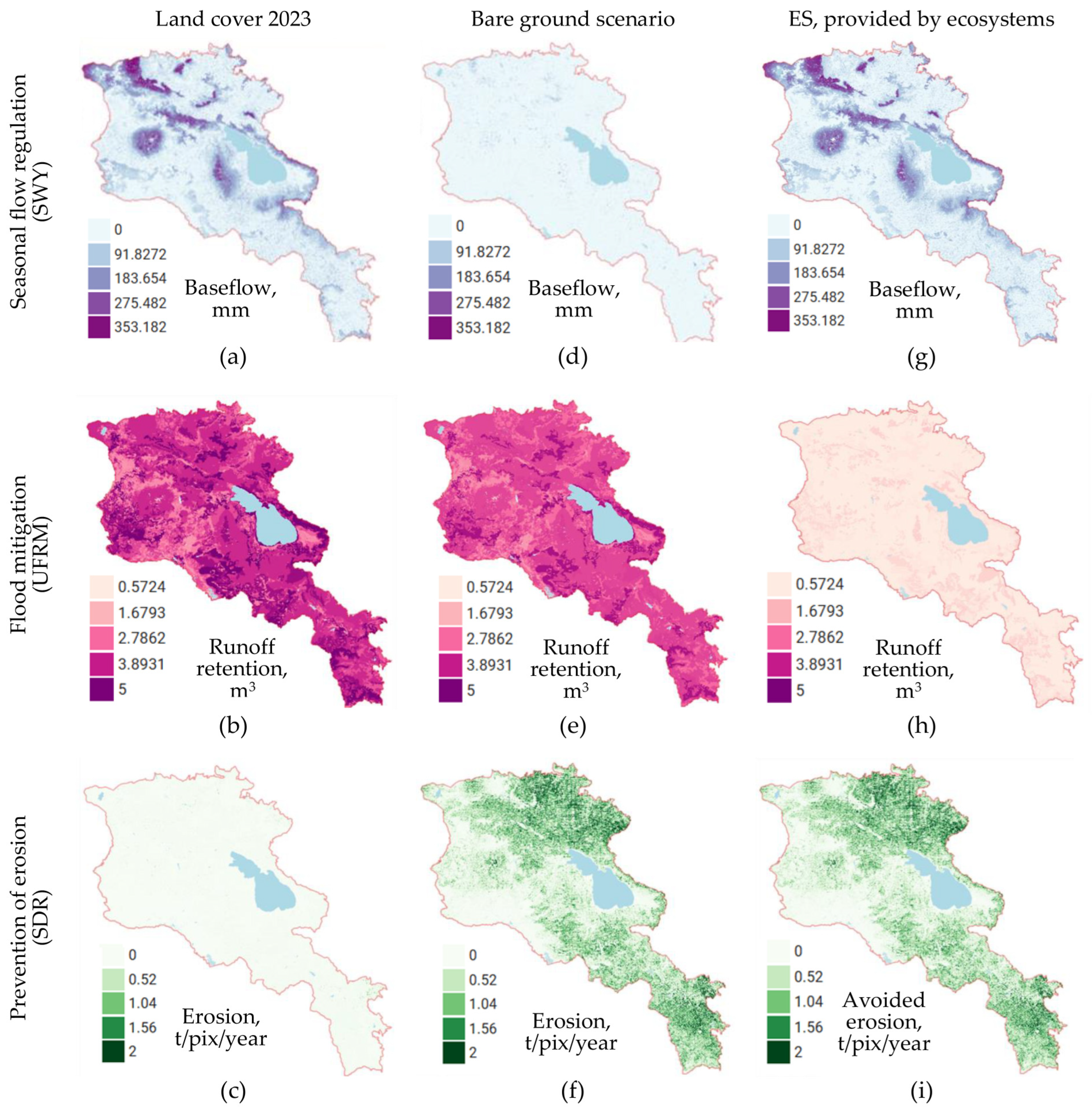
As a result of the modeling, we obtained maps of ES indicators for the current land cover (Figure 3a–c) and for the bare ground scenario (Figure 3d–f). These data allowed us to estimate the amount of ES delivered by ecosystems in the SWY and UFRM models (Figure 3g,h) as the difference between ES values for the current land cover and for bare ground. Avoided erosion (Figure 3i) and avoided sediment export were calculated directly by the SDR model.
The results of our modeling show that natural ecosystems perform between 11% and 96% of the modeled ES (Table 2). Ecosystems have the strongest impact on baseflow supply and erosion prevention, performing these functions almost entirely (93–96%). ES maps show that under the bare ground scenario, baseflow is almost absent (Figure 3d), meaning that the existing baseflow is almost entirely provided by terrestrial ecosystems (Figure 3g). At the same time, under the current land cover, erosion is virtually absent (Figure 3c), indicating that ecosystems almost completely prevent it. Only in the case of ES for flood mitigation under the average spring rainfall scenario (12 mm) was the effect of ecosystems negligible. Runoff retention and quick runoff values change only slightly in absolute terms between the current land cover and the bare ground scenario. However, even in this case, ecosystems reduce quick runoff by 14% (Table 2).
Based on ES maps, ES values were calculated for various ecosystem accounting areas: for Armenia as a whole, for provinces and watersheds (Figure 4), vegetation zones (Figure 5) and landscapes, as well as protected areas (see examples at the project website [31]).
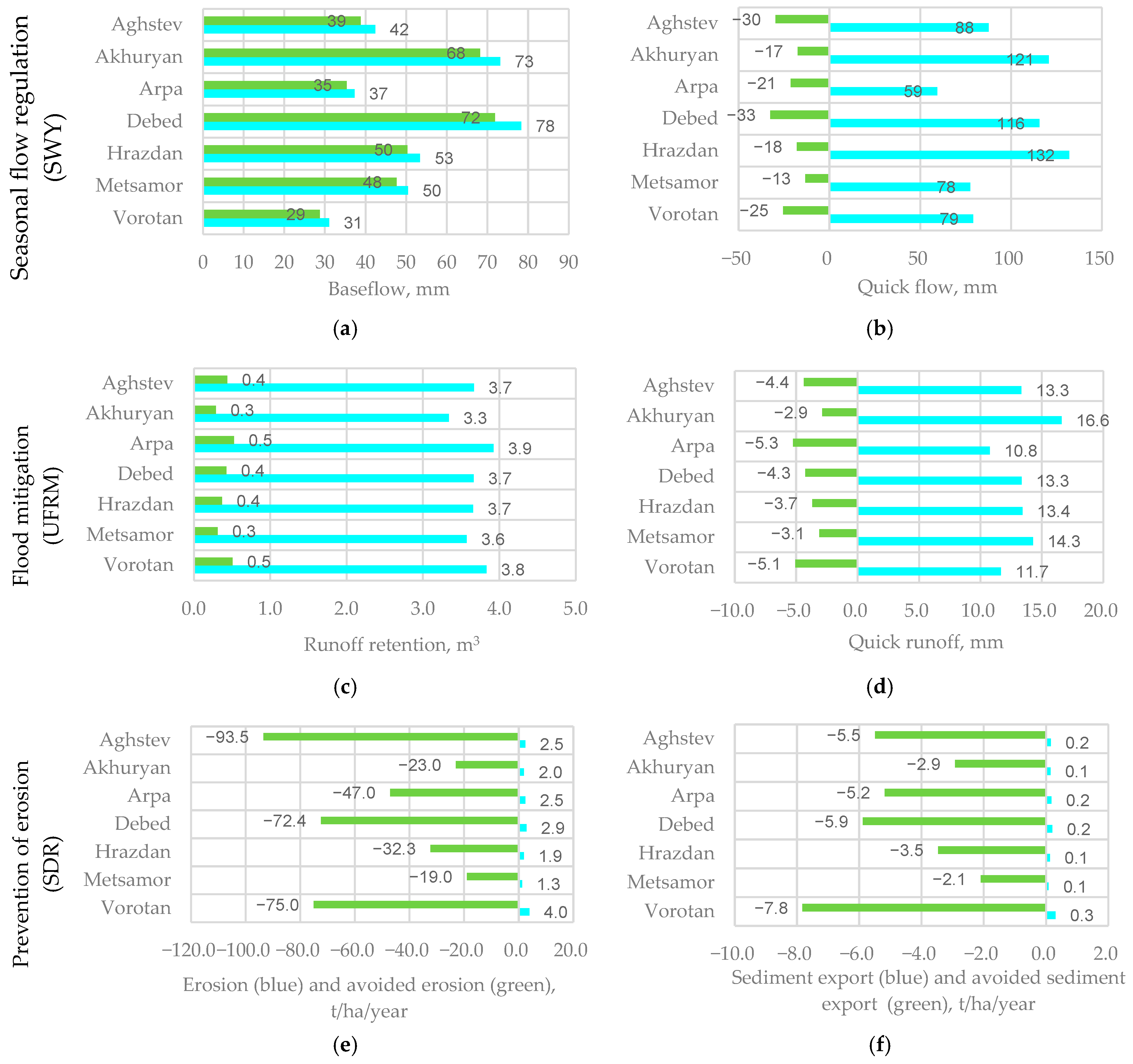
The negative indicator values in Table 2 and Figure 4 indicate that terrestrial ecosystems reduce quick flow, erosion, and sediment export. Because the values of these indicators under actual land cover are lower than under bare ground, the resulting ES values are negative—which, in this context, indicates a positive regulating effect of ecosystems.
Absolute ES values vary considerably across watersheds and provinces (Figure 4). With the current land cover, the SWY model predicts total water flow varying across watersheds from 97 mm (Arpa) to 194 mm (Debed and Akhuryan). The average share of baseflow in the total water flow in Armenia is 34%, and ranges from 29% (Hrazdan) to 40% (Debed), while under the bare ground scenario, baseflow accounts for only 2–4%. Despite significant differences in absolute flow values, ecosystems in all watersheds provide more than 90% (92–95%) of the baseflow (Figure 4a). Ecosystems reduce quick runoff across watersheds by 12% (Hrazdan and Akhuryan) to 26% (Arpa and Aghstev) (Figure 4b). The cropland scenario, which we used in the SWY model, shows almost no difference in ES indicators compared to the bare ground scenario. This suggests that croplands provide little to no contribution to this ES [49].
The ES of flood mitigation (UFRM model) is more pronounced under the extreme spring rainfall scenario (50 mm). Across watersheds, ecosystems increase runoff retention by 9% (Akhuryan and Metsamor) to 13% (Arpa and Vorotan) and decrease quick flow by 17% (Akhuryan) to 49% (Arpa) (Figure 4c,d). The loss of ES that occurred in historical times can be assessed as the difference between the ES indicator values for the 2023 land cover and the no-human scenario (Figure 6). This ratio shows that a significant part of the ES is still preserved at present. The most significant ES loss occurred in watersheds where croplands and built-up areas currently occupy the largest area (Akhuryan, Hrazdan, Metsamor) [35]. Generally, the most significant ES loss occurred in areas that are currently built-up (quick runoff increased from 15.9 mm to 23.5 mm). For croplands, ES loss is less substantial (quick runoff increased from 16.7 mm to 20.1 mm) [63].
The SDR model predicts rates of avoided erosion across watersheds from 19.0 t/ha/year (Metsamor) to 93.5 t/ha/year (Aghstev) and rates of avoided sediment export from 2.1 t/ha/year (Metsamor) to 7.8 t/ha/year (Vorotan), preventing more than 90% of erosion and sediment export in all watersheds (Figure 4e,f). These figures also well reflect the slopes in the watershed.
Indicator values for provinces follow the same patterns for SWY, SDR, and UFRM models because provincial and watershed boundaries highly coincide (Figure 1b) [49,63,64].
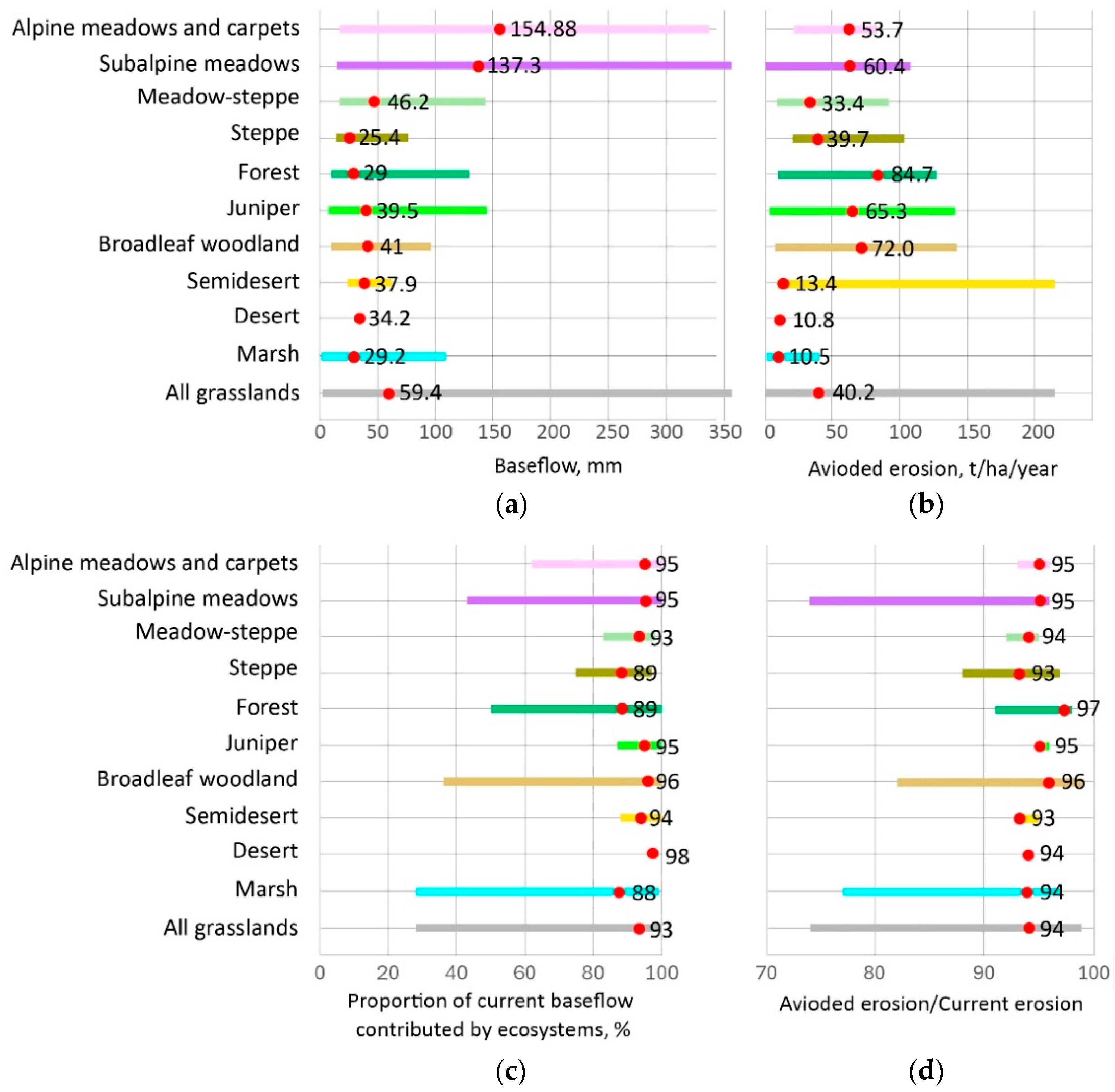
Analysis of ES indicators across vegetation zones shows that the highest average baseflow values occur in alpine and subalpine zones, while woody vegetation exhibits levels similar to those of various grassland types (Figure 5a). As expected, average avoided erosion is highest in forest and woodland zones, moderate in alpine and subalpine zones, and lowest in desert, semi-desert, and marshes (Figure 5b). The range of values within individual polygons of certain vegetation zones is quite large—for baseflow values, in alpine, subalpine, meadow-steppe, forest zones, and juniper woodlands; for avoided erosion values, in semi-desert, forest, juniper, and broadleaf woodland zones.
The distribution of relative ES indicators across vegetation zones shows less variation both in average values and in values within individual polygons. Proportion of current baseflow contributed by ecosystems is lowest in forest, steppe, and marsh zones (88–89%), and highest (98%) in the desert zone due to the specific characteristics of the only small area where it is currently found in Armenia (see the Discussion section). In other vegetation zones, this indicator ranges from 93% to 96% (Figure 5c). The ratio of avoided erosion to current erosion is highest in forest and woodland zones (avoided erosion is 96–97 times greater than current erosion), ranging from 93 to 95 in other zones (Figure 5d).

3.2. Changes in ES Provisioning from 2017 to 2023

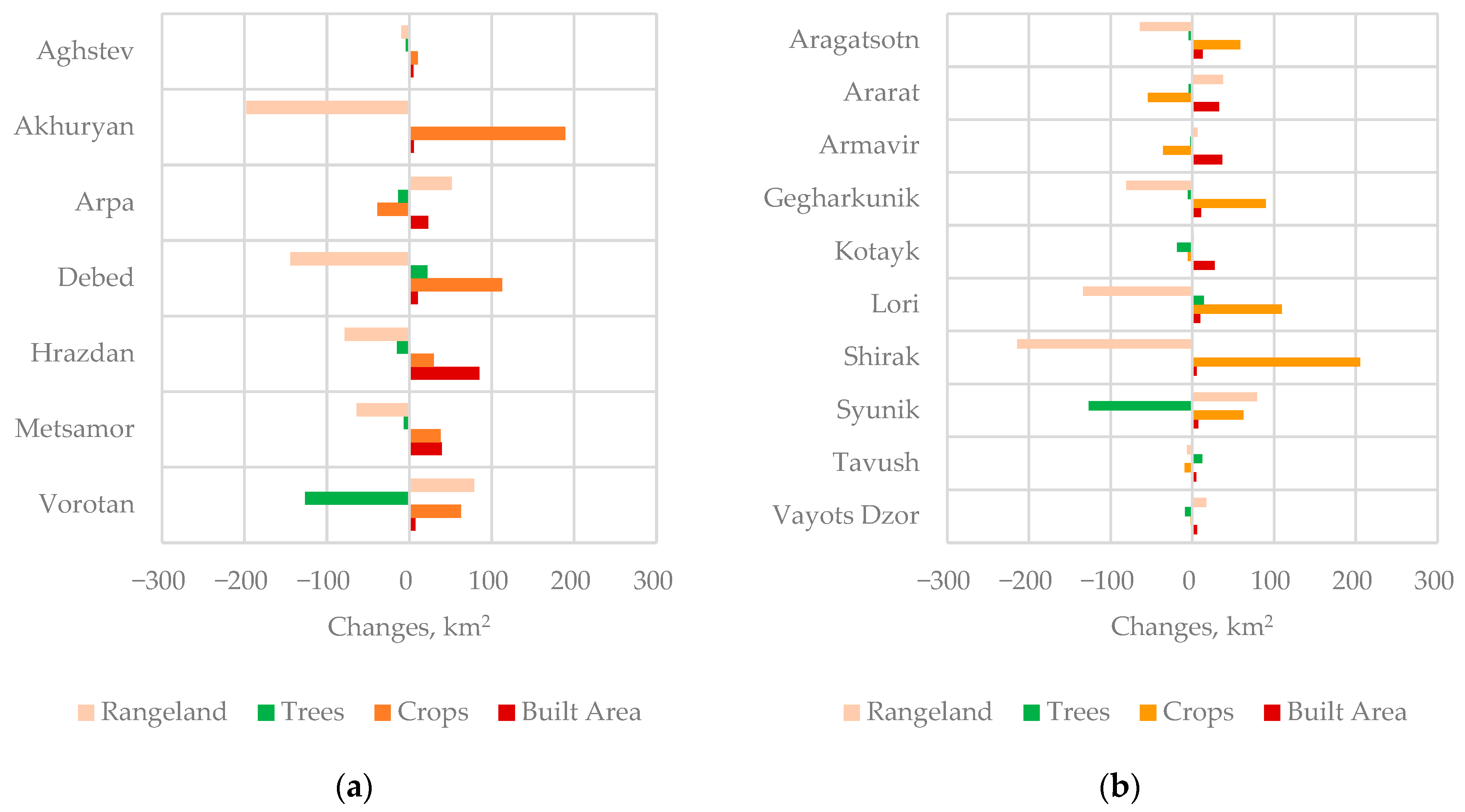
ESRI land cover data indicate that overall, in Armenia, the area of croplands and built-up areas increased by 403 and 175 km2, respectively, while the area of grasslands and forests decreased by 364 and 144 km2, respectively. These processes were most pronounced in the provinces of Shirak, Lori, Gegharkunik, and Aragatsotn, as well as in the watersheds of the Akhuryan, Debed, Hrazdan, and Metsamor rivers. In the Syunik province and Vorotan watershed, there was a partial replacement of forests with grasslands, along with an increase in croplands. In the Ararat and Armavir provinces, croplands decreased due to the expansion of built-up areas, and in Ararat, this was also attributed to the expansion of grasslands. In the Arpa watershed, croplands decreased, while rangelands and built-up areas increased (Figure 7) [35].
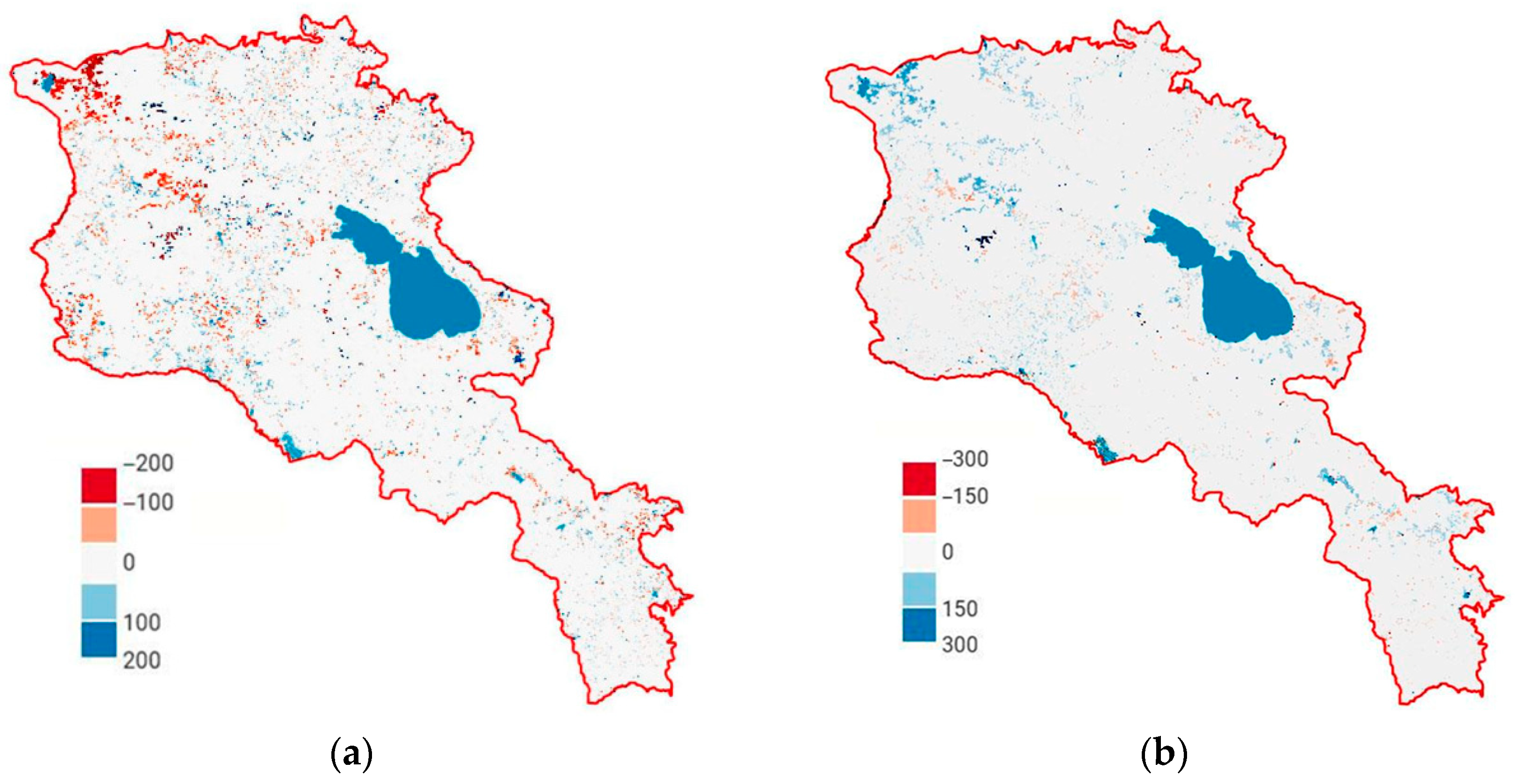
Maps of changes in all four ES show sporadic changes in small areas scattered across the territory, often with opposite signs. Examples for baseflow and quick flow (SWY model) are shown in Figure 8.
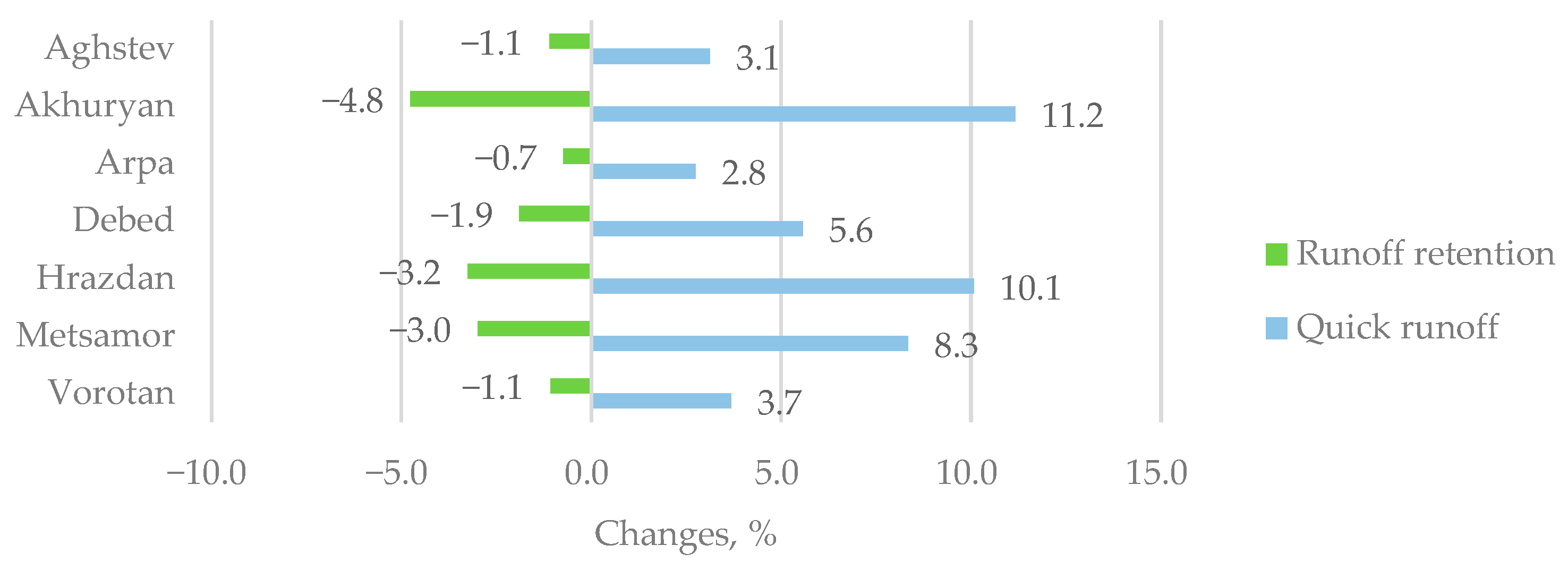
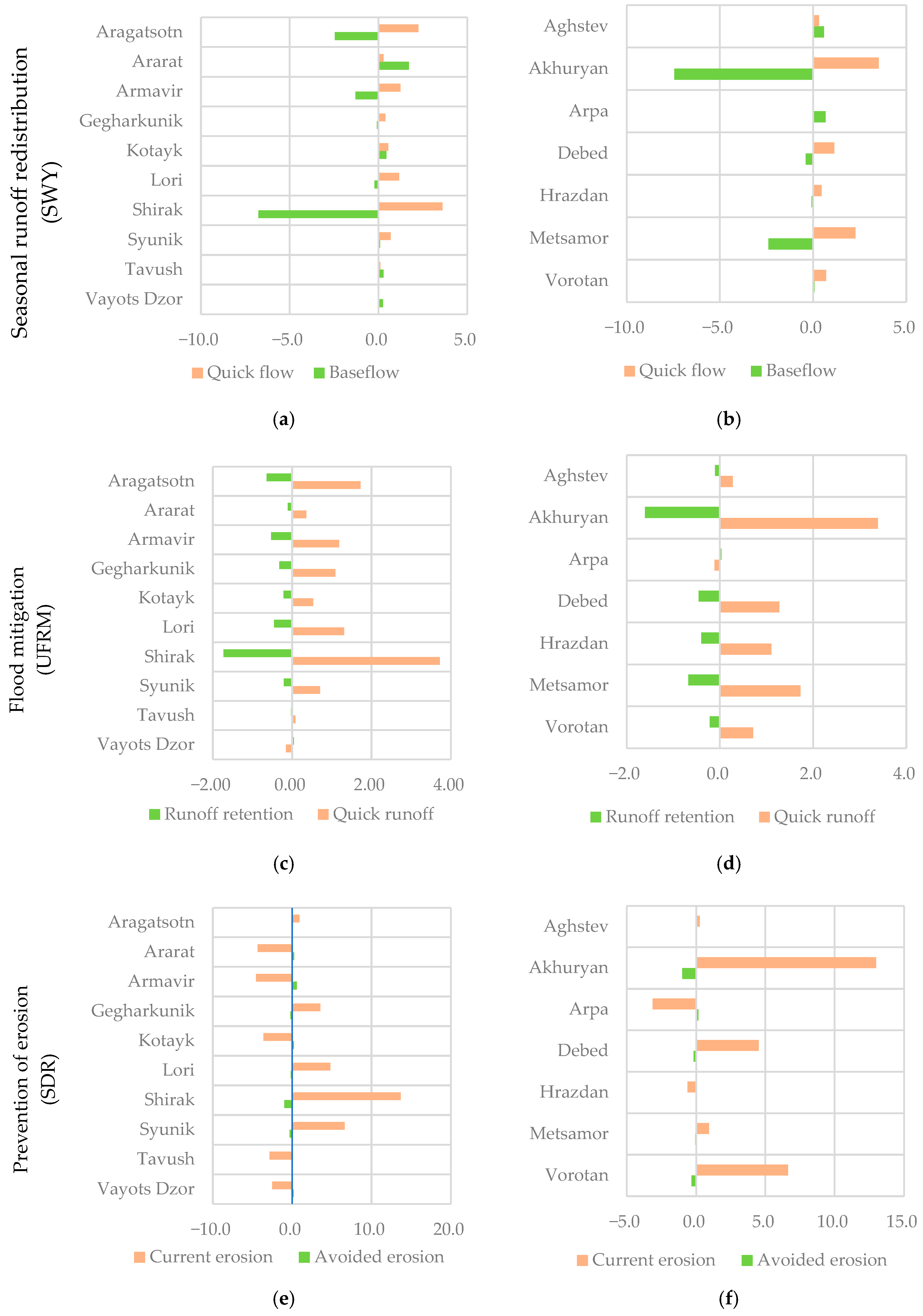
Changes in ES indicator values in most watersheds and provinces are insignificant, both in absolute and relative terms, generally amounting to a few percent or less than one percent. Nevertheless, these changes can be important for tracking trends, which generally can be interpreted as negative (Figure 9).
Baseflow in most cases decreased while quick flow increased (SWY model). This means that the ability of terrestrial ecosystems to sustain baseflow during dry periods declined. The only exceptions are the Arpa watershed and Ararat province (Figure 9a,b) which can be explained by the expansion of grasslands and the reduction in croplands in these areas. The most significant negative changes occurred in the Shirak province and the Akhuryan watershed (Figure 7).
Changes in ES of flood mitigation (UFRM model) generally repeated this pattern. In most cases runoff retention decreased and quick runoff increased, with the most significant negative changes in the Akhuryan watershed and the Shirak province (Figure 9c,d).
The SDR model estimated that very small changes in avoided erosion (0.01–0.99%) led to much more significant changes in current erosion and sediment export as well as in avoided sediment export. All these indicators negatively changed in the Akhuryan, Vorotan, and Debed watersheds as well as in Shirak, Syunik, Lori, and Gegharkunik provinces. Noticeable positive changes occurred only in the Arpa watershed and in the Armavir and Vayots Dzor provinces (highly coincides with the Arpa watershed). It is noteworthy that in the Hrazdan watershed there are almost no changes, while in the two provinces belonging to it (Gegharkunik and Kotayk) the changes are in opposite directions and compensate each other on a watershed scale (Figure 9e,f).

3.3. ES Supply–Use Balance

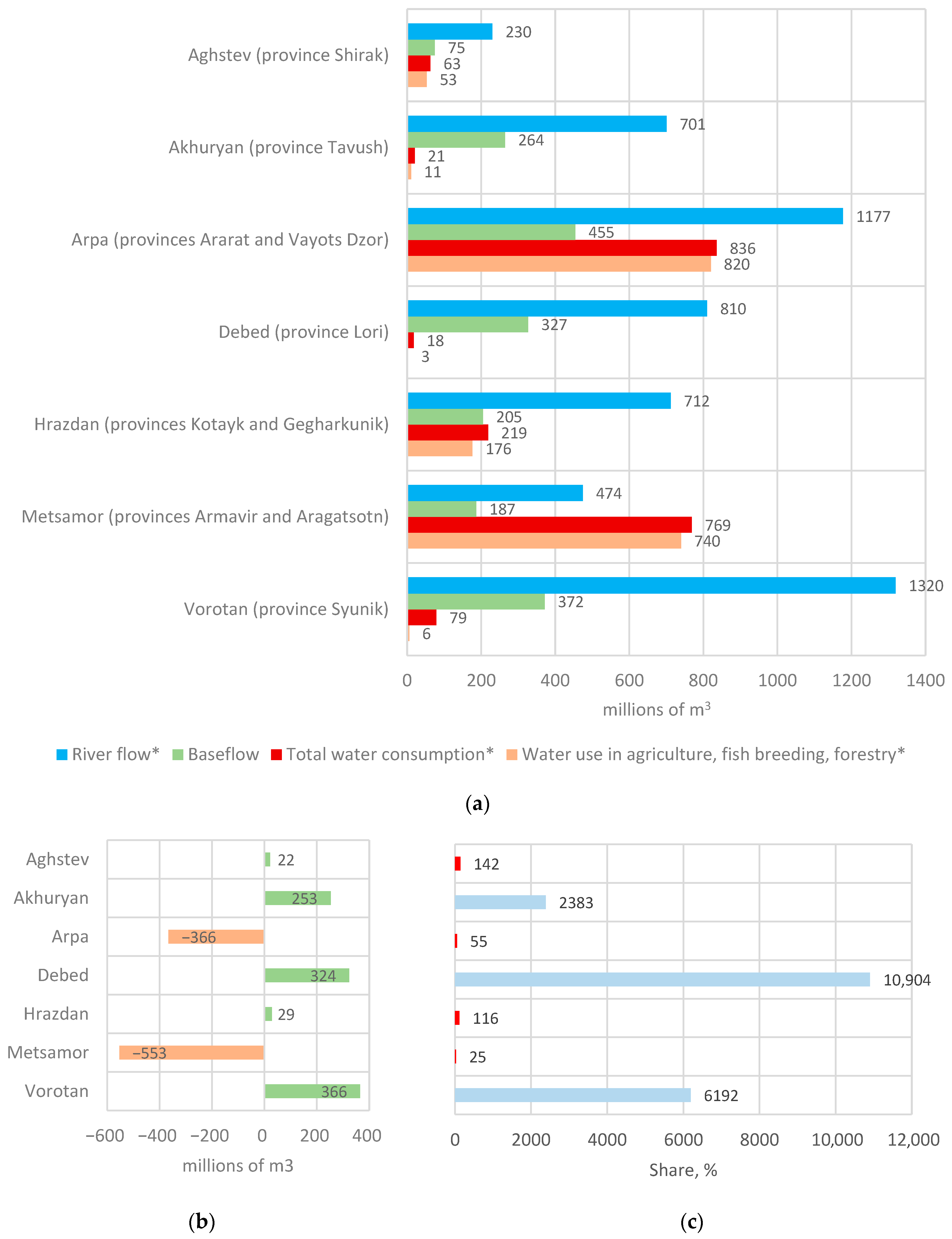
ES of baseflow supply (SWY model) and erosion prevention (SDR model) were used as examples of ES supply–use balance. Statistical data on water consumption were sourced from ARMSTAT regional statistics [41], and river flow data were sourced from ARMSTAT and government-reported data [43]. This analysis is approximate, because we used river flow data by watersheds and water-use data by provinces. The boundaries of provinces and watersheds largely coincide (Figure 1b), which allows such a rough estimate. For watersheds that include two provinces (as shown in Figure 10a), the data for those provinces were summed. Obviously, the balance should be refined in the future using data from the same EAAs.
The overwhelming majority of water consumption is accounted for by the agriculture, fisheries, and forestry sector, which underscores the importance of assessing the ecosystem service of baseflow provision. In two basins—Metsamor and Arpa—agricultural water consumption exceeds the baseflow volume, and in the Metsamor basin it also exceeds river flow generated within Armenia (Figure 10a,b). In the Metsamor and Arpa watersheds, baseflow provides 25% and 55% of agricultural water consumption, respectively; in the Hrazdan and Agstev basins, baseflow slightly exceeds agricultural consumption—by 16% and 42%, respectively. However, in the three other watersheds —Akhuryan, Debed, and Vorotan—baseflow exceeds water consumption by tens of times (Figure 10c).
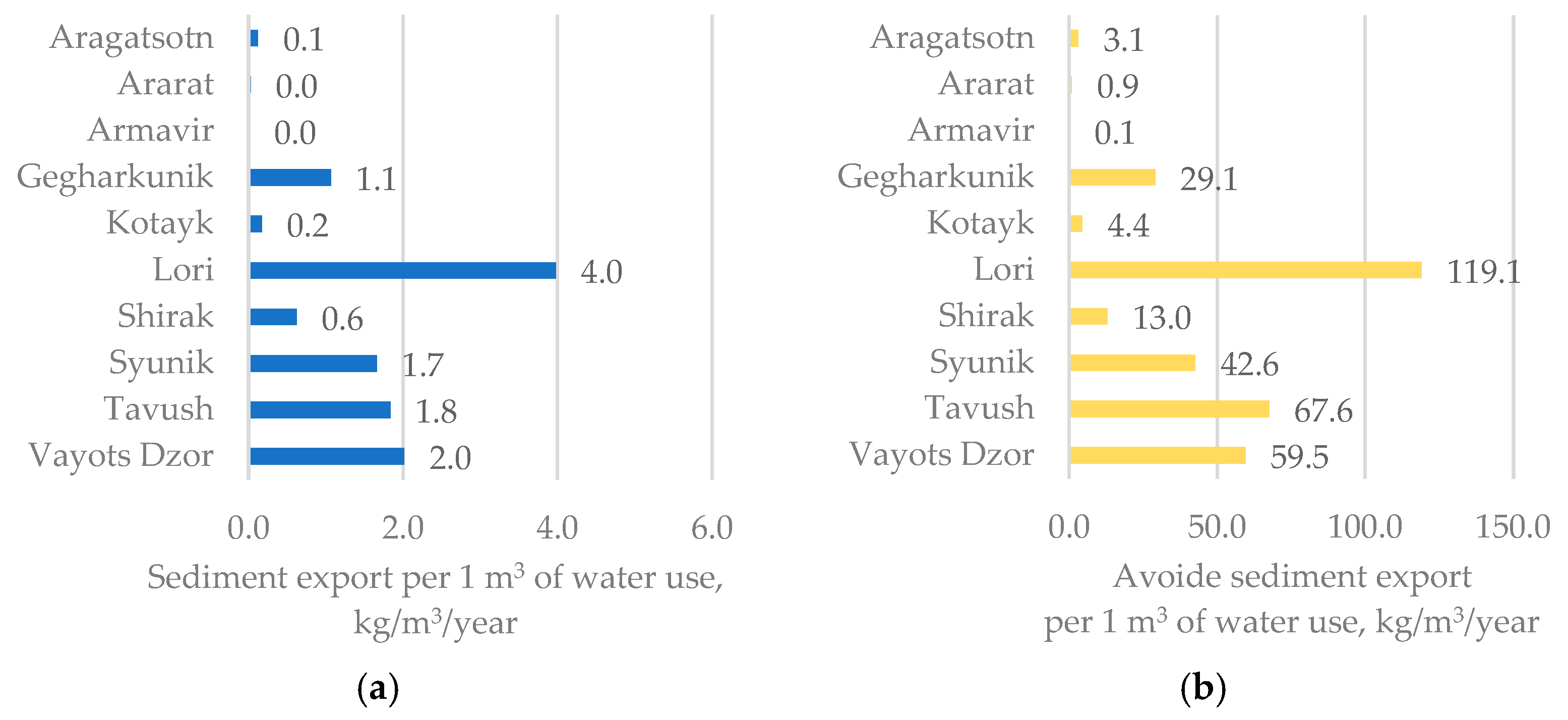
The supply–use balance for the ES of preventing sediment export to streams (SDR model) was assessed at the provincial level, since river flow data are not required for this assessment. This ES is most important in the Lori province, where natural ecosystems annually prevent the export of 119 kg of sediment per one m3 of water used, and lowest in the Armavir and Ararat provinces, where this indicator is less than 1 kg/m3/year (Figure 11). However, the share of avoided sediment export in water use everywhere exceeds 95%, which means that the need for this ES is being met [64].

4. Discussion

4.1. Consistency of the Obtained Results with Other ES Estimates for Armenia and Expected ES Performance Across Vegetation Zones

Our average estimate of the erosion rate for Armenia, 2.3 t/ha/year, is very close to the values for Armenia (2.44–2.47) in the global database of modeled erosion values [65,66]. Neighboring countries (Georgia, Azerbaijan, Iran, Turkey) have similar estimates in this database—around 2–3 t/ha/year. According to Eurostat, erosion in most Mediterranean countries has a similar intensity, ranging from 2 to 5 t/ha/year [67].
The average share of baseflow in total flow, calculated based on SWY modeling results, is 34%, which corresponds to the baseflow index estimate for Armenia according to the AQUASTAT data and methodology of 35.5% (the overlap share of the internal renewable surface water resources) [68,69].
The modeling results for the prevention of erosion and sediment transport (SDR model) align most closely with the commonly accepted understanding of this ES. The SDR model identified forests as the most effective land cover class for preventing erosion, with rangelands and croplands performing worse. Among natural vegetation types, forests and woodlands provide this ES most effectively, followed by mountain meadows and then by steppes (Figure 5b,d). The model also showed that avoided erosion and avoided sediment export are the highest in areas with pronounced terrain and steep slopes, indicating that this ES is most important in those areas. While the SDR model gives plausible outputs, its accuracy depends heavily on soil, evapotranspiration, and rainfall data. The coefficients we used are based on global or European values, which should be adjusted to Armenian conditions and agricultural practices accurately.
The SWY model predicted the highest baseflow values—155 and 137 mm—in alpine and subalpine grasslands, while the forest zone showed a minimal baseflow of 29 mm, similar to that of the steppes (25 mm); both are lower than those in the semidesert and desert zones (Figure 5a,c). The proportion of baseflow contributed by ecosystems is also minimal in the forest and steppe zones (89%). This counterintuitive result, in our view, is explained by the combined effects of multiple factors that determine baseflow—precipitation, terrain slope, and soil permeability. Very high absolute baseflow values in mountain grasslands result from the high precipitation in the mountains. In other mountainous regions, higher baseflow values have also been found in upper elevation areas (e.g., [70]). The low baseflow values in the forest zone are most likely the result of forests occurring predominantly on the steep slopes of gorges and mountains. According to our assessment, the highest mean slope among the vegetation zones occurs in the forest and juniper zones —about 20°, whereas mountain grasslands and steppes occupy gentler slopes from 10° to 17°, and the semideserts and the single desert patch lie on plains with an average slope of about 6°. The moderate baseflow of 38 mm and the high proportion of it contributed by ecosystems (94%) in the semidesert zone are most likely due to its location in areas with the gentlest relief and a high proportion of highly permeable soils. The only small desert patch remaining in Armenia exhibits moderate baseflow of 34 mm an extremely high proportion of baseflow provided by ecosystems (98%), probably because it is entirely located on soils with the highest permeability (for detailed maps, see the project web-GIS [44]).
Thus, modeled average values of soil erosion and baseflow are in good agreement with global and European data for Armenia. The distribution of ES indicators for erosion prevention is consistent with the general understanding of the roles of different terrestrial ecosystem types, and detected deviations in the distribution of baseflow indicators can be logically explained by the combined action of multiple factors. This provides grounds for using the obtained results as EA prototype at the scoping stage. However, incorporating ES into national EA will require more accurate models and input data.

4.2. Accuracy of Input Data

Accurate land cover data is a key prerequisite for reliable ES assessment. Since Armenia currently lacks a validated national land cover dataset, we used the ESRI global land cover dataset. A comparison of the ESRI data with government-reported data on the areas of different land cover classes across provinces revealed a discrepancy of 19.4% relative to the total area of Armenia [61]. The accuracy of global land cover datasets does not exceed 75% [71] or 84% [72]. For countries with a large number of primary sampling units (at least 100), the accuracy of the ESA World Cover—identified by the cited authors as the most accurate—ranges from 66% to 98% [72] with an average of around 80%. Although we cannot directly compare these figures to our estimates due to methodological differences, 80.6% match in land cover class areas at the province level in Armenia provides a reasonable justification for using the ESRI land cover dataset for the national-scale scoping EA. Obviously, global land cover datasets are not suitable for ES mapping in smaller EAA, such as municipalities or small protected areas, which require more precise land cover data at a finer spatial scale. Also, even small total-area errors in land cover data, or changes in the algorithms used to classify land cover types, can result in significant distortions in the assessment of land cover change—especially when the actual changes are small in absolute terms, as is the case in Armenia (Section 3.2). Therefore, a first and crucial step toward launching national EA should be the development of a national land cover dataset, verified using ground-based data collected specifically within the country.
The accuracy of other input data also is critical for ES assessment. In this scoping study, climate data, reference evapotranspiration, and digital elevation model were obtained from global databases which accuracy at the national scale may vary due to spatial interpolation and the resolution of source station networks. We recommend that ES modeling for national ecosystem accounting be based on data verified using in situ measurements from Armenia’s hydrometeorological, geodesy, and cartography services.

4.3. Consistency of the Tested InVEST Models with Armenia’s Natural Conditions

The SWY model does not account for snow accumulation and melt, which is a major factor in Armenia’s highland hydrology. The approach we used in this study ignores snow sublimation and local variations in melt timing. For a more accurate assessment, it is clearly necessary to incorporate specialized models, such as SNOW-17, which can significantly improve runoff predictions [73]. Another significant limitation is the lack of accounting for geological structure, which is important for baseflow assessment.
Modeling the ES of flood risk mitigation (UFRM model) showed meaningful ecosystem effects only under an extreme rainfall scenario (50 mm). For average spring rainfalls (12 mm), the model barely registered any difference between current land cover and the bare ground scenario, which is due to low amounts of precipitation. It suggests the model may not be picking up more subtle but still important differences in landscape runoff retention under typical rainfall events. That raises questions about the model’s sensitivity under more typical weather conditions. Moreover, the UFRM model accounts only for the water retention capacity of ecosystems but does not consider water flow across the terrain, which makes it poorly suited for the mountainous conditions of Armenia. Slope has a critical impact on the rate of water runoff, which is why topography must be taken into account—as was done, for example, in [10].
These issues point to a clear need for InVEST model calibration (i.e., adjusting the model to match observed local data) before using its outputs in ecosystem accounts. According to [11], among the publications that used SWAT, 79% carried out some form of calibration, whereas for InVEST, only 13% of the studies did so. However, calibrated InVEST models can provide a sufficiently reliable ES assessment for strategic decision-making [74,75]. Our experience shows that InVEST models can be useful at the scoping stage, a necessary step before initiating ecosystem accounting.
However, more accurate ES assessment and mapping across the entire territory of Armenia—essential for informed decision-making—are hindered because some important coefficients in InVEST models are assigned single values, either for the entire area (the number of rainy days in the SWY and UFRM models) or for broad land cover classes (Kc in the SWY model), assuming that land-cover classes are uniform across the assessment area. As a result, models do not account for differences among areas at varying elevations or across climatic zones within Armenia.
Thus, at the preliminary stage, InVEST models proved useful for demonstrating general approaches to integrating ES assessments and maps into Armenia’s ecosystem accounting. However, given the aforementioned model uncertainties and simplifications, the estimates we obtained should be regarded as ES proxies rather than reliable data for management decisions or monetary valuation and should not be used directly in national accounting without proper calibration.
As ecosystem accounting and the corresponding data collection system develop, it may become reasonable to transition to the use of hydrological and climatic models that account for a greater number of processes and local data. However, this requires another milestone in Armenia, namely the open access to such data. At later stages, it is advisable to use different models for different purposes and decision-making contexts. InVEST models can be applied for rapid and simplified ecosystem service modeling to obtain a general overview. SWAT and other detailed hydrological and climate models are necessary for producing high-resolution and accurate assessments. Decision-support models (such as RIOS, AQUATOOL, and others) are useful for the practical application of ecosystem service assessments and maps in management contexts [12,76,77].

4.4. Potential Bias in Assessing the Role of Different Terrestrial Ecosystems in ES Provisioning

According to the SEEA-EA guidance, one of the EA tasks is to evaluate how various ecosystem types contribute to ES provisioning [1]. However, using broad land cover classes as proxies for varied and complex ecosystems can lead to significant bias. InVEST models operate with broad land cover classes such as “forest” or “grassland”. Although this approach is practical, it may obscure significant ecological diversity and misrepresent the true functioning of particular ecosystem types [78].
Given high topographic and climatic variability in Armenia, these risks are exacerbated there. With elevations ranging from 375 to over 4,000 m above sea level, the area of the country includes both lowland semi-deserts and high alpine regions. Precipitation, soil properties, temperature regimes, and land use can all change quickly in this area, sometimes within a few kilometers [33]. In Armenia the category “grassland” encompasses diverse ecosystems, ranging from alpine meadows to semideserts, that differ fundamentally in their functioning and in their capacity to provide ES. Average values of ES indicators for grasslands do not reflect the diversity of ecosystem functions and services among the various types of meadows, steppes, and semideserts (Figure 5). Likewise, not all forests have the same function in regulating hydrology; their contributions are influenced by species composition, slope gradient, canopy density, and soil depth [21,22,23]. Thus, conducting ES accounting at the level of broad land cover classes fails to capture ecosystem-specificity, offers little for informed ecosystem-management decisions, and in some cases can lead to incorrect decisions. For example, using the average baseflow value for grasslands (59 mm) leads to underestimating the contribution of mountain grasslands with baseflow values of 137–155 mm to the total baseflow volume.
Biases in understanding the roles of different ecosystem types in delivering ES could have negative consequences for environmental policy. Globally, an example of such a bias is the underestimation of grasslands’ roles in water provision and soil protection, alongside a primary focus on the ecological value of forests. This often leads to afforestation of natural grasslands, resulting in negative impacts on water regulation and soil quality [28,79,80].
Even within vegetation zones—which partially account for the diversity of grasslands and woody vegetation—there remains a wide spread of ES values across individual polygons, indicating the high heterogeneity of environmental conditions and plant communities within them. This raises the question of whether a more detailed ecosystem classification and mapping should be used to assess ecosystems’ roles in delivering ES.

5. Conclusions

  • Modeling results for three water-related regulating ecosystem services (ES)—baseflow supply; prevention of soil erosion and sediment export to water bodies; and flood-risk mitigation (InVEST SWY, SDR, and UFRM)—show that natural ecosystems contribute between 11% and 96% of the modeled ES. The average current erosion is estimated at 2.3 t/ha/year, and sediment export at 0.15 t/ha/year. Avoided erosion is 46.4 t/ha/year and avoided sediment export is 4.3 t/ha/year, indicating that ecosystems prevent 95–96% of erosion and sediment export. Ecosystems provide 93% of baseflow, with an average baseflow index of 34%, while on bare ground it is only 3%. Under the 50 mm rainfall scenario, ecosystems decrease quick runoff by 24% and increase runoff retention by 11%.
  • The tested InVEST models proved suitable at the scoping phase of ecosystem accounting (EA) planning, demonstrating the following decision-relevant outputs from ES accounting:
    -
    ES maps and accounts across different EAAs (e.g., national, provincial, watershed, and vegetation-zone levels);
    -
    The magnitude of ES, both in aggregate and per unit area, demonstrating the importance of water-related regulating ES for human well-being and the economy, and the key role of terrestrial ecosystems in delivering these services;
    -
    Changes in ES supply resulting from land use and land-cover (LULC) changes; and
    -
    ES supply–use balances, revealing water-deficit provinces and watersheds.
3.
Based on the scoping assessment of three ES presented here, the following recommendations are proposed to initiate national ES accounting in Armenia:
-
Develop the national land cover dataset, verified using ground-based data collected specifically within Armenia;
-
Calibrate the models using local data—especially in a few well-studied river basins where streamflow, erosion, and climate data are available;
-
Develop a framework for integrating InVEST and advanced hydrological and meteorological models (e.g., snow dynamics) to account for the high diversity of natural conditions in Armenia, including terrain, geological structure, soil types, and regional climatic differences;
-
Develop a local database of modeling coefficients, such as climate parameters, evapotranspiration, C-factor, river flow, etc., adapted to Armenia’s landscapes and topography; and
-
Use detailed maps of vegetation and terrestrial ecosystems to account for ES delivered by various ecosystem types.

Author Contributions

Conceptualization, E.B.; methodology, E.B. and E.K.; software, E.K.; formal analysis, E.B. and E.K.; investigation, E.K.; data curation, E.K.; writing, E.B., E.K., A.A. and V.A. All authors have read and agreed to the published version of the manuscript.

Funding

The German environmental protection agency (UBA). The principal organization - Leibniz-Institut für ökologische Raumentwicklung e.V. (IOER), Dresden, Germany. Contract for Services 1 June 2024 based upon §§ 631 ff of the BGB (German Civil Code).

Institutional Review Board Statement

Not applicable.

Informed Consent Statement

Not applicable.

Data Availability Statement

Data available at the website of the project “Ecosystem Accounting in Armenia: Setting the Scene” https://biodiversity-armenia.am, accessed on 1 September 2025; and at project webGIS https://bccarmenia.nextgis.com.

Conflicts of Interest

Eduard Kazakov is employed by NextGIS OÜ. The remaining authors declare that the research was conducted in the absence of any commercial or financial relationships that could be construed as a potential conflict of interest.

Abbreviations

The following abbreviations are used in this manuscript:
EAEcosystem accounting
EAAEcosystem accounting area
ARMSTATStatistical Committee Republic of Armenia
ESEcosystem service
InVESTIntegrated Valuation of Ecosystem Services and Trade-Offs
SEEA-EASystem of Environmental-Economic Accounting—Ecosystem Accounting
SDRSediment Delivery Ratio model
SWYSeasonal Water Yield model

Appendix A

Table A1. Model processes and parameters [42].
ModelModel ProcessesDescription of Parameters
SWYQuickflow calculating

QF i = m = 1 12 Q F i , m

QF i , m = n m × ( ( a i , m S i ) e x p ( 0.2 S i a i , m ) + S i 2 a i , m e x p ( 0.8 S i a i , m ) E 1 ( S i a i , m ) ) × 25.4

assuming an exponential distribution of daily precipitation depths f ( p ) = 1 a i , m e x p ( p a i , m )

a i , m = P i , m n m / 25.4
QF i —annual quick flow;
QF i , m —monthly quick flow;
Si—maximum potential retention, 1000 CN i 10 , where CNi is curve number for pixel i;
E1—exponential integral function;
25.4—conversion factor from inches to mm;
ai,m—mean rain depth on a rainy day at pixel i on month m;
ni,m—the number of events at pixel i in month m;
Pi,m—monthly precipitation for pixel i at month m;
SWYLocal recharge calculating

L i = P i QF i AET i

AET i = months . AET i , m

AET i , m = m i n ( PET i , m ; P i , m QF i , m + α m β i L s u m . a v a i l , i )

PET i , m = K c , i , m × E T 0 , i , m

L s u m . a v a i l , i = p ij ( L a v a i l , j + L s u m . a v a i l , j )
Li—local recharge for pixel i;
AETi—annual actual evapotranspiration for pixel i;
AETi,m—monthly actual evapotranspiration;
PETi,m—monthly potential evapotranspiration;
pij—the proportion of flow from cell i to j;
Lavail,j—the available recharge to pixel;
Pi and Pi,m—annual and monthly precipitation;
QF i and QF i , m —annual and monthly quick flow;
ET0,i,m—reference evapotranspiration for month m;
Kc,i,m—monthly crop factor for the pixel i;
α m —the fraction of upslope annual available
recharge that is available in month m (default is 1/12);
β i —the fraction of the upslope subsidy that is
available for downslope evapotranspiration.
SWYBaseflow calculating

B s u m , i = L s u m , i p ij ( 1 L a v a i l , j L s u m , j ) B s u m , j L s u m , j L j .
if   j   is   a   nonstream   pixel

B s u m , i = L s u m , i . p ij    
if   j   is   a   stream   pixel

L s u m , i = L i + j ,   a l l   p i x e l s   d r a i n i n g   t o   p i x e l   i L s u m , j p ji

B i = m a x ( B s u m , i L i L s u m , i , 0 )
B s u m , i —cumulative baseflow through pixel i, contributed by all upslope pixels, which is not evapotranspired before it reaches the stream;
B i —baseflow contribution of a pixel i to slow-release flow which is not evapotranspired before it reaches the stream;
Li—local recharge for pixel i;
L a v a i l , j —the available recharge to pixel i;
L s u m , i —cumulative upstream recharge
SDRSoil loss calculating

u s l e i = R i K i L S i C i P i

A E R i = R K L S i U S L E i
uslei—the amount of annual soil loss on pixel i;
Ri—rainfall erosivity;
Ri—soil erodibility;
LSi—slope length-gradient factor;
Ci—cover-management factor;
Pi—support practice factor;
AERi—avoided erosion on pixel i.
SDRCalculation of Sediment Delivery Ratio

S D R i = S D R m a x 1 + e x p ( I C 0 I C i k )

I C = l o g 10 ( D u p D d n )

D u p = C ¯ t h S ¯ t h A

D d n = i . d i C t h , i S t h , i
SDRi—Sediment Delivery Ratio is the proportion of eroded sediment that is actually delivered to a stream or water body, relative to the total amount of sediment generated by soil erosion within a given area;
SDRmax—is the maximum theoretical SDR, set to an average value of 0.8;
IC0 and k—calibration parameters that define the shape of the SDR-IC relationship;
IC—connectivity index;
Dup—upslope component;
C ¯ t h —average thresholded C factor of the upslope contributing area;
S ¯ t h —average thresholded slope gradient of the upslope contributing area;
A—upslope contributing area;
Ddn—downslope component;
di—the length of the flow path along the ith cell according to the steepest downslope direction;
Cth,i and Sth,i —thresholded cover-management factor and slope gradient of the ith cell, respectively.
SDRCalculation of sediment export

E i = u s l e i S D R i

E = i . E i

A E X i = ( R K L S i U S L E i ) S D R i + T i
Ei—sediment export from pixel i, is the amount of sediment eroded from that pixel that actually reaches a stream;
E—total catchment sediment export;
AEXi—avoided sediment export from pixel i;
Ti—amount of upslope sediment that is trapped on pixel i.
UFRM Q p , i = { ( P λ S m a x i ) 2 P + ( 1 λ ) S m a x , i i f P > λ S m a x , i 0 . o t h e r w i s e }

S m a x , i = 25400 C N i 254

R i = 1 Q p , i P

R _ m 3 i = R i P p i x e l . a r e a 10 3
Qp,i—runoff for pixel i;
P—the design storm depth in mm;
Smax,i—potential retention in mm;
λ S m a x —rainfall depth needed to initiate runoff;
CNi is curve number for pixel i;
Ri—the fraction of runoff retention per pixel i;
R _ m 3 i —runoff retention volume per pixel i;

References

  1. United Nations. System of Environmental-Economic Accounting—Ecosystem Accounting (SEEA EA); System of Environmental-Economic Accounting: New York, NY, USA, 2024; Available online: https://seea.un.org/ecosystem-accounting (accessed on 26 June 2025).
  2. European Commission; Statistical Office of the European Union. Accounting for Ecosystems and Their Services in the European Union (INCA): Final Report from Phase II of the INCA Project Aiming to Develop a Pilot for an Integrated System of Ecosystem Accounts for the EU, 2021 edition; Publications Office of the European Union: Luxemburg, 2021. Available online: https://data.europa.eu/doi/10.2785/197909 (accessed on 26 June 2025).
  3. World Meteorological Organization. State of Global Water Resources 2023; United Nations: New York, NY, USA, 2024; Available online: https://library.wmo.int/idurl/4/69033 (accessed on 26 June 2025).
  4. IPBES. Global Assessment Report on Biodiversity and Ecosystem Services of the Intergovernmental Science-Policy Platform on Biodiversity and Ecosystem Services; Brondizio, E.S., Settele, J., Díaz, S., Ngo, H.T., Eds.; IPBES Secretariat: Bonn, Germany, 2019; Available online: https://zenodo.org/records/3831674 (accessed on 26 June 2025).
  5. UN-Water. The United Nations World Water Development Report 2018: Nature-Based Solutions for Water. Paris, UNESCO, 2018. WWAP (United Nations World Water Assessment Programme). Available online: https://www.unwater.org/publications/world-water-development-report-2018 (accessed on 26 June 2025).
  6. Aznar-Sánchez, J.A.; Velasco-Muñoz, J.F.; Belmonte-Ureña, L.J.; Manzano-Agugliaro, F. The worldwide research trends on water ecosystem services. Ecol. Indic. 2019, 99, 310–323. [Google Scholar] [CrossRef]
  7. Duku, C.; Rathjens, H.; Zwart, S.J.; Hein, L. Towards ecosystem accounting: A comprehensive approach to modelling multiple hydrological ecosystem services. Hydrol. Earth Syst. Sci. 2015, 19, 4377–4396. [Google Scholar] [CrossRef]
  8. Lai, T.-Y.; Salminen, J.; Jäppinen, J.-P.; Koljonen, S.; Mononen, L.; Nieminen, E.; Vihervaara, P.; Oinonen, S. Bridging the gap between ecosystem service indicators and ecosystem accounting in Finland. Ecol. Model. 2018, 377, 51–65. [Google Scholar] [CrossRef]
  9. Nedkov, S.; Campagne, S.; Borisova, B.; Krpec, P.; Prodanova, H.; Kokkoris, I.P.; Hristova, D.; Le Clec’h, S.; Santos-Martin, F.; Burkhard, B.; et al. Modeling water regulation ecosystem services: A review in the context of ecosystem accounting. Ecosyst. Serv. 2022, 56, 101458. [Google Scholar] [CrossRef]
  10. Vallecillo, S.; Kakoulaki, G.; La Notte, A.; Feyen, L.; Dottori, F.; Maes, J. Accounting for changes in flood control delivered by ecosystems at the EU level. Ecosyst. Serv. 2020, 44, 101142. [Google Scholar] [CrossRef]
  11. Ochoa, V.; Urbina-Cardona, N. Tools for spatially modeling ecosystem services: Publication trends, conceptual reflections and future challenges. Ecosyst. Serv. 2017, 26, 155–169. [Google Scholar] [CrossRef]
  12. Lüke, A.; Hack, J. Modelling Hydrological Ecosystem Services—A state of the art model comparison. Hydrol. Earth Syst. Sci. Discuss. 2017. [Google Scholar] [CrossRef]
  13. Stewart-Koster, B.; Bunn, S.; Green, P.; Ndehedehe, C.E.; Anderson, L.; Armstrong McKay, D.I.; Bai, X.; DeClerck, F.; Ebi, K.; Gordon, C.; et al. Living within the safe and just Earth system boundaries for blue water. Nat. Sustian. 2023, 7, 53–63. [Google Scholar] [CrossRef]
  14. World Resource Institute. 25 Countries, Housing One-Quarter of the Population, Face Extremely High Water Stress. 2003. Available online: https://www.wri.org/insights/highest-water-stressed-countries (accessed on 26 June 2025).
  15. Shahnazaryan, N.; Harutyunyan, A. Ecosystem Services in Armenia: Overview of Different Activities on Ecosystem Services Implemented by the Government of Armenia and Different Organizations in the Period of 2011–2017; GIZ EcoServe Project; GIZ: Bonn, Germany, 2017; Available online: https://biodivers-southcaucasus.org/uploads/files/5b461310dad8a.pdf (accessed on 26 June 2025).
  16. Asatryan, V.; Keryan, T.; Radinger-Peer, V.; Dallakyan, M. Assessment of Cultural Ecosystem Services Potential in River Catchments in the Caucasus: Evidence from Dilijan National Park, Armenia. Mt. Res. Dev. 2024, 44, R1–R13. [Google Scholar] [CrossRef]
  17. Introduction of Payment for Ecosystem Services schemes in Upper Hrazdan Pilot River Basin of Armenia. Prepared by: “Geoinfo” LTD. 2011. Available online: https://unece.org/info/publications/pub/22130 (accessed on 26 June 2025).
  18. Pietsch, M.; Uhrig, N.; Sayadyan, H.; Kim, D.Y. Analyzing Ecosystem Services in Armenia Using ArcGIS Online: A Case Study of the Geghard Monastery and the Kotayk Province. J. Digit. Landsc. Archit. 2019, 4, 363–371. [Google Scholar] [CrossRef]
  19. GIZ EcoServe Project. BioTopic. Sensitivity and Management Models of Pastures. 2014. Available online: https://biodivers-southcaucasus.org/uploads/files/GIZ%20(2014)%20BioTopic%20Sensitivity%20and%20Management%20Models%20ENG.pdf (accessed on 26 June 2025).
  20. GIZ EcoServe Project. Sensitivity Assessment of Pasture Lands based on Simulation Models and RS/GIS Techniques in Armenia. 2016. Available online: https://biodivers-southcaucasus.org/uploads/files/5b46105fd8d01.pdf (accessed on 26 June 2025).
  21. Jenkins, M.; Schaap, B. Forest Ecosystem Services. Background Analytical Study; United Nations Forum on Forests: New York, NY, USA, 2018; Available online: https://www.un.org/esa/forests/wp-content/uploads/2018/05/UNFF13_BkgdStudy_ForestsEcoServices.pdf (accessed on 26 June 2025).
  22. FAO; IUFRO; USDA. A Guide to Forest-Water Management; FAO: Rome, Italy, 2021. [Google Scholar] [CrossRef]
  23. Creed, I.; van Noordwijk, M. Forest and Water on a Changing Planet: Vulnerability, Adaptation and Governance Opportunities; A Global Assessment Report; International Union of Forest Research Organizations (IUFRO): Vienna, Austria, 2018; Volume 38, Available online: https://www.iufro.org/publications/world-series-vol-38-forest-and-water-on-a-changing-planet-vulnerability-adaptation-and-governance-opportunities (accessed on 26 June 2025).
  24. Ellison, D. Forests and Water. Background Analytical Study 2; United Nations: New York, NY, USA, 2018; Available online: https://www.un.org/esa/forests/wp-content/uploads/2018/04/UNFF13_BkgdStudy_ForestsWater.pdf (accessed on 26 June 2025).
  25. Springgay, E.; Casallas Ramirez, S.; Janzen, S.; Vannozzi Brito, V. The Forest-Water Nexus: An International Perspective. Forests 2019, 10, 915. [Google Scholar] [CrossRef]
  26. Zhao, Y.; Liu, Z.; Wu, J. Grassland ecosystem services: A systematic review of research advances and future directions. Landsc. Ecol. 2020, 35, 793–814. [Google Scholar] [CrossRef]
  27. Czúcz, B.; Condé, S. Ecosystem Type Fact Sheet on Grasslands. ETC/BD Report to the EEA; Eionet Portal: Copenhagen, Denmark, 2018; Available online: https://www.eionet.europa.eu/etcs/etc-bd/products/etc-bd-reports/etc-bd-report-12-2018-fact-sheets-on-ecosystem-condition/@@download/file/ETCBD_Technical_report_12-2018.zip (accessed on 26 June 2025).
  28. Parmesan, C.; Morecroft, M.D.; Trisurat, Y.; Adrian, R.; Anshari, G.Z.; Arneth, A.; Gao, Q.; Gonzalez, P.; Harris, R.; Price, J.; et al. Terrestrial and Freshwater Ecosystems and Their Services. In Climate Change 2022: Impacts, Adaptation and Vulnerability. Contribution of Working Group II to the Sixth Assessment Report of the Intergovernmental Panel on Climate Change; Pörtner, H.-O., Roberts, D.C., Tignor, M., Poloczanska, E.S., Mintenbeck, K., Alegría, A., Craig, M., Langsdorf, S., Löschke, S., Möller, V., et al., Eds.; Cambridge University Press: Cambridge, UK; New York, NY, USA, 2022; pp. 197–377. Available online: https://www.ipcc.ch/report/ar6/wg2/downloads/report/IPCC_AR6_WGII_Chapter02.pdf (accessed on 3 September 2025). [CrossRef]
  29. Immerzeel, W.W.; Lutz, A.F.; Andrade, M.; Bahl, A.; Biemans, H.; Bolch, T.; Hyde, S.; Brumby, S.; Davies, B.J.; Elmore, A.C.; et al. Importance and vulnerability of the world’s water towers. Nature 2020, 577, 364–369. [Google Scholar] [CrossRef] [PubMed]
  30. Viviroli, D.; Dürr, H.H.; Messerli, B.; Meybeck, M.; Weingartner, R. Mountains of the world, water towers for humanity: Typology, mapping, and global significance. Water Resour. Res. 2007, 43, W07447. [Google Scholar] [CrossRef]
  31. Ecosystem Accounting in Armenia: Setting the Scene. Available online: https://biodiversity-armenia.am (accessed on 26 June 2025).
  32. ARMSTAT. Summary Results of 2022 Population Census of the Republic of Armenia, Yerevan. 2023. Available online: https://armstat.am/file/doc/99542773.pdf?utm (accessed on 21 August 2025).
  33. Fifth National Report of the Republic of Armenia to the Convention on Biological Diversity. 2014. Available online: https://www.cbd.int/doc/world/am/am-nr-05-en.pdf (accessed on 26 June 2025).
  34. BCC-Armenia. Extent of Vegetation/Ecosystem Types. Available online: https://biodiversity-armenia.am/en/vegetation (accessed on 26 June 2025).
  35. BCC-Armenia. Extent of Land Cover Classes. Available online: https://biodiversity-armenia.am/en/seea-ea/ongoing-projects/preliminary-results-on-ea/land-cover-extent (accessed on 26 June 2025).
  36. BCC-Armenia. Extent of Natural Landscapes. Available online: https://biodiversity-armenia.am/en/seea-ea/ongoing-projects/preliminary-results-on-ea/extent-of-landscapes (accessed on 26 June 2025).
  37. Asatryan, V.; Dallakyan, M. Principles to develop a simplified multimetric index for the assessment of the ecological status of Armenian rivers on example of the Arpa River system. Environ. Monit. Assess. 2021, 193, 195. [Google Scholar] [CrossRef] [PubMed]
  38. Interactive Forest Atlas of Armenia. Available online: https://forestatlas.am (accessed on 26 June 2025).
  39. HydroSHEDS. Seamless Hydrographic Data for Global and Regional Applications. Available online: https://hydrosheds.org (accessed on 26 June 2025).
  40. ESRI Land Cover. Sentinel-2 10-Meter Land Use/Land Cover. Available online: https://livingatlas.arcgis.com/landcover (accessed on 26 June 2025).
  41. ARMSTAT. Statistical Committee Republic of Armenia. Regional Statistics. Available online: https://armstat.am/en/?nid=651 (accessed on 26 June 2025).
  42. Natural Capital Project. InVEST. Available online: https://naturalcapitalproject.stanford.edu/software/invest (accessed on 26 June 2025).
  43. Ecoportal Armenia. River Basin Management Plans. Available online: https://ecoportal.am/en/river-basin-management-plans (accessed on 26 August 2025).
  44. The United States Department of Agriculture’s Natural Resources Conservation Service. Part 630 Hydrology National Engineering Handbook. Chapter 7 Hydrologic Soil Groups; The United States Department of Agriculture’s Natural Resources Conservation Service: Washington, DC, USA, 2009. Available online: https://directives.nrcs.usda.gov/sites/default/files2/1712930597/11905.pdf (accessed on 26 June 2025).
  45. Ecosystem accounting of Armenia. Web GIS of the Projet “Ecosystem Accounting in Armenia: Setting the Scene”. Available online: https://bccarmenia.nextgis.com (accessed on 26 June 2025).
  46. Copernicus DEM—Global and European Digital Elevation Model. Available online: https://dataspace.copernicus.eu/explore-data/data-collections/copernicus-contributing-missions/collections-description/COP-DEM (accessed on 3 September 2025).
  47. WorldClim. Global Climate and Weather Data. Available online: https://www.worldclim.org/data/index.html (accessed on 26 June 2025).
  48. Weather in Armenia. Available online: http://armenia.pogoda360.ru (accessed on 26 June 2025).
  49. BCC-Armenia. ES of Seasonal Water Flow Regulation (InVEST Seasonal Water Yield Model). Available online: https://biodiversity-armenia.am/en/seea-ea/ongoing-projects/preliminary-results-on-ea/seasonal-water-yield (accessed on 26 June 2025).
  50. Global Aridity and PET Database. Available online: https://cgiarcsi.community/data/global-aridity-and-pet-database (accessed on 26 June 2025).
  51. FAO. Chapter 6. Etc. Single Crop Coefficient (Kc). Available online: https://www.fao.org/4/X0490E/x0490e0b.htm (accessed on 26 June 2025).
  52. FAO. Chapter 11. ETc During non-Growing Periods. Available online: https://www.fao.org/4/x0490e/x0490e0h.htm#frozen%20or%20snow%20covered%20surfaces (accessed on 26 June 2025).
  53. FAO. Earth Observation. Country Indicators. Available online: https://www.fao.org/giews/earthobservation/country/index.jsp?code=ARM# (accessed on 26 June 2025).
  54. Copernicus. Leaf Area Index. Available online: https://land.copernicus.eu/en/products/vegetation/leaf-area-index-300m-v1.0 (accessed on 26 June 2025).
  55. Asante, K.O.; Artan, G.A.; Pervez, S.; Bandaragoda, C.; Verdin, J.P. Technical Manual for the Geospatial Stream Flow Model (GeoSFM); U.S. Geological Survey Open-File Report 2007–1441; USGS: Reston, VA, USA, 2008. Available online: https://pubs.usgs.gov/of/2007/1441/pdf/ofr2008-1441.pdf (accessed on 26 June 2025).
  56. Hong, Y.; Adler, R.F. Estimation of global SCS curve numbers using satellite remote sensing and geospatial data. Int. J. Remote Sens. 2008, 29, 471–477. [Google Scholar] [CrossRef]
  57. United States Department of Agriculture. Natural Resources Conservation Service. Urban Hydrology for Small Watersheds. Technical Release 55 (TR-55). 1986. Available online: https://www.nrc.gov/docs/ML1421/ML14219A437.pdf (accessed on 3 September 2025).
  58. Panagos, P.; Borrelli, P.; Meusburger, K.; Alewell, C.; Lugato, E.; Montanarella, L. Estimating the soil erosion cover-management factor at the European scale. Land Use Policy 2015, 48, 38–50. [Google Scholar] [CrossRef]
  59. Joint Research Centre. European Soil Data Centre (ESDAC). Global Rainfall Erosivity. Available online: https://esdac.jrc.ec.europa.eu/content/global-rainfall-erosivity (accessed on 26 June 2025).
  60. Allen, R.G.; Pruitt, W.O.; Raes, D.; Smith, M.; Pereira, L.S. Estimating Evaporation from Bare Soil and the Crop Coefficient for the Initial Period Using Common Soils Information. J. Irrig. Drain. Eng. 2005, 131, 14–23. [Google Scholar] [CrossRef]
  61. BCC-Armenia. Testing of Available Land Cover Datasets. Available online: https://biodiversity-armenia.am/en/seea-ea/ongoing-projects/project-tasks/testing-of-available-landcovers-for-the-territory-of-armenia/ (accessed on 21 August 2025).
  62. QGIS Geographic Information System. QGIS Association. 2025. Available online: http://www.qgis.org (accessed on 26 June 2025).
  63. BCC-Armenia. Flood Risk Mitigation (InVEST UFRM Model). Available online: https://biodiversity-armenia.am/en/seea-ea/ongoing-projects/preliminary-results-on-ea/floods (accessed on 26 June 2025).
  64. BCC-Armenia. Prevention of Soil Water Erosion and Ensuring Water Flow Quality (InVEST Sediment Delivery Ratio Model). Available online: https://biodiversity-armenia.am/en/seea-ea/ongoing-projects/preliminary-results-on-ea/erosion (accessed on 26 June 2025).
  65. European Soil Data Centre (ESDAC). Global Soil Erosion. Available online: https://esdac.jrc.ec.europa.eu/content/global-soil-erosion (accessed on 28 August 2025).
  66. Borrelli, P.; Robinson, D.A.; Fleischer, L.R.; Lugato, E.; Ballabio, C.; Alewell, C.; Meusburger, K.; Modugno, S.; Schutt, B.; Ferro, V.; et al. An assessment of the global impact of 21st century land use change on soil erosion. Nat. Commun. 2017, 8, 2013. [Google Scholar] [CrossRef] [PubMed]
  67. Eurostat. Agri-Environmental Indicator—Soil Erosion. Available online: https://ec.europa.eu/eurostat/statistics-explained/index.php?title=Agri-environmental_indicator_-_soil_erosion#Analysis_at_EU_and_country_level (accessed on 28 August 2025).
  68. AQUASTAT. FAO’s Global Information System on Water and Agriculture. Country Profiles, Armenia. Available online: https://www.fao.org/aquastat/en/countries-and-basins/country-profiles/country/ARM (accessed on 28 August 2025).
  69. Vallée, D.; Margat, J. Review of World Water Resources by Country; FAO Water Reports, No. 23; Food and Agriculture Organization of the United Nations: Rome, Italy, 2003; ISBN 92-5-104899-1. Available online: https://openknowledge.fao.org/server/api/core/bitstreams/fc9b6271-67a0-4d74-a681-4fc5c882f7aa/content (accessed on 28 August 2025).
  70. Rumsey, C.A.; Miller, M.P.; Susong, D.D.; Tillman, F.D.; Anning, D.W. Regional scale estimates of baseflow and factors influencing baseflow in the Upper Colorado River Basin. J. Hydrol. Reg. Stud. 2015, 4, 91–107. [Google Scholar] [CrossRef]
  71. Venter, Z.S.; Barton, D.N.; Chakraborty, T.; Simensen, T.; Singh, G. Global 10 m Land Use Land Cover Datasets: A Comparison of Dynamic World, World Cover and Esri Land Cover. Remote Sens. 2022, 14, 4101. [Google Scholar] [CrossRef]
  72. Xu, P.; Tsendbazar, N.-E.; Herold, M.; de Bruin, S.; Koopmans, M.; Birch, T.; Carter, S.; Fritz, S.; Lesiv, M.; Mazur, E.; et al. Comparative validation of recent 10 m-resolution global land cover maps. Remote Sens. Environ. 2024, 311, 114316. [Google Scholar] [CrossRef]
  73. Scordo, F.; Lavender, T.M.; Seitz, C.; Perillo, V.L.; Rusak, J.A.; Piccolo, M.C.; Perillo, G.M.E. Modeling Water Yield: Assessing the Role of Site and Region-Specific Attributes in Determining Model Performance of the InVEST Seasonal Water Yield Model. Water 2018, 10, 1496. [Google Scholar] [CrossRef]
  74. Halder, S.; Das, S.; Basu, S. Estimation of seasonal water yield using InVEST model: A case study from West Bengal, India. Arab. J. Geosci. 2022, 15, 1293. [Google Scholar] [CrossRef]
  75. Hamel, P.; Valencia, J.; Schmitt, R.; Shrestha, M.; Piman, T.; Sharp, R.P.; Francesconi, W.; Guswa, A.J. Modeling seasonal water yield for landscape management: Applications in Peru and Myanmar. J. Environ. Manag. 2020, 270, 110792. [Google Scholar] [CrossRef] [PubMed]
  76. Momblanch, A.; Paredes-Arquiola, J.; Andreu, J. Improved modelling of the freshwater provisioning ecosystem service in water scarce river basins. Environ. Model. Softw. 2017, 94, 87–99. [Google Scholar] [CrossRef]
  77. Vogl, A.L.; Bryant, B.P.; Hunink, J.E.; Wolny, S.; Apse, C.; Droogers, P. Valuing investments in sustainable land management in the Upper Tana River basin, Kenya. J. Environ. Manag. 2017, 195, 78–91. [Google Scholar] [CrossRef]
  78. Bagstad, K.J.; Semmens, D.J.; Waage, S.; Winthrop, R. A comparative assessment of decision-support tools for ecosystem services quantification and valuation. Ecosyst. Serv. 2013, 5, 27–39. [Google Scholar] [CrossRef]
  79. Holl, K.D.; Brancalion, P.H.S. Tree planting is not a simple solution. Science 2020, 368, 580–581. [Google Scholar] [CrossRef]
  80. Veldman, J.W.; Overbeck, G.E.; Negreiros, D.; Mahy, G.; Le Stradic, S.; Fernandes, G.W.; Durigan, G.; Buisson, E.; Putz, F.E.; Bond, W.J. Where Tree Planting and Forest Expansion are Bad for Biodiversity and Ecosystem Services. BioScience 2015, 65, 1011–1018. [Google Scholar] [CrossRef]
Figure 2. Flow-chart of ES assessment.
Sustainability 17 08044 g002
Figure 3. Maps of selected ES indicators: (a) Baseflow under the current land cover; (b) Runoff retention under the current land cover; (c) Erosion under the current land cover; (d) Baseflow under bare ground scenario; (e) Runoff retention under bare ground scenario; (f) Erosion under bare ground scenario; (g) Baseflow provided by terrestrial ecosystems; (h) Runoff retention rovided by terrestrial ecosystems; (i) Erosion prevented by ecosystems. The light blue color indicates Lake Sevan. For detailed maps, see project webGIS [45].
Sustainability 17 08044 g003
Figure 4. ES indicators with current land cover 2023 (blue) and ES provided by terrestrial ecosystems (green) for watersheds: (a) Baseflow; (b) Quick flow; (c) Runoff retention; (d) Quick runoff; (e) Current and avoided erosion; (f) Current and avoided sediment export.
Sustainability 17 08044 g004
Figure 5. Absolute (a,b) and relative (c,d) indicators of baseflow provisioning (a,c) and erosion prevention (b,d) across vegetation zones. Red dots indicate average values, while colored bars represent the range of values within individual polygons.
Sustainability 17 08044 g005
Figure 6. Historical loss of ES of flood mitigation, % relative to 2023.
Sustainability 17 08044 g006
Figure 7. Changes in the area of main terrestrial land cover classes from 2017 to 2023 in watersheds (a) and provinces of Armenia (b).
Sustainability 17 08044 g007
Figure 8. Changes in baseflow, mm (a) and quick flow, mm (b) from 2017 to 2023. Red indicates a decrease; blue indicates an increase.
Sustainability 17 08044 g008
Figure 9. Changes in ES indicators from 2017 to 2023, % relative to 2017: (a) Baseflow and quick flow in provinces; (b) Baseflow and quick flow in watersheds; (c) Runoff retention and quick runoff in provinces; (d) Runoff retention and quick runoff in watersheds; (e) Current and avoided erosion in provinces; (f) Current and avoided erosion in watersheds.
Sustainability 17 08044 g009
Figure 10. Supply–consumption balance of ES of seasonal water flow regulation in provinces, 2023: (a) river flow, baseflow and water consumption across watersheds (* data reported by ARMSTAT and the Government); (b) Difference between baseflow volume and water consumption in agriculture, fishery and forestry; (c) Share of baseflow in agriculture, fisheries and forestry water consumption (%).
Sustainability 17 08044 g010
Figure 11. The use of the ES of sediment export prevention in provinces, 2023: (a) Current sediment export per 1 m3 of water use; (b) Avoided sediment export per 1 m3 of water use.
Sustainability 17 08044 g011
Table 1. Model inputs.
Data TypeModelsSourcesResolutionNotes
LULCSWY, SDR, UFRM ESRI land cover data [40]10 mData for 2017 and 2023
Soil hydrologic groupsSWY, SDR, UFRMSoil map of Armenia from [38]Vector mapThe hydrological soil groups were defined in accordance with USDA recommendations [44]: A—slightly and moderately stony sand; very stony sandy loam; B—slightly and moderately stony sandy loam; very stony loam; C—slightly and moderately stony loam; very stony clay; D—slightly and moderately stony clay. The obtained map of soil hydrologic groups is presented on the project’s webGIS [45]
Soil erodibility (K-factor)SDRSoil map of Armenia from [38]Vector mapA soil erodibility map was obtained on the basis of soil textures using the following coefficients from the InVEST User Guide [42]: 0.0290 for clay, 0.0395 for loam, 0.0171 for sandy loam, 0.0026 for sand.
Digital elevation modelSWY, SDR[46]30 m-
Watershed boundariesSWY, SDR, UFRM[39]Vector mapThe analysis was made for parts of watersheds that are located on the territory of Armenia: Aghstev, Akhuryan, Arpa, Debed, Hrazdan, Metsamor, and Vorotan (Figure 1b)
Climate data (average annually and monthly precipitation and temperature)SWY, UFRM[47]30 arc seconds *The amount of liquid precipitation has been adjusted to take into account the snow period (see below)
Rain events tableSWY, UFRM[48] The number of rainy days for each climatic zone was calculated as the average for several cities located within that zone. In the moderate-cool climate zone, where there are no cities, the average data for this zone is based on three cities situated near its border [49]
Climate zones of ArmeniaSWY, SDR, UC, UFRMThe map of climate zones of Armenia from [38]Vector mapThe digital vector map of climate zones of Armenia was generalized to the four climate zones: (1) Arid; (2) Moderate dry; (3) Moderate cool; (4) Moderate humid. For details, see the project’s webGIS [45]
Monthly reference evapotranspiration (ET0) SWY[50]30 arc seconds *-
Crop coefficients KcSWY[51,52] Kc were determined for the four climate zones. The used Kc are presented at the project website [49]
Vegetation periods
for crops
SWY[53] Vegetation periods were determined for the four climate zones
Leaf Area IndexSWY[54] The LAI values for dates in the middle of the months were used
Curve numbers (CN)SWY, UFRM[55,56,57] Coefficients for medium hydrological conditions and medium vegetation states were used. For croplands and rangelands, differences in climatic zones were taken into account [48]
C-factor for cropsSDR[58] C-factor was defined as average values for Europe: 0.3 for crops and sparse vegetation, 0.05 for rangelands (average between pastures and low productive grasslands), and 0.0014 for forests (average value for Southern European countries). C-factor was considered equal to zero for water, flooded vegetation, built areas, and snow/ice on the InVEST recommendations.
P-factorSDR- P-factor was considered equal to 1 because we did not take into account special anti-erosion measures
Rainfall erosivitySDR[59]30 arc seconds *
* At latitude 40°, 30 arc seconds correspond to an area of approximately 709 by 390 m.
Table 2. Results of ES modeling for the territory of Armenia.
ES ModelIndicatorLand Cover 2023Bare Ground
Scenario
ES Provided by
Natural Ecosystems
Change in ES Due to Ecosystem
Functioning %
SWYBaseflow51.3 mm
(BFI * = 34%)
3.4 mm
(BFI = 3%)
47.8 mm+93%
Quick flow98.0 mm120.2 mm−22.2 mm−18%
SDRErosion2.3 t/ha/year
6.8 Mt/year
48.6 t/ha/year
147.2 Mt/year
Avoided erosion
−46.4 t/ha/year
−140.4 Mt/year
−95%
Sediment export0.15 t/ha/year
0.47 Mt/year
4.5 t/ha/year
13.5 Mt/year
Avoided sediment export
−4.3 t/ha/year
−13.0 Mt/year
−96%
UFRM, 50 mm rainfall scenarioQuick runoff, mm13.317.4−4.1−24%
Runoff retention, m33.73.30.4+11%
UFRM, 12 mm rainfall scenarioQuick runoff, mm0.190.22−0.03−14%
Runoff retention, m31.181.1800
* BFI—baseflow index, BFI = B/(B + QF).
Disclaimer/Publisher’s Note: The statements, opinions and data contained in all publications are solely those of the individual author(s) and contributor(s) and not of MDPI and/or the editor(s). MDPI and/or the editor(s) disclaim responsibility for any injury to people or property resulting from any ideas, methods, instructions or products referred to in the content.