1. Introduction
Clean energy transitions have accelerated significantly in recent years. The global supply of renewable energy has been steadily increasing [
1]. The promotion of renewable and low-carbon energy sources has become a key component of national policies and international agreements. For instance, the European Union’s Green Deal aims to achieve net zero emissions by 2050, positioning Europe as the world’s first climate-neutral continent [
2]. Similarly, the United Nations resolution Transforming Our World: The 2030 Agenda for Sustainable Development recognizes access to affordable, reliable and sustainable energy as a fundamental component of the world where human habitats are safe, resilient, and sustainable. A key strategy to achieve this vision is to substantially increase the share of renewable energy in the global energy mix [
3]. Recent research shows that both consumers and service providers recognize the importance of green practices [
4].
The declared political commitment to clean energy transformation is combined with an increasing global demand for electricity, which has grown faster than total energy use. In the past decade, electricity demand increased twice as fast as overall energy consumption [
5]. This trend is supported by digitalization, electric mobility, and economic growth in developing countries. Experts are increasingly talking about the coming ‘Age of Electricity’, where renewables will play a dominant role in energy systems [
6]. Innovations such as electric vehicles and data-based technologies (including artificial intelligence) are also pushing electricity use higher.
In this context—where clean energy goals meet rising demand—public attitudes toward green energy have to facilitate the evolution of energy supply sources. This is because the transformation of energy systems also brings serious financial and management challenges. Developing green energy infrastructure requires a large investment, both for new generation capacity and for upgrading grids and storage systems [
1,
5,
7]. As a result, the short-term cost of green energy for end users may be higher than that of fossil energy. Although long-term benefits are expected to be greater than costs, many households and companies face the immediate need to pay ‘green premiums’ in different forms. This creates tension between sustainability goals and consumer price sensitivity.
For policymakers and energy companies, one of the main challenges is aligning consumer behavior with transformation strategies. In this context, willingness to pay (WTP) can serve as a key indicator of public acceptance and a useful tool for managing the energy transition. In economic research, the concept of WTP is commonly used to understand how people support renewable energy and to design better policies. Meta-analyses show that many consumers in different countries are willing to accept at least a small extra charge for green energy [
8,
9].
Given its crucial role in the future of the energy transition, a significant question is how Generation Z—defined as people born between 1997 and 2012—understands and supports green energy. They grew up in a digital environment and in a time of growing environmental awareness. Now they are entering adulthood as consumers, workers, and citizens. They will implement today’s energy and climate policies and also bear their long-term consequences. With increasing influence, Generation Z contributes significantly to environmental sensitivity by modifying consumer trends and societal values [
10], for example, in the area of water consumption in tourist locations [
11] or low-carbon tourism [
12]. Should Generation Z demonstrate a willingness to bear the costs associated with the green transition, its support could constitute a meaningful driver of its acceleration.
The aim of this paper is to examine Generation Z’s attitudes towards paying a premium for using products and services manufactured with green energy. We operationalize the aim by three research hypotheses that are directly related to consumer contingent behavior. All hypotheses are tested using a hand-collected dataset from a survey conducted among first- and second-year full-time students enrolled in various Bachelor’s degree programs at Krakow University of Economics.
The remainder of this paper is organized as follows.
Section 2 reviews the relevant literature and develops research hypotheses.
Section 3 introduces the research methodology and describes the data.
Section 4 presents empirical findings.
Section 5 provides a discussion and concludes. A list of references follows the last section.
2. Literature Review and Hypothesis Development
Generation Z’s willingness to pay (WTP) for green energy is confirmed by many studies. Young people born between 1997 and 2012 are more likely to choose environmentally friendly products and accept higher prices for them [
13,
14], although this is not always the case [
15]. Recent meta-analyses confirm that households in many countries are willing to pay a premium for renewable electricity, although the size of this premium varies by region and context. The highest willingness to pay is observed in Europe and North America, while lower values are reported in Asia and Africa, reflecting both economic and methodological differences across studies [
16]. Similarly, residents in Poland are eager to pay a premium for renewable energy and its size depends on the type of housing they live in [
17]. Consequently, according to a global survey, 79% of Generation Z respondents declared that they would pay more for clean energy [
18]. Gomes, Lopes, and Nogueira [
13] identify various determinants of Generation Z positive willingness to pay for green products, including environmental concerns, green future estimation, green perceived quality. Interestingly, tourists from different generations are generally eager to pay a premium for accommodation in green hotels [
19,
20]. Also, sustainability labels influence willingness to pay for sustainable products [
21].
Similarly, willingness to pay for green energy depends on various factors, such as environmental attitude, environmental subjective norms, green human capital, belief about the cost of green energy, and environmental concern [
22]. Consequently, the level of income may influence the willingness to pay for green energy [
23]. The research findings also confirm that both the attitude towards green energy and electricity costs influence willingness to pay for green energy [
24].
Earlier studies on WTP often used general or abstract situations. While these approaches provided valuable information, they do not always reflect how young consumers behave in everyday life. In our research, we focus on real daily contexts that are closer to the experiences of Generation Z, such as buying coffee, renting an apartment or purchasing a travel ticket. This helps us to better relate WTP to real decisions made by young people.
In addition, we use the contingent valuation method and connect WTP levels with the Connectedness to Nature Scale (CNS) scores. This allows us to examine how emotional connectedness to nature influences the willingness to pay extra for green energy. On the basis of these findings, we state the following research hypothesis:
H#1. Generation Z exhibits a positive willingness to pay a premium for green energy.
According to the Value-Belief-Norm (VBN) theory, altruistic or biospheric values, together with beliefs about the consequences of environmental conditions and personal responsibility, activate moral norms that in turn lead to pro-environmental choices [
25]. In general, Value-Belief-Norm theory provides insight into the causality link that begins with individuals’ environmental values, through their ecological beliefs and personal moral norms, leading to actual pro-environmental behaviors. We plan to measure and confirm whether personal economic declarations that would involve extra cash outflows (i.e., paying more for the same products) are consistent with the values, beliefs, and norms that respondents represent. An example of such declarations is the emotional connection to nature. Several measures of this notion have been introduced [
26], including the CNS [
27]. This scale (including its variations) helps to predict environmental behavior. Studies using the CNS show that people who feel close to nature are more likely to support environmental actions [
28]. An emotional bond with nature may encourage people to make pro-environmental decisions. Previous research has demonstrated that individuals with a higher CNS tend to show an increased engagement in sustainable consumption [
29]. While value systems have been linked to willingness to pay (WTP) for green products [
30], direct empirical evidence linking the CNS specifically to WTP for green energy still remains a puzzle. This gap justifies the present study, which tests the following research hypothesis:
H#2. The level of connectedness to nature determines the level of willingness to pay for green energy.
Tipping is a complex phenomenon as it is motivated by different factors [
31]. Among others, tipping behavior is shaped by cultural and country-specific norms, e.g., tips are required in the USA, tips are not accepted in Japan, and tips are voluntary in Poland. The roots of tipping can be traced to altruism, as the donor does not expect any additional service or immediate benefit (although in some cases the donors expect a courteous treatment the next time they buy the service). By the same token, an act of paying a premium for green energy does not have an immediate effect. It would lead to conservation of nature and a cleaner environment, but the effects are impossible to observe while paying a premium. We try to find similarities between tipping behavior and the WTP for green energy. The theory of warm glow giving [
32] may explain the link between tipping behavior and WTP for specific pro-environmental goods. The theory suggests that people derive personal satisfaction from the act of giving, regardless of the impact of their donation. Empirical findings confirm that the warm glow effect and impure altruism exist in the case of willingness to donate for green electricity [
33].
Although the literature suggests a link between tipping and prosocial orientation, the relationship between tipping and willingness to pay for green energy is not straightforward. It appears that there is a notable lack of studies directly examining the relationship between tipping behavior and willingness to pay for specific pro-environmental goods, such as green energy. Although there is evidence that tipping behavior differs across generations, for example, Cakici and Kosar [
34] found that Baby Boomers tipped more generously than Generation X and Generation Y, with Generation Y tipping slightly more than Generation X, the tipping behavior of Generation Z remains insufficiently explored. Our study aims to address this research gap and contribute to a better understanding of the mechanisms underlying pro-environmental decision-making. Hence, we state the last research hypothesis:
H#3. The attitude towards tipping is associated with the willingness to pay for green energy.
4. Empirical Analysis
In
Table 1, we present major descriptive statistics for WTP. In all scenarios, we identify respondents who are not eager to spend any money on green energy: S1 (coffee)—40 respondents are unwilling to pay more, S2 (electricity)—32 respondents are unwilling to pay more, S3 (ticket)—53 respondents are unwilling to pay more, S4 (tree)—30 respondents are unwilling to pay more. Nevertheless, in each scenario, the number of respondents willing to spend more than zero ranges between 120 and 143, i.e., between 69% and 82% of the analyzed sample. Hence, the average response scores for each scenario are above zero: 10.51% for a coffee scenario (S1), 3.09% for an electricity scenario (S2), PLN 4.84 for a ticket scenario (S3) and PLN 15.27 for a tree scenario (S4). It is clear that respondents are willing to pay a substantially higher premium for coffee than for electricity. Similarly, we observe that respondents are willing to donate a higher amount to plant a tree than to offset a carbon footprint from a train trip. Since none of the variables S1-S4 is normally distributed (Shapiro–Wilk W test for normal data,
p-value < 0.01), we base our statistical inferences on medians. In all cases (S1-S4), the medians are above zero and are highly statistically significant (Wilcoxon signed-rank test,
p-value < 0.01): 5% for coffee (S1), 3% for electricity (S2), PLN 4 for ticket (S3) and PLN 10 for a tree (S4). Therefore, our results support research hypothesis #1: Generation Z exhibits a positive willingness to pay a premium for green energy.
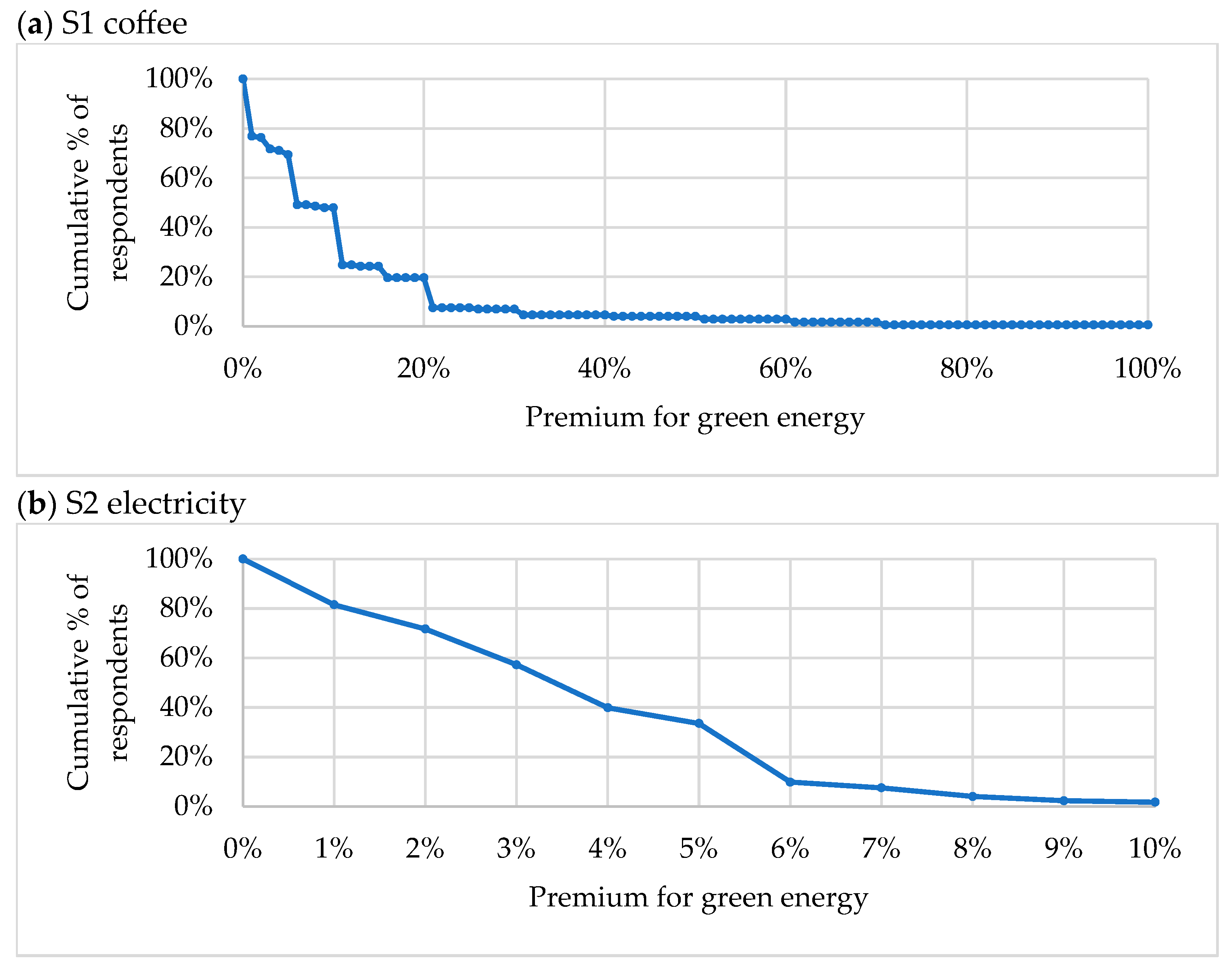
Based on scenario 1 (coffee) in
Figure 1a, we present the cumulative percentage of respondents (vertical axis) willing to pay a certain amount of premium for green energy (horizontal axis). On the vertical axis, the maximum value is 100%, since this represents the total sample size (i.e., all observations). On the horizontal axis, the maximum value is 100%, as this was the maximum amount provided by respondents (premium for a favorite coffee drink prepared exclusively with renewable energy). We notice that 69% of the respondents are willing to pay at least 5% more for a favorite coffee drink prepared exclusively with renewable energy. We also notice that 48% of the respondents are willing to pay at least 10% more, while only 5% of the respondents are willing to pay at least 40% more. Accordingly, in
Figure 1b we present our findings on the basis of Scenario 2 (electricity). On the vertical axis, the maximum value is 100%, as this represents the total sample size (i.e., all observations). On the horizontal axis, the maximum value is 10%, as this was the maximum amount provided by respondents (premium for electricity supplied from renewable sources). We observe that 82% of respondents are willing to pay at least 1% more for energy supplied from renewable sources, while only 34% of respondents are willing to pay at least 5% more for it.
We go into further details, and in
Table 2 we present descriptive statistics for each scenario (S1–S4) in the three sub-samples formed by the CNS criterion (Low–low connectedness to nature, Average–average connectedness to nature, High–high connectedness to nature). In each scenario, the average WTP increases steadily from the low CNS group through the average CNS group up to the high CNS group. Similar observations apply to the median WTP (but for Scenario 4 in which the average CNS and the high CNS groups have the same median WTP).
In
Table 3, we further explore the relationship between the level of CNS and the WTP for green energy. We verify research hypothesis #2 by looking at differences between median scores in three levels of CNS (low, average, high) separately for each scenario. We compare higher levels of CNS with lower levels of CNS and expect positive and statistically significant differences between median responses. Statistical inferences are based on two-sample Wilcoxon rank–sum (Mann–Whitney) tests. In all cases, the differences between median answers in the ‘high’ group (CNS High) and the ‘low’ group (CNS Low) are positive and statistically significant (for S1 the difference is 9.5% with
p-value = 0.0002; for S2 the difference is 3% with
p-value < 0.0001, for S3 the difference is PLN 5.00 with
p-value = 0.0001; for S4 the difference is PLN 3.5 with
p-value = 0.0797).
Therefore, our results support research hypothesis #2: the level of connectedness to nature determines the level of willingness to pay for green energy. A high level of CNS corresponds to a high WTP for green energy. Similarly, a low level of CNS corresponds to a low WTP for green energy.
We further look at the differences between median answers in the ‘high’ group (CNS High) and the ‘average’ group (CNS Average) and observe similar results. In the case of the differences between median answers in the ‘average’ group (CNS Average) and the ‘low’ group (CNS Low), in one case (Scenario 4) the difference is not statistically significant.
We also analyze the association of tipping behavior with WTP for green energy. In
Table 4, we present descriptive statistics for each scenario (S1–S4) in the two subsamples formed on the basis of the tipping criterion (Yes—subject does tip, No—subject does not tip). In each case, tipping subjects display higher average WTP for green energy. Similarly in Scenarios 1, 2, and 3 tipping subjects display higher median willingness to pay (in the case of Scenario 4, medians are identical).
In
Table 5, we further explore the relationship between the tipping attitude and the WTP for green energy. We verify research hypothesis #3 by looking at the differences between median scores in two groups: tipping subjects and nontipping subjects separately for each scenario. We expect positive and statistically significant differences between median responses. Statistical inferences are based on a two-sample Wilcoxon rank–sum (Mann–Whitney) test. In three scenarios (S1–S3) the differences between median answers are positive and statistically significant (for S1 the difference is 5.0 percentage points with
p-value = 0.0952; for S2 the difference is 1 percentage point with
p-value = 0.0435, for S3 the difference is PLN 3.00 with
p-value = 0.0005). Only in the case of scenario 4 is the difference not statistically significant. Summing up, although the empirical results are not fully consistent across all scenarios, we claim that subjects that would tip at the same time are willing to pay more for green energy.
Our results support research hypothesis #3: the attitude towards tipping is associated with the willingness to pay for green energy.
We also identify subjects who are unwilling to pay for green energy (40 subjects for Scenario 1, 32 subjects for Scenario 2, 53 subjects for Scenario 3, 30 subjects for Scenario 4) and subjects who do not want to tip (50 subjects in total). There are 10 subjects who are unwilling to pay more in any case (neither green energy nor tip). Similarly, we observe subjects who both want to pay for green energy and want to tip. Therefore, we further analyze the relationship between the tipping attitude and WTP for green energy. In all scenarios, the relationship is statistically significant, the highest for Scenarios 1 and 2 (
Table 6). Therefore, we conclude that people who tip are also willing to pay for green energy. This is consistent with the assumption that people who want to share their resources do so in various situations.
5. Discussion and Conclusions
The aim of this paper is to examine Generation Z’s attitudes towards paying a premium for using products and services manufactured with green energy. The findings of this study provide evidence that Generation Z is willing to pay more for energy derived from renewable sources, thereby supporting all three hypotheses.
A substantial majority of respondents (ranging from 69% to 82%) expressed readiness to incur additional costs when purchasing products or services powered by green energy. This applies to everyday expenses such as buying coffee, paying electricity bills, or accepting optional carbon offset offers for train travel. These outcomes confirm research hypothesis #1: Generation Z exhibits a positive willingness to pay a premium for green energy. However, the average willingness to pay (WTP) varied by context: respondents indicated a 10.5% premium for coffee prepared using green energy, compared to only 3.1% for green electricity used at home. This suggests that while pro-environmental attitudes are widespread among the sample, the degree of financial commitment depends on the specific context—shigher relative premiums are more acceptable for low-cost discretionary items (e.g., coffee in a café), while lower premiums are tolerated for recurring or high-cost services (e.g., electricity). There are several theories that collectively may provide a comprehensive explanation for the difference between the size of the premium declared by the respondents: transaction cost theory [
38] and mental accounting theory [
39,
40].
Transaction cost theory may explain that price is not the only factor that influences a purchase decision. Buying a favorite drink is a rather effortless and pleasant experience and does not require any mundane actions, such as going through a contract with numerous pages (as in the case of delivery of electricity). Moreover, going into a café is a one-time action that does not have future financial consequences, contrary to an electricity contract that will last for the whole year and will lead to regular cash outflows. If a consumer is dissatisfied with a green drink, they can easily switch to another option, which is not the case with the electricity contract. In summary, the transaction costs of buying a coffee in a café are lower than the transaction costs of buying electricity. Therefore, respondents are more eager to pay a higher percentage premium on green coffee than on green electricity.
The differences in WTP a green premium between product types observed in our study can also be explained using mental accounting theory. According to this framework, consumers categorize expenditures into separate mental budgets, each with its own evaluative standards. Applying this perspective, green electricity for the home likely falls into a utilitarian budget category, where even small price increases are closely scrutinized. In contrast, products like coffee in a café are evaluated within discretionary or hedonic budgets.
Furthermore, while respondents are willing to offset the carbon footprint of a train trip, they are willing to pay three times more to plant a tree. The latter has a visible and material effect. Such environmental effects are preferable. The preference for tree planting over carbon offsetting can be interpreted through the psychological distance theory, which holds that people are more likely to engage with actions that feel close and concrete [
41]. Although our survey did not specify when or where the tree would be planted, respondents may have perceived it as a more tangible and meaningful act. Carbon offsetting, by contrast, remains abstract and technically mediated.
In line with research hypothesis #2, the level of connectedness to nature determines the level of willingness to pay for green energy. Higher levels of CNS correspond to higher levels of WTP for green energy. In particular, higher levels of CNS are associated with a higher median willingness to pay for coffee prepared exclusively with green energy. In the group of respondents that is characterized by a high CNS, the median WTP is 2.5 percentage points higher than in the group of respondents that is characterized by a medium CNS and 9.5 percentage points higher than in the group of respondents that is characterized by a low CNS. The differences between the medians are statistically significant. A stronger emotional and cognitive bond with nature translates into a greater willingness to financially support environmental initiatives.
Research hypothesis #3 was also confirmed: the attitude towards tipping is associated with the willingness to pay for green energy. This association suggests that the willingness to financially support pro-environmental actions may be part of a broader prosocial orientation. For example, the statistically significant 5-percentage points difference between median willingness to pay for coffee prepared exclusively with green energy discriminates the tipping (median of 10%) and nontipping (median of 5%) group. Although the effect size varied between scenarios (1 percentage point difference for electricity and PLN 3 difference for a train trip), the pattern reinforces the behavioral connection between generosity in everyday interactions and willingness to contribute to sustainability. Collectively, these results present Generation Z as a cohort that not only expresses pro-environmental values, but is also willing to act on them financially, particularly when such an action aligns with their values and emotional ties to nature.
The results of our study offer practical implications and actionable insights into three areas: marketing communication strategies, public policy and regulation, environmental education, and engagement.
First, our results confirm that individuals with higher levels of CNS are more willing to pay a premium for green energy. This suggests that marketing efforts should be segmented based on ecological identity, and messages should be tailored accordingly. Communications targeting Generation Z should emphasize emotional and cognitive bonds with nature. This could be achieved through storytelling, green branding, and loyalty programs with an environmental focus. These marketing strategies can strengthen the logical cause-and-effect relationship chain proposed by the VBN theory, linking personal values and ecological awareness with pro-environmental norms and ultimately with desired behavior manifesting in higher WTP for green energy. Therefore, given the relatively low WTP for green electricity at home, the messaging in this context should go beyond pricing and emphasize value-based appeals. For example, campaigns may highlight the long-term environmental benefits of using renewable energy, the collective impact of such choices, or the role of consumers in supporting an energy transition. This can be enhanced through transparent communication about how green energy purchases contribute to measurable outcomes, such as reductions in carbon dioxide emissions or financial support for local ecological initiatives. In addition, companies can consider a bundle pricing strategy (green electricity with sustainable coffee brands or green-certified restaurants), leveraging the higher WTP observed in lifestyle-related scenarios. Clear labeling and verification (e.g., carbon offsets, traceable sourcing, green certifications) can further support consumer trust and motivation. Additionally, pricing strategies could reflect young consumers’ sensitivity to the level of the premium: lower percentage markups may be acceptable for recurring or high-cost expenditures (e.g., electricity), while higher premiums might be tolerated for smaller, everyday items (e.g., coffee).
Second, our results are also valuable for public policy design. Governments could implement legislation on mandatory disclosure of the origin and certification of renewable energy. That would increase the transparency and integrity of companies’ actions. Governmental supervision might also be necessary to ensure that sustainability claims are verified, thereby mitigating risks of greenwashing and reinforcing trust.
Third, our findings prove the role of environmental education in shaping WTP for green energy. Given that a CNS is positively associated with WTP (higher CNS is associated with higher WTP), educational programs should cover a great range of topics associated with biology and ecology. Such changes in curricula may have a long-term behavioral impact. However, one of the requirements would be to use digital technology that aligns with Generation Z preferences (applications, gamification, social media challenges). For example, university instructors could use online platforms to teach environmental topics to strengthen their ecological identity. Such initiatives could activate the logical cause-and-effect chain of VBN and contribute to broader sustainability transitions.
Although the findings offer useful contributions, the study has several limitations. The sample consisted of university students in Poland, a segment of Generation Z that may be well suited to studying environmentally aware and economically empowered future consumers within a stable EU economy. However, it remains a relatively homogeneous group, particularly in terms of education (all participants study at the same university that specializes in economics education), which may limit the generalizability of the findings to the wider Generation Z population. Furthermore, the WTP data were based on hypothetical scenarios and self-reported declarations, which can lead to overestimated values due to social desirability bias. As is common in WTP research, there may be a potential gap between stated intentions and actual behavior when financial trade-offs are real. We also used different ceilings for maximum premiums possible to declare by participants. This reflects the disparity between product types and associated cash outflows: a café drink represents a minor, one-time discretionary expense, whereas an electricity contract constitutes a substantial, recurring necessity, with a single bill potentially 10 times the cost of a drink.
Based on these findings, several directions for future research can be proposed. First, studies could explore actual purchasing behavior in real-world or experimental settings where participants spend their own money. Such approaches would help verify whether the declared WTP is reflected in real consumer decisions. Second, future research could incorporate cross-cultural perspectives, to examine how WTP for green energy varies across different educational, cultural, and economic contexts. Third, longitudinal studies could track how WTP changes over time as members of Generation Z age, experience changes in life circumstances, and gain greater purchasing power. Additional studies might also investigate other indicators of prosocial orientation, such as volunteering or charitable donations, and their relationship with green energy WTP. Finally, future work could explore whether structured educational activities or direct nature experiences can enhance CNS levels and, in turn, increase the willingness to financially support sustainable practices.
Taken together, the results of this study offer a behavioral perspective on the role of Generation Z in the transition towards widely accepted and socially supported forms of green energy.