Article

Sustainable Synchronization of Truck Arrival and Yard Crane Scheduling in Container Terminals: An Agent-Based Simulation of Centralized and Decentralized Approaches Considering Carbon Emissions

by
Veterina Nosadila Riaventin
1,2,3,*,
Andi Cakravastia
1,2,3,
Rully Tri Cahyono
1,2,3 and
Suprayogi
1,2,3
1
Industrial Engineering Program, Faculty of Industrial Technology, Bandung Institute of Technology, Bandung 40132, Indonesia
2
Research Group of Industrial System and Techno-Economics, Bandung Institute of Technology, Bandung 40132, Indonesia
3
Center for Logistics and Supply Chain Studies, Bandung Institute of Technology, Bandung 40132, Indonesia
*
Author to whom correspondence should be addressed.
Sustainability 2024, 16(22), 9743; https://doi.org/10.3390/su16229743
Submission received: 25 September 2024 / Revised: 21 October 2024 / Accepted: 1 November 2024 / Published: 8 November 2024
(This article belongs to the Collection Sustainable Freight Transportation System)

Abstract

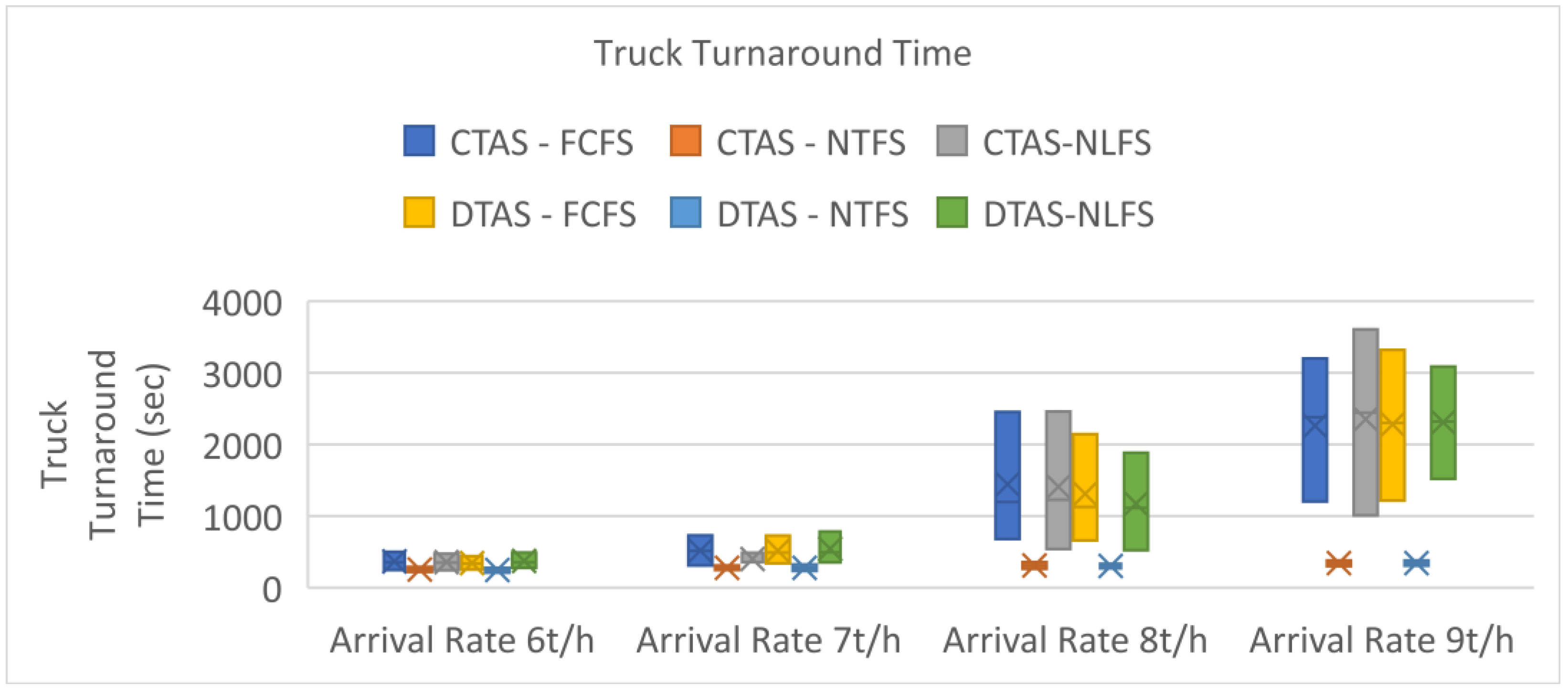
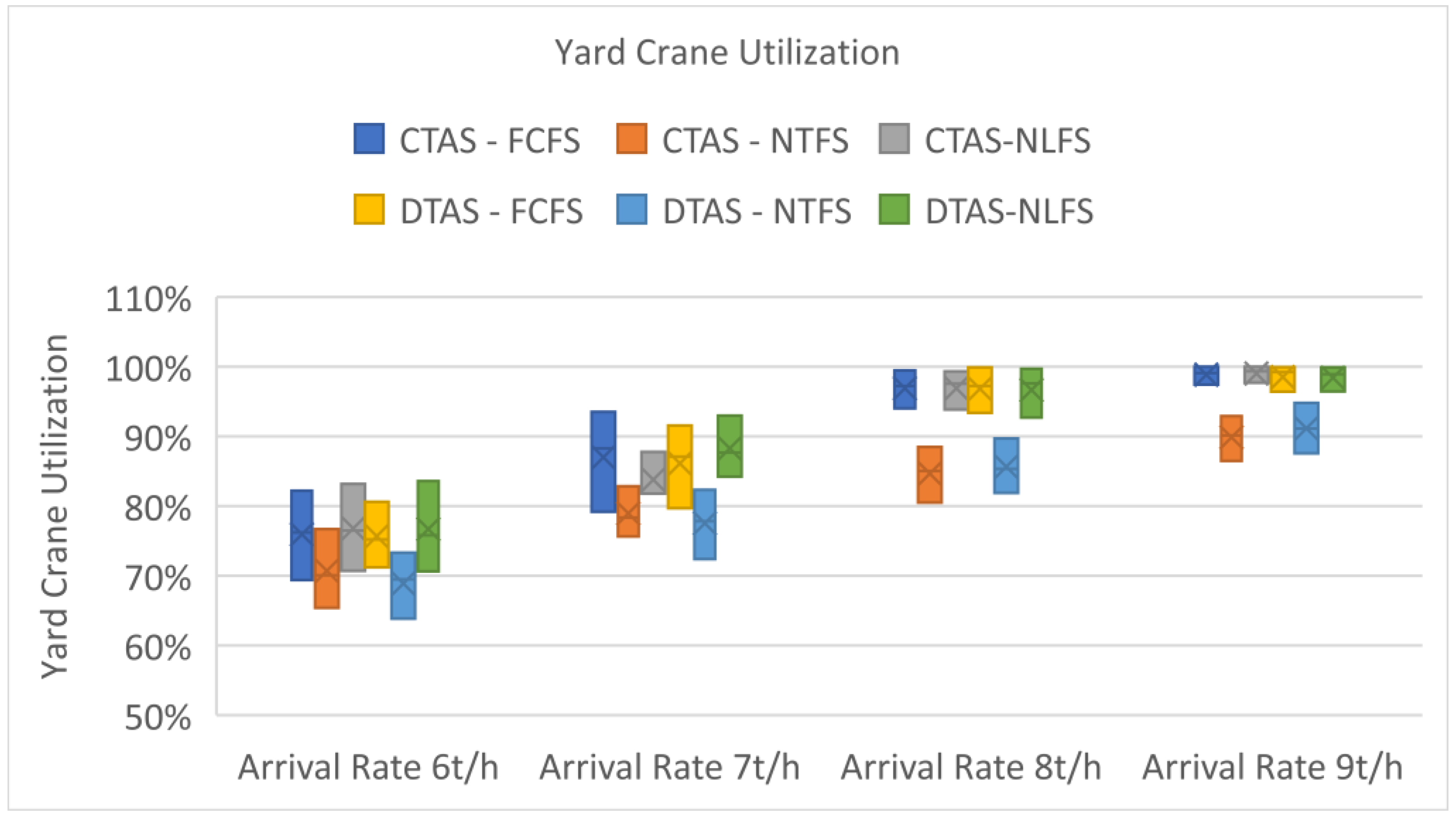
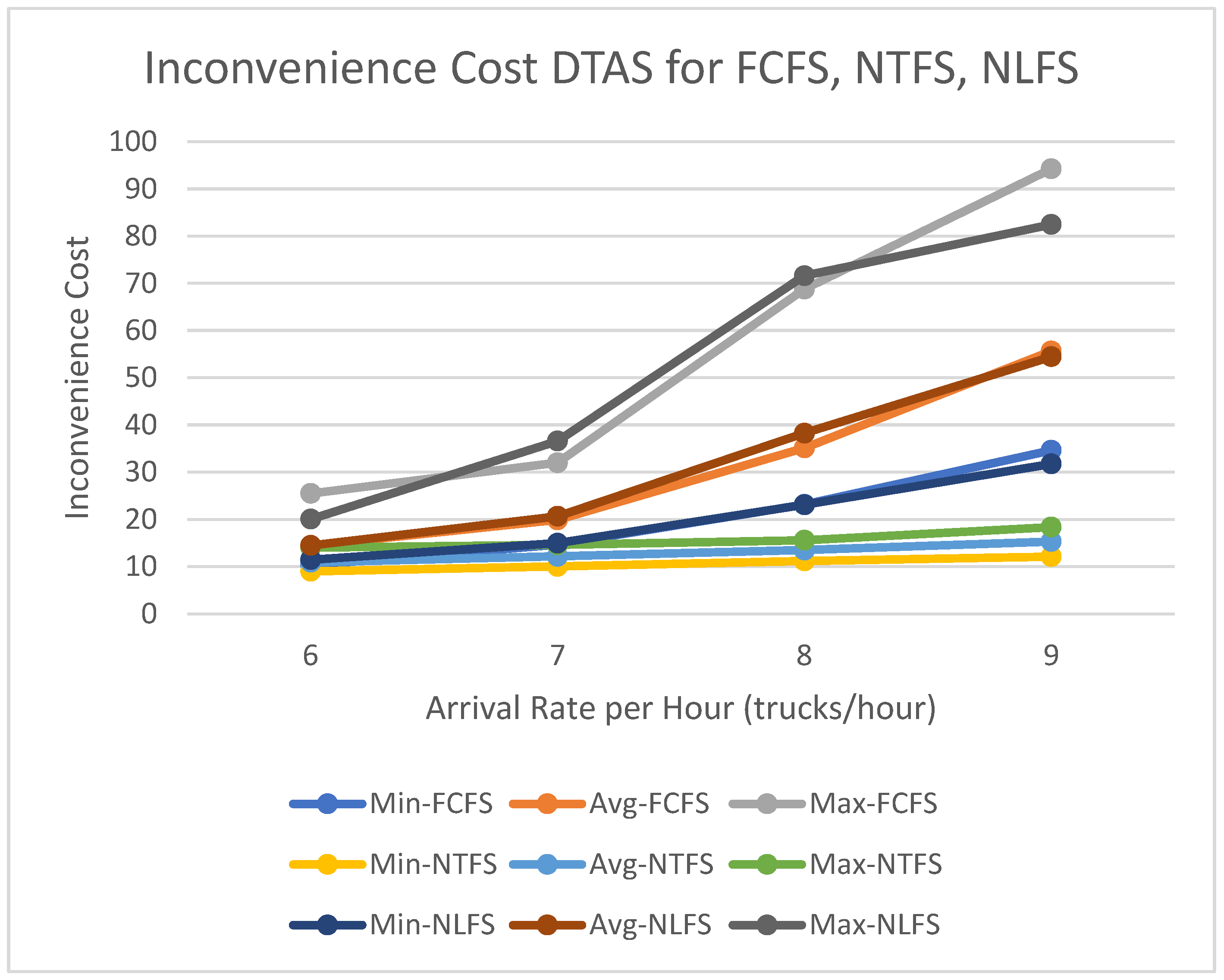
Background: Container terminal congestion is often measured by the average turnaround time for external trucks. Reducing the average turnaround time can be resolved by controlling the yard crane operation and the arrival times of external trucks (truck appointment system). Because the truck appointment system and yard crane scheduling problem are closely interconnected, this research investigates synchronization between the approaches used in truck appointment systems and yard crane scheduling strategies. Rubber-tired gantry (RTG) operators for yard crane scheduling operations strive to reduce RTG movement time as part of the container retrieval service. However, there is a conflict between individual agent goals. While seeking to minimize truck turnaround time, RTGs may travel long distances, ultimately slowing down the RTG service. Methods: We address a method that balances individual agent goals while also considering the collective objective, thereby minimizing turnaround time. An agent-based simulation is proposed to simulate scenarios for yard crane scheduling strategies and truck appointment system approaches, which are centralized and decentralized. This study explores the combined effects of different yard scheduling strategies and truck appointment procedures on performance indicators. Various configurations of the truck appointment system and yard scheduling strategies are modeled to investigate how those factors affect the average turnaround time, yard crane utilization, and CO2 emissions. Results: At all levels of truck arrival rates, the nearest-truck-first-served (NTFS) scenario tends to provide lower external truck turnaround times than the first-come-first-served (FCFS) and nearest-truck longest-waiting-time first-served (NLFS) scenario. Conclusions: The decentralized truck appointment system (DTAS) generally shows slightly higher efficiency in emission reduction compared with centralized truck appointment system (CTAS), especially at moderate to high truck arrival rates. The decentralized approach of the truck appointment system should be accompanied by the yard scheduling strategy to obtain better performance indicators.
Keywords: agent-based simulation; decentralized; carbon emissions; synchronization; truck appointment system; yard scheduling strategy agent-based simulation; decentralized; carbon emissions; synchronization; truck appointment system; yard scheduling strategy