Article

An Attribution Analysis of Runoff Alterations in the Danjiang River Watershed for Sustainable Water Resource Management by Different Methods


1
College of Hydraulic Engineering, Zhejiang University of Water Resources and Electric Power, Hangzhou 310018, China
2
Key Laboratory for Technology in Rural Water Management of Zhejiang Province, Hangzhou 310018, China
3
Jinhua Survey and Design Institute of Water Conservancy and Hydropower, Jinhua 321017, China
4
State Key Laboratory of Soil Erosion and Dryland Farming on the Loess Plateau, Institute of Soil and Water Conservation, Chinese Academy of Sciences & Ministry of Water Resources, Yangling, Xianyang 712100, China
5
Institute of Soil and Water Conservation, Northwest A&F University, Yangling, Xianyang 712100, China
6
School of Architecture, Civil and Environmental Engineering, Ecole Polytechnique Fédérale de Lausanne, 1015 Lausanne, Switzerland
*
Author to whom correspondence should be addressed.
Sustainability 2024, 16(17), 7600; https://doi.org/10.3390/su16177600
Submission received: 9 July 2024 / Revised: 19 August 2024 / Accepted: 30 August 2024 / Published: 2 September 2024

Abstract

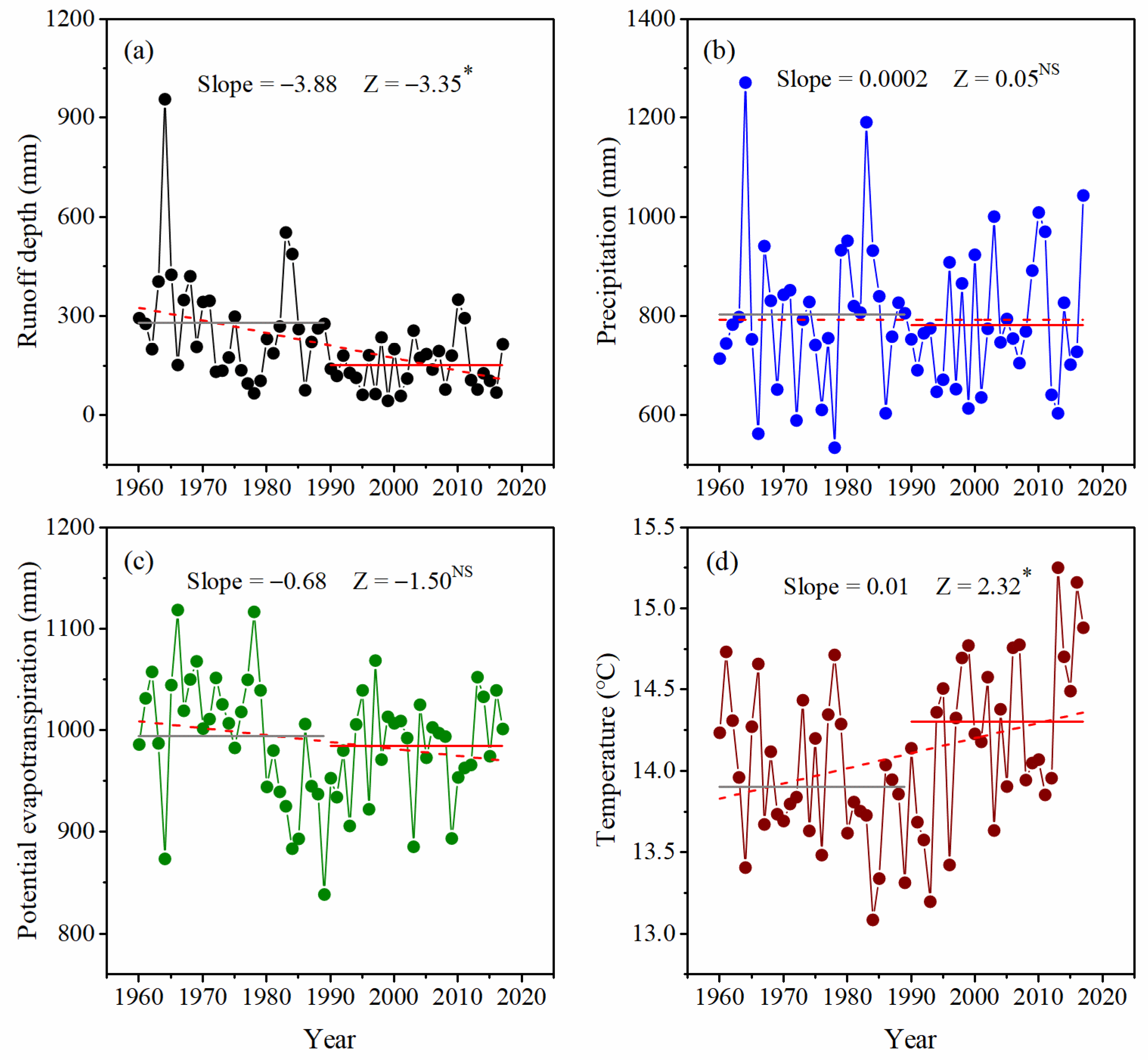
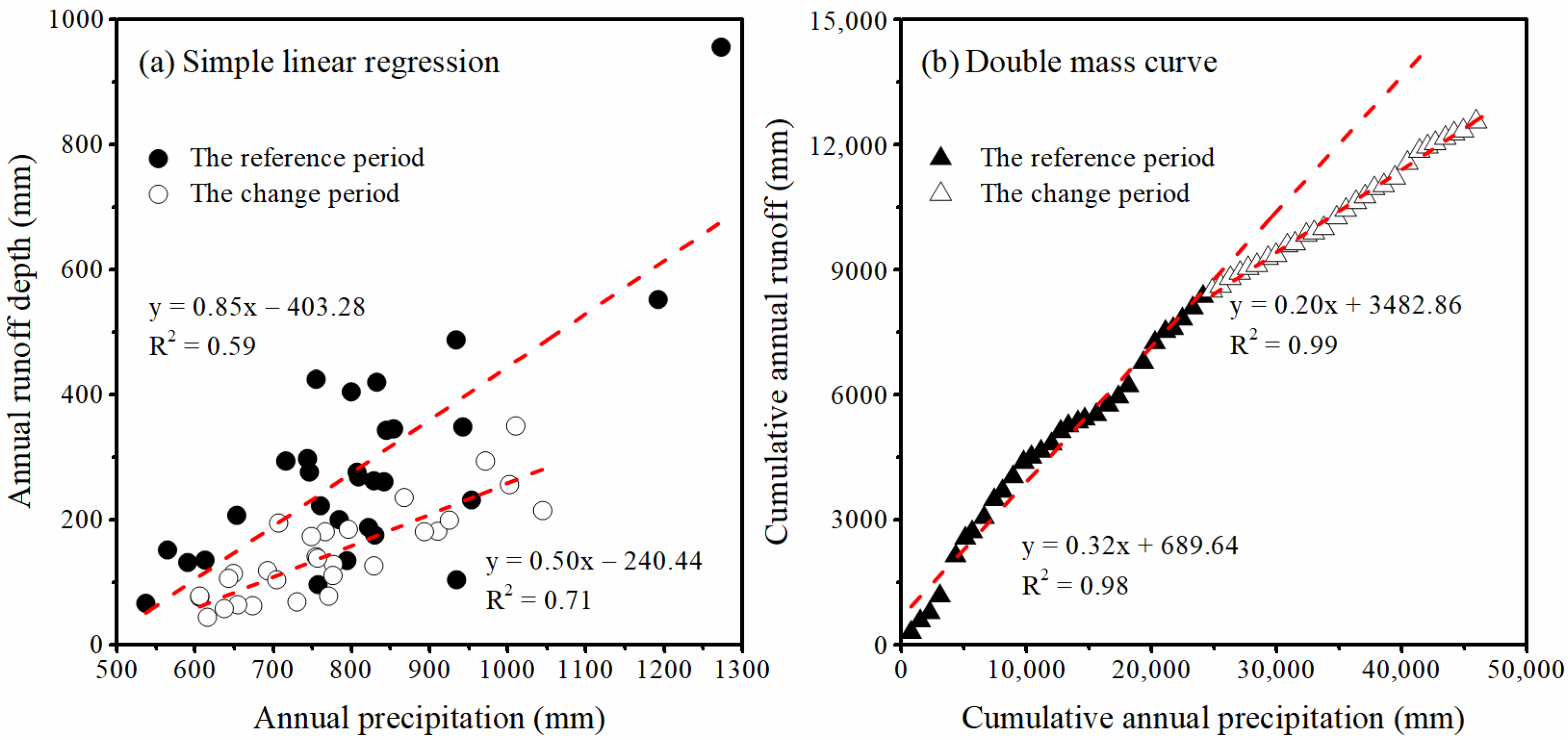
Determining the relative roles of climatic versus anthropogenic factors in runoff alterations is important for sustainable water resource utilization and basin management. The Danjiang River watershed is a crucial water resource area of the middle route of the South-to-North Water Transfer Project. In this study, four widely used quantitative methods, including the simple linear regression, the double mass curve, the paired year with similar climate conditions, and an elasticity method based on the Budyko framework were applied to detect the relative contribution of climatic and anthropogenic factors to runoff variation in the Danjiang River watershed. The calculation processes of each method were systematically explained, and their characteristics and applications were summarized. The results showed that runoff decreased significantly (p < 0.05) with an average change rate of −3.88 mm year−1 during the period of 1960–2017, and a significant change year was detected in 1989 (p < 0.05). Generally, consistent estimates could be derived from different methods that human activity was the dominant driving force of significant runoff reduction. Although the impacts of human activity estimated by the paired year with similar climate conditions method varied among paired years, the other three methods demonstrated that human activity accounted for 80.22–92.88% (mean 86.33%) of the total reduction in the annual runoff, whereas climate change only contributed 7.12–19.78% (mean 13.67%). The results of this study provide a good reference for estimating the effects of climate change and human activities on runoff variation via different methods.
Keywords: runoff; climate change; human activity; the Danjiang River watershed runoff; climate change; human activity; the Danjiang River watershed