Article

Biodiversity and Resilience to Tsunamis in Chilean Urban Areas: The Role of Ecoinformatics

by
Mariana Brüning-González
1,2,*,
Paula Villagra
3,4 and
Horacio Samaniego
2,5
1
Programa de Doctorado en Ciencias Mención Ecología y Evolución, Escuela de Graduados, Facultad de Ciencias, Universidad Austral de Chile, Campus Isla Teja, Valdivia 5090000, Chile
2
Laboratorio de Ecoinformática, Instituto de Conservación, Biodiversidad y Territorio, Universidad Austral de Chile, Campus Isla Teja, Valdivia 5090000, Chile
3
Laboratorio de Paisaje y Resiliencia Urbana (PRULAB), Valdivia 5090000, Chile
4
Instituto de Ciencias Ambientales y Evolutivas, Facultad de Ciencias, Universidad Austral de Chile, Campus Isla Teja, Valdivia 5090000, Chile
5
Instituto de Conservación, Biodiversidad y Territorio, Universidad Austral de Chile, Valdivia 5090000, Chile
*
Author to whom correspondence should be addressed.
Sustainability 2023, 15(9), 7065; https://doi.org/10.3390/su15097065
Submission received: 1 February 2023 / Revised: 10 April 2023 / Accepted: 14 April 2023 / Published: 23 April 2023

Abstract

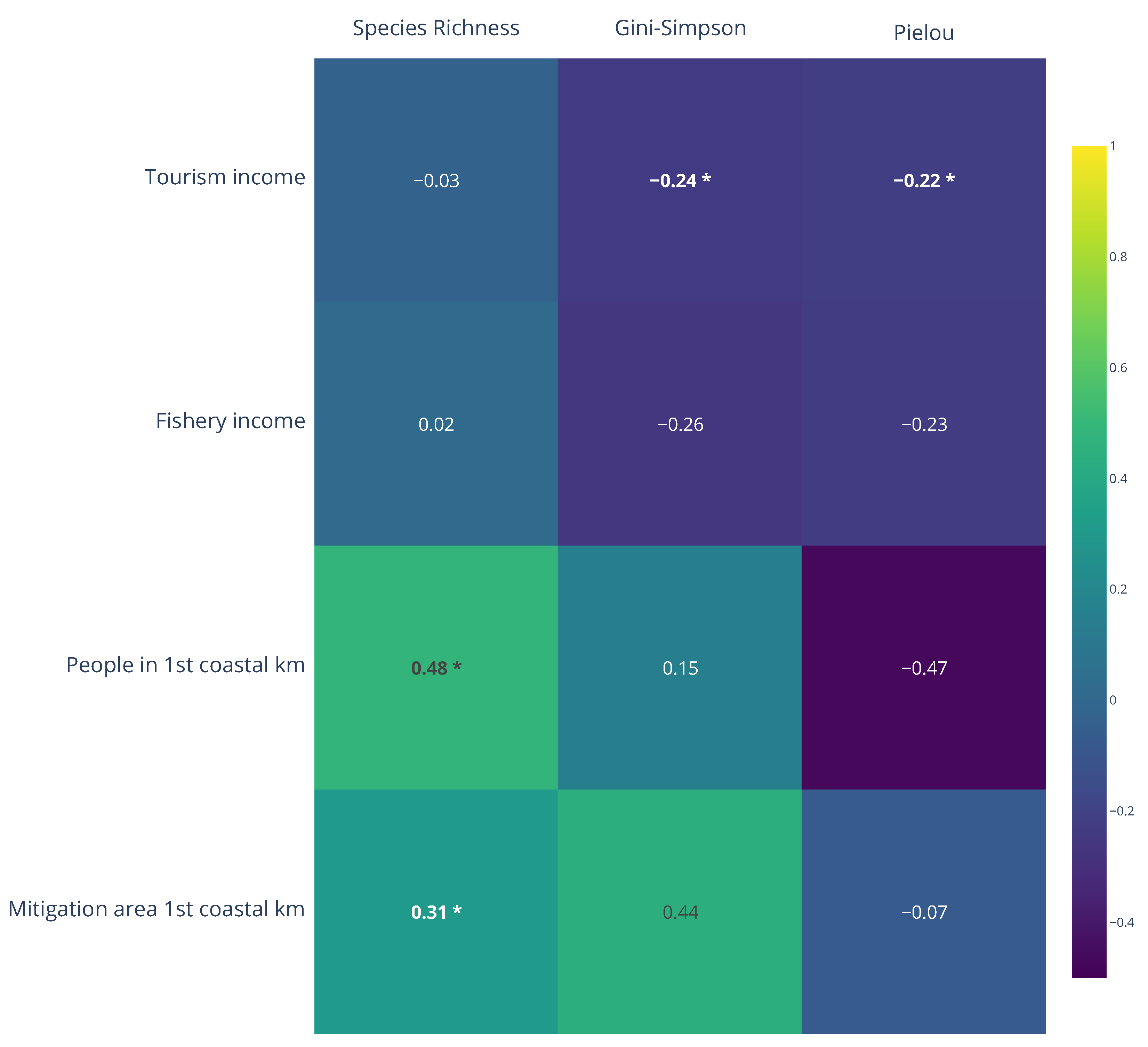
By definition, a smart city must improve its readiness for extreme events in order to confront the growing unpredictability of natural disasters. Doing this implies planning for resilience. That is, to enhance our capacity to cope, mitigate, adapt, and rebuild human settlements after a catastrophic event. Although scholars have argued that biodiversity can enhance resilience, there is a dearth of empirical research that specifically addresses this crucial issue. This research analyzes Nature’s Contributions to People related to tsunami resilience. Then, the relationship between biodiversity and community resilience indexes is examined for 50 coastal Chilean cities that are prone to tsunamis, using biodiversity data from an open access database. The resilience index “population living in the first kilometer from the shoreline” was found to be correlated with species richness (p = 0.48) and the evenness biodiversity index, Pielou (p = −0.47). These results suggest that biodiversity data availability is crucial for understanding nature’s contribution to human settlement resilience. Although this study was hindered by limited data availability, the potential use in other contexts remains valuable for the development of smart cities. The study highlights the need for increased biodiversity data collection on a national scale and emphasizes the use of ecoinformatics to create smart cities that can effectively respond to climate uncertainty in coastal urban areas.
Keywords: biodiversity; community resilience; tsunami; nature’s contributions to people; smart city; ecoinformatics biodiversity; community resilience; tsunami; nature’s contributions to people; smart city; ecoinformatics