Abstract
The study aimed to discover the factors influencing the purchase intention and purchase behaviour of customers for green footwear in the context of Saudi Arabia. The study used the theory of planned behaviour constructs, which was extended with two more variables, environmental consciousness, and health consciousness. It investigated the influence of health consciousness on green purchase intention and attitudes, as well as the influence of environmental consciousness on attitude, subjective norms, perceived behavioural control, and green purchase intention and behaviour of the customers. The results were drawn from empirical data collected from 419 respondents in Saudi Arabia by administering a structured questionnaire. The research model investigated the relationships among constructs by using a structural equation modelling approach. The results show that environmental consciousness influenced attitude, subjective norms, perceived behavioural control, and green purchase intention and behaviour. On the other hand, health consciousness influenced attitudes but showed no significant relationship with the green purchase intention of the customers. Furthermore, environmental consciousness, perceived behavioural control, attitude, and subjective norms showed a statistically significant relationship with green purchase intention for green footwear; however, perceived behavioural control failed to influence green purchase behaviour. The current study is the first of its kind on green footwear using the theory of planned behaviour. Additionally, this is the first study to be conducted in the context of Saudi Arabia. The originality of the study is reflected in the extension of the theory of planned behaviour model with the two constructs of environmental consciousness and health consciousness.
1. Introduction
The increased consumption of goods and services has depleted natural resources and severely damaged the environment. Global warming, environmental degradation, pollution, and decline in flora and fauna are some of the serious consequences of environmental damage [1]. These issues have led to increased environmental concerns among major stakeholders; one such change is the consumer purchasing behaviour towards organizations, which encouraged the latter to engage in sustainable practices [2]. Customers’ increasing demand for environmentally friendly products and services has led organizations to become proactive in sustainable practices [3]. These environmental problems may be solved by transforming human behaviour in a more environmentally sustainable way [4,5]. The consumption habits of people need to change urgently in order to maintain a safer and healthier lifestyle for the present and future generations [6,7,8]. In fact, sustainable consumption behaviour (approaching, purchasing, and consuming products in an environmentally friendly manner) is considered to be an indispensable requirement for promoting sustainable development [4,9,10].
Green purchasing behaviour refers to buying environmentally friendly products and avoiding those detrimental to it [11]. A green product satisfies needs without environmental impairment, hence contributing towards a highly sustainable planet [12]. These products have a lower impact on the environment and are environmentally protective towards nature. They use recyclable materials, are presented in less packaging, and use materials that are safer to the environment [1]. Eco-friendly washing machines, plant-based products, energy-saving light bulbs, and organic products are some examples of green products. Green purchasing is measured as the intention and behaviour of buying green products; intention refers to a consumer’s willingness to buy green products. Intention is the motivational factor that influences the buying behaviour of green products [13].
In recent decades, environmentally sustainable consumption behaviours have become a crucial topic in the consumer market and research due to environmental issues [14,15,16]. Research has focused on a variety of products and services, such as purchase intentions and the behaviour of purchasing organic food, cloths, electric vehicles, and green furniture. Xu et al. [10], investigated green furniture purchase intention, using the theory of planned behaviour (TPB). Several studies investigated the intention of visitors to stay in green hotels [17,18,19]. Joshi and Rahman [20], studied important factors in green purchase behaviours (GPBs), and Bashir et al. [21], extended TPB to visitors’ behaviour in green hotels. Wang et. al. [22], using TPB, predicted the user’s intention to acquire electric vehicles. Yadav and Pathak [23], studied the intention to purchase organic food. In order to develop a sustainable planet, more products, services, and industries need to engage in sustainable business practices. There is also a need to convince the mass of consumers to use green products regularly. One such product used by every individual is footwear. The clothing and footwear industry heavily pollutes the environment in the manufacturing process and disposal of waste [24,25,26]. At present, major footwear and clothing producers, such as Adidas, Nike, H&M, and Zara, have added products containing sustainable materials, such as organic cotton, to their collections [27]. They are producing green footwear using recyclable materials, presented in less packaging, and the materials used are safer to the environment [1]. Since footwear is used by everyone irrespective of gender, age, income, education, and development stage, if everyone starts using green footwear, it may have vast positive effects on environment protection. Not only are the producing countries important in this matter; the consumers at the global level should also be aware and use green footwear to reduce the damage to the environment. In spite of footwear being used by every individual, consumer behaviour regarding green footwears has not been sufficiently investigated by researchers.
Saudi Arabia is one of the largest countries in the Middle East, with a population of 35.9 million people, with a per capita income of USD 44,300 [28], and a growing economy. The Saudi government aims to revamp its economic influx of non-ecologically friendly products through a greener economy. The consumers and markets in Saudi Arabia have become increasingly aware of the growing effects of global warming due to non-degradable products; therefore, they have opted to side-step non-biodegradable goods for green products and services [29]. The vision of the green initiatives of Saudi Arabia and the Middle East is a greener future and better quality of life. Saudi Arabia aspires to enhance quality of life and safeguard future generations at home and beyond its borders. Working toward this goal, the Kingdom of Saudi Arabia brought together government ministries, private sector entities, and foreign leaders under dual green initiatives to identify and deliver on opportunities to rapidly achieve climate action. To achieve its sustainable initiates, the people of the country must also actively appreciate, accept, and practice sustainable behaviour in their day-to-day lives. This study is important as it fills the literature gap by adding another instance to the literature of sustainable consumption. The study is also important because the findings will help in understanding the factors that may influence the purchasing behaviour of green footwear, thus promoting the use of green footwear, which will eventually lower the negative impact on the environment locally as well as globally.
2. Review of the Literature
2.1. Environmental Consciousness (EC)
In the pro-environmental literature, researchers have emphasized the importance of EC as a significant measure in predicting an individual’s ecological friendly behaviour. EC indicates “the extent to which individuals are conscious of environmental issues and are ready to support steps to eradicate these issues and demonstrate the readiness to personally contribute to the solution” [30,31,32]. Recently, a large number of customers has become environmentally conscious due to the considerable damage that has been inflicted on the environment and the growth of environmental activities to protect the environment. Consequently, consumers’ environmentalism has gained significance [33,34]. According to Kim and Seock [35], EC significantly influences the attitude of the consumers for natural beauty products. Many scholars have suggested that EC generally has an indirect impact on sustainable behaviours, and it affects behaviour indirectly through other factors [22,36,37]. To support this view, Bamberg [38], surveyed 380 students in various universities to demonstrate that EC can indirectly affect behavioural intention. The results revealed that EC indirectly influences behavioural intention through TPB constructs, namely, attitude, subjective norms (SN), and perceived behavioural control (PBC); hence, in this study, the researchers propose the following hypotheses:
Hypothesis (H1).
EC has a positive relationship with attitude.
Hypothesis (H2).
EC has a positive relationship with SN.
Hypothesis (H3).
EC has a positive relationship with PBC.
In another study, Chen and Tung [37], created an extended TPB model to forecast the visitors’ intention in staying at green hotels that incorporated EC. Saari et al. [39], found that EC strongly influences behavioural intention, which, in turn, acts as a mediator for sustainable consumption behaviour. They discovered that EC impacted TPB factors positively. Other studies have also discovered that EC directly influences consumers’ green purchase behaviour (GPB). A study conducted in India by Jaiswal and Kant [30], found that EC directly and positively influenced GPI. Pagiaslis and Krontalis [40], noted that customers’ green purchase intention (GPI) was directly and significantly impacted by EC. According to Smith and Paladino [41], the intention to purchase organic food was greatly influenced by EC. Based on the above discussion, the current study proposes the following hypotheses:
Hypothesis (H4).
EC has a positive relationship with GPI.
Hypothesis (H5).
EC has a positive relationship with GPB.
2.2. Health Consciousness (HC)
HC is the seriousness with which an individual contemplates health concerns and the extent to which an individual integrates them into their day-to-day affairs [23,42]. According to Paul and Rana [43], consumers who are more conscious of health issues showed greater favourable attitudes toward purchasing eco-friendly products. Kim and Seock [35], found that health consciousness significantly influenced the importance placed on the attributes of beauty products. They showed that those with high levels of health consciousness are significantly more positive in their evaluation of their perceptions of natural beauty products. Cervellon and Carey [44], surveyed the motivational factors of Canadian and French consumers to purchase eco-friendly fashion and found that consumers’ health concern is considered as one of the prime factors driving the purchase of eco-friendly clothing. In terms of organic food consumption, many researchers found a positive impact of HC on consumer attitudes and intentions toward purchasing organic foods [23,41,45]. The foregoing literature shows that the health consciousness of consumers influences their attitude and purchase intention for sustainable products; hence, this paper proposes the following hypotheses:
Hypothesis (H6).
HC has a positive relationship with attitude.
Hypothesis (H7).
HC has a positive relationship with GPI.
2.3. Attitude
Attitude refers to one’s evaluation of specific behaviour, whether the behaviour is perceived favourably or unfavourably [46]. TPB advocates that if anyone develops a favourable attitude towards a particular behaviour, the chances of conducting that behaviour increase [47]. Ayar and Gürbüz [48], found that variables of planned behaviour theory, which are attitude, subjective norm, and perceived behaviour control, have statistically significant effects on sustainable consumption intentions, and intention has an effect on sustainable consumption behaviours. According to the study of Kotchen and Reiling [49], attitude was the dominant predictor of intention. In terms of green products and the environment, studies across different cultures have shown a positive relationship between consumers’ attitude and GPI [50]. Qin and Song [51], found green purchase behaviour and green transportation behaviour are mainly influenced by attitude. According to Birgelen et al. [52], positive attitudes toward protecting the environment increase the intention to buy beverages with environmentally friendly packaging. Wang et al. [22], also used TPB to forecast consumers’ intention to acquire electric vehicles. The results indicated that consumers’ attitudes significantly influence their adoption intention of hybrid electric vehicles. Based on the above discussion, the researchers propose the following hypothesis:
Hypothesis (H8).
There is a positive relationship between attitude and GPI.
2.4. Subjective Norms (SN)
Subjective norm is the second behavioural intention predictor in the TPB model. It is defined as a person’s perception of social pressure and expectations imposed by significant others who are important to a person and who have an influence on their behavioural intention [47]. In some situations, the approval or disapproval of friends, family, and others important to a person may impact their behavioural intention [53,54]. While researchers in various contexts proved the essential role of subjective norm in encouraging consumers to purchase green products, some researchers claimed an insignificant relationship exists among SN and GPI [55,56]. The findings of Varshneya et al. [56], suggested that consumers’ purchase intentions of organic clothing are not affected by social influence. Thus, they suggested that this relationship needs further examination to be better understood. In the current study, the researchers investigated the impact of SN on GPI towards green footwear and the following hypothesis is proposed:
Hypothesis (H9).
SN has a positive relationship with GPI for green footwear.
2.5. Perceived Behavioural Control (PBC)
PBC is the third variable of the TPB model, commonly studied in predicting the purchase intention. Ajzen described PBC as the degree of difficulty or ease a person perceives in performing a specific behaviour [47]. A person’s behaviour may be affected by many external factors, such as opportunity, time, and money. Thus, the more control an individual has over these factors to conduct a distinct behaviour, the higher the chance of it being performed [37,47]. Past studies [57], divided the PBC factors influencing consumers’ attention to internal and external factors. A person’s behaviour may be internally controllable when a person believes that they have control over internal human resources, such as confidence, required skills, and ability to accomplish the behaviour. A behaviour may also be controlled by external factors, such as time, convenience, and availability, when it is perceived as uncomplicated to accomplish [58]. Earlier research has considered PBC as a direct predictor of intention as well as behaviour [59]. PBC has a direct link to intention as well as to behaviour towards green product consumption. Several studies have indicated the positive impact of PBC on intention in different contexts, such as green hotels [37], green household appliances [60], recycling [61], and consuming green products in general [62]. Based on the foregoing discussion, the following hypotheses are proposed:
Hypothesis (H10).
PBC has a positive relationship with consumers’ GPI.
Hypothesis (H11).
PBC has a positive relationship with consumers’ GPB.
2.6. Green Purchase Intention (GPI)
Ajzen identified intention as the readiness of an individual to conduct a specific behaviour. Moreover, intention is believed to be an immediate precursor to behaviour and is therefore considered the best predictor of behaviour [63]. In other words, depending on the strength of an individuals’ intention to perform the behaviour, the intention turns into actual behaviour. According to Mostafa [64], GPB refers to buying eco-friendly and sustainable products that can be easily recycled and do not harm the environment and society. Consumers’ behaviour to purchase green products is assessed by GPI [65]. Other research indicated a strong relationship between buying intention towards green products and purchase behaviour [30,66,67], while such relationships are not well understood in other studies, such as Kumar et al. [68], Yadav and Pathak [23], and Wei et al., [69]. From the above discussion, the following hypothesis is proposed:
Hypothesis (H12).
GPI has a positive relationship with GPB.
3. Research Framework
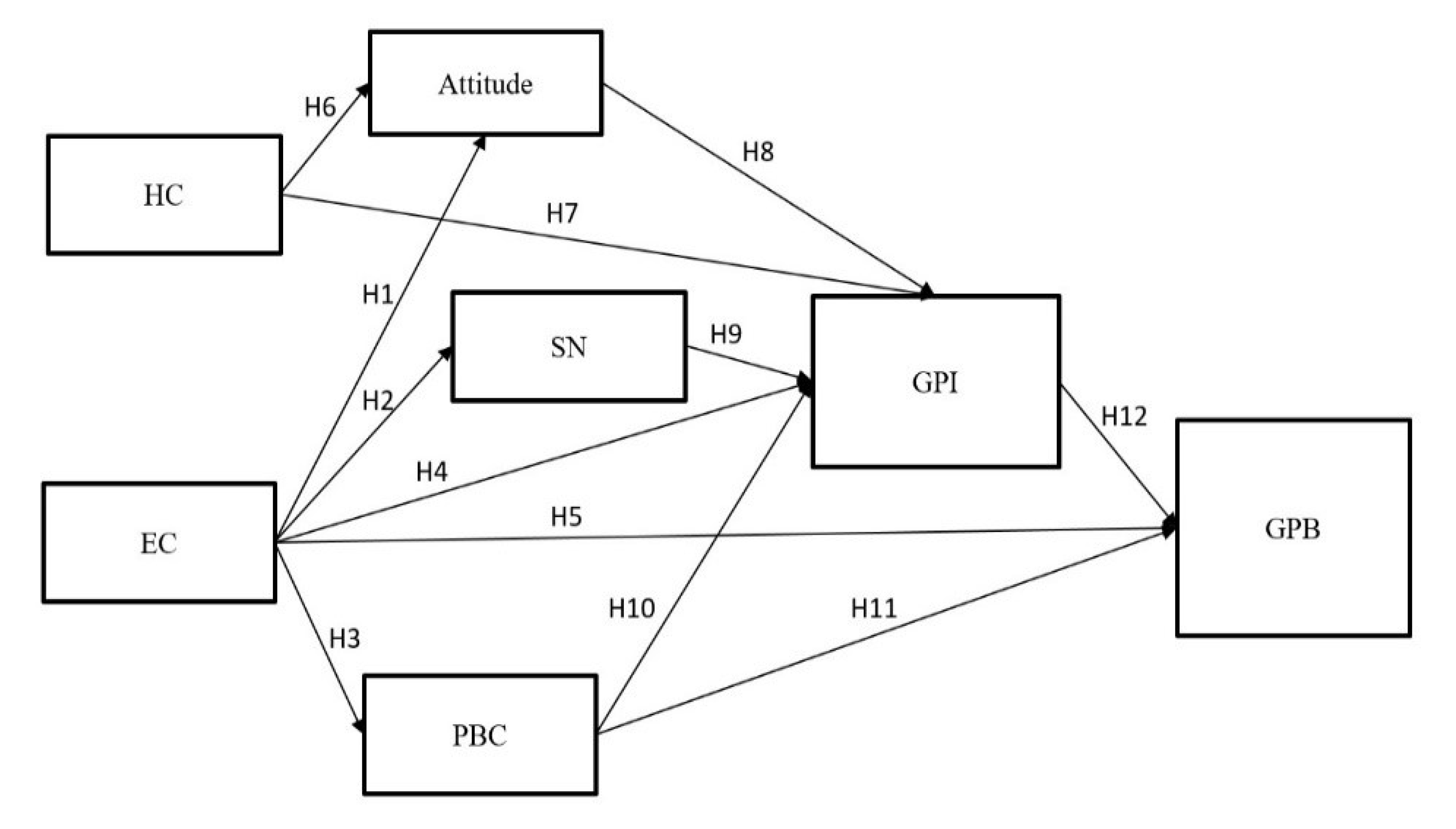
From the literature, the researchers developed a framework (Figure 1) to identify the objectives of the study. The current research was primarily based on the Theory of Planned Behaviour model proposed by Ajzen [47], extending it by adding the EC variable as an antecedent to attitude, SN, and PBC, which further influences the GPI for green footwear. The study also extended the model by investigating the influence of HC on attitude and GPI of green footwear.
Figure 1.
Proposed model of the purchase behaviour of green footwear.
4. Methodology
The TPB model variables (attitude, subjective norms, and perceived control behaviour) were used to study the GPI and GPB of respondents towards green footwear. The model was extended with EC and HC as explained in the research framework in Figure 1. Partial least squares structural equation modelling (PLS-SEM) was used to analyse the model.
4.1. Data Collection
The survey for the current study was administered entirely online by using Google Forms in July and August 2022. The survey cover letter contained descriptions of the research purpose and the meaning of green footwear. Additionally, the participants were guaranteed the confidentiality of their responses. The questionnaire was sent to the respondents by Telegram and WhatsApp. A total of 462 questionnaires were received; however, 43 were discarded as they were incomplete. The sample size of 419 was regarded to be appropriate and it fits the guidelines for using structural equation modelling [70]. The respondents’ demographic information, such as the gender, age, education, and monthly income, were collected and are depicted in Table 1. The demographics of the participants are shown in Table 1: 122 females and 297 males, about 75% of the respondents were aged between 20 and 40 years, and in terms of education level, more than half of them, 58.9%, have a bachelor’s degree. Therefore, the demographic profile of the respondents for this study indicated that most of the respondents were educated and young adults capable of understanding the topic [11] and thus were more likely to have GPB.
Table 1.
Demographics data of respondents (N = 419).
4.2. Questionnaire and Measurement
A structured questionnaire divided into two sections was used to collect data on the identified constructs as per the proposed model from respondents in Saudi Arabia. For a higher participation and better understanding of the questions, the questionnaire was translated into the Arabic language as the respondents were mainly Arabic speakers and a bilingual questionnaire was distributed. The first section included the demographic characteristics of the respondents, such as gender, age, education, and their monthly income. The questionnaire was distributed randomly through email and various WhatsApp groups in which the researchers were members. Additionally, students were contacted to fill it in by themselves and share it with their groups and contacts. The second section of the questionnaire contained the constructs and their indicators based on the existing measures or adapted from similar scales, as shown in Table 2. All the studied constructs in the survey questionnaire were measured by a 5-point Likert scale, from “1 = strongly disagree” to “5 = strongly agree”.
Table 2.
Adjusted statements to collect data.
The questionnaire included 33 items in total to assess attitude (6 items), SN (4 items), PBC (6 items), EC (6 items), HC (3 items), GPI (4 items), and GPB (4 items).
4.3. Data Analysis
Partial least squares structural equation modelling (PLS-SEM), using the Smart PLS 4 program [72], was used to validate the measures model developed and to test the hypotheses. This approach readily incorporates both reflective and formative measures and has less restrictive assumptions about the data [73,74,75]. For instance, PLS does not require a normal distribution since it uses bootstrapping to empirically estimate the standard error for its parameter estimates [76,77]. Therefore, normality in the distribution was not checked.
5. Results
5.1. Factor Loading, Reliability, and Validity
The factor loading for all items varied between 0.752 and 0.931, except for the fifth statement under PBC, which was 0.263. The statement was “I think green footwear is available in my life”, and it was removed. Reliability analyses examined the stability and consistency of the dimensions and items. Table 3 shows the Cronbach’s alpha values, which were greater than the threshold of 0.70 [78]. The values for all constructs were greater than 0.80, which is considered desirable [79]. Another measure of reliability, Rho_a, showed a high level of internal consistency, indicated by all values being greater than 0.8 [80]. The average variance extracted (AVE) for each dimension exceeded 0.5, which showed sufficient convergent validity for an item [81]. Table 3 presents the results for all the variables.
Table 3.
Factor loading, construct reliability, and average variance extracted.
5.2. Discriminant Validity
Discriminant validity means the degree to which the measures of two constructs are empirically distinct [82]. In other words, discriminant validity measures the extent to which constructs are independent and different from one other and have low level of correlations between the measures [83]. Discriminant validity between the constructs exists when the square root of AVE is greater than the diagonal values in the corresponding row and columns [84]. Table 4 shows that the square root of AVE is greater than the off-diagonal elements in the corresponding rows and columns of the correlation table, confirming the discriminant validity of the constructs.
Table 4.
Fornell–Larcker criterion.
5.3. Model Fit
Researchers tested the model fit indices, shown in Table 5. First, the root-mean-squared residual (SRMR) was checked, which is defined as the difference between the observed correlation and the model correlation matrix [85]. The allowed value range of the SRMR index is from 0 to 0.08; according to the analysis, the SRMR value was 0.06, which is lower than the threshold value of 0.08 [86]. Subsequently, the normed fit index (NFI) was assessed. NFI is one of the main incremental fit indices introduced by Bentler and Bonnet [87]. It evaluates the model by comparing the chi-squared value of the model to the chi-squared of the null model, where the null model represents the fact that all the variables are uncorrelated. Values greater than or equal to 0.90 represent a good fit [85]. However, values greater than 0.80 are acceptable [88,89]. The NFI value was 0.84, which is acceptable.
Table 5.
Model fit summary.
5.4. Structural Model and Hypothesis Testing
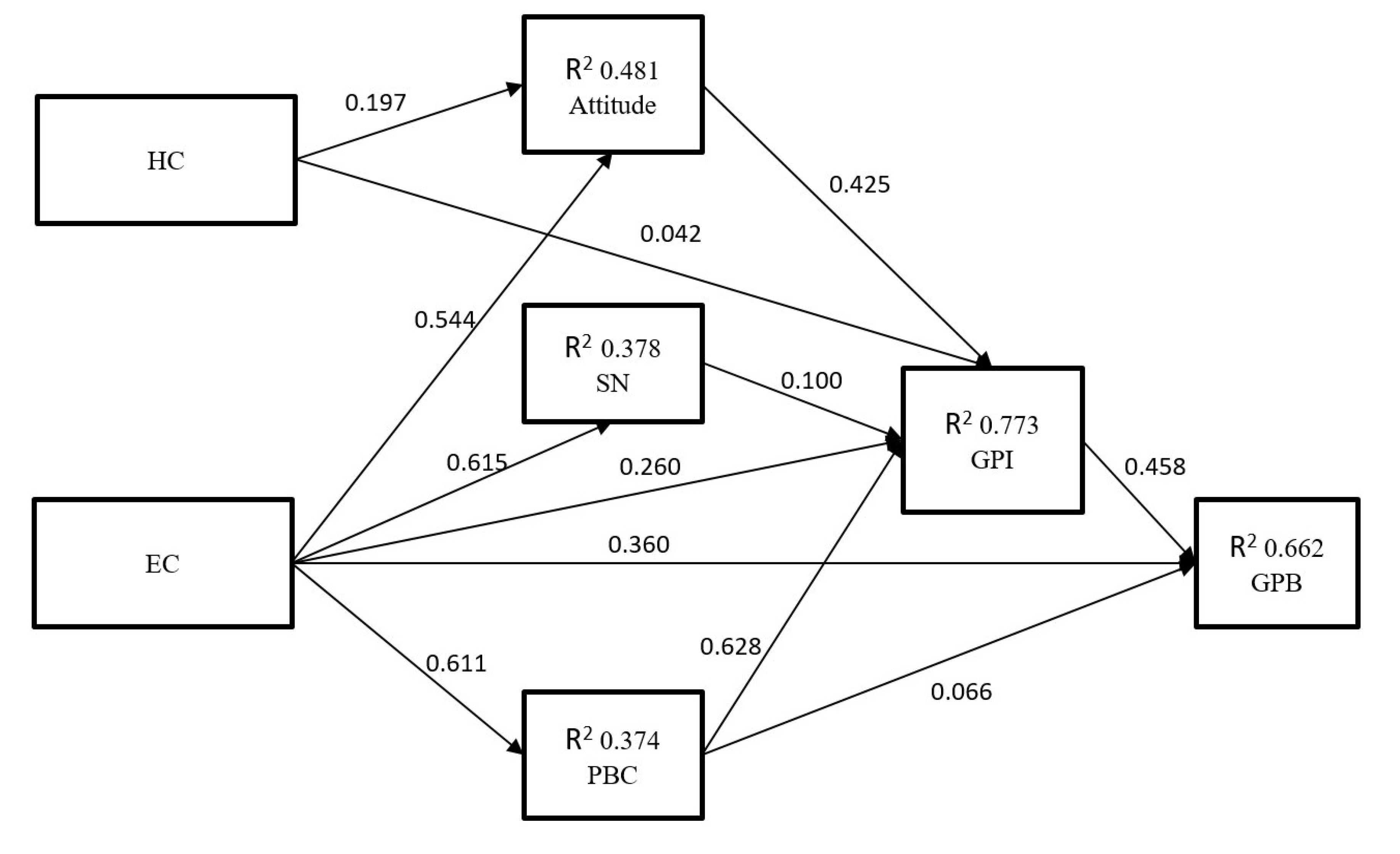
The standardized path coefficients and significance levels provide evidence of the model’s quality [75], and allow the researchers to test the proposed hypotheses. The path coefficients and significance levels are illustrated in Figure 2 and Table 6. The effects of the independent constructs on the dependent ones were examined since they provide practitioners with actionable results regarding cause–effect relationships. Figure 2 shows the main predictors of dependent variable of green purchase behaviour.
Figure 2.
Structural model of green footwear purchase behaviour.
Table 6.
Path coefficients.
After the confirmation of the validity and reliability of the scales, the structural model was built, as discussed above in Table 3, Table 4 and Table 5. Regarding hypothesis testing, Table 6 shows the combined analysis of path coefficients, t-statistics, and p-values. The results shown in Table 6 indicate that EC -> attitude, EC is -> PBC, EC is -> GPI, EC is -> SN, attitude -> GPI, HC -> Att., HC -> GPI, PBC -> GPI, GPI -> GPB, and SN -> GPI have statistically significant path coefficients. The path coefficient PBC -> GPB was not statistically significant, as the t-value was lower than the recommended 1.96. Another hypothesis path coefficient, HC -> GPI, was statistically insignificant. Therefore, 10 hypotheses were accepted and 2 were rejected.
The structural model is presented in Figure 2. As shown by r2, the EC and HC explained 48.1% of attitude, EC further explained SN up to 37.8%, and 37.4% of PBC. On the other hand, EC, attitude, SN, and PBC explained 77.3% of the green footwear purchase intentions. Finally, green footwear purchase behaviour was explained 66.2% by green footwear purchase intention, PBC and HC.
6. Discussion
The main aim of the research was to determine the factors that influence the consumers’ purchase behaviour of green footwear in Saudi Arabia using the theory of planned behaviour with two extended constructs, EC and HC, presented in the research framework in Figure 1.
Five hypotheses were proposed for the independent variable EC. The first hypothesis predicted that EC has a positive relationship with the attitude of the customers towards purchasing green footwear. As in the case of previous studies conducted in the EC context [22,37,38], EC was found to have a positive relationship with the attitude towards green footwear. The second hypothesis proposed that EC has a positive relationship with SN. The hypothesis was based on the findings of Bamberg [38], Wang et al. [22], and Chen and Tung [37]. The results in this study are consistent with these findings and were statistically significant. The third hypothesis was that EC has a positive relationship with perceived behavioural control, and the results support it, which is consistent with the previous studies [22,37,38]. The fourth hypothesis proposed that PBC has a positive relationship with GPI. The hypothesis was based on the findings of Saari et al. [39], and Jaiswal and Kant [30]. The results are consistent and statistically significant in relation to earlier studies, showing a positive relationship between PBC and GPI towards green footwear. The fifth hypothesis proposed EC has a positive relationship with GPB. The results support the hypothesis, showing a statistically significant relationship between EC and GBP. The results show that EC has a statistically positive relationship with the major variables, namely, attitude, SN, PCB, and GPI, which may influence the GPB towards green footwear. Hence, EC is a strong predictor of GBP.
The sixth and seventh hypotheses were in relation to another independent predictor, HC. The sixth hypothesis proposed that HC has a positive relationship with attitude. The result shows that HC has a statistically significant relationship with attitude, and it is consistent with the previous findings [43,44]. When purchasing green footwear, HC may play an important role in forming a positive attitude towards green footwear [90]. The next hypothesis was about the relationship of HC with GPI. The relationship was statistically not significant. This is different from the previous studies, which showed that HC has a positive impact on the intention towards purchasing organic food [23,41]. The difference in the result may be due to the product under investigation, which, in the case of organic food, influences purchase intentions, but in the case of green footwear, shows no significant relationship. Organic food may be perceived to have direct health benefits; however, green footwear may not have any perceived direct health benefits.
The eighth hypothesis proposed that attitude has a positive relationship with GPI. As with previous studies [22,91,92], the results of the current study show that attitude positively influences GPI. Another study, by Lee et al. [14], showed that the relationship between attitude and customers’ expected outcomes of staying at a green hotel had a positive influence on GPI. Thus, attitude, as in the case of other products such as organic food and green hotels, has a statistically significant influence on the GPI of green footwear.
The ninth proposed hypothesis was that there is a positive relationship between SN and GPI. The results are consistent with those of previous studies that showed that SN positively influenced the behavioural intention of visiting green hotels [16,37,93], purchasing organic food [23,94], among others. As in the case of these findings on different products, the current study found that SN significantly influenced the GPI of green footwear. Taking the findings of Tarkiainen and Sundqvist [45], under consideration, SN can have a role in enforcing consumers to use green products in their daily life; thus, purchasing green footwear can slowly become a matter of routine such that, whenever a consumer wants to purchase footwear, they will purchase green footwear.
The tenth hypothesis was that PCB has a positive relationship with GPI and the eleventh hypothesis proposed a positive relationship with GPB. The findings of the study are consistent with the findings of previous studies conducted in various contexts, such as recycling [61], conservation [95], green hotels [37], and green products in general [62]. Unlike many studies that showed that PBC has a direct influence on intention and behaviour towards green product consumption, the findings of the current research show that PBC influenced only the GPI of green footwear; however, its impact on GPB was not statistically significant.
EC, attitude, SN, and PBC significantly influenced the GPI of consumers for green footwear. Together, these four factors explain 77.3% of the variance.
The last hypothesis of the study was that GPI has a positive relationship with GPB. The results show that there is a statistically significant relationship between GPI and GPB. The result is consistent with those of earlier studies [30,66,67]. GPI, along with EC and PBC, explained 66.2% of the GPB for green footwear. Thus, the proposed extended model in this study explained 77.3% of GPI, and 66.2% of GPB for green footwear, Figure 2.
7. Managerial Implications
The findings of this research have significant managerial implications. For the footwear industry, they provide various practical implications. The results inform industry professionals regarding the main predictors of green footwear purchase intentions and purchase behaviour. The findings of the research may be used by marketers in developing appropriate marketing strategies to promote green footwear in general, and in Saudi Arabia in particular. The findings of the study will be helpful in promoting green footwear, and marketers should highlight the environmental contributions when promoting products to environmentally conscious customers. As shown by the results, EC significantly influenced attitude, SN, and PBC, which, in turn, influenced GPI. EC directly influenced GPI and GPB. HC is another factor that can be used to promote green footwear. HC influenced the attitude of customers, which, in turn, influenced GPI. In the promotion of green footwear, marketers can highlight their health benefits, even if they are indirect; even though green footwear may not directly produce health benefits, since it is manufactured in a sustainable manner, it can protect the environment by not polluting it, thus contributing to the health of society at large. Another important finding that may be beneficial to the footwear industry is SN, which significantly influenced GPI. It indicates that people are influenced by each other in purchasing green footwear. Marketers can use influencers in society to promote green footwear, which may motivate others to purchase these items and to develop a norm of using green footwear in society.
Author Contributions
Conceptualization, M.A. and Z.A.A.; methodology, M.A. and Z.A.A.; data collection, M.A. and Z.A.A.; software Smart PLs 4, M.A. and Z.A.A.; formal analysis, M.A. and Z.A.A.; data curation, M.A.; writing—original draft preparation, M.A. and Z.A.A.; writing—review and editing, M.A. and Z.A.A. All authors have read and agreed to the published version of the manuscript.
Funding
This research received no external funding. The cost of the open access publication was covered by the researchers themselves.
Data Availability Statement
The data sets generated from the questionnaire through google forms for the current study are not publicly available. However, the data set used for analysis shall be shared from the corresponding author on request.
Conflicts of Interest
The authors declare no conflict of interest.
References
- Chen, T.B.; Chai, L.T. Attitude towards the Environment and Green Products: Consumers’ Perspective. Manag. Sci. Eng. 2010, 4, 27–39. [Google Scholar]
- Khosla, R.; D’Souza, C.; Taghian, M. Intelligent Consumer Purchase Intention Prediction System for Green Products in Knowledge-Based Intelligent Information and Engineering Systems—KES 2005; Khosla, R., Howlett, R.J., Jain, L.C., Eds.; Lecture Notes in Computer Science; Springer: Berlin/Heidelberg, Gemany, 2005; Volume 3684. [Google Scholar] [CrossRef]
- Roberts, J.A. Green consumers in the 1990s: Profile and implications for advertising. J. Bus. Res. 1996, 36, 217–231. [Google Scholar] [CrossRef]
- Han, H. Theory of green purchase behaviour (TGPB): A new theory for sustainable consumption of green hotel and green restaurant products. Bus. Strategy Environ. 2020, 29, 2815–2828. [Google Scholar] [CrossRef]
- Steg, L.; Vlek, C. Encouraging pro-environmental behaviour: An integrative review and research agenda. J. Environ. Psychol. 2009, 29, 309–317. [Google Scholar] [CrossRef]
- IPCC. Climate Change 2021: The Physical Science Basis. In Contribution of Working Group I to the Sixth Assessment Report of the Intergovernmental Panel on Climate Change; Masson-Delmotte, V., Zhai, P., Pirani, A., Eds.; Cambridge University Press: Cambridge, UK; New York, NY, USA, 2021; pp. 1–41. [Google Scholar] [CrossRef]
- IPCC. Membership WHO is WHO in the IPCC; IPCC: Geneva, Switzerland, 2014. [Google Scholar]
- Ramkissoon, H. Behaviour change in tourism. In Encyclopedia of Tourism Management and Marketing; Edward Elgar Publishing: Cheltenham, UK, 2022. [Google Scholar]
- Ramkisson, H.; Weiler, B.; Smith L. D., G. Place attachment and pro-environmental behaviour in national parks: The development of a conceptual framework. J. Sustain. Tour. 2012, 20, 257–276. [Google Scholar] [CrossRef]
- Xu, X.; Wang, S.; Yu, Y. Consumer’s intention to purchase green furniture: Do health consciousness and environmental awareness matter? Sci. Total Environ. 2019, 704, 135275. [Google Scholar] [CrossRef]
- Chan, R.Y.K. Determinants of Chinese consumers’ green purchase behavior. Psychol. Mark. 2001, 18, 389–413. [Google Scholar] [CrossRef]
- Shamdasani, P.; Chon-Lin, G.; Richmond, D. Exploring green consumers in an oriental culture: Role of personal and marketing mix. Adv. Consum. Res. 1993, 20, 488–493. [Google Scholar]
- Ramayah, T.; Lee, J.; Mohamad, O. Green product purchase intention: Some insights from a developing country. Resour. Conserv. Recycl. 2010, 54, 1419–1427. [Google Scholar] [CrossRef]
- Lee, J.S.; Hsu, L.T.; Han, H.; Kim, Y. Understanding how consumers view green hotels: How a hotel’s green image can influence behavioural intentions. J. Sustain. Tour. 2010, 18, 901–914. [Google Scholar] [CrossRef]
- Suki, M.N.; Suki, M.N. Consumption values and consumer environmental concern regarding green products. Int. J. Sustain. Dev. World Econ. 2015, 22, 269–278. [Google Scholar] [CrossRef]
- Verma, V.K.; Chandra, B. An application of theory of planned behavior to predict young Indian consumers’ green hotel visit intention. J. Clean. Prod. 2018, 172, 1152–1162. [Google Scholar] [CrossRef]
- Hsu, C.L.; Chang, C.Y.; Yansritakul, C. Exploring purchase intention of green skincare products using the theory of planned behavior: Testing the moderating effects of country of origin and price sensitivity. J. Retail. Consum. Serv. 2017, 34, 145–152. [Google Scholar] [CrossRef]
- Lita, R.P.; Surya, S.; Ma’Ruf, M.; Syahrul, L. Green attitude and behavior of local tourists towards hotels and restaurants in West Sumatra, Indonesia. Proc. Environ. Sci. 2014, 20, 261–270. [Google Scholar] [CrossRef]
- Nezakati, H.; Moghadas, S.; Aziz, Y.A.; Amidi, A.; Sohrabinezhadtalemi, R.; Jusoh, Y.Y. Effect of behavioral intention toward choosing green hotels in Malaysia–Preliminary study. Proce-Soc. Behavl. Sci. 2015, 172, 57–62. [Google Scholar] [CrossRef]
- Joshi, Y.; Rahman, Z. Factors affecting green purchase behaviour and future research directions. Int. Strat. Manag. Rew. 2015, 3, 128–143. [Google Scholar] [CrossRef]
- Bashir, S.; Khwaja, M.G.; Turi, J.A.; Toheed, H. Extension of Planned Behavioral Theory to Consumer Behaviors in Green Hotel; Elsevier BV: Amsterdam, The Netherlands, 2019. [Google Scholar]
- Wang, S.; Fan, J.; Zhao, D.; Yang, S.; Fu, Y. Predicting consumers’ intention to adopt hybrid electric vehicles: Using an extended version of the theory of planned behavior model. Transportation 2016, 43, 123–143. [Google Scholar] [CrossRef]
- Yadav, R.; Pathak, G.S. Intention to purchase organic food among young consumers: Evidences from a developing nation. Appetite 2016, 96, 122–128. [Google Scholar] [CrossRef]
- Bianchi, C.; Birtwistle, G. Consumer clothing disposal behaviour: A comparative study. Int. J. Consum. Stud. 2012, 36, 335–341. [Google Scholar] [CrossRef]
- Liu, Y.; Sheng, H.; Mundorf, N.; Redding, C.; Ye, Y. Integrating Norm Activation Model and Theory of Planned Behavior to Understand Sustainable Transport Behavior: Evidence from China. Int. J. Environ. Res. Public Health 2017, 14, 1593. [Google Scholar] [CrossRef]
- Nagurney, A.; Yu, M. Sustainable fashion supply chain management under oligopolistic competition and brand differentiation. Int. J. Prod. Econ. 2012, 135, 532–540. [Google Scholar] [CrossRef]
- Kozlowski, A.; Bardecki, M.; Searcy, C. Environmental impacts in the fashion industry a life-cycle and stakeholder framework. J. Corp. Citizsh. 2012, 45, 17–36. [Google Scholar]
- CIA World Fact Book. Available online: https://www.cia.gov/the-world-factbook/countries/saudi-arabia/#people-and-society (accessed on 27 February 2023).
- Cherian, J.; Jacob, J. Green marketing: A study of consumers’ attitude towards environment friendly products. Asi. Soc. Sci. 2012, 8, 117. [Google Scholar] [CrossRef]
- Jaiswal, D.; Kant, R. Green purchasing behaviour: A conceptual framework and empirical investigation of Indian consumers. J. Retail. Consum. Serv. 2018, 41, 60–69. [Google Scholar] [CrossRef]
- Kim, Y.; Choi, S. Antecedents of Green Purchase Behavior: An Examination of Collectivism, Environmental Concern, and Pce, in NA—Advances in Consumer Research; Menon, G., Rao, A.R., Eds.; Association for Consumer Research: Duluth, MN, USA, 2005; Volume 32, pp. 592–599. [Google Scholar]
- Prakash, G.; Pathak, P. Intention to buy eco-friendly packaged products among young consumers of India: A study on developing nation. J. Clean. Prod. 2017, 141, 385–393. [Google Scholar] [CrossRef]
- Huang, H.; Lin, T.; Lai, M.; Lin, T. Environmental consciousness and green customer behavior: An examination of motivation crowding effect. Int. J. Hosp. Manag. 2014, 40, 139–149. [Google Scholar] [CrossRef]
- McIntosh, A. The impact of environmental issues on marketing and politics in the 1990’s. Int. J. Mark. Res. 1991, 33, 205–218. [Google Scholar]
- Kim, S.; Seock, Y. Impacts of Halth and Environmental Consciousness on Young Female Consumers’ Attitude towards and Purchase of Natural Beauty Products. Int. J. Consum. Stud. 2009, 33, 627–638. [Google Scholar] [CrossRef]
- Ajzen, I.; Fishbein, M. Understanding Attitudes and Predicting Social Behavior, 1st ed.; Prentice-Hall: Englewood Cliffs, NJ, USA, 1980. [Google Scholar]
- Chen, M.; Tung, P. Developing an extended Theory of Planned Behavior model to predict consumers’ intention to visit green hotels. Int. J. Hosp. Manag. 2014, 36, 221–230. [Google Scholar] [CrossRef]
- Bamberg, S. How Does Environmental Concern Influence Specific Environmentally Related Behaviors? A New Answer to an Old Question; Elsevier BV: Amsterdam, The Netherlands, 2003. [Google Scholar]
- Saari, U.A.; Damberg, S.; Frömbling, L.; Ringle, C.M. Sustainable consumption behavior of Europeans: The influence of environmental knowledge and risk perception on environmental concern and behavioral intention. Ecol. Econom. 2021, 189. [Google Scholar] [CrossRef]
- Pagiaslis, A.; Krontalis, A.K. Green Consumption Behavior Antecedents: Environmental Concern, Knowledge, and Beliefs. Psychol. Mark. 2014, 31, 335–348. [Google Scholar] [CrossRef]
- Smith, S.; Paladino, A. Eating clean and green?Investigating consumer motivations towards the purchase of organic food. Australas. Mark. J. 2010, 18, 93–104. [Google Scholar] [CrossRef]
- Wang, S.; Wang, J.; Lin, S.; Li, J. Public perceptions and acceptance of nuclear energy in China: The role of public knowledge, perceived benefit, perceived risk and public engagement. Energy Policy 2019, 126, 352–360. [Google Scholar] [CrossRef]
- Paul, J.; Rana, J. Consumer behavior and purchase intention for organic food. J. Consum. Mark. 2012, 29, 412–422. [Google Scholar] [CrossRef]
- Cervellon, M.; Carey, L. Consumers’ perceptions of ‘green’: Why and how consumers use eco-fashion and green beauty products. Crit. Stud. Fash. Beauty 2011, 2, 117–138. [Google Scholar] [CrossRef]
- Tarkiainen, A.; Sundqvist, S. Subjective norms, attitudes and intentions of Finnish consumers in buying organic food. Br. Food J. 2005, 107, 808–822. [Google Scholar] [CrossRef]
- Eagly, A.H.; Chaiken, S. The advantages of an inclusive definition of attitude. Soc. Cogn. 2007, 25, 582–602. [Google Scholar] [CrossRef]
- Ajzen, I. The theory of planned behavior. Organ. Behav. Hum. Decis. Process. 1991, 50, 179–211. [Google Scholar] [CrossRef]
- Ayar, I.; Gürbüz, A. Sustainable Consumption Intentions of Consumers in Turkey: A Research within the theory of planned behaviour. SAGE Open 2021, 11, 21582440211. [Google Scholar] [CrossRef]
- Kotchen, M.J.; Reiling, S.D. Environmental Attitudes, Motivations, and Contingent Valuation of Nonuse Values: A Case Study Involving Endangered Species; Elsevier BV: Amsterdam, The Netherlands, 2000. [Google Scholar]
- Mostafa, M.M. Gender differences in Egyptian consumers’ green purchase behaviour: The effects of environmental knowledge, concern and attitude. Int. J. Consum. Stud. 2007, 31, 220–229. [Google Scholar] [CrossRef]
- Qin, B.; Song, G. Internal Motivations, External Contexts, and Sustainable Consumption Behavior in China—Based on the TPB-ABC Integration Model. Sustainability 2022, 14, 7677. [Google Scholar] [CrossRef]
- Birgelen, M.; Semeijn, J.; Keicher, M. Packaging and proenvironmental consumption behavior: Investigating purchase and disposal decisions for beverages. Environ. Behav. 2009, 41, 125–146. [Google Scholar] [CrossRef]
- Choi, H.; Jang, J.; Kandampully, J. Application of the extended VBN theory to understand consumers’ decisions about green hotels. Int. J. Hosp. Manag. 2015, 51, 87–95. [Google Scholar] [CrossRef]
- Han, H.; Hsu, L.; Sheu, C. Application of the Theory of Planned Behavior to green hotel choice: Testing the effect of environmental friendly activities. Tour. Manag. 2010, 31, 325–334. [Google Scholar] [CrossRef]
- Paul, J.; Modi, A.; Patel, J. Predicting green product consumption using theory of planned behavior and reasoned action. J. Retail. Consum. Serv. 2016, 29, 123–134. [Google Scholar] [CrossRef]
- Varshneya, G.; Pandey, S.K.; Das, G. Impact of Social Influence and Green Consumption Values on Purchase Intention of Organic Clothing: A Study on Collectivist Developing Economy. Glob. Bus. Rev. 2017, 18, 478–492. [Google Scholar] [CrossRef]
- Manstead, A.S.R.; Van Eekelen, S.A.M. Distinguishing Between Perceived Behavioral Control and Self-Efficacy in the Domain of Academic Achievement Intentions and Behaviors. J. Appl. Soc. Psychol. 1998, 28, 1375–1392. [Google Scholar] [CrossRef]
- Kidwell, B.; Jewell, R.D. An examination of perceived behavioral control: Internal and external influences on intention. Psychol. Mark. 2003, 20, 625–642. [Google Scholar] [CrossRef]
- Armitage, C.J.; Conner, M. Efficacy of the Theory of Planned Behaviour: A meta-analytic review. Br. J. Soc. Psychol. 2001, 40, 471–499. [Google Scholar] [CrossRef]
- Dilotsotlhe, N. Factors Influencing the Green Purchase Behaviour of Millennials: An Emerging Country Perspective; Informa UK Limited: London, UK, 2021. [Google Scholar]
- Yeow, P.; Dean, A.; Tucker, D. Bags for Life: The Embedding of Ethical Consumerism. J. Bus. Ethics 2014, 125, 87–99. [Google Scholar] [CrossRef]
- Moser, A.K. Thinking green, buying green? Drivers of pro-environmental purchasing behavior. J. Consum. Mark. 2015, 32, 167–175. [Google Scholar] [CrossRef]
- Ajzen, I. Perceived Behavioral Control, Self-Efficacy, Locus of Control, and the Theory of Planned Behavior. J. Appl. Soc. Psychol. 2002, 32, 665–683. [Google Scholar] [CrossRef]
- Mostafa, M.M. A hierarchical analysis of the green consciousness of the Egyptian consumer. Psychol. Mark. 2006, 24, 445–473. [Google Scholar] [CrossRef]
- Akehurst, G.; Afonso, C.; Martins Gonçalves, H. Re-examining green purchase behaviour and the green consumer profile: New evidences. Manag. Dec. 2012, 50, 972–988. [Google Scholar] [CrossRef]
- Kanchanapibul, M.; Lacka, E.; Wang, X.; Chan, H.K. An empirical investigation of green purchase behaviour among the young generation. J. Cleaner Prod. 2014, 66, 528–536. [Google Scholar] [CrossRef]
- Lai, C.K.M.; Cheng, E.W.L. Green purchase behavior of undergraduate students in Hong Kong. J. Soc. Sci. (Fort Collins) 2016, 53, 67–76. [Google Scholar] [CrossRef]
- Kumar, B.; Manrai, A.K.; Manrai, L.A. Purchasing behaviour for environmentally sustainable products: A conceptual framework and empirical study. J. Retail. Consum. Serv. 2017, 34, 1–9. [Google Scholar] [CrossRef]
- Wei, C.; Chiang, C.; Kou, T.; Lee, B.C.Y. Toward Sustainable Livelihoods: Investigating the Drivers of Purchase Behavior for Green Products. Bus. Strat. Environ. 2017, 26, 626–639. [Google Scholar] [CrossRef]
- Hair, J.F.; Risher, J.J.; Sarstedt, M.; Ringle, C.M. When to use and how to report the results of PLS-SEM. Eur. Bus. Rev. 2019, 31, 2–24. [Google Scholar] [CrossRef]
- Ajzen, I. Attitudes, Personality and Behavior; Open University Press: Berkshire, UK, 2005. [Google Scholar]
- Ringle, C.M.; Wende, S.; Will, S. SmartPLS 2.0 (M3) (Version Beta). [Software]. Hamburg. Available online: http://www.smartpls.de (accessed on 1 December 2022).
- Hair, J.F.; Ringle, C.M.; Hult, G.T.M.; Sarstedt, M. A Primier on Partial Least Squares Structural Equation Modeling (PLS-SEM); Sage Publications: Thousand Oaks, CA, USA, 2013. [Google Scholar]
- Hair, J.F.; Ringle, C.M.; Sarstedt, M. PLS-SEM: Indeed, a silver bullet. J. Mark. Theory Pract. 2011, 19, 139–151. [Google Scholar] [CrossRef]
- Hair, J.F.; Sarstedt, M.; Pieper, T.M.; Ringle, C.M. The use of partial least squares structural equation modeling in strategic management research: A review of past practices and recommendations for future applications. Long Range Plan. 2012, 45, 320–340. [Google Scholar] [CrossRef]
- Gefen, D.; Rigdon, E.E.; Straub, D. An update and extension to SEM guidelines for administrative and social science research. MIS Quaterly 2011, 35, 3–14. [Google Scholar] [CrossRef]
- Henseler, J.; Ringle, C.M.; Sarstedt, M. Using partial least squares path modeling in international advertising research: Basic concepts and recent issues. In Handbook of Research in International Advertising; Okazaki, S., Ed.; Edward Elgar Publishing: Cheltenham, UK, 2012; pp. 252–276. [Google Scholar]
- Nunnally, J.C. Psychometric Theory; McGraw-Hill: New York, NY, USA, 1967. [Google Scholar]
- De Vellis, R.F. Scale Development: Theory and Applications, 2nd ed.; Sage Publications: Thousand Oaks, CA, USA, 2003; Volume 26. [Google Scholar]
- Cicchetti, D.V. Guidelines, criteria, and rules of thumb for evaluating normed and standardized assessment instruments in psychology. Psychol. Assess. 1994, 6, 284–290. [Google Scholar] [CrossRef]
- Hair, J.F.; Black, W.C.; Babin, B.J.; Anderson, R.E. Multivariate Data Analysis, 7th ed.; Pearson: New York, NY, USA, 2010. [Google Scholar]
- Bagozzi, R.P.; Yi, Y.; Phillips, L.W. Assessing construct validity in organizational research. Adm. Sci. Q. 1991, 36, 421–458. [Google Scholar] [CrossRef]
- Cheung, C.M.K.; Lee, M.K.O. A Theoretical Model of Intentional Social Action in Online Social Networks. Decis. Support Syst. 2010, 49, 24–30. [Google Scholar] [CrossRef]
- Fornell, C.; Larker, D. Evaluating Structural equation models with unobservable variances and measurements error. J. Mark. Res. 1981, 18, 39–50. [Google Scholar] [CrossRef]
- Hu, L.T.; Bentler, P.M. Cutoff Criteria for Fit Indexes in Covariance Structure Analysis: Conventional Criteria versus New Alternatives. Struct. Equ. Model. 1999, 6, 1–55. [Google Scholar] [CrossRef]
- Henseler, J.; Hubona, G.; Ray, P.A. Using PLS path modeling in new technology research: Updated guidelines. Ind. Manag. Data Syst. 2016, 116, 2–20. [Google Scholar] [CrossRef]
- Bentler, P.M.; Bonett, D.G. Significance tests and goodness of fit in the analysis of covariance structures. Psychol. Bull. 1980, 88, 588–606. [Google Scholar] [CrossRef]
- Baumgartner, H.; Homburg, C. Applications of structural equation modeling in marketing and consumer research: A review. Int. J. Res. Mark. 1996, 13, 139–161. [Google Scholar] [CrossRef]
- Doll, W.J.; Xia, W.; Torkzadeh, G. A confirmatory factor analysis of the end-user computing satisfaction instrument. MIS Q. 1994, 18, 453–461. [Google Scholar] [CrossRef]
- Wandel, M.; Bugge, A. Environmental concern in consumer evaluation of food quality. Food Qual. Prefer. 1997, 8, 19–26. [Google Scholar] [CrossRef]
- Han, L.; Wang, S.; Zhao, D.; Li, J. The intention to adopt electric vehicles: Driven by functional and non-functional values. Transp. Res. A Policy Pract. 2017, 103, 185–197. [Google Scholar] [CrossRef]
- Ru, X.; Qin, H.; Wang, S. Young people’s behavior intentions towards reducing PM2. 5 in China: Extending the theory of planned behavior. Resour. Conserv. Recycl. 2019, 141, 99–108. [Google Scholar] [CrossRef]
- Han, H.; Kim, Y. An investigation of green hotel customers’ decision formation: Developing an extended model of the theory of planned behavior. Int. J. Hosp. Manag. 2010, 29, 659–668. [Google Scholar] [CrossRef]
- Yazdanpanah, M.; Forouzani, M. Application of the Theory of Planned Behavior to predict Iranian students’ intention to purchase organic food. J. Clean. Prod. 2015, 107, 342–352. [Google Scholar] [CrossRef]
- Albayrak, T.; Aksoy, Ş.; Caber, M. The effect of environmental concern and skepticism on green purchase behaviour. Mark. Intell. Plan. 2013, 31, 27–39. [Google Scholar] [CrossRef]
Disclaimer/Publisher’s Note: The statements, opinions and data contained in all publications are solely those of the individual author(s) and contributor(s) and not of MDPI and/or the editor(s). MDPI and/or the editor(s) disclaim responsibility for any injury to people or property resulting from any ideas, methods, instructions or products referred to in the content. |
© 2023 by the authors. Licensee MDPI, Basel, Switzerland. This article is an open access article distributed under the terms and conditions of the Creative Commons Attribution (CC BY) license (https://creativecommons.org/licenses/by/4.0/).