



Fashion Digital Transformation: Innovating Business Models toward Circular Economy and Sustainability



Abstract
1. Introduction
2. Literature Review
3. Materials and Methods
4. Modelling Digital-Driven Circular Business Innovation Approaches
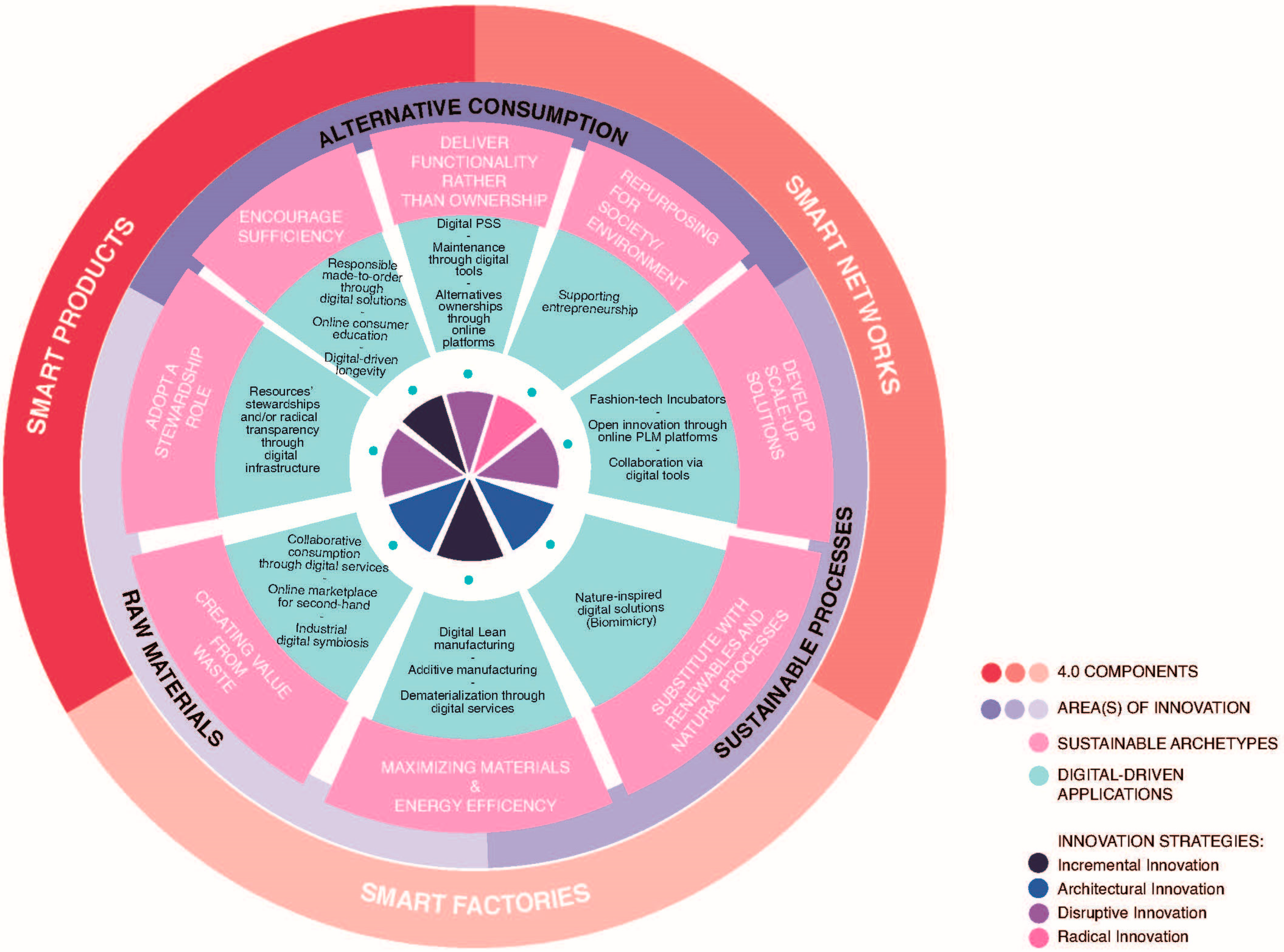
- The higher-level categorization defined the macro areas that emerged from Bertola and Taunissen’s model, which introduced the main paradigmatic changes that have led the fashion system to adopt the concept of Industry 4.0, which is understood as the combination of smart factories where the physical and digital environments converge; smart networks that allow interaction, co-working, and knowledge exchange, which are permitted by digital manufacturing, and smart products that connect the physical and digital dimensions in a cyber-physical system and allow the industrial ecosystem represented by the company, users, and social environment to be reconsidered completely
- The medium-level categorization groups the different areas that emerged from the literature, where the groundwork is being laid for the fashion system’s potential transition to a new circular age through BMI: raw materials; sustainable processes, and alternative forms of consumption. The materials grouping includes archetypes with a dominant component of material-driven innovations (e.g., redesign of sourcing and the concept of “new” materials), the grouping of processes includes archetypes with a dominant component of process innovation (e.g., redesign of production practices and products), while the archetypes in the alternative consumption grouping have a dominant component of organizational innovation (e.g., products that offer consumers with innovative solutions that support a change in their consumption behavior/habits).)
- The lower-level categorization reports the archetypes that are identified and present examples on which they can rely on the specific practices that companies carry out according to both the literature and industry.
- Delivering functionality rather than ownership is the bridge between smart products and smart networks. This archetype is shifting in the concept of the product’s performance. It involves imagining services that meet the users’ needs by offering alternatives to possess an object. Companies that fall into this category operate between these two components of Industry 4.0 by adopting digital solutions to engage end-users with new BMs that feature new forms of ownership.
- The substitution with renewable and natural processes connects smart networks and smart factories. This archetype addresses growth limits that are associated with non-renewable resources that feed current production systems. Companies in this area are working to replace the current models with circular sourcing and create intelligent networks that use the digital component to build sustainable supply chains that offer new synergies and industrial ecosystems which are able to reshape the very concept of a factory.
- Creating value from waste links smart factories and smart products. This archetype acts on the management of waste streams to maximize their value. Companies that work in this category shift their focus from developing their products to creating new infrastructure systems for digitally enabled intelligent production; this can minimize waste and works on the concept of secondary raw material.
- Incremental innovation is the continuous improvement of existing products or services to provide more value to an existing market.
- Architectural innovation modifies existing solutions for an entirely new market.
- Disruptive innovation is the creation of new technologies and products that serve an existing market.
- Radical innovation is a technological breakthrough that transforms industries and often creates new markets.
4.1. Creating Value from Waste
4.2. Maximizing Material and Energy Efficiency
4.3. Substituting with Renewables and Natural Processes
4.4. Developing Scale-Up Solutions
4.5. Re-Purposing the Business for the Society/Environment
4.6. Delivering Functionality Rather than Ownership
4.7. Encouraging Sufficiency
4.8. Adopting a Stewardship Role
5. Conclusions
6. Study Limitations and Future Research Directions
- The internal integration of competencies that are linked to a company ethos of a digital native and has the components necessary to propose a disruptive BM designed to achieve circularity.
- The necessary external acquisition through collaborations and the mix of its traditional practices and systems with the addition of hardware, software, and other services.
- The development, adaptation, and modification of digital technologies for circular fashion BMs and converse.
- Obstacles to adopting the circular BM for digital fashion.
- The effect of digital fashion BMs on a systemic level, for example, in networking.
Author Contributions
Funding
Institutional Review Board Statement
Informed Consent Statement
Data Availability Statement
Conflicts of Interest
References
- Gazzola, P.; Pavione, E.; Pezzetti, R.; Grechi, D. Trends in the Fashion Industry. The Perception of Sustainability and Circular Economy: A Gender/Generation Quantitative Approach. Sustainability 2020, 12, 2809. [Google Scholar] [CrossRef]
- Biloslavo, R.; Bagnoli, C.; Massaro, M.; Cosentino, A. Business model transformation toward sustainability: The impact of legitimation. Manag. Decis. 2020, 58, 1643–1662. [Google Scholar] [CrossRef]
- Pieroni, M.P.P.; McAloone, T.C.; Pigosso, D.C.A. Business model innovation for circular economy and sustainability: A review of approaches. J. Clean. Prod. 2019, 215, 198–216. [Google Scholar] [CrossRef]
- Ardito, L.; Petruzzelli, A.M.; Panniello, U.; Garavelli, A.C. Towards Industry 4.0: Mapping Digital Technologies for Supply Chain Management-marketing Integration. Bus. Process. Manag. J. 2018, 25, 323–346. [Google Scholar] [CrossRef]
- Bertola, P.; Teunissen, J. Fashion 4.0. Innovating fashion industry through digital transformation. Res. J. Text. Appar. 2018, 22, 352–369. [Google Scholar] [CrossRef]
- Khan, I.S.; Ahmad, M.O.; Majava, J. Industry 4.0 and sustainable development: A systematic mapping of triple bottom line, Circular Economy and Sustainable Business Models perspectives. J. Clean. Prod. 2021, 297, 126655. [Google Scholar] [CrossRef]
- Evans, S. A New Frame: Design-Led Transformations from Linear to Circular Economies for Sustainability. In With Design: Reinventing Design Modes: Proceedings of the 9th Congress of the International Association of Societies of Design Research (IASDR 2021); Springer: Singapore, 2022; pp. 3371–3379. [Google Scholar]
- De Medeiros, J.F.; Ribeiro, J.L.D.; Cortimiglia, M.N. Success factors for environmentally sustainable product innovation: A systematic literature review. J. Clean. Prod. 2014, 65, 76–86. [Google Scholar] [CrossRef]
- Snihur, Y.; Bocken, N. A call for action: The impact of business model innovation on business ecosystems, society and planet. Long Range Plan. 2022, 55, 102182. [Google Scholar] [CrossRef]
- Todeschini, B.V.; Cortimiglia, M.N.; Callegaro-De-Menezes, D.; Ghezzi, A. Innovative and sustainable business models in the fashion industry: Entrepreneurial drivers, opportunities, and challenges. Bus. Horiz. 2017, 60, 759–770. [Google Scholar] [CrossRef]
- Pal, R. Sustainable design and business models in textile and fashion industry. In Sustainability in the Textile Industry; Springer: Singapore, 2017; pp. 109–138. [Google Scholar]
- Geissdoerfer, M.; Savaget, P.; Bocken, N.M.; Hultink, E.J. The Circular Economy—A new sustainability paradigm? J. Clean. Prod. 2017, 143, 757–768. [Google Scholar] [CrossRef]
- Tohãnean, D.; Buzatu, A.I.; Baba, C.A.; Georgescu, B. Business model innovation through the use of digital technologies: Managing risks and creating sustainability. Amfiteatru Econ. 2020, 22, 758–774. [Google Scholar]
- Li, F. The digital transformation of business models in the creative industries: A holistic framework and emerging trends. Technovation 2020, 92, 102012. [Google Scholar] [CrossRef]
- Shahi, C.; Sinha, M. Digital transformation: Challenges faced by organizations and their potential solutions. Int. J. Innov. Sci. 2020, 13, 17–33. [Google Scholar] [CrossRef]
- Bocken, N.M.P.; Short, S.W.; Rana, P.; Evans, S. A literature and practice review to develop sustainable business model archetypes. J. Clean. Prod. 2014, 65, 42–56. [Google Scholar] [CrossRef]
- D’Itria, E.; Colombi, C. Biobased Innovation as a Fashion and Textile Design Must: A European Perspective. Sustainability 2022, 14, 570. [Google Scholar] [CrossRef]
- Nayak, R.; George, M.; Haq, I.U.; Pham, H.C. Sustainability benefits of RFID technology in Vietnamese fashion supply chain. Clean. Logist. Supply Chain 2022, 5, 100086. [Google Scholar] [CrossRef]
- Lüdeke-Freund, F. Business Model Concepts in Corporate Sustainability Contexts: From Rhetoric to a Generic Template for ‘Business Models for Sustainability’; Centre for Sustainability Management (CSM) der Leuphana Universität Lüneburg: Lüneburg, Germany, 2009. [Google Scholar]
- Schaltegger, S.; Csutora, M. Carbon accounting for sustainability and management. Status quo and challenges. J. Clean. Prod. 2012, 36, 1–16. [Google Scholar] [CrossRef]
- MacArthur, E. Towards the circular economy. J. Ind. Ecol. 2013, 2, 23–44. [Google Scholar]
- Rosa, P.; Sassanelli, C.; Urbinati, A.; Chiaroni, D.; Terzi, S. Assessing relations between Circular Economy and Industry 4.0: A systematic literature review. Int. J. Prod. Res. 2020, 58, 1662–1687. [Google Scholar] [CrossRef]
- Pagoropoulos, A.; Pigosso, D.C.; McAloone, T.C. The emergent role of digital technologies in the Circular Economy: A review. Procedia CIRP 2017, 64, 19–24. [Google Scholar] [CrossRef]
- Bressanelli, G.; Pigosso, D.C.; Saccani, N.; Perona, M. Enablers, levers and benefits of Circular Economy in the Electrical and Electronic Equipment supply chain: A literature review. J. Clean. Prod. 2021, 298, 126819. [Google Scholar] [CrossRef]
- Berg, A.; Antikainen, R.; Hartikainen, E.; Kauppi, S.; Kautto, P.; Lazarevic, D.; Piesik, S.; Saikku, L. Circular Economy for Sustainable Development. 2018. Available online: https://helda.helsinki.fi/bitstream/handle/10138/251516/SYKEre_26_2018.pdf?sequence=1&isAllowed=y (accessed on 21 December 2022).
- Wijkman, A.; Skånberg, K. The Circular Economy and Benefits for Society; Club of Rome: Winterthur, Switzerland, 2015. [Google Scholar]
- den Hollander, M.; Bakker, C. Mind the gap exploiter: Circular business models for product lifetime extension. In Electronics Goes Green 2016+: Inventing Shades of Green; Fraunhofer IZM: Berlin, Germany, 2016; pp. 1–8. [Google Scholar]
- Schäfer, A.; Gehwolf, P.; Kienzl-Wagner, K.; Cakar-Beck, F.; Wykypiel, H. Linear or circular: Anastomotic ulcer after gastric bypass surgery. Surg. Endosc. 2021, 36, 3011–3018. [Google Scholar] [CrossRef] [PubMed]
- Dragomir, V.D.; Dumitru, M. Practical solutions for circular business models in the fashion industry. Clean. Logist. Supply Chain 2022, 4, 100040. [Google Scholar] [CrossRef]
- Ardito, L.; Petruzzelli, A.M.; Ghisetti, C. The impact of public research on the technological development of industry in the green energy field. Technol. Forecast. Soc. Chang. 2019, 144, 25–35. [Google Scholar] [CrossRef]
- Siddi, M. The European Green Deal: Assessing Its Current State and Future Implementation. 2020. Available online: https://www.fiia.fi/wp-content/uploads/2020/05/wp114_european-green-deal.pdf (accessed on 18 December 2022).
- Huynh, P.H. Enabling circular business models in the fashion industry: The role of digital innovation. Int. J. Prod. Perform. Manag. 2021, 71, 870–895. [Google Scholar] [CrossRef]
- Ranta, V.; Aarikka-Stenroos, L.; Väisänen, J.M. Digital technologies catalyzing business model innovation for circular economy—Multiple case study. Resour. Conserv. Recycl. 2021, 164, 105155. [Google Scholar] [CrossRef]
- European Commissione, COSME Programme (2018–2021). DeFINE Developing a Fashion-Tech Innovation Network for Europe. Available online: https://www.define-network.eu/ (accessed on 20 December 2022).
- Erasmus+ Programme of the European Commission (2020–2022). FTalliance—Weaving Universities and Companies to Co-Create Fashion-Tech Future Talents. Available online: https://www.fashiontechalliance.eu/en/ (accessed on 20 December 2022).
- Education and Research—The Benchmarking Report. Available online: https://www.fashionseeds.org/project-reports (accessed on 21 October 2021).
- European Commission. Directorate-General for Internal Market, Industry, Entrepreneurship and SMEs, Support Report Mapping Sustainable Fashion Opportunities for SMES; Publications Office: Luxembourg, 2019. [Google Scholar]
- D’Itria, E. Driving Sustainability in Fashion through Design: Experimenting with the Role of Design in the Development of a Circular Fashion Supply Chain Model. Doctoral Thesis, Politecnico di Milano, Milano, Italy, June 2022. [Google Scholar]
- Black, S.; Williams, D.; Burcikova, M.; Vecchi, A.; Norton, Z.; Brennan, G.; Lyon, F.; Colombi, C.; D’Itria, E.; Clutier-Léauté, D.; et al. Support Report Mapping Sustainable Fashion Opportunities for SMEs. 2019. Available online: https://op.europa.eu/it/publication-detail/-/publication/43511a04-b988-11e9-9d01-01aa75ed71a1 (accessed on 20 December 2022).
- Baxter, P.; Jack, S. Qualitative Case Study Methodology: Study Design and Implementation for Novice Researchers. Qual. Rep. 2015, 13, 544–559. [Google Scholar] [CrossRef]
- Stake, R.E. The Art of Case Study Research; Sage: Thousand Oaks, CA, USA, 1995. [Google Scholar]
- Stahel, W.R.; MacArthur, E. The Circular Economy: A User’s Guide; Routledge: Oxfordshire, UK, 2019. [Google Scholar]
- Strauss, A.; Corbin, J.M. Grounded Theory in Practice; Sage: Thousand Oaks, CA, USA, 1997. [Google Scholar]
- Strauss, A.; Corbin, J. Basics of Qualitative Research; Sage Publications: Thousand Oaks, CA, USA, 1990. [Google Scholar]
- Johnson, M.W.; Suskewicz, J. How to jump-start the clean economy. Harv. Bus. Rev. 2009, 87, 11. [Google Scholar]
- Henninger, C.E.; Brydges, T.; Iran, S.; Vladimirova, K. Collaborative fashion consumption—A synthesis and future research agenda. J. Clean. Prod. 2021, 319, 128648. [Google Scholar] [CrossRef]
- Amit, R.; Zott, C. Creating Value through Business Model Innovation. MIT Sloan Manag. Rev. 2012. Available online: https://sloanreview.mit.edu/article/creating-value-through-business-model-innovation/ (accessed on 8 January 2023).
- George, G.; Schillebeeckx, S.J. Digital transformation, sustainability, and purpose in the multinational enterprise. J. World Bus. 2022, 57, 101326. [Google Scholar] [CrossRef]
- Elkington, J. Enter the Triple Bottom Line. In The Triple Bottom Line: Does It All Add up? Routledge: Oxfordshire, UK, 2013; pp. 1–16. [Google Scholar]
- Dissanayake, D.; Weerasinghe, D. Towards Circular Economy in Fashion: Review of Strategies, Barriers and Enablers. Circ. Econ. Sustain. 2021, 2, 25–45. [Google Scholar] [CrossRef]
- Royall, E. Defining Biomimicry: Architectural Applications in Systems and Products. In UTSoA-Seminar in Sustainable Architecture; 2010; Available online: https://d1wqtxts1xzle7.cloudfront.net/46363787/09_02_su_royall_emily_paper_ml-libre.pdf?1465500901=&response-content-disposition=inline%3B+filename%3DDefining_Biomimicry_Architectural_Applic.pdf&Expires=1678269102&Signature=UnwLW5HEFKCRx7yxpnPeTA~qkk-kcwbUQ4T5cw9p-SXpcfXdH0hHl-tRqqhYfk~rx4EoSYYQAJsJL3R71aqr1AVnRpyGiyYeKvrCHeaXhowxCGM0Duhhg8v7ErJW0U9zkfl3IqvyxOnLSoye9ab0bjKZjmqdOoxnEqIK~5F24gukN1l5q~gsHRAryH6Osko2bRLjgBAIEDNFezFPZPAQNsO68pxl9hVMnc1Q99fbDTiK1-CRyCVAG4r-BNCr8Q0dsBDGyNHW74sk6IR1kckut0U9GbDJADiu1UHkNEQFqXqpAXMHElEl09RhEYU5sFRcsz~98TwaM58M3t1oj6If7A__&Key-Pair-Id=APKAJLOHF5GGSLRBV4ZA (accessed on 8 January 2023).
- Trapp, C.T.; Kanbach, D.K. Green entrepreneurship and business models: Deriving green technology business model archetypes. J. Clean. Prod. 2021, 297, 126694. [Google Scholar] [CrossRef]
- Eckhardt, G.M.; Dobscha, S. The Consumer Experience of Responsibilization: The Case of Panera Cares. J. Bus. 2018, 159, 651–663. [Google Scholar] [CrossRef]
- Han, S.L.C.; Henninger, C.E.; Apeagyei, P.; Tyler, D. Determining effective sustainable fashion communication strategies. In Sustainability in Fashion; Palgrave Macmillan Cham: London, UK, 2017; pp. 127–149. [Google Scholar]
- Scerbaka, A. Application of make/use platform for sustainable fashion design. In IOP Conference Series: Materials Science and Engineering; IOP Publishing: Bristol, UK, 2020; Volume 827, p. 012047. [Google Scholar]
- Pearce, J.M. The case for open source appropriate technology. Environ. Dev. Sustain. 2012, 14, 425–431. [Google Scholar] [CrossRef]
- Hiteva, R.; Sovacool, B. Harnessing social innovation for energy justice: A business model perspective. Energy Policy 2017, 107, 631–639. [Google Scholar] [CrossRef]
- Fernandes, C.C.M.S. Kering: A Path Towards Sustainable Luxury. Doctoral Dissertation, Universidade Católica Portuguesa, Lisboa, Portugal, 2019. [Google Scholar]
- Casciani, D.; Chkanikova, O.; Pal, R. Exploring the nature of digital transformation in the fashion industry: Opportunities for supply chains, business models, and sustainability-oriented innovations. Sustain. Sci. Pract. Policy 2022, 18, 773–795. [Google Scholar] [CrossRef]
- DeAcetis, J. Son Of A Tailor Leads A New Revolution In Precision Engineering And Sustainability. 2020. Available online: https://www.forbes.com/sites/josephdeacetis/2021/08/06/son-of-a-tailor-leads-a-new-revolution-in-precision-engineering-and-sustainability/?sh=bfbab64576e0 (accessed on 27 December 2022).
- Macchion, L.; Moretto, A.; Caniato, F.; Caridi, M.; Danese, P.; Spina, G.; Vinelli, A. Improving innovation performance through environmental practices in the fashion industry: The moderating effect of internationalisation and the influence of collaboration. Prod. Plan. Control. 2016, 28, 190–201. [Google Scholar] [CrossRef]
- Guo, S.; Sun, X.; Lam, H.K.S. Applications of Blockchain Technology in Sustainable Fashion Supply Chains: Operational Transparency and Environmental Efforts. IEEE Trans. Eng. Manag. 2020, 1–17. [Google Scholar] [CrossRef]
- Eckert, E.; Kovalevska, O. Sustainability in the European Union: Analyzing the Discourse of the European Green Deal. J. Risk Financ. Manag. 2021, 14, 80. [Google Scholar] [CrossRef]
- Broccardo, L.; Zicari, A.; Jabeen, F.; Bhatti, Z.A. How digitalization supports a sustainable business model: A literature review. Technol. Forecast. Soc. Chang. 2023, 187, 122146. [Google Scholar] [CrossRef]
- Parida, V.; Sjödin, D.; Reim, W. Reviewing the literature on digitalization, business model innovation, and sustainable industry: Past achievements and future promises. Sustainability 2019, 11, 391. [Google Scholar] [CrossRef]
- Pal, R.; Shen, B.; Sandberg, E. Circular fashion supply chain management: Exploring impediments and prescribing future research agenda. J. Fash. Mark. Manag. Int. J. 2019, 23, 298–307. [Google Scholar] [CrossRef]

| Document Included (Typology) | Scientific Articles, Papers, Conference Proceedings, Book Chapters | |||||
| Time Horizon | 2012–2022 | |||||
| Keywords | Fashion Industry, Sustainability, Circular Economy, Digital Innovation, Business Model Innovation | |||||
| Search Applied to Titles, Abstract, and Keywords | Scopus → 2 references Science Direct → 679 references Google Scholar → 1000 references | |||||
| Screening of Titles and Abstract | 20 references, excluding publications unrelated to the study | |||||
| Full Text Analysis and Final Selection | 11 references, selecting only publications that supports some of the identified practices further | |||||
| Title | Type | Source | Year | Business Model Innovation | Circular Economy | Digital Innovation |
| Business model innovation for circular economy and sustainability: A review of approaches | Scientific article | Science Direct | 2019 | ✓ | ✓ | |
| Enabling circular business models in the fashion industry: The role of digital innovation. International Journal of Productivity and Performance Management. | Scientific article | Google Scholar | 2021 | ✓ | ✓ | ✓ |
| Sustainability benefits of RFID technology in Vietnamese fashion supply chain. | Scientific article | Science Direct | 2022 | ✓ | ||
| Enablers, levers and benefits of circular economy in the electrical and electronic equipment supply chain: A literature review. | Scientific article | Science Direct | 2021 | ✓ | ✓ | |
| Business model transformation toward sustainability: The impact of legitimation | Scientific article | Google Scholar | 2020 | ✓ | ||
| Sustainable business model innovation: A review | Scientific article | Science Direct | 2018 | ✓ | ||
| A literature and practice review to develop sustainable BM archetypes | Scientific article | Science Direct | 2013 | ✓ | ||
| How digitalization supports a sustainable business model: A literature review | Scientific article | Science Direct | 2022 | ✓ | ✓ | |
| Sustainable design and business models in textile and fashion industry | Book Chapter | Google Scholar | 2017 | ✓ | ||
| Fashion 4.0. Innovating fashion industry through digital transformation | Scientific article | Google Scholar | 2018 | ✓ | ||
| Digital technologies catalyzing business model innovation for circular economy—Multiple case study | Scientific article | Google Scholar | 2021 | ✓ | ✓ | ✓ |
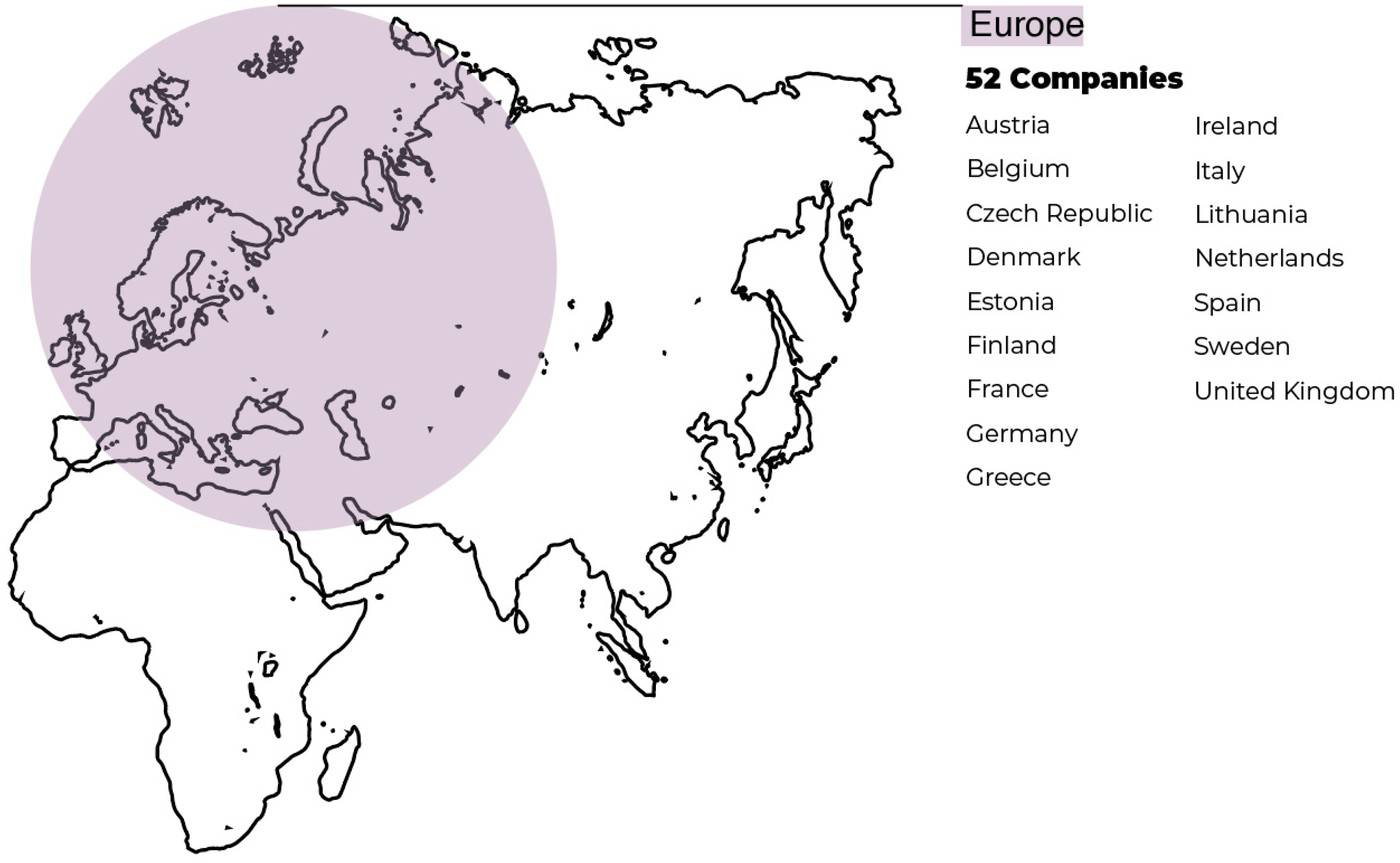
| Country | Sector | Name | Description | Large | Medium | Small | Micro |
|---|---|---|---|---|---|---|---|
| Austria | Materials/Fibers Innovation | Vienna Textile Lab | Producing textile dyes using naturally occurring bacteria. | ✓ | |||
| Austria | Materials/Fibers Innovation | Lenzing | Major production of all three man-made cellulose fiber generations, from viscose to lyocell and modal. Developed in a closed loop. | ✓ | |||
| Belgium | Process Innovation | Resortecs | Resortecs leads the circular transition in fashion with heat-dissolvable stitching threads and thermal disassembly systems. Through targeted innovations in the way clothes are assembled and disassembled, their solutions allow fashion and workwear brands to rise to meet today’s environmental challenges. | ✓ | |||
| Belgium | Business model transformation | Ebuu | Childrenswear rental and e-shop with natural cosmetics. | ✓ | |||
| Belgium | Materials/Fibers Innovation | Centexbel | Technology Center for research and innovation in textiles and plastics focused on profitable and sustainable solutions—biobased, solvent-free | ✓ | |||
| Czech Republic | Textile/Clothing | Bohempia | Sneakers, clothing, and accessories are made of hemp. Environmental and social sustainability at the core of business philosophy | ✓ | |||
| Czech Republic | Process Innovation | Ofform3D | OFFORM3D is the first PhyGital Fashion Hub in Prague that identified the intersection of technology and fashion according to the idea that designers no longer need fabric, pins, scissors, and paper to design a garment. | ✓ | |||
| Denmark | Fashion Practices | Manufacture Copenhagen | Manufacture Copenhagen is a lab that began with the design concept to create a Nordic community that was focused on sustainable design practices. | ✓ | |||
| Denmark | Organizational and BMI | Son of a tailor | Son of a Tailor is a Copenhagen-based fashion-tech company that offers custom fit essentials for men, with a proprietary algorithm that requires just height, weight, age, and shoe size to achieve a perfect fit. | ✓ | |||
| Denmark | Business model transformation | GANNI | Ganni is a contemporary ready-to-wear fashion brand for women. | v | |||
| Denmark | Organizational innovation | Chare | Grassroots clothing sharing scheme. | ✓ | |||
| Estonia | Organizational innovation | UPMADE® | UPMADE® software (UPMADE®, Tallin, Estonia) gives brands and manufacturers a holistic and transparent view of their material flow so that they can make the most of what they have already. It allows brands to create upcycled products easily and quickly. | ✓ | |||
| Estonia | Business model transformation | Reverse Resources | Reverse Resources (RR) offers a sustainable solution to the textile waste management problem by developing an online marketplace. | ✓ | |||
| Finland | Materials/Fibers Innovation | The Infinited Fiber Company | This turns textile, cardboard, and agricultural waste into a new natural fiber, thereby reducing the use of virgin materials. | ✓ | |||
| Finland | Materials/Fibers Innovation | Spinnova | This represents a disruptive ecological innovation that turns cellulose and waste streams into textile fiber simply without dissolving any harmful chemicals. Spinnova developed the most sustainable fiber in the world. | ✓ | |||
| Finland | Organizational innovation | Emmy | An online platform that allows customers to sell their high-end clothing to other customers. The C2C business collects clothes, takes photos, and places them online. | ✓ | |||
| Finland | Materials/Fibers Innovation | Pure Waste | A company that uses textile waste and other valueless materials (such as a focus on cotton) and recycles them into new products. Offers other companies the co-branding of the Pure Waste logo as a certificate of ecology and quality. | ✓ | |||
| Finland | Organizational innovation | Pumpa Upcycle | Rather than being thrown away and burnt, Pumpa Design Oy receives useless textiles and upcycles them into new products: dog/cat beds, grocery bags, bags, and pouches in different sizes. | ✓ | |||
| France | Organizational innovation | Kering | Kering S.A. is an international luxury goods group. As a responsible luxury group, Kering has made sustainability an ethical necessity as well as a determinant of its business strategy. | ✓ | |||
| France | Organizational innovation | Vestiaire Collective | Vestiaire Collective is the leading global online marketplace for desirable pre-loved fashion. | ✓ | |||
| Germany | Materials/Fibers Innovation | Texaid | They are major players in collecting, sorting, and recycling used textiles throughout Europe. EU-wide—Austria, Bulgaria, Germany, Hungary (branches); Switzerland (headquarters). | ✓ | |||
| Germany | Materials/Fibers Innovation | Adidas | Adidas is a German multinational company based in Herzogenaurach. Adidas produces footwear, clothing, and other sporting goods for professional, amateur, and leisure activities. | ✓ | |||
| Germany | Organizational innovation | The TextilePrototyping Lab | An advanced prototyping lab for textiles supported by the German Ministry for Science and Education/futuretex. | ✓ | |||
| Germany | Materials/Fibers Innovation | Algaelife | Algaelife formulates eco-positive, scalable solutions to manufacture fibers and dye fabrics. | ✓ | |||
| Germany | Organizational innovation | I:CO | Solutions and innovation in the collection, reuse, and recycling of clothing and shoes. | ✓ | |||
| Greece | Materials/Fibers Innovation | Athens Making Lab | The Making Lab in Athens focuses on textiles processing (primarily wet processing, i.e., dyeing and finishing), with the goal of providing functional properties to textile substrates and/or increasing the sustainability of production. | ✓ | |||
| Ireland | Business model transformation | Nu Wardrobe | A community and online clothes-sharing platform. | ✓ | |||
| Italy | Process Innovation | TWIN:ONE | A digital collective specializing in photo-real 3D fashion design and animation. Their software allows the first digital twin of a product to be created. With TwinOne, brands can create the content they need to display a product virtually and benefit from its photorealistic quality, unprecedented speed, and zero environmental impact. | ✓ | |||
| Italy | Organizational innovation | WRAD | A sustainable fashion brand that is challenging the status quo through sustainable innovation and social change. | ✓ | |||
| Italy | Materials/Fibers and Process Innovation | ACBC | ACBC is a BCORP leader in applied sustainability within the fashion industry and serves more than 40+ global footwear and accessories premium brands already. | ✓ | |||
| Italy | Clothing | Stella Jean | Stella Jean is an Italian designer of Haitian origin. Her work focuses on a standard of sustainability and multiculturalism that can be applied to the fashion industry. | ✓ | |||
| Italy | Process Innovation | Rayonvert | Rayon Vert’s goal is to produce clothes and technical accessories defined by an aesthetic, gorpcore-urban, following a different, liquid, and light model in the form of Open Manufacture. | ✓ | |||
| Italy | Organizational innovation | Aura | In April 2021, international leaders of the luxury industry jointly created the Aura Blockchain Consortium, which promotes the use of a single global blockchain solution that is open to all luxury brands worldwide to provide consumers with additional transparency and traceability. | ✓ | |||
| Italy | Textile/Clothing | Calzedonia | Calzedonia is an Italian company that owns seven brands linked to the clothing sector, which are marketed in single-brand shops in fifty-five countries. | ✓ | |||
| Italy | Business model transformation | Dress you Can | An innovative SME that focuses on renting fashion products to increase sustainable purchasing choices. | ✓ | |||
| Italy | Business model transformation | YNAP | Yoox Net-A-Porter Group S.p.A. is an Italian company active in the online sales of fashion, luxury, and design goods. | ✓ | |||
| Lithuania | Business model transformation | Vinted | Vinted is an online sales site based in Lithuania on which new or second-hand items, largely clothing, and accessories, can be bought, sold, and exchanged. | ✓ | |||
| Luxembourg | Textile/Clothing | Benu Couture | Collects old clothes, changes (upcycles) them, and thus creates modern clothes again in series, which are produced and sold locally (Founded by Georges Kieffer) | ✓ | |||
| Netherland | Business model transformation and Process Innovation | Dutch aweaness | A ‘circular chain manager’ for the textile industry uses their track and trace system to locate garments and ensure that those that are no longer worn are returned and recycled in a CE. | ✓ | |||
| Netherland | Business model transformation | MUD jeans | Lease or buy options to recycle and resell one’s own products. | ✓ | |||
| Netherland | Process Innovation | The Fabricant | Digital fashion house—a league of designers who specialize in photo-real 3D fashion design and animation. They develop fashion editorials, digital clothing, and occasional collections, available as a service for fashion brands and designers. | ✓ | |||
| Netherland | Business model transformation | LENA | A clothing library that allows users to borrow vintage items with a monthly subscription. | ✓ | |||
| Netherland | Process Innovation | Textiel Recycling (VHT) | A network for textile sorters and charitable and commercial collectors that represents more than 90% of businesses in the Dutch textile recycling industry. | ✓ | |||
| Netherland | Process Innovation | Boer Group Recycling Solutions | Founded by the Boer Group in 2015 to support promising research projects on innovative textile recycling methods. | ✓ | |||
| Spain | Textile/Clothing | Ecoalf | Ecoalf is a sustainable and ethical fashion brand that intends to reduce the fashion industry’s adverse effects and the use of the planet’s natural resources. By integrating breakthrough technology, ECOALF creates clothing and accessories made entirely from recycled materials. | ✓ | |||
| Sweden | Business model transformation | Curatorz | The Clothing library allows users to borrow high-end brands and emerging designer items from their online selection. | ✓ | |||
| Sweden | Business model transformation | The Wow Closet | Clothing library—users can rent designer dresses for special occasions and rent out dresses they no longer wear. | ✓ | |||
| Sweden | Process Innovation | TrusTrace | Blockchain-powered transparency and traceability technology for the fashion industry. NB: owned by Houdini’s CEO. | ✓ | |||
| Sweden | Materials/Fibers Innovation | Renewcell | Renewcell is an award-winning textile-to-textile recycling company based in Sweden. | ✓ | |||
| UK | Materials/Fibers Innovation | Worn Again Technologies | PET into textiles—pioneering polymer recycling technology. | ✓ | |||
| UK | Organizational Innovation | Unmade | A fashion technology business with specialized software for mass customization of knitwear and prints. | ✓ | |||
| UK | Business model innovation | DePop | Depop is a peer-to-peer (P2P) social e-commerce company based in London. | ✓ |
| Country | Sector | Name | Description | Large | Medium | Small | Micro |
|---|---|---|---|---|---|---|---|
| Denmark | Organizational and BMI | Son of a tailor | Son of a Tailor is a Copenhagen-based fashion-tech company that offer custom fit essentials for men, with a proprietary algorithm that requires just height, weight, age, and shoe size to create a perfect fit. | ✓ | |||
| Denmark | Business model transformation | GANNI | Ganni is a contemporary ready-to-wear fashion brand for women. | ✓ | |||
| Estonia | Business model transformation | Reverse Resources | Reverse Resources (RR) offers a sustainable solution to the textile waste management problem through the development of an online marketplace. | ✓ | |||
| France | Organizational innovation | Kering | Kering S.A. is an international luxury goods group. As a responsible luxury group, Kering has made sustainability an ethical necessity as well as a determinant of its business strategy. | ✓ | |||
| France | Organizational innovation | Vestiaire Collective | Vestiaire Collective is the leading global online marketplace for desirable pre-loved fashion. | ✓ | |||
| Germany | Materials/Fibers Innovation | Adidas | Adidas is a German multinational company based in Herzogenaurach. Adidas produces footwear, clothing, and other sporting goods for professional, amateur, and leisure activities. | ✓ | |||
| Germany | Materials/Fibers Innovation | Algaelife | Algaelife formulates eco-positive, scalable solutions for manufacturing fibers and dyeing fabrics. | ✓ | |||
| Italy | Process Innovation | TWIN:ONE | A digital collective specialized in photo-real 3D fashion design and animation. Their software allowed the first digital twin of a product to be created. With TwinOne, brands can create the content they need to display a product virtually and benefit from photorealistic quality, unprecedented speed, and zero environmental impact. | ✓ | |||
| Italy | Clothing | Stella Jean | Stella Jean is an Italian designer of Haitian origin. Her work focuses on a standard of sustainability and multiculturalism applied to the fashion industry. | ✓ | |||
| Italy | Organizational innovation | Aura | In April 2021, international leaders of the luxury industry jointly created the Aura Blockchain Consortium, which promotes the use of a single global blockchain solution that is open to all luxury brands worldwide to provide consumers with additional transparency and traceability. | ✓ | |||
| Italy | Textile/Clothing | Calzedonia | Calzedonia is an Italian company that owns seven brands linked to the clothing sector and is marketed in single-brand shops in fifty-five countries. | ✓ | |||
| Italy | Business model transformation | Dress you Can | Innovative SMEs focus on renting fashion products to increase sustainable purchasing choices. | ✓ | |||
| Lithuania | Business model transformation | Vinted | Vinted is an online sales site based in Lithuania for the buying, selling, and exchanging of new or second-hand items, largely clothing, and accessories. | ✓ | |||
| UK | Business model innovation | DePop | Depop is a P2P social e-commerce company based in London. | ✓ |
| 4.0 Components | Dominant Area of Innovation | BM Archetype | Value Proposition | Value Creation and Delivery | Value Capture |
|---|---|---|---|---|---|
| Smart products | Raw materials | Creating value from waste | Eliminating waste by turning waste into input for other production | Recycling waste, closing resource loops, and making use of under-used capacities | Cost reductions from reusing materials, and reducing waste and the use of virgin material |
| Maximizing material and energy efficiency | Products and services that use fewer resources to reduce waste, emissions, and pollution | More efficient production processes that use fewer resources and reduce waste | Cost reduction from optimal use of resources, and reduction in waste and adverse environmental impacts | ||
| Smart factories | Sustainable processes | Substitution with renewable resources and natural processes | Products based upon renewable resources and natural processes | Innovative production processes based upon renewable resources, energy, and natural systems | Revenues from new products and the reduction in environmental impacts attributable to the use of non-renewable resources |
| Re-purposing the business for society/the environment | Prioritizing social and environmental benefits over economic profit | The development of products and services with the local community as the stakeholders promoting participation and integration | Environmental and social benefits from locally embedded enterprises | ||
| Development of scale-up solutions | The large scale delivery of sustainable solutions | Development of channels and partnerships for scale-up solutions | Revenues for upscaling (e.g., franchising, licensing fees) and benefits from partnerships | ||
| Smart networks | Alternatives to consumption | Delivery of functionality, rather than ownership | Shift from selling physical products to consumers and providing services for them | The redesign and delivery of product/service offerings based upon reuse, reparability, and upgradability | Revenue to provide services and increased access for consumers |
| Adoption of stewardship role | Products and services that ensure stakeholders’ long term well-being | Production and supply systems that deliver environmental and social benefits | Revenues from stewardship and benefits of the stakeholders’ well-being | ||
| Encouragement of sufficiency | Products and services intended to reduce consumption and production | Promotion of less consumption and less waste and more durable products | Revenues from durable products and environmental and social benefits from reused and reduced consumption |
Disclaimer/Publisher’s Note: The statements, opinions and data contained in all publications are solely those of the individual author(s) and contributor(s) and not of MDPI and/or the editor(s). MDPI and/or the editor(s) disclaim responsibility for any injury to people or property resulting from any ideas, methods, instructions or products referred to in the content. |
© 2023 by the authors. Licensee MDPI, Basel, Switzerland. This article is an open access article distributed under the terms and conditions of the Creative Commons Attribution (CC BY) license (https://creativecommons.org/licenses/by/4.0/).
Share and Cite
Colombi, C.; D’Itria, E. Fashion Digital Transformation: Innovating Business Models toward Circular Economy and Sustainability. Sustainability 2023, 15, 4942. https://doi.org/10.3390/su15064942
Colombi C, D’Itria E. Fashion Digital Transformation: Innovating Business Models toward Circular Economy and Sustainability. Sustainability. 2023; 15(6):4942. https://doi.org/10.3390/su15064942
Chicago/Turabian StyleColombi, Chiara, and Erminia D’Itria. 2023. "Fashion Digital Transformation: Innovating Business Models toward Circular Economy and Sustainability" Sustainability 15, no. 6: 4942. https://doi.org/10.3390/su15064942
APA StyleColombi, C., & D’Itria, E. (2023). Fashion Digital Transformation: Innovating Business Models toward Circular Economy and Sustainability. Sustainability, 15(6), 4942. https://doi.org/10.3390/su15064942

