Article

The Contribution of Trees and Green Spaces to Household Food Security in eThekwini Metro, KwaZulu-Natal


by
Qhelile Ntombikayise Bhebhe
1,2,*,
Mjabuliseni S. C. Ngidi
1,2,3,*,
Muthulisi Siwela
4,
Temitope O. Ojo
5,6,
Simphiwe Innocentia Hlatshwayo
1,2 and
Tafadzwanashe Mabhaudhi
2,7
1
African Centre for Food Security, School of Agricultural, Earth and Environmental Sciences, College of Agriculture, Engineering and Science, University of KwaZulu-Natal, Private Bag X01, Scottsville, Pietermaritzburg 3201, South Africa
2
Centre for Transformative Agricultural and Food Systems, School of Agricultural, Earth and Environmental Sciences, College of Agriculture, Engineering and Science, University of KwaZulu-Natal, Private Bag X01, Scottsville, Pietermaritzburg 3201, South Africa
3
Department of Agricultural Extension and Rural Resource Management, School of Agricultural, Earth and Environmental Sciences, College of Agriculture, Engineering and Science, University of KwaZulu-Natal, Private Bag X01, Scottsville, Pietermaritzburg 3201, South Africa
4
Dietetics and Human Nutrition, School of Agricultural, Earth and Environmental Sciences, University of KwaZulu-Natal, Private Bag X01, Scottsville, Pietermaritzburg 3201, South Africa
5
Department of Agricultural Economics, Obafemi Awolowo University, Ile-Ife 220101, Nigeria
6
Disaster Management Training and Education Centre for Africa, University of the Free State, Bloemfontein 9301, South Africa
7
International Water Management Institute (IWMI-SA), Southern Africa Office, Pretoria 0184, South Africa
*
Authors to whom correspondence should be addressed.
Sustainability 2023, 15(6), 4855; https://doi.org/10.3390/su15064855
Submission received: 5 January 2023 / Revised: 16 February 2023 / Accepted: 7 March 2023 / Published: 9 March 2023

Abstract

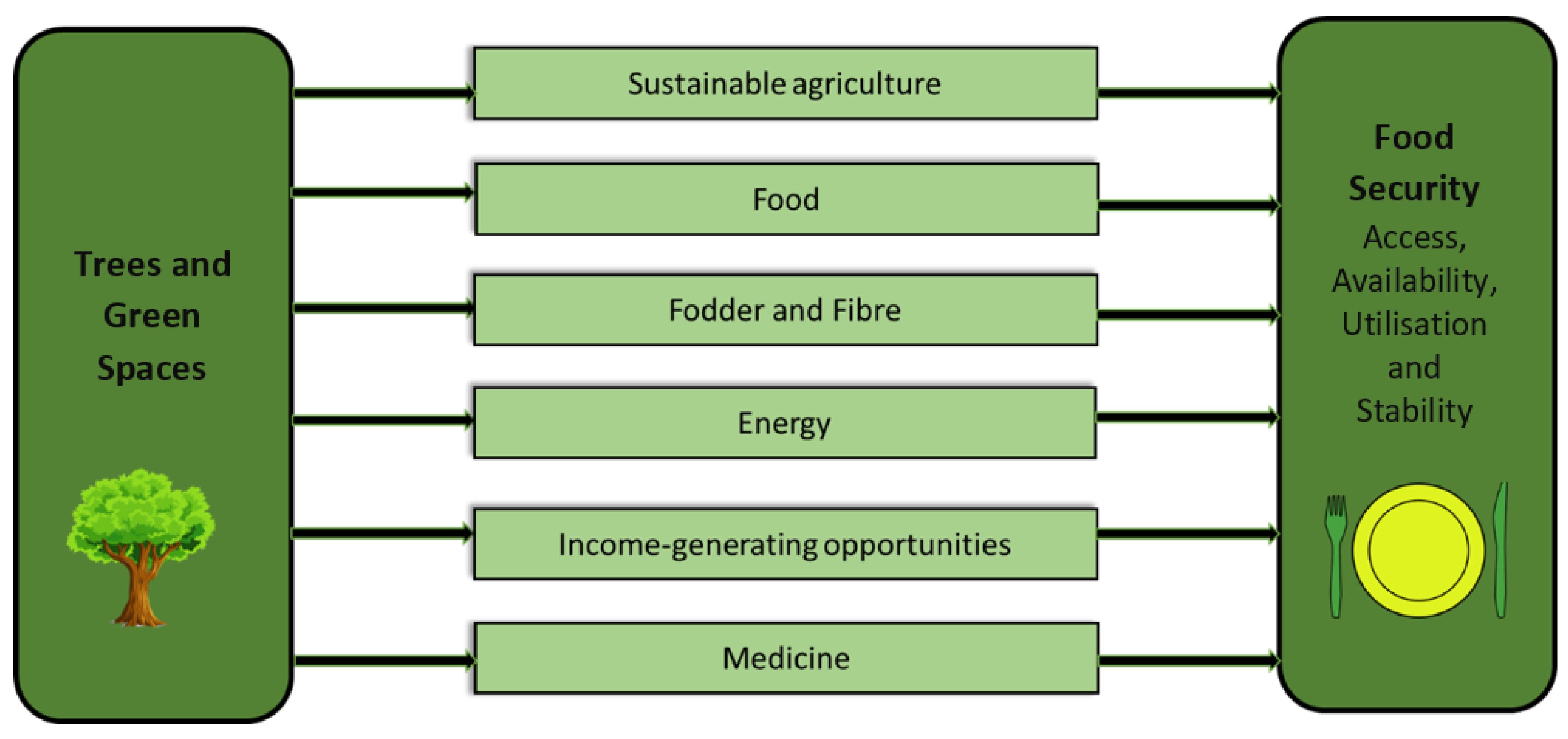
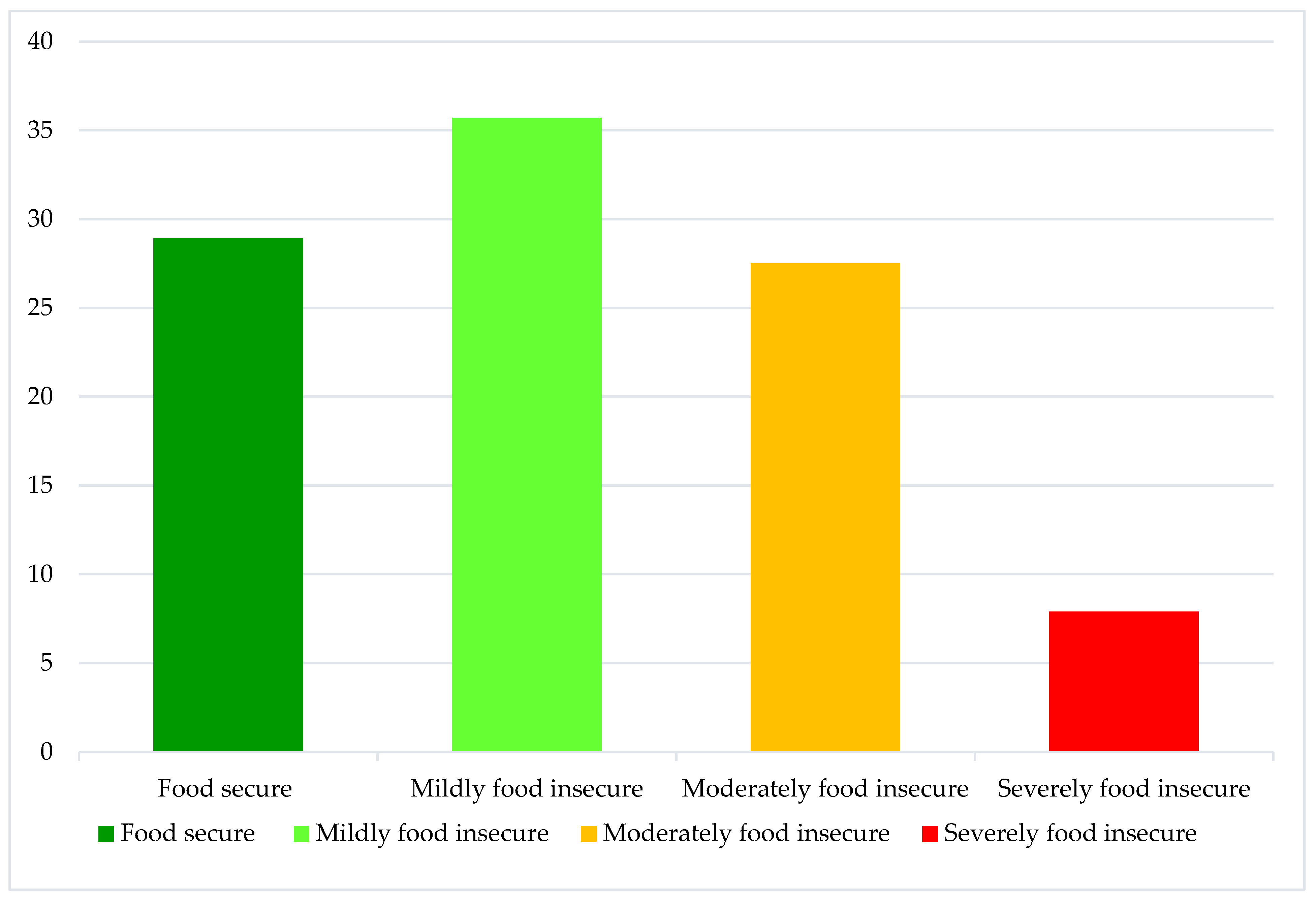
One of the most significant issues faced by many low- and middle-income nations, including South Africa, is ensuring access to healthy, affordable, and sustainable food. South Africa is renowned worldwide for its rich biodiversity and a vast body of traditional knowledge among those who consume forest foods. However, despite ecological diversity, frequent barriers remain to getting diversified household diets. This study sought to investigate the contribution of trees and green spaces to household food security in eThekwini. A total of 280 households met the inclusion criteria and consented to participate in this study by responding to questionnaires. The collected data were analysed using descriptive statistics, the computation of the Household Food Insecurity Access Scale (HFIAS), and the Instrumental Variable Poisson model. The study’s results revealed that only 29% of the respondents were food secure, 36% were mildly food insecure, 27% were moderately food insecure, and 8% were severely food insecure. The Instrumental Variable Poisson model results revealed that cultivated green spaces, wealth index, gender, education level of the head of households, and grants had a negative correlation with household food insecurity. On the other hand, non-cultivated green spaces, local trees, age, marital status, number of dependents, and monthly income positively correlated with food insecurity. Given the existence of trees and green spaces in eThekwini, there is potential for food security solutions to be formed around both cultivated and uncultivated green spaces to promote sustainable access to food and nutritious diets in low-income households. Policy interventions should adopt an approach that encourages the incorporation of foods from both cultivated and uncultivated trees and green spaces in people’s diets.
Keywords: HFIAS; food security; trees and green spaces; households; Instrumental Variable Poisson model HFIAS; food security; trees and green spaces; households; Instrumental Variable Poisson model