


Abstract
Sustainability is a global problem that invites researchers and teachers to integrate sustainability concerns into curricula. The analysis discussed in this paper is grounded in a synthesis of research papers and documents that analyzes the current status of the initiatives taken to achieve sustainability in education in the context of Pakistan. Through content analyses of 26 studies made in higher education, this study discusses the progress and challenges in achieving Education for Sustainable Development (ESD) in Pakistani Higher Education Institutions. Most of the studies reviewed were open access and published by HEC (Higher Education Commission) Pakistan in recognized national and international journals. This review shows how education contributes to transformation by highlighting the contribution of different stakeholders, i.e., administrators and leaders (eight studies) and teachers and students (fifteen studies). It also highlights governance, communication and coordination among stakeholders (eleven studies), campus outreach (five studies), and significant challenges in achieving sustainability (seven studies). The analysis provides a basis for the consideration of logistical support and quality education (SDG #4) to progress toward the SDGs. This analysis will help educators and managers in Higher Education Institutions (HEIs) to reflect on their practices, leading to Sustainable Development (SD). In addition to this, this study will help policy makers and curriculum developers to identify key challenges in meeting sustainable development goals. Also, this will enable researchers to identify gaps in the literature when framing their research questions.
1. Introduction
Educating people who can innovate, think rationally, and promote social justice is at the heart of the transformation of individuals and societies [1]. The best education systems prepare people to be successful, productive, critical, civilized, and engaged members of society [2,3]. Therefore, education systems are expected to provide appropriate knowledge, skills, aptitudes, and experiences that enable students to achieve critical consciousness, self-actualization, social justice, and economic growth. The UN Convention on the Rights of the Child has been the foundation for the rapid expansion of quality learning opportunities and teachers. Sustainable Development Goal 4 is to significantly increase the number of qualified teachers by 2030, including through international cooperation for teachers in developing countries. It has almost become a cliché that an institute can only be as good as its teachers [4].
Sustainability in higher education encompasses a focus on research, education, university operations, and the external community to enhance sustainable development [5]. Education for Sustainable Development (ESD) emphasizes the role of educational institutions in addressing social, economic and environmental issues through curricula by ensuring the equal participation of teachers, administrators, students, and related communities in sustainable behaviors [6]. In order to move ahead, it is necessary for education institutions to gain insights into the initiatives and challenges faced by governments and related industries (i.e., Education industry) in the local and global context. This review highlights the progress and challenges of ESD in the Pakistani higher education context, resulting in a systematic engagement in sustainable behaviors [6].
According to [7], the role of ESD in higher education is to acquire generic sustainability competence by, for instance, building individuals’ capacities to think in a forward-looking manner; deal with uncertainty; predict, expect and plan for the future; work in an interdisciplinary manner; see interconnections, interdependencies and identify relationships; work with open-minded thoughts, trans-cultural understanding and cooperation; and exhibit sympathy, empathy and solidarity. Globally, there is increasing demand of ESD in Higher Education Institutions (HEIs); the vision was promoted with the early initiative of UNESCO chair programs, launched in 1992, which proposed channeling by inter-university networks to transfer knowledge across borders [8]. The comprehensive review of UN-DESD (United Nations Decade of Education for Sustainable Development) highlights the role of universities to advance research, teacher training programs, raise community awareness, and promote individuals’ and societal responsibility. Also, the UN Economic Commission for Europe [9] highlights the role of educators as reflective practitioners to discover the root cause of unsustainable behaviors and, through his/her sprit, contribute to the betterment of individuals, societies and environments in both a local and global context. It then evaluates the learning outcomes in terms of the extent of the change and the improvement in sustainability knowledge and attitude [10].
The UN has adopted the 2030 agenda of the SDGs, and Pakistan is among such nations who have made this a national agenda [11]. The ESD is represented in SDG # 4 and places an emphasis on the acquisition of necessary knowledge/skills to promote sustainable development [12]. It is important to study the progress made in different dimensions, what the obstacles are, and what strategies can address the need for sustainability in a rigorous and effective way. This review will answer these questions with analysis of the findings discussed in the available documents pertaining to the higher education context of Pakistan. The paper’s novelty lies in the fact that there have not been extensive reviews, particularly systematic reviews, that have highlighted the challenges associated with achieving sustainable development goals in higher education institutions in Pakistan in recent years. The analysis will help educators and managers in higher education institutions to reflect on their practices that lead to sustainable development (SD). In addition, this study will help policymakers and curriculum developers to identify key challenges in achieving Sustainable Development Goals. It will also allow researchers to identify gaps in the literature when formulating their research questions. After discussing theoretical foundations, this paper provides a systematic overview of the progress and challenges in achieving sustainability in higher education in Pakistan. Thus, the main question addressed in this paper sheds light on the country’s position in achieving this goal. This paper starts with the background, discusses material and methods, reports the findings and discusses challenges along the way, proposes a model, and concludes with suggestions, limitations and directions for future research.
2. Sustainable Development (SD) and Education for Sustainable Development (ESD)
This section offers a review and historical background of SD. Historically, SD was introduced in a Brundtland report (1987) by the World Commission on Environment and Development. The report’s title was "Our Common Future", and it defined SD as a development that not only meets the needs of the present but also suggests worthwhile outcomes for future generations [13]. It further identified contributors to environmental issues and discussed the influences of social, economic and political development in relation to environmental issues [14]. The emerging paradigm of SD has been embraced globally by many government and non-government organizations [15]. A conference held in 1992 in Rio de Janeiro produced an action plan to manage socio-economic development and prevent the deterioration of natural resources. The agenda of the conference was the application of ESD to reinforce critical awareness in dealing with uncertain situations [16].
SD has three dimensions: society, economy and environment. ESD is crucial in developing individuals’ knowledge, skills and attitudes to take decisions that improve quality of life [17]. HEIs are assigned the responsibility to promote SD through university operations, research and outreach activities [10].
The 2030 Agenda for Sustainable Development states that an education system is successful when it can develop sustainable individuals who continue to learn after graduation, take on future life tasks, and thrive in a changing society and environment [18]. According to UNESCO, [19] SD can be achieved through holistic and pluralistic approaches to ESD. The former emphasizes theory and content-specific awareness, while the latter emphasizes pedagogy. With respect to content, ESD focuses on enhancing the conceptual understanding of the three dimensions of sustainability (social, economic and environmental) and identifies interconnectedness among them [20,21]. Pluralism is significant in addressing sustainability issues and is defined as an approach that incorporates a variety of beliefs and perspectives. At certain times and spaces, it has been difficult to address the issues with pre-defined answers [22]. This innovative pedagogy organizes learner-centered democratic strategies by encouraging participatory decision making and value-based learning [23]. On the whole, with the amalgamation of both holism and pluralism, ESD strives to promote students’ cognition to understand the world based on their own experiences and enables them to exhibit practical sustainable behaviors. The holistic approach to ESD at a higher grade level has a significant effect on students’ knowledge, and a pluralistic approach has a significant effect on positive attitude [24].
The international literature highlights that certain initiatives around the globe are undertaken by universities, such as ’greening the campuses’ movements by students and employees [25], and enriching curricula that address and strengthen the sustainability [26,27,28]. Other universities, including the University of Guyana (UG), place emphasis on teaching, research, and outreach community services that support ESD. The School of Earth and Environmental Sciences (SEES), in their specialized program for a B.Sc. in environmental studies, incorporated such activities that raise awareness not only on campus but also in the general public. In addition, students organize field trips and seminars and host events on International Environmental Day [10].
According to [10], a majority of universities have established a network on ESD and have attained higher degrees of sustainability in their campuses and communities through strategic alliances that share experiences and technical expertise. In Chile, a consortium was formed among six universities to evaluate the management practices that lead to sustainability and sustainable ’clean production’. They seek education methodologies and programs that can be applied at graduate and post graduate levels, as well as teacher training to disseminate sustainability science [10]. In conclusion, internationally, the literature review provides evidence of higher education institutes’ engagement in re-orienting their teaching–learning methods and research that have led to the discovery of new models, competencies, and innovations that contribute to sustainable development.
Theoretically, the government of Pakistan responds to the mandate of SD very positively, as the National Education Policy (2017) recognizes the significance of ESD in promoting the quality of human life through education. For example, the National Conservation Strategy (NCS) has recommended the transformation of the curriculum in relation to environmental sustainability at all bachelor- and master-level curricula [29]. In addition, proposals have been made for the establishment of an independent environment division in all agricultural and engineering universities [30]. Furthermore, HEC has shown interest in sustainability and has initiated the implementation of green practices in most HEIs in 2018 [31,32]. Many other official documents indicate the country’s way forward in achieving the SD mandate:
- According to the Policy Strategic Goal: “Build a nation-wide social movement for transformative LEARNING for ALL children and young people from Early Childhood Education (ECE) to post-secondary education and skills supported by technology, innovations and new media” (https://aserpakistan.org/document/2018/National_Eductaion_Policy_Framework_2018_Final.pdf, accessed on 19 December 2022).
- Article 25A: The State shall provide free and compulsory education to all children of the age of five to sixteen years in such manner as may be determined by law (www.rtepakistan.org, accessed on 19 December 2022).
- SDG 4: Ensure inclusive and equitable quality education and promote lifelong learning opportunities for all (www.globalgoals.org, accessed on 19 December 2022).
3. Materials and Methods
3.1. Search Strategies
Researchers of the current study searched articles published between January 2017 and December 2021 using search engines such as Google Scholar, Eric Data Base, Research gate, Scopus and Web of Science. For the presentation of the search results and the selection procedure, the Preferred Reporting Items for Systematic Reviews and Meta-Analyses [33] statement was used (see Figure 1 and Table 1). To ensure that all related articles were found in each search using different databases and a combination of keywords, the first 10 pages of each search were analyzed. Typically, the researchers found relevant publications within 3-4 pages, but continued to scroll through 10 pages to ensure that no study was missed.
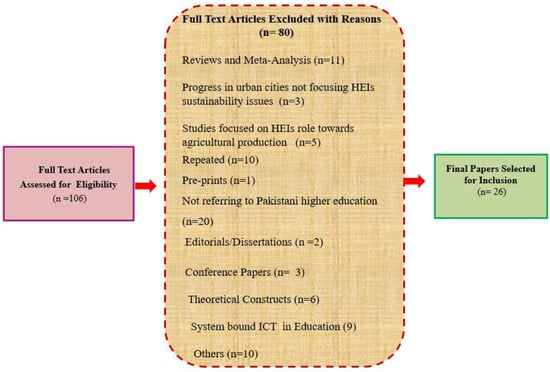
Figure 1.
Flow diagram for Inclusion and Exclusion Criteria.

Table 1.
Studies focused on Sustainability Areas.
Theoretically, in the National Policy on Education (2017), the government of Pakistan elaborates on the mandate of sustainable development and recognizes the importance of ESD in promoting people’s quality of life through education. Previous reviews reported that institutional efforts were underway to achieve sustainable development prior to 2017 [57,58], but there has been a strong focus since then. Therefore, the time selected was after the National Educational Policy took initiatives to meet sustainable development goals. Considering that the study will start and continue in 2022, it was decided to gather information on the topic from the last 5 years. This was done (from 2017 to 2021) based on a selection of recent articles. As a result of the pandemic, new challenges emerged in 2020. The researchers also examined research articles from 2019 onwards to identify additional challenges that occurred in higher education institutions during the crisis.
The search was conducted using a combination of the following keywords: Sustainability, Higher Education, and Pakistan. The search identified 309 articles for initial screening. After preliminary screening of the selected articles by reading the abstracts and identifying the inclusion criteria, 106 articles were selected for full review. Research that did not meet inclusion criteria were rejected, e.g., information that was beyond the scope of the study ( bullying in higher education, career counselling, measuring social anxiety or satisfaction among students, transportation issues in HEIs, studies only highlighting gender statistics or women empowerment in education, studies related to funding and publication frequency in higher education, accreditation, neoliberalism and cultural imperialism in HEIs, etc.), publications focusing only on the role of Higher Education Commission (HEC), Pakistan, research papers not relevant to Pakistan’s context, manuscripts focused on sustainability in industries, manufacturing sector, stock exchange, published articles in non-indexed journals, articles that did not directly address sustainable issues in higher education, and manuscripts published before 2017.
3.2. Inclusion and Exclusion Criteria
Publications were considered if the following criteria were met.
- Empirical studies on Education for Sustainable Development (ESD) in higher education in Pakistan published in peer-reviewed journals indexed with Web of Science, Scopus, Eric and Higher Education Commission (HEC) Pakistan indexed journal list were included. Conference abstracts, letters, unpublished theses or theoretical reviews were excluded (see flow chart, Figure 1); however, book chapters published after peer review were included in the study.
- Experimental studies were considered that shed light on how sustainability can be achieved in different areas of higher education in Pakistan. However, studies dealing with the impact of sustainability were excluded.
- Authors included studies investigating sustainability awareness in higher education institutions (in different departments) in different provinces of Pakistan. Researchers also included document analyses of curricula and factors that trigger and hinder sustainability.
- Comparative studies (aiming to compare Pakistani students with those of other nations) were included.
- Published work with primary data was focused, and work with secondary data and meta-analyses was excluded.
- The age of study participants was not restricted, and all papers were selected and discussed according to age groups.
- Unpublished papers or preprints were excluded.
- Only articles in English were considered.
4. Results—SD and ESD in Pakistan: Findings from Research
According to an analysis of the implementation of the SD mandate, national news articles indicate that educational institutions have begun initiatives, talks, seminars, and discussions on SDGs. This study highlights the progress and challenges pertaining to sustainability in HEIs (see Table 2).
Table 2.
Progress and Challenges in Pakistan.
5. Discussion
5.1. Sustainability Progress
In these studies, it is shown that sustainability has gained the attention of researchers from Pakistan. They have shown enthusiasm, have contributed to studies on sustainability issues, and have provided necessary recommendations.
Studies have proposed measures to incorporate ESD in the following fields: (a) technology development (computer sciences, IT, and software development), which will enable students to adapt strategies for green computing, energy-efficient software, risk reduction, management and code optimization, and resource utilization to address the needs of present and future industries [39]; (b) in social science curricula to enhance values for human rights, peace, gender equality, global citizenry, and celebrating cultural diversity [46]; and (c) in humanitarian groups, where enhanced knowledge and positive attitudes towards sustainability will help individuals to exhibit honesty, lifelong learning, empathy, systematic thinking, environmental care, social justice, and conflict resolution skills [37,38]. The experimental studies were performed by researchers at Lahore College for Women University, where the faculty members integrated ESD into the course title ‘Research in Education’ [36]. The study found that reading and discussing SD and ESD improved students’ concepts and enabled them to establish connections among social, economic, and environmental factors and contribute to their improvement. Moreover, participants became more open to learning new things and showed a keen interest in how to save environmental resources and achieve social justice and gender equity. Many of them showed empathy for the poor and agreed to provide voluntary service that could bring some change. Another experimental study [11] revealed students’ sustainable behaviors after they participated in an intervention where participants came up with solutions to local problems; they started saving water, electricity, and reducing the use of plastic shopping bags by replacing them with reusable cloth bags.
Progress is also highlighted with regards to campus operations and outreach activities [43]. Campus operations were examined through building and infrastructure, energy efficiency, waste management, water management, transport, food, landscape and grounds, the environment, packaging, and pollution prevention. The engagement of HEIs in outreach activities was demonstrated by achieving sustainability on the web, collaboration, community development, community projects, awareness campaigns, and problem solving. Sustainability is a campus operation that is consistent with the findings of [32,35]. It was also found that academic administrators are well aware of the sustainability concept [35]. Along with awareness, a change in attitude from management has also been noticed. Many heads of the arts and social science departments are keenly interested in transforming their curriculum to align with SDG #4. To achieve this, they encourage teachers to adopt ESD with the integration of technology [46].
In contrast with the public sector HEIs, researchers [32] have found better sustainability awareness in private sectors in all three components (social, economic, and environmental resources). In the private sectors, for example, the HEIs excel in developing students into decision makers, organizing regular awareness seminars, and making students competent to earn more than average earnings. However, both sectors offer social science courses, yet the private sectors claim that these HEIs have strong operations and established relationships with the community because they promote social values, social responsibility, loyalty, peacefulness, and a sense of producing quality products and services; meanwhile, the public sector respondents do not do so well.
Moreover, training exposure on sustainable environmental protection seems more so in the private sectors as compared to in the public one. The reason for lower performance is due to public-sector universities having hierarchical structures and limitations on autonomous decision making [52]. Moreover, there are several internal and external factors hampering progress (see in Table 2), [56]. However, not all private-sector HEIs are performing well—some reservations are found on their part as well, such as in investment in sustainability related concerns, teachers’ competency management [55], and their knowledge and implementation of appropriate learning approaches in classrooms [24].
It was found that the achievement of sustainability outcomes in HEIs depend upon sustainable leaders, regardless of the private or public sectors [51]. The required skills for leaders are technical skills (planning, budgeting, and controlling tasks), interpersonal skills (to communicate and cooperate effectively), and exposure to training and professional development [50]. HEIs’ initiatives for Corporate Social Responsibility (CSR) can help change society and the environment, in addition to promoting leadership (see Table 2), [53]. However, it is argued that there are many issues and challenges which have made progress towards SD very slow.
5.2. Sustainability Challenges
Pakistan is far behind the Asian world in sustainability progress [48,54]. In most HEIs, sustainability is neglected in several aspects: academic courses; learning outcomes; programs; immersive experience and assessment; sustainability literacy; establishing campus as a living laboratory; utilization of institution infrastructure and operations for demonstrating, testing, researching, and learning about sustainability; teaching approach and methodology; awareness; and integration [43]. The research findings were consistent when analyzing the curriculum of Technology Education [39] and Arts and Social Sciences (including Economics, History, Sociology, Gender Studies, Pakistan Studies, Political Science, International Relations, Journalism, Media and Communication, Applied Psychology, Philosophy, Sports Sciences and Education) [46].
It is important to acknowledge that the curriculum plays a trivial role in coping with the associated challenges of the emerging world and achieving sustainability in lifestyles [34]. Curricula need to be revamped in most of the domains [24,39,42,43,49]. Under-graduate students in most fields have a much less degree of awareness on sustainability consciousness (SC) [24]. Research in the field of technology education [39] found that 71% of students are unaware of sustainability and its relevance to their field of study, only 17% of students know the basic definition of sustainability, and only 12% of students possess some understanding of how sustainability can be related to technology education. Similarly, undergraduate students in humanitarian groups (i.e., pre-service teachers enrolled in the final year of B.Ed. (Hons) program) also displayed much less awareness of SD, even compared to Canadian high school students and Swedish upper secondary school students [38]. According to a study on teacher education programs, many teacher educators lack a significant understanding of ESD, and they do not perceive the relevance of teaching SD and addressing unsustainability through the teaching of courses [40,42]. Also, large amounts of survey data have found that teachers holding quite minimal knowledge of ESD and learning through both holistic and pluralistic approaches is uncommon in HEIs. Therefore, no significant impact of any approaches on students’ knowledge, attitude, and behavior is noticed [24]. In arts and social science classrooms, teaching practices lack a focus on sustainable lifestyles and human rights (promotion of nonviolence and peace culture, gender equality, global citizenship, and an appreciation of cultural diversity and culture’s contribution to sustainable development) [46]. Also, teachers hold a lesser understanding of how to develop moral values through religious education [49].
In addition to this, there is little evidence of sustainability in the core areas of HEIs [43]. These areas include research (academic research, financial/administrative support), access to information on SD (research on sustainability, sustainability research centers), faculty development (employee orientation, staff professional development, reward and compensation, health and safety, green hiring, and promotion), stakeholders engagement (student involvement, employee engagement, community engagement), and governance (sustainability planning and coordination, vision and mission, committees, Corporate Social Responsibility (CSR), strategies, MOUs, and sustainability reporting).
Ref. [43] also noticed that in some cases, the deans of HEIs have reported the prevalence of outreach activities (sustainability on web, collaboration, community development, community projects, awareness campaigns, public discussion, and problem solving), but a majority of respondents reported little concern in public discussions. These highlights isolate the planning of HEIs and potential gaps between the community and the HEIs. This suggests that HEIs have failed in their attempt to play an influential role in local communities. Managers at the middle level lack competencies [38]. Similar findings were found in Vietnam, indicating that managers did not possess expected competencies such as mentoring and transformation [59].
Similar to most other stakeholders in HEIs, research scholars have an incomplete understanding of SD and ESD. The findings revealed that perceived ESD are those set of skills acquired through education, such as communication and critical thinking, which continue in school and university and help to avail career opportunities. However, ignorance was noticed regarding other skills, for instance regarding honesty, lifelong learning, empathy, systematic thinking, environmental care, social justice, and conflict resolution [37].
In addition, a high illiteracy rate and slow economic growth are major barriers [24]. Slow economic growth has been the cause of insufficient funding in the allocated budget for education. Thus, the attainment of ESD with an expected quality is challenging, primarily due to the lack of funding, awareness, and training (of all stakeholders, including teachers and administrators); the inappropriate infrastructure, insufficient number of trained faculty members [24,35,46,48,50,56], lack of commitment, and interest are additional barriers [35]. A lack of funding affects sustainable procurement, discourages staff training, and may further lead to problems with competencies [56]. Paucity of budget also creates hurdle in hiring trained employees. Some other obstacles reported are the personal motivation of stakeholders, decentralizing of powers, and authorizing teachers to modify existing curricula with adequate administrative and institutional support [40,45,46]. Moreover, it is also a challenge for universities to motivate students to sustain behaviors related to environmental protection and generate resources. One of the reasons for the lack of motivation is a lack of any incentives, and employers have no concern with the jobs of students [32]. Similar obstacles have been noticed in other international studies. For example, among the obstacles in Malaysia are commitment and communication [60], high costs of practicing, lack of infrastructure, training programs, and monetary incentives [61]. Collaboration among top-bottom level stakeholders is crucial for efficiency [52], as is the realization of Corporate Social Responsibility (CSR) [53]. Such initiatives require careful decisions when considering the socio-economic realities in Pakistan.
Globally, ICT has shown substantial progress in education after the outbreak of COVID-19. However, observing pupils’ performance on the basis of technology alone is misleading. Technology can have a positive impact on student performance in Asian countries when it facilitates self-regulated learning and interactive learning [62,63]. A critical approach and sensitivity to technology is necessary to overcome the challenges associated with the use of technology, such as poor physical and mental health, discontinuation of study connectivity, communication, and skills management [34]. As compared to China and India, Pakistani academics encountered additional challenges in shifting towards online learning during the COVID-19 pandemic [64,65]. There are several aspects that affect teachers’ access to and readiness to use ICT and their path towards sustainable education [40,47,66], such as their exhausting role in work that fulfills their technical interests, and their unwillingness to reflect on social and economic issues in order to address them. Moreover, these situations neither allow teachers to enjoy freedom nor do they encourage them to re-orient the curriculum. This finding contradicts the study [46] that stated managers want to incorporate SD and expect teachers to update and reorganize the curriculum.
The literature suggests that SDG 4, target 4.7, proposes the role of higher education institutions in achieving the SDGs in general [67]. The SDSN General Assembly (2017) highlights the valuable contribution HEIs make to economic uplift and local and global well-being [68]. Thus, universities can contribute to the achievement of the SDGs in a variety of ways (see Figure 2) [69]. We propose the following model for decision makers to ensure sustainable education in the context of Pakistan.
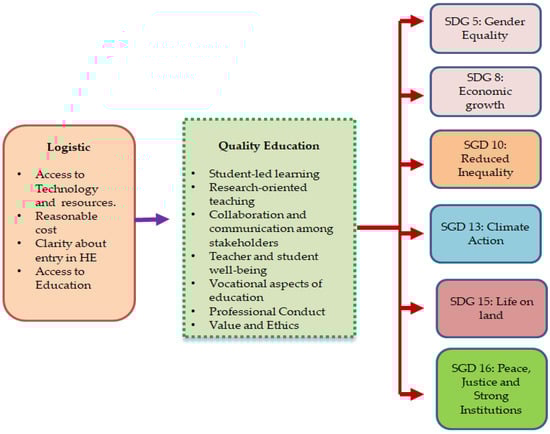
Figure 2.
Model showing the role of HEIs in attaining SDG goals.
6. Conclusions
While researchers get inspired by SD mandates and initiatives taken by the education system across the globe, the authors of the current study identified that they are very much behind in moving forward with quality education. The Pakistan Economic Survey 2021-22 suggests that overall enrolments in the fiscal year (FY) of 2020 totaled 55.7 million as compared to 53.1 million in FY 2019, which shows an increase of 4.9 percent. Similarly, compared to 271.8 thousand institutions registered for FY 2019, there were 277.5 thousand institutions registered for FY 2020. Based on this improvement, it was predicted that Pakistan would have 283.7 thousand institutions in FY 2021. In concert with this, the number of teachers increased from 1.79 million to 1.83 million in FY 2020.; thus, once again it was predicted that there would be 1.89 million teachers in FY 2021 [70]. In Pakistan, however, 31% of youth are unemployed, and many of these unemployed youth hold professional degrees [71]. There is no doubt that a lack of opportunities and a weak job system contributes to this issue [72]. In addition to that, a lack of knowledge and expertise to meet employment requirements and a lack of practical experiences such as internships and field experience are some of the major challenges identified that contribute to the unemployment issue [73]. These also reflect on the overall quality of education that we are offering to our youth and whether it leads to a quality of life that is economically sustainable. Additionally, there are rising concerns regarding psychological ailments such as depression, stress, and anxiety in education [74,75,76], which are a threat to well-being and could restrict our nation’s efforts to achieve the ideals of social inclusion and peace.
The situation certainly calls for a reflection on how the education we offer has an impact on the quality of our youth’s emotional and, therefore, social life and life in general. There is a need to conduct systematic research to determine where current practices lie and what is needed to collectively achieve sustainability as educators, researchers, and practitioners. Regular discourse with stakeholders and teachers on educational development and deep learning is essential to conceptualize what might work in Pakistan. Workshops and clinical sessions are also important to equip students to deal with the complexity and changing dynamics of today and beyond. Thus, the researchers conclude that education for sustainability requires a design of research and other educational strategies at a broad level and at the institutional level throughout the country. The conceptual understanding of ESD and its implications for nurturing quality life and quality of education of all the stakeholders, including parents and students, can also increase the momentum of sustainability in higher education. While most of the literature examined was based on urban contexts in the Punjab and Sindh provinces of Pakistan, sustainability concerns in the remaining two provinces—the Higher Education Context of Khyber Pakhtunkhwa (KPK) and Baluchistan province—need to be addressed clearly and appropriately. To conclude, higher education institutions should not be left alone to address quality and equity issues. The state, parents, funding agencies, and professionals collectively need to re-examine the purpose of education; how to cultivate indigenous and global values and visions both inside and outside the institutions; prioritize positive interactions and wellbeing; incorporate digital technologies that boost communication and collaboration; and enhance teachers’, leaders’, students’, and parents’ constant involvement in improving practices, roles, and responsibilities.
7. Limitations and Direction for Future Studies
This discussion was derived from a document and situation analysis; however, there is a need to conduct a systematic and linguistic study to understand how teachers and students view their preparedness to survive and serve in the 21st century. According to the report, higher education institutions were also affected by the decentralization policy and the 18th Amendment in the education sector [77]. However, it is recommended that more thorough studies be conducted to identify the impact of decentralization on higher education institutions and sustainability.
Author Contributions
Conceptualization, P.H. and R.F.M.; methodology, P.H. and S.S.; validation, S.S.; formal analysis, P.H., S.N. and A.H.; investigation, P.H., S.N. and A.H.; resources, P.H., S.N. and A.H.; data curation, P.H.; writing—original draft preparation, P.H. and R.F.M.; writing—review and editing, S.S.; supervision, R.F.M.; project administration, R.F.M.; funding acquisition, S.S. All authors have read and agreed to the published version of the manuscript.
Funding
The researchers acknowledge the support from the German Research Foundation and the Open Access Publication Fund of TU Berlin.
Institutional Review Board Statement
Not applicable.
Informed Consent Statement
Not applicable.
Data Availability Statement
Data sharing not applicable. No new data were created or analyzed in this study. Data sharing is not applicable to this article.
Conflicts of Interest
The authors declare no conflict of interest.
References
- Misiaszek, L.I. Engaging Gender and Freire: From Discoursal Vigilance to Concrete Possibilities for Inclusion. In The Wiley Handbook of Paulo Freire; Wiley: Hoboken, NJ, USA, 2019; pp. 389–416. [Google Scholar] [CrossRef]
- Connell, R. The neoliberal cascade and education: An essay on the market agenda and its consequences. Crit. Stud. Educ. 2013, 54, 99–112. [Google Scholar] [CrossRef]
- Gary, K. Neoliberal education for work versus liberal education for leisure. Stud. Philos. Educ. 2017, 36, 83–94. [Google Scholar] [CrossRef]
- Shor, I. Empowering Education: Critical Teaching for Social Change; The University of Chicago Press: Chicago, IL, USA, 1992. [Google Scholar]
- Liu, J.; Kitamura, Y. The Role of Universities in Promoting Sustainability in Asia. In Innovations in Asian Higher Education; Routledge: Oxford, UK, 2019; pp. 64–75. [Google Scholar] [CrossRef]
- Rieckmann, M. Learning to Transform the World: Key Competencies in Education for Sustainable Development. In Issues and Trends in Education for Sustainable Development; Leicht, A., Heiss, J., Byun, W.J., Eds.; UNESCO: Paris, France, 2018; pp. 39–59. [Google Scholar]
- Adomssent, M.; Michelsen, G. Education for Sustainable Development Strategies in German Universities. In From Cosmetic Reform to Meaningful Integration: Implementing Education for Sustainable Development in Higher Education Institutes: The State of Affairs in Six European Countries; Wals, A.E.J., Ed.; DHO: Amsterdam, The Netherlands, 2007; pp. 21–24. [Google Scholar]
- UN Decade of ESD. Available online: https://en.unesco.org/themes/education-sustainable-development/what-is-esd/un-decade-of-esd (accessed on 19 December 2022).
- Learning from Each Other: Achievements, Challenges and Ways Forward: Second Evaluation Report of the Implementation of the UNECE ESD Strategy. Available online: https://unece.org/fileadmin/DAM/env/esd/01_Typo3site/SynthesisReport.pdf (accessed on 19 December 2022).
- Wals, A.E. Sustainability in higher education in the context of the UN DESD: A review of learning and institutionalization processes. J. Clean. Prod. 2014, 62, 8–15. [Google Scholar] [CrossRef]
- Nousheen, A.; Zai, S.A.Y.; Waseem, M.; Khan, S.A. Education for sustainable development (ESD): Effects of sustainability education on pre-service teachers’ attitude towards sustainable development (SD). J. Clean. Prod. 2020, 250, 119537. [Google Scholar] [CrossRef]
- A/RES/70/1 Transforming Our World: The 2030 Agenda for Sustainable Development. Available online: https://www.un.org/en/development/desa/population/migration/generalassembly/docs/globalcompact/A_RES_70_1_E.pdf (accessed on 20 December 2022).
- 1987: Brundtland Report. Available online: https://www.are.admin.ch/are/en/home/media/publications/sustainable-development/brundtland-report.html (accessed on 20 December 2022).
- Redclift, M. Sustainable development (1987–2005): An oxymoron comes of age. Sustain. Dev. 2005, 13, 212–227. [Google Scholar] [CrossRef]
- Lele, S.M. Sustainable development: A critical review. World Dev. 1991, 19, 607–621. [Google Scholar] [CrossRef]
- United Nations Conference on Environment and Development, Rio de Janeiro, Brazil, 3–14 June 1992. Available online: https://www.un.org/en/conferences/environment/rio1992 (accessed on 20 December 2022).
- UNESCO. Education for Sustainable Development; Sourcebook; UNESCO: Paris, France, 2012. [Google Scholar]
- Leicht, A.; Combes, B.; Byun, W.J.; Agbedahin, A.V. From Agenda 21 to Target 4.7: The Development of Education for Sustainable Development. In Issues and trends in Education for Sustainable Development; Leicht, A., Heiss, J., Byun, W.J., Eds.; UNESCO: Paris, France, 2018; pp. 25–38. [Google Scholar]
- Hopkins, C. Twenty years of education for sustainable development. J. Educ. Sustain. Dev. 2012, 6, 1–4. [Google Scholar] [CrossRef]
- Gough, S. Right answers or wrong problems? Towards a theory of change for environmental learning. Trumpeter 2002, 18, 1–18. [Google Scholar]
- Summers, M.; Childs, A. Student science teachers’ conceptions of sustainable development: An empirical study of three postgraduate training cohorts. Res. Sci. Technol. Educ. 2007, 25, 307–327. [Google Scholar] [CrossRef]
- Englund, T. Deliberative communication: A pragmatist proposal. J. Curric. Stud. 2006, 38, 503–520. [Google Scholar] [CrossRef]
- Kagawa, F. Dissonance in students’ perceptions of sustainable development and sustainability: Implications for curriculum change. Int. J. Sustain. High. Educ. 2007, 8, 317–338. [Google Scholar] [CrossRef]
- Saqib, Z.A.; Zhang, Q.; Ou, J.; Saqib, K.A.; Majeed, S.; Razzaq, A. Education for sustainable development in Pakistani higher education institutions: An exploratory study of students’ and teachers’ perceptions. Int. J. Sustain. High. Educ. 2020, 21, 1249–1267. [Google Scholar] [CrossRef]
- Wright, T.S.; Wilton, H. Facilities management directors’ conceptualizations of sustainability in higher education. J. Clean. Prod. 2012, 31, 118–125. [Google Scholar] [CrossRef]
- Barth, M.; Rieckmann, M. Academic staff development as a catalyst for curriculum change towards education for sustainable development: An output perspective. J. Clean. Prod. 2012, 26, 28–36. [Google Scholar] [CrossRef]
- Lidgren, A.; Rodhe, H.; Huisingh, D. A systemic approach to incorporate sustainability into university courses and curricula. J. Clean. Prod. 2006, 14, 797–809. [Google Scholar] [CrossRef]
- Waas, T.; Verbruggen, A.; Wright, T. University research for sustainable development: Definition and characteristics explored. J. Clean. Prod. 2010, 18, 629–636. [Google Scholar] [CrossRef]
- National Strategies for Sustainable Development. Available online: https://www.environmental-mainstreaming.org/nssd/country/pakistan/pamtr03.htm (accessed on 20 December 2022).
- Alvi, U.; Aziz, A. Environmental Education: Study Guide; The Aga Khan University-Institute for Educational Development: Karachi, Pakistan, 2002. [Google Scholar]
- The Express Tribune. Available online: https://tribune.com.pk/story/1728670/hec-considers-green-campus-framework (accessed on 20 December 2022).
- Khan, S.; Khan, A.M. A phenomenological study of education for sustainable development in higher education of Pakistan. Pak. J. Educ. 2018, 35, 117–136. [Google Scholar] [CrossRef]
- Moher, D.; Liberati, A.; Tetzlaff, J.; Altman, D.; Group, T. Preferred reporting items for systematic reviews and meta-analyses: The PRISMA statement. PLoS Med. 2009, 6, e1000097. [Google Scholar] [CrossRef]
- Abbas, J.; Aman, J.; Nurunnabi, M.; Bano, S. The impact of social media on learning behavior for sustainable education: Evidence of students from selected universities in Pakistan. Sustainability 2019, 11, 1683. [Google Scholar] [CrossRef]
- Bukhari, S.S.; Said, H.; Mohamad Nor, F. Conceptual understanding of sustainability among academic administrators of Pakistan public universities. Qual. Rep. 2020, 25, 28–59. [Google Scholar] [CrossRef]
- Kalsoom, Q.; Khanam, A. Inquiry into sustainability issues by preservice teachers: A pedagogy to enhance sustainability consciousness. J. Clean. Prod. 2017, 164, 1301–1311. [Google Scholar] [CrossRef]
- Kalsoom, Q.; Qureshi, N.; Khanam, A. Perceptions of the research scholars regarding education for sustainable development (ESD) in Pakistan. In Sustainable Development Research in the Asia-Pacific Region; Springer: Cham, Switzerland, 2018; pp. 165–179. [Google Scholar] [CrossRef]
- Kalsoom, Q.; Khanam, A.; Quraishi, U. Sustainability consciousness of pre-service teachers in Pakistan. Int. J. Sustain. High. Educ. 2017, 18, 1090–1107. [Google Scholar] [CrossRef]
- Malik, M.N.; Khan, H.H.; Chofreh, A.G.; Goni, F.A.; Klemeš, J.J.; Alotaibi, Y. Investigating students’ sustainability awareness and the curriculum of technology education in Pakistan. Sustainability 2019, 11, 2651. [Google Scholar] [CrossRef]
- Mirza, M.S.; Tajuddin. Teacher educators’ preparedness for re-orienting teacher education programs for sustainable development in Pakistan. J. Res. Reflect. Educ. JRRE 2020, 14, 1–15. [Google Scholar]
- Syed, S.Z.; Akhter, M. Assessing Home Economics college students’ behaviour towards sustainable development. Bull. Educ. Res. 2018, 40, 105–111. [Google Scholar]
- Durrani, N.; Halai, A. Dynamics of gender justice, conflict and social cohesion: Analysing educational reforms in Pakistan. Int. J. Educ. Dev. 2018, 61, 27–39. [Google Scholar] [CrossRef]
- Habib, M.N.; Khalil, U.; Khan, Z.; Zahid, M. Sustainability in higher education: What is happening in Pakistan? Int. J. Sustain. High. Educ. 2021, 22, 681–706. [Google Scholar] [CrossRef]
- Zahid, M.; Rahman, H.U.; Ali, W.; Habib, M.N.; Shad, F. Integration, implementation and reporting outlooks of sustainability in higher education institutions (HEIs): Index and case base validation. Int. J. Sustain. High. Educ. 2020, 22, 120–137. [Google Scholar] [CrossRef]
- Iqbal, A.; Latif, F.; Marimon, F.; Sahibzada, U.F.; Hussain, S. From knowledge management to organizational performance: Modelling the mediating role of innovation and intellectual capital in higher education. J. Enterp. Inf. Manag. 2019, 32, 36–59. [Google Scholar] [CrossRef]
- Noureen, S.; Hussain, B.; Khurshid, K. Implementing the sustainable development goals for quality education in institutions of higher education in Pakistan: A Qualitative analysis. Int. J. Innov. Teach. Learn. IJITL 2020, 6, 159–173. [Google Scholar]
- Soomro, K.A.; Kale, U.; Curtis, R.; Akcaoglu, M.; Bernstein, M. Digital divide among higher education faculty. Int. J. Educ. Technol. High. Educ. 2020, 17, 1–16. [Google Scholar] [CrossRef]
- Butt, A.; Lodhi, R.N.; Shahzad, M.K. Staff retention: A factor of sustainable competitive advantage in the higher education sector of Pakistan. Stud. High. Educ. 2020, 45, 1584–1604. [Google Scholar] [CrossRef]
- Asif, T.; Guangming, O.; Haider, M.A.; Colomer, J.; Kayani, S.; Amin, N.U. Moral education for sustainable development: Comparison of university teachers’ perceptions in China and Pakistan. Sustainability 2020, 12, 3014. [Google Scholar] [CrossRef]
- Bukhari, S.K.U.S.; Gul, R.; Bashir, T.; Zakir, S.; Javed, T. Exploring managerial skills of Pakistan Public Universities (PPUs)’middle managers for campus sustainability. J. Sustain. Financ. Invest. 2021, 13, 73–91. [Google Scholar] [CrossRef]
- Iqbal, Q.; Piwowar-Sulej, K. Sustainable leadership in higher education institutions: Social innovation as a mechanism. Int. J. Sustain. High. Educ. 2022, 23, 1–20. [Google Scholar] [CrossRef]
- Bukhari, S.K.U.S.; Ali, R.; Faisal, A. Sustainability in the decision making of Pakistan public universities: A vital initiative. Bull. Educ. Res. 2021, 43, 115–134. [Google Scholar]
- Asrar-ul-Haq, M.; Kuchinke, K.P.; Iqbal, A. The relationship between corporate social responsibility, job satisfaction, and organizational commitment: Case of Pakistani higher education. J. Clean. Prod. 2017, 142, 2352–2363. [Google Scholar] [CrossRef]
- Leal Filho, W.; Dinis, M.A.P.; Sivapalan, S.; Begum, H.; Ng, T.F.; Al-Amin, A.Q.; Alam, G.M.; Sharifi, A.; Salvia, A.L.; Kalsoom, Q.; et al. Sustainability practices at higher education institutions in Asia. Int. J. Sustain. High. Educ. 2022, 23, 1250–1276. [Google Scholar] [CrossRef]
- Waqas, M.; Rehman, M.; Rehman, A. The barriers and challenges faced by private sector higher education institutions (HEIs) in promoting sustainable development: A qualitative inquiry in Pakistan. Pak. J. Educ. 2019, 36, 19–46. [Google Scholar] [CrossRef]
- Zaidi, S.A.H.; Mirza, F.M.; Hou, F.; Ashraf, R.U. Addressing the sustainable development through sustainable procurement: What factors resist the implementation of sustainable procurement in Pakistan? Socio-Econ. Plan. Sci. 2019, 68, 100671. [Google Scholar] [CrossRef]
- Mughal, S.H.; Qaisrani, N.; Solangi, G.; Faiz, S. Promoting education for sustainable development: Challenges and issues for higher education institutions in Pakistan. Int. J. Learn. Dev. 2011, 1, 159–165. [Google Scholar] [CrossRef]
- Batool, Z.; Qureshi, R.H. Quality Assurance Manual for Higher Education in Pakistan; Higher Education Commission: Islamabad, Pakistan, 2007. [Google Scholar]
- Pham, T.V.; Nghiem, T.T.; Nguyen, L.M.T.; Mai, T.X.; Tran, T. Exploring key competencies of mid-level academic managers in higher education in Vietnam. Sustainability 2019, 11, 6818. [Google Scholar] [CrossRef]
- Gholami, H.; Bachok, M.F.; Saman, M.Z.M.; Streimikiene, D.; Sharif, S.; Zakuan, N. An ISM approach for the barrier analysis in implementing green campus operations: Towards higher education sustainability. Sustainability 2020, 12, 363. [Google Scholar] [CrossRef]
- Farooq, K.; Yusliza, M.Y.; Wahyuningtyas, R.; Haque, A.U.; Muhammad, Z.; Saputra, J. Exploring challenges and solutions in performing employee ecological behaviour for a sustainable workplace. Sustainability 2021, 13, 9665. [Google Scholar] [CrossRef]
- Memon, M.Q.; Lu, Y.; Memon, A.R.; Memon, A.; Munshi, P.; Shah, S.F.A. Does the impact of technology sustain students’ satisfaction, academic and functional performance: An analysis via interactive and self-regulated learning? Sustainability 2022, 14, 7226. [Google Scholar] [CrossRef]
- Hettiarachchi, S.; Damayanthi, B.W.R.; Heenkenda, S.; Dissanayake, D.M.S.L.B.; Ranagalage, M.; Ananda, L. Student satisfaction with online learning during the COVID-19 pandemic: A study at state universities in Sri Lanka. Sustainability 2021, 13, 11749. [Google Scholar] [CrossRef]
- Aristovnik, A.; Keržič, D.; Ravšelj, D.; Tomaževič, N.; Umek, L. Impacts of the COVID-19 pandemic on life of higher education students: A global perspective. Sustainability 2020, 12, 8438. [Google Scholar] [CrossRef]
- Khan, M.A.; Nabi, M.K.; Khojah, M.; Tahir, M. Students’ perception towards e-learning during COVID-19 pandemic in India: An empirical study. Sustainability 2020, 13, 57. [Google Scholar] [CrossRef]
- Siddiqui, S.; Arif, I.; Hinduja, P. Technostress: A catalyst to leave the teaching profession- A survey designed to measure technostress among teachers in Pakistan during COVID-19 pandemic. J. e-Learn. Digit. Media 2022, 20, 53–79. [Google Scholar] [CrossRef]
- UNESCO. Education for Sustainable Development Goals-Learning Objectives; UNESCO: Paris, France, 2017; Available online: https://unesdoc.unesco.org/ark:/48223/pf0000247444 (accessed on 14 January 2023).
- SDSN General Assembly. The Role of Higher Education to Foster Sustainable Development: Practices, Tools and Solutions; Position Paper; SDSN General Assembly: New York, NY, USA, 2017; Available online: https://www.sdsn-mediterranean.unisi.it/wp-content/uploads/sites/30/2017/08/Testo-positional-CON-FIG-1.pdf (accessed on 14 January 2023).
- Kestin, T.; van den Belt, M.; Denby, L.; Ross, K.; Thwaites, J.; Hawkes, M. Getting Started with the SDGs in Universities: A Guide for Universities, Higher Education Institutions, and the Academic Sector. 2017. Available online: https://apo.org.au/sites/default/files/resource-files/2017-08/apo-nid105606.pdf (accessed on 14 January 2023).
- Pakistan Economic Survey 2021–2022. Available online: https://www.finance.gov.pk/survey/chapter_22/Economic%20Survey%202021-22.pdf (accessed on 20 January 2023).
- Over 31% of Educated Youth Unemployed, Reveals PIDE. Available online: https://tribune.com.pk/story/2342344/over-31-of-educated-youth-unemployed-reveals-pide (accessed on 20 January 2023).
- Aligning University Education with Emerging Job Market. Available online: https://tribune.com.pk/story/2356885/aligning-university-education-with-emerging-job-market (accessed on 20 January 2023).
- Sustainable Educational Institutes. Available online: https://tribune.com.pk/story/2334835/sustainable-educational-institutes (accessed on 20 January 2023).
- Mallhi, T.H.; Ahmad, N.; Salman, M.; Tanveer, N.; Shah, S.; Butt, M.H.; Alatawi, A.D.; Alotaibi, N.H.; Rahman, H.U.; Alzarea, A.I.; et al. Estimation of psychological impairment and coping strategies during COVID-19 pandemic among university students in Saudi Arabia: A large regional analysis. Int. J. Environ. Res. Public Health 2022, 19, 14282. [Google Scholar] [CrossRef] [PubMed]
- Anjum, A.; Muazzam, A.; Manzoor, F.; Visvizi, A.; Nawaz, R. Mediating bullying and strain in higher education institutions: The case of Pakistan. Sustainability 2019, 11, 2244. [Google Scholar] [CrossRef]
- Iorga, M.; Dondas, C.; Zugun-Eloae, C. Depressed as freshmen, stressed as seniors: The relationship between depression, perceived stress and academic results among medical students. Behav. Sci. 2018, 8, 70. [Google Scholar] [CrossRef] [PubMed]
- Siddiqui, S.; Ahmed, Z.; Memon, A. Impact of devolution on education in Pakistan in the light of 18th amendment: A review article. Gov.-Annu. Res. J. Political Sci. 2021, 10, 82–92. [Google Scholar]
Disclaimer/Publisher’s Note: The statements, opinions and data contained in all publications are solely those of the individual author(s) and contributor(s) and not of MDPI and/or the editor(s). MDPI and/or the editor(s) disclaim responsibility for any injury to people or property resulting from any ideas, methods, instructions or products referred to in the content. |
© 2023 by the authors. Licensee MDPI, Basel, Switzerland. This article is an open access article distributed under the terms and conditions of the Creative Commons Attribution (CC BY) license (https://creativecommons.org/licenses/by/4.0/).