Article

Equitable Global Value Chain and Production Network as a Driver for Enhanced Sustainability in Developing Economies


by
Adolf Akwei Acquaye
1,
Fred Amofa Yamoah
2,*,
Taofeeq Ibn-Mohammed
3,
Enoch Quaye
4 and
David Eshun Yawson
5
1
Department of Management Science and Engineering, Khalifa University, Abu Dhabi P.O. Box 127788, United Arab Emirates
2
Birkbeck Business School, Faculty of Business and Law, Birkbeck University of London, London WC1E 7HX, UK
3
Computational Sustainability Research Group (CSRG), Warwick Manufacturing Group, The University of Warwick, Coventry CV4 7AL, UK
4
School of Accounting and Finance, University of Bristol, Tyndalls Park Road, Bristol BS8 1QU, UK
5
Business School, Ghana Institute of Management and Public Administration (GIMPA), Accra P.O. Box AH 50, Ghana
*
Author to whom correspondence should be addressed.
Sustainability 2023, 15(19), 14550; https://doi.org/10.3390/su151914550
Submission received: 31 August 2023 / Revised: 28 September 2023 / Accepted: 30 September 2023 / Published: 7 October 2023
(This article belongs to the Section Economic and Business Aspects of Sustainability)

Abstract

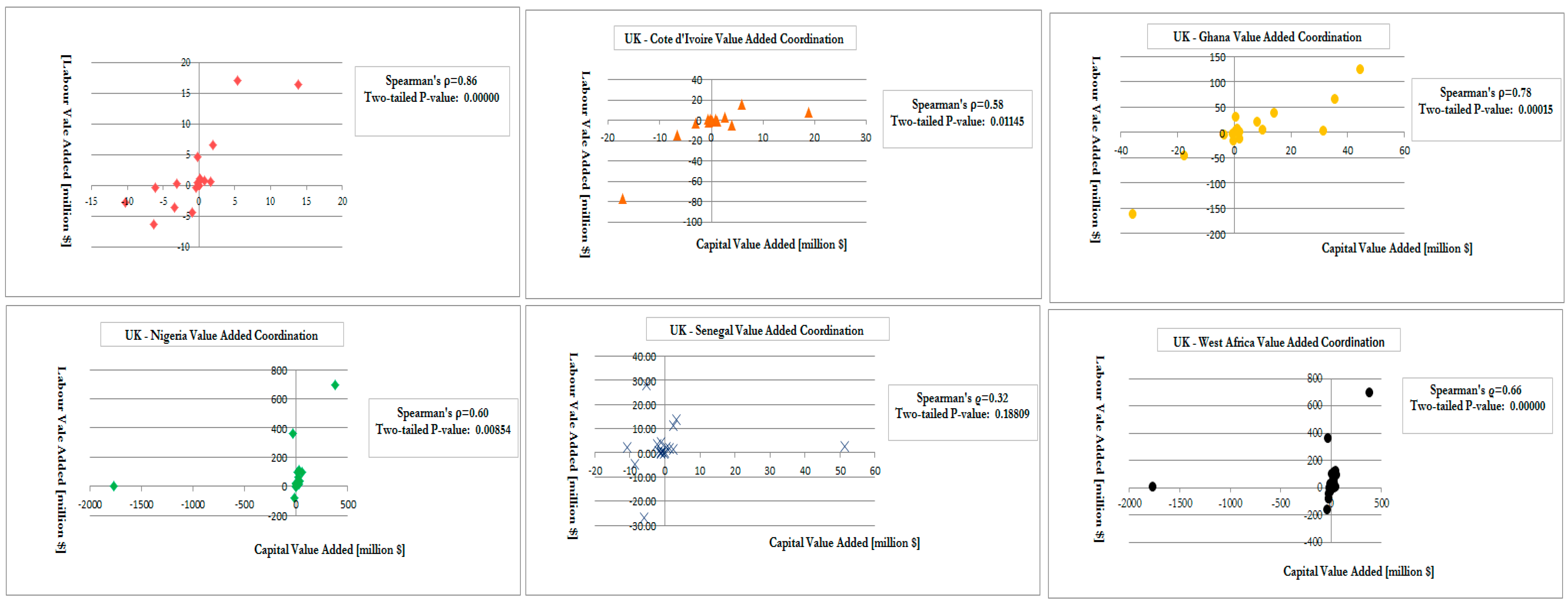
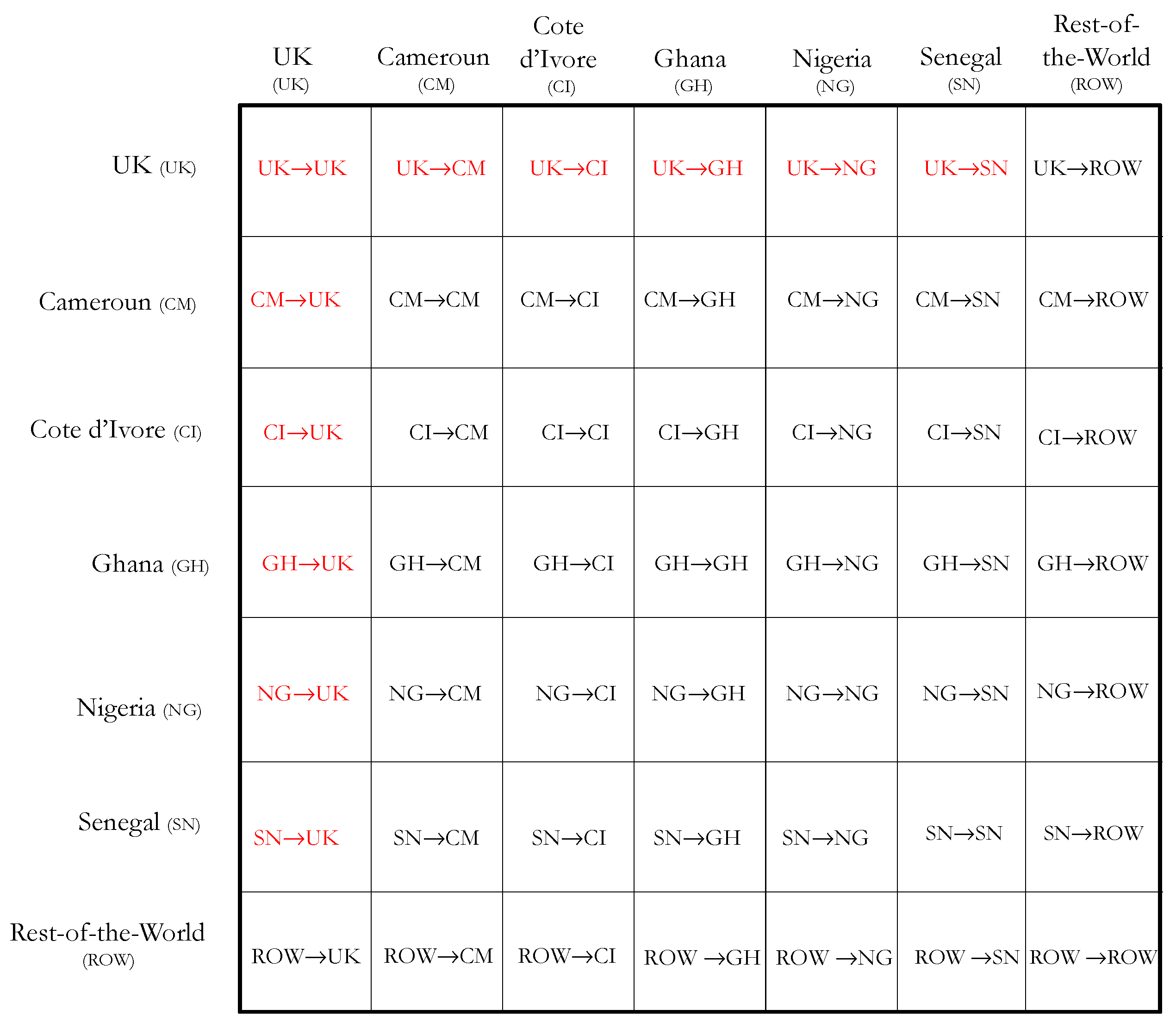
Recent studies on the global value chain (GVC) have highlighted the need to better integrate the value chains of developing countries of the global South with that of the global North regions, which are more highly developed. This is aimed at enhancing the economic and social sustainable upgrading of the value chains of the global South regions. The paper thus seeks to answer a critical question as to whether the existing GVC set-up pertaining to global North and South countries is equitable and whether it would yield the needed socio-economic and wider sustainable benefits, particularly to global South countries. a conceptual Global Value Chain (GVC) model is developed based on the economy-wide and system-based Multi-Regional Input–Output methodology to achieve this goal. Subsequently, this was empirically tested to measure embodied flows in capital and labour for sustainable development between global North and South regions. These are achieved using the GVC networks of the UK (from the global North) and some countries in sub-Saharan Africa (from the global South) to exemplify these developments. With implications for equitable, sustainable development, our study shows significant imbalances exist in the flows of value added activities from the global South to the global North, particularly in the primary industries, which produce low-value products in their raw state. Subsequently, this creates a disproportionate economic disadvantage for South countries. As such, if global South countries are to fully benefit from GVC, the study shows that these imbalances must be addressed, such as through structural changes in the economies of global South countries from their dependencies on the primary industries.
Keywords: global value chain; global north and south; embodied capital and labour; equitable sustainable development global value chain; global north and south; embodied capital and labour; equitable sustainable development