Proposing a Model for Sustainable Development of Creative Industries Based on Digital Transformation



Abstract
1. Introduction
2. Theoretical Foundations
- (a)
- Which components are effective in the sustainable development of creative industries based on digital transformation using structural interpretive modeling?
- (b)
- Which indicators are effective in the sustainable development of creative industries based on digital transformation using structural interpretive modeling?
- (c)
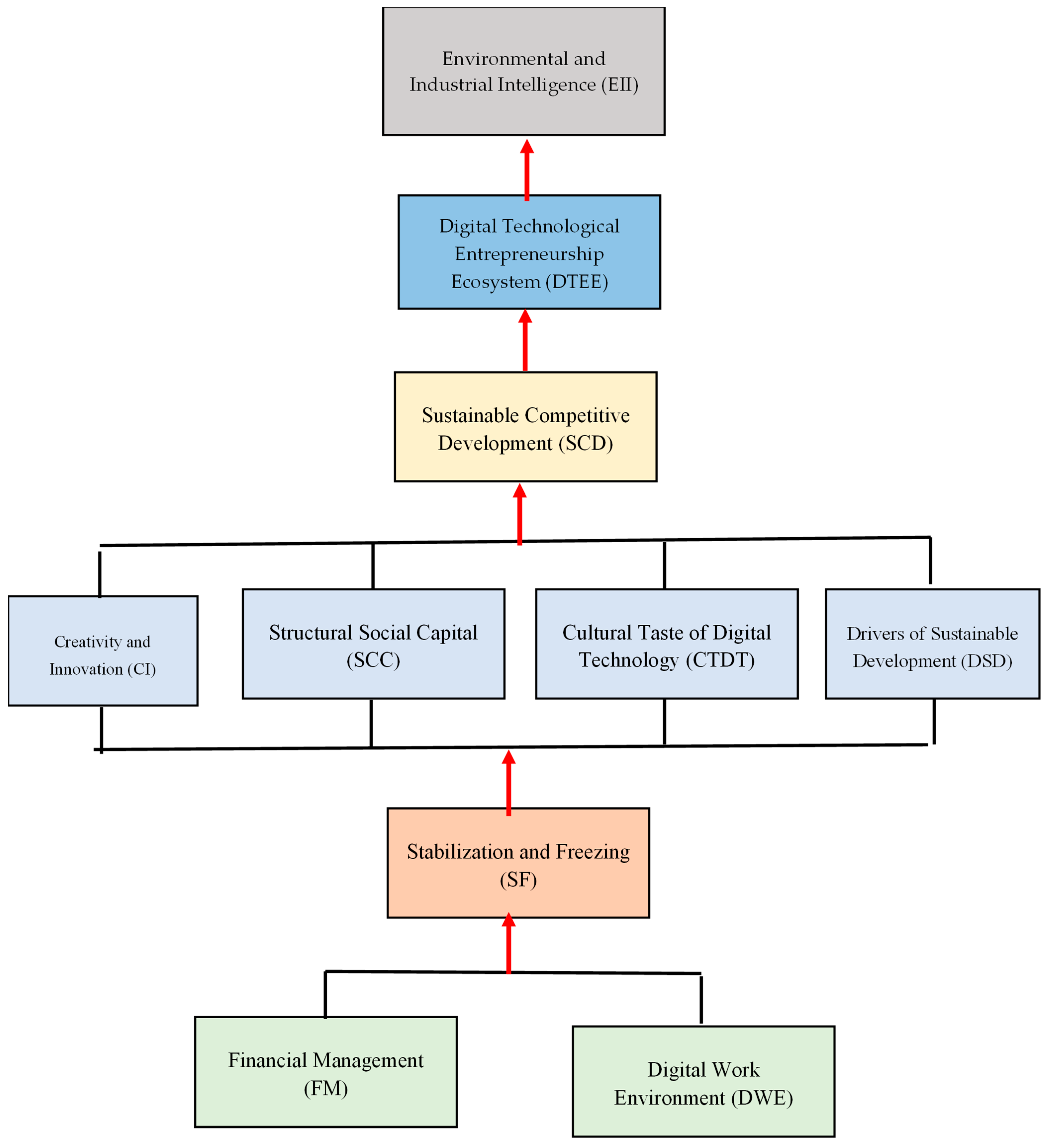
- What is the relationship model of components effective in the sustainable development of creative industries based on digital transformation using structural interpretive modeling for implementing this concept?
3. Materials and Methods
4. Results
Reliability and Validity
5. Discussion
6. Conclusions
6.1. Practical Implications
6.2. Limitations and Future Research Directions
Author Contributions
Funding
Institutional Review Board Statement
Informed Consent Statement
Data Availability Statement
Acknowledgments
Conflicts of Interest
References
- Antolín-López, R.; Delgado-Ceballos, J.; Montiel, I. Deconstructing corporate sustainability: A comparison of different stakeholder metrics. J. Clean. Prod. 2016, 136, 5–17. [Google Scholar] [CrossRef] [Scilit]
- Phillis, Y.A.; Davis, B.J. Assessment of corporate sustainability via fuzzy logic. J. Intell. Robot. Syst. 2009, 55, 3–20. [Google Scholar] [CrossRef] [Scilit]
- Nikraftar, T.; Hosseini, E. The effect of auditing on business performance by modulating organizational culture in knowledge-based companies in the field of information technology. J. Res. Manag. Teach. Mar. Sci. 2022, 9, 215–235. [Google Scholar]
- Johnson, M.W.; Christensen, C.M.; Kagermann, H. Reinventing your business model. Harv. Bus. Rev. 2008, 86, 50–59. [Google Scholar]
- Mukherjee, A.; Kamarulzaman, N.H.; Vijayan, G.; Vaiappuri, S.K. Sustainability: A comprehensive literature. In Handbook of Research on Global Supply Chain Management; IGI Global: Hershey, PA, USA, 2016; pp. 248–268. [Google Scholar]
- Yang, M.; Evans, S.; Vladimirova, D.; Rana, P. Value uncaptured perspective for sustainable business model innovation. J. Clean. Prod. 2017, 140, 1794–1804. [Google Scholar] [CrossRef] [Scilit]
- Chen, M.-J. Competitor analysis and interfirm rivalry: Toward a theoretical integration. Acad. Manag. Rev. 1996, 21, 100–134. [Google Scholar] [CrossRef] [Scilit]
- Ireland, R.D.; Webb, J.W. Strategic entrepreneurship: Creating competitive advantage through streams of innovation. Bus. Horiz. 2007, 50, 49–59. [Google Scholar] [CrossRef] [Scilit]
- Sapta, I.K.S.; Landra, N.; Supartha, I.W.G.; Asih, D.; Setini, M. Public health welfare in digital-based resources transformation from social capital and information sharing: Creative industries from village. Syst. Rev. Pharm. 2020, 11, 688–696. [Google Scholar]
- Kabir, M.N.; Kabir, M.N. Knowledge-Based Social Entrepreneurship: Understanding Knowledge Economy, Innovation, and the Future of Social Entrepreneurship; Springer: Berlin/Heidelberg, Germany, 2019; pp. 59–89. [Google Scholar]
- Rahimli, N.; See-to, E.W. Exploring open innovation technologies in creative industries: Systematic review and future research agenda. In Information Technology Science; Springer: Cham, Switzerland, 2018; pp. 71–85. [Google Scholar]
- Shou, Y.; Shao, J.; Lai, K.-h.; Kang, M.; Park, Y. The impact of sustainability and operations orientations on sustainable supply management and the triple bottom line. J. Clean. Prod. 2019, 240, 118280. [Google Scholar] [CrossRef] [Scilit]
- Hematian Khayyat, M.; Zand Hessami, h.; Davari, A. Dimensions and Components of Technological Entrepreneurship Ecosystem in Iran’s Digital Creative Industries with Emphasis on the Culture Taste of Digital Technologies. J. Entrep. Dev. 2022, 15, 181–200. [Google Scholar] [CrossRef]
- Heavin, C.; Power, D.J. Challenges for digital transformation–towards a conceptual decision support guide for managers. J. Decis. Syst. 2018, 27, 38–45. [Google Scholar] [CrossRef] [Scilit]
- Shirazi, M.; Yazdani, H.R.; Zarei Matin, H. Providing a Roadmap for Deployment the Organizational Culture Required for Digital Transformation with a Meta-Synthesis Approach. Organ. Behav. Stud. Q. 2021, 10, 1–22. [Google Scholar]
- Manioudis, M.; Angelakis, A. Creative Economy and Sustainable Regional Growth: Lessons from the Implementation of Entrepreneurial Discovery Process at the Regional Level. Sustainability 2023, 15, 7681. [Google Scholar] [CrossRef] [Scilit]
- Dwivedi, Y.K.; Kshetri, N.; Hughes, L.; Slade, E.L.; Jeyaraj, A.; Kar, A.K.; Baabdullah, A.M.; Koohang, A.; Raghavan, V.; Ahuja, M. “So what if ChatGPT wrote it?” Multidisciplinary perspectives on opportunities, challenges and implications of generative conversational AI for research, practice and policy. Int. J. Inf. Manag. 2023, 71, 102642. [Google Scholar] [CrossRef] [Scilit]
- ElMassah, S.; Mohieldin, M. Digital transformation and localizing the sustainable development goals (SDGs). Ecol. Econ. 2020, 169, 106490. [Google Scholar] [CrossRef] [Scilit]
- Trushkina, N.; Abazov, R.; Rynkevych, N.; Bakhautdinova, G. Digital transformation of organizational culture under conditions of the information economy. Virtual Econ. 2020, 3, 7–38. [Google Scholar] [CrossRef] [Scilit]
- Arabiun, A.; Hosseini, E.; Mahmoodi, K.; Mohsen, B. An Investigation of the Socio-Cultural Impacts of the Digital Transformation in Developed, Developing, and Middle: Africa and Asia Pacific. In Exploring Business Ecosystems and Innovation Capacity Building in Global Economics; IGI Global: Hershey, PA, USA, 2023; pp. 112–130. [Google Scholar]
- Vares, S.H.; Mohammadian, A.; Kargar Shouraki, M. Sustainable Business Model Innovation in the Digital Age Based on the Dynamic Capabilities Approach. J. Bus. Manag. 2023, 15, 54–84. [Google Scholar]
- Yang, S.; Song, Y.; Tong, S. Sustainable retailing in the fashion industry: A systematic literature review. Sustainability 2017, 9, 1266. [Google Scholar] [CrossRef] [Scilit]
- Huber, M.Z.; Hilty, L.M. Gamification and sustainable consumption: Overcoming the limitations of persuasive technologies. In ICT Innovations for Sustainability; Springer International Publishing: Berlin/Heidelberg, Germany, 2015; pp. 367–385. [Google Scholar]
- Anantrasirichai, N.; Bull, D. Artificial intelligence in the creative industries: A review. Artif. Intell. Rev. 2022, 55, 589–656. [Google Scholar] [CrossRef] [Scilit]
- Ginting, Y.M. Intellectual Capital investigation in achieving sustainable competitive advantages in the creative industry: Does the mediation of knowledge management system affect? J. Manag. Inf. Decis. Sci. 2020, 23, 99–114. Available online: https://web.s.ebscohost.com/abstract?direct=true&profile=ehost&scope=site&authtype=crawler&jrnl=15247252&AN=144256818&h=7Hd%2f4pQ9R6ugJA5aJx6qiaNYnuLr9DlLGSpp6XEsWEjoPTku6hWJxpKjIFfVHmOXtimnIpUsr%2fcGuHrez1kGpA%3d%3d&crl=c&resultNs=AdminWebAuth&resultLocal=ErrCrlNotAuth&crlhashurl=login.aspx%3fdirect%3dtrue%26profile%3dehost%26scope%3dsite%26authtype%3dcrawler%26jrnl%3d15247252%26AN%3d144256818 (accessed on 26 May 2021).
- Hosseini, E.; Tajpour, M.; Mohiuddin, M. Perspective Chapter: The Role of Knowledge Employees’ Voices in Creating Knowledge in Digital Startups. In Recent Advances in Knowledge Management; IntechOpen: London, UK, 2022. [Google Scholar]
- Dessein, J.; Soini, K.; Fairclough, G.; Horlings, L.; Battaglini, E.; Birkeland, I.; Duxbury, N.; De Beukelaer, C.; Matejić, J.; Stylianou-Lambert, T. Culture in, for and as Sustainable Development: Conclusions from the COST Action IS1007 Investigating Cultural Sustainability; University of Jyväskylä: Väskylä, Finland, 2015. [Google Scholar]
- Salamzadeh, A.; Dana, L.P. The coronavirus (COVID-19) pandemic: Challenges among Iranian startups. J. Small Bus. Entrep. 2021, 33, 489–512. [Google Scholar] [CrossRef] [Scilit]
- Tajpour, M.; Hosseini, E.; Mohiuddin, M. Effects of innovative climate, knowledge sharing, and communication on sustainability of digital start-ups: Does social media matter? J. Open Innov. Technol. Mark. Complex. 2023, 9, 100053. [Google Scholar] [CrossRef] [Scilit]
- Petrini, M.; Pozzebon, M. Managing sustainability with the support of business intelligence methods and tools. In Proceedings of the Information Systems, Technology and Management: Third International Conference, ICISTM 2009, Ghaziabad, India, 12–13 March 2009; pp. 88–99. [Google Scholar]
- Kondoh, S.; Mishima, N. Proposal of cause–effect pattern library for realizing sustainable businesses. CIRP Ann. 2011, 60, 33–36. [Google Scholar] [CrossRef] [Scilit]
- Akisik, O.; Gal, G. Sustainability in businesses, corporate social responsibility, and accounting standards: An empirical study. Int. J. Account. Inf. Manag. 2011, 19, 304–324. [Google Scholar] [CrossRef] [Scilit]
- Rezaee, Z. Business sustainability research: A theoretical and integrated perspective. J. Account. Lit. 2016, 36, 48–64. [Google Scholar] [CrossRef] [Scilit]
- Aagaard, A. Sustainable Business: Integrating CSR in Business and Functions; CRC Press: Boca Raton, FL, USA, 2022. [Google Scholar]
- Daskalopoulou, I.; Petrou, A. Entrepreneurial growth expectations and information flows in networks. J. Small Bus. Enterp. Dev. 2010, 17, 334–349. [Google Scholar] [CrossRef] [Scilit]
- Kantabutra, S. Exploring the corporate sustainability process: A Thai perspective. Int. J. Product. Qual. Manag. 2017, 22, 170–189. [Google Scholar] [CrossRef] [Scilit]
- Chiu, C.-M.; Cheng, H.-L.; Huang, H.-Y.; Chen, C.-F. Exploring individuals’ subjective well-being and loyalty towards social network sites from the perspective of network externalities: The Facebook case. Int. J. Inf. Manag. 2013, 33, 539–552. [Google Scholar] [CrossRef] [Scilit]
- Saintilan, P.; Schreiber, D. Managing Organizations in the Creative Economy: Organizational Behaviour for the Cultural Sector; Taylor & Francis: Abingdon-on-Thames, UK, 2023. [Google Scholar]
- Park, S.H.; Gonzalez-Perez, M.-A.; Floriani, D.E. The Palgrave Handbook of Corporate Sustainability in the Digital Era; Springer: Berlin/Heidelberg, Germany, 2021. [Google Scholar]
- Elia, G.; Margherita, A.; Passiante, G. Digital entrepreneurship ecosystem: How digital technologies and collective intelligence are reshaping the entrepreneurial process. Technol. Forecast. Soc. Chang. 2020, 150, 119791. [Google Scholar] [CrossRef] [Scilit]
- Feng, J.; Liu, Z.; Feng, L. Identifying opportunities for sustainable business models in manufacturing: Application of patent analysis and generative topographic mapping. Sustain. Prod. Consum. 2021, 27, 509–522. [Google Scholar] [CrossRef] [Scilit]
- Lapão, L.V.; Correia, J.C.; Jevtic, M. Public Health Framework for Smart Cities within the Comprehensive Approach to Sustainability in Europe: Case Study of Diabetes. Sustainability 2023, 15, 4269. [Google Scholar] [CrossRef] [Scilit]
- Denga, E.M.; Vajjhala, N.R.; Rakshit, S. The Role of Digital Marketing in Achieving Sustainable Competitive Advantage. In Digital Transformation and Internationalization Strategies in Organizations; IGI Global: Hershey, PA, USA, 2022; pp. 44–60. [Google Scholar]
- Qi, W.; Huang, Z.; Dinçer, H.; Korsakienė, R.; Yüksel, S. Corporate governance-based strategic approach to sustainability in energy industry of emerging economies with a novel interval-valued intuitionistic fuzzy hybrid decision making model. Sustainability 2020, 12, 3307. [Google Scholar] [CrossRef] [Scilit]
- Ratalewska, M. The development of creative industries in Poland comparison with the European Union. In Entrepreneurship, Business and Economics-Vol. 1: Proceedings of the 15th Eurasia Business and Economics Society Conference; Springer: Berlin/Heidelberg, Germany, 2016; pp. 57–67. [Google Scholar]
- Mitra, K.; Reiss, M.C.; Capella, L.M. An examination of perceived risk, information search and behavioral intentions in search, experience and credence services. J. Serv. Mark. 1999, 13, 208–228. [Google Scholar] [CrossRef] [Scilit]
- Kobrin, S.J. Managing Political Risk Assessment: Strategic Response to Environmental Change; Univ of California Press: Berkeley, CA, USA, 2022. [Google Scholar]
- Kaufman, I.; Horton, C. Digital Marketing: Integrating Strategy and Tactics with Values, a Guidebook for Executives, Managers, and Students; Routledge: Abingdon, UK, 2014. [Google Scholar]
- Lamberti, G.; Lopez-Sintas, J.; Sukphan, J. The social process of internet appropriation: Living in a digitally advanced country benefits less well-educated Europeans. Telecommun. Policy 2021, 45, 102055. [Google Scholar] [CrossRef] [Scilit]
- Nyagadza, B.; Pashapa, R.; Chare, A.; Mazuruse, G.; Hove, P. Digital technologies, Fourth Industrial Revolution (4IR) & Global Value Chains (GVCs) nexus with emerging economies’ future industrial innovation dynamics. Cogent Econ. Financ. 2022, 10, 2014654. [Google Scholar]
- Tiwari, S.; Bahuguna, P.C.; Walker, J. Industry 5.0: A macroperspective approach. In Handbook of Research on Innovative Management Using AI in Industry 5.0; IGI Global: Hershey, PA, USA, 2022; pp. 59–73. [Google Scholar]
- Jong, S.; Ong, D.; Oh, E. State-of-the-art review of geotechnical-driven artificial intelligence techniques in underground soil-structure interaction. Tunn. Undergr. Space Technol. 2021, 113, 103946. [Google Scholar] [CrossRef] [Scilit]
- Khan, A.; Chen, L.-R.; Hung, C.-Y. The role of corporate social responsibility in supporting second-order social capital and sustainable innovation ambidexterity. Sustainability 2021, 13, 6994. [Google Scholar] [CrossRef] [Scilit]
- Bianchi, I.; Branchini, E. Does Thinking in Opposites in Order to Think Differently Improve Creativity? J. Intell. 2023, 11, 85. [Google Scholar] [CrossRef] [Scilit]
- Ausat, A.M.A.; Al Bana, T.; Gadzali, S.S. Basic Capital of Creative Economy: The Role of Intellectual, Social, Cultural, and Institutional Capital. Apollo J. Tour. Bus. 2023, 1, 42–54. [Google Scholar] [CrossRef] [Scilit]
- Gill, A.S.; Germann, S. Conceptual and normative approaches to AI governance for a global digital ecosystem supportive of the UN Sustainable Development Goals (SDGs). AI Ethics 2022, 2, 293–301. [Google Scholar] [CrossRef] [Scilit]
- Sun, H. Cross-Cultural Technology Design: Creating Culture-Sensitive Technology for Local Users; OUP USA: Oxford, NY, USA, 2012. [Google Scholar]
- Izzo, F.; Camminatiello, I.; Sasso, P.; Solima, L.; Lombardo, R. Creating customer, museum and social value through digital technologies: Evidence from the MANN Assiri project. In Socio-Economic Planning Sciences; Elsevier: Amsterdam, The Netherlands, 2023; p. 101502. [Google Scholar]
- Roy, S.; Mohapatra, S. Exploring the culture–creativity–innovation triad in the handicraft industry using an interpretive approach. J. Bus. Res. 2023, 156, 113460. [Google Scholar] [CrossRef] [Scilit]
- Dana, L.-P.; Salamzadeh, A.; Mortazavi, S.; Hadizadeh, M. Investigating the impact of international markets and new digital technologies on business innovation in emerging markets. Sustainability 2022, 14, 983. [Google Scholar] [CrossRef] [Scilit]
- Bräu, A. Human Capital, Institutional Environment and Social Entrepreneurship-A Multilevel Analysis of Determinants for Social Entrepreneurship. 2021. Available online: https://lup.lub.lu.se/luur/download?func=downloadFile&recordOId=9056827&fileOId=9056829 (accessed on 26 May 2021).
- Sigurdardottir, M.S.; Candi, M. Growth strategies in creative industries. Creat. Innov. Manag. 2019, 28, 477–485. [Google Scholar] [CrossRef] [Scilit]
- Crompton, B. The Effect of Business Coaching and Mentoring on Small-to-Medium Enterprise Performance and Growth; RMIT University: Melbourne, Australia, 2012. [Google Scholar]
- Zagalo, N.; Branco, P. The creative revolution that is changing the world. In Creativity in the Digital Age; Springer: Berlin/Heidelberg, Germany, 2015; pp. 3–15. [Google Scholar]
- Rosário, A.T.; Dias, J.C. Sustainability and the Digital transition: A literature review. Sustainability 2022, 14, 4072. [Google Scholar] [CrossRef] [Scilit]
- Hess, T.; Matt, C.; Benlian, A.; Wiesböck, F. Options for formulating a digital transformation strategy. MIS Q. Exec. 2016, 15, 123–139. [Google Scholar]
- Alipour, S.; Colabi, A.M.; Khodadad Hosseini, S.H. Corporate Sustainability Model Based on Digital Transformation, Strategic Renewal, and Value Creation. Commer. Strateg. 2021, 18, 24–41. [Google Scholar]
- Szakálné Kanó, I.; Vas, Z.; Klasová, S. Emerging synergies in innovation systems: Creative industries in Central Europe. J. Knowl. Econ. 2023, 14, 450–471. [Google Scholar] [CrossRef] [Scilit]
- Maddah, L.; Arauzo-Carod, J.-M.; López, F.A. Detection of geographical clustering: Cultural and creative industries in Barcelona. Eur. Plan. Stud. 2023, 31, 554–575. [Google Scholar] [CrossRef] [Scilit]
- Widiarni, S.A.; Mirzanti, I.R. Business Model Innovation Strategy for Creative Industry in Indonesia. Int. J. Curr. Sci. Res. Rev. 2023, 6, 934–939. [Google Scholar] [CrossRef] [Scilit]
- Giliberto, F.; Labadi, S. Harnessing cultural heritage for sustainable development: An analysis of three internationally funded projects in MENA Countries. Int. J. Herit. Stud. 2022, 28, 133–146. [Google Scholar] [CrossRef] [Scilit]
- Abisuga Oyekunle, O.A.; Sirayi, M. The role of creative industries as a driver for a sustainable economy: A case of South Africa. Creat. Ind. J. 2018, 11, 225–244. [Google Scholar] [CrossRef] [Scilit]
- Hosseini, E.; Sabokro, M. A conceptual model of organizational voice with an interpretive structural modeling approach: A study on Yazd University, Iran. J. Bus. Strategy Financ. Manag. 2021, 3, 34. [Google Scholar] [CrossRef] [Scilit]
- Hosseini, E.; SAEIDA ARDEKANI, S.; Sabokro, M. Conceptual model of the voice of the members of the scientific board of public universities of Iran with the approach of interpretive structural modeling. J. Res. Manag. Teach. Mar. Sci. 2021, 7, 16–41. [Google Scholar]
- Mobarki, M.H.; Ziyae, B.; Rezvani, M.; Tajpour, M. Conceptual model of internationalization of the Entrepreneurial University with an interpretive structural modeling approach. J. Res. Manag. Teach. Mar. Sci. 2021, 8, 186–209. [Google Scholar]
- Nakata, C.; Hwang, J. Design thinking for innovation: Composition, consequence, and contingency. J. Bus. Res. 2020, 118, 117–128. [Google Scholar] [CrossRef] [Scilit]
- Miao, X.; Dawod, A.Y.; Phaphuangwittayakul, A. The Implications, Challenges, and Pathways of Digital Transformation of University Education in China. In Proceedings of the 7th TICC International Conference 2023, toward Sustainable Development Goals: Transformation and Beyond, Chiang Mai, Thailand, 4–5 February 2023. [Google Scholar]
- Haseeb, M.; Hussain, H.I.; Kot, S.; Androniceanu, A.; Jermsittiparsert, K. Role of social and technological challenges in achieving a sustainable competitive advantage and sustainable business performance. Sustainability 2019, 11, 3811. [Google Scholar] [CrossRef] [Scilit]
- Pfitzer, M.; Bockstette, V.; Stamp, M. Innovating for shared value. Harv. Bus. Rev. 2013, 91, 100–107. [Google Scholar]
- Shearmur, R.; Poirier, V. Conceptualizing nonmarket municipal entrepreneurship: Everyday municipal innovation and the roles of metropolitan context, internal resources, and learning. Urban Aff. Rev. 2017, 53, 718–751. [Google Scholar] [CrossRef] [Scilit]
- Manzoor, B.; Othman, I.; Durdyev, S.; Ismail, S.; Wahab, M.H. Influence of artificial intelligence in civil engineering toward sustainable development—A systematic literature review. Appl. Syst. Innov. 2021, 4, 52. [Google Scholar] [CrossRef] [Scilit]
- Gao, Y.; Li, X.; Wang, X.V.; Wang, L.; Gao, L. A review on recent advances in vision-based defect recognition towards industrial intelligence. J. Manuf. Syst. 2022, 62, 753–766. [Google Scholar] [CrossRef] [Scilit]
- Wang, H.; Qi, S.; Zhou, C.; Zhou, J.; Huang, X. Green credit policy, government behavior and green innovation quality of enterprises. J. Clean. Prod. 2022, 331, 129834. [Google Scholar] [CrossRef] [Scilit]
- Goralski, M.A.; Tan, T.K. Artificial intelligence and sustainable development. Int. J. Manag. Educ. 2020, 18, 100330. [Google Scholar] [CrossRef] [Scilit]
- Kraus, S.; Palmer, C.; Kailer, N.; Kallinger, F.L.; Spitzer, J. Digital entrepreneurship: A research agenda on new business models for the twenty-first century. Int. J. Entrep. Behav. Res. 2019, 25, 353–375. [Google Scholar] [CrossRef] [Scilit]
- Kumar, S.; Lim, W.M.; Sivarajah, U.; Kaur, J. Artificial intelligence and blockchain integration in business: Trends from a bibliometric-content analysis. Inf. Syst. Front. 2023, 25, 871–896. [Google Scholar] [CrossRef] [PubMed]
- Bican, P.M.; Brem, A. Digital business model, digital transformation, digital entrepreneurship: Is there a sustainable “digital”? Sustainability 2020, 12, 5239. [Google Scholar] [CrossRef] [Scilit]
- Dwivedi, Y.K.; Hughes, L.; Ismagilova, E.; Aarts, G.; Coombs, C.; Crick, T.; Duan, Y.; Dwivedi, R.; Edwards, J.; Eirug, A. Artificial Intelligence (AI): Multidisciplinary perspectives on emerging challenges, opportunities, and agenda for research, practice and policy. Int. J. Inf. Manag. 2021, 57, 101994. [Google Scholar] [CrossRef] [Scilit]
- Ghazinoory, S.; Phillips, F.; Afshari-Mofrad, M.; Bigdelou, N. Innovation lives in ecotones, not ecosystems. J. Bus. Res. 2021, 135, 572–580. [Google Scholar] [CrossRef] [Scilit]
- Harwiki, W.; Choiron, A.; Hartini, S. Batik creative industry: Creativity, innovation and competitiveness to encounter global market. J. Bus. Finance Emerg. Mark. 2018, 1, 189–196. [Google Scholar] [CrossRef] [Scilit]
- Mattei, G. Fashion industry as a source of inspiration for the’Mental Health Department 4.0′: An overview. J. Psychopathol. 2019, 25, 183–189. [Google Scholar]
- Chen, X.; Liu, C.; Jiang, Y.; Gao, C. What Causes the Virtual Agglomeration of Creative Industries? Sustainability 2021, 13, 9232. [Google Scholar] [CrossRef] [Scilit]
- Whittinghill, C.; Berkowitz, D.; Farrington, P.A. Does Your Culture Encourage Innovation? Defense Acquisition Univ: Fort Belvoir, VA, USA, 2015. [Google Scholar]
- Stehr, N.; Adolf, M.; Mast, J.L. Knowledge society, knowledge-based economy, and innovation. In Encyclopedia of Creativity, Invention, Innovation and Entrepreneurship; Springer: Berlin/Heidelberg, Germany, 2020; pp. 1536–1541. [Google Scholar]
- Tajpour, M.; Razavi, S. The effect of team performance on the internationalization of Digital Startups: The mediating role of entrepreneurship. Int. J. Hum. Cap. Urban Manag. 2023, 8, 17–30. [Google Scholar]
- Yun, J.J.; Park, K.; Gaudio, G.D.; Corte, V.D. Open innovation ecosystems of restaurants: Geographical economics of successful restaurants from three cities. Eur. Plan. Stud. 2020, 28, 2348–2367. [Google Scholar] [CrossRef] [Scilit]
- Snowball, J.; Tarentaal, D.; Sapsed, J. Innovation and diversity in the digital cultural and creative industries. In Arts, Entrepreneurship, and Innovation; Springer: Berlin/Heidelberg, Germany, 2022; pp. 187–215. [Google Scholar]
- Boccella, N.; Salerno, I. Creative economy, cultural industries and local development. Procedia-Soc. Behav. Sci. 2016, 223, 291–296. [Google Scholar] [CrossRef] [Scilit]
- Gustafsson, C.; Lazzaro, E. The innovative response of cultural and creative industries to major European societal challenges: Toward a knowledge and competence base. Sustainability 2021, 13, 13267. [Google Scholar] [CrossRef] [Scilit]
- Costa, J.; Matias, J.C. Open innovation 4.0 as an enhancer of sustainable innovation ecosystems. Sustainability 2020, 12, 8112. [Google Scholar] [CrossRef] [Scilit]
- Dabić, M.; Vlačić, B.; Kovač, I. Guest editorial: The future of family business: Marketing challenges in times of crisis. J. Fam. Bus. Manag. 2023, 13, 1–6. [Google Scholar] [CrossRef] [Scilit]
- Omidi, A.; Dal Zotto, C. Socially Responsible Human Resource Management: A systematic literature review and research agenda. Sustainability 2022, 14, 2116. [Google Scholar] [CrossRef] [Scilit]
- García-Sánchez, I.M.; Rodríguez-Ariza, L.; Aibar-Guzmán, B.; Aibar-Guzmán, C. Do institutional investors drive corporate transparency regarding business contribution to the sustainable development goals? Bus. Strategy Environ. 2020, 29, 2019–2036. [Google Scholar] [CrossRef] [Scilit]
- O’brien, D. Cultural Policy: Management, Value and Modernity in the Creative Industries; Routledge: Abingdon, UK, 2013. [Google Scholar]
- Rahman, A.; Partiwi, S.; Theopilus, D. University organizational culture mapping using organizational culture assessment instrument. In IOP Conference Series: Materials Science and Engineering; IOP Publishing: Bristol, UK, 2021; p. 012069. [Google Scholar]
- Gajdzik, B.; Wolniak, R. Smart production workers in terms of creativity and innovation: The implication for open innovation. J. Open Innov. Technol. Mark. Complex. 2022, 8, 68. [Google Scholar] [CrossRef] [Scilit]


| T | G | F | C | j | |
|---|---|---|---|---|---|
| i | |||||
| O (4) | X (3) | A (2) | V (1) | X | |
| Interviewee Code | Age | Gender | Education | Type of Industry | Executive History |
|---|---|---|---|---|---|
| E1 | 39 | Female | PhD | Literature and Cultural Products | 11 |
| E2 | 53 | Man | Bachelor’s degree | Crafts | 21 |
| E3 | 47 | Man | Bachelor’s degree | Literature and Cultural Products | 17 |
| E4 | 51 | Man | Bachelor’s degree | Crafts | 23 |
| E5 | 43 | Female | Master’s degree | Crafts | 15 |
| E6 | 39 | Man | PhD | Fashion Industry | 19 |
| E7 | 47 | Female | Bachelor’s degree | Fashion Industry | 17 |
| E8 | 56 | Man | Master’s degree | Literature and Cultural Products | 31 |
| E9 | 63 | Man | Bachelor’s degree | Digital Games | 27 |
| E10 | 71 | Man | Bachelor’s degree | Digital Games | 43 |
| E11 | 58 | Man | Bachelor’s degree | Crafts | 37 |
| E12 | 36 | Man | PhD | Visual Arts | 8 |
| E13 | 61 | Man | PhD | Literature and Cultural Products | 31 |
| E14 | 57 | Man | PhD | Crafts | 29 |
| E15 | 59 | Man | Master’s degree | Visual Arts | 19 |
| E16 | 48 | Man | PhD | Visual Arts | 25 |
| E17 | 38 | Man | PhD | Digital Games | 18 |
| E18 | 43 | Female | Master’s degree | Digital Games | 13 |
| E19 | 47 | Man | Bachelor’s degree | Crafts | 27 |
| Components | Indicators | Selective Codes |
|---|---|---|
| Sustainable Competitive Development | Sustainable Value Creation | Creating Sustainable and Added Value in Creative Industries |
| Realization of Domestic Production Goals by Creative Industries | ||
| Process-Oriented Innovation | ||
| Sustainable Competitive Advantage | Developing Competitiveness through Technology in Creative Industries | |
| Increasing the Competitive Potential between Creative Industries | ||
| Competitive Environment | Market Uncertainty | |
| Uncertainty of Customer Behavior | ||
| Short Product Life Cycle | ||
| Reducing the Mismatch between Supply and Demand | ||
| Stabilization and Freezing | Organizational Barriers | Employee Resistance to Change |
| Lack of Indigenous Technology Development | ||
| Lack of Transparency about the Economic Benefits of Digital Investment | ||
| Inequality of Opportunities and Risks of Digitalization | ||
| Legal Barriers | Lack of Legal Provisions to Manage Cybercrime and Information Theft | |
| Inefficient Regulations on Work and Employment | ||
| Lack of Legal Provisions to Manage Data Ownership and Copyright | ||
| Failure to Comply with Legal Requirements | ||
| Technological and Infrastructure Barriers | Lack of Technical Standards | |
| Lack of Information Security and Privacy Protection | ||
| Drivers of Sustainable Development | Individual Stimuli | Demographic Factors (Age/Experience/Gender, etc.) |
| Psychological Factors | ||
| Social Orientation and Altruism | ||
| Management Development | Awareness of Digitization of Management and Commitment to It | |
| Development of a Real-Time Performance Monitoring System | ||
| Collaborate with Business Partners and Support Agencies | ||
| Foreign Participation and Cooperation | ||
| Commitment to Respond to Stakeholder Pressure | ||
| Digital Governance | Registration of Intellectual and Intellectual Property Rights | |
| Patents and Procedures | ||
| Cultural Taste of Digital Technology | Cultural–Social Norms | Taste and Taste in Choosing and Recognizing the Way to Meet the Needs of Customers |
| Cultural Reform and Development of Digital Technology | ||
| Defense of Cultural Values of Digital Technology | ||
| The Organization’s Openness to New Technology | ||
| Development of Market-Oriented Attitudes to Solve Social Problems | ||
| Interaction and Transmission of Cultural Content | ||
| Dual Tradition–Modernity | Tradition as a Source of Inspiration for Creative Industries | |
| Modern Technology as a Source of Inspiration for Creative Industries | ||
| Historical and Cultural Conditions of the Region as a Source of Inspiration for Creative Industries | ||
| Ethics | Respect for Social–Cultural Facts and Truths | |
| Respecting the Dignity of Actors in the Field of Creative Industries | ||
| Observance of Justice and Fairness in Cultural and Social Issues | ||
| Structural Social Capital | Formal Participation | Participation in Economic Institutions |
| Participation in Social Institutions | ||
| Participation in Environmental Institutions | ||
| Participation in Service Institutions | ||
| Informal Partnership | Participation in Charity Associations | |
| Participation in Literary and Artistic Groups | ||
| Participation in Scientific Associations | ||
| Environmental and Industrial Intelligence | Strategic Business Development | Faster Adaptation to the Environment of Foreign Markets |
| Attention to Rapid Changes in the Technological Environment | ||
| Strategic Roadmap for Digitalization | ||
| Quick Response to Market Changes | ||
| Development of Job Description in the Field of Executive Activity of Digital Transformation | ||
| Maintaining Industrial Competitiveness | Improving the Position of Creative Industries in the Value Chain in the Global Market | |
| Overtaking Competitors in the Value Chain in the Global Market | ||
| Success in Competition Between Brands in the Value Chain in the Global Market | ||
| Smart Decision-Making | Flexibility and Freedom in Choosing Creative Industries Products by International Customers | |
| Intelligent and Automatic Detection of New Creative Industries Products by International Customers | ||
| Unmediated Communication with Customers in the Value Chain in the Global Market | ||
| Digital Work Environment | Development of Human Resource Management | Development of Individual Mentoring Characteristics |
| Recruitment of Artistic Professionals | ||
| Development of Specialized Knowledge and Skill Enhancement | ||
| Digital Education and Learning | ||
| Employees’ Perception of the Work Environment that Supports Digital Transformation | ||
| Focus on the Digital Organizational Climate | ||
| Treasury of Talents | Identification and Cultivation of Talents in the Master-Apprentice System | |
| Identification and Cultivation of Talents in the Higher Education System | ||
| Enthusiastic Employee Engagement through Improved IT Experience | ||
| Providing a Suitable Platform for Digital Ideation | ||
| Creativity and Innovation | Double Creativity Skill | Creativity while Preserving Artistic Cultural Identity |
| Strengthening Technical Skills While Maintaining Creativity | ||
| Social Innovation | Interaction Between Organizational Structure, Environment, and Social System | |
| Creative and Innovative Solutions to Deal with Social Issues of Creative Industries | ||
| Global Problems of Creative Industries Need Urgent Solutions | ||
| Creating New Ways to Develop and Improve Products and Services | ||
| Funding Management | Economic Values | Creating Employment and National and Local Wealth |
| Economic Revitalization of the Region by Combining Tradition and Local Resources with Creativity | ||
| Increase Competitiveness | ||
| Support and Financial Support | Entrepreneurial Savings | |
| Private Investment | ||
| Acceptance of Re-Allocation of Resources | ||
| Digital Technological Entrepreneurship Ecosystem | Digital Technology Infrastructure | Taking Advantage of New Technological Opportunities |
| Technology Change | ||
| Digital Communication Infrastructure | ||
| Development of Digital Networking | ||
| Technical Competence of Digitization | Standardization of Existing Technologies | |
| Matching Products with Innovative Digital Business Model | ||
| Digitalization Knowledge and Expertise | ||
| Competence of Knowledge of Information Technology and Digitalization | ||
| Technological Readiness | Willingness to Adopt New Technologies at Work | |
| Having Digital Skills to Use New Technology | ||
| Entrepreneurial Orientation | Company Reputation | |
| Green Entrepreneurship Trend | ||
| Branding and Development of Creative Industries | ||
| Commercialization of Creative Ideas |
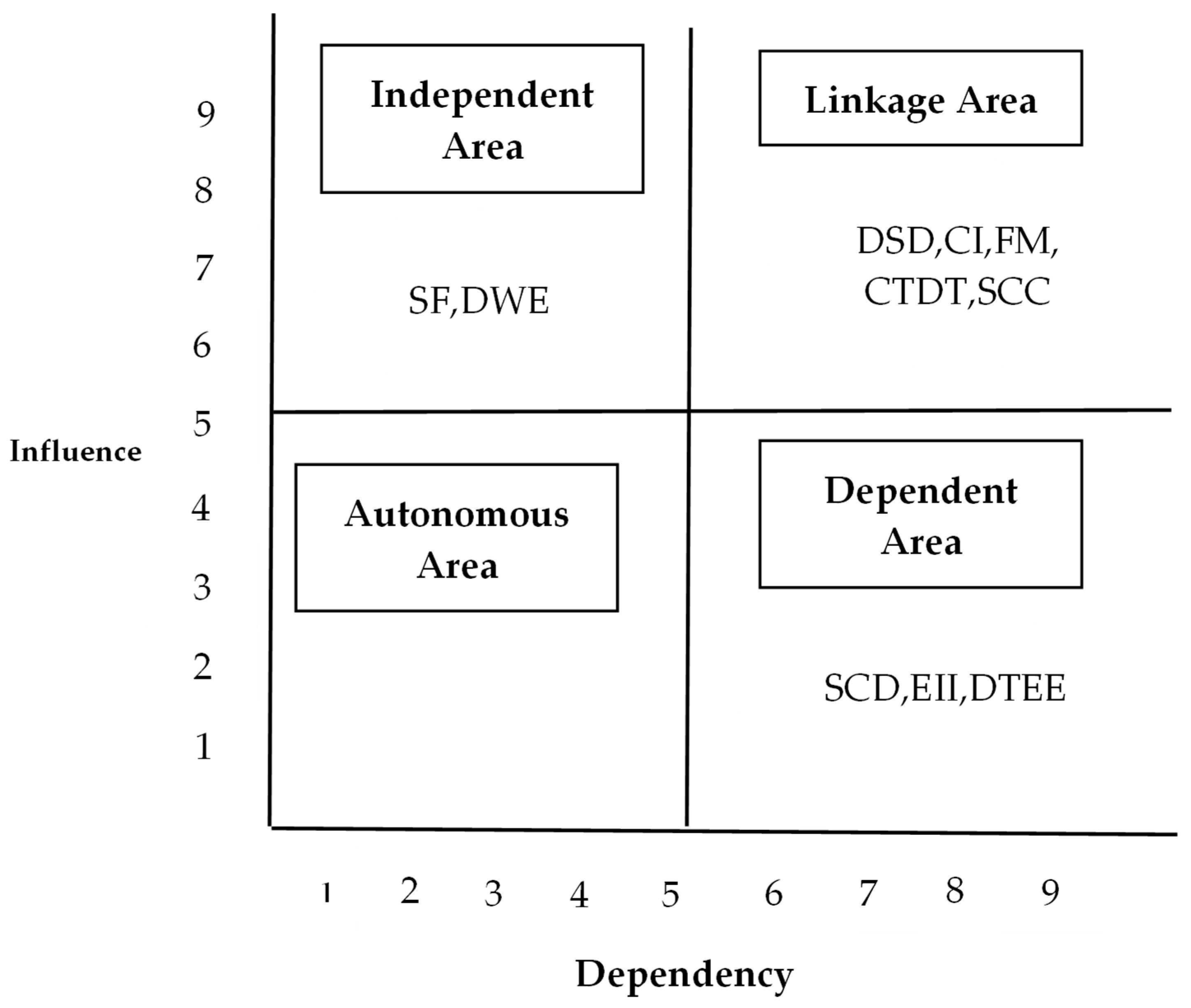
| Components | (SCD) | (SF) | (DSD) | (CTDT) | (SCC) | (EII) | (DWE) | (CI) | (FM) | (DTEE) | Influence |
|---|---|---|---|---|---|---|---|---|---|---|---|
| Sustainable Competitive Development (SCD) | 1 | 0 | 0 | 0 | 0 | 1 | 0 | 0 | 0 | 1 | 3 |
| Stabilization and Freezing (SF) | 1 | 1 | 1 | 1 | 1* | 1 | 0 | 1* | 0 | 1 | 8 |
| Drivers of Sustainable Development (DSD) | 1 | 0 | 1 | 1 | 1 | 1 | 0 | 1 | 1* | 1 | 8 |
| Cultural Taste of Digital Technology (CTDT) | 1 | 0 | 1 | 1 | 1 | 1 | 0 | 1* | 0 | 1 | 7 |
| Structural Social Capital (SCC) | 1 | 0 | 1 | 1* | 1 | 1 | 0 | 1 | 1* | 1 | 8 |
| Environmental and Industrial Intelligence (EII) | 0 | 0 | 0 | 0 | 0 | 1 | 0 | 0 | 0 | 0 | 1 |
| Digital Work Environment (DWE) | 1 | 1 | 1 | 1 | 1* | 1 | 1 | 1 | 1* | 1 | 10 |
| Creativity and Innovation (CI) | 1 | 0 | 1 | 1* | 1* | 1 | 1* | 1 | 1 | 1 | 9 |
| Financial Management (FM) | 1 | 1* | 1 | 1 | 1 | 1 | 1 | 1 | 1 | 1 | 10 |
| Digital Technological Entrepreneurship Ecosystem (DTEE) | 0 | 0 | 0 | 0 | 0 | 1 | 0 | 0 | 0 | 1 | 2 |
| Dependency | 8 | 3 | 7 | 7 | 7 | 10 | 3 | 7 | 5 | 9 |
| Components | Achieving Set | Antecedent Set | Common Set | Level |
|---|---|---|---|---|
| Sustainable Competitive Development (SCD) | (SCD), (EII), (DTEE) | (SCD), (SF), 3, (CTDT), (SCC), (DWE), (CI), (FM) | (SCD) | Fourth |
| Stabilization and Freezing (SF) | (SCD), (SF), (DSD), (CTDT), (SCC), (EII), (CI), (DTEE) | (SF), (DWE), (FM) | (SF) | Second |
| Drivers of Sustainable Development (DSD) | (SCD), (DSD), (CTDT), (SCC), (EII), (CI), (FM), (DTEE) | (SF), (DSD), (CTDT), (SCC), (DWE), (CI), (FM) | (DSD), (CTDT), (SCC), (CI), (FM) | Third |
| Cultural Taste of Digital Technology (CTDT) | (SCD), (DSD), (CTDT), (SCC), (EII), (CI), (DTEE) | (SF), (DSD), (CTDT), (SCC), (DWE), (CI), (FM) | (DSD), (CTDT), (SCC), (CI) | Third |
| Structural Social Capital (SCC) | (SCD), (DSD), (CTDT), (SCC), (EII), (CI), (FM), (DTEE) | (SF), (DSD), (CTDT), (SCC), (DWE), (CI), (FM) | (DSD), (CTDT), (SCC), (CI), (FM) | Third |
| Environmental and Industrial Intelligence (EII) | (EII) | (SCD), (SF), (DSD), (CTDT), (SCC), (EII), (DWE), (CI), (FM), (DTEE) | (EII) | Sixth |
| Digital Work Environment (DWE) | (SCD), (SF), (DSD), (CTDT), (SCC), (EII), (DWE), (CI), (FM), (DTEE) | (DWE), (CI), (FM) | (DWE), (CI), (FM) | First |
| Creativity and Innovation (CI) | (SCD), (DSD), (CTDT), (SCC), (EII), (DWE), (CI), (FM), (DTEE) | (SF), (DSD), (CTDT), (SCC), (DWE), (CI), (FM) | (DSD), (CTDT), (SCC), (DWE), (CI), (FM) | Third |
| Financial Management (FM) | (SCD), (SF), (DSD), (CTDT), (SCC), (EII), (DWE), (CI), (FM), (DTEE) | (DSD), (SCC), (DWE), (CI), (FM) | (DSD), (SCC), (DWE), (CI), (FM) | First |
| Digital Technological Entrepreneurship Ecosystem (DTEE) | (EII), (DTEE) | (SCD), (SF), (DSD), (CTDT), (SCC), (DWE), (CI), (FM), (DTEE) | (DTEE) | Fifth |
| Number of Experts | CVR Value | Number of Experts | CVR Value | Number of Experts | CVR Value |
|---|---|---|---|---|---|
| 5 | 0.99 | 11 | 0.59 | 25 | 0.37 |
| 6 | 0.99 | 12 | 0.56 | 30 | 0.33 |
| 7 | 0.99 | 13 | 0.54 | 35 | 0.31 |
| 8 | 0.75 | 14 | 0.51 | 40 | 0.29 |
| 9 | 0.78 | 15 | 0.49 | ||
| 19 | 0.62 | 20 | 0.42 |
| Components | Reliability Coefficient | Weight of Each Component | Reliability Coefficient: Weight of Each Indicator | Reliability Coefficient Average |
|---|---|---|---|---|
| Sustainable Competitive Development (SCD) | 0.873 | 0.841 | 0.734 | 0.79 |
| Stabilization and Freezing (SF) | 0.921 | 0.736 | 0.678 | |
| Drivers of Sustainable Development (DSD) | 0.813 | 0.869 | 0.706 | |
| Cultural Taste of Digital Technology (CTDT) | 1.12 | 0.835 | 0.935 | |
| Structural Social Capital (SCC) | 1.3 | 0.823 | 1.07 | |
| Environmental and Industrial Intelligence (EII) | 0.941 | 0.906 | 0.852 | |
| Digital Work Environment (DWE) | 0.753 | 0.94 | 0.708 | |
| Creativity and Innovation (CI) | 0.861 | 0.753 | 0.648 | |
| Financial Management (FM) | 0.819 | 0.748 | 0.613 | |
| Digital Technological Entrepreneurship Ecosystem (DTEE) | 0.97 | 0.947 | 0.918 |
Disclaimer/Publisher’s Note: The statements, opinions and data contained in all publications are solely those of the individual author(s) and contributor(s) and not of MDPI and/or the editor(s). MDPI and/or the editor(s) disclaim responsibility for any injury to people or property resulting from any ideas, methods, instructions or products referred to in the content. |
© 2023 by the authors. Licensee MDPI, Basel, Switzerland. This article is an open access article distributed under the terms and conditions of the Creative Commons Attribution (CC BY) license (https://creativecommons.org/licenses/by/4.0/).
Share and Cite
Hosseini, E.; Rajabipoor Meybodi, A. Proposing a Model for Sustainable Development of Creative Industries Based on Digital Transformation. Sustainability 2023, 15, 11451. https://doi.org/10.3390/su151411451
Hosseini E, Rajabipoor Meybodi A. Proposing a Model for Sustainable Development of Creative Industries Based on Digital Transformation. Sustainability. 2023; 15(14):11451. https://doi.org/10.3390/su151411451
Chicago/Turabian StyleHosseini, Elahe, and Alireza Rajabipoor Meybodi. 2023. "Proposing a Model for Sustainable Development of Creative Industries Based on Digital Transformation" Sustainability 15, no. 14: 11451. https://doi.org/10.3390/su151411451
APA StyleHosseini, E., & Rajabipoor Meybodi, A. (2023). Proposing a Model for Sustainable Development of Creative Industries Based on Digital Transformation. Sustainability, 15(14), 11451. https://doi.org/10.3390/su151411451