Voltage Zoning Regulation Method of Distribution Network with High Proportion of Photovoltaic Considering Energy Storage Configuration



Abstract
1. Introduction
- (1)
- Based on the k-means clustering method, the voltage deviation curves of each node in a day are clustered and analyzed, and the nodes are divided into several categories to determine the distribution network partition. The ESDs are connected to the cluster centers of each district, thus realizing the voltage partition adjustment;
- (2)
- The solution method based on PSO can effectively solve the proposed voltage regulation model;
- (3)
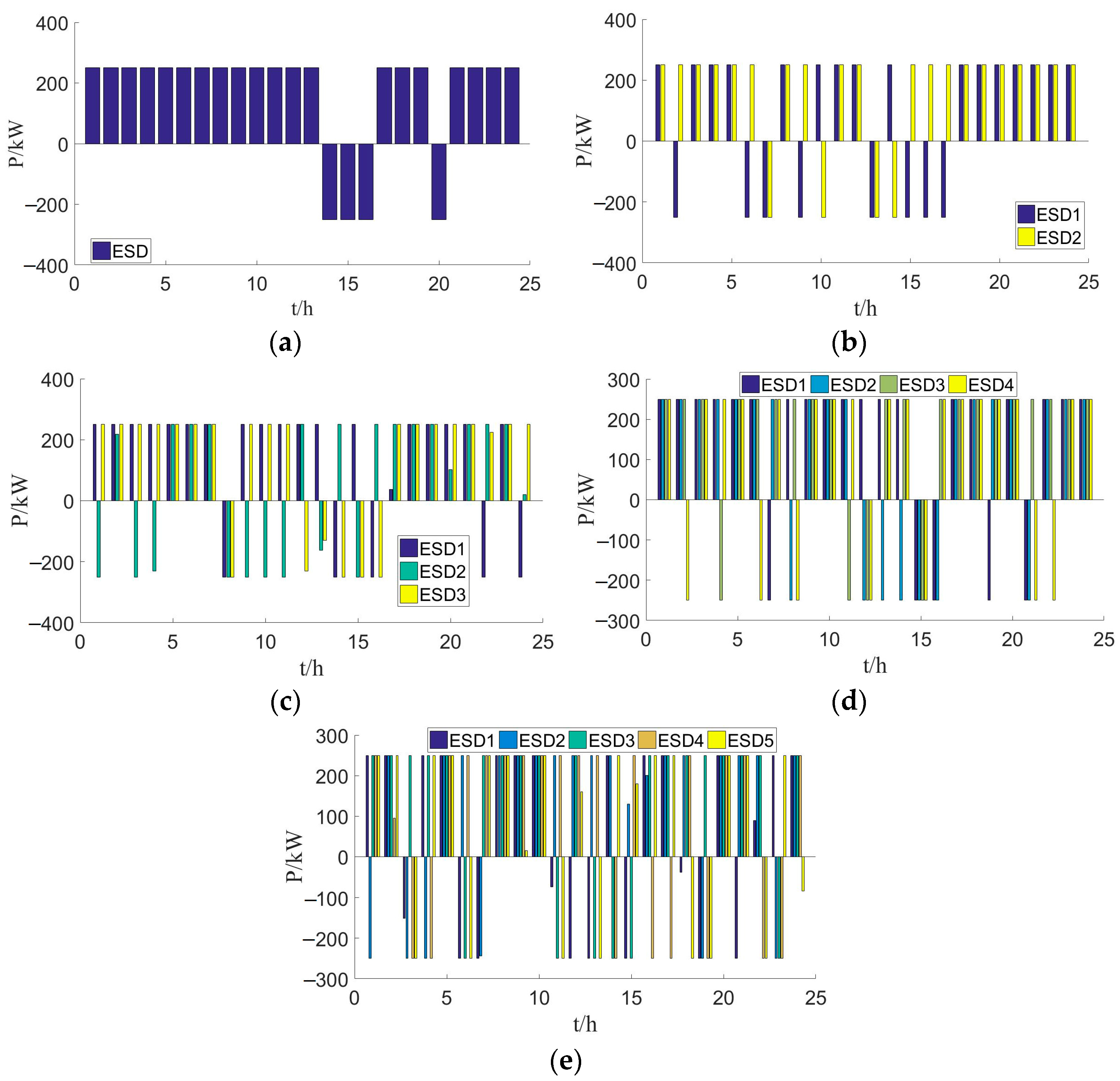
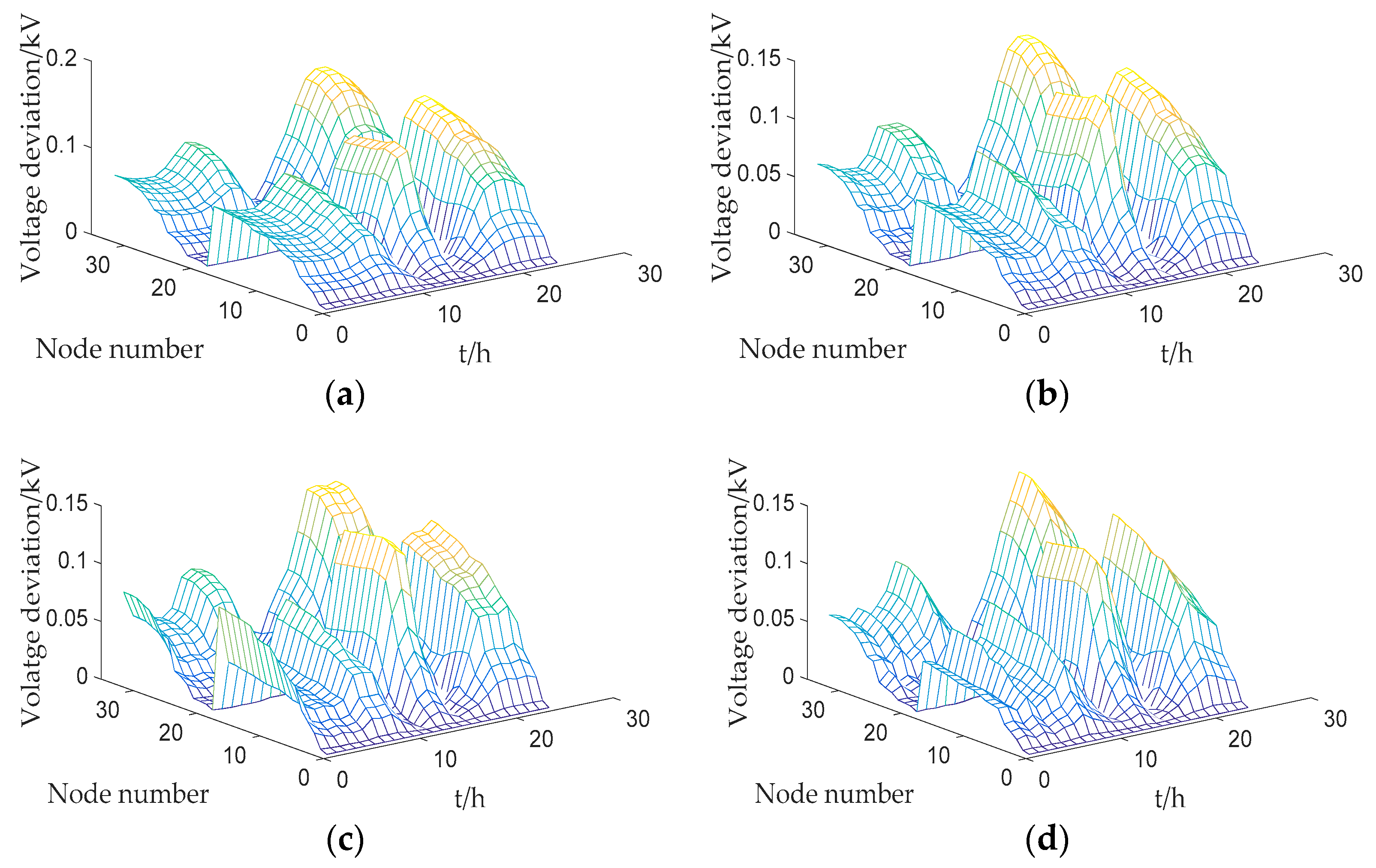
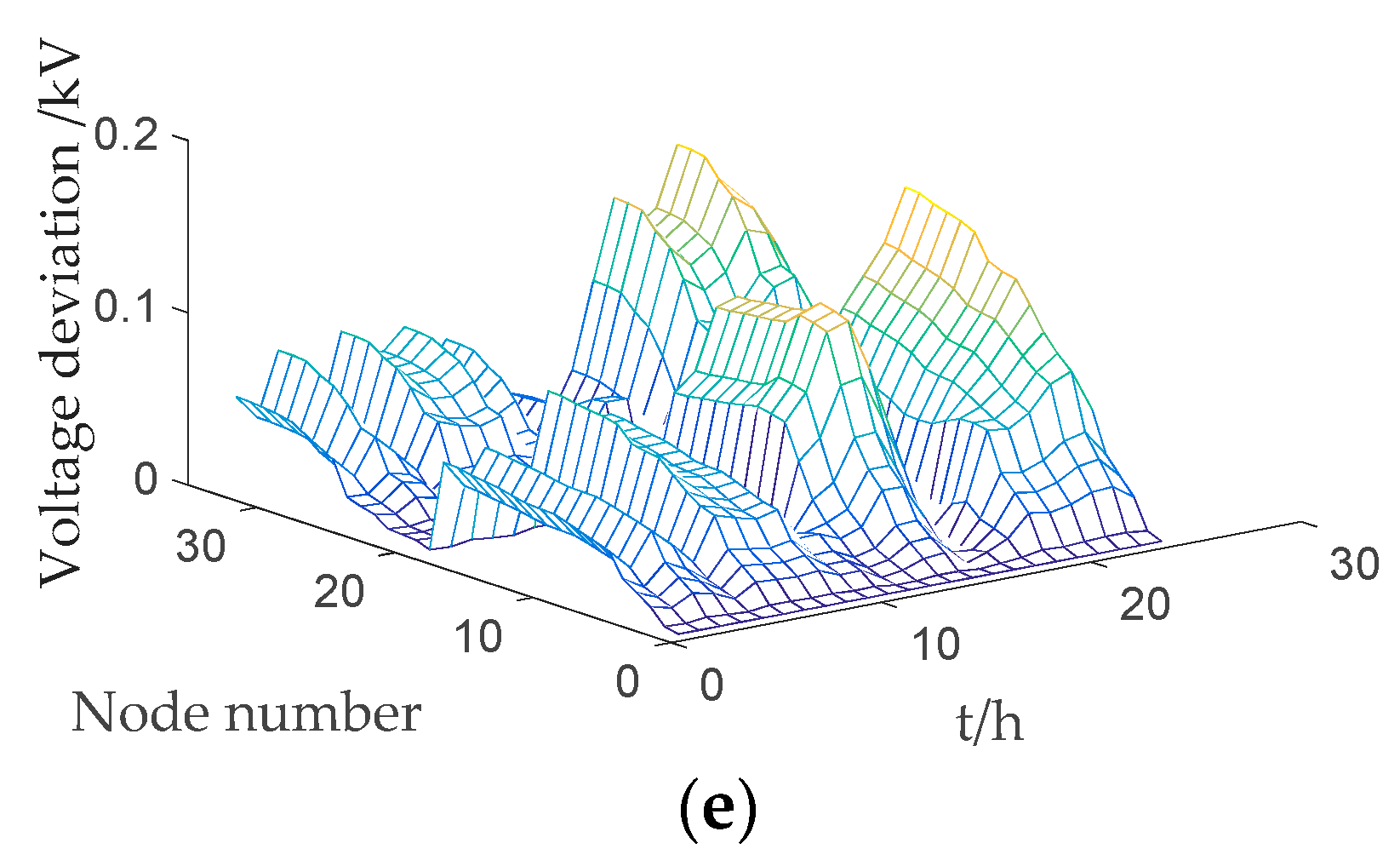
- Based on the proposed voltage regulation method of a distribution network considering energy storage configuration, the IEEE33 example is analyzed, and the objective function values are effectively reduced, thus improving the stability and economy of the distribution network.
2. Partition Configuration of Energy Storage Based on K-Means Clustering
2.1. Definition of High Proportion
2.2. K-Means Clustering
- (1)
- Simple principle, easy realization and fast convergence;
- (2)
- Good clustering effect;
- (3)
- Strong interpretability and intuition;
- (4)
- There is only one parameter, k.
- (1)
- Randomly selecting k sample points as initial clustering centers;
- (2)
- Calculating the distance between each cluster center and other sample points by using Euclidean distance and classifying each sample point into the nearest class;
- (3)
- Finding a new cluster center of each class, and taking it as the center to calculate the average value of each class by Equation (2);where is the center of class k; is the ith data in the kth class; is the number of samples in each category.
- (4)
- Repeating (2) and (3) until the clustering center does not change.
2.3. Elbow Rule to Determine the k Value
2.4. Partition Configuration of ESD
3. Distribution Network Voltage Regulation Model with High Proportion of PV
3.1. Objective Function
- (1)
- Objective function : the economic cost is the lowest:consists of ESD call cost , power generation cost of PVs , power generation cost of MTs , electricity purchase cost [21] and environmental treatment cost , namely➀ ESD call costwhere refers to the call cost of ESD unit power, yuan/kW.➁ Power generation cost of PVs: PVs are clean energy, so there is no fuel cost, so only consists of the operation and maintenance cost of PVs .where is the unit operation and maintenance cost of PV, yuan/kW; is the PV output at time t, kW.➂ Power generation cost of MTs: consists of fuel cost and operation and maintenance cost (see Equation (8)). Among them, is related to factors such as natural gas price and power supply efficiency of the unit [22], and its calculation formula is shown in Equation (9). The calculation formula of is shown in Equation (10).where is the price of natural gas, yuan/m3; is the power generation for natural gas, kcal/m3; is the power supply efficiency for the unit, %; is the MT output at time t, kW; is the unit operation and maintenance cost of MTs, yuan/kW.➃ Electricity purchase costwhere is the electricity price purchased from the superior power grid at time t, yuan/kW; is the exchange power for the electric energy at time t, kW.➄ Environmental treatment cost : CO2 and NOx emissions come from MTs [23]. The calculation formula of is shown in Equation (12).where are the emission cost coefficients of ith pollutants, respectively, yuan/kg; is the discharge amount of ith pollutant, kg/kW.
- (2)
- Objective function : the total power loss of the branch is the lowest.where b is the number of branches; and are, respectively, the active power (kW) and reactive power (kVar) flowing through branch i at time t; is the terminal node voltage of branch i at time t, kV; is the resistance value on branch i; is the duration of each period, h.
- (3)
- Objective function : the installation ratio of ESD is minimum.where is the number of ESDs installed; is the number of installed PVs; is the capacity of the ith ESD, kW h; is the capacity of the ith PV, kW h.
3.2. Constraints
3.2.1. Power Balance Constraints
3.2.2. Unit Output Constraints
3.2.3. Voltage Constraints
3.2.4. Energy Storage Operation Constraints
3.2.5. Power Purchase Constraints
3.3. Mathematical Model of Voltage Regulation
3.4. Determination of the Weighting Factor of the Objective Function
4. Mathematical Model Solving Method
5. Example Analysis
5.1. Basic Data
5.2. Determine the Scheme
5.3. DNVR Result Analysis Based on PSO
6. Conclusions
- (1)
- When establishing a DNVR model with the lowest total voltage deviation, the lowest total cost, including fuel cost, operation and maintenance cost, electricity purchase cost, and environmental treatment cost, the lowest total power loss, and the lowest installation ratio of the ESD as the goal, the model is relatively perfect. It can be more in line with the actual operation of a distribution network and has a good adjustment effect by comprehensively considering many constraints such as power flow constraints, voltage deviation constraints and energy storage constraints;
- (2)
- After high-proportion PV access, node k-means clustering is performed on the voltage deviation curve of each node. The system is divided into different areas, and then FCE is used to determine the weighting factor of each objective function, thus making the determination of energy storage access location more reasonable and the subsequent adjustment effect better;
- (3)
- The results of the PSO algorithm show that the calculation results of the proposed method can effectively adjust the voltage, reduce the cost, reduce the power loss and reduce the installation ratio of ESD, thus improving the economy and security of power grid operation.
Author Contributions
Funding
Institutional Review Board Statement
Informed Consent Statement
Data Availability Statement
Conflicts of Interest
References
- Li, B.; Chen, M.; Zhong, H.; Ma, Z.; Liu, D.; He, G. Review of Long-term Planning of New Power Systems with Large Share of Renewable Energy. Proc. CSEE 2023, 43, 555–581. [Google Scholar]
- Wang, P.; Wu, Q.; Huang, S.; Zhou, B.; Li, C. Distributed optimal voltage control strategy for AC grid with DC connection and offshore wind farms based on ADMM. Int. J. Electr. Power Energy Syst. 2022, 137, 107802. [Google Scholar] [CrossRef] [Scilit]
- Liu, J.; Hu, H.; Yu, S.S.; Trinh, H. Distributed Optimization Control Method of Virtual Energy Storage Plants for Power Grid Ancillary Services. Autom. Electr. Power Syst. 2022, 46, 181–188. [Google Scholar]
- Liu, Z.; Liu, B.; Ding, X.; Wang, F. Research on optimization of energy storage regulation model considering wind–solar and multi-energy complementary intermittent energy interconnection. Energy Rep. 2022, 8, 490–501. [Google Scholar] [CrossRef] [Scilit]
- Wang, J.; Wang, W.; Wang, H.; Wang, S.; Du, J. Two-stage coordinated planning of DG, SOP and ESS in an active distribution network considering violation risk. Power Syst. Prot. Control 2022, 50, 71–82. [Google Scholar]
- Guo, C.X.; Liu, Z.P.; Feng, B.; Jiang, B.; Guo, J.; Liu, F. Research Status and Prospect of New-type Power System Risk Assessment. High Volt. Eng. 2022, 48, 3394–3404. [Google Scholar]
- He, X.; Chen, Z.; Liu, X.; Zhang, T.; Chen, L. Voltage control strategy for medium voltage distribution network with distributed photovoltaic generators. Electr. Meas. Instrum. 2022, 59, 142–148. [Google Scholar]
- Wang, Y.; Chen, Q.; Zheng, Y.; Xue, H.; Li, M.; Mi, Y. Optimal scheduling of mobile energy storage in active distribution network based on dynamic reactive power and voltage sensitivity. Electr. Power Autom. Equip. 2023, 43, 59. [Google Scholar]
- Yang, G.; Sun, R.; Ding, R.; Xu, H.; Chen, C.; Wu, L.; Chen, Q.; Xia, M. Multi Time Scale Reactive Power and Voltage Optimization of Distribution Network Considering Photovoltaic Multi State Regulation Capability. Electr. Power 2022, 55, 105–114. [Google Scholar]
- Zhang, Z.; da Silva, F.F.; Guo, Y.; Bak, C.L.; Chen, Z. Coordinated voltage control in unbalanced distribution networks with two-stage distributionally robust chance-constrained receding horizon control. Renew. Energy 2022, 198, 907–915. [Google Scholar] [CrossRef] [Scilit]
- Pan, W.; Mao, M.; Zhou, Y.; Quan, X.; Li, Y. The impact of extreme weather condition on the voltage regulation in distribution systems with high penetration of roof-top photovoltaic. Energy Rep. 2021, 7, 320–331. [Google Scholar] [CrossRef] [Scilit]
- Yang, S.; Li, Q.; Ming, Z.; Ma, Q.; Luo, Q. Multi-Objective Probabilistic Reactive Power Optimization of Distribution Network Considering the Randomness of Source and Load. Southern Power Syst. Technol. 2023, 17, 125–135. [Google Scholar]
- Zheng, F.; Meng, X.; Wang, L.; Zhang, N. Operation Optimization Method of Distribution Network with Wind Turbine and Photovoltaic Considering Clustering and Energy Storage. Sustainability 2023, 15, 2184. [Google Scholar] [CrossRef] [Scilit]
- Wu, Y.; Yao, L.; Liao, S.; Liu, Y.; Li, J.; Wang, X. A Peak Shaving Method of Aggregating the Distributed Photovoltaics and Energy Storages Based on the Improved K-means++Algorithm. Power Syst. Technol. 2022, 46, 3923–3931. [Google Scholar]
- Zheng, F.; Meng, X.; Wang, L.; Zhang, N. Power Flow Optimization Strategy of Distribution Network with Source and Load Storage Considering Period Clustering. Sustainability 2023, 15, 4515. [Google Scholar] [CrossRef] [Scilit]
- Wang, Z.; Ma, S.; Li, G.; Bian, J. Day-Ahead and Intra-Day Two-Stage Rolling Optimal Dispatch of Power Grid Considering Access of Composite Energy Storage Power Stations. Acta Energiae Solaris Sin. 2022, 43, 400–408. [Google Scholar]
- Shen, J.; Wang, Y.; Cheng, C.; Li, X.; Miao, S.; Zhang, Y.; Zhang, J. Research Status and Prospect of Generation Scheduling for Hydropower-wind-solar Energy Complementary System. Proc. CSEE 2022, 42, 3871–3885. [Google Scholar]
- Li, C.; Dong, Z.; Li, J.; Zhang, H.; Jing, Q.; Qian, K. Control Strategy of Voltage Regulation for Distributed Energy Storage Cluster in Distribution Network. Autom. Electr. Power Syst. 2021, 45, 133–141. [Google Scholar]
- Wu, Y.; Cheng, X.; Liu, J. Distribution Network Reconfiguration Based on Hybrid Simulated Annealing Cuckoo Algorithm. Sci. Technol. Eng. 2023, 23, 626–632. [Google Scholar]
- Huang, Z.; Chen, Y.; Mao, Z.; Sun, J.; Zha, X. Joint Access Planning of Soft Open Point and Distributed Energy Storage System. Autom. Electr. Power Syst. 2022, 46, 29–37. [Google Scholar]
- Zhao, P.; Wu, J.; Zhang, W.; He, S.; Zhang, H. Cooperative Peer to Peer Scheduling of Multi-microgrids Considering Distribution Network Power Flow and Source-load Uncertainty. Power Syst. Technol. 2022, 46, 4885–4896. [Google Scholar] [CrossRef] [Scilit]
- Tian, F.; Jia, Y.; Ren, H.; Bai, Y.; Huang, T. “Source-load” Low-carbon Economic Dispatch of Integrated Energy System Considering Carbon Capture System. Power Syst. Technol. 2020, 44, 3346–3355. [Google Scholar]
- Huang, H.; Liang, R.; Zhang, X.; Lu, M.; Wang, C.; Zhang, G. Two-stage Multi-objective Deployment Optimization of Coal Mine Integrated Energy System Considering Carbon Emission Constraints. Power Syst. Technol. 2022, 46, 1731–1742. [Google Scholar]
- Zhao, S.; Han, L.; Li, Z.; Yang, Y.; Ma, S. Day-ahead Optimal Scheduling of Active Distribution Network by Related Opportunity Goal Planning. J. North China Electr. Power Univ. 2021, 48, 1–10. [Google Scholar]
- Cheng, Y.; Chen, X. Analysis on Influence of Energy Storage on Accommodation Capability of Wind Power Based on Source-Load-Storage Interaction. Autom. Electr. Power Syst. 2022, 46, 84–93. [Google Scholar]
- Cheng, M.; Zhang, X.; Xu, M.; Xue, Y.; Wu, W.; He, Y. Loeation method of an active distribution network fault section based on multi-target weighted grey target decision. Power Syst. Prot. Control 2021, 49, 124–132. [Google Scholar]
- Meng, X.; Wang, L.; Wang, X.; Wang, Y.; Liu, R.; Wang, H. Improve operation characteristics in three-phase four-wire low-voltage distribution network using distributed generation. Power Syst. Technol. 2018, 2018, 4091–4100. [Google Scholar]
- Ma, Y.; Xie, J.; Zhao, S.; Wang, Z.; Luo, Z. Multi-objective Optimal Dispatching for Active Distribution Network Considering Park-level Integrated Energy System. Autom. Electr. Power Syst. 2022, 46, 53–61. [Google Scholar]
- Yan, Q.; Dong, X.; Mu, J.; Ma, Y. Optimal configuration of energy storage in an active distribution network based on improved multi-objective particle swarm optimization. Power Syst. Prot. Control 2022, 50, 11–19. [Google Scholar]
- Meng, R.; Zhao, J.; Zhou, T. Rapid Deployment Strategy of Emergency Repair Team Based on Improved Inertial Weighted PSO. Power Syst. Clean Energy 2021, 37, 17–24. [Google Scholar]







| Behavior | PSO |
|---|---|
| Bird | Particle |
| Forest | Solution space |
| The amount of food | Objective function value |
| The position of each bird | A solution in space (Particle position) |
| Global optimal solution |
| Parameter | Value |
|---|---|
| 200 | |
| 100 | |
| 13.293 | |
| 11.394 | |
| 0.633 | |
| −0.633 | |
| −250 | |
| 250 | |
| 5000 | |
| 1000 | |
| 100 |
| Parameter | Value |
|---|---|
| 0.045 | |
| 0.0096 | |
| 2.20 | |
| 8500 | |
| 32 | |
| 0.082 |
| Pollutant Type | ||
|---|---|---|
| 724 | 0.994 | |
| 0.0036 | 0.00653 | |
| 0.2 | 0.00312 |
| Actual Value | Value |
|---|---|
| /kV | 2.0639 |
| /yuan | 3017.94 |
| /kW | 0.3368 |
| /% | 0.1056 |
| Maximum Allowable Value | Value |
|---|---|
| /kV | 2.5400 |
| /yuan | 3796.01 |
| /kW | 0.5549 |
| /% | 0.1234 |
| Weighing Factor | Value |
|---|---|
| 0.2646 | |
| 0.2590 | |
| 0.1977 | |
| 0.2787 |
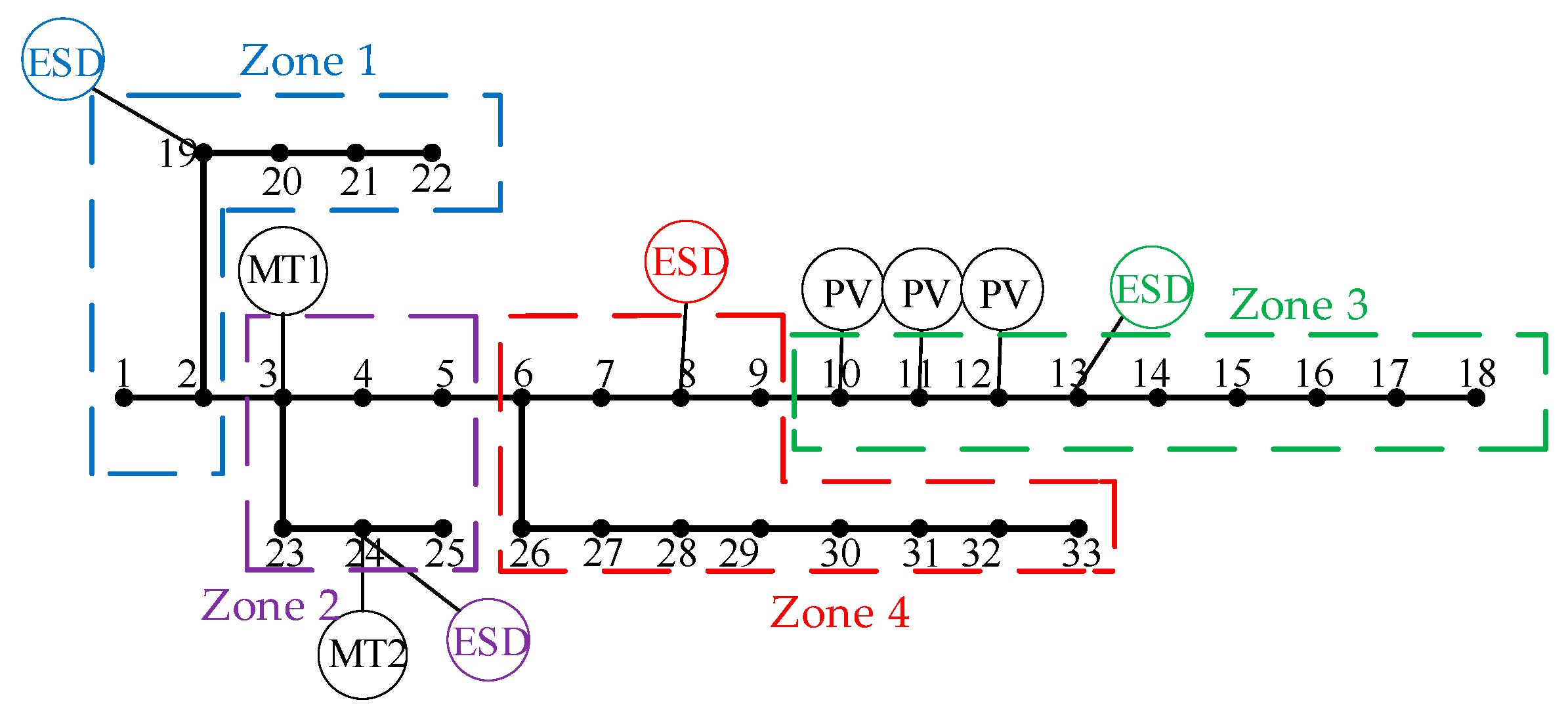
| Cluster Sequence Number | Node Division | Cluster Center (Node Configured with ESD) |
|---|---|---|
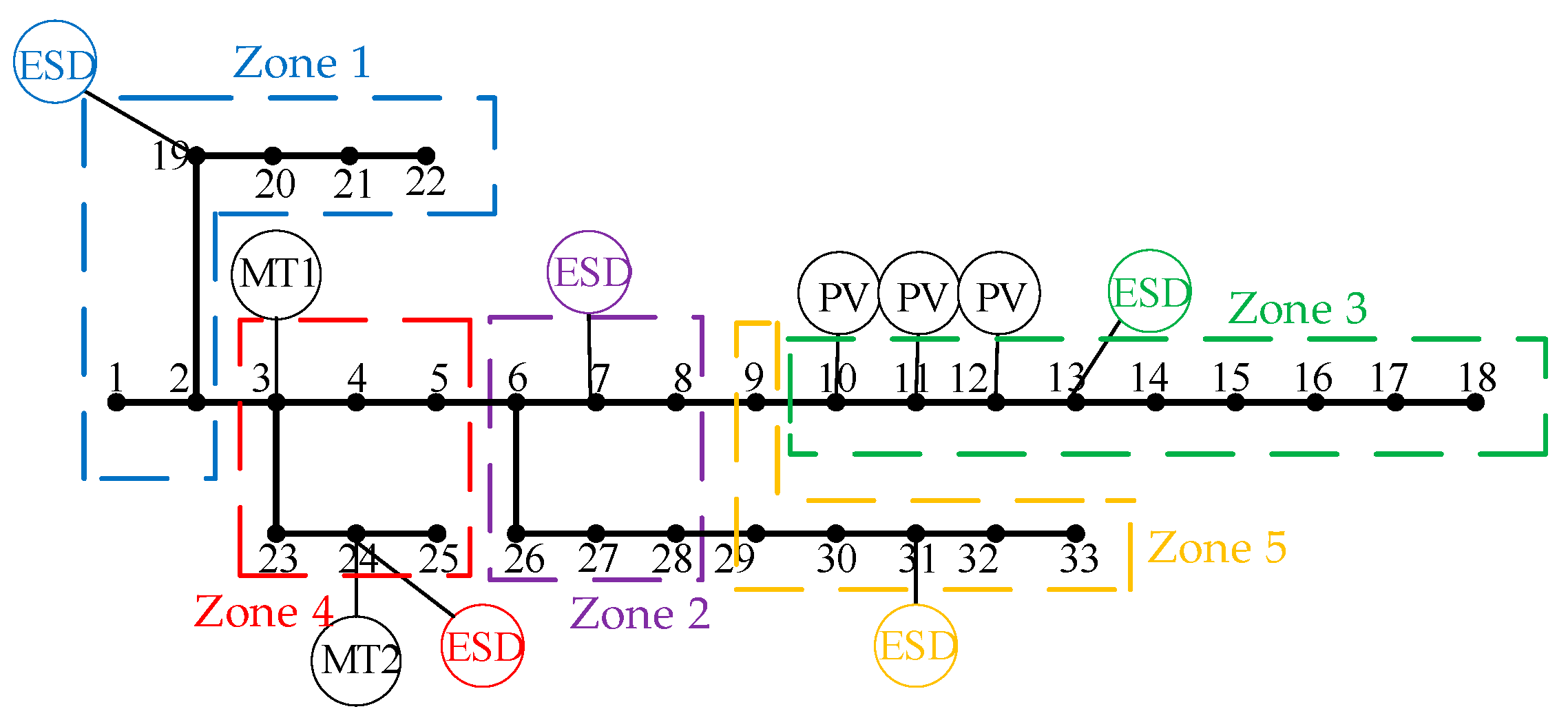
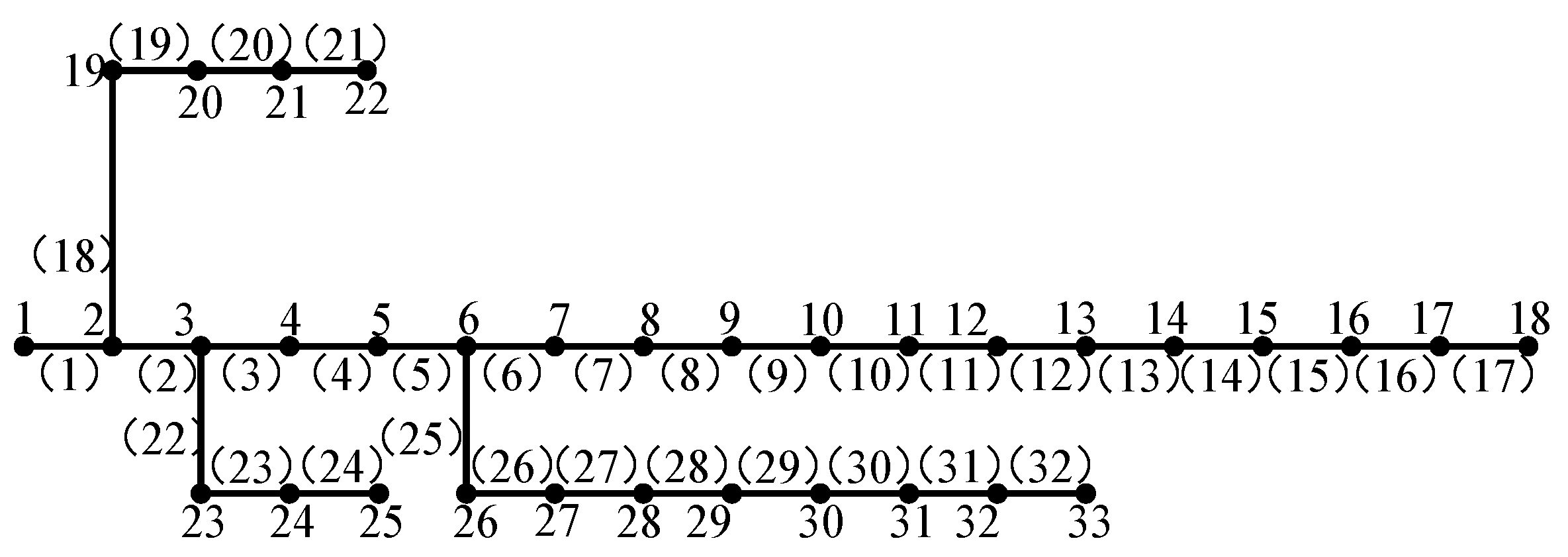
| 1 | 1, 2, 19~22 | 19 |
| 2 | 6~9, 26~33 | 8 |
| 3 | 10~18 | 13 |
| 4 | 3~5, 23~25 | 24 |
| Subitem | /Yuan | /Yuan | /Yuan | /Yuan | /Yuan |
|---|---|---|---|---|---|
| Before DNVR | 0 | 280.0 | 0 | 40,315.1 | 0 |
| scheme 1 | 270.0 | 280.0 | 6085.8 | 31,144.2 | 1311.1 |
| scheme 2 | 540.0 | 280.0 | 5997.6 | 30,259.0 | 1292.0 |
| scheme 3 | 769.7 | 280.0 | 6645.7 | 28,384.1 | 1431.6 |
| scheme 4 | 1080.0 | 280.0 | 6262.2 | 25,538.2 | 1349.0 |
| scheme 5 | 1280.8 | 280.0 | 5897.2 | 27,352.3 | 1266.5 |
| Subitem | /kV | /Yuan | /kWh | /% |
|---|---|---|---|---|
| Before DNVR | 48.1080 | 40,595 | 6.5324 | 0 |
| scheme 1 | 35.6493 | 39,091 | 5.8300 | 12.34 |
| scheme 2 | 35.1966 | 38,369 | 5.6184 | 10.97 |
| scheme 3 | 34.0495 | 37,511 | 5.5829 | 10.29 |
| scheme 4 | 32.3250 | 34,509 | 5.2677 | 9.60 |
| scheme 5 | 33.8130 | 36,059 | 5.5074 | 9.60 |
Disclaimer/Publisher’s Note: The statements, opinions and data contained in all publications are solely those of the individual author(s) and contributor(s) and not of MDPI and/or the editor(s). MDPI and/or the editor(s) disclaim responsibility for any injury to people or property resulting from any ideas, methods, instructions or products referred to in the content. |
© 2023 by the authors. Licensee MDPI, Basel, Switzerland. This article is an open access article distributed under the terms and conditions of the Creative Commons Attribution (CC BY) license (https://creativecommons.org/licenses/by/4.0/).
Share and Cite
Zheng, F.; Meng, X.; Xu, T.; Sun, Y.; Zhang, N. Voltage Zoning Regulation Method of Distribution Network with High Proportion of Photovoltaic Considering Energy Storage Configuration. Sustainability 2023, 15, 10732. https://doi.org/10.3390/su151310732
Zheng F, Meng X, Xu T, Sun Y, Zhang N. Voltage Zoning Regulation Method of Distribution Network with High Proportion of Photovoltaic Considering Energy Storage Configuration. Sustainability. 2023; 15(13):10732. https://doi.org/10.3390/su151310732
Chicago/Turabian StyleZheng, Fangfang, Xiaofang Meng, Tiefeng Xu, Yongchang Sun, and Nannan Zhang. 2023. "Voltage Zoning Regulation Method of Distribution Network with High Proportion of Photovoltaic Considering Energy Storage Configuration" Sustainability 15, no. 13: 10732. https://doi.org/10.3390/su151310732
APA StyleZheng, F., Meng, X., Xu, T., Sun, Y., & Zhang, N. (2023). Voltage Zoning Regulation Method of Distribution Network with High Proportion of Photovoltaic Considering Energy Storage Configuration. Sustainability, 15(13), 10732. https://doi.org/10.3390/su151310732