Experimental Analysis to Evaluate the Impact of Styrene-Butadiene-Styrene and Crumb Rubber on the Rutting and Moisture Resistance of Asphalt Mixtures



Abstract
1. Introduction
2. Materials and Methods
2.1. Materials
2.1.1. Asphalt
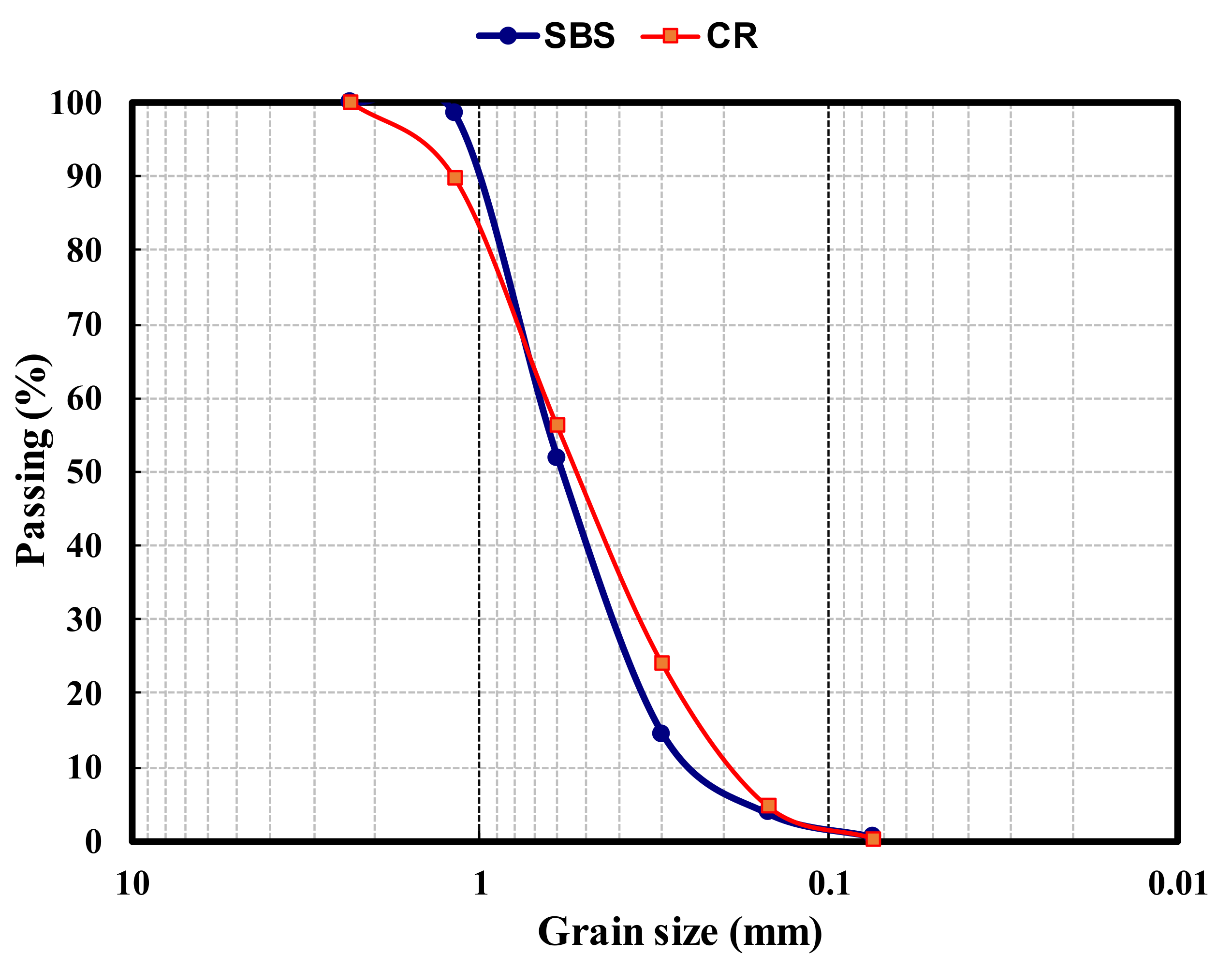
2.1.2. Styrene-Butadiene-Styrene (SBS)
2.1.3. Crumb Rubber (CR)
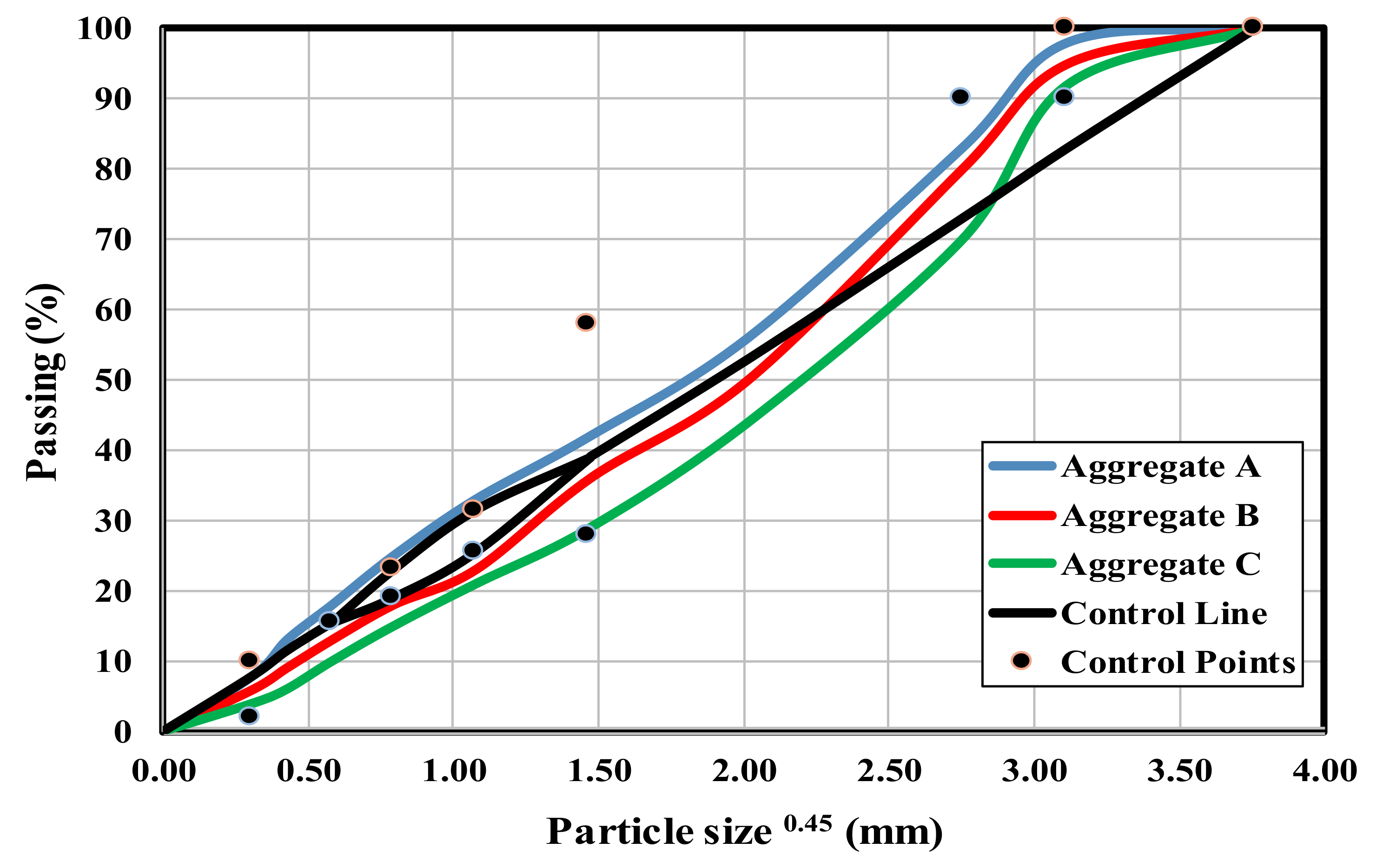
2.1.4. Aggregate
2.2. Methodology
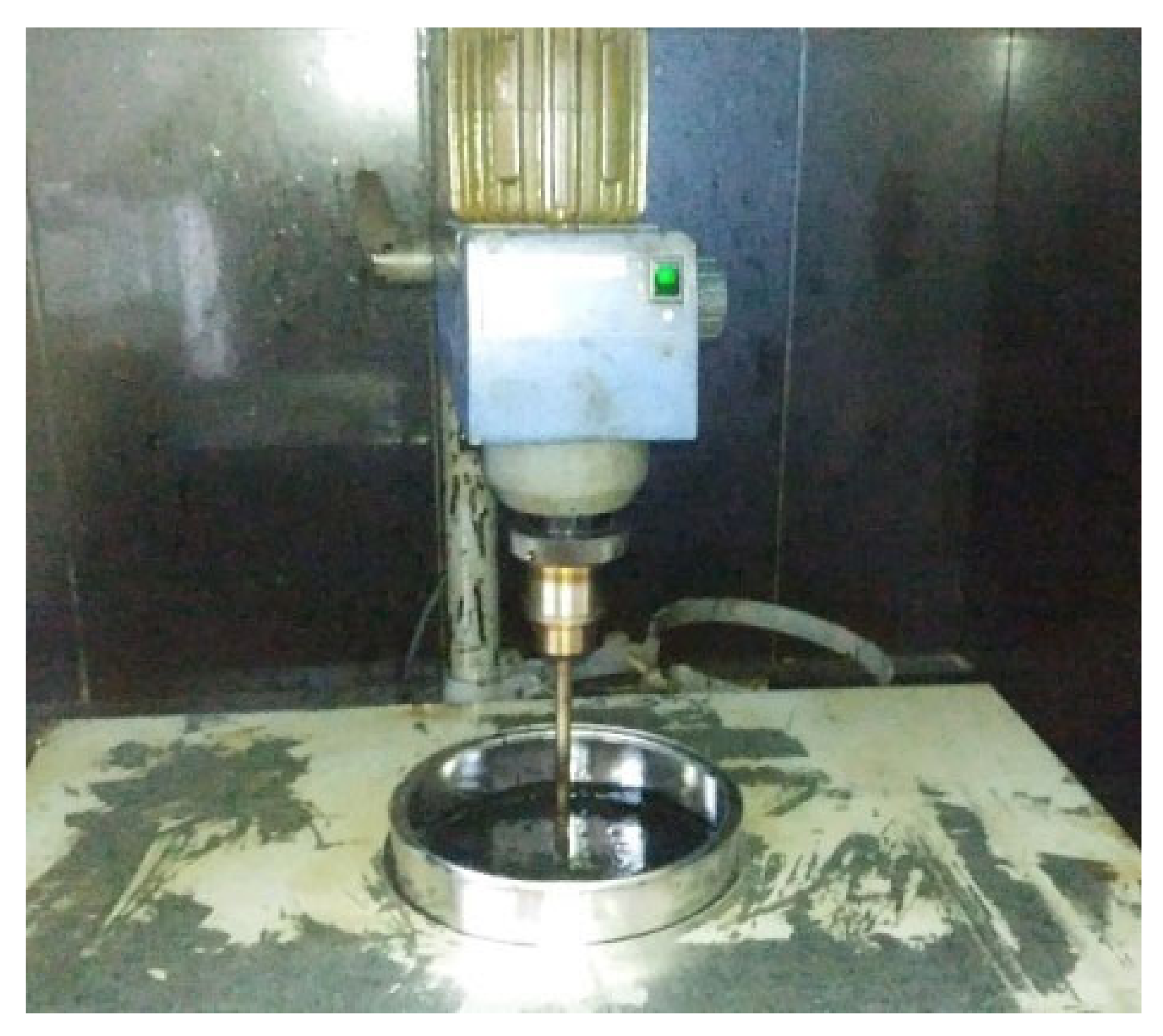
2.2.1. Mixing Asphalt with SBS or CR
2.2.2. Aggregate Structure Selection
2.2.3. Determining the Modified Asphalt Mixture Optimum Contents
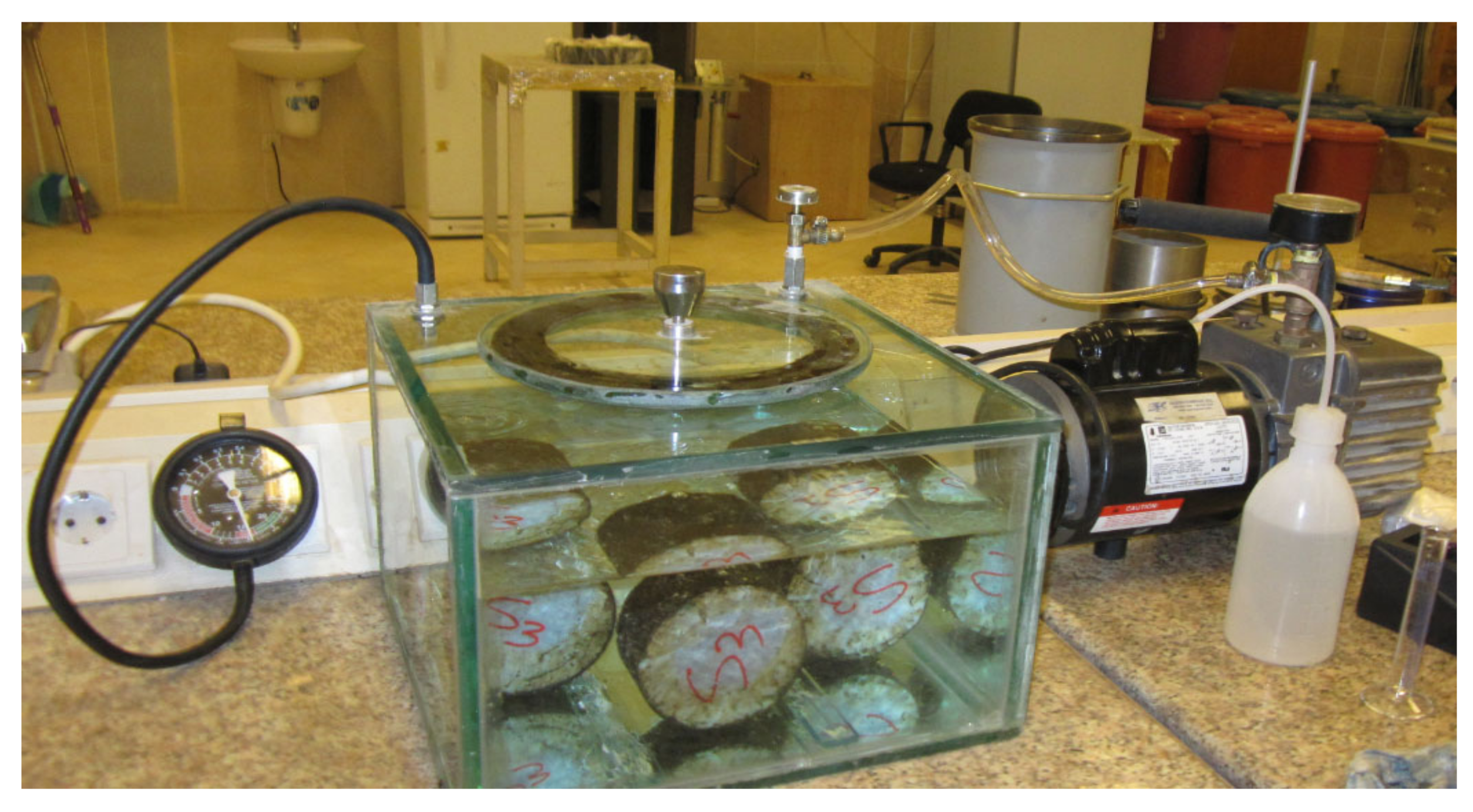
2.2.4. Tensile Strength Ratio Test (TSR) (ASTM D4867 [15], AASHTO T283 [21])
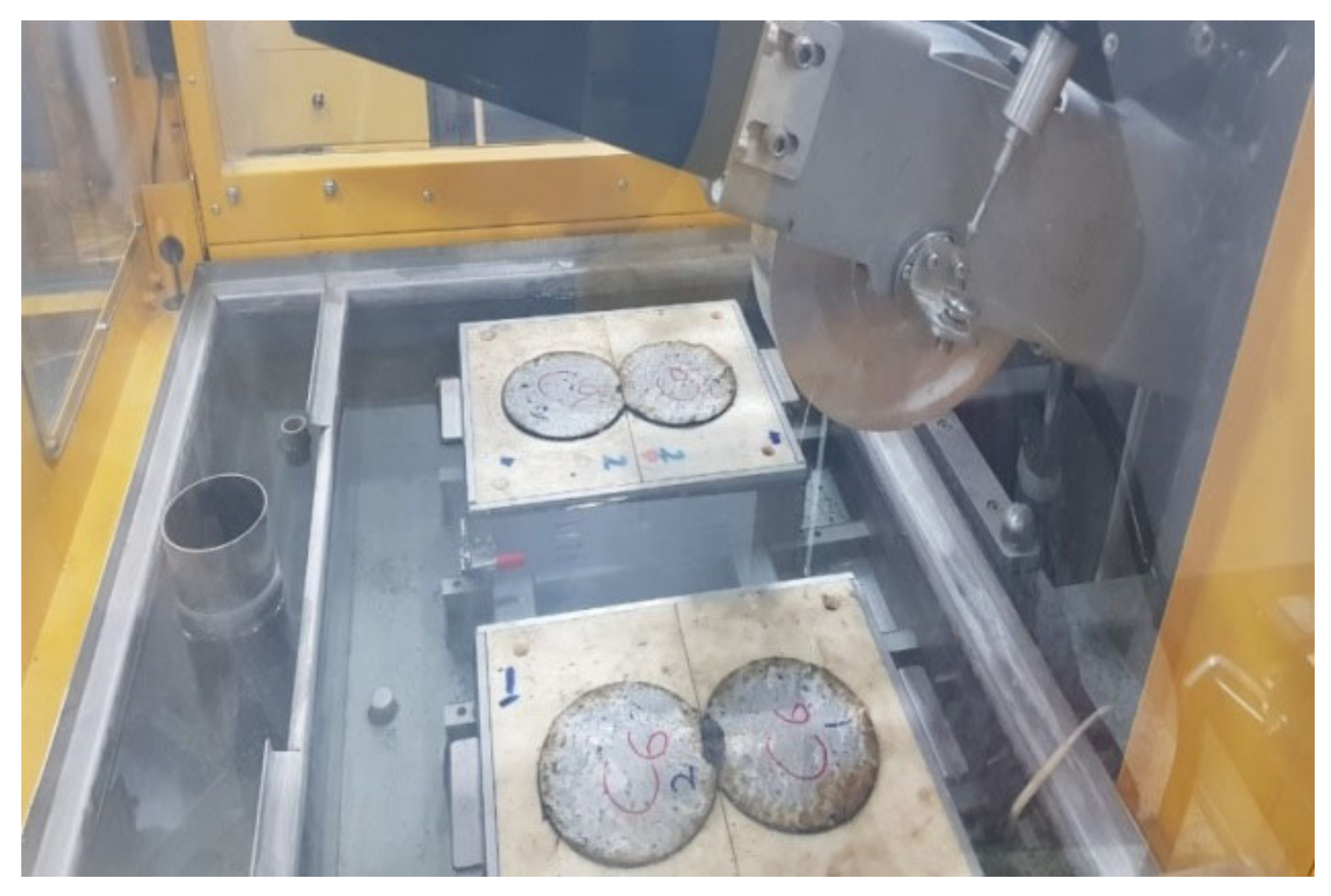
2.2.5. Hamburg Wheel Tracker Tests (AASHTO T324) [21]
3. Results and Discussions
3.1. SBS and CR- Modified Asphalt Binders
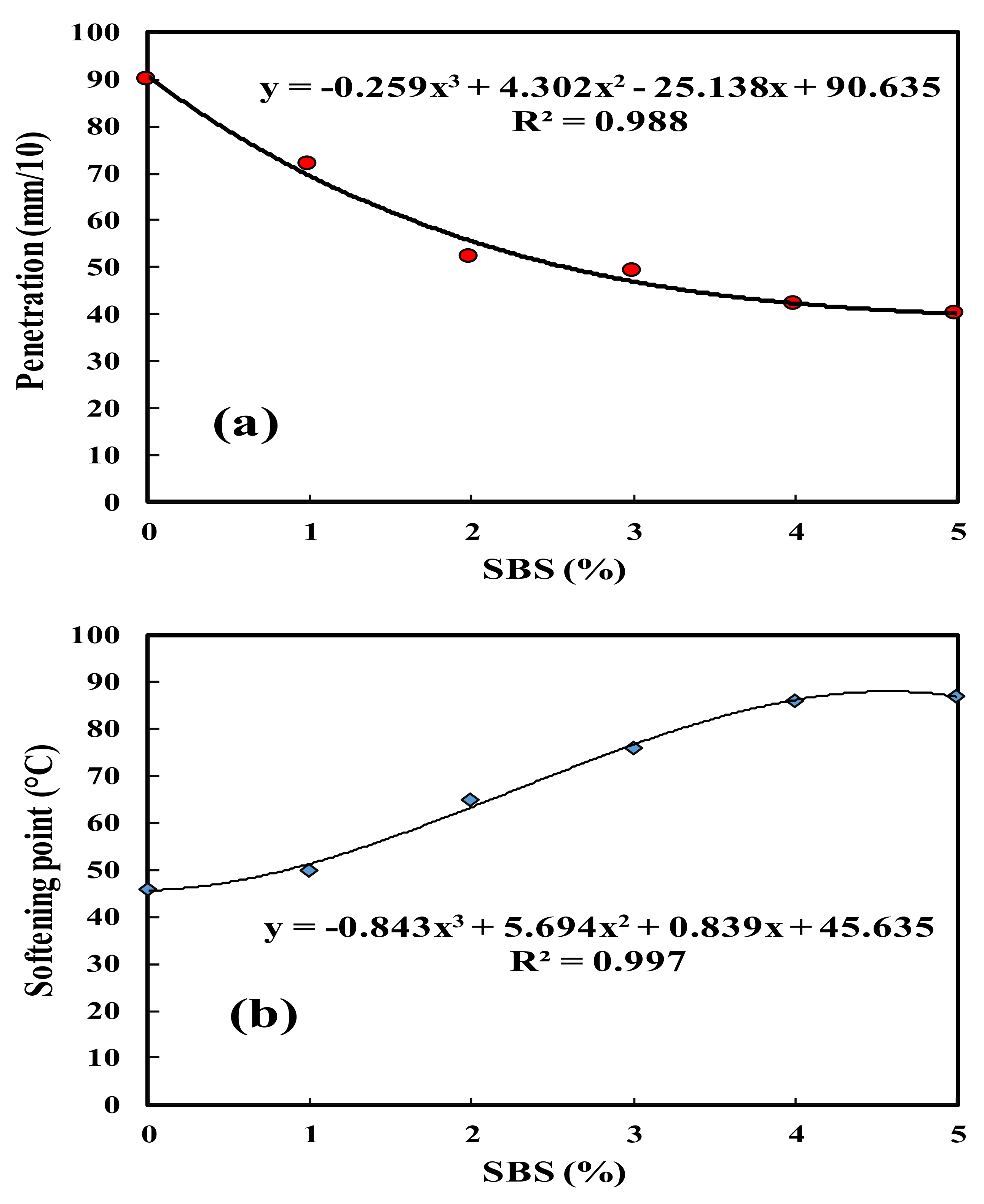
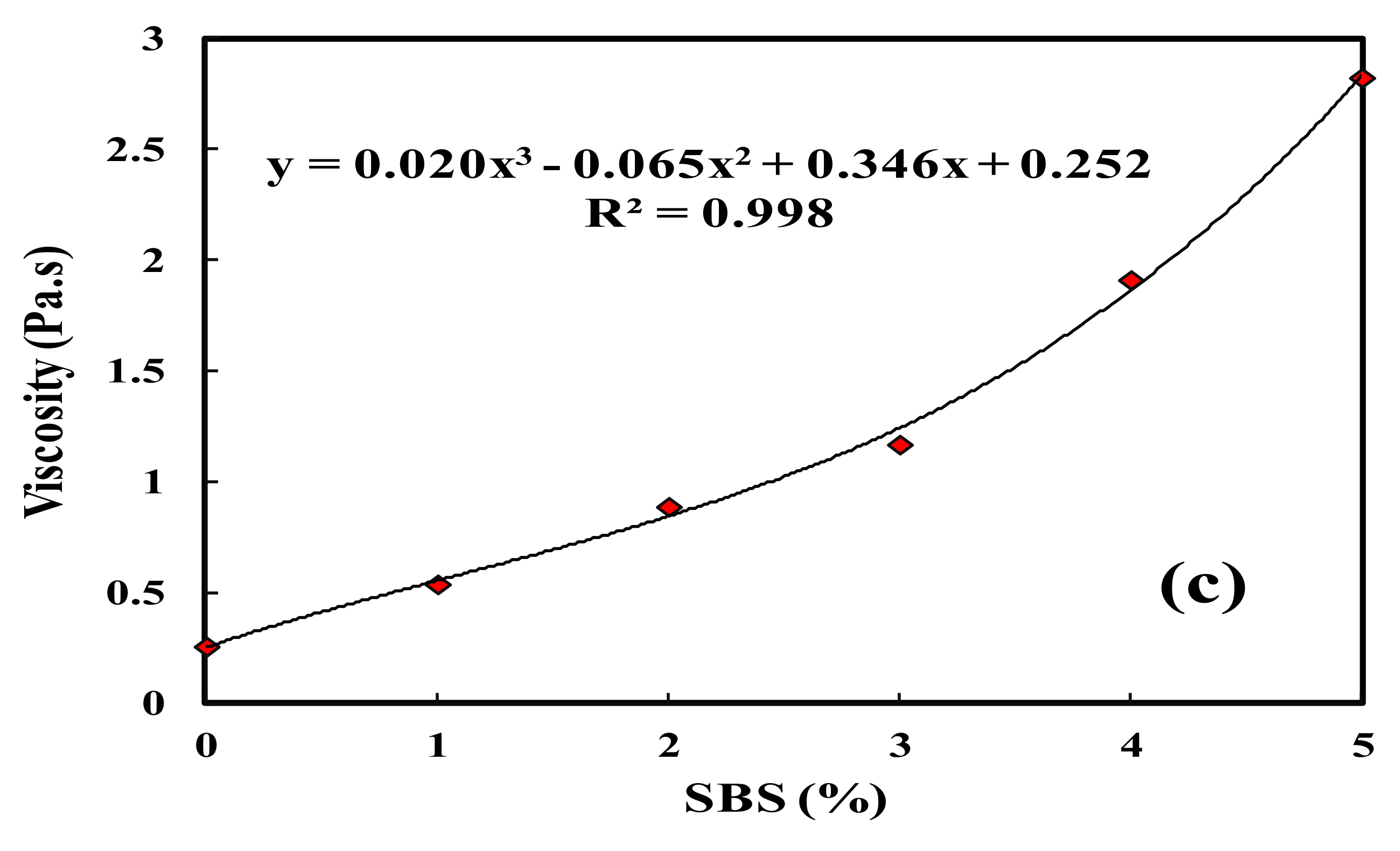
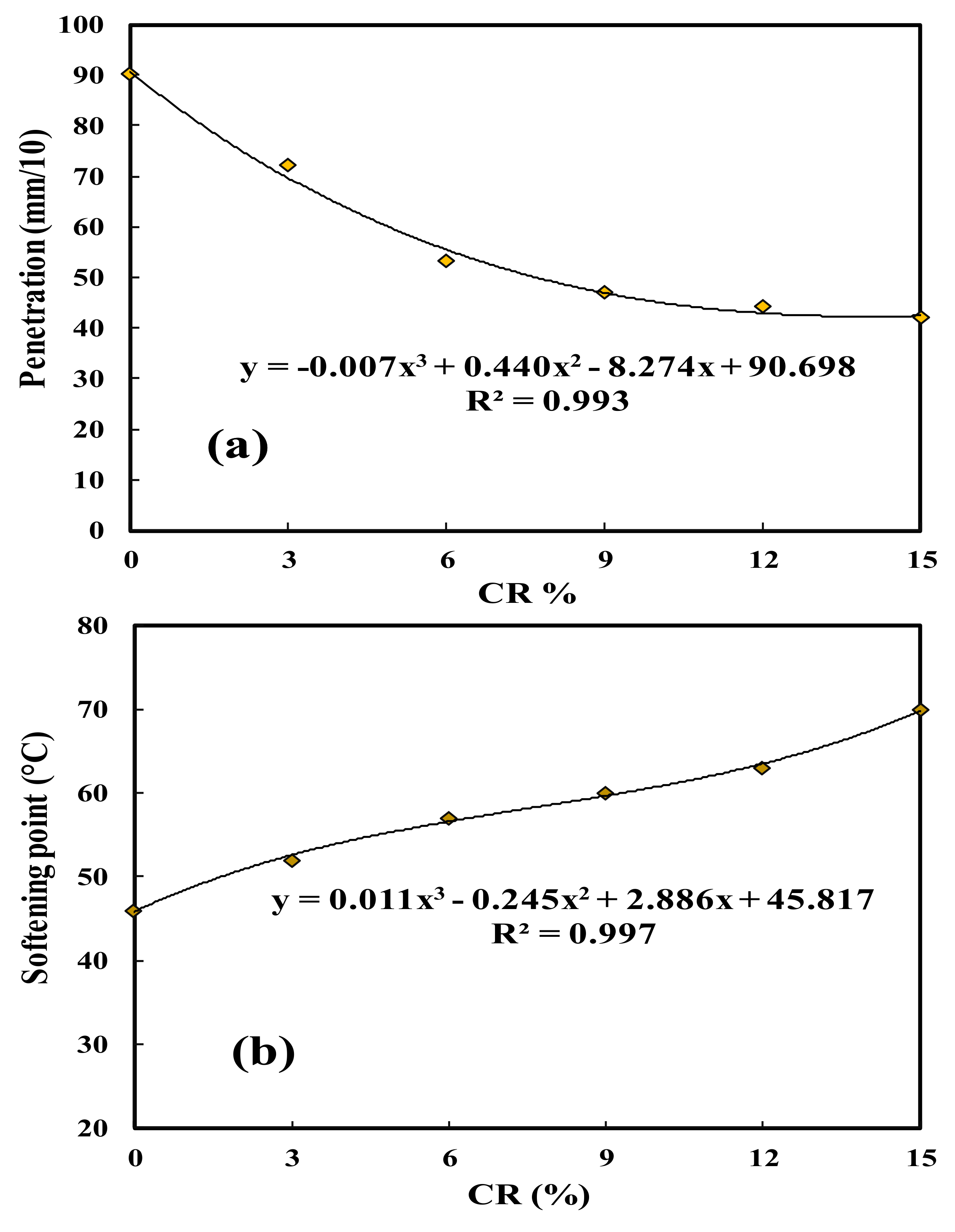
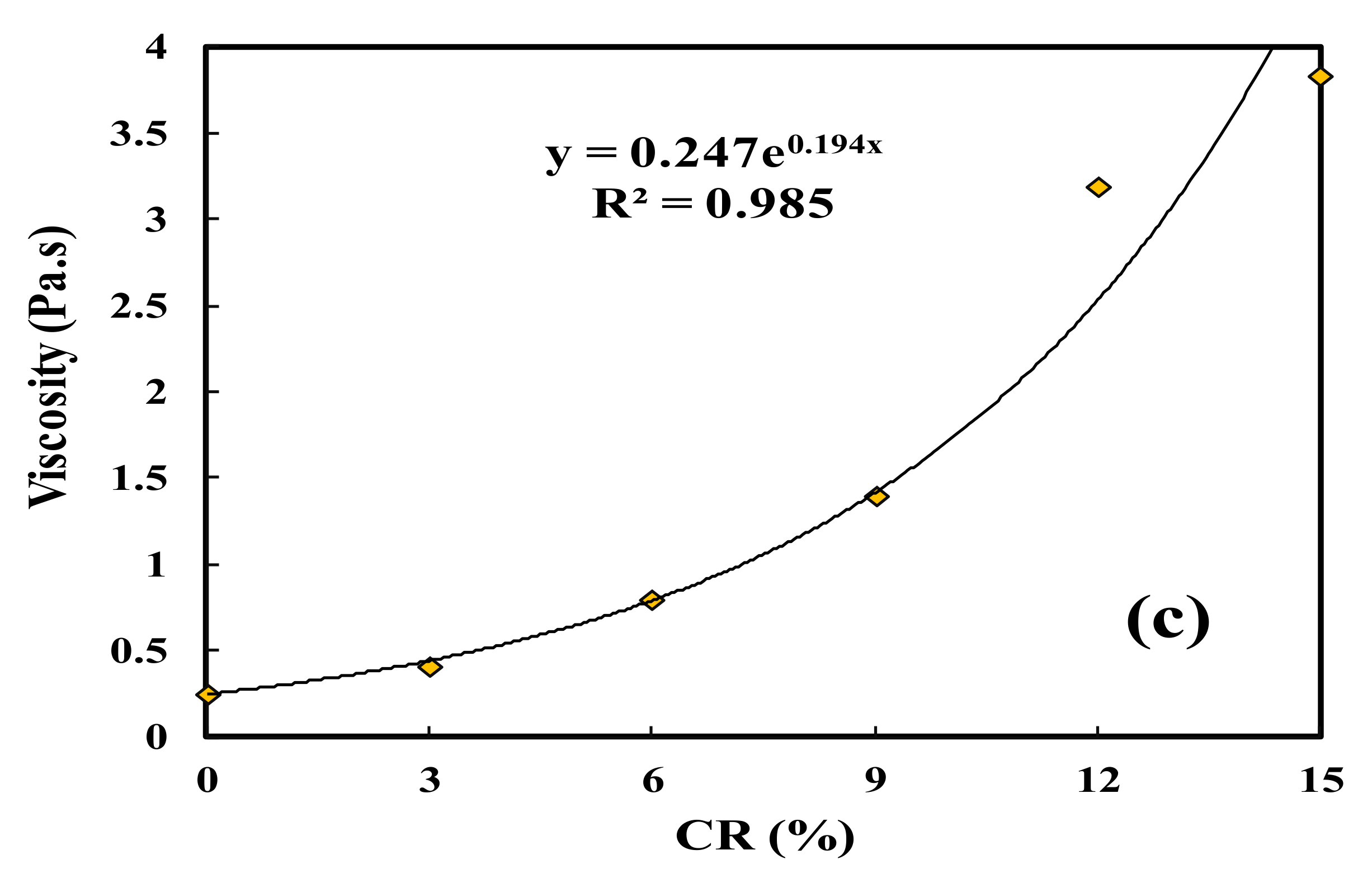
3.2. Relationship of SBS and CR with Penetration, Softening Point, and Viscosity
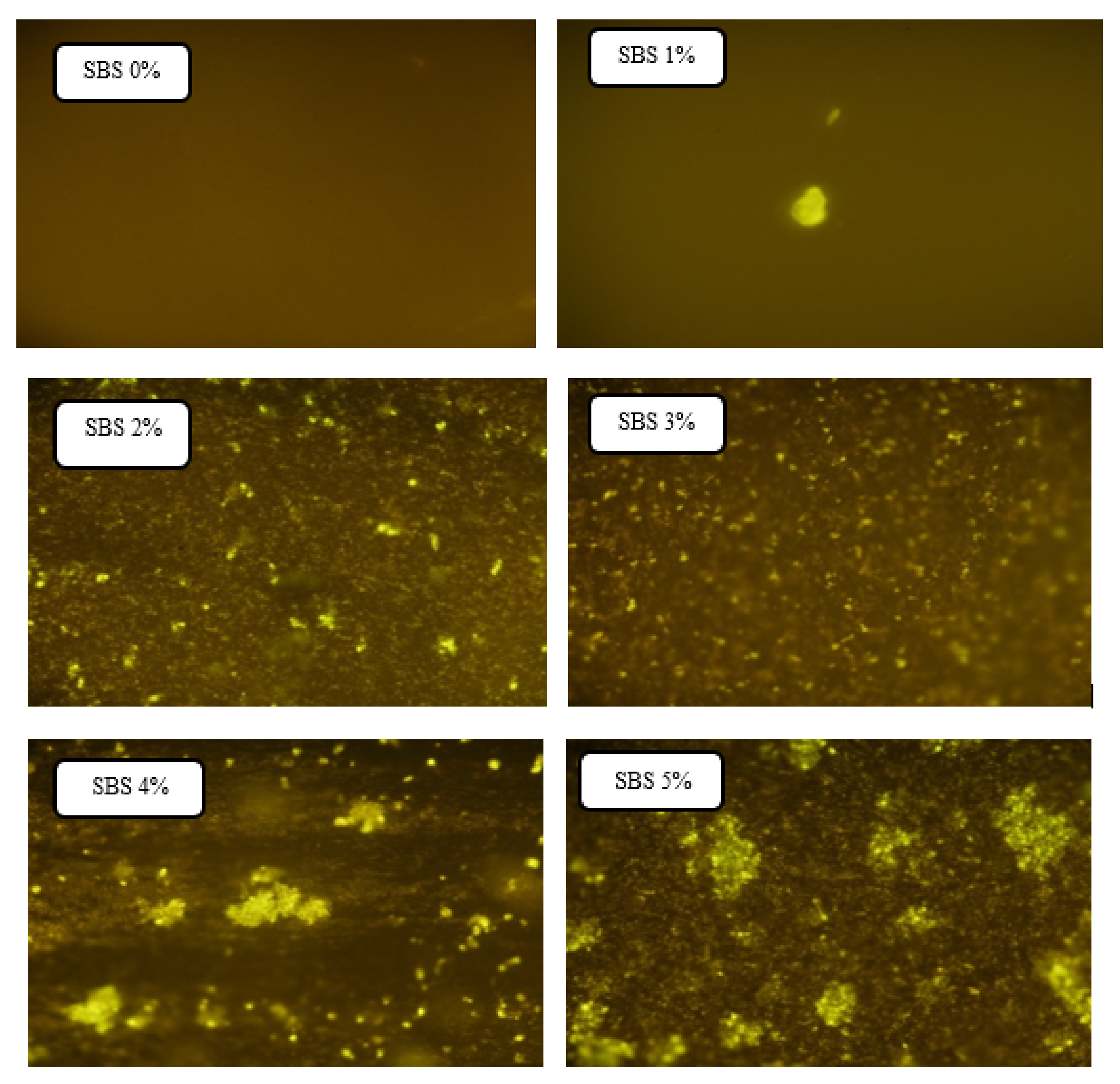
3.3. Microscopic Images of the SBS and CR-Modified Asphalt Binders
3.4. Performance Grade (PG) Tests
3.4.1. Dynamic Shear Rheometer (DSR) Test
3.4.2. Bending Beam Rheometer (BBR) Test
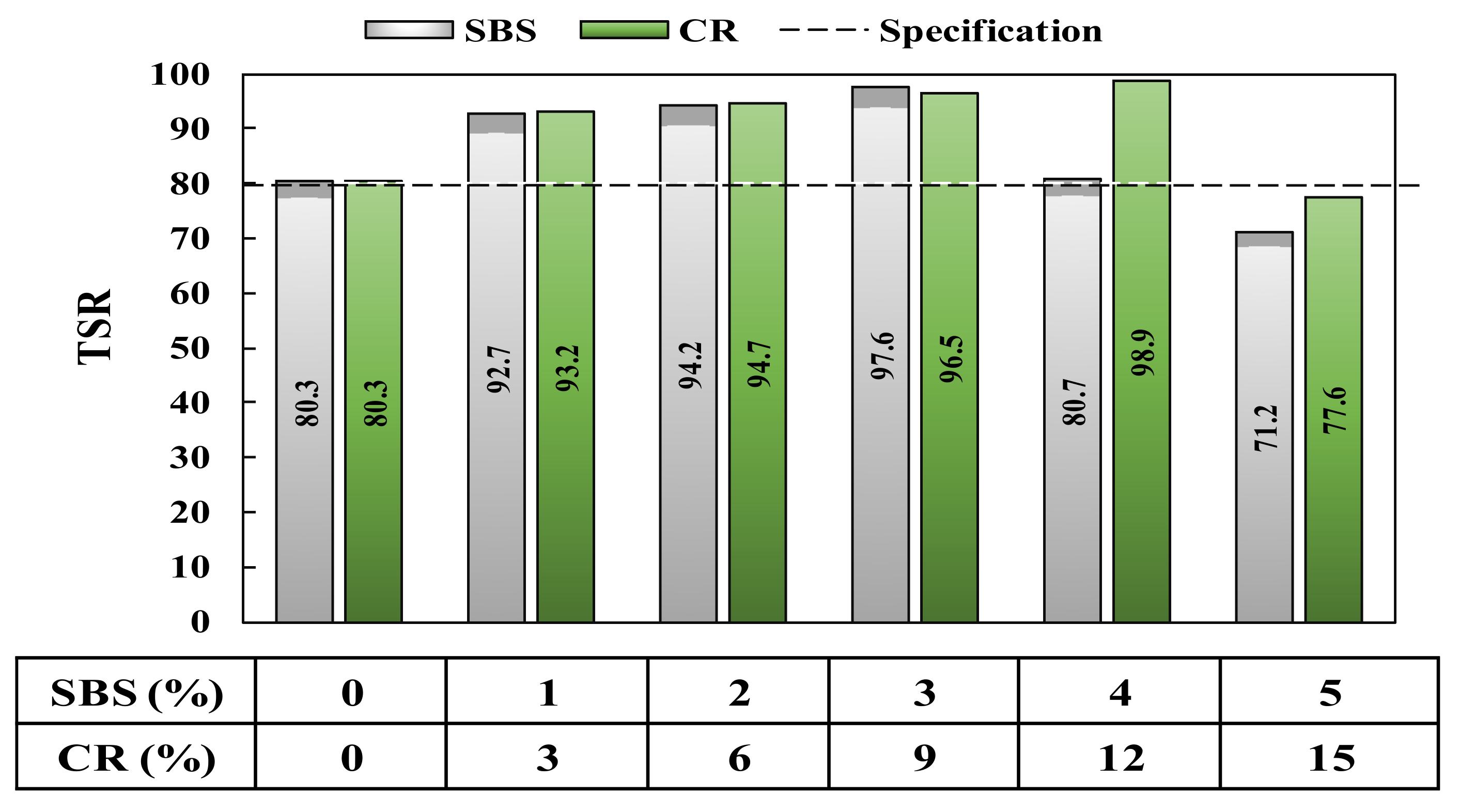
3.5. Tensile Strength Ratio (TSR)
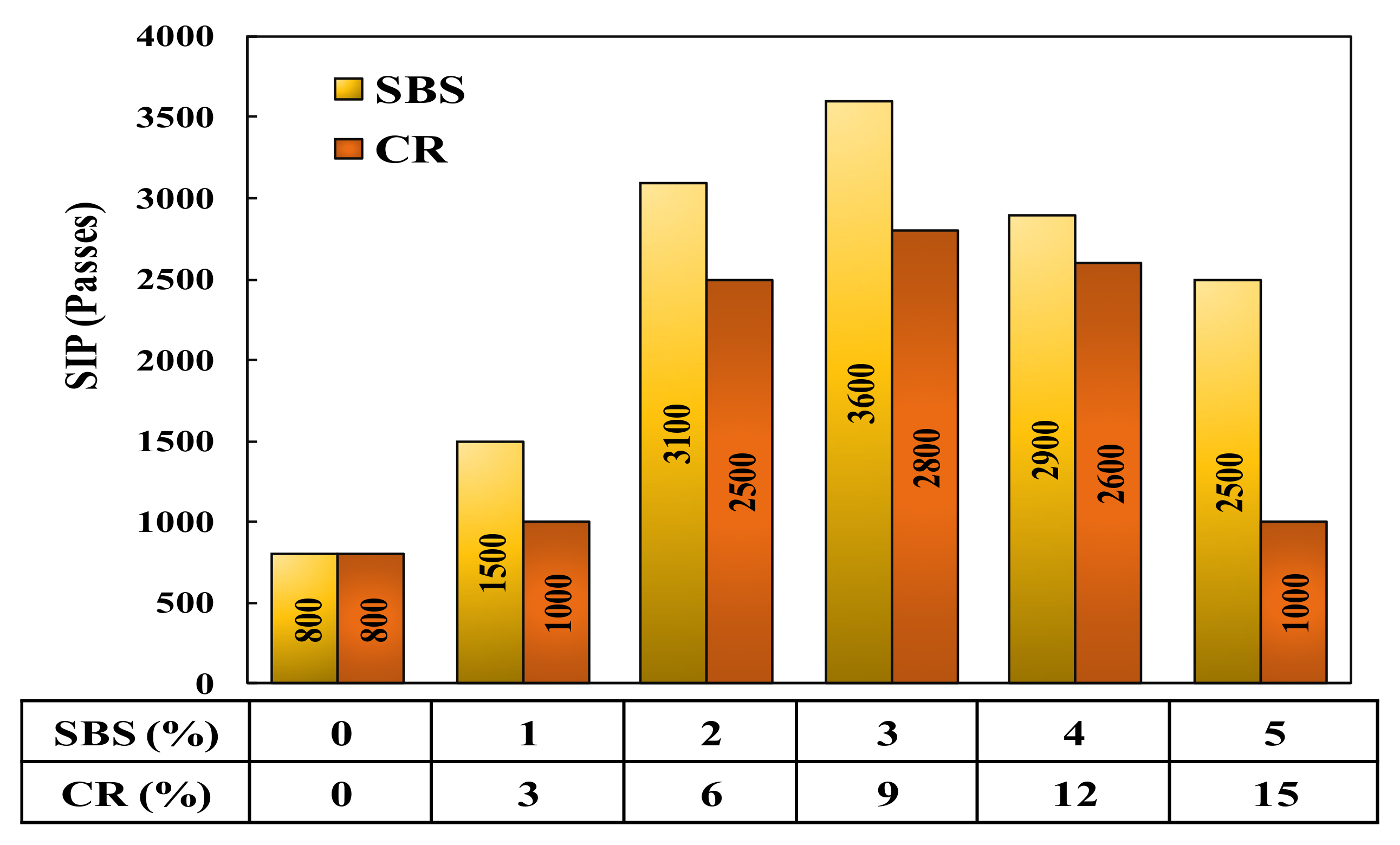
3.6. Hamburg Wheel Tracker
4. Conclusions
- Adding SBS or CR to asphalt raises the viscosity, which leads to higher mixing and compacting temperature of the asphalt mixture, this must be considered in the highway construction process.
- The optimum CR% to get maximum moisture and rutting resistance is CR 9%, while for SBS% is SBS 3%.
- Approximately adding 1% of SBS or 3% CR each to asphalt will raise the high-temperature PG one grade.
- Adding 9% CR or 3% Table SSBS changes the PG from PG 58-22 to PG 76-16, this is very beneficial for hot climate regions.
- The percentage increase in TSR for 9% CR compared to the control sample is 20%, and for 3%, SBS is 22%. These are valuable amounts in moisture resistance.
- The percentage increase in the rutting parameter for 9% CR is 246%, for 3% SBS is 350%. These are remarkable improvements in the rutting resistance of asphalt concrete.
- The extra cost of using SBS or CR in asphalt mixture is approximately 10% and 5%, respectively; this is a reasonable amount regarding their engineering benefits, decreasing maintenance cost, and providing a sustainable asphalt concrete pavement with an extended service life.
- To replace costly SBS additives with cheap and environment-friendly CR, triple the amount of CR is needed to get improvement in engineering properties of asphalt concrete mixture without forgetting that 3% SBS-modified asphalt had higher conventional asphalt tests values (Table 3 and Table 4) and higher asphalt concrete tensile strength and rutting parameter values (Table 10 and Table 11) than 9% CR-modified asphalt.
- TSR values for the control sample are very close to Superpave specifications. This ensures that using a modified asphalt mixture is crucial.
Author Contributions
Funding
Data Availability Statement
Acknowledgments
Conflicts of Interest
References
- Wekumbura, C.; Stastna, J.; Zanzotto, L. Destruction and recovery of internal structure in polymemodified asphalts. J. Mater. Civ. Eng. 2007, 19, 227–232. [Google Scholar] [CrossRef] [Scilit]
- Navarro, F.J.; Partal, P.; Martínez-Boza, F.J.; Gallegos, C. Novel recycled polyethylene/ground tire rubber/bitumen blends for use in roofing applications: Thermo-Mechanical Properties. Polym. Test. 2010, 29, 588–595. [Google Scholar] [CrossRef] [Scilit]
- Kiselev, A.; Zhang, H.; Liu, Z. The effect of two-phase mixing on the functional and mechanical properties of TPS/SBS-modified porous asphalt concrete. Constr. Build. Mater. 2021, 270, 121841. [Google Scholar] [CrossRef] [Scilit]
- Lu, X.; Isacsson, U. Rheological characterization of styrene-butadiene-styrene copolymer modified bitumens. Constr. Build. Mater. 1997, 11, 23–32. [Google Scholar] [CrossRef] [Scilit]
- Yildirim, Y. Polymer modified asphalt binders. Constr. Build. Mater. 2007, 21, 66–72. [Google Scholar] [CrossRef] [Scilit]
- Montepara, A.; Romeo, E.; Birgisson, B.; Tebaldi, G. Strain localization and damage distribution in SBS polymer modified asphalt mixtures. Road Mater. Pavement Des. 2010, 11, 899–915. [Google Scholar] [CrossRef] [Scilit]
- Ahmed, A.W.; Said, S.F.; Lu, X.; Carlsson, H. Pavement performance follow-up and evaluation of polymer-modified test sections. Int. J. Pavement Eng. 2018, 20, 1474–1487. [Google Scholar] [CrossRef] [Scilit]
- Al-Jumaili, M.A.; Al-Jameel, H.A. Reducing rutting in flexible pavement using specified polymers with HMA. IOP Conf. Ser. Mater. Sci. Eng. 2020, 978, 012006. [Google Scholar] [CrossRef] [Scilit]
- Yu, H.; Bai, X.; Qian, G.; Wei, H.; Gong, X.; Jin, J.; Li, Z. Impact of ultraviolet radiation on the aging properties of SBS-Modified Asphalt Binders. Polymers 2019, 11, 1111. [Google Scholar] [CrossRef] [Scilit] [PubMed]
- Hao, J.; Cao, P.; Liu, Z.; Wang, Z.; Xia, S. Developing of a SBS polymer modified bitumen to avoid low temperature cracks in the asphalt facing of a reservoir in a harsh climate region. Constr. Build. Mater. 2017, 150, 105–113. [Google Scholar] [CrossRef] [Scilit]
- Radhakrishnan, V.; Chowdari, G.S.; Reddy, K.S.; Chattaraj, R. Evaluation of wheel tracking and field rutting susceptibility of dense bituminous mixes. Road Mater. Pavement Des. 2017, 20, 90–109. [Google Scholar] [CrossRef] [Scilit]
- Porto, M.; Caputo, P.; Loise, V.; Eskandarsefat, S.; Teltayev, B.; Oliviero Rossi, C. Bitumen and bitumen modification: A review on latest advances. Appl. Sci. 2019, 9, 742. [Google Scholar] [CrossRef] [Scilit]
- Ilyin, S.O.; Arinina, M.P.; Mamulat, Y.S.; Malkin, A.Y.; Kulichikhin, V.G. Rheological properties of road bitumens modified with polymer and solid nanosized additives. Colloid J. 2014, 76, 425–434. [Google Scholar] [CrossRef] [Scilit]
- Mashaan, N.S.; Ali, A.H.; Karim, M.R.; Abdelaziz, M. A review on using crumb rubber in reinforcement of Asphalt Pavement. Sci. World J. 2014, 2014, 1–21. [Google Scholar] [CrossRef] [Scilit] [PubMed]
- Annual Book of ASTM Standards; ASTM International: West Conshohocken, PA, USA, 2018.
- Superpave Mix Design, 3rd ed.; Superpave Series No. 2; Asphalt Institute: Lexington, KY, USA, 2001.
- Iraqi Standard Specifications for Roads and Bridges, 2nd ed.; Part 2; The State Corporation for Roads and Bridges, Ministry of Housing and Reconstruction: Baghdad, Iraq, 2003.
- Dong, F.; Zhao, W.; Zhang, Y.; Wei, J.; Fan, W.; Yu, Y.; Wang, Z. Influence of SBS and asphalt on SBS dispersion and the performance of Modified Asphalt. Constr. Build. Mater. 2014, 62, 1–7. [Google Scholar] [CrossRef] [Scilit]
- Kok, B.V.; Yilmaz, M. The effects of using lime and styrene–butadiene–styrene on moisture sensitivity resistance of hot mix asphalt. Constr. Build. Mater. 2009, 23, 1999–2006. [Google Scholar] [CrossRef] [Scilit]
- Qian, C.; Fan, W. Evaluation and characterization of properties of crumb rubber/SBS modified asphalt. Mater. Chem. Phys. 2020, 253, 123319. [Google Scholar] [CrossRef] [Scilit]
- AASHTO Provisional Standards; American Association of State Highway and Transportation Officials: Washington, DC, USA, 2013.
- Chen, J.-S.; Liao, M.-C.; Shiah, M.-S. Asphalt modified by styrene-butadiene-styrene Triblock copolymer: Morphology and model. J. Mater. Civ. Eng. 2002, 14, 224–229. [Google Scholar] [CrossRef] [Scilit]
- Nikolaides, A. Highway Engineering; eBook—PDF; Taylor & Francis Group: Abingdon, UK, 2014. [Google Scholar]
- Ghasemi, M.; Marandi, S.M. Performance improvement of a crumb rubber modified bitumen using recycled glass powder. J. Zhejiang Univ. Sci. A 2013, 14, 805–814. [Google Scholar] [CrossRef] [Scilit]
- Lv, Q.; Huang, W.; Sadek, H.; Xiao, F.; Yan, C. Investigation of the rutting performance of various modified asphalt mixtures using the Hamburg wheel-tracking device test and multiple stress Creep Recovery Test. Constr. Build. Mater. 2019, 206, 62–70. [Google Scholar] [CrossRef] [Scilit]





| Test | Test Specification [15] | Result |
|---|---|---|
| Penetration at 25 °C (mm/10) | ASTM D5 | 90 |
| Softening point (°C) | ASTM D36 | 46 |
| Ductility at 25 °C (cm) | ASTM D113 | 150 |
| Elastic recovery at 25 °C (%) | ASTM D6084 | 3 |
| Viscosity at 135 °C (Pa·s) | ASTM D4402 | 0.252 |
| Flash point (°C) | ASTM D92 | 277 |
| Specific gravity at 25 °C | ASTM D70 | 1.058 |
| Penetration after RTFOT (mm/10) | ASTM D2872 | 43 |
| Softening point after RTFOT (°C) | ASTM D2872 | 58 |
| Loss on heat after RTFOT (%) | ASTM D2872 | 0.81 |
| Softening point after storage stability (°C) | ASTM D6930 | nil |
| Material | Test | Symbol | Value | Note | Superpave Specifications [16] |
|---|---|---|---|---|---|
| Gravel | Apparent specific gravity | GA | 2.725 | Crushed gravel | |
| Bulk specific gravity | GB | 2.671 | |||
| Effective specific gravity | GE | 2.693 | |||
| Water absorption | W.A% | 0.747 | |||
| Abrasion value | A .V% | 22.56 | |||
| Gravel angularity | P% | 96.6 | 20% round edge, 80% sharp edge, and all rough surface | 95/90% | |
| Flat and elongated | P% | 0.4 | max. 10% | ||
| Sand | Apparent specific gravity | GA | 2.699 | Crushed sand | |
| Bulk specific gravity | GB | 2.535 | |||
| Effective specific gravity | GE | 2.617 | |||
| Water absorption | W.A% | 2.399 | |||
| Uncompacted air void% | U% | 48 | min. 45 | ||
| Sand equivalent value% | Nil | 75 | min. 45 | ||
| Filler | Apparent specific gravity | GA | 2.523 | Brown filler | |
| Bulk specific gravity | GB | 2.435 | |||
| Effective specific gravity | GE | 2.479 | |||
| Water absorption | W.A% | 1.422 |
| Tests | SBS% | Spec. [16] | |||||
|---|---|---|---|---|---|---|---|
| 0 | 1 | 2 | 3 | 4 | 5 | ||
| Penetration (mm/10) | 90 | 72 | 52 | 49 | 42 | 40 | |
| Softening point (°C) | 46 | 50 | 65 | 76 | 86 | 87 | |
| Ductility (cm) | 150 | Nil | Nil | Nil | Nil | Nil | |
| Elastic recovery (%) | 3 | 42 | 82 | 94 | 95 | 96 | |
| Viscosity 135 °C (Pa·s) | 0.252 | 0.542 | 0.889 | 1.171 | 1.910 | 2.819 | 3.0 |
| Flashpoint (°C) | 277 | 294 | 295 | 297 | 298 | 299 | 230 |
| Specific gravity | 1.058 | 1.059 | 1.060 | 1.055 | 1.048 | 1.035 | |
| Penetration Index | −0.80 | −0.30 | 2.08 | 3.71 | 4.64 | 4.64 | |
| Storage stab./Soft. pt. | Nil | U50D50 | U70D60 | U80D70 | U92D79 | U95D80 | |
| RTFOT/Penetration | 43 | 35 | 25 | 31 | 29 | 26 | |
| RTFOT/Soft. point | 58 | 66 | 71 | 81 | 87 | 87 | |
| RTFOT/Loss on heat (%) | 0.81 | 0.79 | 0.77 | 0.75 | 0.74 | 0.74 | ≤1.0 |
| Tests | CR (%) | Spec. [16] | |||||
|---|---|---|---|---|---|---|---|
| 0 | 3 | 6 | 9 | 12 | 15 | ||
| Penetration (mm/10) | 90 | 72 | 50 | 47 | 44 | 42 | |
| Softening point (°C) | 46 | 52 | 57 | 60 | 63 | 70 | |
| Ductility (cm) | 150 | Nil | Nil | Nil | Nil | Nil | |
| Elastic recovery (%) | 3 | 40 | 60 | 70 | 75 | 76 | |
| Viscosity at 135 °C (Pa·s) | 0.252 | 0.406 | 0.796 | 1.396 | 3.187 | 3.827 | 3.0 |
| Flashpoint (°C) | 277 | 279 | 281 | 284 | 290 | 294 | 230 |
| Specific gravity | 1.058 | 1.061 | 1.067 | 1.071 | 1.075 | 1.081 | |
| Penetration Index | −0.80 | 0.21 | 0.41 | 0.87 | 1.29 | 2.39 | |
| Storage stab./Soft. pt. | Nil | U55D53 | U58D54 | U62D57 | U66D61 | U74D65 | |
| RTFOT/Penetration | 43 | 36 | 30 | 32 | 30 | 28 | |
| RTFOT/Soft. point | 58 | 65 | 71 | 74 | 77 | 84 | |
| RTFOT/Loss on heat (%) | 0.81 | 0.78 | 0.74 | 0.71 | 0.68 | 0.66 | ≤1.0 |
| Sample | State | Temp. (°C) | δ° | G* (kPa) | G*/sinδ (kPa) | G*.sinδ (kPa) | Standard Deviation (kPa) | Specification (kPa) [15] | Result |
|---|---|---|---|---|---|---|---|---|---|
| SBS 0% | Original | 58 | 85.0 | 1.748 | 1.754 | 0.0007 | G*/sinδ ≥ 1 | Pass | |
| RTFOT | 64 | 79.7 | 3.728 | 3.789 | 0.0012 | G*/sinδ ≥ 2.2 | Pass | ||
| PAV | 22 | 45.7 | 4987.25 | 3479.30 | 3.34 | G*.Sinδ ≤ 5000 | Pass | ||
| SBS 1% | Original | 64 | 82.7 | 1.785 | 1.801 | 0.0004 | G*/sinδ ≥ 1 | Pass | |
| RTFOT | 70 | 76.1 | 3.866 | 3.985 | 0.0006 | G*/sinδ ≥ 2.2 | Pass | ||
| PAV | 25 | 38.8 | 5386.72 | 3377.06 | 5.31 | G*.Sinδ ≤ 5000 | Pass | ||
| SBS 2% | Original | 70 | 76.3 | 1.556 | 1.602 | 0.0007 | G*/sinδ ≥ 1 | Pass | |
| RTFOT | 82 | 70.8 | 2.401 | 2.542 | 0.0010 | G*/sinδ ≥ 2.2 | Pass | ||
| PAV | 31 | 40.4 | 2476.73 | 1605.25 | 4.47 | G*.Sinδ ≤ 5000 | Pass | ||
| SBS 3% | Original | 76 | 66.2 | 1.030 | 1.126 | 0.0009 | G*/sinδ ≥ 1 | Pass | |
| RTFOT | 88 | 73.7 | 2.164 | 2.254 | 0.0283 | G*/sinδ ≥ 2.2 | Pass | ||
| PAV | 34 | 54.0 | 1680.57 | 1359.61 | 1.62 | G*.Sinδ ≤ 5000 | Pass | ||
| SBS 4% | Original | 82 | 70.6 | 1.143 | 1.212 | 0.0017 | G*/sinδ ≥ 1 | Pass | |
| RTFOT | 88 | 69.9 | 2.396 | 2.551 | 0.0024 | G*/sinδ ≥ 2.2 | Pass | ||
| PAV | 40 | 41.2 | 1242.24 | 817.93 | 3.39 | G*.Sinδ ≤ 5000 | Pass | ||
| SBS 5% | Original | 94 | 48.0 | 1.122 | 1.508 | 0.0008 | G*/sinδ ≥ 1 | Pass |
| Sample | State | Temp. (°C) | δ° | G* (kPa) | G*/sinδ (kPa) | G*.sinδ (kPa) | Standard Deviation (kPa) | Specification (kPa) [15] | Result |
|---|---|---|---|---|---|---|---|---|---|
| CR 0% | Original | 58 | 85.0 | 1.748 | 1.754 | 0.0007 | G*/sinδ ≥ 1 | Pass | |
| RTFOT | 64 | 79.7 | 3.728 | 3.789 | 0.0012 | G*/sinδ ≥ 2.2 | Pass | ||
| PAV | 22 | 45.7 | 4987.25 | 3479.30 | 3.34 | G*.Sin δ≤ 5000 | Pass | ||
| CR 3% | Original | 64 | 81.8 | 1.747 | 1.767 | 0.0003 | G*/sinδ ≥ 1 | Pass | |
| RTFOT | 70 | 74.9 | 4.189 | 4.340 | 0.0009 | G*/sinδ ≥ 2.2 | Pass | ||
| PAV | 25 | 37.2 | 5329.24 | 3219.73 | 5.32 | G*.Sin δ ≤ 5000 | Pass | ||
| CR 6% | Original | 76 | 77.4 | 1.032 | 1.058 | 0.0006 | G*/sinδ ≥ 1 | Pass | |
| RTFOT | 76 | 69.5 | 4.572 | 4.880 | 0.0007 | G*/sinδ ≥ 2.2 | Pass | ||
| PAV | 37 | 41.7 | 1519.62 | 1010.17 | 2.72 | G*.Sin δ ≤ 5000 | Pass | ||
| CR 9% | Original | 76 | 73.2 | 1.229 | 1.283 | 0.0013 | G*/sinδ ≥ 1 | Pass | |
| RTFOT | 82 | 73.0 | 2.871 | 3.003 | 0.0019 | G*/sinδ ≥ 2.2 | Pass | ||
| PAV | 37 | 41.6 | 1337.48 | 887.89 | 2.60 | G*.Sin δ ≤ 5000 | Pass | ||
| CR 12% | Original | 94 | 87.1 | 1.646 | 1.648 | 0.0014 | G*/sinδ ≥ 1 | Pass |
| Sample | Temp. (°C) | Stiffness (MPa) | m-Value | Specification [15] | Result | |
|---|---|---|---|---|---|---|
| Stiffness (MPa) | m-Value | |||||
| SBS 0% | −22 | 96.75 | 0.324 | S max = 300 | min. = 0.300 | Pass |
| −28 | 200.87 | 0.261 | Fail | |||
| SBS 1% | −22 | 121.96 | 0.303 | Pass | ||
| −28 | 245.24 | 0.253 | Fail | |||
| SBS 2% | −16 | 61.19 | 0.329 | Pass | ||
| −22 | 126.88 | 0.280 | Fail | |||
| SBS 3% | −16 | 64.92 | 0.316 | Pass | ||
| −22 | 128.33 | 0.275 | Fail | |||
| SBS 4% | −10 | 40.13 | 0.338 | Pass | ||
| −16 | 81.60 | 0.293 | Fail | |||
| Sample | Temp. (°C) | Stiffness (MPa) | m-Value | Specification [15] | Result | |
|---|---|---|---|---|---|---|
| Stiffness (MPa) | m-Value | |||||
| CR 0% | −22 | 96.75 | 0.324 | S max = 300 | min. = 0.300 | Pass |
| −28 | 200.87 | 0.261 | Fail | |||
| CR 3% | −22 | 107.46 | 0.305 | Pass | ||
| −28 | N/A | <0.3 | Fail | |||
| CR 6% | −16 | 53.16 | 0.315 | Pass | ||
| −22 | 111.47 | 0.285 | Fail | |||
| CR 9% | −16 | 51.30 | 0.322 | Pass | ||
| −22 | 100.65 | 0.284 | Fail | |||
| SBS Modifier | CR Modifier | ||||||
|---|---|---|---|---|---|---|---|
| Asphalt | DSR Original | BBR | PG | Asphalt | DSR Original | BBR | PG |
| SBS 0% | 58 | −22 | 58-22 | CR 0% | 58 | −22 | 58-22 |
| SBS 1% | 64 | −22 | 64-22 | CR 3% | 64 | −22 | 64-22 |
| SBS 2% | 70 | −16 | 70-16 | CR 6% | 76 | −16 | 76-16 |
| SBS 3% | 76 | −16 | 76-16 | CR 9% | 76 | −16 | 76-16 |
| SBS 4% | 82 | −10 | 82-10 | CR 12% | 94 | N/A | N/A |
| SBS 5% | 94 | N/A | N/A | CR 15% | N/A | N/A | N/A |
| Additive | Content (%) | S Conditioned (kPa) | Б (kPa) | S Dry (kPa) | Б (kPa) | TSR |
|---|---|---|---|---|---|---|
| SBS | 0 | 551.8 | 21.35 | 686.8 | 24.23 | 80.3 |
| 1 | 769.9 | 22.28 | 830.2 | 5.32 | 92.7 | |
| 2 | 1073.3 | 20.19 | 1137.4 | 22.71 | 94.2 | |
| 3 | 1080 | 21.19 | 1106.7 | 20.81 | 97.6 | |
| 4 | 1092.3 | 23.76 | 1354.2 | 22.54 | 80.7 | |
| 5 | 734.7 | 23.12 | 1031.1 | 13.65 | 71.2 | |
| CR | 0 | 551.8 | 22.61 | 686.8 | 25.38 | 80.3 |
| 3 | 964.1 | 24.83 | 1034.6 | 10.57 | 93.2 | |
| 6 | 893 | 9.99 | 943.2 | 23.79 | 94.7 | |
| 9 | 947.8 | 20.44 | 981.9 | 7.59 | 96.5 | |
| 12 | 957.3 | 2.77 | 967.6 | 22.77 | 98.9 | |
| 15 | 629.5 | 25.52 | 811.4 | 13.16 | 77.6 |
| Sample | Cycles | Passes | SIP | Nf | Sample | Cycles | Passes | SIP | Nf |
|---|---|---|---|---|---|---|---|---|---|
| SBS 0% | 1158 | 2316 | 800 | 2300 | CR 0% | 1158 | 2316 | 800 | 2300 |
| SBS 1% | 1893 | 3786 | 1500 | 3800 | CR 3% | 2000 | 4000 | 1000 | 3800 |
| SBS 2% | 4900 | 9800 | 3100 | 9800 | CR 6% | 3100 | 6200 | 2500 | 6200 |
| SBS 3% | 5791 | 11,582 | 3600 | 10,400 | CR 9% | 4396 | 8792 | 2800 | 8350 |
| SBS 4% | 4556 | 9112 | 2900 | 8500 | CR 12% | 3100 | 6200 | 2600 | 6200 |
| SBS 5% | 2540 | 5080 | 2500 | 5000 | CR 15% | 1900 | 3800 | 1000 | 3800 |
Disclaimer/Publisher’s Note: The statements, opinions and data contained in all publications are solely those of the individual author(s) and contributor(s) and not of MDPI and/or the editor(s). MDPI and/or the editor(s) disclaim responsibility for any injury to people or property resulting from any ideas, methods, instructions or products referred to in the content. |
© 2023 by the authors. Licensee MDPI, Basel, Switzerland. This article is an open access article distributed under the terms and conditions of the Creative Commons Attribution (CC BY) license (https://creativecommons.org/licenses/by/4.0/).
Share and Cite
Mahmood, A.O.; Kattan, R.A. Experimental Analysis to Evaluate the Impact of Styrene-Butadiene-Styrene and Crumb Rubber on the Rutting and Moisture Resistance of Asphalt Mixtures. Sustainability 2023, 15, 10387. https://doi.org/10.3390/su151310387
Mahmood AO, Kattan RA. Experimental Analysis to Evaluate the Impact of Styrene-Butadiene-Styrene and Crumb Rubber on the Rutting and Moisture Resistance of Asphalt Mixtures. Sustainability. 2023; 15(13):10387. https://doi.org/10.3390/su151310387
Chicago/Turabian StyleMahmood, Arian Omer, and Raad Awad Kattan. 2023. "Experimental Analysis to Evaluate the Impact of Styrene-Butadiene-Styrene and Crumb Rubber on the Rutting and Moisture Resistance of Asphalt Mixtures" Sustainability 15, no. 13: 10387. https://doi.org/10.3390/su151310387
APA StyleMahmood, A. O., & Kattan, R. A. (2023). Experimental Analysis to Evaluate the Impact of Styrene-Butadiene-Styrene and Crumb Rubber on the Rutting and Moisture Resistance of Asphalt Mixtures. Sustainability, 15(13), 10387. https://doi.org/10.3390/su151310387