



Exergo–Economic and Parametric Analysis of Waste Heat Recovery from Taji Gas Turbines Power Plant Using Rankine Cycle and Organic Rankine Cycle

 ,
,  ,
,  , and
, and
Abstract
1. Introduction
2. Description of the GSOCC Cycle
3. Mathematical Analysis
- All components of the combined system operate under steady-state conditions.
- Compositions of air at the inlet of the AC are 79% N2 and 21% O2.
- Natural gas is completely oxidized in the CC.
- Ideal gas principles apply to the exhaust gases.
- The CC is insulated completely.
- The relations utilized to assess the thermodynamic performance of the triple combined cycle are shown in Table 4.
4. Results and Discussion
5. Conclusions
- The combustion chamber is where the most exergy is lost (about 57.3%), and the pumps destroy the least amount of exergy compared to the other parts of the cycle.
- The highest total cost rate parts are the combustion chamber, the gas turbine, the steam turbine, and the heat recovery steam generator. Therefore, from the point of view of energy–economic analysis, these are the most important parts.
- Overall, the cost of exergy destruction for the cycle is 63%, indicating that 37% of the system’s total cost is attributable to the initial investment. This would mean that optimizing the system should focus on minimizing the cost of exergy destruction.
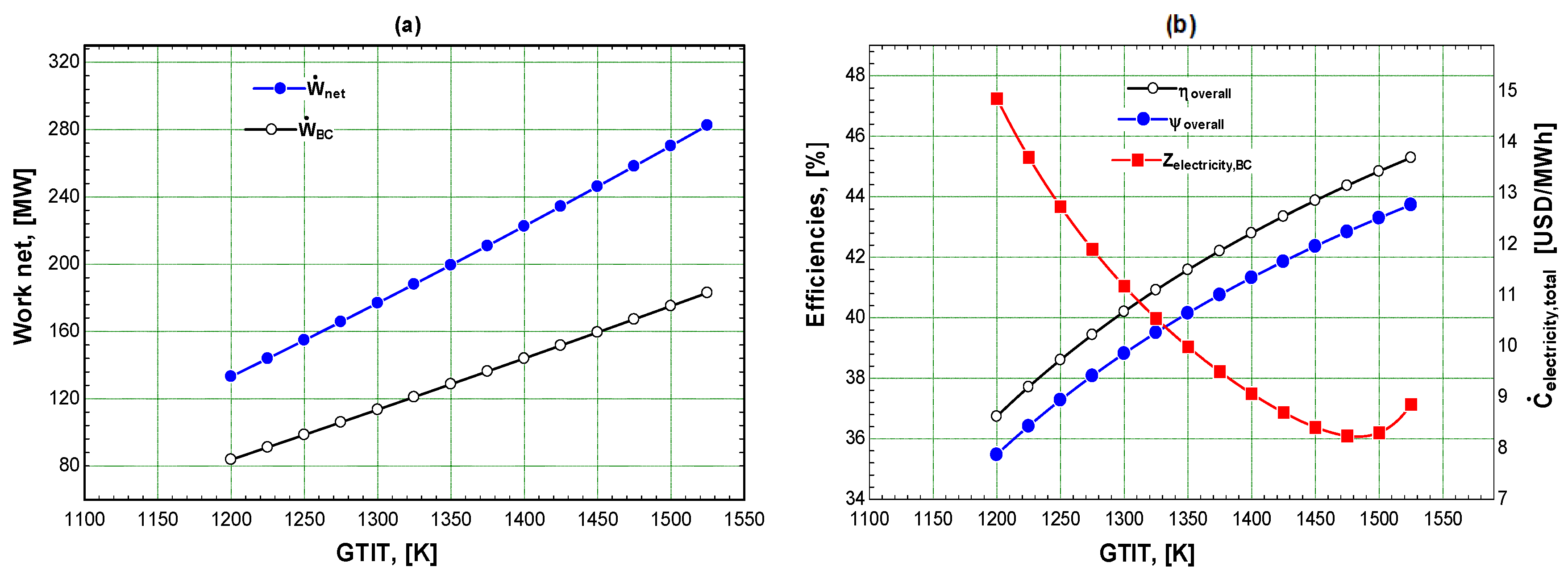
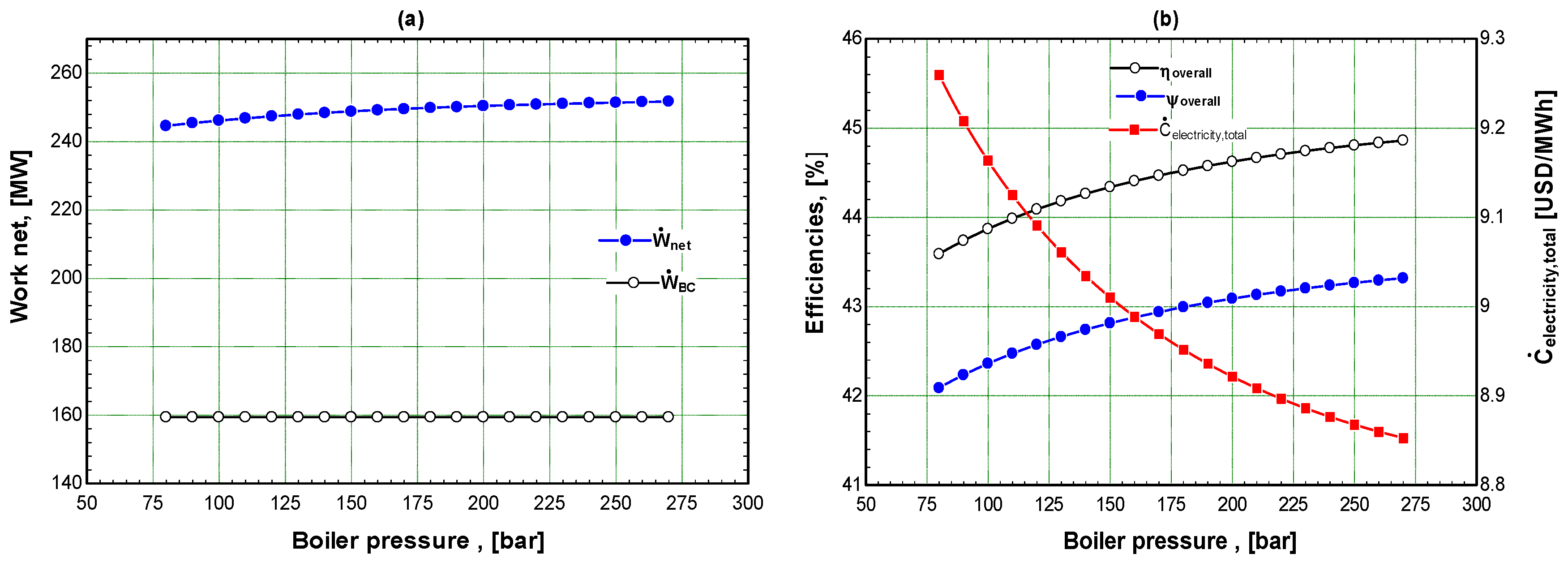
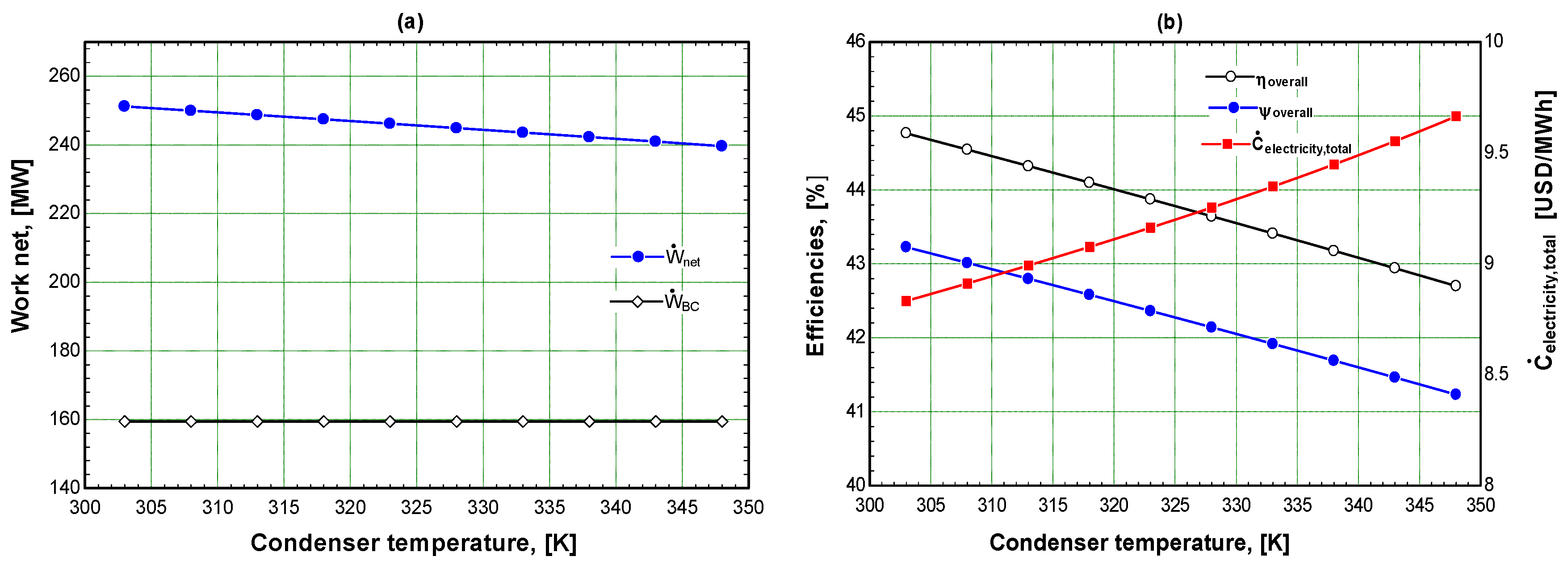
- According to the findings of the parametric analysis of the base case, the thermodynamic performance and cost of the system are enhanced by increasing the gas turbine inlet temperature and the isentropic efficiencies of the gas turbine and the air compressor. However, as these parameters are increased, the total cost of the system increases. Additionally, the increase in the pressure ratio will benefit the system. Additionally, the increase in pressure ratio will be thermodynamically and exergo–economically beneficial to the system. The increase in boiler pressure increases the First- and Second-Law efficiencies and decreases the system’s total cost rate. The increase in condenser temperature decreases the First- and Second-Law efficiencies and raises the system’s total cost rate.
Author Contributions
Funding
Institutional Review Board Statement
Informed Consent Statement
Data Availability Statement
Conflicts of Interest
Nomenclature
| SYMBOL | |
| Average costs per exergy unit of fuel (USD/MJ) | |
| Average costs per exergy unit of product (USD/MJ) | |
| Cost rate of exergy destruction (USD/h) | |
| Exergy flows(MW) | |
| Exergy destruction rate (MW) | |
| Product exergy (MW) | |
| Fuel exergy (MW) | |
| f | Exergo–economic factor (%) |
| specific enthalpy (kJ/kg) | |
| i | Interest rate (considered to be 10%) |
| LHV | lower heating value (MJ/kg) |
| Total mass flow entering per unit of time (kg/s) | |
| Total mass flow exiting per unit time (kg/s) | |
| n | System lifetime (considered to be 20 years) |
| p | pressure (bar) |
| 𝑃𝐸𝐶 | Equipment purchase cost in US dollars |
| Heat transfer (kW) | |
| Specific entropy of mass (kJ/kg.K) | |
| Specific entropy of mass entering the open system(kJ/kg.K) | |
| Environment temperature (K) | |
| Work done (kW) | |
| Capital cost rate (USD/h) | |
| Greek symbols | |
| η | Energy efficiency |
| Exergy efficiency | |
| 𝜑 | Maintenance factor (1.06) |
| Specific exergy | |
| ABBREVITIONS | |
| AC | Air compressor |
| BC | Brayton cycle |
| CC | Combustion chamber |
| CON | Condenser |
| CRF | Capital Recovery Factor |
| GSO CC | Gas steam Organic combined cycle |
| GT | Gas turbine |
| GTIT | Gas turbine inlet temperature |
| HE | Heat exchanger |
| HRB | Heat recovery boiler |
| HRSG | Heat recovery steam generation |
| ORC | Organic Rankine cycle |
| ORT | Organic Rankine turbine |
| P | Pump |
| RC | Cycle |
| ST | Steam turbine |
References
- Chennaif, M.; Zahboune, H.; Elhafyani, M.; Zouggar, S. Electric System Cascade Extended Analysis for Optimal Sizing of an Autonomous Hybrid CSP/PV/Wind System with Battery Energy Storage System and Thermal Energy Storage. Energy 2021, 227, 120444. [Google Scholar] [CrossRef]
- Akroot, A.; Namli, L. Performance Assessment of an Electrolyte-Supported and Anode-Supported Planar Solid Oxide Fuel Cells Hybrid System. J. Ther. Eng. 2021, 7, 1921–1935. [Google Scholar] [CrossRef]
- Abdelhafidi, N.; Bachari, N.E.I.; Abdelhafidi, Z.; Cheknane, A.; Mokhnache, A.; Castro, L. Modeling of Integrated Solar Combined Cycle Power Plant (ISCC) of Hassi R’mel, Algeria. Int. J. Energy Sect. Manag. 2020, 14, 505–526. [Google Scholar] [CrossRef]
- Talal, W.; Akroot, A. Exergoeconomic Analysis of an Integrated Solar Combined Cycle in the Al-Qayara Power Plant in Iraq. Processes 2023, 11, 656. [Google Scholar] [CrossRef]
- Tutumlu, H.; Yumrutaş, R.; Yildirim, M. Investigating Thermal Performance of an Ice Rink Cooling System with an Underground Thermal Storage Tank. Energy Explor. Exploit. 2018, 36, 314–334. [Google Scholar] [CrossRef]
- Görgülü, A.; Yağlı, H.; Koç, Y.; Koç, A.; Öztürk, N.A.; Köse, Ö. Experimental Study of Butane Adsorption on Coconut Based Activated Carbon for Different Gas Concentrations, Temperatures and Relative Humidities. Environ. Technol. 2021, 42, 2122–2131. [Google Scholar] [CrossRef]
- Guvenc, M.A.; Kapusuz, H.; Mistikoglu, S. Experimental Study on Accelerometer-Based Ladle Slag Detection in Continuous Casting Process. Int. J. Adv. Manuf. Technol. 2020, 106, 2983–2993. [Google Scholar] [CrossRef]
- Kyritsis, D.C.; Rakopoulos, C.D.; Rakopoulos, D.C. Engine and Power Plant Combustion Technologies for Sustainability. J. Energy Eng. 2019, 145, 2019001. [Google Scholar] [CrossRef]
- Seyyedi, S.M.; Hashemi-Tilehnoee, M.; Rosen, M.A. Exergy and Exergoeconomic Analyses of a Novel Integration of a 1000 MW Pressurized Water Reactor Power Plant and a Gas Turbine Cycle through a Superheater. Ann. Nucl. Energy 2018, 115, 161–172. [Google Scholar] [CrossRef]
- Akroot, A.; Namli, L.; Ozcan, H. Compared Thermal Modeling of Anode- and Electrolyte-Supported SOFC-Gas Turbine Hybrid Systems. J. Electrochem. Energy Convers. Storage 2021, 18, 011001. [Google Scholar] [CrossRef]
- Cengel, Y.A.; Boles, M.A. Thermodynamics: An Engineering Approach, 8th ed.; McGraw-Hill Education: New York, NY, USA, 2015; ISBN 9788578110796. [Google Scholar]
- Liu, Z.; He, T. Exergoeconomic Analysis and Optimization of a Gas Turbine-Modular Helium Reactor with New Organic Rankine Cycle for Efficient Design and Operation. Energy Convers. Manag. 2020, 204, 112311. [Google Scholar] [CrossRef]
- Sahoo, P.K. Exergoeconomic Analysis and Optimization of a Cogeneration System Using Evolutionary Programming. Appl. Therm. Eng. 2008, 28, 1580–1588. [Google Scholar] [CrossRef]
- Woudstra, N.; Woudstra, T.; Pirone, A.; Stelt, T. van der Thermodynamic Evaluation of Combined Cycle Plants. Energy Convers. Manag. 2010, 51, 1099–1110. [Google Scholar] [CrossRef]
- Roy, J.P.; Mishra, M.K.; Misra, A. Parametric Optimization and Performance Analysis of a Waste Heat Recovery System Using Organic Rankine Cycle. Energy 2010, 35, 5049–5062. [Google Scholar] [CrossRef]
- Köse, Ö.; Koç, Y.; Yağlı, H. Performance Improvement of the Bottoming Steam Rankine Cycle (SRC) and Organic Rankine Cycle (ORC) Systems for a Triple Combined System Using Gas Turbine (GT) as Topping Cycle. Energy Convers. Manag. 2020, 211, 112745. [Google Scholar] [CrossRef]
- Qiu, K.; Entchev, E. Development of an Organic Rankine Cycle-Based Micro Combined Heat and Power System for Residential Applications. Appl. Energy 2020, 275, 115335. [Google Scholar] [CrossRef]
- Hemadri, V.B.; Subbarao, P.M.V. Thermal Integration of Reheated Organic Rankine Cycle (RH-ORC) with Gas Turbine Exhaust for Maximum Power Recovery. Therm. Sci. Eng. Prog. 2021, 23, 100876. [Google Scholar] [CrossRef]
- Bǎlǎnescu, D.T.; Homutescu, V.M. Performance Analysis of a Gas Turbine Combined Cycle Power Plant with Waste Heat Recovery in Organic Rankine Cycle. Procedia Manuf. 2019, 32, 520–528. [Google Scholar] [CrossRef]
- Ahmadi, P.; Dincer, I.; Rosen, M.A. Exergo-Environmental Analysis of an Integrated Organic Rankine Cycle for Trigeneration. Energy Convers. Manag. 2012, 64, 447–453. [Google Scholar] [CrossRef]
- Koç, Y.; Yağlı, H.; Kalay, I. Energy, Exergy, and Parametric Analysis of Simple and Recuperative Organic Rankine Cycles Using a Gas Turbine–Based Combined Cycle. J. Energy Eng. 2020, 146, 04020041. [Google Scholar] [CrossRef]
- Salehi, G.; Hasan, M.; Manesh, K.; Alahyari, A. Thermodynamic and Exergoeconomic Evaluation of Heat Recovery of Gas Refinery Steam Network Using Organic Rankine Cycle and Kalina Cycle with Different Fluids. J. Energy Eng. 2020, 146, 05020002. [Google Scholar] [CrossRef]
- Cao, Y.; Gao, Y.; Zheng, Y.; Dai, Y. Optimum Design and Thermodynamic Analysis of a Gas Turbine and ORC Combined Cycle with Recuperators. Energy Convers. Manag. 2016, 116, 32–41. [Google Scholar] [CrossRef]
- Fernández-Guillamón, A.; Molina-García, Á.; Vera-García, F.; Almendros-Ibáñez, J.A. Organic Rankine Cycle Optimization Performance Analysis Based on Super-Heater Pressure: Comparison of Working Fluids. Energies 2021, 14, 2548. [Google Scholar] [CrossRef]
- Macchi, E.; Astolfi, M. Organic Rankine Cycle (ORC) Power Systems: Technologies and Applications; Woodhead Publishing: Sawston, UK, 2016. [Google Scholar]
- Sadeghi, M.; Chitsaz, A.; Marivani, P.; Yari, M.; Mahmoudi, S.M.S. Effects of Thermophysical and Thermochemical Recuperation on the Performance of Combined Gas Turbine and Organic Rankine Cycle Power Generation System: Thermoeconomic Comparison and Multi- Objective Optimization. Energy 2020, 210, 118551. [Google Scholar] [CrossRef]
- Mago, P.J.; Chamra, L.M.; Srinivasan, K.; Somayaji, C. An Examination of Regenerative Organic Rankine Cycles Using Dry Fluids. Appl. Therm. Eng. 2008, 28, 998–1007. [Google Scholar] [CrossRef]
- Nourpour, M.; Khoshgoftar Manesh, M.H. Modeling and 6E Analysis of a Novel Quadruple Combined Cycle with Turbocompressor Gas Station. J. Therm. Anal. Calorim. 2022, 147, 5165–5197. [Google Scholar] [CrossRef]
- Li, X.; Gui, D.; Zhao, Z.; Li, X.; Wu, X.; Hua, Y.; Guo, P.; Zhong, H. Operation Optimization of Electrical-Heating Integrated Energy System Based on Concentrating Solar Power Plant Hybridized with Combined Heat and Power Plant. J. Clean. Prod. 2021, 289, 125712. [Google Scholar] [CrossRef]
- Nourpour, M.; Khoshgoftar Manesh, M.H. Evaluation of Novel Integrated Combined Cycle Based on Gas Turbine-SOFC-Geothermal-Steam and Organic Rankine Cycles for Gas Turbo Compressor Station. Energy Convers. Manag. 2022, 252, 115050. [Google Scholar] [CrossRef]
- Khaljani, M.; Khoshbakhti Saray, R.; Bahlouli, K. Comprehensive Analysis of Energy, Exergy and Exergo-Economic of Cogeneration of Heat and Power in a Combined Gas Turbine and Organic Rankine Cycle. Energy Convers. Manag. 2015, 97, 154–165. [Google Scholar] [CrossRef]
- Bejan, A.; Tsatsaronis, G.; Moran, M.J. Thermal Design and Optimization; John Wiley & Sons: Hoboken, NJ, USA, 1996; Volume 21, ISBN 0471584673. [Google Scholar]
- Wahhab, H.A.A.; Aziz, A.R.A.; Al-Kayiem, H.H.; Nasif, M.S.; Afolabi, L.O. Prediction of the phase distribution of diesel/CNG bubbly flow in a horizontal pipe under the influence of a magnetic field. J. Mech. Sci. Technol. 2017, 31, 5299–5309. [Google Scholar] [CrossRef]
- Pierobon, L.; Van Nguyen, T.; Larsen, U.; Haglind, F.; Elmegaard, B. Multi-Objective Optimization of Organic Rankine Cycles for Waste Heat Recovery: Application in an Offshore Platform. Energy 2013, 58, 538–549. [Google Scholar] [CrossRef]
- Cavalcanti, E.J.C. Exergoeconomic and Exergoenvironmental Analyses of an Integrated Solar Combined Cycle System. Renew. Sustain. Energy Rev. 2017, 67, 507–519. [Google Scholar] [CrossRef]
- Nami, H.; Mahmoudi, S.M.S.; Nemati, A. Exergy, Economic and Environmental Impact Assessment and Optimization of a Novel Cogeneration System Including a Gas Turbine, a Supercritical CO2 and an Organic Rankine Cycle (GT-HRSG/SCO2). Appl. Therm. Eng. 2017, 110, 1315–1330. [Google Scholar] [CrossRef]
- Ismaeel, A.A.; Wahhab, H.A.A.; Naji, Z.H. Performance Evaluation of Updraft Air Tower Power Plant Integrated with Double Skin Solar Air Heater. Evergreen 2021, 8, 296–303. [Google Scholar] [CrossRef]
- Abdul Wahhab, H.A.; Al-Kayiem, H.H. Environmental Risk Mitigation by Biodiesel Blending from Eichhornia crassipes: Performance and Emission Assessment. Sustainability 2021, 13, 8274. [Google Scholar] [CrossRef]
- Wahhab, H.A.A.; Aljabair, S.; Ayed, S.K. Assessment of Wind Fin Performance Run by Mixed Flows: Experimental and Numerical Investigation. Arab. J. Sci. Eng. 2021, 46, 12077–12088. [Google Scholar] [CrossRef]
- Grisolia, G.; Fino, D.; Lucia, U. Thermodynamic optimization of the biofuel production based on mutualism. Energy Rep. 2020, 6, 1561–1571. [Google Scholar] [CrossRef]
- Lucia, U.; Grisolia, G. Biofuels Analysis Based on the THDI Indicator of Sustainability. Front. Energy Res. 2021, 9, 794682. [Google Scholar] [CrossRef]
- Wahhab, H.A.A.; Aziz, A.R.A.; Al-Kayiem, H.H.; Nasif, M.S. Mathematical modeling of the flow of diesel-CNG fuel mixture in a pipe under the influence of a magnetic field. J. Appl. Fluid Mech. 2017, 10, 389–396. [Google Scholar]
- Abdul-Wahhab, H.A.; Aziz AR, A.; Al-Kayiem, H.H.; Nasif, M.S. Modeling of diesel/CNG mixing in a pre-injection chamber. IOP Conf. Ser. Mater. Sci. Eng. 2015, 100, 012044. [Google Scholar] [CrossRef]
- Al-Maamary, H.M.; Kazem, H.A.; Chaichan, M.T. Changing the energy profile of the GCC States: A review. Int. J. Appl. Eng. Res. (IJAER) 2016, 11, 1980–1988. [Google Scholar]
- Chaichan, M.T. Combustion and emission characteristics of E85 and diesel blend in conventional diesel engine operating in PPCI mode. Therm. Sci. Eng. Prog. 2018, 7, 45–53. [Google Scholar] [CrossRef]
- Khafaji, H.Q.A.; Wahhab, H.A.A.; Al-Maliki, W.A.K.; Alobaid, F.; Epple, B. Energy and Exergy Analysis for Single Slope Passive Solar Still with Different Water Depth Located in Baghdad Center. Appl. Sci. 2022, 12, 8561. [Google Scholar] [CrossRef]
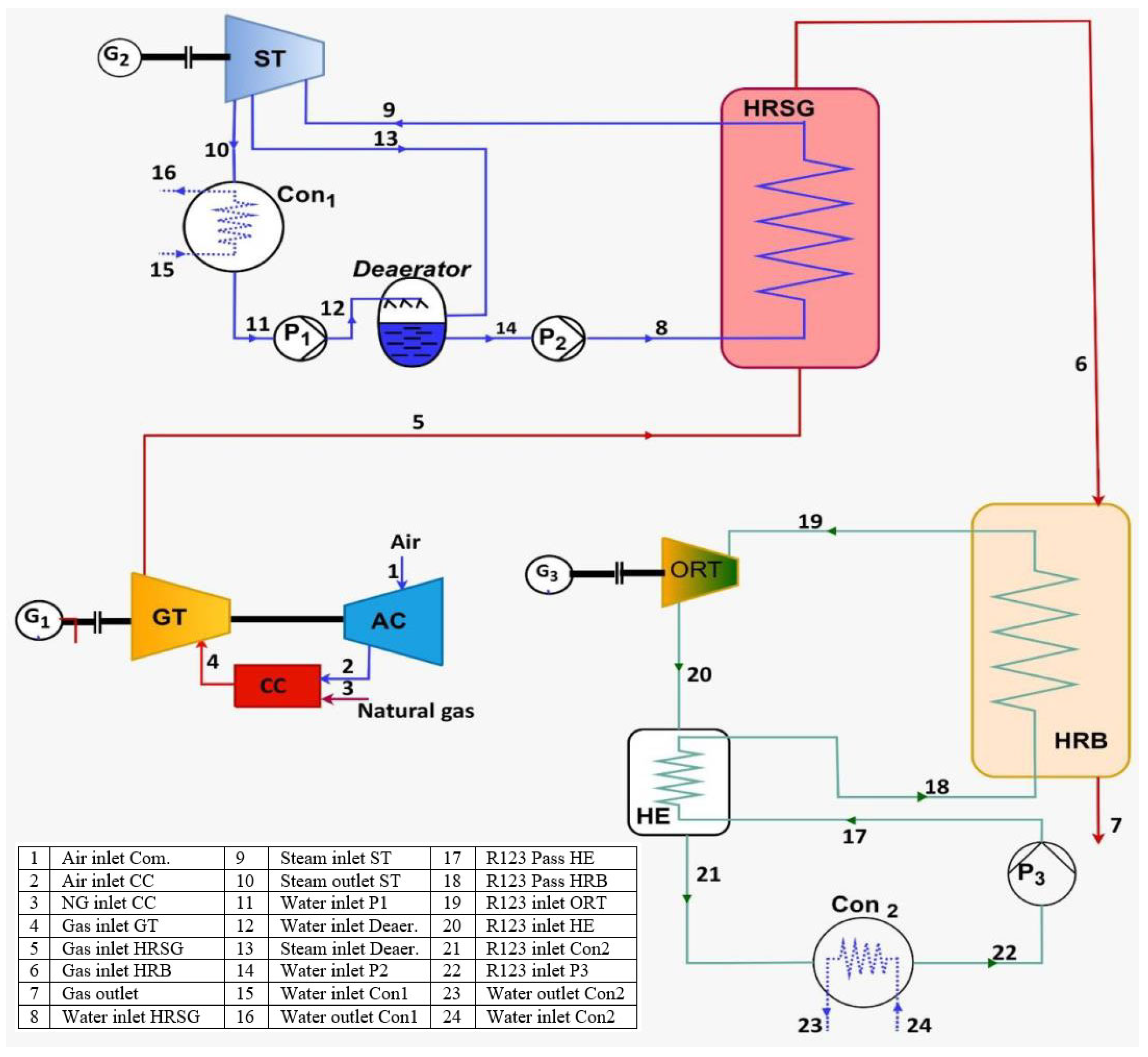
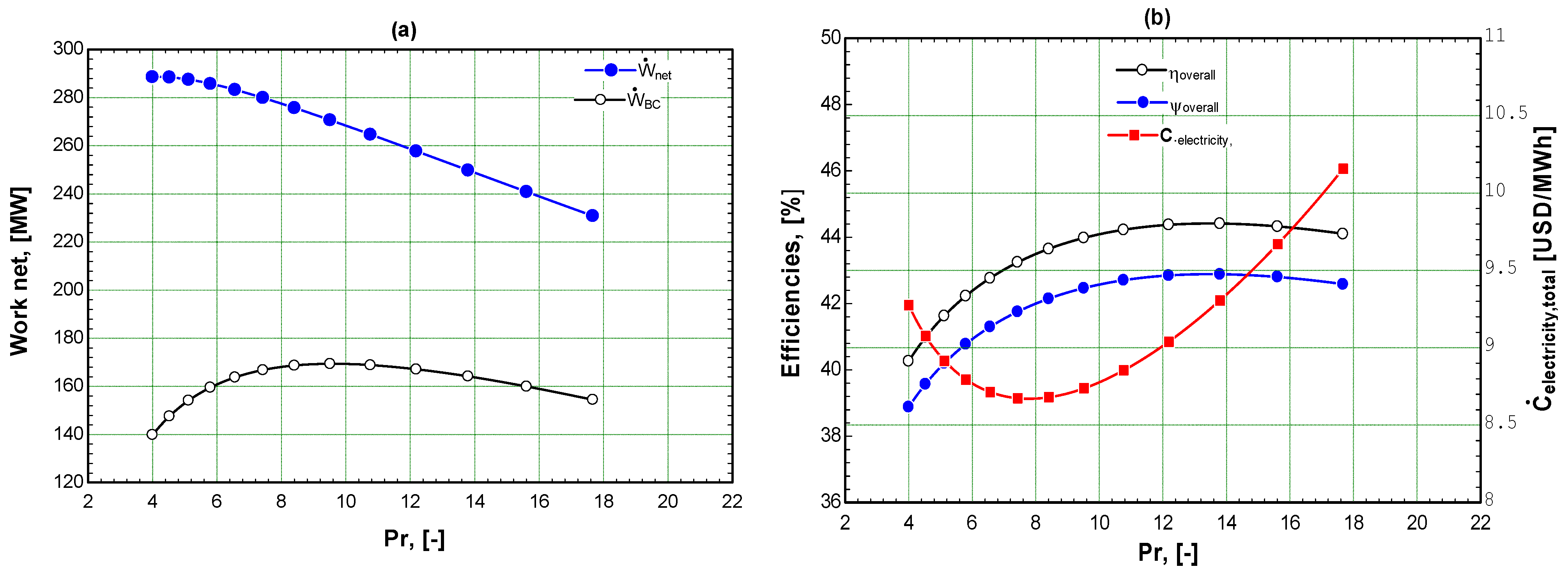
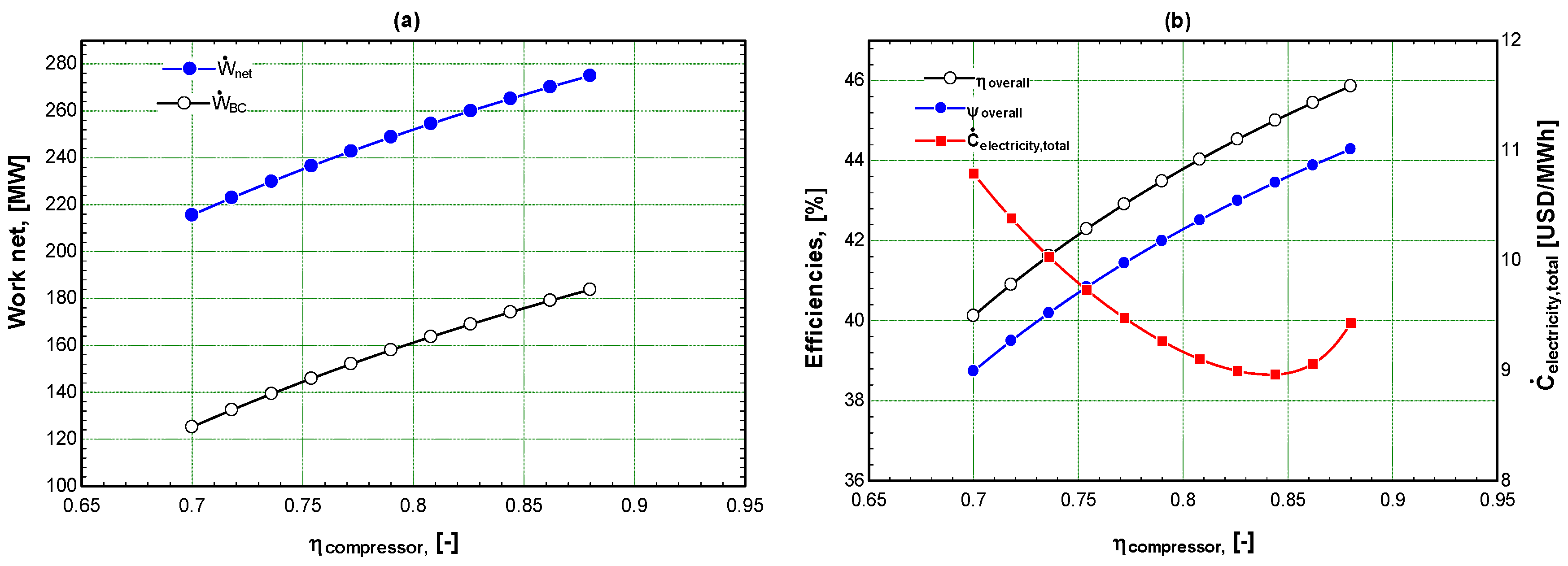
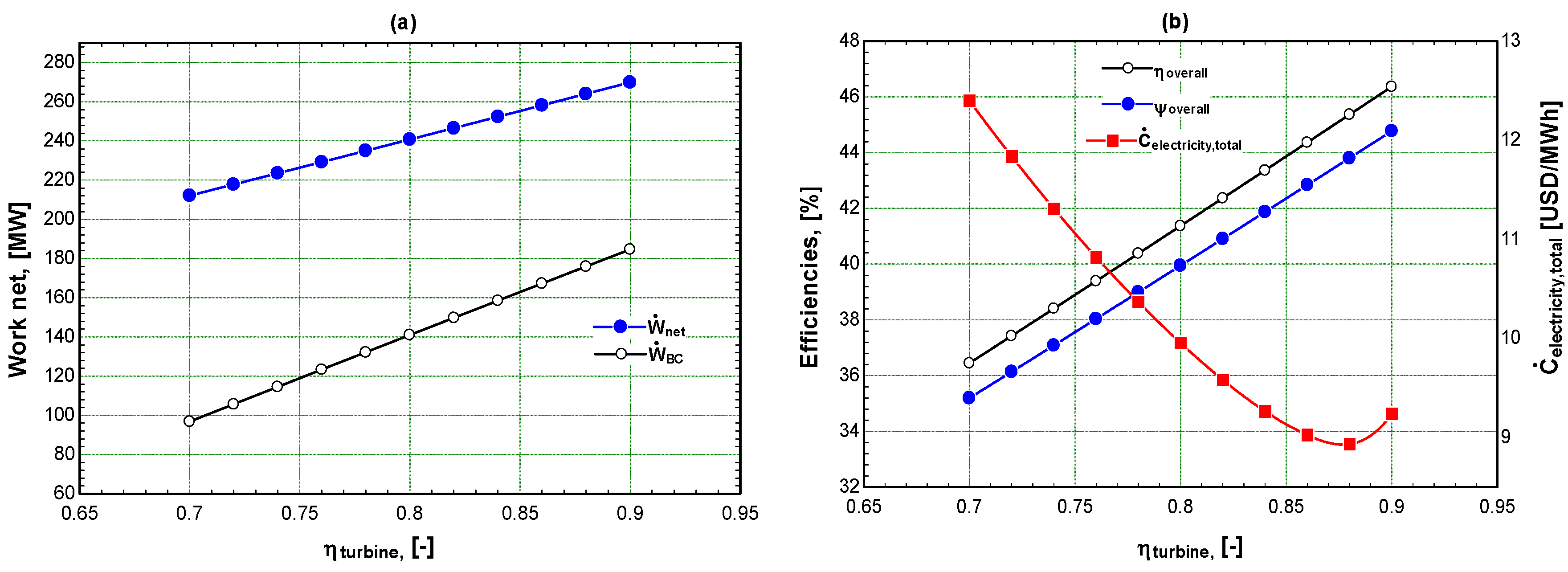

| Authors | Method and Technique | Remarked |
|---|---|---|
| Sahoo [13] | Exergy analysis and economics | New method for regular energy analysis |
| Woudstra et al. [14] | Used modern Combined Cycle Gas Turbines (CCGTs) | Thermal efficiency of at least 60% |
| Roy et al. [15] | The integration of ORC | lower emissions, improved thermal efficiency, and a lower power load |
| Kose et al. [16] & Qui et al. [17] | Used an SRC and ORC integrated with the GT for the variable turbine input pressure and temperature | Improved thermal efficiency |
| Hemadri et al. [18] & Balanesscu et al. [19] | studied the influence of reheat on combined cycle performance and integrated with steam | thermal efficiency of the combined cycle improved by 1.1% |
| Salehi et al. [22] & Cao et al. [23] | Thermodynamic study of a gas turbine and ORC | pressure increased, improved thermal efficiency |
| Parameter | Value | |
|---|---|---|
| GT cycle | Number of units | 4 |
| Compression ratio | 12.1 | |
| Air mass flow rate (kg/s) | 142.6 × 4 | |
| GTIT (°C) | 1177 | |
| Ambient temperature (°C) | 27 | |
| LHV of fuel (Natural Gas (NG)) (kJ/kg) | 50,056 | |
| (%) | 84 | |
| (%) | 88 | |
| (%) | 99.5 | |
| RC cycle | ST inlet pressure (bar) | 100 |
| Condenser Temperature (°C) | 50 | |
| (%) | 90 | |
| (%) | 80 | |
| Effectiveness of HRSG (%) | 70 | |
| ORC cycle | ORT inlet pressure (kPa) | 800 |
| Condenser pressure (bar) | 1.2 | |
| Effectiveness of evaporator (%) | 70 | |
| Working fluid | R123 |
| Subsystem | Energy Balances | Exergy Balances |
|---|---|---|
| Air compressor | ||
| Combustion chamber | ||
| Gas turbine | ||
| HRSG | ||
| Steam Turbine | ||
| Condenser | ||
| Pump1 | ||
| Pump2 | ||
| Deaerator | ||
| HRB | ||
| ORT | ||
| ORC Condenser | ||
| ORC Pump | ||
| Heat exchanger |
| first-law efficiency | |
| Second-law efficiency | |
| Components exergy efficiency | |
| Exergy destructio ratio |
| Average costs per exergy unit of fuel | |
| Average costs per exergy unit of product | |
| Cost rate of exergy destruction | |
| Relative Cost Difference | |
| Exergoeconomic factor | |
| The overall cost | + |
| Total electricity cost |
| Subsystem | Exergy Cost Rate Balance Equation | Exergy Balances |
|---|---|---|
| Air compressor | = 0 | |
| Combustion chamber | = =12 | |
| Gas turbine | = | |
| HRSG | ||
| Steam Turbine | ||
| Condenser | ||
| Pump1 | ||
| Deaerator | ||
| Pump2 | ||
| HRB | ||
| ORT | ||
| ORC Condenser | ||
| ORP | ||
| Heat exchanger |
| Subsystem | Cost Equation |
|---|---|
| Air compressor | [32] |
| Combustion chamber | [32] |
| Gas turbine | [32] |
| HRSG | [32] |
| Steam Turbine | [33] |
| Condenser | [34] |
| Pump1 | [34] |
| Deaerator | [34] |
| Pump2 | [34] |
| HRB | [35] |
| ORT | [30] |
| ORC Condenser | [34] |
| ORP | [34] |
| Heat exchanger | [35] |
| Parameter | Literature Model [21] | Present Model |
|---|---|---|
| Pressure ratio | 15 | 15 |
| Fuel type of gas turbine cycle | Natural gas | Natural gas |
| Air mass flow rate (kg/s) | 21.4 | 21.4 |
| Air mass flow rate (kg/s) | 0.4 | 0.41 |
| Exhaust Flow (kg/s) | 21.8 | 21.9 |
| Power output (kW) | 6200 | 6203 |
| Thermal efficiency | 33.8 | 32.7 |
| State | m (kg/s) | P (kPa) | T (K) | h (kJ/kg) | s (KJ/kg K) | E (MW) | c ($/GJ) | ($/h) |
|---|---|---|---|---|---|---|---|---|
| 1 | 498.4 | 101.3 | 300 | 233.6 | 5.762 | 0 | 0 | 0 |
| 2 | 498.4 | 1226 | 679.2 | 627.8 | 5.886 | 203.7 | 22.53 | 16,522 |
| 3 | 11.2 | 101.3 | 288 | −4672 | 11.53 | 518.2 | 12 | 26,035 |
| 4 | 509.6 | 1165 | 1450 | 235.2 | 8.164 | 508.8 | 18.9 | 42,578 |
| 5 | 509.6 | 107.7 | 919.8 | −425.5 | 8.3 | 200.72 | 18.9 | 14,284 |
| 6 | 509.6 | 104.5 | 500 | −904 | 7.617 | 41.52 | 18.9 | 2873 |
| 7 | 509.6 | 101.3 | 400 | −1012 | 7.386 | 19.4 | 18.9 | 1364 |
| 8 | 67.56 | 10,133 | 445.7 | 735.5 | 2.055 | 11.77 | 43.72 | 1931 |
| 9 | 67.56 | 9829 | 869.8 | 3619 | 6.904 | 140.5 | 25.46 | 13,475 |
| 10 | 54.04 | 12.26 | 323 | 2339 | 7.298 | 36.89 | 25.46 | 3496 |
| 11 | 54.04 | 12.26 | 323 | 208.7 | 0.7019 | 2.889 | 25.46 | 273.3 |
| 12 | 54.04 | 100 | 323 | 208.8 | 0.702 | 2.893 | 25.48 | 273.9 |
| 13 | 13.51 | 100 | 372.8 | 2617 | 7.203 | 13.36 | 25.46 | 1269 |
| 14 | 67.56 | 100 | 372.8 | 690.4 | 2.035 | 9.136 | 46.83 | 1599 |
| 15 | 637.1 | 100 | 300 | 2028 | 7.082 | 0 | 0 | 0 |
| 16 | 637.1 | 100 | 310 | 2781 | 9.551 | 7.854 | 99.85 | 3225 |
| 17 | 177.2 | 800 | 306.4 | 235 | 1.119 | 0.1125 | 64.34 | 26.12 |
| 18 | 177.2 | 800 | 359.6 | 292.9 | 1.292 | 1.222 | 140 | 617.2 |
| 19 | 177.2 | 800 | 480 | 540 | 1.92 | 11.86 | 50.07 | 2141 |
| 20 | 177.2 | 121.6 | 428.4 | 499.3 | 1.931 | 4.088 | 50.07 | 738.4 |
| 21 | 177.2 | 121.6 | 306.1 | 402.8 | 1.669 | 0.8161 | 50.07 | 147.4 |
| 22 | 177.2 | 121.6 | 306.1 | 234.4 | 1.119 | 0.02848 | 50.07 | 5.144 |
| 23 | 39.62 | 100 | 300 | 2028 | 7.082 | 0 | 0 | 0 |
| 24 | 39.62 | 100 | 305 | 2404 | 8.326 | 0.1238 | 329.5 | 147.2 |
| BC Model | ORC Model | |
|---|---|---|
| Net output power | 167.3 | 258.2 |
| Overall exergy efficiency | 27.75 | 42.84 |
| Overall thermal efficiency | 28.74 | 44.37 |
| Exergy | Values (MW) | Percentage (%) | Station | I |
|---|---|---|---|---|
| Input | 602.7 | 100% | GT cycle | 7.2 |
| Output (network) | 258.2 | 42.84% | RC cycle | 9.6 |
| Exergy destruction | 315.3 | 52.31% | ORC cycle | 3.4 |
| Exergy losses | 29.2 | 4.85% | Combined | 7.1 |
| Total | 602.7 | 100% |
| Component | (MW) | (MW) | (MW) | (%) | (Kw/K) | Δs (KJ/Kg.K) | Exergy Effi. (%) |
|---|---|---|---|---|---|---|---|
| AC | 224.8 | 203.7 | 21.17 | 6.9 | 71.04 | 11.654 | 90.6 |
| CC | 784.8 | 608.7 | 176.1 | 57.3 | 590.9 | 9.252 | 77.6 |
| GT | 408 | 384.3 | 23.73 | 7.7 | 79.3 | 0.136 | 94.2 |
| HRSG | 159.2 | 128.8 | 30.39 | 9.88 | 101.98 | 4.166 | 80.9 |
| ST | 90.3 | 82.69 | 7.6 | 2.5 | 2.5 | 7.597 | 91.85 |
| Condenser 1 | 34 | 7.85 | 26.16 | 8.5 | 87.78 | 4.1271 | 23.1 |
| Deaerator | 16.25 | 9.14 | 7.12 | 2.31 | 23.89 | 5.87 | 56.22 |
| Pump 1 | 0.006 | 0.005 | 0.001 | 0.0004 | 0 | 0 | 81.4 |
| Pump 2 | 3.05 | 2.63 | 0.411 | 0.134 | 0 | 0 | 86.5 |
| ORB | 22.14 | 10.63 | 11.5 | 3.74 | 38.59 | 0.04 | 48 |
| ORT | 7.77 | 7.21 | 0.55 | 0.18 | 1.845 | 0.397 | 92.86 |
| HE | 3.27 | 1.11 | 2.16 | 0.7 | 7.25 | 0.089 | 34 |
| Condenser 2 | 0.79 | 0.124 | 0.66 | 0.22 | 2.215 | 1.794 | 15.72 |
| ORP | 0.104 | 0.084 | 0.02 | 0.0066 | 0 | 0 | 80.6 |
| Component | ($/GJ) | ($/GJ) | ($/h) | ($/h) | ($/h) | (%) | (%) |
|---|---|---|---|---|---|---|---|
| AC | 20.41 | 22.27 | 120 | 190.4 | 310.4 | 9.12 | 61.33 |
| CC | 14.66 | 18.9 | 735.8 | 20.1 | 755.9 | 28.94 | 2.65 |
| GT | 18.9 | 20.18 | 124.2 | 187.9 | 312.1 | 6.75 | 60.22 |
| HRSG | 18.9 | 23.8 | 172.9 | 133 | 305.9 | 25.98 | 43.46 |
| ST | 25.46 | 28.65 | 56.56 | 268 | 324.5 | 12.55 | 82.75 |
| Condenser 1 | 25.46 | 99.85 | 185.3 | 1.5 | 186.8 | 292.2 | 0.82 |
| Deaerator | 25.46 | 46.83 | 51.94 | 56.46 | 108.4 | 83.91 | 52.07 |
| Pump 1 | 28.65 | 35.99 | 0.0091 | 0.014 | 0.0236 | 25.95 | 61.18 |
| Pump 2 | 28.65 | 33.12 | 3.439 | 0.074 | 3.513 | 15.58 | 2.1 |
| ORB | 18.9 | 39.73 | 60.53 | 14.5 | 75.02 | 110.2 | 19.31 |
| ORT | 50.07 | 55.28 | 7.728 | 35.65 | 43.38 | 10.42 | 82.19 |
| HE | 50.07 | 147.7 | 30.14 | 0.08 | 30.22 | 195 | 0.254 |
| Condenser 2 | 50.07 | 329.5 | 9.251 | 4.9 | 14.15 | 558 | 34.62 |
| ORP | 55.28 | 69.18 | 0.311 | 0.181 | 0.492 | 25.13 | 36.82 |
| Total system | - | - | 1558.0 | 912.4 | 2470.4 | - | 37 |
Disclaimer/Publisher’s Note: The statements, opinions and data contained in all publications are solely those of the individual author(s) and contributor(s) and not of MDPI and/or the editor(s). MDPI and/or the editor(s) disclaim responsibility for any injury to people or property resulting from any ideas, methods, instructions or products referred to in the content. |
© 2023 by the authors. Licensee MDPI, Basel, Switzerland. This article is an open access article distributed under the terms and conditions of the Creative Commons Attribution (CC BY) license (https://creativecommons.org/licenses/by/4.0/).
Share and Cite
Kareem, A.F.; Akroot, A.; Abdul Wahhab, H.A.; Talal, W.; Ghazal, R.M.; Alfaris, A. Exergo–Economic and Parametric Analysis of Waste Heat Recovery from Taji Gas Turbines Power Plant Using Rankine Cycle and Organic Rankine Cycle. Sustainability 2023, 15, 9376. https://doi.org/10.3390/su15129376
Kareem AF, Akroot A, Abdul Wahhab HA, Talal W, Ghazal RM, Alfaris A. Exergo–Economic and Parametric Analysis of Waste Heat Recovery from Taji Gas Turbines Power Plant Using Rankine Cycle and Organic Rankine Cycle. Sustainability. 2023; 15(12):9376. https://doi.org/10.3390/su15129376
Chicago/Turabian StyleKareem, Alaa Fadhil, Abdulrazzak Akroot, Hasanain A. Abdul Wahhab, Wadah Talal, Rabeea M. Ghazal, and Ali Alfaris. 2023. "Exergo–Economic and Parametric Analysis of Waste Heat Recovery from Taji Gas Turbines Power Plant Using Rankine Cycle and Organic Rankine Cycle" Sustainability 15, no. 12: 9376. https://doi.org/10.3390/su15129376
APA StyleKareem, A. F., Akroot, A., Abdul Wahhab, H. A., Talal, W., Ghazal, R. M., & Alfaris, A. (2023). Exergo–Economic and Parametric Analysis of Waste Heat Recovery from Taji Gas Turbines Power Plant Using Rankine Cycle and Organic Rankine Cycle. Sustainability, 15(12), 9376. https://doi.org/10.3390/su15129376

