


Q-ROF Fuzzy TOPSIS and VIKOR Methods for the Selection of Sustainable Private Health Insurance Policies
.jpg)
 ,
,  , , , and
Abstract
1. Introduction
2. Literature Review
2.1. MCDM Methods in the Insurance Industry
2.2. Q-ROF TOPSIS and Q-ROF VIKOR Methods

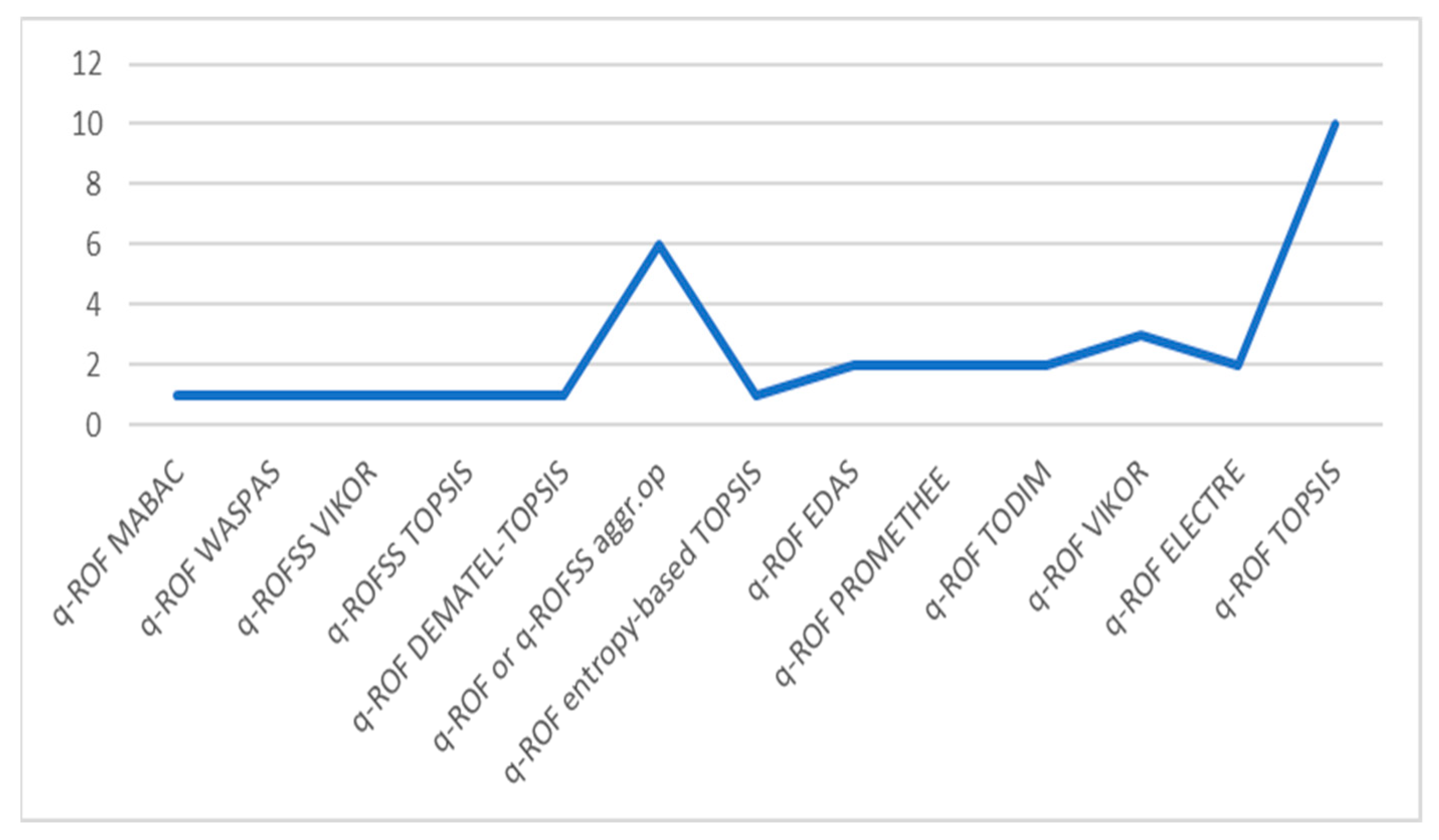
| Author | Sector | Purpose | Q-ROF TOPSIS | Q-ROF ELECTRE | Q-ROF VIKOR | Q-ROF TODIM | Q-ROF PROMETHEE | Q-ROF EDAS | Q-ROF Entropy-Based TOPSIS | Q-ROF or Q-ROFSs | Q-ROF DEMATEL-TOPSIS | Q-ROFSS TOPSIS | Q-ROFSS VIKOR | Q-ROF WASPAS | Q-ROF MABAC |
|---|---|---|---|---|---|---|---|---|---|---|---|---|---|---|---|
| Taghipour et al. [13] | Call Center Organization | The factors that influence supplier selection for speech recognition | √ | ||||||||||||
| Pınar et al. [5] | Turkish Company | Green supplier selection | √ | ||||||||||||
| Doğu [50] | Medical | Ranking the length of stay in the hospital | √ | ||||||||||||
| Pınar and Boran [4] | Construction | Supplier selection | √ | √ | |||||||||||
| Pınar [3] | Third Party Logistics | Provider selection | √ | ||||||||||||
| Tian et.al. [51] | Pork Supplier Companies | Green supplier selection | √ | √ | |||||||||||
| Alkan and Kahraman [52] | COVID-19 Pandemic | Evaluation of government strategies | √ | √ | √ | √ | √ | ||||||||
| Akram and Shumaiza [53] | Construction Project | Contractor selection | √ | √ | √ | √ | √ | ||||||||
| Cheng et al. [54] | Manufacturing | Sustainability enterprise risk management | √ | √ | |||||||||||
| Uslu et.al. [55] | Sustainable Healthcare Policy | Evaluating vaccine hesitancy criteria in the COVID-19 period | √ | ||||||||||||
| Riaz et.al. [9] | Construction Company and Education | Supplier selection and university choice | √ | √ | √ | ||||||||||
| Riaz et al. [10] | Vendor of Baby Cribs | Green supplier selection | √ | ||||||||||||
| Rani and Mishra [8] | Alternative Fuel Technology | Alternative fuel technology selection | √ | √ | |||||||||||
| Li et al. [47] | Household Goods | Refrigerator selection | √ | √ | |||||||||||
| Wang et.al. [56] | Construction | Construction project selection | √ | √ | |||||||||||
| Krishankumar et al. [57] | Construction | Green supplier selection | √ | √ |
3. Methodology
3.1. Q-ROF TOPSIS Method
3.2. Q-ROF VIKOR Method
4. Case Study
4.1. Insurance Company Selection with the Q-ROF TOPSIS Method
4.2. Insurance Company Selection with the Q-ROF VIKOR Method
5. Conclusions and Future Studies
Author Contributions
Funding
Institutional Review Board Statement
Informed Consent Statement
Data Availability Statement
Conflicts of Interest
Abbreviations
| Q-ROF | Q-Rung Orthopair Fuzzy |
| TOPSIS | Technique for Order Preference by Similarity to Ideal Solution |
| VIKOR | VIšeKriterijumska Optimizacija I Kompromisno Resenje |
| Q-ROFS | Q-ROF Sets |
| Q-ROFSs | Q-ROF Soft Set |
| IFS | Intuitionistic Fuzzy Set |
| PFS | Pythagorean Fuzzy Sets |
| SFS | spherical Fuzzy Set |
| MULTIMOORA | Fully Multiplicative Form |
| MEREC | Ratio Analysis-Based Multi-Objective Optimization and Removal Effects of Criteria |
| AHP | Analytical Hierarchy Process |
| CRITIC | Criteria Importance Through Inter-criteria Correlation |
| WEDBA | Weighted Euclidean Distance-Based Approach |
| ANP | analytic network process |
| PROMETHEE | preference ranking organization method for enrichment of evaluations |
| TODIM | Tomada de Decisao Interativa Multicriterio |
| MABAC | Multi-Attributive Border Approximation Area Comparison |
| WASPAS | Weighted Aggregated Sum Product Assessment |
| DEMATEL | The Decision-Making Trial and Evaluation Laboratory |
| EDAS | Evaluation based on Distance from Average Solution |
| ELECTRE | Elimination and Choice Translating Reality English |
| Q-ROFN | Q-ROF Number |
| Q-ROFNs | Q-ROFN sets |
| MCDM | Multiple Criteria Decision Making |
| Q-ROFWA | Q-ROF weighted averaging |
| DM | decision makers |
| PIS | positive ideal solution |
| NIS | negative ideal solution |
References
- Orhaner, E.; Ekinci, N. Ankara’da Yaşayan Kişilerin özel Sağlık Sigortalarına Ilişkin Görüşlerinin Değerlendirilmesi. Sağlık Akad. Derg. 2019, 6, 34–42. Available online: https://dergipark.org.tr/en/pub/sagakaderg/issue/43967/543252 (accessed on 20 May 2022).
- OECD. OECD Health Statistics. 2017. Available online: http://www.oecd.org/health/health-data.html (accessed on 20 May 2022).
- Pınar, A. Üçüncü parti lojistik firma seçiminde q seviyeli bulanık TOPSIS uygulaması. J. Turk. Oper. Manag. (JTOM) 2021, 5, 588–597. [Google Scholar]
- Pınar, A.; Boran, F.E. A Q-rung orthopair fuzzy multi-criteria group decision making method for supplier selection based on a novel distance measure. Int. J. Mach. Learn. Cybern. 2020, 11, 1749–1780. [Google Scholar] [CrossRef]
- Pınar, A.; Rouyendegh, B.D.; Özdemir, Y.S. Q-Rung Orthopair Fuzzy TOPSIS Method for Green Supplier Selection Problem. Sustainability 2021, 13, 985. [Google Scholar] [CrossRef]
- Puelz, R. A process for selecting a life insurance contract. J. Risk Insur. 1991, 58, 138–146. [Google Scholar] [CrossRef]
- Rafiq, M.; Ashraf, S.; Abdullah, S.; Mahmood, T.; Muhammad, S. The cosine similarity measures of spherical fuzzy sets and their applications in decision making. J. Intell. Fuzzy Syst. 2019, 36, 6059–6073. [Google Scholar] [CrossRef]
- Rani, P.; Mishra, A.R. Multi-criteria weighted aggregated sum product assessment framework for fuel technology selection using Q-rung orthopair fuzzy sets. Sustain. Prod. Consum. 2020, 24, 90–104. [Google Scholar] [CrossRef]
- Riaz, M.; Hamid, M.T.; Athar Farid, H.M.; Afzal, D. TOPSIS, VIKOR and aggregation operators based on Q-rung orthopair fuzzy soft sets and their applications. J. Intell. Fuzzy Syst. 2020, 39, 6903–6917. [Google Scholar] [CrossRef]
- Riaz, M.; Pamucar, D.; Athar Farid, H.M.; Hashmi, M.R. Q-Rung orthopair fuzzy prioritized aggregation operators and their application towards green supplier chain management. Symmetry 2020, 12, 976. [Google Scholar] [CrossRef]
- Saeedpoor, M.; Vafadarnikjoo, A.; Mobin, M.; Rastegari, A. A servqual model approach integrated with fuzzy AHP and fuzzy TOPSIS methodologies to rank life insurance firms. In Proceedings of the International Annual Conference of the American Society for Engineering Management, Indianapolis, IN, USA, 7–10 October 2015; American Society for Engineering Management (ASEM): Indianapolis, IN, USA, 2015; p. 1. [Google Scholar]
- Sehhat, S.; Taheri, M.; Sadeh, D.H. Ranking of insurance companies in Iran using AHP and TOPSIS techniques. Am. J. Res. Commun. 2015, 3, 51–60. [Google Scholar]
- Taghipour, A.; Rouyendegh, B.D.; Ünal, A.; Piya, S. Selection of suppliers for speech recognition products in IT projects by combining techniques with an integrated fuzzy MCDM. Sustainability 2022, 14, 1777. [Google Scholar] [CrossRef]
- Tarım, M.; Güdük, Ö. Türkiye’de bireylerin özel sağlık sigortası tercihini etkileyen nedenler ve bilgi düzeyleri. Sağlık Akad. Derg. 2019, 6, 196–200. Available online: https://dergipark.org.tr/tr/pub/sagakaderg/issue/49316/574121 (accessed on 20 May 2022).
- Atanassov, K.T. Intuitionistic fuzzy sets. Fuzzy Sets Syst. 1986, 20, 87–96. [Google Scholar] [CrossRef]
- Zadeh, L.A. Fuzzy sets. Inf. Control 1965, 8, 338–353. [Google Scholar] [CrossRef]
- Yang, Z.; Garg, H.; Li, J.; Srivastava, G.; Cao, Z. Investigation of multiple heterogeneous relationships using a Q-rung orthopair fuzzy multi-criteria decision algorithm. Neural Comput. Appl. 2021, 33, 10771–10786. [Google Scholar] [CrossRef]
- Yager, R.R. Generalized orthopair fuzzy sets. IEEE Trans. Fuzzy Syst. 2016, 25, 1222–1230. [Google Scholar] [CrossRef]
- Yager, R.R. Pythagorean Membership Grades in Multicriteria Decision Making. IEEE Trans. Fuzzy Syst. 2013, 22, 958–965. [Google Scholar] [CrossRef]
- Khan, A.A.; Ashraf, S.; Abdullah, S.; Qiyas, M.; Luo, J.; Khan, S.U. Pythagorean fuzzy Dombi aggregation operators and their application in decision support system. Symmetry 2019, 11, 383. [Google Scholar] [CrossRef]
- Khan, M.J.; Kumam, P.; Shutaywi, M.; Kumam, W. Improved Knowledge Measures for q-Rung Orthopair Fuzzy Sets. Int. J. Comput. Intell. Syst. 2021, 14, 1700–1713. [Google Scholar] [CrossRef]
- Khan, M.; Bharathi, V.; Londhe, B.R. Ranking the critical buying factors of private health insurance using analytic hierarchy process. Indian J. Sci. Technol. 2015, 8, S6. [Google Scholar] [CrossRef]
- Khan, M.J.; Kumam, P.; Liu, P.; Kumam, W.; Ashraf, S. A novel approach to generalized intuitionistic fuzzy soft sets and its application in decision support system. Mathematics 2019, 7, 742. [Google Scholar] [CrossRef]
- Batool, B.; Ahmad, M.; Abdullah, S.; Ashraf, S.; Chinram, R. Entropy based Pythagorean probabilistic hesitant fuzzy decision making technique and its application for fog-haze factor assessment problem. Entropy 2020, 22, 318. [Google Scholar] [CrossRef] [PubMed]
- Ashraf, S.; Abdullah, S.; Chinram, R. Emergency decision support modeling under generalized spherical fuzzy Einstein aggregation information. J. Ambient. Intell. Humaniz. Comput. 2022, 13, 2091–2117. [Google Scholar] [CrossRef] [PubMed]
- Ashraf, S.; Abdullah, S.; Mahmood, T. Spherical fuzzy Dombi aggregation operators and their application in group decision making problems. J. Ambient. Intell. Humaniz. Comput. 2020, 11, 2731–2749. [Google Scholar] [CrossRef]
- Jin, Y.; Ashraf, S.; Abdullah, S. Spherical fuzzy logarithmic aggregation operators based on entropy and their application in decision support systems. Entropy 2019, 21, 628. [Google Scholar] [CrossRef]
- Ashraf, S.; Abdullah, S. Spherical aggregation operators and their application in multi attribute group decision-making. Int. J. Intell. Syst. 2019, 34, 493–523. [Google Scholar] [CrossRef]
- Ashraf, S.; Abdullah, S.; Khan, S. Fuzzy decision support modeling for internet fnance soft power evaluation based on sine trigonometric Pythagorean fuzzy information. J. Ambient. Intell. Hum. Comput. 2021, 12, 3101–3119. [Google Scholar] [CrossRef]
- Ashraf, S.; Abdullah, S.; Mahmood, T.; Ghani, F.; Mahmood, T. Spherical fuzzy sets and their applications in multi-attribute decision making problems. J. Intell. Fuzzy Syst. 2019, 36, 2829–2844. [Google Scholar] [CrossRef]
- Narayanamoorthy, S.; Manirathinam, T.; Geetha, S.; Salahshour, S.; Ahmadian, A.; Kang, D. An approach to assess PWR methods to cope with physical barriers on plastic waste disposal and exploration from developing nations. Expert Syst. Appl. 2022, 207, 117996. [Google Scholar] [CrossRef]
- Narayanamoorthy, S.; Parthasarathy, T.N.; Pragathi, S.; Shanmugam, P.; Baleanu, D.; Ahmadian, A.; Kang, D. The novel augmented Fermatean MCDM perspectives for identifying the optimal renewable energy power plant location. Sustain. Energy Technol. Assess. 2022, 53, 102488. [Google Scholar] [CrossRef]
- Işık, Ö. AHP, CRITIC VE WEDBA Yöntemlerini İçeren Entegre Bir ÇKKV Modeli İle AXA Sigorta Şirketinin Finansal Performansının Analizi. Uluslararası İşletme Ekon. Ve Yönetim Perspekt. Derg. (IJBEMP) 2021, 5, 892–908. [Google Scholar]
- Yücenur, G.N. Sigorta Sektöründe Kasko Poliçe Seçimi için Bulanık Mantık Temelinde Üç Farklı Çözüm: AHP–ANP–VIKOR Yöntemleri ve Türkiye’den bir Uygulama. Süleyman Demirel Üniversitesi Fen Bilim. Enstitüsü Derg. 2018, 22, 779–793. [Google Scholar] [CrossRef]
- Tayyar, N.; Dinçer, Ö. Çok Kriterli Karar Verme Yöntemleri ile Kasko Sigorta Poliçesi Seçimi. In Proceedings of the 3rd International Conference on Economic and Social Impacts of Globalization, Antalya, Turkey, 5–7 October 2017; p. 175. [Google Scholar]
- Mandic, D. Multi-criteria AHP analysis in risk assessment for motor vehicle insurance. Metal. Int. 2013, 18, 128. [Google Scholar]
- Alenjagh, R.S. Performance evaluation and ranking of insurance companies in Tehran Stock Exchange by financial ratios using ANP and PROMETHEE. Eur. Online J. Nat. Soc. Sci. Proc. 2015, 2, 3478. [Google Scholar]
- Mishra, A.R.; Rani, P.; Mardani, A.; Kumari, R.; Zavadskas, E.K.; Kumar Sharma, D. An extended Shapley TODIM approach using novel exponential fuzzy divergence measures for multi-criteria service quality in vehicle insurance firms. Symmetry 2020, 12, 1452. [Google Scholar] [CrossRef]
- Wollmann, D.; Steiner, M.T.A.; Vieira, G.E.; Steiner, P.A. Details of the analytic hierarchy process technique for the evaluation of health insurance companies. Production 2014, 24, 583–593. [Google Scholar] [CrossRef]
- Azizi, F.; Kenari, M.; Nasiri, M. An AHP method for identifying influential factors on insurance cost. Manag. Sci. Lett. 2013, 3, 2479–2482. [Google Scholar] [CrossRef]
- Kahraman, C.; Suder, A.; Bekar, E.T. Fuzzy multiattribute consumer choice among health insurance options. Technol. Econ. Dev. Econ. 2016, 22, 1–20. [Google Scholar] [CrossRef]
- Yücenur, G.N.; Demirel, N.Ç. Group decision making process for insurance company selection problem with extended VIKOR method under fuzzy environment. Expert Syst. Appl. 2012, 39, 3702–3707. [Google Scholar] [CrossRef]
- Mikhailov, L.; Almulhim, T.S. Fuzzy ANP approach for selection of group health insurance plans. In Proceedings of the 6th European Conference of the International Federation for Medical and Biological Engineering, Dubrovnik, Croatia, 7–11 September 2014; Springer: Cham, Switzerland, 2015; pp. 996–999. [Google Scholar]
- Ecer, F.; Pamucar, D. MARCOS technique under intuitionistic fuzzy environment for determining the COVID-19 pandemic performance of insurance companies in terms of healthcare services. Appl. Soft Comput. 2021, 104, 107199. [Google Scholar] [CrossRef]
- Garg, H. (Ed.) q-Rung Orthopair Fuzzy Sets: Theory and Applications; Springer Nature: Berlin/Heidelberg, Germany, 2022. [Google Scholar]
- Luqman, A.; Akram, M.; Al-Kenani, A.N. q-Rung orthopair fuzzy hypergraphs with applications. Mathematics 2019, 7, 260. [Google Scholar] [CrossRef]
- Li, P.; Xu, Z.; Zhang, Z.; Li, Z.; Wei, C. Consensus reaching in multi-criteria social network group decision making: A stochastic multicriteria acceptability analysis-based method. Inf. Fusion 2023, 97, 101825. [Google Scholar] [CrossRef]
- Li, Z.; Zhang, Z. Threshold-Based Value-Driven Method to Support Consensus Reaching in Multicriteria Group Sorting Problems: A Minimum Adjustment Perspective. IEEE Trans. Comput. Soc. Syst. 2023, 1–14. [Google Scholar] [CrossRef]
- Li, Z.; Wei, G.; Wang, R.; Wu, J.; Wei, C.; Wei, Y. EDAS method for multiple attribute group decision making under Q-rung orthopair fuzzy environment. Technol. Econ. Dev. Econ. 2020, 26, 86–102. [Google Scholar] [CrossRef]
- Doğu, E. A Decision-Making Approach with Q-Rung Orthopair Fuzzy Sets: Orthopair Fuzzy TOPSIS Method. Acad. Platf.-J. Eng. Sci. 2021, 9, 214–222. [Google Scholar] [CrossRef]
- Tian, X.; Niu, M.; Zhang, W.; Li, L.; Herrera Viedma, E. A novel TODIM based on prospect theory to select green supplier with Q-rung orthopair fuzzy set. Technol. Econ. Dev. Econ. 2020, 27, 284–3210. [Google Scholar] [CrossRef]
- Alkan, N.; Kahraman, C. Evaluation of government strategies against COVID-19 pandemic using Q-rung orthopair fuzzy TOPSIS method. Appl. Soft Comput. 2021, 110, 107653. [Google Scholar] [CrossRef]
- Akram, M.; Shumaiza, S. Multi-criteria decision making based on Q-rung orthopair fuzzy promethee approach. Iran. J. Fuzzy Syst. 2021, 18, 107–127. [Google Scholar]
- Cheng, S.; Jianfu, S.; Alrasheedi, M.; Saeidi, P.; Mishra, A.R.; Rani, P. A new extended VIKOR approach using Q-rung orthopair fuzzy sets for sustainable enterprise risk management assessment in manufacturing small and medium-sized enterprises. Int. J. Fuzzy Syst. 2021, 23, 1347–1369. [Google Scholar] [CrossRef]
- Uslu, D.Y.; Dinçer, H.; Yüksel, S.; Gedikli, E.; Yılmaz, E. An integrated decision-making approach based on Q-Rung orthopair fuzzy sets in service industry. Int. J. Comput. Intell. Syst. 2022, 15, 14. [Google Scholar] [CrossRef]
- Wang, R.; Li, Y. A Novel Approach for Green Supplier Selection under a Q-Rung Orthopair Fuzzy Environment. Symmetry 2018, 10, 687. [Google Scholar] [CrossRef]
- Krishankumar, R.; Gowtham, Y.; Ahmed, I.; Ravichandran, K.S.; Kar, S. Solving green supplier selection problem using Q-rung orthopair fuzzy-based decision framework with unknown weight information. Appl. Soft Comput. 2020, 94, 106431. [Google Scholar] [CrossRef]
- Liu, P.D.; Wang, P. Some Q-Rung Orthopair Fuzzy Aggregation Operators and their Applications to Multiple-Attribute Decision Making. Int. J. Intell. Syst. 2018, 33, 259–280. [Google Scholar] [CrossRef]
- Du, W.S. Minkowski-type distance measures for generalized orthopair fuzzy sets. Int. J. Intell. 2018, 33, 802–817. [Google Scholar] [CrossRef]
| Author | Criteria Used | Purpose |
|---|---|---|
| Işık [17] | Premiums received, technical profit, financial assets, cash and cash equivalents, net profit/loss, paid capital, total assets, total liabilities, losses paid | Financial performance |
| Ecer and Pamucar [33] | Effectiveness, responsibility, network, age, payback period, premium Pprice | Determining the COVID-19 pandemic performance of insurance companies in terms of healthcare services |
| Mishra et al. [38] | Confidence, responsiveness, reliability, tangibles | Service quality in insurance companies |
| Yücenur [34] | Price, coverage content, after-sales service, distribution channel, organizational structure | Motor insurance policy |
| Tayyar and Dinçer [35] | Company factor, guarantees, policy price | Motor insurance policy |
| Kahraman et al. [41] | Eligibility, portability, catch-up contribution, ownership, funding, health plan arrangement, tax treatment, usability for non-medical expenses | Selection of the best health insurance option |
| Sehhat et al. [12] | Development, after-sales service, productivity, sales network, customer satisfaction, information technology, composition and growth | Ranking of insurance companies |
| Alenjagh [37] | Liquidity, leveraged, profitability, exchange, market | Financial performance |
| Saeedpoor et al. [11] | Tangibility, reliability, assurance, responsiveness, empathy | Service quality of insurance companies |
| Khan et al. [22] | Insurance awareness, brand, trust in insurance provider, purpose of buying HI, policy features and benefits, premium amount, payment options, customer service, claim settlement history | Ranking of private health’s critical purchase factors |
| Mikhailov and Almulhim [43] | The insurance company’s reputation, reliability of the insurance company, clarity of insurance policy terms, quality of the insurance company, efficiency of the health service providers network, health benefits, types of medical treatment, emergency expenses, availability of additional health benefits, financial benefits, period of insurance, geographical scope of coverage worldwide, flexibility of the insurance contract, accessibility of deductible insurance plan, premiums prices, availability of the health service providers, accessibility of the health service providers, specialized team availability, communication channels availability | Health insurance plan selection |
| Wolmann et al. [39] | Location, effectiveness, responsiveness, speed, price, coverage | Ranking of health insurance companies |
| Mandic [36] | Vehicle price, number of penalty points, vehicle age, number of hours per day, week, and month spent driving, driver’s age, vehicle purpose, price of vehicle spare parts, vehicle price implies the risk, geographic setting, size of place of residence, value of working hours in the service, infrastructure, state of traffic culture | Risk assessment model in motor vehicle insurance |
| Azizi et al. [40] | Human productivity, competition inflation rate, information technology, damage, coverage | To list the factors affecting cost management in the field of insurance activity |
| Yücenur and Demirel [42] | Price, profitability, portfolio structure, portfolio size, sales channel structure, brand equity, organizational quality, solvency ratio | Selection of an insurance company for a foreign investor |
| Puelz [6] | Net payment index, contractual flexibility, financial strength, cash value accumulation | Life insurance contract choice |
| Linguistic Terms | Abbreviations | Q-ROFN |
|---|---|---|
| Extremely High | EH | (0.95, 0.15) |
| Very High | VH | (0.85, 0.25) |
| High | H | (0.75, 0.35) |
| Medium High | MH | (0.65, 0.45) |
| Medium | M | (0.55, 0.55) |
| Medium Low | ML | (0.45, 0.65) |
| Low | L | (0.35, 0.75) |
| Very Low | VL | (0.25, 0.85) |
| Extremely Low | EL | (0.15, 0.95) |
| No | Criteria | Research | Description |
|---|---|---|---|
| C1 | Premium Eligibility | Sehhat et al. [12] Yücenur and Demirel [42] | The level of compliance between policy coverage and the premium to be paid. |
| C2 | Company Brand Strength and Value | Azizi et al. [40] Saeedpoor et al. [11] Puelz [6] | The degree of trust the company has created in customers. |
| C3 | Contracted Hospital Chain | Azizi et al. [40] Sehhat et al. [12] Puelz [6] | The hospital chains where the services covered by the policy can be obtained differ depending on service quality. |
| C4 | Number of Inspections | Azizi et al. [40] Saeedpoor et al. [11] | The number of examinations that are conducted annually in outpatient treatment. |
| C5 | Efficiency in Emergencies | Sehhat et al. [12] Yücenur and Demirel [42] Puelz [6] | The success of fast transportation to the patient in any emergency and transfer to the nearest health institution. |
| C6 | Age Limit Acceptance | Azizi et al. [40] Mikhailov and Almulhim [43] Yücenur and Demirel [42] | Insurance companies have determined an age limit because they consider insuring those above a certain age risky within the scope of the regulation of private health policies. |
| C7 | Renewal Guarantee | Sehhat et al. [12] Saeedpoor et al. [11] Mikhailov and Almulhim [43] | When the health policy starts being used, expenses that spread over the years may occur in the continuation of treatment. Companies that want to avoid the high costs this may entail may refrain from renewing the policy. The renewal guarantee processes vary according to the number of policy renewals and the usage status of the insured. |
| C8 | Renewal Premium Eligibility | Azizi et al. [40] Saeedpoor et al. [11] Yücenur and Demirel [42] | Some companies apply additional fees for renewal policies in the following years due to the frequency of use of the policy by the insured or high expense items. |
| C9 | Private Physician Coverage | Azizi et al. [40] Mikhailov and Almulhim [43] Puelz [6] | Determination of whether it covers private doctor examination fees other than contracted health institutions. |
| C10 | Validity Abroad | Sehhat et al. [12] Yücenur and Demirel [42] Puelz [6] | The geographical scope of the insurance is whether it is valid in countries other than the Republic of Turkey. |
| Insurance Company | DM1 | DM2 | DM3 | Criteria | Insurance Company | DM1 | DM2 | DM3 | |
|---|---|---|---|---|---|---|---|---|---|
| C1 | A1 | VH | M | VL | C6 | A1 | MH | ML | M |
| A2 | MH | EH | VH | A2 | M | L | ML | ||
| A3 | H | H | H | A3 | VH | M | H | ||
| A4 | VH | VH | MH | A4 | EH | MH | EH | ||
| A5 | EH | M | MH | A5 | H | H | VH | ||
| C2 | A1 | VH | MH | MH | C7 | A1 | M | MH | MH |
| A2 | M | M | MH | A2 | M | M | M | ||
| A3 | H | H | M | A3 | M | MH | MH | ||
| A4 | H | VH | MH | A4 | EH | VH | H | ||
| A5 | EH | EH | H | A5 | EH | EH | H | ||
| C3 | A1 | H | VH | H | C8 | A1 | L | H | L |
| A2 | H | H | EH | A2 | L | VH | ML | ||
| A3 | MH | H | H | A3 | MH | MH | M | ||
| A4 | H | M | H | A4 | ML | M | ML | ||
| A5 | EH | EH | VH | A5 | EH | EH | VH | ||
| C4 | A1 | H | M | MH | C9 | A1 | VH | H | H |
| A2 | M | ML | M | A2 | M | MH | L | ||
| A3 | H | MH | H | A3 | MH | H | MH | ||
| A4 | H | H | VH | A4 | MH | ML | EH | ||
| A5 | H | VH | H | A5 | EH | VH | VH | ||
| C5 | A1 | MH | M | M | C10 | A1 | M | MH | H |
| A2 | M | M | L | A2 | VH | MH | H | ||
| A3 | M | M | MH | A3 | H | H | MH | ||
| A4 | ML | L | M | A4 | H | H | M | ||
| A5 | EH | VH | VH | A5 | EH | VH | EH |
| R | C1 | C2 | C3 | C4 | |||||||||
| A1 | 0.731 | 0.427 | 0.810 | 0.770 | 0.344 | 0.795 | 0.786 | 0.317 | 0.784 | 0.683 | 0.425 | 0.845 | |
| A2 | 0.850 | 0.282 | 0.713 | 0.579 | 0.523 | 0.872 | 0.839 | 0.284 | 0.728 | 0.525 | 0.578 | 0.872 | |
| A3 | 0.750 | 0.350 | 0.812 | 0.716 | 0.391 | 0.831 | 0.710 | 0.393 | 0.834 | 0.726 | 0.377 | 0.826 | |
| A4 | 0.819 | 0.289 | 0.753 | 0.770 | 0.337 | 0.796 | 0.709 | 0.400 | 0.834 | 0.781 | 0.322 | 0.788 | |
| A5 | 0.863 | 0.288 | 0.694 | 0.928 | 0.185 | 0.580 | 0.935 | 0.170 | 0.562 | 0.786 | 0.317 | 0.784 | |
| C4 | C6 | C7 | C8 | ||||||||||
| A1 | 0.602 | 0.502 | 0.869 | 0.583 | 0.527 | 0.869 | 0.610 | 0.493 | 0.868 | 0.559 | 0.600 | 0.848 | |
| A2 | 0.516 | 0.594 | 0.868 | 0.484 | 0.628 | 0.862 | 0.550 | 0.550 | 0.874 | 0.651 | 0.525 | 0.834 | |
| A3 | 0.579 | 0.523 | 0.872 | 0.775 | 0.342 | 0.791 | 0.610 | 0.493 | 0.868 | 0.629 | 0.473 | 0.864 | |
| A4 | 0.459 | 0.650 | 0.856 | 0.917 | 0.207 | 0.604 | 0.900 | 0.215 | 0.638 | 0.485 | 0.619 | 0.866 | |
| A5 | 0.911 | 0.198 | 0.618 | 0.781 | 0.322 | 0.788 | 0.928 | 0.185 | 0.580 | 0.935 | 0.170 | 0.562 | |
| C9 | C10 | ||||||||||||
| A1 | 0.804 | 0.300 | 0.768 | 0.646 | 0.464 | 0.858 | |||||||
| A2 | 0.556 | 0.560 | 0.867 | 0.787 | 0.323 | 0.783 | |||||||
| A3 | 0.685 | 0.418 | 0.846 | 0.730 | 0.372 | 0.824 | |||||||
| A4 | 0.784 | 0.382 | 0.773 | 0.716 | 0.391 | 0.831 | |||||||
| A5 | 0.911 | 0.198 | 0.618 | 0.932 | 0.174 | 0.570 | |||||||
| Weight of the DMs | DM1 | DM2 | DM3 | Criterion Weight | |||
| 0.4592 | 0.4592 | 0.2931 | 0.2931 | 0.2477 | 0.2477 | ||
| C1 | 0.45 | 0.65 | 0.85 | 0.25 | 0.95 | 0.15 | 0.095 |
| C2 | 0.95 | 0.15 | 0.85 | 0.25 | 0.85 | 0.25 | 0.126 |
| C3 | 0.85 | 0.25 | 0.75 | 0.35 | 0.85 | 0.25 | 0.112 |
| C4 | 0.65 | 0.45 | 0.95 | 0.15 | 0.75 | 0.35 | 0.105 |
| C5 | 0.95 | 0.15 | 0.35 | 0.75 | 0.55 | 0.55 | 0.094 |
| C6 | 0.95 | 0.15 | 0.65 | 0.45 | 0.25 | 0.85 | 0.095 |
| C7 | 0.95 | 0.15 | 0.75 | 0.35 | 0.65 | 0.45 | 0.113 |
| C8 | 0.95 | 0.15 | 0.85 | 0.25 | 0.95 | 0.15 | 0.130 |
| C9 | 0.65 | 0.45 | 0.35 | 0.75 | 0.45 | 0.65 | 0.068 |
| C10 | 0.75 | 0.35 | 0.15 | 0.95 | 0.35 | 0.75 | 0.061 |
| R’ = | C1 | C2 | C3 | C4 | |||||||||
| A1 | 0.359 | 0.922 | 0.554 | 0.420 | 0.874 | 0.636 | 0.416 | 0.879 | 0.629 | 0.340 | 0.914 | 0.581 | |
| A2 | 0.443 | 0.886 | 0.601 | 0.299 | 0.922 | 0.575 | 0.457 | 0.868 | 0.630 | 0.253 | 0.944 | 0.522 | |
| A3 | 0.371 | 0.905 | 0.593 | 0.382 | 0.889 | 0.623 | 0.365 | 0.900 | 0.605 | 0.366 | 0.903 | 0.599 | |
| A4 | 0.418 | 0.888 | 0.609 | 0.420 | 0.872 | 0.640 | 0.364 | 0.902 | 0.602 | 0.403 | 0.888 | 0.616 | |
| A5 | 0.454 | 0.888 | 0.591 | 0.567 | 0.809 | 0.661 | 0.558 | 0.819 | 0.651 | 0.407 | 0.887 | 0.617 | |
| C4 | C6 | C7 | C8 | ||||||||||
| A1 | 0.284 | 0.937 | 0.536 | 0.275 | 0.941 | 0.527 | 0.306 | 0.923 | 0.570 | 0.291 | 0.936 | 0.539 | |
| A2 | 0.240 | 0.952 | 0.497 | 0.225 | 0.957 | 0.483 | 0.273 | 0.934 | 0.547 | 0.345 | 0.919 | 0.566 | |
| A3 | 0.272 | 0.941 | 0.527 | 0.387 | 0.903 | 0.590 | 0.306 | 0.923 | 0.570 | 0.332 | 0.907 | 0.601 | |
| A4 | 0.212 | 0.960 | 0.471 | 0.507 | 0.861 | 0.614 | 0.517 | 0.840 | 0.646 | 0.250 | 0.939 | 0.538 | |
| A5 | 0.499 | 0.859 | 0.624 | 0.391 | 0.898 | 0.600 | 0.550 | 0.826 | 0.647 | 0.584 | 0.794 | 0.670 | |
| C9 | C10 | ||||||||||||
| A1 | 0.365 | 0.921 | 0.553 | 0.266 | 0.954 | 0.482 | |||||||
| A2 | 0.234 | 0.961 | 0.462 | 0.341 | 0.934 | 0.527 | |||||||
| A3 | 0.296 | 0.942 | 0.515 | 0.309 | 0.942 | 0.514 | |||||||
| A4 | 0.352 | 0.937 | 0.512 | 0.302 | 0.945 | 0.506 | |||||||
| A5 | 0.450 | 0.896 | 0.575 | 0.458 | 0.899 | 0.562 | |||||||
| A∗ = | C1 | 0.454 | 0.886 | 0.609 | A− = | C1 | 0.359 | 0.922 | 0.554 |
| C2 | 0.567 | 0.809 | 0.661 | C2 | 0.299 | 0.922 | 0.575 | ||
| C3 | 0.558 | 0.819 | 0.651 | C3 | 0.364 | 0.902 | 0.602 | ||
| C4 | 0.407 | 0.887 | 0.617 | C4 | 0.253 | 0.944 | 0.522 | ||
| C5 | 0.499 | 0.859 | 0.624 | C5 | 0.212 | 0.960 | 0.471 | ||
| C6 | 0.507 | 0.861 | 0.614 | C6 | 0.225 | 0.957 | 0.483 | ||
| C7 | 0.550 | 0.826 | 0.647 | C7 | 0.273 | 0.934 | 0.547 | ||
| C8 | 0.584 | 0.794 | 0.670 | C8 | 0.250 | 0.939 | 0.538 | ||
| C9 | 0.450 | 0.896 | 0.575 | C9 | 0.234 | 0.961 | 0.462 | ||
| C10 | 0.458 | 0.899 | 0.562 | C10 | 0.266 | 0.954 | 0.482 |
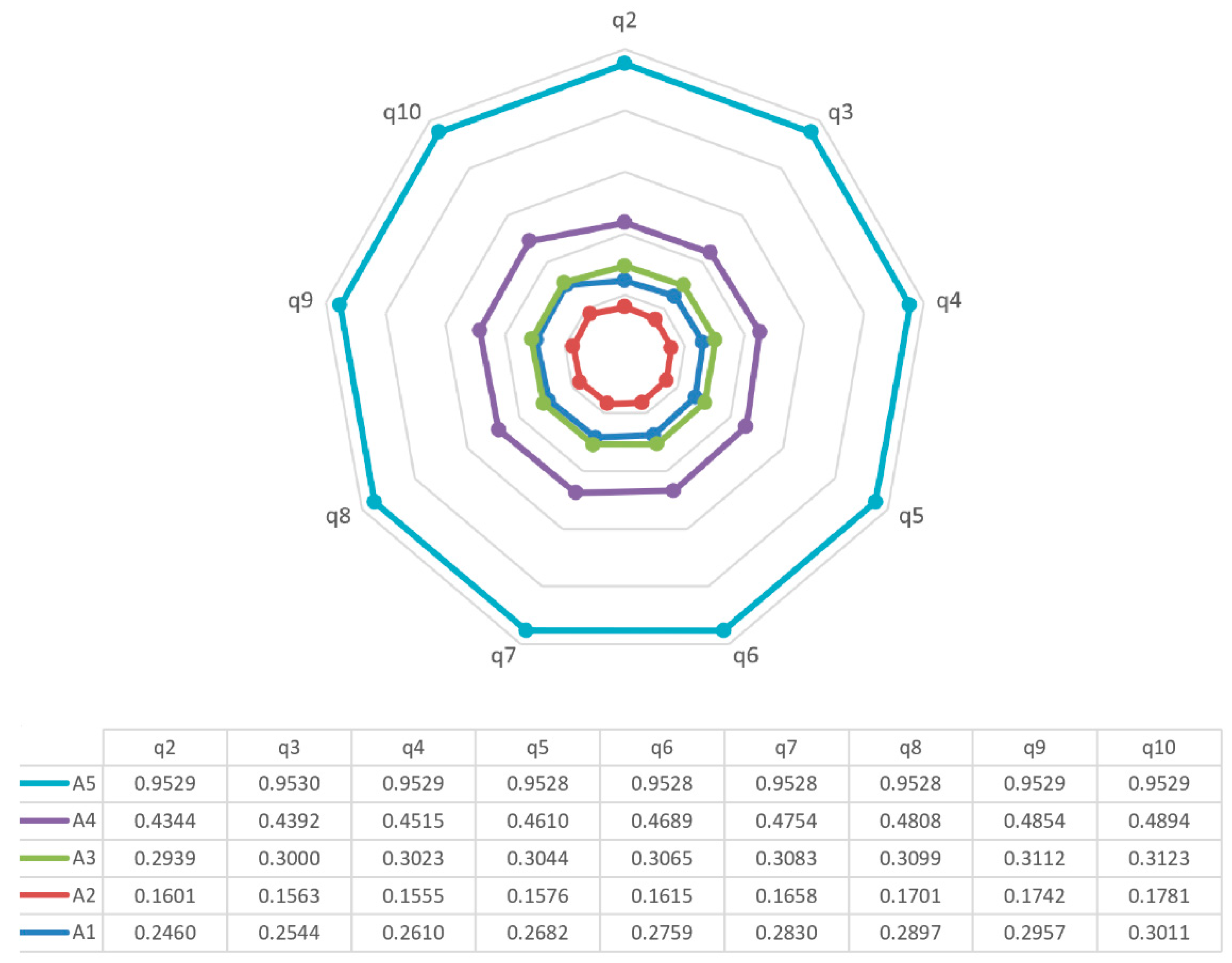
| S* | S− | Ci* | Rank | |
|---|---|---|---|---|
| A1 | 0.099 | 0.034 | 0.254 | 4 |
| A2 | 0.112 | 0.021 | 0.156 | 5 |
| A3 | 0.093 | 0.040 | 0.300 | 3 |
| A4 | 0.075 | 0.059 | 0.439 | 2 |
| A5 | 0.006 | 0.127 | 0.953 | 1 |
| Criteria | Best Values | Worst Values | ||||
|---|---|---|---|---|---|---|
| C1 | 0.862 | 0.288 | 0.693 | 0.730 | 0.426 | 0.810 |
| C2 | 0.927 | 0.185 | 0.580 | 0.579 | 0.523 | 0.871 |
| C3 | 0.935 | 0.170 | 0.562 | 0.709 | 0.399 | 0.833 |
| C4 | 0.786 | 0.317 | 0.783 | 0.525 | 0.577 | 0.871 |
| C5 | 0.910 | 0.197 | 0.618 | 0.459 | 0.650 | 0.851 |
| C6 | 0.916 | 0.209 | 0.604 | 0.483 | 0.627 | 0.868 |
| C7 | 0.927 | 0.185 | 0.580 | 0.550 | 0.550 | 0.873 |
| C8 | 0.935 | 0.170 | 0.562 | 0.484 | 0.618 | 0.861 |
| C9 | 0.910 | 0.197 | 0.618 | 0.555 | 0.559 | 0.867 |
| C10 | 0.931 | 0.174 | 0.570 | 0.645 | 0.463 | 0.857 |
| Si− | Si+ | Ri− | Ri+ |
|---|---|---|---|
| 0.804 | 0.046 | 0.130 | 0.046 |
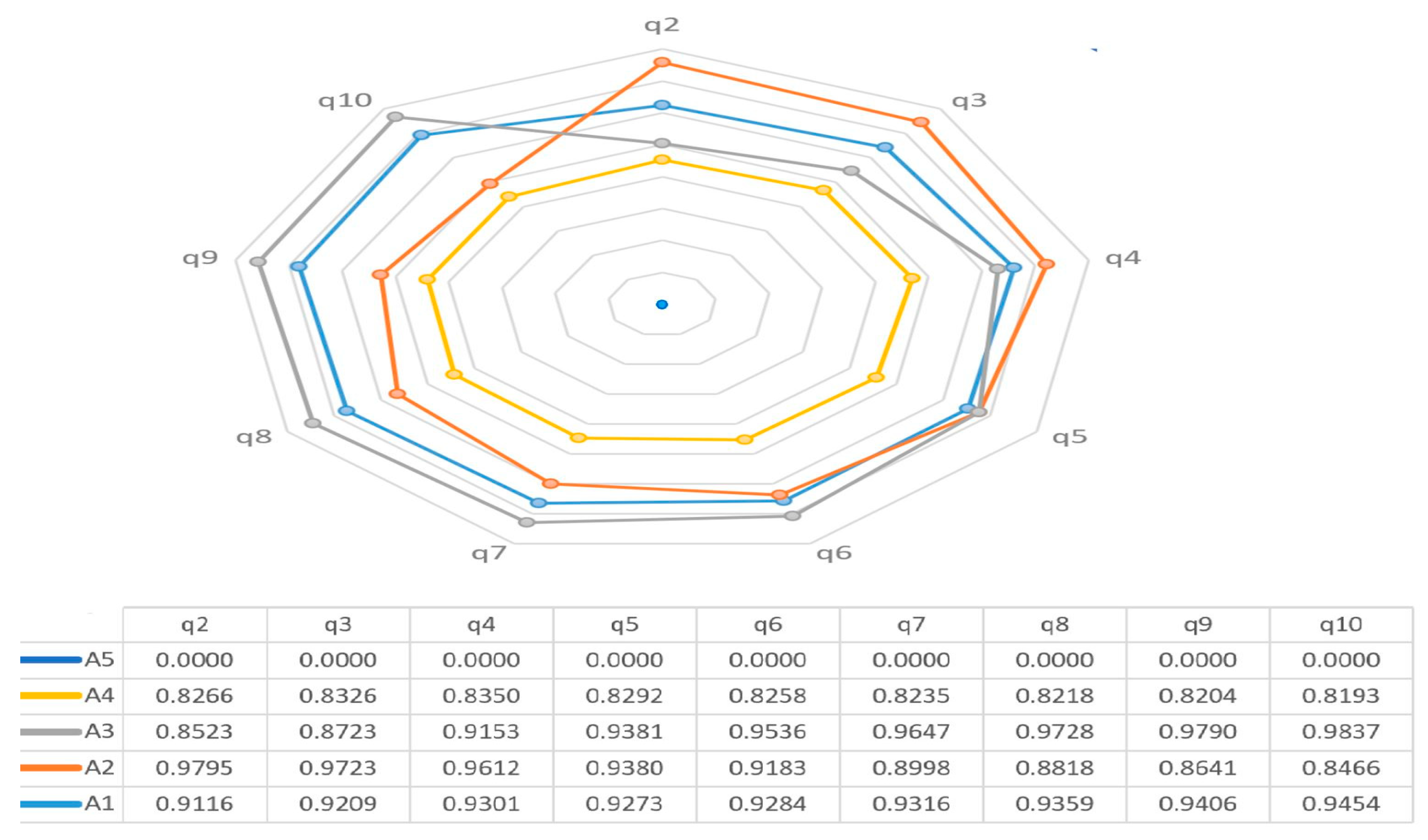
| Alternatives | Si | Ri | Qi (v = 0.5) | Rank |
|---|---|---|---|---|
| A1 | 0.7852 | 0.1192 | 0.9209 | 4 |
| A2 | 0.8042 | 0.1257 | 0.9723 | 5 |
| A3 | 0.7744 | 0.1122 | 0.8723 | 3 |
| A4 | 0.5506 | 0.1304 | 0.8326 | 2 |
| A5 | 0.0465 | 0.0465 | 0.0000 | 1 |
Disclaimer/Publisher’s Note: The statements, opinions and data contained in all publications are solely those of the individual author(s) and contributor(s) and not of MDPI and/or the editor(s). MDPI and/or the editor(s) disclaim responsibility for any injury to people or property resulting from any ideas, methods, instructions or products referred to in the content. |
© 2023 by the authors. Licensee MDPI, Basel, Switzerland. This article is an open access article distributed under the terms and conditions of the Creative Commons Attribution (CC BY) license (https://creativecommons.org/licenses/by/4.0/).
Share and Cite
Erdebilli, B.; Gecer, E.; Yılmaz, İ.; Aksoy, T.; Hacıoglu, U.; Dinçer, H.; Yüksel, S. Q-ROF Fuzzy TOPSIS and VIKOR Methods for the Selection of Sustainable Private Health Insurance Policies. Sustainability 2023, 15, 9229. https://doi.org/10.3390/su15129229
Erdebilli B, Gecer E, Yılmaz İ, Aksoy T, Hacıoglu U, Dinçer H, Yüksel S. Q-ROF Fuzzy TOPSIS and VIKOR Methods for the Selection of Sustainable Private Health Insurance Policies. Sustainability. 2023; 15(12):9229. https://doi.org/10.3390/su15129229
Chicago/Turabian StyleErdebilli, Babek, Ebru Gecer, İbrahim Yılmaz, Tamer Aksoy, Umit Hacıoglu, Hasan Dinçer, and Serhat Yüksel. 2023. "Q-ROF Fuzzy TOPSIS and VIKOR Methods for the Selection of Sustainable Private Health Insurance Policies" Sustainability 15, no. 12: 9229. https://doi.org/10.3390/su15129229
APA StyleErdebilli, B., Gecer, E., Yılmaz, İ., Aksoy, T., Hacıoglu, U., Dinçer, H., & Yüksel, S. (2023). Q-ROF Fuzzy TOPSIS and VIKOR Methods for the Selection of Sustainable Private Health Insurance Policies. Sustainability, 15(12), 9229. https://doi.org/10.3390/su15129229