Tracing the Impact Pathways of COVID-19 on Tourism and Developing Strategies for Resilience and Adaptation in Iran

 ,
,  , and
, and 
Abstract
:1. Introduction
2. Theoretical Background
3. Research Methods
3.1. Research Framework
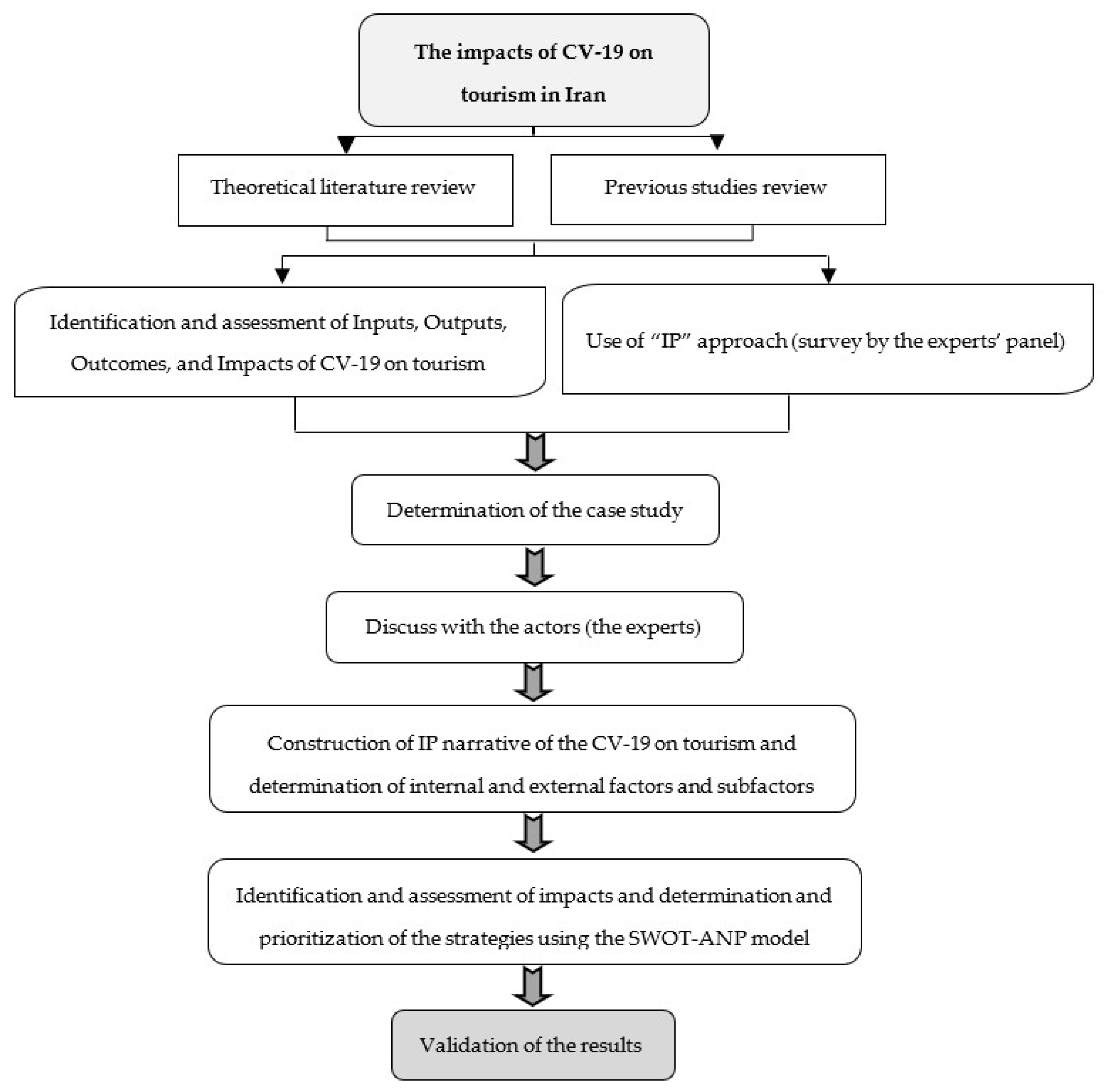
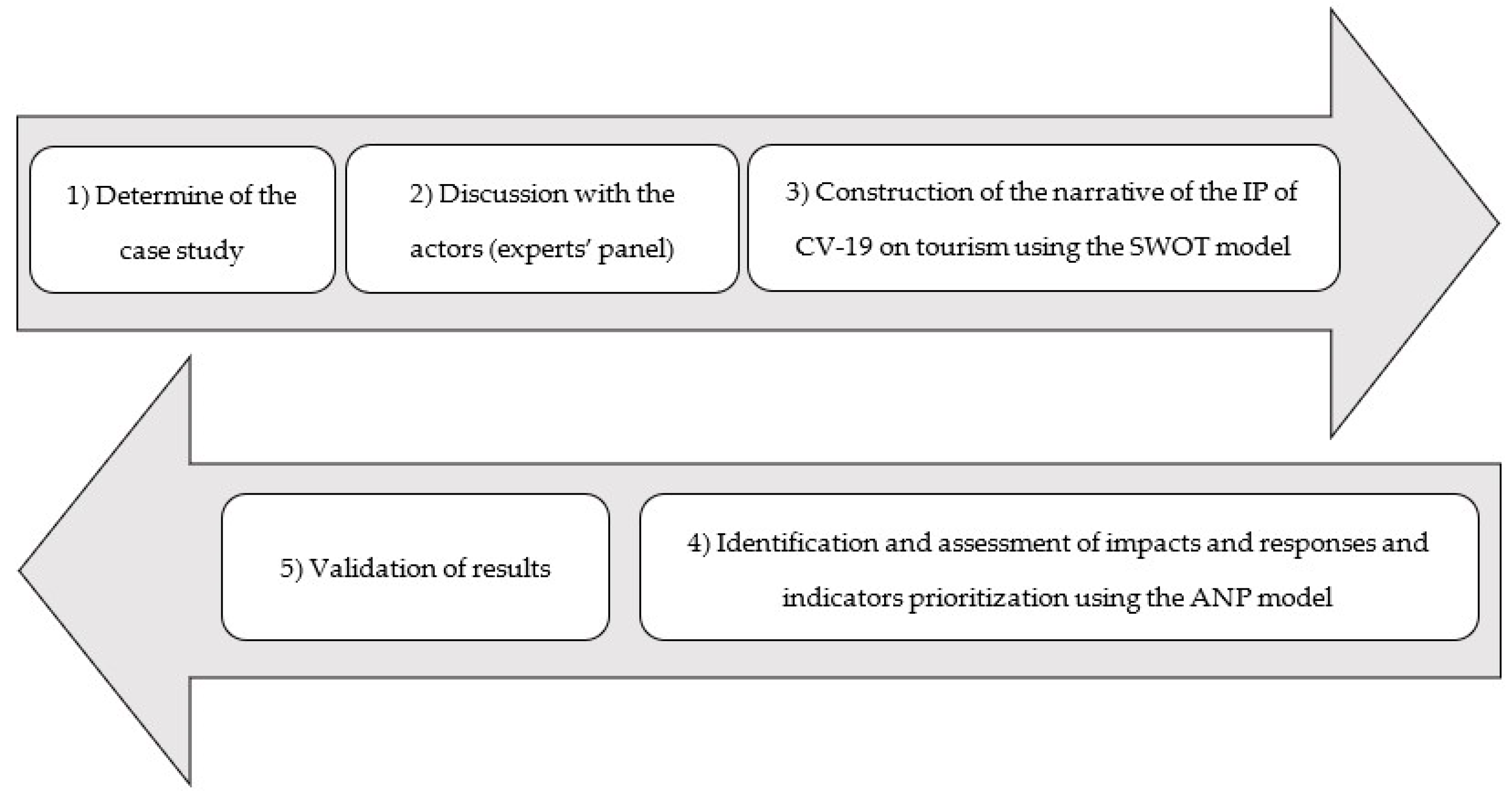
3.2. Research Procedure
- (1)
- Iran was identified as the case study because of its abundance of tourist attractions and the growing demand of tourists for natural, historical-archeological, cultural, and religious sites as well as its artificial attractions.
- (2)
- A group of 35 experts in tourism who are familiar with different tourism industry sectors in Iran was selected.
- (3)
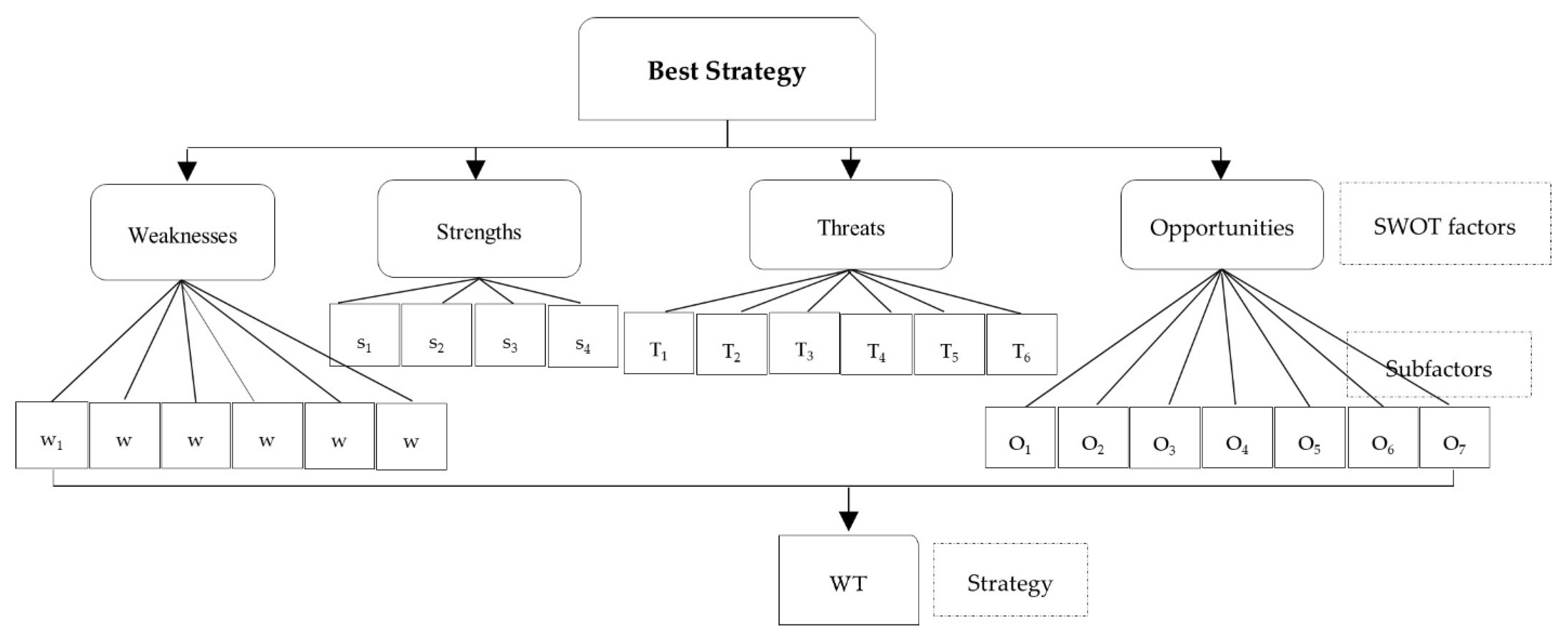
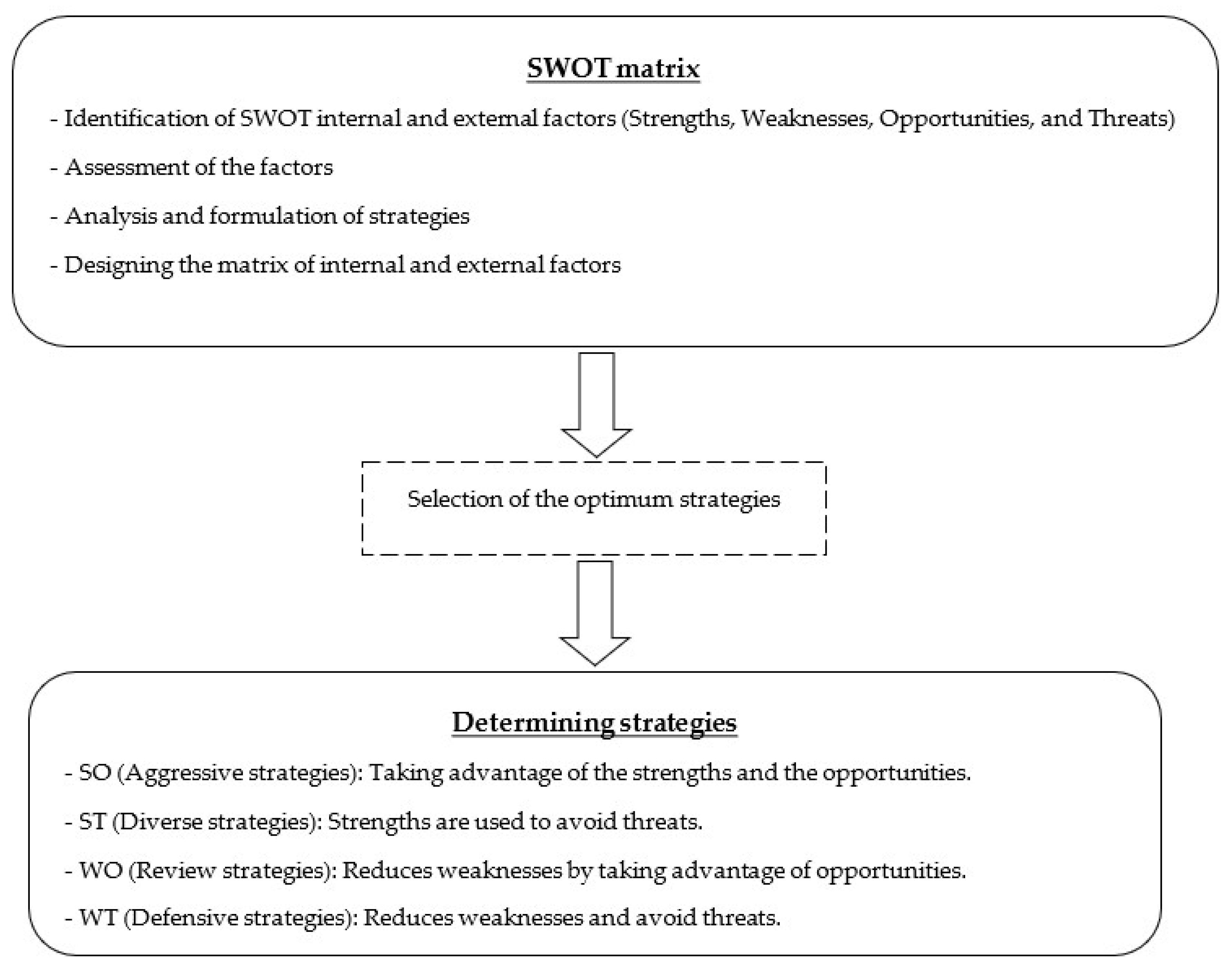
- To construct the IP narrative of the COVID-19 impacts on tourism, the strengths, weaknesses, opportunities, and threats were formulated using the SWOT model, and appropriate solutions for dealing with the impacts of COVID-19 were presented. Figure 4 depicts the steps in the development of the SWOT matrix.
- (4)
- The impacts and indicators were identified and assessed with the participation of the expert panel. At this stage, the experts described the kind of change that they perceived as resulting from a specified situation. Then, for each indicator, the experts assessed negative and positive impacts and determined a value from 1 to 5 for each impact (very low, low, moderate, high, and very high). Using the ANP model, the strategies were then prioritized, and the optimal strategy was selected. The ANP model, one of the multi-criteria decision analysis (MCDA) methods, has various advantages, including measuring different criteria based on their relationships, the complexity of other issues, and achieving better results [54]. The ANP procedure is realized through four steps [55,56]: (I) Modeling and converting a problem into a network structure: When the problem is converted into a network structure, the nodes are presented as clusters. The elements within a cluster may be related to one or all other cluster elements. Elements within a cluster may also interact with each other. (II) Establishment of a matrix of pairwise comparisons and determination of priority vectors: At this stage, the decision elements in each cluster are compared based on how important they are for the two-to-two control dimensions. A special vector can represent the impact of each element on other elements. The vector of internal significance indicates the relative importance of elements or clusters. The interdependence between the cluster criteria is also compared and examined according to Table 2. (III) Creation of a supermatrix and conversion into a limited supermatrix: To achieve general priorities into a system with reciprocal impacts, internal priority vectors are entered in the appropriate matrix columns. The result is presented in a supermatrix; each section demonstrates the relationship between the two clusters in a system. The hierarchical analysis process becomes a networking process if the dimensions have reciprocal impacts. The interactions among the dimensions are possible. (IV) Selection of the best alternative: If the supermatrix created in the third step considers the whole network and the options are also included in the supermatrix, the overall priority of the options from the column of options in the supermatrix of the normalized limit will be available. Suppose the supermatrix includes only a portion of the interconnected network, and the options are not considered in the supermatrix. In that case, further calculations are needed to represent the overall priority of the options. The option that has the highest overall priority is ultimately selected as the best option for the subject.
- (5)
- To validate the results, the expert panel met in three rounds. In the first round, indicators extracted from theoretical literature were presented to the experts, and they were asked to express their viewpoints about them. In the second round, experts were prompted to suggest additional indicators, and internal and external factors for the SWOT analysis. In the third round, the total selection of indicators and factors obtained from the panel meetings were presented to the experts. They were asked to express their final viewpoints to reach a consensus. The process concluded with a validation stage to ensure the accuracy of the views where the experts reviewed the final list of impact indicators and factors.

| Intensity of Importance | Definition |
|---|---|
| 1 | Equal importance |
| 3 | Moderate importance |
| 5 | Strong importance |
| 7 | Very strong importance |
| 9 | Absolute importance |
| 2, 4, 6, 8 | Intermediate values |
4. Results
4.1. Respondent Characteristics
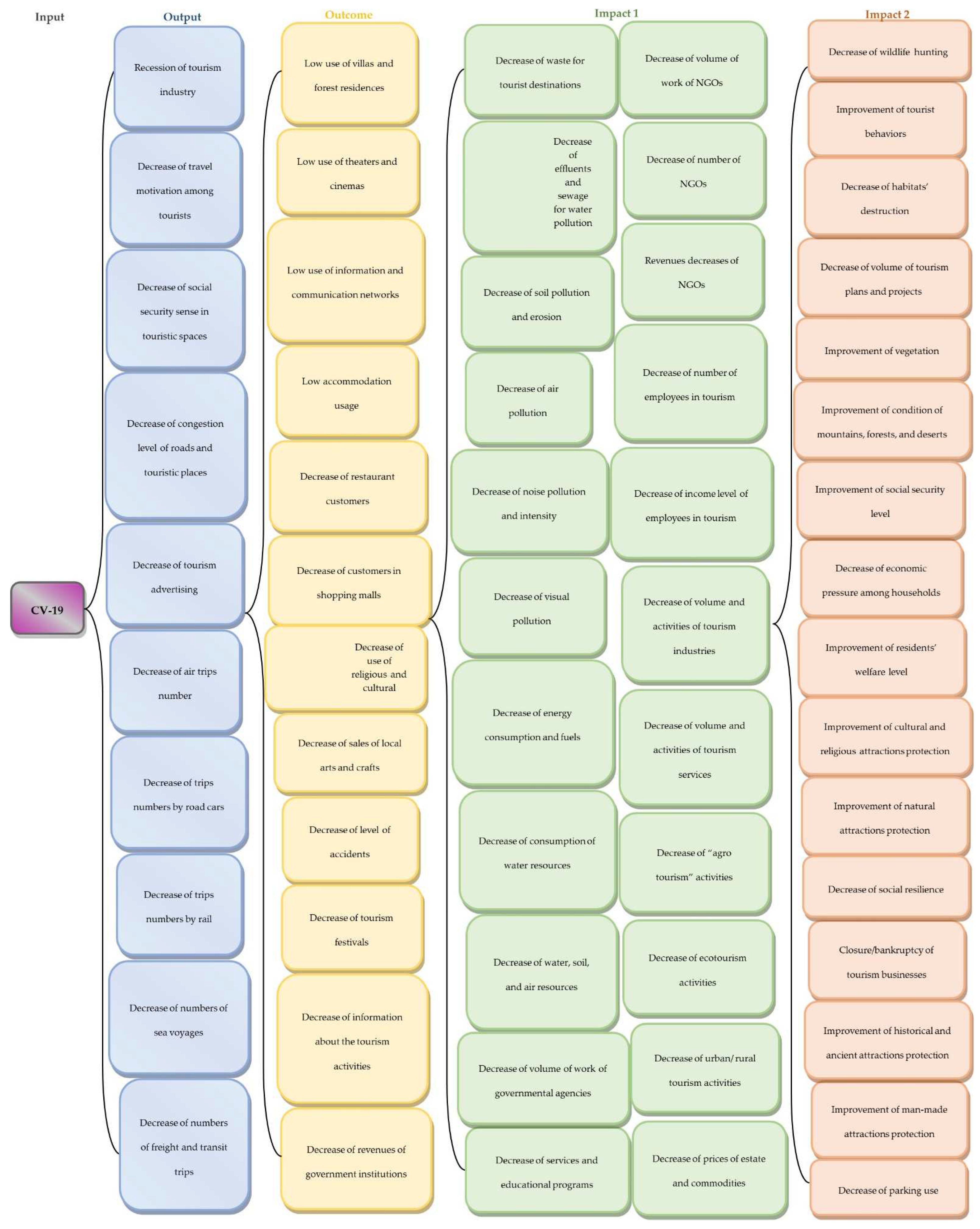
4.2. Construction of the Narrative of the IP and Assessment of COVID-19 Impacts
4.3. Developing a Response Pathway (RP) Approach to Manage COVID-19 Impacts on Tourism
4.4. Optimal Strategies to Mitigate the Impacts of COVID-19
4.5. Positive and Negative Impacts of COVID-19 on Tourism
5. Discussion
6. Conclusions
Supplementary Materials
Author Contributions
Funding
Institutional Review Board Statement
Informed Consent Statement
Data Availability Statement
Acknowledgments
Conflicts of Interest
References
- UNWTO. World Tourism Barometer; UNWTO: Madrid, Spain, 2016. [Google Scholar]
- Sobhani, P.; Esmaeilzadeh, H.; Sadeghi, S.M.M.; Marcu, M.V. Estimation of Ecotourism Carrying Capacity for Sustainable Development of Protected Areas in Iran. Int. J. Environ. Res. Public Health 2022, 19, 1059. [Google Scholar] [CrossRef] [PubMed]
- Jordan, E.J.; Spencer, D.M.; Prayag, G. Tourism Impacts, Emotions and Stress. Ann. Tour. Res. 2019, 75, 213–226. [Google Scholar] [CrossRef]
- Nunkoo, R.; Ramkissoon, H. Small Island Urban Tourism: A Residents’ Perspective. Curr. Issues Tour. 2010, 13, 37–60. [Google Scholar] [CrossRef]
- Lokhandwala, S.; Gautam, P. Indirect Impact of COVID-19 on Environment: A Brief Study in Indian Context. Environ. Res. 2020, 188, 109807. [Google Scholar] [CrossRef]
- Naramski, M.; Szromek, A.R.; Herman, K.; Polok, G. Assessment of the Activities of European Cultural Heritage Tourism Sites during the COVID-19 Pandemic. J. Open Innov. Technol. Mark. Complex. 2022, 8, 55. [Google Scholar] [CrossRef]
- Novelli, M.; Burgess, L.G.; Jones, A.; Ritchie, B.W. ‘No Ebola … Still Doomed’—The Ebola-Induced Tourism Crisis. Ann. Tour. Res. 2018, 70, 76–87. [Google Scholar] [CrossRef]
- Higgins-Desbiolles, F.; Bigby, B.C.; Doering, A. Socialising Tourism After COVID-19: Reclaiming Tourism as a Social Force? J. Tour. Futures 2021, 1–12. [Google Scholar] [CrossRef]
- Rogerson, C.M.; Baum, T. COVID-19 and African Tourism Research Agendas. Develop. S. Afr. 2020, 37, 727–741. [Google Scholar] [CrossRef]
- Candia, S.; Pirlone, F. Tourism Environmental Impacts Assessment to Guide Public Authorities towards Sustainable Choices for the Post-COVID Era. Sustainability 2022, 14, 18. [Google Scholar] [CrossRef]
- Carr, A. COVID-19, Indigenous Peoples and Tourism: A View from New Zealand. Tour. Geogr. 2020, 22, 491–502. [Google Scholar] [CrossRef]
- Dube, K.; Nhamo, G.; Chikodzi, D. COVID-19 pandemic and prospects for recovery of the global aviation industry. J. Air Transp. Manag. 2021, 92, 102022. [Google Scholar] [CrossRef]
- Foo, L.-P.; Chin, M.-Y.; Tan, K.-L.; Phuah, K.-T. The Impact of COVID-19 on Tourism Industry in Malaysia. Curr. Issues Tour. 2021, 24, 2735–2739. [Google Scholar] [CrossRef]
- Aronica, M.; Pizzuto, P.; Sciortino, C. COVID-19 and Tourism: What Can We Learn from the Past? World Econ. 2022, 45, 430–444. [Google Scholar] [CrossRef]
- Li, Z.; Zhang, X.; Yang, K.; Singer, R.; Cui, R. Urban and Rural Tourism Under COVID-19 in China: Research on the Recovery Measures and Tourism Development. Tour. Rev. 2021, 76, 718–736. [Google Scholar] [CrossRef]
- Komasi, H.; Hashemkhani Zolfani, S.; Cavallaro, F. The COVID-19 Pandemic and Nature-Based Tourism, Scenario Planning Approach (Case Study of Nature-Based Tourism in Iran). Sustainability 2022, 14, 3954. [Google Scholar] [CrossRef]
- Masaeli, A.; Rezaei, N.; Derafshi, K.; Basakha, M. Effects of Corona Epidemic on Labor Employment in Iran’s Tourism-Related Industries. Tour. Manag. Stud. 2022, 16, 279–308. [Google Scholar]
- Anonymous. Economic Effects of Coronavirus on Tourism Industry of Iran. Tehran; Research Center of Iran Chamber of Commerce, Industries, Mines and Agriculture: Tehran, Iran, 2021; Available online: https://en.otaghiranonline.ir/ (accessed on 25 December 2021).
- Babbitt, C.W.; Babbitt, G.A.; Oehman, J.M. Behavioral Impacts on Residential Food Provisioning, Use, and Waste During the COVID-19 Pandemic. Sustain. Prod. Consump. 2021, 28, 315–325. [Google Scholar] [CrossRef]
- Berman, J.D.; Ebisu, K. Changes in US Air Pollution During the COVID-19 Pandemic. Sci. Total Environ. 2020, 739, 139864. [Google Scholar] [CrossRef]
- Kang, H.; An, J.; Kim, H.; Ji, C.; Hong, T.; Lee, S. Changes in Energy Consumption According to Building Use Type Under COVID-19 Pandemic in South Korea. Renew. Sustain. Energy Rev. 2021, 148, 111294. [Google Scholar] [CrossRef]
- Corlett, R.T.; Primack, R.B.; Devictor, V.; Maas, B.; Goswami, V.R.; Bates, A.E.; Koh, L.P.; Regan, T.J.; Loyola, R.; Pakeman, R.J. Impacts of the Coronavirus Pandemic on Biodiversity Conservation. Biol. Conserv. 2020, 246, 108571. [Google Scholar] [CrossRef]
- Smith, M.K.S.; Smit, I.P.; Swemmer, L.K.; Mokhatla, M.M.; Freitag, S.; Roux, D.J.; Dziba, L. Sustainability of Protected Areas: Vulnerabilities and Opportunities as Revealed by COVID-19 in a National Park Management Agency. Biol. Conserv. 2021, 255, 108985. [Google Scholar] [CrossRef]
- Orden-Mejía, M.; Carvache-Franco, M.; Huertas, A.; Carvache-Franco, W.; Landeta-Bejarano, N.; Carvache-Franco, O. Post-COVID-19 Tourists’ Preferences, Attitudes and Travel Expectations: A Study in Guayaquil, Ecuador. Int. J. Environ. Res. Public Health 2022, 19, 4822. [Google Scholar] [CrossRef] [PubMed]
- Jones, P. A Review of the UK’s Tourism Recovery Plans Post COVID-19. Athens J. Tour. 2022, 9, 9–18. [Google Scholar] [CrossRef]
- Martínez-Garcia, E.; Raya, J.M.; Majó, J. Differences in Residents’ Attitudes Towards Tourism Among Mass Tourism Destinations. Int. J. Tour. Res. 2017, 19, 535–545. [Google Scholar] [CrossRef] [Green Version]
- Milman, A.; Pizam, A. Social Impacts of Tourism on Central Florida. Ann. Tour. Res. 1988, 15, 191–204. [Google Scholar] [CrossRef]
- Dombey, O. The Effects of SARS on the Chinese Tourism Industry. J. Vacat. Mark. 2004, 10, 4–10. [Google Scholar] [CrossRef]
- Rittichainuwat, B.N.; Chakraborty, G. Perceived Travel Risks Regarding Terrorism and Disease: The Case of Thailand. Tour. Manag. 2009, 30, 410–418. [Google Scholar] [CrossRef]
- Cahyanto, I.; Wiblishauser, M.; Pennington-Gray, L.; Schroeder, A. The Dynamics of Travel Avoidance: The Case of Ebola in the US. Tour. Manag. Perspect. 2016, 20, 195–203. [Google Scholar] [CrossRef]
- Page, S.; Yeoman, I.; Munro, C.; Connell, J.; Walker, L. A Case Study of Best Practice—Visit Scotland’s Prepared Response to An Influenza Pandemic. Tour. Manag. 2006, 27, 361–393. [Google Scholar] [CrossRef]
- Sönmez, S.; Apostolopoulos, Y.; Lemke, M.K.; Hsieh, Y.-C.J. Understanding the Effects of COVID-19 on the Health and Safety of Immigrant Hospitality Workers in the United States. Tour. Manag. Perspect. 2020, 35, 100717. [Google Scholar] [CrossRef]
- Beck, M.J.; Hensher, D.A. Insights into the Impact of COVID-19 on Household Travel and Activities in Australia–The Early Days Under Restrictions. Transp. Policy 2020, 96, 76–93. [Google Scholar] [CrossRef] [PubMed]
- Sharma, G.D.; Thomas, A.; Paul, J. Reviving Tourism Industry Post-COVID-19: A Resilience-Based Framework. Tour. Manag. Perspect. 2021, 37, 100786. [Google Scholar] [CrossRef] [PubMed]
- Qiu, R.T.; Park, J.; Li, S.; Song, H. Social Costs of Tourism During the COVID-19 Pandemic. Ann. Tour. Res. 2020, 84, 102994. [Google Scholar] [CrossRef] [PubMed]
- Yang, Y.; Zhang, H.; Chen, X. Coronavirus Pandemic and Tourism: Dynamic Stochastic General Equilibrium Modeling of Infectious Disease Outbreak. Ann. Tour. Res. 2020, 83, 102913. [Google Scholar] [CrossRef] [PubMed]
- Sharma, A.; Nicolau, J.L. An Open Market Valuation of the Effects of COVID-19 on the Travel and Tourism Industry. Ann. Tour. Res. 2020, 83, 102990. [Google Scholar] [CrossRef]
- Sigala, M. Social Media and Crisis Management in Tourism: Applications and Implications for Research. Inf. Technol. Tour. 2011, 13, 269–283. [Google Scholar] [CrossRef]
- Lin, J.C.; Lin, H.H.; Lu, S.Y.; Chien, J.H.; Shen, C.C. Research on the Current Situation of Rural Tourism in Southern Fujian in China After the COVID-19 Epidemic. Open Geosci. 2022, 14, 24–43. [Google Scholar] [CrossRef]
- Hall, C.M. Tourism Planning; Policies, Processes and Relationships; Person Education Limited: Edinburg Gate, UK, 2000. [Google Scholar]
- Shokouei, H.; Movahed, A. Understanding the Pattern of Tourist Space in Isfahan Using GIS System. Space Plan. 2002, 6, 95–114. [Google Scholar]
- Lee, C.-C.; Chang, C.-P. Tourism Development and Economic Growth: A Closer Look at Panels. Tour. Manag. 2008, 29, 180–192. [Google Scholar] [CrossRef]
- Inskeep, E. Tourism Planning: An Integrated and Sustainable Development Approach; John Wiley & Sons: Hoboken, NJ, USA, 1991. [Google Scholar]
- Taghvayi, M.; Akbari, M. An Introduction to Urban Tourism Planning and Management; Payam Alavi: Isfahan, Iran, 2008. [Google Scholar]
- Shamaei, A.; Musivand, A.J. Leveling of Isfahan Cities in Terms of Tourism Infrastructure Using TOPSIS and AHP Models. J. Urban Stud. Res. 2009, 3, 37–58. [Google Scholar]
- Zheng, Y.; Goh, E.; Wen, J. The Effects of Misleading Media Reports About COVID-19 on Chinese Tourists’ Mental Health: A Perspective Article. Anatolia 2020, 31, 337–340. [Google Scholar] [CrossRef] [Green Version]
- Tucker, H. Coronavirus Bankruptcy Tracker: These Major Companies are Failing Amid the Shutdown. Forbes. 2020. Available online: https://www.forbes.com/sites/hanktucker/2020/05/03/coronavirus-bankruptcy-tracker-these-major-companies-are-failing-amid-theshutdown/#5649f95d3425 (accessed on 17 December 2021).
- Springer-Heinze, A.; Hartwich, F.; Henderson, J.S.; Horton, D.; Minde, I. Impact Pathway Analysis: An Approach to Strengthening the Impact Orientation of Agricultural Research. Agric. Syst. 2003, 78, 267–285. [Google Scholar] [CrossRef]
- Briones, M.; Dey, M.; Ahmed, M.; Stobutzki, I.; Prein, M.; Acosta, B. Impact Pathway Analysis for Research Planning: The Case of Aquatic Resources Research in the WorldFish Center. NAGA WorldFish Cent. Quart 2004, 27, 51–55. [Google Scholar]
- Kurttila, M.; Pesonen, M.; Kangas, J.; Kajanus, M. Utilizing the analytic hierarchy process (AHP) in SWOT analysis—A hybrid method and Its Application to a Forest-Certification Case. For. Policy Econ. 2000, 1, 41–52. [Google Scholar] [CrossRef]
- Kajanus, M.; Kangas, J.; Kurttila, M. The Use of Value Focused Thinking and the A’WOT Hybrid Method in Tourism Management. Tour. Manag. 2004, 25, 499–506. [Google Scholar] [CrossRef]
- Kangas, J.J.; Kajanus, M.; Leskinen, P.; Kurttila, M. Incorporating MCDS and Voting Into SWOT–Basic Idea and Experiences. Serbian J. Manag. 2016, 11, 1–13. [Google Scholar] [CrossRef] [Green Version]
- Arsić, S.; Nikolić, D.; Živković, Ž. Hybrid SWOT-ANP-FANP Model for Prioritization Strategies of Sustainable Development of Ecotourism in National Park Djerdap, Serbia. For. Policy Econ. 2017, 80, 11–26. [Google Scholar] [CrossRef]
- Hadiwijaya, N.A.; Hamdani, H.; Syafrianto, A.; Tanjung, Z. The decision model for selection of tourism site using analytic network process method. Int. J. Intell. Syst. Appl. 2018, 9, 23–31. [Google Scholar] [CrossRef]
- Saaty, T.L. Decision Making with Dependence and Feedback: The Analytic Network Process; RWS Publications: Pittsburgh, PA, USA, 1996; p. 370. [Google Scholar]
- Zhang, J.; Zhang, Y. Assessing the Low-Carbon Tourism in the Tourism-Based Urban Destinations. J. Clean. Prod. 2020, 276, 124303. [Google Scholar] [CrossRef]
- Kasare, K.S. Effects of coronavirus disease (COVID-19) on Tourism Industry of India. Stud. Indian Place Names 2020, 40, 362–365. [Google Scholar]
- Zhu, H.; Deng, F. How to Influence Rural Tourism Intention by Risk Knowledge During COVID-19 Containment in China: Mediating Role of Risk Perception and Attitude. Int. J. Environ. Res. Public Health 2020, 17, 3514. [Google Scholar] [CrossRef] [PubMed]
- McKercher, B.; Chon, K. The Over-Reaction to SARS and the Collapse of Asian Tourism. Ann. Tour. Res. 2004, 31, 716. [Google Scholar] [CrossRef] [PubMed]
- Robina-Ramírez, R.; Sánchez, M.S.-O.; Jiménez-Naranjo, H.V.; Castro-Serrano, J. Tourism Governance During the COVID-19 Pandemic Crisis: A Proposal for A Sustainable Model to Restore the Tourism Industry. Environ. Dev. Sustain. 2021, 24, 1–22. [Google Scholar] [CrossRef] [PubMed]
- Toubes, D.R.; Araújo Vila, N.; Fraiz Brea, J.A. Changes in Consumption Patterns and Tourist Promotion After the COVID-19 Pandemic. J. Theor. Appl. Electron. Commer. Res. 2021, 16, 1332–1352. [Google Scholar] [CrossRef]
- Rahman, M.K.; Gazi, M.A.I.; Bhuiyan, M.A.; Rahaman, M.A. Effect of COVID-19 Pandemic on Tourist Travel Risk and Management Perceptions. PLoS ONE 2021, 16, e0256486. [Google Scholar] [CrossRef]
- Mirzaei, R.; Sadin, M.; Pedram, M. Tourism and COVID-19: Changes in Travel Patterns and Tourists’ Behavior in Iran. J. Tour. Futures 2021, in press. [Google Scholar] [CrossRef]
- Filimonau, V.; De Coteau, D. Tourism Resilience in the Context of Integrated Destination and Disaster Management (DM2). Int. J. Tour. Res. 2020, 22, 202–222. [Google Scholar] [CrossRef] [Green Version]
- Altshuler, A.; Schmidt, J. Does and How Resilience Matter? Global Implications for the Tourism Industry in the Context of COVID-19. Worldw. Hosp. Tour. Themes 2021, 13, 431–436. [Google Scholar]
- Shivakoti, A. Impact of COVID-19 on Tourism in Nepal. Gaze J. Tour. Hospital 2021, 12, 1–22. [Google Scholar] [CrossRef]
- Sigala, M.; Dolnicar, S. Chapter 7 Entrepreneurship Opportunities; Dolnicar, S., Ed.; Goodfellow Publishers: Oxford, UK, 2017. [Google Scholar] [CrossRef]
- Higgins-Desbiolles, F. Socialising Tourism for Social and Ecological Justice After COVID-19. Tour. Geogr. 2020, 22, 610–623. [Google Scholar] [CrossRef] [Green Version]
- Norouzi, N.; de Rubens, G.Z.; Choupanpiesheh, S.; Enevoldsen, P. When Pandemics Impact Economies and Climate Change: Exploring the Impacts of COVID-19 on Oil and Electricity Demand in China. Energy Res. Soc. Sci. 2020, 68, 101654. [Google Scholar] [CrossRef] [PubMed]
- Sigala, M. Tourism and COVID-19: Impacts and Implications for Advancing and Resetting Industry and Research. J. Bus. Res. 2020, 117, 312–321. [Google Scholar] [CrossRef] [PubMed]
- Zenker, S.; Kock, F. The Coronavirus Pandemic–A Critical Discussion of a Tourism Research Agenda. Tour. Manag. 2020, 81, 104164. [Google Scholar] [CrossRef] [PubMed]
- Catterberg, G.; Moreno, A. The Individual Bases of Political Trust: Trends in New and Established Democracies. Int. J. Public Opin. Res. 2006, 18, 31–48. [Google Scholar] [CrossRef] [Green Version]
- Fong, L.H.N.; Law, R.; Ye, B.H. Outlook of Tourism Recovery Amid an Epidemic: Importance of Outbreak Control by the Government. Ann. Tour. Res. 2020, 86, 102951. [Google Scholar] [CrossRef]
- Uğur, N.G.; Akbıyık, A. Impacts of COVID-19 on Global Tourism Industry: A Cross-Regional Comparison. Tour. Manag. Perspec. 2020, 36, 100744. [Google Scholar] [CrossRef]
- Uslaner, E.M. Trust and the Economic Crisis of 2008. Corp. Reput. Rev. 2010, 13, 110–123. [Google Scholar] [CrossRef]
- OECD. Mitigating the Impact of COVID-19 on Tourism and Supporting Recovery. OECD Tourism Papers N° 2020/03; OECD Publishing: Paris, France, 2020. [Google Scholar]
- Arbulú, I.; Razumova, M.; Rey-Maquieira, J.; Sastre, F. Can Domestic Tourism Relieve the COVID-19 Tourist Industry Crisis? The Case of Spain. J. Destin. Mark. Manag. 2021, 20, 100568. [Google Scholar] [CrossRef]
- Chang, C.L.; McAleer, M.; Ramos, V. A Charter for Sustainable Tourism After COVID-19. Sustainability 2020, 12, 3671. [Google Scholar] [CrossRef]
- Pham, T.D.; Dwyer, L.; Su, J.-J.; Ngo, T. COVID-19 Impacts of Inbound Tourism on Australian Economy. Ann. Tour. Res. 2021, 88, 103179. [Google Scholar] [CrossRef]
- Carnevale, J.B.; Hatak, I. Employee Adjustment and Well-Being in the Era of COVID-19: Implications for Human Resource Management. J. Bus. Res. 2020, 116, 183–187. [Google Scholar] [CrossRef] [PubMed]
- McGuire, D.; Germain, M.-L.; Reynolds, K. Reshaping HRD in Light of the COVID-19 Pandemic: An Ethics of Care Approach. Adv. Dev. Hum. Resour. 2021, 23, 26–40. [Google Scholar] [CrossRef]
- Peterson, R.R.; DiPietro, R.B. Exploring the Impact of the COVID-19 Pandemic on the Perceptions and Sentiments of Tourism Employees: Evidence from a Small Island Tourism Economy in the Caribbean. Int. Hospital Rev. 2021, 35, 156–170. [Google Scholar] [CrossRef]
- Martins, A.; Riordan, T.; Dolnicar, S. A Post-COVID-19 Model of Tourism and Hospitality Workforce Resilience. socarXiv 2020. Available online: https://osf.io/preprints/socarxiv/4quga/ (accessed on 17 December 2021).
- Huynh, D.V.; Truong, T.T.K.; Duong, L.H.; Nguyen, N.T.; Dao, G.V.H.; Dao, C.N. The COVID-19 Pandemic and Its Impacts on Tourism Business in a Developing City: Insight from Vietnam. Economies 2021, 9, 172. [Google Scholar] [CrossRef]
- Nguyen, K.T.T. Safety Plan During COVID-19 Pandemic in Restaurant Industry: Case Study: KOKORO Sushi; Laurea University: Vantaa, Finland, 2020. [Google Scholar]
- Dube, K.; Nhamo, G.; Chikodzi, D. COVID-19 Cripples Global Restaurant and Hospitality Industry. Curr. Issues Tour. 2021, 24, 1487–1490. [Google Scholar] [CrossRef]
- Hall, C.M. Publish and Perish? Bibliometric Analysis, Journal Ranking and the Assessment of Research Quality in Tourism. Tour. Manag. 2011, 32, 16–27. [Google Scholar] [CrossRef]
- Imani Jajarmi, H. Social Consequences of Coronavirus Outbreak in Iranian Society. Sci. Quart. Soc. Imp. Assess. 2020, 2, 5553859. [Google Scholar]
- Nicola, M.; Alsafi, Z.; Sohrabi, C.; Kerwan, A.; Al-Jabir, A.; Iosifidis, C.; Agha, M.; Agha, R. The Socio-Economic Implications of the Coronavirus Pandemic (COVID-19): A Review. Int. J. Surg. 2020, 78, 185–193. [Google Scholar] [CrossRef]
- Lenart-Boroń, A.M.; Boroń, P.M.; Prajsnar, J.A.; Guzik, M.W.; Żelazny, M.S.; Pufelska, M.D.; Chmiel, M.J. COVID-19 Lockdown Shows How Much Natural Mountain Regions Are Affected by Heavy Tourism. Sci. Total Environ. 2022, 806, 151355. [Google Scholar] [CrossRef]
- Zambrano-Monserrate, M.A.; Ruano, M.A.; Sanchez-Alcalde, L. Indirect Effects of COVID-19 on the Environment. Sci. Total Environ. 2020, 728, 138813. [Google Scholar] [CrossRef] [PubMed]
- Bhuiyan, M.A.H.; Hassan, S.; Darda, M.A.; Habib, M.W. Aspects of Sustainable Tourism Development and COVID-19 Pandemic. Preprints 2020, 2020080418. [Google Scholar]
- Gautam, S. COVID-19: Air Pollution Remains Low as People Stay at Home. Air Qual. Atmos. Health 2020, 13, 853–857. [Google Scholar] [CrossRef] [PubMed]
- Sharma, S.; Zhang, M.; Gao, J.; Zhang, H.; Kota, S.H. Effect of Restricted Emissions During COVID-19 on Air Quality in India. Sci. Total Environ. 2020, 728, 138878. [Google Scholar] [CrossRef] [PubMed]
- Tobías, A.; Carnerero, C.; Reche, C.; Massagué, J.; Via, M.; Minguillón, M.C.; Alastuey, A.; Querol, X. Changes in Air Quality During the Lockdown in Barcelona (Spain) One Month Into the SARS-CoV-2 Epidemic. Sci. Total Environ. 2020, 726, 138540. [Google Scholar] [CrossRef]
- Wang, Q.; Su, M. A Preliminary Assessment of the Impact of COVID-19 on Environment—A Case Study of China. Sci Total Environ. 2020, 728, 138915. [Google Scholar] [CrossRef]
- He, G.; Pan, Y.; Tanaka, T. The Short-Term Impacts of COVID-19 Lockdown on Urban Air Pollution in China. Nat. Sustain. 2020, 3, 1005–1011. [Google Scholar] [CrossRef]
- de Bruin, W.B.; Bennett, D. Relationships Between Initial COVID-19 Risk Perceptions and Protective Health Behaviors: A National Survey. Am. J. Prev. Med. 2020, 59, 157–167. [Google Scholar] [CrossRef]
- Wen, J.; Kozak, M.; Yang, S.; Liu, F. COVID-19: Potential Effects on Chinese Citizens’ Lifestyle and Travel. Tour. Rev. 2020, 76, 74–87. [Google Scholar] [CrossRef]
- Geng, D.C.; Innes, J.; Wu, W.; Wang, G. Impacts of COVID-19 Pandemic on Urban Park Visitation: A Global Analysis. J. For. Res. 2021, 32, 553–567. [Google Scholar] [CrossRef]
- Kim, M.J.; Bonn, M.; Hall, C.M. Traveler Biosecurity Behavior During the COVID-19 Pandemic: Effects of Intervention, Resilience, and Sustainable Development Goals. J. Travel Res. 2021. [Google Scholar] [CrossRef]
- El-Said, O.; Aziz, H. Virtual Tours a Means to An End: An Analysis of Virtual Tours’ Role in Tourism Recovery Post COVID-19. J. Travel Res. 2022, 61, 528–548. [Google Scholar] [CrossRef]
- Parady, G.; Taniguchi, A.; Takami, K. Analyzing Risk Perception and Social Influence Effects on Self-Restriction Behavior in Response to the COVID-19 Pandemic in Japan: First Results. Transp. Res. Interdiscip. Perspect. 2020, 7, 100181. [Google Scholar] [CrossRef]
- Sumanapala, D.; Wolf, I.D. The Changing Face of Wildlife Tourism During the COVID-19 Pandemic: An Opportunity to Strive Towards Sustainability? Curr. Issues Tour. 2022, 25, 357–362. [Google Scholar] [CrossRef]
- LeTourneux, F.; Grandmont, T.; Dulude-de Broin, F.; Martin, M.-C.; Lefebvre, J.; Kato, A.; Bêty, J.; Gauthier, G.; Legagneux, P. COVID19-Induced Reduction in Human Disturbance Enhances Fattening of an Overabundant Goose Species. Biol. Conserv. 2021, 255, 108968. [Google Scholar] [CrossRef] [PubMed]
- Heydari Chianeh, R.; Nasrollahzadeh, Z.; Abdollahi, M. An Evaluation of Tourism Higher Education in Iran Based on SWOT Model. J. Tour. Plan. Dev. 2012, 1, 129–152. [Google Scholar]




| Dimensions | Variables | Indicators | References |
|---|---|---|---|
| Physical-environmental | Environmental pollutions | Level of water resource pollution | [39,40,41,42] |
| Level of soil pollution and erosion | |||
| Level of air pollution | |||
| Level of noise pollution and noise intensity in tourist destinations | |||
| Level of visual pollution | |||
| Ecosystems | Condition of mountains, forests, and deserts | ||
| Animals’ habitats | Level of wildlife hunting | ||
| Level of habitat destruction | |||
| Vegetation | Quantitative and qualitative status of vegetation | ||
| Resources consumption | Level of energy consumption and types of fuels | ||
| Level of water resource consumption | |||
| Waste and sewage production | Amount of waste produced in tourist destinations | ||
| Quality of environmental resources and climate | Quality of water, soil and air resources | ||
| Safety | Number of accidents | ||
| Accommodation and food services | Usage level of accommodations outside of nature (hotels, inns, and guesthouses) | ||
| Usage level of accommodations inside of nature (forest residences) | |||
| Number of restaurant customers | |||
| Infrastructure and tourism facilities | Level of highway cost and toll services | ||
| Level of information and communication networks (internet, social networks, telephone, newspapers, etc.) | |||
| Level of parking lot usage | |||
| Socio-cultural | Tourism attractions and activities | Level of protection for natural attractions | [36,38,39,40,41,42,43,44,45,46] |
| Level of protection for cultural and religious attractions | |||
| Level of protection for historical and ancient attractions | |||
| Level of protection for man-made attractions | |||
| Transportation | Number of air trips | ||
| Number of vehicle trips | |||
| Number of rail trips (train and metro) | |||
| Number of sea voyages | |||
| Number of freight and transit trips | |||
| Psychic | Travel motivation among tourists | ||
| Level of economic pressure among households | |||
| Security | Level of social security against crime and conflict | ||
| Behavior | Level of change in tourists’ behavior | ||
| Traffic | Level of congestion in roads and public places | ||
| Education and information | Level of services and educational programs | ||
| Level of information about tourism activities of different sites | |||
| Economic—institutional | Institutional elements | The volume of government agencies working in tourism | [35,39,41,44,45,47] |
| Revenues of government institutions | |||
| Employment and income | Closure/bankruptcy of tourism businesses | ||
| Number of employers in different sectors of tourism | |||
| Plans and projects | The volume of tourism plans and projects | ||
| Economic diversity | Volume of activities about tourism industries | ||
| Volume of activities about tourism-related services | |||
| Local prices | Average price of estate and commodities |
| Characteristics | Frequency (n) (Total n = 35) | Percentage | |
|---|---|---|---|
| Gender | Male | 22 | 62.00 |
| Female | 13 | 38.00 | |
| Age | Less than 30 | 5 | 14.28 |
| 30–40 | 15 | 42.85 | |
| 40–50 | 8 | 22.57 | |
| 50+ | 7 | 20.00 | |
| Education | Bachelor’s degree | 12 | 34.29 |
| M.Sc. degree | 15 | 42.86 | |
| Ph.D. degree | 8 | 22.85 | |
| Employment | Employed in different sectors of tourism | 19 | 54.28 |
| Employed in non-tourism sectors | 10 | 28.57 | |
| Unemployed | 6 | 17.15 | |
| Experience in tourism | 6–10 years | 21 | 60.00 |
| 10–20 years | 9 | 25.72 | |
| More than 20 years | 5 | 14.28 | |
| Dimensions | Variables | Indicators of Impacts | Indicators Value | Impact Type | Impact Range |
|---|---|---|---|---|---|
| Physical-environmental (average impacts of dimensions = 2.87) | Environmental pollutions | Level of water resource pollution | 2.94 | P | M |
| Level of soil pollution and erosion | 2.91 | P | M | ||
| Level of air pollution | 2.97 | P | M | ||
| Level of noise pollution and noise intensity in tourist destinations | 2.77 | P | M | ||
| Level of visual pollution | 2.74 | P | M | ||
| Ecosystems | Condition of mountains, forests, and deserts | 2.88 | P | M | |
| Animals’ habitats | Level of wildlife hunting | 3.42 | P | H | |
| Level of habitat destruction | 3.17 | P | H | ||
| Vegetation | Quantitative and qualitative status of vegetation | 2.97 | P | M | |
| Resource consumption | Level of energy consumption and types of fuels | 2.91 | P | M | |
| Level of water resources consumption | 3.11 | P | H | ||
| Waste and sewage production | Amount of wastes for tourist destinations | 2.42 | P | M | |
| Amount of effluents and sewages for tourist destinations | 2.40 | P | M | ||
| Quality of environmental resources and climate | Quality of water, soil, and air resources | 3.20 | P | H | |
| Safety | Level of accidents | 2.42 | P | M | |
| Accommodation and food services | Level of accommodation usage (hotels, inns, and guesthouses) | 3.34 | N | H | |
| Usage level of villas and forest residences | 3.51 | N | H | ||
| Number of restaurant customers | 3.40 | N | H | ||
| Level of shopping malls and stores customers | 3.68 | N | H | ||
| Infrastructure and tourism facilities | Level of highways’ cost and toll services | 2.45 | P | M | |
| Level of information and communication networks (internet, social networks, telephone, newspapers, etc.) | 2.62 | P | M | ||
| Level of theaters and cinemas usage | 2.42 | N | M | ||
| Level of religious and cultural places usage | 2.57 | N | M | ||
| Level of parking lot usage | 2.14 | N | M | ||
| Level of local arts and crafts sales in tourism destinations | 2.62 | N | M | ||
| Socio-cultural (average impacts of dimensions = 3.43) | Tourist attractions and activities | Level of natural attractions’ protection | 3.22 | P | H |
| Level of cultural and religious attractions’ protection | 2.88 | P | M | ||
| Level of historical and ancient attractions’ protection | 2.88 | P | M | ||
| Level of man-made attractions’ protection | 2.77 | P | M | ||
| The volume of tourism festivals | 2.65 | N | M | ||
| Transportation | Number of air trips | 3.48 | N | H | |
| Number of road cars trips | 3.28 | N | H | ||
| Number of rail trips (train and metro) | 3.34 | N | H | ||
| Number of sea voyages | 3.37 | N | H | ||
| Number of freight and transit trips | 3.20 | N | H | ||
| Psychic | Travel motivation among tourists | 3.22 | N | H | |
| Level of economic pressure among households | 4.22 | N | VH | ||
| Security | Level of social security against crime and conflict | 3.88 | P | H | |
| Behavior | Level of change in tourists behavior | 3.94 | P | H | |
| Level of social resilience | 4.20 | N | VH | ||
| Traffic | Level of congestion in roads and public places | 4.02 | P | VH | |
| Education and information | Level of services and educational programs | 3.77 | N | H | |
| Level of information about tourism activities of different sites | 3.25 | N | H | ||
| Tourism advertising | 3.65 | N | H | ||
| Economic-institutional (average impacts of dimensions = 4.35) | Institutional elements | The volume of governmental agencies’ work in relation to tourism | 4.34 | N | VH |
| Revenues of governmental institutions | 4.28 | N | VH | ||
| The volume of non-governmental organizations’ work (tourism agencies, NGOs, local associations and councils, etc.) | 4.57 | N | VH | ||
| Number of non-governmental organizations | 4.22 | N | VH | ||
| Level of non-governmental organizations revenues | 4.54 | N | VH | ||
| Employment and income | Closure/bankruptcy of tourism businesses | 4.88 | N | VH | |
| Number of employers in different sectors of tourism | 4.74 | N | VH | ||
| Level of employees’ income in different sectors of tourism | 4.88 | N | VH | ||
| Level of the residents’ welfare of tourist destinations | 4.22 | N | VH | ||
| Plans and projects | The volume of tourism plans and projects | 4.45 | N | VH | |
| Economic diversity | Volume of activities about tourism industries | 4.68 | N | VH | |
| Volume of activities about tourism-related services | 4.54 | N | VH | ||
| Level of agro-tourism development | 4.34 | N | VH | ||
| Level of nature-based and ecotourism development | 4.77 | N | VH | ||
| Level of urban and rural tourism development | 4.22 | N | VH | ||
| Local prices | Average prices of estate and commodities | 1.97 | P | L |
| Internal Factors | Factors Weight | SWOT Subfactors | Subfactor Weight | Final Weight |
|---|---|---|---|---|
| Strengths | 0.321 | S1: Existence of local NGOs in public education and crisis management | 0.198 | 0.063 |
| S2: Low level of environmental pollution | 0.192 | 0.061 | ||
| S3: Low level of traffic and population density in tourism destinations | 0.175 | 0.056 | ||
| S4: Improvements the protection of tourism attractions (natural, cultural and religious, historical, and man-made) | 0.156 | 0.050 | ||
| Weaknesses | 0.388 | W1: Low level of organizational cooperation in crisis management | 0.238 | 0.092 |
| W2: Weaknesses in some of the rules and regulations | 0.222 | 0.086 | ||
| W3: Low level of adaptive ability among tourists and local communities in crisis situations | 0.218 | |||
| W4: Low level of education and public awareness | 0.185 | 0.084 | ||
| W5: Low level of health infrastructure and facilities in controlling negative impacts of COVID-19 in tourism destinations | 0.178 | 0.071 | ||
| W6: Low volume of trips and flights to tourism destinations | 0.164 | 0.063 | ||
| Opportunities | 0.132 | O1: Possibility of improvements in the environment and wildlife in tourism destinations | 0.211 | 0.027 |
| O2: Possibility of decreasing the amount of waste and sewage in tourism destinations | 0.182 | 0.024 | ||
| O3: Possibility of decreasing the consumption of water, energy and types of fuels in tourism destinations | 0.177 | 0.023 | ||
| O4: Learning opportunities provided by advanced countries in controlling COVID-19 in tourism destinations | 0.166 | 0.021 | ||
| O5: Possibility of institutional capacity-building in ecotourism destinations | 0.154 | 0.020 | ||
| O6: Using the capacity of informational networks to raise public awareness | 0.148 | 0.019 | ||
| O7: Possibility of forming new ideas and innovations about tourism development under COVID-19 | 0.128 | 0.016 | ||
| Threats | 0.157 | T1: Bankruptcy of tourism businesses | 0.214 | 0.034 |
| T2: High economic pressure among households in tourism destinations | 0.194 | 0.030 | ||
| T3: Decrease of income and employment levels in tourism destinations | 0.174 | 0.027 | ||
| T4: Lack of financial support from tourism communities during spread of COVID-19 | 0.163 | 0.025 | ||
| T5: Increase of anxiety levels among government, tourists and local communities | 0.158 | 0.024 | ||
| T6: Probability of forming public demonstrations due to decrease of social resilience levels | 0.146 | 0.022 |
| SWOT Matrix | Strengths (S) | Weaknesses (W) |
|---|---|---|
| Opportunities (O) | Aggressive strategy (SO) | Review strategy (WO) |
|
| |
| Threats (T) | Diverse strategy (ST) | Defensive strategy (WT) |
|
|
| Internal Factors | Factors Weight | SWOT Subfactors | Subfactors Weight | Strategies | |||
|---|---|---|---|---|---|---|---|
| SO | ST | WO | WT | ||||
| Weaknesses (W) | 0.388 | W1 | 0.128 | 0.184 | 0.145 | 0.184 | 0.114 |
| W2 | 0.143 | 0.165 | 0.132 | 0.162 | 0.141 | ||
| W3 | 0.167 | 0.142 | 0.149 | 0.147 | 0.126 | ||
| W4 | 0.202 | 0.124 | 0.154 | 0.184 | 0.139 | ||
| W5 | 0.173 | 0.178 | 0.136 | 0.119 | 0.146 | ||
| W6 | 0.148 | 0.168 | 0.125 | 0.147 | 0.136 | ||
| Strengths (S) | 0.321 | S1 | 0.198 | 0.125 | 0.131 | 0.147 | 0.125 |
| S2 | 0.156 | 0.137 | 0.147 | 0.127 | 0.133 | ||
| S3 | 0.192 | 0.114 | 0.124 | 0.114 | 0.154 | ||
| S4 | 0.175 | 0.138 | 0.172 | 0.138 | 0.178 | ||
| External Factors | Factors Weight | SWOT Subfactors | Subfactors Weight | Strategies | |||
| SO | ST | WO | WT | ||||
| Threats (T) | 0.157 | T1 | 0.198 | 0.124 | 0.136 | 0.174 | 0.126 |
| T2 | 0.203 | 0.138 | 0.152 | 0.163 | 0.136 | ||
| T3 | 0.225 | 0.115 | 0.127 | 0.187 | 0.162 | ||
| T4 | 0.215 | 0.132 | 0.116 | 0.119 | 0.147 | ||
| T5 | 0.162 | 0.187 | 0.171 | 0.126 | 0.131 | ||
| T6 | 0.117 | 0.130 | 0.125 | 0.176 | 0.165 | ||
| Opportunities (O) | 0.132 | O1 | 0.208 | 0.114 | 0.123 | 0.127 | 0.145 |
| O2 | 0.198 | 0.138 | 0.145 | 0.135 | 0.138 | ||
| O3 | 0.238 | 0.184 | 0.174 | 0.141 | 0.178 | ||
| O4 | 0.185 | 0.165 | 0.126 | 0.169 | 0.115 | ||
| O5 | 0.172 | 0.148 | 0.113 | 0.128 | 0.164 | ||
| O6 | 0.205 | 0.136 | 0.122 | 0.143 | 0.175 | ||
| O7 | 0.168 | 0.188 | 0.210 | 0.162 | 0.128 | ||
| Strategies Final Weight | 0.178 | 0.265 | 0.321 | 0.378 | |||
Publisher’s Note: MDPI stays neutral with regard to jurisdictional claims in published maps and institutional affiliations. |
© 2022 by the authors. Licensee MDPI, Basel, Switzerland. This article is an open access article distributed under the terms and conditions of the Creative Commons Attribution (CC BY) license (https://creativecommons.org/licenses/by/4.0/).
Share and Cite
Sobhani, P.; Veisi, H.; Esmaeilzadeh, H.; Sadeghi, S.M.M.; Marcu, M.V.; Wolf, I.D. Tracing the Impact Pathways of COVID-19 on Tourism and Developing Strategies for Resilience and Adaptation in Iran. Sustainability 2022, 14, 5508. https://doi.org/10.3390/su14095508
Sobhani P, Veisi H, Esmaeilzadeh H, Sadeghi SMM, Marcu MV, Wolf ID. Tracing the Impact Pathways of COVID-19 on Tourism and Developing Strategies for Resilience and Adaptation in Iran. Sustainability. 2022; 14(9):5508. https://doi.org/10.3390/su14095508
Chicago/Turabian StyleSobhani, Parvaneh, Hadi Veisi, Hassan Esmaeilzadeh, Seyed Mohammad Moein Sadeghi, Marina Viorela Marcu, and Isabelle D. Wolf. 2022. "Tracing the Impact Pathways of COVID-19 on Tourism and Developing Strategies for Resilience and Adaptation in Iran" Sustainability 14, no. 9: 5508. https://doi.org/10.3390/su14095508
APA StyleSobhani, P., Veisi, H., Esmaeilzadeh, H., Sadeghi, S. M. M., Marcu, M. V., & Wolf, I. D. (2022). Tracing the Impact Pathways of COVID-19 on Tourism and Developing Strategies for Resilience and Adaptation in Iran. Sustainability, 14(9), 5508. https://doi.org/10.3390/su14095508