
Linkage of Sustainability to Environmental Impact Assessment Using the Concept of Ecosystem Services: Lessons from Thailand

Abstract
1. Introduction
“Environmental Impact Assessment, as a national instrument, shall be undertaken for proposed activities that are likely to have a significant adverse impact on the environment and are subject to a decision of a competent national authority”.
2. Methods
2.1. Case Study
2.2. Content Analysis
3. Results and Discussion
3.1. Ecosystem Services in Environmental Impact Studies
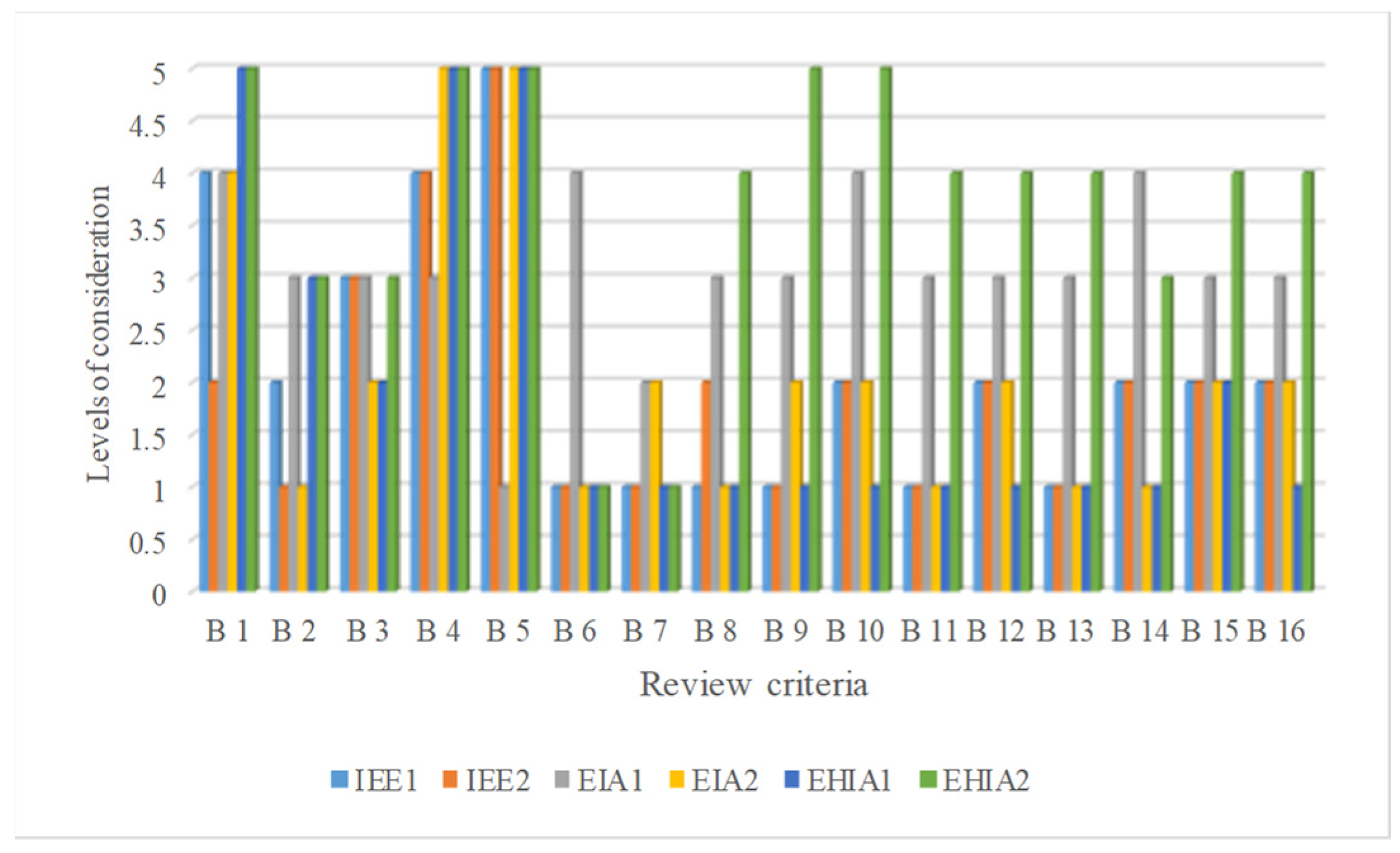
3.1.1. Baseline Study
| B1. To specify likely project alternatives |
| B2. To specify a flexible boundary area |
| B3. To consider the characteristics of the area and the appropriateness of conservation and development |
| B4. To consider land use |
| B5. To consider urban planning |
| B6. To consider international agreements |
| B7. To identify reasons to support the balance between environment and socio-economic indicators |
| B8. To consider the linkage between ecological and socio-economic factors |
| B9. To identify a specific ecological boundary |
| B10. To identify ecosystem types |
| B11. To present and review legislation related to biodiversity |
| B12. To consider a sensitive area for biodiversity |
| B13. To visit the study area based on the features of its biodiversity |
| B14. To detail the laws and regulations that contribute to sustainable development |
| B15. To integrate ecological, social, and economic data based on land use consideration |
| B16. To provide priority of supply and demand on the basis of baseline information |
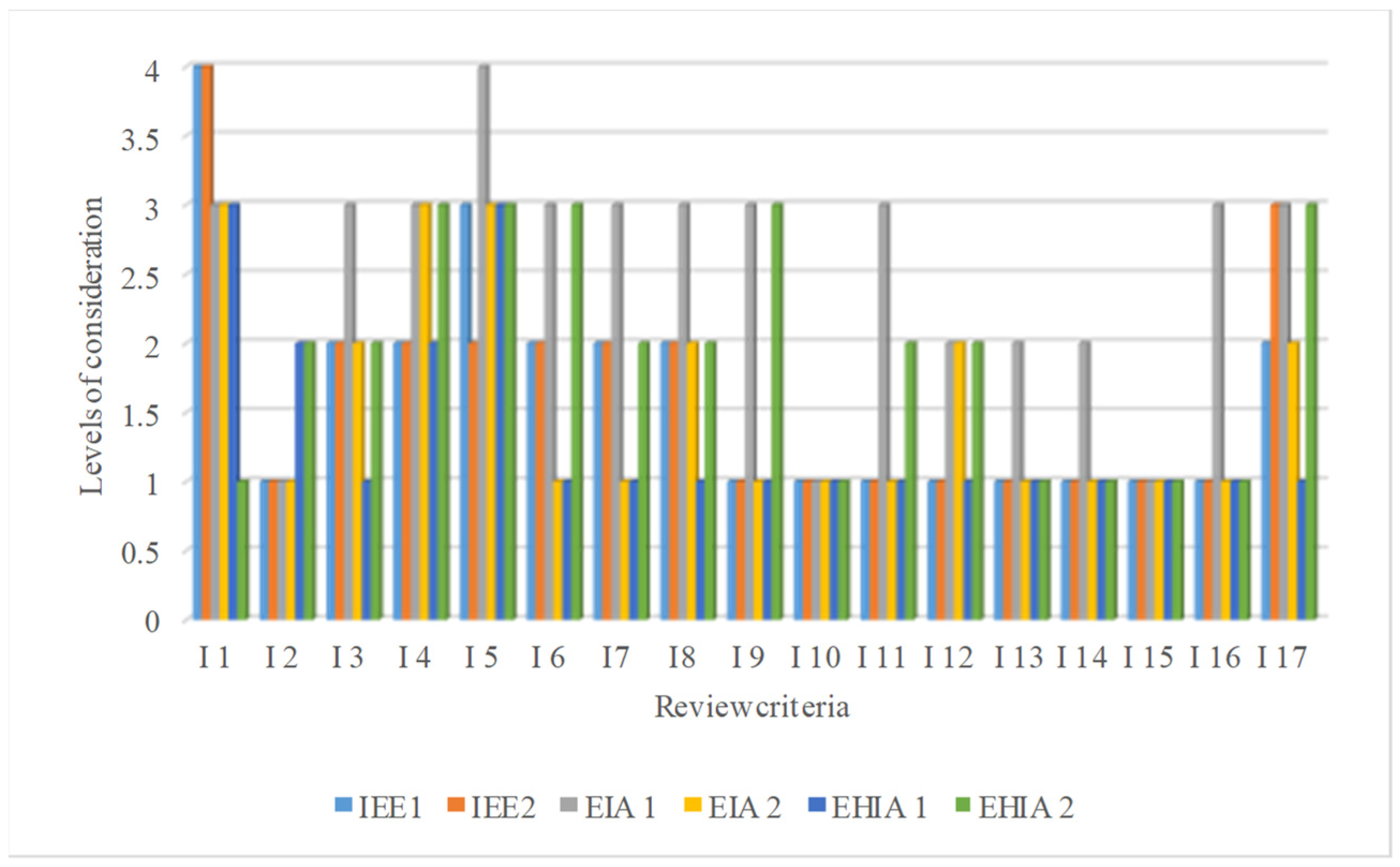
3.1.2. Impact Assessment
| I1. To assess the impact covered by a project’s life cycle |
| I2. To analyze project alternatives |
| I3. To assess impacts based on an ecological baseline |
| I4. To consider other sustainable components |
| I5. To cover all affected members of the public |
| I6. To clarify ecological impact identification |
| I7. To clarify ecological impact evaluation |
| I8. To analyze the ecological impact, focusing on the risk to ecosystems |
| I9. To assess the impact on qualitative biodiversity |
| I10. To assess the impact on quantitative biodiversity |
| I11. To assess the impact on the loss or gain of biodiversity |
| I12. To consider impact severity based on the sensitivity of biodiversity |
| I13. To consider impact severity based on the resilience of biodiversity |
| I14. To consider impact severity based on the recovery of biodiversity |
| I15. To assess residual and/or cumulative impacts |
| I16. To arrange the impact hierarchy on biodiversity |
| I17. To assess ecological aspects consistent with the project characteristics |
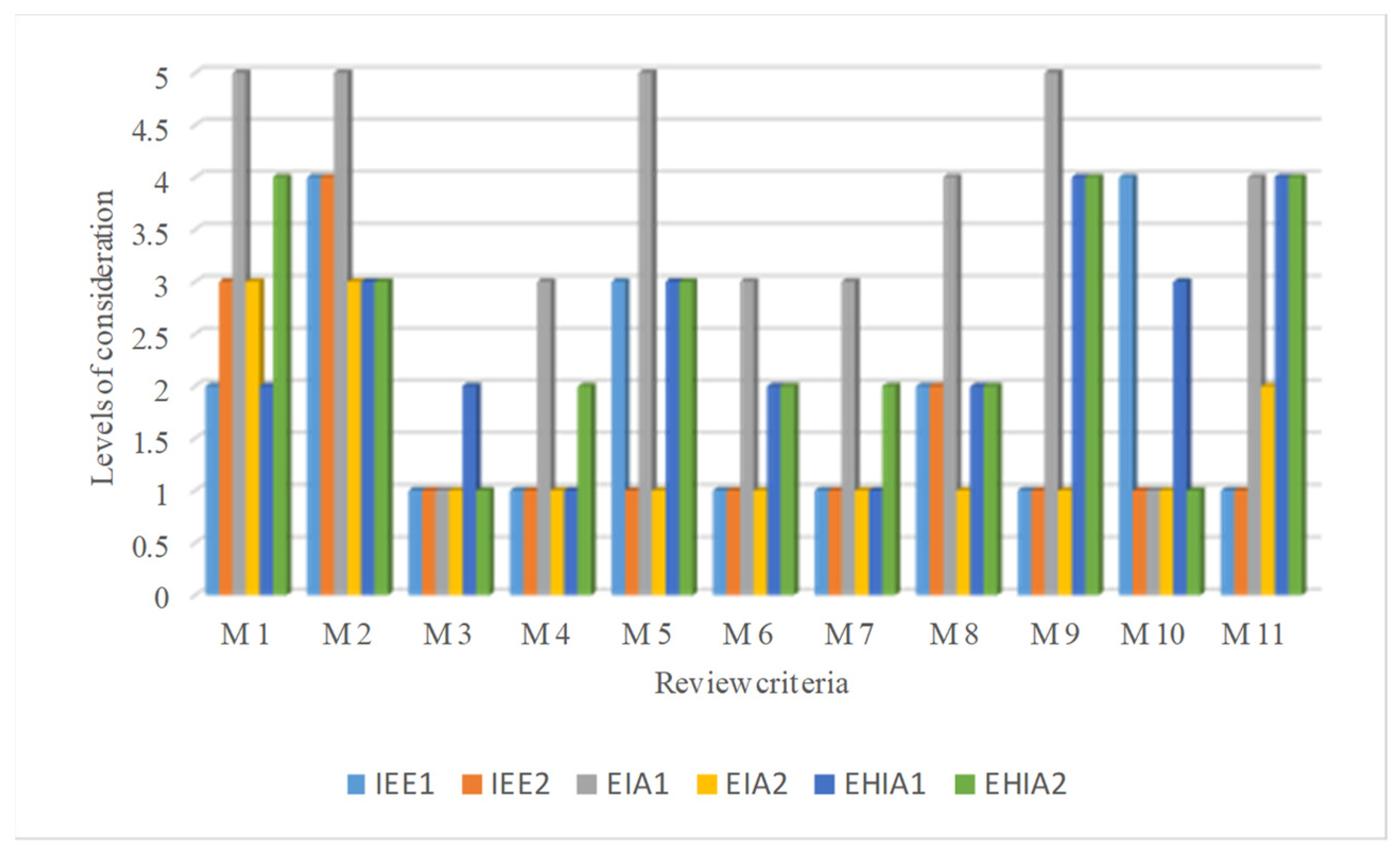
3.1.3. Mitigation and Monitoring Measures
| M1. To identify the measures based on survey data and public opinion |
| M2. To identify the measures agreed with the result of the impact assessment |
| M3. To consider alternative measures |
| M4. To identify mitigation of biodiversity losses |
| M5. To consider the residual impact |
| M6. To identify the compensation for the loss of biodiversity at the species to the ecosystem levels |
| M7. To consider the mitigation hierarchy |
| M8. To establish a compensation plan for ecosystems |
| M9. To provide an opportunity to enhance or change the mitigation measures |
| M10. To provide an opportunity to enhance or change the monitoring programs |
| M11. To consider the achievements of the measures |
3.2. Integration of Ecosystem Services in Environmental Impact Studies
4. Conclusions
Funding
Institutional Review Board Statement
Informed Consent Statement
Data Availability Statement
Acknowledgments
Conflicts of Interest
References
- Morrison-Saunders, A.; Pope, J.; Gunn, J.A.E.; Bond, A.; Retief, F. Strengthening impact assessment: A call for integration and focus. Impact Assess. Proj. Apprais. 2014, 32, 2–8. [Google Scholar] [CrossRef]
- Elvan, O.D. Analysis of environmental impact assessment practices and legislation in Turkey. Environ. Sci. Policy 2018, 84, 1–6. [Google Scholar] [CrossRef]
- Geneletti, D. Assessing the impact of alternative land-use zoning policies on future ecosystem services. Environ. Impact Assess. Rev. 2013, 40, 25–35. [Google Scholar] [CrossRef]
- Victor, D.; Agamuthu, P. Policy trends of strategic environmental assessment in Asia. Environ. Sci. Policy 2014, 41, 63–76. [Google Scholar] [CrossRef]
- Wathern, P. Ecological impact assessment. In Handbook of Environmental Impact Assessment; Wathern, P., Ed.; Blackwell Science: Oxford, UK, 1999; pp. 323–345. [Google Scholar]
- Höjer, M.; Ahlroth, S.; Dreborg, K.-H.; Ekvall, T.; Finnveden, G.; Hjelm, O.; Hochschorner, E.; Nilsson, M.; Palm, V. Scenarios in selected tools for environmental system analysis. J. Clean Prod. 2008, 16, 1958–1970. [Google Scholar] [CrossRef]
- Retief, F.; Bond, A.; Gunn, J.A.E.; Pope, J.; Morrison-Saunders, A. International perspectives on the strengthening of impact assessment through integration and focus. Impact Assess. Proj. Apprais. 2014, 32, 27–30. [Google Scholar] [CrossRef][Green Version]
- Finlayson, M.; Cruz, R.D.; Davidson, N.; Alder, J.; Cork, S.; De Groot, R.S.; Lévêque, C.; Milton, G.R.; Peterson, G.; Pritchard, D.; et al. Millennium Ecosystem Assessment. In Ecosystem and Human Well-Being: A Synthesis; Island Press: Washington, DC, USA, 2005. [Google Scholar]
- Potschin, M.; Haines-Young, R.; Fish, R.; Turner, R.K. Ecosystem services in the twenty-first century. In Routledge Handbook of Ecosystem Services; Potschin, M., Haines-Young, R., Fish, R., Turner, R.K., Eds.; Earthscan: Oxford, UK, 2016; pp. 1–9. [Google Scholar]
- Engel, D.; Evans, M.A.; Low, B.S.; Schaeffer, J. Understanding ecosystem services adoption by natural resource managers and research ecologists. J. Great Lakes Res. 2017, 43, 169–179. [Google Scholar] [CrossRef]
- Landsberg, F.; Ozment, S.; Stickler, M.; Henninger, N.; Treweek, J.; Venn, O.; Mock, G. Introduction and Guide to Scoping. In Ecosystem Services Review for Impact Assessment; World Resources Institute: Washington, DC, USA, 2016; Available online: www.wri.org (accessed on 4 July 2018).
- Costanza, R. Ecosystem services in theory and practice. In Routledge Handbook of Ecosystem Services; Potschin, M., Haines-Young, R., Fish, R., Turner, R.K., Eds.; Earthscan: Oxford, UK, 2016; pp. 15–24. [Google Scholar]
- Fürst, C.; Frank, S.; Inkoom, J.N. Managing regulating services for sustainability. In Routledge Handbook of Ecosystem Services; Potschin, M., Haines-Young, R., Fish, R., Turner, R.K., Eds.; Earthscan: Oxford, UK, 2016; pp. 328–342. [Google Scholar]
- Sanna, S.; Eja, P. Recreational, cultural ecosystem services: How do people describe the value? Ecosyst. Serv. 2017, 26, 1–9. [Google Scholar]
- Maron, M.; Mitchell, M.G.E.; Runting, R.K.; Rhodes, J.R.; Mace, G.M.; Keith, D.A.; Watson, J.E.M. Towards a threat assessment framework for ecosystem services. Trends Ecol. Evol. 2017, 32, 240–248. [Google Scholar] [CrossRef]
- Ingram, V.; Van Den Ber, J.; Van Oorschot, M.; Arets, E.; Judge, L. Governance options to enhance ecosystem services in cocoa, soy, tropical timber and palm oil value chains. Environ. Manag. 2018, 62, 128. [Google Scholar] [CrossRef]
- Atun, A.; Nafa, H.; Türker, Ö.O. Envisaging sustainable rural development through context-dependent tourism: A case of Northern Cyprus. Environ. Dev. Sustain. 2018, 21, 1715–1744. [Google Scholar] [CrossRef]
- Balvanera, P.; Quijas, S.; Martin-Lόpez, B.; Barrios, E.; Dee, L.; Isbell, F.; Durance, I.; White, P.; de Groot, R. The links between biodiversity and ecosystem services. In Routledge Handbook of Ecosystem Services; Potschin, M., Haines-Young, R., Fish, R., Turner, R.K., Eds.; Earthscan: Oxford, UK, 2016; pp. 45–61. [Google Scholar]
- United Nations (UN). Rio Declaration on Environment and Development. In Proceedings of the UN Conference on Environment and Development 1992, Rio de Janeiro, Brazil, 3–14 June 1992; Available online: www.un.org/documets/ga/conf151/aconf15126-1annex1.htm (accessed on 3 September 2018).
- Swangjang, K. Comparative review of EIA in the Association of Southeast Asian Nations. Environ. Impact Assess. Rev. 2018, 78, 33–42. [Google Scholar] [CrossRef]
- Meylan, L.; Gary, C.; Allinne, C.; Ortiz, J.; Jackson, L. Evaluating the effect of shade trees on the provision of ecosystem services in intensively managed coffee plantations. Agric. Ecosyst. Environ. 2017, 245, 32–42. [Google Scholar] [CrossRef]
- Cruz-Garcia, G.; Sachet, E.; Blundo-Canto, G.; Vanegas, M.; Quintero, M. To what extent have the link between ecosystem services and human well-being has been researched in Africa, Asia, and Latin America? Ecosyst. Serv. 2017, 25, 201–212. [Google Scholar] [CrossRef]
- McDonough, K.; Hutchinson, S.; Moore, S.T.; Shawn Hutchinson, J.M. Analysis of publication trends in ecosystem services research. Ecosyst. Serv. 2017, 25, 82–88. [Google Scholar] [CrossRef]
- Lerouge, F.; Gulinck, H.; Vranken, L. Valuing ecosystem services to explore scenarios for adaptive spatial planning. Ecol. Indic. 2017, 81, 30–40. [Google Scholar] [CrossRef]
- Bouwma, I.; Schleyer, C.; Primmer, E.; Winkler, K.J.; Berry, P.; Young, J.; Carmen, E.; Špulerová, J.; Bezák, P.; Preda, E.; et al. Adopting of the ecosystem services concept in EU policies. Ecosyst. Serv. 2018, 29, 213–222. [Google Scholar] [CrossRef]
- Karjalainen, T.P.; Marttunen, M.; Sarkki, S.; Rytkonen, A.M. Integrating ecosystem services into environmental impact assessment: An analytic-deliberative approach. Environ. Impact Assess. Rev. 2013, 40, 54–64. [Google Scholar] [CrossRef]
- Honrado, J.P.; Vieira, C.; Soares, C.; Monteiro, M.B.; Marcos, B.; Pereira, H.M.; Partidario, M.R. Can we infer about ecosystem services from EIA and SEA practice? A framework for analysis and examples from Portugal. Environ. Impact Assess. Rev. 2013, 40, 14–24. [Google Scholar] [CrossRef]
- Tallis, H.; Kennedy, C.M.; Ruckelshaus, M.; Goldstein, J.; Kiesecker, J.M. Mitigation for one & all: An integrated framework for mitigation of development impacts on biodiversity and ecosystem services. Environ. Impact Assess. Rev. 2015, 55, 21–34. [Google Scholar]
- Baker, J.; Sheate, W.R.; Phillips, P.; Eales, R. Ecosystem services in environmental assessment—Help or hindrance? Environ. Impact Assess. Rev. 2013, 40, 3–13. [Google Scholar] [CrossRef]
- Rosa, J.C.S.; Sánchez, L.E. Advances and challenges of incorporating ecosystem services into impact assessment. J. Environ. Manag. 2016, 180, 485–492. [Google Scholar] [CrossRef] [PubMed]
- Karlson, M.; Mörberg, U.; Balfors, B. Road ecology in environmental impact assessment. Environ. Impact Assess. Rev. 2014, 48, 10–19. [Google Scholar] [CrossRef]
- Brander, L.M.; Wagtendonk, A.J.; Hussain, S.S.; McVittie, A.; Verburg, P.H.; de Groot, R.S.; van der Ploeg, S. Ecosystem service values for mangroves in Southeast Asia: A meta-analysis and value transfer application. Ecosyst. Serv. 2012, 1, 62–69. [Google Scholar] [CrossRef]
- Menéndez, P.; Losada, I.J.; Beck, M.W.; Torres-Ortega, S.; Espejo, A.; Narayan, S.; Díaz-Simal, P.; Lange, G.M. Valuing the protection services of mangroves at national scale: The Philippines. Ecosyst. Serv. 2018, 34, 24–36. [Google Scholar] [CrossRef]
- Rasmussen, L.V.; Mertz, O.; Christenzen, A.E.; Danielsen, F.; Dawson, N.; Xaydongvah, P. A combination methods needed to assess the actual use of provisioning ecosystem services. Ecosyst. Serv. 2016, 17, 75–86. [Google Scholar] [CrossRef]
- Leimona, B.; Noordwijk, M.; de Groot, R.; Leemans, R. Fairly efficient, efficiently fair: Lessons from designing and testing payment schemes for ecosystem services in Asia. Ecosyst. Serv. 2015, 12, 16–28. [Google Scholar] [CrossRef]
- Kibria, A.S.M.G.; Behie, A.; Costanza, R.; Groves, C.; Farrell, T. The value of ecosystem services obtained from the protected forest of Cambodia: The case of Veun Sai-Siam Pang National Park. Ecosyst. Serv. 2017, 26, 27–36. [Google Scholar] [CrossRef]
- Intralawan, A.; Wood, D.; Frankel, R.; Costanza, R.; Kubiszewski, I. Tradeoff analysis between electricity generation and ecosystem services in the Lower Mekong Basin. Ecosyst. Serv. 2018, 30, 27–35. [Google Scholar] [CrossRef]
- Shoyoma, K.; Kamiyama, C.; Morimoto, J.; Ooba, M.; Okuro, T. A review of modeling approaches for ecosystem services assessment in the Asian region. Ecosyst. Serv. 2017, 26, 316–328. [Google Scholar] [CrossRef]
- Abcede, R., Jr.; Gera, W. Examining the coherence of legal frameworks for ecosystem services toward sustainable mineral development in the Association of Southeast Asian Nations. Ecosyst. Serv. 2018, 29, 228–239. [Google Scholar] [CrossRef]
- Drayson, K.; Wood, G.; Thompson, S. Assessing the quality of the ecological component of English Environmental Statements. J. Environ. Manag. 2015, 160, 241–253. [Google Scholar] [CrossRef]
- Office of the National Economic and Social Development. The 11th Nation Economic and Social Development Plan 2012–2016. Bangkok Thailand (In Thai). Available online: http://www.nesdb.go.th (accessed on 24 December 2019).
- Office of the National Economic and Social Development. The 12th Nation Economic and Social Development Plan 2017–2021. Bangkok Thailand (In Thai). Available online: http://www.nesdb.go.th (accessed on 24 December 2019).
- Office of Natural Resources and Environmental Policy and Planning. Government Gazettea: Project Types and Sizes Required Environmental Impact Assessment. Number 136 Section 3 on 4 January 2562. Bangkok Thailand (In Thai). Available online: http://www.onep.go.th (accessed on 24 December 2019).
- Office of Natural Resources and Environmental Policy and Planning. Government Gazette: Guideline for Environmental Impact Assessment of Projects Located in Protected Area. Number 135 Section 39 on 21 February 2562. Bangkok Thailand (In Thai). Available online: http://www.onep.go.th (accessed on 24 December 2019).
- Office of Natural Resources and Environmental Policy and Planning. Government. Gazetteb: Public Participation in the Stage of Environmental Impact Assessment. Number 136 Section 36 on 8 February 2562. Bangkok Thailand (In Thai). Available online: http://www.onep.go.th (accessed on 24 December 2019).
- Lee, N.; Colley, R. Reviewing the Quality of Environmental Statements; Occasional Paper No.24; EIA Centre, University of Manchester: Manchester, UK, 1990. [Google Scholar]
- Swangjang, K.; Wathern, P.; Rochanaburanon, T. Ecological issues in Thai environmental assessment scoping guidance. Impact Assess. Proj. Apprais. 2004, 22, 271–281. [Google Scholar] [CrossRef][Green Version]
- Wood, C.; Lee, N.; Jones, C.E. Environmental statement in the United Kingdom: The initial experience. Proj. Apprais. 1991, 6, 187–194. [Google Scholar] [CrossRef][Green Version]
- Lee, N.; Dancey, R. The quality of environmental impact statements in Ireland and the United Kingdom: A comparative analysis. Proj. Apprais. 1993, 8, 31–36. [Google Scholar] [CrossRef]
- Maquire, D. A Review of All EISs Submitted for Marina Development, since July 1988: A Case Study of Malahide Marina. Master Dissertation, St.Patrick’s College, Maynooth, UK, 1994. [Google Scholar]
- O’Shea, A. The Quality of Environmental Impact Statements: A Review of those Submitted in Ireland in 1992. Master Dissertation, University of Dublin, Dublin, UK, 1994. [Google Scholar]
- McGraph, C.; Bond, A.J. The quality of an environmental impact statement: A review of those submitted in Cork, Eire from 1988–1993. Proj. Apprais. 1997, 12, 43–52. [Google Scholar] [CrossRef]
- Kanokporn, K.; Iamaram, V. Ecological impact assessment, conceptual approach for better outcomes. Int. J. Environ. Res. 2011, 5, 435–446. [Google Scholar]
- Chanchitpricha, C.; Bond, A. Conceptualizing the effectiveness of impact assessment process. Environ. Impact Assess. Rev. 2013, 43, 65–72. [Google Scholar] [CrossRef]
- Eccleston, C.H. The EIS Book: Managing and Preparing Environmental Impact Statements; Taylor&Francis: Boca Raton, FL, USA, 2014. [Google Scholar]
- Rosa, J.; Novachi, L.E.; Sanchez, L.E. Offsetting and compensating biodiversity and ecosystem services losses in mining. In Proceedings of the Annual Conference of the International Association for Impact Assessment, Nagoya, Japan, 11–14 May 2016. [Google Scholar]
- Baresi, U.; Vella, K.J.; Sipe, N.G. SEA integration in sustainable planning frameworks. In Proceedings of the Annual Conference of the International Association for Impact Assessment, Nagoya, Japan, 11–14 May 2016. [Google Scholar]
- Phuc, P. Mainstream biodiversity consideration in the Vietnam environment country safeguard. In Proceedings of the Annual Conference of the International Association for Impact Assessment, Nagoya, Japan, 11–14 May 2016. [Google Scholar]
- Geneletti, D. Strengthening biodiversity and ecosystem services in impact assessment for better decisions. In Routledge Handbook of Ecosystem Services; Potschin, M., Haines-Young, R., Fish, R., Turner, R.K., Eds.; Earthscan: Oxford, UK, 2016; pp. 477–485. [Google Scholar]
- Brownlie, S.; Treweek, J. Biodiversity and Ecosystem Services in Impact Assessment; Special publication Series No.3 Fargo; International Association for Impact Assessment: Fargo, ND, USA, 2018; Available online: www.iaia.org (accessed on 12 April 2022).
- Sadler, B.; Brown, K.; Senécal, P.; Goldsmith, B.; Conover, S. Principles of Environmental Impact Assessment Best Practice; International Association for Impact Assessment and Institute of Environmental Assessment: London, UK, 1999; Available online: http://www.iaia.org (accessed on 12 April 2022).
- Dunster, J.A. Assessing the sustainability of Canadian forest management: Progress or procrastination. Environ. Impact Assess. Rev. 1992, 12, 67–84. [Google Scholar] [CrossRef]
- Mandle, L.; Tallis, H. Spatial ecosystem service analysis for environmental impact assessment of projects. In Routledge Handbook of Ecosystem Services; Potschin, M., Haines-Young, R., Fish, R., Turner, R.K., Eds.; Earthscan: Oxford, UK, 2016; pp. 15–40. [Google Scholar]
- Callesen, I. Biodiversiy and ecosystem services in life cycle impact assessment-inventory objects or impact categories? Ecosyst. Serv. 2016, 22, 94–103. [Google Scholar] [CrossRef]
- Paetzold, A.; Warren, P.H.; Maltby, L.L. A framework for assessing ecological quality based on ecosystem services. Ecol. Complex. 2010, 7, 273–281. [Google Scholar] [CrossRef]
- De Groot, R.S.; Alkemade, R.; Braat, L.; Hien, L.; Willemen, L. Challenges in integrating the concept of ecosystem services and values in landscape planning, management and decision making. Ecol. Complex. 2010, 7, 260–272. [Google Scholar] [CrossRef]
- Swangjang, K.; Cumkhet, C. Mitigation hierarchy; an effectiveness of project control mechanism. In Handbook of Advanced Approaches towards Pollution Prevention and Control; Rahman, R.O., Hussain, C.M., Eds.; Elsevier: Chennai, India, 2021; Volume 1, pp. 325–342. [Google Scholar]
- Souza, B.A.; Rosa, J.C.S.; Siqueira-Gay, J.; Sánchez, L.E. Mitigating impacts on ecosystem services requires more than biodiversity offsets. Land Use Policy 2021, 105, 105393. [Google Scholar] [CrossRef]
- Eales, R.; Sheate, W.R. Effectiveness of policy level environmental and sustainability assessment: Challenges and lessons from recent practice. J. Environ. Assess. Policy Manag. 2011, 12, 39–65. [Google Scholar] [CrossRef]
- Yamuara, K.; Sakaue, S.; Washida, S. An assessment of global warming and biodiversity: CGE EMEDA analyses. Environ. Econ. Policy Stud. 2016, 19, 405–426. [Google Scholar] [CrossRef]
- Huge, J.; Rochette, A.J.; de Bisthoven, L.J.; Dahdouh-Guebas, F.; Koedam, N.; Vanhove, M.P.M. Utilitarian framing of biodiversity shape environmental impact assessment in developing cooperation. Environ. Sci. Policy 2017, 75, 91–102. [Google Scholar] [CrossRef]
- Mörtberg, U.M.; Balfors Knol, W.C. Landscape ecological assessment: A tool for integrating biodiversity issues in strategic environmental assessment. J. Environ. Manag. 2007, 82, 457–470. [Google Scholar] [CrossRef]
- Briggs, S.; Hudson, M.D. Determination of significance in ecological impact assessment: Past change, current practice and future improvement. Environ. Impact Assess. Rev. 2013, 38, 16–25. [Google Scholar] [CrossRef]
- Geneletti, D. Some common shortcomings in the treatment of impacts of linear infrastructures on natural habitat. Environ. Impact Assess. Rev. 2006, 26, 257–267. [Google Scholar] [CrossRef]
- Sirami, C.; Brotons, L.; Burfield, I.; Fonderflick, J.; Martin, J.L. Is land abandonment having an impact on biodiversity? A meta-analytical approach to bird distribution changes in the north-western Mediterranean. Biol. Conserv. 2007, 141, 450–459. [Google Scholar] [CrossRef]
- Gontier, M. Scale issue in the assessment of ecological impacts using a GIS-based habitat model- A case study for the Stockholm region. Environ. Impact Assess. Rev. 2007, 27, 440–459. [Google Scholar] [CrossRef]
- Brownlie, S.; Treweek, J. Biodiversity offsets for no net loss through impact assessment. In Routledge Handbook of Ecosystem Services; Potschin, M., Haines-Young, R., Fish, R., Turner, R.K., Eds.; Earthscan: Oxford, UK, 2016; pp. 364–396. [Google Scholar]
- Villarroya, A.; Puig, J. Ecological compensation and impact assessment in Spain. Environ. Impact Assess. Rev. 2010, 30, 357–362. [Google Scholar] [CrossRef]
- Chaisomphob, T.; Sa-Nguanmanasak, J.; Swangjang, K. Role of public participation in planning power plant projects in Thailand. Sci. Technol. Asia. 2004, 9, 67–73. [Google Scholar]
- United Nations (UN). The 2030 Agenda for Sustainable Development. Available online: http://www.un.org/documets/ga/conf151/aconf15126-1annex1.htm (accessed on 20 October 2019).
- Roe, D.; Geneletti, D. Addressing the interactions between biodiversity conservation and poverty alleviation in impact assessment. In Routledge Handbook of Ecosystem Services; Potschin, M., Haines-Young, R., Fish, R., Turner, R.K., Eds.; Earthscan: Oxford, UK, 2016; pp. 347–363. [Google Scholar]
- Baird, M. Environmental Impact Assessment in Southeast Asia. Available online: http://www.boell.de (accessed on 12 April 2022).
- The Association of Southeast Asian Nations (ASEAN). ASEAN Socio-Cultural Community Blueprint 2025. Available online: www.asean.org (accessed on 12 April 2022).
- The Association of Southeast Asian Nations (ASEAN). ASEAN a Community of Opportunities. Available online: http://www.asean.org (accessed on 15 April 2020).



| Issues | IEE | EIA | EHIA |
|---|---|---|---|
| Legal enforcement | NEQA * since the 1992 Government Gazette | NEQA since 1975 | Constitution of the Kingdom, since 2007 |
| The number of projects required (as of 2022) | 2 projects 1 and 10 projects in protected areas 2 | 35 projects and 3 projects in protected areas | 11 projects and not allowed in protected areas |
| Project significance | Moderate impact | Moderate to high impact | The greatest impact |
| Public participation 3 (as of 2022) | One time During an EIA study | Two times During scoping and drafting of the final document | Three times During scoping, EIA study, and drafting of the final document |
| EISs | Consulting Firm * | Project Type | Project Size | Year |
|---|---|---|---|---|
| IEE1 | A | Condominium | 32 rooms within a protected area | 2016 |
| IEE2 | B | Housing | 1.6 hectares | 2016 |
| EIA1 | C | Petroleum exploration | An area of 2-km radius | 2007 |
| EIA2 | B | Condominium | 70 rooms within a protected area | 2016 |
| EHIA1 | D | Petrochemical | Product expansion to 90,000 tons/year | 2012 |
| EHIA2 | D | Battery factory | >10 tons/day | 2016 |
| Stage of an EIA Study | Criteria Topics | Codes for the Criteria |
|---|---|---|
| Baseline study | Sufficiency of baseline data | B1–6 |
| Provide a framework for ES | B7–8, 13–14 | |
| Content support for ES | B9–16 | |
| Impact assessment | Sufficiency for impact assessment | I1–5 |
| Content support loss/gain in an ecosystem | I9–11 | |
| Content support for ES | I6–17 | |
| Linkage to ES compensation | I15–17 | |
| Mitigation monitoring | Sufficiency for mitigation/monitoring | M1–3, 9–11 |
| Provision of a linkage to ES | M4–5 | |
| Mitigation/monitoring support for ES | M6–8 |
| Level | Criteria | Detailed Response |
|---|---|---|
| 5 | Complete | Provided complete information about issues related to the set criteria; no further supporting information necessary |
| 4 | Sufficient | Provided sufficient information, only minor information required for more completeness |
| 3 | Adequate | Provided details related to the set criteria; lacked some important information |
| 2 | Inadequate | Only provided general details with no responses to the set criteria |
| 1 | Deficient | Missing details in a particular category |
| Opportunities | Barriers | Approach to Integrate ES in EIA Studies |
|---|---|---|
| Baseline description(project description and existing environment) | ||
|
|
|
| Impact assessment | ||
|
|
|
| Mitigation and monitoring measures | ||
|
|
|
Publisher’s Note: MDPI stays neutral with regard to jurisdictional claims in published maps and institutional affiliations. |
© 2022 by the author. Licensee MDPI, Basel, Switzerland. This article is an open access article distributed under the terms and conditions of the Creative Commons Attribution (CC BY) license (https://creativecommons.org/licenses/by/4.0/).
Share and Cite
Swangjang, K. Linkage of Sustainability to Environmental Impact Assessment Using the Concept of Ecosystem Services: Lessons from Thailand. Sustainability 2022, 14, 5487. https://doi.org/10.3390/su14095487
Swangjang K. Linkage of Sustainability to Environmental Impact Assessment Using the Concept of Ecosystem Services: Lessons from Thailand. Sustainability. 2022; 14(9):5487. https://doi.org/10.3390/su14095487
Chicago/Turabian StyleSwangjang, Kanokporn. 2022. "Linkage of Sustainability to Environmental Impact Assessment Using the Concept of Ecosystem Services: Lessons from Thailand" Sustainability 14, no. 9: 5487. https://doi.org/10.3390/su14095487
APA StyleSwangjang, K. (2022). Linkage of Sustainability to Environmental Impact Assessment Using the Concept of Ecosystem Services: Lessons from Thailand. Sustainability, 14(9), 5487. https://doi.org/10.3390/su14095487