


Sustainable Inventory Management in Supply Chains: Trends and Further Research




Abstract
:1. Introduction
2. Review Methodology
3. Literature Review

| Reference | SC Structure | Environmental Approach | Problem Type | Model Approach | Solution Approach |
|---|---|---|---|---|---|
| Arikan et al. [1] | SE | R6 | I | S | SS |
| Battini et al. [3] | N | R6 | I | EOQ | H |
| Chen et al. [4] | CJ | R6 | I | MP | M |
| Fichtinger et al. [5] | U | R6 | I | S | SS |
| Ali et al. [14] | RL | R1, R2, R3 | I | MP | E |
| Nativi and Lee [15] | RL | R1 | I | R | ST |
| Ivanov [16] | N | R6 | L | MP | E |
| Ganev et al. [17] | N | R4 | L-I-R | MP | E |
| Dekker et al. [18] | D | R6 | I-R | S-C | SS |
| Tsolakis and Srai [19] | U | R4 | I | S | SS |
| Halat and Hafezalkotob [20] | CJ | R6 | I | MP | E |
| Al-Haidous et al. [21] | N | R6 | I-R | MP | M |
| Žic and Žic [22] | SE | R6 | I | S | SS |
| Amer et al. [23] | N | R6 | I-R | S | SS |
| Mohammadnazari and Ghannadpour [24] | C | R6 | I-R | MP | E |
| Zhang et al. [25] | C | R6 | L-I-R | MP | E |
| Sun et al. [26] | N | R6 | L-I-R | MP | E |
| Ching et al. [27] | D | R6 | I | S | SS |
| Paam et al. [28] | D | R6 | I | MP | E |
| Wang et al. [29] | CJ | R6 | I-R | MP | M |
| Nikolopoulou and Ierapetritou [30] | U | R1, R2, R3, R4, R6 | L-I-R | MP-C | E-H |
| Bostel et al. [31] | RL | R1, R2, R3, R5 | L-I-R | MP-S | E-H-SS |
| Kuo [32] | CL | R3 | I | S | SS |
| Calmon and Graves [33] | CL | R3, R5 | I | MP-S | M |
| Guo et al. [34] | CL | R2, R3 | L-I | MP | M |
| Tighazoui et al. [35] | RL | R3 | I-R | S | M |
| Ross et al. [36] | CL | R2 | I | S-R | ST |
| Yang et al. [37] | CL | R2 | I | MP | M |
| Zhang et al. [38] | C | R4 | L-I-R | S | SS |
| Yılmaz Balaman and Selim [39] | CJ | R4 | L-I-R | MP | E |
| Pati et al. [40] | RL | R1 | I-R | MP | E |
| Ahmadini et al. [41] | SE | R6 | I | MP | E-H |
| Rout et al. [42] | D | R6 | I-R | MP | H |
| Tavana et al. [43] | N | R6 | L-I-R | MP | E |
| Ugarte et al. [44] | D | R6 | I-R | S | SS |
| Takeda et al. [45] | D | R6 | I | S | SS |
4. Discussion
5. Conclusions
Author Contributions
Funding
Institutional Review Board Statement
Informed Consent Statement
Conflicts of Interest
Appendix A
Appendix A.1. Distribution of Reviewed Publications Per Journal
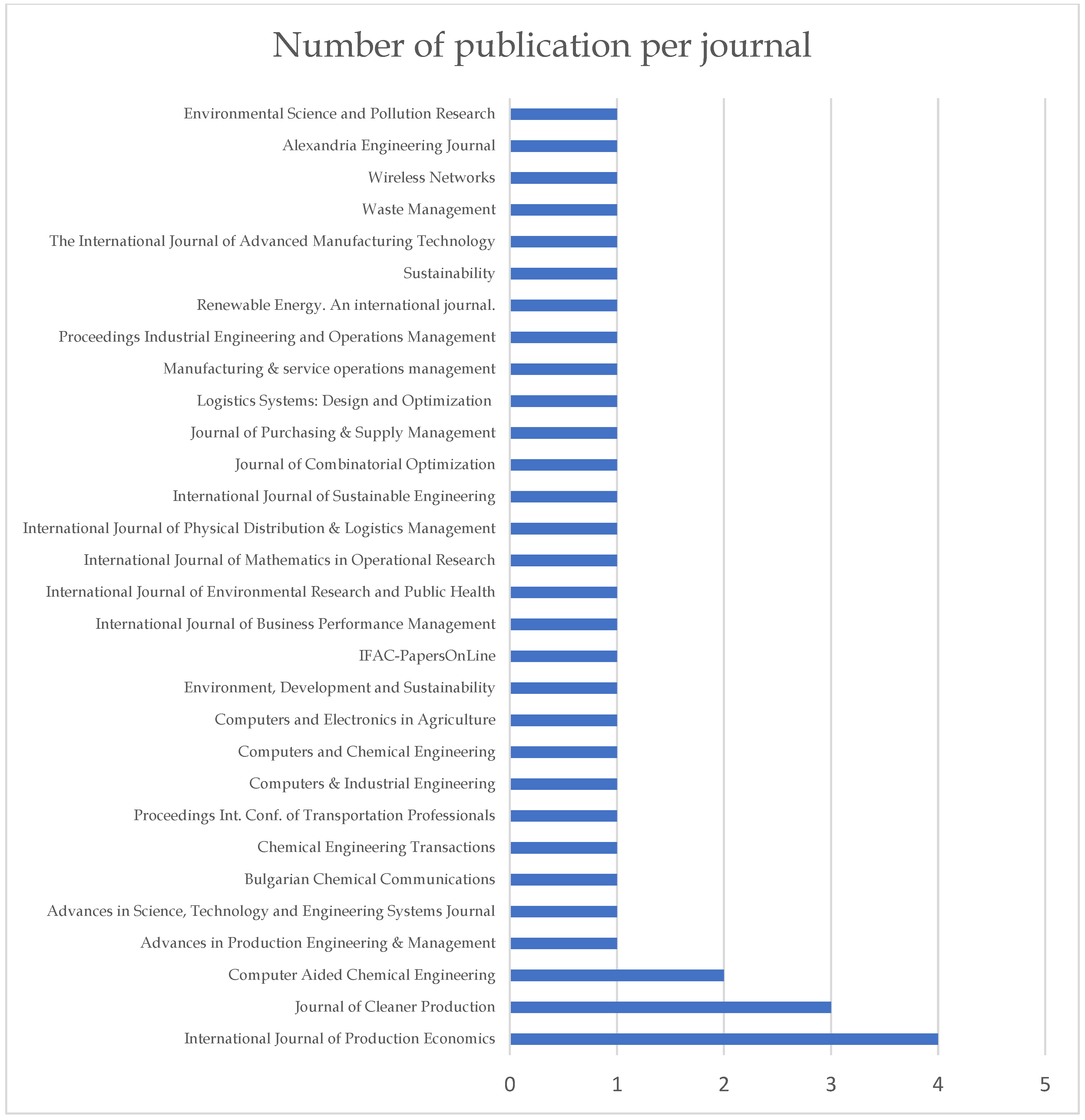
Appendix A.2. Sustainability Aspects, Research Methodology, Objectives and Proposed Further Research Per Article
| Reference | Sustainability Aspects | Research Methodology | Objective | Proposed Further Research | ||
|---|---|---|---|---|---|---|
| EC | EN | S | ||||
| Pati et al. [40] | X | X | Empirical | Formulate a linear analytical model which minimises the total reverse logistics costs for multivariety recycled waste reverse logistics systems (RWRLS) subjected to constraints that take into account various internal and external factors that affect RWRLS. | Formulate a cost optimization model that considers the impact of various government regulations on the recycling industry. | |
| Bostel et al. [31] | X | X | Conceptual | Review the applications, case studies, models and techniques proposed for the design, planning and optimization of reverse logistics systems. | There is a growing need for models to integrate all relevant factors, i.e., inventory management, production or disassembly activities, as well as transport activities, for collection or distribution planning. There is also a need for specialized models adapted to realistic specific cases. Regarding strategic models, the data of the return flows and models should, therefore, incorporate stochastic features or be robust for the uncertainty of the supply of return products. | |
| Dekker et al. [18] | X | Empirical | Determine with a simulation experiment what strategy is the most efficient one of the proposed strategies in the inventory management area by considering the use of temporary storage offered by intermodal transhipment points to position some stock of fast-moving consumer goods in advance of demand. | Apply floating-stock requires batch production, a somewhat predictable demand (in volume terms), containerised transport and a standardised product mix. | ||
| Ross et al. [36] | X | X | Exploratory cross-sectional | Develop managerial insights related to the management and repositioning of the empty reusable container inventory. | Address the container supply risk issue at all three types of port operations. This approach would examine variations in container ability with a view to minimize variation in container overstock and shortage. | |
| Kuo [32] | X | X | Empirical | Simulate and construct a manufacturing/remanufacturing model by means of different inventory management strategies and variables. | The lean principle, material requirement planning in remanufacturing and forecasting in remanufacturing could be used to revise this research model. The satisfaction between customer and remanufacturer could also be studied. | |
| Nativi and Lee [15] | X | X | Exploratory cross-sectional | Investigate how Radio Frequency Identification information-sharing can help SCs that use reverse logistics to increase environmental and economic benefits through more coordinated inventory management. | An adaptive information-sharing policy must be proposed to remain economically beneficial when drastic changes in the SC configuration occur. Study how the government’s role affects players’ economic performance. Government regulations can also help to motivate manufacturers, suppliers and third-party collectors to increase returns, but it is necessary to identify how incentives or penalties are assigned to achieve the best system improvement. | |
| Zhang et al. [38] | X | X | Empirical | Develop a simulation model for SC management to include the selection of the optimal biofuel facility location, logistics design, inventory management and information exchange. | Refine the model to incorporate data uncertainty and model uncertainty, and also include inventory holding costs. | |
| Nikolopoulou and Ierapetritou [30] | X | X | X | Conceptual | Review research on sustainable chemical processes and SC, and identify the emerging challenges and future opportunities in this area. | Develop stochastic methods capable of capturing uncertainty effects. Define an appropriate performance measure for the accurate and efficient assessment of network operations to devise new modeling systems and solution techniques for SCM. Examine integrated methodologies by combining two sustainable approaches or more (e.g., inventory management, production planning, product recovery, etc.) |
| Arikan et al. [1] | X | X | Empirical | Analyze a serial inventory system through the indirect effect of transport lead time variability with the replenishment policy on SCs economic and environmental performance. | Consider more SC levels and include the potential variability at different echelons. Production lead time at the supplier site and the transportation time on road/rail from the supplier to the port, and from the central warehouse to further stocking points and customers, are potential causes of variability and inefficiency in the SC. Moreover, study the consideration of different transportation modes and the combination in intermodal logistics networks. | |
| Zhang et al. [25] | X | X | Empirical | Develop a multi-echelon multiperiod solid waste management system by inoculating with multi-echelon SCs to minimize the system cost with cost-effective allocations of waste flows and disposal rates at waste management facilities. | Integrate either interval programming to deal with uncertain data or integer programming to plan the capacity expansion problem of disposal facilities, transportation load or inventory. Design a multiwaste, multi-echelon, multi-uncertainty SC of the waste management network. | |
| Battini et al. [3] | X | X | X | Empirical | Propose a new easy-to-use theoretical model to calculate a sustainable EOQ, called S-EOQ, and study S-EOQ compared to the traditional approach (EOQ). | Study the trade-off between costs and emissions by analyzing the influence of changes in a set of key parameters. Apply an integrated point of view to the sustainable lot sizing problem, in which the whole SC is involved in sharing costs (and not only one firm). |
| Fichtinger et al. [5] | X | X | Empirical | Build an integrated simulation model to examine the interaction between inventory and warehouse management. Highlight the key effects of inventory management on warehouse-related greenhouse gas emissions. | Consider variable and fixed costs of operating warehouses in a joint inventory and warehouse cost optimization problem. Analyze the integrated warehouse and inventory management in a larger SC context by contemplating the total landed cost, including manufacturing and transport costs. Work in a sustainable warehouse management by integrating economic, social and environmental goals. Increase the efficiency of inventory management and warehousing processes to reduce their environmental impact and to contemplate worker welfare, job satisfaction and occupational safety. | |
| Ugarte et al. [44] | X | Empirical | Quantify the difference in greenhouse gas emissions between a traditional EOQ inventory policy and each lean-oriented inventory management practice. | Study fundamental impacts, such as the water footprint of lean practices, from an international stand point. | ||
| Yılmaz Balaman and Selim [39] | X | X | Empirical | Develop a decision model for the sustainable design of biomass based on renewable energy SCs and district heating systems (DHS) with thermal energy storages. The model integrates strategic decisions, such as location and capacity selection for energy plants, DHS, thermal storages and biomass storages, with tactical decisions related to biomass production, supply and transportation planning, inventory management and energy production. | Develop a model to handle bioenergy SC design problems in various regions with different types of feedstock and transportation modes. Include the additional case-specific constraints required by the problem. | |
| Calmon and Graves [33] | X | Empirical | Describe, model and optimize inventory in a reverse logistics system that supports warranty returns and replacements for a consumer electronic device. | Extend the modeling and analysis to relax the assumption that the price at which refurbished devices can be sold in a side channel is nonincreasing. | ||
| Tsolakis and Srai [19] | X | X | X | Empirical | Develop a system dynamics model to investigate inventory planning and control operations of crude sulfate turpentine as the source of renewable terpenoid feedstocks, and ‘green’ paracetamol as the commercial medication, to support the design of SC operations for the emerging bio-based chemicals market. | Promote effective operations management research about ‘green’ medications and outline robust policy-making interventions. |
| Takeda Berger et al. [45] | X | Empirical | Simulate different inventory management strategies for finished products in a supplier-customer relationship in a lean SCM environment. | Develop a model that contemplates variability in transportation time, loading and unloading times and truck capacity. Explore the model’s influence on the involved costs by quantifying the impact of lead time and service level. | ||
| Ivanov [16] | X | X | X | Empirical | Design optimal integrated bioethanol SCs for waste management in the biofuel production and usage process. | Incorporate uncertainty into demand, production and harvesting parameters. |
| Amer et al. [23] | X | X | X | Empirical | Develop a simulation model of a two-echelon real-life SC to study the effect of changing the order quantity with uncertain demand and lead time on a set of economic, social and environmental performance measures. | Study the effect of different transportation modes, or multimodal, on SC sustainability, as well as the effect of distinct water transportation types of either container shipment or reefer shipment on performance. |
| Sun et al. [26] | X | X | Empirical | Propose an optimization model to minimize the total cost formula for a location-inventory-routing problem by considering food waste and fuel consumption. | Develop an efficient heuristic algorithm to handle middle-scale and large-scale instances to use multiple products and to vary shelf lifetimes for perishable products. | |
| Yang et al. [37] | X | X | Empirical | Investigate the new containers ordering decision and the production decision with reusable containers through a discrete-time Markov decision process (MDP). | Enrich the model with more inventory decisions and necessary restrictions. Extend the model to a semi-Markov decision process that considers the randomness of delivery/production processes. | |
| Guo et al. [34] | X | X | Empirical | Develop a mixed-integer nonlinear programming model to optimize the facility location, facility-customer assignment and inventory replenishment decisions simultaneously, and also design a novel self-adaptive differential evolution algorithm to efficiently solve this model. | Extend to a location-inventory-routing problem by incorporating the vehicle routing problem. Consider different assignments between hybrid distribution-collection centers and customer zones in different markets. | |
| Ching et al. [27] | X | X | X | Empirical | Apply the system dynamics framework to model perishable inventory systems and to design policies that benefit the environment and the economy by reducing waste production and increasing the viability of the goods reaching customers. | Apply system dynamics to evaluate and improve policies in a wide variety of cases. |
| Halat and Hafezalkotob [20] | X | X | X | Empirical | Apply a Stackelberg game between the government and a multistage green SC (GSC), in which the government’s goal is to maximize social welfare and that of the GSC is to minimize its cost. | Consider complex inventory management assumptions, such as deteriorating products and delayed payment, during demand uncertainty. Engage the rewards-driven systems and maintenance scheduling concepts with GSCM. |
| Tighazoui et al. [35] | X | Empirical | Determine the optimal capacities of the manufacturing and remanufacturing stocks, purchasing warehouses, transport vehicles, and the optimal percentage of end-of-life returned products. | Model a more complex system that considers a random demand, vehicle breakdowns and several cities to be satisfied. | ||
| Paam et al. [28] | X | X | Empirical | Investigate the impact of inventory management optimization through a mathematical programming model on fruit loss, and inventory and processing costs, in apple SCs by proposing new inventory policies about high-tech storage room configuration. | Extend the problem to a multiproduct food SC or other fruit and vegetable industries in other geographical locations. Investigate the effects of storage technology on apple prices and sales of top-quality fruit at a higher price than medium-quality fruit. Incorporate demand or supply uncertainty, and integrated decisions, such as harvest inventory or inventory-transportation and risk analysis. | |
| Chen et al. [4] | X | Empirical | Determine efficiently the optimal product image location, product price, and procurement quantity that maximize the profit. | Incorporate loss of stockouts into the model based on the health care system. Focus on the estimation of price and space elasticity of various supplies. | ||
| Al-Haidous et al. [21] | X | X | Empirical | Develop a multi-objective mathematical model for shipping fleet scheduling, routing and delivery for sustainable liquified natural gas SCc. The model incorporates flexibility in delivery times; inventory management and berth availability constraints; and fuel consumption and carbon emissions. | Consider multidischarges on the same route, ship-to-ship transfer operation and alternative routings between Asia and Europe. Capture all the sustainability dimensions at higher resolutions. | |
| Mohammadnazari and Ghannadpour [24] | X | X | X | Empirical | Present a mathematical programming formulation to solve the problem of ordering the required amount to project site, while taking into account an ancillary warehouse. | Integrate location decisions into the model formulation to find the best warehouse location. |
| Ganev et al. [17] | X | X | X | Empirical | Propose a mixed integer linear programming model to optimize the strategic design of a sustainable integrated biodiesel/diesel SC using first- and second-generation bioresources for biodiesel production, such as sunflower and rapeseed, waste cooking oil and animal fats, by considering all the sustainability aspects: economic, environmental, social. | Incorporate uncertainty into demand, production and harvesting parameters. |
| Žic and Žic [22] | X | X | Empirical | Analyze correlation and interdependencies among inventory levels, costs and greenhouse gas emissions from replenishments within SC echelons using simulation-based inventory optimization conducted in 4000 experiments by assuming the conditions of: stochastic market demand, (R, s, S) inventory policy, target fill rates, predefined lead times, closing days constraint. | Consider a multi-echelon inventory system with different inventory policies. | |
| Wang et al. [29] | X | Empirical | Propose a practical integrated scheduling model for a port-centric SC considering the particularity of neighboring-port manufacturing, uncertain arrival delay and departure time caused by variable draft requirements and dynamic tidal levels with a mathematical optimization model that aims to minimize the overall cost. | Consider multimode land transportation. Different transportation modes have distinct scheduling rules, and landside transport scheduling can have a nonnegligible impact on the overall results. | ||
| Ali et al. [14] | X | X | Empirical | Design a multi-echelon reverse logistics network, and propose a mixed integer linear programming model that considers a number of facilities and product returns with different recovery options to minimize total expenses. | Incorporate uncertainty about the amount and quality of return products, sources and constraints, and some constraints, such as capacity and demand, that can be considered fuzzy, as well as objective functions. It can be strengthened in a closed network model, which is the integration of both forward and reverse logistics, and can be customized for different problems. | |
| Ahmadini et al. [41] | X | X | Empirical | Formulate a multi-item multi-objective inventory model with back-ordered quantity incorporating green investment in order to save the environment | Incorporate continuous price and or price break in the items. Furthermore, late delivery and shortages of items can be considered as an extension of the proposed model. Further, deteriorating items with expiration duration could be possibly considered as an extension to this work. | |
| Tavana et al. [43] | X | X | Empirical | Propose a novel bi-objective mixed-integer linear programming model to solve the location-inventory-routing problems in green supply chains with low-carbon emissions under uncertainty. | Consider supplier’s score through multi-criteria decision-making approaches from economic, circularity, and social perspectives. Is suggest developing an efficient meta-heuristic algorithm to solve large-size instances of this problem. | |
| Rout et al. [42] | X | X | Empirical | Design a bi-objective model minimizing both total cost and overall emissions simultaneously subject to a well-built set of constraints. The model focuses on obtaining a trade-off between cost and emissions, thereby determining the optimal production–shipment policy and a proper routing plan for the fleet of vehicles. | Extend the model in an uncertain environment, be it random or fuzzy. | |
| This paper | X | X | X | Conceptual | Literature review of SIM quantitative models in an SC context | Propose new conceptual frameworks and optimization models for SIM in an SC context |
References
- Arikan, E.; Fichtinger, J.; Ries, J.M. Impact of Transportation Lead-Time Variability on the Economic and Environmental Performance of Inventory Systems. Proc. Int. J. Prod. Econ. 2014, 157, 279–288. [Google Scholar] [CrossRef]
- Tiwari, S.; Daryanto, Y.; Wee, H.M. Sustainable Inventory Management with Deteriorating and Imperfect Quality Items Considering Carbon Emission. J. Clean. Prod. 2018, 192, 281–292. [Google Scholar] [CrossRef]
- Battini, D.; Persona, A.; Sgarbossa, F. A Sustainable EOQ Model: Theoretical Formulation and Applications. Int. J. Prod. Econ. 2014, 149, 145–153. [Google Scholar] [CrossRef]
- Chen, Y.K.; Chiu, F.R.; Chang, Y.C. Implementing Green Supply Chain Management for Online Pharmacies through a Vadd Inventory Model. Int. J. Environ. Res. Public Health 2019, 16, 4454. [Google Scholar] [CrossRef] [PubMed] [Green Version]
- Fichtinger, J.; Ries, J.M.; Grosse, E.H.; Baker, P. Assessing the Environmental Impact of Integrated Inventory and Warehouse Management. Int. J. Prod. Econ. 2015, 170, 717–729. [Google Scholar] [CrossRef]
- Pattnaik, S.; Nayak, M.M.; Abbate, S.; Centobelli, P. Recent Trends in Sustainable Inventory Models: A Literature Review. Sustainability 2021, 13, 11756. [Google Scholar] [CrossRef]
- Malladi, K.T.; Sowlati, T. Sustainability Aspects in Inventory Routing Problem: A Review of New Trends in the Literature. J. Clean. Prod. 2018, 197, 804–814. [Google Scholar] [CrossRef]
- Chan, F.T.S.; Li, N.; Chung, S.H.; Saadat, M. Management of Sustainable Manufacturing Systems-a Review on Mathematical Problems. Int. J. Prod. Res. 2017, 55, 1210–1225. [Google Scholar] [CrossRef]
- Becerra, P.; Mula, J.; Sanchis, R. Green Supply Chain Quantitative Models for Sustainable Inventory Management: A Review. J. Clean. Prod. 2021, 328, 129544. [Google Scholar] [CrossRef]
- Yadav, D.; Kumari, R.; Kumar, N.; Sarkar, B. Reduction of Waste and Carbon Emission through the Selection of Items with Cross-Price Elasticity of Demand to Form a Sustainable Supply Chain with Preservation Technology. J. Clean. Prod. 2021, 297, 126298. [Google Scholar] [CrossRef]
- Dangayach, G.S.; Deshmukh, S.G. Manufacturing Strategy. Int. J. Oper. Prod. Manag. 2001, 21, 884–932. [Google Scholar] [CrossRef]
- Malhotra, M.K.; Grover, V. An Assessment of Survey Research in POM: From Constructs to Theory. J. Oper. Manag. 1998, 16, 407–425. [Google Scholar] [CrossRef]
- George, J.; Madhusudanan Pillai, V. A Study of Factors Affecting Supply Chain Performance. In Proceedings of the Journal of Physics: Conference Series; Institute of Physics Publishing: Bristol, UK, 2019; Volume 1355. [Google Scholar]
- Ali, S.S.; Paksoy, T.; Torğul, B.; Kaur, R. Reverse Logistics Optimization of an Industrial Air Conditioner Manufacturing Company for Designing Sustainable Supply Chain: A Fuzzy Hybrid Multi-Criteria Decision-Making Approach. Wirel. Netw. 2020, 26, 5759–5782. [Google Scholar] [CrossRef]
- Nativi, J.J.; Lee, S. Impact of RFID Information-Sharing Strategies on a Decentralized Supply Chain with Reverse Logistics Operations. Int. J. Prod. Econ. 2012, 136, 366–377. [Google Scholar] [CrossRef]
- Ivanov, B. Multi-Period Deterministic Model of Sustainable Integrated of Hybrid First and Second Generation Bioethanol Supply Chains for Synthesis and Renovation. Bulg. Chem. Commun. 2018, 50, 24–35. [Google Scholar]
- Ganev, E.I.; Dzhelil, Y.R.; Ivanov, B.B.; Vaklieva-Bancheva, N.G.; Kirilova, E.G. Optimal Design of a Sustainable Integrated Biodiesel/Diesel Supply Chain Using First and Second Generations Bioresources. Chem. Eng. Trans. 2020, 81, 67–72. [Google Scholar] [CrossRef]
- Dekker, R.; van Asperen, E.; Ochtman, G.; Kusters, W. Floating Stocks in FMCG Supply Chains: Using Intermodal Transport to Facilitate Advance Deployment. Int. J. Phys. Distrib. Logist. Manag. 2009, 39, 632–648. [Google Scholar] [CrossRef]
- Tsolakis, N.; Srai, J.S. Inventory Planning and Control in ‘Green’ Pharmacies Supply Chains—A System Dynamics Modelling Perspective. In Computer Aided Chemical Engineering; Elsevier: Amsterdam, The Netherlands, 2017; Volume 40, pp. 1285–1290. [Google Scholar]
- Halat, K.; Hafezalkotob, A. Modeling Carbon Regulation Policies in Inventory Decisions of a Multi-Stage Green Supply Chain: A Game Theory Approach. Comput. Ind. Eng. 2019, 128, 807–830. [Google Scholar] [CrossRef]
- Al-Haidous, S.; Govindan, R.; Al-Ansari, T. Swarm Optimisation for Shipping Fleet Scheduling, Routing and Delivery in Sustainable Liquified Natural Gas (LNG) Supply Chain Models. Comput. Aided Chem. Eng. 2020, 48, 1225–1230. [Google Scholar] [CrossRef]
- Žic, J.; Žic, S. Multi-Criteria Decision Making in Supply Chain Management Based on Inventory Levels, Environmental Impact and Costs. Adv. Prod. Eng. Manag. 2020, 15, 151–163. [Google Scholar] [CrossRef]
- Amer, H.H.; Galal, N.M.; El-Kilany, K.S. A Simulation Study of Sustainable Agri-Food Supply Chain. In Proceedings of the International Conference on Industrial Engineering and Operations Management, Paris, France, 26–27 July 2018. [Google Scholar]
- Mohammadnazari, Z.; Ghannadpour, S.F. Sustainable Construction Supply Chain Management with the Spotlight of Inventory Optimization under Uncertainty. Environ. Dev. Sustain. 2020, 23, 10937–10972. [Google Scholar] [CrossRef]
- Zhang, Y.; Huang, G.H.; He, L. A Multi-Echelon Supply Chain Model for Municipal Solid Waste Management System. Waste Manag. 2014, 34, 553–561. [Google Scholar] [CrossRef] [PubMed]
- Sun, Q.; Chien, S.; Hu, D.; Ma, B. Optimizing the Location-Inventory-Routing Problem for Perishable Products Considering Food Waste and Fuel Consumption. In Proceedings of the CICTP 2018: Intelligence, Connectivity, and Mobility—Proceedings of the 18th COTA International Conference of Transportation Professionals, Beijing, China, 5–8 July 2018. [Google Scholar]
- Ching, P.L.; Mutuc, J.E.; Jose, J.A. Assessment of the Quality and Sustainability Implications of FIFO and LIFO Inventory Policies through System Dynamics. Adv. Sci. Technol. Eng. Syst. 2019, 4, 69–81. [Google Scholar] [CrossRef] [Green Version]
- Paam, P.; Berretta, R.; Heydar, M.; García-Flores, R. The Impact of Inventory Management on Economic and Environmental Sustainability in the Apple Industry. Comput. Electron. Agric. 2019, 163, 104848. [Google Scholar] [CrossRef]
- Wang, X.; Rodrigues, V.S.; Demir, E. Managing Your Supply Chain Pantry: Food Waste Mitigation Through Inventory Control. IEEE Eng. Manag. Rev. 2019, 47, 97–102. [Google Scholar] [CrossRef]
- Nikolopoulou, A.; Ierapetritou, M.G. Optimal Design of Sustainable Chemical Processes and Supply Chains: A Review. Comput. Chem. Eng. 2012, 44, 94–103. [Google Scholar] [CrossRef]
- Bostel, N.; Dejax, P.; Lu, Z. The Design, Planning, and Optimization of Reverse Logistics Networks. In Logistics Systems: Design and Optimization; Springer: Boston, MA, USA, 2005; pp. 171–212. [Google Scholar]
- Kuo, T.C. The Study of Production and Inventory Policy of Manufacturing/Remanufacturing Environment in a Closed-Loop Supply Chain. Int. J. Sustain. Eng. 2011, 4, 323–329. [Google Scholar] [CrossRef]
- Calmon, A.P.; Graves, S.C. Inventory Management in a Consumer Electronics Closed-Loop Supply Chain. Manuf. Serv. Oper. Manag. 2017, 19, 568–585. [Google Scholar] [CrossRef]
- Guo, H.; Li, C.; Zhang, Y.; Zhang, C.; Lu, M. A Location-Inventory Problem in a Closed-Loop Supply Chain with Secondary Market Consideration. Sustainability 2018, 10, 1891. [Google Scholar] [CrossRef] [Green Version]
- Tighazoui, A.; Turki, S.; Sauvey, C.; Sauer, N. Optimal Design of a Manufacturing-Remanufacturing-Transport System within a Reverse Logistics Chain. Int. J. Adv. Manuf. Technol. 2019, 101, 1773–1791. [Google Scholar] [CrossRef]
- Ross, A.D.; Jayaraman, V.; Rodrigues, A.; Mollenkopf, D.A. Repositioning of Reusable Containers in a Sustainable Global Supply Chain Environment. Int. J. Math. Oper. Res. 2010, 2, 178–204. [Google Scholar] [CrossRef]
- Yang, T.; Fu, C.; Liu, X.; Pei, J.; Liu, L.; Pardalos, P.M. Closed-Loop Supply Chain Inventory Management with Recovery Information of Reusable Containers. J. Comb. Optim. 2018, 35, 266–292. [Google Scholar] [CrossRef]
- Zhang, F.; Johnson, D.M.; Johnson, M.A. Development of a Simulation Model of Biomass Supply Chain for Biofuel Production. Renew. Energy 2012, 44, 380–391. [Google Scholar] [CrossRef]
- Yılmaz-Balaman, Ş.; Selim, H. Sustainable Design of Renewable Energy Supply Chains Integrated with District Heating Systems: A Fuzzy Optimization Approach. J. Clean. Prod. 2016, 133, 863–885. [Google Scholar] [CrossRef]
- Pati, R.K.; Vrat, P.; Kumar, P.; Pati, R.K.; Vrat, P.; Kumar, P. Cost Optimisation Model in Recycled Waste Reverse Logistics System. Int. J. Bus. Perform. Manag. 2004, 6, 245–261. [Google Scholar] [CrossRef]
- Ahmadini, A.A.H.; Modibbo, U.M.; Shaikh, A.A.; Ali, I. Multi-Objective Optimization Modelling of Sustainable Green Supply Chain in Inventory and Production Management. Alex. Eng. J. 2021, 60, 5129–5146. [Google Scholar] [CrossRef]
- Rout, C.; Paul, A.; Kumar, R.S.; Chakraborty, D.; Goswami, A. Integrated Optimization of Inventory, Replenishment and Vehicle Routing for a Sustainable Supply Chain under Carbon Emission Regulations. J. Clean. Prod. 2021, 316, 128256. [Google Scholar] [CrossRef]
- Tavana, M.; Tohidi, H.; Alimohammadi, M.; Lesansalmasi, R. A Location-Inventory-Routing Model for Green Supply Chains with Low-Carbon Emissions under Uncertainty. Environ. Sci. Pollut. Res. 2021, 28, 50636–50648. [Google Scholar] [CrossRef]
- Ugarte, G.M.; Golden, J.S.; Dooley, K.J. Lean versus Green: The Impact of Lean Logistics on Greenhouse Gas Emissions in Consumer Goods Supply Chains. J. Purch. Supply Manag. 2016, 22, 98–109. [Google Scholar] [CrossRef]
- Berger, S.L.T.; Tortorella, G.L.; Frazzon, E.M. Simulation-Based Analysis of Inventory Strategies in Lean Supply Chains. IFAC-Pap. 2018, 51, 1453–1458. [Google Scholar] [CrossRef]
- Reike, D.; Vermeulen, W.J.V.; Witjes, S. The Circular Economy: New or Refurbished as CE 3.0?—Exploring Controversies in the Conceptualization of the Circular Economy through a Focus on History and Resource Value Retention Options. Resour. Conserv. Recycl. 2018, 135, 246–264. [Google Scholar] [CrossRef]
- Ivanov, D. Supply Chain Simulation and Optimization with AnyLogistix, 5th ed.; Berlin School of Economics and Law: Berlin, Germany, 2021. [Google Scholar]
- Mahapatra, A.S.; Soni, H.N.; Mahapatra, M.S.; Sarkar, B.; Majumder, S. A Continuous Review Production-Inventory System with a Variable Preparation Time in a Fuzzy Random Environment. Mathematics 2021, 9, 747. [Google Scholar] [CrossRef]
- Ahmed, W.; Moazzam, M.; Sarkar, B.; Ur Rehman, S. Synergic Effect of Reworking for Imperfect Quality Items with the Integration of Multi-Period Delay-in-Payment and Partial Backordering in Global Supply Chains. Engineering 2021, 7, 260–271. [Google Scholar] [CrossRef]
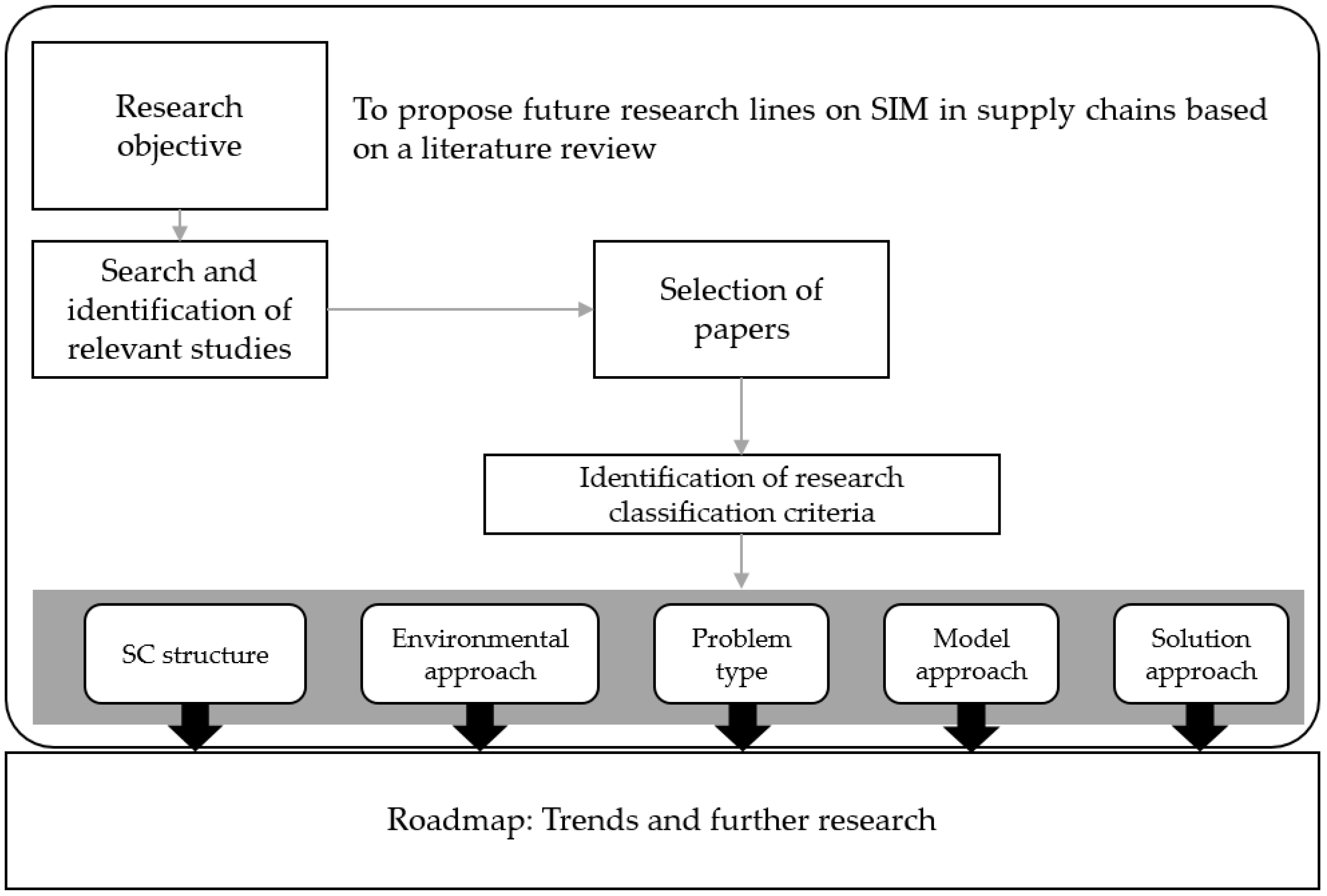
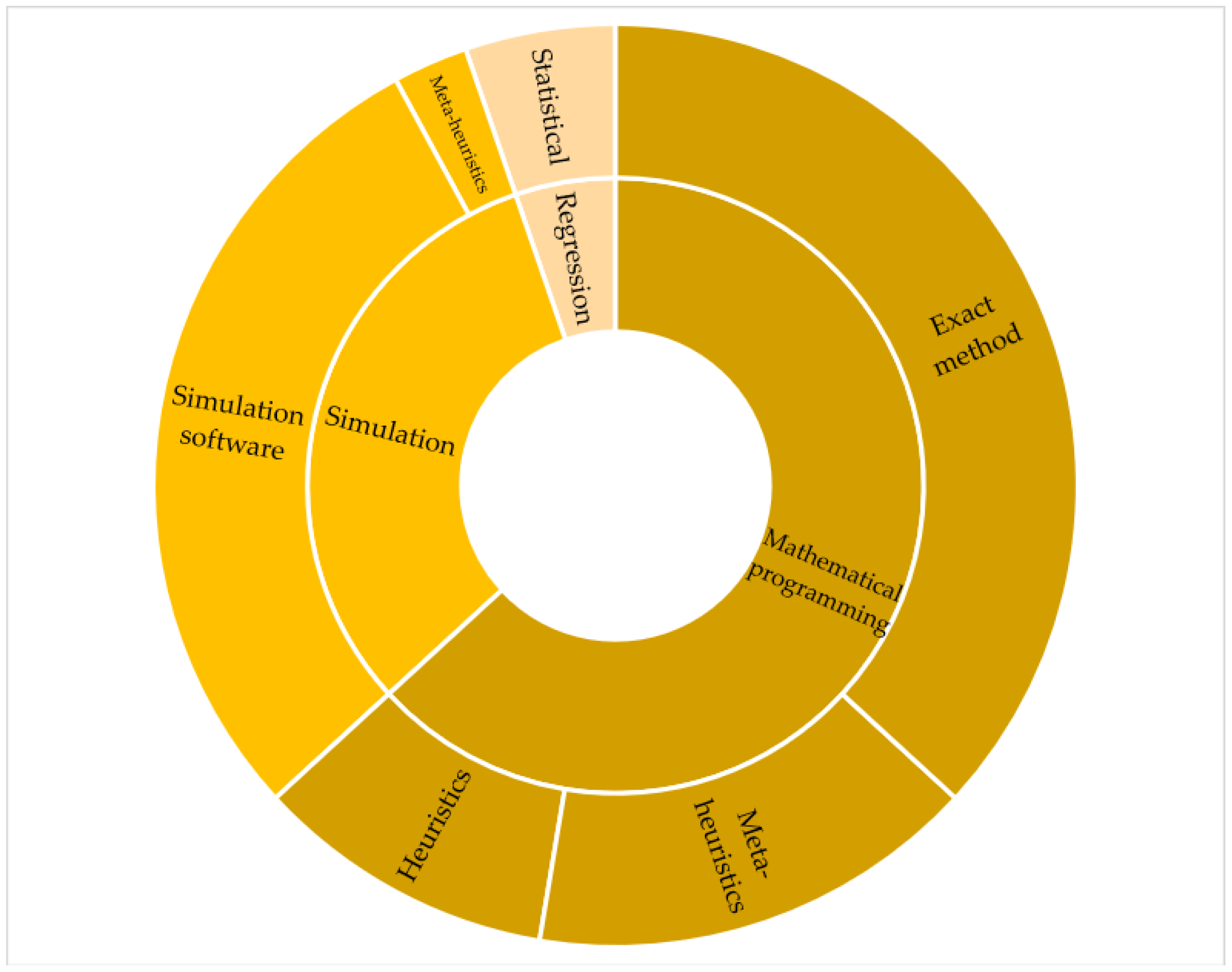
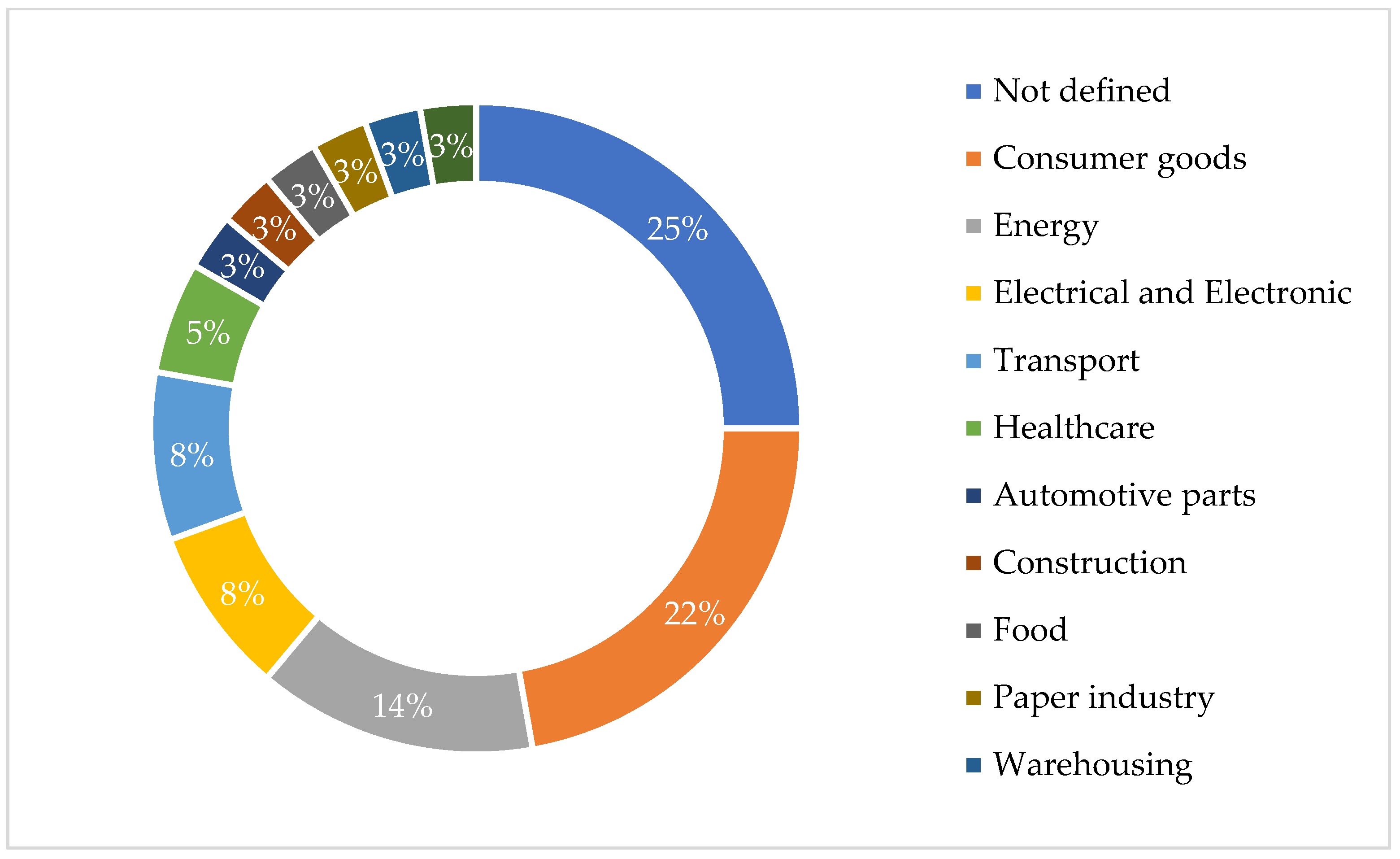
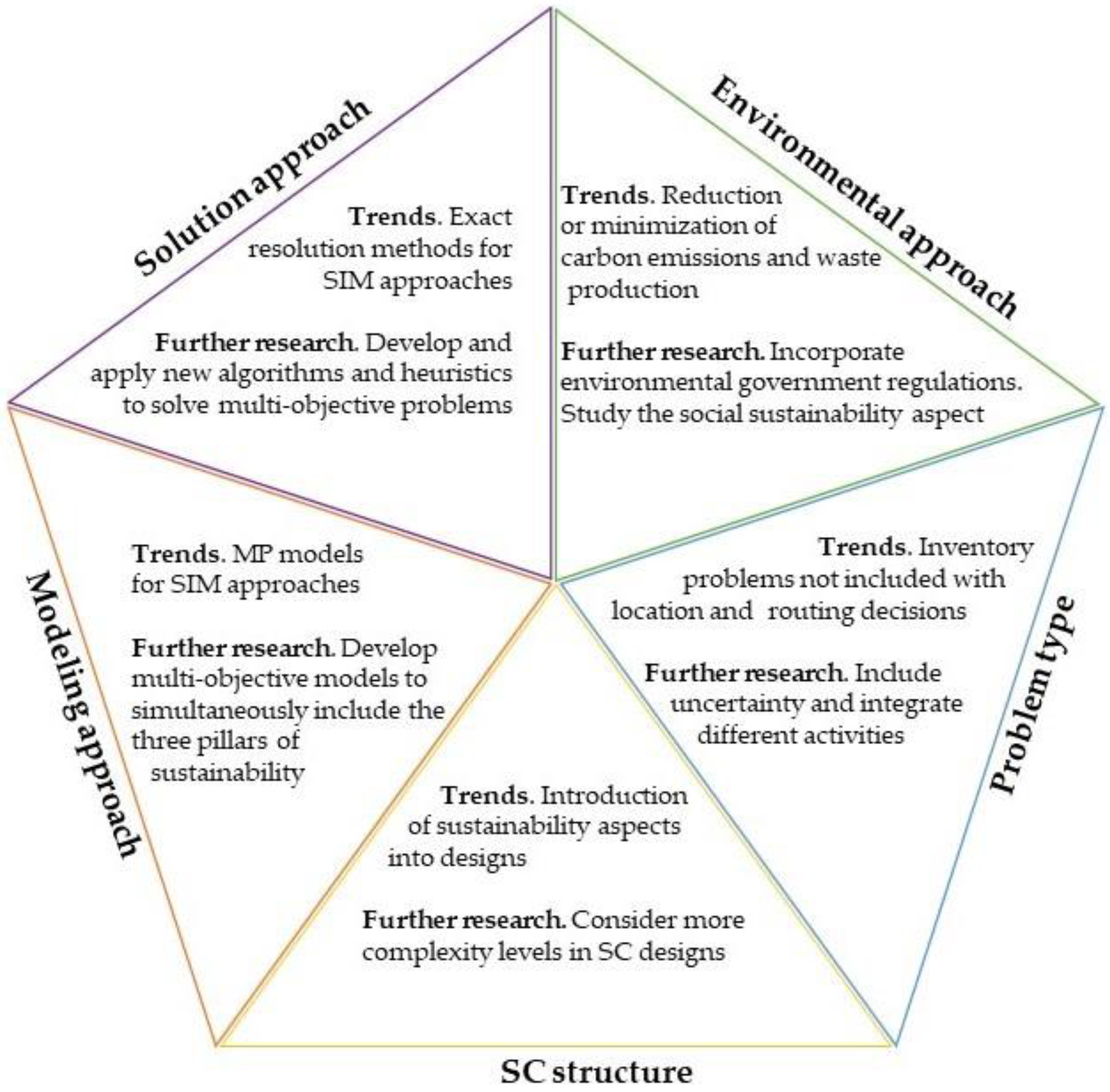
| Keyword Used | (Supply Chain or Supply Network) and (Sustainab* or Green or Circular Economy or Environment or Social) and (Inventory Management) and (Quantitative Method or Mathematical Programming or Optimization or Analytic Models or Simulation or Artificial Intelligence) |
|---|---|
| Scopus database | 183 articles |
| Wos database | 142 articles |
| Total papers in the two databases excluding duplication, conference reviews, not considering environmental aspects, case studies on specific sectors not related to SCs or nonquantitative models | 47 articles |
| Articles that present potential future lines or develop a quantitative model | 36 articles |
Publisher’s Note: MDPI stays neutral with regard to jurisdictional claims in published maps and institutional affiliations. |
© 2022 by the authors. Licensee MDPI, Basel, Switzerland. This article is an open access article distributed under the terms and conditions of the Creative Commons Attribution (CC BY) license (https://creativecommons.org/licenses/by/4.0/).
Share and Cite
Becerra, P.; Mula, J.; Sanchis, R. Sustainable Inventory Management in Supply Chains: Trends and Further Research. Sustainability 2022, 14, 2613. https://doi.org/10.3390/su14052613
Becerra P, Mula J, Sanchis R. Sustainable Inventory Management in Supply Chains: Trends and Further Research. Sustainability. 2022; 14(5):2613. https://doi.org/10.3390/su14052613
Chicago/Turabian StyleBecerra, Pablo, Josefa Mula, and Raquel Sanchis. 2022. "Sustainable Inventory Management in Supply Chains: Trends and Further Research" Sustainability 14, no. 5: 2613. https://doi.org/10.3390/su14052613
APA StyleBecerra, P., Mula, J., & Sanchis, R. (2022). Sustainable Inventory Management in Supply Chains: Trends and Further Research. Sustainability, 14(5), 2613. https://doi.org/10.3390/su14052613

