


Tourism–Growth Nexus in the Presence of Instability

Abstract
1. Introduction
2. Literature Review
3. Materials and Methods
3.1. Methodology
3.2. Data
4. Results and Discussion
4.1. Traditional and Recursive Granger Causality Test
4.2. Robust Granger Causality Test
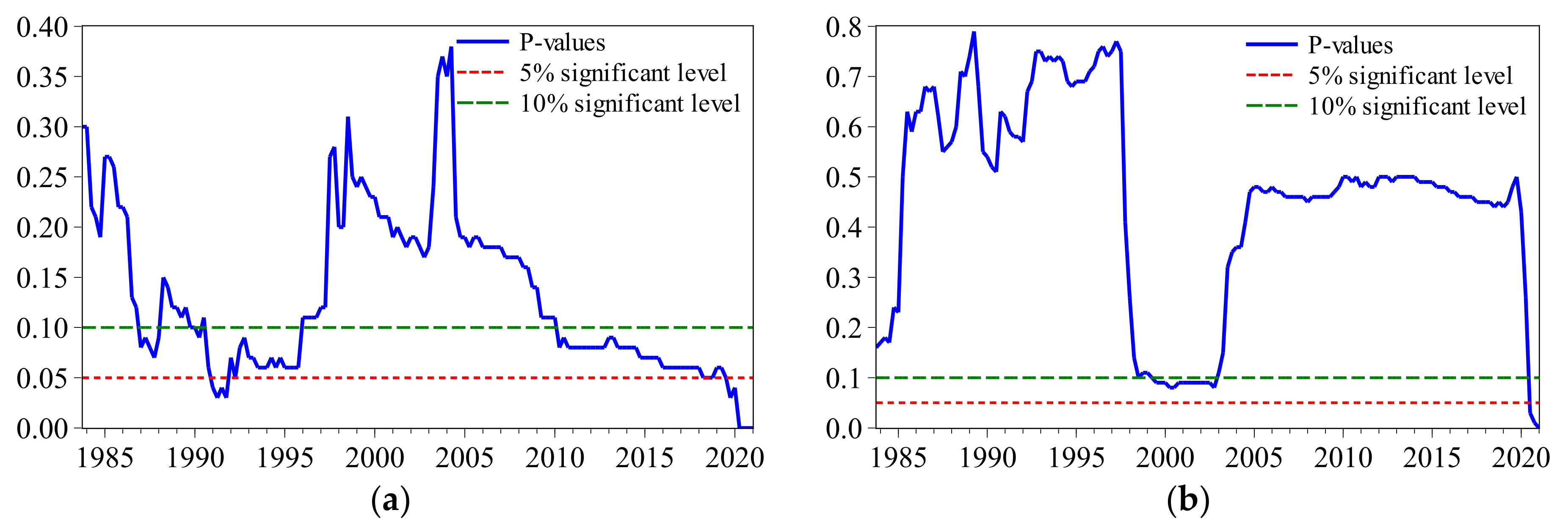
- Null hypothesis: GDPg does not Granger-cause VAg.
- Null hypothesis: VAg does not Granger-cause GDPg.
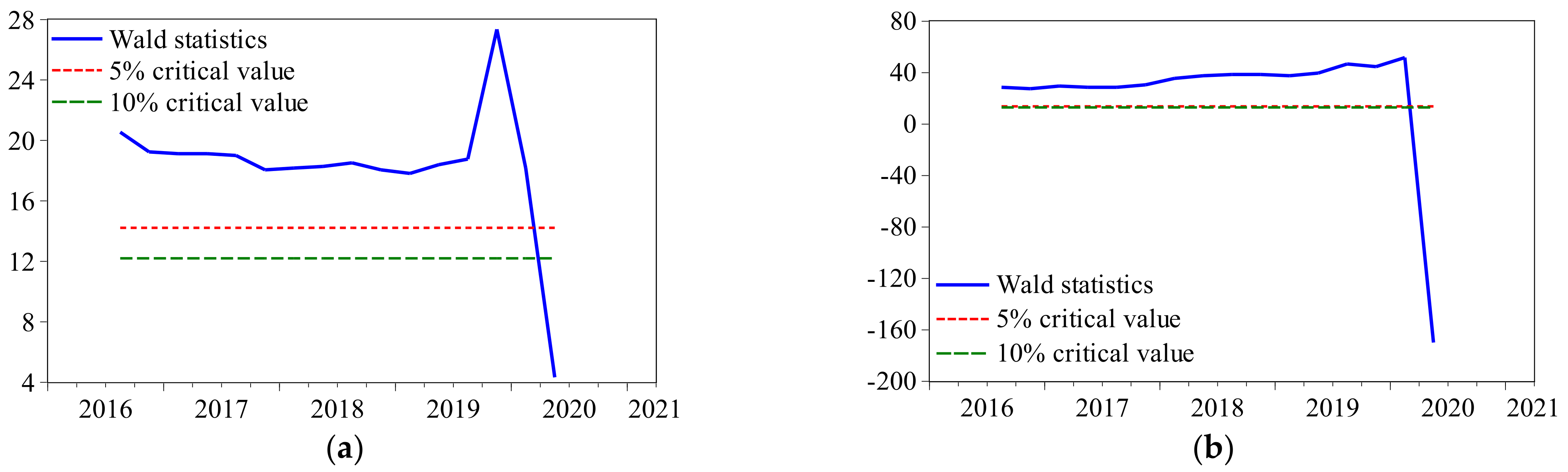
4.3. Has the Validity of TLEGH and EDTGH Changed during COVID-19?
5. Conclusions
Author Contributions
Funding
Institutional Review Board Statement
Informed Consent Statement
Data Availability Statement
Conflicts of Interest
References
- Blake, A.; Arbache, J.S.; Sinclair, M.T.; Teles, V. Tourism and poverty relief. Ann. Tour. Res. 2008, 35, 107–126. [Google Scholar] [CrossRef] [Scilit]
- Badulescu, A.; Badulescu, D.; Simut, R.; Dzitac, S. Tourism–economic growth nexus. The case of Romania. Technol. Econ. Dev. Econ. 2020, 26, 867–884. [Google Scholar] [CrossRef] [Scilit]
- Sehleanu, M. Analysis of foreign participation in the share capital of companies from the counties of North-West region of Romania. Orad. J. Bus. Econ. 2019, 4, 7–16. [Google Scholar] [CrossRef] [Scilit]
- Khan, H.; Seng, C.F.; Cheong, W.K. Tourism multiplier effects on Singapore. Ann. Tour. Res. 1990, 17, 408–418. [Google Scholar] [CrossRef] [Scilit]
- Liu, H.; Song, H.Y. New evidence of dynamic links between tourism and economic growth based on mixed-frequency Granger causality tests. J. Travel Res. 2017, 57, 899–907. [Google Scholar] [CrossRef] [Scilit]
- Alodadi, A.; Benhin, J. Religious tourism and economic growth in oil-rich countries: Evidence from Saudi Arabia. Tour. Anal. 2015, 20, 645–651. [Google Scholar] [CrossRef] [Scilit]
- Kumar, N.; Kumar, R.R.; Patel, A.; Stauvermann, P.J. Exploring the effect of tourism and economic growth in Fiji: Accounting for capital, labor, and structural breaks. Tour. Anal. 2019, 24, 115–130. [Google Scholar] [CrossRef] [Scilit]
- Leal Filho, W.; Brandli, L.L.; Lange Salvia, A.; Rayman-Bacchus, L.; Platje, J. COVID-19 and the UN sustainable development goals: Threat to solidarity or an opportunity? Sustainability 2020, 12, 5343. [Google Scholar] [CrossRef] [Scilit]
- Drozdowski, G. Economic calculus qua an instrument to support sustainable development under increasing risk. J. Risk Financ. Manag. 2021, 14, 15. [Google Scholar] [CrossRef] [Scilit]
- Song, H.; Wu, D.C. A critique of tourism-led economic growth studies. J. Travel Res. 2021, 00472875211018514. [Google Scholar] [CrossRef] [Scilit]
- Rossi, B.; Wang, Y. Vector autoregressive-based Granger causality test in the presence of instabilities. Stata J. Promot. Commun. Stat. Stata 2019, 19, 883–899. [Google Scholar] [CrossRef] [Scilit]
- Barnett, M.L.; Darnall, N.; Husted, B.W. Sustainability strategy in constrained economic times. Long Range Plan. 2015, 48, 63–68. [Google Scholar] [CrossRef] [Scilit]
- Ghali, M.A. Tourism and economic growth: An empirical study. Econ. Dev. Cult. Chang. 1976, 24, 527–538. [Google Scholar] [CrossRef] [Scilit]
- Pablo-Romero, M.d.P.; Molina, J.A. Tourism and economic growth: A review of empirical literature. Tour. Manag. Perspect. 2013, 8, 28–41. [Google Scholar] [CrossRef] [Scilit]
- Kyophilavong, P.; Gallup, J.L.; Charoenrat, T.; Nozaki, K. Testing tourism-led growth hypothesis in Laos? Tour. Rev. 2018, 73, 242–251. [Google Scholar] [CrossRef] [Scilit]
- Eeckels, B.; Filis, G.; Leon, C. Tourism income and economic growth in Greece: Empirical evidence from their cyclical components. Tour. Econ. 2012, 18, 817–834. [Google Scholar] [CrossRef] [Scilit]
- Bayramoğlu, T.; Arı, I. The relationship between tourism and economic growth in Greece economy: A time series analysis. Comput. Methods Soc. Sci. 2015, 3, 89–93. [Google Scholar]
- Balli, E.; Sigeze, C.; Manga, M.; Birdir, S.; Birdir, K. The relationship between tourism, CO2 emissions and economic growth: A case of Mediterranean countries. Asia Pac. J. Tour. Res. 2018, 24, 219–232. [Google Scholar] [CrossRef] [Scilit]
- Rivera, M.A. The synergies between human development, economic growth, and tourism within a developing country: An empirical model for Ecuador. J. Destin. Mark. Manag. 2017, 6, 221–232. [Google Scholar] [CrossRef] [Scilit]
- Wu, T.P.; Wu, H.C. The influence of international tourism receipts on economic development: Evidence from China’s 31 Major Regions. J. Travel Res. 2017, 57, 871–882. [Google Scholar] [CrossRef] [Scilit]
- Shahbaz, M.; Ferrer, R.; Shahzad, S.J.H.; Haouas, I. Is the tourism–economic growth nexus time-varying? Bootstrap rolling-window causality analysis for the top 10 tourist destinations. Appl. Econ. 2017, 50, 2677–2697. [Google Scholar] [CrossRef] [Scilit]
- Jebli, M.B.; Hadhri, W. The dynamic causal links between CO2 emissions from transport, real GDP, energy use and international tourism. Int. J. Sustain. Dev. World Ecol. 2018, 25, 568–577. [Google Scholar] [CrossRef] [Scilit]
- Enilov, M.; Wang, Y. Tourism and economic growth: Multi-country evidence from mixed-frequency Granger causality tests. Tour. Econ. 2021. [Google Scholar] [CrossRef] [Scilit]
- Ozturk, I.; Acaravci, A. On the causality between tourism growth and economic growth: Empirical evidence from Turkey. Transylv. Rev. Adm. Sci. 2009, 5, 73–81. [Google Scholar]
- Tang, C.-H.H.; Jang, S.S. The tourism–economy causality in the United States: A sub-industry level examination. Tour. Manag. 2009, 30, 553–558. [Google Scholar] [CrossRef] [Scilit]
- Lean, H.H.; Tang, C.F. Is the tourism-led growth hypothesis stable for Malaysia? A note. Int. J. Tour. Res. 2010, 12, 375–378. [Google Scholar] [CrossRef] [Scilit]
- Tang, C.F.; Tan, E.C. How stable is the tourism-led growth hypothesis in Malaysia? Evidence from disaggregated tourism markets. Tour. Manag. 2013, 37, 52–57. [Google Scholar] [CrossRef] [Scilit]
- Stock, J.H.; Watson, M.W. Evidence on structural instability in macroeconomic time series relations. J. Bus. Econ. Stat. 1996, 14, 11–30. [Google Scholar] [CrossRef] [Scilit]
- Clark, T.E.; McCracken, M.W. The predictive content of the output gap for inflation: Resolving in-sample and out-of-sample evidence. J. Money Credit Bank. 2006, 38, 1127–1148. [Google Scholar] [CrossRef] [Scilit]
- Cárdenas-García, P.J.; Sánchez-Rivero, M.; Pulido-Fernández, J.I. Does tourism growth influence economic development? J. Travel Res. 2013, 54, 206–221. [Google Scholar] [CrossRef] [Scilit]
- Saha, S.; Yap, G. The moderation effects of political instability and terrorism on tourism development: A cross-country panel analysis. J. Travel Res. 2014, 53, 509–521. [Google Scholar] [CrossRef] [Scilit]
- Elshaer, I.A.; Saad, S.K. Political instability and tourism in Egypt: Exploring survivors’ attitudes after downsizing. J. Policy Res. Tour. Leis. Events 2017, 9, 3–22. [Google Scholar] [CrossRef] [Scilit]
- Sönmez, S.F. Tourism, terrorism, and political instability. Ann. Tour. Res. 1998, 25, 416–456. [Google Scholar] [CrossRef] [Scilit]
- Dibeh, G.; Fakih, A.; Marrouch, W. Tourism–growth nexus under duress: Lebanon during the Syrian crisis. Tour. Econ. 2019, 26, 353–370. [Google Scholar] [CrossRef] [Scilit]
- Rossi, B. Optimal tests for nested model selection with underlying parameter instability. Econom. Theor. 2005, 21, 962–990. [Google Scholar] [CrossRef] [Scilit]
- Andrews, D.W.K.; Ploberger, W. Optimal tests when a nuisance parameter is present only under the alternative. Econometrica 1994, 62, 1383–1414. [Google Scholar] [CrossRef] [Scilit]
- Nyblom, J. Testing for the constancy of parameters over time. J. Am. Stat. Assoc. 1989, 84, 223–230. [Google Scholar] [CrossRef]
- Andrews, D.W.K. Tests for parameter instability and structural change with unknown change point. Econometrica 1993, 61, 821–856. [Google Scholar] [CrossRef] [Scilit]
- Ghysels, E.; Hill, J.B.; Motegi, K. Testing for Granger causality with mixed frequency data. J. Econom. 2016, 192, 207–230. [Google Scholar] [CrossRef] [Scilit]
- Wu, P.C.; Liu, S.Y.; Hsiao, J.M.; Huang, T.Y. Nonlinear and time-varying growth-tourism causality. Ann. Tour. Res. 2016, 59, 45–59. [Google Scholar] [CrossRef] [Scilit]
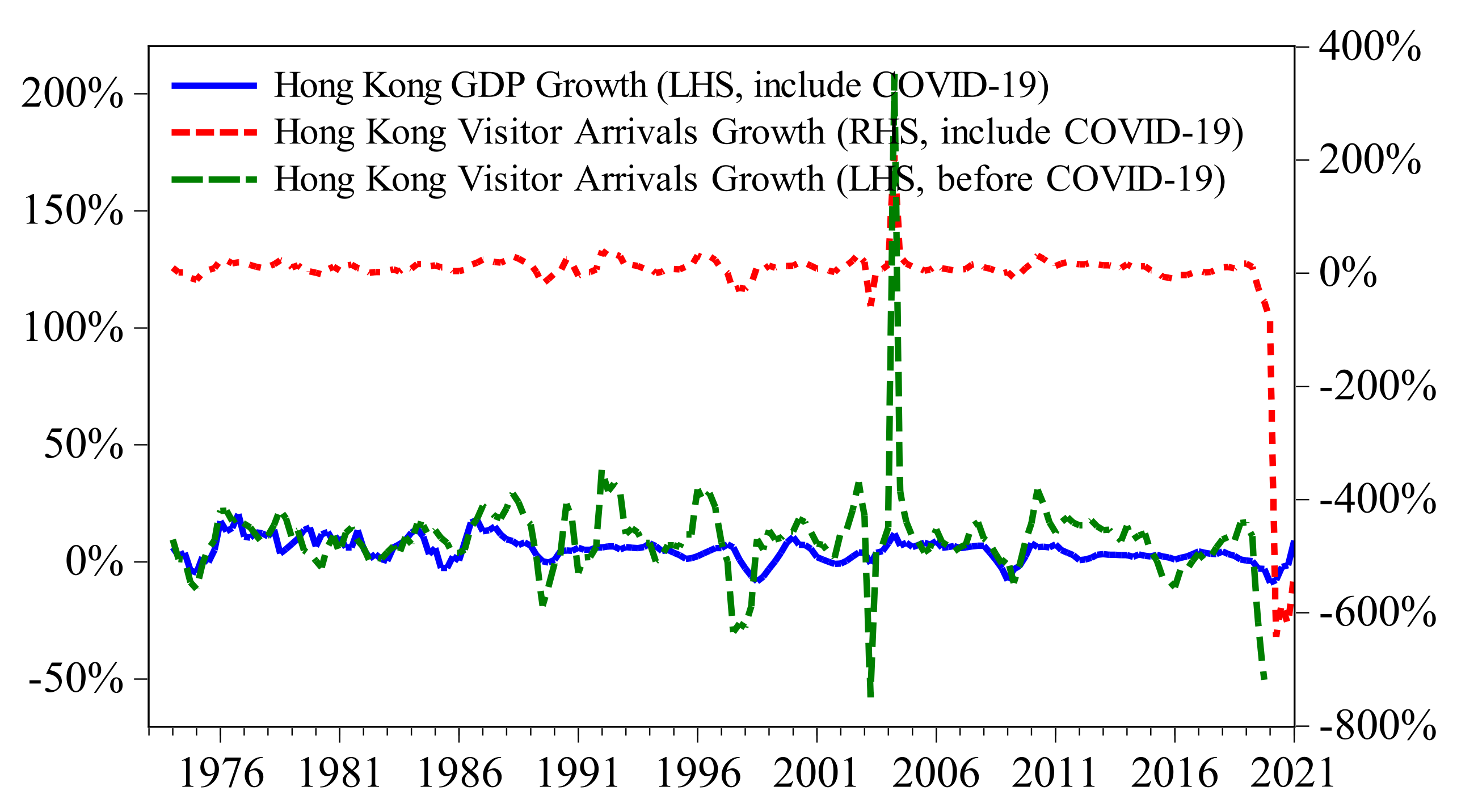

| Variable | Obs | Mean | SD | Max. | Min. | Skewness | Kurtosis | J–B (Probability) |
|---|---|---|---|---|---|---|---|---|
| VAg | 189 | −3.43 | 89.86 | 208.44 | −642.84 | −6.11 | 41.64 | 12,940.75 (0.00) *** |
| GDPg | 189 | 4.89 | 5.07 | 20.50 | −8.90 | 0.10 | 3.57 | 2.91 (0.23) |
| Max Lag | 1 | 2 | 3 | 4 | 5 | 6 | 7 | 8 | 9 | 10 | 11 | 12 |
|---|---|---|---|---|---|---|---|---|---|---|---|---|
| LR | 1 | 1 | 3 | 4 | 5 | 5 | 5 | 5 | 5 | 5 | 5 | 5 |
| FPE | 1 | 1 | 1 | 4 | 5 | 5 | 5 | 5 | 5 | 5 | 5 | 5 |
| AIC | 1 | 1 | 1 | 4 | 5 | 5 | 5 | 5 | 5 | 5 | 5 | 5 |
| SIC | 1 | 1 | 1 | 1 | 1 | 1 | 1 | 1 | 1 | 1 | 1 | 1 |
| HQIC | 1 | 1 | 1 | 4 | 5 | 5 | 5 | 4 | 4 | 4 | 4 | 5 |
| Null Hypothesis | p Values | Results |
|---|---|---|
| VAg does not Granger-cause GDPg | 0.15 | Accept |
| GDPg does not Granger-cause VAg | 0.03 ** | Reject |
| Variables | (c, t, k) | Critical Values | t-Statistics | p-Value | ||
|---|---|---|---|---|---|---|
| 1% | 5% | 10% | ||||
| VAg | (c, 0, 1) | −3.46 | −2.87 | −2.57 | −8.28 | 0.00 *** |
| GDPg | (c, 0, 4) | −3.46 | −2.87 | −2.57 | −4.29 | 0.00 *** |
| Statistics | ||||
|---|---|---|---|---|
| Null Hypothesis | ExpW* (Probability) | MeanW* (Probability) | Nyblom* (Probability) | QLR* (Probability) |
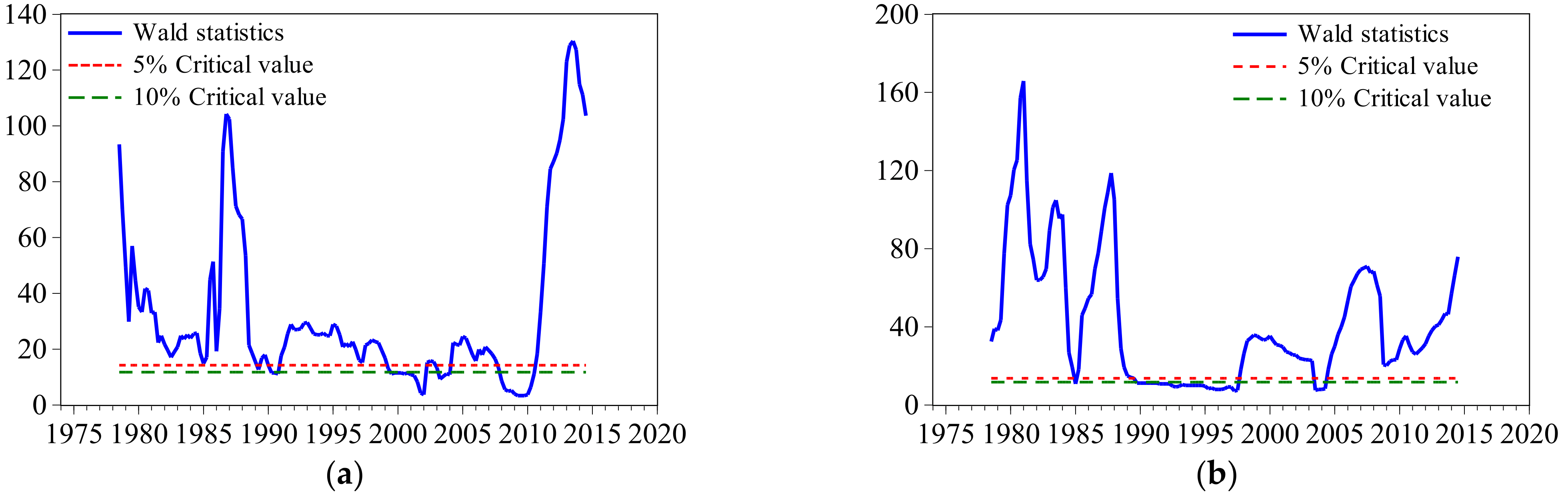
| EDTGH | 60.81 (0.00) | 32.80 (0.00) | 2.94 (0.04) | 130.80 (0.00) |
| TLEGH | 78.40 (0.00) | 42.80 (0.00) | 2.01 (0.11) | 166.71 (0.00) |
| Variables | (c, t, k) | Critical Values | t-Statistics | p Value | ||
|---|---|---|---|---|---|---|
| 1% | 5% | 10% | ||||
| VAg | (c, 1, 3) | −4.66 | −3.73 | −3.31 | −4.51 | 0.01 ** |
| GDPg | (c, 1, 3) | −3.92 | −3.06 | −2.67 | −3.52 | 0.02 ** |
Publisher’s Note: MDPI stays neutral with regard to jurisdictional claims in published maps and institutional affiliations. |
© 2022 by the authors. Licensee MDPI, Basel, Switzerland. This article is an open access article distributed under the terms and conditions of the Creative Commons Attribution (CC BY) license (https://creativecommons.org/licenses/by/4.0/).
Share and Cite
Wang, Y.; Wang, L.; Pan, C. Tourism–Growth Nexus in the Presence of Instability. Sustainability 2022, 14, 2170. https://doi.org/10.3390/su14042170
Wang Y, Wang L, Pan C. Tourism–Growth Nexus in the Presence of Instability. Sustainability. 2022; 14(4):2170. https://doi.org/10.3390/su14042170
Chicago/Turabian StyleWang, Yonglian, Lijun Wang, and Changchun Pan. 2022. "Tourism–Growth Nexus in the Presence of Instability" Sustainability 14, no. 4: 2170. https://doi.org/10.3390/su14042170
APA StyleWang, Y., Wang, L., & Pan, C. (2022). Tourism–Growth Nexus in the Presence of Instability. Sustainability, 14(4), 2170. https://doi.org/10.3390/su14042170

