Article

Tourism–Growth Nexus in the Presence of Instability
1
Department of Statistics, Jilin University of Finance and Economics, Changchun 130117, China
2
School of Economics, Jilin University, Changchun 130012, China
*
Author to whom correspondence should be addressed.
Sustainability 2022, 14(4), 2170; https://doi.org/10.3390/su14042170
Submission received: 19 January 2022 / Revised: 8 February 2022 / Accepted: 11 February 2022 / Published: 14 February 2022
(This article belongs to the Special Issue Sustainability Performance in the Tourism Sector)

Abstract

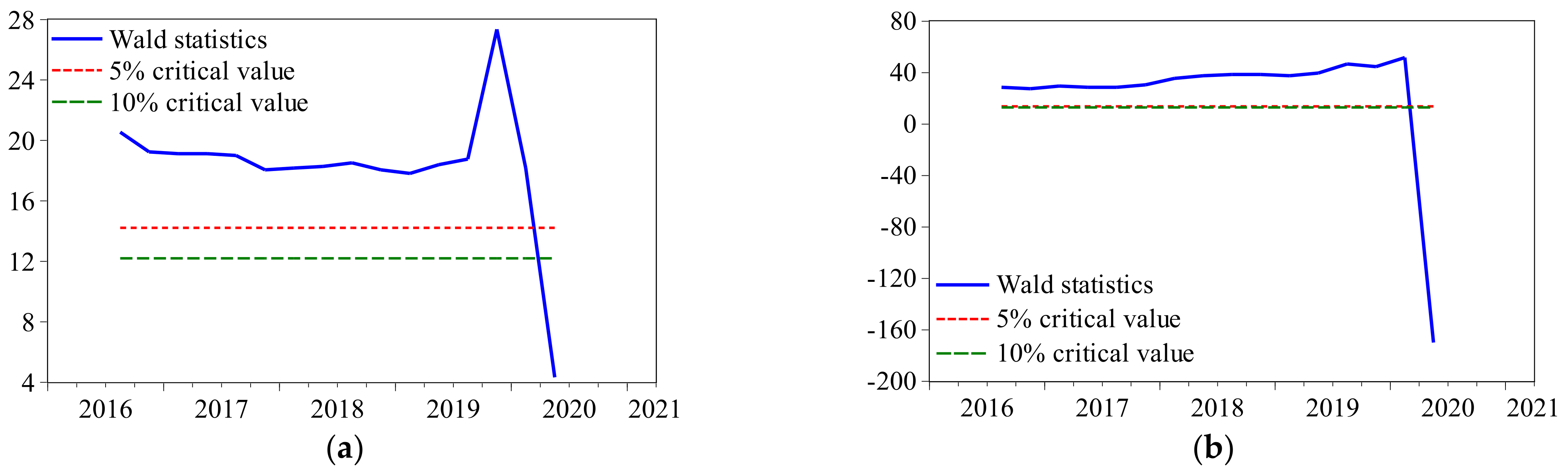
This paper contributes to the tourism–growth literature by applying the new vector autoregressive-based Granger causality test in the presence of instability to reassess the Granger causality between Hong Kong’s tourism and economic growth. The results of the traditional and recursive Granger causality test under the VAR framework show that the tourism-led economic growth hypothesis (TLEGH) and the economy-driven tourism growth hypothesis (EDTGH) are both unstable in Hong Kong. The results of the vector autoregressive-based Granger causality test in the presence of instability generally support bidirectional causality between tourism and economic growth. However, the relationship between tourism and economic growth is vulnerable to sudden major political incidents, public health incidents, and financial crises. Among these incidents and crises, political events have long-term effects on the relationship between Hong Kong’s tourism and economic growth. In contrast, economic policies, financial crises, and public health emergencies have short-term impacts on the relationship.
Keywords: tourism; economic growth; instability; robust Granger causality test tourism; economic growth; instability; robust Granger causality test