Sustainable Tourism Development in the Protected Areas of Maramureș, Romania: Destinations with High Authenticity
 ,
,  ,
, 
 ,
,  ,
, 
Abstract
1. Introduction
- (1)
- Diversification and specialization of the tourist offer, together with increase of service quality, concentration of infrastructure investments, and the re-qualification of degraded tourist areas;
- (2)
- Active national and international promotion of Romanian tourism, in particular rural, ecological, and cultural tourism for the use of the variety of rural landscapes, of the persistence of traditional activities, of traditional gastronomy, and of the cultural offer of the neighboring urban centers;
- (3)
- Training and qualification of specialized personnel, accreditation and records of specialized structures to ensure the quality and competitiveness of specific tourism services.
2. Literature Review
- -
- Sites of Community Importance (SCI) are natural areas which, in the region or biogeographical regions in which they exist, contribute significantly to maintaining or restoring to a favorable conservation status the natural habitats or species of Community interest;
- -
- Special Areas for Conservation (SAC), aims are the conservation, maintenance and, where appropriate, the restoration of a favorable conservation status of the natural habitats and/or populations of the species for which the site is designated;
- -
- SCI and SAC concern the same site, with differences of their level of protection. For SACs are necessary conservation measures are applied in order to ensure the conservation of the species and habitat types of EU importance present, national regulation need to establish the procedure of transition from SCI to SAC;
- -
- Special Protection Areas (SPA), aims are the conservation, maintenance and, where appropriate, the restoration of a favorable conservation status of bird species and specific habitats designated for the protection of wild migratory bird species [42].In Romania, we have declared:
- ✓
- Natural areas of international interest: Biosphere Reserves—Danube Delta (1991), Retezat (1979), Pietrosul Rodnei (1979);
- ✓
- Wetlands of international importance—Danube Delta (1991), Insula Mică a Brăilei (2001), Lunca Mureşului (2006), Complexul Piscicol Dumbrăviţa (2006), Techirghiol Lake (2006);
- ✓
- Natural sites of the universal natural heritage—Danube Delta;
- ✓
- Geoparks—Geopark of dinosaurs in Ţara Haţegului, Geopark Mehedinţi Plateau (designated by GD 2151/2005 in the category of natural parks).
The Aim of the Paper
3. Materials and Methods
4. Results and Discussion
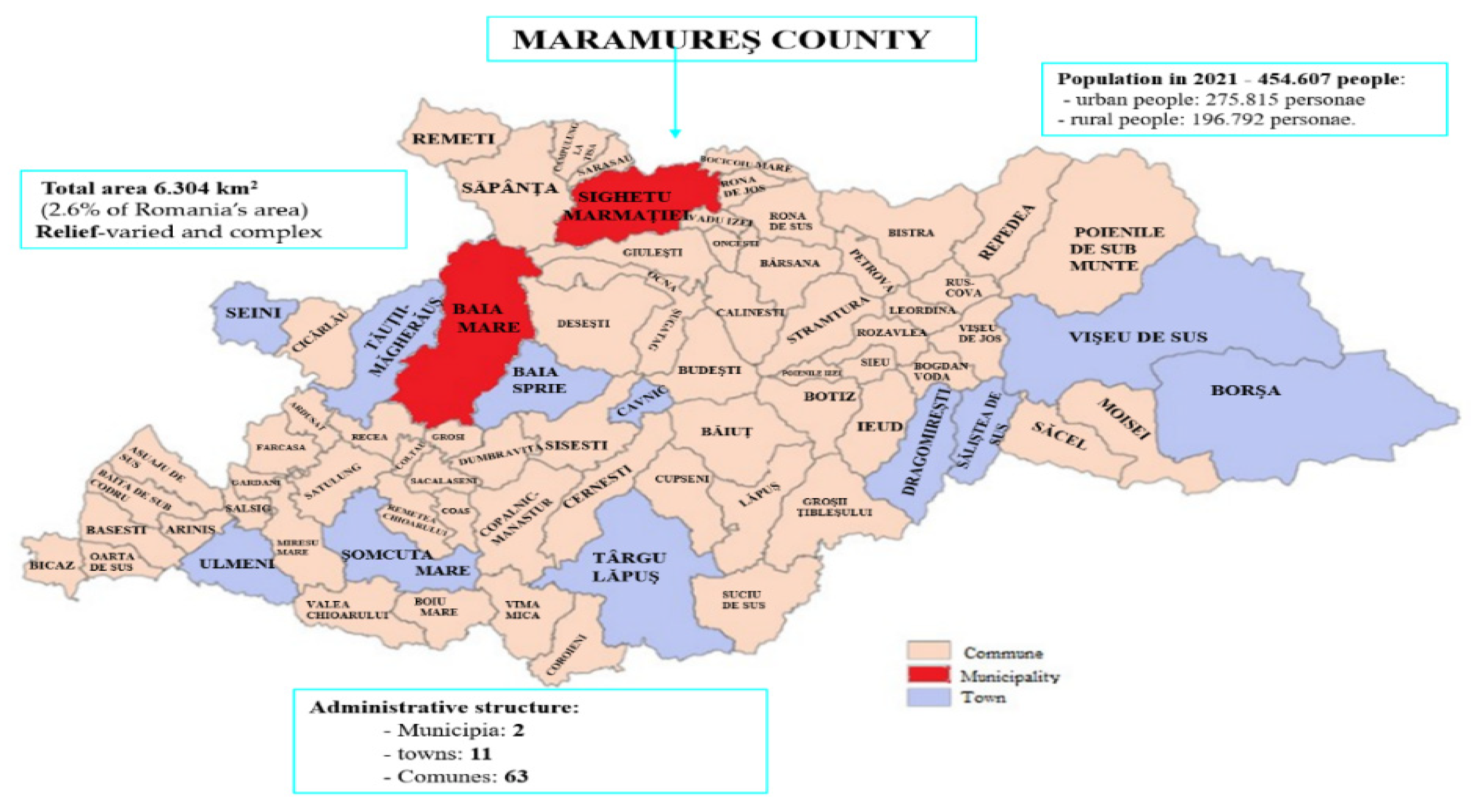
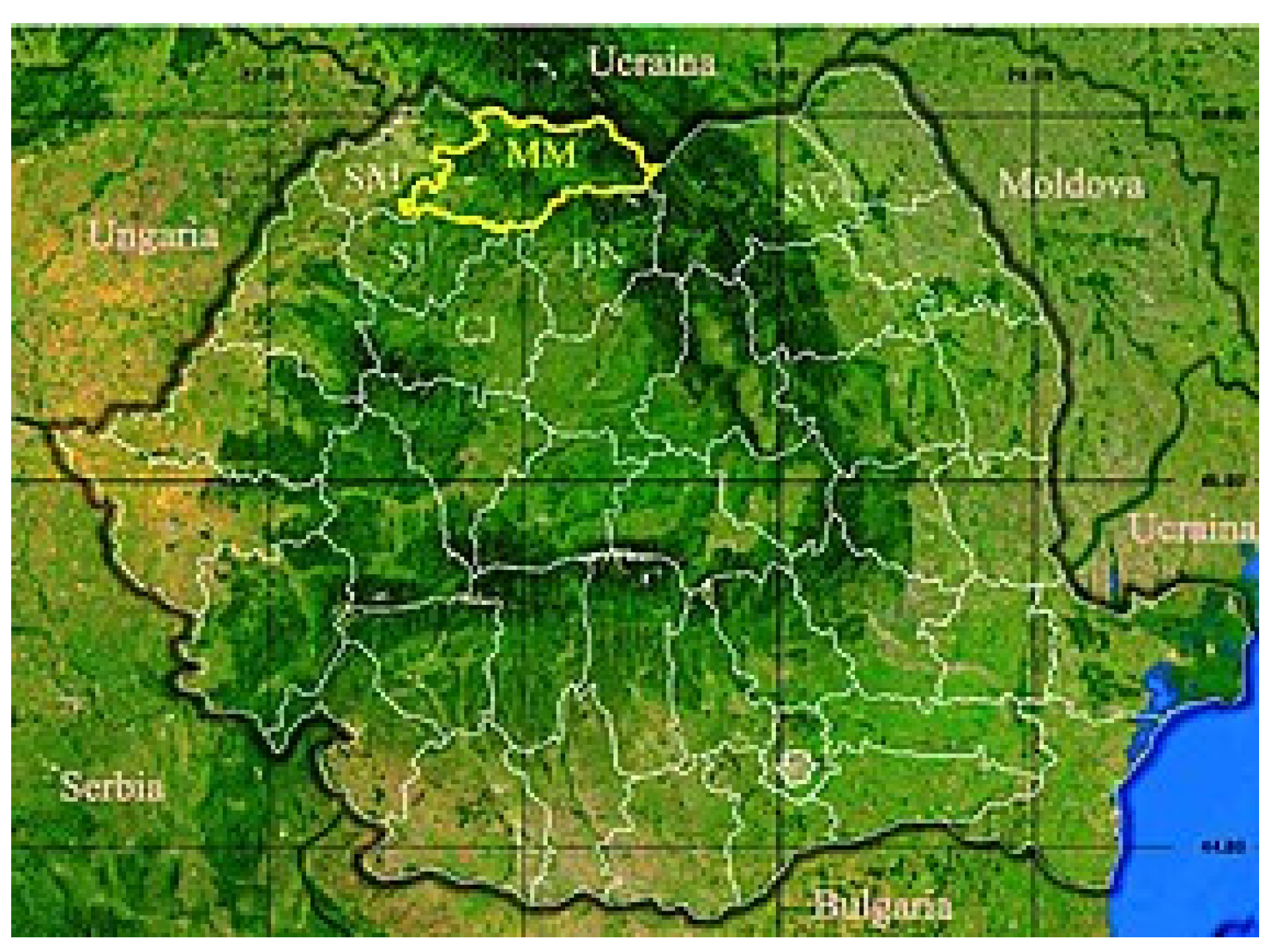
4.1. Maramureş Area as a Place of Research for the Sustainable Development of Tourism in Protected Areas
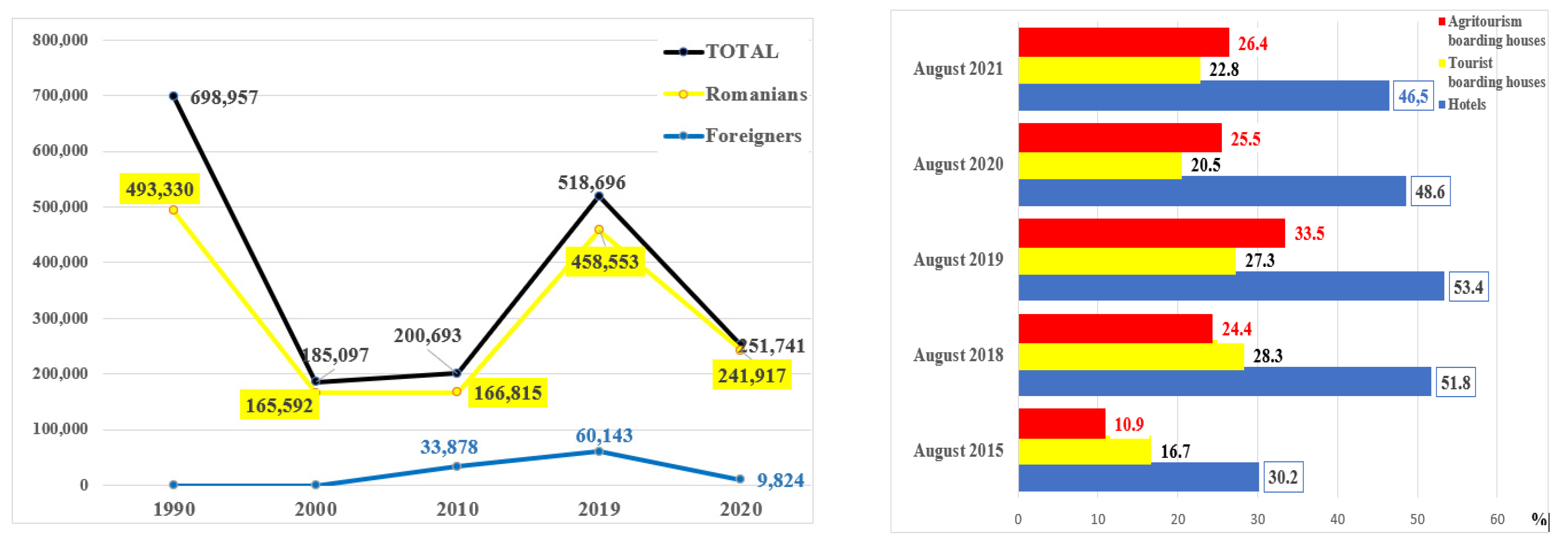
4.2. Tourism in Maramureș: Best Known Tourism Destinations
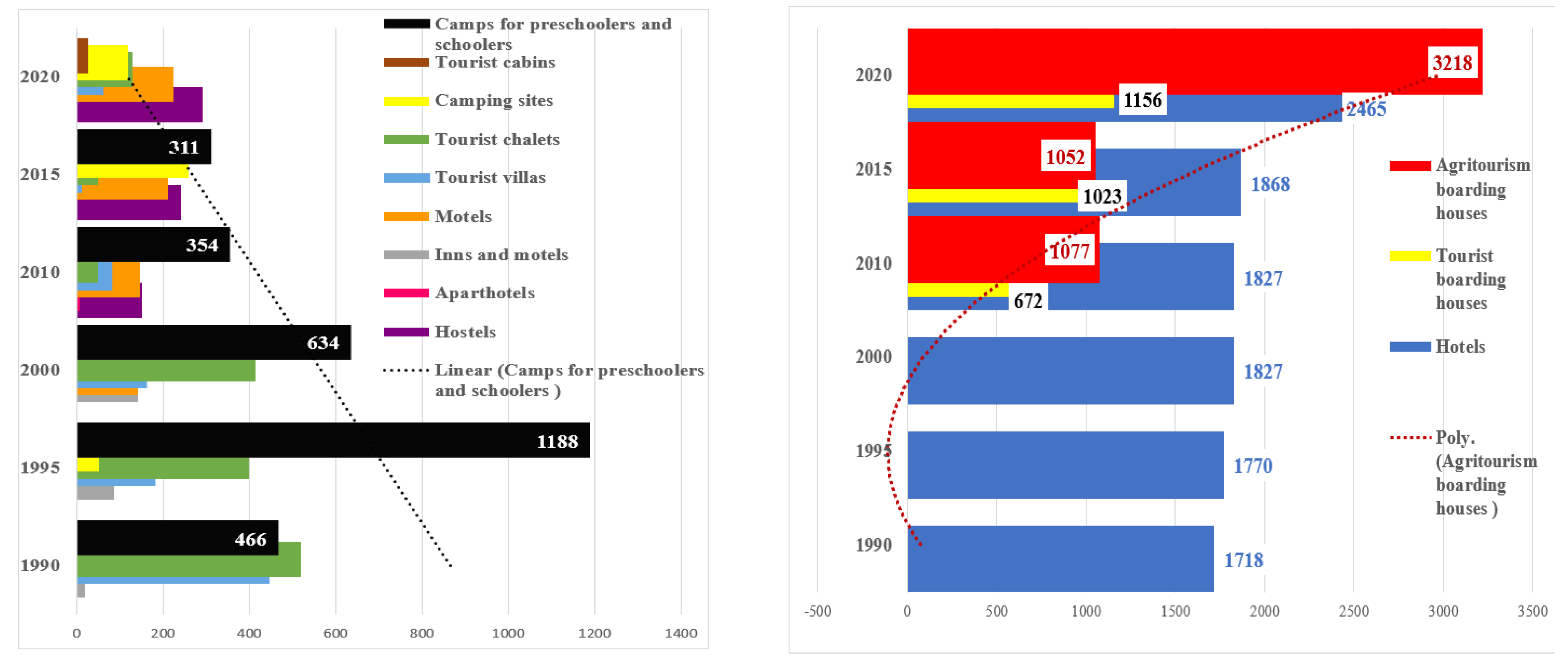
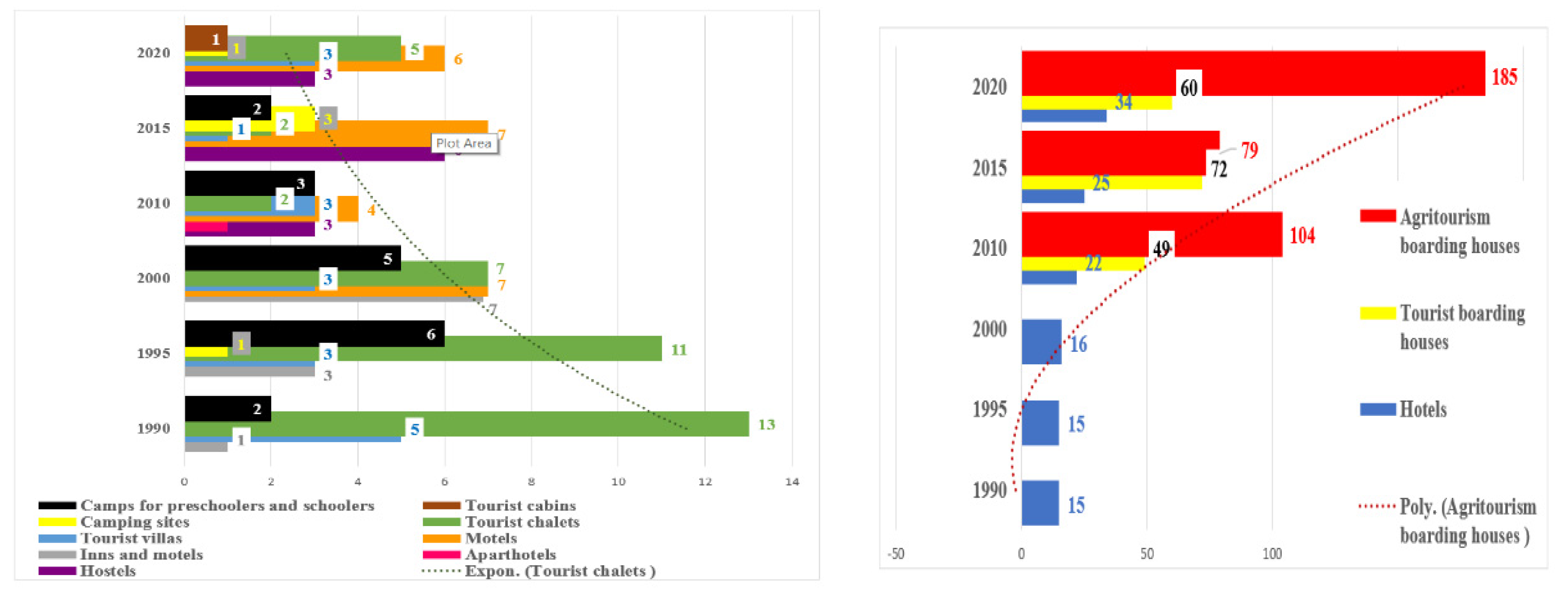
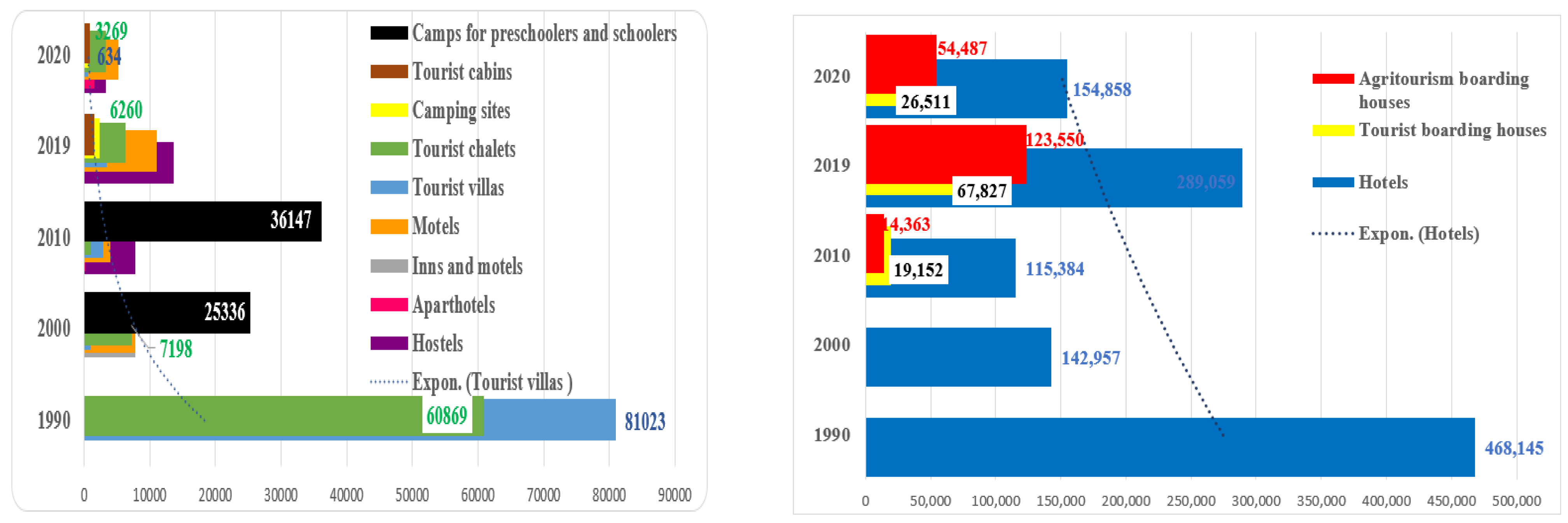
4.3. Available Accommodation in Maramureș
4.4. Identification of Protected Areas in Maramureș
- -
- of national interest: scientific reservations, national parks, natural monuments, natural reserves, natural parks;
- -
- of international interest: natural sites of the universal natural heritage, geoparks, wetlands of international importance, biosphere reserves;
- -
- of Community interest or “Natura 2000” sites: sites of Community importance, special conservation areas, special avifauna protection areas;
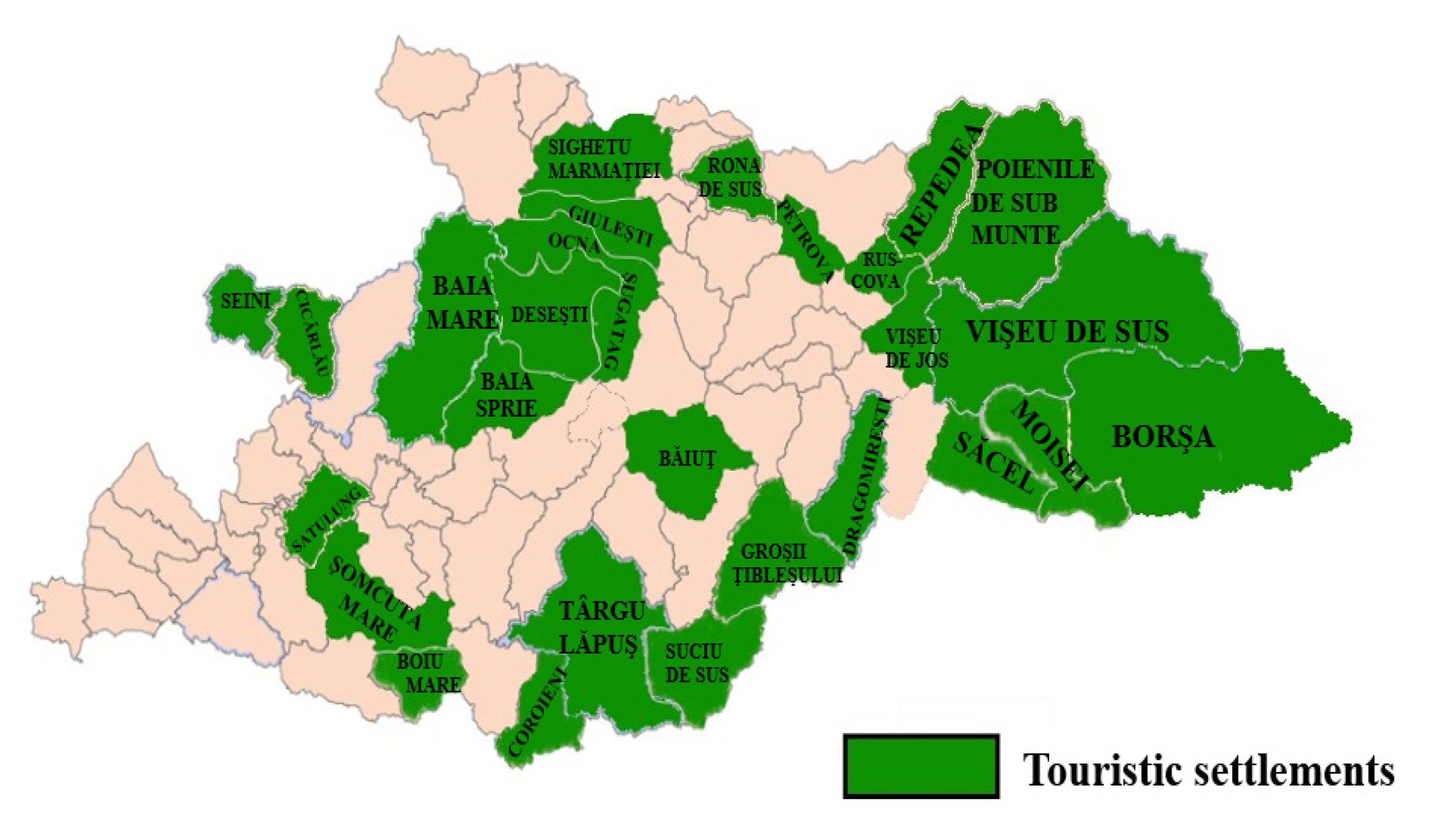
4.5. Identification of Localities, Natural Resources, and Tourist Destinations in Protected Areas
- ✓
- the churches from Budești-Josani, Desești, Bârsana, Poienile Izei, Ieud Deal, Surdești, Plopiș and Rogoz, elements of the representative cultural heritage of Maramureș, are included in the UNESCO world heritage;
- ✓
- Maramureș county accomplished one of five Romanian ecotourism destination, Mara-Cosău—Creasta Cocoșului area, being supported by a local partnership between protected area administrators, local public authorities and non-governmental bodies, as Destination Management Organization;
- ✓
- Maramureș as touristic destination was rewarded by European Commission with four destinations of excellence by EDEN programme: Sighetu Marmației and Chioar Country for tangible cultural tourism, Ocna Șugatag and Tăuții Măgherăuș for health and relaxation tourism. This programme aims to sustain sustainable tourism be decreasing the negative impact on consecrated touristic destination and increasing the visibility of non-traditional destinations. Romania participated to all program competitions and prof that have a large potential for sustainable tourism.
4.6. Identification of Tourism Forms in Protected Area Localities of Maramureş—Which Can Contribute to the Development of the Locality
- Includes approaches to the optimal use of environmental resources, the conservation of natural heritage and biodiversity (a key element in sustainable development);
- It presents aspects related to the preservation of the socio-cultural authenticity of the host communities, the preservation of the cultural heritage and traditions over time (promotes intercultural understanding and tolerance, encourages the preservation of the built cultural heritage, traditional gastronomy, etc.)
- It can stimulate the development of viable, long-term economic operations that provide socio-economic benefits to all parties involved (alleviating poverty by creating jobs, income and social services for host communities, safety issues for tourists, etc.).
- Contributes to ensuring the satisfaction of tourists (promoting sustainable practices for the forms of tourism discussed), awareness of sustainability issues and media coverage of this region, in order to develop it sustainably.
5. Conclusions
Author Contributions
Funding
Institutional Review Board Statement
Informed Consent Statement
Data Availability Statement
Acknowledgments
Conflicts of Interest
References
- Word Tourism Organization. World Tourism Day 2021: Tourism for Inclusive Growth. Available online: https://www.unwto.org/join-world-tourism-day-2021 (accessed on 26 November 2021).
- Ciolac, R.; Iancu, T.; Brad, I.; Adamov, T.; Mateoc-Sîrb, N. Agritourism—A Business Reality of the Moment for Romanian Rural Area’s Sustainability. Sustainability 2021, 13, 6313. [Google Scholar] [CrossRef]
- Government of Romania. Tourism Development Strategy of Romania—Strategy and Action Plan (February 2019); Government of Romania: Bucharest, Romania, 2019; Volume 2. Available online: http://sgg.gov.ro/1/ (accessed on 25 November 2021).
- Government of Romania; Ministry of Regional Development and Public Administration. Romania’s Territorial Development Strategy (Polycentric Romania 2035—Territorial Cohesion and Competitiveness, Development and Equal Opportunities for People); Government of Romania: Bucharest, Romania, 2015. [Google Scholar]
- Ciolac, R.; Iancu, T.; Brad, I.; Popescu, G.; Marin, D.; Adamov, T. Agritourism Activity—A “Smart Chance” for Mountain Rural Environment’s Sustainability. Sustainability 2020, 12, 6237. [Google Scholar] [CrossRef]
- Bâc, D.P. Turismul si Dezvoltarea Durabila—Realităti, Provocari, Oportunitati; Economica: Bucharest, Romania, 2013. [Google Scholar]
- Talabă, I.; Gîtan, D.; Halle, A.P.; Ungureanu, D. Turismul Rural Românesc în Contextul Dezvoltării Durabile—Actualitate şi Perspective; Economic and Social Research Institute “Gheorghe Zane”: Iași, Romania, 2010; Volume 20. [Google Scholar]
- Milin, I.A.; Merce, I.I. Research on the tourist traffic in protected areas in Romania. Glob. J. Bus. Econ. Manag. 2020, 10, 83–90. [Google Scholar] [CrossRef]
- Jain, P. Design thinking…inspiring innovation, transforming humanity. Glob. J. Arts Educ. 2018, 8, 68–74. [Google Scholar] [CrossRef][Green Version]
- Patrascu, R.; Damian, A.; Minciuc, E. Problematici Fundamentale Privind Dezvoltarea Durabila; AGIR: Bucharest, Romania, 2015; ISBN 978-973-720-615-2. [Google Scholar]
- Camarda, A.; Barsan, I.O. Dezvoltarea Durabila a Turismului Regional; Uranus: Bucharest, Romania, 2010; ISBN 9789737765833. [Google Scholar]
- Mazilu, M. Turism si Dezvoltare Durabila; Universitaria Craiova: Craiova, Romania, 2011; ISBN 978-606-14-0238-0. [Google Scholar]
- Bibirigea, R. Turismul Durabil—Oportunitati si Provocari; Universitara: Bucharest, Romania, 2009; ISBN 978-973-749-548-8. [Google Scholar]
- WCED. Viitorul Nostru Comun; Oxford University Press: New York, NY, USA, 1987. [Google Scholar]
- Nash, D.; Butler, R. Towards sustainable tourism. Tour. Manag. 1990, 11, 263–264. [Google Scholar] [CrossRef]
- Butler, R.W. Tourism—An evolutionary perspective. In Tourism and Sustainable Development: Monitoring, Planning, Managing; Nelson, J.G., Butler, R.W., Wall, G., Eds.; University of Waterloo: Waterloo, UK, 1993; pp. 27–44. [Google Scholar]
- May, V. Tourism, environment and development—Values, sustainability and stewardship. Tour. Manag. 1991, 12, 112–124. [Google Scholar] [CrossRef]
- Sörensson, A.; von Friedrichs, Y. An importance—Performance analysis of sustainable tourism: A comparison between international and national tourists. J. Destin. Mark. Manag. 2013, 2, 14–21. [Google Scholar] [CrossRef]
- Torres-Delgado, A.; López Palomeque, F. Measuring sustainable tourism at the municipal level. Ann. Tour. Res. 2014, 49, 122–137. [Google Scholar] [CrossRef]
- Lee, T.H.; Hsin-Pei, H. Indicators of sustainable tourism: A case study from a Taiwan’s wetland. Ecol. Indic. 2016, 67, 779–787. [Google Scholar] [CrossRef]
- Khan, M.R.; Khan, H.U.R.; Lim, C.K.; Tan, K.L.; Ahmed, M.F. Ahmed, Sustainable Tourism Policy, Destination Management and Sustainable Tourism Development: A Moderated-Mediation Model. Sustainability 2021, 13, 12156. [Google Scholar] [CrossRef]
- Constantinescu, I.; Moțatu, A.; Ionașcu, G. Dezvoltare Durabilă și Civilizație; Milena Press: Bucharest, Romania, 2019. [Google Scholar]
- Ibănescu, B.C.; Stoleriu, O.M.; Munteanu, A.; Iațu, C. The Impact of Tourism on Sustainable Development of Rural Areas: Evidence from Romania. Sustainability 2018, 10, 3529. [Google Scholar] [CrossRef]
- Sultan, M.T.; Sharmin, F.; Badulescu, A.; Stiubea, E.; Xue, K. Travelers’ Responsible Environmental Behavior towards Sustainable Coastal Tourism: An Empirical Investigation on Social Media User-Generated Content. Sustainability 2021, 13, 56. [Google Scholar] [CrossRef]
- Ban, O.; Hotos, A.; Droj, L.; Toderascu, C. Investigating the Image of the Bihor Tourist Destination among Romanians in the Context of Increasing Economic Indicators of Tourist Activity-25. Sustainability 2021, 13, 9002. [Google Scholar] [CrossRef]
- Charter, M. Greener Marketing; Greenleaf: Sheffield, UK, 1992; ISBN 1 874719 00 4. [Google Scholar]
- Mateoc-Sirb, N.; Toth, A.; Mateoc, T.; Manescu, C.; Dumitrescu, C. Aspects Regarding Rural Space Development And Life Improvement In Romania, Ecology, economics, education and legislation. SGEM 2016, 3, 43. [Google Scholar]
- World Tourism Organization; Ecotourism and Protected Areas. Available online: https://www.unwto.org/sustainable-development/ecotourism-and-protected-areas (accessed on 25 December 2021).
- Government of Romania. DECISION no. 358 of May 30, 2019 Regarding the Approval of the National Ecotourism Development Strategy—Context, Vision and Objectives—2019–2029. Available online: https://legislatie.just.ro/Public/DetaliiDocument/219401 (accessed on 25 December 2021).
- Hornoiu, R.I.; Padurean, M.A.; Nica, A.M.; Maha, L.G. Comportamentul de consum turistic în ariile naturale protejate. Amfiteatrul Econ. 2014, XVI, 961–974. [Google Scholar]
- Bădulescu, A.; Bâc, D. Profile of ecotourists in the Apuseni Mountains natural park. GeoJournal Tour. Geosites 2009, 3, 7–16. [Google Scholar]
- Dologlou, N.; Katsoni, V. Ecotourism in protected areas, a literature review. ECOCLUB Com. Ecotourism Pap. 2016, 38, 1–20. [Google Scholar]
- IUCN—A Brief History. Available online: https://www.iucn.org/about/iucn-a-brief-history (accessed on 25 November 2021).
- IUCN/SSC. Strategic Planning for Species Conservation: A Handbook. Version 1.0; IUCN Species Survival Commission: Gland, Switzerland, 2008; ISBN 978-2-8317-1125-6. [Google Scholar]
- Bleahu, M. Ariile Protejate și Protecția Naturii; Paideia: Bucharest, Romania, 2019; ISBN 9786067482362. [Google Scholar]
- Smaranda, J.S. Managementul Turismului în Ariile Protejate; Risoprint: Cluj-Napoca, Romania, 2008; ISBN 978-973-751-714-2. [Google Scholar]
- Baltaretu, A.M. Arii Protejate; Prouniversitari: Bucharest, Romania, 2011. [Google Scholar]
- Burns, K. The National Parks—American Best Idea; KNOPF: New York, NY, USA, 2009. [Google Scholar]
- Katsoni, V.; Dologlou, N. ICT Applications in Smart Ecotourism Environments. In Smart Cities in the Mediterranean; Stratigea, A., Kyriakides, E., Nicolaides, C., Eds.; Springer: Cham, Switzerland, 2017. [Google Scholar] [CrossRef]
- Official Journal of the European Union. Council Directive 92/43/EEC of 21 May 1992 on the Conservation of Natural Habitats and of Wild Fauna and Flora. Available online: https://eur-lex.europa.eu/legal-content/RO/TXT/?uri=celex%3A31992L0043 (accessed on 16 December 2021).
- Official Journal of the European Union. Commission, Implementing Decision of 11 July 2011 Concerning a Site Information Format for Natura 2000 Sites. Available online: https://eur-lex.europa.eu/legal-content/EN/TXT/?uri=CELEX%3A32011D0484 (accessed on 16 December 2021).
- European Commission; Directorate-General for Environment; Sundseth, K. Natura 2000: Protecting Europe’s Biodiversity; Wegefelt, S., Mézard, N., Eds.; European Commission: Brussels, Belgium, 2008; Available online: https://data.europa.eu/doi/10.2779/45963. (accessed on 25 December 2021).
- Government of Romania. Emergency Ordinance No. 57 of June 20, 2007 on the Regime of Protected Natural Areas, Conservation of Natural Habitats, Wild Flora and Fauna (Official Gazette No. 442 of June 29, 2007); Government of Romania: Bucharest, Romania, 2007. [Google Scholar]
- Government of Romania; Ministry of Environment. Order of the Minister of Environment and Forests No. 3836/2012 on the Approval of the Methodology for Approving the Tariffs Established by the Administrators/Custodians of Protected Natural Areas for Visiting Protected Natural Areas, for Analyzing Documentation and Issuing Approvals According to Law, for Photography and Filming for Commercial Purposes (Official Gazette No. 854 of December 18, 2012); Government of Romania: Bucharest, Romania, 2012. [Google Scholar]
- Government of Romania. Government Decision 1284 / 2007 on the Declaration of Special Avifauna Protection Areas as an Integral Part of the Natura 2000 Network in Romania (Official Gazette No. 739/31.10.2007); Government of Romania: Bucharest, Romania, 2007. [Google Scholar]
- Government of Romania; Ministry of Environment. Order of the Minister 1710/2007 Regarding the Approval of the Necessary Documentation in Order to Establish the Regime of Protected Natural Area of National Interest (Official Gazette 815/29 November 2007); Government of Romania: Bucharest, Romania, 2007. [Google Scholar]
- Government of Romania; Ministry of Environment. Order of the Minister 1964/2007 on the Establishment of the Protected Natural Area Regime of Sites of Community Importance, as an Integral Part of the European Ecological Network Natura 2000 in Romania (Official Gazette no. 98/07.02.2008); Government of Romania: Bucharest, Romania, 2008. [Google Scholar]
- Government of Romania. National Agency for Protected Natural Areas. Available online: http://ananp.gov.ro/wp-content/uploads/inventar_arii_Ro_v1-00000003.pdf (accessed on 16 December 2021).
- Otiman, P.I.; Florian, V.; Ionescu, C. Conservarea Geo-și Biodiversității și Dezvotarea Durabilă în Țara Hațegului—Retezat; Romanian Academy: Bucharest, Romania, 2010; Volume 2, pp. 67–68. [Google Scholar]
- How to Use JASP. Available online: https://jasp-stats.org/how-to-use-jasp/ (accessed on 15 December 2021).
- Geographical Map of Romania. Available online: https://harta-romaniei.org/harta-geografica-a-romaniei.html (accessed on 19 November 2021).
- Maramureş County. Directorate of Statistics. Available online: https://maramures.insse.ro/ (accessed on 17 November 2021).
- Romanian Parliament. Low No.290/2018 for the Amendment and Completion of Law No. 2/1968 Regarding the Administrative Organization of the Romanian Territory (Official Gazette no. 1052/12.12.2018); Romanian Parliament: Bucharest, Romania, 2018. [Google Scholar]
- Maramures County Council. Available online: https://www.cjmaramures.ro/ (accessed on 25 December 2021).
- National Institute of Statistics. Available online: http//statistici.insse.ro/tempo-online (accessed on 19 November 2021).
- Porumb, M. Biserici de Lemn din Maramureș; Romanian Academy: Bucharest, Romania, 2005; ISBN 973-27-1257-0. [Google Scholar]
- Man, G. Biserici de Lemn din Maramureș; Proema: Baia Mare, Romania, 2005; ISBN 973-8013-45-3. [Google Scholar]
- Otiman, P.I.; COLAB, M.S.N.Ş. Dezvoltarea Rurală Durabilă în România; Romanian Academy: Bucharest, Romania, 2006. [Google Scholar]
- Mateoc-Sirb, N.; Otiman, P.I.; Mateoc, T.; Manescu, C. The Evolution of Romanian Villages Since the Great Union of 1918. Transylv. Rev. 2018, 27, 249–261, WOS:000460088300020. [Google Scholar]
- Man, G.; Gaftone, V. Coordinators-Maramureş: The Treasure from the Geografical Center of Europe, 2nd ed.; Maramureş County Council, Maramureş County Museum, Eds.; Proema: Baia Mare, Romania, 2003. [Google Scholar]
- Ivaniuc, T. Ghidul Turistic al Țării Maramureșului; Limes: Cluj-Napoca, Romania, 2006. [Google Scholar]
- Romanian National Bibliography, Publishing House of the National Library of Romania. Available online: https://aleph.bibnat.ro/F?RN=886363533 (accessed on 31 October 2021).
- Toth, A.; Mateoc-Sirb, N.; David, S.; Mateoc, T.; Manescu, C.; Venig, A.; Sarb, G. Organic agriculture: An opportunity for sustainable development of Romanian villages. J. Biotechnol. 2016, 231, S83. [Google Scholar] [CrossRef]
- Gavrilescu, C.; Florea, A.; David, S.; Popescu, A.; Mateoc-Sirb, N. Agri-food organic products—A fast increasing market. J. Biotechnol. 2016, 231, S94. [Google Scholar] [CrossRef]
- Țigan, E.; Brînzan, O.; Obrad, C.; Lungu, M.; Mateoc-Sîrb, N.; Milin, I.A.; Gavrilaș, S. The Consumption of Organic, Traditional, and/or European Eco-Label Products: Elements of Local Production and Sustainability. Sustainability 2021, 13, 9944. [Google Scholar] [CrossRef]




| Strategic Indicators | 2017 | 2020 | 2025 | 2030 |
|---|---|---|---|---|
| International incoming tourists (thousands) | 2.760 | 3.674 | 5.916 | 10.354 |
| International tourism receipts (millions of Euros) | 1.314 | 1.796 | 3.360 | 6.554 |
| Mean expenses per arrival (Euros) | 476 | 496 | 568 | 633 |
| Increase of mean tourist stay from target-markets (days) | 2 | 2 | 2 | 3 |
| Number of employees in tourism | 209.575 | 278.978 | 449.219 | 786.210 |
| Share of GDP (%) | 2.79 | 1.70 | 4.25 | 4.27 |
| Objectives | “Natura 2000” Sites | Advantages |
|---|---|---|
| - Stopping the decline of biodiversity by long-term preservation of the most valuable species and habitats of community interest; - Protecting Europe’s biodiversity and promoting beneficial economic activities. | - Must include human activities that are compatible with the purposes of preservation; - People need to understand, through their own experience, why a particular site is worth protecting. |
|
| Tourism Type “i” | |||||
|---|---|---|---|---|---|
| Rural Locality “j” | 1 | 2 | m | Total | |
| 1 | T11 | T21 | … | Tm1 | P(V1) = |
| 2 | T12 | T22 | … | Tm2 | P(V2) = |
| … | … | … | … | ||
| n | T1n | T2n | … | Tmn | P(Vn) = |
| Place | Particularities |
|---|---|
| 1. Merry Cemetary from Săpânța | One of the most famous tourist attractions in Maramureş, recognized abroad for its uniqueness and for the note of optimism and joy it gives on death perception. |
| 2. Bârsana Monastery | Located 22 km southeast of Sighetul Marmaţiei, it is one of the reference objectives in Maramureş. The church of Barsana Monastery is one of the highest wooden churches in Romania (57 m in height) (included in the UNESCO heritage) |
| 3. Valea Vaserului forestry railway | Since 2007, Valea Vaserului is part of the “Maramureş Mountains” Natural Park under European protection. The Valea Vaserului forestry train is one of the most famous tourist points in Romania. Annually, thousands of tourists travel by it, being declared in 2013 the tourism objective of the year. |
| 4. Cailor Waterfalls | It is located near the tourist resort Borşa, in the northeastern part of the Rodnei Mountains. The water gathered in a glacial circus runs over a steep limestone called “The Horses’ Bridge”, in several steps, resulting in the largest waterfall in Romania. It is at an altitude of 1300 m and the waterfall is 90 m high. The waterfall is accessible from several directions, from the Borşa-Complex with the chairlift, or on foot, or from the higher areas of the Rodnei Mountains. |
| 5. The town of Sighetu Marmației | The Memorial of Victims of Communism and Resistance, known as the Sighet Pain Memorial. “Maramureşean Village Museum” (outdoor museum) is a reservation of peasant architecture monuments, aimed at recreating a zonal village with houses and households grouped on the main subzone of historical Maramureş; “Maramureş Ethnographic Museum”; the Reformed Church (14th century), which is the highest building in the city (about 60 m); Maramureş County Building, Museum of Culture and Jewish Civilization, the Holocaust Monument, the Jewish Synagogue, the Museum “Dr. Ioan Mihalyi de Apta”. |
| 6.The municipium of Baia-Mare | Stephen’s Tower, Citadel Square, Freedom Square, Evangelical Church, Butchers’ Bastion, Museum of History and Archeology, Museum of Ethnography and Folk Art, Planetarium, Museum of Mineralogy. |
| 7. Folk craftsmen | Wood processing in Maramureş covers joinery, cooperage, carpentry, shingling, pottery, all related to the surrounding woods, were usually passed from generation to generation or learned by apprenticeship. Tailoring was, in historic Maramureş, a male craft; tailors were sewing furs, vests, and wool clothes, but also tight peasant trousers—man pants—and they also applied ornamentation, a scrupulous work, which demanded patience and much skill. Spinning and weaving and rituals designed to chase away bad spirits (female activities). |
| 8. Folk outfit | Numerous notes of sobriety, beauty, and incontestable seniority. |
| Areas | Settlements Included in the Study | Natural Resources | Other Tipe of Resources |
|---|---|---|---|
| No.1 | (1) Borșa | Cornu Nedeii—Ciungii Blăsinii, part of the Maramureș Mountains Natural Park, Piatra Rea, Stîncăriile Sălhoi—Zâmbroslavele, Pietrosu Mare (the nature reserve is part of the Mountains Rodnei National Park, declared protected area in 2000 and covering 3300 ha, included in the UNESCO programme “Man and Biosphere”), Izvorul Bătrâna, a hydro-geological nature reserve (0.50 ha). | Tourist Complex Băile-Borşa;the wooden Church from Borșa din Jos (1700); the Obelisk in Borşa (1717). |
| (2) Moisei | Izvorul Bătrâna; Maramureș Mountains Natural Park; National Park Rodnei Mountains; Nature Reserve Cave and spring Izvorul Albastru al Izei: Cave from Solovan Hill (a natural area declared natural monument); IzaRiver Valley | the Moisei Monastery; the wooden Church “Adormirea Maicii Domnului” from the Moisei Monastery (1672); Workshop and oven of potterer Tănase Burnar | |
| (3) Săcel | Cave and spring Izvorul Albastru al Izei (a mixed nature reserve); the Natural Park Maramureș Mountains; the Natural Park Rodnei Mountains; the Nature Reserve Izvorul Bătrâna ; the Cave from Solovan Hill ; Peasant Water Mills in Săcel, Mountain trails in Rodnei Mountains, Iza River Valley | the Church “St Apostoli Petru și Pavel” (1909) | |
| (4) Vișeul de Jos | Natural Park Maramureș Mountains Reserve Narcissus Clearing Tomnatec Sehleanu; Protected natural area Peak Farcău Lake Vinderel Peak Mihailescu; | Valea Morii, a partially electrified hamlet, very authentic, which leads to Poienile de Sub Munte and Valea Drăguiasa the Church “St Ierarh Nicolae”; the Orthodox Parish Vişeu de Jos “Înalțarea St Cruci”; “Mocăniţa” on the River Vaser (the only industrial train pulled by a steam locomotive in Europe still operating) | |
| (5) Vișeul de Sus | Natural Park Maramureș Mountains Vaser Valley and Mocăniţă; Vişeu Valley, Iza Valley | Cartierul Țipțerai—the neighbourhood of German colonists; theDocumentary-Exhibition Centre of Maramureș Romanian Nobility; the Museum-House “Elefant”—the last traditional Jewish wooden house; the Hermitage “Naşterea Maicii Domnului” from Valea Scradei (1762); the Orthodox Church “Buna Vestire” (1834); the Museum of Ethnography and History and the Crafts Centre; the Roman-Catholic Church Ioan şi Ana (1812); the Jewish Cemetery | |
| (6) Petrova | Natural Park Maramureș Mountains | -old house and wooden gates;Bulbucilor Festival”, a folklore festival | |
| (7) Ruscova | Natural Park Maramureș Mountains Ruscovei Valley and Dragmirov Valley | -the wooden Church “St Ierarh Nicolae” from Oblaz; a synagogue; old houses and typically Ukrainian folk outfit, rafting downstream, mountain climbing; hiking; folk craftsmen | |
| No.1 | (8) Poienile de sub Munte and Repedea | protected natural area Peak Fărcău—Lake Vinderelu—Peak Mihăilescu included in the Natural Park Maramureșului Mountains; the reserve has a glacier relief (Groapa Julii, Groapa Lupilor, Groapa Bologhii, Farcău), rocky ravines, meadows, patches of forest and meadow; Narcissus Clearing Tomnatec—Sehleanu River Repedea; River Ruscova; Lake Vinderel, Gorges Scărişoara, Valea Cvașnița, Zakira; Gruni or Elea Herbari from Pentaya; Gura Ricii or Belen host gaseous mineral water springs; cave Pentaya—Soloteanei, cave on the Menciul Mountain and cave Bursucina. | Church “Înălţarea lui Hristos”, the museum-church from Poienile de Sub Munte, the Ukrainian wooden Church “Înălțarea Domnului” from Poienile de sub Munte (1798); the Orthodox Ukrainian Church (1901); the mountain chain |
| No.2 | (1)Sighetu Marmației | Cave from Solovan Hill; the archaeological site Solovan Hill; the archaeological site Valea Mare, River Iza Valley. | Church “Adormirea Maicii Domnului” (1892); the Reformed Church (14th century); the Church St Carol de Borromeo” (1730–1806); the Ukrainian Church “Înălțarea Sfintei Cruci” (1792–1807); the Synagogue (1902), as well as the Ethnographic Museum of Maramureș; the Museum of Maramureș Village; the Museum of Jewish Culture; the Prison, today the Museum of the victims of communism and of anti-communist resistance from Sighet (1897); the Museum-House “Dr Ioan Mihalyi de Apșa”; |
| (2) Rona de Sus | larixforest at Coștiui and Forest Ronișoara (both forestry nature reserves) | the Roman-Catholic Church “St Ioan” from Coștiui (1807–1812); the Orthodox Monastery “Adormirea Maicii Domnului” from Rona de Sus; the Church “Calvaria” (1841–1842); the Greek-Catholic Church from Coștiui (1775); the Chapel “St Ana”; the Chapel “Fecioara Maria” (1771); the Apaffi Castle; the Monument of St Ioan de Nepomuk” (patron of miners) (1742). | |
| (3) Giulești | Poiana Brazilor Marshes; “Tăul lui Dumitru”; Igniș Mountains | the wooden Church “St Nicolae” from Ferești (1700); the wooden Church of the Monastery (17th century); the brick Church “Adormirea Maicii Domnului” | |
| (4) Ocna Șugatag | Forest Crăiasa, Gutâi Mountains; the Nature Reserve Lake Morărenilor (20 ha) | the wooden Church “Cuvioasa Paraschiva” from Șugatag (1642); the wooden Church “Sts Arhangheli Mihail și Gavril” from Hoteni (built in 1790 in Slatina, Ukraine, and brought in 1895 to Hoteni); | |
| (5) Baia Sprie | two nature reserves: Blu Lake and the fossiliferous Reserve Chiuzbaia; Gutâi Mountains | the Orthodox Church “Adormirea Maicii Domnului” (1793, historical monument); the Orthodox Church “Sts Arhangheli Mihail și Gavriil” from Satu Nou de Sus (1775); the Roman-Catholic Church in Gothic style from Tăuții de Sus (14th–15th century); the Church “Sts Apostoli Petru și Pavel” from Tăuții de Sus (1779); The Roman-Catholic Church (1846–1858); the Jesuits’ House (16th–17th century); the Chapel “Calvaria” (17th century); the Roman-Catholic parish house (1773); the Orthodox parish house (1836); the wooden House “Csaszi” (1754) the former building of the Mines’ Office (1733), today Town Hall | |
| (6)Baia Mare | Arborele de castan comestibil de la Baia Mare; Coloanele de la Limpedea; Mlaștinile Vlășinescu; Tăul lui Dumitru;the fossiliferous Reserve Chiuzbaia; the Nature Reserve Mlaștina Iezerul Mare (0.5 ha); the protected area Creasta Cocoșului (50 ha); Cheile Tătarului; Gutâi Mountains; Igniș Mountains. | The Roman-Catholic Church “Tăierea Capului St Ioan” from Tăuții de Sus (14th century); The Reformed Church from Tăuții Măgherăuș (14th–15th century); The Church “St Anton” from Baia Mare (1402); the Roman-Catholic Church “St Lorinc” from Tăuții Măgherăuș (1875); the stone Church “Sts Apostoli Petru și Pavel” from Tăuții de Sus (1773); the Orthodox Church “Sts Arhangheli Mihail și Gavriil” (1885); the Cathedral Adormirea Maicii Domnului from Baia Mare (1905–1911); the Ștefan Tower from Baia Mare (annexe of the cathedral “St Ștefan” built by Iancu de Hunedoara, 15th century); the Iancu de Hunedoara House from Baia Mare (1446, part of the old medieval castle built by Iancu de Hunedoara for his wife Elisabeta); the wooden Church “St Paraschiva” from Desești (18th century,); the wooden Church “Naşterea Maicii Domnului” from Hărniceşti (1770); the Historic Centre from Baia Mare; the Agreement Area “Firiza”, | |
| (7) Băiuț | Mlaștina Tăul Negru and the Bone Cave from Poiana Botizii; the Tăul Negru Marshes; Nature Reserve- wetlands that shelter a rich and diversified flora; mountain trails in Maramureș and Bucovinei mountains | the wooden Church “Sts Apostoli” from Poiana Botizii (1825); the stone Church “Sts Arhangheli Mihail şi Gavriil” (1818) from Băiuţ; | |
| (8) Breb | natural area—Lake Morărenilor; Forest Crăiasa (44 ha); Nature Reserve by Gutâi Mountains | Church “Sts Arhangheli Mihail și Gavriil” from Breb (1622); the wooden Church “Cuvioasa Paraschiva” from Șugatag (1642); the wooden Church “Sts Arhangheli Mihail și Gavril” from Hoteni | |
| (9) Desești | Cheile Tătarului, Gutâi Mountains, Igniș Mountains, Creasta Cocoșului; the Iezerul Mare Marshes (a floristic and faunistic nature at an altitude of 1014 m) | the wooden Church “St Paraschiva” from Desești | |
| No.3 | (1) Seini | Pine Forest in Comja (a forest nature reserve located in the counties of Maramureș and Satu Mare, on the administrative territory of Seini -Rașca); the archaeological site “Berenaș”; Gutâi Mountains | the stone Orthodox Church “Sts Arhangheli Mihail și Gavriil” (1882); the Roman-Catholic Church “Neprihănita Zămislire” (1421); the former Romanian confessional school (1860–1865); the Reformed Calvinist Church (1796); a synagogue (1904); the Roman-Catholic confessional school (18th century);the Church “Adormirea Maicii Domnului” from Racșa (19th century); |
| (2) Cicârlău | geological, palaeontological, and landscape Nature Reserve Rozeta de piatră from Ilba; Gutâi Mountains | the Orthodox Church “Sts Apostoli Petru și Pavel” from Cicârlău (1911); numerous historical monument churches in Tăuții-Măgherăuș: the Orthodox Church “Sts Apostoli Petru și Pavel” (1560); the Roman-Catholic Church “St Lorinc” (1875); the Reformed Church (14th century); | |
| (3) Satulung and Fersig | Forest Bavna, Someșului Meadow. | the wooden Church “Cuvioasa Paraschiva” from Stejera (1700); the Orthodox Church “Sts Arhangheli Mihail și Gavriil” from Mireșu Mare (1886); the Teleki Castle from Satulung (1740–1780); the Geza Teleki Castle from Pribilești (19th century); | |
| (4) Boiu Mare | the Cave Boiu Mare (Natural Monument of speleologic importance); the historical Region of Țării Chioarului; the Cheile Lăpușului Nature Reserve; the Cave from Vălenii Șomcutei; Agreement area and hiking in Valea Lăpușului. | the wooden Church from Frâncenii Boiului (1780); the wooden Church from Codru Buteșii (1700); the wooden Church from Vălenii Șomcutei (17th century). | |
| (5) Șomcuta Mare | the protected area Cave of Vălenii Șomcutei (a speleologic nature reserve); the archaeological sites “Valea lui Ștefan” and “Ograda Budenilor” from Vălenii Șomcutei. | the Orthodox Church “Sts Apostoli Petru și Pavel” from Șomcuta Mare (1862–1885); the Roman-Catholic Church “St Vasile” from Șomcuta Mare (1895); the wooden Church “Sts Arhangheli Mihail și Gavril” from Vălenii Șomcutei (17th century); the wooden Church “Sts Arhangheli Mihail și Gavril” from Codru Butesii (1700); the Headquarters of the District Chioar (today the headquarters of the gendarmerie), (1861); the Small Rural District Court (today the Law Court and Prosecutor’s Office of Șomcuta Mare) (19th century); | |
| No.4 | (1) Târgu Lăpuș | the protected area Cheile Lăpușului; the Nature Reserve “Cheile Babei” | Wooden church “St Nicolae” from Boiereni (1815); the Reformed-Calvinist Church from Dămăcușeni (circa 1700); the wooden Church “Sts Arhangheli Mihail și Gavril” from Dumbrava (18th century); the wooden Church “St Maria” from Fântânele (1900); the wooden Church “Sts Apostoli” from Groape (1830); the wooden Church “Sts Arhangheli Mihail și Gavril” from Inău (1689); the wooden Church from Răzoare (18th century, brought from Glod, Sălaj County, after 1867); the wooden Church “St Arhangheli” from Rogoz (1663); the Church “Adormirea Maicii Domnului” from Boroieni; the Rohia Monastery; the wooden Church from Stoiceni (1860); |
| (2) Coroieni | Cheile Babei, Cheile Lăpuşului | the wooden Church from Drăghia (1706); the wooden Church “Sts Arhangheli Mihail și Gavriil” from Dealu Mare (1875); the brick Church “Nașterea Maicii Domnului” from Vălenii Lăpușului (1813); from Dealu Mare- Măgura (1707) | |
| (3)–(5) Dragomirești, Groșii Țibleșului, Suciu de Sus | the protected area Acer—Țibleș Bran; the Nature Reserve “Cave from Solovan Hill”; the tourist area “Valea Izei”. | the wooden Church “St Dumitru” from Larga (1771); the monk Monastery from Dragomirești; the Museum of Romanian peasant woman from Dragomireşti; |
| Tourism Types “Ti” | |||||||||||
|---|---|---|---|---|---|---|---|---|---|---|---|
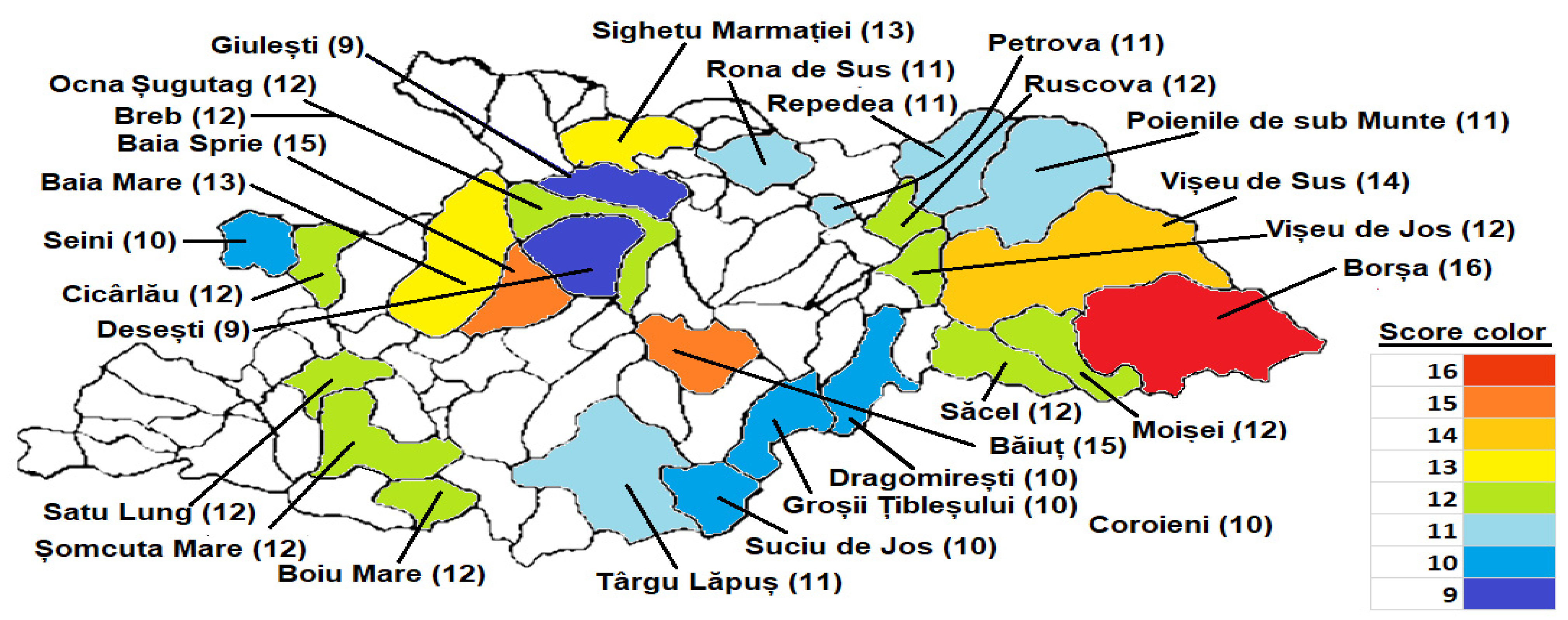
| Rural/Urban “Vj” | T1 | T2 | T3 | T4 | T5 | T6 | T7 | T8 | T9 | T10 | Total Points P(Vj) |
| V1 | 2 | 0 | 2 | 2 | 2 | 2 | 1 | 0 | 2 | 0 | 13 |
| V2 | 2 | 2 | 1 | 2 | 2 | 2 | 2 | 0 | 2 | 0 | 15 |
| V3 | 2 | 1 | 2 | 2 | 2 | 2 | 1 | 2 | 1 | 0 | 15 |
| V4 | 2 | 1 | 0 | 2 | 2 | 2 | 0 | 2 | 1 | 0 | 12 |
| V5 | 2 | 2 | 2 | 2 | 2 | 2 | 2 | 0 | 2 | 0 | 16 |
| V6 | 2 | 1 | 2 | 2 | 2 | 2 | 0 | 0 | 1 | 0 | 12 |
| V7 | 2 | 1 | 0 | 2 | 2 | 2 | 2 | 0 | 1 | 0 | 12 |
| V8 | 2 | 1 | 0 | 2 | 2 | 2 | 0 | 0 | 1 | 0 | 10 |
| V9 | 2 | 1 | 0 | 2 | 2 | 2 | 0 | 0 | 1 | 0 | 9 |
| V10 | 2 | 1 | 0 | 2 | 2 | 2 | 0 | 0 | 1 | 0 | 10 |
| V11 | 2 | 0 | 0 | 2 | 2 | 2 | 0 | 0 | 1 | 0 | 9 |
| V12 | 2 | 2 | 0 | 2 | 2 | 2 | 0 | 0 | 2 | 0 | 12 |
| V13 | 2 | 1 | 2 | 2 | 2 | 2 | 0 | 0 | 1 | 0 | 12 |
| V14 | 2 | 2 | 0 | 2 | 2 | 2 | 0 | 0 | 1 | 0 | 11 |
| V15 | 2 | 2 | 0 | 2 | 2 | 2 | 0 | 0 | 1 | 0 | 11 |
| V16 | 2 | 1 | 2 | 2 | 2 | 2 | 0 | 0 | 1 | 0 | 12 |
| V17 | 2 | 2 | 0 | 2 | 2 | 2 | 0 | 0 | 1 | 0 | 11 |
| V18 | 2 | 0 | 2 | 2 | 2 | 2 | 0 | 0 | 2 | 0 | 12 |
| V19 | 2 | 1 | 0 | 2 | 2 | 2 | 0 | 2 | 1 | 0 | 12 |
| V20 | 2 | 1 | 0 | 2 | 2 | 2 | 0 | 0 | 1 | 0 | 10 |
| V21 | 2 | 1 | 0 | 2 | 2 | 2 | 0 | 0 | 2 | 2 | 13 |
| V22 | 2 | 1 | 0 | 2 | 2 | 2 | 0 | 2 | 1 | 0 | 12 |
| V23 | 2 | 1 | 0 | 2 | 2 | 2 | 0 | 0 | 2 | 0 | 11 |
| V24 | 2 | 2 | 0 | 2 | 2 | 2 | 0 | 0 | 2 | 0 | 12 |
| V25 | 2 | 2 | 2 | 2 | 2 | 2 | 0 | 0 | 2 | 0 | 14 |
| Total value of the tourist area P(TA) | 298 | ||||||||||
| Score | Frequency | Percent |
|---|---|---|
| 9 | 2 | 8 |
| 10 | 3 | 12 |
| 11 | 4 | 16 |
| 12 | 10 | 40 |
| 13 | 2 | 8 |
| 14 | 1 | 4 |
| 15 | 2 | 8 |
| 16 | 1 | 4 |
| Total | 25 | 100 |
| Mean | 11.92 |
| Median | 12 |
| Mode | 12 |
| Standard Deviation | 1.754 |
| Sample Variance | 3.076 |
| Kurtosis | 0.359 |
| Skewness | 0.534 |
| Range | 7 |
| Minimum | 9 |
| Maximum | 16 |
| Sum | 298 |
| Count | 25 |
| Types of Tourism | Specificity |
|---|---|
| T1 Ecotourism | More than 26% of the county’s area is covered by protected natural areas, which are largely located in areas with great tourist flow. Ecotourism is the type of tourism that can be carried out in all the localities analysed because it meets all economic, social, aesthetic, tourism actors, maintaining cultural integrity, organic biological diversity, and all systems supporting life. |
| T2 Mountain Tourism | Has a great spread in the investigated localities, determined by the exceptional natural resources offered by the mountains surrounding the Depression of Maramureş (on the upper course of River Tisa) to the west and south of Oaşului, Gutâi, Tibleş and Rodnei Mountains and to the east and north of Maramureş Mountains. Natural Park Maramureş Mountains is a protected area of national interest (IUCN-V) designated for the purpose of protecting biodiversity and it is located on the territorial administrative units of the localities Borşa, Vişeu de Sus, Poienile sub Munte, Repedea, Petrova, Bistra, Moisei, and Vişeu, where mountain tourism can be practiced. A variant of mountain tourism is winter sports tourism in Borşa, Cavnic, Căvior, Izvoare and Mogoşa near Baia Sprie or blue sports tourism – Lake Sports, Near Baia Sprie or Lake Zânelor in Mogoşa. On the Vaser, Mara, or Lăpuş rivers, one can practice rafting, kayaking or canoeing. |
| T4 Rural Tourism/Agritourism | The reason for developing tourism in rural areas is small farmers’ awareness of the need for diversification of the activity both on agricultural farms (agritourism) and outside, by engaging in forestry, tourism or appealing to certain activities specific to the local economy. Due to the richness of natural and anthropogenic resources, unique worldwide, in all 25 localities studied, rural tourism and agritourism can be practiced. |
| T5 Cultural and Scientific Tourism | There are over 680 cultural heritage destinations of national and international interest, including: churches and assemblies, monuments and assemblies of architecture and arts, urban architectural assemblies, historical centers of which some are part of the UNESCO World Heritage. Ethnographic and folkloric Maramureş is also high originality, being represented by: the architecture specific to the villages in the Romanian historical provinces; Maramureş wooden churches; woodworking; folk outfit; the art of decoration; traditional ethnocultural and religious celebrations; fairs and ethnographic outdoor museum exhibitions or exhibition pavilions. Taking these elements, we also find that cultural, spiritual, and scientific tourism is specific to all localities in the protected areas of Maramureş. |
| T6 Religious (ecumenical) Tourism | Consists in the pilgrimages of believers to different cult buildings considered holy by different religions. To the same extent, the major cult premises, the saint patrons’ days and the churches attract, during the traditional religious holidays, a considerable number of pilgrims. The tourism potential for this form of tourism in Maramureş is particularly high and it is represented by the many monasteries, churches or other cult monuments that exist in all localities in the investigated areas. |
| T7 Mining Tourism | Has emerged by touring the mining patrimony and by putting it into the tourist circuit. In Maramureş, there are such mining areas attracted in the tourist circuit: Borşa, Cavnic, Sprie Baia or Speleo-mining circuit Cicariu-Poiana with Spines. The Mineralogical Museum of Baia Mare includes an impressive collection of minerals, fossils and rocks, of which around 1000 copies are unique in the world and that is one of the most visited tourist sites that include rare exhibits. A mining museum is also open in Baia Sprie, former mining town. |
| T8 Speleological Tourism | This type of tourism must be authorized by the Speleological Heritage Commission operating under the coordination of the Ministry of Environment. This committee is responsible for the authorization of speleological activities in caves; classifying in protective classes; assessment of caves based on scientific studies assumed; monitoring the preservation of the caves. Cave Baiu Mare, Cave Bătăţ, Cave Motori, Cave and the Blue Spring of Iza in Săcel, Cave Vălenii Mari- Şomcuta are declared monuments of nature and are designed to speleological tourism. |
| T9 Hunting and fishing Tourism | Hunting tourism addresses the lovers of hunting and fishing adventures. Maramureş is an area with many forests and fish rivers, and it has a rich and varied hunting fund. Maramureş is the area with the best-preserved forest fund due to reduced deforestation. In Maramureş, 54 hunting funds are declared, with an area of over 600,000 ha (for Carpathian deer, black goat, deer, wild boar, fox) but the most important are: Babei Valley, Faena, Rica, Baicu Ieud, Black, Băiţa, Fersig, Strâmbu and Țibleș. Fishing can be practiced in the rivers: Mara, Tisa, Iza, Vişeu, Vaser, Cosău—a tributary of Mara, Lake Firiza, and in the bogs in the localities: Baia Mare-Firiza, Tăuții, Lăpușel, Câmpulung, Baia Sprie, Satulung. |
| T10 Dark-Tourism | Can be practiced with reference to visiting locations associated with suffering, death or other macabre events. Here is the Memorial of Communism and Resistance (Sighet Pain Memorial). |
Publisher’s Note: MDPI stays neutral with regard to jurisdictional claims in published maps and institutional affiliations. |
© 2022 by the authors. Licensee MDPI, Basel, Switzerland. This article is an open access article distributed under the terms and conditions of the Creative Commons Attribution (CC BY) license (https://creativecommons.org/licenses/by/4.0/).
Share and Cite
Mateoc-Sîrb, N.; Albu, S.; Rujescu, C.; Ciolac, R.; Țigan, E.; Brînzan, O.; Mănescu, C.; Mateoc, T.; Milin, I.A. Sustainable Tourism Development in the Protected Areas of Maramureș, Romania: Destinations with High Authenticity. Sustainability 2022, 14, 1763. https://doi.org/10.3390/su14031763
Mateoc-Sîrb N, Albu S, Rujescu C, Ciolac R, Țigan E, Brînzan O, Mănescu C, Mateoc T, Milin IA. Sustainable Tourism Development in the Protected Areas of Maramureș, Romania: Destinations with High Authenticity. Sustainability. 2022; 14(3):1763. https://doi.org/10.3390/su14031763
Chicago/Turabian StyleMateoc-Sîrb, Nicoleta, Simona Albu, Ciprian Rujescu, Ramona Ciolac, Eugenia Țigan, Oana Brînzan, Camelia Mănescu, Teodor Mateoc, and Ioana Anda Milin. 2022. "Sustainable Tourism Development in the Protected Areas of Maramureș, Romania: Destinations with High Authenticity" Sustainability 14, no. 3: 1763. https://doi.org/10.3390/su14031763
APA StyleMateoc-Sîrb, N., Albu, S., Rujescu, C., Ciolac, R., Țigan, E., Brînzan, O., Mănescu, C., Mateoc, T., & Milin, I. A. (2022). Sustainable Tourism Development in the Protected Areas of Maramureș, Romania: Destinations with High Authenticity. Sustainability, 14(3), 1763. https://doi.org/10.3390/su14031763