Article

A PANAS Structure Analysis: On the Validity of a Bifactor Model in Korean College Students

1
Department of Counselling Psychology, Graduate School of Education, Hankuk University of Foreign Studies, Seoul 02450, Republic of Korea
2
Department of Counseling Psychology, Seoul Graduate School of Counselling Psychology, Seoul 03136, Republic of Korea
3
Vision Department, LS ELECTRIC, Seoul 03722, Republic of Korea
4
Division of Police Administration, Dongguk University, Seoul 04620, Republic of Korea
5
College of Law, Sungshin Women’s University, Seoul 02844, Republic of Korea
*
Author to whom correspondence should be addressed.
These authors contributed equally to this work.
Sustainability 2022, 14(24), 16456; https://doi.org/10.3390/su142416456
Submission received: 20 October 2022 / Revised: 30 November 2022 / Accepted: 6 December 2022 / Published: 8 December 2022
(This article belongs to the Section Psychology of Sustainability and Sustainable Development)

Abstract

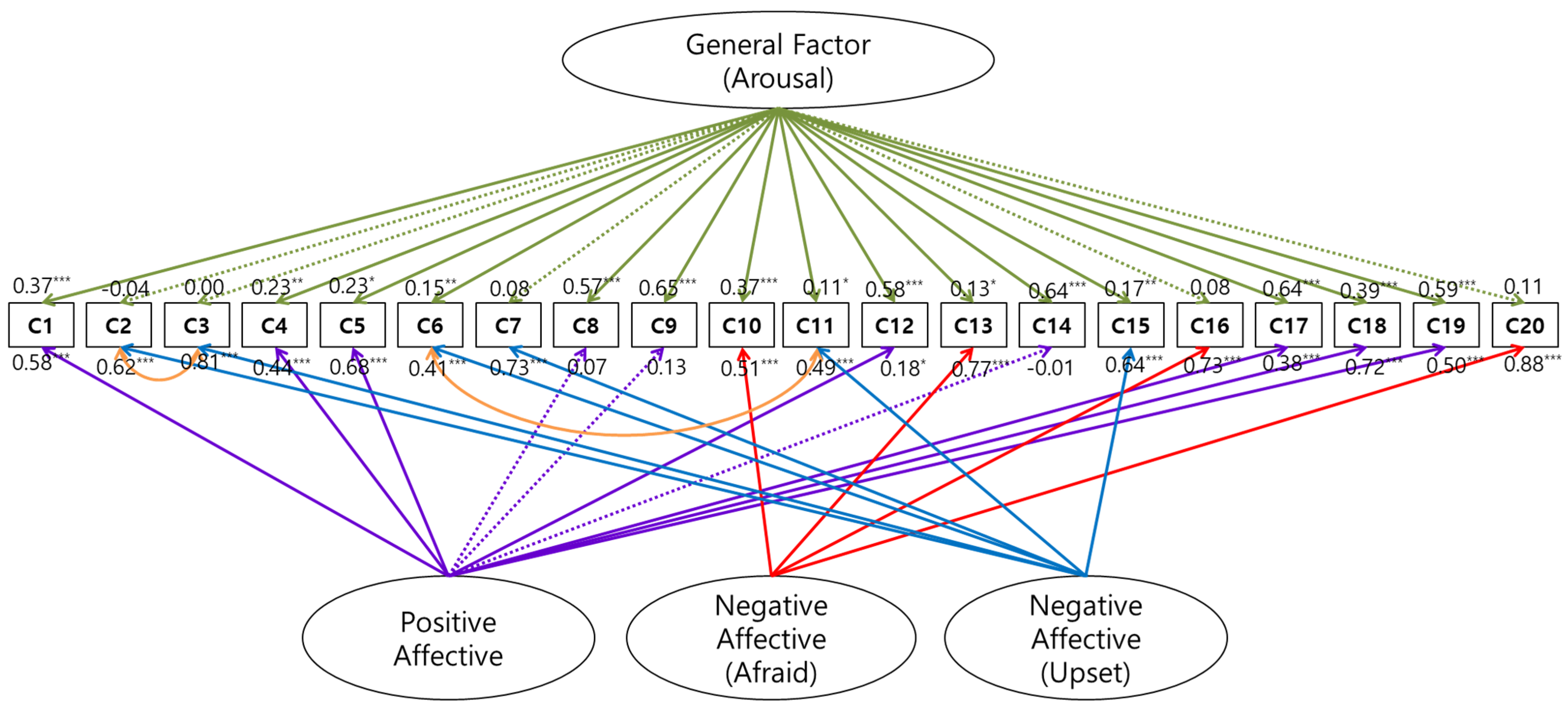
The purpose of this study was to determine the best model fit among the six models in the Korean version of Positive and Negative Affect Schedule (K-PANAS). Therefore, this study compared and analyzed the dimensional structure of this schedule for Korean college students. Specifically, the model fitness of six models, which are under debate, were compared: a single model for K-PANAS, a two-factor model (PA&NA) without any factor correlation, a three-factor model (PA, NA-Afraid, NA-Upset), a two-factor bifactor model, a three-factor bifactor model, and a three-factor bifactor model with error correlation. A total of 875 samples were analyzed, and the results show that best model fit is the three-factor bifactor model with error correlation. We named the general factor of the bifactor model “activation (or arousal).” This findings of this study will provide a richer explanation of emotions for researchers analyzing emotional activation (or arousal), a general factor of emotion, PA, and NA future studies that use PANAS.
Keywords: PANAS; affect; bifactor model; general factor; emotional arousal; recidivism PANAS; affect; bifactor model; general factor; emotional arousal; recidivism