Article

Entropy-Based Transit Tour Synthesis Using Fuzzy Logic

by
Diana P. Moreno-Palacio
1,2,
Carlos A. Gonzalez-Calderon
2,
John Jairo Posada-Henao
2,
Hector Lopez-Ospina
3,* and
Jhan Kevin Gil-Marin
4
1
Department of Civil Engineering, Universidad de Antioquia, Medellín 050010, Colombia
2
Department of Civil Engineering, Universidad Nacional de Colombia at Medellin, Medellín 050034, Colombia
3
Facultad de Ingeniería y Ciencias Aplicadas, Universidad de Los Andes, Santiago 12455, Chile
4
Department of Civil and Environmental Engineering, University of Maine, Orono, ME 04469, USA
*
Author to whom correspondence should be addressed.
Sustainability 2022, 14(21), 14564; https://doi.org/10.3390/su142114564
Submission received: 3 October 2022 / Revised: 29 October 2022 / Accepted: 3 November 2022 / Published: 5 November 2022
(This article belongs to the Special Issue Sustainable Urban Transportation, Freight and Logistics)

Abstract

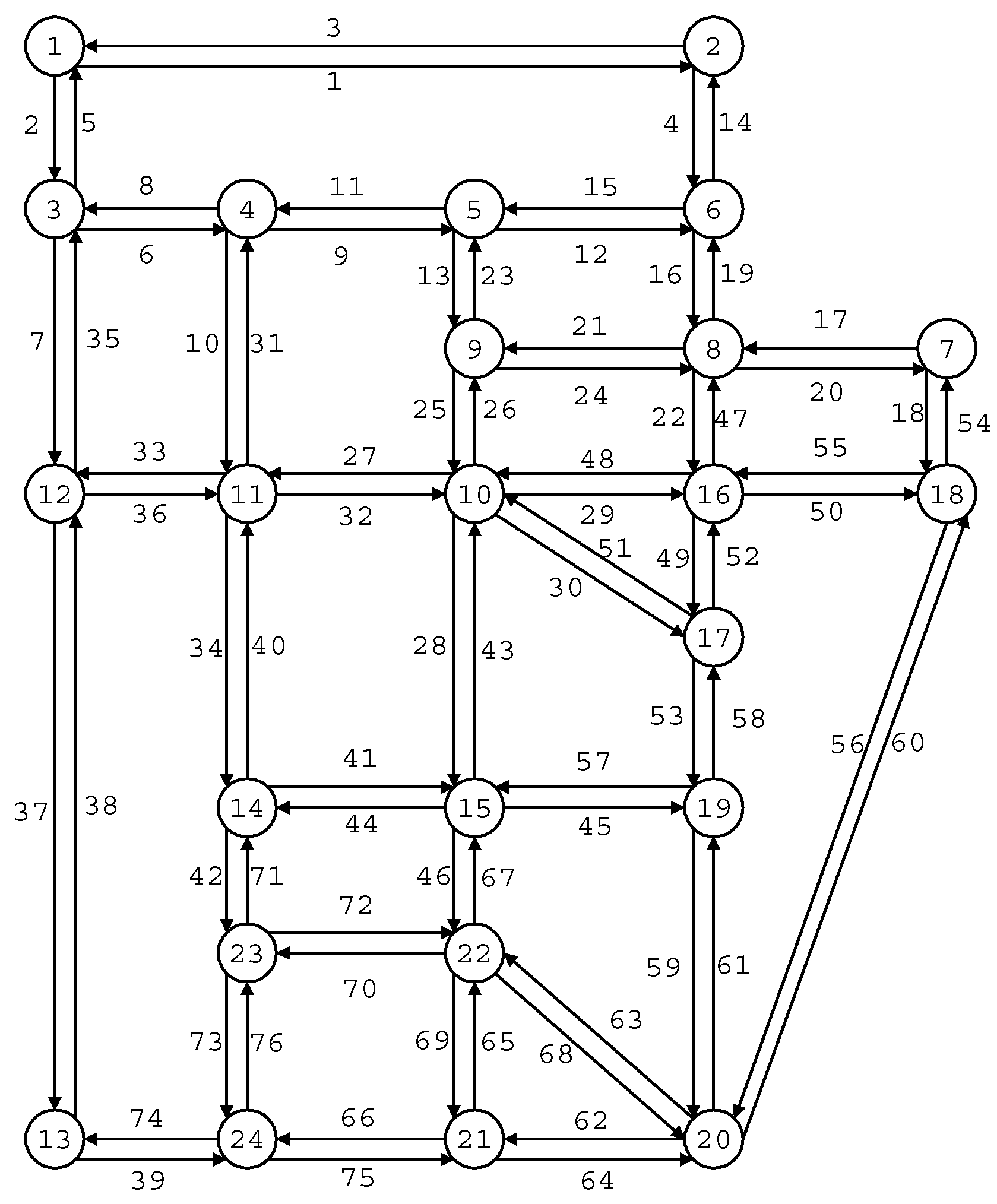
This paper presents an entropy-based transit tour synthesis (TTS) using fuzzy logic (FL) based on entropy maximization (EM). The objective is to obtain the most probable transit (bus) tour flow distribution in the network based on traffic counts. These models consider fixed parameters and constraints. The costs, traffic counts, and demand for buses vary depending on different aspects (e.g., congestion), which are not captured in detail in the models. Then, as the FL can be included in modeling that variability, it allows obtaining solutions where some or all the constraints do not entirely satisfy their expected value, but are close to it, due to the flexibility this method provides to the model. This optimization problem was transformed into a bi-objective problem when the optimization variables were the membership and entropy. The performance of the proposed formulation was assessed in the Sioux Falls Network. We created an indicator (Δ) that measures the distance between the model’s obtained solution and the requested value or target value. It was calculated for both production and volume constraints. The indicator allowed us to observe that the flexible problem (FL Mode) had smaller Δ values than the ones obtained in the No FL models. These results prove that the inclusion of the FL and EM approaches to estimate bus tour flow, applying the synthesis method (traffic counts), improves the quality of the tour estimation.
Keywords: transit tour synthesis; entropy maximization; fuzzy logic; transit tours; bi-objective optimization; traffic counts transit tour synthesis; entropy maximization; fuzzy logic; transit tours; bi-objective optimization; traffic counts