Abstract
This design-based research (DBR) project aimed to develop apt in-class and out-of-class teacher facilitation strategies to be employed in a pedagogic integration of flipped learning and social enquiry learning, viz., FIBER (Flipped Issue-Based Enquiry Ride), with respect to upper-, average-, and lower-academic classrooms. The research was conducted in the formal learning and teaching context of senior secondary social humanities education in Hong Kong, involving nine teachers (from nine different schools at three different academic bands) and their Secondary-5 (Grade-11) classes (with a total of 610 students) in two consecutive school years. Apart from delineating the evidence-based teacher facilitation practices that we designed, enacted and evaluated in the DBR process, this paper also discusses the principles that we derived in accordance with these practices. The present work provides both researchers and educators with new insights into developing adequate teacher facilitation strategies when adopting flipped learning in social humanities education and upon different formal schooling settings.
1. Introduction
Against the backdrop of the pervasive promotion of harnessing online technologies in learning and teaching, flipped learning, as well as its synonyms: “flipped classroom,” “inverted teaching,” “flipping the classroom,” etc., has been regarded as one of the most salient approaches in school education [1,2]. As suggested by the name, flipped learning inverts the in-class and out-of-class pedagogic activities that are used to being exercised inside and outside the classroom [3]. At home, students pursue online, pre-lesson individual learning with relatively simple, straightforward materials posted on the learning management system (LMS) by the teacher; at school, they pursue face-to-face, in-lesson peer learning through accomplishing more complicated collaborative tasks assigned by the teacher.
There have been considerable studies and examples about adopting flipped learning in subjects pertaining to STEM (science, technology, engineering and mathematics) (e.g., [4,5,6,7]) and second language learning (e.g., [8,9,10,11]). However, research into harnessing this approach in social humanities education (SHE) has remained in its infancy state [12,13]. The present work is not only targeted at filling this research gap but also addressing the pedagogic problems which have existed in SHE in Hong Kong secondary schools.
This paper reports on our design-based research (DBR) project which aimed to develop apt in-class and out-of-class teacher facilitation strategies to be employed in a pedagogic framework of flipped social enquiry learning, namely FIBER (Flipped Issue-Based Enquiry Ride) [14], with respect to upper-, average-, and lower-academic classrooms. The project was conducted in the formal learning and teaching context of senior secondary SHE in Hong Kong, involving nine teachers (from nine different schools at three different academic bands) and their Secondary-5 classes (with a total of 610 students) in two consecutive school years. Apart from delineating the teacher facilitation practices that we designed, enacted and evaluated in the DBR process, we also discuss the principles that we derived in accordance with these practices.
After this introduction, the rest of the paper is organised as follows. The next section will elaborate on the related works that framed and shaped this DBR. Hence, we will sequentially discuss the research design, findings, implications and limitations. At the end of this paper, we will give our concluding remarks and suggest further studies stemming from the present work.
2. Related Works
2.1. Flipped Learning
Along with the prevalence of online learning management systems in schools and low-cost, user-friendly video-recording devices, flipped learning has continued to receive a lot of educators’ attention since it was preliminarily introduced in the early 2010s [15,16,17]. In general, the instructional paradigm of flipped learning articulates (i) online, individual video-based learning at home, and (ii) face-to-face, collaborative learning at school [2,3,6]. While researchers in this area have yet to come up with a unique definition for this pedagogic approach [12,13], Hwang et al.’s [18] seminal elaboration on flipped learning has been widely employed as the operational definition in the related studies, and so is the present work.
Hwang et al. [18] conceptualised flipped learning by theoretically grounding on Anderson et al.’s [19] revised version of Bloom’s Taxonomy. Outside the classroom, arranged by the teacher, students preliminarily acquire relatively simple, straightforward knowledge through online direct-instruction videos in the form of individual, remembering- and/or understanding-oriented homework (i.e., the lower-order thinking levels in the revised Bloom’s Taxonomy). Inside the classroom, facilitated by the teacher, students deepen and transfer their knowledge acquired outside the classroom through participating in peer-supported, applying-, analysing-, evaluating-, and/or creating-oriented classwork (i.e., the higher-order thinking levels in the revised Bloom’s taxonomy).
So far, empirical studies pertaining to flipped learning have largely focused on its adoption in STEM-related education (e.g., [4,5,6,7]) and foreign language education (e.g., [8,9,10,11]). Research into harnessing this pedagogic approach in SHE remains in its infancy [14]. In fact, the same observation is unfolded when scrutinising the recent scholarly reviews on “flipped” research (e.g., [12,13]). In addition, flipped learning has been narrowly viewed as an instructional method to supplement, if not replace, some existing traditional, teacher-centred approaches in schools [17]. There has been little attention to improving/enhancing, if not revamping, some current constructivist learning approaches riding on the pedagogic advantages brought by flipping the classroom [20].
2.2. Social Enquiry Learning
Constructivist, learner-centred approaches to education have been pervasively advocated over the world since the beginning of this century [21,22]. Social enquiry learning is one of these approaches broadly adopted as a pedagogy in SHE [23,24]. Usually, in the course of enquiry, students are situated in a societal issue which is argumentatively open-ended in nature and pertains to a number of stakeholders in the society [25]. Pivoting around the issue, they have to carry out a set of articulated tasks of “questioning,” “investigating,” “analysing,” “explaining,” “evaluating,” and “reflecting,” from different stakeholders’ perspectives [26]. Thus, social enquiry learning has a synonym called “issue-based enquiry” [27].
While social enquiry learning places a strong emphasis on learners’ active studying role, it is impractical to expect that school students can accomplish all required enquiry tasks and then co-develop the knowledge on their own without any learning guidance [23,25,27,28]. Apart from promoting their sense of competence [29,30] and reducing the entailed extraneous cognitive load [31,32] in the learning process, the learning environment should cognitively, emotionally and behaviourally engage students to attain the final enquiry goal and the corresponding interim subgoals [33]. Building on theories of Dewey’s [34] experiential learning, Vygotsky’s [35] scaffolding, and Bruner’s [36] interpretative learning, Stripling [37,38] developed a framework, viz., Stripling Model of Enquiry (SME), to support students in pursuing their learning in the course of social enquiry. The framework consists of six enquiry phases, including Connection, Exploration, Comprehension, Construction, Expression and Reflection. SME is part of the theoretical foundation of the design of FIBER [14], which will be further discussed in Section 2.4.
2.3. Social Humanities Education (SHE) in Hong Kong Secondary Schools
In Hong Kong, Liberal Studies (LS) is a mandatory social humanities subject in senior secondary schools, aiming to empower students with real-life knowledge, reasoning skills and holistic perspectives for enquiring into social issues arising in the world [39]. The curricular contents of LS are shaped by a theme-based structure. Each theme is composed of several enquiry modules; each module focuses on a societal issue. For instance, “Globalisation,” “Environment and Sustainable Development,” and “Influences of Energy Technology” are the modules in the theme of “Society and the Environment.” In the common school practice, a nine-day teaching cycle is allocated for studying an enquiry module, in which three classroom-based lessons (around 70 min each) are evenly distributed in the cycle. The official subject document of LS recommends social enquiry learning as the general instructional approach in most of the curricular learning and teaching activities.
Nevertheless, students’ performance in the LS public examination in recent years has been unsatisfactory; the post-examination reports [40,41,42,43,44] spell out the students’ common problems. For example, they were unable to recognise and employ relevant concepts to discuss the societal issues concerned in the examination questions. They could only give shallow elaborations when answering the questions, without conceptualising and generalising the underneath problems. On top of that, they used to overlook the steps for framing their arguments, i.e., the processes, consequences, reasons, etc., leading to their conclusions.
2.4. Flipped Issue-Based Enquiry Ride (FIBER)
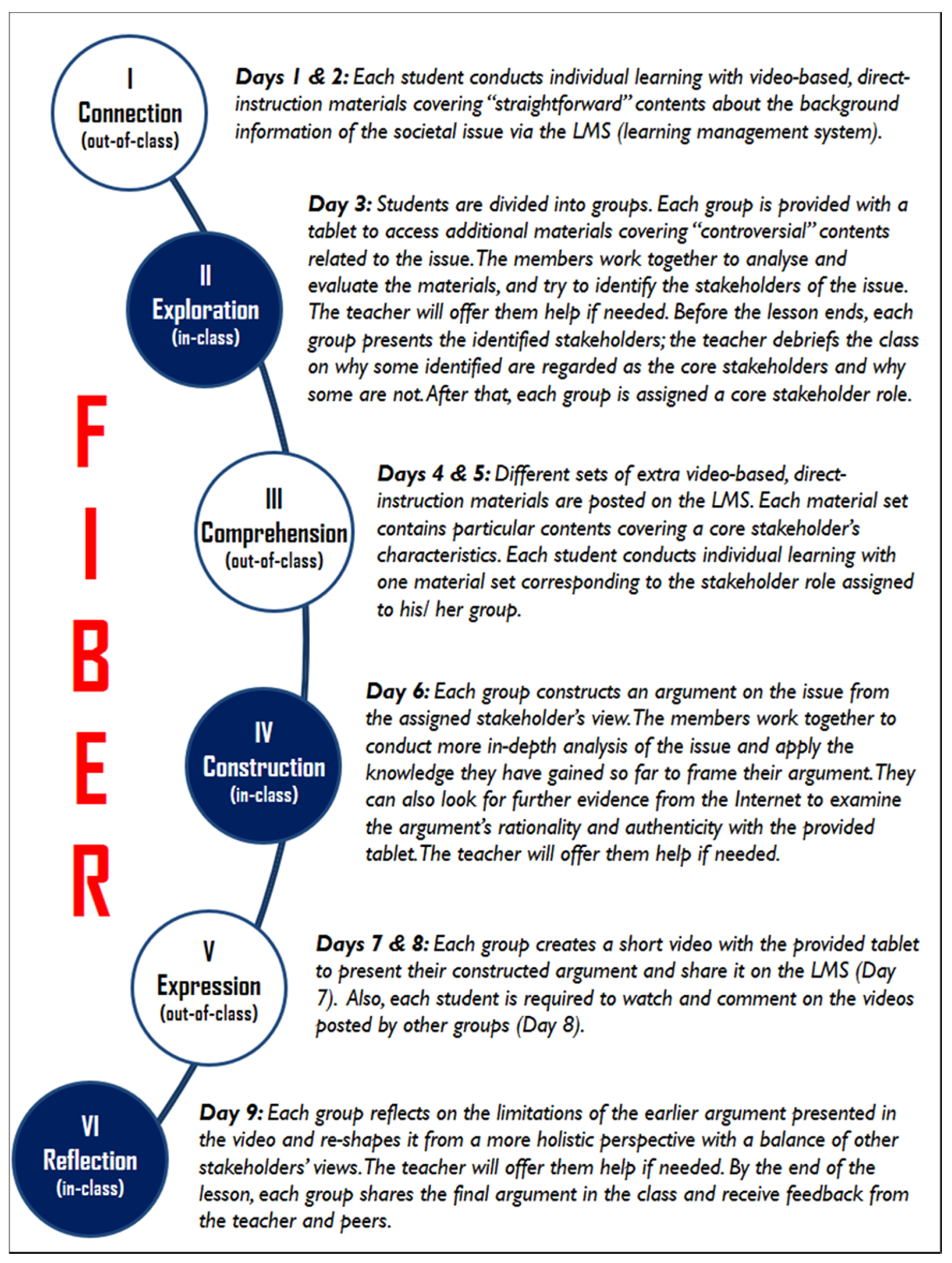
In accordance with the formal learning and teaching context of LS, leveraging the theoretical bases of Hwang et al.’s [18] “flipped” conceptualisation and Stripling’s SME [37,38], we have introduced flipped learning to LS by proposing a six-phase pedagogic integration of flipped learning and social enquiry learning, viz. FIBER [14]. While the detailed description of the design and implementation of FIBER was documented in our previous publication, Figure 1 summarises how FIBER is operated in studying a social enquiry module within a nine-day LS teaching cycle in Hong Kong secondary schools.
Figure 1.
Operation of FIBER in studying a social enquiry module in a nine-day LS teaching cycle.
Prior to the present DBR project, we developed learning resource sets based on the enquiry modules of the LS curricular theme of “Society and the Environment” for supporting the implementation of FIBER as described in Figure 1. We also set up a research advisory panel for reviewing the quality of the resource sets and their alignment with the curricular objectives spelled out in the official subject document [39]. The panel was composed of educators from local universities, experienced LS teachers from nonparticipating secondary schools, and experienced curriculum officers [45].
In the pilot research, we showed that, compared with the conventional approach to social enquiry learning adopted in the participating schools, FIBER significantly yielded higher pedagogic effectiveness in terms of students’ learning performance [45]. However, in the interviews with the LS teachers who observed the research, they were concerned that FIBER might not be directly employed in their own schools in practice, unless apt pedagogic interventions with respect to their class settings could be “locally” incorporated in the different enquiry phases. They deemed that teacher facilitation should be the key to optimising the process of students’ “flipped” social enquiry learning.
2.5. Design-Based Research (DBR)
DBR, which is a research methodology broadly used not only in the field of educational technology but also education in general, has a strong emphasis on the collaboration between researchers and practitioners to co-develop pragmatic knowledge to be used in real-life contexts [46,47]. Usually, the pedagogic DBR aims to design precise interventions for tackling difficulties or problematic issues emerging from the process of learning and teaching [48,49]. The designed interventions have to be authentically exercised in the corresponding pedagogic contexts for evaluating their empirical effectiveness. Iterative research rounds for optimising the original design of the interventions are always salient in DBR; the research results of the former round steer the research work of the next round [50].
There have been various DBR approaches suggested by various DBR researchers (e.g., [46,47,48,49,50]). However, the seminal DBR paradigm proposed by DBR Collective [51], which systematically models DBR’s interactive research rounds with the methodological stages of Design, Enact, Analyse, and Redesign, has still been the most widely adopted one in DBR studies. In this DBR project, we also employed this paradigm to guide the research design.
3. Method
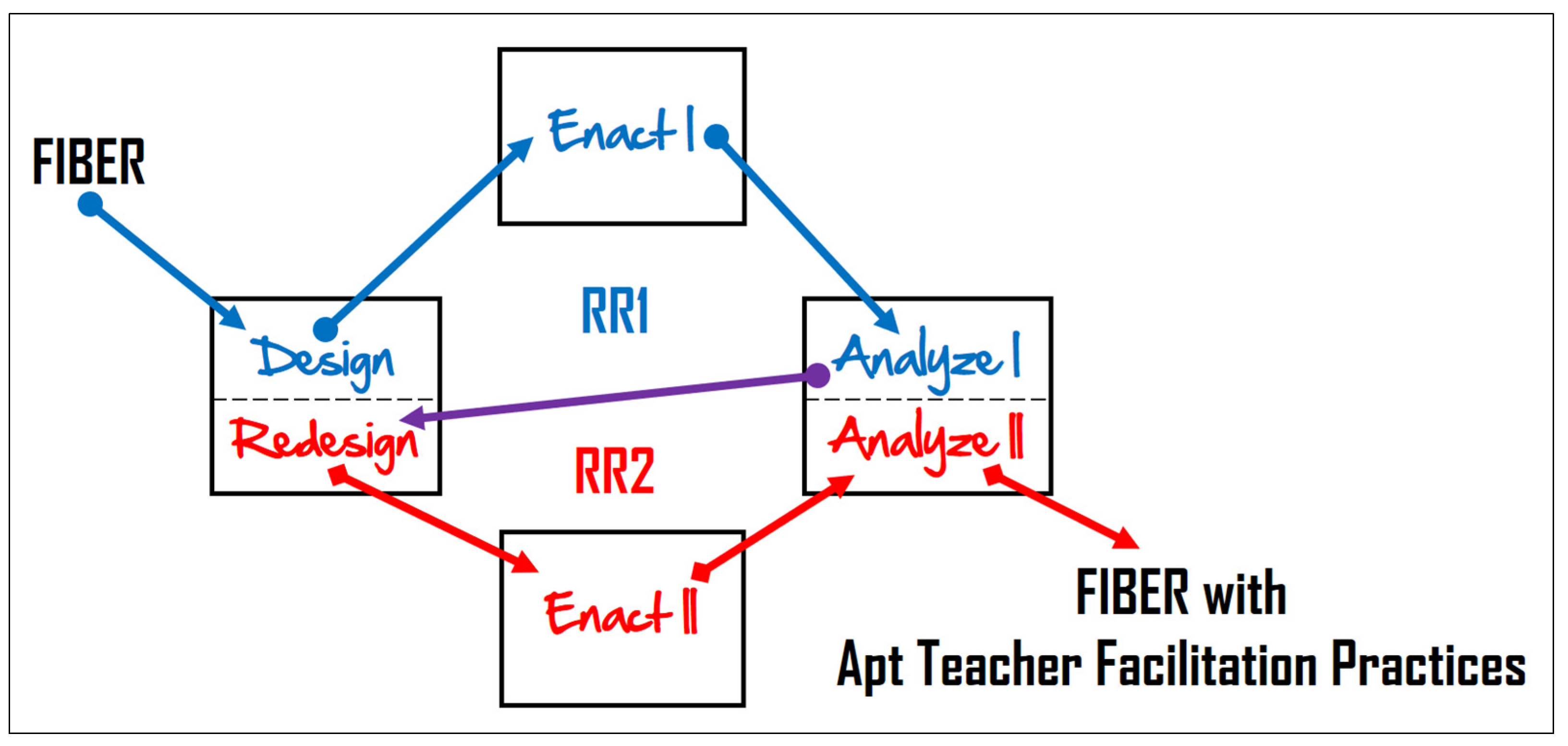
The aim of this DBR project was to—harnessing FIBER as an initial pedagogic framework—design, enact and evaluate what and how teachers could do in order to optimise the process of students’ “flipped” social enquiry learning in SHE. Using the methodological paradigm proposed by DBR Collective [51], we carried out the research in the context of LS formal curriculum learning and teaching in different school settings in Hong Kong in 2 consecutive school years, with 2 iterative research rounds (namely RR1 and RR2, see Figure 2; 1 year per round). RR1′s preliminary findings were documented in our previous working paper [20]. While this paper focuses on presenting and discussing RR2′s work and the overall results of this DBR, in order to let readers have a more comprehensive understanding of the entire research, some important recaps of RR1 are included in the following subsections.
Figure 2.
Research Round 1 (RR1) and Research Round 2 (RR2) in the DBR.
3.1. Design (in RR1)
In Hong Kong, based on students’ general academic performance, secondary schools are categorised into 3 academic bands, viz., Band A (upper), Band B (average), and Band C (lower) [27,52]. In this DBR, 3 LS teachers from 3 different schools at each academic band were recruited to collaborate with us, i.e., a total of 9 teachers from 9 schools (3 at Band A, 3 at Band B, and 3 at Band C). The background of the 9 recruited teachers was similar; each had a bachelor of education degree and 5 to 6 years of LS teaching experience. Before participating in the study, all of them had had some prior knowledge about FIBER; 3 of them had observed the FIBER implementation in our pilot work [45], while 6 of them had participated in our introductory workshop on FIBER held in the first author’s university.
At the beginning of the Design stage (see Figure 2), we conducted individual refresher training on flipped learning and FIBER for the 9 teachers. To gain more familiarity with this pedagogic framework before the Enact I stage, the teachers experimented on implementing FIBER (as described in Figure 1) in their own Secondary-4 classes [14]. After that, each of them was assigned a social enquiry module in the LS curricular theme of “Society and the Environment”, “Globalisation,” “Environment and Sustainable Development,” or “Influences of Energy Technology” [39]. We further went through with him/her the FIBER resource set previously developed for the assigned module [20].
3.2. Enact I (in RR1) and Enact II (in RR2)
At the Enact I stage in RR1 (i.e., the first year, see Figure 2), in each school, the teacher implemented FIBER to facilitate a Secondary-5 class (class size: from 31 to 37) to study the assigned module in a 9-day teaching cycle (as described in Figure 1). In this round, there were a total of 307 student participants from the 9 schools. Table 1: RR1 shows the student distribution of Band-A, Band-B and Band-C schools at the Enact I stage.
Table 1.
Distribution of the student participants in RR1 and RR2 in terms of academic bands.
At the Enact II stage in RR2 (i.e., the second year, see Figure 2), in each school, the teacher implemented FIBER with the incorporation of the new teacher facilitation practices formulated at the Redesign stage (see Section 3.4) to facilitate another Secondary-5 class to study the same assigned module in a 9-day teaching cycle. In RR2, we deliberately requested the teacher to select a class that was comparable with the participating class in RR1, in terms of academic performance. We cross-checked that there was no significant difference (p > 0.05) between the LS school-based examination mean scores of the 2 classes prior to their participation in this DBR. In this round, there were a total of 303 student participants from the 9 schools. Table 1: RR2 shows the student distribution of Band-A, Band-B and Band-C schools at the Enact II stage. Combining RR1′s and RR2’s subjects, the total number of student participants in the entire DBR was 610.
3.3. Analyse I (in RR1) and Analyse II (in RR2)
At both stages of Analyse I in RR1 and Analyse II in RR2 (see Figure 2), in each school, we administered a knowledge test (75 min) to the students. The test questions were developed in accordance with the recent 5-year LS public examination questions [40,41,42,43,44] pertaining to the social enquiry module (“Globalisation,” “Environment and Sustainable Development,” or “Influences of Energy Technology” [39]) that the students had studied at the stages of Enact I and Enact II. All customised questions were scrutinised by the same research advisory panel which had been set up for reviewing the previously developed FIBER resources [14,20,45]. Every completed test paper in RR1 and RR2 was individually marked by 2 experienced LS teachers from 2 nonparticipating schools. The Kappa values of the inter-rater reliability in RR1 and RR2 were 0.92 and 0.91, respectively. Moreover, in each school, we conducted in-depth, semi-structured individual interviews [53] with 3 randomly selected students for probing into their learning experience in FIBER in both RR1 and RR2. We employed Creswell’s [54] analytical approaches to layering and inter-relating the collected interview data to triangulate and explain the knowledge test results.
As reported in the working paper [20], at the Analyse I stage in RR1, we revealed a number of problems arising from the implementation of FIBER during the Enact I stage, impeding the students’ flipped social enquiry learning process. Some of the problems generically happened in all schools across the 3 academic bands, while the others uniquely happened in the schools at a particular academic band. All of these problems are summarised in Appendix A for readers’ convenient reference.
3.4. Redesign (in RR2)
Three teacher groups were formed to work on the optimisation of FIBER by addressing the problems revealed in RR1 (see Appendix A). The 3 teachers at the same schools’ academic band were grouped together, e.g., the 3 Band-A teachers joined the Band-A teacher group, and so on. Through face-to-face and Apple® FaceTime online meetings, as well as other online tools (e.g., emails and WhatsApp® group chats), we discussed the findings obtained in RR1 in each teacher group and collaborated with them to formulate possible interventions for improving/enhancing the implementation of FIBER in their own schools. Specifically, we aimed to derive new teacher facilitation practices for tackling the identified problems. Table 2 shows a summary of the newly derived practices to be enacted by the teachers in the Band-A, Band-B, and Band-C schools at the Enact II stage in RR2. We will revisit and further elaborate on these practices in the Discussion part (Section 5) of this paper.
Table 2.
Teacher facilitation practices derived at the Redesign stage for addressing the generic (G) and unique (U) problems arising in the Band-A (A), Band-B (B), and Band-C (C) schools.
4. Findings
We received a total of 295 and 292 completed test papers from the 9 schools in RR1 (return rate: 96.09%) and RR2 (return rate: 96.37%), respectively. Table 3 shows the distribution of the papers collected from the Band-A, Band-B and Band-C schools. The full score of the test was 60. The following subsections present and compare the results obtained from the different academic-banding classes in RR1 and RR2.
Table 3.
Number of the completed test papers received in RR1 and RR2 in terms of academic bands.
4.1. Band-A Students
The students at Band A were upper academic-achieving learners. Table 4 displays the descriptive statistics of their test performance in RR1 and RR2. An independent samples t-test on the test results shows that the students in RR2 (mean: 51.33) significantly outperformed those in RR1 (mean: 45.21), t(203) = 4.08, p < 0.001. The Cohen’s d is 0.57, reflecting that the new teacher facilitation practices enacted in the Band-A classes in RR2 (see Table 2) significantly promoted the pedagogic effectiveness of FIBER, with a medium effect size [55].
Table 4.
Band-A students’ test performance in RR1 and RR2.
In the interviews with the Band-A students (pseudonyms: Students A1, A2, A3, A4, A5, A6, A7, A8, and A9) at the Analyse II stage in RR2, they shared their positive flipped social enquiry learning experience in FIBER in light of the new teacher facilitation practices derived at the Redesign stage. Their sharing aligned what we had observed at the Enact II stage in RR2. Table 5 shows the pertaining excerpts from the interviews.
Table 5.
Band-A students’ interview excerpts pertaining to the new teacher facilitation practices.
4.2. Band-B Students
The students at Band B were average academic-achieving learners. Table 6 displays the descriptive statistics of their test performance in RR1 and RR2. An independent samples t-test on the test results shows that the students in RR2 (mean: 43.88) significantly outperformed those in RR1 (mean: 37.35), t(197) = 3.96, p < 0.001. The Cohen’s d is 0.56, reflecting that the new teacher facilitation practices enacted in the Band-B classes in RR2 (see Table 2) significantly promoted the pedagogic effectiveness of FIBER, with a medium effect size [55].
Table 6.
Band-B students’ test performance in RR1 and RR2.
In the interviews with the Band-B students (pseudonyms: Students B1, B2, B3, B4, B5, B6, B7, B8 and B9) at the Analyse II stage in RR2, they shared their positive flipped social enquiry learning experience in FIBER in light of the new teacher facilitation practices derived at the Redesign stage. Their sharing aligned what we had observed at the Enact II stage in RR2. Table 7 shows the pertaining excerpts from the interviews.
Table 7.
Band-B students’ interview excerpts pertaining to the new teacher facilitation practices.
4.3. Band-C Students
The students at Band C were lower academic-achieving learners. Table 8 displays the descriptive statistics of their test performance in RR1 and RR2. An independent samples t-test on the test results shows that the students in RR2 (mean: 31.81) significantly outperformed those in RR1 (mean: 21.12), t(181) = 5.72, p < 0.001. The Cohen’s d is 0.85, reflecting that the new teacher facilitation practices enacted in the Band-3 classes in RR2 (see Table 2) significantly promoted the pedagogic effectiveness of FIBER, with a large effect size [55].
Table 8.
Band-C students’ test performance in RR1 and RR2.
In the interviews with the Band-C students (pseudonyms: Students C1, C2, C3, C4, C5, C6, C7, C8, and C9) at the Analyse II stage in RR2, they shared their positive flipped social enquiry learning experiences in FIBER in light of the new teacher facilitation practices derived at the Redesign Stage. Their sharing aligned what we had observed at the Enact II stage in RR2. Table 9 shows the pertaining excerpts from the interviews.
Table 9.
Band-C students’ interview excerpts pertaining to the new teacher facilitation practices.
5. Discussion
According to the quantitative analysis of the overall students’ performance across the three academic bands (see Table 4, Table 6 and Table 8 in Section 4) and the qualitative triangulation with the student-interview data (see Table 5, Table 7 and Table 9 in Section 4), the new teacher facilitation practices (see Table 2 in Section 3), which were respectively enacted in Band-A, Band-B, and Band-C schools in RR2, functioned to significantly advance the pedagogic effectiveness of FIBER, with medium to large effects. Based on the results of this DBR project, we propose the following six teacher facilitation principles for optimising the process of students’ flipped social enquiry learning.
5.1. Principle I: Projecting “Teacher Presence” onto Pre-Lesson Individual Learning
Regardless of low-cost, handy and user-friendly video-recording devices available in schools or self-owned by teachers, due to their busy teaching schedule and daily school administration work, some flipped learning proponents do not deem that teachers should produce “flipped” videos on their own to support students in conducting pre-lesson individual learning [12]. On the other hand, in the condition of properly obeying and addressing the corresponding intellectual property rights, teachers can make use of existing relevant/suitable video resources created by others (e.g., publishers, university faculties, etc.), or available from free online educational platforms (e.g., Khan Academy), YouTube® channels, etc. [13]. However, as observed (at RR1) and evidenced (at RR2) in this DBR, the short “teacher presence” in the video materials was a salient element to better scaffold, engage, and motivate the students to accomplish the pre-lesson individual learning tasks across the three academic bands (see the interview excerpts of Students A1, B1, and C1 in Section 4).
In flipped social enquiry learning, we are not proposing that every video material for supporting pre-lesson individual learning should make students’ own teachers “present.” In fact, harnessing ready-to-use videos which closely align the concerning curricular objectives is a cost-effective means to support the out-of-class part of flipped learning [2,3,17,18]. Instead, Principle I suggests that teachers can prepare a short scaffolding video for providing their own students with “learning tricks” with respect to each set of existing video materials. This kind of preamble support can effectively assist students in better mastering the learning contents covered in the video sets [11], promoting their sense of competence in the individual learning process [29,30]. Moreover, when conducting the pre-lesson homework, students being virtually guided by a familiar teacher face and voice can incubate a “personalised” atmosphere. This favours the cognitive process that integrates incoming information with students’ prior knowledge [56], as well as promoting their emotional engagement [33].
5.2. Principle II: Rectifying Misconceptions before In-Lesson Peer Learning
Although the out-of-class part of flipped learning places a strong emphasis on student’s independent learning, it is unrealistic to expect that all students can attain the same designated learning outcomes at home before coming back to the classroom [4,11]. Thus, it is important for teachers to reserve a portion of lesson time to follow up students’ pre-lesson individual learning [6,8,10]. As observed (at RR1) and evidenced (at RR2) in this DBR, across the three academic bands, the short MC questions articulated to the pre-lesson individual learning tasks did assist the students in self-assessing and/or reinforcing the self-gained knowledge/concepts (see the interview excerpts of Students A2, B2, and C2 in Section 4). In addition, through reviewing the students’ performance in answering the MC questions, the teachers obtained precise “hints” about their students’ common misconceptions. Hence, before facilitating the in-lesson peer learning activities, the teachers could timely and aptly rectify the students’ misconceptions (see the interview excerpts of Students A2, B2, B5, C2, and C5 in Section 4).
Teachers’ just-in-time, corrective feedback is always one of the crucial elements in any pedagogy underpinned with a self-directed learning paradigm [22,27], and so does flipped learning. Principle II suggests that, according to students’ learning proceedings gathered in pre-lesson individual learning, teachers find authentic clues to rectify students’ common misconceptions before engaging them in in-lesson, collaborative social enquiry learning tasks. This timely support in the classroom can make students perceive themselves more “well-equipped” prior to the next harder learning task [17,18]. In turn, not only their sense of competence [29,30] but also their cognitive engagement in the peer learning process will be promoted [33]. In flipped learning, the use of MC questions has been regarded as a quick-and-effective method to gather students’ pre-lesson learning progress [13] because it does not require teachers’ heavy effort and can effectively promote students’ behavioural engagement in accomplishing the required pre-lesson homework [6].
5.3. Principle III: Allowing Competence-Based Autonomy in Flipped Formative and Summative Learning Tasks
Social enquiry learning emphasises not only the enquiry outcome but also the enquiry process [23,24,25,26,27]. To better motivate and engage students in mastering the formative and summative tasks entailed in different enquiry phases, it is of paramount importance to foster them with the sense of autonomy in the entire learning proceedings [37,38]. As observed (at RR1) and evidenced (at RR2) in this DBR, through bringing in the idea of “post-lesson work,” it relieved the students’ pressure on rushing into finishing all in-lesson peer learning tasks without thoroughly counter-checking the limitations therein, and eventually promoted the quality of their formative learning artefacts (see the interview excerpts of Students A6 and A7 in Section 4). Moreover, through relaxing the requirement of using videos as the only means to present their co-constructed arguments across the three academic bands, the students were more confident in developing the summative learning artefacts with their familiar tools and media (see the interview excerpts of Students A3, B3, B9, and C3 in Section 4).
Educators have believed that, to encourage students’ continuous learning participation, it is salient to offer them a certain amount of freedom in the course of learning in which they can select different paths to attain the learning goal and the corresponding subgoals based on their own competence [22,27,34,35]. Principle III suggests that, to reduce unnecessary extraneous cognitive load [31,32] in the flipped social enquiry learning process, teachers allow students to have competence-based autonomy (i.e., in accordance with students’ current competence) in accomplishing the required formative and summative tasks. With the sense of this autonomy, students will be more confident in mastering their learning progress [29,30].
5.4. Principle IV: Incorporating Necessitated In-Class Technical Scaffolds
When employing technology-enhanced pedagogies, teachers often assume that every student in the classroom is able to use the entailed technological tools intuitively, if not properly. However, it is not true in reality [22,27]. As observed (at RR1) and evidenced (at RR2) in this DBR, through grouping the tech-savvy students and tech-novice students in the classroom, the former guided the latter on how to operate the tablets so that they could smoothly participate in the in-lesson peer learning activities (see the interview excerpts of Students A4, B4 and C4 in Section 4). The Internet-searching techniques gained from the flipped video effectively assisted the students in reaching the authentic information for grounding their co-constructed arguments in the classroom (see the interview excerpts of Students B6 and C6 in Section 4). Meanwhile, the activation of the tablets’ “Guided Access” function helped cease the students’ off-task misbehaviour during the in-lesson peer learning (see the interview excerpts of Students B7 and C7 in Section 4).
In the context of technology-supported learning, one should be cautioned to assume that all students in the classroom are “digital natives” [57] who can master technologies effortlessly and make good use of technologies as digital learning tools rather than digital toys [58,59]. Principle IV suggests that teachers incorporate necessitated technical scaffolds (both assistance and control) to support students in the flipped social enquiry learning process. For example, as shown in our study, “tech-savvies’ peer support” and “technique-based flipped video” are assistance-wise scaffolds, while “guided-access control” is a control-wise scaffold. Apt technical scaffolds, which are a sort of germane cognitive load [31,32] in the learning process, can effectively promote students’ sense of competence in attaining the expected learning outcomes and can mitigate undesirable learning distractions [29,30].
5.5. Principle V: Empowering Student Leaders to Moderate In-Lesson Peer Learning
“Democratising knowledge,” “collective responsibility,” and “idea diversity” are regarded as must-have attributes of a team-based collaborative environment [28]. However, without a capable “chairperson” to steer the team toward the collective learning goal, these attributes will not appear in the peer learning process [23,24]. As observed (at RR1) and evidenced (at RR2) in this DBR, the moderation work carried out by the leader in each student group successfully fosters a more harmonic, interactive and supportive atmosphere in the classroom during the in-lesson peer-learning process, alleviating the problems and/or situations of conflicting, dominating, shadowing, and silencing (see the interview excerpts of Students A8, A9, and B8 in Section 4).
Teachers are used to playing a significant role in moderating students in online discussion activities [22]. Nevertheless, all group-based discussions in flipped social enquiry learning take place in face-to-face lessons. Under the time constraint, it is impractical for a single teacher to simultaneously monitor and support seven to eight groups in the classroom. Principle V suggests that teachers distribute part of the moderation work to students (leaders) who are capable of leading their groups. The leader of each group helps to steer his/her groupmates toward the designated peer learning goal. Instead of being selected randomly, the leader in each group can be peer-voted by the groupmates or teacher-assigned, based on, for example, his/her rapport with the classmates and/or prior learning attitude and behaviour in the classroom [24,28]. Moreover, teachers should pre-alert the elected/assigned leaders to what possible problems may arise in their groups, as well as offering them guidelines about how to handle the undesirable situations emerging from the in-lesson peer learning process [25]. A supportive peer learning environment, which is a sort of germane cognitive load [31,32] in the learning process, can effectively promote students’ emotional and behavioural engagement, in turn advancing their learning performance [33].
5.6. Principle VI: Integrating Contextual-Based Pedagogic Elements into Flipped Learning
In real practice, teachers usually need to infuse their “contextual wisdom” (with respect to their own schools, classrooms and students) into the use of existing pedagogies in order to make them work locally [2]. As observed (at RR1) and evidenced (at RR2) in this DBR, treating the upper-academic students’ pre-lesson homework and in-lesson classroom as part of the formative assessment successfully facilitated their active participation in the flipped social enquiry learning process (see the interview excerpt of Student A5 in Section 4). The lower-academic students did benefit from the manipulation of “learning the simpler contents at home” and “leaving the more difficult contents to be covered by the teachers in the classroom” (see the interview excerpt of Student C8 in Section 4). Moreover, fostering the fair intergroup competitive atmosphere among the heterogeneous groups in the classroom effectively motivated the lower-academic students to be more engaged in pursuing the in-lesson peer learning tasks (see the interview excerpt of Student C9 in Section 4).
Pedagogies with strong theoretical backup, if not positive empirical evidence, may not perfectly work in all educational situations [46,48,49,51]. Principle IV suggests that, based on their personal teaching experiences, teachers integrate their own contextual-based pedagogic elements into the implementation of flipped social enquiry learning. In general, these elements are used to being effective to promote their students’ active participation. For example, offering “mark-oriented” high-academic achievers incentives to motivate their active participation in the context of formal curriculum teaching is usually an effective means in elite schools [58,59,60]. Regardless of only involving lower-order cognitive processes (remembering and understanding) [19], for low-academic achievers, complicated contents are more suitable to be taught by teachers at school rather than self-learned on their own at home [15,16]. Moreover, in general, infusing fair intergroup competitive elements into team-based learning activities with teachers’ familiar gamifying tricks is a desirable way to quickly engage students in place [6,7,22,27,52].
5.7. Limitations and Further Research
FIBER, if not flipped social enquiry learning, is still a relatively new instructional approach among the education community in Hong Kong. In this DBR project, the nine teachers’ participation was on a voluntary basis, reflecting that they were generally positive about the pedagogic idea of flipped learning. They were willing to risk adopting FIBER in the context of formal curriculum teaching and co-working with us for two consecutive school years to derive new teacher facilitation practices for advancing its pedagogic effectiveness. However, we should acknowledge that, if these teacher participants had been arbitrarily selected, we might not have achieved the same success as reported in this paper. Additional research is thus required to further examine the practices developed in this project. There is a need to further recruit more LS teachers to implement the customised version of FIBER (see Table 2) in different school settings. Moreover, the current six teacher facilitation principles are more specific to LS in secondary education. It is suggested that researchers can make use of the developed as a basis to further derive particular “flipped” practices and principles for other SHE subjects (e.g., geography, history, economics, and religious studies) and different educational sectors (e.g., primary schools, colleges and universities).
6. Conclusions
Teachers are the “gatekeepers” of technology-enhanced pedagogies in formal schooling; teachers’ implementation concerns can either hinder or promote the pedagogies’ adoption, if not its sustainability, in schools [58,59]. Thus, the pedagogic advocators have to develop precise interventions to resolve or address the concerns. With respect to the LS teachers’ concerns about FIBER gathered from the upper-, average-, and lower-academic schools, this DBR project designed, enacted and evaluated apt in-class and out-of-class teacher facilitation strategies to support them in implementing flipped social enquiry learning in the context of formal curriculum teaching.
Besides the formulated ready-to-use practices, based on the results of this DBR, we propose six teacher facilitation principles for optimising the process of students’ flipped social enquiry learning. They are (i) projecting “teacher presence” onto pre-lesson individual learning, (ii) rectifying misconceptions before in-lesson peer learning, (iii) allowing competence-based autonomy in flipped formative and summative learning tasks, (iv) incorporating necessitated in-class technical scaffolds, (v) empowering student leaders to moderate in-lesson peer learning, and (vi) integrating contextual-based pedagogic elements into flipped learning. We believe our work can provide both researchers and educators with new insights into (i) harnessing flipped learning in SHE, (ii) “flipping” current constructivist learning approaches, and (iii) developing adequate teacher facilitation strategies when adopting flipped learning in SHE and upon different formal schooling settings.
Author Contributions
Conceptualization, M.S.-Y.J.; data curation, M.S.-Y.J. and M.C.; formal analysis, M.S.-Y.J.; funding acquisition, M.S.-Y.J., G.C., V.T. and M.-T.H.; investigation, M.S.-Y.J.; methodology, M.S.-Y.J. and G.C.; project administration, M.S.-Y.J.; resources, M.S.-Y.J.; supervision, M.S.-Y.J.; validation, M.S.-Y.J., G.C., V.T. and M.C.; visualization, M.S.-Y.J., V.T., M.-T.H. and M.C.; writing—original draft, M.S.-Y.J.; writing—review & editing, M.S.-Y.J., G.C., V.T. and M.-T.H. All authors have read and agreed to the published version of the manuscript.
Funding
The work described in this paper was substantially supported by a grant from the Research Grants Council of Hong Kong Special Administration Region, China (Project No.: 14604817).
Institutional Review Board Statement
Research approval was obtained from the Survey and Behavioural Research Ethics Committee of the first author’s institution.
Informed Consent Statement
Every participant had read and signed the voluntary informed consent before he/she participated in the study.
Data Availability Statement
Not applicable.
Acknowledgments
Thank you very much to all participants in this study.
Conflicts of Interest
The authors declare no conflict of interest. The funders had no role in the design of the study; in the collection, analyses, or interpretation of data; in the writing of the manuscript, or in the decision to publish the results.
Appendix A
Table A1.
Generic (G) and unique (U) problems arising in the Band-A (A), Band-B (B), and Band-C (C) schools at the Enact I stage in RR1 [20].
Table A1.
Generic (G) and unique (U) problems arising in the Band-A (A), Band-B (B), and Band-C (C) schools at the Enact I stage in RR1 [20].
| Band-A Schools | Band-B Schools | Band-C Schools |
|---|---|---|
| ||
|
| |
|
| |
Table A2.
Major acronyms/abbreviations (in alphabetic order) used in this paper.
Table A2.
Major acronyms/abbreviations (in alphabetic order) used in this paper.
| DBR | Design-Based Research |
| FIBER | Flipped Issue-Based Enquiry Ride |
| G(number) | Generic problems in Band-A, Band-B, and Band-C schools |
| GBC(number) | Generic problems in Band-B and Band-C schools |
| LMS | Learning Management System |
| LS | Liberal Studies |
| RR1 | Research Round 1 |
| RR2 | Research Round 2 |
| SHE | Social Humanities Education |
| SME | Stripling Model of Enquiry |
| Student A(number) | Students from Band-A schools |
| Student B(number) | Students from Band-B schools |
| Student C(number) | Students from Band-C schools |
| UA(number) | Unique problems in Band-A schools |
| UB(number) | Unique problems in Band-B schools |
| UC(number) | Unique problems in Band-C schools |
References
- EDUCAUSE. 2020 EDUCAUSE Horizon Report: Teaching and Learning Edition. Available online: https://library.educause.edu/resources/2020/3/2020-educause-horizon-report-teaching-and-learning-edition (accessed on 15 August 2021).
- Song, Y.; Jong, M.S.Y.; Chang, M.; Chen, W. “HOW” to design, implement and evaluate the flipped classroom? A Synthesis. Educ. Technol. Soc. 2017, 20, 180–183. [Google Scholar]
- Cheng, L.; Ritzhaupt, A.D.; Antonenko, P. Effects of the flipped classroom instructional strategy on students’ learning outcomes: A meta-analysis. Educ. Technol. Res. Dev. 2019, 67, 793–824. [Google Scholar] [CrossRef]
- He, W.; Holton, A.J.; Farkas, G. Impact of partially flipped instruction on immediate and subsequent course performance in a large undergraduate chemistry course. Comput. Educ. 2018, 125, 120–131. [Google Scholar] [CrossRef]
- Howland, K.; Good, J. Learning to communicate computationally with flip: A bi-modal programming language for game creation. Comput. Educ. 2015, 80, 224–240. [Google Scholar] [CrossRef] [Green Version]
- Lo, C.K.; Hew, K.F. Developing a flipped learning approach to support student engagement: A design-based research of secondary school mathematics teaching. J. Comput. Assist. Learn. 2021, 37, 142–157. [Google Scholar] [CrossRef]
- Ye, S.H.; Hsiao, T.Y.; Sun, C.T. Using commercial video games in flipped classrooms to support physical concept construction. J. Comput. Assist. Learn. 2018, 34, 602–614. [Google Scholar] [CrossRef]
- Jiang, M.Y.C.; Jong, M.S.Y.; Lau, W.W.F.; Chai, C.S.; Wu, N. Using automatic speech recognition technology to enhance EFL learners’ oral language complexity in a flipped classroom. Australas. J. Educ. Technol. 2021, 37, 110–131. [Google Scholar] [CrossRef]
- Lin, C.J.; Hwang, G.J.; Fu, Q.K.; Chen, J.F. A flipped contextual game-based learning approach to enhancing EFL students’ English business writing performance and reflective behaviors. Educ. Technol. Soc. 2018, 21, 117–131. [Google Scholar]
- Tonkin, K.; Page, S.; Forsey, M. Managing cognitive load with a flipped language class: An ethnographic study of the student experience. Foreign Lang. Ann. 2019, 52, 551–575. [Google Scholar] [CrossRef]
- Wu, W.C.V.; Hsieh, J.S.C.; Yang, J.C. Creating an online learning community in a flipped classroom to enhance EFL learners’ oral proficiency. Educ. Technol. Soc. 2017, 20, 142–157. [Google Scholar]
- Akçayır, G.; Akçayır, M. The flipped classroom: A review of its advantages and challenges. Comput. Educ. 2018, 126, 334–345. [Google Scholar] [CrossRef]
- Bond, M. Facilitating student engagement through the flipped learning approach in K-12: A systematic review. Comput. Educ. 2020, 151, 103819. [Google Scholar] [CrossRef]
- Jong, M.S.Y.; Chen, G.W.; Tam, V.; Chai, C.S. Adoption of flipped learning in social humanities education: The FIBER experience in secondary schools. Interact. Learn. Environ. 2019, 27, 1222–1238. [Google Scholar] [CrossRef]
- Baepler, P.; Walker, J.D.; Driessen, M. It’s not about seat time: Blending, flipping, and efficiency in active learning classrooms. Comput. Educ. 2014, 78, 227–236. [Google Scholar] [CrossRef]
- Bergmann, J.; Sams, A. Flipped Learning for Social Studies Instruction; International Society for Technology in Education: Washington, DC, USA, 2015. [Google Scholar]
- Hwang, G.J.; Yin, C.; Chu, H.C. The era of flipped learning: Promoting active learning and higher order thinking with innovative flipped learning strategies and supporting systems. Interact. Learn. Environ. 2019, 27, 991–994. [Google Scholar] [CrossRef]
- Hwang, G.J.; Wang, S.Y.; Lai, C.L. Seamless flipped learning- a mobile technology-enhanced flipped classroom with effective learning strategies. J. Comput. Educ. 2015, 2, 449–473. [Google Scholar] [CrossRef]
- Anderson, L.W.; Krathwohl, D.R.; Airasian, P.W.; Cruikshank, K.A.; Mayer, R.E.; Pintrich, P.R.; Raths, J.; Wittrock, M.C. A Taxonomy for Learning, Teaching, and Assessing: A revision of Bloom’s Taxonomy of Educational Objectives; Pearson: London, UK, 2001. [Google Scholar]
- Jong, M.S.Y.; Chen, G.; Tam, V.; Jiang, Y.C.; Chen, M.Y. Unforeseen impediments emerging in the process of flipped learning: A lesson learned in FIBER. In Proceedings of the 27th International Conference on Computers in Education, Kenting, Taiwan, 4–6 December 2019; pp. 569–574. [Google Scholar]
- Fullan, M.; Quinn, J.; McEachen, J. Deep Learning: Engage the World Change the World; Corwin: Thousand Oaks, CA, USA, 2018. [Google Scholar]
- Jong, M.S.Y.; Shang, J.J.; Lee, F.L.; Lee, J.H.M. An evaluative study on VISOLE—Virtual Interactive Student-Oriented Learning Environment. IEEE Trans. Learn. Technol. 2010, 3, 307–318. [Google Scholar] [CrossRef]
- Small, R.V.; Arone, M.P.; Stripling, B.; Berger, P. Teaching for Inquiry: Engaging the Learner within; Neal-Schuman Publishers: New York, NY, USA, 2012. [Google Scholar]
- Wallace, V.L.; Husid, W.N. Collaborating for Inquiry-Based Learning; Libraries Unlimited: Westport, CT, USA, 2011. [Google Scholar]
- New Zealand Ministry of Education. Approaches to Social Inquiry; Learning Media Limited: Wellington, New Zealand, 2008; Available online: https://ssol.tki.org.nz/Social-studies-1-10/Teaching-and-learning/Effective-teaching-in-social-studies/Social-inquiry/Approaches-to-Social-Inquiry (accessed on 17 August 2021).
- Jansen, B.A. Inquiry unpacked: An introduction to inquiry-based learning. Lib. Media Connect. 2011, 29, 10–12. [Google Scholar]
- Jong, M.S.Y.; Chan, T.; Hue, M.T.; Tam, V. Gamifying and mobilising social enquiry-based learning in authentic outdoor environments. Educ. Technol. Soc. 2018, 21, 277–292. [Google Scholar]
- Scardamalia, M.; Bereiter, C. Knowledge building: Theory, pedagogy, and technology. In The Cambridge Handbook of the Learning Sciences; Sawyer, R.K., Ed.; Cambridge University Press: Cambridge, UK, 2006; pp. 97–118. [Google Scholar]
- Ryan, R.M.; Deci, E.L. Self-determination theory and the facilitation of intrinsic motivation, social development, and well-being. Am. Psychol. 2000, 55, 68–78. [Google Scholar] [CrossRef] [PubMed]
- Chiu, T.K.F.; Jong, M.S.Y.; Mok, I.A.C. Does learner expertise matter when designing emotional multimedia for learners of primary school mathematics? Educ. Technol. Res. Dev. 2020, 68, 2305–2320. [Google Scholar] [CrossRef]
- Sweller, J.; Ayres, P.; Kalyuga, S. Cognitive Load Theory; Springer: New York, NY, USA, 2011. [Google Scholar]
- Lin, H.C.S.; Yu, S.J.; Sun, J.C.Y.; Jong, M.S.Y. Engaging university students in a library guide through wearable spherical video-based virtual reality: Effects on situational interest and cognitive load. Interact. Learn. Environ. 2021, 28, 1272–1287. [Google Scholar] [CrossRef]
- Fredricks, J.A.; McColskey, W. The measurement of student engagement: A comparative analysis of various methods and student self-report instruments. In Handbook of Research on Student Engagement; Christenson, S.L., Reschly, A.L., Wylie, C., Eds.; Springer: New York, NY, USA, 2012; pp. 763–782. [Google Scholar]
- Dewey, J. Art as Experience; Capricorn Books: Halifax, NS, Canada, 1958. [Google Scholar]
- Vygotsky, L. Mind and Society; MIT Press: Cambridge, MA, USA, 1978. [Google Scholar]
- Bruner, J.S. Actual Minds, Possible Worlds; Harvard University Press: Cambridge, MA, USA, 1986. [Google Scholar]
- Stripling, B.K. Inquiry-based learning. In Curriculum Connections through the Library; Stripling, B.K., Hughes-Hassell, S., Eds.; Libraries Unlimited: Westport, CT, USA, 2003; pp. 3–39. [Google Scholar]
- Stripling, B.K. Inquiry: Inquiring minds want to know. Sch. Libr. Media Act. Mon. 2008, 25, 50–52. [Google Scholar]
- Curriculum Development Council. Liberal Studies: Curriculum and Assessment Guide (Secondary 4–6). Available online: https://334.edb.hkedcity.net/new/doc/eng/curriculum/LS%20C&A%20Guide_updated_e.pdf (accessed on 20 July 2021).
- Hong Kong Examinations and Assessment Authority. Report on Hong Kong Diploma of Secondary Education Examination 2015: Liberal Studies; HKEAA: Hong Kong, China, 2015. [Google Scholar]
- Hong Kong Examinations and Assessment Authority. Report on Hong Kong Diploma of Secondary Education Examination 2016: Liberal Studies; HKEAA: Hong Kong, China, 2016. [Google Scholar]
- Hong Kong Examinations and Assessment Authority. Report on Hong Kong Diploma of Secondary Education Examination 2017: Liberal Studies; HKEAA: Hong Kong, China, 2017. [Google Scholar]
- Hong Kong Examinations and Assessment Authority. Report on Hong Kong Diploma of Secondary Education Examination 2018: Liberal Studies; HKEAA: Hong Kong, China, 2018. [Google Scholar]
- Hong Kong Examinations and Assessment Authority. Report on Hong Kong Diploma of Secondary Education Examination 2019: Liberal Studies; HKEAA: Hong Kong, China, 2019. [Google Scholar]
- Jong, M.S.Y. Empowering students in the process of social inquiry learning through flipping the classroom. Educ. Technol. Soc. 2017, 20, 306–322. [Google Scholar]
- Anderson, T.; Shattuck, J. Design-based research: A decade of progress in education research? Educ. Res. 2012, 41, 16–25. [Google Scholar] [CrossRef] [Green Version]
- Mckenney, S.; Reeves, T.C. Conducting Educational Design Research; Routledge: Oxfordshire, UK, 2019. [Google Scholar]
- Philips, B.; McNaught, C.; Kennedy, G. Evaluating E-Learning: Guiding Research Sand Practice; Routledge: Oxfordshire, UK, 2012. [Google Scholar]
- Bakker, A. Design Research in Education; Routledge: Oxfordshire, UK, 2019. [Google Scholar]
- Wang, F.; Hannafin, M. Design-based research and technology-enhanced learning environments. Educ. Technol. Res. Dev. 2005, 53, 5–23. [Google Scholar] [CrossRef]
- Design-based Research Collective. Design-based research: An emerging paradigm for educational inquiry. Educ. Res. 2003, 32, 5–8. [Google Scholar]
- Jong, M.S.Y.; Shang, J.J.; Lee, F.L.; Lee, J.H.M.; Law, H.Y. Learning online: A comparative study of a game-based situated learning approach and a traditional web-based learning approach. In Lecture Notes in Computer Science: Vol. 3942. Technologies for e-Learning and Digital Entertainment; Pan, Z., Aylett, R., Diener, H., Jin, X., Gobel, S., Li, L., Eds.; Springer: New York, NY, USA, 2006; pp. 541–551. [Google Scholar]
- Miles, M.B.; Huberman, A.M.; Saldana, J. Qualitative Data Analysis: A Methods Sourcebook, 4th ed.; SAGE: Thousand Oaks, CA, USA, 2020. [Google Scholar]
- Creswell, J.W. Educational Research: Planning, Conducting, and Evaluating Quantitative and Qualitative Research, 6th ed.; Pearson Education: New York, NY, USA, 2019. [Google Scholar]
- Cohen, J. Statistical Power Analysis for the Behavioral Sciences; Lawrence Erlbaum Associates: Mahwah, NJ, USA, 1988. [Google Scholar]
- Mayer, R.E. Applying the Science of Learning; Pearson/Allyn & Bacon: Boston, MA, USA, 2011. [Google Scholar]
- Prensky, M. Education to Better Their World: Unleashing the Power of 21st Century Kids; Teacher College Press: New York, NY, USA, 2016. [Google Scholar]
- Jong, M.S.Y.; Shang, J.J. Impeding phenomena emerging from students’ constructivist online game-based learning process: Implications for the importance of teacher facilitation. Educ. Technol. Soc. 2015, 18, 262–283. [Google Scholar]
- Jong, M.S.Y. Sustaining the adoption of gamified outdoor social enquiry learning in high schools through addressing teachers’ emerging concerns: A three-year study. Br. J. Educ. Technol. 2019, 50, 1275–1293. [Google Scholar] [CrossRef]
- Biggs, J.B.; Moore, P. The Process of Learning, 3rd ed.; Prentice Hall: Hoboken, NJ, USA, 1993. [Google Scholar]
Publisher’s Note: MDPI stays neutral with regard to jurisdictional claims in published maps and institutional affiliations. |
© 2022 by the authors. Licensee MDPI, Basel, Switzerland. This article is an open access article distributed under the terms and conditions of the Creative Commons Attribution (CC BY) license (https://creativecommons.org/licenses/by/4.0/).