Article

Comparison of DEM Models with Different Elemental Dimensions for TBM Disc Cutter Rock Fragmentation

1
Changjiang Institute of Survey, Planning, Design and Research, Wuhan 430010, China
2
State Key Laboratory of Hydroscience and Engineering, Tsinghua University, Beijing 100084, China
3
Key Laboratory of Geotechnical Mechanics and Engineering of Ministry of Water Resources, Wuhan 430010, China
4
School of Civil Engineering and Architecture, Henan University, Kaifeng 475004, China
*
Author to whom correspondence should be addressed.
Sustainability 2022, 14(19), 12909; https://doi.org/10.3390/su141912909
Submission received: 22 September 2022 / Revised: 29 September 2022 / Accepted: 8 October 2022 / Published: 10 October 2022
(This article belongs to the Special Issue Sustainability in Geology and Civil Engineering)

Abstract

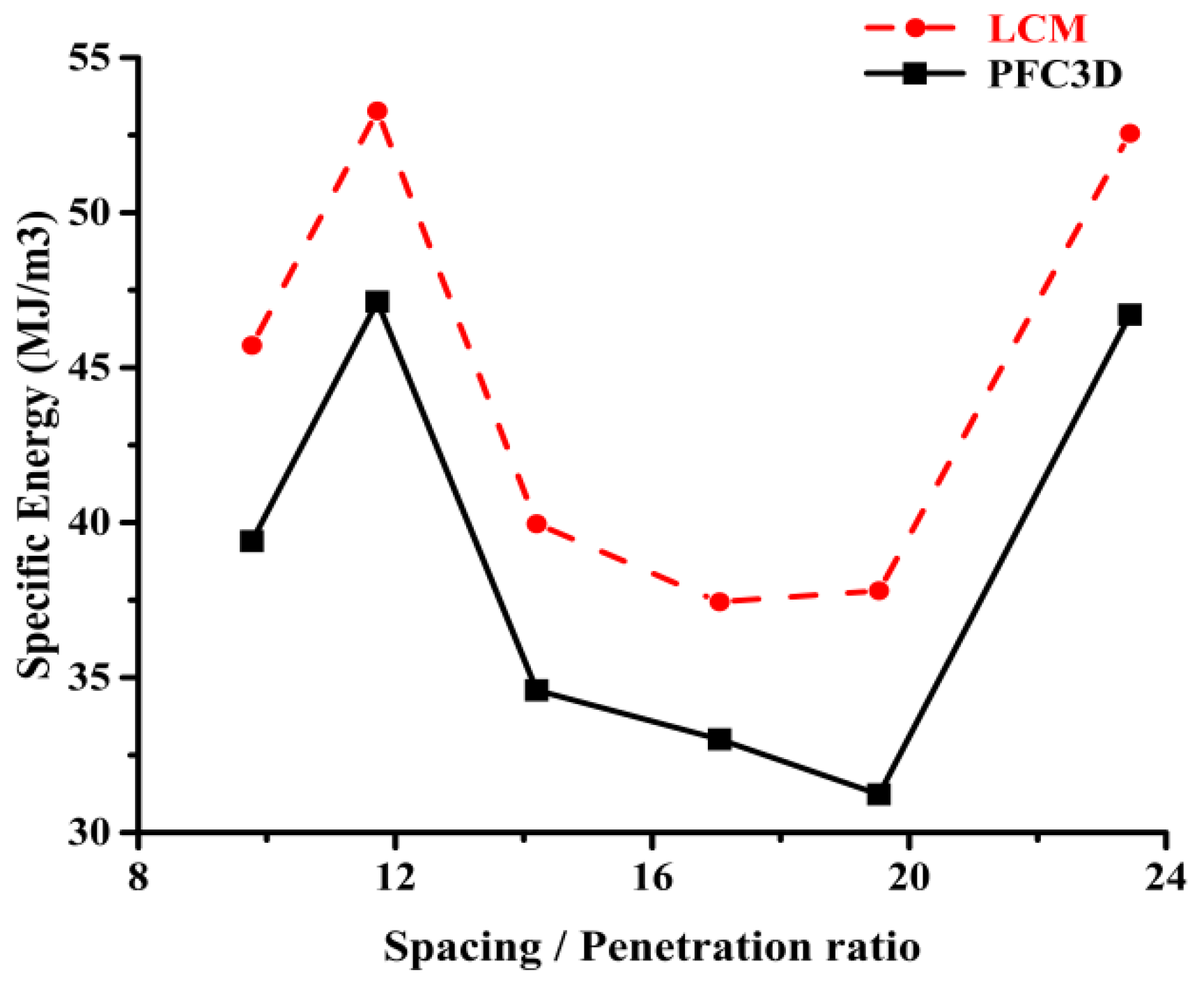
Disc cutters are the dominant tool used in the excavation of hard rock formations in any underground construction application, such as when tunneling using tunnel-boring machines (TBM), as well as in shaft- and raise boring operations. Optimization of the cutting geometry of a given disc cutter for application in a rock formation often involves full-scale cutting tests, which is a difficult and costly proposition. An alternative to full-scale testing is the numerical simulation of TBM disc cutters for optimization under different settings. Recent efforts in the field of numerical simulations of rock cutting have shown the relative success of discrete element models, such as particle flow code (PFC), to simulate two- and three-dimensional rock fragmentation. This study is focused on a sensitivity analysis of PFC simulation of rock-cutting relative to the size of the elements. The calculated cutting forces were compared with the recorded forces under various conditions during full-scale tests using a linear cutting machine (LCM) on Colorado red granite (CRG). The estimated cutting coefficient and specific energy in the LCM tests and simulations showed good correlations, which validates the numerical simulation results. Two- and three-dimensional models showed that two-dimensional numerical models can offer a qualitative assessment of crack development, whereas three-dimensional models could be used to estimate the specific energy when cutting. The results can help in predicting the cutting forces in different rocks and ultimately improving disc-cutter geometry and cutter-head design.
Keywords: disc cutters; tunnel-boring machine (TBM); discrete element modeling (DEM); cutting force; specific energy; linear cutting machine (LCM) disc cutters; tunnel-boring machine (TBM); discrete element modeling (DEM); cutting force; specific energy; linear cutting machine (LCM)