Article

Causal Strands for Social Bonds—A Case Study on the Credibility of Claims from Impact Reporting

Wuppertal Institute for Climate, Environment and Energy, 42103 Wuppertal, Germany
*
Author to whom correspondence should be addressed.
Sustainability 2022, 14(19), 12633; https://doi.org/10.3390/su141912633
Submission received: 1 August 2022 / Revised: 19 September 2022 / Accepted: 26 September 2022 / Published: 4 October 2022

Abstract

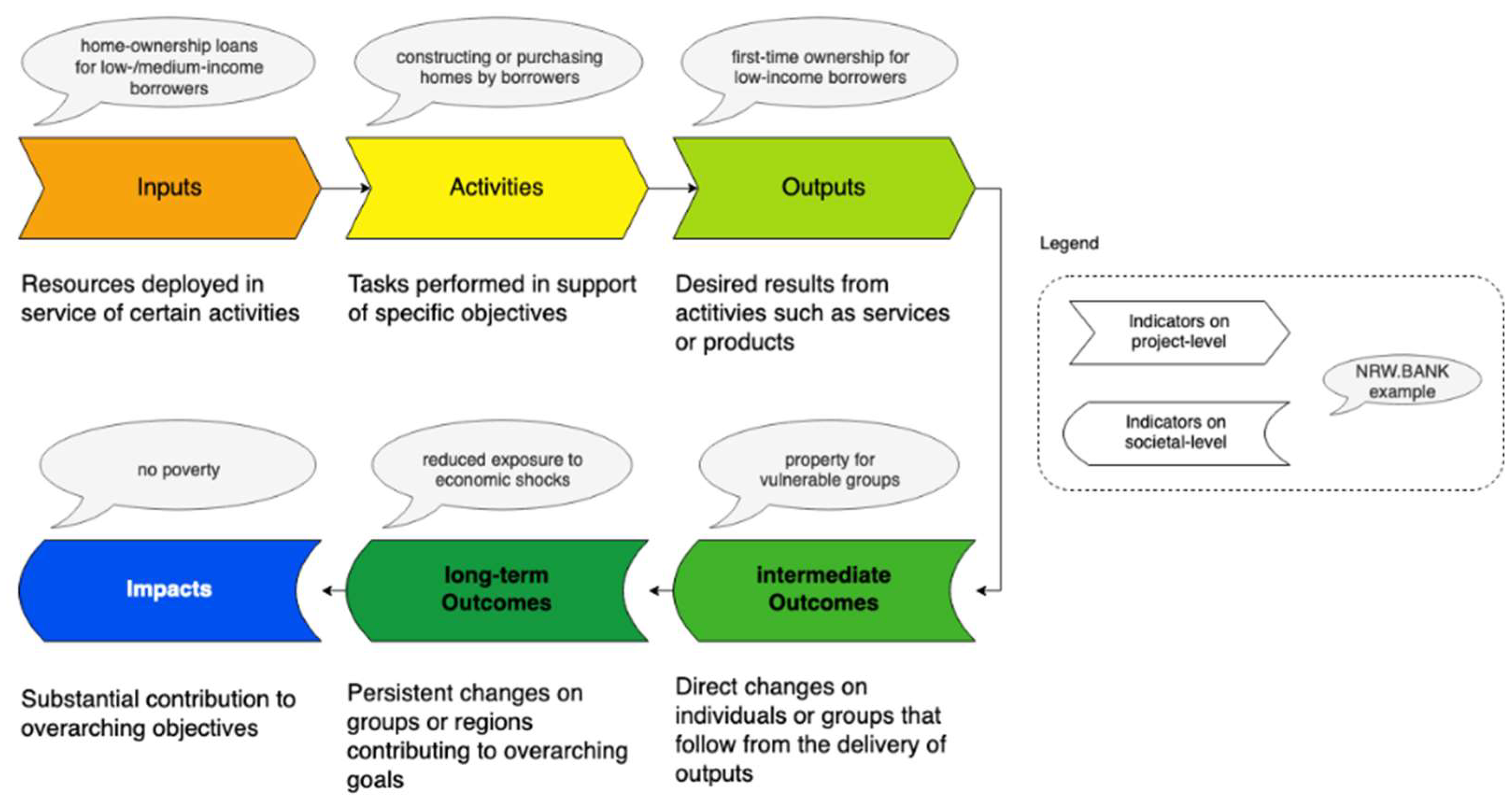
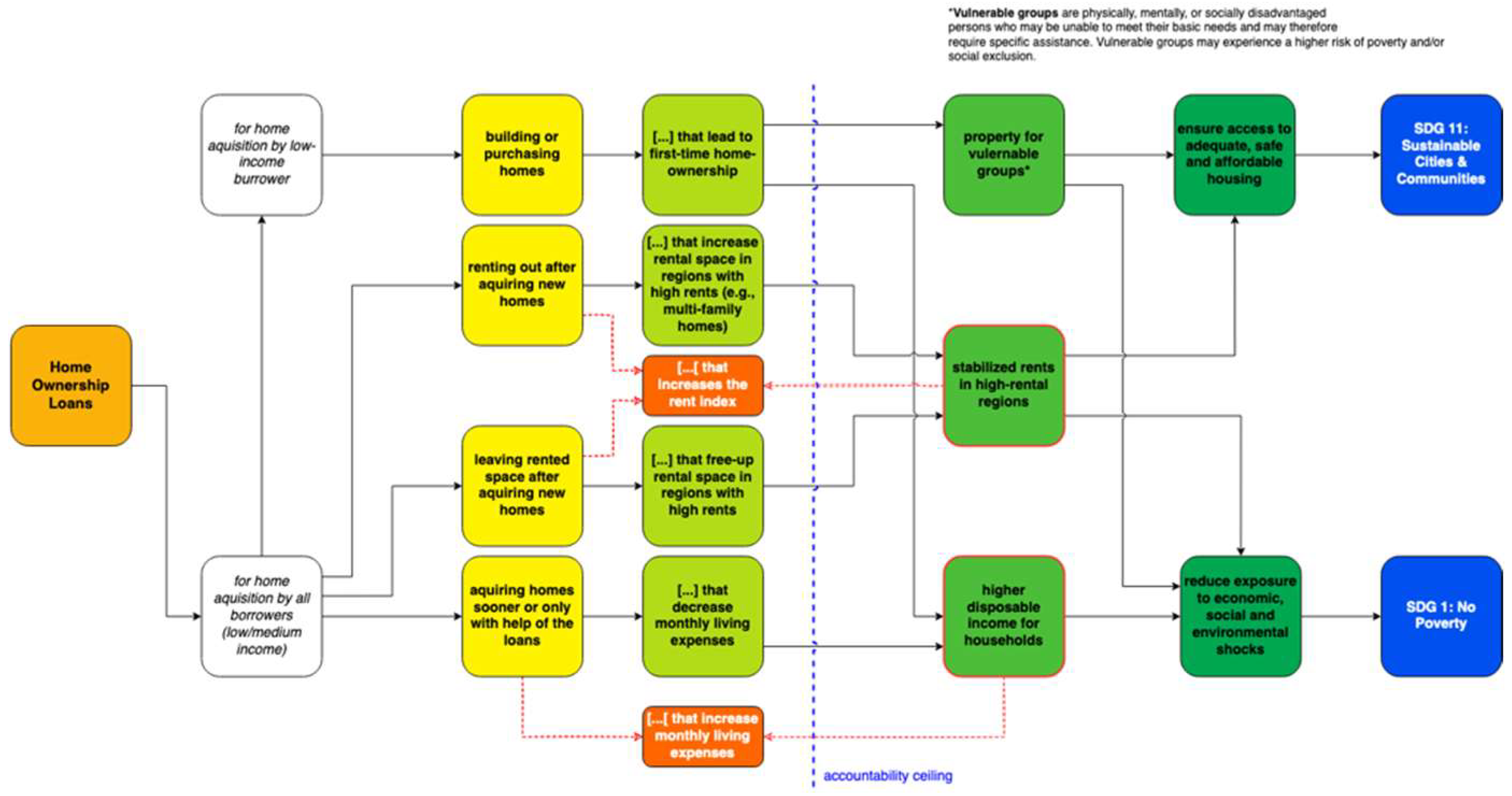
The study investigates if causal claims based on a theory-of-change approach for impact reporting are credible. The authors use their most recent impact report for a Social Bond to show how theory-based logic models can be used to map the sustainability claims of issuers to quantifiable indicators. A single project family (homeownership loans) is then used as a case study to test the underlying hypotheses of the sustainability claims. By applying Bayes Theorem, evidence for and against the claims is weighted to calculate the degree to which the belief in the claims is warranted. The authors found that only one out of three claims describe a probable cause–effect chain for social benefits from the loans. The other two claims either require more primary data to be corroborated or should be re-defined to link the intervention more closely and robustly with the overarching societal goals. However, all previous reported indicators are below the thresholds of the most conservative estimates for fractions of beneficiaries in the paper at hand. We conclude that the combination of a Theory-of-Change with a Bayesian Analysis is an effective way to test the plausibility of sustainability claims and to mitigate biases. Nevertheless, the method is—in the presented form—also too elaborate and time-consuming for impact reporting in the sustainable finance market.
Keywords: sustainable finance; social bonds; theory-of-change; Bayesian reasoning; impact reporting sustainable finance; social bonds; theory-of-change; Bayesian reasoning; impact reporting