Article

Effect of Revegetation in Extremely Degraded Grassland on Carbon Density in Alpine Permafrost Regions

1
Cryosphere and Eco-Environment Research Station of Shule River Headwaters, State Key Laboratory of Cryospheric Science, Northwest Institute of Eco-Environment and Resources, Chinese Academy of Sciences, Lanzhou 730000, China
2
University of Chinese Academy of Sciences, Beijing 100049, China
3
School of Geographical Sciences, Academy of Plateau Science and Sustainability, Qinghai Normal University, Xining 810008, China
4
Long-Term National Scientific Research Base of the Qilian Mountain National Park, Xining 810000, China
*
Author to whom correspondence should be addressed.
Sustainability 2022, 14(19), 12575; https://doi.org/10.3390/su141912575
Submission received: 24 August 2022 / Revised: 17 September 2022 / Accepted: 29 September 2022 / Published: 3 October 2022
(This article belongs to the Special Issue Permafrost Changes and Eco-Hydrological Effects)

Abstract

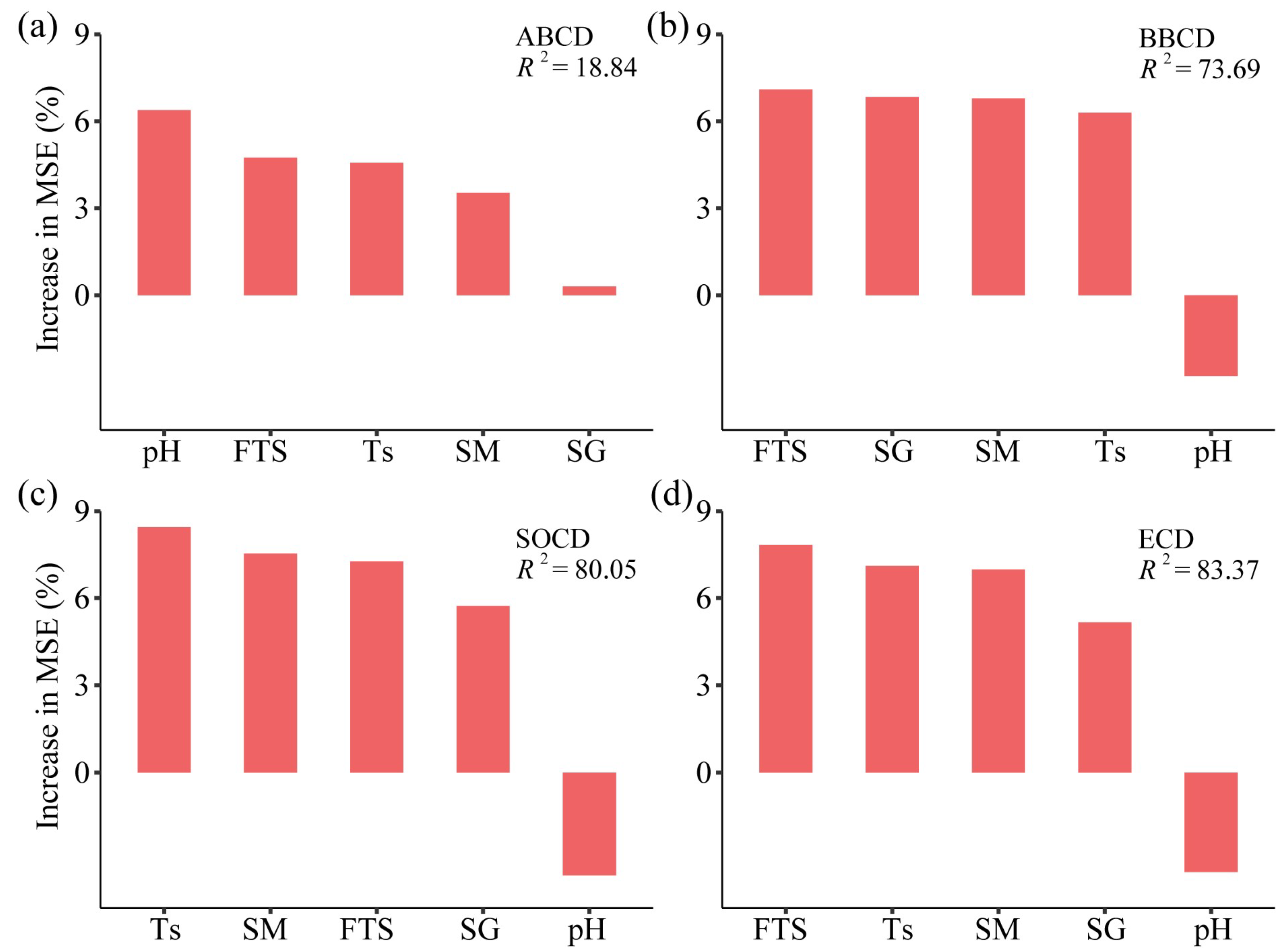
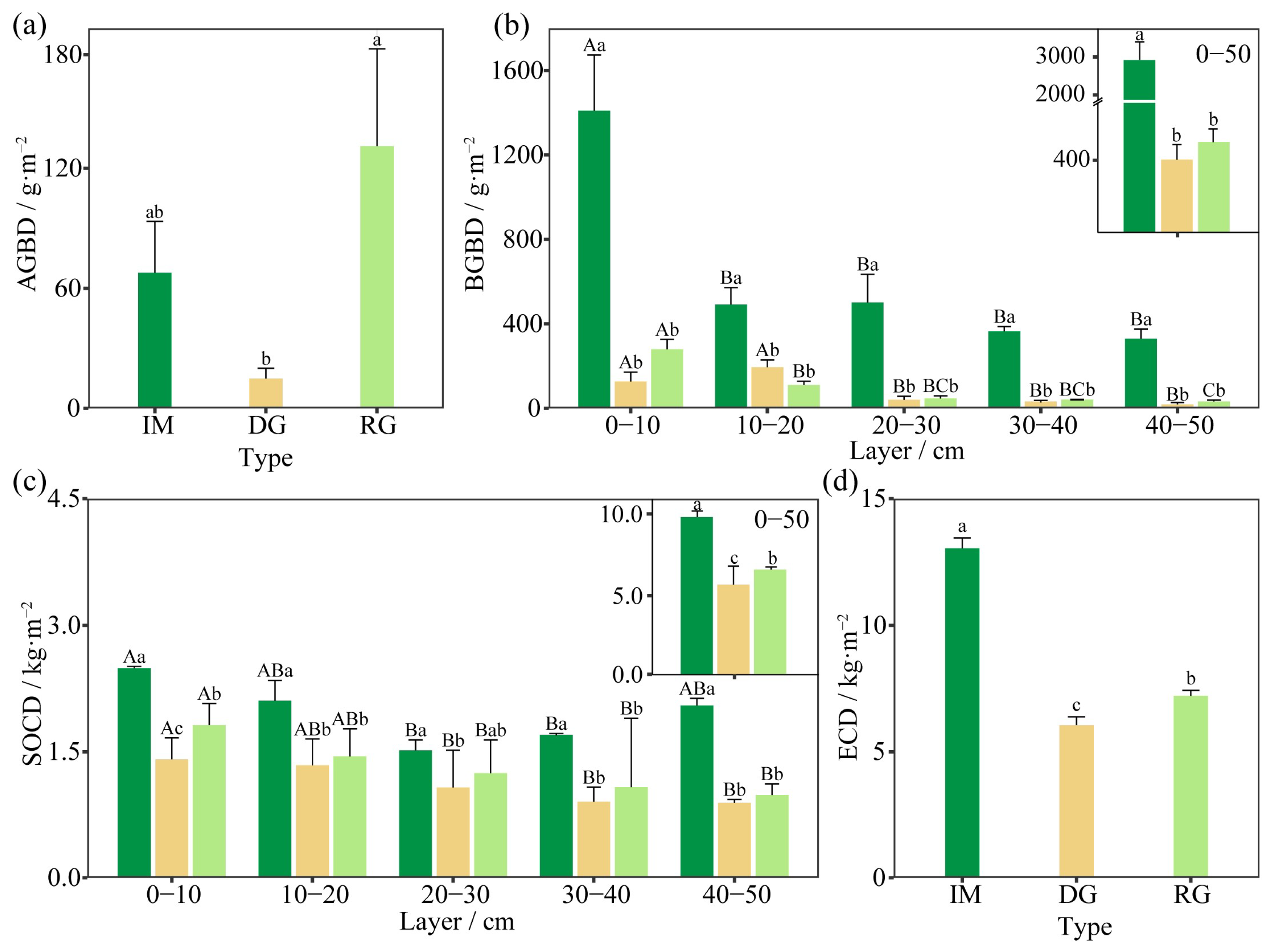
Revegetation has been proposed as an effective approach to restoring the extremely degraded grassland in the Qinghai–Tibetan Plateau (QTP). However, little is known about the effect of revegetation on ecosystem carbon density (ECD), especially in alpine permafrost regions. We compared aboveground biomass carbon density (ABCD), belowground biomass carbon density (BBCD), soil organic carbon density (SOCD), and ECD in intact alpine meadow, extremely degraded, and revegetated grasslands, as well as their influencing factors. Our results indicated that (1) ABCD, BBCD, SOCD, and ECD were significantly lower in extremely degraded grassland than in intact alpine meadow; (2) ABCD, SOCD, and ECD in revegetated grassland significantly increased by 93.46%, 16.88%, and 19.22%, respectively; (3) stepwise regression indicated that BBCD was mainly influenced by soil special gravity, and SOCD and ECD were controlled by freeze–thaw strength and soil temperature, respectively. This study provides a comprehensive survey of ECD and basic data for assessing ecosystem service functions in revegetated grassland of the alpine permafrost regions in the QTP.
Keywords: extremely degraded grassland; revegetated grassland; ecosystem carbon density; alpine permafrost regions extremely degraded grassland; revegetated grassland; ecosystem carbon density; alpine permafrost regions