Article

Grassroots Innovation for Urban Greening within a Governance Vacuum by Slum Dwellers in Dhaka

Australian Centre for Culture, Environment, Society and Space, University of Wollongong, Wollongong, NSW 2522, Australia
*
Author to whom correspondence should be addressed.
Sustainability 2022, 14(18), 11631; https://doi.org/10.3390/su141811631
Submission received: 5 August 2022 / Revised: 12 September 2022 / Accepted: 13 September 2022 / Published: 16 September 2022

Abstract

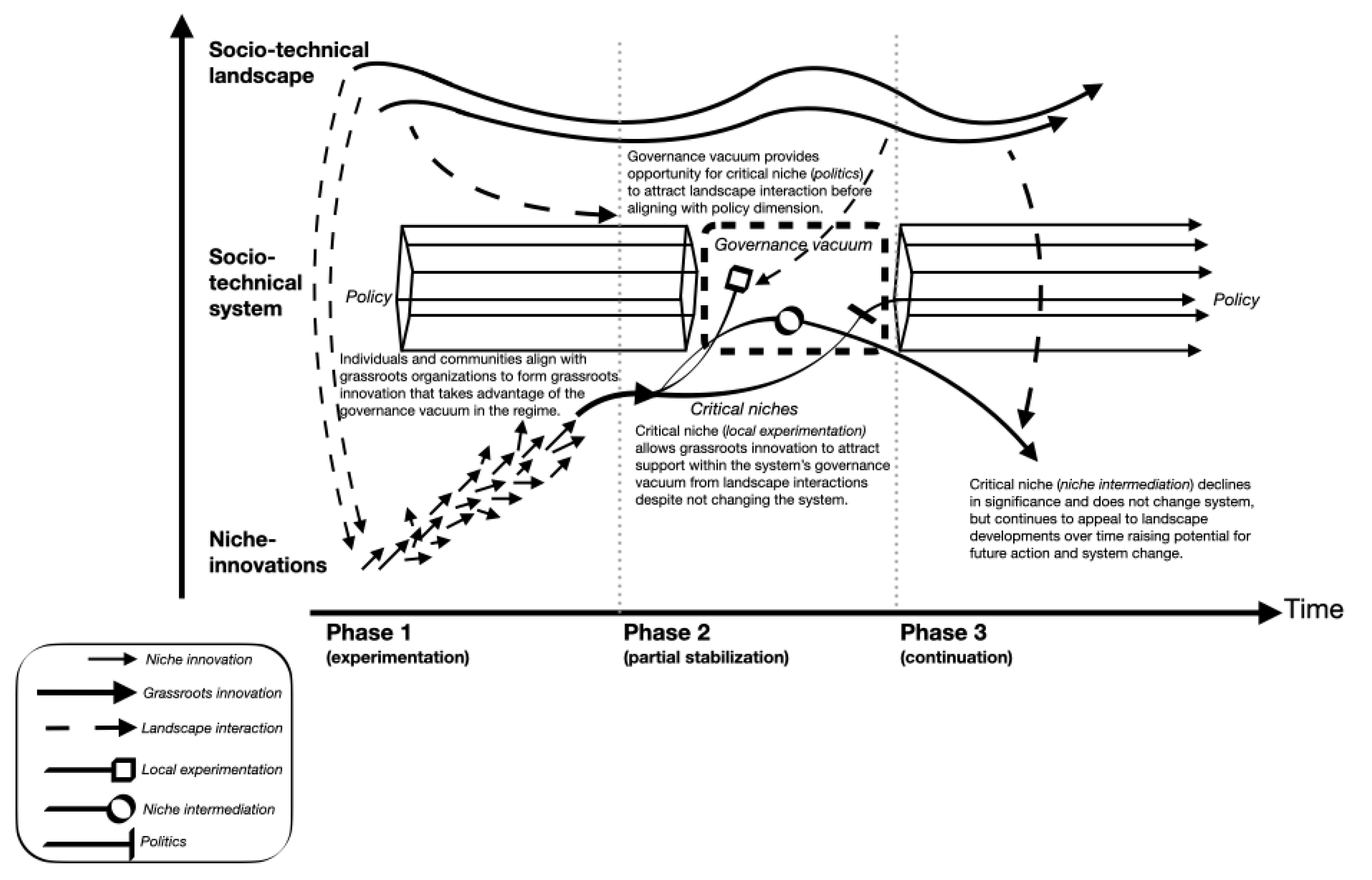
The nature-based solutions of slumdwellers are paramount to the ongoing integrity of major cities in the global South. The paper investigates the urban-greening decision-making of slum citizens whose civic participation finds support in shared governance initiatives: non-governmental organizations (NGOs) and community-based organizations (CBOs). The background informing the conceptual framework guiding this research derives from socio-technical transitions scholarship on critical niches in grassroots innovations. The objective of this research is to examine how slum dwellers are implementing urban greening in Dhaka, Bangladesh. The research considers how slum dwellers manage a governance vacuum through civic participation with NGOs and CBOs. The methods in this study comprise qualitative fieldwork in Dhaka and semi-structured interviews with stakeholders and citizens. The research findings show that a governance vacuum requires an adjustment to the perspective on grassroots innovations to endure in the global South in contexts where there is limited opportunity locally for intermediaries to achieve scale. There is a limit to the extent that the critical niches perspective applies to grassroots innovations in greening Dhaka’s slums; therefore, we contribute nuance as a refinement to the approach. The study offers a complementary explanatory framework for how NGOs, CBOs and other intermediaries at the grassroots contend with, and even thrive within, a vacuum of governance in the enactment of urban greening in Dhaka’s slum settlements.
Keywords: slums; urban green infrastructure; green space; Bangladesh; multi-level perspective slums; urban green infrastructure; green space; Bangladesh; multi-level perspective