


Abstract
Intercropping has been practiced worldwide in both traditional and sustainable agriculture to feed the growing population. This study aims to analyze the research status and evolution of intercropping, to identify the influential authors, research centers, and articles, and to reveal the main research topics between 1992 and 2020 based on the Web of Science Core Collection database. The results show that the volume of publications in this field has increased rapidly over the past three decades. The analysis identifies the top three authors (i.e., Meine Van Noordwijk, Wenyu Yang, and Teja Tscharntke), top three contributing organizations (i.e., the World Agroforestry Center (ICRAF), the Chinese Academy of Science, and the INRA), and three most productive countries (i.e., the USA, India, and China). Co-occurrence analysis demonstrates that studies on intercropping can be divided into four clusters as centered by keywords of intercropping/maize, biodiversity/conservation, agroforestry, and carbon, respectively. Lal 2004 is the most influential study with the greatest number of citations and Agroforestry Systems is the most utilized journal. Perspectives on future studies were also given. This study helps researchers to clarify the current research status in the field of intercropping and put forward its future research.
1. Introduction
Intercropping is the agronomic practice of simultaneously growing two or more crop species in the same field in close proximity for a considerable proportion of their growing season [1,2,3]. The main types of intercropping include agroforestry, hedgerow intercropping, relay intercropping, mixed intercropping, row intercropping, and strip intercropping [4]. Intercropping has been widely applied around the world in both tropical and temperate regions for both traditional, intensive farming systems, and sustainable agriculture systems [4,5,6,7]. The intercropping systems vary from place to place as a result of variations in local climate, soil, and socio-economic structure and status. For instance, there are multistrata agroforestry and jungle rubber-based agroforestry in tropical areas of Indonesia, India, Niger, and Mali. There are silvopastoral systems, coffee agroforests in Central America, dehesa agroforestry in Spain/Portugal, and cocoa agroforestry worldwide [4,8,9]. In both Africa and Latin America, beans and peas climb tall cornstalks, whereas pumpkins and squash cover the ground below [10]. In temperate regions, peas are grown with barley or oat, wheat is grown with canola or pea, and broccoli is grown with peas, beans, potatoes, oats, cauliflower, or cabbage in Canada. In the USA, maize (corn) and soybeans are intercropped [4]. In Europe, there are barley/pea intercropping in Denmark, the United Kingdom, France, Italy, and Germany, and wheat/pea intercropping in Denmark, popcorn/melon and potato/cabbage intercropping in the United Kingdom, berseem clover/barley, common vetch/wheat, triticale, barley, or oat intercropping in Greece, fennel/dill intercropping in Italy, maize/bush bean intercropping in Spain, leek/celery intercropping in Switzerland, and various vegetables/vegetables intercropping (e.g., cabbage, cauliflower or strawberry intercropped with bean, cos lettuce, leaf lettuce, onion, or radish) in Turkey [4,11,12]. In China, India, Iran, Nepal, Sri Lanka, and Thailand, there are many kinds of intercropping, including spring wheat/spring maize, maize/soybean/flax, winter wheat/spring maize, wheat/soybean, wheat/faba bean, maize/potato, wheat/potato, wheat/sunflower, wheat/vegetables, Peking cabbage, and onion, maize/vegetables, maize/pea intercropping [4].
Crops selected for intercropping normally have different abilities to use the resources available for growth [13]. The major benefits of intercropping include: (1) improved yields, yield stability, and farmers’ profitability [14,15], with a decreased risk of reducing total crop production due to climate change; (2) enhanced competitive ability of crops for use efficiency of resources such as nutrients, water, light, and heat [3,4,5]; (3) improved management of weeds, pest/insects, and disease/pathogens due to enhanced competition, physical dominance, space occupation, and allelopathic influence [16,17,18], sometimes the main objective of planting the second crop in intercropping farming is to control weeds; (4) intercropping with cash crops for higher profitability, provide shade/shelter and support to the other crop, and act as insurance against crop failure in abnormal years due to extreme weather such as drought, hurricanes/cyclones, and torrential rain; (5) reduced erosion, enhanced soil carbon sequestration and nitrogen fixation [19], and increased microbial diversity [20]. Compared with monocropping or a monoculture system, the disadvantages of intercropping may include: (1) more input of resources (e.g., seeds, fertilizer, irrigation, gasoline, and manpower-difficult to harvest) [21,22]; (2) significant allelopathic interactions between crop species if species were inappropriately combined [23]; (3) decreased yield due to differences in their competitive abilities.
There are many studies reviewing various aspects of intercropping, including yield stability [24,25,26], water and nutrient utilization [27,28,29,30,31], biodiversity [32,33,34,35,36,37,38,39], allelopathy [17,40,41,42,43,44], agroforestry [29,45,46,47,48,49,50,51], or species-dependent intercropping such as cereal-legume or maize-based intercropping [7,31,52,53]. However, no study has investigated the overall research tends and features of intercropping. Previous studies [45,46,47,48,54,55] have shown that scientometrics is a powerful tool for quantitative and statistical demonstration of research trends and features of a certain topic. The objective of this study is to quantitatively analyze the growth and evolution of intercropping research based on the scientometric method based on the Web of Science database. It is hoped that this study would provide information to the novice and expert alike to guide them on the advantages, limitations, development, and the applications of intercropping.
2. Materials and Methods
The Web of Science Core Collection (WoSCC) is among the most comprehensive and widely utilized databases for scientometric analyses [54,55,56], it contains quality controlled full literature data (e.g., title, author, abstract, keywords, references, and citations) since 1985 up to present. The data between 1985 and 2020 were downloaded from the WoSCC on Jan 2, 2021 for analysis based on the preset query sets. The query sets used for the literature search are TS = (“intercrop*” OR “interplant*” OR “crop mixture” OR “undercrop sow*” OR “agroforest*” OR “hedgerow”), where TS is a field tag indicating topic in the Web of Science. The search results were further restricted by languages and document types and only articles, letters, notes, books, book chapters, data papers, database reviews, and reviews written in English were retrieved. This search process returned a total of 14,001 publications and they were saved as tab-limited text files (UTF-8) containing the “full record with citation data”.
VOSviewer 1.6.15 (The Centre for Science and Technology Studies, Netherlands) and CiteSpace 5.7.R1 (Drexel University, USA) were used to perform scientometric analysis. VOSviewer 1.6.15, a Java-based software developed in 2009 by van Eck and Waltman [57], is a tool for building and visualizing a scientometric network, which can quickly observe knowledge and research in a specific field. The annual trend of publication volume, the main authors, countries and institutions, the most utilized journals, the highly impacted studies, and occurrence network of keywords were analyzed. CiteSpace is a Java-based software tool to present the rules and structure of scientific knowledge [58], which is used to analyze the burst time of keywords that reflect the development and revolution of research hotspots.
3. Results
3.1. Overview of Publication Trend
It is noted that query sets in Section 2 returned no data between 1985 and 1991, which was also reported in other studies as the main SCI-expanded database of WoSCC began archiving since 1992 [54,55], where SCI is short for Science Citation Index. There is an increasing trend in the number of publications, from 241 (1.72%) in 1992 to 1258 (8.99%) in 2020 (Figure 1). This indicates that research on intercropping has received increasingly more attention. For the 14,001 publications, most of them fall into the Web of Science category of agronomy (4638 or 33.13%), forestry (2555 or 18.25%), environmental science (2158 or 15.41%), agriculture multidiscipline (1907 or 13.62%), ecology (1847 or 13.19%), plant science (1461 or 10.44%), and soil science (1460 or 10.43%). The dominant document type is an article, which accounts for 13,287 or 94.90% of the total publications, followed by a review that accounts for 620 papers or 4.43% of the total publications.
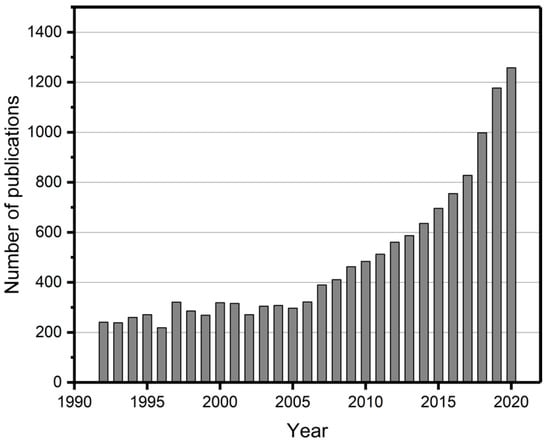
Figure 1.
Annual trend in publications on research pertaining to intercropping based on data between 1992 and 2020 from the Web of Science Core Collection (WoSCC).
3.2. The Co-Authorship of Authors
There are 291 out of 38,704 authors meeting the threshold of a minimum of 10 publications (Figure 2). They are grouped in 77 clusters, where a cluster indicates a group of closely collaborating authors. The largest set of connected authors consists of 184 researchers centered in Figure 2a. The colors in Figure 2b indicate the active periods of authors, with the “yellow” indicating that researchers published intercropping studies in recent years, “green” indicates that most papers of the authors were published around 2010, while “blue” around 2000. For instance, Drs. Wenyu Yang and Taiwen Yong from Sichuan Agriculture University (China) have been publishing on intercropping [59,60,61], they are also the top productive authors on these topics (Table 1). This is similar to Drs. Qiang Chai and Zhilong Fan from Gansu Agriculture University (China, Table 1) and Dr. Lijin Lin from Sichuan Agriculture University (China) [27]. Other productive researchers such as Dr. Fusuo Zhang (China Agriculture University, China, Table 1) and Meine van noordwijk (Wageningen University and Research, Netherlands, Table 1) were active around 2010, while Dr. Chin K. Ong (World Agroforestry Center, Kenya, Table 1) was active around 2000 [49].
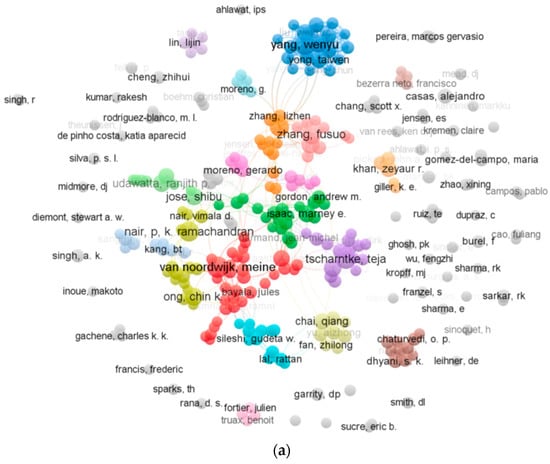
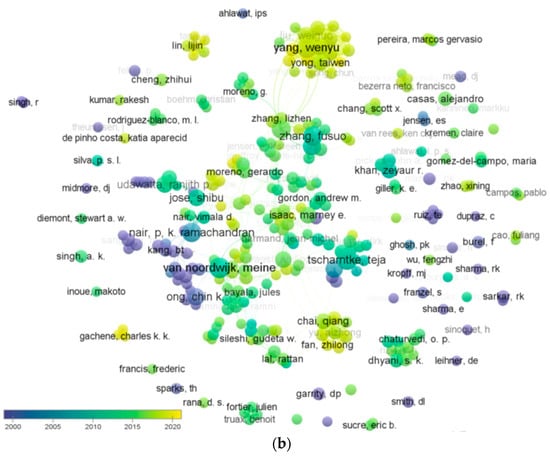
Figure 2.
Network visualization (a) and overlay visualization (b) of co-authorship for authors with a minimum of 10 publications on research pertaining to intercropping based on Web of Science Core Collection (WoSCC) data between 1992 and 2020.

Table 1.
Top 25 authors with publications on intercropping. VOSviewer is used to count document number (N), citations (C), and total link strength (TLS). Values of N and C are recorded by Web of Science Core Collection (WoSCC) from data between 1992 and 2020, while C/N indicates the calculated average citations per publication. The total link strength (TLS) indicates the total strength of the links of an item with other items.
3.3. The Top Contributed Organizations and Countries
There are 8037 organizations that published research on intercropping, the World Agroforestry Center (ICRAF) ranked first on the publication volume (n = 326), followed by Chinese Academy of Science (n = 307), INRA (n = 260), China Agriculture University (n = 217), and University of Gottingen (n = 213). The top 25 organizations are tabulated in Table 2. In terms of average per publication citation times, the University of Gottingen ranked first (C/N = 42), followed by the University of California (C/N = 35), and the University of Florida (C/N = 34). The average per-publication citations of the University of Missouri, the China Agriculture University, and INRA are equal to or greater than 30, which indicates the high influence of these institutions. In addition, the World Agroforestry Center (ICRAF), the China Agriculture University, and INRA collaborated more with other organizations as indicated by their greater TLS (over >10,000), CSIC and the University of California Davis had the least inter-organization collaborations among the top 25 organizations.
Table 2.
The top 25 organizations with publications on intercropping. VOSviewer was used to count document number (N), citations (C), and total link strength (TLS). Values of N and C are recorded by Web of Science Core Collection (WoSCC) data between 1992 and 2020, while C/N indicates the calculated average citations per publication. The total link strength (TLS) indicates the total strength of the links of an item with other items.
In addition, there are 169 countries that published research on intercropping, with the USA (n = 2468), India (n = 1470), China (n = 1437), and Brazil (n = 1164) are the top four countries (Table 2, Table 3 and Figure 3). They consist of the research centers for study on intercropping. It is interesting to notice that the average citations of Indonesia ranked first (C/N = 29), followed by the USA, Australia, Denmark, and Costa Rica that had C/N = 28. The USA collaborated most with other countries with the greatest TLS = 35,512, followed by France and Germany with TLS = 21,916 and 21,538, respectively.
Table 3.
The top 25 countries with publications on intercropping. VOSviewer was used to count document number (N), citations (C), and total link strength (TLS). Values of N and C are recorded by Web of Science Core Collection (WoSCC) data between 1992 and 2020, while C/N indicates the calculated average citations per publication. The total link strength (TLS) indicates the total strength of the links of an item with other items.
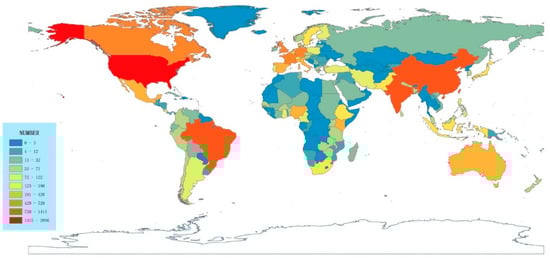
Figure 3.
World map of countries contributing to research on intercropping based on Web of Science Core Collection (WoSCC) data between 1992 and 2020.
3.4. The Co-Occurrence and Burst Time of Keywords
There are 37,398 keywords in the title, abstract, and author-provided keyword list, and 338 keywords meeting the threshold of 60 occurrences. These keywords are grouped into four clusters: red, green, blue, and yellow (Figure 4), and the top 25 keywords were tabulated in Table 4. The red-colored cluster in Figure 4 is pertaining to crop intercropping as represented with high-frequency keywords of “maize”, “yield”, “wheat”, and “soybean” etc. [59,62,63]. Among them, the “maize” (corn) based intercropping system is the dominant type around the world [31,53,62,63]. The green-colored cluster is mainly related to “biodiversity” or “conservation” and management of intercropping systems [34,36,64]. One of the popular topics is to increase “biodiversity” without compromising yield in the intercropping system [65]. The blue-colored cluster is themed with “agroforestry” or “sustainability” [66,67,68,69], while the yellow-colored cluster is featured with “nitrogen”, “carbon sequestration”, and “microbe biomass” etc. [70,71,72,73].
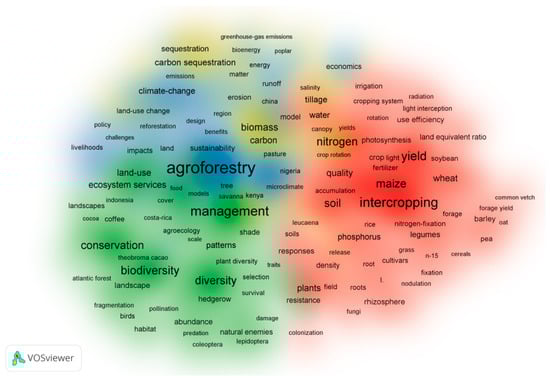
Figure 4.
Cluster density visualization map of 338 keywords each occurring 60 times or more in the title, abstract, and keyword list (produced by VOSviewer 1.6.15). Note: the number of co-occurrences of n keywords indicates the number of publications in which all n keywords occur together. Font size and density (background color) of keywords are used to represent the total link strength (TLS). A greater font size indicates greater TLS. The distances between each of the keywords indicate the relatedness of these research topics. The top keywords, their times of occurrence, and their TLS are shown in Table 4.
Table 4.
High-frequency keywords for research on intercropping and word frequency analysis from 1992 to 2020 with VOSviewer 1.6.15. The total link strength (TLS) indicates the total strength of the links of an item with other items.
The burst time of keywords was used to illustrate the development and evolution of research directions. Figure 5 shows that the 1990s featured different intercropping species as indicated by keywords such as “wheat”, “cassava”, “barley”, and “groundnut”. Agroforestry is also the hot research topic as indicated by “alley cropping”, “multipurpose tree”, and “tropic forest”. Crop species including “cowpea”, “maize”, and “sorghum” became the research focus, while land-use type and management also gained attention as indicated by “hedgerow” and “fallow”. In the 2010s, research topics on intercropping shifted to “ecosystem service” and “carbon sequestration” under “climate change”.
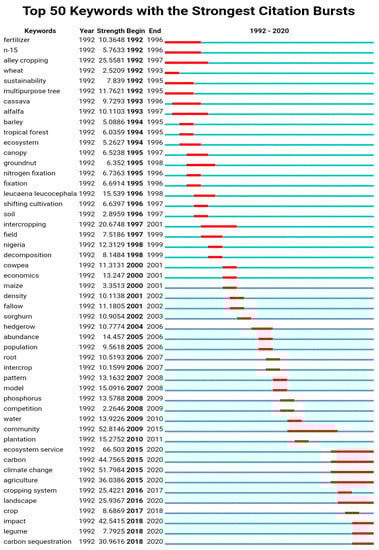
Figure 5.
The top 50 keywords with the strongest citation burst between 1992 and 2020 using VosViewer based on data retrieved from the Web of Science Core Collection (WoSCC) with CiteSpace.
3.5. The Highly Impacted Publications
There are 361 out of 14,001 publications meeting the threshold of 100 citations, they are divided into 98 clusters with the largest set of connected documents consisting of 270 papers (Figure 6). Lal [74], Smith et al. [75], and Reich et al. [76] are the top three studies that were cited over 1000 times based on the record of WoSCC, with the first two being mainly about carbon sequestration or greenhouse gas emission mitigation in agriculture.
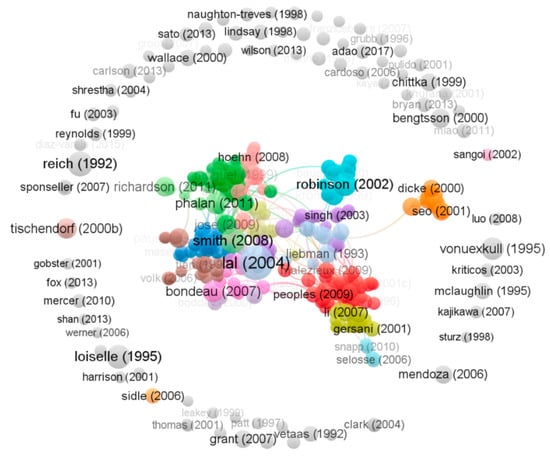
Figure 6.
The network visualization map of citations for 361 publications with a minimum of 100 citations on intercropping using VosViewer based on data retrieved from the Web of Science Core Collection (WoSCC). Each node represents a publication, the size of the node represents the number of citations, the lines represent the co-citation relationship between documents, and the thicker the lines the stronger the links.
3.6. The Widely Utilized Journals
There are 1291 journals that published research on intercropping, among which 15 journals each published over 100 papers (Figure 7). Agroforestry Systems is the most utilized journal that published over 1500 papers, followed by Agriculture Ecosystems and Environment that published around 500 papers between 1992 and 2020 based on the Web of Science Core Collection (WoSCC).
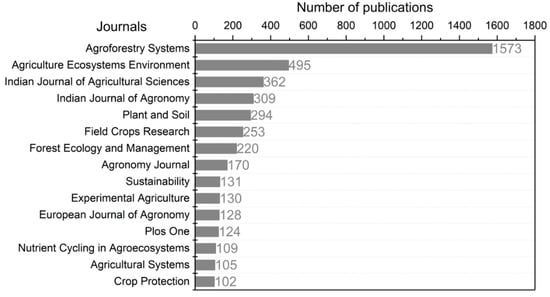
Figure 7.
Top 15 journals and their publication volume on intercropping between 1992 and 2020 based on the Web of Science Core Collection (WoSCC).
4. Conclusions and Perspectives
The results show that the volume of publications in this field has increased rapidly over a period of 29 years with 241 papers (1.72%) in 1992 to 1258 (8.99%) in 2020. The analysis shows that Meine Van Noordwijk, Wenyu Yang, and Teja Tscharntke are the top three authors that published over 70 papers on this topic. The Chinese Academy of Science, INRA, and the China Agriculture University are the top three contributing organizations, while the USA, India, and China are the most productive countries for research centers on intercropping. The most influential studies are Lal [74] and Smith et al. [75] that investigated the carbon sequestration or mitigation of greenhouse gas emission. Agroforestry Systems is the most utilized journal that published over 1500 papers on intercropping in total.
The co-occurrence analysis demonstrates that intercropping studies generally focus on four aspects as indicated by keywords of intercropping/maize, biodiversity/conservation, agroforestry, and carbon, respectively. Given that applications of synthetic fertilizers significantly increased grain yield over the past decades, but overuse of chemical fertilizer leads to soil and environmental pollution and threatens agricultural sustainability [77], more studies are required to develop efficient approaches so as to improve the crop quality while maintaining or increasing yield to meet food security and higher demands of food quality [78,79,80]. As intercropping has been well studied in well-developed countries including the USA and the mostly populated countries including India and China, more intercropping studies in undeveloped countries in Africa should be conducted to fight starvation and malnutrition and to adapt to climate change [63,81]. In addition, the paradox between intercropping and automation should be properly addressed with the design and development of new compatible intercropping machineries [63,82]. Moreover, future studies are recommended to investigate the below-ground competition for water and nutrients between intercropped species, root-shoot equilibrium of intercropping, inter-zone water migration in water-saving irrigation agriculture systems, and regions with a low input level [27,83,84]. Increased attention should also be paid to innovative perennial systems with intercropping to facilitate root interactions and microbial abundance and diversity [85]. Furthermore, previous studies are generally based on experimental studies, it is desired to develop functional structural plant modeling to better understand and optimize species mixture [86]. This study helps researchers to clarify the current research status in the field of intercropping and put forward its future research.
Author Contributions
Conceptualization, P.W. and H.H.; methodology, J.L. and X.Z.; software, W.L.; validation, J.L., X.Z., and P.W.; formal analysis, W.L.; investigation, W.L.; resources, W.L. and X.Z.; data curation, W.L.; writing—original draft preparation, W.L. and H.H.; writing—review and editing, P.W., X.Z., and J.L.; visualization, W.L.; supervision, P.W. and H.H.; project administration, X.Z.; funding acquisition, P.W. and H.H. All authors have read and agreed to the published version of the manuscript.
Funding
Funding for this research was provided in part by the Northwest A & F University (Youth Talent Training Program), the 111 project (Grant No. B12007), and First-Class Discipline Construction (Ecology) for Ningxia Higher Education Project (NXYLXK2017B06).
Institutional Review Board Statement
Not applicable.
Informed Consent Statement
Not applicable.
Data Availability Statement
Not applicable.
Acknowledgments
The authors greatly appreciate the valuable and insightful comments by anonymous reviewers.
Conflicts of Interest
The authors declare no conflict of interest.
References
- Ofori, F.; Stern, W.R. Cereal–legume intercropping systems. In Advances in Agronomy; Brady, N.C., Ed.; Academic Press: Cambridge, MA, USA, 1987; Volume 41, pp. 41–90. [Google Scholar]
- Willey, R.W. Intercropping: Its importance and research needs. Part 2, agronomy and research approaches. Field Crop. Abstr. 1979, 32, 73–85. [Google Scholar]
- Stomph, T.; Dordas, C.; Baranger, A.; de Rijk, J.; Dong, B.; Evers, J.; Gu, C.; Li, L.; Simon, J.; Jensen, E.S.; et al. Chapter one—Designing intercrops for high yield, yield stability and efficient use of resources: Are there principles? In Advances in Agronomy; Sparks, D.L., Ed.; Academic Press: Cambridge, MA, USA, 2020; Volume 160, pp. 1–50. [Google Scholar]
- Li, L.; Zhang, L.; Zhang, F. Crop mixtures and the mechanisms of overyielding. In Encyclopedia of Biodiversity, 2nd ed.; Levin, S.A., Ed.; Academic Press: Waltham, MA, USA, 2013; pp. 382–395. [Google Scholar]
- Kremer, R.J. Chapter 4—Soil health benefits of the solar corridor crop system. In The Solar Corridor Crop System; Deichman, C.L., Kremer, R.J., Eds.; Academic Press: Cambridge, MA, USA, 2019; pp. 79–101. [Google Scholar]
- Sharma, R.C. Chapter 5—Cereal-based cropping systems in asia: Nutrition and disease management. In Crop Physiology; Sadras, V., Calderini, D., Eds.; Academic Press: San Diego, CA, USA, 2009; pp. 99–119. [Google Scholar]
- Seran, T.H.; Brintha, I. Review on maize based intercropping. J. Agron. 2010, 9, 135–145. [Google Scholar] [CrossRef]
- Zomer, R.; Trabucco, A.; Coe, R.; Place, F. Trees on Farm: Analysis of Global Extent and Geographical Patterns of Agroforestry; ICRAF Working Paper no. 89-World Agroforestry Centre: Nairobi, Kenya, 2009; p. 72. [Google Scholar]
- Zomer, R.; Trabucco, A.; Coe, R.; Place, F.; Van Noordwijk, M.; Xu, J. Trees on Farms: An Update and Reanalysis of Agroforestry’s Global Extent and Socio-Ecological Characteristics; ICRAF Working Paper no. 179-World Agroforestry Centre: Jawa Barat, Indonesia, 2014; p. 54. [Google Scholar]
- Machado, S. Does intercropping have a role in modern agriculture? J. Soil Water Conserv. 2009, 64. [Google Scholar] [CrossRef]
- Santalla, M.; de Ron, A.M.; Escribano, M.R. Effect of intercropping bush bean populations with maize on agronomic traits and their implications for selection. Field Crop. Res. 1994, 36, 185–189. [Google Scholar] [CrossRef]
- Santalla, M.; Rodiño, A.P.; Casquero, P.A.; de Ron, A.M. Interactions of bush bean intercropped with field and sweet maize. Eur. J. Agron. 2001, 15, 185–196. [Google Scholar] [CrossRef]
- Asseng, S.; Zhu, Y.; Basso, B.; Wilson, T.; Cammarano, D. Simulation modeling: Applications in cropping systems. In Encyclopedia of Agriculture and Food Systems; Van Alfen, N.K., Ed.; Academic Press: Oxford, UK, 2014; pp. 102–112. [Google Scholar]
- Zaefarian, F.; Rezvani, M. 5—soybean (glycine max [l.] merr.) production under organic and traditional farming. In Environmental Stresses in Soybean Production; Miransari, M., Ed.; Academic Press: San Diego, CA, USA, 2016; pp. 103–129. [Google Scholar]
- Sharma, N.K.; Singh, R.J.; Mandal, D.; Kumar, A.; Alam, N.M.; Keesstra, S. Increasing farmer’s income and reducing soil erosion using intercropping in rainfed maize-wheat rotation of himalaya, india. Agric. Ecosyst. Environ. 2017, 247, 43–53. [Google Scholar] [CrossRef]
- Carruthers, K.; Fe, Q.; Cloutier, D.; Smith, D.L. Intercropping corn with soybean, lupin and forages: Weed control by intercrops combined with interrow cultivation. Eur. J. Agron. 1998, 8, 225–238. [Google Scholar] [CrossRef]
- Głąb, L.; Sowiński, J.; Bough, R.; Dayan, F.E. Chapter two—Allelopathic potential of sorghum (sorghum bicolor (l.) moench) in weed control: A comprehensive review. In Advances in Agronomy; Sparks, D.L., Ed.; Academic Press: Cambridge, MA, USA, 2017; Volume 145, pp. 43–95. [Google Scholar]
- Jabran, K.; Mahmood, K.; Melander, B.; Bajwa, A.A.; Kudsk, P. Chapter three—Weed dynamics and management in wheat. In Advances in Agronomy; Sparks, D.L., Ed.; Academic Press: Cambridge, MA, USA, 2017; Volume 145, pp. 97–166. [Google Scholar]
- Cong, W.F.; Hoffland, E.; Li, L.; Six, J.; Sun, J.H.; Bao, X.G.; Zhang, F.S.; Werf, W.V.D. Intercropping enhances soil carbon and nitrogen. Glob. Chang. Biol. 2015, 21, 1715–1726. [Google Scholar] [CrossRef] [PubMed]
- Venter, Z.S.; Jacobs, K.; Hawkins, H.-J. The impact of crop rotation on soil microbial diversity: A meta-analysis. Pedobiologia 2016, 59, 215–223. [Google Scholar] [CrossRef]
- Zimdahl, R.L. Chapter 12—Properties and uses of herbicides. In Fundamentals of Week Science; Zimdahl, R.L., Ed.; Academic Press: Cambridge, MA, USA, 1993; pp. 225–269. [Google Scholar]
- Gowda, B.; Deepak, T.; Suma, T.; Yadahalli, G.S.; Maccha, S.; Prashanth, S. Effect of intercropping and fertilizer dose on seed quality and physiological properties of chickpea (cicer arietinum l.). Int. J. Curr. Microbiol. Appl. Sci. 2020, 9, 591–601. [Google Scholar] [CrossRef]
- Liebman, M.; Dyck, E. Crop rotation and intercropping strategies for weed management. Ecol. Appl. 1993, 3, 92–122. [Google Scholar] [CrossRef] [PubMed]
- Piepho, H.P. Methods for comparing the yield stability of cropping systems—A review. J. Agron. Crop Sci. Z. Fur Acker Und Pflanzenbau 1998, 180, 193–213. [Google Scholar] [CrossRef]
- Bayala, J.; Sileshi, G.W.; Coe, R.; Kalinganire, A.; Tchoundjeu, Z.; Sinclair, F.; Garrity, D. Cereal yield response to conservation agriculture practices in drylands of west africa: A quantitative synthesis. J. Arid Environ. 2012, 78, 13–25. [Google Scholar] [CrossRef]
- Morugan-Coronado, A.; Linares, C.; Gomez-Lopez, M.D.; Faz, A.; Zornoza, R. The impact of intercropping, tillage and fertilizer type on soil and crop yield in fruit orchards under mediterranean conditions: A meta-analysis of field studies. Agric. Syst. 2020, 178, 10. [Google Scholar] [CrossRef]
- Yin, W.; Chai, Q.; Zhao, C.; Yu, A.Z.; Fan, Z.L.; Hu, F.L.; Fan, H.; Guo, Y.; Coulter, J.A. Water utilization in intercropping: A review. Agric. Water Manag. 2020, 241, 13. [Google Scholar] [CrossRef]
- Zhang, F.S.; Shen, J.B.; Zhang, J.L.; Zuo, Y.M.; Li, L.; Chen, X.P. Rhizosphere processes and management for improving nutrient use efficiency and crop productivity: Implications for China. In Advances in Agronomy; Sparks, D.L., Ed.; Elsevier Academic Press Inc: San Diego, CA, USA, 2010; Volume 107, pp. 1–32. [Google Scholar]
- Lowry, J.B.; Wilson, J.R. Nutritional quality of tree and understorey forage in silvopastoral systems. Ann. Arid Zone 1999, 38, 363–384. [Google Scholar]
- Miao, Y.X.; Stewart, B.A.; Zhang, F.S. Long-term experiments for sustainable nutrient management in China. A review. Agron. Sustain. Dev. 2011, 31, 397–414. [Google Scholar] [CrossRef]
- Latati, M.; Bargaz, A.; Belarbi, B.; Lazali, M.; Benlahrech, S.; Tellah, S.; Kaci, G.; Drevon, J.J.; Ounane, S.M. The intercropping common bean with maize improves the rhizobial efficiency, resource use and grain yield under low phosphorus availability. Eur. J. Agron. 2016, 72, 80–90. [Google Scholar] [CrossRef]
- Graefe, S.; Dufour, D.; van Zonneveld, M.; Rodriguez, F.; Gonzalez, A. Peach palm (bactris gasipaes) in tropical latin america: Implications for biodiversity conservation, natural resource management and human nutrition. Biodivers. Conserv. 2013, 22, 269–300. [Google Scholar] [CrossRef]
- Vickery, J.A.; Feber, R.E.; Fuller, R.J. Arable field margins managed for biodiversity conservation: A review of food resource provision for farmland birds. Agric. Ecosyst. Environ. 2009, 133, 1–13. [Google Scholar] [CrossRef]
- Torralba, M.; Fagerholm, N.; Burgess, P.J.; Moreno, G.; Plieninger, T. Do european agroforestry systems enhance biodiversity and ecosystem services? A meta-analysis. Agric. Ecosyst. Environ. 2016, 230, 150–161. [Google Scholar] [CrossRef]
- Simon, S.; Bouvier, J.C.; Debras, J.F.; Sauphanor, B. Biodiversity and pest management in orchard systems. A review. Agron. Sustain. Dev. 2010, 30, 139–152. [Google Scholar] [CrossRef]
- Joa, B.; Winkel, G.; Primmer, E. The unknown known—A review of local ecological knowledge in relation to forest biodiversity conservation. Land Use Policy 2018, 79, 520–530. [Google Scholar] [CrossRef]
- De Beenhouwer, M.; Aerts, R.; Honnay, O. A global meta-analysis of the biodiversity and ecosystem service benefits of coffee and cacao agroforestry. Agric. Ecosyst. Environ. 2013, 175, 1–7. [Google Scholar] [CrossRef]
- Robinson, R.A.; Sutherland, W.J. Post-war changes in arable farming and biodiversity in great britain. J. Appl. Ecol. 2002, 39, 157–176. [Google Scholar] [CrossRef]
- Mineau, P.; McLaughlin, A. Conservation of biodiversity within canadian agricultural landscapes: Integrating habitat for wildlife. J. Agric. Environ. Ethics 1996, 9, 93–113. [Google Scholar] [CrossRef]
- Jabran, K.; Mahajan, G.; Sardana, V.; Chauhan, B.S. Allelopathy for weed control in agricultural systems. Crop Protect. 2015, 72, 57–65. [Google Scholar] [CrossRef]
- Shah, A.N.; Iqbal, J.; Ullah, A.; Yang, G.Z.; Yousaf, M.; Fahad, S.; Tanveer, M.; Hassan, W.; Tung, S.A.; Wang, L.S.; et al. Allelopathic potential of oil seed crops in production of crops: A review. Environ. Sci. Pollut. Res. 2016, 23, 14854–14867. [Google Scholar] [CrossRef] [PubMed]
- Kong, C.H.; Xuan, T.D.; Khanh, T.D.; Tran, H.D.; Trung, N.T. Allelochemicals and signaling chemicals in plants. Molecules 2019, 24, 2737. [Google Scholar] [CrossRef]
- Rehman, S.; Shahzad, B.; Bajwa, A.A.; Hussain, S.; Rehman, A.; Cheema, S.A.; Abbas, T.; Ali, A.; Shah, L.; Adkins, S.; et al. Utilizing the allelopathic potential of brassica species for sustainable crop production: A review. J. Plant Growth Regul. 2019, 38, 343–356. [Google Scholar] [CrossRef]
- Rizvi, S.J.H.; Tahir, M.; Rizvi, V.; Kohli, R.K.; Ansari, A. Allelopathic interactions in agroforestry systems. Crit. Rev. Plant Sci. 1999, 18, 773–796. [Google Scholar] [CrossRef]
- Martinho, V. Interrelationships between renewable energy and agricultural economics: An overview. Energy Strategy Rev. 2018, 22, 396–409. [Google Scholar] [CrossRef]
- Liu, W.J.; Yao, S.C.; Wang, J.S.; Liu, M.C. Trends and features of agroforestry research based on bibliometric analysis. Sustainability 2019, 11, 3473. [Google Scholar] [CrossRef]
- Leal, A.I.; Correia, R.A.; Palmeirim, J.M.; Bugalho, M.N. Is research supporting sustainable management in a changing world? Insights from a mediterranean silvopastoral system. Agrofor. Syst. 2019, 93, 355–368. [Google Scholar] [CrossRef]
- Barisaux, M. How have environmental concepts reshaped the agroforestry concept? Bois For. Trop. 2017, 5–17. [Google Scholar] [CrossRef]
- Tilander, Y.; Ong, C.K. Conservation of and competition for water and nutrients in semi-arid agroforestry. Ann. Arid Zone 1999, 38, 309–334. [Google Scholar]
- Hartemink, A.E. Nutrient stocks, nutrient cycling, and soil changes in cocoa ecosystems: A review. In Advances in Agronomy; Sparks, D.L., Ed.; Elsevier Academic Press Inc: San Diego, CA, USA, 2005; Volume 86, pp. 227–253. [Google Scholar]
- Isaac, M.E.; Borden, K.A. Nutrient acquisition strategies in agroforestry systems. Plant Soil 2019, 444, 1–19. [Google Scholar] [CrossRef]
- Mutsaers, H.J.W.; Ezumah, H.C.; Osiru, D.S.O. Cassava-based intercropping—A review. Field Crop. Res. 1993, 34, 431–457. [Google Scholar] [CrossRef]
- Du, J.B.; Han, T.F.; Gai, J.Y.; Yong, T.W.; Sun, X.; Wang, X.C.; Yang, F.; Liu, J.; Shu, K.; Liu, W.G.; et al. Maize-soybean strip intercropping: Achieved a balance between high productivity and sustainability. J. Integr. Agric. 2018, 17, 747–754. [Google Scholar] [CrossRef]
- He, D.; Bristow, K.; Filipović, V.; Lv, J.; He, H. Microplastics in terrestrial ecosystems: A scientometric analysis. Sustainability 2020, 12, 8739. [Google Scholar] [CrossRef]
- He, H.; Dyck, M.; Lv, J. The heat pulse method for soil physical measurements: A bibliometric analysis. Appl. Sci. 2020, 10, 6171. [Google Scholar] [CrossRef]
- Cañas-Guerrero, I.; Mazarrón, F.R.; Pou-Merina, A.; Calleja-Perucho, C.; Díaz-Rubio, G. Bibliometric analysis of research activity in the “agronomy” category from the web of science, 1997–2011. Eur. J. Agron. 2013, 50, 19–28. [Google Scholar] [CrossRef]
- van Eck, N.J.; Waltman, L. Software survey: Vosviewer, a computer program for bibliometric mapping. Scientometrics 2010, 84, 523–538. [Google Scholar] [CrossRef] [PubMed]
- Chen, C.M. Searching for intellectual turning points: Progressive knowledge domain visualization. Proc. Natl. Acad. Sci. USA 2004, 101, 5303–5310. [Google Scholar] [CrossRef]
- Luo, K.; Xie, C.; Yang, W.Y.; Yong, T.W. Plant growth regulators increase soybean yields by delaying leaf senescence in maize (zea mays l.)-soybean glycine max (l.) merr relay strip intercropping system. Legume Res. 2020, 43, 794–799. [Google Scholar] [CrossRef]
- Yan, Y.H.; Gong, W.Z.; Yang, W.Y.; Wan, Y.; Chen, X.L.; Chen, Z.Q.; Wang, L.Y. Seed treatment with uniconazole powder improves soybean seedling growth under shading by corn in relay strip intercropping system. Plant Prod. Sci. 2010, 13, 367–374. [Google Scholar] [CrossRef]
- Wan, Y.; Yan, Y.H.; Yang, W.Y.; Yong, T.W.; Liu, W.G.; Wang, X.C. Responses of root growth and nitrogen transfer metabolism to uniconazole, a growth retardant, during the seedling stage of soybean under relay strip intercropping system. Commun. Soil Sci. Plant Anal. 2013, 44, 3267–3280. [Google Scholar] [CrossRef]
- Raza, A.; Asghar, M.A.; Ahmad, B.; Bin, C.; Hussain, M.I.; Li, W.; Iqbal, T.; Yaseen, M.; Shafiq, I.; Yi, Z.; et al. Agro-techniques for lodging stress management in maize-soybean intercropping system-a review. Plants 2020, 9, 1592. [Google Scholar] [CrossRef] [PubMed]
- Iqbal, N.; Hussain, S.; Ahmed, Z.; Yang, F.; Wang, X.C.; Liu, W.G.; Yong, T.W.; Du, J.B.; Shu, K.; Yang, W.Y.; et al. Comparative analysis of maize-soybean strip intercropping systems: A review. Plant Prod. Sci. 2019, 22, 131–142. [Google Scholar] [CrossRef]
- He, H.M.; Liu, L.N.; Munir, S.; Bashir, N.H.; Wang, Y.; Yang, J.; Li, C.Y. Crop diversity and pest management in susctainable agriculture. J. Integr. Agric. 2019, 18, 1945–1952. [Google Scholar] [CrossRef]
- Tamburini, G.; Bommarco, R.; Wanger, T.C.; Kremen, C.; van der Heijden, M.G.A.; Liebman, M.; Hallin, S. Agricultural diversification promotes multiple ecosystem services without compromising yield. Sci. Adv. 2020, 6, eaba1715. [Google Scholar] [CrossRef]
- Sollen-Norrlin, M.; Ghaley, B.B.; Rintoul, N.L.J. Agroforestry benefits and challenges for adoption in europe and beyond. Sustainability 2020, 12, 7001. [Google Scholar] [CrossRef]
- Sheppard, J.P.; Reckziegel, R.B.; Borrass, L.; Chirwa, P.W.; Cuaranhua, C.J.; Hassler, S.K.; Hoffmeister, S.; Kestel, F.; Maier, R.; Malicke, M.; et al. Agroforestry: An appropriate and sustainable response to a changing climate in southern africa? Sustainability 2020, 12, 6796. [Google Scholar] [CrossRef]
- Muchane, M.N.; Sileshi, G.W.; Gripenberg, S.; Jonsson, M.; Pumarino, L.; Barrios, E. Agroforestry boosts soil health in the humid and sub-humid tropics: A meta-analysis. Agric. Ecosyst. Environ. 2020, 295, 12. [Google Scholar] [CrossRef]
- Marsden, C.; Martin-Chave, A.; Cortet, J.; Hedde, M.; Capowiez, Y. How agroforestry systems influence soil fauna and their functions-a review. Plant Soil 2020, 453, 29–44. [Google Scholar] [CrossRef]
- Sykes, A.J.; Macleod, M.; Eory, V.; Rees, R.M.; Payen, F.; Myrgiotis, V.; Williams, M.; Sohi, S.; Hillier, J.; Moran, D.; et al. Characterising the biophysical, economic and social impacts of soil carbon sequestration as a greenhouse gas removal technology. Glob. Chang. Biol. 2020, 26, 1085–1108. [Google Scholar] [CrossRef] [PubMed]
- Abbas, F.; Hammad, H.M.; Ishaq, W.; Farooque, A.A.; Bakhat, H.F.; Zia, Z.; Fahad, S.; Farhad, W.; Cerda, A. A review of soil carbon dynamics resulting from agricultural practices. J. Environ. Manag. 2020, 268, 16. [Google Scholar] [CrossRef]
- Mayrinck, R.C.; Laroque, C.P.; Amichev, B.Y.; Van Rees, K. Above- and below-ground carbon sequestration in shelterbelt trees in canada: A review. Forests 2019, 10, 922. [Google Scholar] [CrossRef]
- Yuen, J.Q.; Fung, T.; Ziegler, A.D. Carbon stocks in bamboo ecosystems worldwide: Estimates and uncertainties. Ecol. Manag. 2017, 393, 113–138. [Google Scholar] [CrossRef]
- Lal, R. Soil carbon sequestration impacts on global climate change and food security. Science 2004, 304, 1623–1627. [Google Scholar] [CrossRef]
- Smith, P.; Martino, D.; Cai, Z.; Gwary, D.; Janzen, H.; Kumar, P.; McCarl, B.; Ogle, S.; O’Mara, F.; Rice, C.; et al. Greenhouse gas mitigation in agriculture. Philos. Trans. R. Soc. B Biol. Sci. 2008, 363, 789–813. [Google Scholar] [CrossRef]
- Reich, P.B.; Walters, M.B.; Ellsworth, D.S. Leaf life-span in relation to leaf, plant, and stand characteristics among diverse ecosystems. Ecol. Monogr. 1992, 62, 365–392. [Google Scholar] [CrossRef]
- Guo, J.H.; Liu, X.J.; Zhang, Y.; Shen, J.L.; Han, W.X.; Zhang, W.F.; Christie, P.; Goulding, K.W.T.; Vitousek, P.M.; Zhang, F.S. Significant acidification in major chinese croplands. Science 2010, 327, 1008–1010. [Google Scholar] [CrossRef] [PubMed]
- Li, M.; Zhang, J.; Liu, S.; Ashraf, U.; Zhao, B.; Qiu, S. Mixed-cropping systems of different rice cultivars have grain yield and quality advantages over mono-cropping systems. J. Sci. Food Agric. 2019, 99, 3326–3334. [Google Scholar] [CrossRef] [PubMed]
- Singh, A.B.; Ghosh, P.K.; Ajay. Effect of integrated nutrient-management practices on improvement in grain quality of soybean (glycine max), sorghum (sorghum bicolor) and wheat (triticum aestivum) in multiple cropping systems in vertisol. Indian J. Agric. Sci. 2003, 73, 65–68. [Google Scholar]
- Zhang, X.; Fang, Q.; Zhang, T.; Ma, W.; Velthof, G.L.; Hou, Y.; Oenema, O.; Zhang, F. Benefits and trade-offs of replacing synthetic fertilizers by animal manures in crop production in China: A meta-analysis. Glob. Chang. Biol. 2020, 26, 888–900. [Google Scholar] [CrossRef] [PubMed]
- Hassen, A.; Talore, D.G.; Tesfamariam, E.H.; Friend, M.A.; Mpanza, T.D.E. Potential use of forage-legume intercropping technologies to adapt to climate-change impacts on mixed crop-livestock systems in africa: A review. Reg. Environ. Chang. 2017, 17, 1713–1724. [Google Scholar] [CrossRef]
- Mondani, A.; Karparvarfard, S.H. Development and field evaluation of an intercropping machine for corn and bean. J. Agric. Mach. 2016, 6, Pe283–Pe297. [Google Scholar]
- Thorsted, M.D.; Weiner, J.; Olesen, J.E. Above- and below-ground competition between intercropped winter wheat triticum aestivum and white clover trifolium repens. J. Appl. Ecol. 2006, 43, 237–245. [Google Scholar] [CrossRef]
- Hauggaard-Nielsen, H.; Jornsgaard, B.; Kinane, J.; Jensen, E.S. Grain legume-cereal intercropping: The practical application of diversity, competition and facilitation in arable and organic cropping systems. Renew. Agric. Food Syst. 2008, 23, 3–12. [Google Scholar] [CrossRef]
- Duchene, O.; Vian, J.-F.; Celette, F. Intercropping with legume for agroecological cropping systems: Complementarity and facilitation processes and the importance of soil microorganisms. A review. Agric. Ecosyst. Environ. 2017, 240, 148–161. [Google Scholar] [CrossRef]
- Evers, J.B.; van der Werf, W.; Stomph, T.J.; Bastiaans, L.; Anten, N.P.R. Understanding and optimizing species mixtures using functional-structural plant modelling. J. Exp. Bot. 2019, 70, 2381–2388. [Google Scholar] [CrossRef] [PubMed]
Publisher’s Note: MDPI stays neutral with regard to jurisdictional claims in published maps and institutional affiliations. |
© 2021 by the authors. Licensee MDPI, Basel, Switzerland. This article is an open access article distributed under the terms and conditions of the Creative Commons Attribution (CC BY) license (http://creativecommons.org/licenses/by/4.0/).