Article

Analysis of Crash Frequency and Crash Severity in Thailand: Hierarchical Structure Models Approach


by
Thanapong Champahom
1,
Sajjakaj Jomnonkwao
2,
Chinnakrit Banyong
2,
Watanya Nambulee
3,
Ampol Karoonsoontawong
4 and
Vatanavongs Ratanavaraha
2,*
1
Department of Management, Faculty of Business Administration, Rajamangala University of Technology Isan, Nakhon Ratchasima 30000, Thailand
2
School of Transportation Engineering, Institute of Engineering, Suranaree University of Technology, Nakhon Ratchasima 30000, Thailand
3
Division of Logistic, Engineering Faculty of Engineering, Nakhon Phanom University, Nakhon Phanom 48000, Thailand
4
Department of Civil Engineering, Faculty of Engineering, King Mongkut’s University of Technology Thonburi, Bangkok 10140, Thailand
*
Author to whom correspondence should be addressed.
Sustainability 2021, 13(18), 10086; https://doi.org/10.3390/su131810086
Submission received: 23 July 2021 / Revised: 6 September 2021 / Accepted: 6 September 2021 / Published: 9 September 2021
(This article belongs to the Special Issue Sustainable Analysis of Traffic Crash Risk)

Abstract

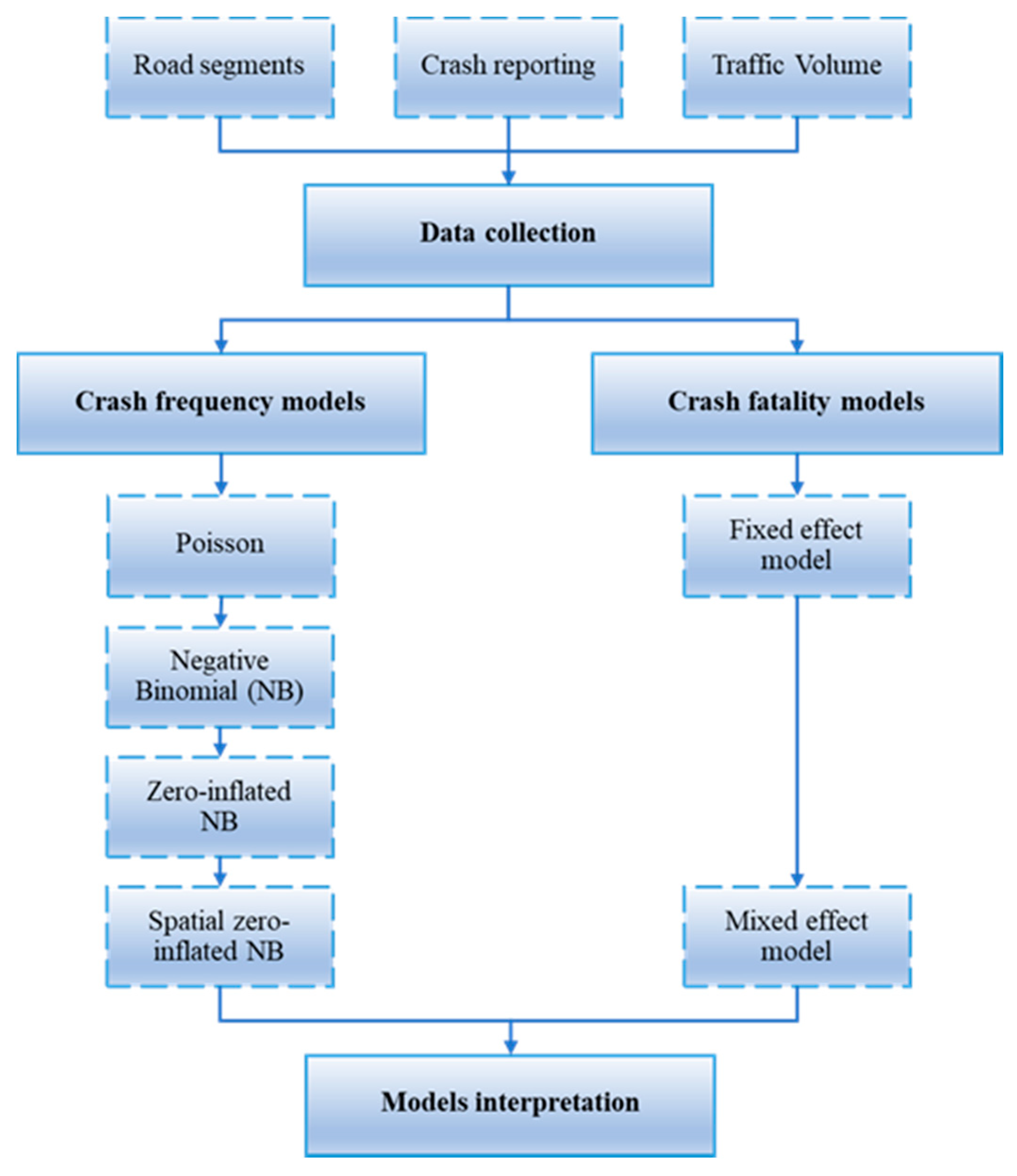
Currently, research on the development of crash models in terms of crash frequency on road segments and crash severity applies the principles of spatial analysis and heterogeneity due to the methods’ suitability compared with traditional models. This study focuses on crash severity and frequency in Thailand. Moreover, this study aims to understand crash frequency and fatality. The result of the intra-class correlation coefficient found that the spatial approach should analyze the data. The crash frequency model’s best fit is a spatial zero-inflated negative binomial model (SZINB). The results of the random parameters of SZINB are insignificant, except for the intercept. The crash frequency model’s significant variables include the length of the segment and average annual traffic volume for the fixed parameters. Conversely, the study finds that the best fit model of crash severity is a logistic regression with spatial correlations. The variances of random effect are significant such as the intersection, sideswipe crash, and head-on crash. Meanwhile, the fixed-effect variables significant to fatality risk include motorcycles, gender, non-use of safety equipment, and nighttime collision. The paper proposes a policy applicable to agencies responsible for driver training, law enforcement, and those involved in crash-reduction campaigns.
Keywords: spatial model; zero-inflated; crash severity; hierarchical structure analysis; Thai highways spatial model; zero-inflated; crash severity; hierarchical structure analysis; Thai highways