


Indigenous Knowledge Systems in Ecological Pest Control and Post-Harvest Rice Conservation Techniques: Sustainability Lessons from Baduy Communities

Abstract
:1. Introduction
- The functioning of organizational structures through which the Baduy communities institutionalize new knowledge creation, the protection of knowledge sources, intracommunity knowledge transmission and knowledge preservation mechanisms.
- Sociocultural systems used by the Baduy communities to transform existing and new knowledge in order to apply it to sustaining their livelihoods and preserving their autonomy vis-à-vis the outside world.
- Institutionalized attitudes towards external sources of ecological practices and towards knowledge sharing with outside communities.
“A cumulative body of knowledge, know-how, practices and representations maintained and developed by peoples with extended histories of interaction with the natural environment. These sophisticated sets of understandings, interpretations and meanings are part and parcel of a cultural complex that encompasses language, naming and classification systems, resource use practices, ritual, spirituality and worldview”[40] (p. 9).
2. Materials and Methods
3. Results
3.1. The Baduy and Their Ecological Practices in Rice Production and Post-Harvest Conservation
3.1.1. The Baduy and Their Habitat
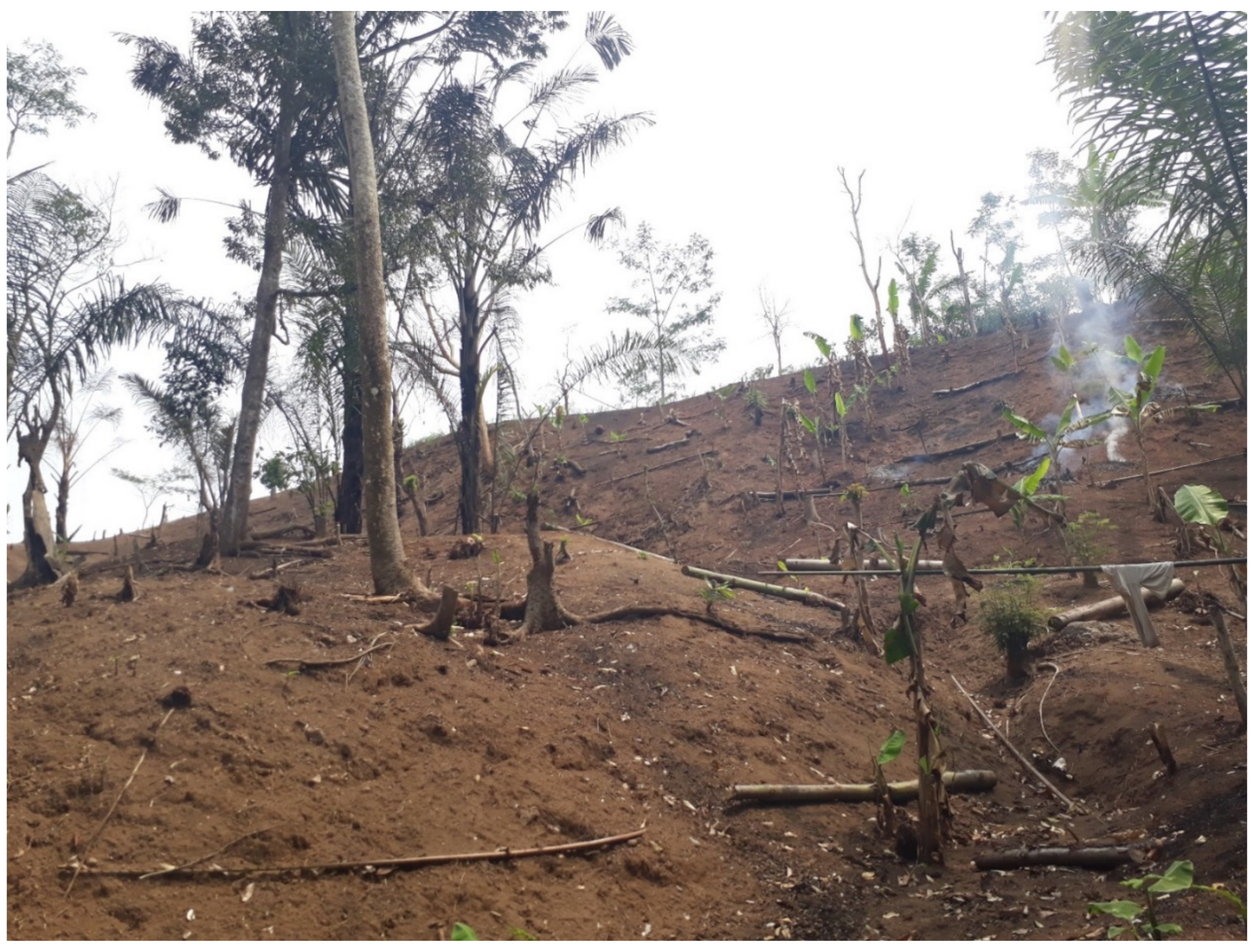
3.1.2. Ecological Huma Rice Planting Process and Pest Control
3.1.3. Sustainable Soil Regeneration and Pest Control Methods
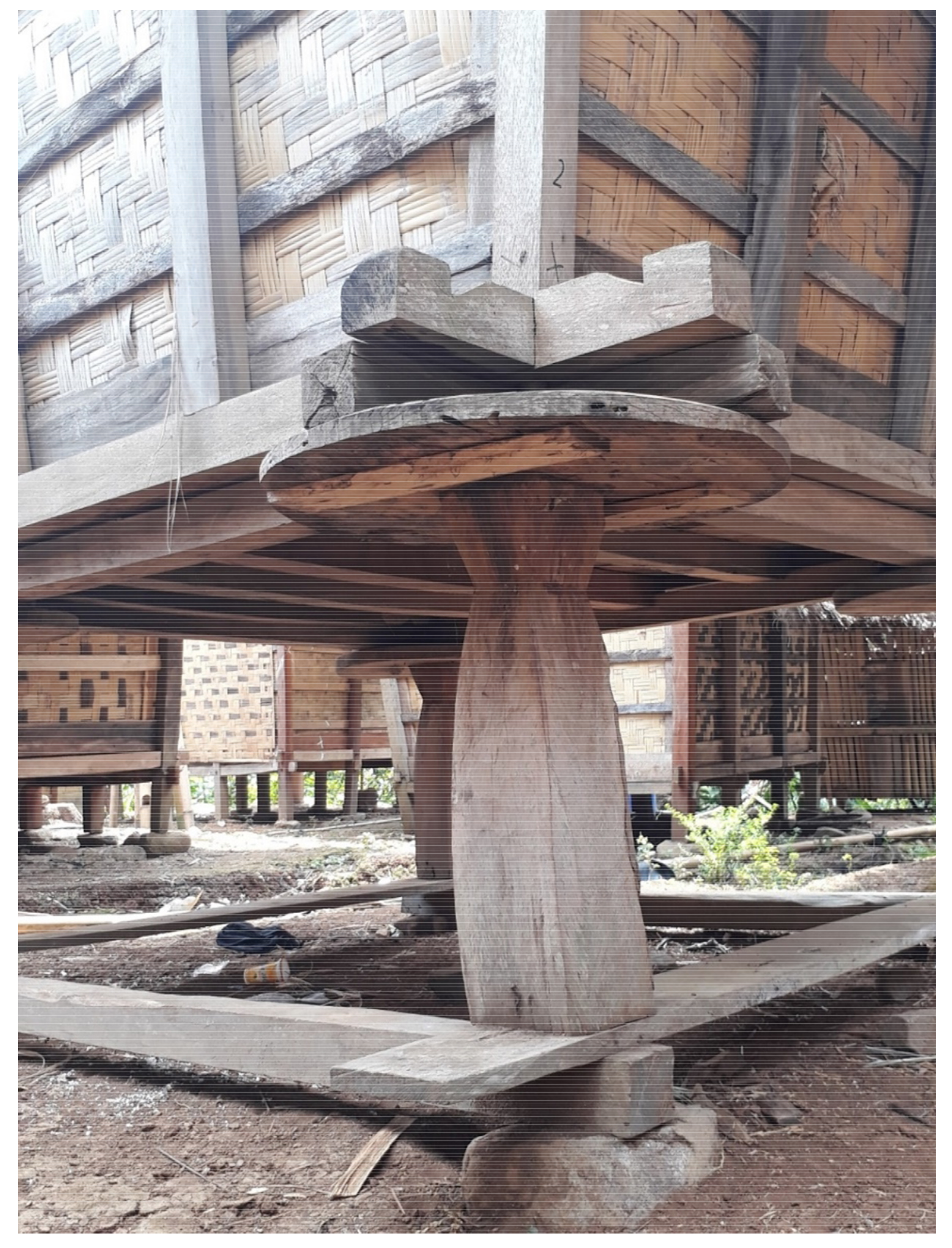
3.1.4. Rice Conservation in Leuit as Baduy’s Symbol of Food Autonomy
3.2. Findings on Knowledge Protection, Knowledge Transmission and Attitudes towards Its Sharing to Enhance Ecological Outcomes
3.2.1. Traditional Knowledge Production, Transmission and Preservation Mechanisms
3.2.2. Attitudes towards Knowledge Exchange with Outside Communities
I believe nothing is impossible if we want to learn. But we are not allowed to go to school for formal education because people, once they become clever from schooling, they use acquired knowledge to deceive others and have power on them.
There are frequent proposals from the government to give information sessions about health. We usually decline the offers. There were even proposals to build a permanent clinic. But in Baduy dalam and in Baduy luar, we oppose the construction of permanent buildings and we are still relying primarily on traditional herbal medicine for all our health care needs. Only when every available traditional medication has been tried and there is still a need for other means, then Baduy may seek the medical help provided by the government, like consulting a doctor or a midwife. Until today, however, Baduy dalam have been able to handle everything with traditional medicine solutions. Only in Baduy luar, a part of them is still exclusively using traditional medicine while the other part sometimes seeks the help from midwives.
4. Discussion
- It is still often argued that some aspects of indigenous knowledge are incompatible with modern science. Those arguments are usually rooted in an ethnocentric paradigm, whose validation norms are defined by a cultural context, yet purports to separate knowledge from culture. It would be interesting to explore new epistemological and ontological theories of knowledge validation based on a new thinking about diversity of cognition.
- Further inquiry is needed in order to explore the optimal ways to foster the dialogue between modern scientific knowledge practitioners and indigenous knowledge holders in various domains where they can complement one another. Complementarity of knowledge systems is namely a major source of potential for mutual learning.
- Further debate in the intellectual property right regimes should thus also be opened to explore how the owners of traditional knowledge sources can benefit more (beyond the existing sui generis protection) from their contribution to the global knowledge stocks.
5. Conclusions
Author Contributions
Funding
Institutional Review Board Statement
Informed Consent Statement
Data Availability Statement
Acknowledgments
Conflicts of Interest
References
- Overland, I.; Sovacool, B. The misallocation of climate research funding. Energy Res. Soc. Sci. 2020, 62, 101349. [Google Scholar] [CrossRef]
- Iskandar, J. Responses to environmental stress in the Baduy swidden system, South Bantem, Java. In Modern Crises and Traditional Strategies: Local Knowledge in Island Southeast. Asia; Ellen, R., Ed.; Berghahn Book: New York, NY, USA, 2007. [Google Scholar]
- Iskandar, J.; Iskandar, B. Studi etnobotani keanekaragaman tanaman pangan pada “Sistem Huma” dalam menunjang keamanan pangan Orang Baduy. Pros. Sem. Nas. Masy. Biodiv. Indon. 2015, 1, 1265–1272. [Google Scholar]
- Huntington, H.P. Using traditional ecological knowledge in science: Methods and applications. Ecol. Appl. 2000, 10, 1270–1274. [Google Scholar] [CrossRef]
- Nakashima, D.; Roué, M. Indigenous Knowledge, Peoples and Sustainable Practice. In Social and Economic Dimensions of Global Environmental Change; Timmerman, P., Munn, T., Eds.; John Wiley & Sons: Chichester, UK, 2002; pp. 314–324. [Google Scholar]
- Klein, J.A.; Hopping, K.A.; Yeh, E.T.; Nyima, Y.; Boone, R.B.; Galvin, K.A. Unexpected climate impacts on the Tibetan Plateau: Local and scientific knowledge in findings of delayed summer. Global Environ. Chang. 2014, 28, 141–152. [Google Scholar] [CrossRef]
- Green, E.C. Indigenous knowledge systems and health promotion in Mozambique. In Indigenous Knowledge and Its Use; Normann, H., Snyma, I., Cohen, M., Eds.; SRP: London, UK, 1996. [Google Scholar]
- Alexander, C.; Bynum, N.; Johnson, E.; King, U.; Mustonen, T.; Neofotis, P.; Vicarelli, M. Linking indigenous and scientific knowledge of climate change. BioScience 1120, 61, 477–484. [Google Scholar] [CrossRef] [Green Version]
- Cochran, P.; Huntington, O.H.; Pungowiyi, C.; Tom, S.; Chapin, F.S.; Huntington, H.P.; Trainor, S.F. Indigenous frameworks for observing and responding to climate change in Alaska. Clim. Chang. 2013, 120, 557–567. [Google Scholar] [CrossRef]
- Turner, N.; Spalding, P. “We Might Go Back to This”: Drawing on the Past to Meet the Future in Northwestern North American Indigenous Communities. Ecol. Soc. 2013, 18. [Google Scholar] [CrossRef] [Green Version]
- McDonald, D.R. Food Taboos: A Primitive Environmental Protection Agency (South America). Anthropos 1977, 72, 734–748. [Google Scholar]
- Eyong, C.T. Indigenous Knowledge and Sustainable Development in Africa: Case Study on Central Africa. In Indigenous Knowledge Systems and Sustainable Development: Relevance for Africa; Boon, E.K., Hens, L., Eds.; Kamla-Raj Enterprises: New Delhi, India, 2007; pp. 121–139. [Google Scholar]
- Neluvhalani, E.F. Enabling a global imperative of sustainable development through Indigenous (local) ways of knowing: A case of southern African. Trib. Tribals Sp. 2007, 1, 157–165. [Google Scholar]
- Trung, T.C.; Le, X.Q.; Vu, V.H. The role of indigenous knowledge in sustainable development: A case study of the Vietnam mountain regions. Trib. Tribals Sp. 2007, 1, 215–224. [Google Scholar]
- Chemhuru, M.; Masaka, D. Taboos as sources of Shona people’s environmental ethics. J. Sust. Dev. Afr. 2010, 12, 121–133. [Google Scholar]
- Risiro, J.; Tshuma, D.T.; Basikiti, A. Indigenous knowledge systems and environmental management: A case study of Zaka District, Masvingo Province, Zimbabwe. Int. J. Acad. Res. Progr. Educ. Dev. 2013, 2, 19–39. [Google Scholar]
- Rist, S.; Boillat, S.; Gerritsen, P.; Schneider, F.; Mathez-Stiefel, S.; Tapia, N. Endogenous knowledge: Implications for sustainable development. In Research for Sustainable Development: Foundations, Experiences, and Perspectives; Wiesmann, U., Hurni, H., Eds.; Geographica Bernensia: Bern, Switzerland, 2007; pp. 119–146. [Google Scholar]
- Berkes, F.; Colding, J.; Folke, C. Rediscovery of traditional ecological knowledge as adaptive management. Ecol. Appl. 2000, 10, 1251–1262. [Google Scholar] [CrossRef]
- Fazey, I.R.; Fazey, J.A.; Fazey, D.M. Learning more effectively from experience. Ecol. Soc. 2005, 10, 4. [Google Scholar] [CrossRef] [Green Version]
- Mathez-Stiefel, S.L.; Boillat, S.; Rist, S. Promoting the diversity of worldviews: An ontological approach to bio-cultural diversity. In Endogenous Development and Bio-cultural Diversity: The Interplay of Worldview, Globalization and Locality; Haverkort, B., Rist, S., Eds.; Centre for Development and Environment: Bern, Switzerland, 2007; pp. 67–812. [Google Scholar]
- Berkes, F. Sacred Ecology; Routledge: New York, NY, USA, 2012. [Google Scholar]
- Bruchac, M. Indigenous Knowledge and Traditional Knowledge. In Encyclopedia of Global Archaeology; Smith, C., Ed.; Springer Science and Business Media: New York, NY, USA, 2014; pp. 3814–3824. [Google Scholar]
- Hill, R.; Adem, C.; Alangui, W.; Molnar, Z.; Aumeeruddy-Thomas, Y. Working with Indigenous, local and scientific knowledge in assessments of nature and nature’s linkages with people. Curr. Opin. Sust. 2020, 43, 8–20. [Google Scholar] [CrossRef]
- Tharakan, J. Indigenous knowledge system for appropriate technology development. In Indigenous People; Venkatesan, P., Ed.; IntechOpen: London, UK, 2017. [Google Scholar] [CrossRef] [Green Version]
- United Nations. Study of the Problem of Discrimination against Indigenous People. Final Report Submitted by the Special Rapporteur, Mr Jose R. Marticez Cabo. United Nations, New York, USA. 1982. Available online: https://www.un.org/esa/socdev/unpfii/documents/MCS_intro_1982_en.pdf (accessed on 30 June 2021).
- Le Gall, S.B. Defining traditional knowledge: A perspective from Caribbean’. Carib. Quart. 2012, 58, 62–86. [Google Scholar] [CrossRef]
- Rai, P.; Khawas, V. Traditional knowledge system in disaster risk reduction: Exploration, acknowledgement and proposition. J. Dis. Risk Stud. 2019, 11, 1–7. [Google Scholar] [CrossRef]
- van der Ploeg, J.D. Styles of farming: An introductory note on concepts and methodology. In Born from Within: Practice and Perspectives of Endogenous Rural Development; van der Ploeg, J.D., Long, A., Eds.; Van Gorcum Publisher: Assen, The Netherlands, 1994; pp. 7–34. [Google Scholar]
- Posey, D. Cultural and Spiritual Values of Biodiversity: A Complementary Contribution to the Global Biodiversity Assessment; Intermediate Technology Publications: London, UK, 1999. [Google Scholar]
- Agrawal, A. Dismantling the divide between indigenous and scientific knowledge. Dev. Chang. 1995, 26, 413–439. [Google Scholar] [CrossRef] [Green Version]
- Maila, M.; Loubster, C. Emancipatory Indigenous Knowledge Systems: Implications for environmental education in South Africa. S. Afr. J. Educ. 2003, 23, 276–280. [Google Scholar]
- Flint, C.G.; Robinson, E.S.; Kellogg, J.; Ferguson, G.; Boufajreldin, L.; Dolan, M.; Lila, M.A. Promoting wellness in Alaskan villages: Integrating traditional knowledge and science of wild berries. EcoHealth 2011, 8, 199–209. [Google Scholar] [CrossRef]
- Odora-Hoppers, C.A. (Ed.) Indigenous Knowledge and the Integration of Knowledge Systems: Towards a Philosophy of Articulation; New Africa Books: Claremont, South Africa, 2002. [Google Scholar]
- Tom, M.N.; Sumida Huaman, E.; McCarty, T.L. Indigenous knowledges as vital contributions to sustainability. Int. Rev. Educ. 2019, 65, 1–18. [Google Scholar] [CrossRef] [Green Version]
- Brazier, A. Harnessing Zimbabwe’s Indigenous Knowledge for a Changing Climate; Konrad Adenauer Stiftung: Harare, Zimbabwe, 2020. [Google Scholar]
- Langdon, D. Environment and Development in a Traditional Indonesian Community: A Case Study of the Baduy of West Java. Ph.D. Thesis, Flinders University, Adelaide, Australia, 2002. [Google Scholar]
- Hart, T. The significance of African vegetables in ensuring food security for South Africa’s rural poor. Agric. Hum. Values 2011, 28, 321–333. [Google Scholar] [CrossRef]
- Schuster, R.; Germain, R.; Bennett, J.; Reo, N.; Arcese, P. Vertebrate biodiversity on indigenous-managed lands in Australia, Brazil, and Canada equals that in protected areas. Env Sci Pol. 2019, 101, 1. [Google Scholar] [CrossRef]
- Eira, I.; Jaedicke, C.; Magga, O.; Maynard, N.; Vikhamar-Schuler, D.; Mathiesen, S. Traditional Sámi snow terminology and physical snow classification: Two ways of knowing. Cold Reg. Sci. Technol. 2013, 85, 117–130. [Google Scholar] [CrossRef]
- UNESCO. Science, Traditional Knowledge and Sustainable Development; UNESCO: Paris, France, 2002; p. 9. [Google Scholar]
- UNESCO. Science for the 21st Century: Science and Other Systems of Knowledge; UNESCO: Paris, France, 1999; Available online: http://www.unesco.org/science/wcs/abstracts/thematic_meetings.htm (accessed on 30 June 2021).
- Nakashima, D.; Prott, L.; Bridgewater, P. Tapping into the world’s wisdom. UNESCO Sources 2000, 125, 12. [Google Scholar]
- Pohl, C.; Rist, S.; Zimmermann, A.; Fry, P.; Gurung, G.S.; Schneider, F.; Ifejika Speranza, C.; Kiteme, B.; Boillat, S.; Serrano, E.; et al. Researchers’ roles in knowledge co-production: Experience from sustainability research in Kenya, Switzerland, Bolivia and Nepal. Sci. Publ. Policy 2010, 37, 267–281. [Google Scholar] [CrossRef] [Green Version]
- Guston, D.H. Boundary organizations in environmental policy and science: An introduction. Sci. Techn. Hum. Val. 2001, 26, 399–408. [Google Scholar] [CrossRef] [Green Version]
- Forsyth, T. Critical Political Ecology: The Politics of Environmental Science; Routledge: New York, NY, USA, 2004. [Google Scholar]
- Nowotny, H.; Scott, P.; Gibbons, M. Re-Thinking Science: Knowledge and the Public in an Age of Uncertainty; Polity Press: Cambridge, UK, 2001. [Google Scholar]
- Maffi, L.; Woodley, E. Biocultural Diversity Conservation: A Global Sourcebook; Earthscan: London, UK; Washington, DC, USA, 2010. [Google Scholar]
- Ens, E.J.; Pert, P.; Clarke, P.A.; Budden, M.; Clubb, L.; Doran, B.; Locke, J. Indigenous biocultural knowledge in ecosystem science and management: Review and insight from Australia. Biol. Conserv. 2015, 181, 133–149. [Google Scholar] [CrossRef]
- Berkes, F. Indigenous ways of knowing and the study of environmental change. J. Roy. Soc. N. Zeal. 2009, 39, 151–156. [Google Scholar] [CrossRef]
- Boillat, S.; Berkes, F. Perception and interpretation of climate change among Quechua farmers of Bolivia: Indigenous knowledge as a resource for adaptive capacity. Ecol. Soc. 2003, 18. [Google Scholar] [CrossRef] [Green Version]
- Iskandar, J. Swidden Cultivation as a Form of Cultural Identity: The Baduy Case. Ph.D. Thesis, University of Kent, Canterbury, UK, 1998. [Google Scholar]
- Hadi, A.C. Melestarikan kearifan masyarakat tradisional (Indigenous Knowledge). Buletin Perpustakaan dan Informasi Bogor 2006, 1, 27–32. [Google Scholar]
- Dhanya, S.; Kumar, A.; Nayak, A.S.; Raj, U.S.; Prabhu Ravikiran, D. Cytotoxicity Studies of Microwave Assisted Natural Product Extracts in HeLa and MCF-7 Cell Lines. Int. J. Med. Arom. Pl. 2013, 2, 27–31. [Google Scholar]
- Blume, C.L. Gedachten op een reis door het zuidoostelijke gedeelte der residentie Bantam. Indisch Magazijn 1845, 2, 1–36. [Google Scholar]
- Raffles, T.S. The History of Java; Cox and Baylls: London, UK, 1817. [Google Scholar]
- Danasasmita, S.; Djatisunda, A. Kehidupan masyarakat Kanekes, Vol. 2: Bagian Proyek Penelitian dan Pengkajian Kebudayaan Sunda. Departemen Pendidikan dan Kebudayaan; Ministry of Education and Culture: Jakarta, Indonesia, 1986. [Google Scholar]
- Zafar, R.; Neerja, G. Momordica charantia—A review. Hamdard Med. 1991, 34, 49–61. [Google Scholar] [PubMed]
- Agrawal, M.; Kamal, R. In vitro clonal propagation of Momordica charantia L. Indian J. Biotechnol. 2004, 3, 426–430. [Google Scholar]
- Grover, J.K.; Yadav, S.P. Pharmacological actions and potential uses of Momordica charantia: A Review. J. Ethnopharmacol. 2004, 93, 123–132. [Google Scholar] [CrossRef]
- Gupta, M.; Sharma, S.; Gautam, A.; Bhadauria, R. Momordica charantia Linn. (Karela): Nature’s silent healer. Int. J. Pharm. Sci. Rev. Res. 2011, 11, 32–37. [Google Scholar]
- Rambo, A.T. Observations on the role of improved fallow management agricultural systems. In Voices from the Forest: Integrating Indigenous Knowledge into Sustainable Upland Farming; Cairns, M., Ed.; Resources for the Future: Washington, DC, USA, 2007. [Google Scholar]
- Reijntjes, C.; Haverkort, B.; Waters-Bayer, A. Farming for the Future: An Introduction to Low-External Input and Sustainable Agriculture; MacMillan: London, UK, 1992. [Google Scholar]
- Iskandar, J.; Ellen, R. In situ conservation of rice landraces among the Baduy West Java. J. Ethnobiol. 1999, 19, 97–125. [Google Scholar]
- Dutfield, G. Indigenous Peoples, Bioprospecting and the TRIPs Agreement: Threats and Opportunities. Available online: https://www.iatp.org/sites/default/files/Indigenous_Peoples_Bioprospecting_and_the_TRIP.htm (accessed on 27 May 2021).
- Calma, T. Protection of indigenous knowledge’s. In Native Title Report 2008; Australian Human Rights Commission: Sidney, Australia, 2008. [Google Scholar]
- Dutfield, G. TK unlimited: The emerging but incoherent international law of traditional knowledge protection. J. World Intel. Prop. 2017, 20, 144–159. [Google Scholar] [CrossRef] [Green Version]
- Snively, G.; Corsiglia, J. Indigenous Science: Proven, Practical and Timeless. In Knowing Home: Braiding Indigenous Science with Western Science (Book 1); Snively, G., Williams, W.L., Eds.; ePublishing Services, University of Victoria Libraries: Victoria, BC, Canada, 2016; pp. 89–104. [Google Scholar]
Publisher’s Note: MDPI stays neutral with regard to jurisdictional claims in published maps and institutional affiliations. |
© 2021 by the authors. Licensee MDPI, Basel, Switzerland. This article is an open access article distributed under the terms and conditions of the Creative Commons Attribution (CC BY) license (https://creativecommons.org/licenses/by/4.0/).
Share and Cite
Habiyaremye, A.; Korina, L. Indigenous Knowledge Systems in Ecological Pest Control and Post-Harvest Rice Conservation Techniques: Sustainability Lessons from Baduy Communities. Sustainability 2021, 13, 9148. https://doi.org/10.3390/su13169148
Habiyaremye A, Korina L. Indigenous Knowledge Systems in Ecological Pest Control and Post-Harvest Rice Conservation Techniques: Sustainability Lessons from Baduy Communities. Sustainability. 2021; 13(16):9148. https://doi.org/10.3390/su13169148
Chicago/Turabian StyleHabiyaremye, Alexis, and Leeja Korina. 2021. "Indigenous Knowledge Systems in Ecological Pest Control and Post-Harvest Rice Conservation Techniques: Sustainability Lessons from Baduy Communities" Sustainability 13, no. 16: 9148. https://doi.org/10.3390/su13169148
APA StyleHabiyaremye, A., & Korina, L. (2021). Indigenous Knowledge Systems in Ecological Pest Control and Post-Harvest Rice Conservation Techniques: Sustainability Lessons from Baduy Communities. Sustainability, 13(16), 9148. https://doi.org/10.3390/su13169148

