A Service-Learning Based Computers Reuse Program


Abstract
1. Introduction
- Present a methodology to design a Service-Learning-based CRP in the field of an educational institution where technical training related to computers is provided to students
- Present a model to evaluate the impact of the CRP
- Present, as an example, a case study in which the two methodologies described in objectives 1 and 2 have been applied.
2. Materials and Methods
2.1. The Computer Reuse Program
2.1.1. Objectives of the CRP
- CRP1: To provide technological resources to non-profit social entities so they can carry out their projects.
- CRP2: To increase the lifespan of computers and facilitate recycling when they become obsolete, thus reducing e-waste.
- CRP3: To increase the students’ technical competencies and increase their commitment to sustainable development.
2.1.2. Workforce
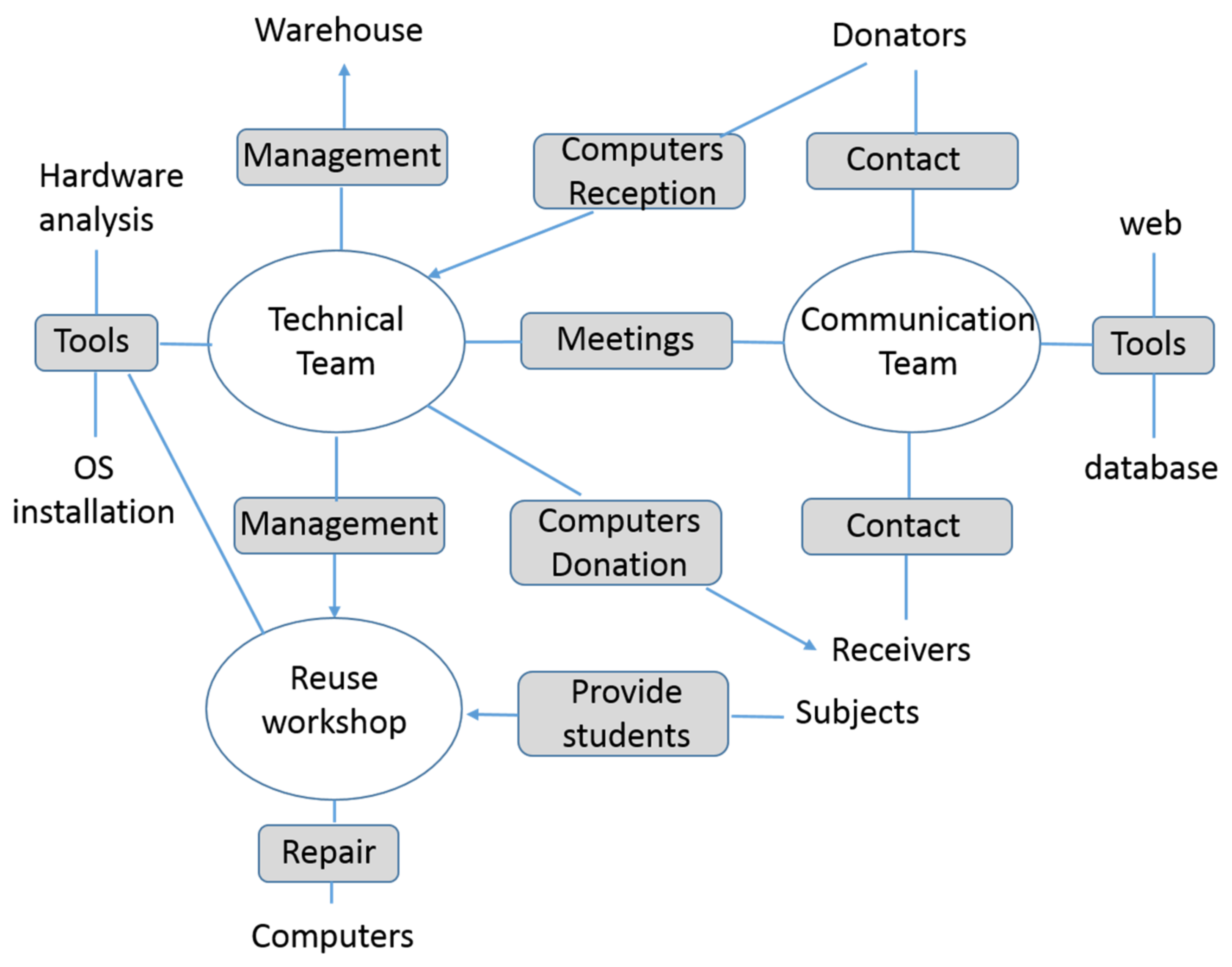
- The technical team is responsible for reconditioning the computers to function properly. It can be formed by a small group of especially motivated students (voluntaries) or supported by students of VET (Vocational Education and Training) courses who carry out their practices in the program (in the UPC-ReuTIlitza Program, the internship is unpaid). Voluntary students may dedicate typically between 10 and 20 h per week to the CRP, depending on their availability. One of these students, or a staff member, acts as the coordinator of activities. The number of students in the technical team will depend on the volume of computers reconditioned monthly. In our experience, at least one student for every 10 computers/month is required for this task.
- The communication team maintains contact with external entities, both suppliers (the CRT may accept computers from external enterprises) and receivers of computers. The team is responsible for (1) keeping in touch with their own university or external companies to receive their obsolete computers, (2) managing applications from entities requesting computers, and (3) keeping in touch with receiving entities throughout the donation process. To simplify the management of the program, all procedures must be managed through a web page, and the information must be stored in a database.
2.1.3. The Reuse Workshop
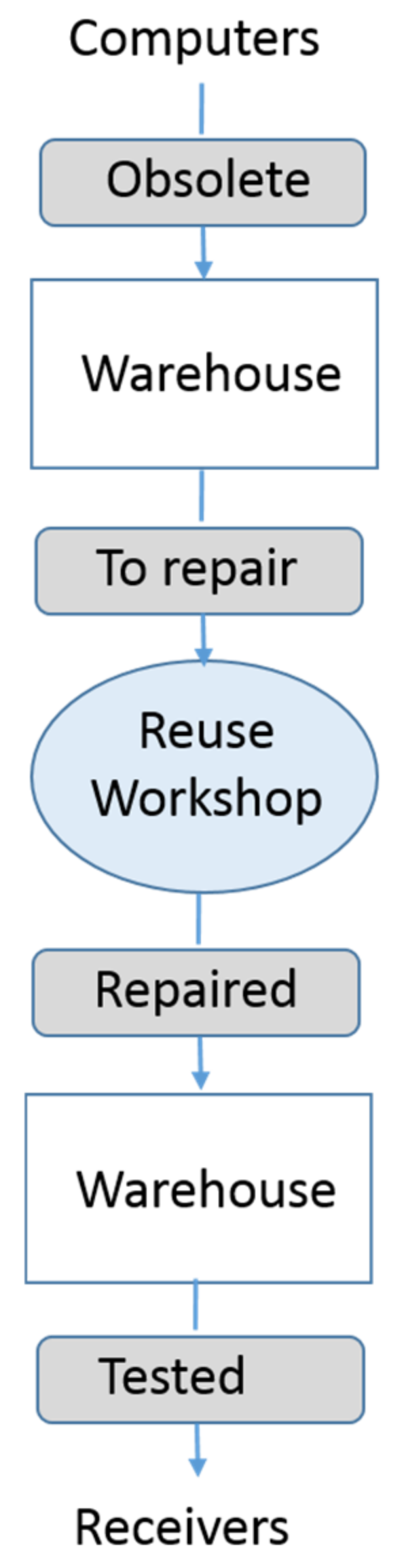
- The first group is in charge of opening the computers, cleaning them (basically, dusting them) and checking their correct functioning. These students separate computers into two categories: those that work correctly and those that do not work or are incomplete. This task can be entrusted to students with little or no computer training.
- The second group is in charge of repairing and remanufacturing the computers. Components that work properly on computers that are otherwise beyond repair will be used for the repair of other computers. The parts that do not work will be taken to a recycling point. These students must have received previous training in some technical subjects.
- The third group is responsible for refurbishing computers, installing the most appropriate free software in the computer (it is advisable to install a Long Term Support (LTS) version to ensure that, as far as possible, the operating system will be supported throughout the time the computer is in use at the receiving entity) while taking into account the computers’ hardware limitations, the needs of the receiving entities and ensuring that the software has technical support for updates during the expected extended lifespan of the computer. These students must have received previous training.
- A software tool to analyze the computer hardware and to store information of every computer in a database. With this information, the program can trace the life of all computers and components, as well as analyze the durability of these components [53].
- Hardware and software support to install software to multiple computers simultaneously by using a network.
- A software tool to assure that all data on the computer disks have been erased and cannot be recovered, in order to reassure donors that all information about their companies has been erased.
2.1.4. Minimum Requirements to Establish a CRP
- A stable communication team supervised by one person, and a stable technical team also supervised by one person. The minimum team size depends on the volume of program activity.
- A website to provide information and manage the program.
- A warehouse to store computers, both those repaired in the workshop and those that are pending repair. The warehouse size will depend on the annual number of computers managed by the program.
- A workspace for the technical and communication teams. The size will depend on the number of team members.
- A room for the Reuse Workshop. The size of the room will depend on the number of students participating in each workshop session. For a group of 20 students, a space of at least 70 square meters is recommended, with enough power outlets and 10 tables (students work in groups of two). Repaired computers, pending repair/installation and spare parts must also be temporarily stored in the room during the workshop.
- The installation of the computer operating systems can be performed individually if the volume of computers is not large, but for a volume greater than 20–30 computers per workshop, installation via network using a switch is more recommended.
- A computer hardware analysis software that allows the automatic detection of computer configuration and can save it in a database is recommended. This software will allow traceability of donated computers.
2.2. Impact
2.2.1. Impact on the Community
2.2.2. Impact on Student Learning
2.2.3. Reducing Resource and Environmental Impacts
Amount of Equipment Affected by the UPC-ReTIlitza Program
Lifespan Extension of the Material Donated
Weight of the Material
Material Composition, Material Weight Recycling, Cost of Raw Materials and Environmental Impact
3. Results
3.1. Evaluating the Impact on the Community
3.2. Evaluating the Impact on Student Learning
3.3. Reducing Resource and Environmental Impacts
3.3.1. Impact of the Donated Material
3.3.2. Impact on the Reduction of Manufactured Products
3.3.3. Limitations of the Model
4. Discussion
4.1. The Service Learning Methodology
- Although entities are properly informed throughout the donation process, most of them continue showing, in general, a preference for operating systems based on Microsoft Windows © rather than Linux-based systems. This is due to a lack of familiarity with Linux-based systems. Thus, in some cases, the entity formats computers again in order to install a Windows-based system. Unfortunately, as delivered computers are quite old, most of them fail to function efficiently shortly after a current Windows System is installed, as the system quickly consumes all computer resources.
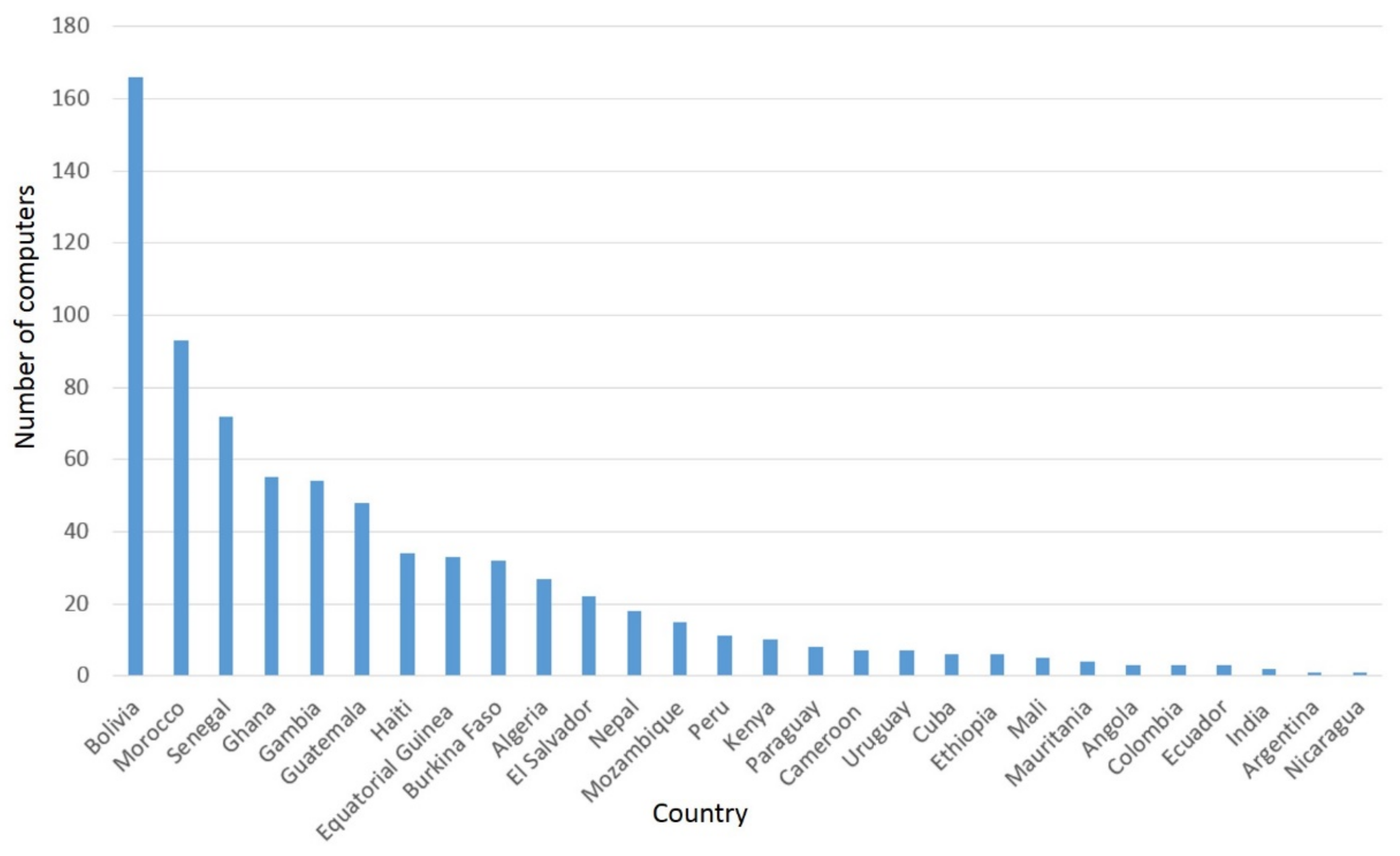
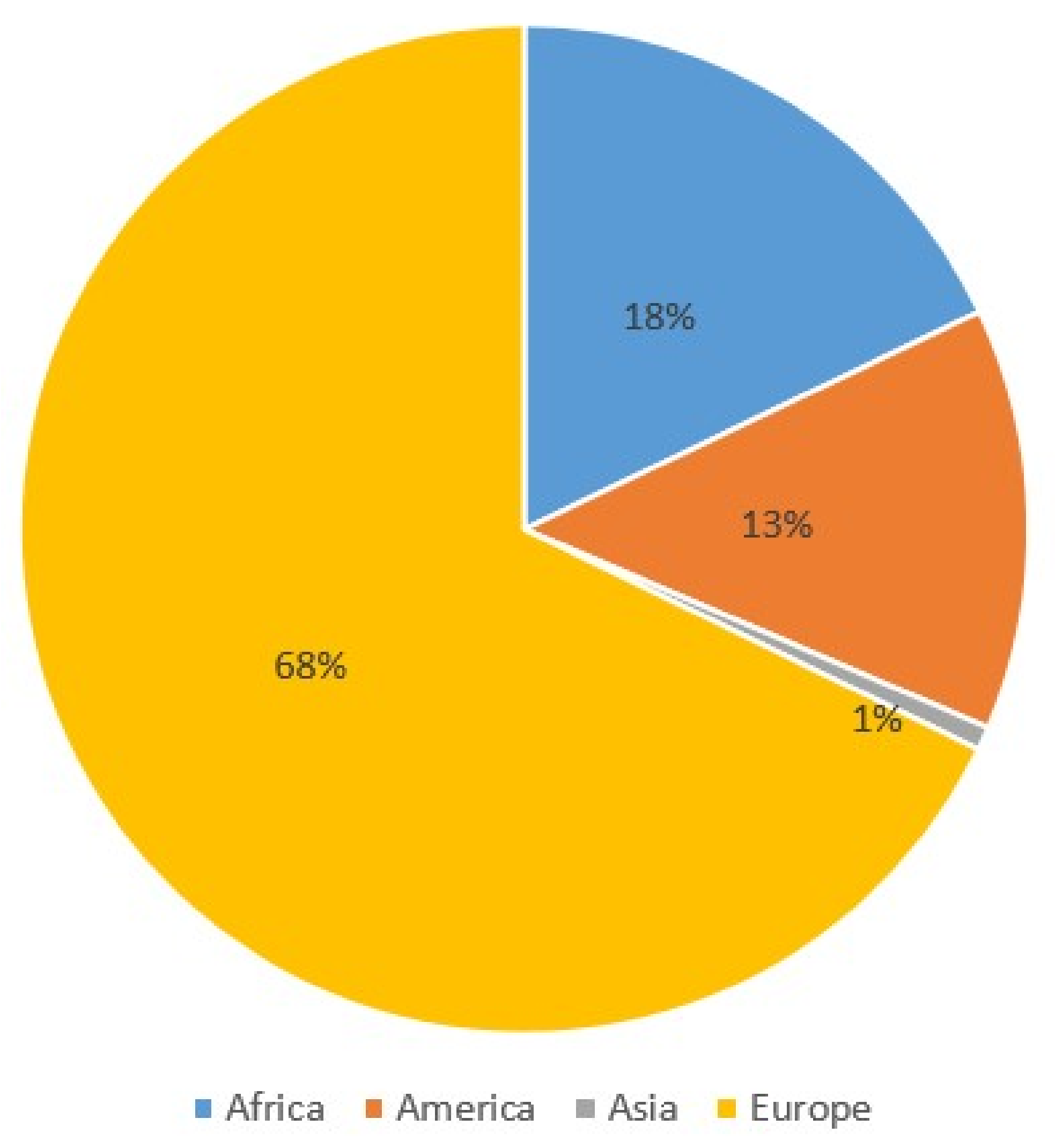
- Initially, target entities were connected to projects in countries in the Global South, in many of which the transportation of desktops is complicated, and the environmental and electrical conditions are unsuitable for these devices. Therefore, in some cases, they break down quickly. In addition, countries in the Global South usually do not have recycling centers, so damaged computers often end up in a landfill as e-waste. In order to avoid this, the UPC-ReuTIlitza Program prioritizes the dispatch of laptops to these countries. To this end, counterparts in countries in the Global South must be committed to recycling laptops appropriately when they reach the end of their useful life or returning them to Spain if recycling them locally is not possible. Since the entities receiving computers normally work with counterparts based in Spain, the counterpart volunteers are responsible for bringing equipment back to Spain when they cannot be locally recycled.
- In the main, desktops are currently assigned to supporting the needs of local entities. These entities are obliged to deliver computers to a recycling center once their useful life is over. In the case of entities in which computers previously delivered by the program are broken, they are accorded priority for receiving new computers. However, many local entities are currently also asking for laptops.
- The program does not normally accept any material except computers and their corresponding input/output devices (flat screen, keyboard and mouse). However, our university replaces servers and networking equipment that often end up in the program warehouse. This equipment is not normally delivered to social entities because it does not meet their needs. Nevertheless, VET schools that collaborate with the program by providing internship students are delighted to receive this equipment for developing labs of their subjects, so the servers and networking equipment are also endowed with a second life.
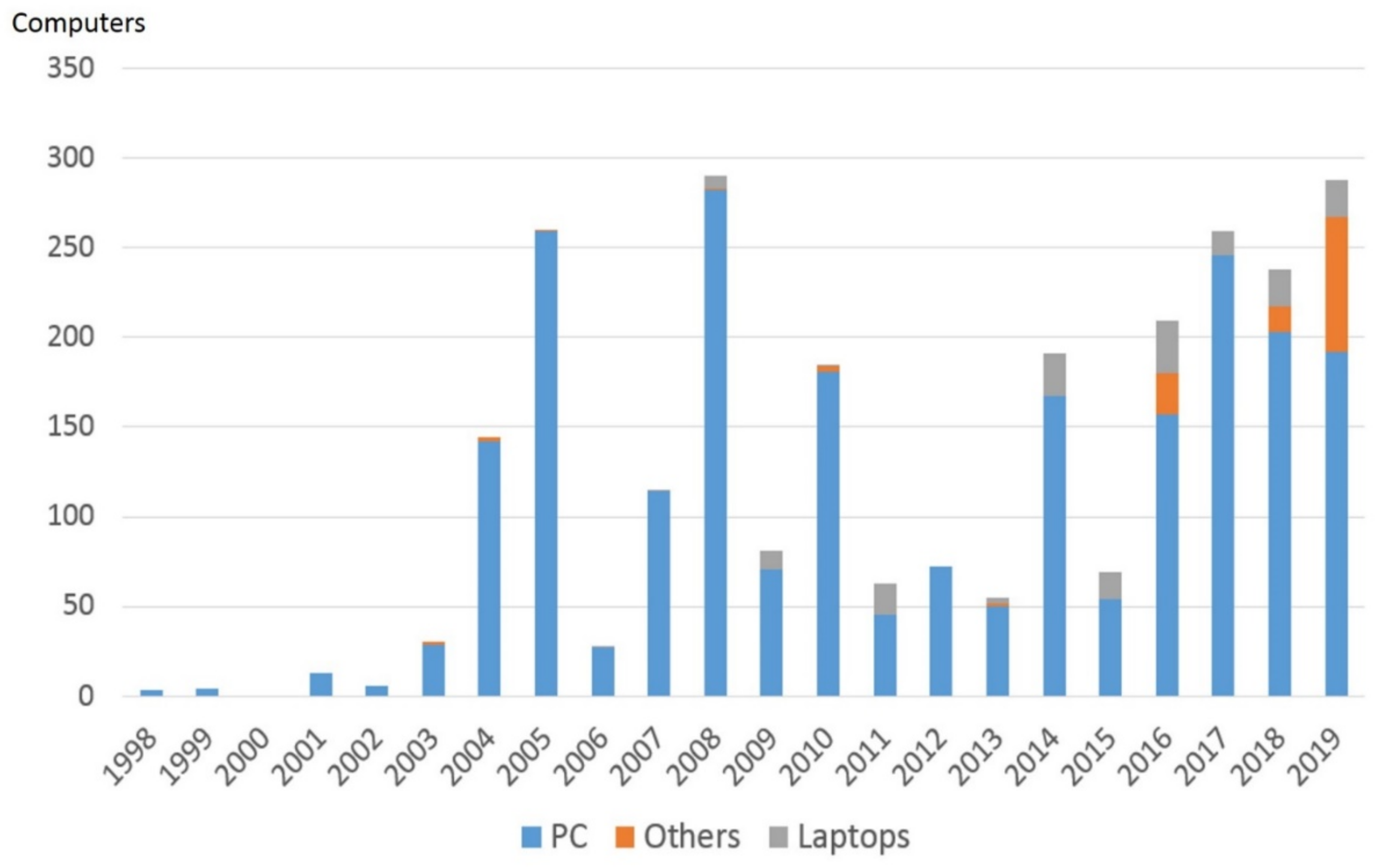
- Laptops and screens usually enjoy a longer useful lifespan than desktops, and therefore they arrive in worse condition (especially laptops). However, the donors have begun to renew flat screens, and in 2015, the program started to receive significant donations and screen stock problems are not expected in the future. The case of laptops is different, as many companies allow their employees to buy back these devices at a nominal price when they are replaced, so these laptops are not donated. Nonetheless, we have detected an increase in laptop donations from 2018, most of them provided by private users.
- Other devices such as printers, phones or tablets are accepted only when an entity has previously requested them. This procedure is followed because there is little demand for this type of equipment and not enough room is available in the warehouse. Printers are also prone to problems with the toners, which are very expensive and have a very short lifetime. Therefore, we do not accept donations of printers unless they are of high quality or are new.
- Some companies expressly request a deep erasure of the hard drives they donate, and a certification of that erasure. The members of the technical team perform this deletion before the computers arrive at the workshop. The UPC-ReuTIlitza Program manager, a UPC-BarcelonaTech teacher, issues the erasure certificate.
- Some donors request a certificate of valuation for donated equipment. This certificate allows them to deduct the donation on their next tax return. To correctly value the equipment, an analysis is made of the current market price of the equipment on different platforms for the sale of second-hand equipment.
4.2. Impact on Society and the Environment
4.3. Limitations of a CRP Following the Proposed Methodology
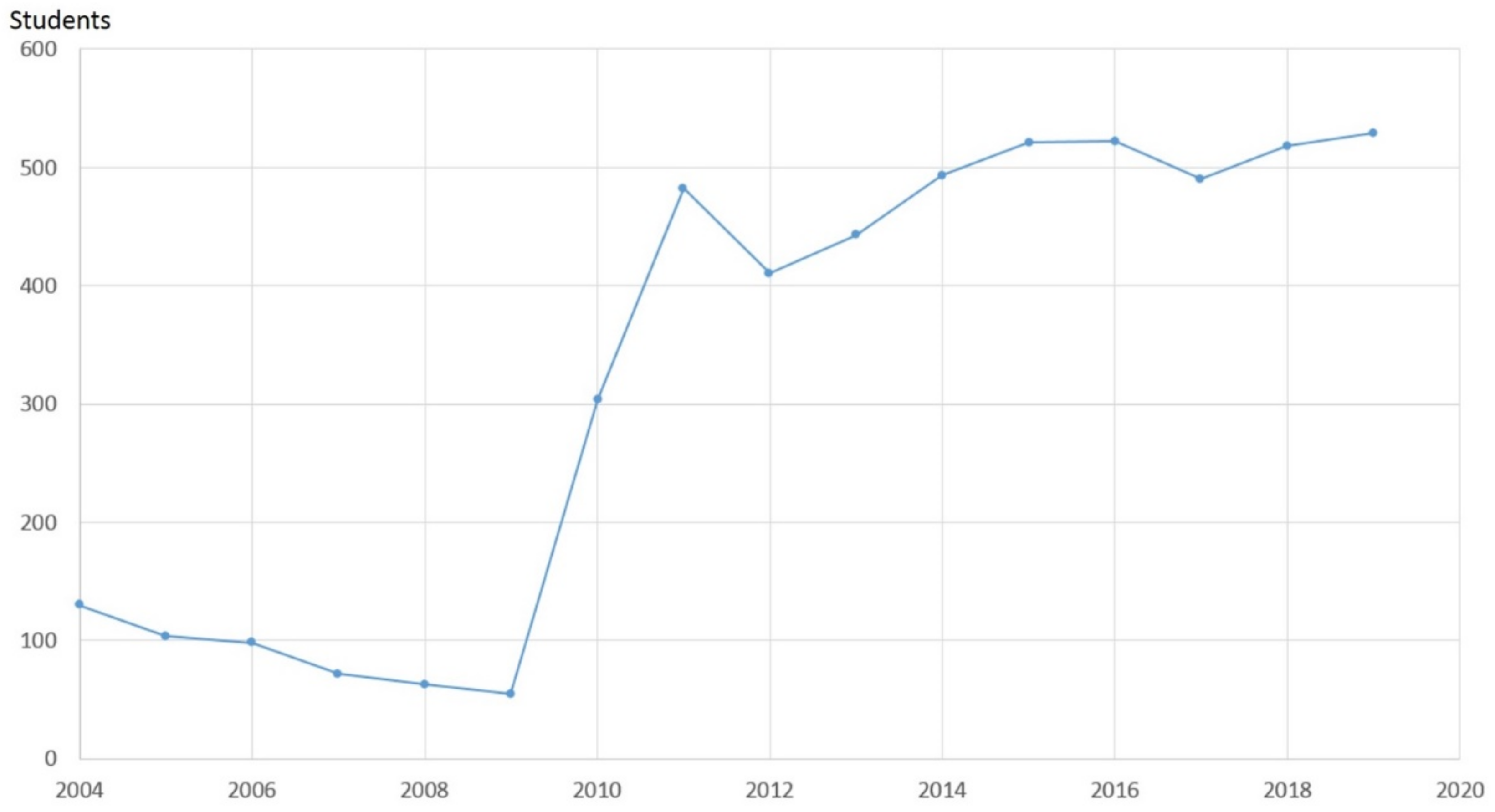
- One of the main limitations concerns space. It is necessary to have enough room to store the computers, a place to conduct the Reuse Workshop and a room to undertake the work carried out by the volunteers of the program. The UPC-ReuTIlitza Program has at its disposal a warehouse of one hundred square meters, where computers are stored and volunteers work. For the Reuse Workshop, a classroom capable of housing all the computers to be set up in each workshop is required, with enough space for 20 to 40 students to work simultaneously. This room must be suitably equipped and adapted so that between 10 and 20 computers can be repaired simultaneously, or up to 40 computers can be simultaneously installed. In addition, a room with sufficient space is required to give talks and for projecting documentaries, etc., to all the students. In the case of the UPC-ReuTIlitza Program, up to 250 students may be enrolled in the “Computer Interfaces” subject, so a room of this capacity is necessary.
- The number of students is a further limitation, and one closely related to the available space, as mentioned above. On the one hand, the number of students participating directly in the program (volunteers and VET students who complete their internships in the program) must be taken into account. The number of these students is fundamental when it comes to determining how many activities can be conducted at the Reuse Workshop, as well as how many computers can be delivered to the social entities each week, since these students are the ones who perform the daily work and are at the front-end of the program for the entities benefitting from the service. Furthermore, the number of students attending the Reuse Workshop constitutes another limitation (also highly dependent on the space available for the workshop). The number of computers that can be set up in each workshop depends on how many students attend the workshop. Taking into account that students work in pairs, between four and six students are required to refurbish each computer (two to check it, two to install it and two to repair it, if necessary.) Bearing in mind that each student dedicates two hours to the Reuse Workshop in the UPC-ReuTIlitza Program, and that part of this time is dedicated to learning rather than to service, our experience shows that, in the case of the “Computer Interfaces” subject, each pair can manage a maximum of three computers in each workshop, up to four or five computers in the “PC Architecture” subject, and up to six to eight computers in the Operating Systems subjects. Therefore, the number of students attending the Reuse Workshop determines the number of computers that can be set up in each workshop.
- The donations received constitute another limitation. First, while the number of requests for laptops is increasing, companies and institutions donate few laptops, so it turns out that desktop computers are often sent to entities that have requested laptops. On some occasions, many desktop computers are received, and on other occasions several flat screens arrive, but rarely are complete computers (i.e., computer, screen and peripherals) donated. The number of computers received is usually greater than the number of screens, so in some cases, requests from entities for equipment have not been met due to the absence of screens in the warehouse. This has also happened with keyboards, mice and connection cables, because screens are usually donated without the cables required for connection to the computer. In such cases, the available material is stored and the entities are placed on the waiting list, so that all the requested material can be delivered to them when it becomes available.
- The last limitation is the number of computers requested by social entities. As the UPC-ReuTIlitza Program has become better known in the local environment, more companies and institutions have been donating their old computers to the program. This has meant that, recently, the program has been able to completely meet the requests of social entities. With rare exceptions, social entities normally request small numbers of computers, either because they are small organizations with limited requirements or because they are reticent to ask for more equipment. More applications from entities are therefore required because the volume of received computers continues to grow. If not enough applications come from social entities, there is a risk that the amount of equipment in the warehouse will increase, and computers will tend to exhaust their lifespan in the warehouse. For this reason, a campaign to increase the number of requests from social entities has been launched.
5. Conclusions
- An organization responsible for the management of the program, both for the technical aspect and for management and communication with social entities.
- The involvement of permanent staff members of the university in this organization (teachers and administrative staff) in addition to student volunteers.
- A specialized workforce to carry out daily work. Students engaged in practices at their own university or in VET courses can be useful for this purpose.
- Organize two Reuse Workshop every year on dates that do not interfere with examination schedules.
- In the case of HEIs, introduce participation in the Reuse Workshop or the daily tasks of the program into the curriculum of some ICT Degree subjects. Selecting hardware and operating systems subjects is the most appropriate option.
- Gaining the involvement of the school management teams is very important. Involve the university as an entity so that the program forms part of its Corporate Social Responsibility objectives. Involve the technological managers and directors of the university so that all the replaced computers go to the Computer Reuse Program. Request the press office to publicize the program to help obtain donations and recipients. Carry out dissemination among private companies and NGOs.
- Maintain direct and fluid contact with institutions to attain access to third sector entities and publicize the program.
- Have enough space to work, to store computers and to conduct the Reuse Workshop.
Author Contributions
Funding
Institutional Review Board Statement
Informed Consent Statement
Data Availability Statement
Acknowledgments
Conflicts of Interest
Appendix A. Case Study: The UPC-ReuTIlitza Program
Appendix A.1. Workforce
- Two CCD members and two TxT members, which held weekly meetings to decide on the assignment of computers to entities applying to the program.
- A student recipient of the UPC-ReuTIlitza Program grant, funded through the CCD budget. This student devotes 15 h per week to the program and warehouse management (i.e., delivers the equipment to entities, ensures that the delivered computers work properly, manages the daily tasks of the warehouse, etc.).
- Four students from Vocational Education and Training courses (VET), usually studying “microcomputer systems” or “management of networked computer systems” courses. These students conduct their compulsory internship (workplace training) by supporting the UPC-ReuTIlitza Program. Each student dedicates about 350 h to this task, usually divided into 4 h daily over a period of four months. The UPC-ReuTIlitza Program has agreements with several VET schools in Barcelona and its environs for the training of these students. The collaboration started in 2009 with a single student, and more students joining subsequently as the workload grew. Currently, four VET students participate continuously in the UPC-ReuTIlitza Program. However, due to the health restrictions imposed by the COVID-19 crisis, this number has been reduced to two students.
Appendix A.2. Tools
- Website: All requests and donations of equipment are handled thorough the webpage. However, after receiving the applications, communication with the entities (donors and receivers) is conducted via email or phone in a more personalized way.
- Computer Analysis tool: A software tool has been designed to analyze the computer hardware. The tool works in both local and network mode: it analyzes each computer, keeps detailed information about all the components and assigns a unique serial number to each computer based on information from its components. This information is stored in a database, which is able to follow the life of all the components of each computer if they are subsequently registered with the tool. The objective of this tool is twofold: on the one hand, we can analyze the performance and durability of each component, creating an open database of which components offer the best performance in terms of reliability and lifetime and, therefore, are more sustainable. On the other hand, we have the opportunity to create a trace for each computer and component; thus, should it be found outside the recycling circuit, its origin can be traced.
- Network installation of computers: During the Reuse Workshop, the Operating System is installed in many computers simultaneously. To this end, a simple tool has been developed; the computers are connected to a switch that distributes the selected version of the operating system to all the connected computers. The number of computers in which this installation can be performed simultaneously depends on the capacity of the switch. In the Reuse Workshop, we use switches of up to 40 outputs.
Appendix A.3. Computer Configuration
Appendix A.4. The Reuse Workshop
- “Computer Interfaces”: Students open all computers, clean them by using vacuum cleaners and compressed air, review and update the settings and verify their operation by a startup test that checks the status of all devices. Subsequently, they perform a memory test and a hard disk test. Computers that present any problems are set aside to be repaired. After servicing the computers, these students perform a practical activity related to the subject, consisting of identifying the different components and buses of a computer, elements that have been studied in theory classes. For many students, this is the first time they have opened a computer.
- “PC Architecture”: Students repair broken computers and replace damaged components. Computers that are not easy to repair (defective motherboards, for example) are discarded, and their useful elements are set aside as spare parts for repairing other computers, either in the future or during the workshop. The damaged cards and the remaining material that cannot be repaired are taken to a recycling center. In this way, students improve their awareness about recycling.
- “Operating Systems Administration” and “Free Software and Social Development”: Students install a Linux operating system in computers that work properly and catalog the computers in the program database.
- A talk on the sustainability of ICT is given to “Computer Interfaces” students, in which both the meaning and importance of the workshop and TxT activities are explained. The UPC-BarcelonaTech’s ICT volunteer program [76] is also explained, and students are invited to participate in the next edition. Through these activities, new volunteers enroll in TxT each year.
- A documentary concerning the impact of technology on the sustainability of the planet is shown, and a roundtable discussion is also held. Among others, we have shown the documentary The E-Waste Tragedy by Cosima Dannoritzer and a short documentary report by Gemma Parellada on mineral extraction in the Congo. In both cases, the makers of the documentaries have participated in the roundtable discussion that followed the projection.
- Every year, the CCD issues a call for cooperation projects with countries in the global south, and a hundred projects are subsidized. During Workshop sessions, posters of the most representative projects are presented to the students to make them aware of the cooperation that takes place in the university and to encourage them to participate in future calls.
- Special activities for students from other schools are also scheduled. For example, a program of open-door days for secondary school students is organized, the goal of which is to acquaint these students with the program and the social and environmental problems it addresses. These sessions are complemented by visits to the FIB museum and to the MareNostrum supercomputer at the Barcelona Supercomputing Center [77].
- Specific training sessions on current issues related to reuse and recycling are scheduled. For example, training sessions are provided on the operation of the eReuse project [53], an open software platform aimed at facilitating the reuse of computer equipment and ensure recycling at the end of its life.
- A Restart Party is held almost on every workshop edition. A Restart Party is an event in which participants bring their broken electrical or electronic devices to be repaired. The restarters are volunteers who, using their own tools, help the participants to repair their damaged devices. Restart Parties are organized jointly with the Restarters Barcelona collective [78].
- Target entities are invited to participate in some of the workshop activities, at the end of which equipment is given to entities that apply for them. If the receipt of equipment from donors is expected in dates close to the workshop, the donation is organized so that it takes place at the start of the workshop, thereby minimizing the movement of computers between the warehouse and the workshop venue.
Appendix B. Assumptions for Calculating the Environmental Impact of the UPC-ReuTIlitza
Appendix B.1. Lifespan of ICT Products
Appendix B.2. Estimation of the Weight of ICT Products

| Weight in kg | Laptop | Desktop | ||
|---|---|---|---|---|
| Computer | LCD | CRT | ||
| Chancerel and Rotter [63] | 2.84 | 11.03 | 3.559 (min) | - |
| Hischier et al. [64] | 3.055 (max) | 12.706 | 4.010 | - |
| Hischier and Wäger [65] | 2.8 | 13.523 (max) | 4 | 10.9 (min) |
| Song et al. [66] | - | 10.47 (min) | 6.825 (max) | 16.23 (max) |
| Teehan and Kandlikar [47] | 2.8 | 10.7 | 5.1 | - |
| Tecchio et al. [62] | 1.930 (min) | - | - | - |
| Average | 2.685 | 11.686 | 4.699 | 13.565 |
| Weight (kg) per Unit for | Scenario MIN | Scenario MAX | Scenario AVG |
|---|---|---|---|
| Desktop computers | 10.47 | 13.523 | 11.6858 |
| Laptop Computers | 1.93 | 3.055 | 2.685 |
| LCD display | 3.559 | 6.825 | 4.699 |
| CRT Display | 10.9 | 16.23 | 13.565 |
Appendix B.3. E-Waste Weight Collected by the Computers Reuse Program
| Scenario MIN | Scenario MAX | Scenario AVG | ||
|---|---|---|---|---|
| Desktop computers | Weight (kg) per unit | 10.47 | 13.523 | 11.6858 |
| Kg of donated material | 24,300.87 | 31,386.88 | 27,122.74 | |
| Kg of discarded material | 88.46 | 114.25 | 98.73 | |
| Total (kg) | 24,389.33 | 31,501.13 | 27,221.47 | |
| Laptop Computers | Weight (kg) per unit | 1.93 | 3.055 | 2.685 |
| Kg of donated material | 316.52 | 501.02 | 440.34 | |
| LCD display | Weight (kg) per unit | 3.559 | 6.825 | 4.699 |
| Kg of donated material | 2106.93 | 4040.4 | 2781.81 | |
| CRT Display | Weight (kg) per unit | 10.9 | 16.23 | 13.565 |
| Kg of donated material | 14,148.2 | 21,066.54 | 17,607.37 | |
| Total e-waste (kg) | 40,960.98 | 57,109.09 | 48,050.99 | |
Appendix B.4. Material Composition and Weight Recycling of ICT Products and Cost of the Raw Materials
| Desktop | Laptop | ||||
|---|---|---|---|---|---|
| Material % | MWR % | Material % | MWR % | ||
| Ferrous | 37.2 | 89 | 14.2 | 86 | |
| Aluminum | 4.61 | 83 | 8.44 | 75 | |
| Copper | 4.32 | 78 | 6.85 | 85 | |
| Precious metals | Total | 0.0113 | 88 | 0.029 | 88 |
| Au | 0.00188 | 88 | 0.00819 | 88 | |
| Ag | 0.00839 | 88 | 0.01458 | 88 | |
| Pd | 0.00103 | 88 | 0.00623 | 88 | |
| Other non-ferrous | 0.369 | 29 | 10.9 | 90 | |
| Plastics | 18.8 | 43 | 40.6 | 13 | |
| Other organics | 0.0914 | 0 | 0.0874 | 0 | |
| Minerals | 30 | 0 | 12.6 | 0 | |
| Others | 4.36 | 0 | 6.32 | 0 | |
| LCD | CRT | ||||
|---|---|---|---|---|---|
| Weight | MWR % | Weight | MWR % | ||
| Valuable metals | Fe | 18% | 82 | 26% | 82 |
| Al | 3.6% | 98 | 2% | 98 | |
| Cu | 7.2% | 70 | 6.5% | 70 | |
| Precious metals | Au | 60 × 10−6 | 98 | 40 × 10−6 | 98 |
| Ag | 300 × 10−6 | 97 | 207 × 10−6 | 97 | |
| Pd | 25 × 10−6 | 98 | 190 × 10−6 | 98 | |
| Plastic (%) | 25.64% | 98 | 13.19% | 98 | |
| Prize in USD | |
|---|---|
| Fe (in tons) | 120 |
| Al (in tons) | 2300 |
| Cu (in tons) | 6400 |
| Au (in gram) | 47 |
| Ag (in grams) | 1.03 |
| Pd (in gram) | 21 |
| Plastic (in tons) | 890 |
| Weight of Potentially Recoverable Material | Price of Potentially Recoverable Material | |||||
|---|---|---|---|---|---|---|
| MIN | MAX | AVG | MIN | MAX | AVG | |
| Fe | 11,411.56 | 15,540.50 | 13,198.06 | 1369.388 | 1864.860 | 1583.767 |
| Al | 1301.5 | 1788.12 | 1508.92 | 2993.443 | 4112.677 | 3470.511 |
| Cu | 1587.20 | 2248.95 | 1880.91 | 10,158.104 | 14,393.267 | 12,037.793 |
| Au | 1.103 | 1.619 | 1.334 | 51,857.104 | 76,081.626 | 62,708,999 |
| Ag | 5.289 | 7.787 | 6.404 | 5447.388 | 8020.967 | 6596.031 |
| Pd | 2.923 | 4.334 | 3.617 | 61,396.242 | 91,004.302 | 75,949.195 |
| Plastics | 4339.42 | 6302.10 | 5190.80 | 3862.088 | 5608.871 | 4619.810 |
| Total estimated cost | 137,083.76 | 201,086.57 | 166,966.106 | |||
Appendix B.5. Estimated Savings Due to ICT Material Lifespan Extension
| Donated | Lifespan | Lifespan Extension | Equivalent Material Saved | |
|---|---|---|---|---|
| Desktop | 2321 | 6 | 3 | 1160 |
| Laptop | 164 | 5.5 | 2.5 | 74 |
| LCD | 592 | 7 | 4 | 338 |
| CRT | 1298 | 7 | 4 | 741 |
| Weight of Potentially Saved Material | Price of Potentially Saved Material | |||||
|---|---|---|---|---|---|---|
| MIN | MAX | AVG | MIN | MAX | AVG | |
| Fe | 6854.82 | 9409.65 | 7970.19 | 822.58 | 1129.16 | 956.42 |
| Al | 776.80 | 1065.81 | 899.89 | 1786.62 | 2451.37 | 2069.75 |
| Cu | 1146.07 | 1640.96 | 1366.92 | 7334.82 | 10,502.15 | 8748.30 |
| Au | 0.64 | 0.93 | 0.77 | 29,858.12 | 43,845.97 | 36,118.51 |
| Ag | 3.07 | 4.53 | 3.72 | 3164.78 | 4666.52 | 3835.15 |
| Pd | 1.70 | 2.52 | 2.10 | 35,672.23 | 52,885.35 | 44,131.99 |
| Plastics | 3715.06 | 5218.64 | 4362.15 | 3306.40 | 4644.59 | 3882.32 |
| Total estimated cost | 81,945,57 | 120,125.10 | 99,742.44 | |||
| Production Phase Energy (kg CO2-e) | Production Phase Energy Saved (kg CO2-e) | |||
|---|---|---|---|---|
| Min | Max | Min | Max | |
| Desktop | 218 | 628 | 252,880 | 728,480 |
| Laptop | 281 | 468 | 20,794 | 34,632 |
| LCD | 95 | 95 | 32,110 | 32,110 |
| CRT | 200 | 200 | 148,200 | 148,200 |
| Total kg CO2-e saved | 453,984 | 943,422 | ||
| Forest Type | Maple-Beech-Birch | White and Red Pine | |
|---|---|---|---|
| Sequestration rate | 1.14 kg CO2/tree/year | 6.35 kg CO2/tree/year | |
| kg CO2-e (min) | 453,984 | 398,231.58 | 71,493.54 |
| kg CO2-e (max) | 943,422 | 827,563.16 | 148,570.40 |
References
- Furco, A. Advancing service-learning at research universities. New Dir. High. Educ. 2001, 114, 67–78. [Google Scholar] [CrossRef]
- Lambrechts, W.; Mulà, I.; Ceulemans, K.; Molderez, I.; Gaeremynck, V. The integration of competences for sustainable development in higher education: An analysis of bachelor programs in management. J. Clean. Prod. 2013, 48, 65–73. [Google Scholar] [CrossRef]
- Ruesch Schweizer, C.; Di Giulio, A.; Burkhardt-Holm, P. Scientific Support for Redesigning a Higher-Education Curriculum on Sustainability. Sustainability 2019, 11, 6035. [Google Scholar] [CrossRef]
- Wals, A.E. Sustainability in higher education in the context of the UN DESD: A review of learning and institutionalization processes. J. Clean. Prod. 2014, 62, 8–15. [Google Scholar] [CrossRef]
- Barth, M.; Godemann, J.; Rieckmann, M.; Stoltenberg, U. Developing key competencies for sustainable development in higher education. Int. J. Sustain. High. Educ. 2007, 8, 416–430. [Google Scholar] [CrossRef]
- Clancy, E.A.; Quinn, P.; Miller, J.E. Using case studies to increase awareness of, and improve resolution strategies for, ethical issues in engineering. In Proceedings of the 31st ASEE/IEEE Frontiers in Education Conference, Reno, NV, USA, 10–13 October 2001. [Google Scholar] [CrossRef]
- Diehl, J.C.; Boks, C.; Silvester, S. The Evolution of Design for Sustainability Courses. In Proceedings of the 4th International Symposium on Environmentally Conscious Design and Inverse Manufacturing, Tokyo, Japan, 12–14 December 2005. [Google Scholar] [CrossRef]
- Disterheft, A.; Caeiro, S.; Azeiteiro, U.M.; Leal Filho, W. Sustainable universities—A study of critical success factors for participatory approaches. J. Clean. Prod. 2015, 106, 11–21. [Google Scholar] [CrossRef]
- Hu, Q.; Li, F.; Chen, C. A Smart Home Test Bed for Undergraduate Education to Bridge the Curriculum Gap from Traditional Power Systems to Modernized Smart Grids. IEEE Trans. Educ. 2015, 58, 32–38. [Google Scholar] [CrossRef]
- Kirchherr, J.; Reike, D.; Hekkert, M. Conceptualizing the circular economy: An analysis of 114 definitions. Resour. Conserv. Recycl. 2017, 127, 221–232. [Google Scholar] [CrossRef]
- Lozano, R.; Merrill, M.; Sammalisto, K.; Ceulemans, K.; Lozano, F. Connecting competences and pedagogical approaches for sustainable development in higher education: A literature review and framework proposal. Sustainability 2017, 9, 1889. [Google Scholar] [CrossRef]
- Quinn, P. Assessment of a case study laboratory to increase awareness of ethical issues in engineering. IEEE Trans. Educ. 2005, 48, 313–317. [Google Scholar] [CrossRef]
- Hedden, M.K.; Worthy, R.; Akins ESlinger-Friedman, V.; Paul, R.C. Teaching Sustainability Using an Active Learning Constructivism Approach: Discipline-Specific Case Studies in Higher Education. Sustainability 2017, 9, 1320. [Google Scholar] [CrossRef]
- Ofei-Manu, P.; Didham, R.J. Identifying the factors for sustainability learning performance. J. Clean. Prod. 2018, 198, 1173–1184. [Google Scholar] [CrossRef]
- Segalàs, J.; Ferrer-Balas, D.; Mulder, K.F. What do engineering students learn in sustainability courses? The effect of the pedagogical approach. J. Clean. Prod. 2010, 18, 275–284. [Google Scholar] [CrossRef]
- Adomßent, M.; Fischer, D.; Godemann, J.; Herzig, C.; Otte, I.; Rieckmann, M.; Timm, J. Emerging areas in research on higher education for sustainable development–management education, sustainable consumption and perspectives from Central and Eastern Europe. J. Clean. Prod. 2014, 62, 1–7. [Google Scholar] [CrossRef]
- Dlouhá, J.; Huisingh, D.; Barton, A. Learning networks in higher education: Universities in search of making effective regional impacts. J. Clean. Prod. 2013, 49, 5–10. [Google Scholar] [CrossRef]
- Fleddermann, C.B. Engineering ethics cases for electrical and computer engineering students. IEEE Trans. Educ. 2000, 43, 284–287. [Google Scholar] [CrossRef]
- Stables, K. Educating for environmental sustainability and educating for creativity: Actively compatible or missed opportunities. Int. J. Technol. Des. Educ. 2009, 19, 199–219. [Google Scholar] [CrossRef]
- Bissing-Olson, M.J.; Fielding, K.S.; Iyer, A. Experiences of pride, not guilt, predict pro-environmental behavior when pro-environmental descriptive norms are more positive. J. Environ. Psychol. 2016, 45, 145–153. [Google Scholar] [CrossRef]
- Gifford, R.; Nilsson, A. Personal and social factors that influence pro-environmental concern and behaviour: A Review. Int. J. Psychol. 2014, 49, 141–157. [Google Scholar] [CrossRef]
- Corporation for National and Community Service. National and Community Service Act of 1990. Available online: https://www.nationalservice.gov/sites/default/files/page/Service_Act_09_11_13.pdf (accessed on 26 May 2021).
- Conner, J.; Erickson, J. When Does Service-Learning Work? Contact Theory and Service-Learning Courses in Higher Education. Mich. J. Community Serv. Learn. 2017, 23, 53–65. [Google Scholar] [CrossRef]
- Holsapple, M.A. Service-learning and student diversity outcomes: Existing evidence and directions for future research. Mich. J. Community Serv. Learn. 2012, 8, 5–18. Available online: https://eric.ed.gov/?id=EJ988316 (accessed on 12 July 2021).
- Lozano, R.; Barreiro-Gen, M.; Lozano, F.J.; Sammalisto, K. Teaching Sustainability in European Higher Education Institutions: Assessing the Connections between Competences and Pedagogical Approaches. Sustainability 2019, 11, 1602. [Google Scholar] [CrossRef]
- Rinaldo, S.B.; Davis, D.F.; Borunda, J. Delivering value to community partners in service-learning projects. J. Community Engagem. Scholarsh. 2015, 8, 13. Available online: https://digitalcommons.northgeorgia.edu/jces/vol8/iss1/13 (accessed on 26 May 2021).
- Kolb, D.A. Experiential Learning: Experience as the Source of Learning and Development; Prentice Hall: Englewood Cliffs, NJ, USA, 2014. [Google Scholar]
- Godfrey, P.C.; Illes, L.M.; Berry, G.R. Creating breadth in business education through service-learning. Acad. Manag. Learn. Educ. 2005, 4, 309–323. [Google Scholar] [CrossRef]
- Franquesa, D.; Cruz, J.L.; Alvarez, C.; Sánchez, F.; Fernández, A.; López, D. The social and environmental impact of engineering solutions: From the lab to the real world. Int. J. Eng. Educ. 2010, 26, 1144. Available online: https://www.researchgate.net/profile/Fermin_Sanchez2/publication/290529671_The_Social_and_Environmental_Impact_of_Engineering_Solutions_from_the_Lab_to_the_Real_World/links/5718f28508aed8a339e6f98c.pdf (accessed on 26 May 2021).
- Govekar, M.A.; Rishi, M. Service learning: Bringing real-world education into the B-school classroom. J. Educ. Bus. 2007, 83, 3–10. [Google Scholar] [CrossRef]
- Rhoads, R.A. Community Service and Higher Learning: Explorations of the Caring Self; SUNY Press: Albany, NY, USA, 1997. [Google Scholar]
- Rutti, R.M.; LaBonte, J.; Helms, M.M.; Hervani, A.A.; Sarkarat, S. The service learning projects: Stakeholder benefits and potential class topics. Educ. Train. 2016, 58, 422–438. [Google Scholar] [CrossRef]
- Taylor, A.; Kahlke, R. Institutional Logics and Community Service-Learning in Higher Education. Can. J. High. Educ. 2017, 47, 137–152. Available online: https://pdfs.semanticscholar.org/8e45/ffc9a223d0b1bd80ad8a3557b1850cca6873.pdf (accessed on 26 May 2021). [CrossRef]
- Celio, C.I.; Durlak, J.; Dymnicki, A. A meta-analysis of the impact of service-learning on students. J. Exp. Educ. 2011, 34, 164–181. [Google Scholar] [CrossRef]
- Conway, J.M.; Amel, E.L.; Gerwien, D.P. Teaching and learning in the social context: A meta-analysis of service learning’s effects on academic, personal, social, and citizenship outcomes. Teach. Psychol. 2009, 36, 233–245. [Google Scholar] [CrossRef]
- Programa UPC-ReuTIlitza. Available online: https://reutilitza.upc.edu/ca (accessed on 26 May 2021).
- Geissdoerfer, M.; Savaget, P.; Bocken, N.M.P.; Hultink, E.J. The Circular Economy—A new sustainability paradigm? J. Clean. Prod. 2016, 143, 757–768. [Google Scholar] [CrossRef]
- Ghisellini, P.; Cialani, C.; Ulgiati, S. A review on circular economy: The expected transition to a balanced interplay of environmental and economic systems. J. Clean. Prod. 2016, 114, 11–32. [Google Scholar] [CrossRef]
- Hofmann, F. Circular business models: Business approach as driver or obstructer of sustainability transitions? J. Clean. Prod. 2019, 224, 361–374. [Google Scholar] [CrossRef]
- Merli, R.; Preziosi, M.; Acampora, A. How do scholars approach the circular economy? A systematic literature review. J. Clean. Prod. 2018, 178, 703–722. [Google Scholar] [CrossRef]
- Murray, A.; Skene, K.; Haynes, K. The circular economy: An interdisciplinary exploration of the concept and application in a global context. J. Bus. Ethics 2017, 140, 369–380. [Google Scholar] [CrossRef]
- Braungart, M.; McDonough, W.; Bollinger, A. Cradle-to-cradle design: Creating healthy emissions—A strategy for eco-effective product and system design. J. Clean. Prod. 2007, 15, 1337–1348. [Google Scholar] [CrossRef]
- Potting, J.; Hekkert, M.P.; Worrell, E.; Hanemaaijer, A. Circular Economy: Measuring Innovation in the Product Chain. PBL Publishers. 2017. Available online: https://www.researchgate.net/publication/319314335_Circular_Economy_Measuring_innovation_in_the_product_chain (accessed on 26 May 2021).
- Cucchiella, F.; D’Adamo, I.; Koh, S.L.; Rosa, P. Recycling of WEEEs: An economic assessment of present and future e-waste streams. Renew. Sustain. Energy Rev. 2015, 51, 263–272. [Google Scholar] [CrossRef]
- Belkhir, L.; Elmeligi, A. Assessing ICT global emissions footprint: Trends to 2040 & recommendations. J. Clean. Prod. 2018, 177, 448–463. [Google Scholar] [CrossRef]
- Subramanian, K.; Yung, W.K.C. Life cycle assessment study of an integrated desktop device-comparison of two information and communication technologies: Desktop computers versus all-in-ones. J. Clean. Prod. 2017, 156, 828–837. [Google Scholar] [CrossRef]
- Teehan, P.; Kandlikar, M. Comparing Embodied Greenhouse Gas Emissions of Modern Computing and Electronics Products. Environ. Sci. Technol. 2013, 47, 3997–4003. [Google Scholar] [CrossRef]
- Awasthi, A.K.; Cucchiella, F.; D’Adamo, I.; Li, J.; Rosa, P.; Terzi, S.; Wei, G.; Zeng, X. Modelling the correlations of e-waste quantity with economic increase. Sci. Total Environ. 2018, 613, 46–53. [Google Scholar] [CrossRef]
- Balde, C.P.; Forti, V.; Gray, V.; Kuehr, R.; Stegmann, P. The Global e-Waste Monitor 2017: Quantities, Flows and Resources. Available online: https://www.itu.int/en/ITU-D/Climate-Change/Documents/GEM%202017/Global-E-waste%20Monitor%202017%20.pdf (accessed on 26 May 2021).
- Díaz, L.A.; Lister, T.E. Economic evaluation of an electrochemical process for the recovery of metals from electronic waste. Waste Manag. 2018, 74, 384–392. [Google Scholar] [CrossRef]
- Xue, M.; Kendall, A.; Xu, Z.; Schoenung, J.M. Waste management of printed wiring boards: A life cycle assessment of the metals recycling chain from liberation through refining. Environ. Sci. Technol. 2015, 49, 940–947. [Google Scholar] [CrossRef] [PubMed]
- Moyo, T.; Chirume, B.H.; Petersen, J. Assessing alternative pre-treatment methods to promote metal recovery in the leaching of printed circuit boards. Resour. Conserv. Recycl. 2020, 152, 104545. [Google Scholar] [CrossRef]
- Franquesa, D.; Navarro Moldes, L.; López, D.; Bustamante, X.; Lamora, S. Breaking barriers on reuse of digital devices ensuring final recycling. In Proceedings of the 29th International Conference on Informatics for Environmental Protection and the 3rd International Conference ICT for Sustainability (EnviroInfo & ICT4S 2015): Proceedings of a Meeting Held, Copenhagen, Denmark, 7–9 September 2015; Atlantis Press: Copenhagen, Denmark, 2015; pp. 281–288. [Google Scholar] [CrossRef]
- Segalàs, J.; Sánchez-Carracedo, F. The EDINSOST project: Improving Sustainability Education in Spanish Higher Education. In Proceedings of the 19th ERSCP- European Roundtable for Sustainable Consumption and Production, Barcelona, Spain, 15–18 October 2019; 2, pp. 217–240. [Google Scholar]
- Rasmussen, N.C. Reactor safety study. An assessment of accident risks in U. S. commercial nuclear power plants. Executive summary: Main report Wash-1400, (Nureg-75/014). 1975. Available online: https://www.nrc.gov/docs/ML0706/ML070610293.pdf (accessed on 12 July 2021). [CrossRef]
- Subramanian, K.; Yung, W.K.C. Review of life cycle assessment on consumer electronic products: Developments and the way ahead. Crit. Rev. Environ. Sci. Technol. 2016, 46, 1441–1497. [Google Scholar] [CrossRef]
- André, H.; Söderman, M.L.; Nordelöf, A. Resource and environmental impacts of using second-hand laptop computers: A case study of commercial reuse. Waste Manag. 2019, 88, 268–279. [Google Scholar] [CrossRef] [PubMed]
- Ertza, M.; Leblanc-Proulxa, S.; Sarigöllüb, E.; Morinc, V. Advancing quantitative rigor in the circular economy literature: New methodology for product lifetime extension business models. Resour. Conserv. Recycl. 2019, 150, 104437. [Google Scholar] [CrossRef]
- Van Eygen, E.; de Meester, S.; Tran, H.P.; Dewulf, J. Resource savings by urban mining: The case of desktop and laptop computers in Belgium. Resour. Conserv. Recycl. 2016, 107, 53–64. [Google Scholar] [CrossRef]
- Kumar, A.; Holuszko, M.; Espinosa, D.C.R. E-waste: An overview on generation, collection, legislation and recycling practices. Resour. Conserv. Recycl. 2017, 122, 32–42. [Google Scholar] [CrossRef]
- Prakash, S.; Köhler, A.; Liu, R.; Stobbe, L.; Proske, M.; Schischke, K. Paradigm shift in Green IT-extending the life-times of computers in the public authorities in Germany. In Electronics Goes Green (EGG); IEEE: Piscataway, NJ, USA, 2016; pp. 1–7. [Google Scholar] [CrossRef]
- Tecchio, P.; Ardente, F.; Marwede, M.; Clemm, C.; Dimitrova, G.; Mathieux, F. Analysis of Material Efficiency Aspects of Personal Computers Product Group; Publications Office of the EU: Luxembourgh, 2018. [CrossRef]
- Chancerel, P.; Rotter, S. Recycling-oriented characterization of small waste electrical and electronic equipment. Waste Manag. 2009, 29, 2336–2352. [Google Scholar] [CrossRef]
- Hischier, R.; Coroama, V.C.; Schien, D.; Achachlouei, M.A. Grey Energy and Environmental Impacts of ICT Hardware. In ICT Innovations for Sustainability; Lorentz, M.H., Aebischer, B., Eds.; Springer: Cham, Switzerland, 2015; pp. 171–189. [Google Scholar] [CrossRef]
- Hischier, R.; Wäger, P.A. The Transition from Desktop Computers to Tablets: A Model for Increasing Resource Efficiency? Adv. Intell. Syst. Comput. 2014, 310, 243–256. [Google Scholar] [CrossRef][Green Version]
- Song, Q.; Wang, Z.; Li, J.; Yuan, W. Life cycle assessment of desktop PCs in Macau. Int. J. Life Cycle Assess. 2013, 18, 553–566. [Google Scholar] [CrossRef]
- Böni, H.; Schluep, M.; Widmer, R. Recycling of ICT equipment in industrialized and developing countries. In ICT Innovations for Sustainability; Springer: Cham, Switzerland, 2014; pp. 223–241. [Google Scholar] [CrossRef]
- Suresh, S.S.; Bonda, S.; Mohanty, S.; Nayak, S.K. A review on computer waste with its special insight to toxic elements, segregation and recycling techniques. Proc. Saf. Environ. Protec. 2018, 116, 477–493. [Google Scholar] [CrossRef]
- Zeng, X.; Gong, R.; Chen, W.Q.; Li, J. Uncovering the recycling potential of “New” WEEE in China. Environ. Sci. Technol. 2016, 50, 1347–1358. [Google Scholar] [CrossRef]
- Arduin, R.H.; Grimaud, G.; Leal, J.M.; Pompidou, S.; Charbuillet, C.; Laratte, B.; Alix, T.; Perry, N. Influence of scope definition in recycling rate calculation for European e-waste extended producer responsibility. Waste Manag. 2019, 84, 256–268. [Google Scholar] [CrossRef] [PubMed]
- Nelen, D.; Manshoven, S.; Peeters, J.R.; Vanegas, P.; D’sHaese, N.; Vrancken, K. A multidimensional indicator set to assess the benefits of WEEE material recycling. J. Clean. Prod. 2014, 83, 305–316. [Google Scholar] [CrossRef]
- Wäger, P.A.; Hischier, R.; Widmer, R. The material basis of ICT. In ICT Innovations for Sustainability; Springer: Cham, Switzerland, 2014; pp. 209–221. [Google Scholar] [CrossRef]
- Myers, N.; Goreau, T.J. Tropical Forests and the Greenhouse Effect: A Management Response. In Tropical Forests and Climate; Myers, N., Ed.; Springer: Dordrecht, The Netherlands, 1991; pp. 215–225. [Google Scholar]
- Orwa, C.; Mutua, A.; Kindt, R.; Jamnadass, R.; Simons, A. Agroforestree Database: A Tree Reference and Selection Guide Version 4.0. World Agroforestry Centre, Kenya. 2009. Available online: http://www.worldagroforestry.org/output/agroforestree-database (accessed on 26 May 2021).
- Toochi, E.C. Carbon sequestration: How much can forestry sequester CO2. For. Res. Eng. Int. J. 2018, 2, 148–150. [Google Scholar] [CrossRef]
- Sánchez-Carracedo, F.; López, D.; Vendrell, E.; Marqués, E.; Ortega, X. Technological volunteering as an approach for service learning. In Proceedings of the 46th SEFI Annual Conference, Copenhagen, Denmark, 17–21 September 2018. [Google Scholar]
- Barcelona Supercomputing Center. Available online: https://www.bsc.es (accessed on 26 May 2021).
- Restartersbcn. Available online: https://restartersbcn.info/en/ (accessed on 26 May 2021).

| (1) Question | (2) Diff | (3) M–W U-Test | (4) Cohen’s D Effect |
|---|---|---|---|
| Q7. I understand the environmental costs of ICT-related products throughout their life cycle. | 1.05 | 6.62 | 1.47 |
| Q13. I know the strategic role that ICT plays in the sustainability of the planet, as well as the concepts of social justice, resource reuse and circular economy. | 1.16 | 6.64 | 1.49 |
| Q15. I know the problems associated with social justice, equity, diversity and transparency. | 0.89 | 5.25 | 1.12 |
| Q16. I know the direct and indirect consequences that ICT products and services have on society, | 0.80 | 5.86 | 1.27 |
| Q18. I understand the need to introduce social justice, equity, diversity, and transparency into ICT projects. | 0.68 | 3.95 | 0.86 |
| Q32. I know the deontological principles related to sustainability. | 1.97 | 8.65 | 2.76 |
| Q33. I know how to assess the implications of deontological principles related to sustainability in an ICT project. | 1.65 | 7.79 | 2.09 |
| Weight (kg) per Unit for | Scenario MIN | Scenario MAX | Scenario AVG |
|---|---|---|---|
| Desktop computers | 10.47 | 13.523 | 11.6858 |
| Laptop Computers | 1.93 | 3.055 | 2.685 |
| LCD display | 3.559 | 6.825 | 4.699 |
| CRT Display | 10.9 | 16.23 | 13.565 |
| Weight of Potentially Recoverable Material | Price of Potentially Recoverable Material | |||||
|---|---|---|---|---|---|---|
| MIN | MAX | AVG | MIN | MAX | AVG | |
| Fe | 11,411.56 | 15,540.50 | 13,198.06 | 1369.388 | 1864.860 | 1583.767 |
| Al | 1301.5 | 1788.12 | 1508.92 | 2993.443 | 4112.677 | 3470.511 |
| Cu | 1587.20 | 2248.95 | 1880.91 | 10,158.104 | 14,393.267 | 12,037.793 |
| Au | 1.103 | 1.619 | 1.334 | 51,857.104 | 76,081.626 | 62,708,999 |
| Ag | 5.289 | 7.787 | 6.404 | 5447.388 | 8020.967 | 6596.031 |
| Pd | 2.923 | 4.334 | 3.617 | 61,396.242 | 91,004.302 | 75,949.195 |
| Plastics | 4339.42 | 6302.10 | 5190.80 | 3862.088 | 5608.871 | 4619.810 |
| Total estimated cost (in USD) | 137,083.76 | 201,086.57 | 166,966.106 | |||
| Weight of Potentially Saved Material (kg) | Price of Potentially Saved Material (USD) | |||||
|---|---|---|---|---|---|---|
| MIN | MAX | AVG | MIN | MAX | AVG | |
| Fe | 6854.82 | 9409.65 | 7970.19 | 822.58 | 1129.16 | 956.42 |
| Al | 776.80 | 1065.81 | 899.89 | 1786.62 | 2451.37 | 2069.75 |
| Cu | 1146.07 | 1640.96 | 1366.92 | 7334.82 | 10,502.15 | 8748.30 |
| Au | 0.64 | 0.93 | 0.77 | 29,858.12 | 43,845.97 | 36,118.51 |
| Ag | 3.07 | 4.53 | 3.72 | 3164.78 | 4666.52 | 3835.15 |
| Pd | 1.70 | 2.52 | 2.10 | 35,672.23 | 52,885.35 | 44,131.99 |
| Plastics | 3715.06 | 5218.64 | 4362.15 | 3306.40 | 4644.59 | 3882.32 |
| Total estimated cost | 81,945,57 | 120,125.10 | 99,742.44 | |||
Publisher’s Note: MDPI stays neutral with regard to jurisdictional claims in published maps and institutional affiliations. |
© 2021 by the authors. Licensee MDPI, Basel, Switzerland. This article is an open access article distributed under the terms and conditions of the Creative Commons Attribution (CC BY) license (https://creativecommons.org/licenses/by/4.0/).
Share and Cite
Sánchez-Carracedo, F.; López, D. A Service-Learning Based Computers Reuse Program. Sustainability 2021, 13, 7785. https://doi.org/10.3390/su13147785
Sánchez-Carracedo F, López D. A Service-Learning Based Computers Reuse Program. Sustainability. 2021; 13(14):7785. https://doi.org/10.3390/su13147785
Chicago/Turabian StyleSánchez-Carracedo, Fermín, and David López. 2021. "A Service-Learning Based Computers Reuse Program" Sustainability 13, no. 14: 7785. https://doi.org/10.3390/su13147785
APA StyleSánchez-Carracedo, F., & López, D. (2021). A Service-Learning Based Computers Reuse Program. Sustainability, 13(14), 7785. https://doi.org/10.3390/su13147785