Abstract
Myanmar is one of the most forested countries of mainland Southeast Asia and is a globally important biodiversity hotspot. However, forest cover has declined from 58% in 1990 to 44% in 2015. The aim of this paper was to understand the patterns and drivers of deforestation and forest degradation in Myanmar since 2005, and to identify possible policy interventions for improving Myanmar’s forest management. Remote sensing derived land cover maps of 2005, 2010 and 2015 were accessed from the Forest Department, Myanmar. Post-classification change detection analysis and cross tabulation were completed using spatial analyst and map algebra tools in ArcGIS (10.6) software. The results showed the overall annual rate of forest cover loss was 2.58% between 2005 and 2010, but declined to 0.97% between 2010 and 2015. The change detection analysis showed that deforestation in Myanmar occurred mainly through the degradation of forest canopy associated with logging rather than forest clearing. We propose that strengthening the protected area system in Myanmar, and community participation in forest conservation and management. There needs to be a reduction in centralisation of forestry management by sharing responsibilities with local governments and the movement away from corruption in the timber trading industry through the formation of local-based small and medium enterprises. We also recommend the development of a forest monitoring program using advanced remote sensing and GIS technologies.
1. Introduction
Myanmar is located at the junction of the Himalayan, Indochinese, and Malayan Peninsular eco-regions [1]. It has high spatial variations in rainfall and temperature with over 40% of mountainous topography, diverse river systems and forest ecosystems. Forest types include alpine in the northern mountainous region, dry and deciduous forests in the central dry ecosystems, and rainforests and mangroves on the southern floodplains [1]. These diverse ecosystems are home to a wide range of habitats and wildlife, including many endemic species, such as 10% of the world’s freshwater turtles and tortoises, 250 mammal species and more than 1000 bird species [2]. Myanmar’s forests are some of the most extensive and intact in Southeast Asia [2]. Despite this, many of Myanmar’s diverse ecosystems have been degraded after more than 50 years of political and economic hardship. The protection and restoration of these threatened ecosystems are urgently required.
Myanmar has a total land area of 676,600 km2 and an estimated population of 53.37 million people [3]. Its forests are a globally important and highly threatened biodiversity hotspots [4]. There is a paucity of information on long-term forest monitoring and assessment in Myanmar and research that does address this is challenged by inconsistency in underlying technical definitions and methodologies [5]. Despite this, Sexton et al. (2015) demonstrated moderate to high consensus regarding forest cover data among eight satellite-based datasets for the majority of Myanmar (excluding the immediate Irrawaddy River catchment) [6]. Figure 1 compares reporting period and deforestation rate of several prominent reports and studies.
Figure 1.
Review of deforestation and degradation studies in Myanmar since 1973 and the comparative rates of deforestation published by each study or report.
The Forest Resource Assessment, which provides a comprehensive assessment of forest cover data, found national forest cover declined from 58% in 1990 to 42% in 2020 (the net annual change was 1.05% per annum), with Myanmar ranking 7th in the world for annual net loss of forest area in the period of 2010 to 2020 [7,8]. A longer study showed that between 1988 and 2017, Myanmar lost around 0.87% of its forests each year [5]. This paper adapts the Forest Resource Assessment definitions for deforestation and forest degradation [7]:
Deforestation: Forest clearance associated with a change in landscape cover from open or closed forest to cover by trees and/or ferns less than 10% and ground coverage by, palm and/or bamboo less than 20%
Forest degradation: The change in landscape cover from “closed forest” to “open forest”. Closed forest is “natural forest with crown cover by trees and/or ferns 40–100% and ground coverage by, palm and/or bamboo over 20%” and open forest is “Natural forest with crown cover by trees and/or ferns 10–40% and ground coverage by, palm and/or bamboo 50–80%”.
Virtually all of Myanmar’s more accessible forests are shrinking rapidly in both their spatial extent and quality; forest loss in low-latitude areas with fast economic development, dense population and concentrated arable land was occurring at a much higher rate than the country average, yet some areas, for example, Sagaing, had no forest loss at all between 1988 and 2017 [5,7]. This unevenness in loss or degradation also occurs between forest types, for instance, tropical dry forests are often less protected and tend to be lost at higher rates [9]. Between 1973 and 2005, annual forest loss in the Thapanseik Reservoir area was 1.86% per annum, but in the nearby Chatthin Wildlife Sanctuary it was 0.45% in the same period [9].
The extent of degradation of forest structure and composition associated with logging and fuelwood and charcoal extraction also significantly impacts biodiversity and livelihoods. In 1989, contracts were made with Thai logging companies for logging border areas with Thailand and likewise, in Kachin State, where Chinese companies gained informal logging rights. In both cases, logging activities have lacked effective monitoring [10]. The Myanmar Forest Department, which officially governs almost all of the country’s forest area, has had little effective authority over these operations due to difficulties in law enforcement, governance structures and lack of control over the value chain; the Department has rarely been in a position to ensure that the logging was sustainable [11]. There are numerous environmental issues and natural disasters such as severe storms, drought, and flooding. In addition to logging, agriculture, infrastructure development and proximity to population centres have been significant drivers of deforestation and degradation [12,13,14]. Many of these issues are related to the deforestation and forest degradation from unsustainable management and overexploitation of Myanmar’s natural resources [13,15,16,17]. In southern and western regions, agricultural expansion (e.g., palm oil and rubber plantations, aquaculture, and the allocations of commercial agricultural concessions) in areas affected by conflict between ethnic armed groups and military have also contributed to deforestation [13,17]. With the recent political changes, central government control has been reduced by a power sharing arrangement between regional and state governments. These agencies require more rigorous scientific information to ensure sustainable management and decision making in their specific state or region, and for the country as a whole. Looking ahead, “business as usual” scenarios should be revised, as remaining mangroves are not at exposed to similar drivers of deforestation, for instance, they are not necessarily situated on land suitable for rice cultivation or other agricultural products [18]. Additionally, a greater body of information is needed to improve management strategies.
Determining the patterns and rates of deforestation and forest degradation in Myanmar is an essential step for conserving Myanmar’s forest. Land cover mapping through the use of remote sensing (RS) and geographical information systems (GIS) has been developed over the past decades and applied to assess Myanmar’s forest cover (e.g., [19,20,21,22,23,24,25,26]).
In this paper, we investigate how the extent of Myanmar’s forests has changed from 2005–2015. We quantify the patterns and drivers of deforestation and forest degradation for the major ecosystems for the whole of Myanmar and for the administrative states using 2005, 2010 and 2015 remote sensing derived land cover maps and GIS-based change detection analysis. The proximate drivers of deforestation and degradation are complex, with legal and illegal logging, agricultural expansion, fuelwood and charcoal consumption, road construction, and mining and dam construction the main pressures. A reduced rate of deforestation coincided with the political transition period when the elected government started in 2010 and the military- ruled government ended under the revised 2008 Constitution. We then provide suggested constructive policy interventions for improving the management and conservation of Myanmar’s forests.
2. Material and Methods
2.1. Data Sets and Limitations
Land cover maps of 2005, 2010 and 2015 were accessed from the Forest Department, under the Ministry of Natural Resources and Environmental Conservation (MONREC), Myanmar. Data acquisition, image processing, and land cover classifications were conducted by staff within the Remote Sensing and Geographic Information System section, at the Headquarters Office of the Forest Department. In 2015, MONREC and FAO jointly implemented a capacity building program to help strengthen Myanmar’s national forest monitoring and land-use assessment. The project trained 12 junior staff at the RS/GIS unit to produce the 2015 national forest cover map following the Intergovernmental Panel on Climate Change (IPCC) guidelines [27].
A supervised maximum likelihood classification method was used to classify pixel-based land cover classes from 30 m Landsat imagery for 2005 and 2015, and 23.5 m LISS-3 imagery for 2010 [19]. For 2005 land cover products, imagery from 2006 Landsat 7 ETM was used for the majority of the country, with 2007 and 2008 imagery from the same sensor incorporated for gap regions; the exception was Shan State, which utilised 2005 Landsat 5 TM imagery [28]. The 2010 products were generated from a combination of 2010 LISS-3 and 2010 Landsat 7 ETM imagery to cover the entirety of the country. The 2015 series of land cover products relied on Landsat 8 OLI imagery acquired between October 2014 and March 2015. Geometric correction was performed using Geometica software and mosaicked for all states and regions, and radiometric and atmospheric corrections were conducted to improve the interpretability of imagery. The 6, 5, 4 (SWIR, NIR, R) Landsat band combination was used to classify land cover classes due to its high spectral variation allowing for the creation of fifty Regions of Interest for each land cover class incorporating shape, type, colour, and texture with Google Earth as a triangulation tool. Finally, a supervised maximum likelihood classification was applied to produce a thematic land cover map [27].
The raster files have certain limitations [19]. For example, not all satellite imagery was collected from the same referenced year but from the consecutive years if cloud free images were not available (e.g., for 2005 map, images from 2005, 2006 and 2007 were used). There was also no standard operating procedure for mapping at different time points and upgrading of map quality is still required. Leimgruber et al. (2005) and Bhagwat et al. (2017) suggest the post-monsoon months from December to February as the most useful for forest cover mapping in Myanmar due to the lower cloud cover and lush vegetation cover [21,25]. Acquiring the same anniversary images can minimise the influence of tree phenological differences and sun angle, which can have adverse impacts and change detection analysis [29,30,31,32]. Hence, it could also have a negative impact on image classification if there is a wide range of acquired satellite images.
The lack of formal accuracy assessment of classified maps, with the exception of 2015, is the main limitation of the study [27]. Accuracy assessments for the 2005 and 2010 maps have not been performed, although expert knowledge and the field experience of the analysts contributed to the validation of the classification of land cover classes. Google Earth was the primary source for accuracy checks, and the lack of ground truthing through field surveys due to inaccessibility as well as poor internet access at the time of the classification process is a limitation. Townshend et al. (2012) stated that reliable reference datasets or fine resolution images are essential for estimating the accuracy results of classified maps [33]. The final accuracy of the land cover products used for analysis is relatively high when compared to other studies (e.g., [34,35,36]).
In spite of these limitations, the quality of maps was considered adequate for the application of change detection analysis. The raster land cover data for each year have seven land cover classes and descriptions of classes (Table 1). The percentage of annual forest loss (r) was calculated by applying formula according to Puyravaud (2003) [37]. The formula is derived from Compound Interest Law and the mean annual rate of change, and is more intuitive than the formula used by the FAO (q = (A2/A1) (1 − t2/t1) − 1).
where ‘r’ represents the annual rate of forest change, A1 and A2 are the area of each forest cover class at t1 and later time, t2, respectively. Following (Mon et al., 2011), the canopy cover was applied as the indicator of deforestation (forest to other landcovers) and forest degradation (closed forest to open forest cover) [23].
Table 1.
Landcover classes and descriptions [28].
2.2. Post Classification Change Detection Analysis
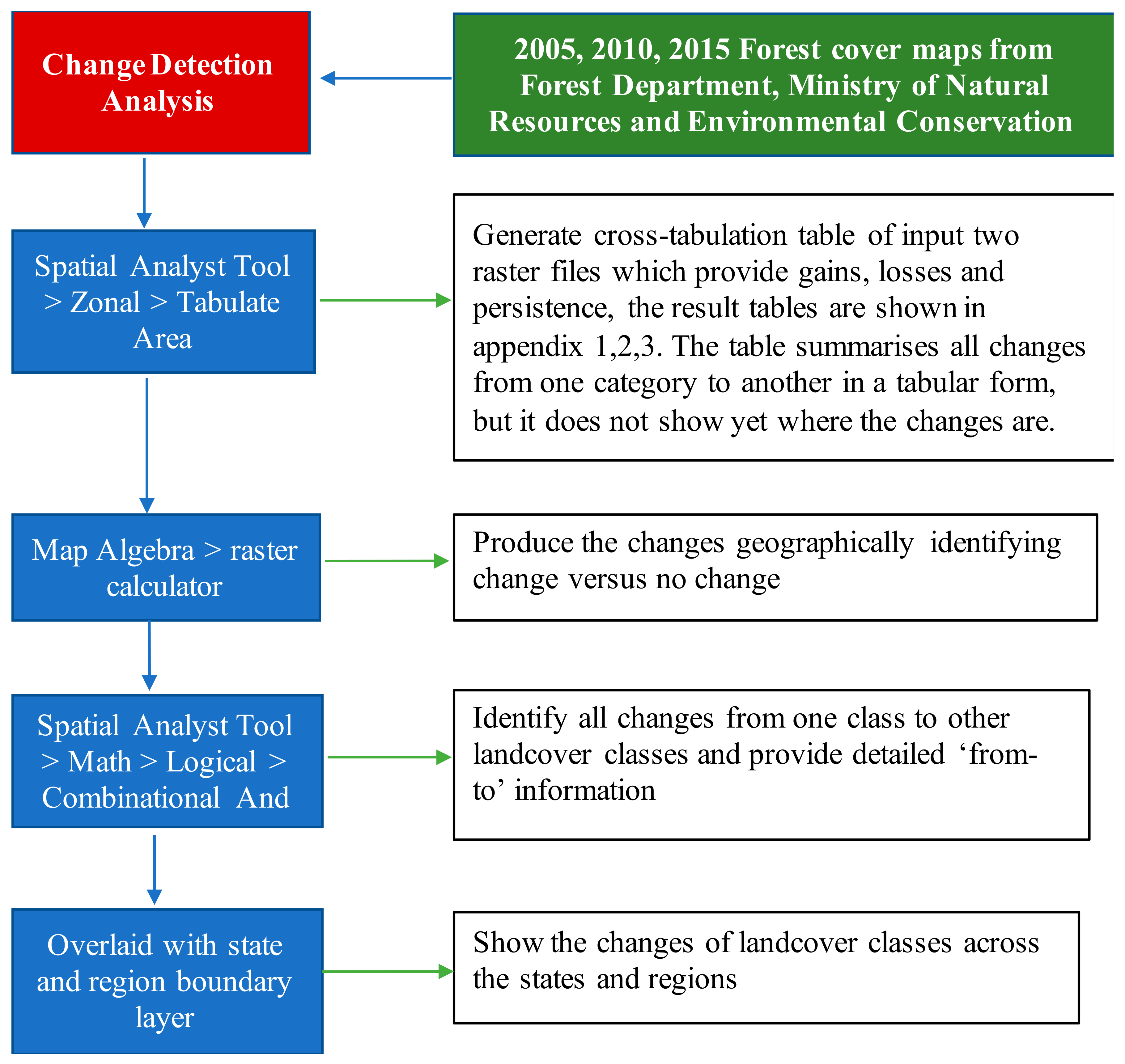
Change detection analysis and cross tabulation were completed using spatial analyst and map algebra tools in ArcMap (10.6 version). The GIS workflow of change detection analysis is illustrated in Appendix A. Post-classification change detection requires rectified and classified thematic maps beforehand to implement comparison based on pixel by pixel [38]. Im et al. (2007) states that post-classification comparison has been one of the more widely used change detection techniques to extract detailed “from–to” change information [35]. Its ultimate advantage is that it provides a complete matrix of change information [30]. It also reduces the impacts of atmospheric, sensor, and environmental differences between multi-temporal images. The general cross-tabulation matrix that produces gains, losses and persistence of the two compared maps are shown in Appendix B and is according to Pontius et al. (2004) [31]. Forest cover maps were overlaid with state and regional boundaries to analyse the forest cover changes in each state and region. The state and regional boundaries layer was downloaded from the Myanmar Information Management Unit (MIMU) Humanitarian Data Exchange [39].
3. Results
The results from the change detection analysis are described in the following sections: (1) major changes of land cover, (2) ‘from-to’ change information of land cover classes, and (3) land cover changes across whole of Myanmar and its states.
3.1. Major Changes in Land Cover
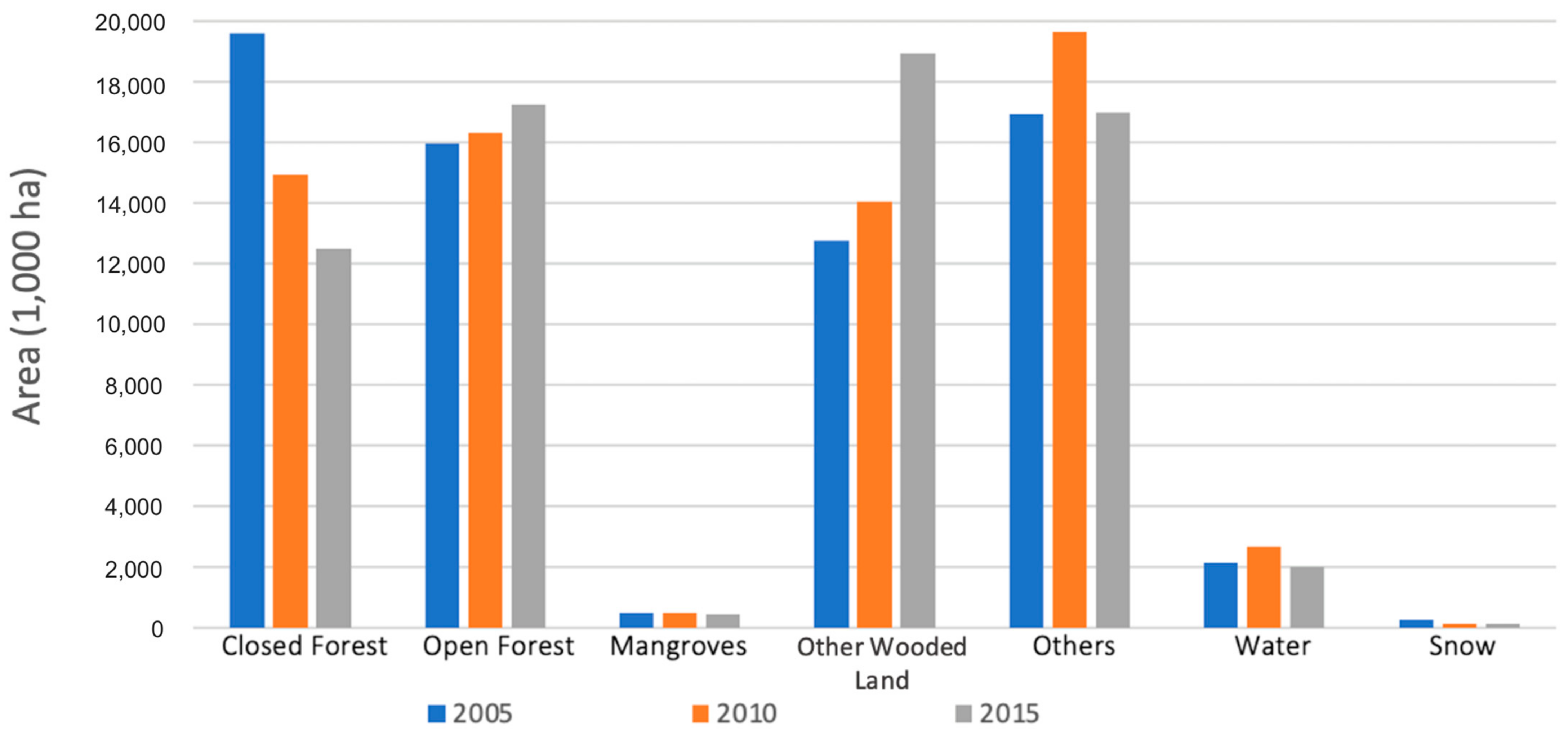
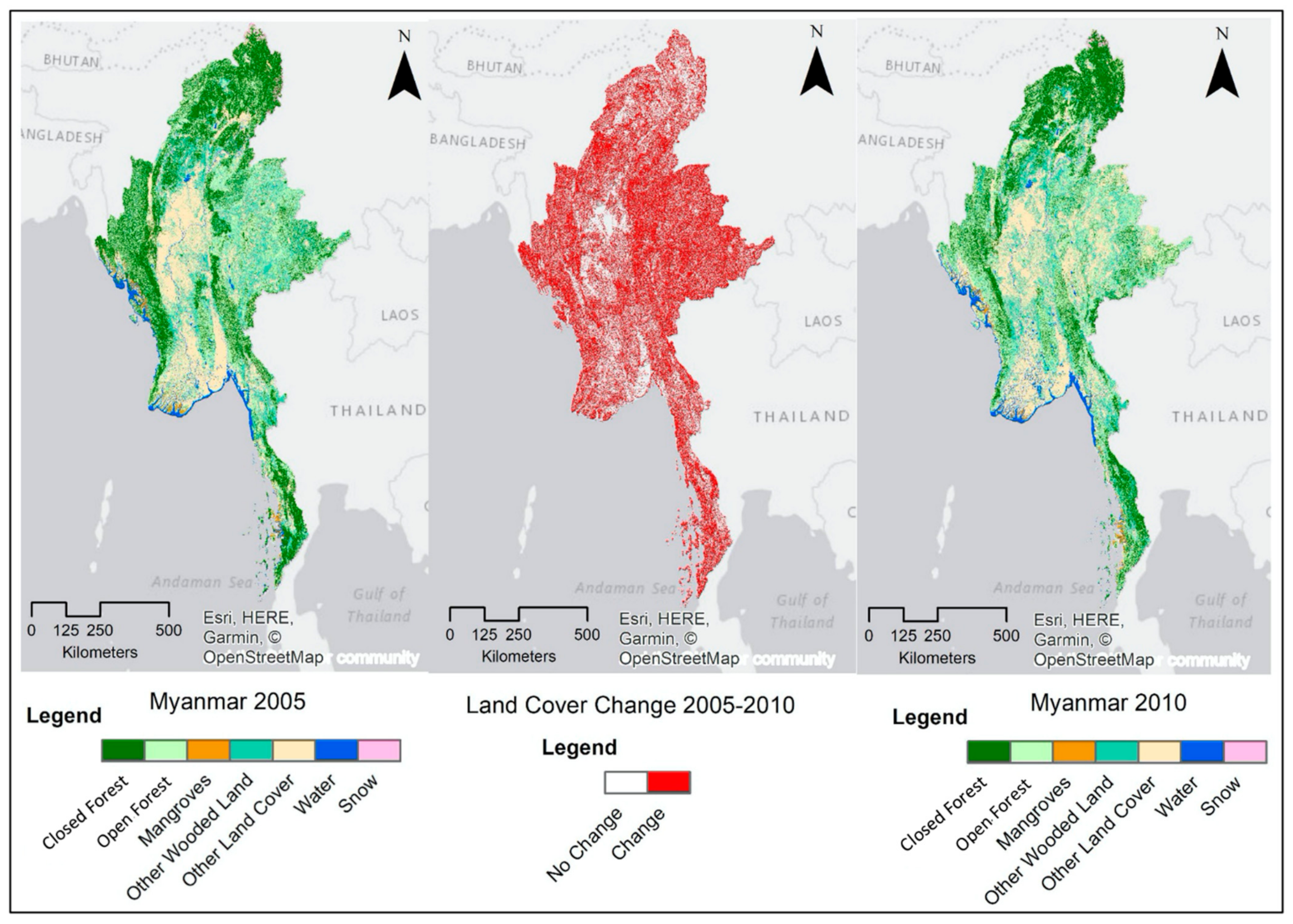
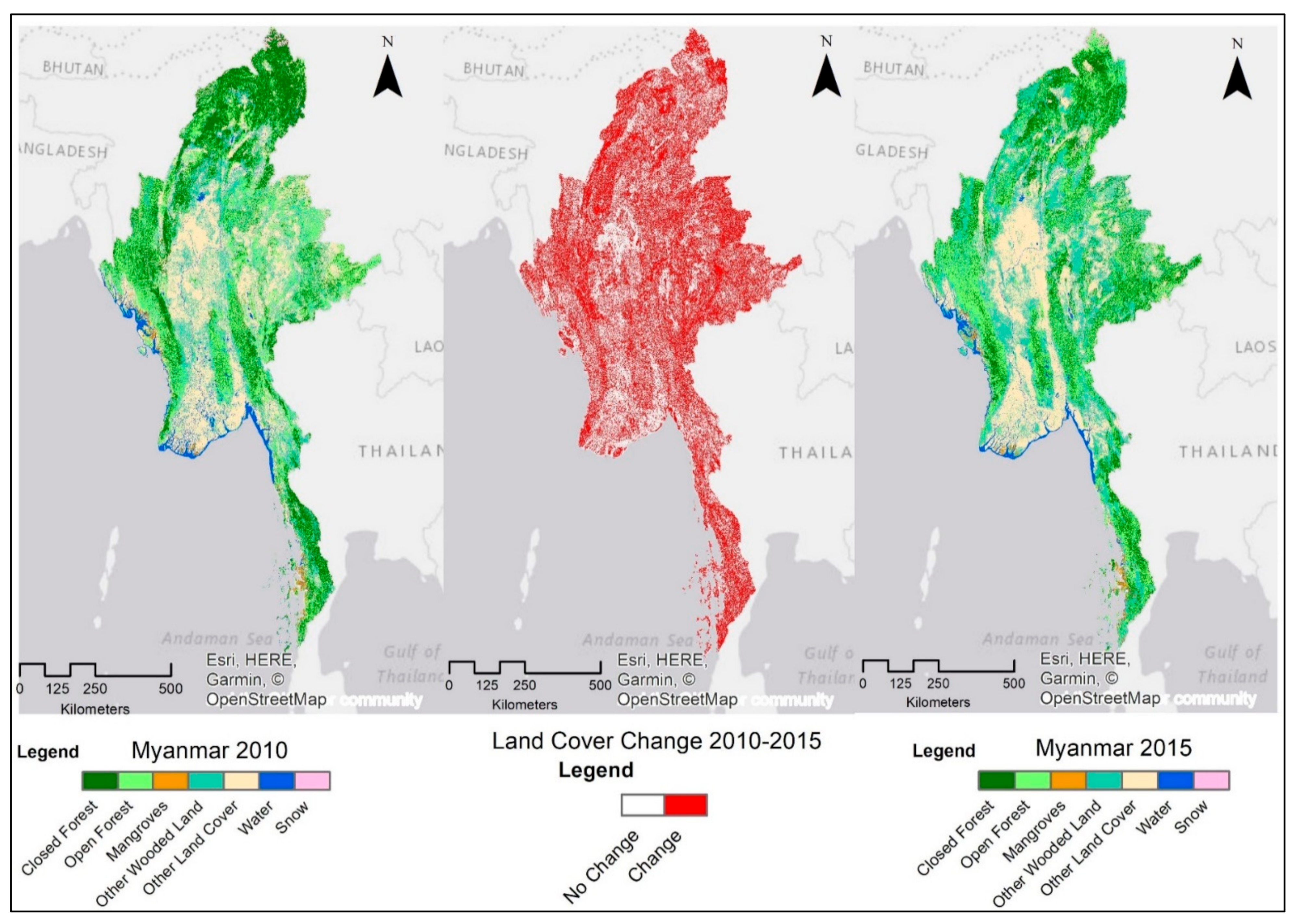
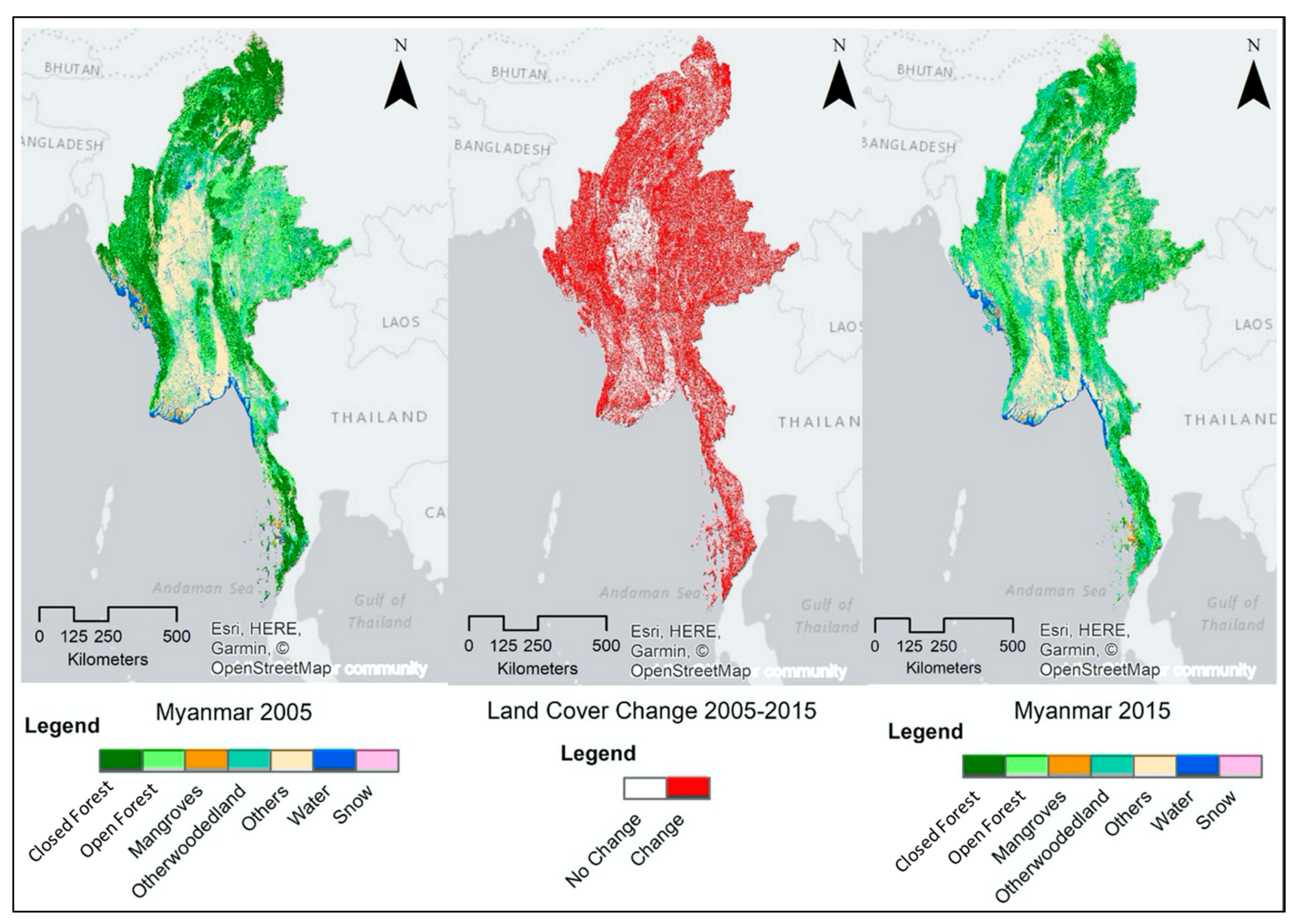
Over the study period, closed forest cover was significantly reduced while open forest and other wooded land cover classes notably increased (Figure 2, Appendix C and Appendix D). Closed forest cover was reduced by 5.44% annually during the 2005–2010 period, which was higher than for the 3.54% annually second period. The extent of mangroves was reduced at a rate of 0.19% for 2005–2010 and 1.58% for 2010–2015. Other wooded land cover classes increased from approximately 12,800,000 ha in 2005 to 14,000,000 ha and 18,900,00 ha in 2010 and 2015 with an annual increase at 1.90% and 5.98% for first and second period, respectively. The “Others” landcover class increased at 2.98% for 2005–2010 and reduced at 2.93% for 2010–2015. The similar changes to the water landcover class were found, and snow cover was reduced during both study periods. Land cover and change detection maps are shown in Figure 3, Figure 4 and Figure 5. During the periods 2005–2010 and 2010–2015 (and combined 2005–2015), significant land cover changes occurred. For the whole of Myanmar, forest cover was lost at an annual rate of 2.58% between 2005 and 2010, and 0.97% between 2010 and 2015. The area of closed forest cover was reduced from 19,600,000 ha in 2005 to 14,900,000 ha in 2010 and 12,500,000 ha in 2015. Correspondingly, open forest cover increased from 15,900,000 ha in 2005 to 16,300,000 ha in 2010 and 17,200,000 ha 2015.
Figure 2.
Graphical summary of landcover changes between 2005, 2010 and 2015.
Figure 3.
Land cover maps of 2005 and 2010, and the binary change detection map. The red colour in the centre map represents change areas between 2005 and 2010.
Figure 4.
Land cover maps of 2010 and 2015, and the binary change detection map. The red colour in the centre map represents change areas between 2010 and 2015.
Figure 5.
Land cover maps of 2005 and 2015, and the binary change detection map. The colours in the centre map represents change areas between 2005 and 2015.
3.2. ‘From-To’ Change Information of Land Cover Classes
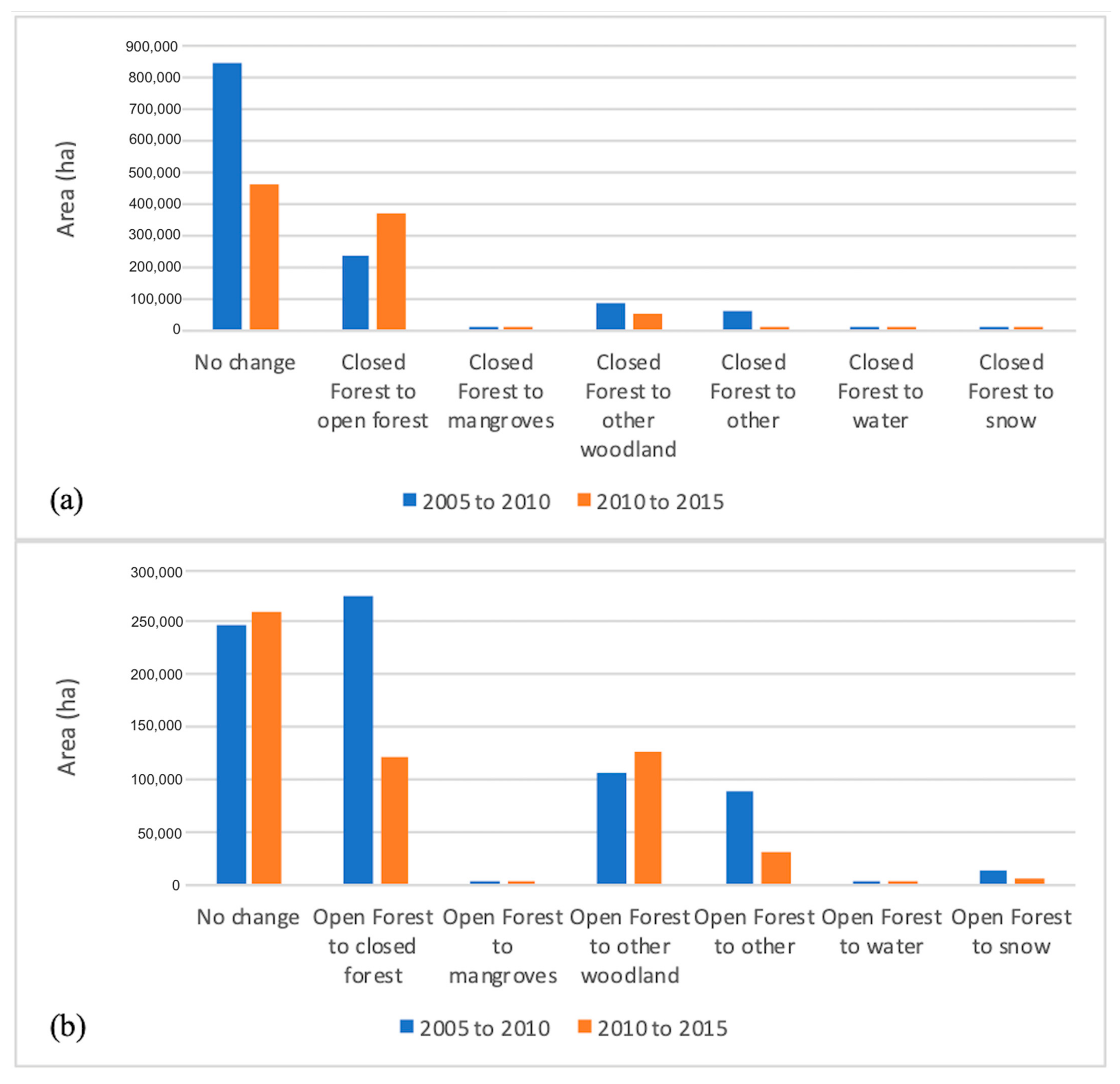
One of the objectives of this study was to understand how Myanmar’s forest cover has changed over time during the study periods. The strongest changes occurred among the closed forest, open forest, and other woodland classes. Between 2005 and 2010, approximately 238,000 ha of closed forest changed to open forest and 105,000 ha of open forest were converted to woodland, while 84,000 ha of the closed forest changed to woodland. Therefore, closed forests are more likely to change to open forest rather than other woodland. Likewise, a similar pattern of change occurred between 2010 and 2015 where 372,000 ha of closed forest were transformed to open forest. In comparison, 50,000 ha were converted to other woodland, which is about seven times lower than the change rate of closed to open forest. Figure 6 compares and illustrates the changes of closed forest and open forest to other land cover classes between two study periods.
Figure 6.
Changes from (a) closed forest and (b) open forest to other land cover classes during study periods.
3.3. Land Cover Changes by States and Regions
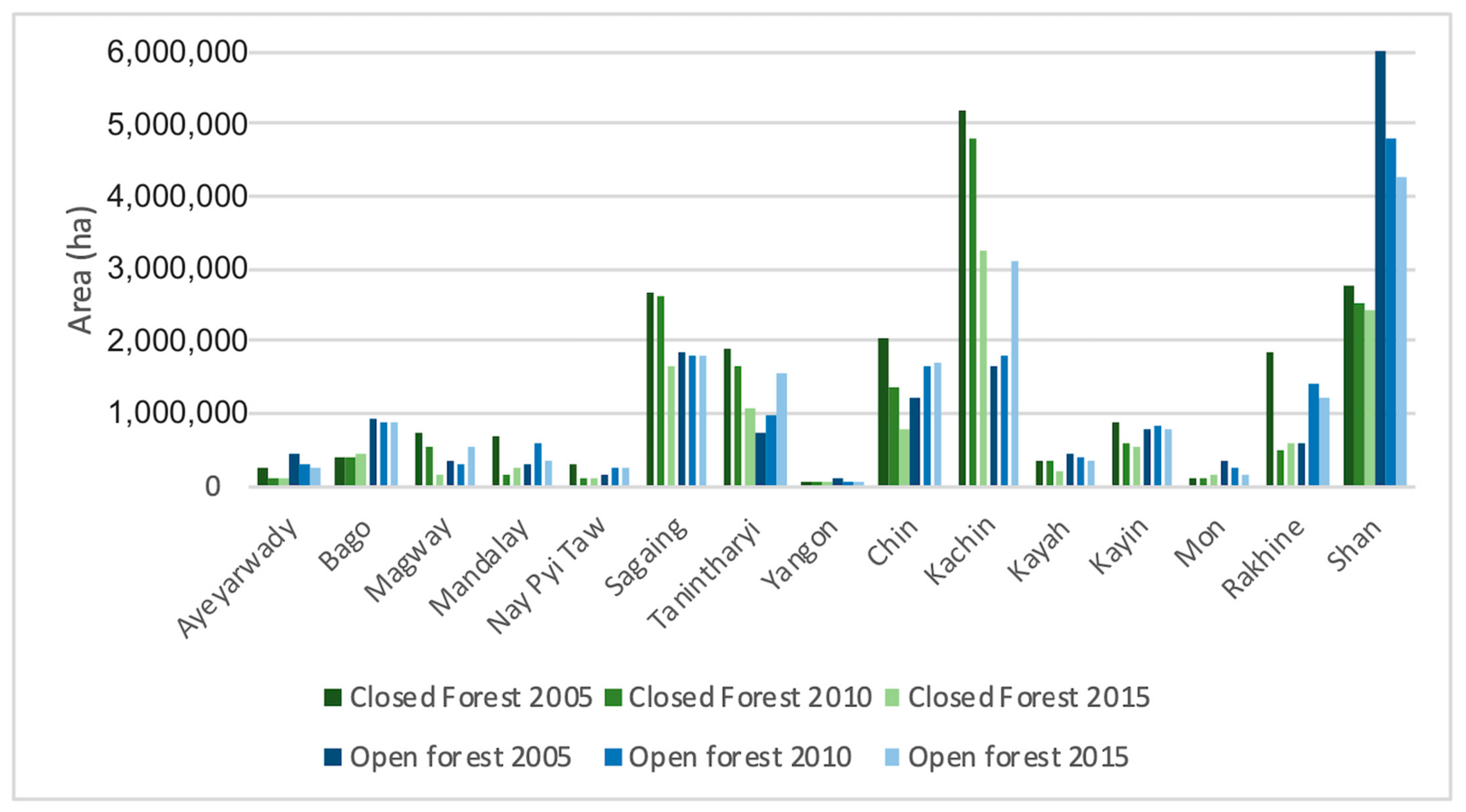
Figure 7 shows the closed and open forest cover changes across the states and regions during the study periods. Natural forest areas are located predominantly in Kachin, Shan, Sagaing, Tanintharyi, and Chin followed by Rakhine, Kayin, and Bago. The most deforestation occurred in Kachin state, followed by Sagaing, Shan, and Tanintharyi, respectively, as shown in Figure 7.
Figure 7.
Closed and open forest cover changes by state and region.
The change-detection forest cover maps show that deforestation hotspots were located in the states of Kachin, Shan, Sagaing, and Tanintharyi; these hotspots occurred on the upland areas, Kachin and Shan bordering with China, and in Tanintharyi region which borders Thailand (Figure 5). The change detection analysis reveals that Kachin followed by Shan, Sagaing and Tanintharyi experienced the greatest deforestation and forest degradation during the study periods. Moreover, open forest cover increased in Chin state, and Sagaing and Tanintharyi regions. High-density human population regions such as Yangon, had few forest areas and the central areas such as Mandalay and Magway are highly populated and less forested with dry forests, open forests and savannas dominating.
4. Discussion
4.1. Significance
Extensive deforestation and forest degradation occurred in Myanmar during both 2005–2010 and 2010–2015. The annual rate of deforestation decreased from 2.58% for the first period to 0.97% for the second period. The reduced rate coincides with the political transition period after the military-ruled government ended under the 2008 Constitution. Therefore, the patterns and rates of forest cover loss in Myanmar are potentially influenced by the constitutional and political change. Forest losses occurred mainly through forest degradation (closed forest to open forest cover) rather than direct deforestation (forest clearance). The reason for this may be due to the nature of the Myanmar Selection System (MSS) of timber harvesting which has been in place since 1856, followed by illegal logging, charcoal, and fuelwood collection. These forests with a degraded canopy cover and open structure are likely to be replaced by commercial plantations or subsistence agriculture [40].
4.2. Drivers of Deforestation and Forest Degradation
The drivers of deforestation and forest degradation are interconnected and complex given the local context [41]. There are a number of proximate and underlying causes of forest loss and degradation in Myanmar. These are: (1) agricultural expansion, (2) legal and illegal logging, (3) fuelwood and charcoal consumption, (4) road construction, and (5) mining and dam construction [40,41].
4.2.1. Agricultural Expansion
Agricultural expansion is a key driver of global deforestation [17,42]. In recent decades, agricultural footprints have expanded in the tropics, where 80% of new croplands have replaced natural forests [17]. Land conversion for agriculture is likely to be highest on tropical developing nations where there are large forested areas suitable for agriculture, where climates are suitable for high value crops (such as tropical timber and oil palm) and where population growth rates are high [42]. Myanmar, which has recently been opened to the world communities after a long military dictatorship (1962–2011), is expected to encounter rapid agriculture-driven deforestation [42]. Over time, the agricultural sector is likely to develop due to increased access to international markets and private sector investment. Consequently, agricultural expansion at the expense of forests and biodiversity is expected through the development of technology and infrastructure [18].
Lim et al. (2017) who studied proximate causes and underlying drivers of deforestation and forest degradation in Myanmar between 1995 and 2016, identified agricultural expansion as a direct cause and major driver of forest loss and degradation in Myanmar [13]. Likewise, other studies Treue et al. (2016) and UN-REDD point out that commercial agriculture such as palm oil and rubber plantations have contributed more to Myanmar’s deforestation than subsistence agriculture [40,43]. Moreover, Donald et al. (2015) stated that agricultural concessions granted by the Myanmarese government in 2010 and 2012 in the Tanintharyi region, which borders with Thailand, were approved in densely forested areas of the proposed Lenya national park [44]. Those land concessions were mainly accessed by companies that had a strong relationship with the military. Prior to agricultural rights, the companies were able to extract the timber value from the land [45]. Although they cleared the land of timber but then did not turn the land into agriculture as per the concession. Only less than 25% of the 2 million ha granted between 2012–2013 were converted to agriculture [45]. However, the unused or unsuitable commercial concessions have been revoked by the MONREC [44]. Daniel and Daniel (2016) also found that mangrove forest loss was often associated with the expansion of aquaculture, especially shrimp farms, during the 2000–2012 period in Myanmar [46]. Other studies of the Ayeyarwady delta region of Myanmar also confirmed that agricultural expansion attributed to mangrove losses between 2000 and 2013 [18].
Land areas with high potential yield for agriculture are mainly located in the mountainous states and regions that have experienced civil wars [17]. Insecure land tenure has further hindered agricultural expansion in those regions over the past decades. However, the allocations of commercial agricultural concessions following cease-fire agreements and the peace process between the ethnic armed groups and military have also contributed to deforestation. An example is the allocation of cassava agribusiness concessions to a “crony” company in a previously protected area of Hukaung Valley [45,47,48]. Additionally, Lim et al. (2017) state that large-scale deforestation occurred after ceasefire agreements in these uplands [13]. Therefore, Zhang et al. (2018) expected greater deforestation following the peace process due to economic development in the border areas and suggested that conservation could be crucial to achieve a sustainable forest transitions in those regions [17].
4.2.2. Legal and Illegal Logging
Although Myanmar has historically practiced science-based forest management with the Myanmar Selection System (MSS), studies have shown that unsustainable timber extraction has contributed to Myanmar’s deforestation and forest degradation. Selective logging practice is commonly used in most tropical forests worldwide and there have been increasing concerns about the sustainability of wood exploitation [49,50,51]. An analysis of Myanmar’s forest cover loss by Lim et al. (2017) revealed that logging was one of the main causes of forest loss or degradation from 1995 to 2016 [13]. In Myanmar, the Forest Department and the Myanmar Timber Enterprise are the two government organisations responsible for commercial logging operations. The Forest Department plays a forest conservation role, while the Myanmar Timber Enterprise is responsible for wood extraction. However, during recent decades, commercial logging was sub-contracted to approximately 100 companies in the pursuit of foreign income through the export of timber mainly to China [48]. Although the annual allowable cut and 30 years cutting frequency of production forests are the foundation rules of the Myanmar Selection System, the annual cutting on the ground were more likely to exceed the allowable cut [45]. Under the Myanmar Selection System, valuable trees such as teak (Tectona grandis) and other hardwoods are selectively logged within the production forests leading to forest degradation. In addition, illegal logging has followed legal logging and further contributed to forest degradation in Myanmar [52]. Illegal logging has occurred for both timber extraction and charcoal [53]. A study of the Bago mountain range, which is well-known as the ‘Home of Teak’ in Myanmar found that about 59.8% of the disturbed areas were caused by logging impacts and was followed by water infrastructure development due to dam construction [24]. Similarly, other studies (e.g., Refs. [23,53,54] reveal that both legal and illegal logging activities had a substantial impact on deforestation and forest degradation in Myanmar. The report by the UN states that government, research, and NGO’s concur that the legal but unmonitored harvesting of teak and other valuable hardwoods for decades and the supply of the illegal timber market has contributed to Myanmar’s deforestation and forest degradation [43]. Consequently, timber production in Myanmar has gradually decreased in both quality and quantity while natural forest areas are rapidly depleted [55]. While 28% of tropical forests worldwide are utilised for wood production [56], 35% of Myanmar’s natural forests are used for commercial wood production and suffer from forest degradation rather than deforestation [14,23]. Treue et al. (2016) also assert that there has been a rapid decline of growing stock over the past two decades, highlighting a reduction in the Annual Allowable Cut (AAC) of Myanmar’s forests [40]. This is the result of focusing heavily on timber exports to earn foreign revenue by the previous government. Observations in Kachin and Sagaing indicate that teak-producing forests are encountering severe forest degradation and are being exploited for teak and other hardwood species regardless of the prescribed 30 years rotation [40]. Based on remote sensing and visual observations, it was inferred that over-logged areas were used for charcoal and fuelwood productions, which seemed to be the final stage before permanent conversion to agriculture or plantations [40].
Moreover, EIA (2015) revealed that the amount of illegal timber traded across Myanmar’s borders is significant and has been occurring for more than two decades [57]. High demand for wood from China, Thailand, and Vietnam continues to exert pressure on Myanmar’s forests, due to logging bans on their own natural forests. There are 39 main tracks across Myanmar’s borders along which the illegal timber trade is conducted, with 25 tracks leading to China, six to Bangladesh, two to India, and six to Thailand [58]. According to a comparison of official government data and global market records for Myanmar’s log exports during 2001 and 2013, there were 10.2 million m3 of logs that were not authorised for harvest, revealing an illegal logging rate of 47% [59].
4.2.3. Fuelwood and Charcoal Consumption
About 2 billion people in the developing world are still mainly depending on fuelwood and charcoal for cooking and heating in both rural and urban areas [43]. According to the 2014 Myanmar Population and Housing Census, approximately 69% and 12% of households in Myanmar are using firewood and charcoal, respectively, for cooking [60]. Thus, 81% of households in Myanmar depend on wood derived energy sources for cooking, while only 16% use electricity for cooking. Moreover, about 52% of urban households also rely on either firewood or charcoal for cooking. Fuelwood and charcoal use in Myanmar have contributed to deforestation [18,21,23]. In a study of charcoal production and environmental impacts in tropics worldwide, Chidumayo and Gumbo (2012) stated that approximately 7% of total forest cover loss in tropical countries was attributed to charcoal production [61]. There has been rising concerns of the environmental impact of charcoal consumption rather than firewood consumption due to the nature of charcoal production that uses live trunks and big branches [52,62], while dead wood and small branches are used for firewood [63]. A study of the differences in consumption rates and distribution of firewood and charcoal use in Myanmar reported that the production of fuelwood is unlikely to be a direct cause of forest loss [52]. Nevertheless, the current and increasing demand for charcoal in Myanmar is likely to lead to a higher number of tree cuts that may result in further forest degradation. According to UN-REDD (2017), an estimated annual volume of fuelwood collected during 2000–2013 in Myanmar was approximately 70 million m3, mainly extracted from natural forest [43]. It was also much higher than annual timber extraction (based on official data) of 4 million m3 and therefore, it is one of the major causes of forest degradation and deforestation in Myanmar. Myanmar is also one of the world’s largest fuelwood and charcoal exporting nations accounting for an annual value of USD 30.5 million [64]. Charcoal exports through the illegal market along the border areas of China boomed between 2006 and 2008 and are likely to continue to increase due to increasing demand from the Yunam Province, China. Therefore, fuelwood consumption is likely a cause of further degradation of already degraded forests, and fuelwood collection and charcoal production may be considered a major cause of further forest degradation in Myanmar.
4.2.4. Road Construction
Myanmar’s forest loss over the past decades has also been attributed to infrastructure expansion, such as the construction of new highways and main roads [22]. Liu et al. (2016) discussed the status of the Asian Highway system in Myanmar, made up of four main routes linking Myanmar with China, India, and Thailand [22]. These routes pass through Myanmar’s remaining pristine forests, causing major habitat fragmentation, increasing edge effects, and increasing disturbances to natural forests. Forest cover loss has occurred along these routes, mostly replaced by commercial and subsistence agriculture [22]. Deforestation was positively correlated with the distance from roads and villages while negatively correlated with the park boundaries and elevation [22]. Lim et al. (2017) also asserted that infrastructure development, mainly roads and bridges creating networks were a key proximate cause of Myanmar’s forest loss or degradation [13]. Studies related to deforestation and forest degradation in Myanmar such as Htun et al. (2013) [13,20,23]. Rosy Ne et al. (2009) and Shimizu et al. (2017) confirmed that road construction, which promoted network accessibility across the Myanmar’s remaining unspoiled forests, have contributed to forest loss and degradation [24,54]. Htun et al. (2013) reported that forest cover loss and degradation was more severe in the areas close to main roads and park tracks of the Popa Mountain Park [20]. Fuelwood collection was likely to be a significant driver of deforestation and forest degradation in the Popa mountain park, central Myanmar. Fuelwood collection is largely along the roadside and as a consequence, forest areas adjacent to roads and park tracks that are easily accessible were more impacted and degraded.
Putz et al. (2000) reported that almost all selective logging procedures in the tropical forests worldwide are inadequately planned and often create the excessive road-construction activities in natural settings [65]. This access allows resource hunters and forest penetration into frontier tropical forests. These actions have compounded deforestation and forest degradation due to selective logging operations in those areas [56]. Logged forests in the Amazon penetrated by logging roads are approximately 400% more likely to be deforested than un-logged forests [66]. Similar conditions were observed in Myanmar’s tropics. Win et al. (2018) have shown that illegal logging for both timber and charcoal increased notably after legal operations [67]. Temporary logging roads by legal operations were used by illegal loggers who previously had no access. Although these roads are closed according to Myanmar forestry rules, Win et al. (2018) confirmed that most of the logging roads within the study area were easily accessible to illegal trucks [67]. Mon et al. (2011) and Khai et al. (2016) also reported the similar processes and patterns of deforestation and forest degradation within selectively logged forests [23,53]. Therefore, the government should enforce the forestry rules for closing the temporary logging roads and bridges efficiently after the legal operations.
Worldwide, road infrastructure is known to be an important driver of the spatial pattern of forest loss and subsistence agriculture [56,68,69]. The nature of forest cover loss due to road construction is complex [56]. Forest encroachment and destruction have usually followed with the construction of roads, even in remote areas. Secondary roads that increase the spatial scale of main roads were also developed. These expanded road networks have posed many environmental problems such as forest fragmentation and road fauna kills in tropical forests [70]. Pfaff et al. (2007) claims that road networks in the Brazilian Amazon region significantly shape the remaining spatial pattern and the extent of tropical forests [71]. Whenever new road investment occurred, the neighbouring forest clearing within 100 km increased. Road density is significantly correlated not only with market access and economic development but also natural resource exploitation, habitat fragmentation and deforestation in the Congo basin [72]. Moreover, paved or unpaved roads and highways play a role in opening up access to natural areas for resource hunters and forest invasions. Laurance et al. (2009), Nepstad et al. (2006) and Pfaff et al. (2007) suggested that protected areas (PAs) could be created in advance along the new planned roads to reduce the uncontrolled forest loss and invasion [56,71,73]. Therefore, the establishment of the protected areas along the new road development, especially in well-forested areas, should be prioritized in Myanmar where the Aichi Target 11 of the Convention on Biological Diversity (CBD) has not yet been met [10]. The Aichi Target 11 is a commitment by members of the United Nations (UN) to commit to conserve at least 17% of the countries terrestrial and inland water area and 10% of coastal and marine areas, especially areas with higher biodiversity values and ecosystem services, by 2020 [74].
4.2.5. Mining Sites and Dam Construction
Myanmar is one of the largest nations in Southeast Asia and has a wide array of mineral resources including popular jade, gemstones, gold, silver, copper, tin, and tungsten [75]. However, the country’s mineral resources have been poorly explored and the mining sector was underdeveloped during the era of the military dictatorship. Under the democratic government, foreign investment in Myanmar focused on the mining sector. A recent remote sensing-based study of the extent of mining in Myanmar between 2002 and 2015, states that over 90 thousand ha of new mine sites were identified across Myanmar [76]. Most of these mining areas were observed within densely forested areas, of which, about 71% are concentrated in the Sagaing region and Kachin state that have significant gold and jade deposits. The third largest mining areas occurred in the Mandalay region, followed by Shan, Tanintharyi, and Bogo. The development of tin mines in Shan along the border with China has increased Myanmar’s share for the global tin market [76]. Mining has been conducted by both legal and illegal operation, ranging from small scale to large open-pit mines [77]. Gold mining and agricultural expansion were shown to impact tree cover; in communities in Northern Myanmar open-pit gold mines studied 2002–2014 were spatially associated with tree cover loss [25,78]. These sites were often observed along the rivers and streams. Contaminates, such as mercury used for mining, are discharged into waterways and have negatively impacted on local communities and biodiversity. Therefore, mining in Myanmar which is expected to continue to grow might impact not only on the intact forests in remote areas but also on biodiversity and local communities.
Global population growth, economic development, and industrialisation over the past four decades have increased the demand for energy. That demand has led to the expansion of hydropower projects and dam construction across the world [79]. Such demand has also occurred in Myanmar and Wang et al. (2013) estimate that 48 hydropower projects were operating or under construction in Myanmar [80]. Most of these are located in the densely forested areas with higher biodiversity values. Shimizu et al. (2017) also found that water invasion was the second largest disturbance (14.6%) of deforestation after logging (59.8%) in the Bago mountain region [24]. Water invasion is attributed to dam construction over the past 15 years. Forests in most of the study areas (26 townships) were impacted by water invasion due to dam construction, with large forested areas logged before dam construction. This suggests that the construction of dams in Myanmar has negatively impacted on the forests. Likewise, the impacts of dam construction on deforestation and forest degradation have long been recognised [79,81,82]. However, to this point, dam construction and its impact on the environment has been under-researched in the Myanmar context. Therefore, the area is worth further attention given the impact of dam construction on forest loss and degradation in Myanmar.
4.3. Insight into Possible Policy Interventions
The drivers of deforestation and forest degradation in Myanmar are complex, having socioeconomic, demographic, and political implications. For some time, it has been suggested that Myanmar reform their legal frameworks to control unsustainable natural resource exploitation [44,55]. Since 2015, the country has been better connected with international communities and access to global markets. Subsequently, foreign investment and connection with foreign markets has driven increased extraction of natural resources [75,80]. Therefore, Myanmar’s remaining biodiversity rich forests have been impacted and are likely to be more impacted in the near future, highlighting a need for environmental conservation measures. This transition must be paired with policy measures to ensure forest and biodiversity retention.
Globally there is an awareness of the importance of the role of protected areas (PAs) for natural resource and biodiversity conservation [83]. Researchers in the field have encouraged the conservation of biodiversity rich areas within PAs. In Myanmar, according to the National Biodiversity Strategy and Action Plan (2015–2020) (NBSAP), forests within the Permanent Forest Estate (PFE) are managed by MONREC [10]. Forests are categorised into three groups either for timber production (reserved forest—RF), supply forests for local communities (protected public forest—PPF), or wildlife conservation (protected areas—PAs). Forests outside the PFE may be classified as public forests or unclassified. In 2015, ~30% of the country’s area had been designated within the PFE [10]. Moreover, Bhagwat et al. (2017) reported that a higher proportion of Myanmar’s remaining densely forested areas are not protected either within the nation’s reserve forests or Pas [25]. These forests are unclassified forests according to the Myanmar Forest Department [10]. Most of these areas are located in the mountainous upland areas of the country where historically conflicts between the ethnic armed groups and military have occurred. Thus, it was difficult to designate those areas as PAs from the union government, although all the trees in the country whether within or outside the PFE are subject to the regulations of the MONREC [10,84]. Under the PFE, settlements and harvesting are not allowed. All the PAs in Myanmar are currently managed by the Nature and Wildlife Conservation Department (NWCD), which is a section under the FD. Myanmar has now declared 6.37% (42,878 km2) of the total land area as terrestrial and inland water PAs and 2.33% (11,964 km2) for marine PAs [85]. According to the NBSAP report, Myanmar plans to conserve up to 8% by 2020 and 10% by 2030 of the country’s terrestrial area [10]. This means that Myanmar still requires almost double the current designated areas to meet the Aichi Target 11 of the CBD, to designate 17% of the country terrestrial and inland water area as PAs. Therefore, it is highly recommended that more PAs are declared in Myanmar. Moreover, it has been suggested that these declarations occur in advance of new road construction especially in the frontier areas [56]. In Myanmar, there have been 132 keys biodiversity areas (KBAs) identified by the Wildlife Conservation Society (WCS) [10]. However, just 35 KBAs are being protected within current PAs and still more KBAs are likely to be identified. Hence, speeding the designation of PAs in Myanmar seems to be important for both meeting the CBD commitments and covering all KBAs. Australia provides an example of what might be achieved. In 1997, the Australia government developed the National Reserve System to meet CBD targets, building the Collaborative Australian Protected Area Database (CAPAD) to record and keep track of PAs across the nation [86]. Moreover, PAs in Australia can be designated by either State or local government [87]. Remarkably, the percentage of terrestrial PAs almost doubled from 7.5% in 1997 to 15.9% in 2014 [86]. In Myanmar, it is suggested to establish a power sharing agreement between levels of government in order to establish PAs within states or regions. Moreover, as mentioned above, most intact forests in the uplands where ethnic communities live are not yet designated as PFF that are governed by the central government, and hence it would be an opportune time to step forward by reducing centralisation in natural resource management in those areas, thereby increasing linkages local-based small and medium enterprises.
Another important point is that greater community involvement in natural resource conservation has provided better results in forest protection across the world [88]. However, in Myanmar, historically science-based forestry management started during the British colonial era, which targeted revenue and marginalised sustainable forest management by a focussing on wood extraction [55]. This focus on resource utilisation with limited community involvement continued through the military lead government era until the present day. However, it has been widely accepted that forest resources can contribute to the livelihoods of local people, particularly in developing countries [89]. In Myanmar, about 70% of the population live in rural areas and rely on natural forest resources, not only timber but also other forest products such as fuelwood and bamboo. Moreover, forest dwellers who live near or in the forest have been practicing traditional shifting cultivation, which is a common practice of subsistence agriculture in Myanmar, since before the colonial time [90]. However, it was reported that shifting cultivation in Bago mountains has contributed to forest degradation but resulting in only low levels of deforestation [54]. Thus, having a great number of people relying on natural forest resources, local involvement in the forestry management would have a better impact on sustainable natural resource conservation in Myanmar.
With increased recognition of the importance of community involvement in natural resource management, community forestry (CF) has emerged in Myanmar in the past few decades [91]. The FD has set a target of 919,000 ha for CF management by 2030, and 12% of this target was achieved by 2016 [91]. As of 2017, 3840 community forestry user groups across the country have registered with the FD. However, Lin (2004) has raised criticism of the CF program in Myanmar, which has suffered from setbacks due to a lack of secure land tenure and local engagement [92]. Moreover, a study related to the benefits of CF for livelihoods in Myanmar’s mangroves (Feurer et al., 2018) suggests that trust building between the communities and the government, especially to make more secure for forest land tenure is critical for the CF development in Myanmar. Therefore, efforts to encourage greater involvement of rural communities should be investigated and land tenure policies strengthened through stakeholder analysis to address these issues.
On the other hand, the timber industry has been influenced by illegal markets in both the domestic and export sectors. The present wood trading industry has emerged from the foreign income targeted policy of the military led elite groups [55]. Enforcing the rule of law in the forestry sector is important to combat illegal logging and related corruption. Knowing the consumption rate of wood for both timber and fuelwood in Myanmar will support the change process. Nevertheless, local wood consumption and demand data are very limited and unreliable and subsequently require further attention and research, and an increase to monitoring and reporting efforts [55].
5. Conclusions
The study applied 2005, 2010 and 2015 land cover maps derived from remote sensing images supplied by the FD, Myanmar to understand the patterns and rates of deforestation and forest degradation. The results showed the overall annual forest cover loss rate to be 2.58% between 2005 and 2010, and 0.97% between 2010 and 2015. The change detection analysis shows that forest cover change occurred through a progression of forest degradation to deforestation. This has been confirmed by other remote sensing and field observation-based studies [25,40]. Therefore, over-logged areas are often followed by further encroachment for charcoal and fuelwood production and then shift towards permanent conversion as either agriculture or plantations. Such a pattern has occurred across the country. The major forest cover changes were found in Kachin, Shan, Tanintharyi, and Sagaing where most of the agricultural expansion and wood extraction has occurred. Scientific literature, official reports, and grey literature were reviewed to investigate the issues behind forest loss in Myanmar. Given a greater understanding of these issues, some insights into policy interventions have been provided. The first insight would be to work towards strengthening the PA system in Myanmar (including monitoring and reporting), where the KBAs have not yet been protected. In doing so, this will help to achieve an international commitment to meet the CBD targets for biodiversity conservation. The second proposition from the work would be to emphasise community participation in forestry management although it is already a prioritised area of FD. The work suggests that more involvement of multi-stakeholders such as CSOs and NGOs, in addition to local communities may be beneficial. The third insight from the work suggests that a reduction in centralisation of forestry management by sharing responsibilities with the local government may be timely and productive. The fourth suggestion would be stronger more transparent governance of the wood trading industry in the country through the formation of local based small and medium enterprises. Lastly, remote sensing and GIS are powerful tools that can help to better manage the forest areas and therefore, capacity building and human resource development relating to these areas should be encouraged. Forest cover mapping using remote sensing derived images for the production of higher quality maps with reliable ground-truthing accuracy assessment is recommended as a future research area.
Author Contributions
Conceptualization, Z.N.T., C.M. and P.D.; methodology, Z.N.T., C.M. and D.M.; software, Z.N.T. and D.M.; validation, Z.N.T. and D.M.; formal analysis, Z.N.T. and D.M., C.M.; investigation, Z.N.T.; resources, P.D. and C.M.; data curation, Z.N.T. and D.M.; writing— Z.N.T.; C.M., P.D. and G.H.; visualization, Z.N.T., C.M. and G.H.; supervision, P.D. and C.M.; project administration, Z.N.T. and P.D.; funding acquisition, Z.N.T. All authors have read and agreed to the published version of the manuscript.
Funding
This research received no external funding.
Institutional Review Board Statement
Not applicable.
Informed Consent Statement
Not applicable.
Conflicts of Interest
The authors declare no conflict of interest.
Appendix A
Figure A1.
Flow diagram of change detection analysis GIS work.
Appendix B
Table A1.
General cross-tabulation matrix of two maps at different points in time.
Table A1.
General cross-tabulation matrix of two maps at different points in time.
| Time 1 | Time 2 | Total Time 1 | Loss | |||
|---|---|---|---|---|---|---|
| Category 1 | Category 2 | Category 3 | Category 4 | |||
| Category 1 | P11 | P12 | P13 | P14 | P1+ | P1+ − P11 |
| Category 2 | P21 | P22 | P23 | P24 | P2+ | P2+ − P22 |
| Category 3 | P31 | P32 | P33 | P34 | P3+ | P3+ − P33 |
| Category 4 | P41 | P42 | P43 | P44 | P4+ | P4+ − P44 |
| Total time 2 | P+1 | P+2 | P+3 | P+4 | ||
| Gain | P1+ − P11 | P2+ − P22 | P3+ − P33 | P4+ − P44 | 1 |
Diagonal line highlighted in green colour represents persistence between two different points of time.
Appendix C
Table A2.
Magnitude and rates of landcover changes during study periods.
Table A2.
Magnitude and rates of landcover changes during study periods.
| LC Classes | 2005 Area(Mha) | 2010 Area(Mha) | 2015 Area(Mha) | 2005–2010, Change Rate (r,%/year) | 2010–2015, Change Rate (r,%/year) | 2005–2015, Change Rate (r,%/year) |
|---|---|---|---|---|---|---|
| Closed Forest | 19.6 | 14.9 | 12.5 | −5.44 | −3.54 | −4.49 |
| Open Forest | 15.9 | 16.3 | 17.2 | 0.45 | 1.12 | 0.79 |
| Total Forest | 35.5 | 31.2 | 29.7 | −2.58 | −0.97 | −1.78 |
| Mangroves | 0.52 | 0.51 | 0.48 | −0.19 | −1.58 | −0.89 |
| Other woodland | 12.8 | 14.0 | 18.9 | 1.90 | 5.98 | 3.94 |
| Others | 16.9 | 19.7 | 17.0 | 2.98 | −2.93 | 0.02 |
| Water | 2.1 | 2.7 | 2.0 | 4.60 | −5.89 | −0.65 |
| Snow | 0.3 | 0.1 | 0.1 | −12.95 | −1.31 | −7.13 |
Appendix D
Table A3.
Landcover classes across states and regions for 2005, 2010 and 2015.
Table A3.
Landcover classes across states and regions for 2005, 2010 and 2015.
| 2005 | |||||||
|---|---|---|---|---|---|---|---|
| OBJECTID | Value | Count | S/R Code | States and Regions | lulc_2005 | Landcover Classes | Area (ha) |
| 71 | 72 | 2,849,615 | 0 | Ayeyarwady | 1 | Closed Forest | 256,465 |
| 57 | 58 | 4,450,287 | 1 | Bago | 1 | Closed Forest | 400,526 |
| 34 | 35 | 8,030,925 | 2 | Magway | 1 | Closed Forest | 722,783 |
| 30 | 31 | 7,395,045 | 3 | Mandalay | 1 | Closed Forest | 665,554 |
| 44 | 45 | 2,990,963 | 4 | Nay Pyi Taw | 1 | Closed Forest | 269,187 |
| 7 | 8 | 29,796,843 | 5 | Sagaing | 1 | Closed Forest | 2,681,716 |
| 92 | 93 | 21,199,748 | 6 | Tanintharyi | 1 | Closed Forest | 1,907,977 |
| 74 | 75 | 70,378 | 7 | Yangon | 1 | Closed Forest | 6334 |
| 14 | 15 | 22,785,172 | 8 | Chin | 1 | Closed Forest | 2,050,665 |
| 3 | 4 | 57,738,683 | 9 | Kachin | 1 | Closed Forest | 5,196,481 |
| 52 | 53 | 4,010,554 | 10 | Kayah | 1 | Closed Forest | 360,950 |
| 55 | 56 | 9,462,643 | 11 | Kayin | 1 | Closed Forest | 851,638 |
| 78 | 79 | 1,268,680 | 12 | Mon | 1 | Closed Forest | 114,181 |
| 36 | 37 | 20,265,935 | 13 | Rakhine | 1 | Closed Forest | 1,823,934 |
| 23 | 24 | 30,420,311 | 14 | Shan | 1 | Closed Forest | 2,737,828 |
| 70 | 71 | 4,681,542 | 0 | Ayeyarwady | 2 | Open Forest | 421,339 |
| 56 | 57 | 10,481,844 | 1 | Bago | 2 | Open Forest | 943,366 |
| 35 | 36 | 3,991,575 | 2 | Magway | 2 | Open Forest | 359,242 |
| 27 | 28 | 3,125,797 | 3 | Mandalay | 2 | Open Forest | 281,322 |
| 47 | 48 | 1,509,691 | 4 | Nay Pyi Taw | 2 | Open Forest | 135,872 |
| 8 | 9 | 20,513,683 | 5 | Sagaing | 2 | Open Forest | 1,846,231 |
| 90 | 91 | 8,063,641 | 6 | Tanintharyi | 2 | Open Forest | 725,728 |
| 73 | 74 | 853,557 | 7 | Yangon | 2 | Open Forest | 76,820 |
| 16 | 17 | 13,643,378 | 8 | Chin | 2 | Open Forest | 1,227,904 |
| 2 | 3 | 18,381,687 | 9 | Kachin | 2 | Open Forest | 1,654,352 |
| 49 | 50 | 4,802,122 | 10 | Kayah | 2 | Open Forest | 432,191 |
| 54 | 55 | 8,465,038 | 11 | Kayin | 2 | Open Forest | 761,853 |
| 80 | 81 | 3,929,632 | 12 | Mon | 2 | Open Forest | 353,667 |
| 37 | 38 | 6,704,367 | 13 | Rakhine | 2 | Open Forest | 603,393 |
| 24 | 25 | 67,685,349 | 14 | Shan | 2 | Open Forest | 6,091,681 |
| 83 | 84 | 1,793,063 | 0 | Ayeyarwady | 3 | Mangroves | 161,376 |
| 66 | 67 | 4476 | 1 | Bago | 3 | Mangroves | 403 |
| 65 | 66 | 1 | 2 | Magway | 3 | Mangroves | 0 |
| 93 | 94 | 1,793,312 | 6 | Tanintharyi | 3 | Mangroves | 161,398 |
| 85 | 86 | 136 | 7 | Yangon | 3 | Mangroves | 12 |
| 43 | 44 | 24 | 8 | Chin | 3 | Mangroves | 2 |
| 88 | 89 | 7942 | 11 | Kayin | 3 | Mangroves | 715 |
| 87 | 88 | 21,742 | 12 | Mon | 3 | Mangroves | 1957 |
| 42 | 43 | 1,723,919 | 13 | Rakhine | 3 | Mangroves | 155,153 |
| 69 | 70 | 6,445,068 | 0 | Ayeyarwady | 4 | Other Woodland | 580,056 |
| 60 | 61 | 7,909,594 | 1 | Bago | 4 | Other Woodland | 711,863 |
| 33 | 34 | 7,913,316 | 2 | Magway | 4 | Other Woodland | 712,198 |
| 29 | 30 | 7,566,108 | 3 | Mandalay | 4 | Other Woodland | 680,950 |
| 45 | 46 | 1,617,997 | 4 | Nay Pyi Taw | 4 | Other Woodland | 145,620 |
| 10 | 11 | 22,045,565 | 5 | Sagaing | 4 | Other Woodland | 1,984,101 |
| 91 | 92 | 6,286,607 | 6 | Tanintharyi | 4 | Other Woodland | 565,795 |
| 75 | 76 | 908,304 | 7 | Yangon | 4 | Other Woodland | 81,747 |
| 15 | 16 | 2,787,315 | 8 | Chin | 4 | Other Woodland | 250,858 |
| 4 | 5 | 6,709,212 | 9 | Kachin | 4 | Other Woodland | 603,829 |
| 50 | 51 | 2,412,120 | 10 | Kayah | 4 | Other Woodland | 217,091 |
| 62 | 63 | 8,389,212 | 11 | Kayin | 4 | Other Woodland | 755,029 |
| 79 | 80 | 3,584,005 | 12 | Mon | 4 | Other Woodland | 322,560 |
| 39 | 40 | 2,806,426 | 13 | Rakhine | 4 | Other Woodland | 252,578 |
| 18 | 19 | 53,940,688 | 14 | Shan | 4 | Other Woodland | 4,854,662 |
| 68 | 69 | 19,718,808 | 0 | Ayeyarwady | 5 | Others | 1,774,693 |
| 58 | 59 | 19,264,392 | 1 | Bago | 5 | Others | 1,733,795 |
| 31 | 32 | 29,342,318 | 2 | Magway | 5 | Others | 2,640,809 |
| 26 | 27 | 15,867,026 | 3 | Mandalay | 5 | Others | 1,428,032 |
| 46 | 47 | 1,673,213 | 4 | Nay Pyi Taw | 5 | Others | 150,589 |
| 9 | 10 | 29,883,632 | 5 | Sagaing | 5 | Others | 2,689,527 |
| 94 | 95 | 6,419,928 | 6 | Tanintharyi | 5 | Others | 577,794 |
| 76 | 77 | 8,321,388 | 7 | Yangon | 5 | Others | 748,925 |
| 17 | 18 | 823,862 | 8 | Chin | 5 | Others | 74,148 |
| 5 | 6 | 11,939,302 | 9 | Kachin | 5 | Others | 1,074,537 |
| 51 | 52 | 1,730,103 | 10 | Kayah | 5 | Others | 155,709 |
| 61 | 62 | 6,970,502 | 11 | Kayin | 5 | Others | 627,345 |
| 81 | 82 | 3,246,647 | 12 | Mon | 5 | Others | 292,198 |
| 38 | 39 | 6,063,786 | 13 | Rakhine | 5 | Others | 545,741 |
| 19 | 20 | 25,593,693 | 14 | Shan | 5 | Others | 2,303,432 |
| 67 | 68 | 1,947,062 | 0 | Ayeyarwady | 6 | Water | 175,236 |
| 59 | 60 | 1,074,817 | 1 | Bago | 6 | Water | 96,734 |
| 32 | 33 | 749,432 | 2 | Magway | 6 | Water | 67,449 |
| 28 | 29 | 488,812 | 3 | Mandalay | 6 | Water | 43,993 |
| 48 | 49 | 62,363 | 4 | Nay Pyi Taw | 6 | Water | 5613 |
| 12 | 13 | 1,817,717 | 5 | Sagaing | 6 | Water | 163,595 |
| 95 | 96 | 12,73,853 | 6 | Tanintharyi | 6 | Water | 114,647 |
| 77 | 78 | 687,463 | 7 | Yangon | 6 | Water | 61,872 |
| 25 | 26 | 89,657 | 8 | Chin | 6 | Water | 8069 |
| 6 | 7 | 999,059 | 9 | Kachin | 6 | Water | 89,915 |
| 53 | 54 | 99,408 | 10 | Kayah | 6 | Water | 8947 |
| 64 | 65 | 332,219 | 11 | Kayin | 6 | Water | 29,900 |
| 82 | 83 | 435,181 | 12 | Mon | 6 | Water | 39,166 |
| 41 | 42 | 1,303,430 | 13 | Rakhine | 6 | Water | 117,309 |
| 22 | 23 | 578,413 | 14 | Shan | 6 | Water | 52,057 |
| 13 | 14 | 43 | 5 | Sagaing | 7 | Snow | 4 |
| 0 | 1 | 2,968,200 | 9 | Kachin | 7 | Snow | 267,138 |
| 2010 | |||||||
| OBJECTID | Value | Count | S/R Code | States and Regions Name | lulc_2010 | Landcover Classes | Area (ha) |
| 63 | 63 | 1,332,886 | 0 | Ayeyarwady | 1 | Closed Forest | 119,960 |
| 53 | 53 | 4,266,372 | 1 | Bago | 1 | Closed Forest | 383,973 |
| 31 | 31 | 5,961,075 | 2 | Magway | 1 | Closed Forest | 536,497 |
| 26 | 26 | 1,664,572 | 3 | Mandalay | 1 | Closed Forest | 149,811 |
| 41 | 41 | 878,324 | 4 | Nay Pyi Taw | 1 | Closed Forest | 79,049 |
| 9 | 9 | 28,886,100 | 5 | Sagaing | 1 | Closed Forest | 2,599,749 |
| 77 | 77 | 18,090,061 | 6 | Tanintharyi | 1 | Closed Forest | 1,628,105 |
| 66 | 66 | 42,161 | 7 | Yangon | 1 | Closed Forest | 3794 |
| 14 | 14 | 15,333,125 | 8 | Chin | 1 | Closed Forest | 1,379,981 |
| 3 | 3 | 53,042,063 | 9 | Kachin | 1 | Closed Forest | 4,773,786 |
| 45 | 45 | 3,567,534 | 10 | Kayah | 1 | Closed Forest | 321,078 |
| 49 | 49 | 6,541,032 | 11 | Kayin | 1 | Closed Forest | 588,693 |
| 71 | 71 | 1,258,086 | 12 | Mon | 1 | Closed Forest | 113,228 |
| 35 | 35 | 5,567,455 | 13 | Rakhine | 1 | Closed Forest | 501,071 |
| 21 | 21 | 27,846,211 | 14 | Shan | 1 | Closed Forest | 2,506,159 |
| 62 | 62 | 3,402,949 | 0 | Ayeyarwady | 2 | Open Forest | 306,265 |
| 55 | 55 | 9,644,275 | 1 | Bago | 2 | Open Forest | 867,985 |
| 29 | 29 | 3,084,448 | 2 | Magway | 2 | Open Forest | 277,600 |
| 23 | 23 | 6,655,135 | 3 | Mandalay | 2 | Open Forest | 598,962 |
| 39 | 39 | 2,943,761 | 4 | Nay Pyi Taw | 2 | Open Forest | 264,938 |
| 8 | 8 | 19,748,783 | 5 | Sagaing | 2 | Open Forest | 1,777,390 |
| 78 | 78 | 10,967,154 | 6 | Tanintharyi | 2 | Open Forest | 987,044 |
| 65 | 65 | 578,791 | 7 | Yangon | 2 | Open Forest | 52,091 |
| 12 | 12 | 18,049,813 | 8 | Chin | 2 | Open Forest | 1,624,483 |
| 2 | 2 | 19,955,902 | 9 | Kachin | 2 | Open Forest | 1,796,031 |
| 43 | 43 | 4,515,384 | 10 | Kayah | 2 | Open Forest | 406,385 |
| 48 | 48 | 9,398,729 | 11 | Kayin | 2 | Open Forest | 845,886 |
| 70 | 70 | 2,787,443 | 12 | Mon | 2 | Open Forest | 250,870 |
| 33 | 33 | 15,861,487 | 13 | Rakhine | 2 | Open Forest | 1,427,534 |
| 19 | 19 | 53,208,056 | 14 | Shan | 2 | Open Forest | 4,788,725 |
| 64 | 64 | 768,306 | 0 | Ayeyarwady | 3 | Mangroves | 69,148 |
| 58 | 58 | 832 | 1 | Bago | 3 | Mangroves | 75 |
| 82 | 82 | 2,478,427 | 6 | Tanintharyi | 3 | Mangroves | 223,058 |
| 75 | 75 | 122 | 7 | Yangon | 3 | Mangroves | 11 |
| 76 | 76 | 100,357 | 12 | Mon | 3 | Mangroves | 9032 |
| 37 | 37 | 2,033,575 | 13 | Rakhine | 3 | Mangroves | 183,022 |
| 61 | 61 | 5,231,723 | 0 | Ayeyarwady | 4 | Other woodland | 470,855 |
| 54 | 54 | 11,011,515 | 1 | Bago | 4 | Other woodland | 991,036 |
| 30 | 30 | 13,804,068 | 2 | Magway | 4 | Other woodland | 1,242,366 |
| 25 | 25 | 10,581,621 | 3 | Mandalay | 4 | Other woodland | 952,346 |
| 38 | 38 | 2,201,838 | 4 | Nay Pyi Taw | 4 | Other woodland | 198,165 |
| 10 | 10 | 20,978,780 | 5 | Sagaing | 4 | Other woodland | 1,888,090 |
| 79 | 79 | 8,427,866 | 6 | Tanintharyi | 4 | Other woodland | 758,508 |
| 67 | 67 | 1,987,464 | 7 | Yangon | 4 | Other woodland | 178,872 |
| 16 | 16 | 5,208,367 | 8 | Chin | 4 | Other woodland | 468,753 |
| 5 | 5 | 11,168,970 | 9 | Kachin | 4 | Other woodland | 1,005,207 |
| 44 | 44 | 2,777,141 | 10 | Kayah | 4 | Other woodland | 249,943 |
| 50 | 50 | 9,899,278 | 11 | Kayin | 4 | Other woodland | 890,935 |
| 72 | 72 | 3,080,180 | 12 | Mon | 4 | Other woodland | 277,216 |
| 32 | 32 | 4,767,022 | 13 | Rakhine | 4 | Other woodland | 429,032 |
| 17 | 17 | 44,408,799 | 14 | Shan | 4 | Other woodland | 3,996,792 |
| 60 | 60 | 22,941,569 | 0 | Ayeyarwady | 5 | Other | 2,064,741 |
| 52 | 52 | 16,364,866 | 1 | Bago | 5 | Other | 1,472,838 |
| 27 | 27 | 26,400,477 | 2 | Magway | 5 | Other | 2,376,043 |
| 22 | 22 | 14,915,664 | 3 | Mandalay | 5 | Other | 1,342,410 |
| 40 | 40 | 1,716,664 | 4 | Nay Pyi Taw | 5 | Other | 154,500 |
| 7 | 7 | 30,246,333 | 5 | Sagaing | 5 | Other | 2,722,170 |
| 80 | 80 | 3,953,496 | 6 | Tanintharyi | 5 | Other | 355,815 |
| 68 | 68 | 7,174,867 | 7 | Yangon | 5 | Other | 645,738 |
| 15 | 15 | 1,472,989 | 8 | Chin | 5 | Other | 132,569 |
| 4 | 4 | 11,846,064 | 9 | Kachin | 5 | Other | 1,066,146 |
| 46 | 46 | 2,071,458 | 10 | Kayah | 5 | Other | 186,431 |
| 56 | 56 | 7,379,412 | 11 | Kayin | 5 | Other | 664,147 |
| 73 | 73 | 4,448,497 | 12 | Mon | 5 | Other | 400,365 |
| 34 | 34 | 9,022,149 | 13 | Rakhine | 5 | Other | 811,993 |
| 18 | 18 | 57,693,178 | 14 | Shan | 5 | Other | 5,192,386 |
| 59 | 59 | 3,762,037 | 0 | Ayeyarwady | 6 | Water | 338,583 |
| 51 | 51 | 1,897,550 | 1 | Bago | 6 | Water | 170,780 |
| 28 | 28 | 777,499 | 2 | Magway | 6 | Water | 69,975 |
| 24 | 24 | 625,796 | 3 | Mandalay | 6 | Water | 56,322 |
| 42 | 42 | 113,640 | 4 | Nay Pyi Taw | 6 | Water | 10,228 |
| 11 | 11 | 2,064,772 | 5 | Sagaing | 6 | Water | 185,829 |
| 81 | 81 | 1,267,538 | 6 | Tanintharyi | 6 | Water | 114,078 |
| 69 | 69 | 1,058,383 | 7 | Yangon | 6 | Water | 95,254 |
| 13 | 13 | 80,188 | 8 | Chin | 6 | Water | 7217 |
| 6 | 6 | 1,228,631 | 9 | Kachin | 6 | Water | 110,577 |
| 47 | 47 | 128,115 | 10 | Kayah | 6 | Water | 11,530 |
| 57 | 57 | 435,478 | 11 | Kayin | 6 | Water | 39,193 |
| 74 | 74 | 812,443 | 12 | Mon | 6 | Water | 73,120 |
| 36 | 36 | 1,633,701 | 13 | Rakhine | 6 | Water | 147,033 |
| 20 | 20 | 784,668 | 14 | Shan | 6 | Water | 70,620 |
| 1 | 1 | 1,512,338 | 9 | Kachin | 7 | Snow | 136,110 |
| 2015 | |||||||
| OBJECTID | Value | Count | S/R Code | States and Regions Name | lulc_2015 | Landcover Classes | Area (ha) |
| 59 | 59 | 972,753 | 0 | Ayeyarwady | 1 | Closed Forest | 87,548 |
| 52 | 52 | 4,974,478 | 1 | Bago | 1 | Closed Forest | 447,703 |
| 31 | 31 | 1,877,276 | 2 | Magway | 1 | Closed Forest | 168,955 |
| 25 | 25 | 2,481,660 | 3 | Mandalay | 1 | Closed Forest | 223,349 |
| 40 | 40 | 1,149,253 | 4 | Nay Pyi Taw | 1 | Closed Forest | 103,433 |
| 7 | 7 | 18,196,614 | 5 | Sagaing | 1 | Closed Forest | 1,637,695 |
| 77 | 77 | 11,907,205 | 6 | Tanintharyi | 1 | Closed Forest | 1,071,648 |
| 64 | 64 | 113,456 | 7 | Yangon | 1 | Closed Forest | 10,211 |
| 13 | 13 | 8,716,851 | 8 | Chin | 1 | Closed Forest | 784,517 |
| 5 | 5 | 36,020,720 | 9 | Kachin | 1 | Closed Forest | 3,241,865 |
| 45 | 45 | 2,324,750 | 10 | Kayah | 1 | Closed Forest | 209,228 |
| 50 | 50 | 6,120,824 | 11 | Kayin | 1 | Closed Forest | 550,874 |
| 68 | 68 | 1,404,163 | 12 | Mon | 1 | Closed Forest | 126,375 |
| 34 | 34 | 6,641,887 | 13 | Rakhine | 1 | Closed Forest | 597,770 |
| 20 | 20 | 26,804,356 | 14 | Shan | 1 | Closed Forest | 2,412,392 |
| 61 | 61 | 2,499,982 | 0 | Ayeyarwady | 2 | Open Forest | 224,998 |
| 53 | 53 | 9,912,396 | 1 | Bago | 2 | Open Forest | 892,116 |
| 30 | 30 | 5,835,882 | 2 | Magway | 2 | Open Forest | 525,229 |
| 26 | 26 | 3,649,866 | 3 | Mandalay | 2 | Open Forest | 328,488 |
| 38 | 38 | 2,484,875 | 4 | Nay Pyi Taw | 2 | Open Forest | 223,639 |
| 8 | 8 | 19,720,130 | 5 | Sagaing | 2 | Open Forest | 1,774,812 |
| 78 | 78 | 17,464,240 | 6 | Tanintharyi | 2 | Open Forest | 1,571,782 |
| 63 | 63 | 820,789 | 7 | Yangon | 2 | Open Forest | 73,871 |
| 12 | 12 | 18,988,795 | 8 | Chin | 2 | Open Forest | 1,708,992 |
| 2 | 2 | 34,543,214 | 9 | Kachin | 2 | Open Forest | 3,108,889 |
| 44 | 44 | 4,054,996 | 10 | Kayah | 2 | Open Forest | 364,950 |
| 49 | 49 | 8,892,058 | 11 | Kayin | 2 | Open Forest | 800,285 |
| 67 | 67 | 1,513,525 | 12 | Mon | 2 | Open Forest | 136,217 |
| 32 | 32 | 13,457,679 | 13 | Rakhine | 2 | Open Forest | 1,211,191 |
| 18 | 18 | 47,466,537 | 14 | Shan | 2 | Open Forest | 4,271,988 |
| 73 | 73 | 855,940 | 0 | Ayeyarwady | 3 | Mangroves | 77,035 |
| 74 | 74 | 7770 | 1 | Bago | 3 | Mangroves | 699 |
| 82 | 82 | 2,770,394 | 6 | Tanintharyi | 3 | Mangroves | 249,335 |
| 75 | 75 | 18,145 | 7 | Yangon | 3 | Mangroves | 1633 |
| 76 | 76 | 35,233 | 12 | Mon | 3 | Mangroves | 3171 |
| 37 | 37 | 1,350,131 | 13 | Rakhine | 3 | Mangroves | 121,512 |
| 58 | 58 | 8,562,428 | 0 | Ayeyarwady | 4 | Other woodland | 770,619 |
| 51 | 51 | 10,780,958 | 1 | Bago | 4 | Other woodland | 970,286 |
| 29 | 29 | 19,743,112 | 2 | Magway | 4 | Other woodland | 1,776,880 |
| 24 | 24 | 8,819,073 | 3 | Mandalay | 4 | Other woodland | 793,717 |
| 39 | 39 | 1,305,735 | 4 | Nay Pyi Taw | 4 | Other woodland | 117,516 |
| 9 | 9 | 34,043,519 | 5 | Sagaing | 4 | Other woodland | 3,063,917 |
| 79 | 79 | 10,631,664 | 6 | Tanintharyi | 4 | Other woodland | 956,850 |
| 65 | 65 | 2,295,712 | 7 | Yangon | 4 | Other woodland | 206,614 |
| 14 | 14 | 11,538,669 | 8 | Chin | 4 | Other woodland | 1,038,480 |
| 3 | 3 | 16,915,581 | 9 | Kachin | 4 | Other woodland | 1,522,402 |
| 43 | 43 | 4,720,950 | 10 | Kayah | 4 | Other woodland | 424,886 |
| 48 | 48 | 12,472,099 | 11 | Kayin | 4 | Other woodland | 1,122,489 |
| 69 | 69 | 4,508,120 | 12 | Mon | 4 | Other woodland | 405,731 |
| 33 | 33 | 9,112,832 | 13 | Rakhine | 4 | Other woodland | 820,155 |
| 17 | 17 | 54,390,820 | 14 | Shan | 4 | Other woodland | 4,895,174 |
| 62 | 62 | 23,361,579 | 0 | Ayeyarwady | 5 | Other | 2,102,542 |
| 54 | 54 | 15,951,025 | 1 | Bago | 5 | Other | 1,435,592 |
| 28 | 28 | 21,922,752 | 2 | Magway | 5 | Other | 1,973,048 |
| 22 | 22 | 18,987,355 | 3 | Mandalay | 5 | Other | 1,708,862 |
| 41 | 41 | 2,853,881 | 4 | Nay Pyi Taw | 5 | Other | 256,849 |
| 10 | 10 | 30,958,708 | 5 | Sagaing | 5 | Other | 2,786,284 |
| 80 | 80 | 1,750,640 | 6 | Tanintharyi | 5 | Other | 157,558 |
| 71 | 71 | 7,151,858 | 7 | Yangon | 5 | Other | 643,667 |
| 21 | 21 | 852,339 | 8 | Chin | 5 | Other | 76,711 |
| 6 | 6 | 9,145,899 | 9 | Kachin | 5 | Other | 823,131 |
| 46 | 46 | 1,900,298 | 10 | Kayah | 5 | Other | 171,027 |
| 56 | 56 | 5,910,405 | 11 | Kayin | 5 | Other | 531,936 |
| 70 | 70 | 4,837,231 | 12 | Mon | 5 | Other | 435,351 |
| 35 | 35 | 7,298,823 | 13 | Rakhine | 5 | Other | 656,894 |
| 16 | 16 | 34,460,851 | 14 | Shan | 5 | Other | 3,101,477 |
| 60 | 60 | 1,186,892 | 0 | Ayeyarwady | 6 | Water | 106,820 |
| 55 | 55 | 1,558,783 | 1 | Bago | 6 | Water | 140,290 |
| 27 | 27 | 648,545 | 2 | Magway | 6 | Water | 58,369 |
| 23 | 23 | 504,834 | 3 | Mandalay | 6 | Water | 45,435 |
| 42 | 42 | 60,483 | 4 | Nay Pyi Taw | 6 | Water | 5443 |
| 11 | 11 | 123,7181 | 5 | Sagaing | 6 | Water | 111,346 |
| 81 | 81 | 720,354 | 6 | Tanintharyi | 6 | Water | 64,832 |
| 66 | 66 | 441,895 | 7 | Yangon | 6 | Water | 39,771 |
| 15 | 15 | 51,977 | 8 | Chin | 6 | Water | 4678 |
| 4 | 4 | 705,569 | 9 | Kachin | 6 | Water | 63,501 |
| 47 | 47 | 58,984 | 10 | Kayah | 6 | Water | 5309 |
| 57 | 57 | 262,758 | 11 | Kayin | 6 | Water | 23,648 |
| 72 | 72 | 188,762 | 12 | Mon | 6 | Water | 16,989 |
| 36 | 36 | 1,024,632 | 13 | Rakhine | 6 | Water | 92,217 |
| 19 | 19 | 824,693 | 14 | Shan | 6 | Water | 74,222 |
| 1 | 1 | 1,428,849 | 9 | Kachin | 7 | Snow | 128,596 |
References
- MOECAF. Fifth National Report to the Convention on Biological Diversity; Ministry of Environmental Conservation and Forestry (MOECAF): Naypyitaw, Myanmar, 2014.
- IUCN. Myanmar; IUCN: Gland, Switzerland, 2018. [Google Scholar]
- World Bank. Myanmar’s Country Profile; World Bank: Washington, DC, USA, 2018. [Google Scholar]
- Hughes, A.C. Understanding the drivers of Southeast Asian biodiversity loss. Ecosphere 2017, 8, e01624. [Google Scholar] [CrossRef]
- Yang, R.; Luo, Y.; Yang, K.; Hong, L.; Zhou, X. Analysis of Forest Deforestation and its Driving Factors in Myanmar from 1988 to 2017. Sustainability 2019, 11, 3047. [Google Scholar] [CrossRef]
- Sexton, J.O.; Noojipady, P.; Song, X.P.; Feng, M.; Song, D.X.; Kim, D.H.; Anand, A.; Huang, C.; Channan, S.; Pimm, S.L.; et al. Conservation policy and the measurement of forests. Nat. Clim. Chang. 2016, 6, 192–196. [Google Scholar] [CrossRef]
- FAO. Country Report: Myanmar, Global Forest Resources Assessment 2020; Food and Agriculture Organisation: Rome, Italy, 2020; Available online: www.fao.org/3/cb0030en/cb0030en.pdf (accessed on 29 June 2021).
- FAO. Global Forest Resources Assessment 2020; Food and Agriculture Organization: Rome, Italy, 2020; Available online: http://www.fao.org/3/ca9825en/ca9825en.pdf (accessed on 29 June 2021).
- Songer, M.; Aung, M.; Senior, B.; DeFries, R.; Leimgruber, P. Spatial and temporal deforestation dynamics in protected and unprotected dry forests: A case study from Myanmar (Burma). Biodivers. Conserv. 2009, 18, 1001–1018. [Google Scholar] [CrossRef]
- Forest Department. National Biodiversity Strategy and Action Plan 2015–2020; Forest Department Myanmar: Naypyitaw, Myanmar, 2014.
- Dong, M.; He, J. Linking the past to the future: A reality check on cross-border timber trade from Myanmar (Burma) to China. For. Policy Econ. 2018, 87, 11–19. [Google Scholar] [CrossRef]
- Aung, T.S.; Fischer, T.B.; Buchanan, J. Land use and land cover changes along the China-Myanmar Oil and Gas pipelines–Monitoring infrastructure development in remote conflict-prone regions. PLoS ONE 2020, 15, e0237806. [Google Scholar] [CrossRef]
- Lim, C.L.; Prescott, G.W.; Alban, J.D.T.; Ziegler, A.D.; Webb, E.L. Untangling the proximate causes and underlying drivers of deforestation and forest degradation in Myanmar. Conserv. Biol. 2017, 31, 1362–1372. [Google Scholar] [CrossRef] [PubMed]
- Mon, M.S.; Kajisa, T.; Mizoue, N.; Yoshida, S. Monitoring deforestation and forest degradation in the Bago Mountain Area, Myanmar using FCD Mapper. J. For. Plan. 2010, 15, 63–72. [Google Scholar] [CrossRef]
- Pasha, S.; Satish, K.; Unnikrishnan, A.; Chavan, S.; Jha, C.; Diwakar, P.; Dadhwal, V. Quantifying and predicting multi-decadal forest cover changes in Myanmar: A biodiversity hotspot under threat. Biodivers. Conserv. 2019, 28, 1129–1149. [Google Scholar] [CrossRef]
- Prescott, G.W.; Sutherland, W.J.; Aguirre, D.; Baird, M.; Bowman, V.; Brunner, J.; Connette, G.M.; Cosier, M.; Dapice, D.; De Alban, J.D.; et al. Political transition and emergent forest-conservation issues in Myanmar. Conserv. Biol. 2017, 31, 1257–1270. [Google Scholar] [CrossRef]
- Zhang, Y.; Prescott, G.W.; Tay, R.E.; Dickens, B.L.; Webb, E.L.; Htun, S.; Tizard, R.J.; Rao, M.; Carrasco, L.R. Dramatic cropland expansion in Myanmar following political reforms threatens biodiversity. Sci. Rep. 2018, 8, 1–10. [Google Scholar] [CrossRef]
- Webb, E.L.; Jachowski, N.R.A.; Phelps, J.; Friess, D.A.; Than, M.M.; Ziegler, A.D. Deforestation in the Ayeyarwady Delta and the conservation implications of an internationally-engaged Myanmar. Glob. Environ. Chang. 2014, 24, 321–333. [Google Scholar] [CrossRef]
- FREL. Forest Reference Emission Level (FREL) of Myanmar; Ministry of Natural Resources and Environmental Conservation (MONREC): Naypyitaw, Myanmar, 2018.
- Htun, N.; Mizoue, N.; Yoshida, S. Changes in determinants of deforestation and forest degradation in Popa Mountain Park, Central Myanmar. Environ. Manag. 2013, 51, 423–434. [Google Scholar] [CrossRef]
- Leimgruber, P.; Kelly, D.S.; Steininger, M.K.; Brunner, J.; Mueller, T.; Songer, M. Forest cover change patterns in Myanmar (Burma) 1990-2000. Environ. Conserv. 2005, 32, 356–364. [Google Scholar] [CrossRef]
- Liu, F.J.; Huang, C.; Pang, Y.; Li, M.; Song, D.X.; Song, X.P.; Channan, S.; Sexton, J.O.; Jiang, D.; Zhang, P.; et al. Assessment of the three factors affecting Myanmar’s forest cover change using Landsat and MODIS vegetation continuous fields data. Int. J. Digit. Earth 2016, 9, 562–585. [Google Scholar] [CrossRef]
- Mon, M.S.; Mizoue, N.; Htun, N.Z.; Kajisa, T.; Yoshida, S. Factors affecting deforestation and forest degradation in selectively logged production forest: A case study in Myanmar. For. Ecol. Manag. 2011, 267, 35–57. [Google Scholar] [CrossRef]
- Shimizu, K.; Ahmed, O.S.; Ponce-Hernandez, R.; Ota, T.; Win, Z.C.; Mizoue, N.; Yoshida, S. Attribution of disturbance agents to forest change using a Landsat Time Series in tropical seasonal forests in the Bago Mountains, Myanmar. Forests 2017, 8, 218. [Google Scholar] [CrossRef]
- Bhagwat, T.; Hess, A.; Horning, N.; Khaing, T.; Thein, Z.M.; Aung, K.M.; Aung, K.H.; Phyo, P.; Tun, Y.L.; Oo, A.H.; et al. Losing a jewel-Rapid declines in Myanmar’s intact forests from 2002–2014. PLoS ONE 2017, 12, e0176364. [Google Scholar] [CrossRef] [PubMed]
- Wang, C.; Myint, S.W. Environmental concerns of deforestation in Myanmar 2001–2010. Remote Sens. 2016, 8, 728. [Google Scholar] [CrossRef]
- Aung, W.Y. Report on Image Classification Process of Forest Cover Assessment for 2015; Malaysian Forest Department: Naypyidaw, Myanmar, 2016.
- FAO. Country Report: Myanmar, Global Forest Resources Assessment 2015; Food and Agriculture Organisation: Rome, Italy, 2014; Available online: http://www.fao.org/3/az283e/az283e.pdf (accessed on 29 June 2021).
- Jensen, J.R. Remote Sensing of the Environment: An Earth Resource Perspective 2/e; Pearson Education India: Delhi, India, 2009; pp. 333–378. [Google Scholar]
- Lu, D.; Mausel, P.; Brondízio, E.; Moran, E. Change detection techniques. Int. J. Remote Sens. 2004, 25, 2365–2401. [Google Scholar] [CrossRef]
- Pontius, R.G.; Shusas, E.; McEachern, M. Detecting important categorical land changes while accounting for persistence. Agric. Ecosyst. Environ. 2004, 101, 251–268. [Google Scholar] [CrossRef]
- Ward, D.; Phinn, S.R.; Murray, A.T. Monitoring growth in rapidly urbanizing areas using remotely sensed data. Prof. Geogr. 2000, 52, 371–386. [Google Scholar] [CrossRef]
- Townshend, J.R.; Narasimhan, R.; Kim, D.; Song, X.P.; Hansen, M.C.; Li, M.; Channan, S. Global characterization and monitoring of forest cover using Landsat Data: Opportunities and challenges. Int. J. Digit. Earth 2012, 5, 45–57. [Google Scholar] [CrossRef]
- Feng, Y.; Lu, D.; Moran, E.F.; Dutra, L.V.; Calvi, M.F.; De Oliveira, M.A.F. Examining spatial distribution and dynamic change of urban land covers in the Brazilian Amazon using multitemporal multi-sensor high spatial resolution satellite imagery. Remote Sens. 2017, 9, 381. [Google Scholar] [CrossRef]
- Im, J.; Rhee, J.; Jensen, J.R.; Hodgson, M.E. An automated binary change detection model using a calibration approach. Remote Sens. Environ. 2007, 106, 89–105. [Google Scholar] [CrossRef]
- Parihar, S.M.; Sarkar, S.; Dutta, A.; Sharma, S.; Dutta, T. Characterizing wetland dynamics: A post-classification change detection analysis of the East Kolkata Wetlands using open source satellite data. Geocarto Int. 2012, 28, 1–15. [Google Scholar] [CrossRef]
- Puyravaud, J.P. Standardizing the calculation of the annual rate of deforestation. For. Ecol. Manag. 2003, 177, 593–596. [Google Scholar] [CrossRef]
- Hussain, M.; Chen, D.M.; Cheng, A.; Wei, H.; Stanley, D. Change detection from remotely sensed images: From pixel-based to object-based approaches. ISPRS J. Photogramm. Remote 2013, 80, 91–106. [Google Scholar] [CrossRef]
- MIMU. Myanmar State and Region Boundaries MIMU v9.2.1; United Nations Office for the Coordination of Humanitarian Affairs: New York, NY, USA, 2020. [Google Scholar]
- Springate-Baginski, O.; Treue, T.; Htun, K. Legally and Illegally Logged Out; University of Copenhagen: Copenhagen, Denmark, 2016; pp. 1–33. [Google Scholar]
- Lambin, E.F.; Turner, B.L.; Geist, H.J.; Agbola, S.B.; Angelsen, A.; Bruce, J.W.; Coomes, O.T.; Dirzo, R.; Fischer, G.; Folke, C. The causes of land-use and land-cover change: Moving beyond the myths. Glob. Environ. Chang. 2001, 11, 261–269. [Google Scholar] [CrossRef]
- Gibbs, H.K.; Ruesch, A.S.; Achard, F.; Clayton, M.K.; Holmgren, P.; Ramankutty, N.; Foley, J.A. Tropical forests were the primary sources of new agricultural land in the 1980s and 1990s. Proc. Natl. Acad. Sci. USA 2010, 107, 16732–16737. [Google Scholar] [CrossRef]
- FAO. What Woodfuels Can Do to Mitigate Climate Change; Food and Agriculture Organisation: Rome, Italy, 2017; Available online: whttp://www.fao.org/3/i1756e/i1756e00.pdf (accessed on 29 June 2021).
- Donald, P.F.; Round, P.D.; Dai, W.; Aung, T.; Grindley, M.; Steinmetz, R.; Shwe, N.M.; Buchanan, G.M. Social reform and a growing crisis for southern Myanmar’s unique forests. Conserv. Biol. 2015, 29, 1485–1488. [Google Scholar] [CrossRef]
- Woods, K. Commercial agriculture expansion in Myanmar: Links to deforestation, conversion timber, and land conflicts. For. Trends 2015, 13, 1–56. [Google Scholar]
- Daniel, R.R.; Daniel, A.F. Rates and drivers of mangrove deforestation in Southeast Asia, 2000–2012. Proc. Natl. Acad. Sci. USA 2016, 113, 344. [Google Scholar] [CrossRef]
- Grundy-War, C.; Wong Siew Yin, E. Geographies of displacement: The Karenni and The Shan across the Myanmar-Thailand border. Singap. J. Trop. Geogr. 2002, 23, 93–122. [Google Scholar] [CrossRef]
- Woods, K. Ceasefire capitalism: Military–private partnerships, resource concessions and military–state building in the Burma–China borderlands. J. Peasant Stud. 2011, 38, 747–770. [Google Scholar] [CrossRef]
- Hla Maung, T.; Kanzaki, M.; Fukushima, M.; Yazar, M. Structure and composition of a teak-bearing forest under the Myanmar selection system: Impacts of logging and bamboo flowering. Southeast Asian Stud. 2007, 45, 303–316. [Google Scholar] [CrossRef]
- Sist, P.; Ferreira, F.N. Sustainability of reduced-impact logging in the Eastern Amazon. For. Ecol. Manag. 2007, 243, 199–209. [Google Scholar] [CrossRef]
- Sist, P.; Mazzei, L.; Blanc, L.; Rutishauser, E. Large trees as key elements of carbon storage and dynamics after selective logging in the Eastern Amazon. For. Ecol. Manag. 2014, 318, 103–109. [Google Scholar] [CrossRef]
- Win, Z.C.; Mizoue, N.; Ota, T.; Kajisa, T.; Yoshida, S.; Oo, T.N.; Ma, H.O. Differences in consumption rates and patterns between firewood and charcoal: A case study in a rural area of Yedashe Township, Myanmar. Biomass Bioenergy 2018, 109, 39–46. [Google Scholar] [CrossRef]
- Khai, T.C.; Mizoue, N.; Kajisa, T.; Ota, T.; Yoshida, S. Stand structure, composition and illegal logging in selectively logged production forests of Myanmar: Comparison of two compartments subject to different cutting frequency. Glob. Ecol. Conserv. 2016, 7, 132–140. [Google Scholar] [CrossRef]
- Rosy Ne, W.; Suzuki, R.; Takeda, S. Forest cover changes under selective logging in the Kabaung Reserved Forest, Bago Mountains, Myanmar. Mt. Res. Dev. 2009, 29, 328–338. [Google Scholar] [CrossRef]
- Springate-Baginski, O.; Thein, A.K.; Neilm, A.; Thu, W.M.; Doherty, F. Democratising timber: An assessment of Myanmar’s emerging ‘Forest Law Enforcement, Governance and Trade’ (FLEGT) process. For. Policy Econ. 2014, 48, 33–45. [Google Scholar] [CrossRef]
- Laurance, W.F.; Goosem, M.; Laurance, S.G. Impacts of roads and linear clearings on tropical forests. Trends Ecol. Evol. 2009, 24, 659–669. [Google Scholar] [CrossRef]
- EIA. Data Corruption: Exposing the True Scale of Logging in Myanmar. Environment Investigation. Available online: https://www.business-humanrights.org/en/pdf-data-corruption-exposing-the-true-scale-of-logging-in-myanmar (accessed on 10 January 2020).
- ITTO. Tropical Timber Market Report; International Tropical Timber Organisation: Yokohama, Japan, 2017. [Google Scholar]
- EIA. Organised Chaos: The Illicit Overland Timber Trade between Myanmar and China. Available online: https://eia-international.org/report/organised-chaos-the-illicit-overland-timber-trade-between-myanmar-and-china/ (accessed on 10 January 2020).
- DOP. The 2014 Myanmar Population and Housing Census. 2A; Department of Population, Ministry of Immigration and Population: Nay Pyi Taw, Myanmar, 2015.
- Chidumayo, E.N.; Gumbo, D.J. The environmental impacts of charcoal production in tropical ecosystems of the world: A synthesis. Energy Sustain. Dev. 2012, 17, 86–94. [Google Scholar] [CrossRef]
- Bensch, G.; Peters, J. Alleviating deforestation pressures? Impacts of improved stove dissemination on charcoal consumption in urban Senegal. Land Econ. 2013, 89, 676–698. [Google Scholar] [CrossRef]
- Top, N.; Mizoue, N.; Ito, S.; Kai, S.; Nakao, T.; Ty, S. Re-assessment of woodfuel supply and demand relationships in Kampong Thom Province, Cambodia. Biomass Bioenergy 2006, 30, 134–143. [Google Scholar] [CrossRef]
- Forest Trends. Analysis of the China-Myanmar Timber Trade; Forest Trends: Washington, DC, USA, 2014. [Google Scholar]
- Putz, F.E.; Dykstra, D.P.; Heinrich, R. Why poor logging practices persist in the tropics? Conserv. Biol. 2000, 14, 951–956. [Google Scholar] [CrossRef]
- Gregory, P.A.; Eben, N.B.; Paulo, J.C.O.; Michael, K.; David, E.K.; José, N.M.S. Condition and fate of logged forests in the Brazilian Amazon. Proc. Natl. Acad. Sci. USA 2006, 103, 129–147. [Google Scholar] [CrossRef]
- Win, Z.C.; Mizoue, N.; Ota, T.; Wang, G.; Innes, J.L.; Kajisa, T.; Yoshida, S. Spatial and temporal patterns of illegal logging in selectively logged production forest: A case study in Yedashe, Myanmar. J. For. Plan. 2018, 23, 15–25. [Google Scholar] [CrossRef]
- Allen, J.C.; Barnes, D.F. The causes of deforestation in developing countries. Ann. Assoc. Am. Geogr. 1985, 75, 163–184. [Google Scholar] [CrossRef]
- Lambin, E.F.; Geist, H.J.; Lepers, E. Dynamics of Land-Use and Land-Cover Change in Tropical Regions. Annu. Rev. Environ. Resour. 2003, 28, 205–241. [Google Scholar] [CrossRef]
- Laurance, W.; Balmford, A. A global map for road building. Nature 2013, 495, 308–309. [Google Scholar] [CrossRef]
- Pfaff, A.; Robalino, J.; Walker, R.; Aldrich, S.; Caldas, M.; Reis, E.; Perz, S.; Bohrer, C.; Arima, E.; Laurance, W.; et al. Road investments, spatial spillovers, and deforestation in the Brazilian Amazon. J. Reg. Sci. 2007, 47, 109–123. [Google Scholar] [CrossRef]
- Wilkie, D.; Shaw, E.; Rotberg, F.; Morelli, G. Auzel, Roads, Development, and Conservation in the Congo Basin. Conserv. Biol. 2000, 14, 1614–1622. [Google Scholar] [CrossRef]
- Nepstad, D.; Schwartzman, S.; Bamberger, B.; Santilli, M.; Ray, D.; Schlesinger, P.; Rolla, A. Inhibition of Amazon deforestation and fire by parks and indigenous lands. Conserv. Biol. 2006, 20, 65–73. [Google Scholar] [CrossRef]
- IUCN. Protected Planet Report 2016; International Union for Conservation of Nature: Gland, Switzerland, 2016. [Google Scholar]
- Gardiner, N.J.; Robb, L.J.; Searle, M.P. The metallogenic provinces of Myanmar. Appl. Earth Sci. 2014, 123, 25–38. [Google Scholar] [CrossRef]
- Connette, K.; Connette, G.; Bernd, A.; Phyo, P.; Aung, K.; Tun, Y.; Songer, M. Assessment of mining extent and expansion in Myanmar based on freely-available satellite imagery. Remote Sens. 2016, 8, 912. [Google Scholar] [CrossRef]
- Takahito, O.; Yuichi, H.; Osawa, T.; Hatsukawa, Y. Artisanal and small-scale gold mining in Myanmar. Int. J. Hum. Cult. Stud. 2015, 25, 221–230. [Google Scholar] [CrossRef]
- Sarah, P.; Madhu, R.; Myint, O.; Kyaw Thinn, L.; Robert, T.; Thomas, P.; Carrasco, L.R. The impact of gold mining and agricultural concessions on the tree cover and local communities in northern Myanmar. Sci. Rep. 2017, 7, 45–60. [Google Scholar] [CrossRef]
- Jiang, X.; Lu, D.; Moran, E.; Calvi, M.F.; Dutra, L.V.; Li, G. Examining impacts of the Belo Monte hydroelectric dam construction on land-cover changes using multitemporal Landsat imagery. Appl. Geogr. 2018, 97, 35–47. [Google Scholar] [CrossRef]
- Wang, C.; Wang, F.; Wang, Q.; Yang, D.; Li, L.; Zhang, X. Preparing for Myanmar’s environment-friendly reform. Environ. Sci. Policy 2013, 25, 229–233. [Google Scholar] [CrossRef]
- Chen, G.; Powers, R.P.; de Carvalho, L.M.T.; Mora, B. Spatiotemporal patterns of tropical deforestation and forest degradation in response to the operation of the Tucuruí hydroelectric dam in the Amazon basin. Appl. Geogr. 2015, 63, 1–8. [Google Scholar] [CrossRef]
- Lees, A.; Peres, C.; Fearnside, P.; Schneider, M.; Zuanon, J. Hydropower and the future of Amazonian biodiversity. Biodivers. Conserv. 2016, 25, 451–466. [Google Scholar] [CrossRef]
- Scharlemann, J.P.; Kapos, V.; Campbell, A.; Lysenko, I.; Burgess, N.D.; Hansen, M.C.; Gibbs, H.K.; Dickson, B.; Miles, L. Securing tropical forest carbon: The contribution of protected areas to REDD. Oryx 2010, 44, 352–357. [Google Scholar] [CrossRef][Green Version]
- Aung, M. Policy and practice in Myanmar’s protected area system. J. Environ. Manag. 2007, 84, 188–203. [Google Scholar] [CrossRef]
- UNEP. Protected Area Profile for Myanmar. World Database of Protected Areas; United Nations Environment Program: Nairobi, Kenya, 2018. [Google Scholar]
- Cook, C.N.; Valkan, R.S.; Mascia, M.B.; McGeoch, M.A. Quantifying the extent of protected-area downgrading, downsizing, and degazettement in Australia. Conserv. Biol. 2017, 31, 1039–1052. [Google Scholar] [CrossRef]
- Reed, M.S. Stakeholder participation for environmental management: A literature review. Biol. Conserv. 2008, 141, 2417–2431. [Google Scholar] [CrossRef]
- Rasmussen, L.V.; Watkins, C.; Agrawal, A. Forest contributions to livelihoods in changing agriculture-forest landscapes. For. Policy Econ. 2017, 84, 1–8. [Google Scholar] [CrossRef]
- Bryant, R.L. The Rise and Fall of Taungya Forestry: Social Forestry in Defence of the Empire; Ecologist; International Centre for Research in Agroforestry (ICRAF): Nairobi, Kenya, 1994. [Google Scholar]
- Feurer, M.; Gritten, D.; Than, M.M. Community forestry for livelihoods: Benefiting from Myanmar’s mangroves. Forests 2018, 9, 150. [Google Scholar] [CrossRef]
- James, A.F. Private protected areas in Australia: Current status and future directions. Nat. Conserv. 2015, 10, 1–23. [Google Scholar] [CrossRef]
- Lin, H. Community forestry initiatives in Myanmar: An analysis from a social perspective. Int. For. Rev. 2004, 6, 79–88. [Google Scholar] [CrossRef]

Publisher’s Note: MDPI stays neutral with regard to jurisdictional claims in published maps and institutional affiliations. |
© 2021 by the authors. Licensee MDPI, Basel, Switzerland. This article is an open access article distributed under the terms and conditions of the Creative Commons Attribution (CC BY) license (https://creativecommons.org/licenses/by/4.0/).