Sustainable Allocation Model of Construction Workforce for Work Resumption during COVID-19



Abstract
1. Introduction
- The work resumption prioritization: that is, what projects should resume first and what can resume later?
- The work resumption scheduling: that is, how to return available and skilled workers to full employment?
- How to stabilize the labor relationship and improve the construction company’s resumption simultaneously during the pandemic period.
2. Literature Review
3. Indicator System Design
3.1. Prioritization of the Projects in a Project Pool during a Pandemic
3.1.1. Indicators for Project Prioritization
3.1.2. Pandemic Impact Indicators for Project Priorities
3.1.3. Assessment Models for Project Priorities in a Pandemic
3.2. Energy Level Assessment of Skilled Workers in a Project Pool
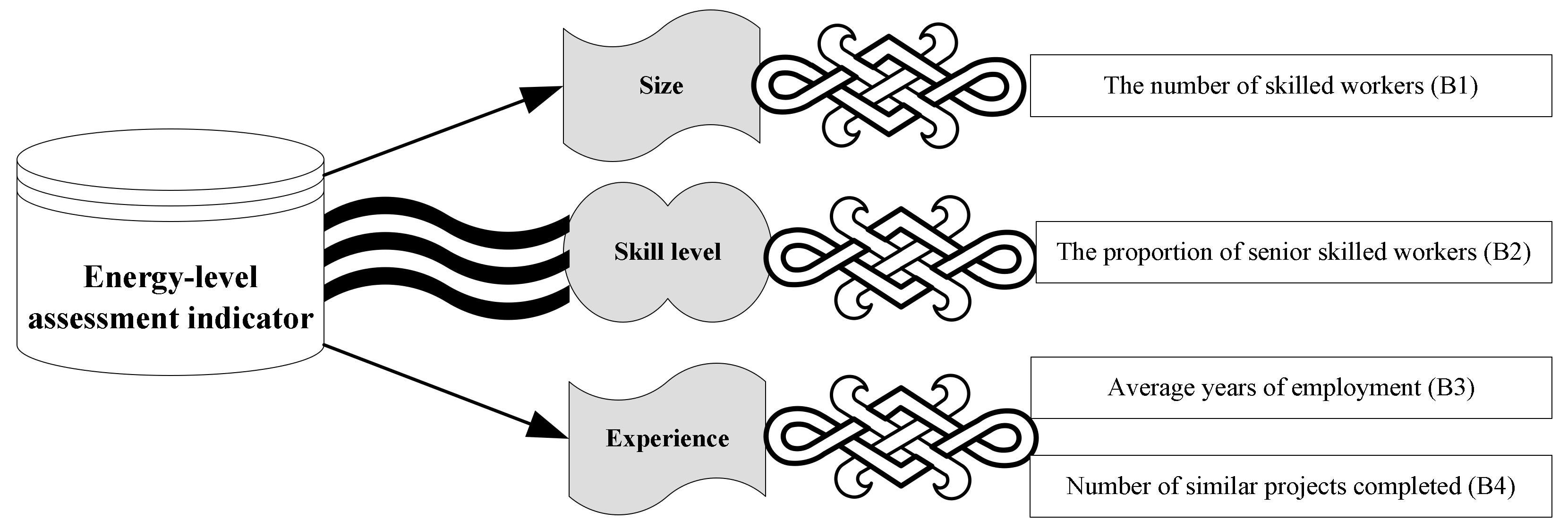
- —the level of skilled workers recognized by the state shall prevail for the senior skilled workers; if there is no relevant national certification, the comprehensive evaluation of the enterprise shall prevail;
- —the average year of the construction team after removing the minimum and maximum;
- —similar projects involving more than 50% of the construction team members shall prevail, and the participants must include the team leader [22].
4. Allocation Model Development
4.1. Basic Steps of Sustainable Allocation for Work Resumption in a Pandemic
4.2. Model Establishment and Sustainable Allocation Parametric Analysis Based on Cellular Automaton
4.2.1. Establishment of the Allocation Model for Work Resumption Based on Cellular Automaton
4.2.2. Parametric Analysis of the Allocation Model
Energy Similarity Function: SIM
Time-Cost Function: Min(t)
- Allocation of the lost workers in a project construction team for work resumption. At moment t1, if , is not unique, and multiple dispatch routes will be generated, and the route with the minimum combined number of dispatching instances of a project is regarded as the optimal route. When the comprehensive dispatching time is the same for both routes, the route with the fewest dispatching instances N is optimal. At this time, the mathematical expression for the decision function of the optimal route of the work resumption of construction teams in a project pool is:where tμ1 depends on the status of the pandemic and the degree of pandemic control at the location of the dispatched team (or potential dispatched team) at a given time (if the conditions for the resumption of construction teams are met, ; if the conditions for the resumption of construction teams are met, but those for the resumption of projects are not met, ). Moreover, tμ2 depends on the traffic and spatial distance between the project site and the location of the construction team at a certain time during the pandemic, and tμ3 is the controllable reference time, which is set as a constant empirical value. The pandemic situation and site environment at the project location at a certain moment will affect the recruitment search time tz. The decision function of the optimal route when the number of dispatching instances is equal to N is:In the case of multiple routes, the route with a lower pandemic level, less frequent dispatching, and local dispatching should be chosen as the optimal route.
- Allocation for certain types of construction teams for the resumption of projects for which the construction team has been lost. At t1, there may be several lost construction teams of the same type in the project pool (the number of such teams is L). According to the priority of L projects with lost construction teams and the basic steps outlined in Section 4.1, it is possible to allocate them independently. However, if the lost team still faces multiple at a certain time, there may be mutual interference among the L lost construction teams in the process of independent systematic allocation. Thus, the decision function of the optimal route is extended as:
5. Case Study and Demonstration
5.1. Case Overview and Prioritization Evaluation of the SGJ Construction
5.2. Sustainable Allocation of the SGJ Construction Teams for Work Resumption
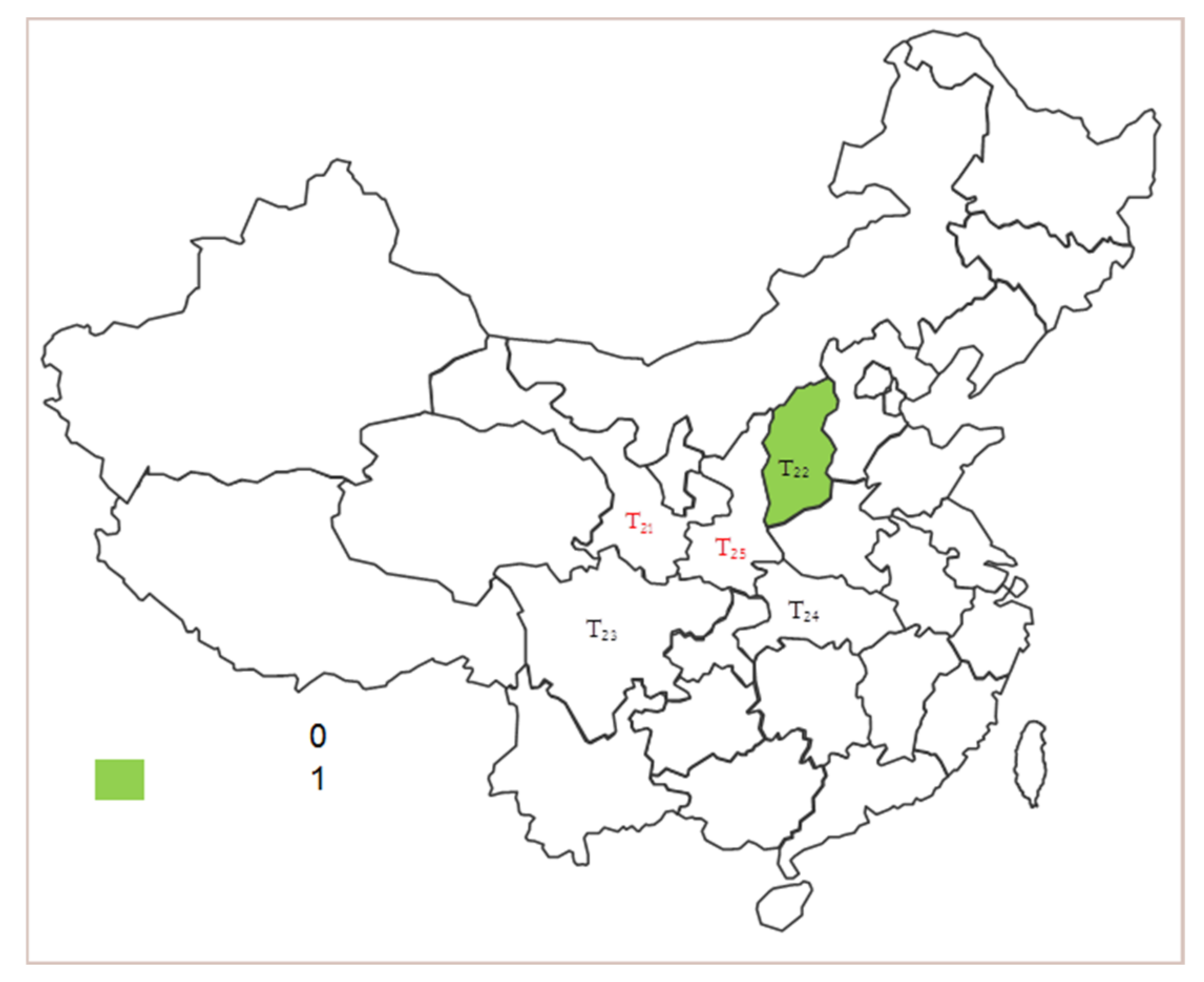
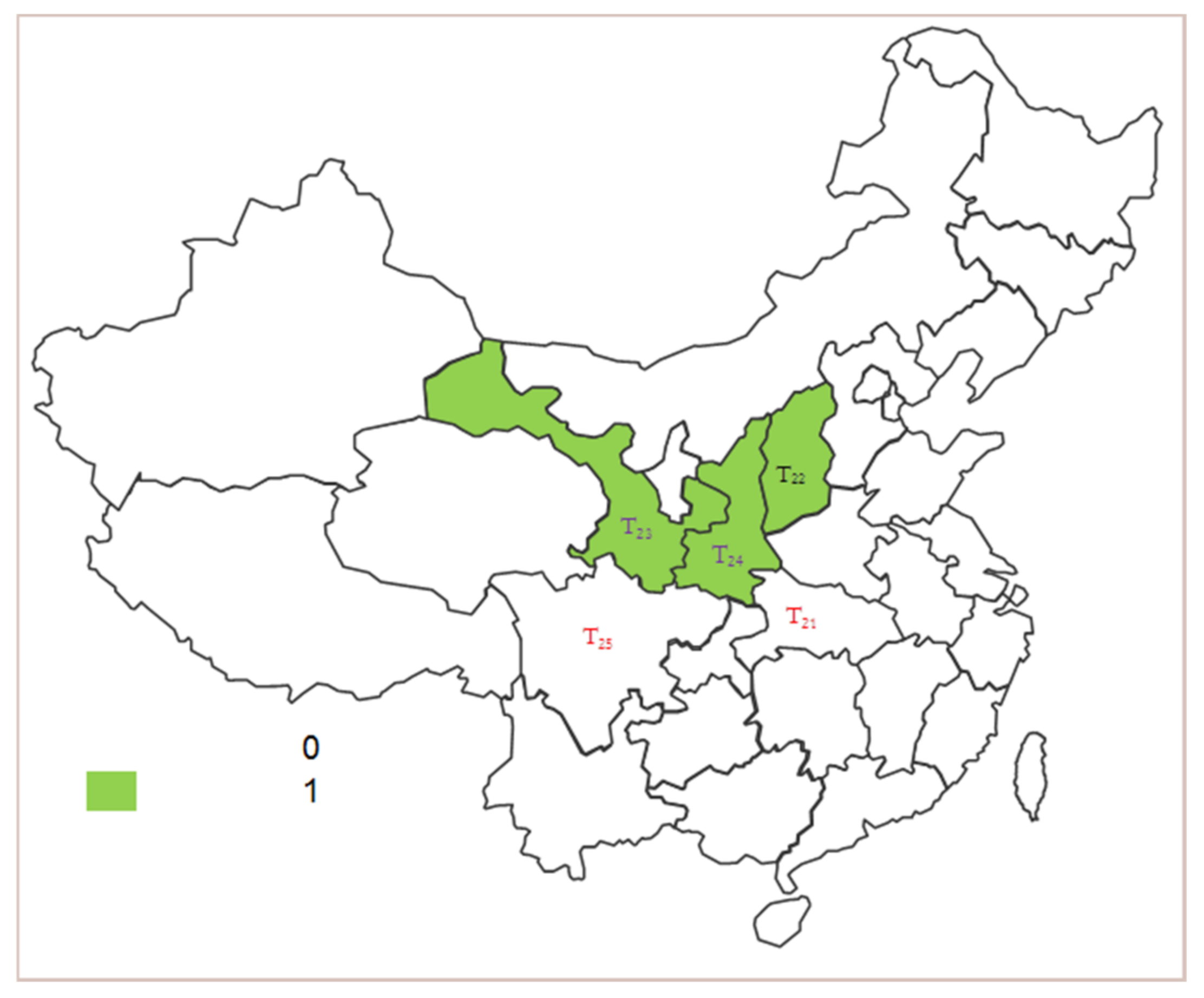
- The cells involved in the sustainable allocation include (T21, T25; T23, T24 (T23, T24; T25, T21);
- The energy level of each cell involved in the sustainable allocation is (T21 = T23; T25 = T24) and (T23 = T25; T24 = T21);
- The evolution process of the cellular matrix is as follows.
5.3. Result and Discussion
6. Conclusions
Author Contributions
Funding
Institutional Review Board Statement
Informed Consent Statement
Data Availability Statement
Acknowledgments
Conflicts of Interest
References
- Liu, J.; Liu, Y.S.; Chen, X. An analysis of the influencing factors, development trend and countermeasures of labor cost rising in construction industry. J. Beijing Jiaotong Univ. 2015, 14, 45. [Google Scholar]
- Ministry of Human Resources and Social Security of the People’s Republic of China. Opinions on Doing a Good Job in Stabilizing Labor Relations during the Prevention and Control of the Covid-19 Pandemic and Supporting Enterprises to Work Resumption. Available online: http://www.mohrss.gov.cn/gkml/zcfg/gfxwj/202002/t20200207_358328.html (accessed on 29 February 2020).
- Castillo-Salazar, J.A.; Landa-Silva, D.; Qu, R. Workforce scheduling and routing problems: Literature survey and computational study. Ann. Oper. Res. 2016, 239, 39–67. [Google Scholar] [CrossRef] [Scilit]
- Persad, K.R.; O’Connor, J.T.; Varghese, K. Forecasting engineering manpower requirements for highway preconstruction activities. J. Manag. Eng. 1995, 11, 41–47. [Google Scholar] [CrossRef] [Scilit]
- Whang, S.W.; Flanagan, R.; Kim, S.; Kim, S. Contractor-led critical design management factors in high-rise building projects involving multinational design teams. J. Constr. Eng. Manag. 2016, 143, 06016009. [Google Scholar] [CrossRef] [Scilit]
- Zhang, X.; Luo, W.; Cai, Y. Assigning crowdsourcing project to crowdsourcing workers: A risky multi-objective optimization model. Syst. Eng. 2018, 36, 53–60. [Google Scholar]
- Yang, W.J.; Kim, Y.S. Manpower allocation model for construction site office engineers based on inherent technical risks. KSCE J. Civ. Eng. 2019, 23, 947–957. [Google Scholar] [CrossRef] [Scilit]
- Ballesteros-Pérez, P.; González-Cruz, M.C.; Fernandez-Diego, M. Human resource allocation management in multiple projects using sociometric techniques. Int. J. Proj. Manag. 2012, 30, 901–913. [Google Scholar] [CrossRef] [Scilit]
- Liao, P.C.; Liu, B.; Wang, Y.; Wang, X.; Ganbat, T. Work paradigm as a moderator between cognitive factors and behaviors—A comparison of mechanical and rebar workers. KSCE J. Civ. Eng. 2017, 21, 2514–2525. [Google Scholar] [CrossRef] [Scilit]
- Shahbazi, B.; Akbarnezhad, A.; Rey, D.; Fini, A.; Loosemore, M. Optimization of job allocation in construction organizations to maximize workers’ career development opportunities. J. Constr. Eng. Manag. 2019, 145, 04019036. [Google Scholar] [CrossRef] [Scilit]
- Mats, E.; Anna, J. The resource allocation syndrome: The prime challenge of multi-project management. Int. J. Proj. Manag. 2003, 21, 403–409. [Google Scholar]
- Yoshimura, M.; Fujimi, Y.; Nishiwa-Ki, S. Human resource allocation optimization for multiple development projects. Trans. Jpn. Soc. Mech. Eng. 2005, 71, 677–684. [Google Scholar] [CrossRef] [Scilit]
- Chen, J.; Wang, S. Method research for dynamic multi-project human resource allocation based on multidimensional model. In Proceedings of the 2011 International Conference on Information Management, Innovation Management and Industrial Engineering, Shenzhen, China, 26–27 November 2011; Volume 3, pp. 78–81. [Google Scholar]
- El-Abbasy, M.S.; Elazouni, A.; Zayed, T. Generic scheduling optimization model for multiple construction projects. J. Comput. Civ. Eng. 2017, 31, 04017003. [Google Scholar] [CrossRef] [Scilit]
- Yong, Z.; Zhigao, C.; Zhong, Z. Resource allocation model and strategy research of large-scale construction projects: System dynamics modeling and simulation. Chin. Manag. Sci. 2016, 24, 125–132. [Google Scholar]
- Hou, Y.H.; Rao, W.Z.; Hao, M. Study on multi-project human resources allocation of engineering construction enterprise-based on the perspective of competence and two-level optimization. Oper. Res. Manag. Sci. 2017, 26, 192–199. [Google Scholar]
- Florez, L. Crew allocation system for the masonry industry. Comput. Aided Civ. Infrastruct. Eng. 2017, 32, 874–889. [Google Scholar] [CrossRef] [Scilit]
- Mo, Y.; Zhao, D.; Du, J.; Syal, M.; Aziz, A.; Li, H. Automated staff assignment for building maintenance using natural language processing. Autom. Constr. 2020, 113, 103150. [Google Scholar] [CrossRef] [Scilit]
- Koch, C.; Marton, J. Implementing multi-skilled teams on a construction site-Developing a Scandinavian model? In Proceedings of the 18th Annual ARCOM Conference, Newcastle upon Tyne, UK, 2–4 September 2002; pp. 247–256. [Google Scholar]
- Thomas, H.R.; Horman, M.J. Fundamental principles of workforce management. J. Constr. Eng. Manag. 2006, 132, 97–104. [Google Scholar] [CrossRef] [Scilit]
- Walter, M.; Zimmermann, J. On a multi-project staffing problem with heterogeneously skilled workers. Oper. Res. Proc. 2012, 127, 489–494. [Google Scholar]
- Li, W.; Peng, L.; Zhang, D. Analysis on the mechanism of the heterogeneity of project construction team leaders affecting post competence. J. Railw. Sci. Eng. 2019, 16, 1857–1864. [Google Scholar]
- Anoshkina, Y.; Meisel, F. Technician teaming and routing with service-, cost- and fairness-objectives. Comput. Ind. Eng. 2019, 135, 868–880. [Google Scholar] [CrossRef] [Scilit]
- Drezet, L.; Billaut, J. A project scheduling problem with labor constraints and time-dependent activities requirements. Eur. J. Oper. Res. 2008, 112, 217–225. [Google Scholar]
- Nasirian, A.; Arashpour, M.; Abbasi, B.; Zavadskas, E.K.; Akbarnezhad, A. Skill set configuration in prefabricated construction: Hybrid optimization and multicriteria decision-making approach. J. Constr. Eng. Manag. 2019, 145, 04019050. [Google Scholar] [CrossRef] [Scilit]
- Nasirian, A.; Arashpour, M.; Abbasi, B. Critical literature review of labor multiskilling in construction. J. Constr. Eng. Manag. 2019, 145, 04018113. [Google Scholar] [CrossRef] [Scilit]
- Sarihi, M.; Shahhosseini, V.; Banki, M.T. Multiskilled project management workforce assignment across multiple projects regarding competency. J. Constr. Eng. Manag. 2020, 146, 04020134. [Google Scholar] [CrossRef] [Scilit]
- Baidu. Real-Time Big Data Report of the Pandemic. Available online: https://voice.baidu.com/act/newpneumonia/newpneumonia/ (accessed on 29 February 2020).
- State Council of the Central People’s Government of the People’s Republic of China. Guidance Opinions on the Prevention and Control of New Coronary Pneumonia Pandemic through Scientific Prevention and Precise Measures in Zones and Grades. Available online: http://www.gov.cn/xinwen/2020-02/18/content_5480514.htm (accessed on 29 February 2020).
- Shannon, C.E. Prediction and Entropy of Printed English; Oxford University Press: Oxford, UK, 1951. [Google Scholar]
- Bi, A.; Luo, Z.; Wang, X.; Sun, Y. Extension model weighted by vague sets and entropy method and its engineering application. Syst. Eng. 2018, 36, 112–120. [Google Scholar]
- Wang, L.-Y. A research to build and operate the BIM-L database for supply-side reform of skilled workers in construction industry. J. Xi’an Univ. Arch. Tech. 2020, 39, 67–73. [Google Scholar]
- Chao, X.; Yang, Y.; Zhou, Z. Simulation of risk transfer in enterprise group based on Cellular Automaton. Chin. J. Manag. Sci. 2012, 20, 144–150. [Google Scholar]
- Wolfram, S. Statistical mechanics of Cellular Automaton. Rev. Mod. Phys. 1983, 55, 601–643. [Google Scholar] [CrossRef] [Scilit]
- Rong, L.; Zhou, P.; Rong, Z. A consequence deduction model of emergency based on one-dimensional cellular automata. Oper. Res. Manag. Sci. 2015, 24, 158–160. [Google Scholar]
- Lindgren, K.; Mats Nordahl, G. Universal computation in simple one-dimensional Cellular Automaton. Complex Syst. 1990, 4, 299–318. [Google Scholar]
- Bosurgi, G.; Pellegrino, O.; Sollazzo, G. Project duration evaluated using affine arithmetic. Period. Polytech. Civ. Eng. 2017, 61, 412–420. [Google Scholar] [CrossRef] [Scilit]



| Work Unit | Title | Number | Age (Avg.) | Work Experience (Avg.) | Method |
|---|---|---|---|---|---|
| Universities | Professor | 2 | 40 | 8 | Face-to-face |
| Construction companies | Manager | 3 | 45 | 12 | Online (WeChat) |
| Indicator System | Evaluation Criteria | ||||
|---|---|---|---|---|---|
| 0.8–1 | 0.6–0.8 | 0.4–0.6 | 0.2–0.4 | 0–0.2 | |
| Remaining contract amount A1 | Very large | Large | Average | Small | Very small |
| More than 50% of the total remaining amount of the annual contract of the enterprise | 30–50% of the total remaining amount of the annual contract of the enterprise | 10–30% of the total remaining amount of the annual contract of the enterprise | 5–10% of the total remaining amount of the annual contract of the enterprise | Less than 5% of the total remaining amount of the annual contract of the enterprise | |
| Profit per unit of time A2 | Very large | Large | Average | Small | Very small |
| More than 50% above the average enterprise level | 10–50% above the average enterprise level | Within 10% of the average enterprise level | 10–50% below the average enterprise level | More than 50% below the average enterprise level | |
| Remaining duration A3 | Very high | High | Normal | Low | Very low |
| More than 20% longer than the normal duration of similar projects | 10–20% longer than the normal duration of similar projects | Within 10% of the normal duration of similar projects | 10–20% shorter than the normal duration of similar projects | More than 20% shorter than the normal duration of similar projects | |
| Quality A4 | Very high | High | Normal | Low | Very low |
| Exceeding the enterprise quality standards and proposing to apply for national awards | Exceeding the enterprise quality standards and proposing to apply for awards in the administration region | Meeting corporate quality standards | Lower than the quality standards of the enterprise and higher than national and local standards | Lower than local standards, higher than mandatory national standards | |
| Level of technical complexity A5 | Very high | High | Average | Low | Very low |
| The technical difficulty factor is much higher than the average for similar projects | The technical difficulty factor is slightly higher than the average for similar projects | The technical difficulty factor is at the average level of similar projects | The technical difficulty factor is slightly lower than the average for similar project | The technical difficulty factor is well below the average for similar projects | |
| Impact of the project on short-term enterprise strategies A6 | Significant | Large | General | Small | Very small |
| Project success or failure is a sufficient condition for the achievement of short-term strategies | Project success or failure is a necessary condition for the achievement of short-term strategies | Project success or failure is a condition for the achievement of short-term strategies | Project success or failure has less impact on short-term strategies | Project success or failure has no impact on short-term strategies | |
| Impact of the project on long-term enterprise strategies A7 | Significant | Large | General | Small | Very small |
| Project success or failure is the only basis for adjusting long-term strategies | Project success or failure is an important criterion for adjusting long-term strategies | Project success or failure is one of the bases for adjusting long-term strategies | Project success or failure has less impact on short-term strategies | Project success or failure has no impact on long-term strategies | |
| Indicator System | Evaluation Criteria | ||||
|---|---|---|---|---|---|
| 0.9 | 0.7 | 0.5 | 0.3 | 0.1 | |
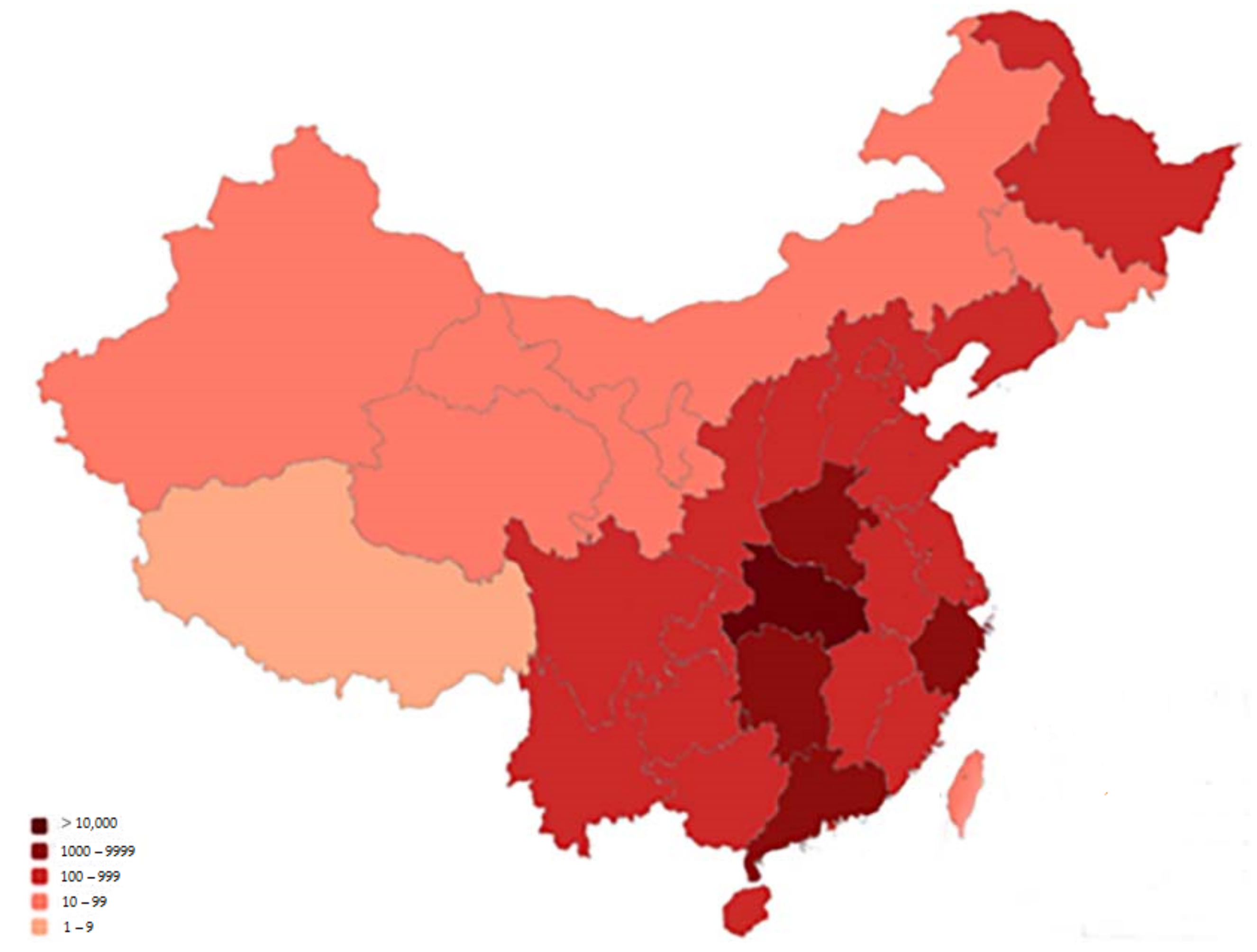
| Pandemic levels of the province (municipality directly under the authority of the central government or autonomous region) | High risk | Relatively high risk | Medium risk | Relatively low risk | Low risk |
| Cumulative number of confirmed cases ≥10,000 | Cumulative number of confirmed cases between 1000–9999 | Cumulative number of confirmed cases between 100–999 | Cumulative number of confirmed cases between 10–99 | Cumulative number of confirmed cases between 1–9 | |
| Local pandemic level | High risk | Relatively high risk | Medium risk | Relatively low risk | Low risk |
| The pandemic risk level of each county or city (district) published during the reporting period shall prevail (adjusted every 14 days) | |||||
| Type of Work | Project Prioritization (from Highest to Lowest) | |||||
|---|---|---|---|---|---|---|
| P1 | P2 | … | Pa | … | Pn | |
| G1 | T11 | T12 | … | T1a | … | T1n |
| G2 | T21 | T22 | … | T2a | … | T2n |
| … | … | … | … | … | … | … |
| Gb | Tb1 | Tb2 | … | Tba | … | Tbn |
| … | … | … | … | … | … | … |
| Gm | Tm1 | Tm2 | … | Tma | … | Tmn |
| Situation | Resumption of Projects | Resumption of Construction Teams | Total Number | Project Set | Construction Team Set | Analysis |
|---|---|---|---|---|---|---|
| I | Conditions are in place to resume projects | Conditions are in place to resume construction teams | Direct work resumption without reallocation | |||
| II | Conditions are in place to resume projects | Failure to meet conditions for the resumption of construction teams | The main allocations | |||
| III | Failure to meet conditions for the resumption of projects | Conditions are in place to resume construction teams | The construction team is allocated into II in time | |||
| IV | Failure to meet conditions for the resumption of projects | Failure to meet conditions for the resumption of construction teams | Make pre-arrangements for the work resumption of subsequent projects and waiting workers |
| Priority Indicator | Project Pool | ||||
|---|---|---|---|---|---|
| SX1 | SX2 | HB | SC | GS | |
| A1 | 0.66 | 0.22 | 0.38 | 0.27 | 0.70 |
| A2 | 0.50 | 0.40 | 0.60 | 0.85 | 0.72 |
| A3 | 0.30 | 0.70 | 0.50 | 0.50 | 0.50 |
| A4 | 0.50 | 0.50 | 0.50 | 0.80 | 0.70 |
| A5 | 0.50 | 0.60 | 0.50 | 0.50 | 0.55 |
| A6 | 0.60 | 0.45 | 0.50 | 0.55 | 0.70 |
| A7 | 0.50 | 0.70 | 0.50 | 0.70 | 0.80 |
| Initial Prioritization Rank of Project Pools | ||||
|---|---|---|---|---|
| GS | SX1 | SC | HB | SX2 |
| Project Code | SX1 | SX2 | HB | SC | GS |
|---|---|---|---|---|---|
| 0.05 | 0.05 | 0.81 | 0.25 | 0.03 | |
| 0.2090 | 0.1445 | 0.0791 | 0.1431 | 0.2590 |
| Revised Prioritization Ranking of Project Pools | ||||
|---|---|---|---|---|
| GS | SX1 | SX2 | SC | HB |
| Type of Work | Project Pool | ||||
|---|---|---|---|---|---|
| Carpenter, G1 | T11 | T12 | T13 | T14 | T15 |
| Reinforcement worker, G2 | T21 | T22 | T23 | T24 | T25 |
| Concrete worker, G3 | T31 | T32 | T33 | T34 | T35 |
| Masonry worker, G4 | T41 | T42 | T43 | T44 | T45 |
| Plasterer, G5 | T51 | T52 | T53 | T54 | T55 |
| Scaffolder, G6 | T61 | T62 | T63 | T64 | T65 |
| … | … | … | … | … | … |
| Situation | Resumption of Projects | Resumption of Construction Teams | Project Set | Construction Team Set |
|---|---|---|---|---|
| I | Conditions are in place to resume projects | Conditions are in place to resume construction teams | = {SX1} | = {T22} |
| II | Conditions are in place to resume projects | Failure to meet conditions for the resumption of construction teams | = {GS, SX2} | = {T21, T25} |
| III | Failure to meet conditions for the resumption of projects | Conditions are in place to resume construction teams | = {SC, HB} | = {T23, T24} |
Publisher’s Note: MDPI stays neutral with regard to jurisdictional claims in published maps and institutional affiliations. |
© 2021 by the authors. Licensee MDPI, Basel, Switzerland. This article is an open access article distributed under the terms and conditions of the Creative Commons Attribution (CC BY) license (https://creativecommons.org/licenses/by/4.0/).
Share and Cite
Wang, L.; Zhao, D.; Zhong, Y. Sustainable Allocation Model of Construction Workforce for Work Resumption during COVID-19. Sustainability 2021, 13, 6481. https://doi.org/10.3390/su13116481
Wang L, Zhao D, Zhong Y. Sustainable Allocation Model of Construction Workforce for Work Resumption during COVID-19. Sustainability. 2021; 13(11):6481. https://doi.org/10.3390/su13116481
Chicago/Turabian StyleWang, Layin, Dong Zhao, and Yanqi Zhong. 2021. "Sustainable Allocation Model of Construction Workforce for Work Resumption during COVID-19" Sustainability 13, no. 11: 6481. https://doi.org/10.3390/su13116481
APA StyleWang, L., Zhao, D., & Zhong, Y. (2021). Sustainable Allocation Model of Construction Workforce for Work Resumption during COVID-19. Sustainability, 13(11), 6481. https://doi.org/10.3390/su13116481