

A Regional Socio-Economic Life Cycle Assessment of a Bioeconomy Value Chain




Abstract
1. Introduction
2. Methods
2.1. Definition of Goal and Scope
2.2. Inventory Analysis
2.3. Functional Unit
3. Results
3.1. Impact Assessment
3.2. Interpretation
4. Discussion and Conclusions
5. Outlook
Supplementary Materials
Author Contributions
Funding
Conflicts of Interest
Appendix A. SDG Sub-Goals Related to RESPONSA Indicators
| SDG Code | SDG Sub-Goal | Part of Monitoring | RESPONSA | RESPONSA Indicator |
| 1.1 | Eliminate extreme poverty, pay equity | must | no | |
| 1.2 | Poverty reduction, pay equity | must | yes | Payment according to basic wage, average remuneration level, rate of marginal employees (max. 450 €), rate of fixed-term employees, rate of employees provided by temporary work agencies |
| 1.4 | Enable economic participation for all people | must | no | |
| 1.5 | Increase resistance of population against extreme climate events | may | no | |
| 1.a | Financial support/development aid, eradication of poverty | may | no | |
| 2.1 | Food access, food security | must | no | |
| 2.2 | End malnutrition, food security | must | no | |
| 2.3 | Increase agricultural productivity, income (small producers) | may | no | |
| 2.4 | Sustainable systems in food production (resilience) | must | no | |
| 2.5 | Preserve genetic diversity of seeds/plants/animals | must | no | |
| 2.a | Investment in rural infrastructure, agricultural research and consulting | must | no | |
| 2.b | Trade restrictions, prevent distortions, stop agricultural export subsidies | may | no | |
| 2.c | Stability food market, fluctuations of food prices, reserves | must | no | |
| 3.9 | Reduce pollution of air/water/soil, health protection | must | no | |
| 4.1 | Equal access/free education from elementary schools on (girls/boys) | may | no | |
| 4.2 | Equal access/free education from preschool/kindergarten on (girls/boys) | may | no | |
| 4.3 | Promote gender equality | may | yes | Rate of employees participated in trainings, support for professional qualification, rate of vocational trainees |
| 4.5 | Gender disparities (parity indices) | may | yes | rate of disabled employees, rate of foreign employees |
| 4.7 | Education for sustainable development | must | yes | Rate of employees participated in trainings |
| 4.b | Increase number of scholarships | may | no | |
| 5.1 | Eliminate discrimination against women | may | yes | Measures to improve gender equality, rate of female employees |
| 5.a | Financial equality, legal framework for women (e.g., pension, real estate) | may | no | Measures to improve gender equality, rate of female employees |
| 8.2 | Economic productivity increase through diversification | may | no | |
| 8.3 | Promoting decent work, innovation, creativity, SMEs | must | no | |
| 8.4 | Resource efficiency in consumption/production | may | no | |
| 8.6 | Increase share of youth employment, education and vocational training | may | no | Rate of vocational trainees |
| 8.7 | Worker rights, abolition of forced labor/trafficking/child labor | may | no | |
| 8.10 | Promote national financial institutions for financial infrastructure | must | no | |
| 8.a | Support developing countries/technical assistance | may | no | |
| 10.1 | Income growth | may | yes | Payment according to basic wage, average remuneration level, rate of marginal employees (max. 450 €) |
| 10.5 | Regulation/supervision of global financial markets | may | no | |
| 10.6 | Improvement of representation/participation of developing countries | must | no | |
| 10.a | Justice, treatment of developing countries | may | no | |
| 10.b | Efficient and effective development assistance/financial flows/direct investment | must | no | |
| 16.5 | Reduction of bribery/corruption | must | no | |
| 16.7 | Democratic decision-making | may | yes | Works council |
Appendix B. RESPONSA Indicators Related to SDG Sub-Targets and Stakeholder Relevance
| Index | Sub-Index | Responsa Indicator | SDG Sub-Goal | Stakeholder Relevance for Monitoring (1) |
| Health and safety | Accidents | Occupational accidents | 8.8 | no relevance |
| Occupational fatal accidents | 8.8 | no relevance | ||
| Sick-leave | Sick-leave days | 8.8 | no relevance | |
| Preventive health measures | 8.8 | no relevance | ||
| Adequate remuneration | Payment | Payment according to basic wage | 1.2, 10.1, 8.5 | must, may, no relevance |
| Average remuneration level | 1.2, 10.1, 8.5 | must, may, no relevance | ||
| Financial participation | Capital participation | 8.5 | no relevance | |
| Profit-sharing and bonuses | 8.5 | no relevance | ||
| Adequate working time | Working time | Contractual working hours | 8.5 | no relevance |
| Compensation for overtime | 8.5 | no relevance | ||
| Work–life balance | Access to flexible working time agreements | 8.5, 3.4 | no relevance | |
| Rate of part-time employees | 8.5, 3.4 | no relevance | ||
| Employment | Job conditions | Rate of qualified employees | 4.4 | no relevance |
| Rate of marginal employees (max. 450 €) | 1.2, 10.1, 8.5 | must, may, no relevance | ||
| Duration of employment | Rate of fixed-term employees | 1.2, 8.5 | must, no relevance | |
| Rate of employees provided by temporary work agencies | 1.2, 8.5 | must, no relevance | ||
| Knowledge capital | On-the-job-training | Rate of employees participated in training | 4.7, 4.3, 4.4, | must, may, no relevance |
| Support for professional qualification | 4.3, 4.4 | may, no relevance | ||
| Vocational training | Rate of vocational trainees | 4.3, 8.6, 4.4 | may, may, no relevance | |
| Research and development | Rate of employees in research and development | 9.5 | may | |
| Equal opportunities | Gender equality | Female employees in management positions | 5.5 | no relevance |
| Rate of female employees | 5.1, 5.a, 8.5 | may, may, no relevance | ||
| Measures to improve gender equality | 5.1, 5.a, 5.4 | may, may, no relevance | ||
| Integrate older employees | Measures to support older employees | 10.2, 10.3 | no relevance | |
| Integrate minorities | Rate of disabled employees | 4.5, 8.5, 10.2, 10.3 | may, no relevance | |
| Rate of foreign employees | 4.5, 8.5, 10.7 | may, no relevance | ||
| Participation | Worker participation | Works council | 16.7 | may |
| Indices, sub-indices, and Responsa indicators adapted from [2]; (1) stakeholder relevance for each SDG sub-target according to [1]. | ||||
Appendix C. Data, PRP, and Calculated Scores for O1
| RESPONSA Indicator | Data O1 | PRP O1 | Scores O1 |
| 1. Health and Safety | 8.2 a | ||
| Occupational accidents | 51.12 | 67 b | 7.4 |
| Occupational fatal accidents | 0.00 | 0.011 b | 10 |
| Sick-leave days | 2.67 | 14.1 b | 10 |
| Preventive health measures | yes | 94% yes, 6% no (biggest organizational size) b | 5.6 * |
| Sick-leave analysis | yes | 50% yes, 50% no | 7.5 |
| Employee survey regarding safety measures taken at the workplace | no | 50% yes, 50% no | 2.5 |
| Discussion groups on health and safety issues in the organization | no | 100% no | 5 |
| Internal activities | yes | 50% yes, 50% no | 7.5 |
| Training or consultation offers for employees | yes | 100% no | 10 |
| Financial support for external health activities | no | 100% no | 5 |
| Network for organizational health management | no | 25% yes, 75% no | 3.75 |
| Other | no data | 10% yes, 80% no | |
| 2. Adequate remuneration | 7.2 a | ||
| Payment according to basic wage | sectoral collective agreement | 22% yes, 78% no | 8.9 |
| Average remuneration level | 4105 € | 1016.34 | 10 |
| Capital participation | no | 100% no | 5.0 |
| Profit-sharing and bonuses | no | 100% no | 5.0 |
| 3. Adequate working time | 8.4 a | ||
| Contractual working hours | 40.0 | 40.85 | 6.6 |
| Compensation for overtime | financial and free time compensation | financial compensation and free time b | 9.3 |
| Access to flexible working time agreements | yes | 14% yes, 86% no | 9.7 |
| Rate of part-time employees | 4.34% | 42.70% | 9.5 |
| 4. Employment | 8.4 a | ||
| Rate of qualified employees | 5.4 | ||
| Rate of employees with vocational training | 52% | 37.63% | 6,8 |
| Rate of employees with an academic degree | 44% | 0.00% | 7,0 |
| Rate of employees in the board | 0% | 15.48% | 2,3 |
| Rate of marginal employees (max. 450 €) | 0.23% | 14.29% | 9.7 |
| Rate of fixed-term employees | 1.55% | 1.62% | 10 |
| Rate of employees provided by temporary work agencies | 0% | no data | >5 |
| 5. Knowledge capital | 5.4 a | ||
| Rate of employees participated in training | no data | 33.44% | |
| Support for professional qualification | no | 39% yes, 61% no | 3.1 |
| Rate of vocational trainees | 3.25% | 0.00% | 7.7 |
| Rate of employees in research and development | 0.77% | no data | |
| 6. Equal opportunities | 7.5 a | ||
| Female employees in management positions | yes | 21% yes, 79% no (biggest organizational size) b | 9.0 * |
| 19.00% | |||
| Rate of female employees | 18.28% | 39.50% | 2.0 |
| Measures to improve gender equality | yes | 86% yes, 14% no (biggest organizational size) b | 5.7 * |
| Childcare support | no | 100% yes | 0 |
| Support for employees with relatives in need of care | no | 100% no | 5 |
| Special consideration on employees with care responsibilities regarding the work organization | yes | 40% yes, 60% no | 8 |
| Offers for employees in parental leave | yes | 100% yes | 5 |
| Special support for women | no data | no data | |
| Member of a network of family friendly organizations | no | 100% no | 5 |
| Other measures | no data | no data | |
| Measures to support older employees | yes | ||
| Partial retirement | yes | no data | |
| Special equipment in the workplaces for older employees | no | no data | |
| Individual adaptation of the job requirements | no data | no data | |
| Working groups mixed in ages | no data | no data | |
| Integration of older employees into training | yes | no data | |
| Specific training for older employees | no | no data | |
| Integration of older employees into preventive health measures | no | no data | |
| Rate of disabled employees | 5.81% | 2.8% b | 10 |
| Rate of foreign employees | 22.2% | 10.8% b | 10 |
| 7. Participation | 9.1 a | ||
| Works council | yes | 18% yes, 82% no | 9.1 |
| * Indicator score calculation on ES and OS level: (OS score for Preventive health measures: 5.3, OS score for Female employees in management positions: 8.95 for Q1, 3.95 for Pollmeier, OS score for Measures to support older employees: 5.7); a Index score calculation: ; b Other sources than IAB Estabishment Panel [30,31,32,33,34,35]. | |||
Appendix D. Set of Indicators with Type of Indicator, Objective, and PRP Level
| Indicators | Unit | Measure | Type | Objective | PRP Level |
| Occupational accidents | Nr | Number of accidents per year per 1000 employees | quant. | Min | ES |
| Occupational fatal accidents | Nr | Number of fatal accidents per year per 1000 employees | quant. | Min | ES |
| Sick-leave days | Nr | Sick-leave days per year per employee | quant. | Min | ES |
| Preventive health measures | y/n | Health measures (e.g., sick-leave analysis, health activities) | qual. | Yes | OS |
| Payment according to basic wage | y/n | Payment according to collective agreement | qual. | Yes | ES |
| Average remuneration level | € | Average payment per month per full-time employee per total employees | quant. | Max | ES |
| Capital participation | y/n | Possibility of capital participation | qual. | Yes | ES |
| Profit-sharing and bonuses | y/n | Possibility of profit-sharing and bonuses | qual. | Yes | ES |
| Contractual working hours | H | Average contractual working hours per week per full-time employee | quant. | Min | ES |
| Compensation for overtime | y/n | Compensation measures | qual. | Yes | ES |
| Access to flexible working time agreements | y/n | Availability of flexible working agreements | qual. | Yes | ES |
| Rate of part-time employees | % | Percentage of part-time employees per total employees | quant. | Min | ES |
| Rate of qualified employees | % | Percentage of employees with professional training per total employees | quant. | Max | ES |
| Rate of marginal employees (max. 450 €) | % | Percentage of employees earning max. 450 € per month per total employees | quant. | Min | ES |
| Rate of fixed-term employees | % | Percentage of fixed-term employees per total employees | quant. | Min | ES |
| Rate of employees provided by temporary work agencies | % | Percentage of employees provided by temporary work agencies per total employees | quant. | Min | ES |
| Rate of employees participated in training | % | Percentage of employees participated in training per total employee | quant. | Max | ES |
| Support for professional qualification | y/n | Assumption of cost or exemption for training programs | qual. | Yes | ES |
| Rate of vocational trainees | % | Percentage of trainees per total employees | quant. | Max | ES |
| Rate of employees in research and development | % | Percentage of employees working permanently or temporally in the R&D section per total employee | quant. | Max | ES |
| Female employees in management positions | % | Percentage of female employees in management positions (1st and 2nd level) in relation to all employees in management positions | quant. | Max | OS |
| Rate of female employees | % | Percentage of female employees per total employees | quant. | Max | ES |
| Measures to improve gender equality | y/n | Measures for family support (e.g., support for child care, support for female employees) | qual. | Yes | OS |
| Measures to support older employees | y/n | Measures for older employees (e.g., offer of part-time contracts, special equipment of the workplace) | qual. | Yes | ES |
| Rate of disabled employees | % | Percentage of disabled employees per total employees | quant. | 5% | ES |
| Rate of foreign employees | % | Percentage of foreign employees per total employees | quant. | Max | ES |
| Works council | y/n | Existence of works councils in the organization | qual. | Yes | ES |
| Units: Nr = Number; % Percent; y/n = yes/no; h = hours. Type: quant. = quantitative; qual. = qualitative. PRP level: ES = Economic sector; OS = Economic sector and organizational size. (Adapted from [21]). | |||||
References
- Zeug, W.; Bezama, A.; Moesenfechtel, U.; Jähkel, A.; Thrän, D. Stakeholders’ Interests and Perceptions of Bioeconomy Monitoring Using a Sustainable Development Goal Framework. Sustainability 2019, 11, 1511. [Google Scholar] [CrossRef]
- Siebert, A.; O’Keeffe, S.; Bezama, A.; Zeug, W.; Thrän, D. How not to compare apples and oranges: Generate context-specific performance reference points for a social life cycle assessment model. J. Clean. Prod. 2018, 198, 587–600. [Google Scholar] [CrossRef]
- BMBF, Forschung Für Eine Biobasierte Wirtschaft—Erfolge Und Herausforderungen Für Die Bioökonomie in Deutschland (Research For a Bio-Based Economy—Successes and Challenges for the Bio-Economy in Germany). Available online: https://www.fona.de/medien/pdf/Forschung_fuer_eine_biobasierte_Wirtschaft.pdf (accessed on 1 November 2019).
- UN. Transforming Our World: The 2030 Agenda for Sustainable Development; UN: Geneva, Swizerland, 2015. [Google Scholar]
- German Bioeconomy Council. Update Report of National Strategies around the World—Bioeconomy Policy (Part III); Bioeconomy Council: Berlin, Germany, 2018. [Google Scholar]
- Kleinschmit, D.; Arts, B.; Giurca, A.; Mustalahti, I.; Sergent, A.; Pulzl, H. Environmental concerns in political bioeconomy discourses. Int. For. Rev. 2017, 19, 41–55. [Google Scholar] [CrossRef]
- Meyer, R. Bioeconomy Strategies: Contexts, Visions, Guiding Implementation Principles and Resulting Debates. Sustainability 2017, 9, 1031. [Google Scholar] [CrossRef]
- Heimann, T. Bioeconomy and SDGs: Does the Bioeconomy Support the Achievement of the SDGs? Earth’s Future 2019, 7, 43–57. [Google Scholar] [CrossRef]
- Balkau, F.; Bezama, A. Life cycle methodologies for building circular economy in cities and regions. Waste Manag. Res. 2019, 37, 765–766. [Google Scholar] [CrossRef] [PubMed]
- Siebert, A.; Bezama, A.; O’Keeffe, S.; Thrän, D. Social life cycle assessment: in pursuit of a framework for assessing wood-based products from bioeconomy regions in Germany. Int. J. Life Cycle Assess. 2016, 23, 651–662. [Google Scholar] [CrossRef]
- O’Keeffe, S.; Majer, S.; Bezama, A.; Thrän, D. When considering no man is an island—assessing bioenergy systems in a regional and LCA context: A review. Int. J. Life Cycle Assess. 2016, 21, 885–902. [Google Scholar] [CrossRef]
- Bezama, A.; Siebert, A.; Hildebrandt, J.; Thrän, D. Integration of LCA, LCC, and SLCA methods for assessing a bioeconomy region. In Life Cycle Approaches to Sustainable Regional Development; Taylor & Francis: Abingdon, UK, 2016; pp. 258–264. [Google Scholar]
- Bezama, A.; Ingrao, C.; O’Keeffe, S.; Thrän, D. Resources, Collaborators, and Neighbors: The Three-Pronged Challenge in the Implementation of Bioeconomy Regions. Sustainability 2019, 11, 7235. [Google Scholar] [CrossRef]
- Hildebrandt, J.; Siebert, A.; Thrän, D.; Bezama, A. Monitoring material flows of a bioeconomy region. In Proceedings of the 25th European Biomass Conference: Setting the Course for a Biobased Economy, Stockholm, Sweden, 12–15 June 2017; ETA-Florence Renewable Energies: Florence, Italy, 2017; pp. 1566–1574. [Google Scholar]
- Carus, M.; Dammer, L. Food or Non-Food: Which Agricultural Feedstocks Are Best for Industrial Uses? Nova-Institut: Huerth, Germany, 2013. [Google Scholar]
- Bezama, A. Let us discuss how cascading can help implement the circular economy and the bio-economy strategies. Waste Manag. Res. 2016, 34, 593–594. [Google Scholar] [CrossRef] [PubMed]
- Bezama, A. Understanding the systems that characterise the circular economy and the bioeconomy. Waste Manag. Res. 2018, 36, 553–554. [Google Scholar] [CrossRef] [PubMed]
- Ingrao, C.; Bacenetti, J.; Bezama, A.; Blok, V.; Goglio, P.; Koukios, E.G.; Lindner, M.; Nemecek, T.; Siracusa, V.; Zabaniotou, A.; et al. The potential roles of bio-economy in the transition to equitable, sustainable, post fossil-carbon societies: Findings from this virtual special issue. J. Clean. Prod. 2018, 204, 471–488. [Google Scholar] [CrossRef]
- United Nations Environment Programme. Guidelines for Social Life Cycle Assessment of Products; United Nations Environment Programme, DTIE: Paris, France, 2009. [Google Scholar]
- Finkbeiner, M.; Schau, E.M.; Lehmann, A.; Traverso, M. Towards Life Cycle Sustainability Assessment. Sustainability 2010, 2, 3309–3322. [Google Scholar] [CrossRef]
- Siebert, A.; Bezama, A.; O’Keeffe, S.; Thrän, D. Social life cycle assessment indices and indicators to monitor the social implications of wood-based products. J. Clean. Prod. 2018, 172, 4074–4084. [Google Scholar] [CrossRef]
- IAB-FDZ IAB-Betriebspanel—Testdaten [IAB Establishment Panel—Test Data]. Available online: https://fdz.iab.de/de/FDZ_Establishment_Data/IAB_Establishment_Panel/IABBP_9317.aspx (accessed on 1 January 2018).
- Mercer Holz. Zahlen & Fakten. Available online: https://mercer-holz.de/unternehmen/zahlen-fakten.html (accessed on 1 November 2019).
- Pollmeier Pollmeier Stammwerk Creuzburg. Pollmeier Main Plant at Creuzburg. Available online: https://www.pollmeier.com/de/Unternehmen/standorte (accessed on 1 November 2019).
- Pollmeier. Pollmeier Buche. eine Holzart. 1000 Möglichkeiten (Pollmeier Beech. A Type of Wood. 1000 Possibilities); Pollmeier: Creuzburg, Germany, 2018. [Google Scholar]
- Statista Durchschnittliche Jährliche Arbeitszeit pro Erwerbstätigen (Voll-und Teilzeit) in Deutschland von 2001 bis 2018 (Average Annual Working Time per Employee (Full and Part-Time) in Germany from 2001 to 2018). Available online: https://de.statista.com/statistik/daten/studie/4047/umfrage/entwicklung-der-jaehrlichen-arbeitszeit-pro-erwerbstaetigen/ (accessed on 1 December 2019).
- van Breeschoten, L.; Evertsson, M. When does part-time work relate to less work-life conflict for parents? Moderating influences of workplace support and gender in the Netherlands, Sweden and the United Kingdom. Community Work Fam. 2019, 22, 606–628. [Google Scholar] [CrossRef]
- Beham, B.; Drobnič, S.; Präg, P.; Baierl, A.; Eckner, J. Part-time work and gender inequality in Europe: A comparative analysis of satisfaction with work–life balance. Eur. Soc. 2018, 21, 378–402. [Google Scholar] [CrossRef]
- Martínez-Blanco, J.; Lehmann, A.; Chang, Y.-J.; Finkbeiner, M. Social organizational LCA (SOLCA)—A new approach for implementing social LCA. Int. J. Life Cycle Assess. 2015, 20, 1586–1599. [Google Scholar] [CrossRef]
- BAUA Bundesanstalt für Arbeitsschutz und Arbeitsmedizin; BMAS Bundesministerium für Arbeit und Soziales Sicherheit und Gesundheit bei der Arbeit—Berichtsjahr 2016 (Safety and Health at Work—Reporting Year 2016). Available online: www.baua.de/dok/8732292 (accessed on 1 November 2019).
- Statista Tödliche Arbeitsunfälle in Deutschland bis 2017. Anzahl tödlicher Arbeitsunfälle je 1.000 Vollarbeiter in Deutschland in den Jahren 1987 bis 2017 (Fatal Occupational Accidents in Germany until 2017 Number of Fatal Occupational Accidents per 1,000 Full-Time Workers in Germany in the Years 1987 to 2017). Available online: https://de.statista.com/statistik/daten/studie/763855/umfrage/toedliche-arbeitsunfaelle-je-1000-vollarbeiter-in-deutschland/ (accessed on 17 August 2019).
- Knieps, F.; Pfaff, H. Gesundheit in Regionen. Zahlen, Daten, Fakten mit Gastbeiträgen aus Wissenschaft, Politik und Praxis; MWV Medizinisch Wissenschaftliche Verlagsgesellschaft: Berlin, Germany, 2014. [Google Scholar]
- Zapf, I. Individual and Workplace-Specific Determinants of Paid and Unpaid Overtime Work in Germany; DIW, Deutsches Institut für Wirtschaftsforschung: Berlin, Germany, 2015. [Google Scholar]
- Statistik der Bundesagentur für Arbeit Schwerbehinderte Menschen in Beschäftigung (Anzeigeverfahren SGB IX) (Severely Disabled Persons in Employment (Notification Procedure SGB IX). Available online: https://www.bmas.de/DE/Themen/Teilhabe-Inklusion/Foerderung-der-Ausbildung-und-Beschaeftigung/beschaeftigung-schwerbehinderter-menschen.html (accessed on 1 October 2019).
- Statistik der Bundesagentur für Arbeit Berichte: Analyse Arbeitsmarkt, Arbeitsmarkt für Ausländer (Monatszahlen), Dezember 2017 (Reports: Analysis Labour Market, Labour Market for Foreigners (Monthly Figures), December 2017). Available online: https://statistik.arbeitsagentur.de/Statistikdaten/Detail/201807/analyse/analyse-d-arbeitsmarkt-auslaender/analyse-d-arbeitsmarkt-auslaender-d-0-201807-pdf.pdf (accessed on 1 October 2019).
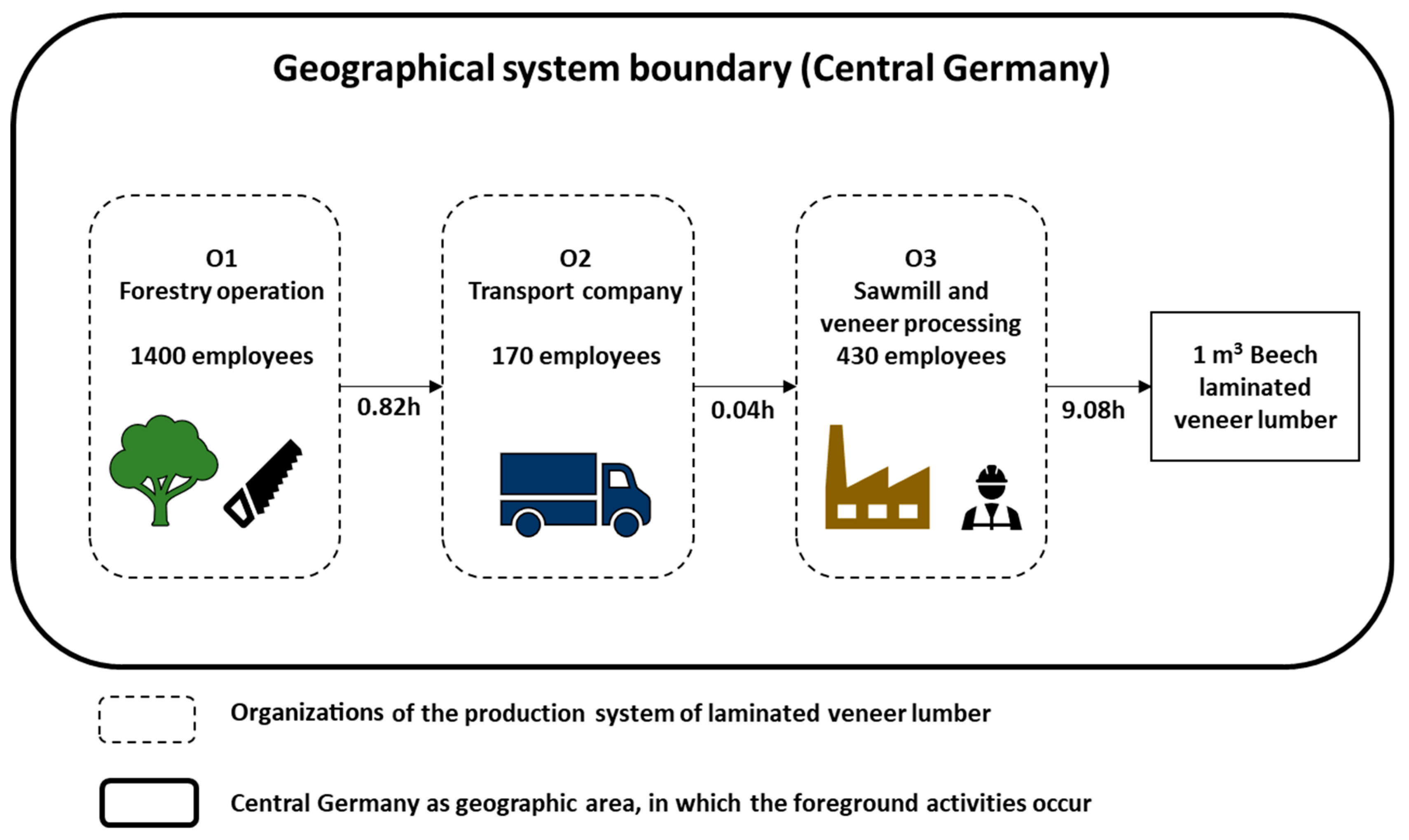

| O1 | O2 | O3 | |||
|---|---|---|---|---|---|
| Employees | 1394 | Employees | 170 | Employees | 430 |
| Logging 01 (m3/y) | 2,800,000 | Transport of timber (m3/y) | 7,000,000 | Beech wood processing (m3/y) | 750,000 |
| Logging of beech wood (m3/y) | 547,620 | Beech wood processing Creuzburg (m3/y) | 325,000 | ||
| Production of beech LVL (m3/y) | 180,000 | ||||
| O1 | O2 | O3 | |||
|---|---|---|---|---|---|
| Annual working hours (h/y) | 2,295,918 | Annual working hours (h/y) | 279,990 | Annual working hours (h/y) | 708,210 |
| Production of beech LVL Creuzburg (m3/y) | 78,000 | ||||
| Working hours per LVL (h/m3) | 0.82 | Working hours per LVL (h/m3) | 0.04 | Working hours per LVL (h/m3) | 9.08 |
| Index | Index Score O1 | Weighted Score O1 1 | Index Score O3 | Weighted Score O3 2 | Weighted Product Score |
|---|---|---|---|---|---|
| 1. Health & safety | 8.2 | 0.68 | I1 | WS1 | 0.68 + WS1 |
| 2. Adequate remuneration | 7.2 | 0.60 | I2 | WS2 | 0.60 + WS2 |
| 3. Adequate working time | 8.4 | 0.70 | I3 | WS3 | 0.70 + WS3 |
| 4. Employment | 8.4 | 0.70 | I4 | WS4 | 0.70 + WS4 |
| 5. Knowledge capital | 5.4 | 0.45 | I5 | WS5 | 0.45 + WS5 |
| 6. Equal opportunities | 7.5 | 0.62 | I6 | WS6 | 0.62 + WS6 |
| 7. Participation | 9.1 | 0.76 | I7 | WS7 | 0.76 + WS7 |
 . 1 ; 2 .
© 2020 by the authors. Licensee MDPI, Basel, Switzerland. This article is an open access article distributed under the terms and conditions of the Creative Commons Attribution (CC BY) license (http://creativecommons.org/licenses/by/4.0/).
Share and Cite
Jarosch, L.; Zeug, W.; Bezama, A.; Finkbeiner, M.; Thrän, D. A Regional Socio-Economic Life Cycle Assessment of a Bioeconomy Value Chain. Sustainability 2020, 12, 1259. https://doi.org/10.3390/su12031259
Jarosch L, Zeug W, Bezama A, Finkbeiner M, Thrän D. A Regional Socio-Economic Life Cycle Assessment of a Bioeconomy Value Chain. Sustainability. 2020; 12(3):1259. https://doi.org/10.3390/su12031259
Chicago/Turabian StyleJarosch, Lena, Walther Zeug, Alberto Bezama, Matthias Finkbeiner, and Daniela Thrän. 2020. "A Regional Socio-Economic Life Cycle Assessment of a Bioeconomy Value Chain" Sustainability 12, no. 3: 1259. https://doi.org/10.3390/su12031259
APA StyleJarosch, L., Zeug, W., Bezama, A., Finkbeiner, M., & Thrän, D. (2020). A Regional Socio-Economic Life Cycle Assessment of a Bioeconomy Value Chain. Sustainability, 12(3), 1259. https://doi.org/10.3390/su12031259

