Sensorised Low-Cost Pencils for Developing Countries: A Quantitative Analysis of Handwriting Learning Progress in Children with/without Disabilities from a Sustainable Perspective

 ,
,  ,
,  and
and 
Abstract
1. Introduction
2. Related Work
- Falk et al. [18] performed a comprehensive study of the grip forces and how they vary over time during a handwriting task. Force variability measures were computed and tested as correlates of handwriting legibility, form and strokes, showing that grip force variability correlates strongly with handwriting quality, in particular for students classified as non-proficient writers. Static grip force patterns were shown to result in poor handwriting quality and in greater variation in handwriting stroke durations.
- Gupta et al. [19] created a low-cost device called the S-Pencil to continuously monitor the children’s grip and writing activity. The device is coupled to a data collection system, which feeds machine learning modules that classify the results of exercises recommended by a mobile app.
- Farris et al. [20] presented a study of the relationship between muscle tone, legibility and consistency of writing with reference to grips, finding that dynamic grips are beneficial for right-handed children (not so much for left-handed ones) to develop fine movements, whereas lateral grips were better to improve gross muscle activation.
- Whittaker et al. [21] presented several iterations in the design of a stylus for tablets that would facilitate its use by children aged 4 to 7, and that at the same time would allow them to develop fine-motor skills. They initially discarded the triangular prism shape for technical difficulties to mold it and to fit the required sensors inside. Yet, they added finger wedges and ridges in order to replicate the effect of having a triangular grip.
- Provda and Provda [22] presented a grip that promotes thumb opposition for hand tools that have elongated handles, including writing instruments. The pinch grasp area can accommodate a distal end of an index finger and a distal end of a thumb of a user, so that a tip of the thumb is opposed to a tip of the index finger in a pinch grasp.
- Pincus et al. [23] described a pen/pencil grip with a head section, a middle section and a tail section forming a continuous and smoothly connected body. Positioned on the grip are placement recesses and grooves to accommodate the thumb, index finger, middle finger, ring finger, little finger, and thenar eminence of a hand. The grip also includes a channel to receive the shaft of a pen/pencil. The structure is designed to reduce fatigue when writing, fostering a tripod grip without putting pressure on the middle, ring and small fingers.
- Marin and Marin [24] presented methods and systems for facilitating handwriting for individuals who require assistance with their fine motor skills and pinch strength due to various conditions or injuries, such as loss of strength in the main muscles and ligaments used for writing. The solutions include a writing instrument with variable weights and diameters, that may be adjusted in order of succession based on improved or worsened fine motor skills.
- Walden [25] presents a cone-shaped gripping aid that features various methods to assist adults and children in gaining the ability to relieve finger pressure upon a writing implement, to improve hand steadiness, and to attain a firmer and improved grasp.
- Finally, Forester and Forester [26] proposed a system and method for training correct positioning and pressure of fingers on writing instruments, thanks to embedded force and tilt sensors.
3. Experiment Context and Design
- The control group, with 26 children (6 with SEN) who would only use the common pencil (cylindrical and thin).
- The intervention group, with 29 children (11 with SEN) who would use the STPP in the Language and Literature classes, and the common pencil in the rest of the subjects.
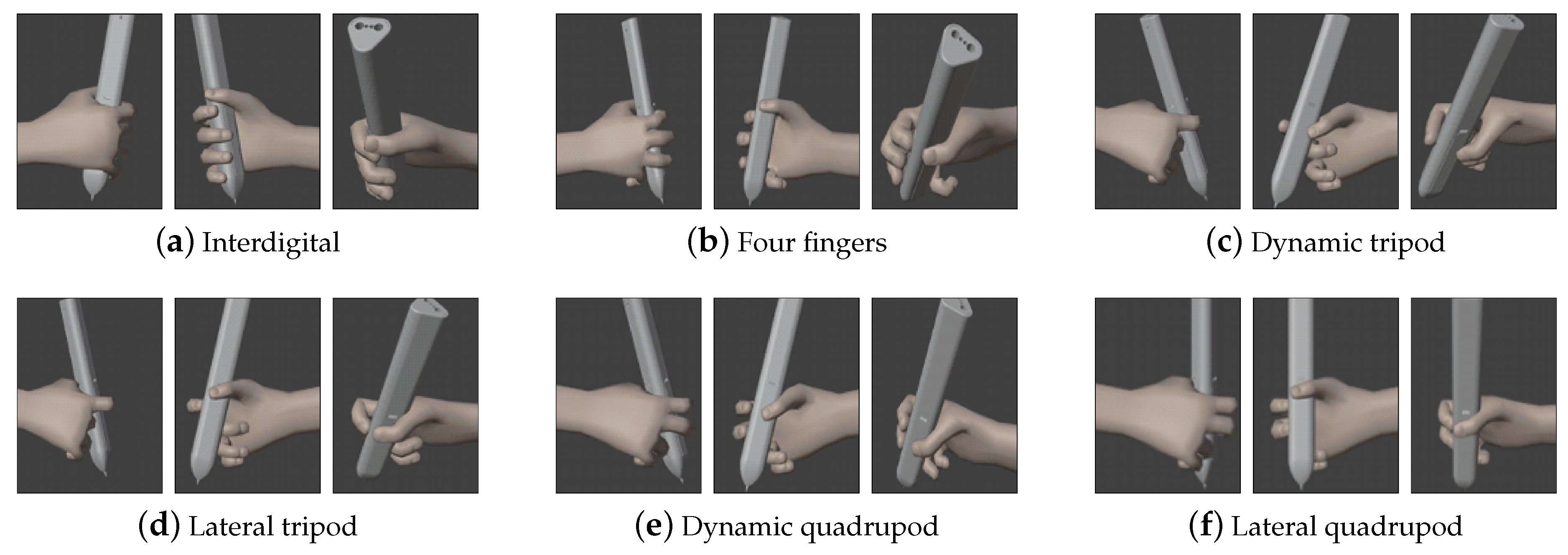
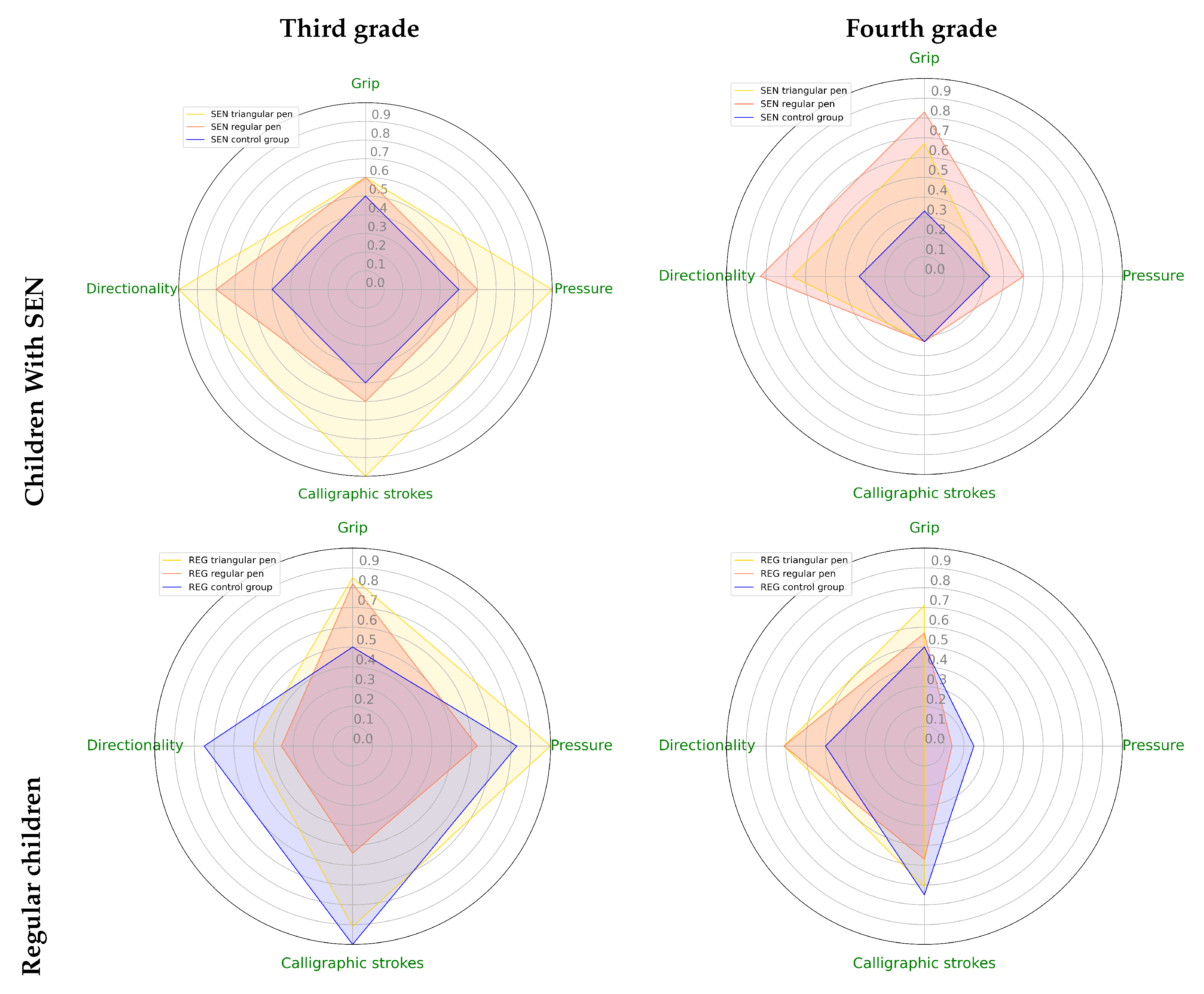
- The preferred grip is tridigital and scored 3. The digital grip (i.e., the pencil is held at two points) scored 2, and the global grip (i.e., the pencil is held with the whole palm of the hand) scored 1.
- As regards the level of pressure exerted on the paper, low pressure scored 3, assuming that the child did not have hypotonia (low muscle tone), and strong pressure scored 1 when there was no hypertonia (excessive muscle tone).
- As regards the calligraphic strokes, continuous execution with constant speed scored as good (3). If there was hesitation (bursts of speeds in some lines with slight deterioration of the handwriting) the score was fair (2). If there were only bursts, straight lines where there should be curved ones, and/or unconnected strokes, the score was poor (1).
- As for directionality, when the stroke followed the established order, the score was 3. When that was not always the case, the score was 2. The score 1 was applied when the strokes were most often executed in ways that contravened the common patterns.
4. Results and Discussion
5. Moving on from the Positive Results: A Success Story from Cuenca, Ecuador
- Feasibility to build the pencil locally with low-cost 3D printers (this is determined by the complexity of the 3D model and the minimum size required to allocate the electronic components inside).
- Local availability of the electronic components to make the printed circuit boards.
- Novelty and functionalities: we wanted to compare with recent proposal able to yield the same data we needed in our experiment.
6. Conclusions and Future Work
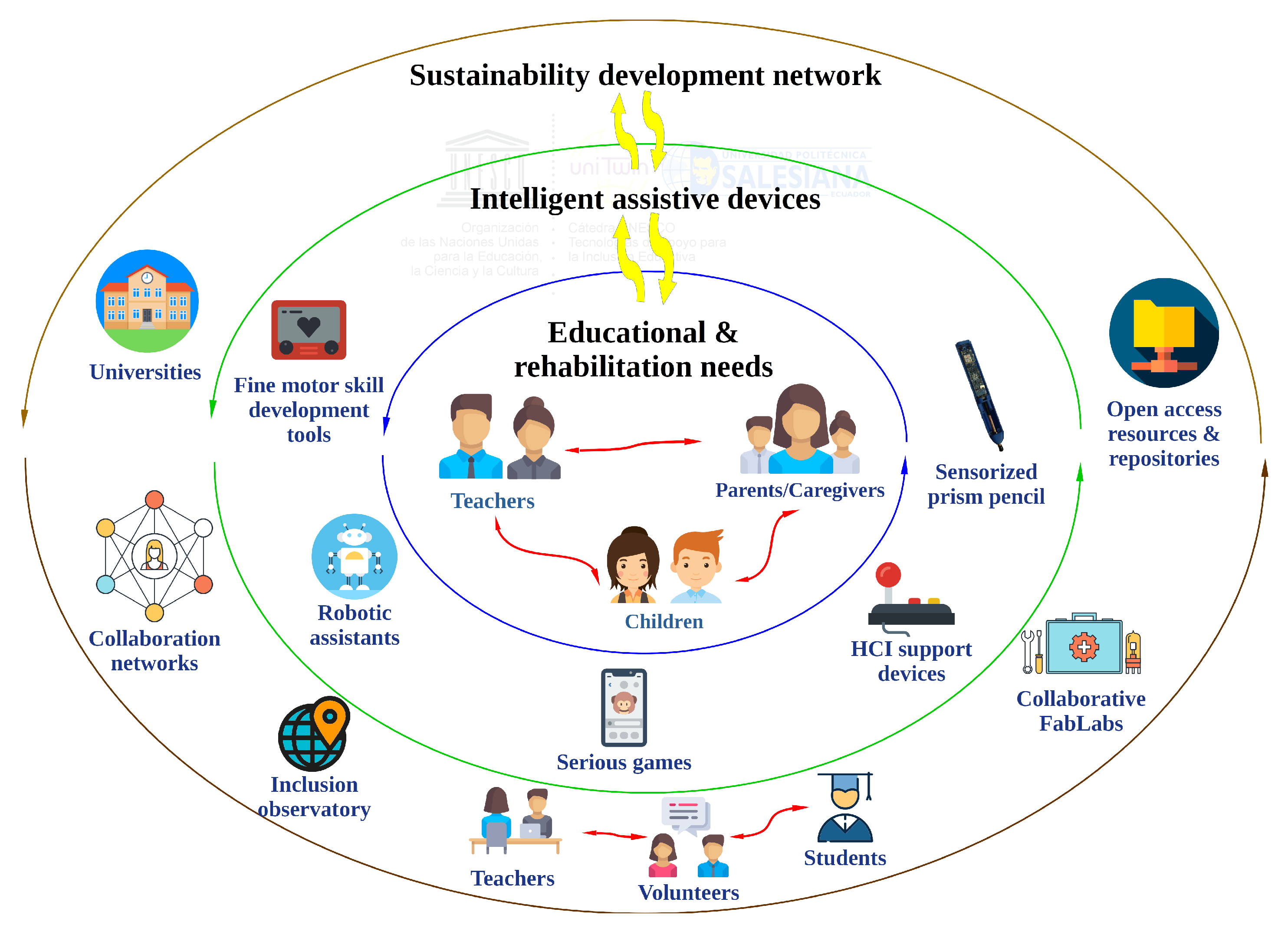
- Sensorised pencils that can be adapted to any size for children of different ages. Similarly, during the first stage, we can make only the case of the pencil and adjust its form to train the child.
- The human-computer interaction tools are fundamental to complement the interaction between children and technological devices such as computers, smartphones and tablets. These tools can be as simple as mouse or keyboard adaptations, or more complex such as brain signal readers.
- The serious games (currently under development) are very useful to motivate children being part of the therapy, and rehabilitation activities. Several studies have shown that children suffer less fatigue when they use serious games to carry out educational and rehabilitation activities [46].
- The introduction of robotic assistants in the different educational levels has changed the perspective of educational inclusion in the last years. With the support of proper robots it is possible to perform a wide range of activities for both education and rehabilitation.
- To complement the activities to develop fine motor skills with children, it is very important to continue using classical tools as puzzles, zippers, buttons, and in general, fine motor skill activities boards. These boards can be easily adapted to different children without losing their manual essence.
- The universities and research centers. These can be responsible for generating new designs of all tools used by professionals of regular and special education centers. Many universities in Ecuador have FabLabs that can collaborate to develop educational tools. Likewise, the universities have students who, according to the Ecuadorian curricula, must complete community labor as part of their professional training process. These students can act as volunteers to fabricate the tools during their community service and pre-professional practices.
- The open-access resources and repositories. These can help to reduce significantly the time required to develop or adopt new technological solutions. Similarly, they can contain the results of different pilot experiments carried out during the validation of tools.
- The inclusion observatory. This is an essential element to collect data related to the development of new tools and support the creation of collaboration networks between research groups, education centers and volunteers.
Author Contributions
Funding
Acknowledgments
Conflicts of Interest
Abbreviations
| STPP | Sensorised Triangular Prism Pencil |
| SEN | Special education needs |
References
- Hen-Herbst, L.; Rosenblum, S. Which characteristics predict writing capabilities among adolescents with dysgraphia? Pattern Recognit. Lett. 2019, 121, 6–12. [Google Scholar] [CrossRef] [Scilit]
- Kushki, A.; Schwellnus, H.; Ilyas, F.; Chau, T. Changes in kinetics and kinematics of handwriting during a prolonged writing task in children with and without dysgraphia. Res. Dev. Disabil. 2011, 32, 1058–1064. [Google Scholar] [CrossRef] [Scilit] [PubMed]
- Feder, K.P.; Majnemer, A. Handwriting development, competency, and intervention. Dev. Med. Child Neurol. 2007, 49, 312–317. [Google Scholar] [CrossRef] [Scilit]
- Sonali, K.; Smita, K.; Khushboo, B.; Chandrakant, P. Effectiveness of Training with Different Sizes of Pen on Writing Capacity in School Going Children. Indian J. Physiother. Occup. Ther.-Int. J. 2019, 13, 133–137. [Google Scholar] [CrossRef] [Scilit]
- Urbano, I.D.E. Factores que inciden en la legibilidad de la letra de estudiantes de grado primero. INDAGA 2019, 1, 79–86. [Google Scholar]
- Medina, P.A.R.; León, S.C.F. Estrategias para Contribuir con el Desarrollo de la Psicomotricidad Fina en Niños de 4 a 5 añOs. Master’s Thesis, Facultad de Psicología. Universidad de Cuenca, Cuenca, Ecuador, 2013. [Google Scholar]
- Ojigho, E.J.; Odokuma, I.E. Pencil Grip Patterns of Students and Skilled Workers. J. Coll. Med. Sci.-Nepal. 2019, 15, 53–58. [Google Scholar] [CrossRef] [Scilit]
- Carter, J.L.; Synolds, D. Effects of Relaxation Training upon Handwriting Quality. J. Learn. Disabil. 1974, 7, 236–238. [Google Scholar] [CrossRef] [Scilit]
- Tseng, M.H. Development of Pencil Grip Position in Preschool Children. Occup. Ther. J. Res. 1998, 18, 207–224. [Google Scholar] [CrossRef] [Scilit]
- Ziviani, J.; Elkins, J. Effect of Pencil Grip on Handwriting Speed and Legibility. Educ. Rev. 1986, 38, 247–257. [Google Scholar] [CrossRef] [Scilit]
- Koziatek, S.M.; Powell, N.J. Pencil Grips, Legibility, and Speed of Fourth-Graders’ Writing in Cursive. Am. J. Occup. Ther. 2003, 57, 284–288. [Google Scholar] [CrossRef] [Scilit]
- Bailey, C. Handwriting: Ergonomics, Assessment and Instruction. Br. J. Spec. Educ. 1988, 15, 65–71. [Google Scholar] [CrossRef] [Scilit]
- Schneck, C.M.; Henderson, A. Descriptive Analysis of the Developmental Progression of Grip Position for Pencil and Crayon Control in Nondysfunctional Children. Am. J. Occup. Ther. 1990, 44, 893–900. [Google Scholar] [CrossRef] [Scilit]
- Azzam, A.M. Efficacy of Hand Arches Training In the Improvement of Dynamic Tripod Grasp and Handwriting Skills in Hemiplegic C.P. Children. IOSR J. Nurs. Health Sci. (IOSR-JNHS) 2018, 7, 84–92. [Google Scholar]
- Rosenblum, S.; Goldstand, S.; Parush, S. Relationships Among Biomechanical Ergonomic Factors, Handwriting Product Quality, Handwriting Efficiency, and Computerized Handwriting Process Measures in Children with and without Handwriting Difficulties. Am. J. Occup. Ther. Off. Publ. Am. Occup. Ther. Assoc. 2006, 60, 28–39. [Google Scholar] [CrossRef] [Scilit] [PubMed]
- Hooke, A.W.; Park, J.; Shim, J.K. The forces behind the words: Development of the kinetic pen. J. Biomech. 2008, 41, 2060–2064. [Google Scholar] [CrossRef] [Scilit]
- Hinckley, K.; Chen, X.; Benko, H. Motion and Context Sensing Techniques for Pen Computing. In Proceedings of the GI ’13: Graphics Interface 2013, Regina, SK, Canada, 29–31 May 2013; Canadian Information Processing Society: Toronto, ON, Canada, 2013; pp. 71–78. [Google Scholar]
- Falk, T.; Tam, C.; Schwellnus, H.; Chau, T. Grip Force Variability and Its Effects on Children’s Handwriting Legibility, Form, and Strokes. J. Biomech. Eng. 2010, 132, 114504. [Google Scholar] [CrossRef] [Scilit]
- Gupta, P.; Agarwal, R.; Saraswat, S.; Gupta, H.P.; Dutta, T. S-Pencil: A Smart Pencil Grip Monitoring System for Kids Using Sensors. In Proceedings of the GLOBECOM 2017—2017 IEEE Global Communications Conference, Singapore, 4–8 December 2017. [Google Scholar]
- Farris, K.; Fehrenbacher, R.; Hayes, E.; McEvoy, R.; Smith, A.; McCulloch, R. The relationship between muscle activation and handwriting quality with different grip styles. Int. J. Exerc. Sci. Conf. Proc. 2019, 8, 57. [Google Scholar]
- Whittaker, S.; Rose, N.; Ward, T. Stylus For Fine-Motor Development; Technical Report; Worcester Polytechnic Institute: Worcester, MA, USA, 2019. [Google Scholar]
- Provda, A.B.; Provda, A.S. Grip for Hand-Held Tools and Method of Using the Same. U.S. Patent No. 9,505,259, 29 November 2016. [Google Scholar]
- Pincus, A.D.; Barger, W.D.; Mauer, B. Pen/Pencil Grip. U.S. Patent No. 14/165,937, 7 August 2014. [Google Scholar]
- Marin, D.; Marin, T. Weighted Writing Instrument System. U.S. Patent No. 15/729,065, 26 April 2018. [Google Scholar]
- Walden, D.G. Gripping Aid and System. U.S. Patent No. 10,369,835, 6 August 2019. [Google Scholar]
- Forester, D.J.; Forester, L.K.H. System and Method for Training Correct Positioning and Pressure of Digits on a Marking Instrument. U.S. Patent Application No. 15/217,870, 26 January 2017. [Google Scholar]
- Crane, H.D.; Ostrem, J.S. Automatic signature verification using a three-axis force-sensitive pen. IEEE Trans. Syst. Man, Cybern. 1983, 1, 329–337. [Google Scholar] [CrossRef] [Scilit]
- Diddens, D.; Reynaerts, D.; Van Brussel, H. Design of a ring-shaped three-axis micro force/torque sensor. Sens. Actuators A Phys. 1995, 46, 225–232. [Google Scholar] [CrossRef] [Scilit]
- Shimizu, H.; Kiyono, S.; Motoki, T.; Gao, W. An electrical pen for signature verification using a two-dimensional optical angle sensor. Sens. Actuators A Phys. 2004, 111, 216–221. [Google Scholar] [CrossRef] [Scilit]
- Chau, T.; Ji, J.; Tam, C.; Schwellnus, H. A novel instrument for quantifying grip activity during handwriting. Arch. Phys. Med. Rehabil. 2006, 87, 1542–1547. [Google Scholar] [CrossRef] [Scilit] [PubMed]
- Kamel, N.S.; Sayeed, S.; Ellis, G.A. Glove-based approach to online signature verification. IEEE Trans. Pattern Anal. Mach. Intell. 2008, 30, 1109–1113. [Google Scholar] [CrossRef] [Scilit] [PubMed]
- Wang, D.; Zhang, Y.; Yao, C.; Wu, J.; Jiao, H.; Liu, M. Toward force-based signature verification: A pen-type sensor and preliminary validation. IEEE Trans. Instrum. Meas. 2009, 59, 752–762. [Google Scholar] [CrossRef] [Scilit]
- Calusdian, J.; Yun, X.; Drakopoulos, L. Testing and evaluation of an inertial/magnetic sensor-based pen input device. In Proceedings of the IEEE/RSJ International Conference on Intelligent Robots and Systems, Taipei, Taiwan, 18–22 October 2010; pp. 5232–5237. [Google Scholar]
- Malik, M.I.; Ahmed, S.; Dengel, A.; Liwicki, M. A signature verification framework for digital pen applications. In Proceedings of the 2012 10th IAPR International Workshop on Document Analysis Systems, Gold Coast, Australia, 27–29 March 2012; pp. 419–423. [Google Scholar]
- Bashir, M.; Kempf, F. Advanced biometric pen system for recording and analyzing handwriting. J. Signal Process. Syst. 2012, 68, 75–81. [Google Scholar] [CrossRef] [Scilit]
- Djioua, M.; Plamondon, R. Studying the variability of handwriting patterns using the kinematic theory. Hum. Mov. Sci. 2009, 28, 588–601. [Google Scholar] [CrossRef] [Scilit] [PubMed]
- Rosenblum, S.; Simhon, H.A.B.; Gal, E. Unique handwriting performance characteristics of children with high-functioning autism spectrum disorder. Res. Autism Spectr. Disord. 2016, 23, 235–244. [Google Scholar] [CrossRef] [Scilit]
- Saraswat, S.; Gupta, H.P.; Dutta, T. An interactive writing monitoring system for kids. In Proceedings of the 2018 10th International Conference on Communication Systems & Networks (COMSNETS), Bangalore, India, 3–7 January 2018; pp. 534–536. [Google Scholar]
- Tapia-Jaya, C.; Ojeda-Zamalloa, I.; Robles-Bykbaev, V.; Pesántez-Avilés, F.; Becerra, I.S.A.; Wong, V.C.L. An intelligent pen to assess anxiety levels through pressure sensors and fuzzy logic. In Proceedings of the International Conference on Applied Human Factors and Ergonomics, Orlando, FL, USA, 27–31 July 2017; Springer: Berlin/Heidelberg, Germany, 2017; pp. 64–71. [Google Scholar]
- Hnatiuc, M.; Iov, C.; Savin, B. Emotion Identification Using Writing System. In Proceedings of the IEEE 24th International Symposium for Design and Technology in Electronic Packaging (SIITME), Iași, Romania, 25–28 October 2018; pp. 9–12. [Google Scholar]
- Pan, Z.; Talwar, S.; Plamondon, R.; Van Gemmert, A.W. Characteristics of bi-directional unimanual and bimanual drawing movements: The application of the Delta-Lognormal models and Sigma-Lognormal model. Pattern Recognit. Lett. 2019, 121, 97–103. [Google Scholar] [CrossRef] [Scilit]
- Laniel, P.; Faci, N.; Plamondon, R.; Beauchamp, M.H.; Gauthier, B. Kinematic analysis of fast pen strokes in children with ADHD. Appl. Neuropsychol. Child 2020, 9, 125–140. [Google Scholar] [CrossRef] [Scilit]
- Di Febbo, D.; Lunardini, F.; Malavolti, M.; Pedrocchi, A.; Borghese, N.A.; Ferrante, S. IoT ink pen for ecological monitoring of daily life handwriting. In Proceedings of the 2020 42nd Annual International Conference of the IEEE Engineering in Medicine & Biology Society (EMBC), Montreal, QC, Canada, 20–24 July 2020; pp. 5749–5752. [Google Scholar]
- Júnior, E.P.; Delmiro, I.L.; Magaia, N.; Maia, F.M.; Hassan, M.M.; Albuquerque, V.H.C.; Fortino, G. Intelligent Sensory Pen for Aiding in the Diagnosis of Parkinson’s Disease from Dynamic Handwriting Analysis. Sensors 2020, 20, 5840. [Google Scholar] [CrossRef] [Scilit]
- Serpa Andrade, L.J. Diseño de un Sistema Inteligente de Predicción y Simulación Para la Escritura en Niños con Espasticidad. Master’s Thesis, Universidad Politécnica Salesiana, Cuenca, Ecuador, 2017. [Google Scholar]
- Holtz, B.E.; Murray, K.; Park, T. Serious Games for Children with Chronic Diseases: A Systematic Review. Games Health J. 2018, 7, 291–301. [Google Scholar] [CrossRef] [Scilit]



| Reference | Highlights | Cost (USD) | Fabrication Time (Days) |
|---|---|---|---|
| Crane et al. [27] | Sensitivity analysis of pressures in the three axes when writing; connection by cable to a computer. | 490 | 4 |
| Diddens et al. [28] | Signature recognition by pressure sensitivity matrix using finite elements for characterisation. | 630 | 5 |
| Hooke et al. [16] | Three-dimensional measurements of pressure, time, writing speed, fingerprints; signature recognition by recording the sound of the writing. | 700 | 5 |
| Shimizu et al. [29] | Measurements of pressure in all axes and angle of inclination of the pen | 950 | 8 |
| Chau et al. [30] | Touch screen digitiser with pressure gauge; grip system equipped with 32 pressure sensors. | 850 | – |
| Hooke et al. [16] | Three-dimensional force analysis that allows quantifying the torques of the finger joints when trying to write. | 800 | 6 |
| Kamel et al. [31] | A glove that measures a matrix of distributed energy parameters by means of the finger flexions. | 880 | 7 |
| Wang et al. [32] | Reconstruction of trajectories using a sensorised pen that contains a triaxial accelerometer and two gyroscopes. | 750 | 5 |
| Calusdian et al. [33] | Generation of traces detected through accelerometers and magnetometers after an initialisation in space. | 700 | 6 |
| Malik et al. [34] | A camera taking data through Gaussian mixture models; detection of signature forgery. | 650 | 5 |
| Bashir et al. [35] | Commercial digitising tablet and stylus, plus digital grip pressure sensors. | 850 | – |
| Djioua et al. [36] | A kinematic study of writing using PDA and longitudinal sigma. | 1300 | 5 |
| Rosenblum et al. [37] | A digitising tool collecting spatial, temporal and pressure data. | 800 | – |
| Gupta et al. [19] | An accelerometer and a pressure sensor to determine the orientation and type of grip, tuned for the replication of geometric shapes. | 720 | 6 |
| Saraswat et al. [38] | A system for monitoring writing, considering the location of the arm with respect to the orientation of the pencil. | 620 | 5 |
| Tapia et al. [39] | A smart writing tool that provides a presumptive diagnosis of an individual’s anxiety levels. | 745 | 7 |
| Hnatiuc et al. [40] | Identification of emotions through a pencil that records the characteristic features of calm and agitated people. | 560 | 5 |
| Diaz et al. [41] | Data collection using a commercial digitiser tablet and stylus, to measure agonistic and antagonistic muscle neural responses. | 950 | – |
| Laniel et al. [42] | Analysis of the writing of children with attention deficit disorders (ADHD) using a commercial digitiser tablet. | 950 | – |
| Di Febbo et al. [43] | Identification of indicators of tremor in daily life, working with Bluetooth Low Energy technology. | 690 | 6 |
| Junior et al. [44] | Detection of dynamic writing parameters for the diagnosis of Parkinson’s disease. | 560 | 5 |
| Grade | Group | Number of Students | Average Age | Students with SEN | Total Boys | Total Girls |
|---|---|---|---|---|---|---|
| Third | Intervention | 16 | 7 | 5 | 10 | 6 |
| Third | Control | 14 | 7 | 2 | 7 | 7 |
| Fourth | Intervention | 13 | 8 | 6 | 5 | 8 |
| Fourth | Control | 12 | 8 | 4 | 4 | 8 |
| Variable | Weight | ||
|---|---|---|---|
| Grip | Tridigital (3) | Digital (2) | Global (1) |
| Pressure level | Low (3) | Moderate (2) | Strong (1) |
| Calligraphic strokes | Good (3) | Fair (2) | Poor (1) |
| Directionality | Good (3) | Fair (2) | Poor (1) |
| Question | Very Positive | Positive | Neutral | Negative | Very Negative |
|---|---|---|---|---|---|
| Do you think it is useful to have a system for the acquisition and analysis of quantitative data about handwriting? | 79.31% | 17.24% | 3.45% | 0% | 0% |
| Do you think the STPP is better than other possible choices to improve the pressure when writing? | 82.78% | 17.24% | 0% | 0% | 0% |
| Do you think the STPP is better than other possible choices to improve grasp? | 72.41% | 17.24% | 6.9% | 3.45% | 0% |
| Do you think the STPP is better than other possible choices to improve directionality? | 51.72% | 41.38% | 6.9% | 0% | 0% |
| Do you think the STPP is better than other possible choices to improve calligraphic strokes? | 62.07% | 31.03% | 6.9% | 0% | 0% |
| Would you like to take up the STPP in your classes, from the next academic year onwards? | 82.76% | 13.79% | 3.45% | 0% | 0% |
Publisher’s Note: MDPI stays neutral with regard to jurisdictional claims in published maps and institutional affiliations. |
© 2020 by the authors. Licensee MDPI, Basel, Switzerland. This article is an open access article distributed under the terms and conditions of the Creative Commons Attribution (CC BY) license (http://creativecommons.org/licenses/by/4.0/).
Share and Cite
Serpa-Andrade, L.J.; Pazos-Arias, J.J.; López-Nores, M.; Robles-Bykbaev, V.E. Sensorised Low-Cost Pencils for Developing Countries: A Quantitative Analysis of Handwriting Learning Progress in Children with/without Disabilities from a Sustainable Perspective. Sustainability 2020, 12, 10682. https://doi.org/10.3390/su122410682
Serpa-Andrade LJ, Pazos-Arias JJ, López-Nores M, Robles-Bykbaev VE. Sensorised Low-Cost Pencils for Developing Countries: A Quantitative Analysis of Handwriting Learning Progress in Children with/without Disabilities from a Sustainable Perspective. Sustainability. 2020; 12(24):10682. https://doi.org/10.3390/su122410682
Chicago/Turabian StyleSerpa-Andrade, Luis Javier, José Juan Pazos-Arias, Martín López-Nores, and Vladimir Espartaco Robles-Bykbaev. 2020. "Sensorised Low-Cost Pencils for Developing Countries: A Quantitative Analysis of Handwriting Learning Progress in Children with/without Disabilities from a Sustainable Perspective" Sustainability 12, no. 24: 10682. https://doi.org/10.3390/su122410682
APA StyleSerpa-Andrade, L. J., Pazos-Arias, J. J., López-Nores, M., & Robles-Bykbaev, V. E. (2020). Sensorised Low-Cost Pencils for Developing Countries: A Quantitative Analysis of Handwriting Learning Progress in Children with/without Disabilities from a Sustainable Perspective. Sustainability, 12(24), 10682. https://doi.org/10.3390/su122410682