Using Best Worst Method for Sustainable Park and Ride Facility Location

 ,
,  ,
, 
 and
and
Abstract
1. Introduction
2. Literature Review
3. Materials and Methods
3.1. Survey
3.2. Design of Saaty Scale and Description Criteria
3.3. Best Worst Method
- Determining the criteria for decision-making;
- Defining the least important (worst) and most important (best) criteria;
- Defining the most important preference criterion (the best) over all other criteria;
- Defining the least important criterion (worst) of all the least important criteria;
- Checking coherence;
- Measurement of weight values.
4. Case Study
5. Results
6. Discussion
7. Conclusions
Author Contributions
Funding
Acknowledgments
Conflicts of Interest
References
- Mozos-Blanco, M.Á.; Pozo-Menéndez, E.; Arce, R.; Baucells-Aletà, N. The way to sustainable mobility. A comparative analysis of sustainable mobility plans in Spain. Transp. Policy 2018, 72, 45–54. [Google Scholar] [CrossRef]
- Diez, J.M.; Lopez-Lambas, M.E.; Gonzalo, H.; Rojo, M.; Garcia-Martinez, A. Methodology for assessing the cost effectiveness of Sustainable Urban Mobility Plans (SUMPs). The case of the city of Burgos. J. Transp. Geogr. 2018, 68, 22–30. [Google Scholar] [CrossRef]
- Arsenio, E.; Martens, K.; di Ciommo, F. Sustainable urban mobility plans: Bridging climate change and equity targets? Res. Transp. Econ. 2016, 55, 30–39. [Google Scholar] [CrossRef]
- Hoehne, C.; Chester, M.V. Greenhouse gas and air quality effects of auto first-last mile use with transit. Transp. Res. Part D Transp. Environ. 2017, 53, 306–320. [Google Scholar] [CrossRef]
- Dell’Olio, L.; Cordera, R.; Ibeas, Á.; Barreda, R.; Oreña, B.A.; Moura, J.L. A methodology based on parking policy to promote sustainable mobility in college campuses. Transp. Policy 2019, 80, 148–156. [Google Scholar] [CrossRef]
- Rizopoulos, D.; Esztergár-Kiss, D. A Method for the Optimization of Daily Activity Chains Including Electric Vehicles. Energies 2020, 13, 906. [Google Scholar] [CrossRef]
- Antolín, G.; Ibeas, Á.; Alonso, B.; Dell’Olio, L. Modelling parking behaviour considering users heterogeneities. Transp. Policy 2018, 67, 23–30. [Google Scholar]
- Nocera, S.; Pungillo, G.; Bruzzone, F. How to evaluate and plan the freight-passengers first-last mile. Transp. Policy 2020. [Google Scholar] [CrossRef]
- Bruzzone, F.; Cavallaro, F.; Nocera, S. The integration of passenger and freight transport for first-last mile operations. Transp. Policy 2021, 100, 31–48. [Google Scholar] [CrossRef]
- Saif, M.A.; Zefreh, M.M.; Török, Á. Public Transport Accessibility: A Literature Review. Period. Polytech. Transp. Eng. 2018, 47, 36–43. [Google Scholar] [CrossRef]
- Chen, Z.; Xia, J.; Irawan, B.; Caulfied, C. Development of location-based services for recommending departure stations to park and ride users. Transp. Res. Part C Emerg. Technol. 2014, 48, 256–268. [Google Scholar] [CrossRef]
- Chen, Z.; Xia, J.; Irawan, B. Development of Fuzzy Logic Forecast Models for Location-Based Parking Finding Services. Math. Probl. Eng. 2013, 2013, 1–6. [Google Scholar] [CrossRef]
- Chen, T.-C.T.; Honda, K.; Wang, Y.-C. Development of location-based services for recommending departure stations to park and ride users: A note. Int. J. Internet Manuf. Serv. 2015, 4, 54. [Google Scholar] [CrossRef]
- Ortega, J.; Tóth, J.; Moslem, S.; Péter, T.; Duleba, S. An Integrated Approach of Analytic Hierarchy Process and Triangular Fuzzy Sets for Analyzing the Park-and-Ride Facility Location Problem. Symmetry 2020, 12, 1225. [Google Scholar] [CrossRef]
- Ortega, J.; Tóth, J.; Péter, T. Mapping the Catchment Area of Park and Ride Facilities within Urban Environments. ISPRS Int. J. Geo-Informat. 2020, 9, 501. [Google Scholar] [CrossRef]
- Ortega, J.; Hamadneh, J.; Esztergár-Kiss, D.; Tóth, J. Simulation of the Daily Activity Plans of Travelers Using the Park-and-Ride System and Autonomous Vehicles: Work and Shopping Trip Purposes. Appl. Sci. 2020, 10, 2912. [Google Scholar] [CrossRef]
- Ortega, J.; Tóth, J.; Péter, T.; Moslem, S. An Integrated Model of Park-And-Ride Facilities for Sustainable Urban Mobility. Sustainability 2020, 12, 4631. [Google Scholar] [CrossRef]
- Macioszek, E.; Kurek, A. The Use of a Park and Ride System—A Case Study Based on the City of Cracow (Poland). Energies 2020, 13, 3473. [Google Scholar] [CrossRef]
- Buchari, E. Transportation Demand Management: A Park and Ride System to Reduce Congestion in Palembang City Indonesia. Proc. Eng. 2015, 125, 512–518. [Google Scholar] [CrossRef]
- Shirgaokar, M.; Deakin, E. Study of park-and-ride facilities and their use in the San Francisco Bay Area of California. Transport. Res. Record 2005, 1927, 46–54. [Google Scholar] [CrossRef]
- Ruan, J.-M.; Liu, B.; Wei, H.; Qu, Y.; Zhu, N.; Zhou, X. How Many and Where to Locate Parking Lots? A Space–time Accessibility-Maximization Modeling Framework for Special Event Traffic Management. Urban Rail Transit 2016, 2, 59–70. [Google Scholar] [CrossRef][Green Version]
- Balsa-Barreiro, J.; Valero-Mora, P.M.; Menéndez, M.; Mehmood, R. Extraction of Naturalistic Driving Patterns with Geographic Information Systems. Mob. Networks Appl. 2020, 1–17. [Google Scholar] [CrossRef]
- Horner, M.W.; Grubesic, T.H. A GIS-based planning approach to locating urban rail terminals. Transportation 2001, 28, 55–77. [Google Scholar] [CrossRef]
- Balsa-Barreiro, J.; Valero-Mora, P.M.; Berné, J.L.; Varela-García, F.-A. GIS Mapping of Driving Behavior Based on Naturalistic Driving Data. ISPRS Int. J. Geo-Informat. 2019, 8, 226. [Google Scholar] [CrossRef]
- Farhan, B.; Murray, A.T. A GIS-Based Approach for Delineating Market Areas for Park and Ride Facilities. Trans. GIS 2005, 9, 91–108. [Google Scholar] [CrossRef]
- He, B.; He, W.; He, M. The Attitude and Preference of Traveler to the Park & Ride Facilities: A Case Study in Nanjing, China. Proc. Soc. Behav. Sci. 2012, 43, 294–301. [Google Scholar] [CrossRef][Green Version]
- Olaru, D.; Smith, B.; Xia, J.; Lin, T. (Grace) Travellers’ Attitudes Towards Park-and-Ride (PnR) and Choice of PnR Station: Evidence from Perth, Western Australia. Proc. Soc. Behav. Sci. 2014, 162, 101–110. [Google Scholar] [CrossRef]
- Cavadas, J.; Antunes, A.P. An optimization model for integrated transit-parking policy planning. Transportation 2019, 46, 1867–1891. [Google Scholar] [CrossRef]
- Du, B.; Wang, D.Z. Continuum modeling of park-and-ride services considering travel time reliability and heterogeneous commuters—A linear complementarity system approach. Transp. Res. Part E Logist. Transp. Rev. 2014, 71, 58–81. [Google Scholar] [CrossRef]
- Holguı´n-Veras, J.; Yushimito, W.F.; Aros-Vera, F.; Reilly, J.J. User rationality and optimal park-and-ride location under potential demand maximization. Transp. Res. Part B Methodol. 2012, 46, 949–970. [Google Scholar] [CrossRef]
- Moslem, S.; Duleba, S. Application of AHP for evaluating passenger demand for public transport improvements in Mersin, Turkey. Pollack Period. 2018, 13, 67–76. [Google Scholar] [CrossRef]
- Wong, J.K.W.; Li, H. Application of the analytic hierarchy process (AHP) in multi-criteria analysis of the selection of intelligent building systems. Build. Environ. 2008, 43, 108–125. [Google Scholar] [CrossRef]
- de Brito, M.M.; Evers, M.; Almoradie, A.D.S. Participatory flood vulnerability assessment: A multi-criteria approach. Hydrol. Earth Syst. Sci. 2018, 22, 373–390. [Google Scholar] [CrossRef]
- Duleba, S.; Moslem, S. Examining Pareto optimality in analytic hierarchy process on real Data: An application in public transport service development. Expert Syst. Appl. 2019, 116, 21–30. [Google Scholar] [CrossRef]
- Hervás-Peralta, M.; Poveda-Reyes, S.; Prieto, G.D.M.; Santarremigia, F.E.; Pastor-Ferrando, J.P. Improving the Performance of Dry and Maritime Ports by Increasing Knowledge about the Most Relevant Functionalities of the Terminal Operating System (TOS). Sustainability 2019, 11, 1648. [Google Scholar] [CrossRef]
- Yüksel, I.; Dagdeviren, M. Using the analytic network process (ANP) in a SWOT analysis—A case study for a textile firm. Inf. Sci. 2007, 177, 3364–3382. [Google Scholar] [CrossRef]
- Ergu, D.; Kou, G.; Shi, Y.; Shi, Y. Analytic network process in risk assessment and decision analysis. Comput. Oper. Res. 2014, 42, 58–74. [Google Scholar] [CrossRef]
- Ligmann-Zielinska, A.; Jankowski, P. Spatially explicit integrated uncertainty and sensitivity analysis of criteria weights in multicriteria land suitability evaluation. Environ. Model. Softw. 2014, 57, 235–247. [Google Scholar] [CrossRef]
- Hsu, T.-H.; Pan, F.F. Application of Monte Carlo AHP in ranking dental quality attributes. Expert Syst. Appl. 2009, 36, 2310–2316. [Google Scholar] [CrossRef]
- Yaraghi, N.; Tabesh, P.; Guan, P.; Zhuang, J. Comparison of AHP and Monte Carlo AHP Under Different Levels of Uncertainty. IEEE Trans. Eng. Manag. 2014, 62, 122–132. [Google Scholar] [CrossRef]
- Bozóki, S.; Fülöp, J. Efficient weight vectors from pairwise comparison matrices. Eur. J. Oper. Res. 2018, 264, 419–427. [Google Scholar] [CrossRef]
- Aydın, S.; Kahraman, C. Evaluation of firms applying to Malcolm Baldrige National Quality Award: A modified fuzzy AHP method. Complex Intell. Syst. 2018, 5, 53–63. [Google Scholar] [CrossRef]
- Otto, K.N.; Hölttä-Otto, K. A multi-criteria assessment tool for screening preliminary product platform concepts. J. Intell. Manuf. 2007, 18, 59–75. [Google Scholar] [CrossRef]
- Janssen, R. On the use of multi-criteria analysis in environmental impact assessment in the Netherlands. J. Multi-Criteria Decis. Anal. 2001, 10, 101–109. [Google Scholar] [CrossRef]
- Zhu, K.-J.; Jing, Y.; Chang, D.-Y. A discussion on Extent Analysis Method and applications of fuzzy AHP. Eur. J. Oper. Res. 1999, 116, 450–456. [Google Scholar] [CrossRef]
- Prasetyo, D.H.; Mohamad, J.; Fauzi, R. A GIS-based multi-criteria decision analysis approach for public school site selection in Surabaya, Indonesia. Geomatica 2018, 72, 69–84. [Google Scholar] [CrossRef]
- Ghorbanzadeh, O.; Moslem, S.; Blaschke, T.; Duleba, S. Sustainable Urban Transport Planning Considering Different Stakeholder Groups by an Interval-AHP Decision Support Model. Sustainability 2018, 11, 9. [Google Scholar] [CrossRef]
- Razandi, Y.; Pourghasemi, H.R.; Neisani, N.S.; Rahmati, O. Application of analytical hierarchy process, frequency ratio, and certainty factor models for groundwater potential mapping using GIS. Earth Sci. Informat. 2015, 8, 867–883. [Google Scholar] [CrossRef]
- Lakusic, S.; Barauskas, A.; Mateckis, K.J.; Palevičius, V.; Antuchevičiene, J. Ranking conceptual locations for a park-and-ride parking lot using EDAS method. J. Croat. Assoc. Civ. Eng. 2018, 70, 975–983. [Google Scholar] [CrossRef]
- Fierek, S.; Bieńczak, M.; Zmuda-Trzebiatowski, P. Multiple criteria evaluations of P&R lots location. Transp. Res. Proc. 2020, 47, 489–496. [Google Scholar] [CrossRef]
- Rezaei, J. Best-worst multi-criteria decision-making method: Some properties and a linear model. Omega 2016, 64, 126–130. [Google Scholar] [CrossRef]
- Bozóki, S.; Fülöp, J.; Poesz, A. On reducing inconsistency of pairwise comparison matrices below an acceptance threshold. Central Eur. J. Oper. Res. 2015, 23, 849–866. [Google Scholar] [CrossRef]
- Kumar, A.; Gupta, H. Evaluating green performance of the airports using hybrid BWM and VIKOR methodology. Tour. Manag. 2020, 76, 103941. [Google Scholar] [CrossRef]
- Rezaei, J. Best-worst multi-criteria decision-making method. Omega 2015, 53, 49–57. [Google Scholar] [CrossRef]
- Ren, J.; Liang, H.; Chan, F.T.S. Urban sewage sludge, sustainability, and transition for Eco-City: Multi-criteria sustainability assessment of technologies based on best-worst method. Technol. Forecast. Soc. Chang. 2017, 116, 29–39. [Google Scholar] [CrossRef]
- Moslem, S.; Campisi, T.; Szmelter-Jarosz, A.; Duleba, S.; Nahiduzzaman, K.M.; Tesoriere, G. Best–Worst Method for Modelling Mobility Choice after COVID-19: Evidence from Italy. Sustainability 2020, 12, 6824. [Google Scholar] [CrossRef]
- Orellana, D.; Guerrero, M.L. Exploring the influence of road network structure on the spatial behaviour of cyclists using crowdsourced data. Environ. Plan. B Urban Anal. City Sci. 2019, 46, 1314–1330. [Google Scholar] [CrossRef]
- Hermida, C.; Cordero, M.; Orellana, D. Analysis of the influence of urban built environment on pedestrian flow in an intermediate-sized city in the Andes of Ecuador. Int. J. Sustain. Transp. 2019, 13, 777–787. [Google Scholar] [CrossRef]
- Ortega, J.; Tóth, J.; Péter, T. A Spatial Study of the Catchment Area of P&R Facilities. In X International Conference on Transport Sciences Győr 2020; X International Conference on Transport Sciences: Győr, Hungary, 2020; p. 20. Available online: https://www.researchgate.net/publication/341978299_A_spatial_study_of_the_catchment_area_of_PR_facilities (accessed on 12 March 2020).
- Ortega, J.; Tóth, J.; Péter, T. Estimation of Parking Needs at Light Rail Transit System Stations. In Conference on Transport Sciences 2019; IX International Conference on Transport Sciences: Győr, Hungary, 2019; p. 8. Available online: https://www.researchgate.net/publication/331976894_Estimation_of_parking_needs_at_Light_Rail_Transit_System_stationsISBN_978-963-8121-85-1 (accessed on 30 April 2019).



| Criteria | Sub Criteria |
|---|---|
| “Distance” | “Distance from the zones to the P&R system”. |
| “Distance from P&R system to central business district”. | |
| “Traffic conditions on the route (origin–destination)” | “Time of travel by private car”. |
| “Time of travel by public transport”. | |
| “Time of travel by P&R system”. | |
| “Accessibility of public transport”. | “Frequency of public transport operations”. |
| “Transfer time from P&R to public transport stop”. | |
| “The distance of the P&R from the nearest public transport stop”. | |
| “Transport aspects”. | “Reduction of trips by private car in CBD”. |
| “Increase of demand by public transport in CBD”. | |
| “Number of public transport connections available”. | |
| “Demand for parking at a P&R system”. | |
| “Economic” | “Cost of implementation for the project”. |
| “Cost of land use”. | |
| “Cost of the implementation of the telecommunication infrastructure”. | |
| “Total cost of investment maintenance”. | |
| “Environmental” | “CO2 reduction”. |
| “Noise reduction”. | |
| “Area occupied by existing green areas”. |
| Explanation | Description | Criteria Code |
|---|---|---|
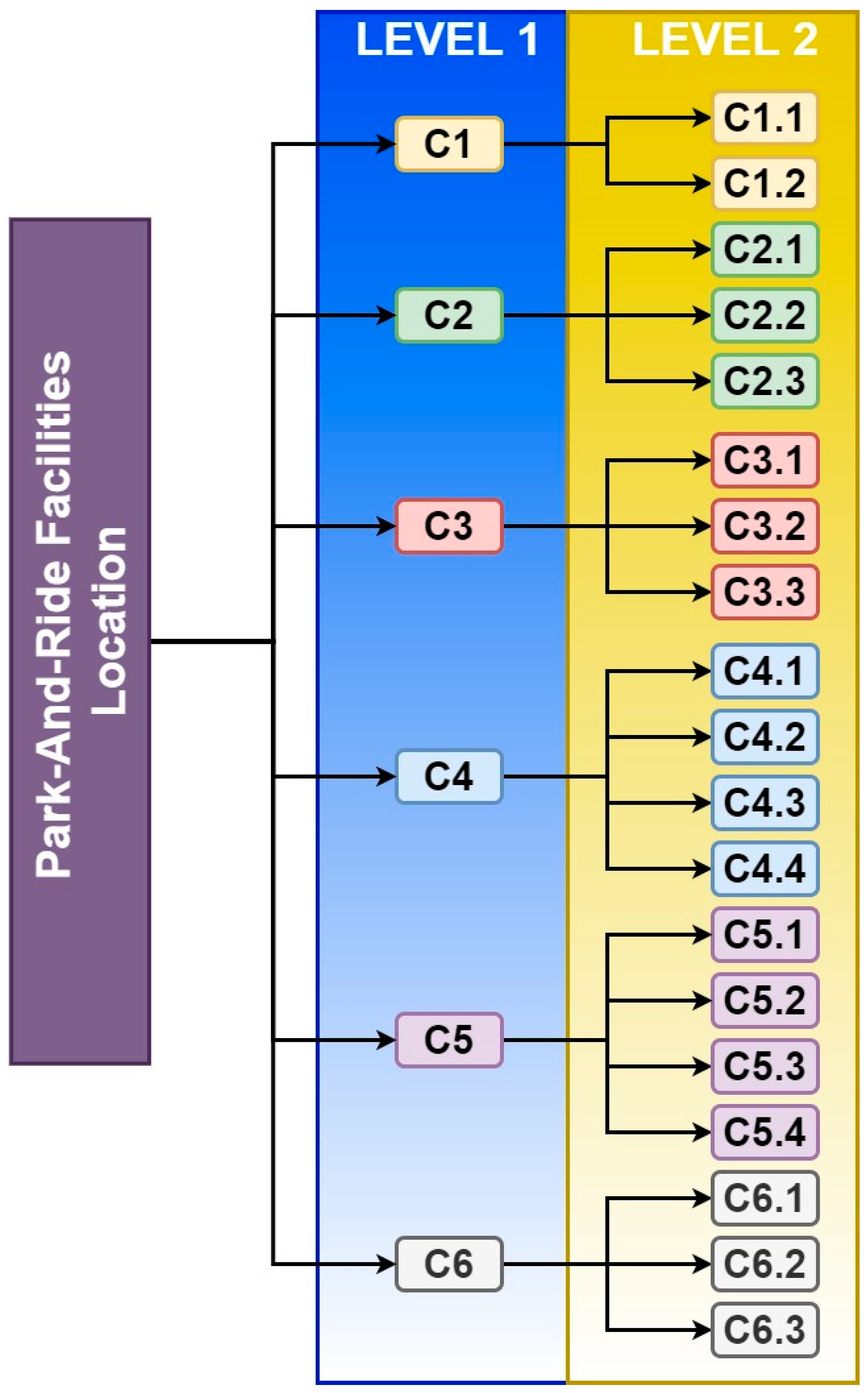
| “Distance” | One of the key factors for the place of a facility in the P&R is the distance criterion. | C1 |
| “Traffic conditions on the route (origin–destination)” | The traffic from the origin to the destination at varying hours of the day, merging two transport modes belonging to the P&R system (private car and public transport). | C2 |
| “Accessibility of public transport”. | Represents the aspects related to the second portion of the journey by the P&R, which is by public transport. | C3 |
| “Transport aspects”. | The P&R system is considered a transport mode and therefore involves the detailed study of aspects related to transport planning. | C4 |
| “Economic” | Economic evaluation is a criterion used to determine the feasibility of the project. | C5 |
| “Environmental” | In recent years, this criterion has become a significant element for the implementation of a P&R. | C6 |
| Explanation | Description | Criteria Code |
|---|---|---|
| “Distance from the zones to the P&R system”. | The cities are split into areas, which are the origin of P&R travel. The criteria apply to the distance between P&R and zones. | C1.1 |
| “Distance from P&R system to central business district”. | The distance between the P&R system and the CBD. | C1.2 |
| “Time of travel by private car”. | The first portion of the P&R journey is the time that the user of a private vehicle dedicates to travel. | C2.1 |
| “Time of travel by public transport”. | This criterion applies to the second half of the journey; it is the time that the P&R user dedicates to public transport to arrive at their destination. | C2.2 |
| “Time of travel by P&R system”. | This criterion applies to the idea that a P&R should be a transport mode that allows a modal transfer; thus, travel time via the P&R system depends on the facility’s location. | C2.3 |
| “Frequency of public transport operations”. | The public transport frequency is a fundamental criterion that determines the accessibility level of the P&R system. | C3.1 |
| “Transfer time from P&R to public transport stop”. | A facility is situated near the public transit station; therefore, transfer time is considered a criterion. | C3.2 |
| “The distance of the P&R from the nearest public transport stop”. | According to the P&R location principle, the facilities are near the public transport stations; the P&R’s distance from the public transport station must be viewed as a criterion. | C3.3 |
| “Reduction of trips by private car in CBD”. | When introduced, the P&R system helps to minimize private car journeys to the CBD. | C4.1 |
| “Increase of demand by public transport in CBD”. | In order to reach their destination, the users of the P&R system make the second portion of the journey through the public transport system; thus, the demand increases in the system. | C4.2 |
| “Number of public transport connections available”. | The P&R is linked to public transport; therefore, public transport lines or connections are a criterion for the system’s success. | C4.3 |
| “Demand for parking at a P&R system”. | The essential factor for the implementation of a transportation system is the demand. | C4.4 |
| “Cost of implementation for the project”. | The criterion corresponds to the cost of the project to develop the P&R system. | C5.1 |
| “Cost of land use”. | The land use costs can alter the P&R system location. | C5.2 |
| “Cost of the implementation of the telecommunication infrastructure”. | Moreover, the P&R system includes the communication of the number of spaces usable, the link to public transport, and the intelligent system’s operation. | C5.3 |
| “Total cost of investment maintenance”. | Maintenance is an expense to ensuring the operation of the system over time. | C5.4 |
| “CO2 reduction”. | CO2 reductions are centered on the criterion that the P&R is able to reduce the undesirable effects of the private vehicle through reduced trips to the CBD. | C6.1 |
| “Noise reduction”. | The P&R eliminates the negative consequences of private cars, such as the level of noise. | C6.2 |
| “Area occupied by existing green areas”. | This criterion is correlated with the assumption that P&R is used where green areas exist. | C6.3 |
| 1 | 2 | 3 | 4 | 5 | 6 | 7 | 8 | 9 | |
|---|---|---|---|---|---|---|---|---|---|
| 0 | 0.44 | 1.0 | 1.63 | 2.3 | 3.0 | 3.73 | 4.47 | 5.23 |
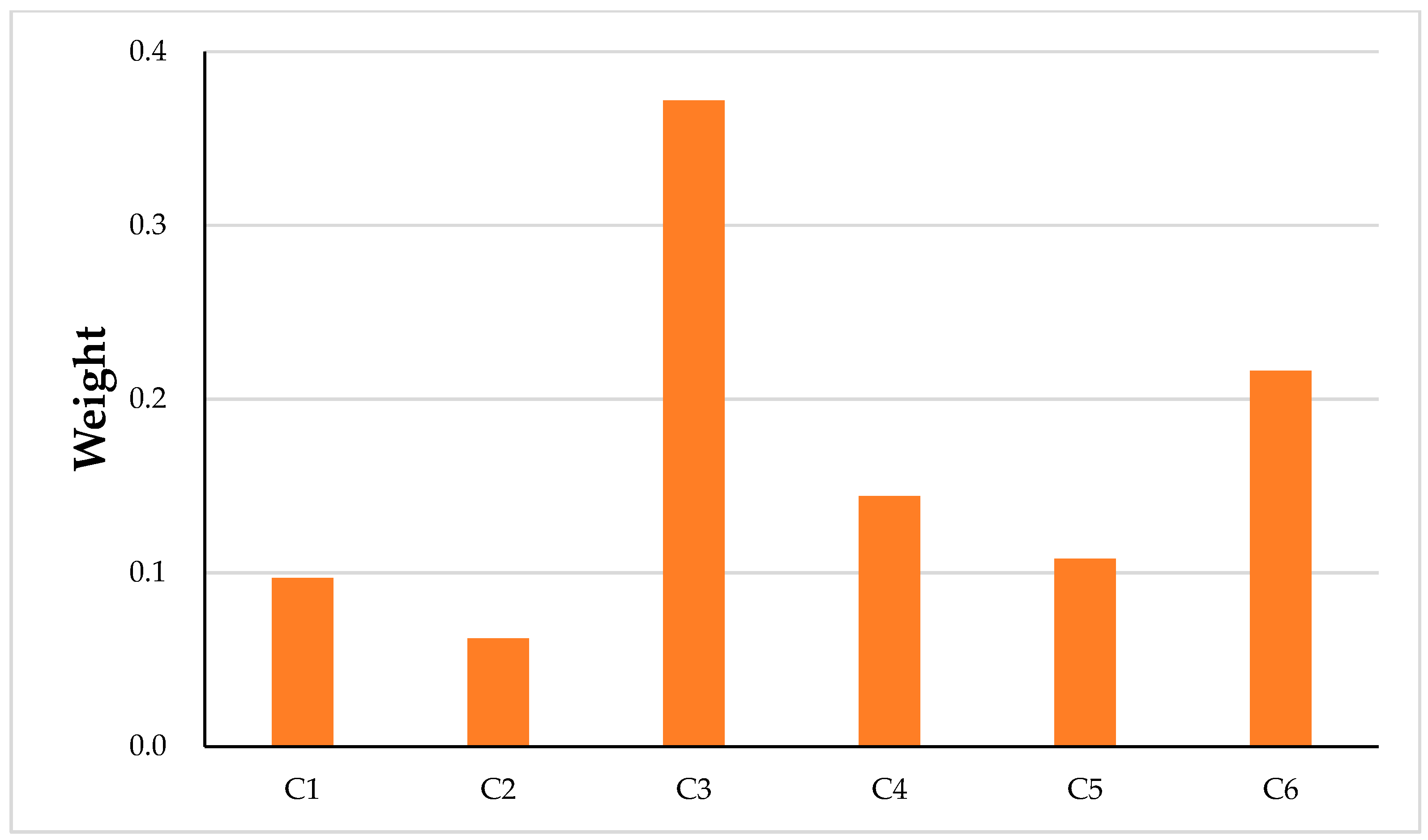
| Main Criteria | Sub-Criteria | Rank | Global Weight | Rank |
|---|---|---|---|---|
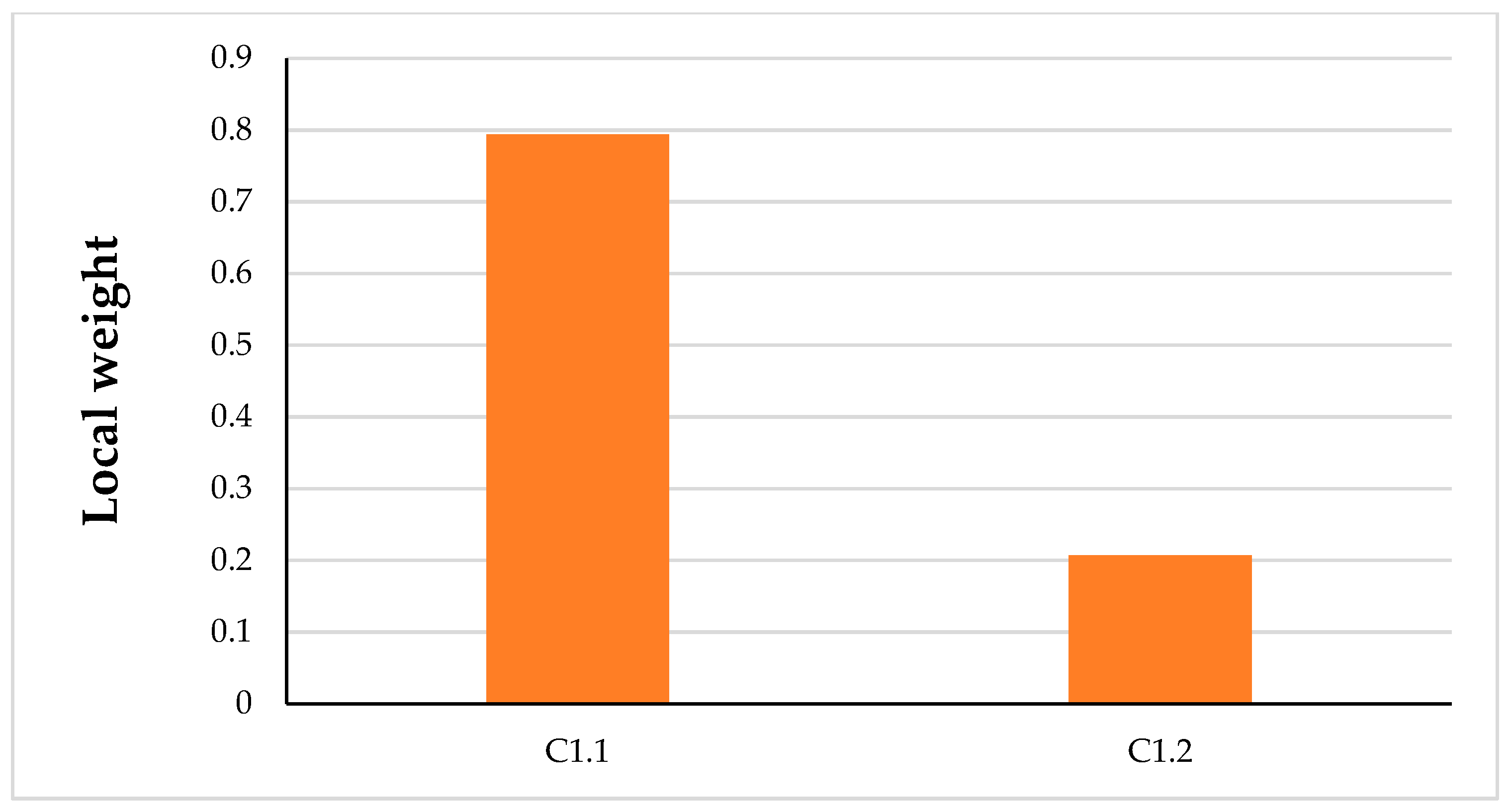
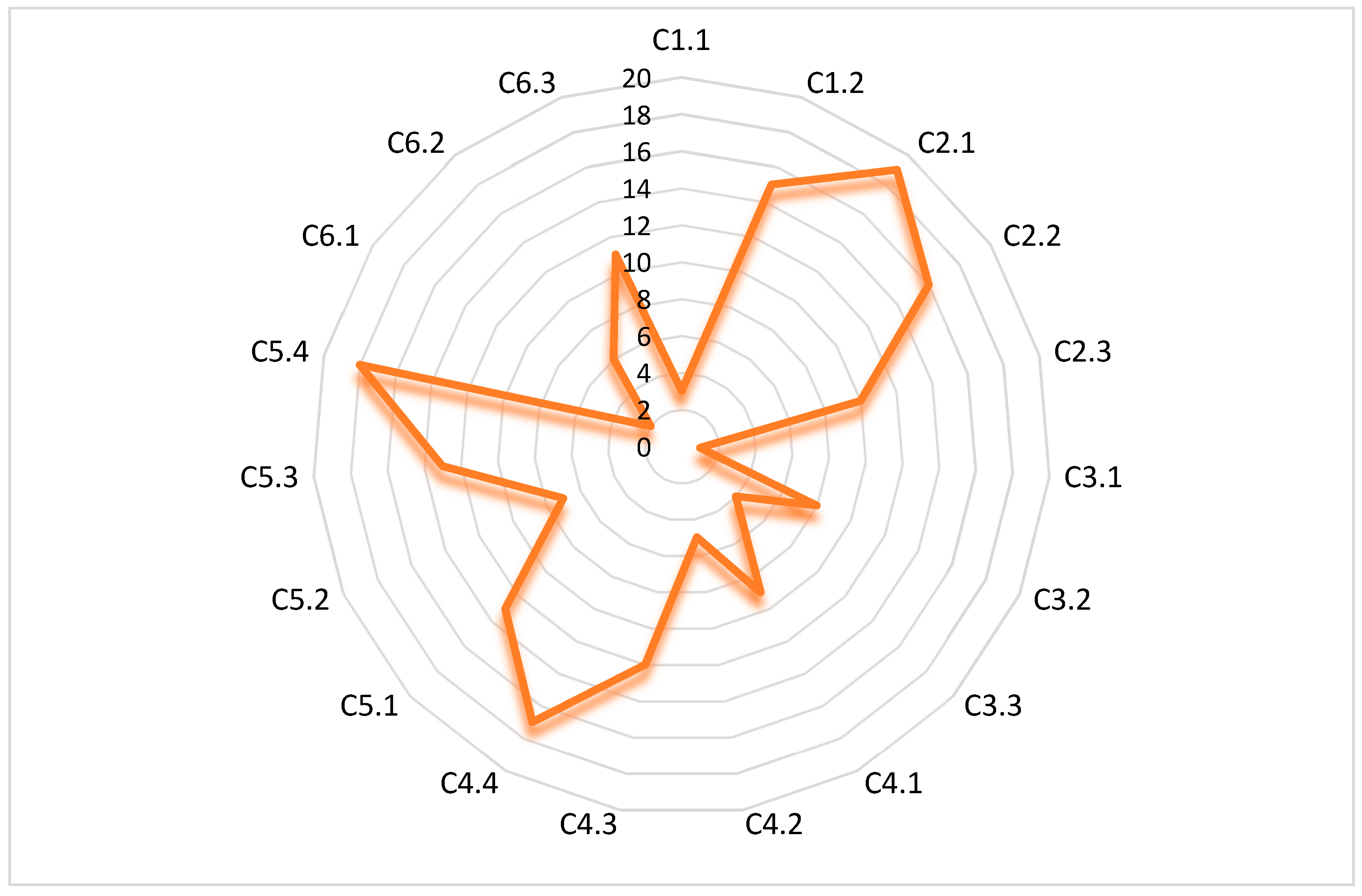
| C1 | C1.1 | 1 | 0.0771 | 3 |
| C1.2 | 2 | 0.0201 | 15 | |
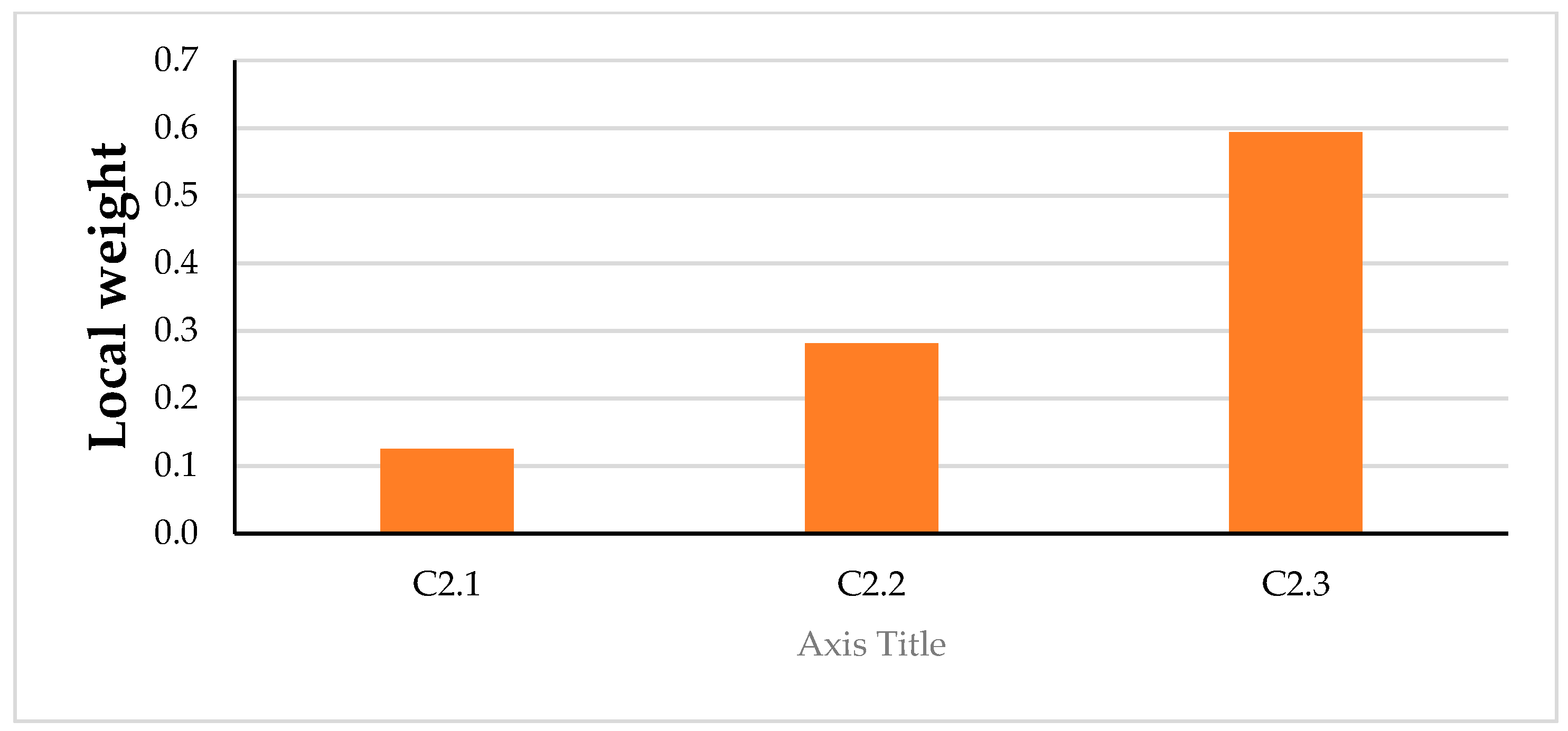
| C2 | C2.1 | 3 | 0.0078 | 19 |
| C2.2 | 2 | 0.0175 | 16 | |
| C2.3 | 1 | 0.0369 | 10 | |
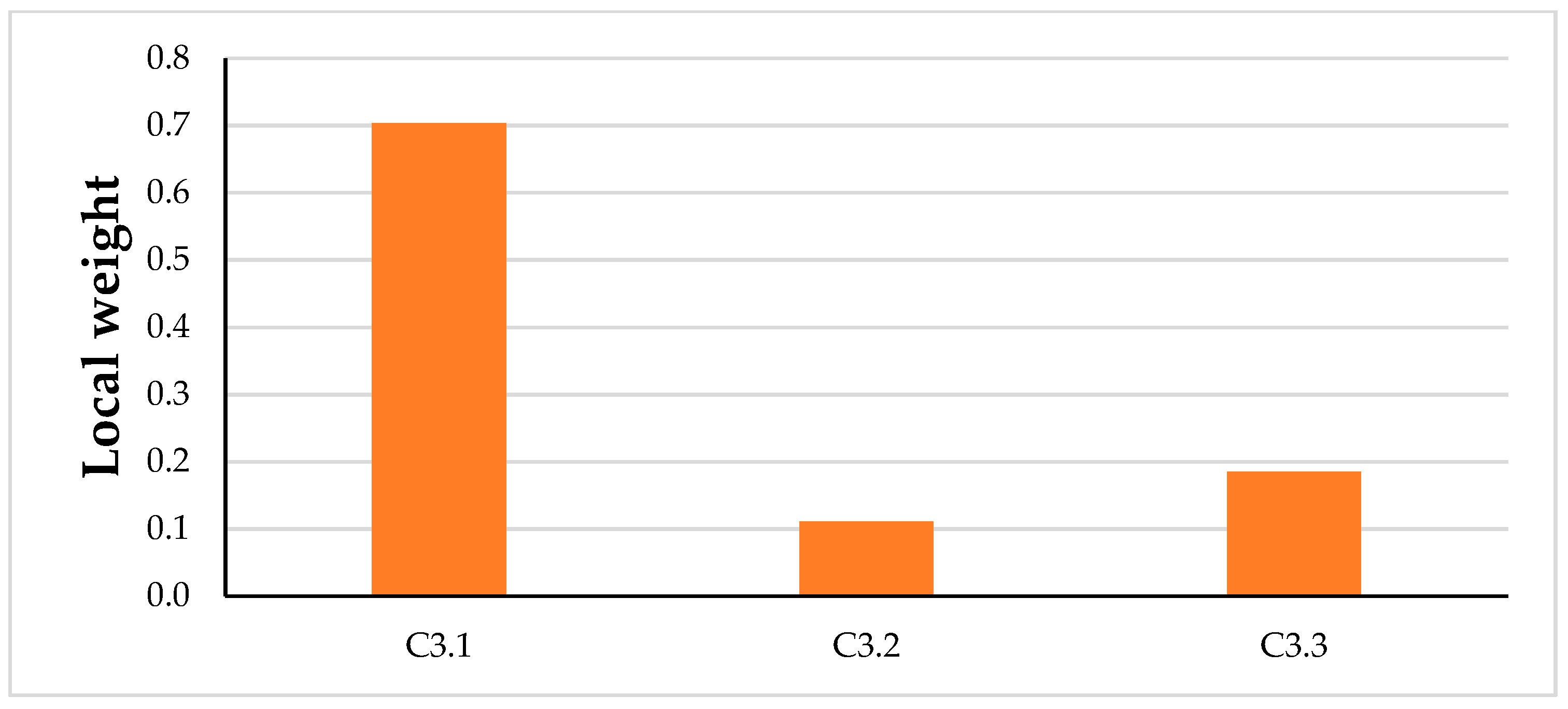
| C3 | C3.1 | 1 | 0.2617 | 1 |
| C3.2 | 3 | 0.0414 | 8 | |
| C3.3 | 2 | 0.0688 | 4 | |
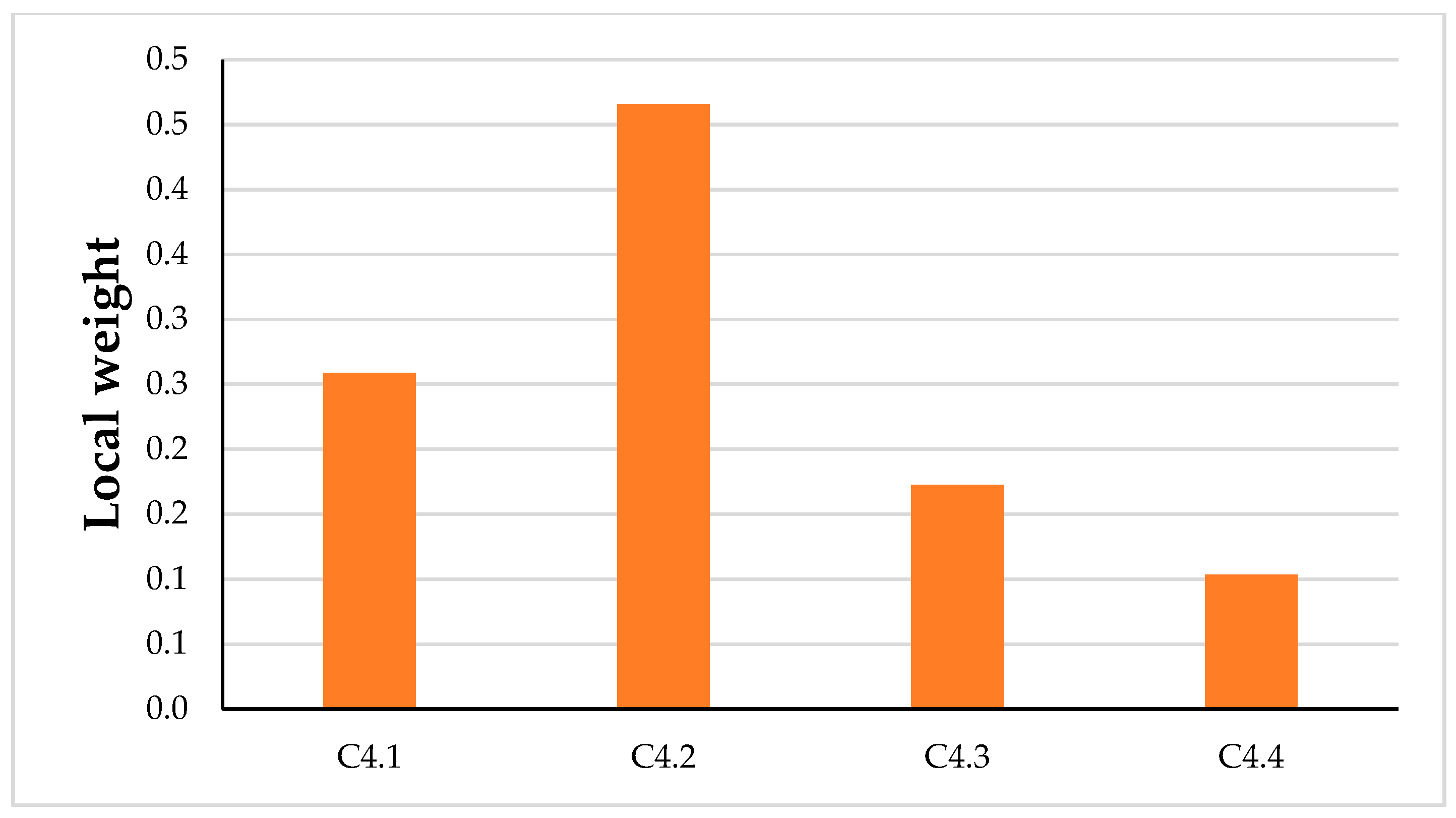
| C4 | C4.1 | 2 | 0.0373 | 9 |
| C4.2 | 1 | 0.0671 | 5 | |
| C4.3 | 3 | 0.0249 | 12 | |
| C4.4 | 4 | 0.0149 | 17 | |
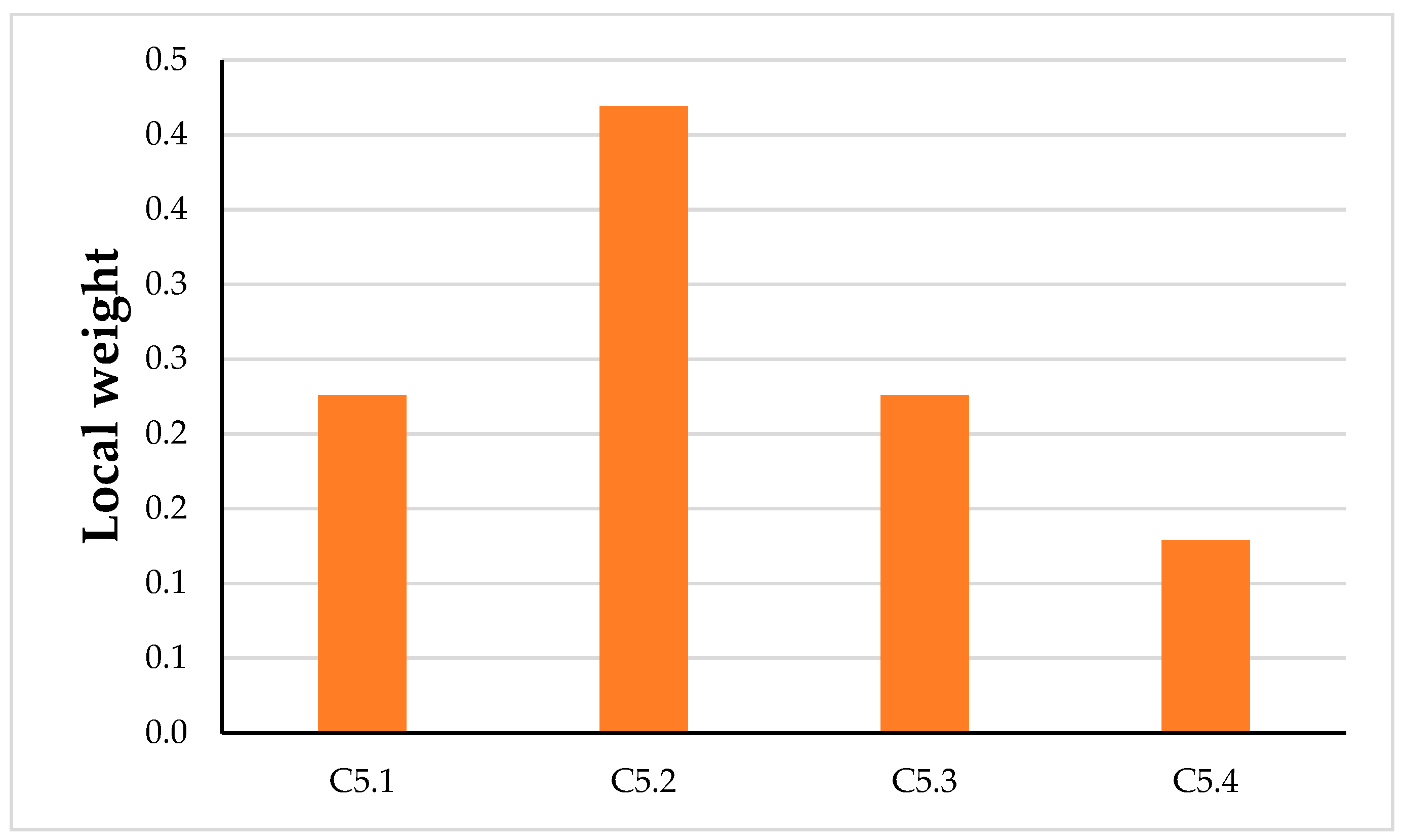
| C5 | C5.1 | 2 | 0.0246 | 13 |
| C5.2 | 1 | 0.0454 | 7 | |
| C5.3 | 3 | 0.0244 | 14 | |
| C5.4 | 4 | 0.0140 | 18 | |
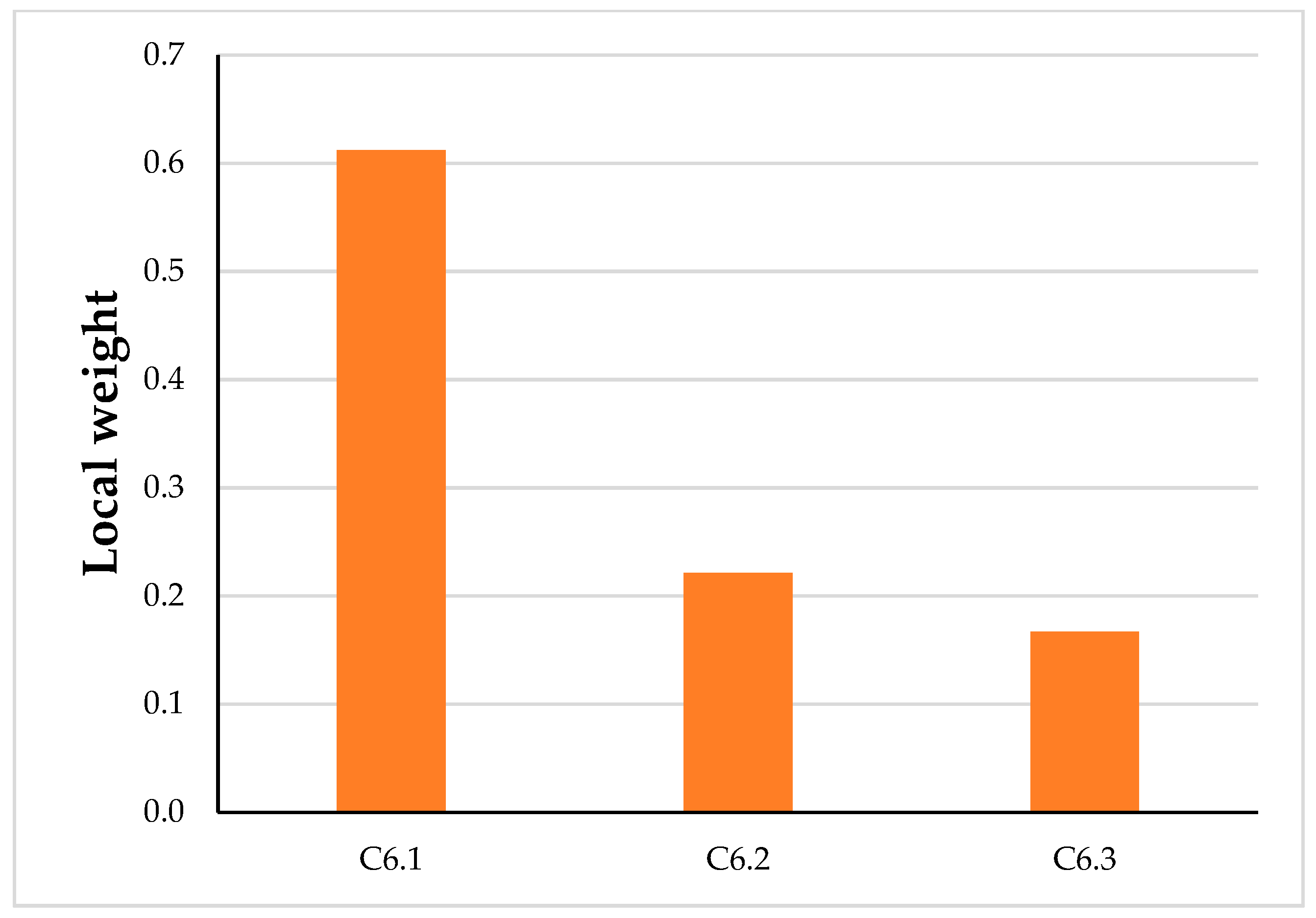
| C6 | C6.1 | 1 | 0.1325 | 2 |
| C6.2 | 2 | 0.0478 | 6 | |
| C6.3 | 3 | 0.0361 | 11 |
Publisher’s Note: MDPI stays neutral with regard to jurisdictional claims in published maps and institutional affiliations. |
© 2020 by the authors. Licensee MDPI, Basel, Switzerland. This article is an open access article distributed under the terms and conditions of the Creative Commons Attribution (CC BY) license (http://creativecommons.org/licenses/by/4.0/).
Share and Cite
Ortega, J.; Moslem, S.; Tóth, J.; Péter, T.; Palaguachi, J.; Paguay, M. Using Best Worst Method for Sustainable Park and Ride Facility Location. Sustainability 2020, 12, 10083. https://doi.org/10.3390/su122310083
Ortega J, Moslem S, Tóth J, Péter T, Palaguachi J, Paguay M. Using Best Worst Method for Sustainable Park and Ride Facility Location. Sustainability. 2020; 12(23):10083. https://doi.org/10.3390/su122310083
Chicago/Turabian StyleOrtega, Jairo, Sarbast Moslem, János Tóth, Tamás Péter, Juan Palaguachi, and Mario Paguay. 2020. "Using Best Worst Method for Sustainable Park and Ride Facility Location" Sustainability 12, no. 23: 10083. https://doi.org/10.3390/su122310083
APA StyleOrtega, J., Moslem, S., Tóth, J., Péter, T., Palaguachi, J., & Paguay, M. (2020). Using Best Worst Method for Sustainable Park and Ride Facility Location. Sustainability, 12(23), 10083. https://doi.org/10.3390/su122310083