

Systemic Sustainable Development in the Transport Service Sector


Abstract
1. Systemic Sustainable Development—Introduction
- is a type of socio-economic development, pursued by and for man, aiming at environmental and socioeconomic egalitarianism,
- is a process that integrates all human activities, commonly seen in three dimensions: economic, social, and environmental, and less frequently extended to spatial or institutional (political) dimensions,
- means a desirable living environment and a responsible society that implements the concept of intra- and intergenerational order [14].
2. Research Methodology—Materials and Methods
- 100% of buses meet the EURO – (European emission standards),
- at least 50% of vehicles are powered by CNG—(compressed natural gas),
- at least 50% of vehicles are used for less than 5 years.
3. Sustainable Transport Development in the European Union—Results of Desk Research
- Mobility, transport, and infrastructure
- Environment, energy, and resources
- Safety and security.
- coordination of integrated urban transport and private vehicles for ready access of citizens to convenient transportation;
- urban deliveries or long-distance hauling as part of goods transport and logistics making efficient use of infrastructure;
- better integration of land-use developments with transport planning in order to eliminate unnecessary demand for transport and parking;
- increased cohesion of urban strategies and urban transport planning taking into account environmental and social dimensions;
- development of prediction models taking into account citizens’ transport behaviour and analysing the impact of e-services on that behaviour;
- appropriate location of warehouses and local logistics centres;
- creation of new concepts for environmentally friendly road vehicles providing transport services;
- development of new concepts in the context of safety, noise reduction, and cleanliness in urban transport, especially operating at night;
- integration of different modes of passenger and freight transport through the development of multi-purpose vehicle concepts (e.g., postal bus) and intermodal transport concepts, as well as the possibility of their flexible use in multiple configurations.
- development of renewable and alternative low-carbon fuels together with advanced vehicle powertrains contributing to security of energy supply and environmental improvement;
- improvements to vehicles, tyres, and infrastructure to reduce transport noise by 10 dB;
- more efficient traffic management, changes in driving behaviour for the development of systems using artificial intelligence and reducing energy use;
- improved vehicle efficiency and reduced pollutant emissions as a result of the development of low-carbon and hydrogen fuels.
- development of the road infrastructure that is easily understood and designed to minimize road user mistakes and limit their consequences;
- further development of vehicle safety systems to prevent accidents and mitigate their effects;
- protection of sensitive parts of urban areas by reducing unnecessary vehicle traffic in such places;
- development of theft deterrent systems in vehicles;
- improved personal safety systems without violating citizens’ privacy (biometrics features).
- building an integrated and interconnected transport network for a competitive economy;
- improving the organization and management of the transport system;
- implementing changes in individual and collective mobility (e.g., promotion of public transport);
- improving the safety of traffic participants and transported goods;
- reducing the negative impact of transport on the environment;
- boosting the efficient use of public funds in transport projects.
4. Dimensions of Systemic Sustainable Transport Development—Results of Desk and Field Research
5. Discussion and Conclusions
- The compatibility of intelligent development and sustainable development found its reflection in the works of the European Commission that indicated three priorities in the document “Europe 2020. A strategy for smart, sustainable and inclusive growth”:
- smart growth: development of knowledge and innovation-based economy;
- sustainable growth: support for the economy that uses resources efficiently, is more environmentally friendly and more competitive;
- This definition was adopted by the European Conference of Ministers of Transport in 2004 and by the Centre for Sustainable Transportation in 2005. It is the definition of choice for many experts, including the Transportation Research Board’s Sustainable Transportation Indicators Subcommittee and the European Council of Ministers of Transport, as well as the Canadian Centre for Sustainable Transportation.
- Electromobility embraces the entirety of issues relating to the use of electric vehicles (EV). The term “electromobility” refers to both technical and operational aspects of EV, charging technology and infrastructure, as well as socio-economic and legal issues related to the design, manufacture, acquisition, and use of electric vehicles. The Electromobility Development Plan envisages steps towards building infrastructure that will ensure the functionality of the electric car equal to that of the combustion engine. The Electromobility Development Programme defines multifaceted objectives to be achieved through the development of electromobility in Poland: support for the development of the electromobility ecosystem (by, for example, defining the boundaries of the development of a new economic system), increased demand for other alternative fuels (e.g., liquefied and compressed natural gas), benefits to public transport, innovative entrepreneurs building the infrastructure, vehicle manufacturers and, above all, drivers [32,33].
- Intelligent Transportation Systems (ITS) cover a wide range of tools based on information technology, wireless communication, and vehicle electronics, which ensure efficient and effective management of transport infrastructure and passenger service. Intelligent Transport Systems are built using connections between a variety of telematics concepts, which people can control with special tools. ITS combines electronics, telecommunications, and information technologies with transport engineering in order to plan, design, operate, maintain, and manage transport systems [33,34].
- Intermodal (combined) transport—transportation of passengers/freight using more than one mode of transport. Combined transport in practice usually consists of combining road transport with rail transport. In the classic definition of intermodal transport, the transport process involves moving goods with different means of transport or moving goods in the same vehicle on the whole route in the case of a door-to-door arrangement. The concept of intermodality adopts a deeper meaning in the age of sharing, reducing consumption, and making life greener. This is manifested in integrated bike sharing, car sharing, park and ride, and pre-paid Transport Service Cards. This approach to intermodality is supported by the development of applications such as: mytaxi, movel, Nextbike, and others. Additionally, such practices lead to a decreased use of passenger cars and rationalization of transport as well as counteracting many other civilization-related consequences [34].
- The article was inspired by a master’s thesis written by D. Pajunk and entitled “Integration of Public Transport for the Concept of Balanced Development of the Service Sector”; University of Economics, 2020, supervisor prof. UE dr hab. Izabela Sztangret
Funding
Conflicts of Interest
References
- UNCED. Agenda 21; United Nations Conference on Environment and Development (UNCED) United Nations: Rio de Janeiro, Brazil, 1992. [Google Scholar]
- Kates, R.W.; Corell, R.; Hall, J.M.; Jaeger, C.C.; Lowe, I.; McCarthy, J.J.; Schellnhuber, H.J.; Bolin, B.; Dickson, N.M.; Faucheux, S.; et al. Sustainability Science. Science 2001, 292, 641. [Google Scholar] [CrossRef] [PubMed]
- Stappen, R. Raport Brundtland; Brundtland Report; Oxford University Press: New York, NY, USA, 2006. [Google Scholar]
- Gallopín, G. A Systems Approach to Sustainability and Sustainable Development; Sustainable Development and Human Settlements Division ECLAC/Government of the Netherlands Project NET/00/063 “Sustainability Assessment in Latin America and the Caribbean” Medio Ambiente y Desarrollo 64 Santiago, Chile, March. 2003. Available online: https://repositorio.cepal.org/bitstream/handle/11362/5759/S033119_en.pdf (accessed on 4 May 2020).
- Gerwin, M. Plan Zrównoważonego Rozwoju dla POLSKI: Lokalne Inicjatywy Rozwojowe. Sustainable Development Plan for Poland: Local Developmental Initiatives. Available online: http://www.sopockainicjatywa.org/earth/pdf/LIR-new.pdf (accessed on 11 June 2020).
- Kozłowski, S. Przyszłość Ekorozwoju. The Future of Eco-Development; John Paul II Catholic University of Lublin: Lublin, Poland, 2005. [Google Scholar]
- Cruz, I.; Stahel, A.; Max-Neef, M. Towards A Systemic Development Approach: Building on the Human-Scale Development Paradigm. Ecol. Econ. 2009, 68, 2021–2030. [Google Scholar] [CrossRef]
- Spruill, N.; Kenney, C.; Kaplan, L. Community Development and Systems Thinking: Theory and Practice. Natl. Civ. Rev. 2001, 90, 2001. [Google Scholar] [CrossRef]
- Flander, K.; Brugmann, J. Pressure-Point Strategy: Leverages for Urban Systemic Transformation. Sustainability 2017, 9, 99. [Google Scholar] [CrossRef]
- Sala, S.; Ciuffo, B.; Nijkamp, P. A Systemic Framework for Sustainability Assessment. Ecol. Econ. 2015, 119, 314. [Google Scholar] [CrossRef]
- Ehrenfeld, J.R. Sustainability by Design: A Subversive Strategy for Trans forming Our Consumer Culture New Haven; Yale University Press: London, UK, 2008. [Google Scholar]
- Werbach, A. Strategy for Sustainability: A Business Manifesto; Harvard Business Press: Boston, MA, USA, 2008. [Google Scholar]
- Pezzey, J.C.V.; Toman, M.A. The Economics of Sustainability. Rev. J. Artic. 2002. [Google Scholar] [CrossRef]
- Borys, T.; Brzozowski, T. Analiza istniejących danych statystycznych pod kątem ich użyteczności dla określenia poziomu zrównoważonego rozwoju transportu wraz z propozycją ich rozszerzenia. Raport z realizacji ekspertyzy. Jelenia Góra-Warszawa. Logistyka 2014, 3, 7254–7260. [Google Scholar]
- Ciegis, R.; Ramanauskiene, J.; Martinkus, B. The Concept of Sustainable Development and its Use for Sustainability Scenarios. Econ. Cond. Enterp. Funct. 2009, 62, 2. [Google Scholar]
- White Paper, IV. Rationalizing Urban Transport, and: ANNEX IV: Technological Developments and Intelligent Transport Systems. 2000. Available online: https://ec.europa.eu/transport/sites/transport/files/themes/strategies/doc/2001_white_paper/lb_com_2001_0370_en.pdf (accessed on 11 November 2020).
- Seidler, R.; Bawa, K.S. Dimensions of Sustainable Development; Encyclopedia of Life Support Systems (EOLSS); University of Massachusetts Boston: Boston, MI, USA, 2019. [Google Scholar]
- Banister, D. The Sustainable Mobility Paradigm. Transp. Policy 2008, 15, 73–80. [Google Scholar] [CrossRef]
- Feitelson, E. Introducing Environmental Equity Dimensions into the Sustainable Transport Discourse: Issues And Pitfalls. Transp. Res. Part D Transp. Environ. 2002, 7, 99–118. [Google Scholar] [CrossRef]
- Communication from the Commission to the European Parliament, the Council, the European Economic and Social Committee and the Committee of the Regions A Resource-Efficient Europe–A Flagship Initiative under the Europe 2020 Strategy. Available online: http://ww.w.xploit-eu.com/pdfs/Europe%202020%20Flagship%20Initiative%20INNOVATION.pdf (accessed on 11 November 2020).
- White Paper: Roadmap to a Single European Transport Area–Towards a Competitive and Resource Efficient Transport System. COM. Available online: https://eur-lex.europa.eu/legal-content/EN/ALL/?uri=CELEX%3A52011DC0144 (accessed on 11 November 2020).
- Strategy for Sustainable Transport Development to 2030 Adopted with the Resolution No. 105/2009 of the Council of Ministers as of 24 September 2019 (M.P. Item 1054). Available online: https://constructionmarketexperts.com/en/news/a-new-transport-development-strategy-adopted-by-the-government/ (accessed on 11 November 2020).
- Kiełczewski, D.; Dobrzyńska, B. Ekologiczne problemy zrównoważonego rozwoju, Wyd. Wyższej Szkoły Ekonomicznej w Białymstoku, Białystok. Available online: https://epnp.pl/ebook/A04533_ekologiczne_problemy (accessed on 11 November 2020).
- Transport Development Strategy to 2020 (towards 2030) (2013), Resolution No. 6 of the Council of the Ministers (M.P. 2013 item 75). 2013. Available online: http://isap.sejm.gov.pl/DetailsServlet?id=WMP20130000075 (accessed on 25 March 2017).
- Motowidlak, U. Rozwój transportu a paradygmat zrównoważonego rozwoju; Studia Ekonomiczne. Zeszyty Naukowe Uniwersytetu Ekonomicznego w Katowicach ISSN 2083-8611 No. 337. 2017. Available online: http://cejsh.icm.edu.pl/cejsh/element/bwmeta1.element.cejsh-580fb08d-31a0-4518-8e0b-ee23cf6c55f5 (accessed on 11 November 2020).
- ERTRAC. European Road Transport Research Advisory Council. Available online: https://www.earpa.eu/earpa/36/ertrac.html (accessed on 11 November 2020).
- Europe 2020. Flagship Initiatives, European Commission. Available online: www.ec.europa.eu (accessed on 28 March 2019).
- Europe 2020. A Strategy for Smart, Sustainable and Inclusive Growth; European Commission: Brussels, Belgium, 2020; p. 5. [Google Scholar]
- Żabiński, L. Marketing of Systemic Products; PWE: Warsaw, Poland, 2010. [Google Scholar]
- Zaremba, P. Plan Rozwoju Elektromobilności w Polsce ‘Energia do przyszłości’, Ministerstwo Energii Rzeczpospolitej Polskiej. Law Electromobility Altern. Fuels 2018, 17, 317. [Google Scholar]
- The Act of 27 April 2001, The Environmental Protection Law. Available online: https://www.global-regulation.com/translation/poland/10093814/the-act-of-27-april-2001%252c-the-environmental-protection-law.html (accessed on 11 November 2020).
- Koźlak, A. Inteligentne Systemy Transportowe Jako Instrument Poprawy Efektywności Transportu; Uniwersytet Gdański: Gdańsk, Poland, 2008. [Google Scholar]
- Bławat, D.; Kalkowski, K. Transport Intermodalny w Polsce–Teraźniejszość i Przyszłość. Available online: https://www.researchgate.net/profile/Krzysztof_Kalkowski/publication/267981316_Transport_intermodalny_w_Polsce_-_terazniejszosc_i_przyszlosc/links/545e663c0cf295b561602d97/Transport-intermodalny-w-Polsce-terazniejszosc-i-przyszlosc.pdf (accessed on 11 November 2020).
- Leksykon Transportowy, Wyd. TIMOCOM. Available online: https://www.timocom.pl/lexicon/leksykon-transportowy/transport-intermodalny (accessed on 12 June 2020).

| Specification | Characteristics |
|---|---|
| research methodology | the analysis of industry journals, websites, sponsored interviews, personal interviews |
| surveys, electronic survey with 46 managers in public transport companies | |
| direct interview, CATI (computer-assisted telephone interviewing) in 16 Regional Transport Infrastructure Departments | |
| character of research | exploratory research |
| sample selection | targeted selection of typical units, based on rankings in trade journals |
| sample size | 46 (firms)/16 (infrastructure departments) |
| over 100 websites of public passenger transport companies, including utilities, organizations associating entities from the transport service sector, industry associations, municipal halls; the website of Poland’s Ministry of Infrastructure, Mobility and Transport—the EU’s website | |
| geographical scope | EU |
| time scope | 2017–2020 |
| Principle | Interpretation |
|---|---|
| 1. Structuring demand for transport and developing ways to satisfy it. | curbing the growth in traffic and transport services in some transport subsystems, limiting the length of journeys, and division of transport tasks |
| 2. Promoting energy-efficient and less environmentally damaging modes and forms of transport | priority for rail, maritime, and inland waterway transport, the use of electromobility, bicycles, and pedestrian traffic |
| 3. Restoring the balance of needs | it addresses the needs of international, national, regional, and local transport, as well as its compatibility and intermodality |
| 4. Rationalising transit traffic | integration of routes or nodes of the transit network into the national network |
| 5. Keeping the right proportions | it concerns balancing the further development of infrastructure with the maintenance and repairs of existing resources |
| 6. The division of roles in management, market regulation and privatisation | it includes leaving as many market segments as possible free to market play, supporting local governments in their role of organizing public transport on a local and regional scale, creating joint state and local government programmes and projects |
| 7. Financing of transport infrastructure | deployment of integrated forms of payment, remote handling and e-ticketing |
| 8. Privatization | support for further privatisation of non-urban, suburban and urban bus transport, as well as privatisation of passenger and freight rail transport, airports, and local public transport |
| Symbol | Area | Symbol | Action | Action Labelled by Respondents | Number of First Choices Responses in % | Main Dimensions of Sustainability According to Respondents | Policy Priorities of Local Governments Responses in % | Main Dimensions of Sustainability According to the EU |
|---|---|---|---|---|---|---|---|---|
| A | use of alternative fuels and new powertrain technologies | A1 | development of infrastructure providing alternative fuels | B, S, E | 4 | B−, E++, S+ | 60 | B−, E+, S+ |
| A2 | reduced prices of alternative fuels | B, S | 4 | B+, S++ | 2 | B+, S+ | ||
| A3 | increased production of low-carbon vehicles | B, S, E | 11 | B+, E++, S+ | 12 | B−, E+, S+ | ||
| A4 | job creation | B, S | 1 | B+, S++ | 34 | B+, S+ | ||
| B | energy efficiency | B1 | reduced consumption of traditional fuels | B, E | 2 | B−, E++ | 12 | B+, E+ |
| B2 | electromobility | B, E | 17 | B++, E++ | 54 | B−, E++, S+ | ||
| C | transport logistics | C1 | interoperability and integrity of the transport system | B, S, E | 1 | B+, S+, E+ | 11 | B+, E+, S++ |
| C2 | transport optimization and intermodality | E, B, S | 14 | B+, E++, S+ | 54 | B++, E++ | ||
| C3 | full competition | B, S | 1 | B+, S+ | 6 | B+, S+ | ||
| D | transport infrastructure | D1 | alternative citizen mobility and interchange stations | B, S, E | 1 | B+, S+, E++ | 51 | S+ |
| D2 | reduced congestion; traffic monitoring and control systems | B, S, E | 1 | B+, S+, E++ | 49 | B+, E+, S+ | ||
| D3 | improved urban traffic, ITS | B, S, E | 15 | B+, S+, E+ | 49 | E+, S+ | ||
| E | pro-environmental policy | E1 | exhaust emission and noise norms | E | - | E++ | 1 | E+ |
| E2 | promotion of mobility culture | E | 10 | E++ | 11 | E+ | ||
| E3 | increased prices of traditional fuels | B, S, E | - | B−, S−−, E+ | 7 | B−, S−, E+ | ||
| E4 | promotion of alternative fuels | B, E | 2 | B−, E+ | 8 | B−, E+ | ||
| F | safety and working conditions | F1 | size, weight, and equipment of vehicles | B, E | - | B−, E+ | 8 | B−, E+, S+ |
| F2 | safety monitoring systems; tachographs | B, S | 1 | B−, S+ | 11 | B−, E+, S+ | ||
| F3 | social security of workers | S | 4 | S+ | 7 | S+ | ||
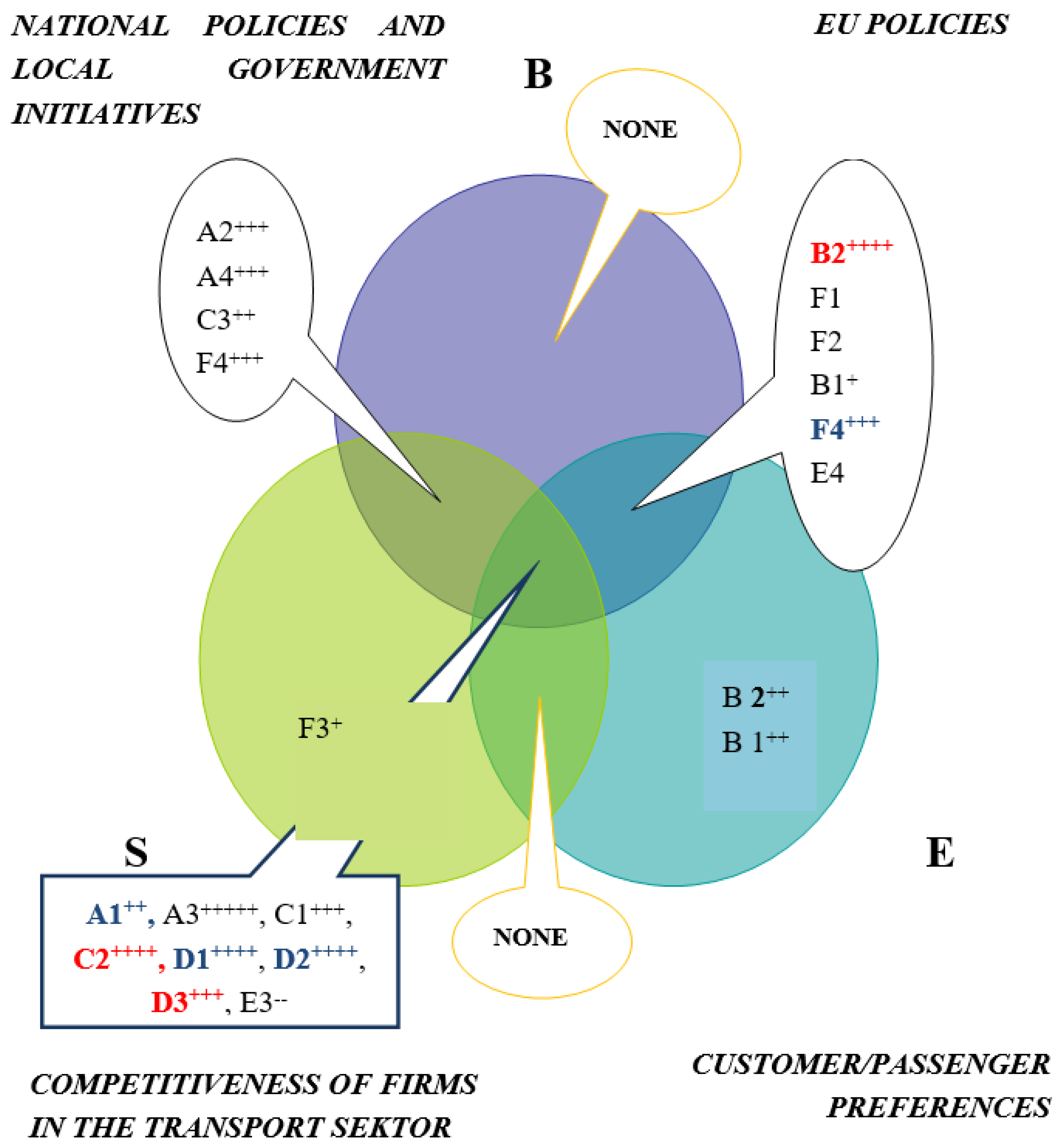
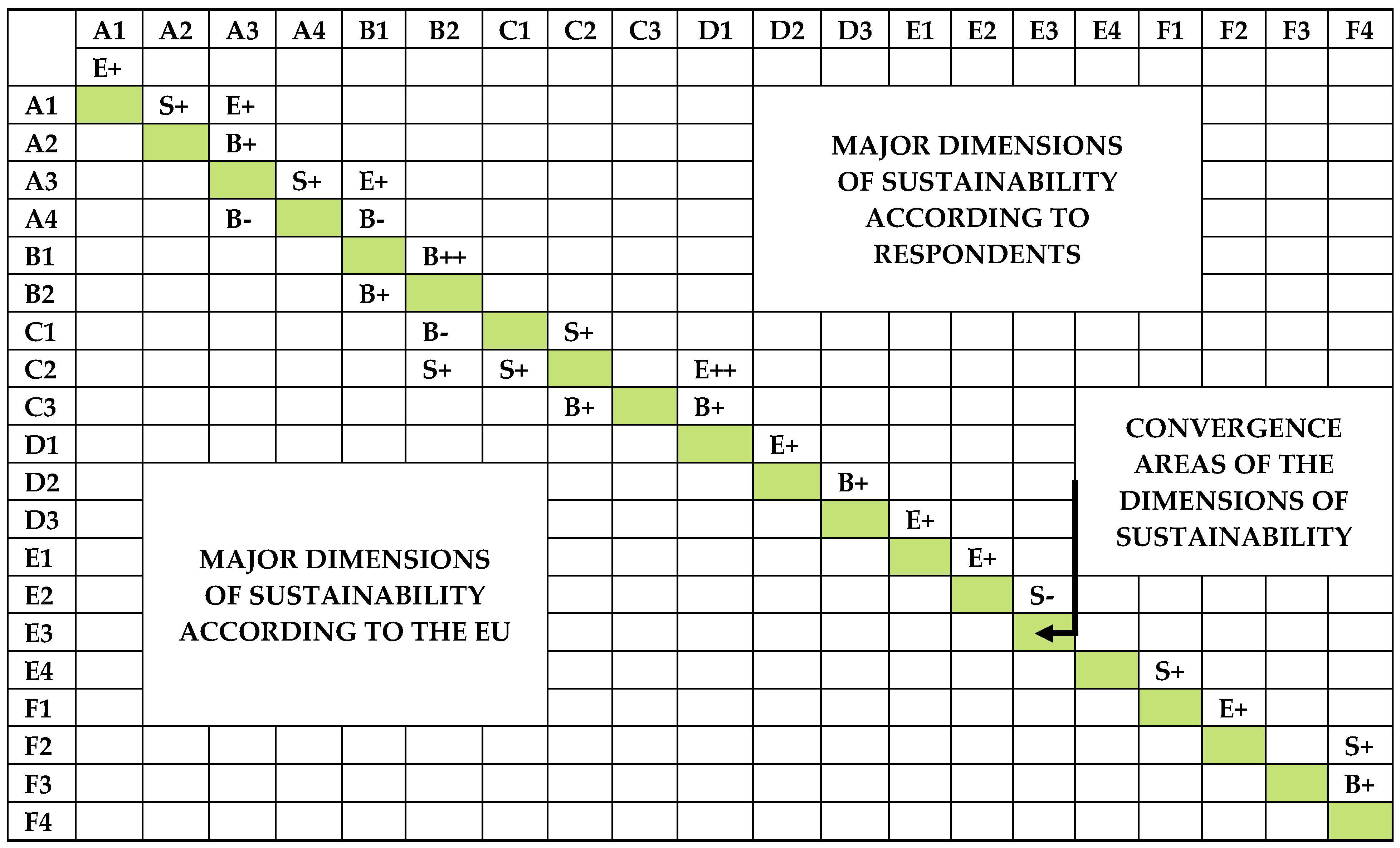
| F4 | passenger and/or cargo safety | B, S | 11 | B+, S++ | 41 | S+ |
Publisher’s Note: MDPI stays neutral with regard to jurisdictional claims in published maps and institutional affiliations. |
© 2020 by the author. Licensee MDPI, Basel, Switzerland. This article is an open access article distributed under the terms and conditions of the Creative Commons Attribution (CC BY) license (http://creativecommons.org/licenses/by/4.0/).
Share and Cite
Sztangret, I. Systemic Sustainable Development in the Transport Service Sector. Sustainability 2020, 12, 9525. https://doi.org/10.3390/su12229525
Sztangret I. Systemic Sustainable Development in the Transport Service Sector. Sustainability. 2020; 12(22):9525. https://doi.org/10.3390/su12229525
Chicago/Turabian StyleSztangret, Izabela. 2020. "Systemic Sustainable Development in the Transport Service Sector" Sustainability 12, no. 22: 9525. https://doi.org/10.3390/su12229525
APA StyleSztangret, I. (2020). Systemic Sustainable Development in the Transport Service Sector. Sustainability, 12(22), 9525. https://doi.org/10.3390/su12229525

