Article

The Best Bang for the Bucks: Rethinking Global Investment in Biodiversity Conservation

by
Sebastián Cordero
1,*,
Gabriel J. Castaño-Villa
2,3 and
Francisco E. Fontúrbel
1
1
Instituto de Biología, Facultad de Ciencias, Pontificia Universidad Católica de Valparaíso, Av. Universidad 330, Valparaíso 2373223, Chile
2
Grupo de Investigación en Ecosistemas Tropicales, Facultad de Ciencias Exactas y Naturales, Universidad de Caldas, C. 65 # 26-10, Manizales 170004, Colombia
3
Departamento de Desarrollo Rural y Recursos Naturales, Facultad de Ciencias Agropecuarias, Universidad de Caldas, C. 65 # 26-10, Manizales 170004, Colombia
*
Author to whom correspondence should be addressed.
Sustainability 2020, 12(21), 9252; https://doi.org/10.3390/su12219252
Submission received: 14 October 2020 / Revised: 1 November 2020 / Accepted: 2 November 2020 / Published: 6 November 2020

Abstract

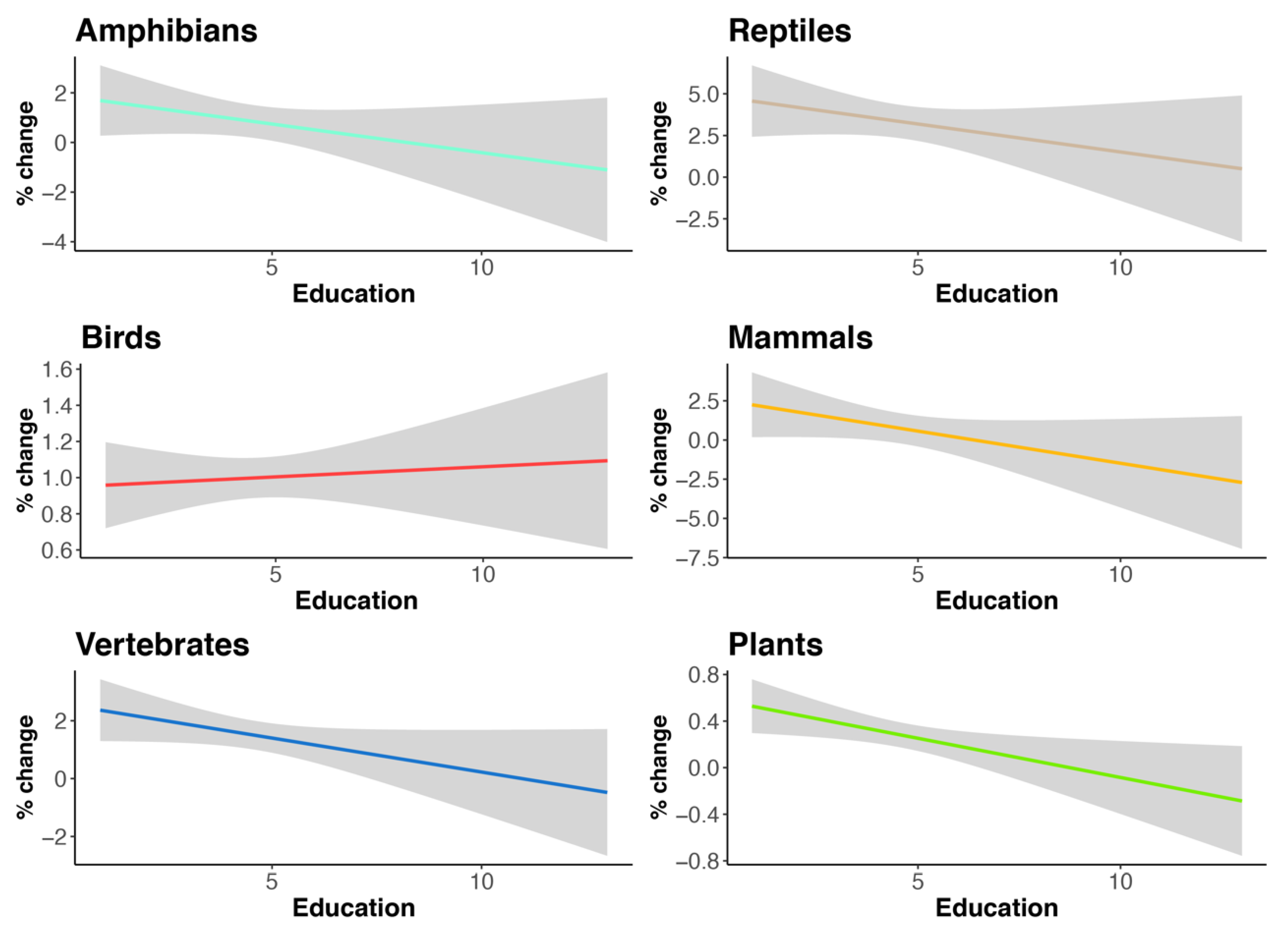
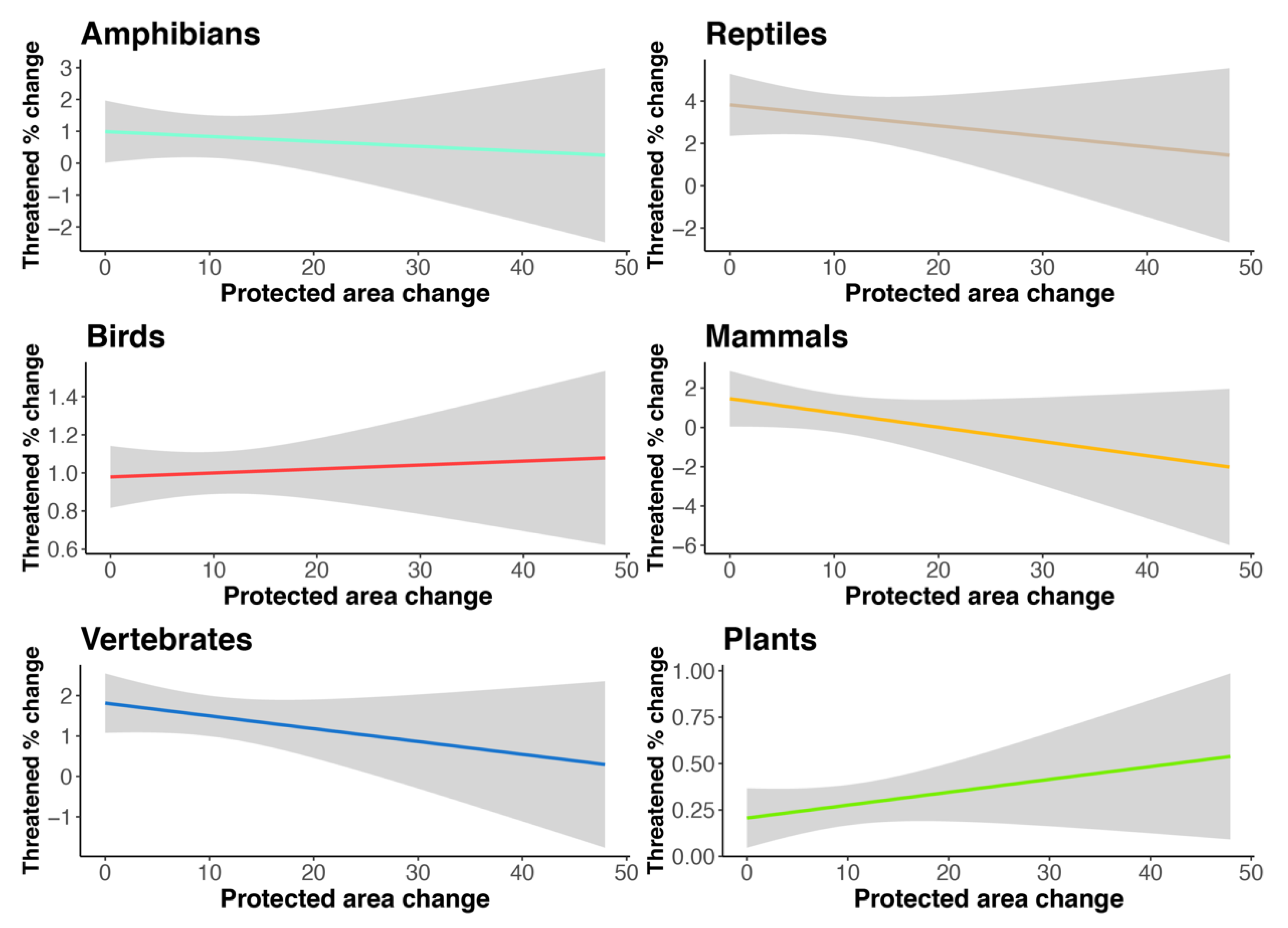
Biodiversity loss is a central issue in conservation biology, with protected areas being the primary approach to stop biodiversity loss. However, education has been identified as an important factor in this regard. Based on a database of threatened species and socio-economic features for 138 countries, we tested whether more protected areas or more education investment is associated with a lower proportion of threatened species (for different groups of vertebrates and plants). For this, we fitted generalized linear mixed-effects models (GLMM) to assess the relative importance of socio-economic variables on the proportion of threatened species. We found that education investment was negatively associated with the proportion of threatened species in 2007 and 2017, as well as with their change rates. Conversely, the percentage of protected land was significant for reptiles but showed weak relationships with other groups. Our results suggest that only increasing protected areas will not stop or reduce biodiversity loss, as the context and people’s attitudes towards wildlife also play major roles here. Therefore, investing in education, in addition to protected areas, would have the missing positive effect on achieving effective species conservation actions worldwide.
Keywords: education; islands; long-term effects; protected areas; urbanization; threatened species education; islands; long-term effects; protected areas; urbanization; threatened species