

Nursing as a Sustainability Factor of the Health System during the COVID-19 Pandemic: A Qualitative Study

 , , , and
Abstract
1. Introduction
- Study the non-conceptualized lived experiences of nursing professionals and the meaning attributed to these experiences.
- Identify the perceptions of nursing professionals regarding the degree of recognition received from service users in the community setting.
2. Materials and Methods
2.1. Study Design
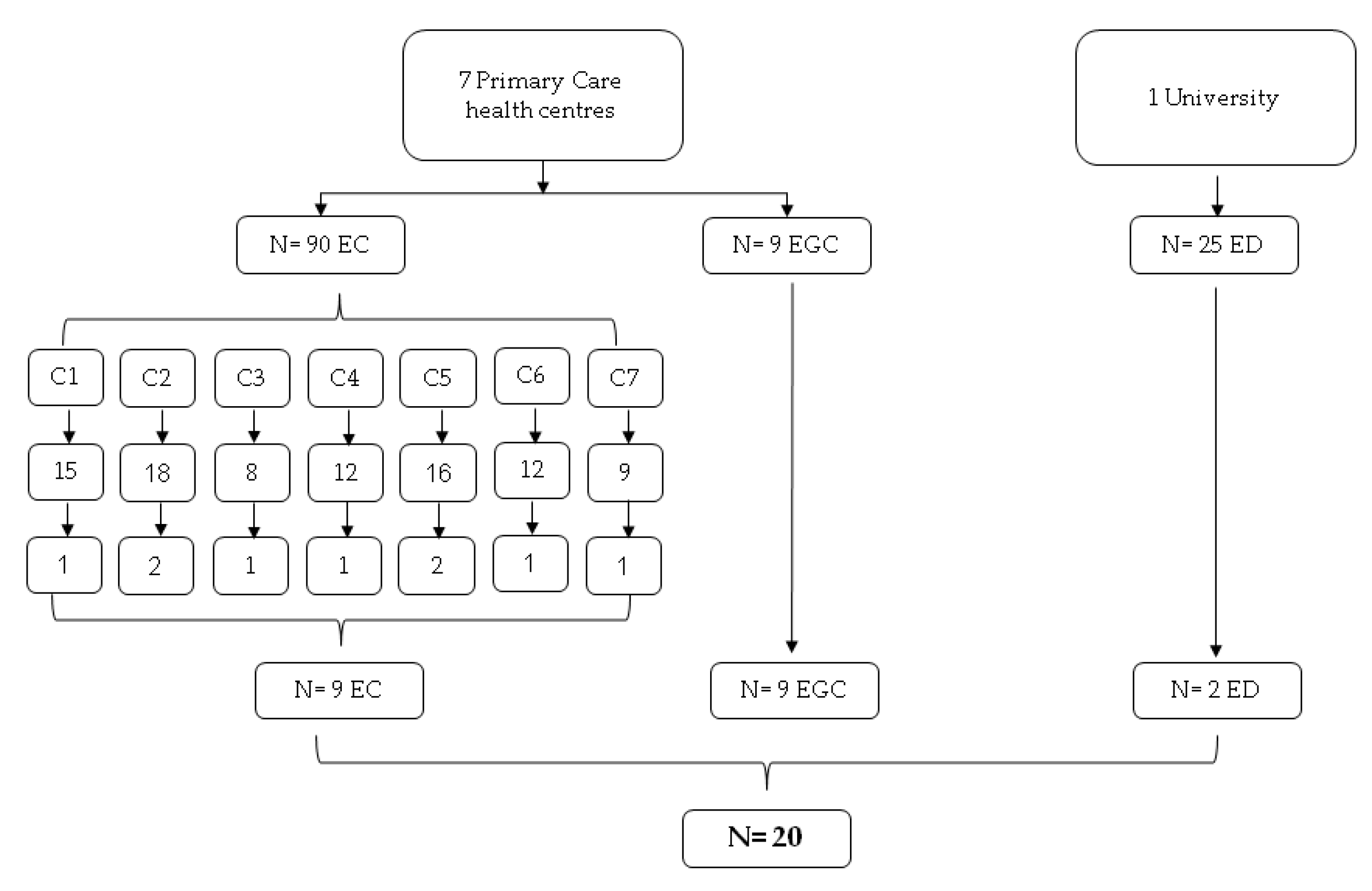
2.2. Setting and Participants
2.3. Data Collection
2.4. Data Analysis
3. Results
- -
- Self-concept: Understood as the concept of oneself as a nursing professional.
- -
- Recognition: Understood as positive declarations of service users regarding the work performed by nurses.
- -
- Satisfaction or dissatisfaction with work at home.
4. Discussion
- With regards to study limitations, it should be highlighted that the study was limited exclusively to the province of Huelva. Further, whilst inclusion of an interdisciplinary team was a strong point, key informants were all nurses. It would, therefore, have been more enlightening to have examined the perceptions of other health professionals, and even service users and family, on nursing work and the role of these groups in holding back the tide during the pandemic as a sustainability factor in the health system.
- Perceptions of all health professionals to have intervened in the COVID-19 health crisis;
- Opinions and experiences of patients and families; and
- Data from qualitative work in the other Andalusian provinces not examined here.
5. Conclusions
Supplementary Materials
Author Contributions
Funding
Conflicts of Interest
References
- Martín, J.; González, M. La sostenibilidad del Sistema Nacional de Salud en España. Ciência Saúde Coletiva 2011, 16, 2773–2782. [Google Scholar] [CrossRef]
- Pasarín, M.; Berra, S.; González, A.; Segura, A.; Tebé, C.; García-Altés, A. Evaluación de la atención primaria: Las “Herramientas de evaluación de la atención primaria—Versión de instalación” para el sistema de salud español. Gaceta Sanit. 2013, 27, 12–18. [Google Scholar] [CrossRef]
- Rivera, F.; Santolalla, I.; Jodra, B.; Sufrate, T. Estudio comparativo de casos sobre el papel del modelo europeo de excelencia en la sostenibilidad de las organizaciones sanitarias. Arch. Nurs. Res. 2020, 3, 71. [Google Scholar] [CrossRef]
- Agencia Estatal Boletín Oficial del Estado. Real Decreto 463/2020 de 14 de Marzo, por el que se Declara el Estado de Alarma Para la Gestión de la Situación de Crisis Sanitaria Ocasionada por el COVID-19. BOE-A-2020-3692; Agencia Estatal Boletín Oficial del Estado: Madrid, Spain, 2020; Available online: https://www.boe.es/eli/es/rd/2020/03/14/463 (accessed on 26 June 2020).
- Barbagelata, A.; Perna, E.; Piskorz, D.; Lorenzatti, A. Prevención del colapso del Sistema de salud en pacientes cardiovasculares con COVID-19: El rol del cardiólogo en la reducción de la sobrecarga de las unidades de cuidados intensivos con el advenimiento del frío en América del Sur. Reporte de la Federación Argentina de Cardiología. Rev. Fed. Argic. Cardiol. 2020, 49, 4–12. [Google Scholar]
- García, V.A.; Picazo, J.; Ballesteros, M.; Pérez, L.; Moro, I.; Martínez, M.; Téllez, J.M. Para qué llaman los pacientes? Evaluación de consultas telefónicas no urgentes en Atención Primaria. Revista Clínica de Medicina de Familia 2020, 13, 7–14. [Google Scholar]
- Brito, P. En los límites de lo cotidiano: A propósito del covid-19 en atención primaria. Revista Ene de Enfermería 2020, 14, 1–3. [Google Scholar]
- Jiménez-Rodriguez, D.; Santillán, A.; Montoro, J.; Rodríguez, M.M.; Muñoz, F.J.; Arrogante, O. Incremento de Consultas por Video Durante el COVID-19 Pandemia: Percepciones de los Profesionales de la Salud Sobre su Implementación y Adecuación. Administración. Int. J. Environ. Res. Salud Pública 2020, 17, 5112. Available online: https://www.mdpi.com/1660-4601/17/14/5112 (accessed on 27 June 2020).
- Stilwell, B.; Munashe, N. Nursing now. In Advanced Practice Nursing Leadership: A Global Perspective; Springer: Cham, Switzerland, 2020. [Google Scholar] [CrossRef]
- Cacha, A. Enfermería, el reconocimiento de una profesión a través de la práctica. Conoc. Enferm. 2020, 3, 2. [Google Scholar]
- Raurell-Torredà, M.; Martínez-Estalella, G.; Frade-Mera, M.; Carrasco, L.; Romero, E. Reflections arising from the COVID-19 pandemic. Enfermería Intensiva (English Ed.) 2020, 31, 90–93. [Google Scholar] [CrossRef]
- Dadich, A.; Doloswala, N. What can organisational theory offer knowledge translation in healthcare? A thematic and lexical analysis. BMC Health Serv. Res. 2018, 18, 351. [Google Scholar] [CrossRef]
- Cía, N.M.; Pérez, M.P.; Heras-Mosteiro, J.; Ávila, G.G.; Díaz-Olalla, J.M.; Aguilar, J.L. Encuentros y desencuentros entre salud comunitaria y sustema sanitario español. Informe SESPAS 2018. Gac. Sanit. 2018, 32, 17–21. [Google Scholar] [CrossRef]
- Rivera, F.; Santolalla, I.; Ibañez, D.; Jodra, B. Metodología para el análisis de la sostenibilidad de las organizaciones sanitarias. Index de Enfermería 2018, 27, 225–229. [Google Scholar]
- Taylor, S.J.; Bogdan, R. Introducción a Los Métdos Cualitativos de la Investigación; Paidós: Barcelona, Spain, 1990. [Google Scholar]
- Mundial, A.M. Declaración de Helsinki de la AMM. In Principios Éticos Para Las Investigaciones Médicas en Seres Humanos; World Medical Association, Inc.: Geneva, Switzerland, 2019. [Google Scholar]
- Orgánica, L. de 5 de diciembre, de Protección de Datos Personales y garantía de los derechos digitales. Boletín Oficial del Estado 2018, 294, 119788. [Google Scholar]
- Kangasniemi, M.; Pakkanen, P.; Korhonen, A. Professional ethics in nursing: An integrative review. J. Adv. Nurs. 2015, 71, 1744–1757. [Google Scholar] [CrossRef]
- Puggina, A.C.; Cavalheiro, A.C.; Trentino, J.P.; Castro, P.; Silva, M.J. Relação entre necessidade de adornos com satisfação com imagem corporal e autoconceito profissional da equipe de enfermagem. Rev. Anna Nery 2015, 19, 563–570. [Google Scholar] [CrossRef]
- Souza, M.E.; Amaro, B.; Silva, R.R. Relação entre autoconceito profissional e desempenho da equipe de enfermagem. In Centro Universitário de Volta Redonda. I Jornada Científica de Enfermagem do UniFOA. Centro Universitário de Volta Redonda 2013, 25. [Google Scholar] [CrossRef]
- Piña, C.N.; López, M.M.; Delgado, I.C. Caracterización del Clima Organizacional del Policlínico Universitario “Cecilio Ruiz de Zarate” de la Provincia de Cienfuegos. Rev. Electrón. de Pedag. 2011, 3, 30–37. [Google Scholar]
- Vera, M.; Samudio, M. Clima organizacional de enfermería en los hospitales regionales del Instituto de Previsión Social. Mem. Inst. Investig. Cienc. Salud. 2013, 11, 41–54. [Google Scholar]
- Pérez, A. La gestión universitaria y el clima organizacional. Rev. Cubana Educ. Médica Super. 2011, 25, 164–177. [Google Scholar]
- Sabanciogullari, S.; Dogan, S. Professional self-concept in nurses and related factors: A sample from Turkey. Int. J. Caring Sci. 2017, 10, 1676. [Google Scholar]
- Juárez, S. Clima organizacional y satisfacción laboral. Rev. Med. Inst. Mex. Seguro 2012, 50, 307–314. [Google Scholar]
- Segredo, A.M. Clima organizacional en la gestión del cambio para el desarrollo de la organización. Rev. Cubana Salud Pública 2013, 39, 385–393. [Google Scholar]
- Valenziano, K.B.; Glod, S.A.; Jia, S.; Belser, A.; Brazell, B.; Dellasega, C.; Dillon, P.W. An Interprofessional Curriculum to Advance Relational Coordination and Professionalism in Early-Career Practitioners. J. Teach. Learn. Resour. 2018, 14, 10697. [Google Scholar] [CrossRef] [PubMed]
- Segredo, A.M.; Reyes, D. Clima organizacional en salud pública. Consideraciones generales. Rev. Correo Científico Médico de Holguín 2004, 8, 3. [Google Scholar]
- Hammar, T.; Rissanen, P.; Perälä, M.L. The cost-effectiveness of integrated home care and discarge practice for home care clients. Health Policy 2009, 92, 10–20. [Google Scholar] [CrossRef]
- Carretero, S.; Garcés, J.; Ródenas, F. Evaluation of the home help service and its impacto n the informal caregiver’s burden of dependent elders. Int. J. Geriatr. Psychiatry 2007, 22, 738–749. [Google Scholar] [CrossRef] [PubMed]
- Losa, M.E.; Becerro de Bengoa, R. Prevalence of bullying at work and its association with self-esteem scores in a Spanish nurse sample. Contemp. Nurse 2012, 42, 2–10. [Google Scholar] [CrossRef]
- Mian, A.; Khan, S. Coronavirus: The spread of misinformation. BMC Med. 2020, 18, 89. [Google Scholar] [CrossRef]
- Costa, R.; Motta, M.; Jatobá, A.I.; Lorenzini, E.; Manfrini, G.C.; Cavalcanti, L. Enseñanza de enfermería en tiempos de covid-19: Cómo reinventarla en este contexto? Texto Contexto Enfermagem 2020, 29. [Google Scholar] [CrossRef]
- Losa-Iglesias, M.E.; López, D.; Rodriguez, R.; Becerro, R. Relationships between social skills and self-esteem in nurses: A questionnaire study. Contemp. Nurse 2017, 53, 681–690. [Google Scholar] [CrossRef]
- Fuentes-Bermúdez, G.P. Enfermería y COVID-19: Reconocimiento de la profesión en tiempos de adversidad. Revista Colombiana de Enfermería 2019, 19. [Google Scholar] [CrossRef]
- Keshmiri, F.; Farahmand, S.; Bahramnezhad, F.; Nedaei, H.H. Exploring the challengues of professional identity formation in clinical education environment: A qualitative study. J. Adv. Med. Educ. Prof. 2020, 8, 42–49. [Google Scholar] [CrossRef] [PubMed]
- Farcic, N.l.; Barac, I.; Lovric, R.; Pacaric, S.; Gvozdanovic, Z.; Ilakovac, V. The influence of self-concept on clinial decision making in nurses and nursing students: A cross-sectional study. Int. J. Environ. Res. Public Health 2020, 17, 3059. [Google Scholar] [CrossRef]
- Jiménez, S.; Vilaplana, C. La interacción del sistema social y sanitario. Informe SESPAS 2012. Gac. Sanit. 2012, 26, 124–133. [Google Scholar] [CrossRef] [PubMed]
- Corrales, D.; Palomo, L. La importancia de la longitudinalidad, integralidad, coordinación y continuidad de cuidados domiciliarios efectuados por enfermería. Enfermería Clínica 2014, 24, 51–58. [Google Scholar] [CrossRef] [PubMed]
- Carretero, L.; Gomes, N.; Borrás, A.; Rodríguez, A.; Seara, G. Integración clínica en el paciente crónico. Enfermería Clínica 2014, 24, 35–43. [Google Scholar] [CrossRef]
- Garcés, J.; Ródenas, F. La gestión de casos como metodología para la conexión de los sistemas sanitario y social en España. Atención Primaria 2015, 47, 482–489. [Google Scholar] [CrossRef]
- Greenhalgh, T.; Koh, G.C.H.; Car, J. Covid-19: A remote assessment in primary care. BMJ 2020, 368, m1182. Available online: https://www.ncbi.nlm.nih.-gov/pubmed/32213507 (accessed on 28 June 2020). [CrossRef]

| Participant | Work Area | Age | Work Experience (Years) | Sex | Communication Training | Training in Clinical Interviews | Participation |
|---|---|---|---|---|---|---|---|
| Participant 1 | Community nurses 1 | 46 | 6 | Female | No | Basic | Interview |
| Participant 2 | Community nurses 2 | 45 | 18 | Male | No | No | Interview |
| Participant 3 | Community nurses 3 | 37 | 3 | Male | Basic | Basic | Interview |
| Participant 4 | Community nurses 4 | 56 | 2 | Female | No | Basic | Interview |
| Participant 5 | Community nurses 5 | 50 | 7 | Female | No | No | Focus group 1 |
| Participant 6 | Community nurses 6 | 42 | 4 | Female | Basic | No | Focus group 1 |
| Participant 7 | Community nurses 7 | 48 | 2 | Female | No | No | Focus group 1 |
| Participant 8 | Community nurses 8 | 46 | 16 | Female | No | No | Focus group 2 |
| Participant 9 | Community nurses 9 | 45 | 9 | Female | Basic | Basic | Focus group 2 |
| Participant 10 | Case managers 1 | 51 | 17 | Female | Advanced | Advanced | Interview |
| Participant 11 | Case managers 2 | 52 | 24 | Female | Basic | Advanced | Interview |
| Participant 12 | Case managers 3 | 55 | 27 | Female | Basic | Basic | Interview |
| Participant 13 | Case managers 4 | 45 | 11 | Male | No | Basic | Interview |
| Participant 14 | Case managers 5 | 56 | 25 | Female | Basic | Basic | Focus group 1 |
| Participant 15 | Case managers 6 | 51 | 24 | Female | Basic | Basic | Focus group 1 |
| Participant 16 | Case managers 7 | 49 | 27 | Female | Basic | Basic | Focus group 2 |
| Participant 17 | Case managers 8 | 47 | 16 | Male | Advanced | Basic | Focus group 2 |
| Participant 18 | Case managers 9 | 49 | 17 | Female | Basic | Basic | Focus group 2 |
| Participant 19 | Nurse teaching 1 | 36 | 7 | Female | Advanced | Advanced | Focus group 1 |
| Participant 20 | Nurse teaching 1 | 58 | 4 | Male | Advanced | Basic | Focus group 2 |
| Dimension | Categories | Subcategories | Non-Participant Observation | Interviews | Discussion Groups |
|---|---|---|---|---|---|
| Professional identity | Self-concept | Nurses as a resource, guide, and source of emotional support | * | * | * |
| Professional independence | * | * | |||
| Professional self-esteem | * | * | |||
| Recognition | Contribution to learning | * | * | ||
| Coordination with professionals | * | * | |||
| Patient-family emotional support and back-stop | * | * | * | ||
| Satisfaction | Comfort | * | * | ||
| Emotional relief | * | * | |||
| Humane | * | * | * | ||
| Team communication | * | * |
| Subcategory | Nurse Case Manager | Community Nurse |
|---|---|---|
| Nurses as a resource, guide, and emotional support | “Educational interventions are a bit longer. Well, more formal to say the least. As for whether we look at whether they are important or not, I already believe that they are, in terms of that patient education is in a crisis situation like the one we have experienced, where everything has been fear and uncertainty. As for dealing with the patient, understanding, fundamentally caring, to solve unforeseen situations that may happen, to manage somewhat independently the environment at a given moment, they can also serve as self-help, to express themselves, to work “(GC1, segment 9–9). | “Furthermore, I believe that we have been born to help them, both the liaison nurse and the home nurse, were born so that they continue taking care of themselves, because there is no institution possible right now, right now, that can maintain the volume of population consultations, from there we start” (EC3, segment 91–91). |
| “Nurses do more than we think” (GC1, segment 24–24). | “I think that the fact that a patient has a professional intervention to guide them, the fact that they know that they have a professional, a nurse, who is going to be there, what we have said before, they must interact with something whilst the care process lasts as long as it lasts. Who is accompanying you in that process? Who can consult the new symptoms every day to help you make whatever decision, to support you? I think that makes you see that if you don’t do this they are alone. And I think it makes them say: I am going to try to do better, because at the same time, you want it, we are training them, we are informing them” (EC1, segment 92–92). | |
| Professional independence | “I think that with this crisis situation, nurses have become empowered at a social, institutional and institutional level” GC1 (segment 31–31). | “Most of the things I decide and also my doctor gives me that space” (EC2, segment 58–58). |
| “Patients know that we solve problems for them, they know about our individual competences, they know what issues the nursing staff have, now it is not like before when if they did not bring you a P10 from the doctor, we did nothing, so the truth is that much has changed, a lot. Primary care has changed a lot and during this crisis we have been even more autonomous, where possible” (EC3, segment 58–58). | ||
| Professional self-esteem | “The truth is that in living this situation, I have realized the importance of our work with the patient and the family” (EC4, segment 23–23). | |
| “Sometimes we are so involved in the daily dynamics of cures, visits, consultations, papers, that we are not aware that we are the cornerstone of our centers and the health system. We are the group of professionals who have been in the most contact with those affected by COVID, both in our community environment and in the case of our colleagues in hospitals, and all the words of the patients and relatives have been warm and grateful. I am very happy with the work performed” (EC6, segment 13–13). |
| Contribution to learning | “If you ask people you have been caring for, even when rushed or directing towards those with learning needs, I am convinced that a nurse will be mentioned to you. You ask my mother and she give you names of two or three nurses who have taught, guided and accompanied her in this confinement.” (EC5 2, segment 116-116). | |
| Coordination with professionals | “At the moment that a patient with signs of COVID who lives alone is detected, they are put into contact with the social worker to activate the necessary resources and health assets that are in the area and that are relevant at that moment” GC6 (sec 52-52). | “Because before you were waiting for rehabilitation appointments for two months, they are no longer moving, the rehabilitator, why am I going to give you a walker, you stay in bed, you ulcerate and you die, so that is also not helping too much, I don’t know what the intervention would be called” (EC6, segment 35-35). |
| “Interdisciplinary work and socio-sanitary coordination are of vital importance for solving different patient and family problems more quickly and effectively than a nurse alone would be able to do. That is what has saved us to get out of this crisis” GC5, (sec 31-31). | ||
| Emotional support and patient-family security | “We contribute, I believe to well-being. Because they also allow us to do so, before they had to make an appointment with the nurse but this situation has allowed us and enabled us to be in permanent telephone contact or even by video calls with the patient and their family, they are constantly calling me” (GC7, segment 93-93). | “They told us that they were "hooked" to our weekly calls, that after this intervention they felt better and that knowing that we were there, at the other end of the phone, conveyed security” (EC10 1, segment 35-35). |
| “They have thanked me many times for listening to them” (EC9, segment 80-80). |
| Comforting | “Just because of hearing that, after your words of encouragement, that nothing will happen, that just by being calm at home taking your medication and without being in contact with anyone, this situation will happen and we will return to normal, they say they trust us. The sensation you feel is from a job well done and I am comforted to know that” (EC8 2, segment 61-61). | |
| Emotional relief | “They have a number to call, apart from that the fact that they get a response from the health service and everything, but they have the nurse a physical person who knows them and who knows that they are not only going to post a message, but perhaps it is to tell you: I’m fed up! Give three screams and hang up. I tell them that if they feel like screaming I do to, if you need to let it out, call me and I will answer and they shout at me and great and tomorrow if you need it again too”(GC6, segment 93-93). | |
| Humanely | “They have a number to call, apart from that the fact that they get a response from the health service and everything, but they have the nurse a physical person who knows them and who knows that they are not only going to post a message, but perhaps it is to tell you: I’m fed up! Give three screams and hang up. I tell them that if they feel like screaming I do to, if you need to let it out, call me and I will answer and they shout at me and great and tomorrow if you need it again too”(GC6, segment 93-93). | |
| Team communication | “This health crisis, it has led us to reinvent ourselves, given us the chance to grow personally and professionally despite all of the hard work and the pain”GC7(seg 51-51) | “Every time we had to attend a patient in person with suspicious symptoms, the following days everything was fear until the results came. Fear for yourself and especially for those around you, for our families” EC6 (sec 26-26). |
| “It was all chaos, we did not know what regulations to attend to, constant changes, nervousness, not knowing if you were doing things right. But over time and seeing that all of our colleagues were the same, we have learned to support each other.” EC7 (sec 14-14) |
© 2020 by the authors. Licensee MDPI, Basel, Switzerland. This article is an open access article distributed under the terms and conditions of the Creative Commons Attribution (CC BY) license (http://creativecommons.org/licenses/by/4.0/).
Share and Cite
Rojas-Ocaña, M.J.; Araujo-Hernández, M.; Romero-Castillo, R.; Román-Mata, S.S.; García-Navarro, E.B. Nursing as a Sustainability Factor of the Health System during the COVID-19 Pandemic: A Qualitative Study. Sustainability 2020, 12, 8099. https://doi.org/10.3390/su12198099
Rojas-Ocaña MJ, Araujo-Hernández M, Romero-Castillo R, Román-Mata SS, García-Navarro EB. Nursing as a Sustainability Factor of the Health System during the COVID-19 Pandemic: A Qualitative Study. Sustainability. 2020; 12(19):8099. https://doi.org/10.3390/su12198099
Chicago/Turabian StyleRojas-Ocaña, María Jesús, Miriam Araujo-Hernández, Rocío Romero-Castillo, Silvia San Román-Mata, and E. Begoña García-Navarro. 2020. "Nursing as a Sustainability Factor of the Health System during the COVID-19 Pandemic: A Qualitative Study" Sustainability 12, no. 19: 8099. https://doi.org/10.3390/su12198099
APA StyleRojas-Ocaña, M. J., Araujo-Hernández, M., Romero-Castillo, R., Román-Mata, S. S., & García-Navarro, E. B. (2020). Nursing as a Sustainability Factor of the Health System during the COVID-19 Pandemic: A Qualitative Study. Sustainability, 12(19), 8099. https://doi.org/10.3390/su12198099

