Evaluation of Key Performance Indicators (KPIs) for Sustainable Postgraduate Medical Training: An Opportunity for Implementing an Innovative Approach to Advance the Quality of Training Programs at the Saudi Commission for Health Specialties (SCFHS)

 ,
,  , and
, and
Abstract
1. Introduction
1.1. The Saudi Commission for Health Specialties’s Quality Assurance Initiative for Sustainable Personalized Medical Training
1.2. Governance of Training Programs in SCFHS
- Targeting important improvements (there is a direct connection with sustainability),
- Precisely defined (measurable metrics, impose efficiency and enhanced decision making—they also provide a systematic way for monitoring performance over time with significant managerial implications in the medical sector),
- Reliable,
- Valid,
- Implemented with risk adjustment,
- Implemented with reasonable cost,
- Implemented with low data collection effort,
- Achieving results which can be easily interpreted, and
- Global (overall evaluation).
- Improve the quality of postgraduate medical training (PGMT),
- Provide means for objective assessment of residency programs and training centers,
- Provide guidance to residency programs and training centers periodically and objectively, and
- Assist program directors in reviewing the conduction and educational quality of their programs.
2. Critical Literature Review on KPIs in Healthcare Training Programs for Sustainable Healthcare
- Measurement tool for enhanced decision making
- Learning behavior analysis and adjustment
- Predicting performance and personalizing learning experience
- Real-time monitoring tool of learning process
- Customizing learning feedback
- Standardization of instruction flow
- Interoperable technology-enhanced learning systems
3. Research Methodology
3.1. Study Design
3.2. Sources of Data
3.3. Validity and Reliability of the Primary Data Collection Tool (i.e., Survey)
3.4. Program Directors’ Survey
3.5. Trainees Survey
3.6. Data Analysis
3.6.1. Data Management
3.6.2. Descriptive Statistics
3.6.3. Inferential Statistics
4. Analysis and Main Findings
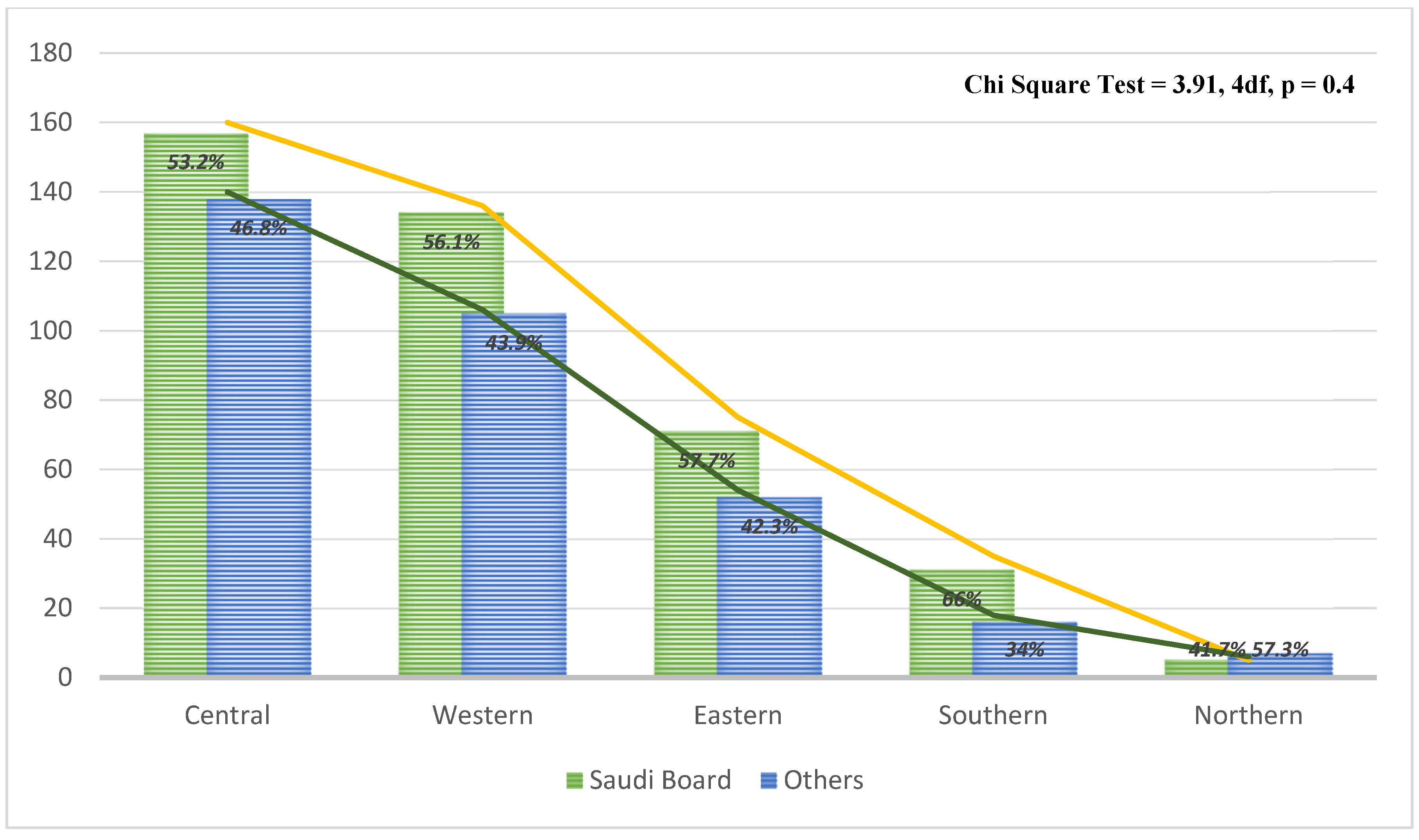
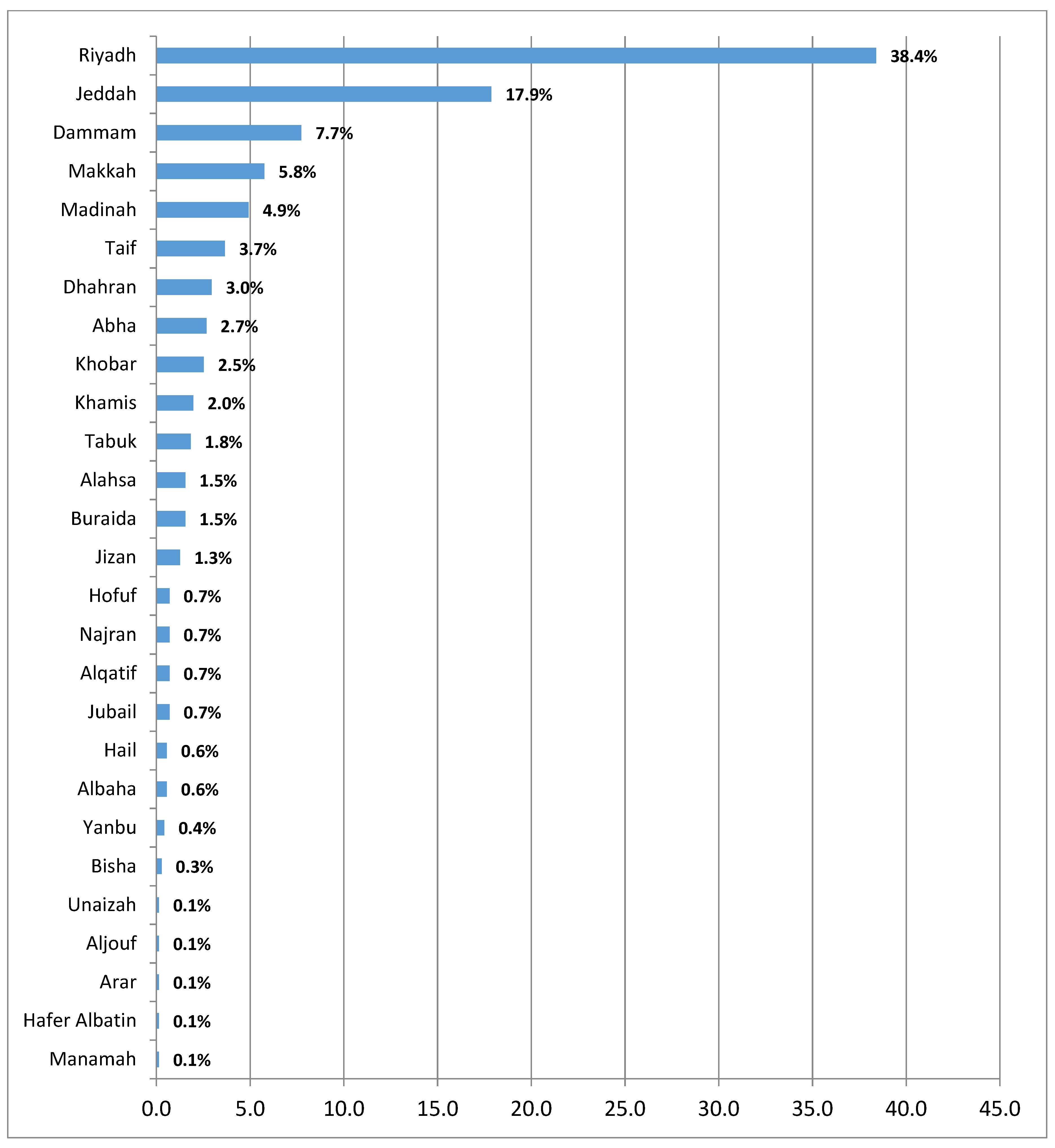
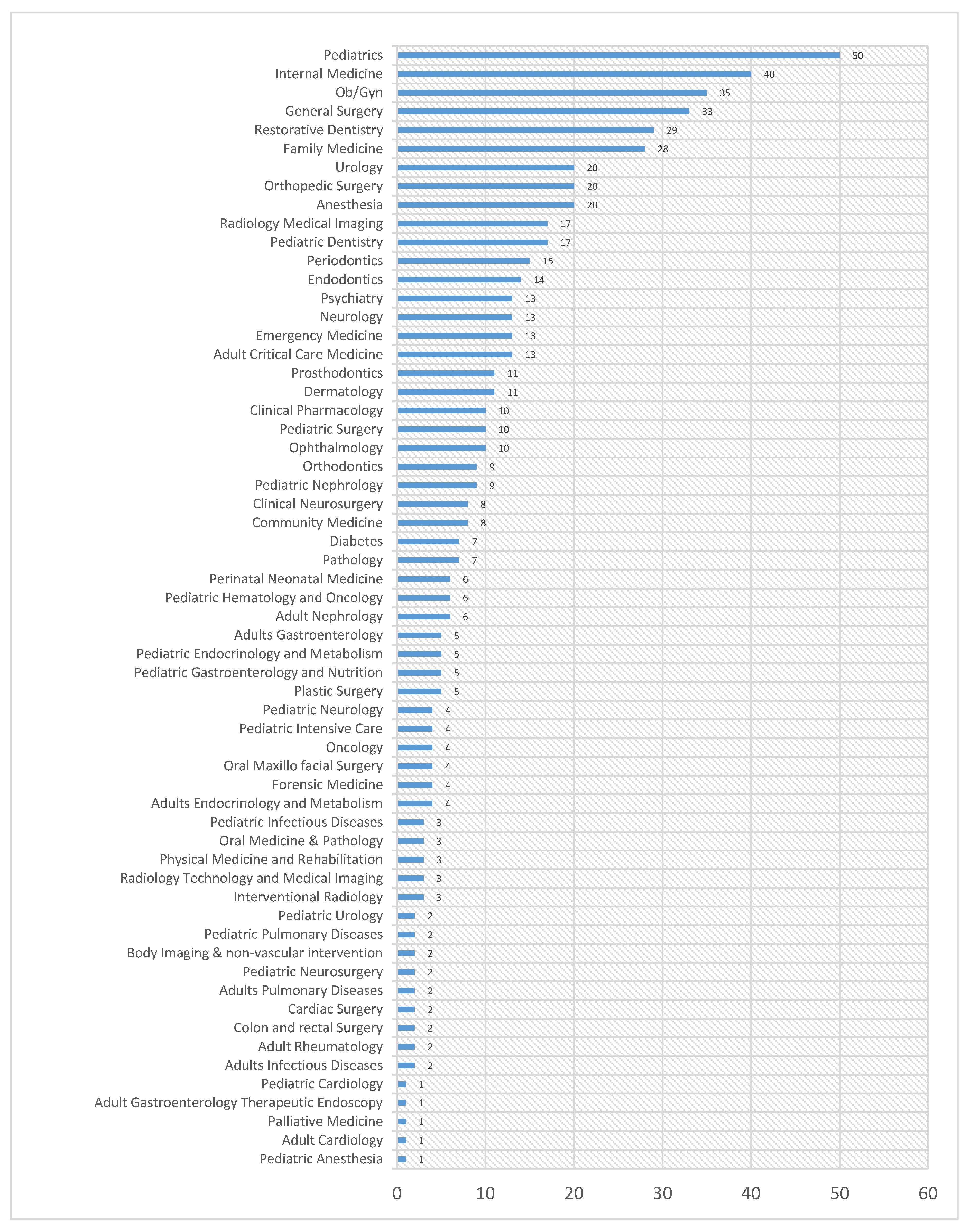
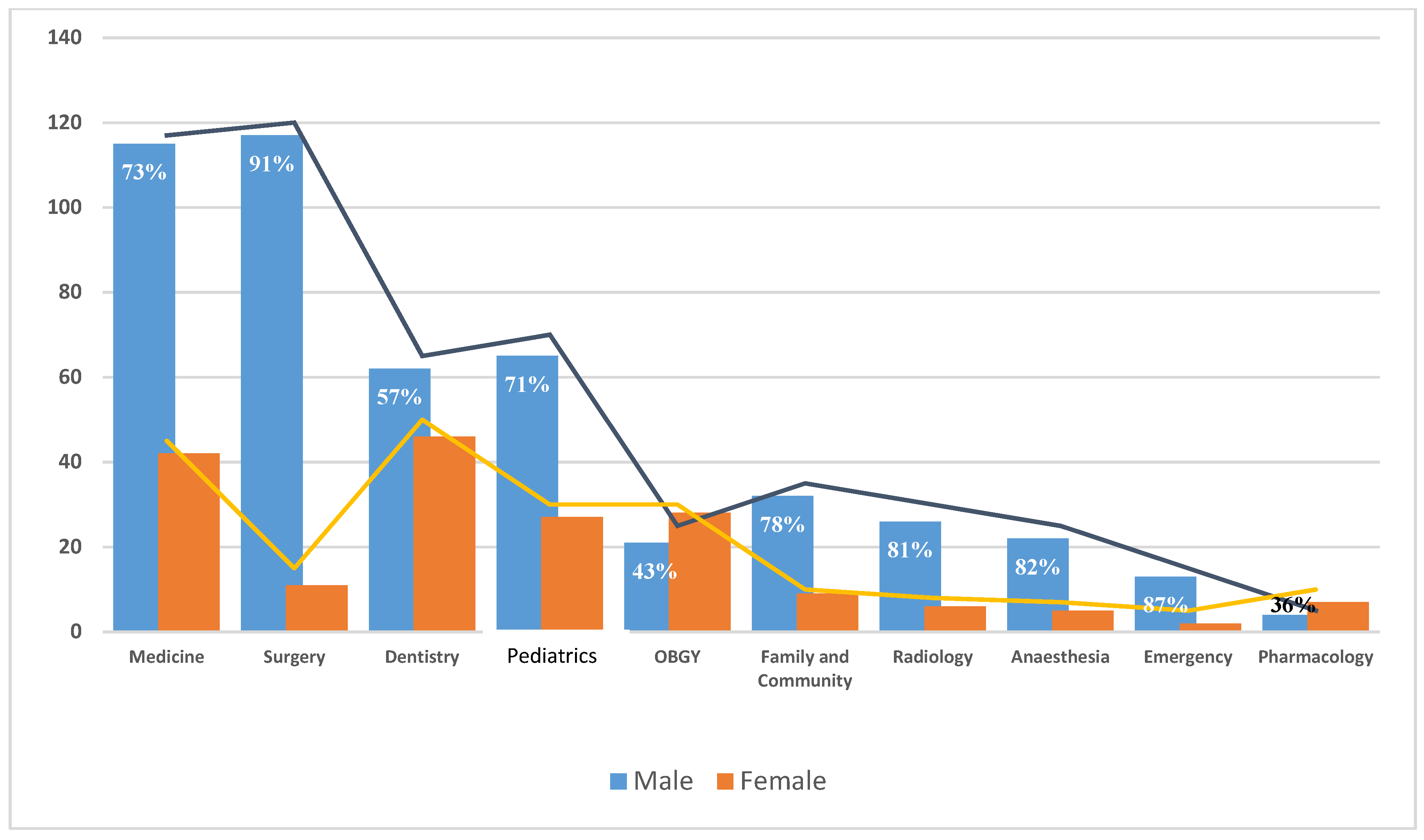
4.1. Demographic Features of Our Respondents
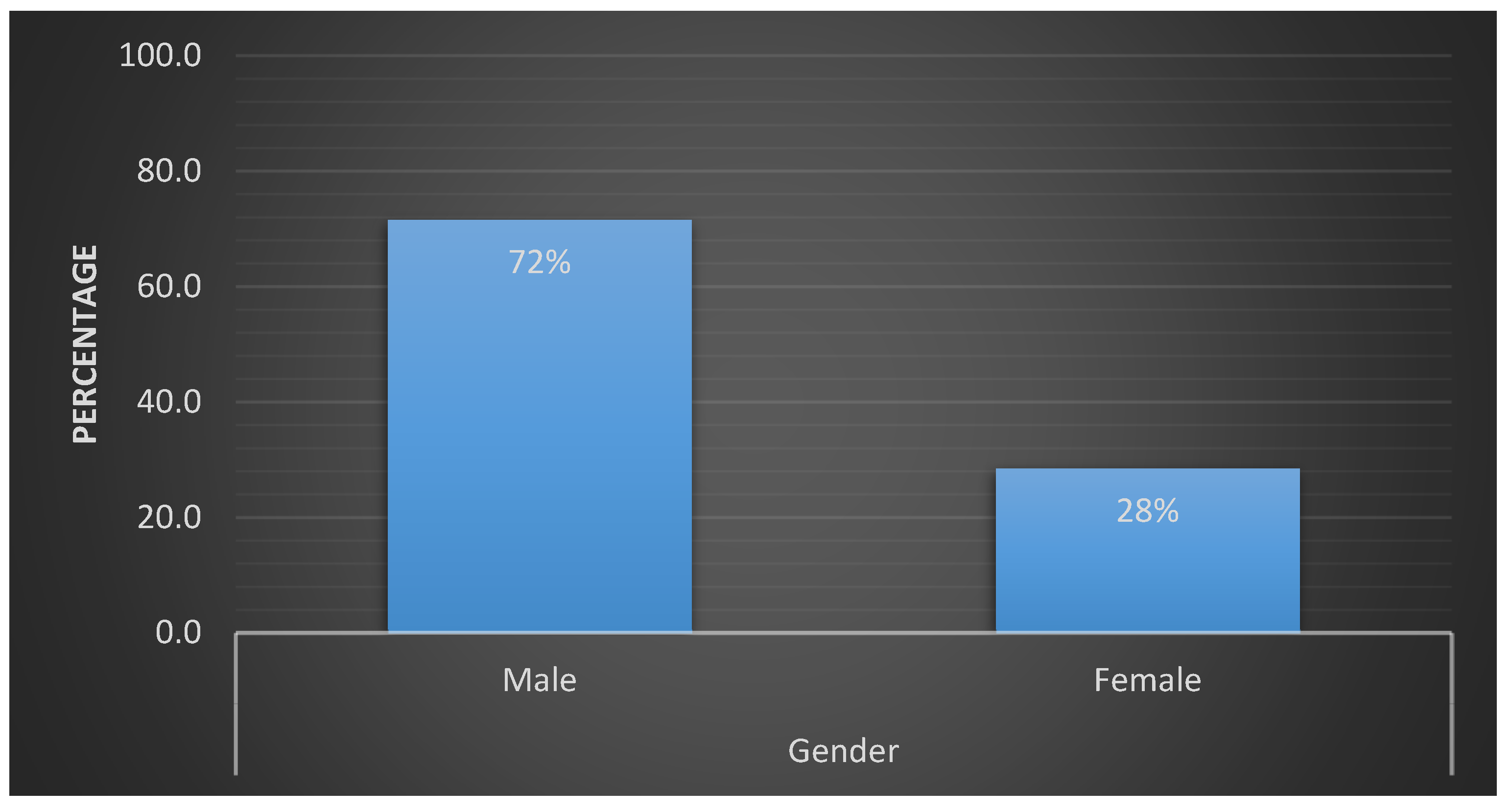
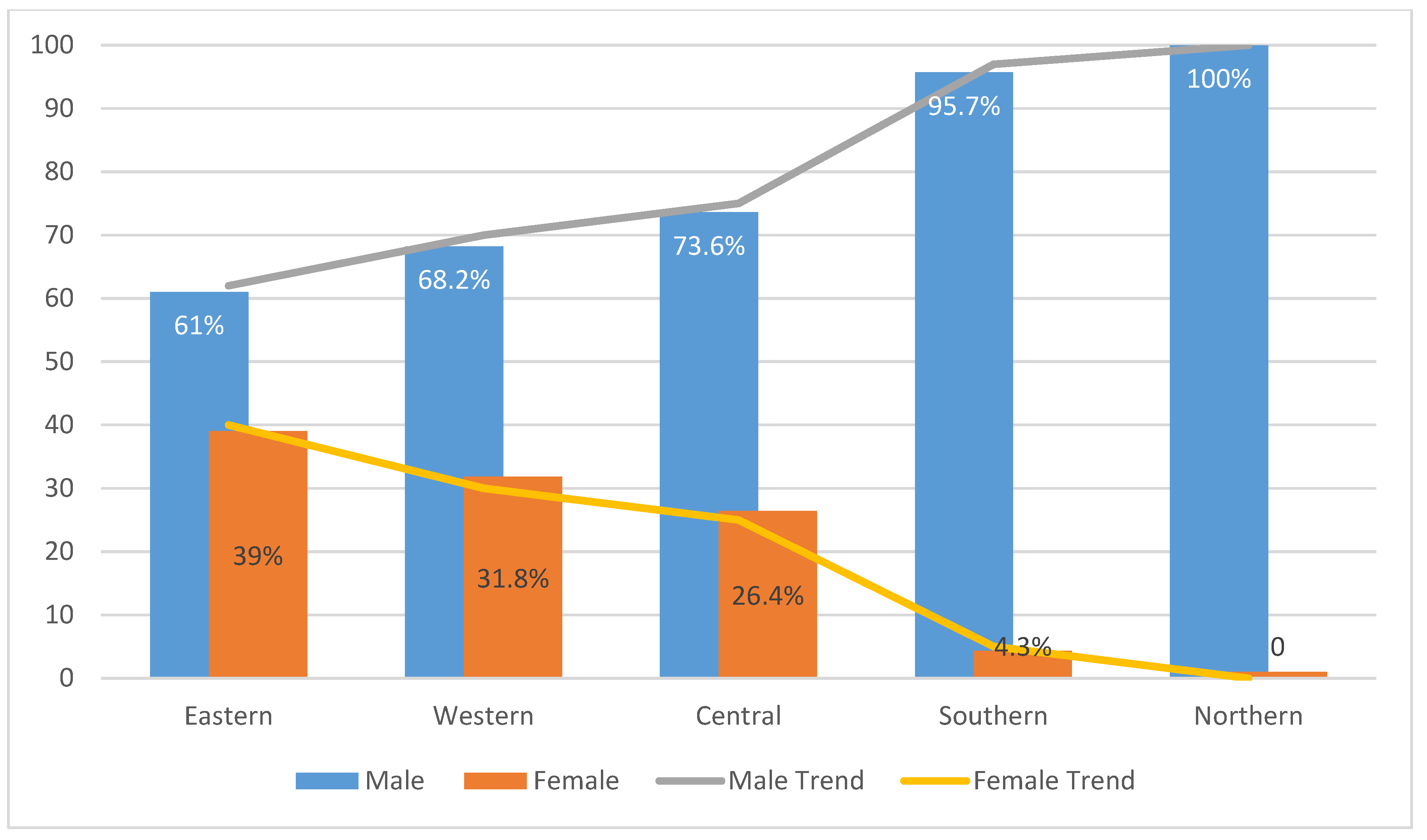
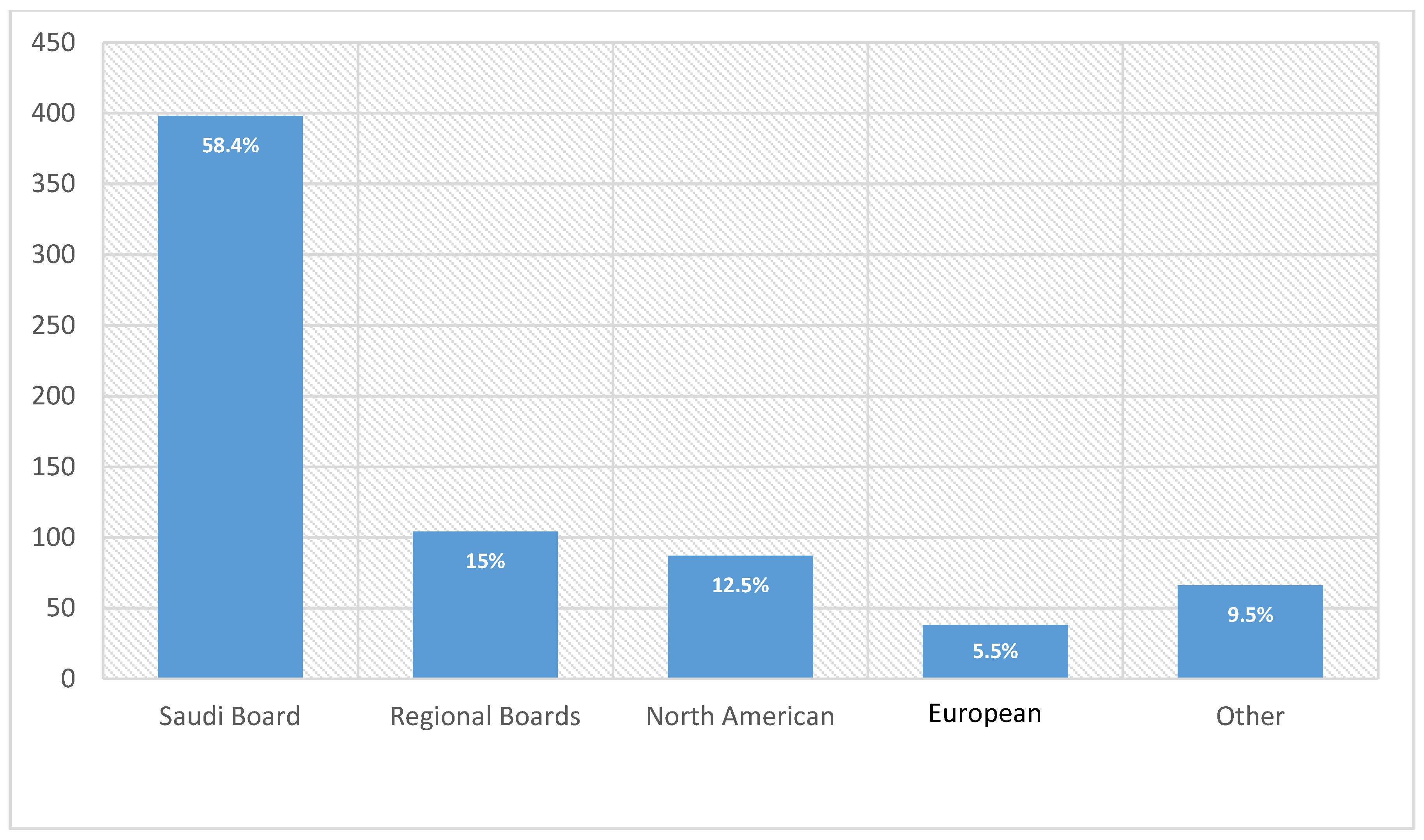
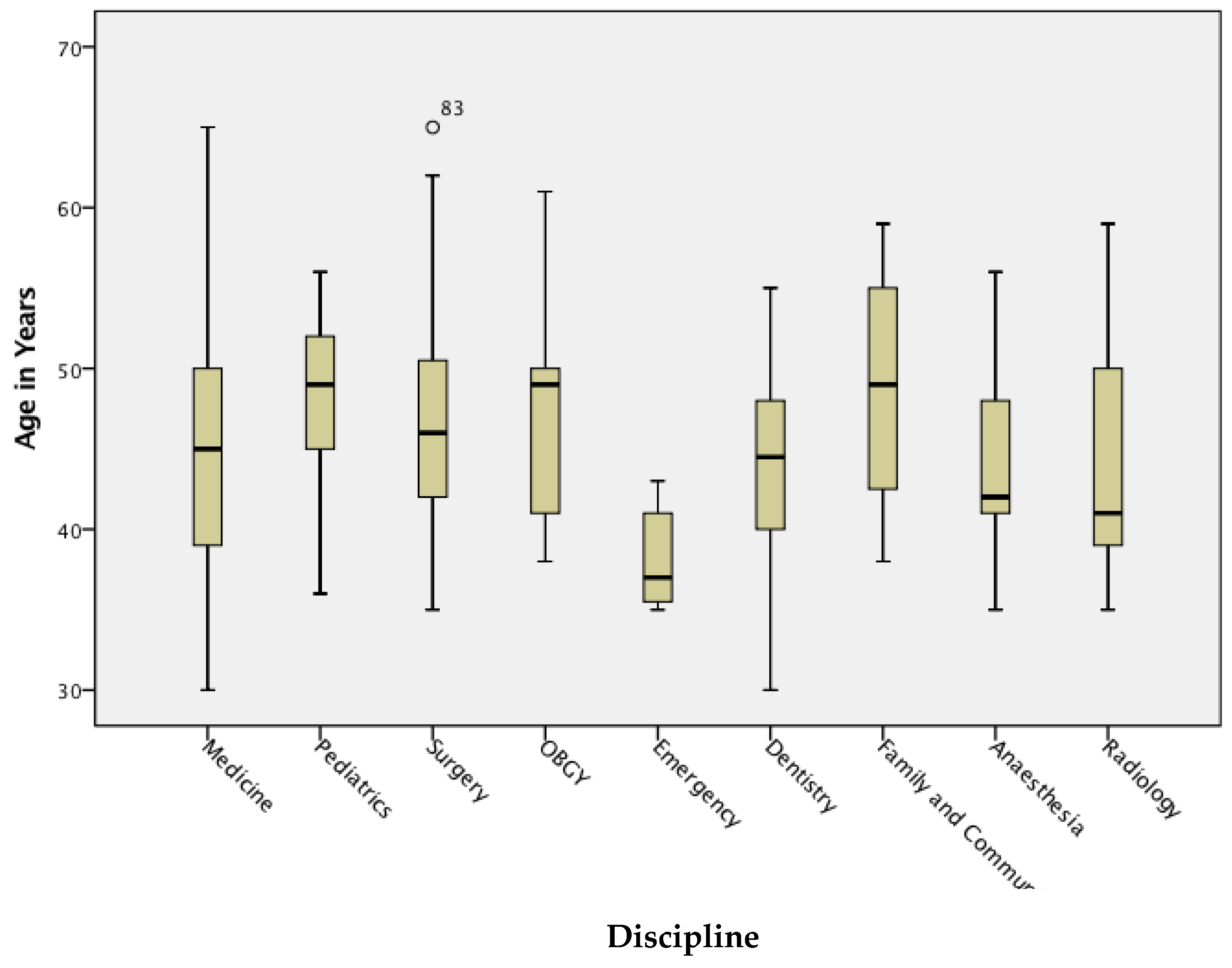
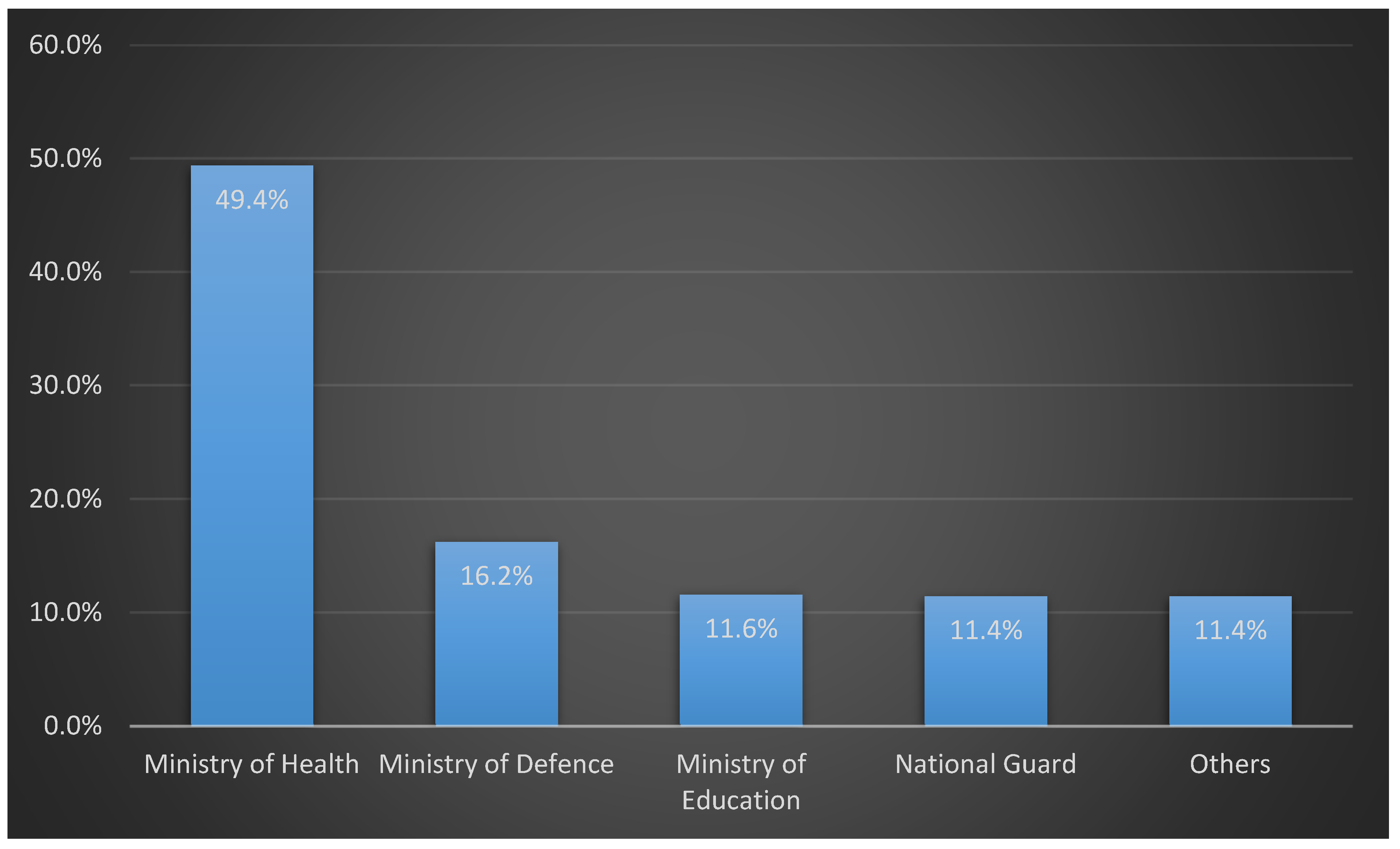
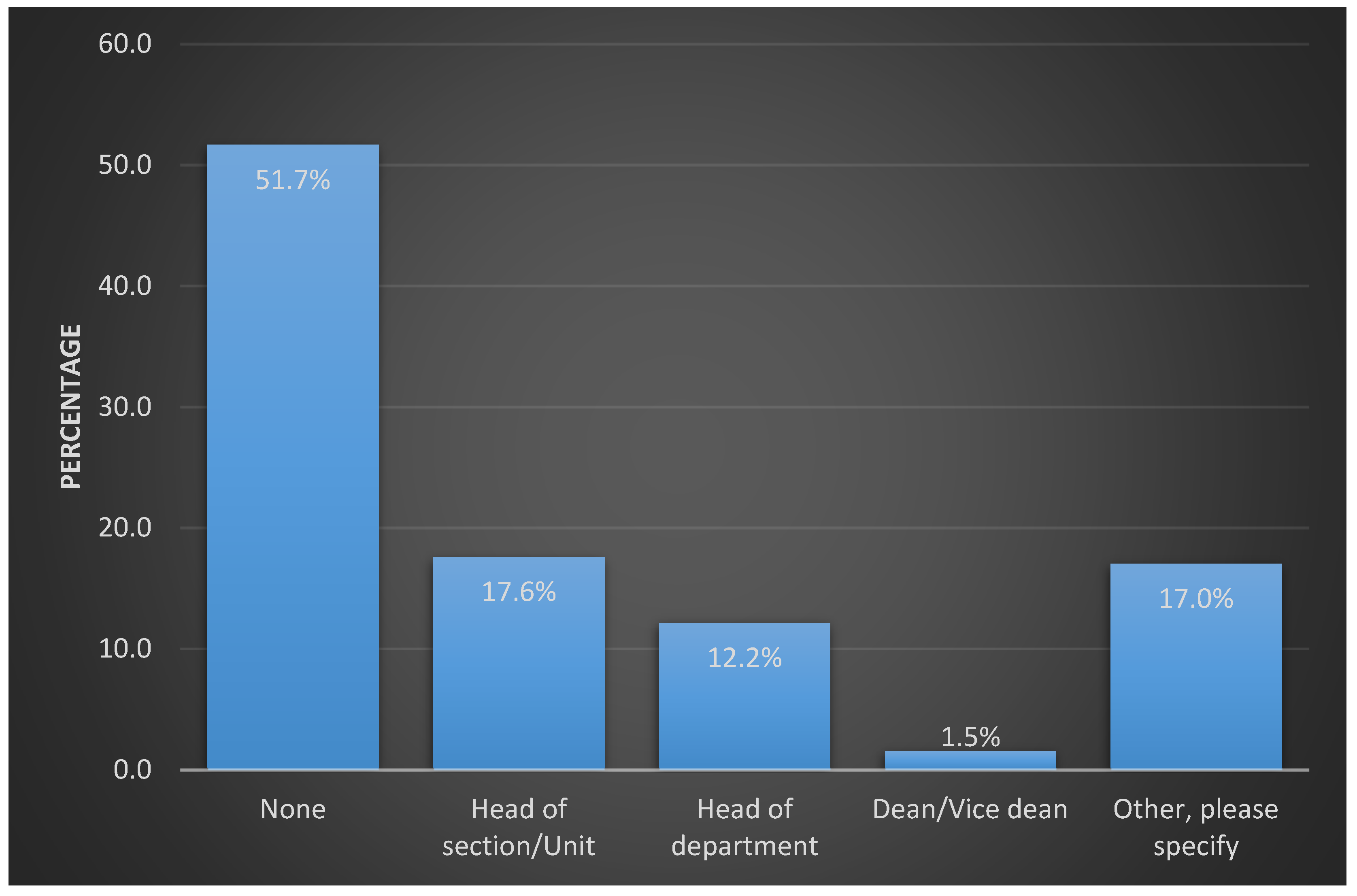
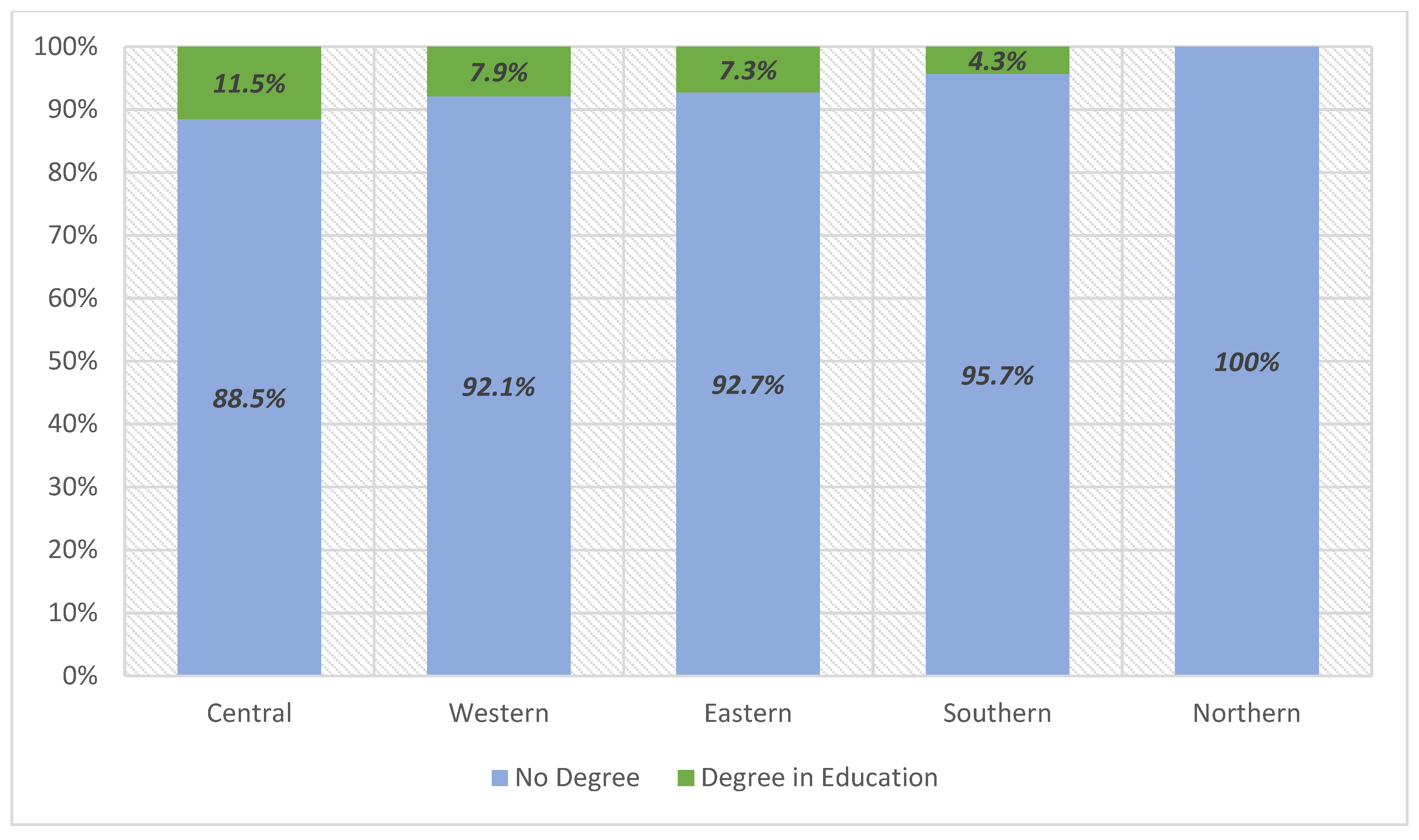
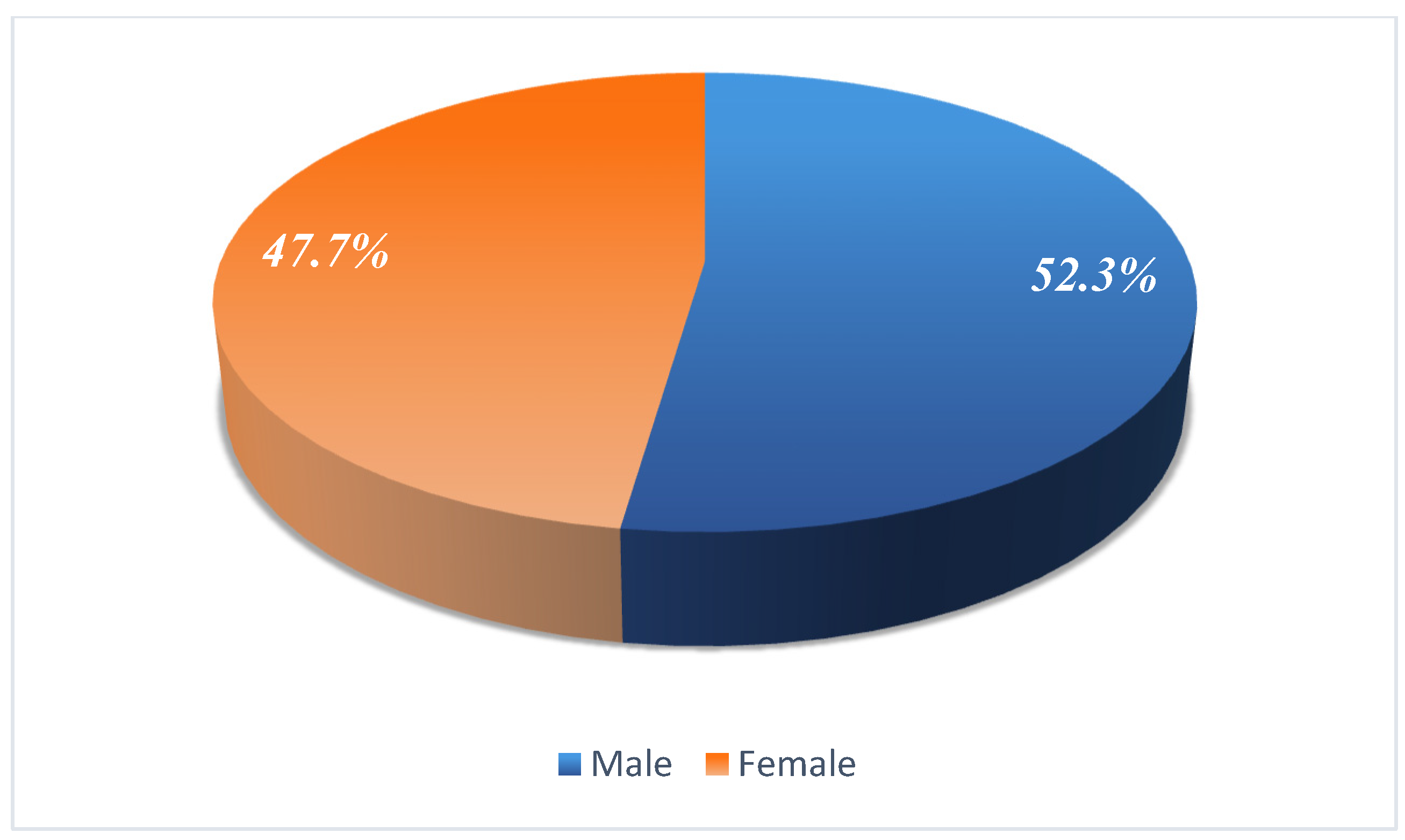
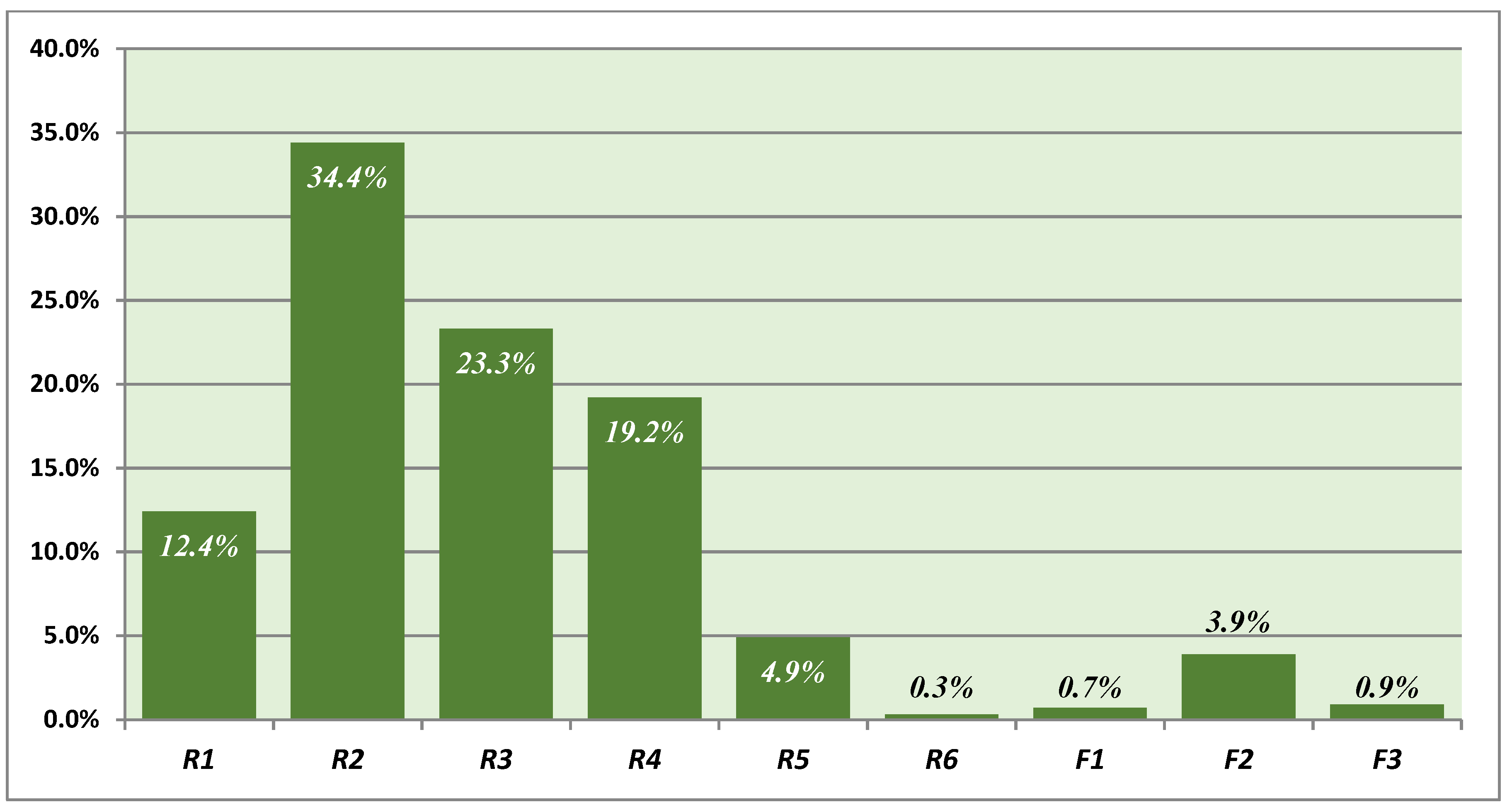
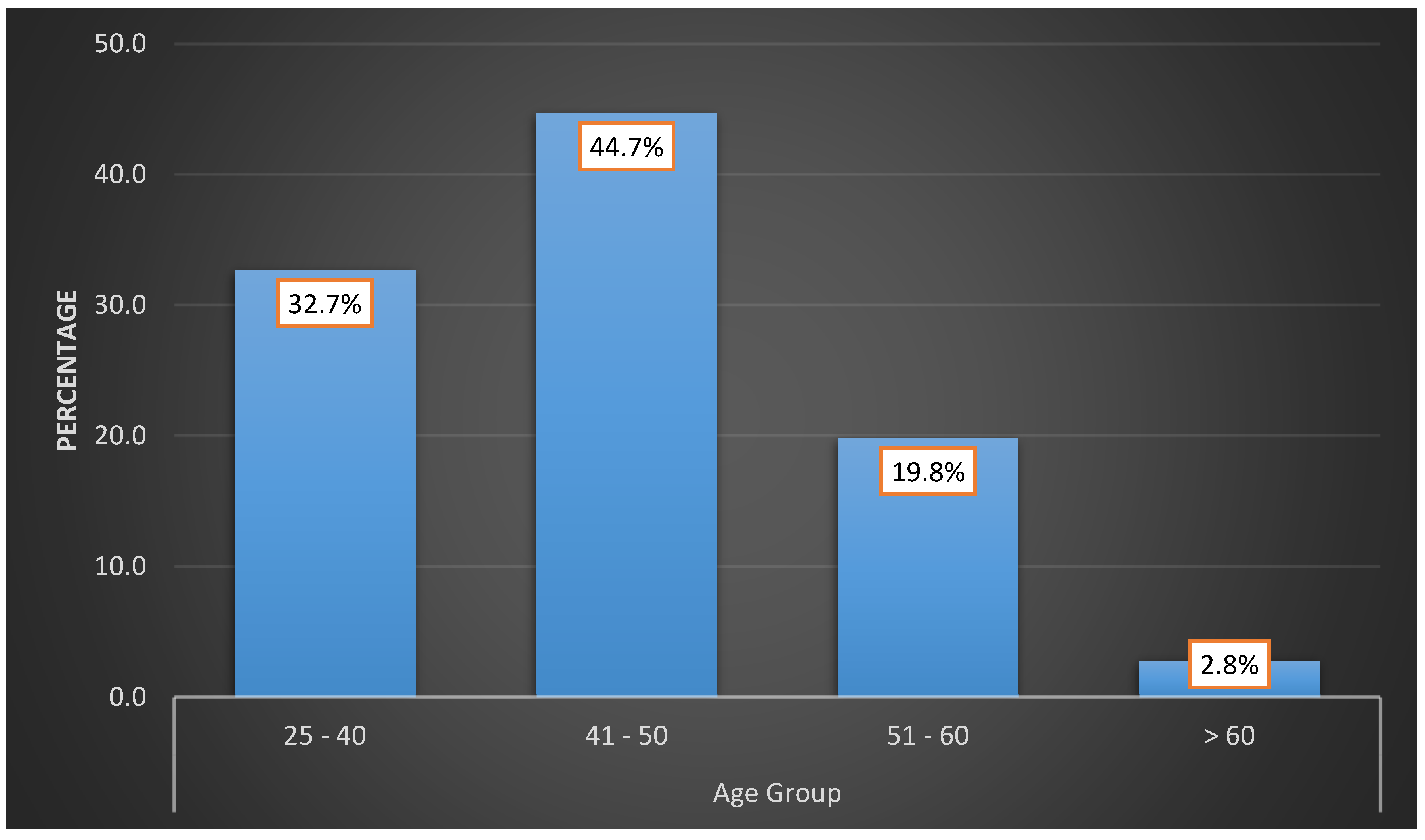
4.1.1. Section One: Program Directors’ Basic Characteristics
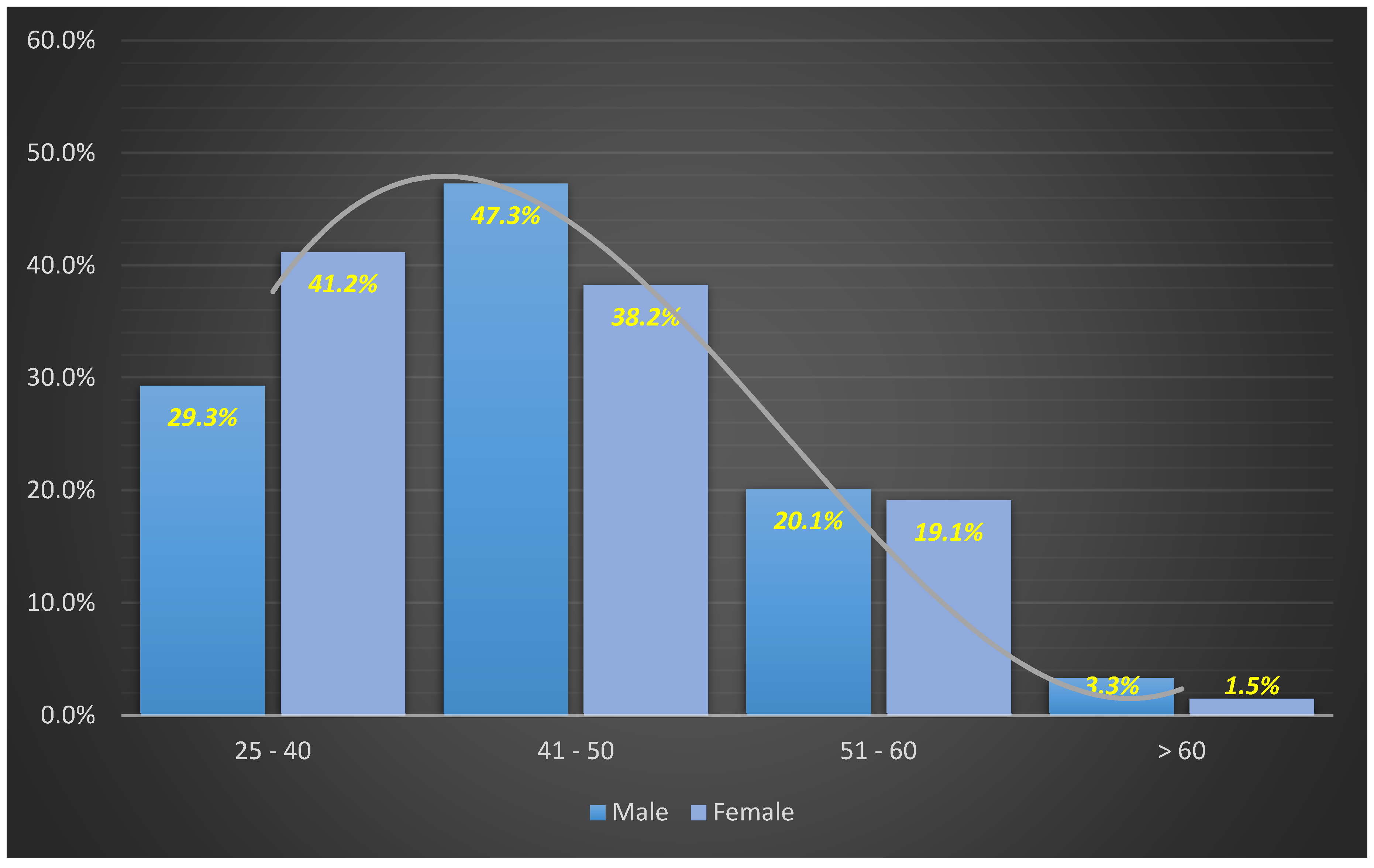
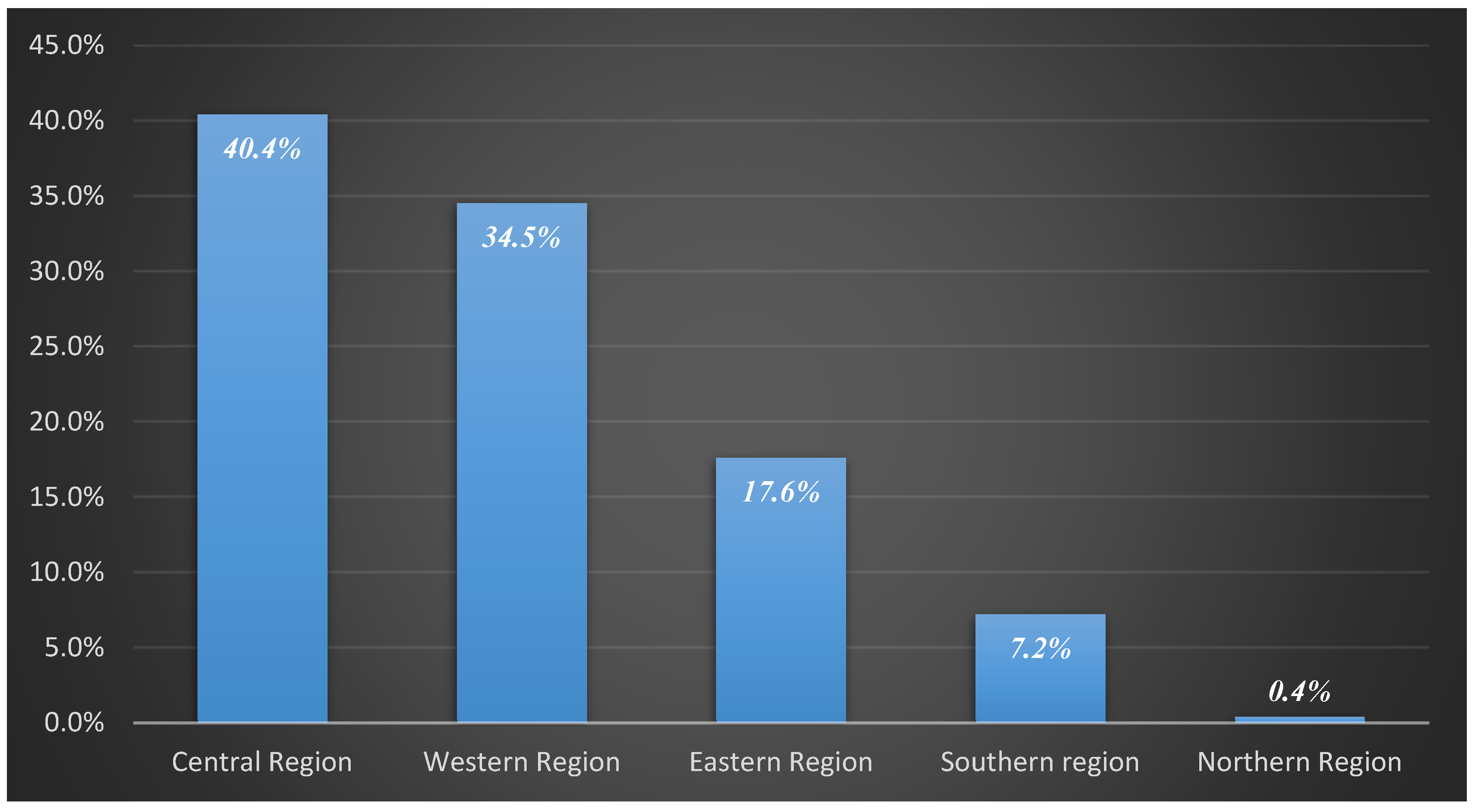
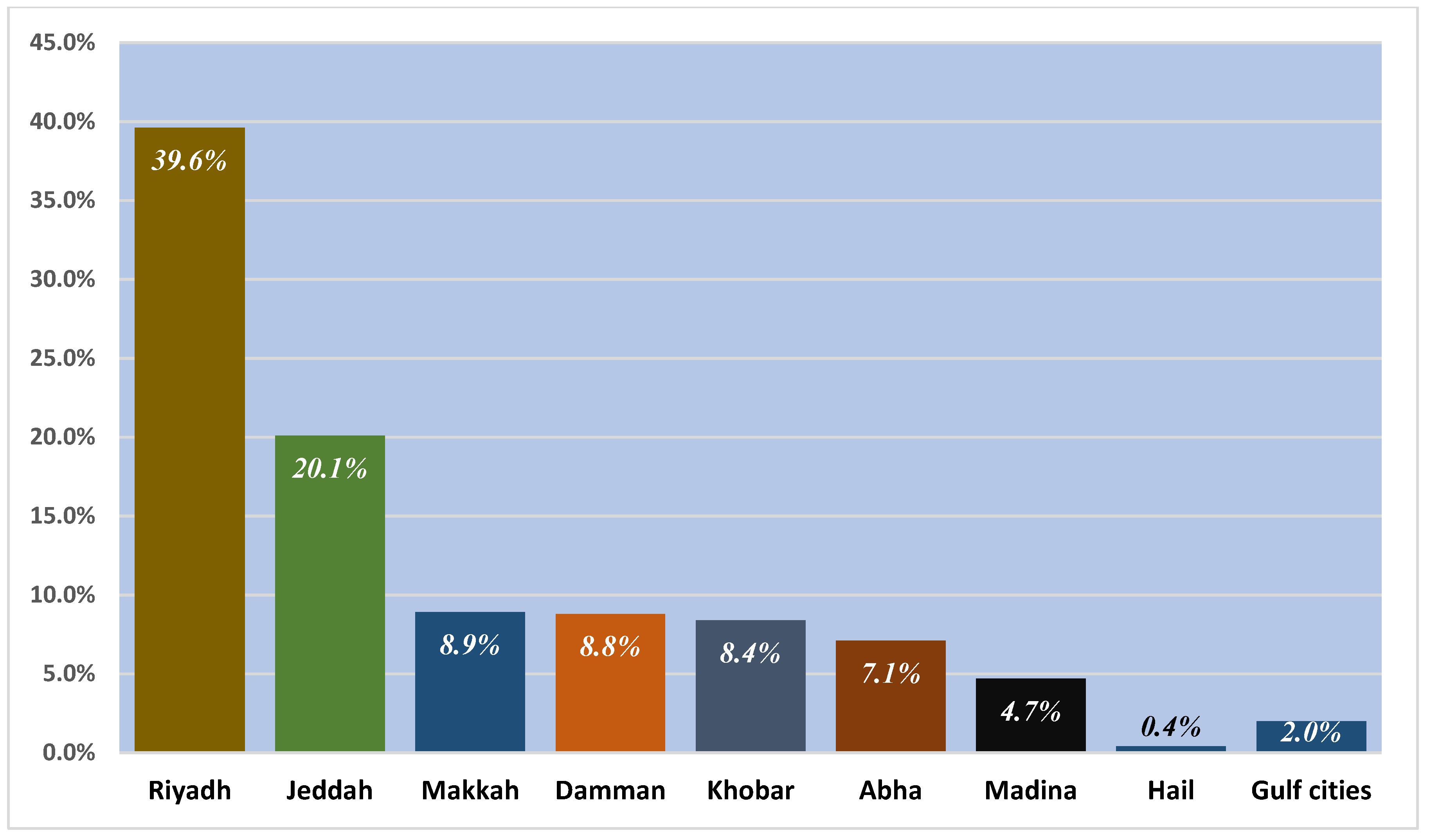
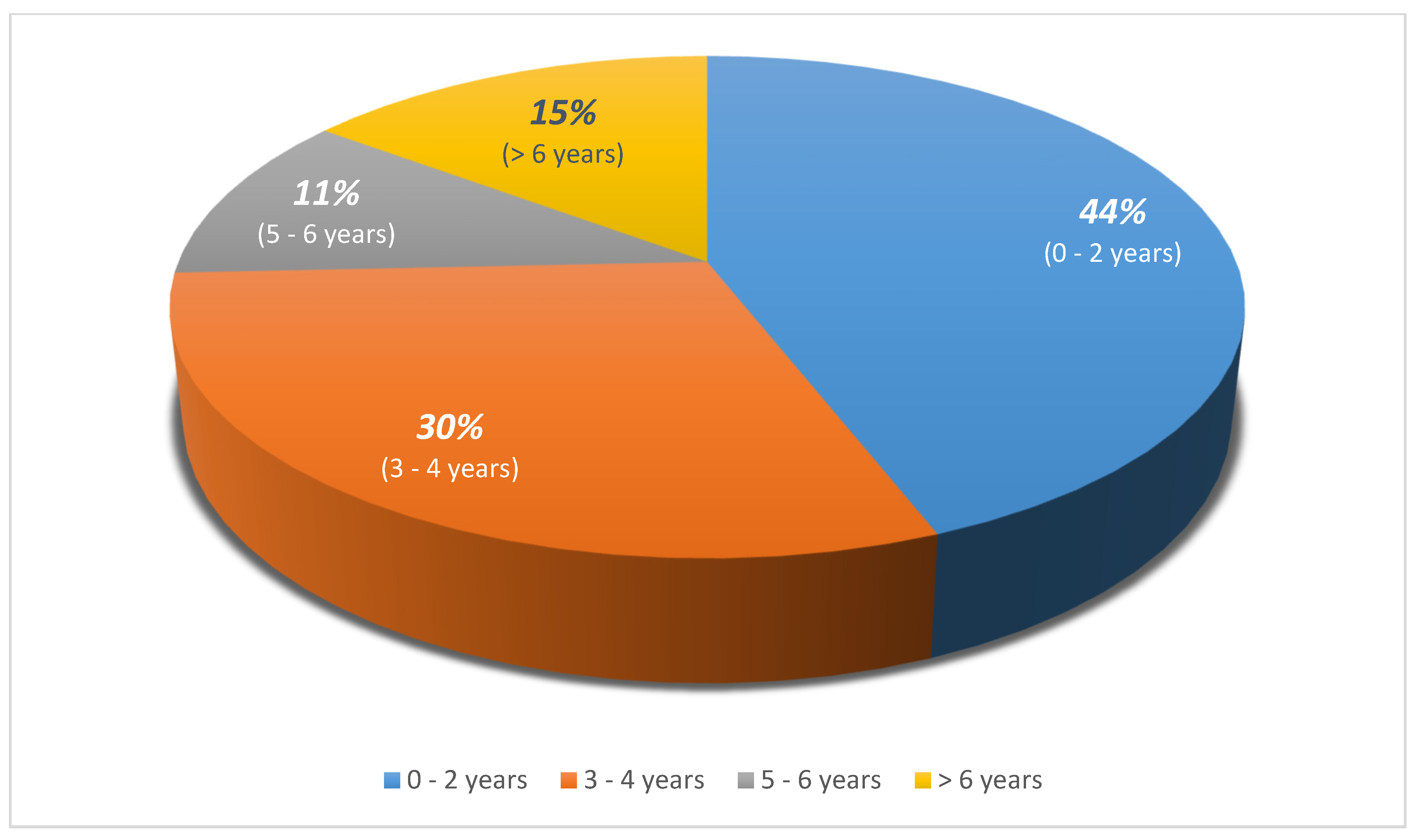
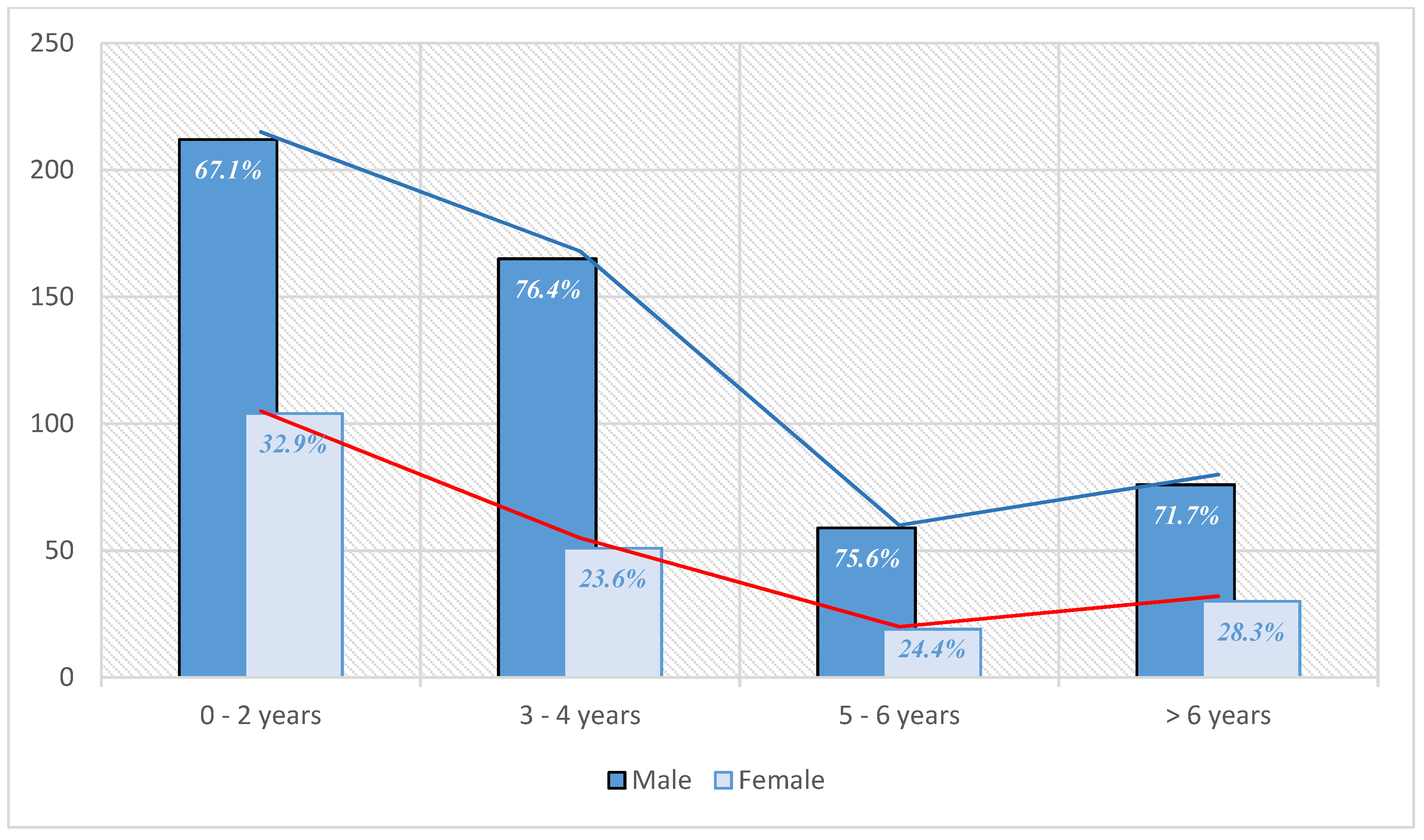
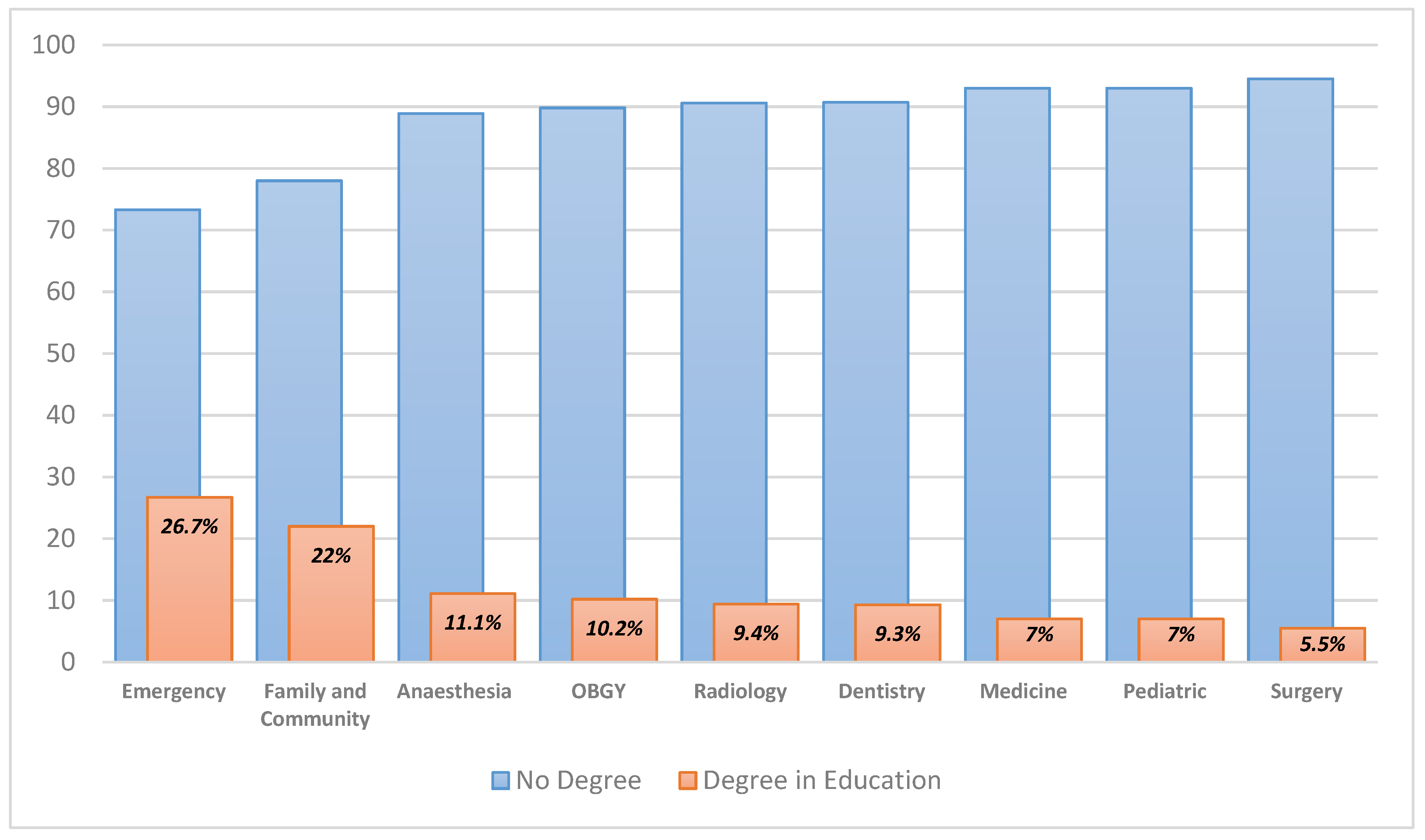
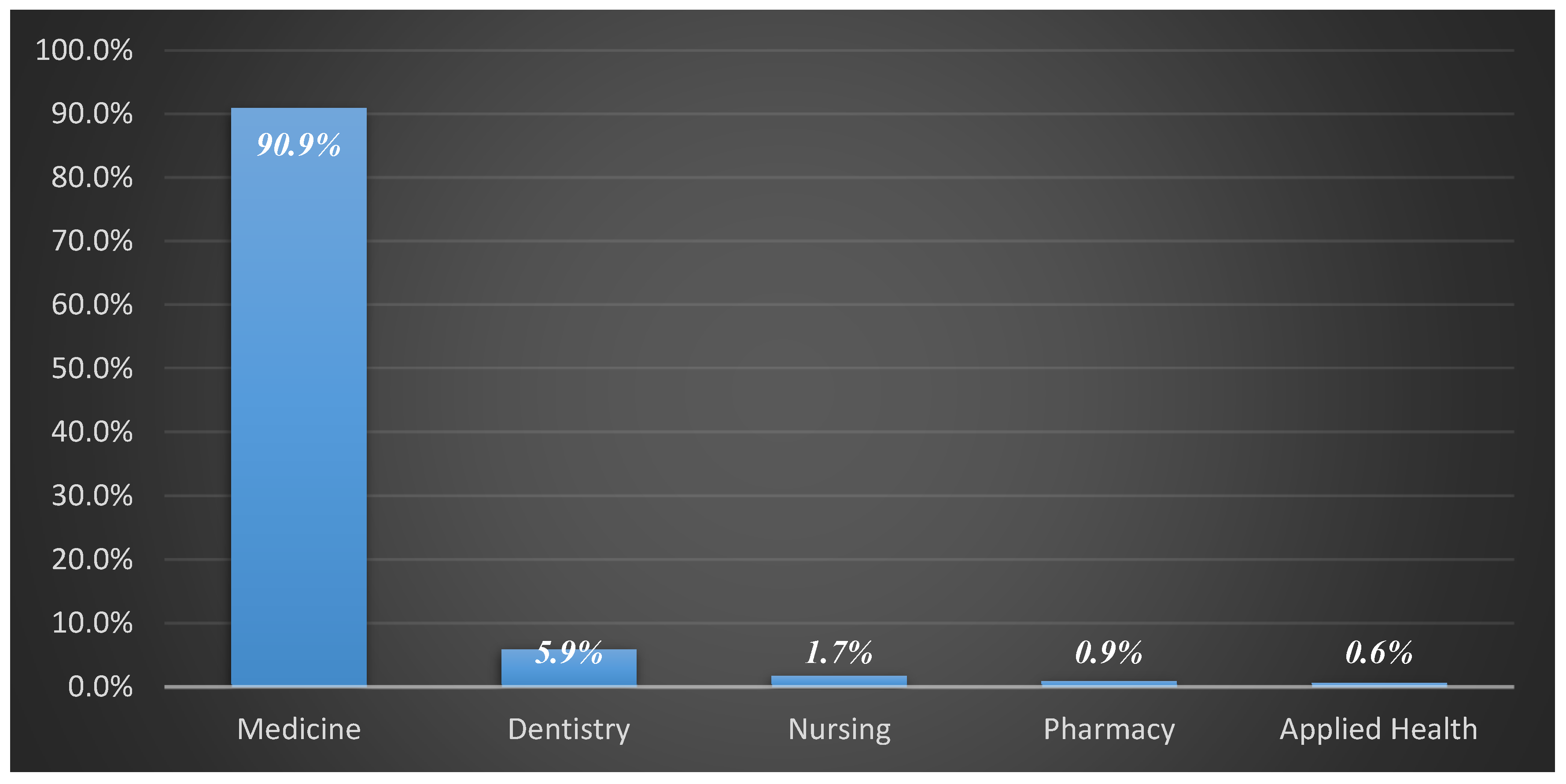
4.1.2. Trainees’ Demographic Data
4.2. Results of Key Performance Indicator (KPI) Domains
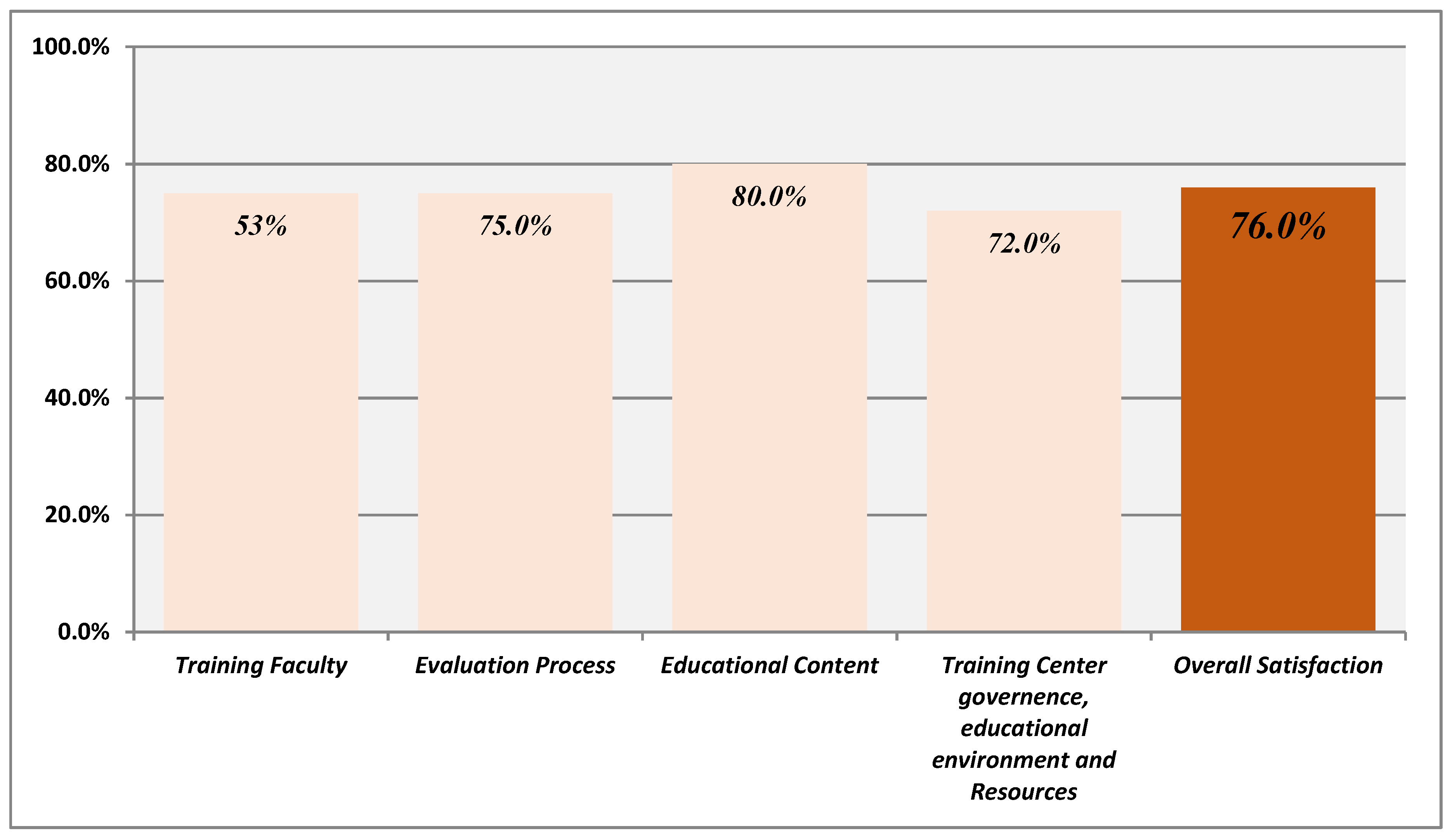
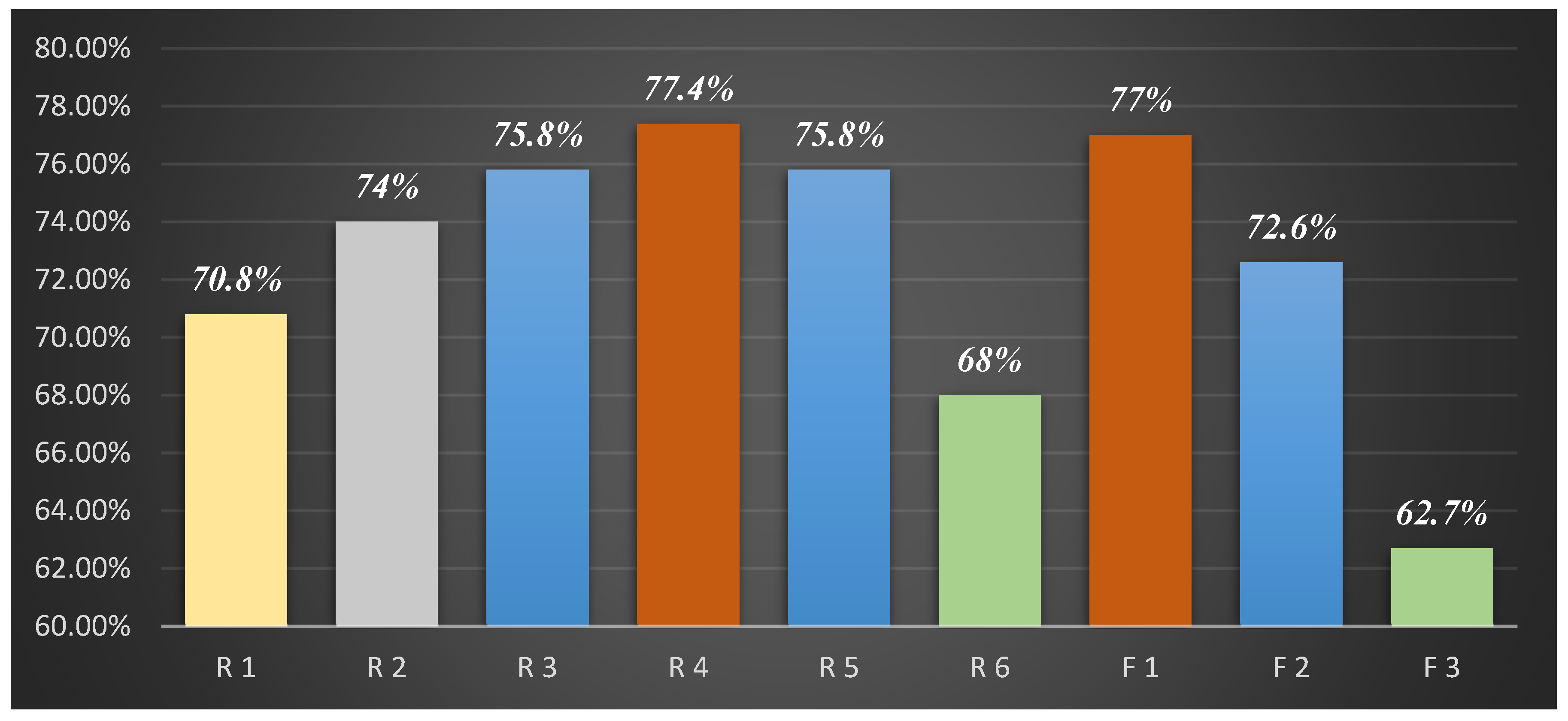
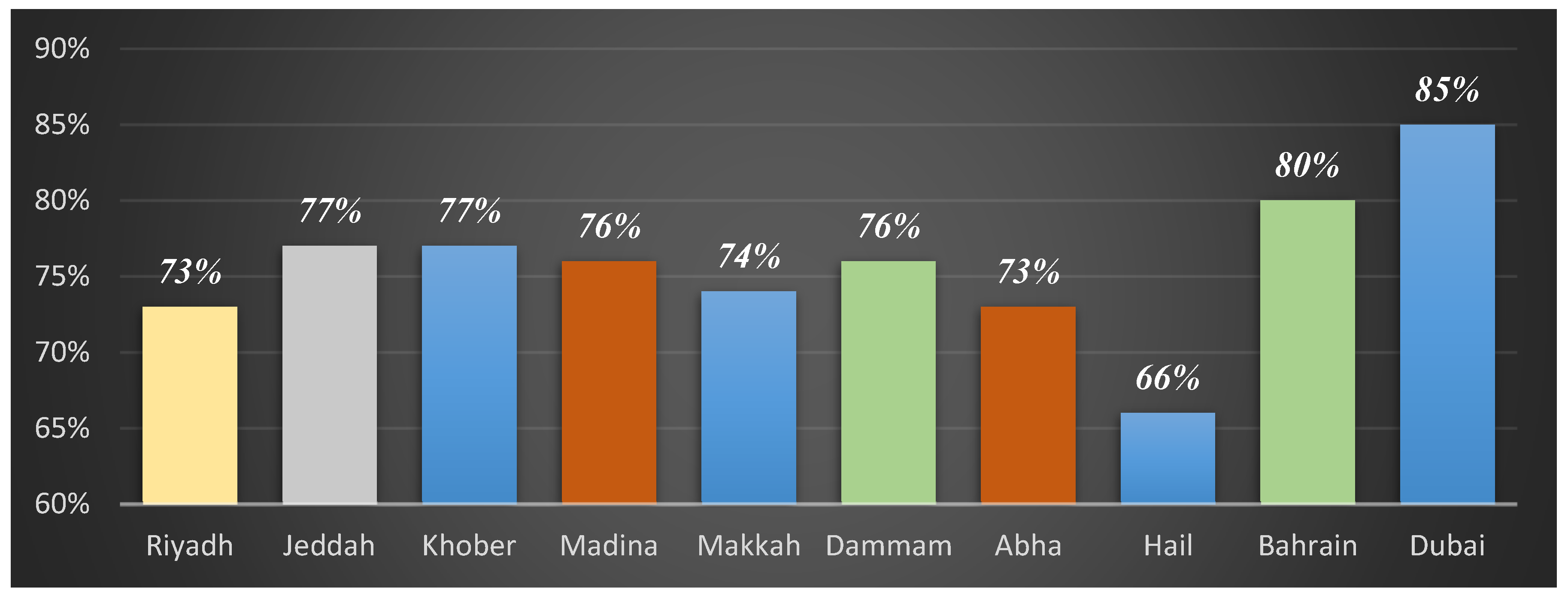
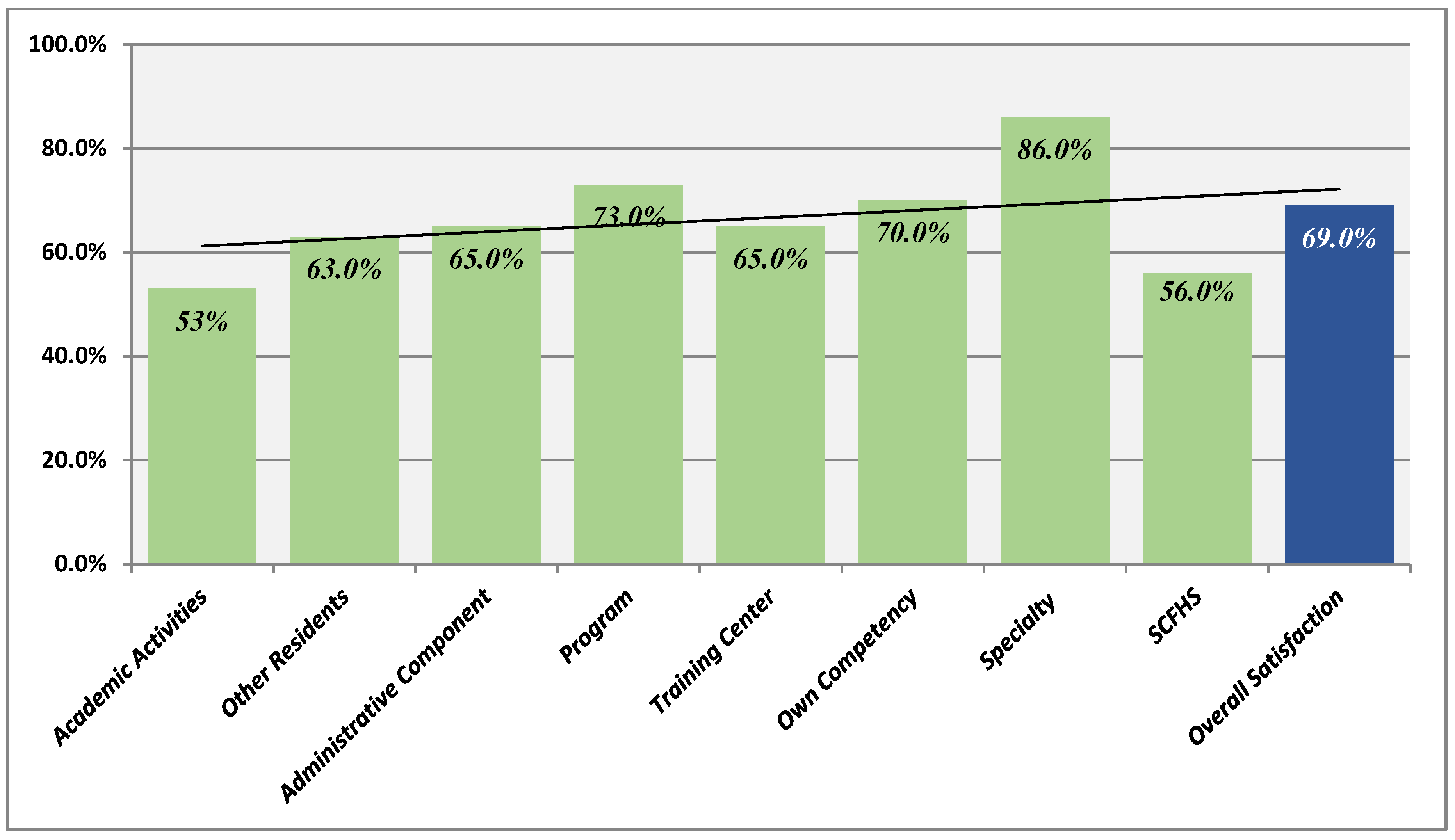
4.2.1. Percentage of Trainees’ Satisfaction (GMH QI 1.1)
4.2.2. Percentage of Trainers’ Satisfaction (GMH QI 1.2)
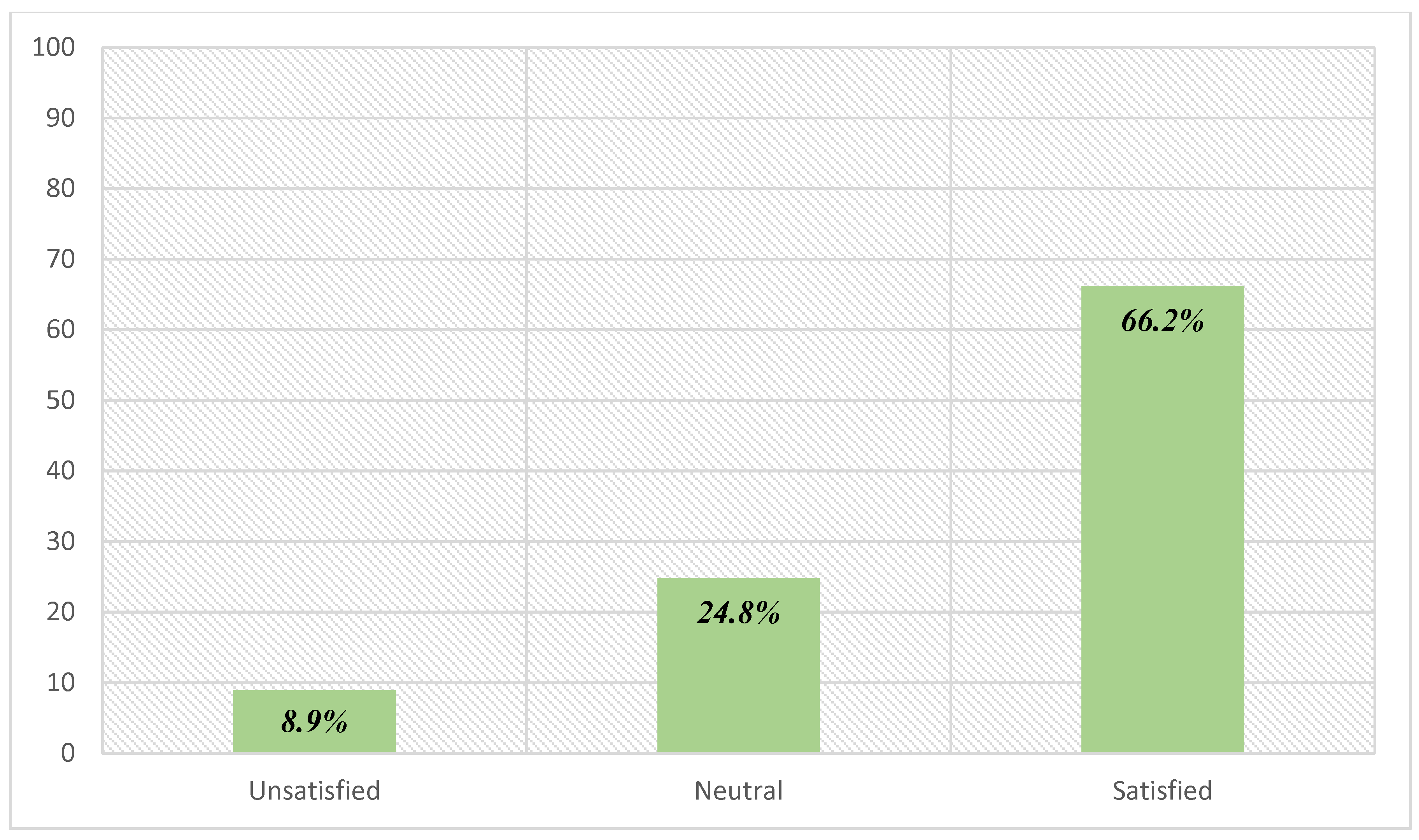
4.2.3. Percentage of Program Directors’ (PDs’) Satisfaction (GMH QI 1.3)
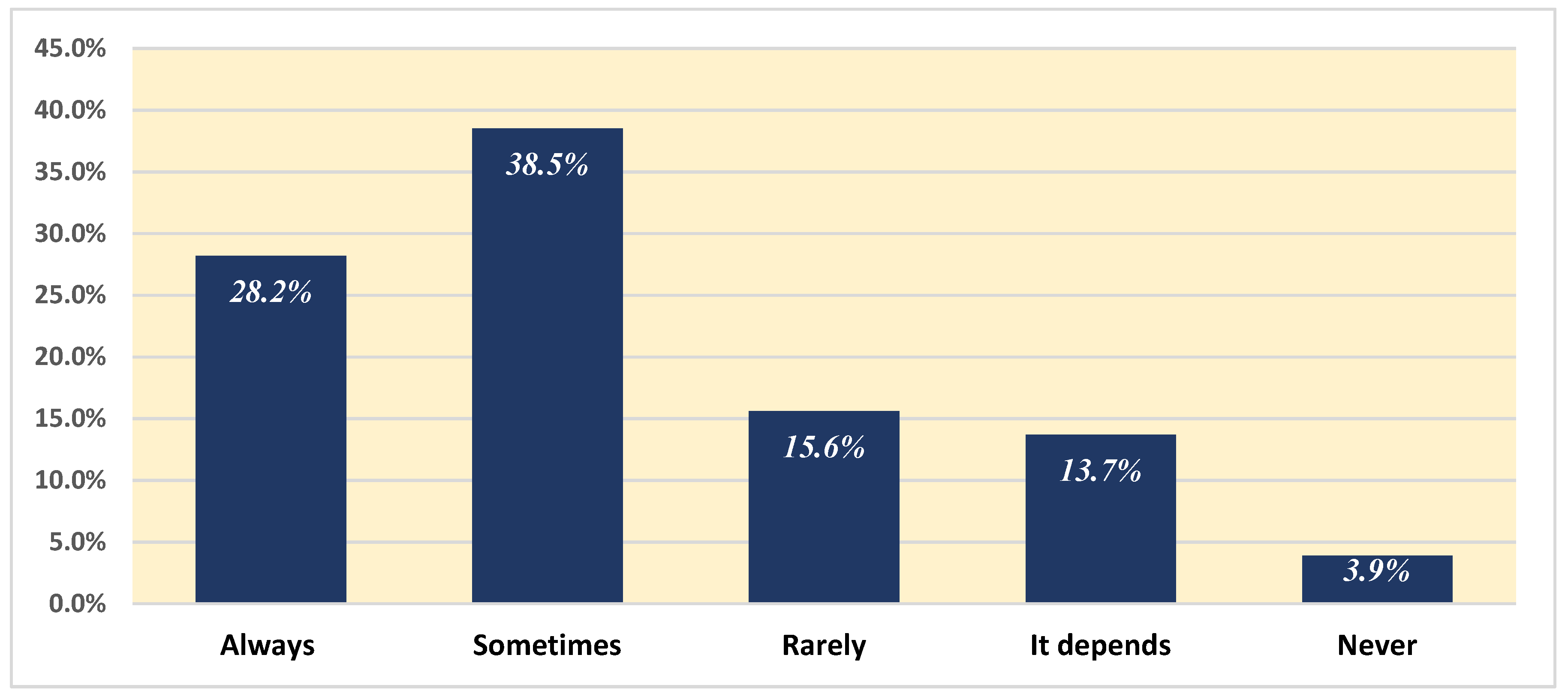
4.2.4. Percentage of Trainees’ Burnout (GMH QI 1.4)
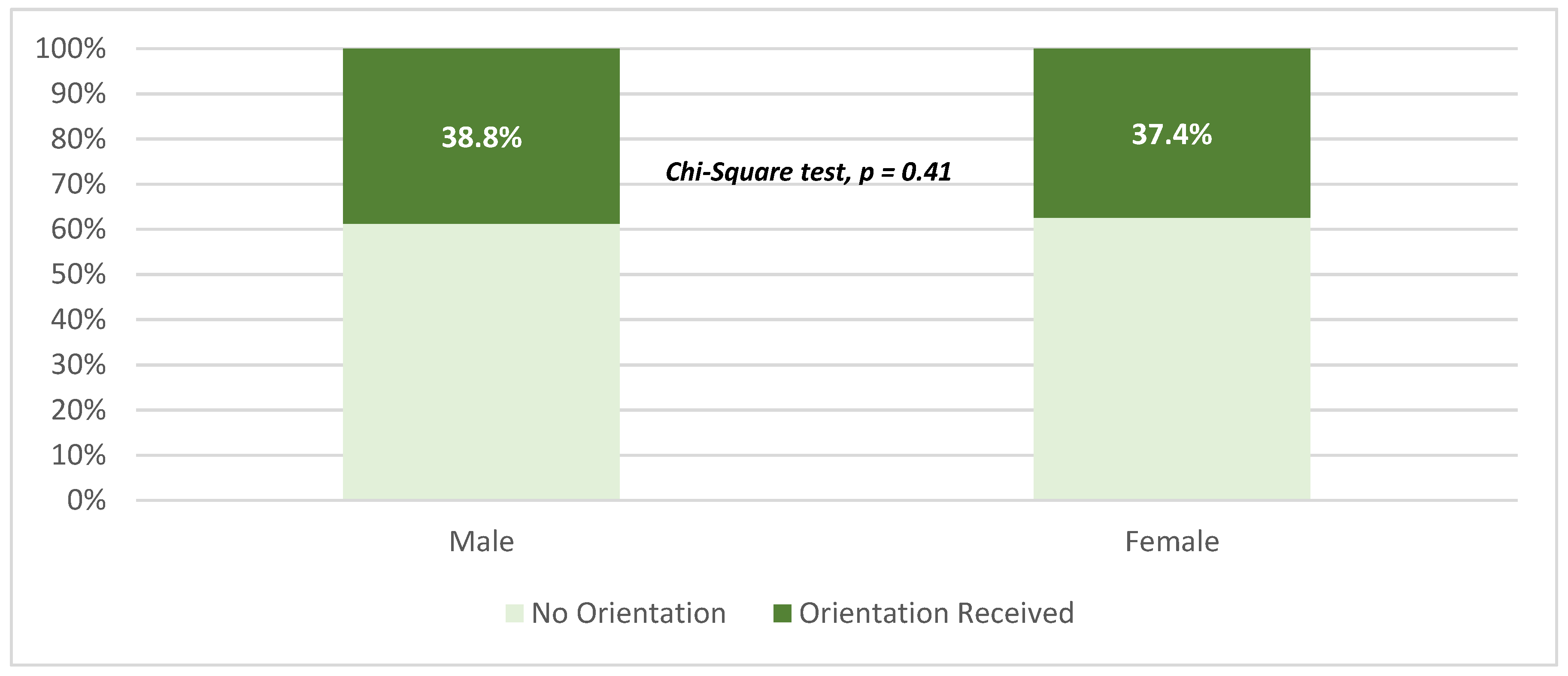
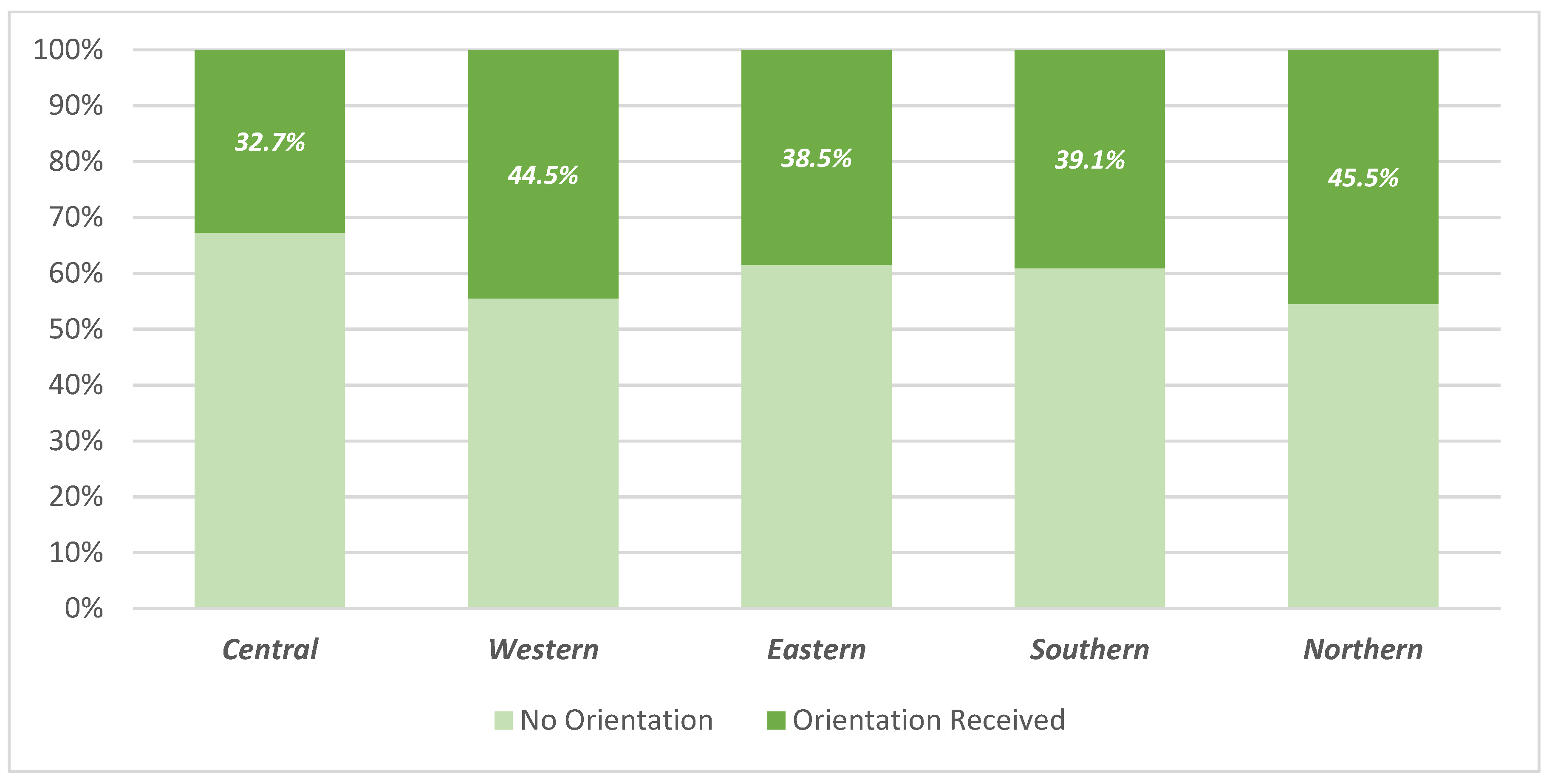
4.2.5. Percentage of PDs Who Attended PD Training Course Offered by the SCFHS (GMH QI 2.1)
4.2.6. Percentage of Trainers in PGMT Programs Who Successfully Completed SCFHS Training (GMH QI 2.2)
4.2.7. Percentage of Surveyors Who Have Successfully Completed SCFHS’s Accreditation Training (GMH QI 2.3)
4.2.8. Percentage of Trainees’ Compliance with Minimal Procedure, Case Exposure Policies Required Competency Index (GMH QI 2.4)
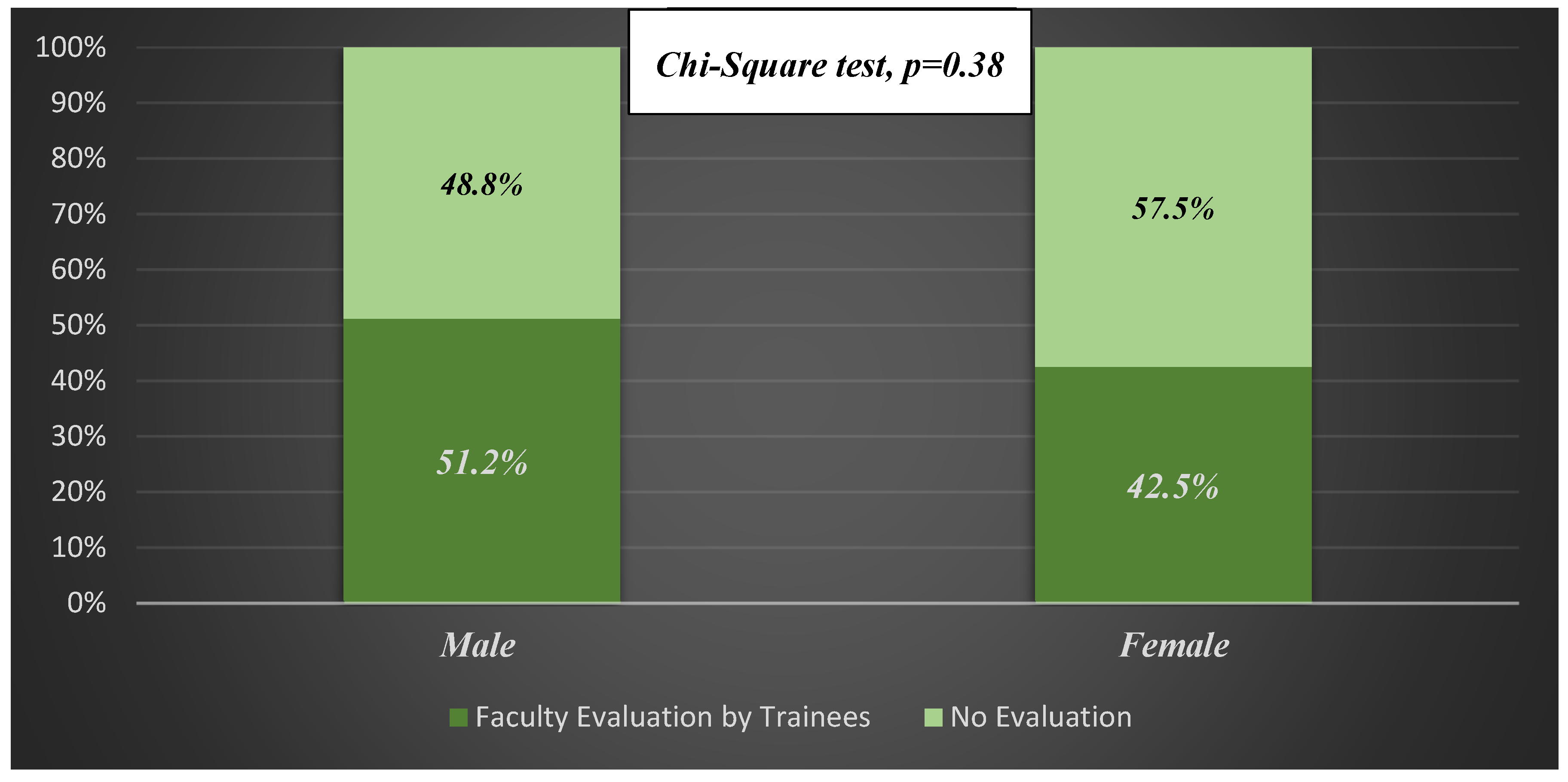
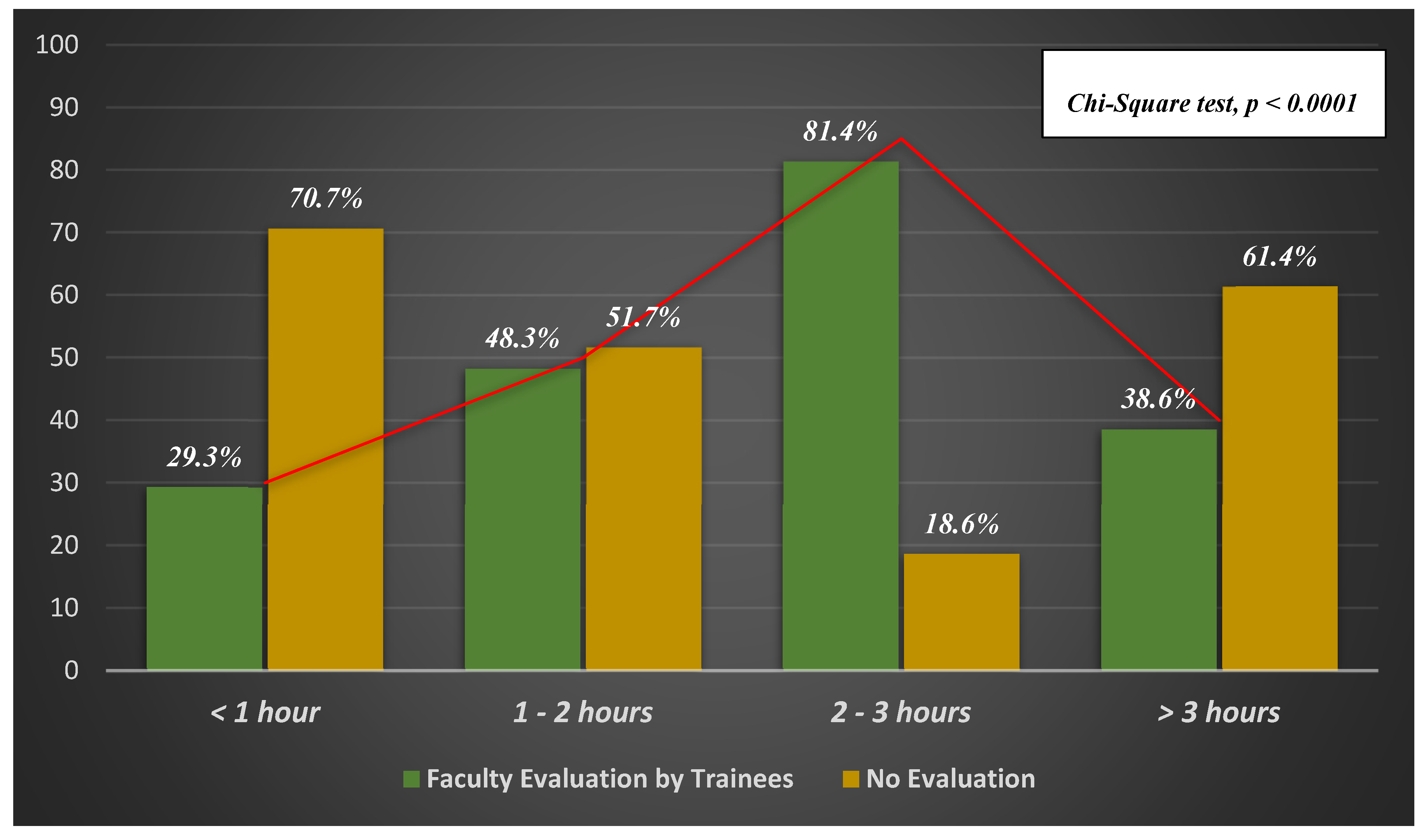
4.2.9. Percentage of Trainees Who Have Received Trainees’ Evaluation by Program in a Specific Period (GMH QI 2.5)
4.2.10. Percentage of Research Included in Curriculum (GMH QI 2.6)
4.2.11. Percentage of Programs with Burnout Policy (GMH QI 2.7)
4.2.12. Percentage of Compliance with Implementing Incorporated e-log System in Each Program (GMH QI 2.8)
4.2.13. Percentage of Trainees Who Fulfilled Their Promotion Criteria (GMH QI 2.9)
4.2.14. Percentage of Trainees Who Passed the Board Exam (GMH QI 2.10)
4.2.15. Percentage of Programs That Incorporated Simulation in Their Curricula (GMH QI 2.11)
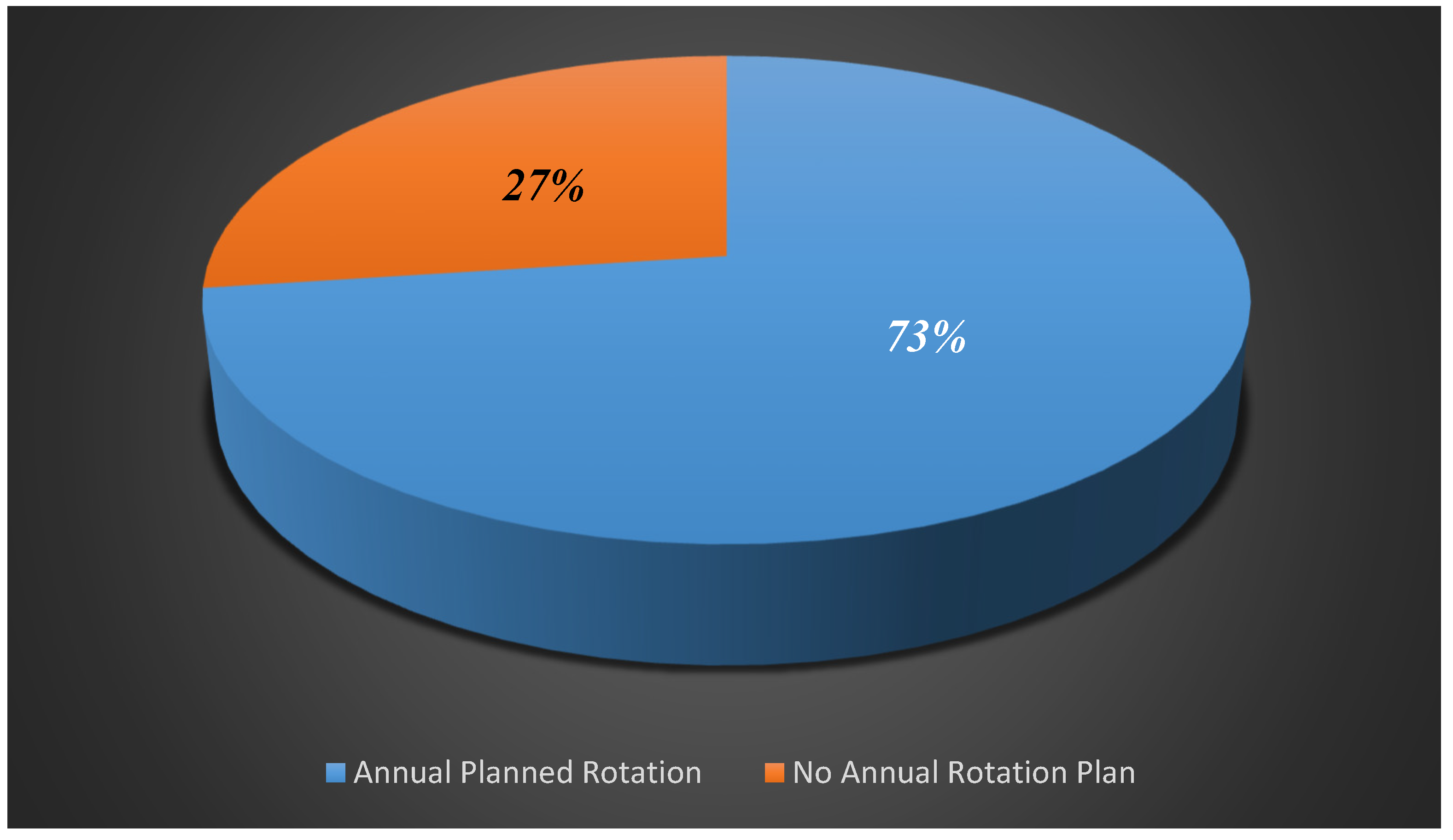
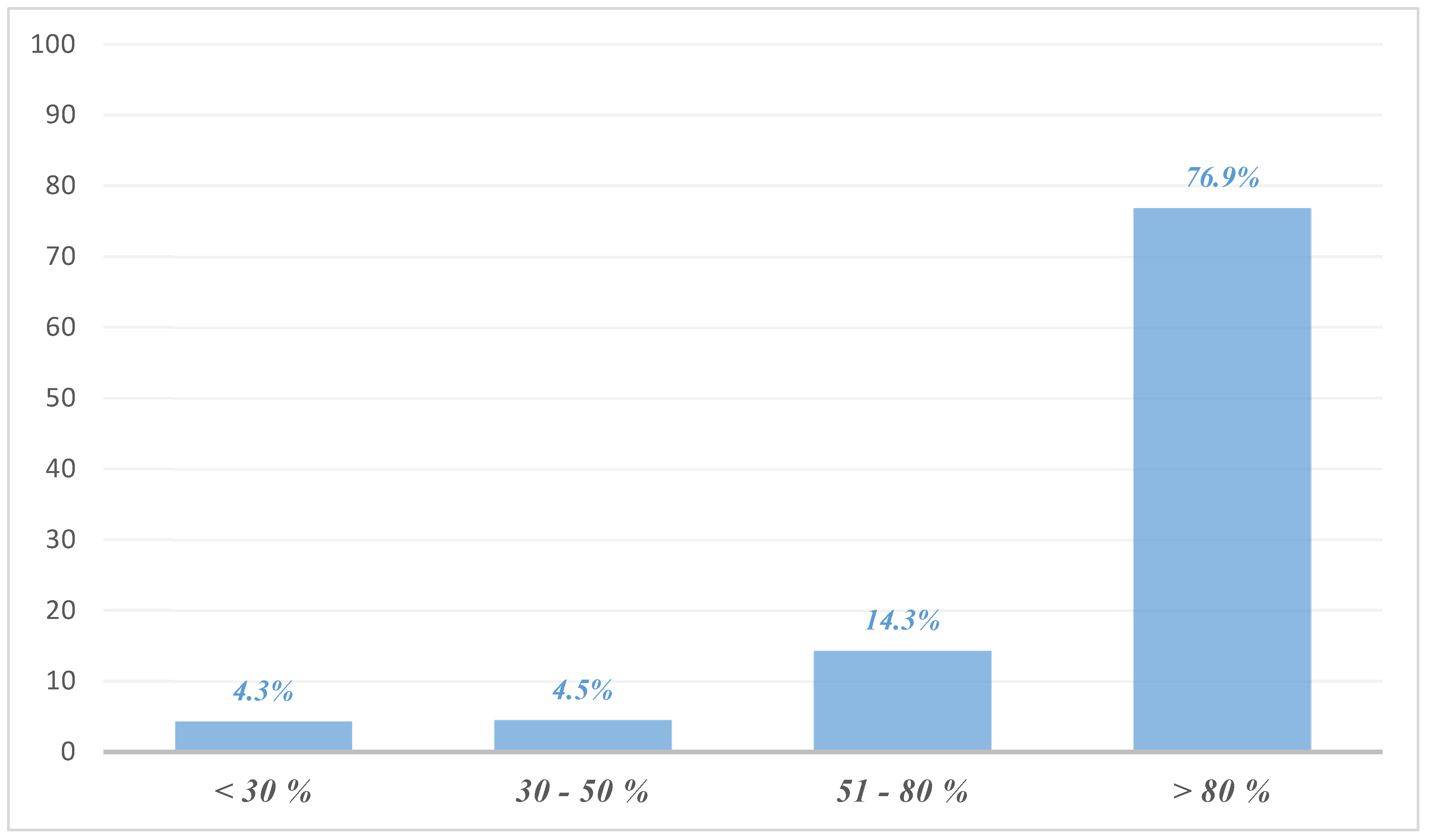
4.2.16. Percentage of Programs with Trainees Receiving Annual Master Rotation Plan (GMH QI 2.12)
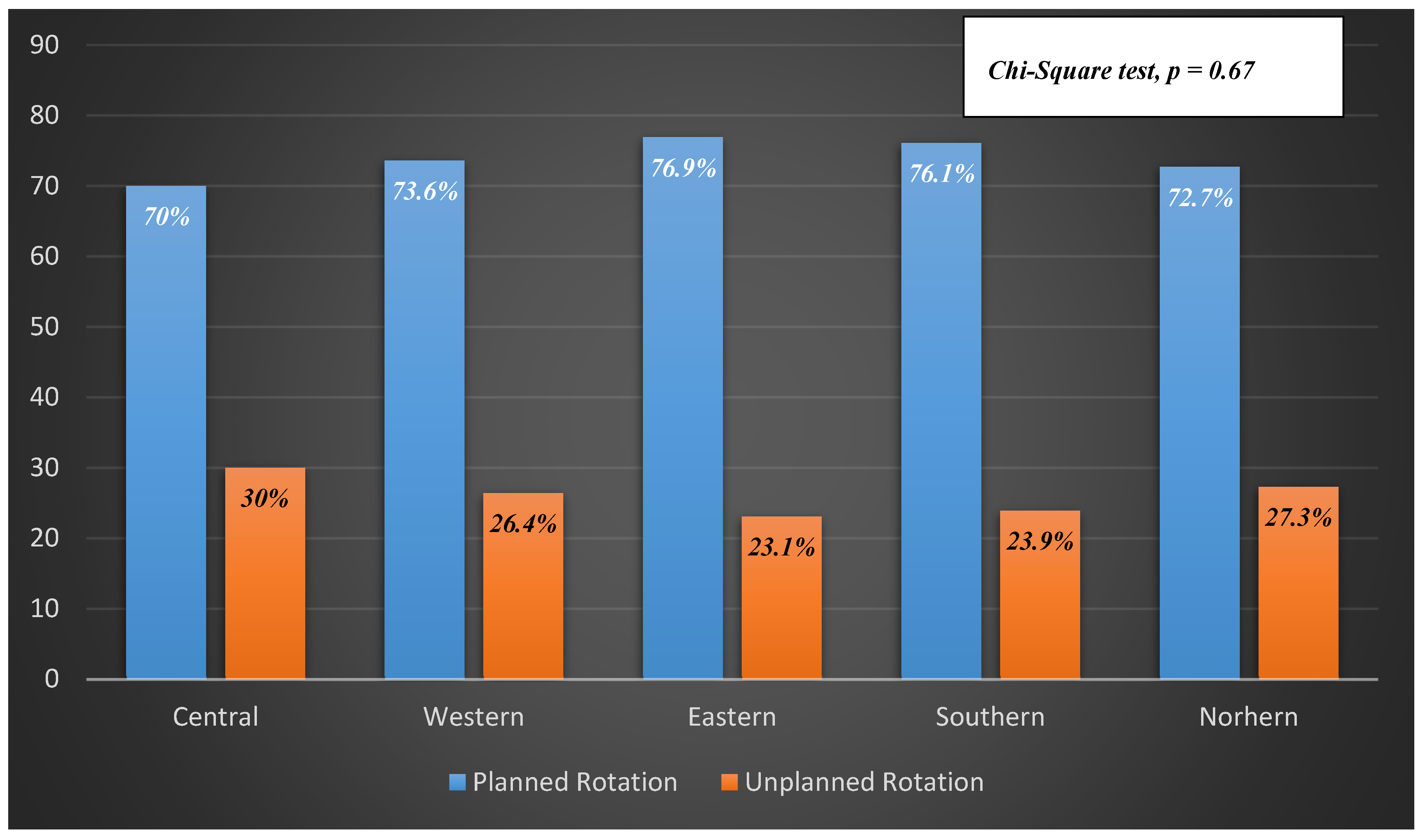
4.2.17. Percentage of Programs in Compliance with the Annual Master Plan (GMH QI 2.13)
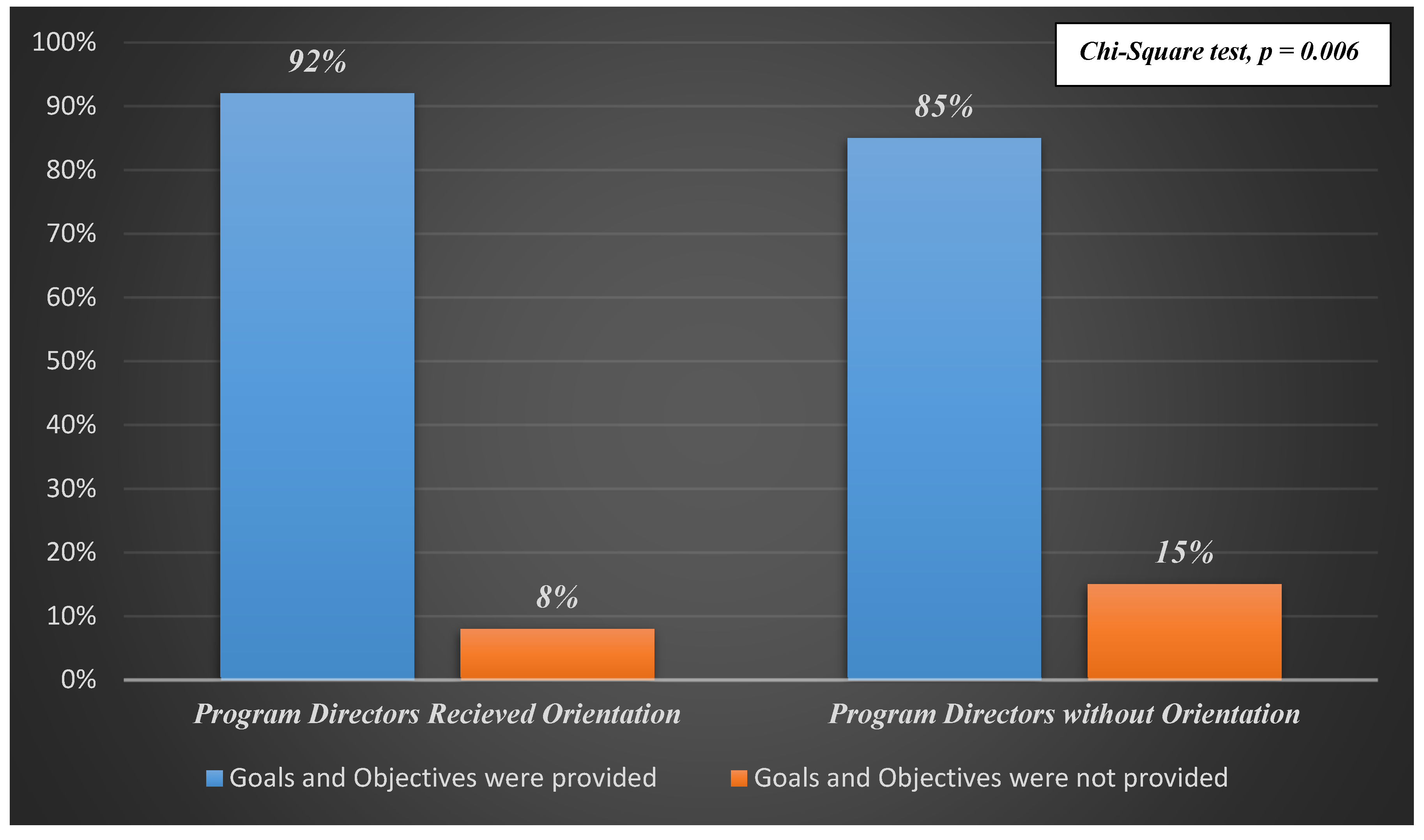
4.2.18. Percentage of Programs with Complete Goals and Objectives for Residency Programs (GMH QI3.1)
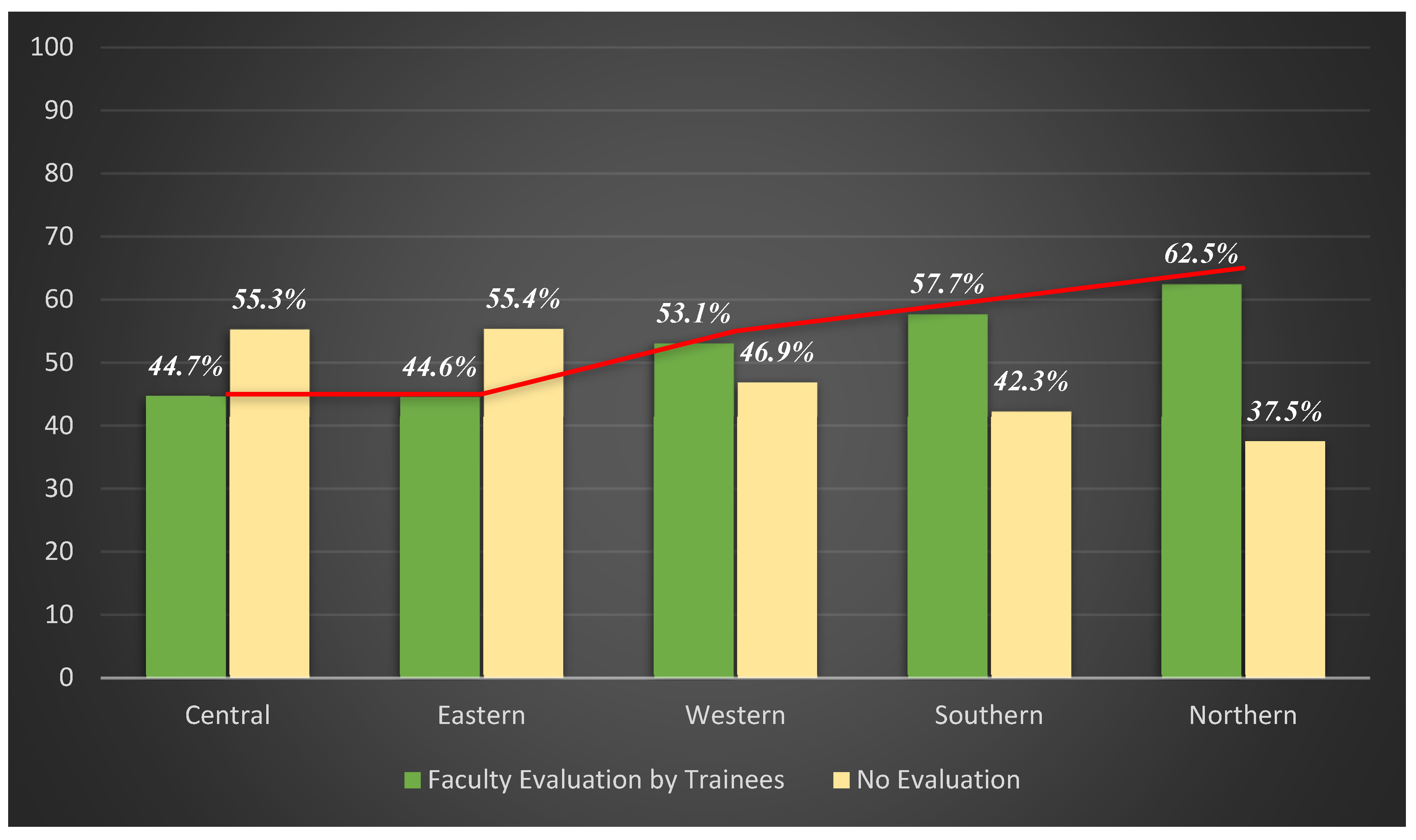
4.2.19. Percentage of Completed Trainer Evaluations by Trainee per Program (GMH QI 3.2)
4.2.20. Percentage of Adherence to Accreditation Requirements (GMH QI 3.3)
4.2.21. Percentage of PD Turnover Rate (GMH QI 3.4)
4.2.22. Percentage of Accreditation Compliance Score (GMH QI 3.5)
4.2.23. Percentage of Violations with the Matching Regulations (GMH QI 3.6)
5. Key Findings Related to the Research Objectives
5.1. Recommendations of the Program Directors and Trainees in Improving the Quality of Training
- The burnout rate in trainees is multifaceted but most of the residents agree that lack of staff at the training center is the main reason. Training centers need to ensure the proper distribution of workload among residents with appropriate staff coverage.
- The resident dropout rate should be monitored closely for each program and should be investigated in each training center; the reasons should be clarified and addressed with appropriate actions for each reason.
- The residents’ annual vacation is their right and should be protected by the training center to choose the time where it suits the residents the best—not the program.
- Trainees suggest that one day per month should be offered as an admin leave to every resident, mandatorily (note that month and date should be determined by the resident only).
- Under no circumstances should the residents cover the service without appropriate supervision, including ER rotation, and they should not be prevented from attending the academic activities.
- A unified ecosystem of smart medical educational content and distance learning facilities can significantly reduce the burnout rate. More flexible procedures and cloud training services can be a bold action for the improvement of the burnout rate. It was one of the most critical findings and the SCFHS takes this seriously into consideration and various initiatives are planned, closely related also to the digital transformation in the Vision 2030.
- The analysis of the dropout rate and critical reasons must be monitored through a transparent web service capable of monitoring responsive actions. In an integrated service, advanced notification and counseling procedures can support residents’ training and commitment to participate and learn.
- Time restrictions related to annual vacations or obligations must be supported and training must always be a priority as a long-term capability that enhances the full competence of the Saudi healthcare system. Towards this direction, a new hybrid training platform and strategy must be implemented. Human factors are a critical aspect of a Sustainable Medical Education Framework.
- Rewards for training efficiency and performance must be introduced for residents providing a transparent mechanism for facilitating training without dropouts. This reward system can be part of a holistic data and services ecosystem in the SCFHS.
- 6.
- Given that residents are struggling in finding time to read during the working hours, centers have to make sure that the educational environment is proper for residents’ educational needs by enforcing academic half-days on a weekly basis and availability of rooms, reading areas, and resources like libraries with updated textbooks.
- 7.
- Residents are struggling with long working hours even after their on-call times, therefore, centers have to ensure that post call off is strictly implemented, as per SHF policy.
- 8.
- Professional behavior of seniors including consultants is of paramount importance in educational gain.
- 9.
- Centers need to conduct continuous medical educational activities on professionalism, especially dealing with junior staff, to enhance proper communication and professional behavior.
- A blended virtual and physical space for reading, study, and research is also required. Within such a virtual medical educational space, seniors support juniors and also advance knowledge management capabilities, codify know-how, experiences, lessons learned, and similar activities.
- Time and space reservation for sophisticated research activities is also a critical pillar in a sustainable medical education framework.
- Advanced professional social networking of medical experts is also required, and thus, SCFHS is planning a sophisticated social human network of medical experts and professionals in the KSA aiming to enhance teamwork and collective intelligence management.
- 10.
- Many centers lack a simulation and skill lab which is nowadays an imperative tool in training; therefore, centers should invest in preparing such facilities with proper support to enhance the educational opportunities or should collaborate with an accredited center formally.
- 11.
- Simulation activity should be incorporated in the curriculum and if the training center does not provide such a facility, collaborative effort with regional accredited simulation centers and a proof of evidence for such an activity should be recorded.
- 12.
- Simulation training should be offered to all trainees including all essential procedures which need to be kept in a resident portfolio.
- The new SCFHS data and services ecosystem requires an integrated open simulation lab, partially implemented in the cloud as well as an enhanced virtual and augmented reality medical lab. Towards digital transformation, a Saudi Agora of Virtual and Augmented Reality Medical Lab and Content Laboratory can be implemented. This requires, of course, significant resources but will release unexploited capabilities of residents.
- In a parallel effort and initiative, the SCFHS should lead the adoption of virtual and augmented reality content for medical training and labs. This should be a continuous, ongoing process towards excellence.
- 13.
- All candidates for a program director post should not be appointed unless they attend a comprehensive orientation of how to perform this job efficiently, before starting their duties.
- 14.
- Most trainees are not aware of the availability of courses on training; thus, the SCFHS needs better advertisements.
- 15.
- External rotations should be offered to all residents twice a year and it is up to the resident to choose what rotation he/she will select and should not be pressured to give up his right to choose the elective rotation.
- 16.
- The training center has to ensure the availability of diverse specialties to improve the clinical encounter and make sure that residents are trained by highly qualified physicians.
- 17.
- The institutional leadership should be supportive of the educational process by all means necessary, promptly listen to the trainees’ complaints about their needs, and address their concerns.
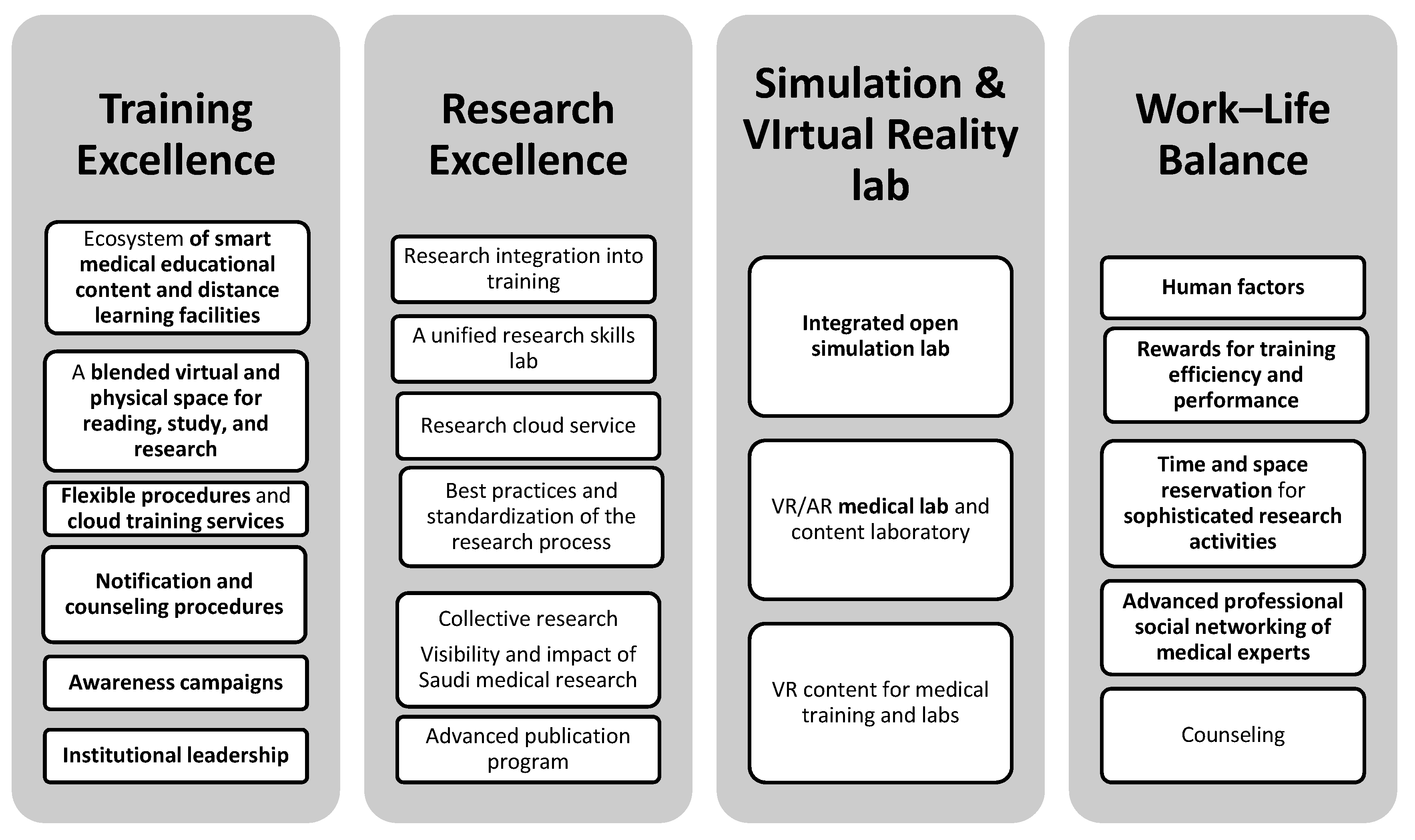
- An integrated Training Excellence approach is required with various constitutional parts including active learning medical practice, mentoring, etc. It is also necessary to support continuous awareness campaigns for the excellent training and research programs of the SCFHS.
- Institutional leadership is also an integral part of the Sustainable Medical Education Framework, with dynamic channels for direct communication and accurate information for trainees. It also provides all the means for the realization of a fully efficient educational medical environment.
- 18.
- The on-call duty needs modification from the current practice which has been the same for the case; the on-call duty should be in shifts (the 24 h on-call duty should be terminated).
- 19.
- On-call shifts should not exceed 8 each month and post call off duty should be implemented immediately right after the handover and it should be monitored by the training center.
- Shifting on-call duties is a key action for the enhancement of the efficiency in medical education and research. Within an integrated data and services ecosystem, on-call duties can be also supported by electronic services.
- 20.
- Research support should be made available by the training center, the Saudi commission should incorporate a research curriculum into every training program, and a research portal should be made available to all training centers with weak research capability.
- 21.
- Research facilities vary from one center to another, so the Saudi commission should make sure that all the trainees have access to minimum research supporting tools to standardize the level of facilities and enhance the quality outcome. An e-portfolio of the resident regarding research should be maintained by the Saudi commission and should be updated periodically by the residents.
- Research integration into training must be an integral part of any medical training program.
- A unified research skills lab and research cloud service must be implemented for providing ubiquitous and effective research training to residents. Sophisticated services and access to medical and other scientific libraries, as well as the cultivation of best practices and standardization of the research process, should be promoted. Finally, collective research towards higher accomplishment must promote team research, increasing the visibility and impact of Saudi medical research.
- An advanced publication program should allow residents to execute their research skills towards publications with impact. In the long term, we will have high skilled residents with top publication and research records promoting the objectives of Vision 2030.
- 22.
- Residents should receive regular counseling sessions (minimum quarterly to address any concerns).
- 23.
- Centers should put the needs of trainees as a high priority without hindering patient care quality.
- Counseling should be offered to residents in a constant and systematic way exploiting also the data and services ecosystem of the SCFHS.
5.2. Recommendation of the Training Quality Department
Novel Data and Services Ecosystem in SCFHS
- Data quality was a major challenge of this project: availability, completeness, and accuracy were the most worrisome. In fact, some of the KPI information has yet to be retrieved. The collection of data related to the KPIs and quality assurance indicates the need for an integrated data strategy in the SCFHS. The establishment of big data flows for continuous management monitoring and support of the medical education process is a key requirement. In addition, the suggested services proposed in the previous section for residents require a new, sophisticated analytics upper level.
- Transparency, collaboration, and effective communication are a cornerstone in achieving the objective of the assigned committee and its charges including conducting this project and preparing the report. The provision of a systematic, manageable workflow within the data and services ecosystem of the SCFHS is also another critical development.
- Some KPIs need further revisiting to re-define them, or even modify or define certain measures. This research study focused on 23 KPIs based on Kirkpatrick’s model, but further enhancement can be developed. Emphasis can be based on active learning, team development, research skills and capability, collective intelligence, social impact, etc. A key interpretation for this requirement is related to a continuous improvement process on KPIs for teaching, training, and research excellence. This is a core component of any Sustainability Framework for Medical Education.
- The developed questionnaire was an eye opener toward a better-constructed questionnaire with pre-determined comprehensive domains in order to accurately measure what it was made for, covering all aspects of training quality. In a greater context, the establishment of two-way data and communication channels in various training and research initiatives in SCFHS must be a key target. The continuous provision of real-time data can serve as a basis for numerous personalized medical training and research services.
- A quality rating system utilizes a unified scoring system for the satisfaction level across all surveys and performs reliability analysis to check for internal consistency. A transparent, multi-component quality rating system, like the one we tested in this research through 23 KPIs, is a bold initiative towards the objective measurement of quality. It is necessary for the next years to design and implement a cloud-based rating system, capable of delivering on real-time variations and updates on quality and satisfaction perceptions of participants in training and research conducted by the SCFHS.
- Setting the target value, i.e., benchmark, was somewhat arbitrary. Using an objective measure as much as possible would be ideal, however, any subjective measure selected should be agreed upon by the TQC, with acceptable reasoning for this value. In this direction, relevant research in analytics and KPIs and international benchmarks should be also exploited. For a Sustainability Framework for Medical Education, this quality benchmark can be developed through community collaboration and international associations’ intervention. The SCFHS can be a leader in this area by also exploiting international collaborations.
- We should utilize a multi-source feedback system to retrieve the required information; this might enhance the validity of the information and reduce bias. Securing accurate, transparent, trusted feedback allows for enhanced decision making and also integrates knowledge creation processes. The integrated data and services ecosystem has to secure this kind of feedback as a long-term commitment and trust agreement between the stakeholders in the SCFHS ecosystem.
- Data integration between all departments or even within the same department is mandatory. Thus, the new data and services ecosystem of the SCFHS will offer this integration as a value-adding service for enhanced decision making.
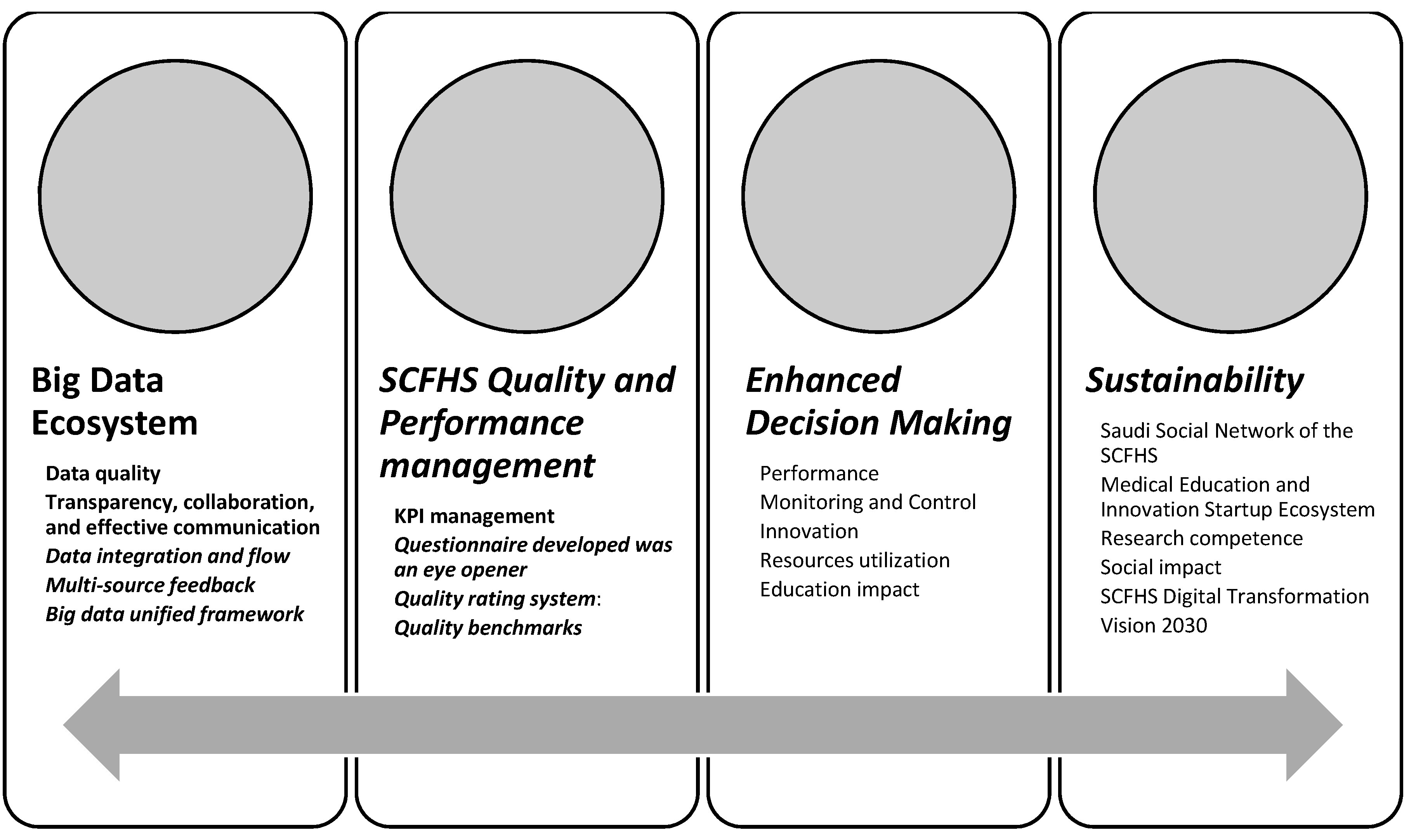
6. The SCFHS Sustainable Medical Education Framework
- Data quality;
- Transparency, collaboration, and effective communication;
- Data integration and flow;
- Multi-source feedback; and
- A big data unified framework
- KPI management,
- A quality rating system, and
- quality benchmarks.
- Performance,
- Monitoring and control,
- Innovation,
- Resource utilization, and
- Education impact.
- Saudi Social Network of the SCFHS,
- Medical Education and Innovation Startup Ecosystem,
- Research competence,
- Social impact,
- SCFHS Digital Transformation, and
- Vision 2030
- Integrated training excellence organization-wide;
- A unified ecosystem of smart medical educational content and distance learning facilities;
- A blended virtual and physical space for reading, study, and research;
- Flexible procedures and cloud training services;
- Advanced notification and counseling procedures;
- Awareness campaigns; and
- Institutional leadership.
- Research integration into training,
- A unified research skills lab and research cloud service,
- Best practices and standardization of the research process,
- Collective research towards higher accomplishment,
- Visibility and impact of Saudi medical research, and
- An advanced publication program.
- Integrated open simulation lab;
- Saudi Agora of Virtual and Augmented Reality Medical Lab and Content Laboratory; and
- Virtual and augmented reality content for medical training and labs
- Rewards for training efficiency and performance,
- Time and space reservation for sophisticated research activities,
- Advanced professional social networking of medical experts, and
- Counseling.
- Integration of social network of medical experts, towards continuous input and feedback from the community of the SCFHS;
- Establishment of a Medical Education and Innovation Startup Ecosystem capable of bringing to life and launching smart services and applications for domains of special interest for the evolution of medical research and education;
- The development of a continuous research competence developmental process integrated into the sustainability framework; and
- The direct integration of medical education and training excellence to the digital transformation vision. The quality initiative described in this research study is a first proof of concept approach for the capacity of multidisciplinary approaches to promote this vision to functional managerial and training practices.
7. Conclusions and Future Research
Author Contributions
Funding
Conflicts of Interest
References
- Khoja, T.; Rawaf, S.; Qidwai, W.; Rawaf, D.; Nanji, K.; Hamad, A. Health Care in Gulf Cooperation Council Countries: A review of challenges and opportunities. Cureus 2017, 9, e1586. [Google Scholar] [CrossRef]
- ten Cate, O.; Scheele, F. Competency-based postgraduate training: Can we bridge the gap between theory and clinical practice? Acad. Med. 2007, 82, 542–547. [Google Scholar] [CrossRef]
- Kjaer, N.K.; Kodal, T.; Shaughnessy, A.F.; Qvesel, D. Introducing competency-based postgraduate medical training: Gains and losses. Int. J. Med. Educ. 2011, 2, 110–115. [Google Scholar] [CrossRef][Green Version]
- Scheele, F.; Teunissen, P.; Van Luijk, S.; Heineman, E.; Fluit, L.; Mulder, H.; Meininger, A.; Wijnen-Meijer, M.; Glas, G.; Sluiter, H.; et al. Introducing competency-based postgraduate medical education in the Netherlands. Med. Teach. 2008, 30, 248–253. [Google Scholar] [CrossRef]
- 5. Rees, C.J.; Bevan, R.; Zimmermann-Fraedrich, K.; Rutter, M.D.; Rex, D.; Dekker, E.; Ponchon, T.; Bretthauer, M.; Regula, J.; Saunders, B.; et al. Expert opinions and scientific evidence for colonoscopy key performance indicators. Gut 2016, 65, 2045–2060. [Google Scholar] [CrossRef]
- Sandhu, S.S.C. Benchmarking, key performance indicators and maintaining professional standards for cataract surgery in Australia. Exp. Ophthalmol. 2015, 43, 505–507. [Google Scholar] [CrossRef]
- Raitt, J.; Hudgell, J.; Knott, H.; Masud, S. Key performance indicators for pre hospital emergency Anaesthesia—A suggested approach for implementation. Scand. J. Trauma. Resusc. Emerg. Med. 2019, 27, 42. [Google Scholar] [CrossRef]
- Santana, M.J.; Stelfox, H.T. Trauma quality Indicator consensus panel. Development and evaluation of evidence-informed quality indicators for adult injury care. Ann. Surg. 2014, 259, 186–192. [Google Scholar] [CrossRef]
- Lytras, M.D.; Aljohani, N.R.; Hussain, A.; Luo, J.; Zhang, X.Z. Cognitive Computing Track Chairs’ Welcome & Organization. In Proceedings of the Companion of the Web Conference, Lyon, France, 23–27 April 2018. [Google Scholar]
- Lytras, M.D.; Raghavan, V.; Damiani, E. Big data and data analytics research: From metaphors to value space for collective wisdom in human decision making and smart machines. Int. J. Semant. Web Inf. Syst. 2017, 13, 1–10. [Google Scholar] [CrossRef]
- Visvizi, A.; Daniela, L.; Chen, C.W. Beyond the ICT- and sustainability hypes: A case for quality education. Comput. Hum. Behav. 2020. [Google Scholar] [CrossRef]
- Alkmanash, E.H.; Jussila, J.J.; Lytras, M.D.; Visvizi, A. Annotation of Smart Cities Twitter Microcontents for Enhanced Citizen’s Engagement. IEEE Access 2019, 7, 116267–116276. [Google Scholar] [CrossRef]
- Lytras, M.D.; Mathkour, H.I.; Abdalla, H.; Al-Halabi, W.; Yanez-Marquez, C.; Siqueira, S.W.M. An emerging social- and emerging computing-enabled philosophical paradigm for collaborative learning systems: Toward high effective next generation learning systems for the knowledge society. Comput. Hum. Behav. 2015, 5, 557–561. [Google Scholar] [CrossRef]
- Visvizi, A.; Lytras, M.D. Editorial: Policy Making for Smart Cities: Innovation and Social Inclusive Economic Growth for Sustainability. J. Sci. Technol. Policy Mak. 2018, 9, 1–10. [Google Scholar]
- Visvizi, A.; Lytras, M.D. Transitioning to Smart Cities: Mapping Political, Economic, and Social Risks and Threats; Elsevier-US: New York, NY, USA, 2019. [Google Scholar]
- Arnaboldi, M. The Missing Variable in Big Data for Social Sciences: The Decision-Maker. Sustainability 2018, 10, 3415. [Google Scholar] [CrossRef]
- Olszak, C.M.; Mach-Król, M. A Conceptual Framework for Assessing an Organization’s Readiness to Adopt Big Data. Sustainability 2018, 10, 3734. [Google Scholar] [CrossRef]
- Kent, P.; Kulkarni, R.; Sglavo, U. Finding Big Value in Big Data: Unlocking the Power of High Performance Analytics. In Big Data and Business Analytics; Liebowitz, J., Ed.; CRC Press Taylor & Francis Group, LLC: Boca Raton, FL, USA, 2013; pp. 87–102. ISBN 9781466565784. [Google Scholar]
- Kharrazi, A.; Qin, H.; Zhang, Y. Urban big data and sustainable development goals: Challenges and opportunities. Sustainability 2016, 8, 1293. [Google Scholar] [CrossRef]
- Wielki, J. The Opportunities and Challenges Connected with Implementation of the Big Data Concept. In Advances in ICT for Business, Industry and Public Sector; Mach-Król, M., Olszak, C.M., Pełech-Pilichowski, T., Eds.; Springer: Cham, Switzerland, 2015; pp. 171–189. ISBN 978-3-319-11327-2. [Google Scholar]
- Lytras, M.D.; Aljohani, N.R.; Visvizi, A.; De Pablos, P.O.; Gasevic, D. Advanced Decision-Making in Higher Education: Learning Analytics Research and Key Performance Indicators. Behav. Inf. Technol. 2018, 37, 937–940. [Google Scholar] [CrossRef]
- Zhang, J.; Zhang, X.; Jiang, S.; de Pablos, P.O.; Sun, Y. Mapping the Study of Learning Analytics in Higher Education. Behav. Inf. Technol. 2018, 37, 1142–1155. [Google Scholar] [CrossRef]
- Rajkaran, S.; Mammen, K.J. Identifying Key Performance Indicators for Academic Departments in a Comprehensive University through a Consensus-Based Approach: A South African Case Study. J. Sociol. Soc. Anthropol. 2014, 5, 283–294. [Google Scholar] [CrossRef]
- Asif, M.; Awan, M.U.; Khan, M.K.; Ahmad, N. A Model for Total Quality Management in Higher Education. Qual. Quant. 2013, 47, 1883–1904. [Google Scholar] [CrossRef]
- Varouchas, E.; Sicilia, M.-A.; Sánchez-Alonso, S. Towards an Integrated Learning Analytics Framework for Quality Perceptions in Higher Education: A 3-Tier Content, Process, Engagement Model for Key Performance Indicators. Behav. Inf. Technol. 2018, 37, 1129–1141. [Google Scholar] [CrossRef]
- Varouchas, E.; Sicilia, M.-Á.; Sánchez-Alonso, S. Academics’ Perceptions on Quality in Higher Education Shaping Key Performance Indicators. Sustainability 2018, 10, 4752. [Google Scholar] [CrossRef]
- Sanyal, B.C.; Martin, M. Quality assurance and the role of accreditation: An overview. In Higher Education in the World 2007: Accreditation for Quality Assurance: What Is at Stake? Palgrave Macmillan: New York, NY, USA, 2007; pp. 3–23. [Google Scholar]
- McDonald, R.; Van Der Horst, H. Curriculum alignment, globalization, and quality assurance in South African higher education. J. Curric. Stud. 2007, 39, 6. [Google Scholar] [CrossRef]
- Deming, W. Improvement of quality and productivity through action by management. Natl. Product. Rev. 2000, 1, 12–22. [Google Scholar] [CrossRef]
- Dlačić, J.; Arslanagić, M.; Kadić-Maglajlić, S.; Marković, S.; Raspor, S. Exploring perceived service quality, perceived value, and repurchase intention in higher education using structural equation modelling. Total Qual. Manag. Bus. Excell. 2014, 25, 141–157. [Google Scholar] [CrossRef]
- Suryadi, K. Key Performance Indicators Measurement Model Based on Analytic Hierarchy Process and Trend-Comparative Dimension in Higher Education Institution. In Proceedings of the 9th International Symposium on the Analytic Hierarchy Process for Multi-criteria Decision Making (ISAHP), Viña del Mar, Chile, 2–6 August 2007. [Google Scholar]
- Chalmers, D. Teaching and Learning Quality Indicators in Australian Universities. In Proceedings of the Institutional Management in Higher Education (IMHE) Conference, Paris, France, 8–10 September 2008. [Google Scholar]
- Varouchas, E.; Lytras, M.; Sicilia, M.A. Understanding Quality Perceptions in Higher Education: A Systematic Review of Quality Variables and Factors for Learner Centric Curricula Design. In EDULEARN16—8th Annual International Conference on Education and New Learning Technologies; IATED: Barcelona, Spain, 2016; pp. 1029–1035. [Google Scholar]
- Yarime, M.; Tanaka, Y. The Issues and Methodologies in Sustainability Assessment Tools for Higher Education Institutions: A Review of Recent Trends and Future Challenges. J. Educ. Sustain. Dev. 2012, 6, 63–77. [Google Scholar] [CrossRef]
- Sheng, Y.; Yu, Q.; Chen, L. A Study on the Process Oriented Evaluation System of Undergraduate Training Programs for Innovation and Entrepreneurship. Creative Educ. 2016, 07, 2330–2337. [Google Scholar] [CrossRef]
- Toussaint, N.D.; McMahon, L.P.; Dowling, G.; Söding, J.; Safe, M.; Knight, R.; Fair, K.; Linehan, L.; Walker, R.G.; A Power, D. Implementation of renal key performance indicators: Promoting improved clinical practice. Nephrology (Carlton) 2015, 20, 184–193. [Google Scholar] [CrossRef]
- Pencheon, D. The Good Indicators Guide: Understanding How to Use and Choose Indicators. London: Association of Public Health Observatories & NHS Institute for Innovation and Improvement. 2008. Available online: http://fingertips.phe.org.uk/documents/The%20Good%20Indicators%20Guide.pdf (accessed on 10 September 2020).
- Lunsford, L.D.; Kassam, A.; Chang, Y.F. Survey of United States neurosurgical residency program directors. Neurosurgery 2004, 54, 239–245, discussion 245–247. [Google Scholar] [CrossRef]
- Ahmadi, M.; Khorrami, F.; Dehnad, A.; Golchin, M.H.; Azad, M.; Rahimi, S. A Survey of Managers’ Access to Key Performance Indicators via HIS: The Case of Iranian Teaching Hospitals. Stud. Health. Technol. Inform. 2018, 248, 233–238. [Google Scholar]
- Aggarwal, S.; Kusano, A.S.; Carter, J.N.; Gable, L.; Thomas, C.R., Jr.; Chang, D.T. Stress and Burnout among Residency Program Directors in United States Radiation OncologyPrograms. Int. J. Radiat. Oncol. Biol. Phys. 2015, 93, 746–753. [Google Scholar] [CrossRef]
- Ishak, W.W.; Lederer, S.; Mandili, C.; Nikravesh, R.; Seligman, L.; Vasa, M.; Ogunyemi, D.; Bernstein, C.A. Burnout during residency training: A literature review. J. Grad. Med. Educ. 2009, 1, 236–242. [Google Scholar] [CrossRef]
- Krebs, R.; Ewalds, A.L.; van der Heijden, P.T.; Penterman, E.J.M.; Grootens, K.P. Burn-out, commitment, personality and experiences during work and training; survey among psychiatry residents. Tijdschr. Psychiatr. 2017, 59, 87–93. [Google Scholar]
- Gouveia, P.A.D.C.; Ribeiro, M.H.C.; Aschoff, C.A.M.; Gomes, D.P.; Silva, N.A.F.D.; Cavalcanti, H.A.F. Factors associated with burnout syndrome in medical residents of a university hospital. Rev. Assoc. Med. Bras. 2017, 63, 504–511. [Google Scholar] [CrossRef]
- Dyrbye, L.N.; West, C.P.; Satele, D.; Boone, S.; Tan, L.J.; Sloan, J.; Shanafelt, T.D. Burnout among U.S. medical students, residents, and earlycareer physicians relative to the general U.S. population. Acad. Med. 2014, 89, 443–451. [Google Scholar] [CrossRef]
- Shoimer, I.; Patten, S.; Mydlarski, P.R. Burnout in dermatology residents: A Canadian perspective. Br. J. Dermatol. 2018, 178, 270–271. [Google Scholar] [CrossRef]
- Porter, M.; Hagan, H.; Klassen, R.; Yang, Y.; Seehusen, D.A.; Carek, P.J. Burnout and Resiliency Among Family Medicine Program Directors. Fam. Med. 2018, 50, 106–112. [Google Scholar] [CrossRef]
- Chaukos, D.; Chad-Friedman, E.; Mehta, D.H.; Byerly, L.; Celik, A.; McCoy, T.H., Jr.; Denninger, J.W. Risk and Resilience Factors Associated with Resident Burnout. Acad. Psychiatry. 2017, 41, 189–194. [Google Scholar] [CrossRef]
- Holmes, E.G.; Connolly, A.; Putnam, K.T.; Penaskovic, K.M.; Denniston, C.R.; Clark, L.H.; Rubinow, D.R.; Meltzer-Brody, S. Taking Care of Our Own: Multispecialty Study of Resident and Program Director Perspectives on Contributors to Burnout and Potential Interventions. Acad. Psychiatry. 2017, 41, 159–166. [Google Scholar] [CrossRef]
- Dyrbye, L.; Shanafelt, T. A narrative review on burnout experienced by medical students and residents. Med. Educ. 2016, 50, 132–149. [Google Scholar] [CrossRef]
- Jagsi, R.; Griffith, K.A.; Jones, R.; Perumalswami, C.R.; Ubel, P.; Stewart, A. Sexual harassment and discrimination experiences of academic medical faculty. JAMA 2016, 315, 2120–2121. [Google Scholar] [CrossRef]
- Karim, S.; Duchcherer, M. Intimidation and harassment in residency: A review of the literature and results of the 2012 Canadian Association of Internsand Residents National Survey. Can. Med. Educ. J. 2014, 5, e50–e57. [Google Scholar] [CrossRef]
- Fnais, N.; Soobiah, C.; Chen, M.H.; Lillie, E.; Perrier, L.; Tashkhandi, M.; Straus, S.E.; Mamdani, M.; Al-Omran, M.; Tricco, A.C. Harassment and discrimination in medical training: A systematic review and meta-analysis. Acad. Med. 2014, 89, 817–827. [Google Scholar] [CrossRef]
- Bates, C.K.; Jagsi, R.; Gordon, L.K.; Travis, E.; Chatterjee, A.; Gillis, M.; Means, O.; Chaudron, L.; Ganetzky, R.; Gulati, M.; et al. It Is Time for Zero Tolerance for Sexual Harassment in Academic Medicine. Acad. Med. 2018, 93, 163–165. [Google Scholar] [CrossRef]
- Giroux, C.; Moreau, K. Leveraging social media for medical education: Learning from patients in online spaces. Med. Teach. 2020, 42, 970–972. [Google Scholar] [CrossRef]
- McKimm, J.; McLean, M. Rethinking health professions’ education leadership: Developing ‘eco-ethical’ leaders for a more sustainable world and future. Med. Teach. 2020, 42, 855–860. [Google Scholar] [CrossRef]
- Wald, H. Optimizing resilience and wellbeing for healthcare professions trainees and healthcare professionals during public health crises—Practical tips for an ‘integrative resilience’ approach. Med. Teach. 2020, 42, 744–755. [Google Scholar] [CrossRef]
- Naeve, A.; Yli-Luoma, P.; Kravcik, M.; Lytras, M.D. A modelling approach to study learning processes with a focus on knowledge creation. Int. J. Technol. Enhanc. Learn. 2018, 1, 1–34. [Google Scholar] [CrossRef]
- Spruit, M.; Lytras, M. Applied Data Science in Patient-centric Healthcare. Telemat. Inform. 2018, 35, 2018. [Google Scholar] [CrossRef]
















| Literature Review | |||
|---|---|---|---|
| Author(s) | Learning Analytics Metaphors | Key Interpretation | Impact on Our Research Model |
| [21,22,23,24] | Learning analytics and KPIs serve as a measurement tool for enhanced decision making | There is a critical need for the definition of trusted, measurable, and efficient learning analytics and KPIs to support decision making. | We have a tremendous interest in analyzing how KPI research can enhance the quality of training programs in the Saudi Commission for Health Specialties (SCFHS). We are looking for a set of KPIs that will allow for enhanced decision making and adjustment of training programs. |
| [21,22,23,24,25] | Learning analytics as a key approach for learning behavior analysis and adjustment | In the recent literature, there is an increasing interest in the use of KPIs and learning analytics for understanding, interpreting, and enhancing the learning behavior and adjustment. | In our research study, we want to investigate how well-defined KPIs can be used for a short-term and long-term analysis of residents in postgraduate medical training programs‘ learning behavior and attitudes. |
| [22,23,24,26] | Learning analytics as a key approach for predicting performance and personalizing learning experience | The use of learning analytics to predict performance in training programs can be used as the basis for the adjustment of the learning experience for the benefit of trainees. | In the wide range of the medical training programs of the SCFHS, this is not currently the priority. We are interested, though, in the future, in utilizing a newly established big data ecosystem towards this direction. |
| [21,22,26,27] | Learning analytics as a key approach for real-time monitoring tool of learning process | KPIs can provide a systematic way of monitoring the efficiency in various aspects of the learning and training process. | In the variety of medical training programs of the SCFHS, there is a necessity to define and maintain a set of KPIs for monitoring the learning and training processes. |
| [21,22,23,24,25,26,27] | Learning analytics as a key approach for customizing learning experience | KPIs and learning analytics can be the basis for flexible training programs based on variations of training approaches. | A fully functional set of KPIs for the purposes of the SCFHS’s training programs can be used for a deep understanding of obstacles in training and alteration of training approach. |
| [21,22,23,24,25,26,27] | Learning analytics as a key approach for standardizing the flow of instruction | KPIs can be used as a methodological framework for the standardization of instruction. Learning objectives as well as learning outcomes in training programs can be codified as measurable KPIs. | In the SCFHS, there is a special interest in a quality initiative that will be distributed across all training programs in a transparent way. |
| [28,29,30,31,32,33] | Learning analytics as a means for interoperable technology-enhanced learning systems | A thorough, sophisticated learning analytics and KPI framework can be also empower interoperable or distributed technology-enhanced learning systems. | The development of a reliable set of KPIs for the purposes of the quality initiative in the SCFHS can support interoperable learning services with various other stakeholders and their training services in the near future. |
| Domains | Code | Descriptors |
|---|---|---|
| REACTION | GMH QI 1.1 | Percentage of trainees’ satisfaction |
| GMH QI 1.2 | Percentage of trainers’ satisfaction | |
| GMH QI 1.3 | Percentage of program directors’ (PDs’) satisfaction | |
| GMH QI 1.4 | Percentage of trainees’ burnout | |
| LEARNING | GMH QI 2.1 | Percentage of program directors (PDs) who attended a PD training course offered by the SCFHS |
| GMH QI 2.2 | Number of trainers in postgraduate management training (PGMT) programs who successfully completed SCFHS training | |
| GMH QI 2.3 | Percentage of surveyors who have successfully completed SCFHS’s accreditation certification | |
| GMH QI 2.4 | Percentage of trainees’ compliance with minimal procedure, case exposure policies required competency index | |
| GMH QI 2.5 | Percentage of trainees who have received trainees’ evaluation by program in specific period | |
| GMH QI 2.6 | Percentage of research inclusion in curricula | |
| GMH QI 2.7 | Percentage of programs with burnout policy | |
| GMH QI 2.8 | Percentage of compliance with implementing incorporated e-log system in each program | |
| GMH QI 2.9 | Percentage of trainees who fulfilled their promotion criteria | |
| GMH QI 2.10 | Percentage of trainees who passed the board exam | |
| GMH QI 2.11 | Percentage of programs that incorporated simulation in their curricula | |
| GMH QI 2.12 | Percentage of programs with trainees receiving annual master rotation plan | |
| GMH QI 2.13 | Percentage of programs in compliance with the annual master plan | |
| GOVERNANCE | GMH QI 3.1 | Percentage of programs with complete goals and objectives for residency programs |
| GMH QI 3.2 | Percentage of completed trainer evaluations by trainee per program | |
| GMH QI 3.3 | Percentage of adherence to accreditation requirements | |
| GMH QI 3.4 | Percentage of PD turnover rate | |
| GMH QI 3.5 | Percentage of accreditation compliance score | |
| GMH QI 3.6 | Percentage of violations of the matching regulations |
| Code | Program Directors’ Survey | Trainees’ Survey | Admission Department | Accreditation Department | Training Department | Assessment Department |
|---|---|---|---|---|---|---|
| GMH QI 1.1 | ||||||
| GMH QI 1.2 | ||||||
| GMH QI 1.3 | ||||||
| GMH QI 1.4 | ||||||
| GMH QI 2.1 | ||||||
| GMH QI 2.2 | ||||||
| GMH QI 2.3 | ||||||
| GMH QI 2.4 | ||||||
| GMH QI 2.5 | ||||||
| GMH QI 2.6 | ||||||
| GMH QI 2.7 | ||||||
| GMH QI 2.8 | ||||||
| GMH QI 2.9 | ||||||
| GMH QI 2.10 | ||||||
| GMH QI 2.11 | ||||||
| GMH QI 2.12 | ||||||
| GMH QI 2.13 | ||||||
| GMH QI 3.1 | ||||||
| GMH QI 3.2 | ||||||
| GMH QI 3.3 | ||||||
| GMH QI 3.4 | ||||||
| GMH QI 3.5 | ||||||
| GMH QI 3.6 |
| Primary Data (Surveys) | Secondary Data (SCFHS Databases) |
| Domain | KPI ID | Definition | Questions and Calculation | Result |
|---|---|---|---|---|
| Reaction | GMH QI 1.1 | Trainees’ Satisfaction | TS Q10, TS Q11, TS Q12, TS Q13, TS Q16, TS Q17, TS Q25 | 69% |
| GMH QI 1.2 | Trainers’ Satisfaction | Unavailable | ||
| GMH QI 1.3 | Program Directors’ Satisfaction | PDS Q 2.4 PDS Q 2.6 PDS Q 3.3 PDS Q 4.2 | 76% | |
| GMH QI 1.4 | Trainees’ Burnout | TS Q 14 | 66.7% | |
| Learning | GMH QI 2.1 | Program directors who attended training course offered by SCFHS | PDS Q 2.1 | 38.4% |
| GMH QI 2.2 | Trainers in PGMT programs who successfully completed SCFHS training certification | Training Department Database | 276 | |
| GMH QI 2.3 | Surveyors who have successfully completed SCFHS’s accreditation training | Accreditation Department Database | 67% | |
| GMH QI 2.4 | Trainees’ compliance with minimal procedure, case exposure policies required competency index | Unavailable | ||
| GMH QI 2.5 | Trainees who have received trainees’ evaluation by program in a specific period | PDS Q 2.6 | 74% | |
| GMH QI 2.6 | Research included in curriculum | Training Department Database =? (TS Q 22 = 33.1%) | Unavailable | |
| GMH QI 2.7 | Programs with burnout policy | PDS Q 4.2 = 69% | 69% | |
| GMH QI 2.8 | Compliance with implementing incorporated e-log system in each program | Training Department Database | Unavailable | |
| GMH QI 2.9 | Trainees who fulfilled their promotion criteria | Training Department Database Assessment Department Database | Unavailable | |
| GMH QI 2.10 | Trainees who passed the board exam | Assessment Department Database | 79% | |
| GMH QI 2.11 | Programs that incorporated simulation in their curricula | PDS Q 3.1 = 3% TS Q 10 = 34.2% | 18.6% | |
| GMH QI 2.12 | Programs with trainees receiving annual master rotation plan | PDS Q 2.7 | 73% | |
| GMH QI 2.13 | Programs’ compliance with the annual master plan | PDS Q 2.8 | 76.9% | |
| Training Governance | GMH QI 3.1 | Programs with complete goals and objectives for residency programs | PDS Q 3.2 | 87.7% |
| GMH QI 3.2 | Completed trainer evaluation by trainee per program | PDS Q 2.9 | 48.7% | |
| GMH QI 3.3 | Adherence to accreditation requirements | Accreditation Department Database | Not Available | |
| GMH QI 3.4 | PD turnover rate | TBD | Not Available | |
| GMH QI 3.5 | Accreditation compliance score | TBD | Not Available | |
| GMH QI 3.6 | Violations with the matching regulations | Admission and Registration Database | 4% |
| Overview of Key Findings | ||
|---|---|---|
| No. | Research Objective | Key Findings |
| 1 | KPI definition for efficient medical training |
|
| 2 | KPIs‘ social impact and sustainability in medical education |
|
| 3 | Sustainable data science for medical education and digital transformation of healthcare |
|
© 2020 by the authors. Licensee MDPI, Basel, Switzerland. This article is an open access article distributed under the terms and conditions of the Creative Commons Attribution (CC BY) license (http://creativecommons.org/licenses/by/4.0/).
Share and Cite
Housawi, A.; Al Amoudi, A.; Alsaywid, B.; Lytras, M.; bin Μoreba, Y.H.; Abuznadah, W.; Alhaidar, S.A. Evaluation of Key Performance Indicators (KPIs) for Sustainable Postgraduate Medical Training: An Opportunity for Implementing an Innovative Approach to Advance the Quality of Training Programs at the Saudi Commission for Health Specialties (SCFHS). Sustainability 2020, 12, 8030. https://doi.org/10.3390/su12198030
Housawi A, Al Amoudi A, Alsaywid B, Lytras M, bin Μoreba YH, Abuznadah W, Alhaidar SA. Evaluation of Key Performance Indicators (KPIs) for Sustainable Postgraduate Medical Training: An Opportunity for Implementing an Innovative Approach to Advance the Quality of Training Programs at the Saudi Commission for Health Specialties (SCFHS). Sustainability. 2020; 12(19):8030. https://doi.org/10.3390/su12198030
Chicago/Turabian StyleHousawi, Abdulrahman, Amal Al Amoudi, Basim Alsaywid, Miltiadis Lytras, Yara H. bin Μoreba, Wesam Abuznadah, and Sami A. Alhaidar. 2020. "Evaluation of Key Performance Indicators (KPIs) for Sustainable Postgraduate Medical Training: An Opportunity for Implementing an Innovative Approach to Advance the Quality of Training Programs at the Saudi Commission for Health Specialties (SCFHS)" Sustainability 12, no. 19: 8030. https://doi.org/10.3390/su12198030
APA StyleHousawi, A., Al Amoudi, A., Alsaywid, B., Lytras, M., bin Μoreba, Y. H., Abuznadah, W., & Alhaidar, S. A. (2020). Evaluation of Key Performance Indicators (KPIs) for Sustainable Postgraduate Medical Training: An Opportunity for Implementing an Innovative Approach to Advance the Quality of Training Programs at the Saudi Commission for Health Specialties (SCFHS). Sustainability, 12(19), 8030. https://doi.org/10.3390/su12198030