Analysis of Operational Changes of Tarbela Reservoir to Improve the Water Supply, Hydropower Generation, and Flood Control Objectives



Abstract
1. Introduction
1.1. Description of Study Area
1.1.1. Indus River
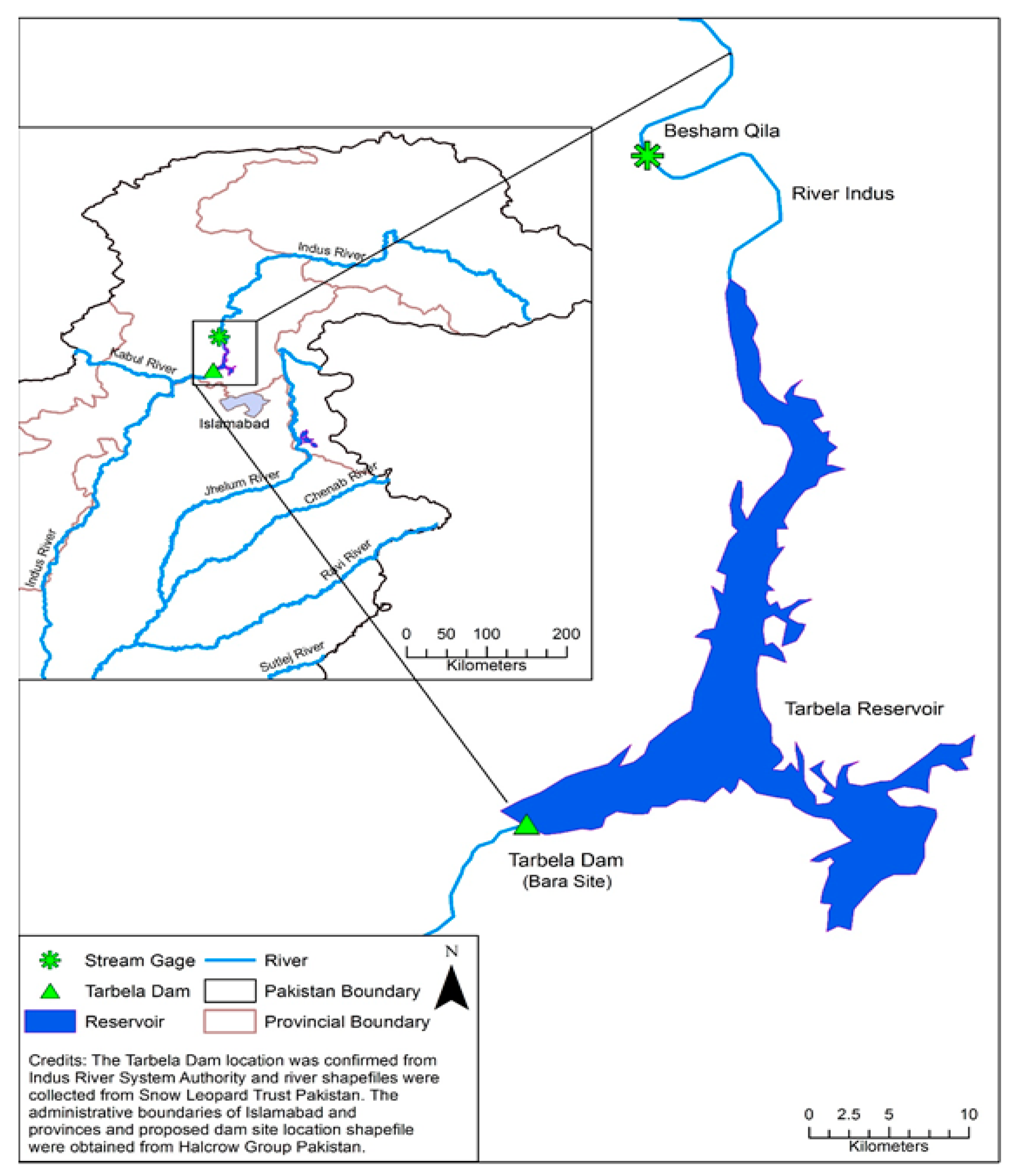
1.1.2. Tarbela Dam and Reservoir
1.1.3. Current Reservoir Operations of Tarbela
2. Materials and Methods
2.1. Water Evaluation and Planning (WEAP) System Model
2.2. Data Collection and Input
2.3. Exploration of Altered Reservoir Operations
- (1)
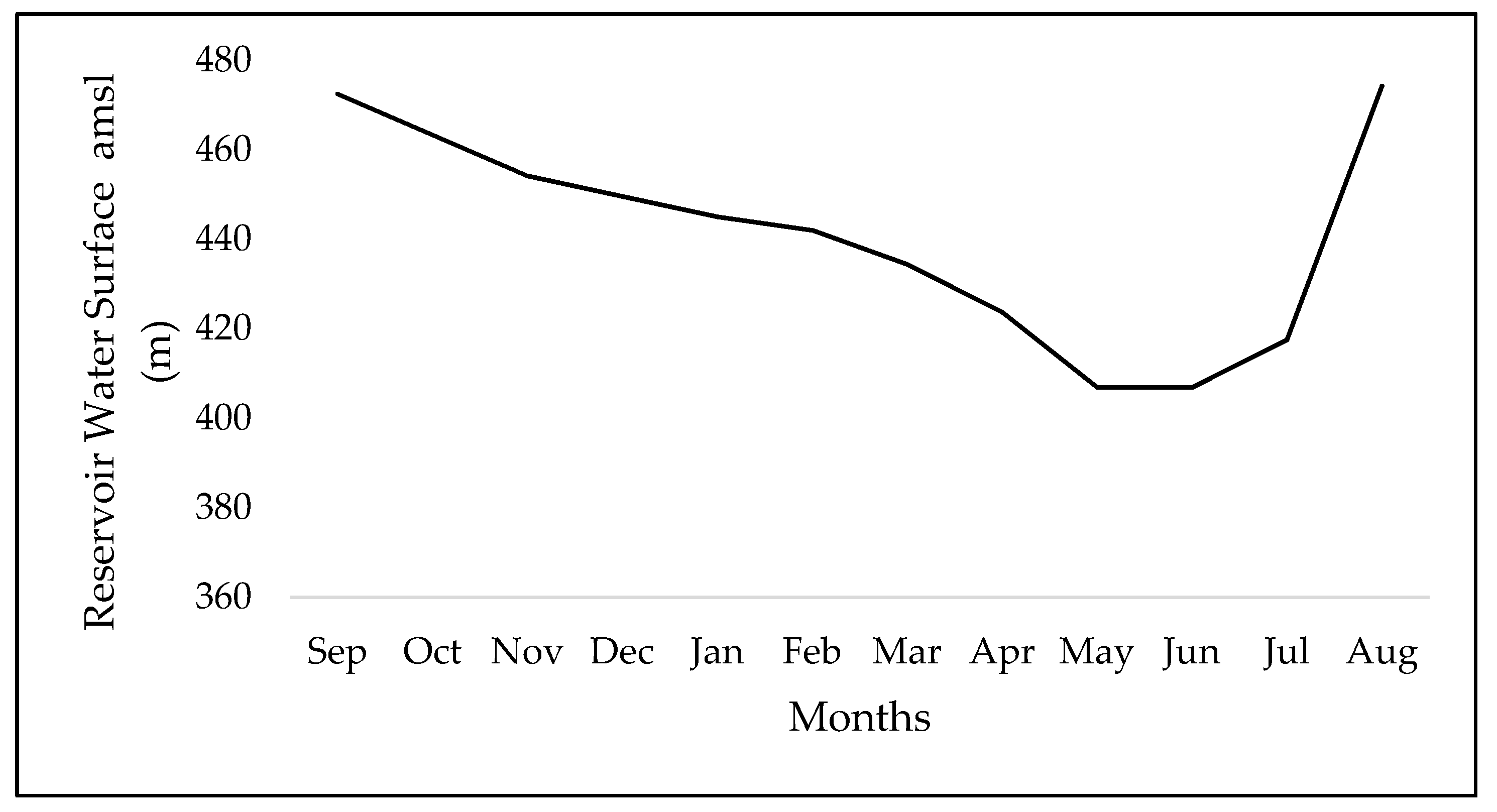
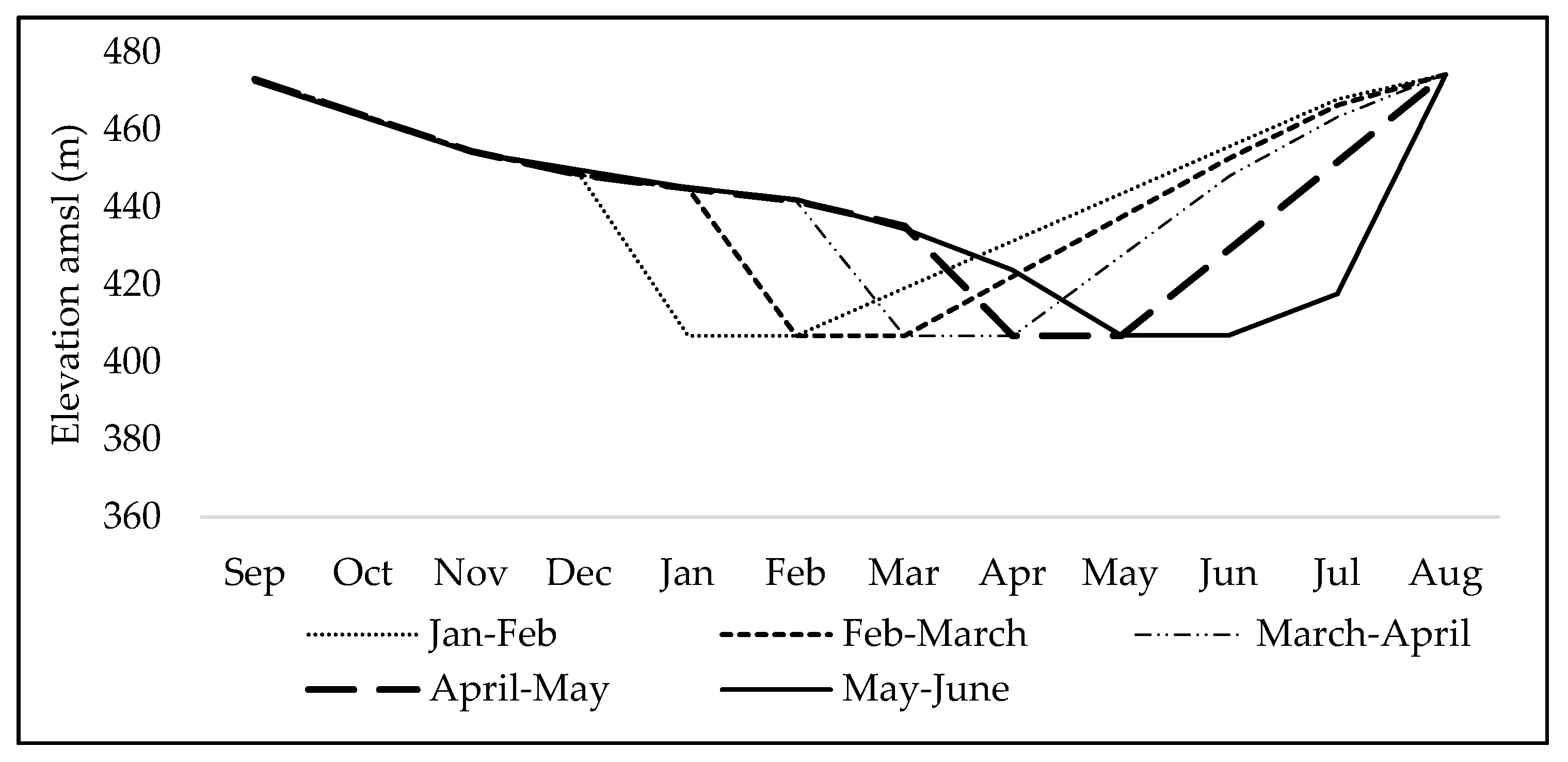
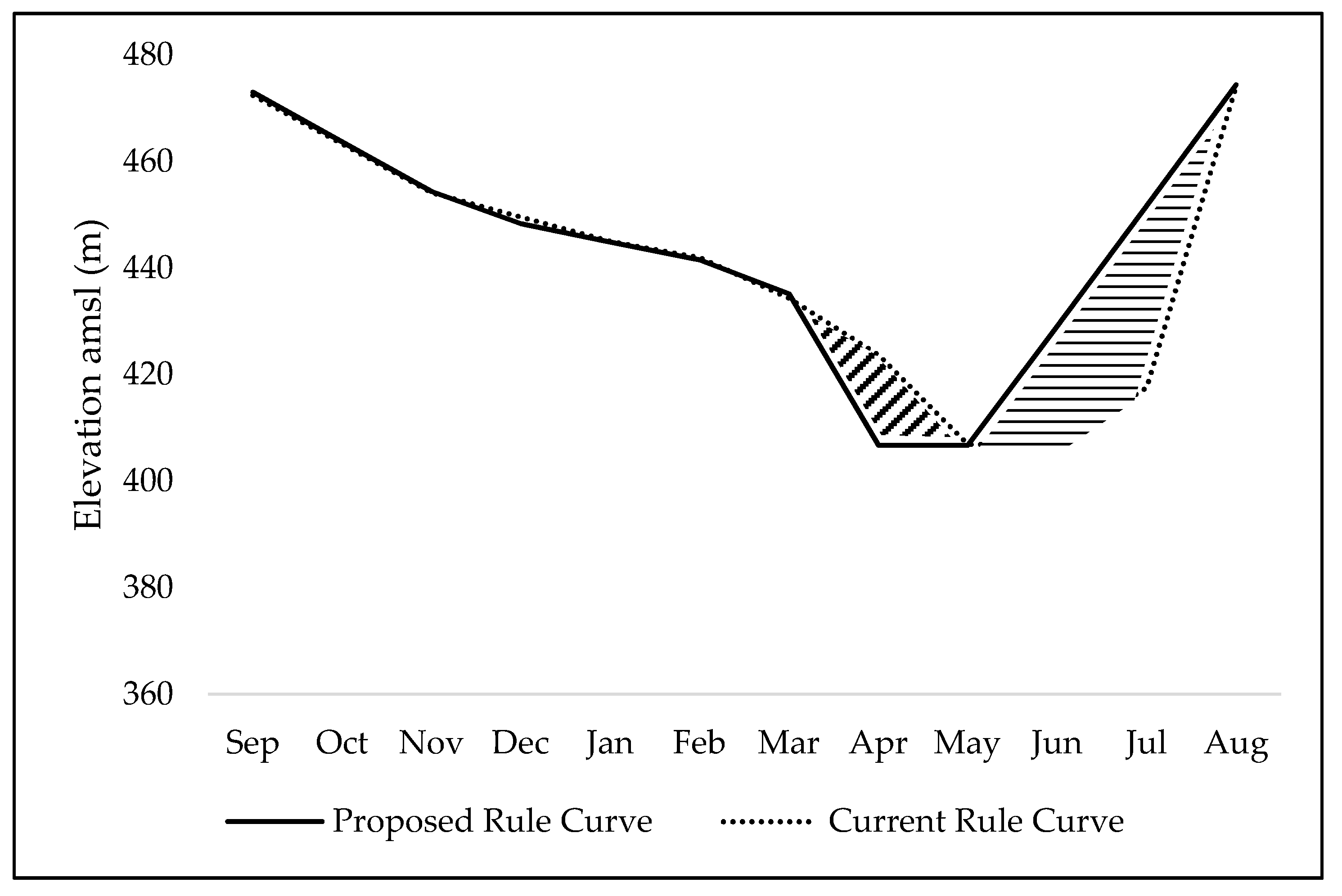
- Under current operations, the water level in the reservoir is maintained at the minimum from mid-May to mid-June. By maintaining the reservoir water surface level at the minimum, the water releases are maximized, but at the expense of hydropower generation potential. The releases should also be maximized in earlier months to better complement irrigation demands. Therefore, one proposed operation change is to adjust the timing of the minimum reservoir level by shifting it to an earlier period. The rule curve can thus be modified but adhere to three constraints. First, the maximum reservoir level should be targeted for late August because of high flows during July and August. Second, the proposed earlier drawdown of the reservoir must follow the water indent requirements from the provinces which are based on crop water demand. Third, drawdown and filling rate should not exceed 3 m/day to ensure the structural integrity of the dam. Figure 6 shows the resulting set of rule curves with varying minimum reservoir levels. Using WEAP simulations, the recommended rule curve (herein called proposed operations) can be set based on the best tradeoff for reliability between irrigation and hydropower objectives.
- (2)
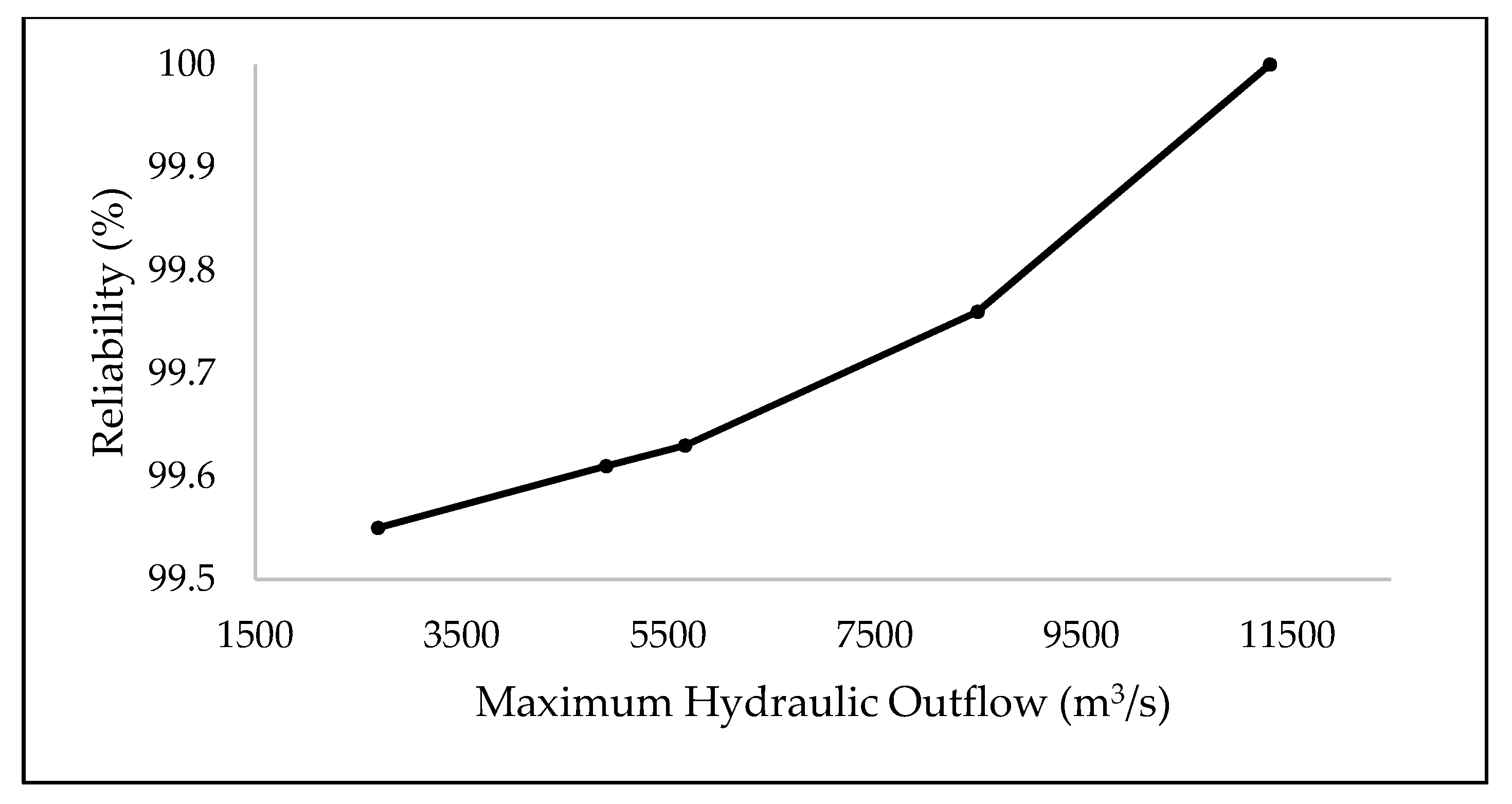
- Since flood control is not addressed by the proposed changes in the timing of the minimum water level or other changes in the rule curve, structural changes to upgrade the capacity of the tunnels (increasing maximum hydraulic outflow) were investigated as a solution.
2.4. Performance Evaluation of Proposed Operations
3. Results and Discussion
3.1. Evaluation of Altered Reservoir Operations
3.2. Performance Improvement with Proposed Operations for Historical and Future Conditions
3.2.1. Historical Conditions (H-CR vs. H-PR)
3.2.2. Future Conditions (F-CR vs. F-PR)
4. Conclusions and Recommendations
- (1)
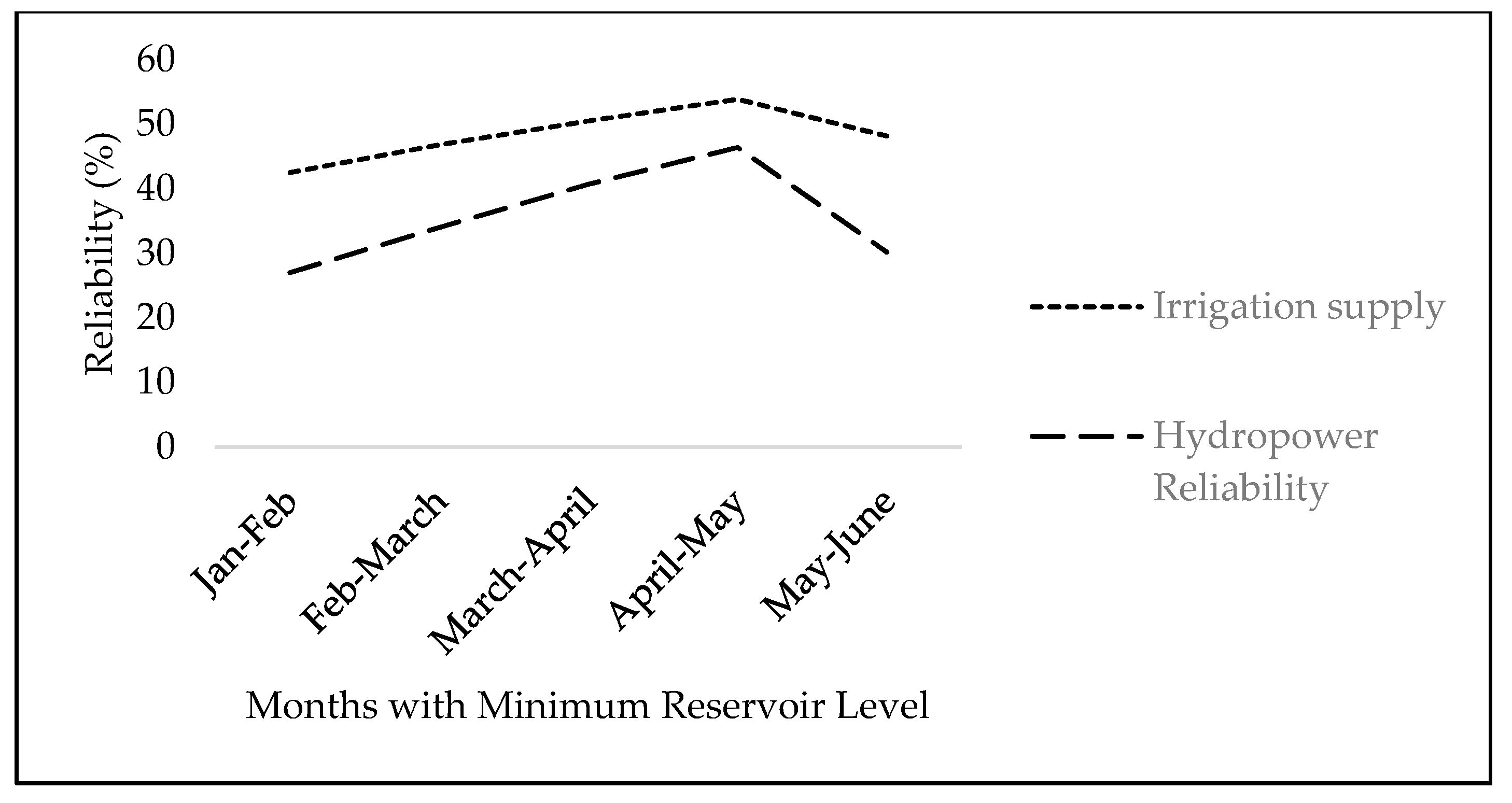
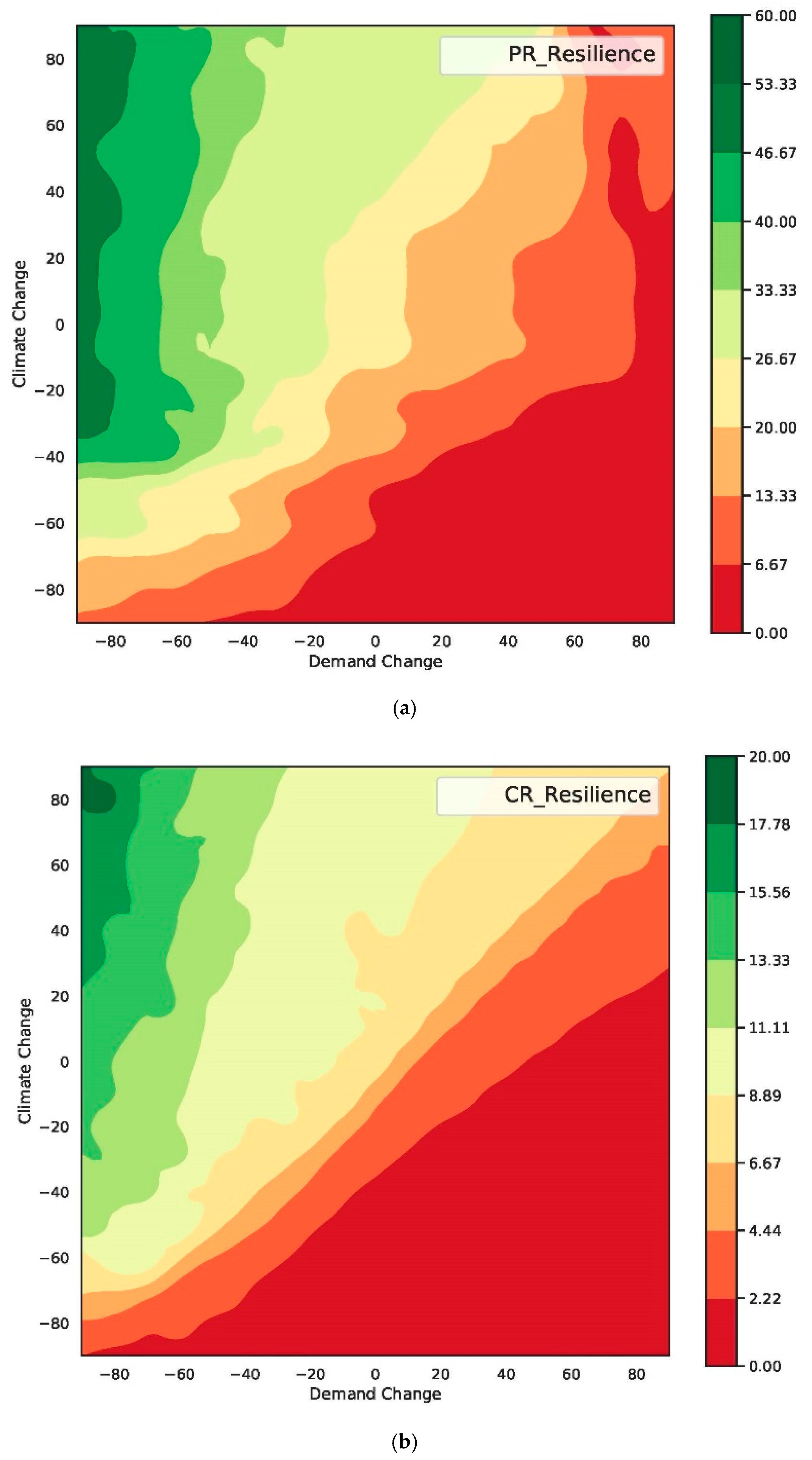
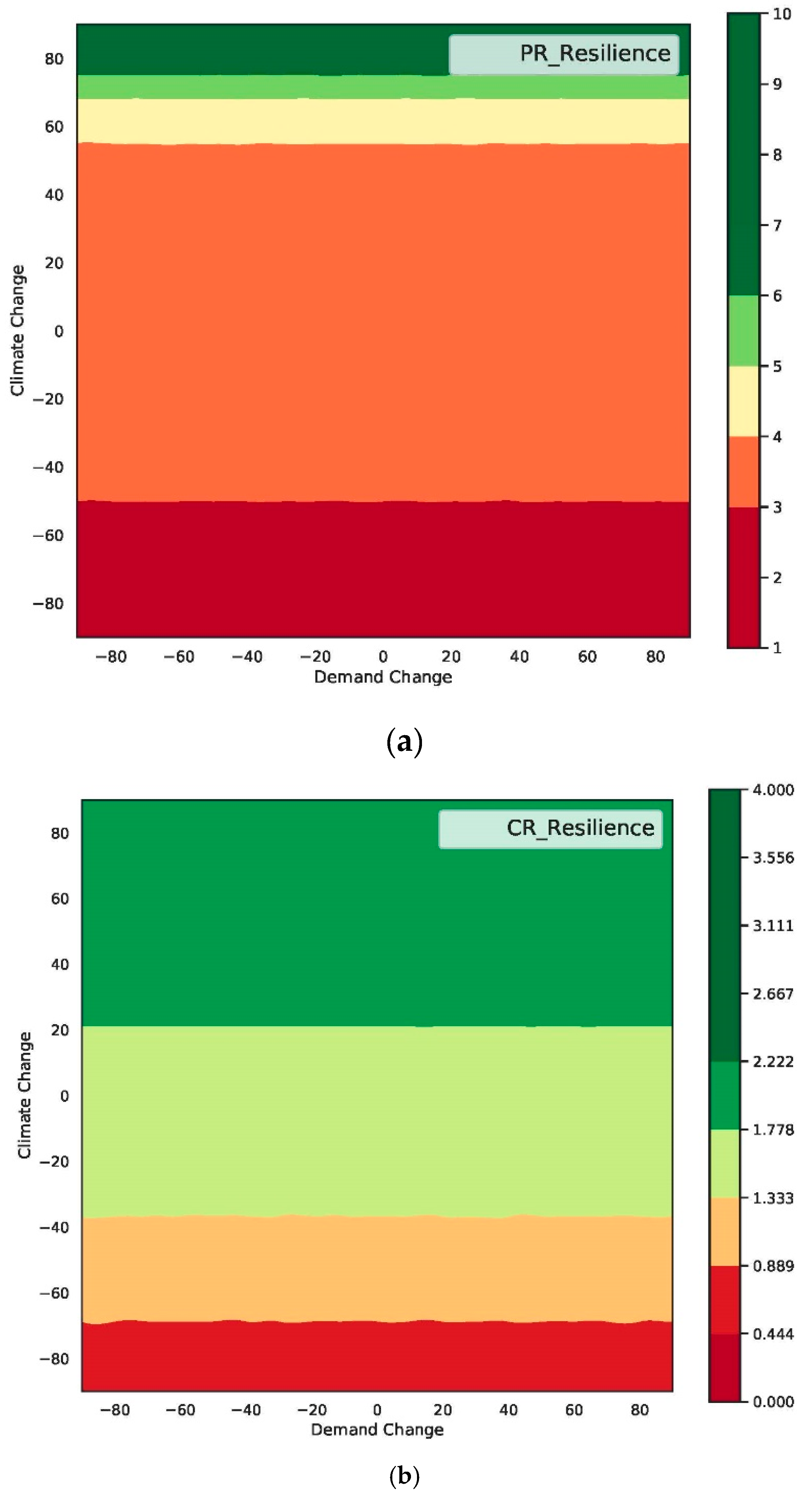
- Effects of rule curve change on reservoir performance: The timing of the minimum target water elevation in Tarbela Reservoir was shifted one month earlier in the calendar year to April–May. The shifting of the minimum reservoir level increased the performance of Tarbela Reservoir for both irrigation supply and hydropower objectives. This shifting of the rule curve will ensure an increase in sustainability and resilience to future uncertainties of climate and irrigation and hydropower demand.
- (2)
- Maximum hydraulic outflow: The maximum hydraulic outflow played a pivotal role in controlling the flooding downstream of Tarbela. It was concluded that the maximum release capacity from the tunnels needs to be increased to reduce spillway discharges that do not generate hydropower. The downstream channel of Tarbela can safely convey 11,326 m3/s, which was tested and shown to lead to improved performance.
- (3)
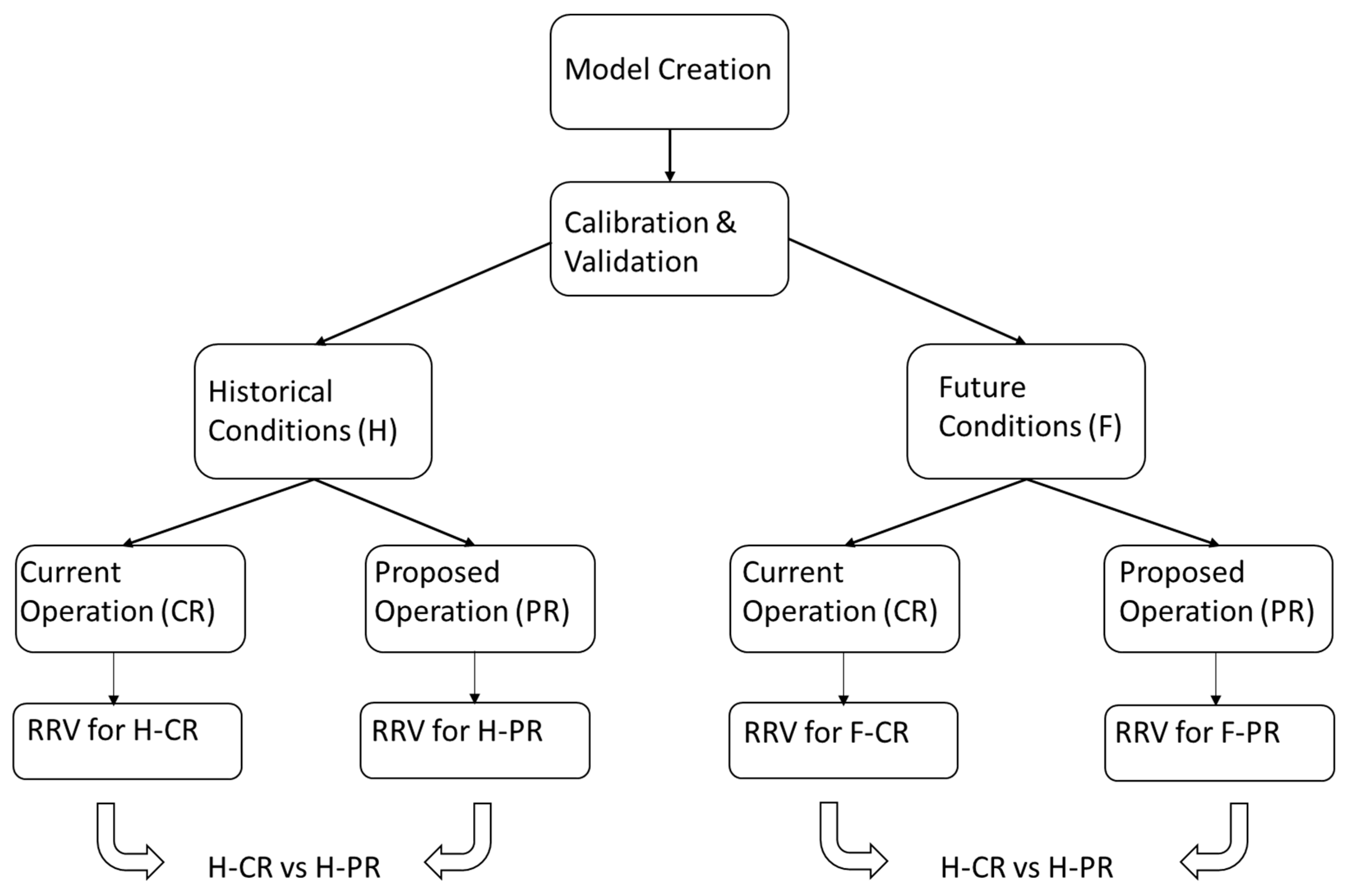
- Percentage improvement in RRV with proposed operations: The performance of the reservoir operations with proposed operations over current operations was evaluated for the entire period for historical and future climate and demand conditions. The analysis resulted in the exploration of gains in objectives with the proposed operations. The performance evaluations of water supply for irrigation and hydropower objectives showed improvement in reliability and resilience with an increase in vulnerability. The flood control objective resulted in an increase in reliability and a decrease in resilience and vulnerability.
5. Future Work and Limitations of Study
Author Contributions
Funding
Acknowledgments
Conflicts of Interest
Disclaimer
References
- Pereira, L.S.; Oweis, T.; Zairi, A. Irrigation management under water scarcity. Agric. Water Manag. 2002, 57, 175–206. [Google Scholar] [CrossRef]
- Somlyódy, L.; Varis, O. Freshwater under pressure. Int. Rev. Environ. Str. 2006, 6, 181–204. [Google Scholar]
- Wheater, H.; Evans, E. Land use, water management and future flood risk. Land Use Policy 2009, 26, S251–S264. [Google Scholar] [CrossRef]
- Kijne, J.W. Lessons learned from the change from supply to demand water management in irrigated agriculture: A case study from Pakistan. Water Policy 2001, 3, 109–123. [Google Scholar] [CrossRef]
- Qureshi, A.S.; McCornick, P.G.; Sarwar, A.; Sharma, B.R. Challenges and prospects of sustainable groundwater management in the Indus Basin, Pakistan. Water Resour. Manag. 2010, 24, 1551–1569. [Google Scholar] [CrossRef]
- Arfan, M.; Lund, J.; Hassan, D.; Saleem, M.; Ahmed, A. Erratum: Assessment of spatial and temporal flow variability of the Indus River. Resources 2019, 8, 103. [Google Scholar] [CrossRef]
- Hassan, D.; Rais, M.N.; Ahmed, W.; Bano, R.; Burian, S.J.; Ijaz, M.W.; Bhatti, F.A. Future water demand modeling using water evaluation and planning: A case study of the Indus basin in Pakistan. Sustain. Water Resour. Manag 2019, 5, 1903–1915. [Google Scholar] [CrossRef]
- Kirsch, T.D.; Wadhwani, C.; Sauer, L.; Doocy, S.; Catlett, C. Impact of the 2010 Pakistan floods on rural and urban populations at six months. PLoS Curr. 2012, 4, 4fdfb212d2432. [Google Scholar] [CrossRef]
- Looney, R. Economic impacts of the floods in Pakistan. Contemp. South Asia 2012, 20, 225–241. [Google Scholar] [CrossRef]
- Tate, E.L.; Farquharson, F.A. Simulating reservoir management under the threat of sedimentation: The case of Tarbela dam on the river Indus. Water Resour. Manag. 2000, 14, 191–208. [Google Scholar] [CrossRef]
- Khan, N.M.; Tingsanchali, T. Optimization and simulation of reservoir operation with sediment evacuation: A case study of the Tarbela Dam, Pakistan. Hydrol. Process. Int. J. 2009, 23, 730–747. [Google Scholar] [CrossRef]
- Tarar, R.N. Performance of Tarbela Dam project. In Proceedings of Pakistan Engineering Congress, 69th Annual Session Proceedings Report; Punjab, Pakistan, 2006; pp. 8–10. Available online: https://www.pecongress.org.pk/images/upload/books/632.pdf (accessed on 30 August 2020).
- Water & Power Development Authority. Available online: http://www.wapda.gov.pk/index.php/investor-s-corner/annual-report (accessed on 24 April 2018).
- The World Commission on Dams. Available online: https://energypedia.info/wiki/World_Commission_on_Dams_(WCD)_Report (accessed on 27 April 2018).
- Khan, N.M.; Babel, M.S.; Tingsanchali, T.; Clemente, R.S.; Luong, H.T. Reservoir optimization-simulation with a sediment evacuation model to minimize irrigation deficits. Water Resour. Manag. 2012, 26, 3173–3193. [Google Scholar] [CrossRef]
- Naheed, G.; Mahmood, A. Water requirement of wheat crop in Pakistan. Pak. J. Meteorol. 2009, 6, 89–97. [Google Scholar]
- Naheed, G.; Rasul, G. Projections of crop water requirement in Pakistan under global warming. Pak. J. Meteorol. 2010, 7, 45–51. [Google Scholar]
- Moy, W.S.; Cohon, J.L.; Revelle, C.S. A programming-model for analysis of the reliability, resilience, and vulnerability of a water-supply reservoir. Water Resour. Res. 1986, 22, 489–498. [Google Scholar] [CrossRef]
- Vogel, R.M.; Bolognese, R.A. Storage-reliability-resilience-yield relations for over-year water-supply systems. Water Resour. Res. 1995, 31, 645–654. [Google Scholar] [CrossRef]
- Jain, S.K.; Bhunya, P.K. Reliability, resilience and vulnerability of a multipurpose storage reservoir/confiance, résilience et vulnérabilité dun barrage multi-objectifs. Hydrol. Sci. J. 2008, 53, 434–447. [Google Scholar] [CrossRef]
- Mateus, M.C.; Tullos, D. Reliability, sensitivity, and vulnerability of reservoir operations under climate change. J. Water Resour. Plan. Manag. 2017, 143, 04016085. [Google Scholar] [CrossRef]
- Lutz, A.F.; Immerzeel, W.W.; Shrestha, A.B.; Bierkens, M.F.P. Consistent increase in high Asia’s runoff due to increasing glacier melt and precipitation. Nat. Clim. Chang. 2014, 4, 587–592. [Google Scholar] [CrossRef]
- Wang, W.; Xiang, Y.; Gao, Y.; Lu, A.; Yao, T. Rapid expansion of glacial lakes caused by climate and glacier retreat in the central Himalayas. Hydrol. Process. 2015, 29, 859–874. [Google Scholar] [CrossRef]
- Khan, A.J.; Koch, M. Selecting and downscaling a Set of climate models for projecting climatic change for impact assessment in the upper Indus basin (UIB). Climate 2018, 6, 89. [Google Scholar] [CrossRef]
- Yu, W.; Yang, Y.-C.; Savitsky, A.; Alford, D.; Brown, C.; Wescoat, J.; Debowicz, D.; Robinson, S. The Indus Basin of Pakistan: The Impacts of Climate Risks on Water and Agriculture; The World Bank: Washington, DC, USA, 2013. [Google Scholar]
- Hunt, J.R.; Lilley, J.M.; Trevaskis, B.; Flohr, B.M.; Peake, A.; Fletcher, A.; Zwart, A.B.; Gobbett, D.; Kirkegaard, J.A. Early sowing systems can boost Australian wheat yields despite recent climate change. Nat. Clim. Chang. 2019, 9, 244–247. [Google Scholar] [CrossRef]
- Rashid, M.; Haider, S.; Latif, M.; Raja, N. Multi-objective optimization for irrigation deficit through cascade reservoirs. Eur. Water 2017, 59, 323–329. [Google Scholar]
- Kindler, J.; Tyszewski, S. Multicriteria evaluation of decision rules in the design of a storage reservoir. System analysis for water resources management: Closing the gap between the theory and practice. In Proceedings of the Baltimore Symposium, Baltimore, MD, USA, 19–22 May 1989. [Google Scholar]
- Kim, U.; Kaluarachchi, J.J. Climate change impacts on water resources in the upper blue Nile river basin, ethiopia 1. JAWRA J. Am. Water Resour. Assoc. 2009, 45, 1361–1378. [Google Scholar] [CrossRef]
- Khan, A.; Richards, K.S.; Parker, G.T.; McRobie, A.; Mukhopadhyay, B. How large is the upper Indus basin? The pitfalls of auto-delineation using DEMs. J. Hydrol. 2014, 509, 442–453. [Google Scholar] [CrossRef]
- Mukhopadhyay, B.; Khan, A. A quantitative assessment of the genetic sources of the hydrologic flow regimes in upper Indus basin and its significance in a changing climate. J. Hydrol. 2014, 509, 549–572. [Google Scholar] [CrossRef]
- Cook, E.R.; Palmer, J.G.; Ahmed, M.; Woodhouse, C.A.; Fenwick, P.; Zafar, M.U.; Wahab, M.; Khan, N. Five centuries of upper Indus river flow from tree rings. J Hydrol 2013, 486, 365–375. [Google Scholar] [CrossRef]
- Tariq, S.M. Pakistan-India Relations: Implementation of Indus-Water Treaty–A Pakistani Narrative; The Pakistan Institute of Legislative Development and Transparency (PILDAT), Office: Islamabad, Pakistan, 2010; p. 9. [Google Scholar]
- Ray, P.A.; Brown, C.M. Introduction. In Confronting Climate Uncertainty in Water Resources Planning and Project Design: The Decision Tree Framework; World Bank Publications: Washington, DC, USA, 2015; pp. 1–6. [Google Scholar]
- Brown, C.; Steinschneider, S.; Ray, P.; Wi, S.; Basdekas, L.; Yates, D. Decision scaling (DS): Decision support for climate change. In Decision Making under Deep Uncertainty; Springer: Cham, Switzerland, 2019; pp. 255–287. [Google Scholar]
- Sieber, J. WEAP water evaluation and planning system. In Proceedings of the 3rd International Congress on Environmental Modelling and Software, Burlington, VT, USA, 1 July 2006. [Google Scholar]
- Hassan, D.; Burian, S.J.; Bano, R.; Ahmed, W.; Arfan, M.; Naseer Rais, M.; Rafique, A.; Ansari, K. An assessment of the Pakistan water apportionment accord of 1991. Resources 2019, 8, 120. [Google Scholar] [CrossRef]
- Nash, J.E.; Sutcliffe, J.V. River flow forecasting through conceptual models part I—A discussion of principles. J. Hydrol. 1970, 10, 282–290. [Google Scholar] [CrossRef]
- Hashimoto, T.; Stedinger, J.R.; Loucks, D.P. Reliability, resiliency, and vulnerability criteria for water-resource system performance evaluation. Water Resour. Res. 1982, 18, 14–20. [Google Scholar] [CrossRef]
- Tariq, M.A.U.R.; Van De Giesen, N. Floods and flood management in Pakistan. Phys. Chem. Earth 2012, 48, 11–20. [Google Scholar] [CrossRef]
- Kindler, J. The Monte Carlo approach to optimization of the operation rules for a system of storage reservoirs/la méthode Monte Carlo pour l’optimization des règles opératoires pour un système de réservoirs. Hydrol. Sci. J. 1977, 22, 203–214. [Google Scholar] [CrossRef]
- Robinson, P.J. Climate change and hydropower generation. Int. J. Climatol. 1997, 17, 983–996. [Google Scholar] [CrossRef]
- Harrison, G.; Whittington, H.; Wallace, A. Sensitivity of hydropower performance to climate change. Int. J. Power Energy Syst. 2006, 26, 42. [Google Scholar] [CrossRef]
- Zeng, R.J.; Cai, X.M.; Ringler, C.; Zhu, T.J. Hydropower versus irrigation-an analysis of global patterns. Environ. Res. Lett. 2017, 12. [Google Scholar] [CrossRef]
- Amin, A.; Iqbal, J.; Asghar, A.; Ribbe, L. Analysis of current and future water demands in the Upper Indus Basin under IPCC climate and socio-economic scenarios using a hydro-economic WEAP model. Water 2018, 10, 537. [Google Scholar] [CrossRef]



| Scenario | Jan | Feb | Mar | Apr | May | Jun | Jul | Aug | Sep | Oct | Nov | Dec |
|---|---|---|---|---|---|---|---|---|---|---|---|---|
| Current | 68 | 84 | 130 | 173 | 218 | 215 | 194 | 177 | 155 | 124 | 83 | 64 |
| 1 °C Rise | 69 | 85 | 131 | 175 | 219 | 216 | 197 | 178 | 156 | 126 | 84 | 65 |
| 2 °C Rise | 71 | 87 | 133 | 178 | 224 | 221 | 200 | 182 | 160 | 129 | 86 | 67 |
| 3 °C Rise | 76 | 93 | 141 | 186 | 232 | 229 | 207 | 189 | 166 | 134 | 90 | 72 |
| Objectives | Reliability | Resilience | Vulnerability |
|---|---|---|---|
| Water Supply | 17 * | 67 * | 7 |
| Hydropower Generation | 34 * | 346 * | 22 * |
| Flood Control | 0.3 * | - | - |
| Objectives | Reliability | Resilience | Vulnerability |
|---|---|---|---|
| Water Supply | 7 | 219 * | 11 |
| Hydropower Generation | 19 * | 136 * | 13 |
| Flood Control | 2 * | −33 * | −39 * |
© 2020 by the authors. Licensee MDPI, Basel, Switzerland. This article is an open access article distributed under the terms and conditions of the Creative Commons Attribution (CC BY) license (http://creativecommons.org/licenses/by/4.0/).
Share and Cite
Rafique, A.; Burian, S.; Hassan, D.; Bano, R. Analysis of Operational Changes of Tarbela Reservoir to Improve the Water Supply, Hydropower Generation, and Flood Control Objectives. Sustainability 2020, 12, 7822. https://doi.org/10.3390/su12187822
Rafique A, Burian S, Hassan D, Bano R. Analysis of Operational Changes of Tarbela Reservoir to Improve the Water Supply, Hydropower Generation, and Flood Control Objectives. Sustainability. 2020; 12(18):7822. https://doi.org/10.3390/su12187822
Chicago/Turabian StyleRafique, Ahmed, Steven Burian, Daniyal Hassan, and Rakhshinda Bano. 2020. "Analysis of Operational Changes of Tarbela Reservoir to Improve the Water Supply, Hydropower Generation, and Flood Control Objectives" Sustainability 12, no. 18: 7822. https://doi.org/10.3390/su12187822
APA StyleRafique, A., Burian, S., Hassan, D., & Bano, R. (2020). Analysis of Operational Changes of Tarbela Reservoir to Improve the Water Supply, Hydropower Generation, and Flood Control Objectives. Sustainability, 12(18), 7822. https://doi.org/10.3390/su12187822