


Abstract
This article adopts a systemic approach to address the problem of the operationalization of relationships between actors conducive to food self-sufficiency in urban areas. Through the use of Social Network Analysis (SNA), the literature on urban agriculture was analyzed, detecting eight key trends and topic areas. This information was used to design a generic recursive organizational structure with the identification of the key roles and functions for management and governance in the multi-level and multi-stakeholder relationships of a sustainable urban self-sufficient food production system, inspired by the principles of complexity management and organizational cybernetics. Methodologically, this is the first application that combines the exploratory capability of SNA and the recursive structure of the Viable System Model (VSM) to propose applicable organizational structures in any urban area, suggesting a new route for the study and application of systemic thinking in the development of urban agriculture schemes. However, due to the conceptual nature of this work, this study opens a discussion on how we can rethink interactions to seek continuous adaptation in food self-sufficiency, provide tools that foster inclusion, and adapt to every context to support the relevant actors and academics in urban agriculture.
1. Introduction
According to Schwaninger [1], the current social context exhibits accelerated changes. In this environment, sustainability remains a challenge for different social groups, governments, and regions, regardless of their type or the sector in which they operate [2]. As a society, we are witnessing increasing amounts of waste, poor management of (limited) resources, the irrational use of biodiversity that disturbs the equilibrium between socio-ecological systems, restricted access to goods for human beings, and increasing scarcity [3]. Following this, Williams et al. [4] and Savaget et al. [5] stated that sustainability-related problems have been addressed mainly from a linear or reductionist perspective. In this regard, these possible solutions converge on the urgency of adopting a systemic perspective to deal with such situations, especially in problematic situations directly related to food self-sufficiency and the conceptual and operational frameworks to facilitate food supply.
Consequently, this paper aims to explore the application of a systemic approach to food sustainability. Likewise, we suggest applying the principles of organizational cybernetics through the Viable System Model (VSM) as an alternative solution to the challenge of sustainability at different levels and, in turn, propose a recursive organizational structure that seeks food viability. Hence, within this systemic methodological framework [6], and considering the exploratory nature of this work, rather than a hypothesis, this article proposes the following conceptual proposal: the recursive structure of the VSM makes it possible to generate a framework of action and rethink the relationships between actors to promote food self-sufficiency. Consequently, the ideas developed in this article concern the organizational domain and use the agriculture in urban areas as a context for their application, aiming to ensure food self-sufficiency.
Focusing our research efforts on urban agriculture issues is necessary and urgent because current agricultural practices, especially those associated with large-scale or industrialized systems, are considered to have negative impacts on environmental, social, and health factors [7]. This relegates a large part of society to having a high dependence on industrialized food or living under a continuous state of scarcity, which is why it is considered necessary to adopt comprehensive approaches that make it possible to generate strategies and synergies aimed at ensuring food self-sufficiency in urban areas [8]. For this purpose, the objectives to guide this work are (a) performing a literature review through Social Network Analysis (SNA) to identify the communities or areas of knowledge related to the analysis and development of agriculture in urban areas; (b) proposing a conceptual model based on the functions of the VSM that serves as a guide to rethink and organize relationships aimed at ensuring food sustainability, as well as the components related to food management, as recently highlighted by Muñoz-Rodríguez et al. [9]. Notably, the proposed organizational structure seeks to benefit academics, civil organizations, and actors who have the decision-making power to implement changes in their communities. It should be added that both the VSM elements and the structural design in this article can be applied to an international context with minimal adjustments in each region. For this, the definition of each VSM component is provided to avoid confusion when making such adjustments.
2. Literature Review
This work explores the state of the art in the use of the systemic method and systemic tools for the design of food sustainability and self-sufficiency in urban areas (mostly through development based on urban agriculture systems). Some relevant works shed light on this problem using the naturalistic and structuralist approach of systems thinking to address social challenges [10]. There are various approaches to the issue of food sustainability, including quantitative [11], qualitative [12], mixed methodologies [13], environmental, and social [14]. Therefore, to achieve the stated objectives, it is necessary to conduct a literature review.
Society follows the definition of McGinnis et al. [15], in which the use of resources must be regulated to avoid an economic, social, and ecological imbalance. In this regard, Espinosa and Walker [16] highlight that there are still actions and research areas that must be addressed for sustainability. Following this idea, organizations such as the UN’s Food and Agriculture Organization (FAO) [17] and the World Wildlife Fund [18] have warned about crises related to energy, financial systems, food shortages, and the lack of institutional coordination, which can increase the deterioration of these problems for sustainability [19,20].
In recent years, the interest in sustainable development and attention to problems related primarily to sustainability, insecurity, and food insufficiency has increased. However, integrative analyses for generating positive impacts in areas seeking to improve their security practices related to food supply have been neglected. Addressing this type of problem is considered relevant since economic, political, and social stability is highly important for the availability of essential food inputs [10]. In this regard, Le Tellier et al. [21] specified that companies and social groups are capable of achieving significant impacts in the dimensions mentioned above. In this sense, various efforts have been made at both a theoretical and practical level to support these actors [22]. For instance, in theoretical terms, the water–energy–food nexus approach can be used to estimate the degree of resource provisioning in some urban regions [23], the study of food self-sufficiency aspects can shed light on social factors that must be treated [24], and the concept of food sovereignty can be used as a conceptual framework to generate policies and agreements at the international level [25].
For practice-oriented efforts, Leonardo et al. [26] determined the variables needed to improve food availability through geospatial analysis to assess the utility of adopting urban plots [27]. In contrast, Ward et al. [11] suggested using linear programming to evaluate diet styles and determine the feasibility of urban agriculture modalities. However, Baer-Nawrocka and Sadowski [28] indicated that one of the factors that influences problems related to food self-sufficiency is the high concentration of the agricultural sector in related studies. Additionally, Montiel [29] considered another limitation as the attempts to understand the different factors in isolation and the low potential to handle multiple social and ecological interactions at the local, regional, and international levels.
There are different aspects upon which solutions to the current ecological crisis should focus. Authors such as Ward [30] and Weidner et al. [31] considered the answer to lie at the local or individual level, where the generation of ideas, the degree of organization, and the coordination of efforts can be achieved more rapidly; subsequently, the patterns of behavior or learning can be scaled to higher levels of any social organization [22]. In contrast, Li et al. [32] and Xie et al. [33] indicated that the design of improvements for sustainability problems can be found among international actors who have the resources to regulate this process effectively. This argument suggests a gap between the adoption of standards or tools and the implementation of sustainability practices. Thus, following Nunez Rios et al. [34], the search for answers must be multifaceted, meaning that the effort between researchers and society should be transversal to find and propose ways that mitigate, as much as possible, the negative impacts on the environment and positively influence the community [35].
3. Methodology
Food self-sufficiency issues are framed by a complex environment that demands the adoption of holistic perspectives. In this sense, a systemic approach is considered appropriate, since this approach addresses the components and complementary elements of any social system, such as relationships, structures, and functions [36], allowing the articulation of ideas to generate positive actions. It is essential to highlight that, as a research method, systems thinking seeks a synthesis between positivist, naturalistic, and critical research methods, thereby generating a flexible framework to integrate methodologies and models to study complex problems [37]. Considering this, we sought to develop a broad perspective on how food self-sufficiency and food sustainability has been approached based on the academic production in scientific articles. An approach based on SNA was thus designed and used [38].
There are different approaches for connecting systems-oriented thinking to sustainability [39]. The SNA was selected for its robustness in handling and visually presenting large amounts of relational data. Although the SNA methodology offers mathematical rigor, its flexibility allows its use with data to show the relationships between nodes rather than to focus purely on statistical analysis. SNA could be can also be used to represent systems shaped by different components [40]. In this case, we propose using SNA to draw a network constituted by documents and the authors’ keywords.
In this context, to perform the literature analysis using SNA, the SCOPUS database was used following this analytic protocol:
- Establish the descriptors and search strategy: “food sustainability and systems thinking” ((“food AND self-sufficiency” OR “food self-sufficiency” OR “food AND sustainability” OR “food sustainability” OR “food AND security” OR “food security”) AND TITLE-ABS-KEY (“organization AND” management “OR” sustainable agriculture “OR” urban agriculture “OR” resources management“) AND TITLE-ABS-KEY (“system” OR “system thinking” OR “organizational cybernetics” OR “Viable System Model”)) both in the titles and in the abstracts and keywords. It is important to clarify that the search focused on detecting the application of tools belonging to systems science or systems thinking, especially organizational cybernetics, to problems related to food sustainability and urban agriculture. Moreover, the search strategy considered the ideas of Sánchez-García [41] and Romero-García [42].
- Inclusion criteria: articles with a scope based on sustainable operations or a systemic approach to food self-sufficiency or food sustainability without a restriction of countries were included.
- Set period and published language: our search strategy in SCOPUS yielded articles from 2015 to 2019 published in the English language.
- Based on an initial exploration of the density of publications relevant to the purposes of this research, articles that only addressed aspects of soil composition, spatial patterns, or food chemistry were excluded, as these technical components of the study of (urban) agriculture were not directly related to the observation of self-sufficiency from an organizational perspective.
Based on the above, the articles were first linked to the keywords listed in each one of them. Second, a network of co-words was built to find communities of related keywords. We adapted a two-mode network approach (see [43]) to create an undirected and weighted network in which the keywords are linked based on the recurrence of their use on papers. Considering the workflow of the SNA, an edgelist-type arrangement was followed to establish the article–keyword relationships, and a node file was also generated (both in CSV format). These files were later processed using the igraph [44] package in RStudio.
Third, the “fastgreedy” algorithm of communities’ detection [45] was applied to the keyword network. These communities were interpreted by their trends or currents of analysis and their theoretical–empirical approaches to food self-sufficiency.
Additionally, the VSM was selected for this article because it is a robust theoretical model that has been validated in quantitative and practical terms [34]. Additionally, its design allows the diagnosis and improvement of practical fields—that is, it specifies the necessary and sufficient elements needed to guide any socio-ecological system and maintain both autonomy and constant equilibrium [46]. Returning to the ideas of Schwaninger [1], from the perspective of the falsification principle [47], serious attempts have been made to falsify the VSM [48]. These attempts found that the model passes all tests. Thus, VSM has not been falsified or proven to be wrong, and its results are considered to be true. Notably, the works of Núñez-Ríos et al. [49] and Sánchez-García et al. [50] have applied structural analyses that quantitatively show the suitability of the model.
Beer’s model [39] uses a structuralist perspective that recognizes the recursive nature of systems: that systems exist holonically or in hierarchies and that their modalities of organization at a higher level are consistently repeated in other parts of the system. In this sense, viable systems exhibit the same organizational characteristics [51].
Before proposing the relationships that strengthen the organizational structure in the context of food self-sufficiency, the viable system model’s components will be concisely defined to determine how the system can be used. The VSM is composed of five subsystems that can be understood as functions (Table 1).
Table 1.
Viable System Model (VSM) components.
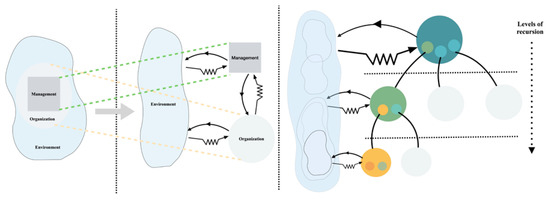
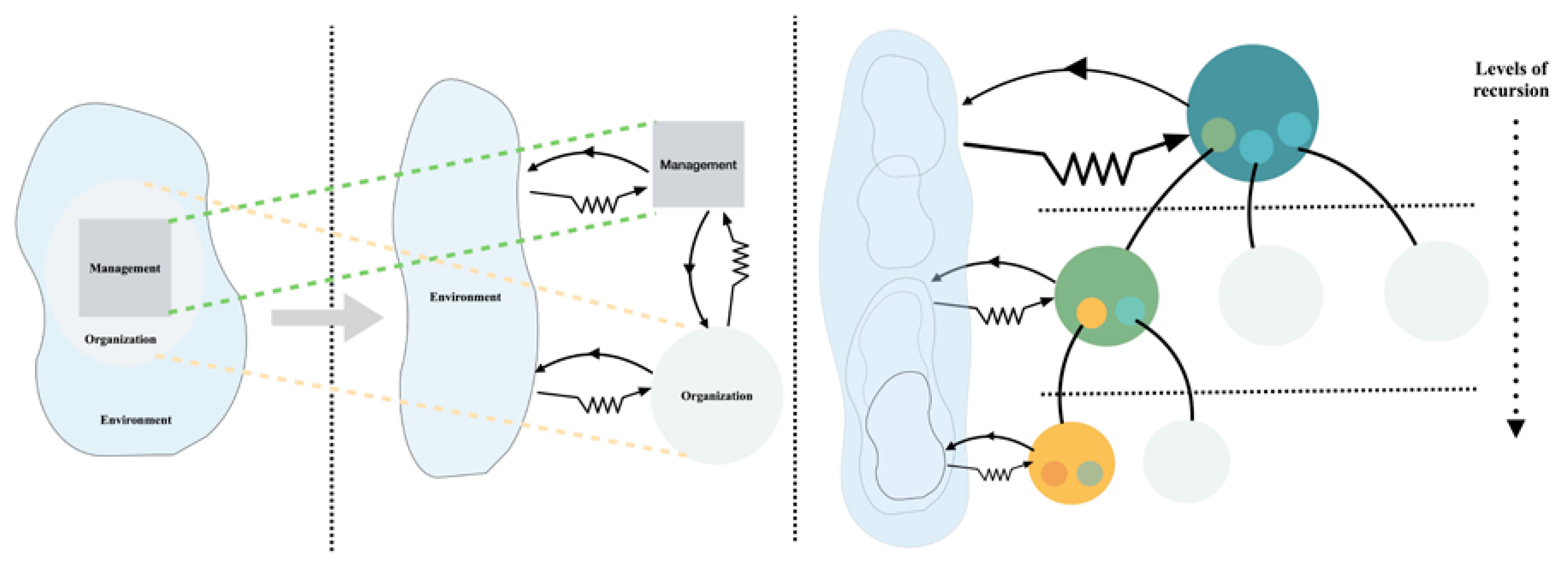
The VSM assembly demands the prompt identification and understanding of the coherent and regulated relationships between the environment in which a particular system operates. VSM understands its organization and the management mechanisms that allow it to maintain balance within its context. Figure 1 shows the essential elements of the viable system model and how they are concatenated.
Figure 1.
Viable system model’s basic elements. Source: based on Pérez Ríos [52].
In the left part of Figure 1, the circle represents an organization, with its management (rectangle) nested in a specific environment (amoeba shape). In the central part of the figure, these components are shown separately to visualize their relationships, and the arrows represent the management and regulation of the input and output flow between these elements. The right section of the figure presents the unfolding of the system’s complexity, one of the crucial steps for the development of VSM, based on an understanding that in a recursive organizational structure, any viable system contains and is contained in the viable system.
Thus, the viable system model proposal aims to suggest the ideal connections of different actors at different levels of recursion to promote food self-sufficiency in urban areas. This proposed design contemplates the components identified in the thematic communities detected by SNA. For this purpose, based on the methodology suggested by Espejo and Kuropatwa [53], the subsequent steps were as follows: (a) unfolding the complexity to show the relationships between the different levels of recursion of an ideal urban food system; (b) the use of a diagram for viable systems at each of the recursive levels to identify the relevant transformations and suggest which actors and components should carry out the necessary operations, as well as the functions of coordination, management, auditing, intelligence, or strategic planning and governance.
Considering the expressed ideas, the steps for developing the viable system model for this study can be summarized as follows:
- Identify the purpose and recursive structure (unfolding complexity).
- Diagnose the existing situation and provide recommendations for change (considering SNA support).
- Also based on SNA, identify the critical functions, critical activities, and information requirements.
- Using the Transformation, Actors, Suppliers, Customers, Owners, Interveners (TASCOI) mnemonic, identify the basic and necessary elements for modeling and propose new relationships under the organizational cybernetic framework.
4. Results
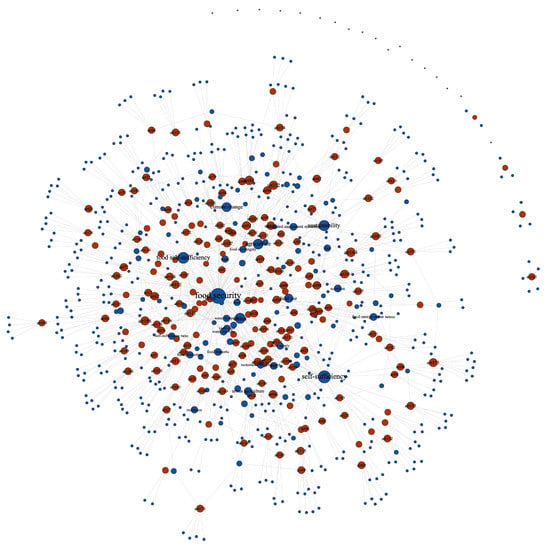
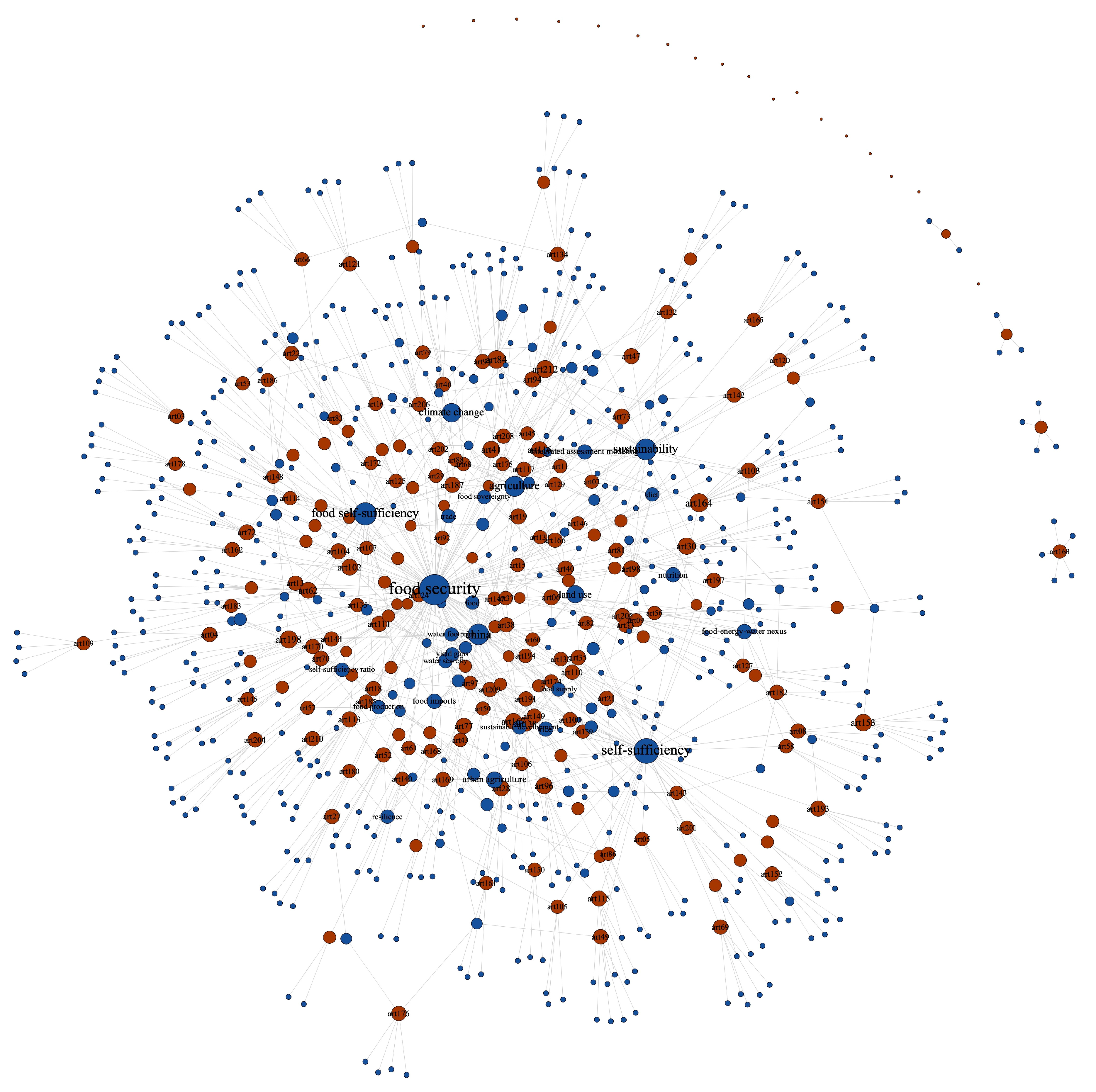
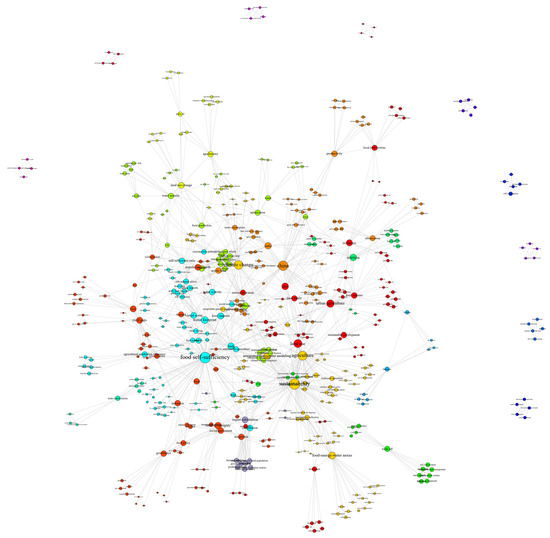
After processing the data retrieved from SCOPUS, two types of networks were generated and analyzed. The first network (Figure 2) is a two-mode network composed of the 212 articles (nodes in red) found in SCOPUS and 588 different keywords (KWs, nodes in blue), which were reported in the articles. Of the 212 documents, KWs were not recovered in 18 of them; therefore, these articles were excluded from the dataset, leaving only 194 articles in the network. This first approach allowed us to distinguish four main concepts: security, sovereignty, self-sufficiency, and sustainability (see the sizes of these nodes in Figure 2). Moreover, for visual purposes, we removed the labels of KWs with a low frequency of use and the labels of papers with few keywords.
Figure 2.
Two-mode network of articles and keywords.
The construction of this network allowed us to infer that, as a concept, food security and sovereignty are mainly linked in policy terms. The first concept refers to the existence of food that allows survival. The FAO [17] conceives food security as the physical and economic access that every person must have at all times to ensure their diets include safe and nutritious food, as well as the necessary food-supply preferences for living an active and healthy life, regardless of the origin of the food [54]. Meanwhile, food sovereignty is the right of a nation to maintain and develop its capacity to produce its own essential foods while respecting cultural and productive diversity. According to Patel [55] and Neilson and Wright [56], food sovereignty is a condition for food security, thereby affecting the interactions between food imports and food exports. These facts influence the concepts of self-sufficiency and sustainability, in which a population determines to what extent its food system, consumption patterns, methods, and techniques are articulated through the management and disposal of resources and food. Although each concept addresses different characteristics of the food system, they are not mutually exclusive, and existing relationships may affect the development of a population without overlooking agriculture as the basic component that contributes to reconciliation between the four concepts [57].
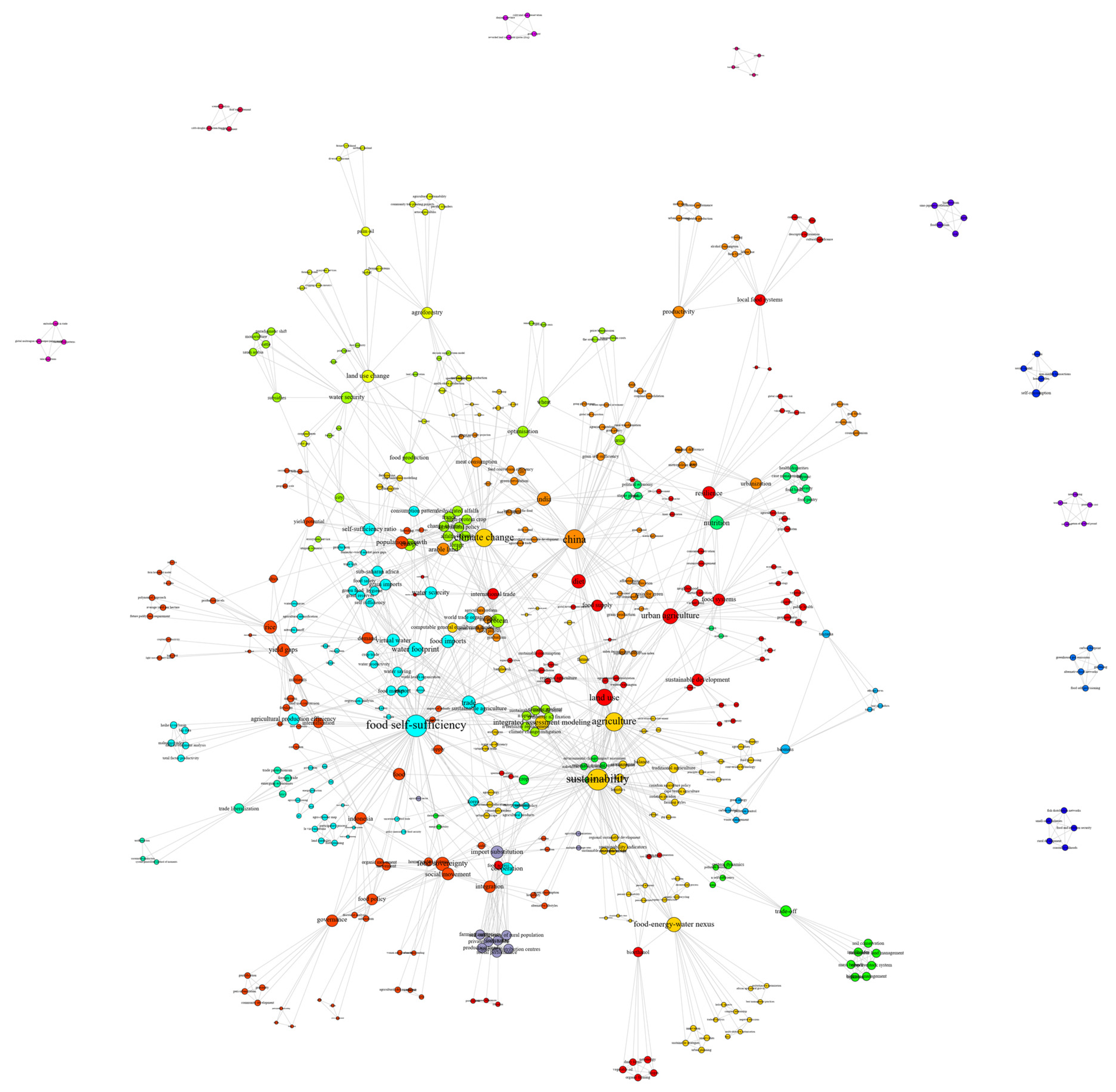
Subsequently, the network in Figure 2 was transformed into a network of co-keywords. This procedure is based on converting a two-mode network into a one-mode network [43], in this case, focused on keywords (KWs). Notably, performing this transformation can identify patterns and areas of knowledge related to the analysis and development of urban agriculture, food self-sufficiency, and, more importantly, the usage of systemic tools and thinking to address the problem. When two or more KWs were used in the same article, all of them were connected by a link, and this connection increased successively if another article also used them. As a result of that process, some KWs were found to be firmly connected with a higher usage than others. Thus, this procedure allowed us to observe the KWs that were rarely used and not very connected. Based on the above, the dataset was revised, and the KWs with a maximum of two links were removed. As a result of this process, some KWs were found to have close proximity to each other, forming a community (Figure 3). Under this SNA approach, 20 communities were detected and assumed to be thematic areas in which the topic of food self-sufficiency was developed. To detect these communities, we used the “fastgreedy” algorithm, which forms agglomerative hierarchical clusters (communities) [45]. In this second network, nine isolated communities were first identified not to be connected with other KWs, which means that they were KWs used in particular articles. Second, a very large component was composed of different communities. Third, eight superior communities contained 80% of the concepts. Approximation using these KWs units facilitated the study of the graph as a whole and allowed us to detect the edges of knowledge based on cohesion in the substructures.
Figure 3.
One-mode network of keywords (co-keyword network).
Based on this information, and to deepen our understanding of the different aspects of this article’s central idea, detailed observations of the KWs comprising the eight largest communities with high relevance are summarized in Table 2. Notably, the colors in this table are linked to the colors in Figure 3. Additionally, to prepare this table, the network was used as a basis to later search for the words within each article, review them, and connect them to determine their contributions.
Table 2.
Relevant communities based on the co-keyword network.
Based on the previous information, we identified that a large portion of the critical body of literature that seeks to understand and provide solutions to global food problem through urban agriculture is centered in China, Europe, India, and Australia. This finding highlights the opportunity to design contributions that consider a broader scope of territories, as such environmental and social inequalities are global. Under this framework, the application of systems science or systems thinking to address contextual, structural, or relational issues in problematic situations with high social participation it is still rare. Considering the information that allowed us to apply the SNA approach, upon reviewing the components of the thematic communities, we identified that although there is an adoption of a systemic perspective in the literature, no contributions were observed to articulate the organizational links from the local level to the contextual and institutional levels to influence the problem of (urban) food supply or (urban) food sustainability.
Structuring Food Self-Sufficiency in Urban Areas through the VSM
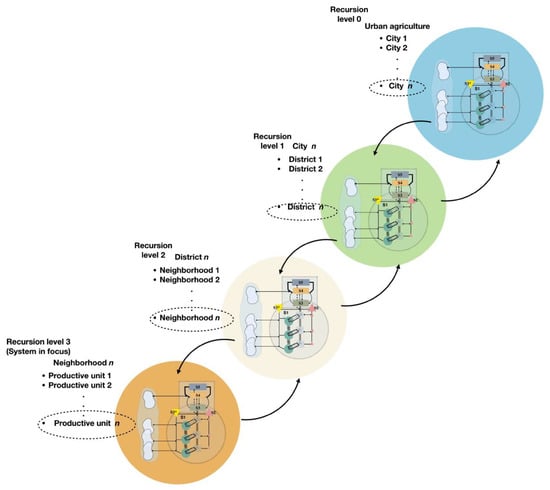
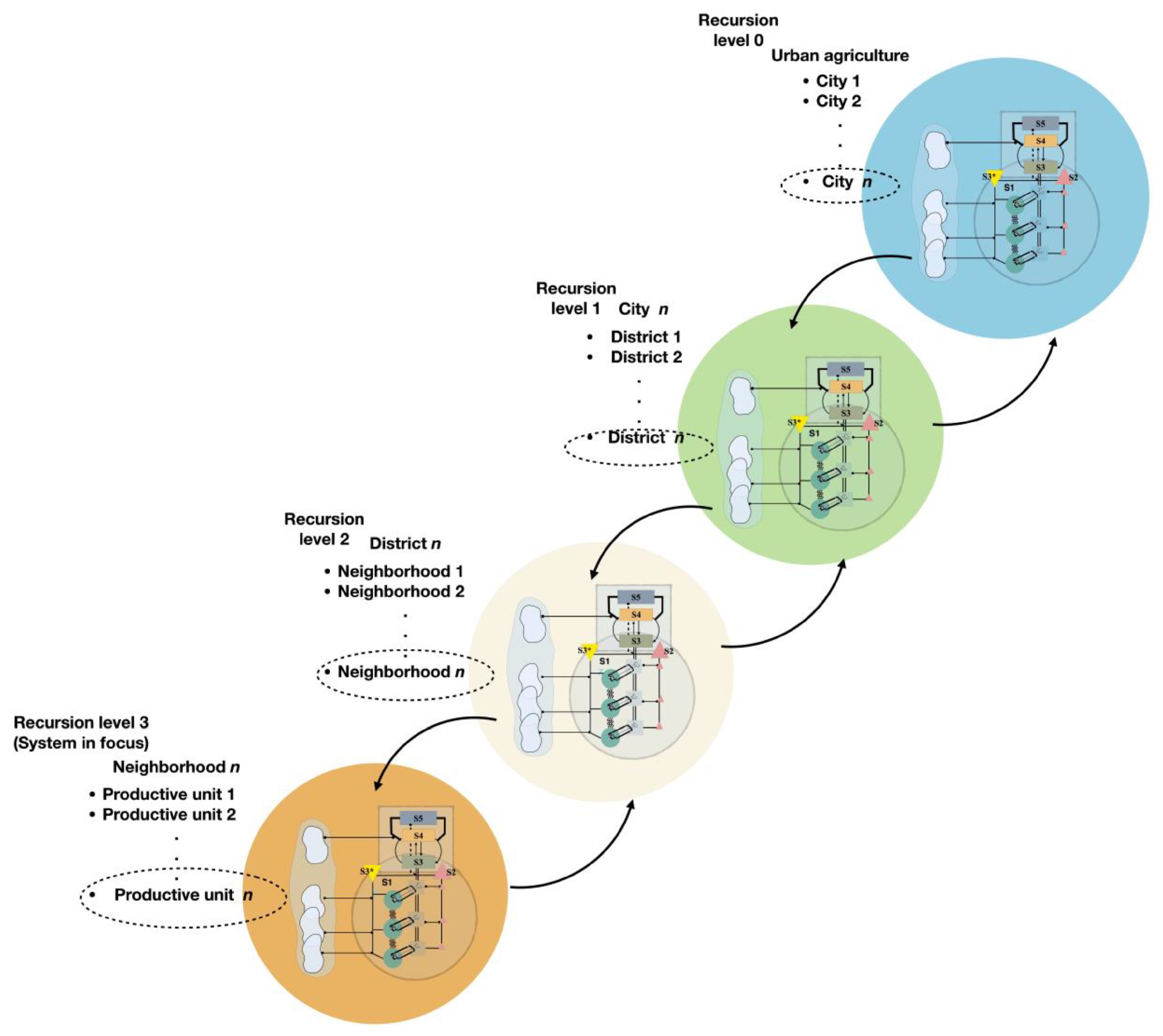
This proposed unfolding of complexity (Figure 4) takes advantage of the existing political-administrative structures/divisions in most cities, as well as the common resources and information channels, such as community boards, minor mayors, community centers, units of administration, and the management of public spaces.
Figure 4.
Unfolding complexity on food self-sufficiency in urban areas. Source: based on Espejo and Kuropatwa [53].
The entire system’s basis is the “productive unit,” which should ideally be constituted by an association of domestic producers, e.g., a local cooperative or neighbor farming association. The initial objective of these associations should be self-consumption, with the open possibility to offer the production surplus in the market to other productive units and the general public.
Based on the elements of Table 3, the design of the productive unit level (neighbors) is proposed, which is considered to be a 0 level or recursion (Figure 5).
Table 3.
Productive Unit Transformation, Actors, Suppliers, Customers, Owners, Interveners (TASCOI).
Figure 5.
Viable System Model of a core productive unit.
The interactions between the components of the essential productive unit (neighbors) are explained in Table 4.
Table 4.
Productive units VSM systems, roles, and functions.
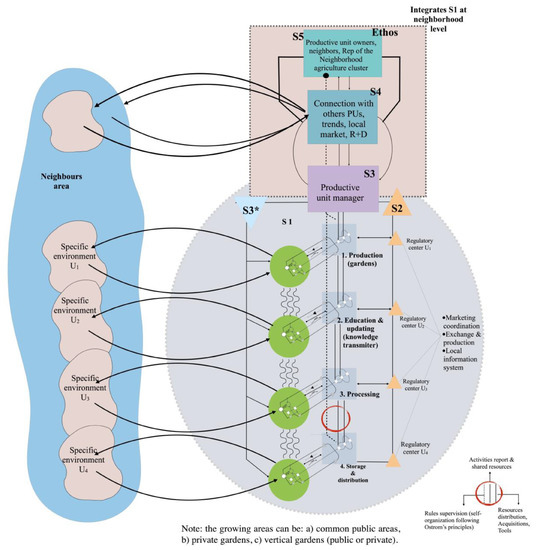
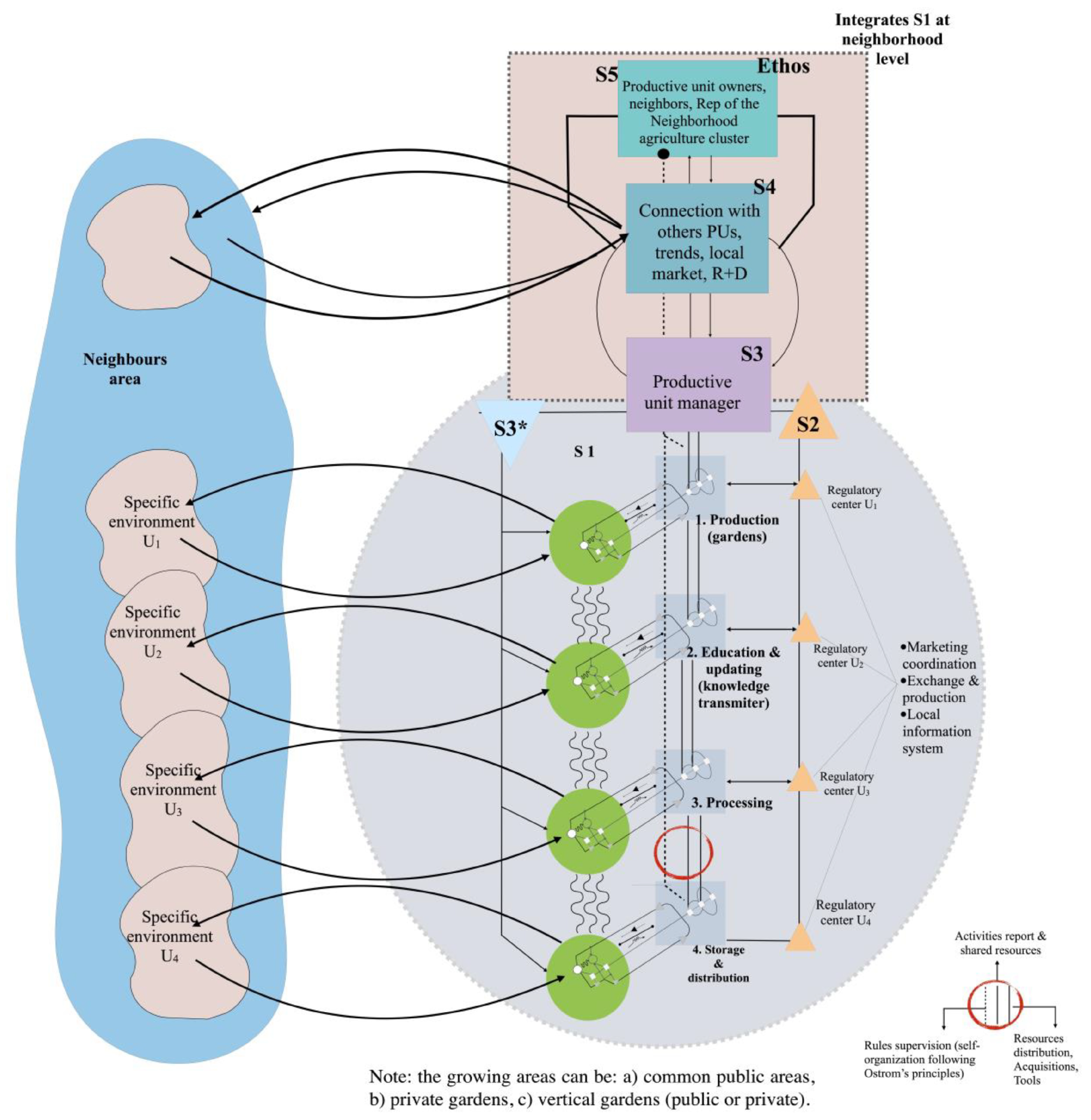
As a basic unit, the zero-recursion level must be nested in an identical structure that allows it to fulfill its goal and generate synergy to positively affect food self-sufficiency in urban areas. In this sense, the components that interact in recursion level 1 (neighborhood level) are defined in Table 5 (Figure 6).
Table 5.
Neighborhood level TASCOI.
Figure 6.
Neighborhood as a Viable System Model.
Table 6 suggests which actors must participate in certain VSM systems, along with their roles or functions.
Table 6.
Neighborhood VSM systems and their roles and functions.
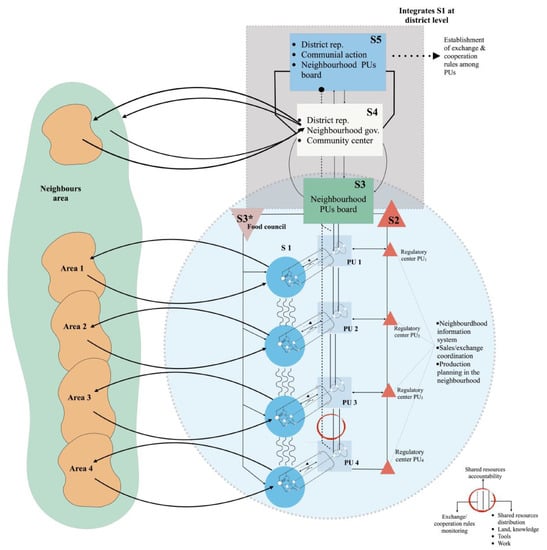
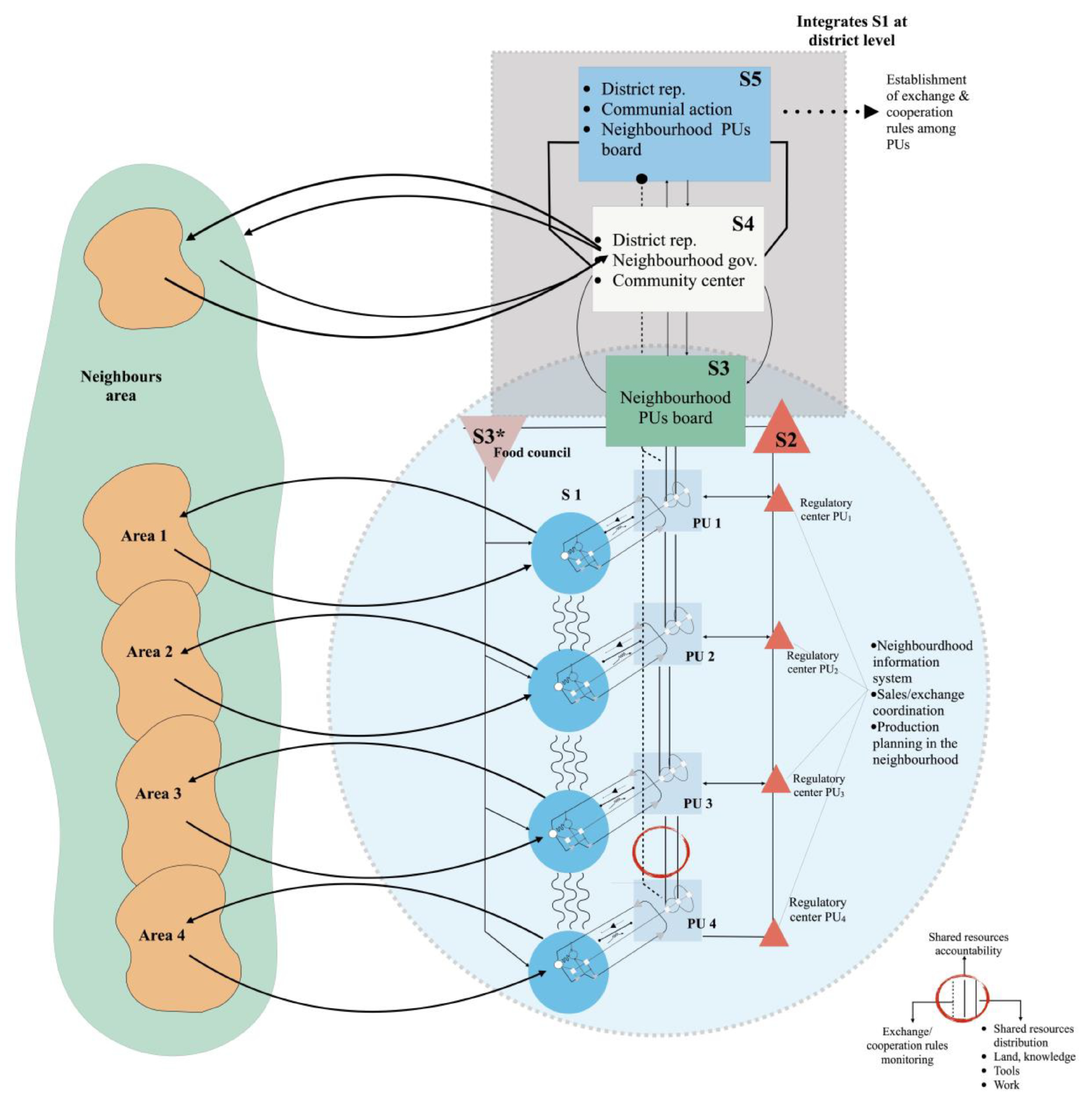
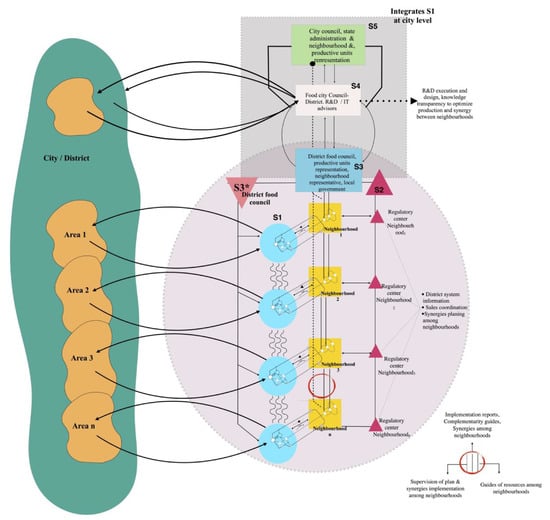
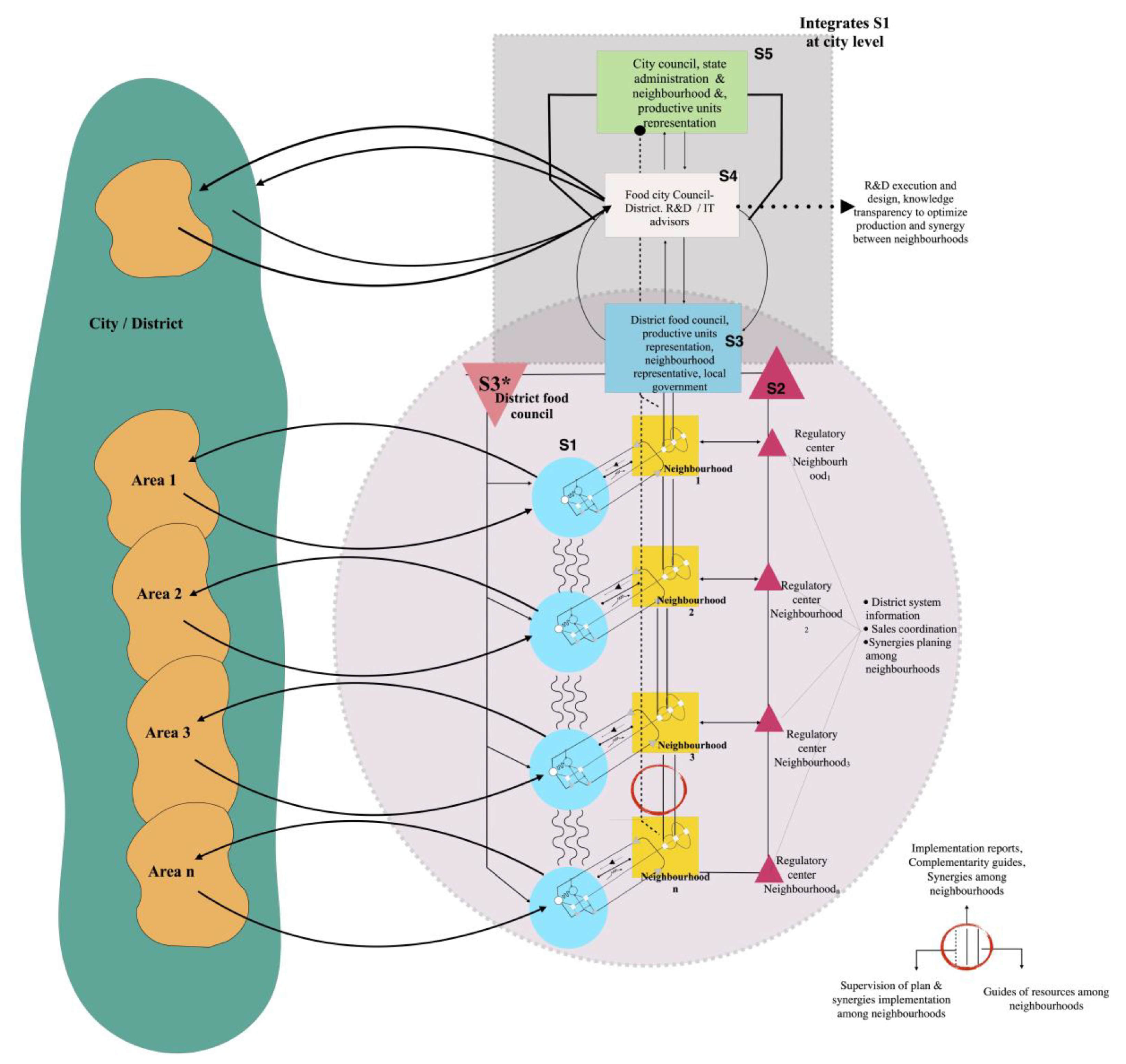
To foster relationships that lead to sustainability, the spectrum of participants needs to be broadened (Figure 7). Considering this, Table 7 presents the second level or district level:
Figure 7.
District as a Viable System Model.
Table 7.
District level TASCOI.
In Table 8, the Viable System Model elements related to district level recursion are described:
Table 8.
District VSM systems and their roles and functions.
Finally, Table 9 outlines the components that should be considered at a higher level:
Table 9.
City level TASCOI.
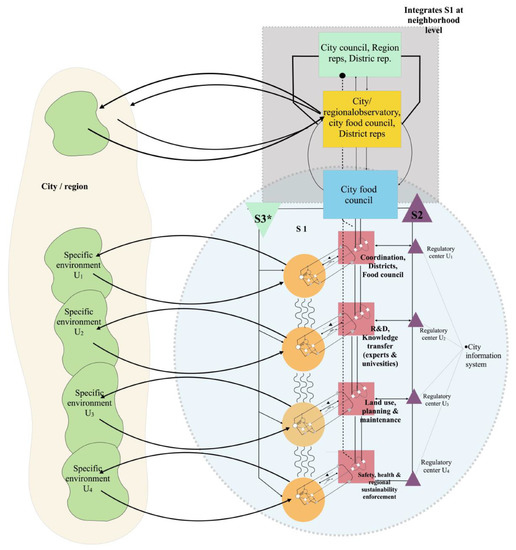
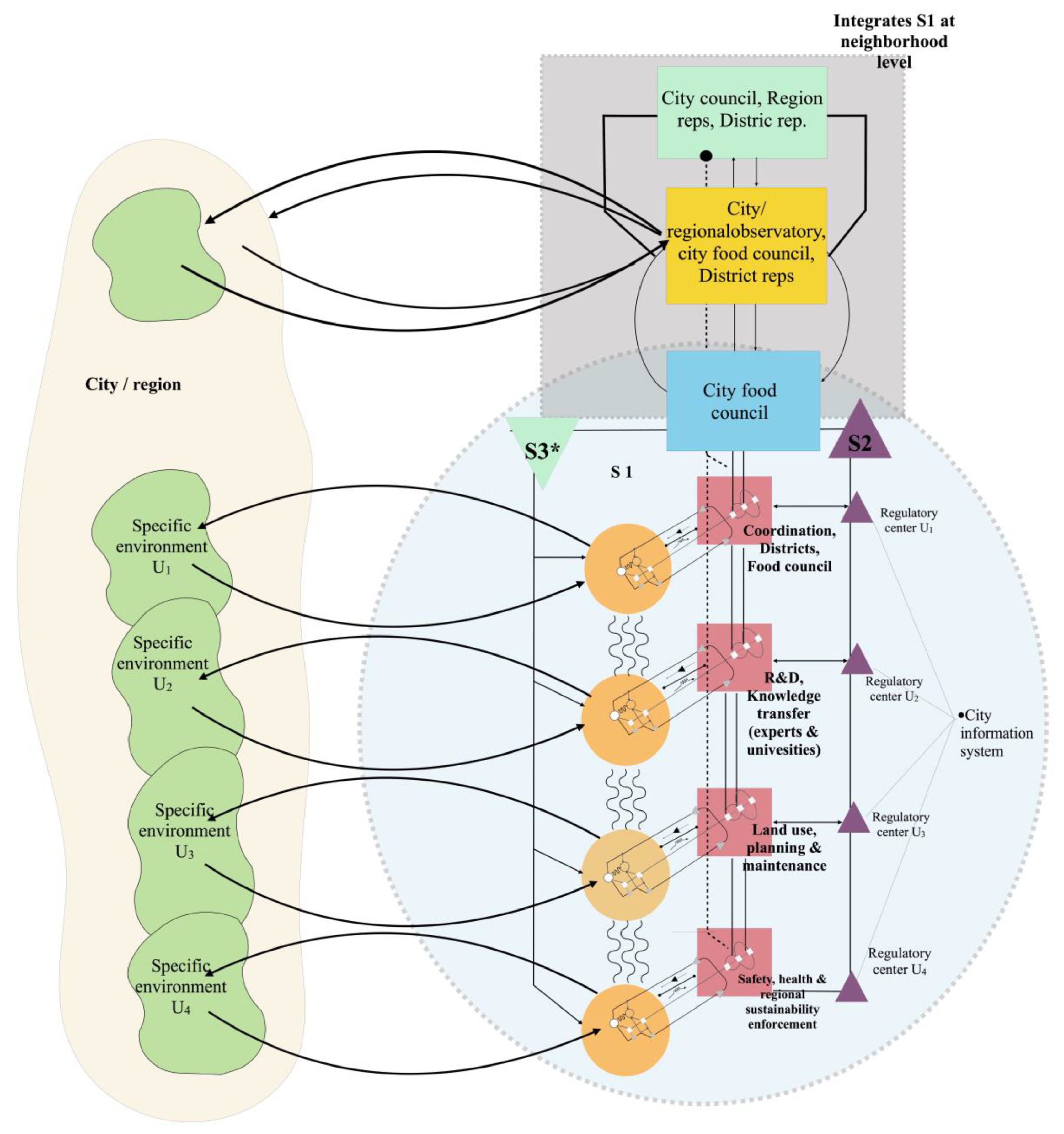
According to the diagrams above, Table 10 describes the VSM elements that must be considered to propose city-level relations (Figure 8):
Table 10.
City VSM systems and their roles and functions.
Figure 8.
City as a Viable System Model.
In general, this recursive structure suggests the main communication channels and monitoring activities that can provide decentralized management and cohesive governance capable of responding to dynamic changes for sustainable urban agriculture. By providing the participation of key actors (e.g., local governments, R + D, and KT), this system could respond to challenges and limitations, such as urban planning and the use of land, through the use of an updated database of land available for use in food production, with the potential to inform policy, such as vertical and horizontal food production, related research, and the delimitation of safe areas of production, as well as the overall planning of crops and the knowledge transfer of novel food production techniques and exchange mechanisms and planning for the development of green and blue urban areas [105].
5. Discussion
Considering the methodology section, it is necessary to remember that the goal of this search was to identify patterns and the use of tools, particularly from the perspective of system science, in problems related to food sustainability and urban agriculture. Although the literature review did not focus exclusively on urban agriculture, the algorithm for community detection and its subsequent review indicated that the works that deal with urban agriculture as their central theme with a precise geographical context did not identify particularities in the spaces, techniques, forms of management, and organizational structures for food production in urban areas [10,19,28,54,105,106].
Based on the above, despite the fact that in operative terms, both the global North and South use similar spaces and techniques for urban food production (e.g., roofs, public and private urban land, vertical walls, abandoned or decommissioned urban infrastructure, hydroponics, permaculture, raised beds, square foot gardening, and crop rotation) and face similar challenges (e.g., soil and air pollution and limited space), important differences in the motivation to grow food, the technology used, the production scale, and institutional regulations and support are evident between these two contexts of urban agriculture. For instance, in cities in developing countries, the function of urban agriculture will usually be to fulfill food security and nutritional needs, usually in very limited spaces, as well as adopting innovative and often unconventional low-tech methods. In the global north, instead, urban agriculture has functions that are not strictly related to food security but instead relate to the adoption of sustainable lifestyles or the creation of social ties, such as green urban tribes, and access to high-tech solutions using intensively urban areas and infrastructures apt for, or adapted to, food production [19].
Problems related to sustainability, specifically those related to management mechanisms or urban food production and supply, present an opportunity to apply systemic thinking, more specifically, to address issues related to identifying the contextual variables that affect a problem’s situation, locate unhealthy relationships, manage resources, and promote measures of control and regulation to generate actions and strategies that operationalize changes that positively affect the structure and sharing of a given system.
According to the literature review, the contributions by Steenbergen et al. [58], Viira and Roots [64], Agarwal [91], Lin [85], Zhan [94], Neilson [56], and Petry [100] made important efforts to characterize, from different perspectives, the components related to the problem of urban agriculture and how this type of agriculture can be established as an alternative for reducing the potential threats that the current provision of food generates in urban areas. Another aspect in which these authors agree (although it is an aspect that they leave unanswered) is the need to establish partnerships under a sufficiently robust organizational framework that does not depend on the kindness and goodwill of the actors but instead on systemic principles that promote autonomy and self-organization. A predominant trend was the adoption of theories or models with a reductionist perspective for the study of urban agriculture. This characteristic stood out when the studies focused on specific variables, sidestepping the relationship with the general context and when the proposals focused on solving a specific problem were out of alignment with their viability and the relevant transformation processes. Another aspect that emerged was the standard import—with some adjustments—of management or control models that were designed for other sectors or different contexts, producing imbalances in the organizations or communities in which they were applied. To narrow down the previous knowledge gaps, this article identified the minimum and sufficient structural and operational elements needed to characterize a viable urban food production system. The results suggest a socio-technical system capable of ensuring a food supply system based on its immediate context to reduce the impact of agricultural activity without neglecting the option of generating surpluses that allow those involved to operate sustainably.
Many other groups of contributions focused on the identification of actors and their involvement in the organization [14,17,20,25,39,44]. However, the mechanisms for monitoring, coordinating, and controlling each of the actors involved were not established. In this work, this last issue was solved via the presentation of a balanced organizational architecture with a generic definition of the agents, roles, and functions through the use of the VSM.
Diehl [13] identified the reasons for the associations between farmers in urban areas and how building links is a viable means of accessing resources and maintaining agricultural subsistence. The precision of this process is paramount, highlighting socio-cultural barriers as a dimension that many proposals do not characterize but which may establish greater cohesion and/or adequate ways of managing a project of this nature, as stated by Bucagu et al. [71], Niragira et al. [12], Suter et al. [70], Traore et al. [73], and Wesener et al. [104]. In this context, the present work addresses these issues and suggests some of the generic associations and links that should be present to provide cohesion and, ultimately, viability.
For the proposals that used an integral or systemic approach, the limits of the system or the object of study were often proposed as traditional organizational structures that relegate decision-making to external actors or those not closely related to the knowledge of the system. In addition, a gap in the feedback mechanisms was identified to support system problems and address their intermediate relationships with other actors in order to adapt to changes in the environment. The use of VSM corrected these issues since, by default, the design of the proposed organizational architecture provides a clear definition of its boundaries, recursive levels, and, at each one, the relevant mechanisms for monitoring and (self)governance with a multi-stakeholder and multi-level approach that matches the FAO Framework for the Urban Food Agenda [35]. Moreover, the recursive VSM architecture suggested in this work provides a generic, adaptable, and comprehensive platform for the operationalization of the FAO-Milan Urban Food Policy Pact (MUFPP; the proposed VSM architecture can simplify the mapping and implementation of all MUFPP monitoring framework indicators, with particular emphasis on those related to governance, food production, food supply and distribution, and food waste. It also offers the basic design for a multilevel information system that could facilitate the collection and consolidation of data for the remaining MUFPP indicators on sustainable diets and nutrition and social and economic equality [20], a capability not found in any other work in the reviewed literature.
The application of SNA allowed us to identify some convergences with the viable model proposed by the articles. For example, the model proposed by Scharf [96] established that the food system for urban areas requires profound changes and the adoption of a systemic perspective to plan long-term actions that contribute to sustainability in cities. In this sense, the proposed model suggests the creation of highly accessible spaces and platforms for the exchange of ideas and goods, regardless of linguistic, generational, or cultural backgrounds, as well as an increase in identification within the neighborhood, the positive impacts of the cohesion of the group (and local communities), and the connections between people. This model thus has value as a testing ground for sustainable practices and the local field of action. In this paper, the recommended VSM suggests organizational structures that could facilitate the emergence of previously identified spaces. In this sense, the VSM proposes the neighborhood as a critical building block of food self-sufficiency, considering it to be a conglomerate of interacting productive units, where the flows of raw materials, participation, motivation, and education can yield self-organization. In this context, awareness must be encouraged to achieve sustainability in terms of food production. This, in turn, will facilitate and support the agents involved in analyzing and understanding the context in which such interactions occur in their organizations.
This work coincides with that of Diehl [13], who proposed grouping typical forms of urban agriculture with community gardens, urban farms, school gardens, hydroponic systems on ceilings, and walls as the primary forms of production for a productive structure to respond to weather conditions and fulfill a specific function in a given community. Diel also suggested that urban agriculture must transition from a specific or local scope towards a scope that integrates broader geographical areas (the city-region). However, these contributions neglect the elements that would allow their implementation. Considering the above, the VSM presented in this article proposes a generic description of the different roles and functions that would allow the articulation of the basic productive unit (neighborhood) with other productive and administrative and operative levels (we did not, however, include the city-regional level). In this regard, we considered which systems and individuals should be applied as the actors that promote and regulate participation and the dissemination of knowledge.
Following Artmann and Sartison [10], urban agriculture must be integrated into society’s dynamics while considering solutions based on nature. Consequently, the organizational models focused on articulating agriculture in urban areas need to address various social challenges, such as climate change, security and safety, ecosystem and biodiversity services, the control of agricultural intensification, resource efficiency, the renewal and regeneration of urban areas, land management, public health, social cohesion, and economic growth. In this context, engaging in efficient implementation requires the construction of an integrative framework, such as the definition of a clear vision for the challenges that the solution must address, the identification of the relevant actors and supporting instruments, and an evaluation of the appropriation of urban agriculture, e.g., the TASCOI in our proposed model. Following von Ow et al. [59], using the VSM, some socio-cultural and economic factors were identified. These factors are considered in our model, and we propose that they should be used to feed the channels of accountability—the transaction of resources—to improve the information capacities and the decision-making process at each level of recursion (from PUs to the city). In this case, a breakdown of the four levels of recursion favors the viability of each nested system responsible for the activities integrated into it, adding to the definition of the communication channels and the main topics to be discussed in these channels at each recursive level.
6. Conclusions
Using SNA to analyze the existing literature on urban agriculture, it was possible to form an overview on how, and with which tools, food self-sufficiency and urban agriculture have been studied. Moreover, SNA allowed us to identify the gaps that constitute an opportunity to contribute to further developing a dialogue, particularly in the organizational and structural domains.
In this sense, through the detection of thematic communities, it was possible to review contributions that identified components related to contextual, operational, and management elements. Subsequently, some of these thematic components were included in the VSM models for each level of recursion, and we sought to contribute to both by suggesting different interactions between the contextual and management elements mentioned by other authors for the proposal of generic operationalization including regulatory mechanisms via the VSM architecture. In this process, we discovered that the use of the VSM was effective and able to satisfy all the requirements for the management of sustainable urban food production systems according to the parameters stablished by the FAO.
From a methodological point of view, the integration of SNA and VSM enriched the application of a systemic perspective to the study of urban agriculture by providing a framework that includes the systematic identification of key factors, the construction of robust responsive organizational structures with a multi-stakeholder and multi-level approach and (eventually), the suggestion of generic (organizational) roles and functions that could facilitate the implementation of urban agriculture. In this sense, the general objective of this work was achieved.
Consequently, the proposed framework can support subsequent work that can be applied to various contexts of urban agriculture with minimal adjustments. In this sense, we believe that the ideas developed in this article may be useful to support actors involved in the study and promotion of urban agriculture by inviting further exploration of the use of systems thinking and organizational cybernetics, moving away from a reductionist or functionalist model to solve problems with a high impact on social systems.
In general, this works offers—and is limited to—a conceptual contribution to the study of the organizational aspects of urban agriculture, based on the design of an organizational artefact inspired by organizational cybernetics, for which key state-of-the-art design elements were incorporated from the literature published from 2015 to 2019. This limitation, however, invites the creation of further studies focused on the adoption of different approaches and the addition of other tools to the basic VSM design (e.g., using SNA to analyze the social interactions between the recursive levels, the use of partial least square modeling to identify key variables affecting the roles/functions at all recursive levels, and using the Systems Dynamics to model and assess the viability and resilience of urban food production systems). These additions to the current proposed use of VSM could enhance the understanding and management of urban food production systems, strengthen our ability to predict behaviors within these systems, and suggest/identify possible affiliations and links that could prevent problems and ruptures or enhance cohesion and resilience, ultimately sharpening the adaptation capacity, viability, and sustainability of any urban agriculture setting.
Author Contributions
All authors contributed equally to this work. All authors have read and agreed to the published version of the manuscript.
Funding
This research received no external funding.
Conflicts of Interest
The authors declare no conflict of interest.
References
- Schwaninger, M. Model-based Management: A Cybernetic Concept. Syst. Res. Behav. Sci. 2015, 32, 564–578. [Google Scholar] [CrossRef] [Scilit]
- Brombin, A. Faces of sustainability in Italian ecovillages: Food as ‘contact zone’. Int. J. Consum. Stud. 2015, 39, 468–477. [Google Scholar] [CrossRef] [Scilit]
- Mellisse, B.T.; Descheemaeker, K.; Giller, K.E.; Abebe, T.; van de Ven, G.W.J. Are traditional home gardens in southern Ethiopia heading for extinction? Implications for productivity, plant species richness and food security. Agric. Ecosyst. Environ. 2018, 252, 1–13. [Google Scholar] [CrossRef] [Scilit]
- Williams, A.; Kennedy, S.; Philipp, F.; Whiteman, G. Systems thinking: A review of sustainability management research. J. Clean. Prod. 2017, 148, 866–881. [Google Scholar] [CrossRef] [Scilit]
- Savaget, P.; Geissdoerfer, M.; Kharrazi, A.; Evans, S. The theoretical foundations of sociotechnical systems change for sustainability: A systematic literature review. J. Clean. Prod. 2019, 206, 878–892. [Google Scholar] [CrossRef] [Scilit]
- Núñez-Ríos, J.E.; Sánchez-García, J.Y.; Tejeida-Padilla, R. Human Capital Management in Tourism SMEs from a Cyber-Systemic Approach. Syst. Pract. Action Res. 2020, 33, 527–559. [Google Scholar] [CrossRef] [Scilit]
- Nicholls, E.; Ely, A.; Birkin, L.; Basu, P.; Goulson, D. The contribution of small-scale food production in urban areas to the sustainable development goals: A review and case study. Sustain. Sci. 2020. [Google Scholar] [CrossRef] [Scilit]
- Dolley, J.; Marshall, F.; Butcher, B.; Reffin, J.; Robinson, J.A.; Eray, B.; Quadrianto, N. Analysing trade-offs and synergies between SDGs for urban development, food security and poverty alleviation in rapidly changing peri-urban areas: A tool to support inclusive urban planning. Sustain. Sci. 2020, 1–19. [Google Scholar] [CrossRef] [Scilit]
- Muñoz-Rodríguez, M.; Fernández-González, C.; Aguilar-Gallegos, N.; González-Santiago, M.V. The Primacy of Politics in Public Food Security Policies: The Case of Home Gardens. Sustainability 2020, 12, 4316. [Google Scholar] [CrossRef] [Scilit]
- Artmann, M.; Sartison, K. The Role of Urban Agriculture as a Nature-Based Solution: A Review for Developing a Systemic Assessment Framework. Sustainability 2018, 10, 1937. [Google Scholar] [CrossRef] [Scilit]
- Ward, J.D.; Ward, P.J.; Mantzioris, E.; Saint, C. Optimising diet decisions and urban agriculture using linear programming. Food Secur. 2014, 6, 701–718. [Google Scholar] [CrossRef] [Scilit]
- Niragira, S.; D’Haese, M.; Buysse, J.; Van Orshoven, J.; Ndimubandi, J. Historical changes in the traditional agrarian systems of Burundi: Endogenous drive to survive from food insecurity. GeoJournal 2019, 1–20. [Google Scholar] [CrossRef] [Scilit]
- Diehl, J.A. Growing for Sydney: Exploring the Urban Food System through Farmers’ Social Networks. Sustainability 2020, 12, 3346. [Google Scholar] [CrossRef] [Scilit]
- Schreer, V.; Padmanabhan, M. The many meanings of organic farming: Framing food security and food sovereignty in Indonesia. Org. Agric. 2019, 10, 327–338. [Google Scholar] [CrossRef] [Scilit]
- McGinnis, R.; Meadows, D.H.; Meadows, D.L.; Randers, J.; Behren, W.W. The Limits to Growth: A Report for the Club of Rome’s Project on the Predicament of Mankind. Demography 1973, 10, 295. [Google Scholar] [CrossRef] [Scilit]
- Espinosa, A.; Walker, J. A Complexity Approach to Sustainability; Henrik, J.J., Ed.; Series on Complexity Science; Imperial College Press: London, UK, 2011; Volume 1, ISBN 978-1-84816-527-4. [Google Scholar]
- FAO. Trade Reforms and Food Security: Conceptualising the Linkages; FAO: Rome, Italy, 2003. [Google Scholar]
- WWF. Using Systems Thinking to Transform Society; WWF: Gland, Switzerland, 2018. [Google Scholar]
- Taguchi, M.; Santini, G. Urban Agriculture in the Global North & South: A Perspective from FAO. Available online: https://journals.openedition.org/factsreports/5610 (accessed on 30 July 2020).
- FAO. The Milan Urban Food Policy Pact Monitoring Framework. Available online: http://www.milanurbanfoodpolicypact.org/wp-content/uploads/2019/11/CA6144EN.pdf (accessed on 30 July 2020).
- Le Tellier, M.; Berrah, L.; Stutz, B.; Audy, J.-F.; Barnabé, S. Towards sustainable business parks: A literature review and a systemic model. J. Clean. Prod. 2019, 216, 129–138. [Google Scholar] [CrossRef] [Scilit]
- Eustachio, J.H.P.P.; Caldana, A.C.F.; Liboni, L.B.; Martinelli, D.P. Systemic indicator of sustainable development: Proposal and application of a framework. J. Clean. Prod. 2019, 241, 118383. [Google Scholar] [CrossRef] [Scilit]
- Gondhalekar, D.; Ramsauer, T. Nexus City: Operationalizing the urban Water-Energy-Food Nexus for climate change adaptation in Munich, Germany. Urban Clim. 2017, 19, 28–40. [Google Scholar] [CrossRef] [Scilit]
- Ruiz-Almeida, A.; Rivera-Ferre, M.G. Internationally-based indicators to measure Agri-food systems sustainability using food sovereignty as a conceptual framework. Food Secur. 2019, 11, 1321–1337. [Google Scholar] [CrossRef] [Scilit]
- Luan, Y.; Cui, X.; Ferrat, M. Historical trends of food self-sufficiency in Africa. Food Secur. 2013, 5, 393–405. [Google Scholar] [CrossRef] [Scilit]
- Leonardo, W.J.; van de Ven, G.W.J.; Udo, H.; Kanellopoulos, A.; Sitoe, A.; Giller, K.E. Labour not land constrains agricultural production and food self-sufficiency in maize-based smallholder farming systems in Mozambique. Food Secur. 2015, 7, 857–874. [Google Scholar] [CrossRef] [Scilit]
- Saha, M.; Eckelman, M.J. Growing fresh fruits and vegetables in an urban landscape: A geospatial assessment of ground level and rooftop urban agriculture potential in Boston, USA. Landsc. Urban Plan. 2017, 165, 130–141. [Google Scholar] [CrossRef] [Scilit]
- Baer-Nawrocka, A.; Sadowski, A. Food security and food self-sufficiency around the world: A typology of countries. PLoS ONE 2019, 14, e0213448. [Google Scholar] [CrossRef] [Scilit] [PubMed]
- Montiel, I. Corporate Social Responsibility and Corporate Sustainability. Organ. Environ. 2008, 21, 245–269. [Google Scholar] [CrossRef] [Scilit]
- Ward, J.D. Can urban agriculture usefully improve food resilience? Insights from a linear programming approach. J. Environ. Stud. Sci. 2015, 5, 699–711. [Google Scholar] [CrossRef] [Scilit]
- Weidner, T.; Yang, A.; Hamm, M.W. Consolidating the current knowledge on urban agriculture in productive urban food systems: Learnings, gaps and outlook. J. Clean. Prod. 2019, 209, 1637–1655. [Google Scholar] [CrossRef] [Scilit]
- Li, S.; Juhász-Horváth, L.; Pintér, L.; Rounsevell, M.D.A.; Harrison, P.A. Modelling regional cropping patterns under scenarios of climate and socio-economic change in Hungary. Sci. Total Environ. 2018, 622–623, 1611–1620. [Google Scholar] [CrossRef] [Scilit]
- Xie, W.; Huang, J.; Wang, J.; Cui, Q.; Robertson, R.; Chen, K. Climate change impacts on China’s agriculture: The responses from market and trade. China Econ. Rev. 2018. [Google Scholar] [CrossRef] [Scilit]
- Nunez Rios, J.E.; Sánchez García, J.Y.; Soto Pérez, M.; Rojas, O. A Systemic Approach to Self-management in SMEs. Case: Mexican Lodging Organisations. Int. J. Bus. Innov. Res. 2020, 1, 1. [Google Scholar] [CrossRef] [Scilit]
- FAO. FAO Framework for the Urban Food Agenda; FAO: Rome, Italy, 2019; ISBN 978-92-5-131274-2. [Google Scholar]
- Bunge, M. Philosophy of Science and Technology: A Personal Report. In Philosophy of Latin America; Springer: Dordrecht, The Netherlands, 2003; pp. 245–272. ISBN 9027719039. [Google Scholar]
- Mouhib, N.; Bah, S.; Berrado, A. Viability Theory and PSI Theory Interrelation Inspired by Bunge Systemic Classification: The Viable System Ontology Theory. Syst. Pract. Action Res. 2019. [Google Scholar] [CrossRef] [Scilit]
- Borgatti, S.P.; Mehra, A.; Brass, D.J.; Labianca, G. Network Analysis in the Social Sciences. Science 2009, 323, 892–895. [Google Scholar] [CrossRef] [Scilit] [PubMed]
- Beer, S. The Viable System Model: Its Provenance, Development, Methodology and Pathology. J. Oper. Res. Soc. 1984, 35, 7. [Google Scholar] [CrossRef] [Scilit]
- Aguilar-Gallegos, N.; Martínez-González, E.G.; Aguilar-Ávila, J. Análisis de Redes Sociales: Conceptos Clave y Cálculo de Indicadores. Serie: Metodologías y Herramientas Para la Investigación, 5th ed.; UACh, CIESTAAM: Chapingo, Mexico, 2017. [Google Scholar]
- Sánchez-García, J.Y.; Ramírez-Gutiérrez, A.G.; Núñez-Ríos, J.E.; Cardoso-Castro, P.P.; Rojas, O.G. Systems Thinking Approach to Sustainable Performance in RAMSAR Sites. Sustainability 2019, 11, 6469. [Google Scholar] [CrossRef] [Scilit]
- Romero-García, L.E.; Aguilar-Gallegos, N.; Morales-Matamoros, O.; Badillo-Piña, I.; Tejeida-Padilla, R. Urban tourism: A systems approach—State of the art. Tour. Rev. 2019, 74, 679–693. [Google Scholar] [CrossRef] [Scilit]
- Borgatti, S.P.; Everett, M.G. Network analysis of 2-mode data. Soc. Networks 1997, 19, 243–269. [Google Scholar] [CrossRef] [Scilit]
- Csárdi, G.; Nepusz, T. The igraph software package for complex network research. InterJournal Complex Syst. 2006, 1695, 1–9. [Google Scholar]
- Kolaczyk, E.D.; Csárdi, G. Statistical Analysis of Network Data with R; Springer: New York, NY, USA, 2014; Volume 65, ISBN 978-1-4939-0982-7. [Google Scholar]
- Leonard, A. Integrating sustainability practices using the viable system model. Syst. Res. Behav. Sci. 2009, 25, 643–654. [Google Scholar] [CrossRef] [Scilit]
- Popper, K. The Logic of Scientific Discovery; Routledge: London, UK, 2005; ISBN 9780203994627. [Google Scholar]
- Schwaninger, M.; Scheef, C. A Test of the Viable System Model: Theoretical Claim vs. Empirical Evidence. Cybern. Syst. 2016, 47, 544–569. [Google Scholar] [CrossRef] [Scilit]
- Ríos, J.E.N.; Pérez, M.S.; García, J.Y.S.; Rojas, O.G. A systemic approach to self-management in SMEs. Case: Mexican lodging organisations. Int. J. Bus. Innov. Res. 2020, 22, 585. [Google Scholar] [CrossRef] [Scilit]
- Sánchez-García, J.Y.; Núñez-Ríos, J.E.; Soto-Pérez, M.; Cardoso-Castro, P.P.; Rodríguez-Magaña, A. A Systems Science Approach to Inter-Organisational Complementarity in Tourism SMEs. Syst. Pract. Action Res. 2020, 33, 1–25. [Google Scholar] [CrossRef] [Scilit]
- Cardoso Castro, P.P. The viable system model as a framework to guide organisational adaptive response in times of instability and change. Int. J. Organ. Anal. 2019, 27, 289–307. [Google Scholar] [CrossRef] [Scilit]
- Ríos, J.P. Models of organizational cybernetics for diagnosis and design. Kybernetes 2010, 39, 1529–1550. [Google Scholar] [CrossRef] [Scilit]
- Espejo, R.; Kuropatwa, D. Appreciating the complexity of organizational processes. Kybernetes 2011, 40, 454–476. [Google Scholar] [CrossRef] [Scilit]
- Wegren, S.K.; Elvestad, C. Russia’s food self-sufficiency and food security: An assessment. Post-Communist Econ. 2018, 30, 565–587. [Google Scholar] [CrossRef] [Scilit]
- Patel, R. Food sovereignty. J. Peasant Stud. 2009, 36, 663–706. [Google Scholar] [CrossRef] [Scilit]
- Neilson, J.; Wright, J. The state and food security discourses of Indonesia: Feeding the bangsa. Geogr. Res. 2017, 55, 131–143. [Google Scholar] [CrossRef] [Scilit]
- Pradhan, P.; Fischer, G.; van Velthuizen, H.; Reusser, D.E.; Kropp, J.P. Closing Yield Gaps: How Sustainable Can We Be? PLoS ONE 2015, 10, e0129487. [Google Scholar] [CrossRef] [Scilit]
- Steenbergen, D.J.; Eriksson, H.; Hunnam, K.; Mills, D.J.; Stacey, N. Following the fish inland: Understanding fish distribution networks for rural development and nutrition security. Food Secur. 2019, 11, 1417–1432. [Google Scholar] [CrossRef] [Scilit]
- Von Ow, A.; Waldvogel, T.; Nemecek, T. Environmental optimization of the Swiss population’s diet using domestic production resources. J. Clean. Prod. 2020, 248, 119241. [Google Scholar] [CrossRef] [Scilit]
- Liu, Y.; Wang, S.; Chen, B. Optimization of national food production layout based on comparative advantage index. Energy Procedia 2019, 158, 3846–3852. [Google Scholar] [CrossRef] [Scilit]
- Davis, K.F.; Gephart, J.A.; Gunda, T. Sustaining food self-sufficiency of a nation: The case of Sri Lankan rice production and related water and fertilizer demands. Ambio 2016, 45, 302–312. [Google Scholar] [CrossRef] [Scilit] [PubMed]
- Prášilová, M.; Procházková, R. Structural changes of Czech agriculture and the impact of these on inner foodstuffs self-sufficiency of Czech Republic. In Proceedings of the 28th International Business Information Management Association Conference—Vision 2020: Innovation Management, Development Sustainability, and Competitive Economic Growth, Seville, Spain, 9–10 November 2016; pp. 2905–2919. [Google Scholar]
- Xie, H.; Perez, N.; Anderson, W.; Ringler, C.; You, L. Can Sub-Saharan Africa feed itself? The role of irrigation development in the region’s drylands for food security. Water Int. 2018, 43, 796–814. [Google Scholar] [CrossRef] [Scilit]
- Põldaru, R.; Viira, A.H.; Roots, J. Optimization of arable land use to guarantee food security in Estonia. Agron. Res. 2018, 16, 1837–1853. [Google Scholar]
- Avila-Sanchez, H. Agricultura Urbana y Periurbana. Reconfiguraciones territoriales y potencialidades en torno a los sistemas alimentarios urbanos. Investig. Geográficas 2019. [Google Scholar] [CrossRef] [Scilit]
- Nadal, A.; Rodríguez-Cadena, D.; Pons, O.; Cuerva, E.; Josa, A.; Rieradevall, J. Feasibility assessment of rooftop greenhouses in Latin America. The case study of a social neighborhood in Quito, Ecuador. Urban For. Urban Green. 2019, 44, 126389. [Google Scholar] [CrossRef] [Scilit]
- He, C.; Liu, Z.; Xu, M.; Ma, Q.; Dou, Y. Urban expansion brought stress to food security in China: Evidence from decreased cropland net primary productivity. Sci. Total Environ. 2017, 576, 660–670. [Google Scholar] [CrossRef] [Scilit] [PubMed]
- Smith, A. The Farm Wife Mystery School: Women’s use of social media in the contemporary North American urban homestead movement. Stud. Educ. Adults 2015, 47, 142–159. [Google Scholar] [CrossRef] [Scilit]
- Dewi, G.D.P.; Yustikaningrum, R.V. Improving food security empowerment in Indonesia- Timor Leste border. In Proceedings of the IOP Conference Series: Earth and Environmental Science, Medan, Indonesia, 11–12 October 2017; Volume 126. [Google Scholar]
- Suter, M.; Connolly, J.; Finn, J.A.; Loges, R.; Kirwan, L.; Sebastià, M.-T.; Lüscher, A. Nitrogen yield advantage from grass-legume mixtures is robust over a wide range of legume proportions and environmental conditions. Glob. Chang. Biol. 2015, 21, 2424–2438. [Google Scholar] [CrossRef] [Scilit]
- Bucagu, C.; Vanlauwe, B.; Van Wijk, M.T.; Giller, K.E. Resource use and food self-sufficiency at farm scale within two agro-ecological zones of Rwanda. Food Secur. 2014, 6, 609–628. [Google Scholar] [CrossRef] [Scilit]
- Ji, Y.; Yan, H.; Liu, J.; Kuang, W.; Hu, Y. A MODIS data derived spatial distribution of high-, mediumand low-yield cropland in China. Acta Geogr. Sin. 2015, 70, 766–778. [Google Scholar]
- Traore, B.; Descheemaeker, K.; van Wijk, M.T.; Corbeels, M.; Supit, I.; Giller, K.E. Modelling cereal crops to assess future climate risk for family food self-sufficiency in southern Mali. F. Crop. Res. 2017, 201, 133–145. [Google Scholar] [CrossRef] [Scilit]
- Cho, S.; Lee, Y.-W. Deep learning-based analysis of the relationships between climate change and crop yield in China. ISPRS—Int. Arch. Photogramm. Remote Sens. Spat. Inf. Sci. 2019, XLII-3/W8, 93–95. [Google Scholar] [CrossRef] [Scilit]
- Dalin, C.; Qiu, H.; Hanasaki, N.; Mauzerall, D.L.; Rodriguez-Iturbe, I. Balancing water resource conservation and food security in China. Proc. Natl. Acad. Sci. USA 2015, 112, 4588–4593. [Google Scholar] [CrossRef] [Scilit] [PubMed]
- Cuberos Balda, M.; Furubayashi, T.; Nakata, T. A novel approach for analyzing the food-energy nexus through on-farm energy generation. Clean Technol. Environ. Policy 2017, 19, 1003–1019. [Google Scholar] [CrossRef] [Scilit]
- Lee, S.-H.; Mohtar, R.H.; Yoo, S.-H. Assessment of food trade impacts on water, food, and land security in the MENA region. Hydrol. Earth Syst. Sci. 2019, 23, 557–572. [Google Scholar] [CrossRef] [Scilit]
- Loon, M.P.; Hijbeek, R.; Berge, H.F.M.; De Sy, V.; Broeke, G.A.; Solomon, D.; Ittersum, M.K. Impacts of intensifying or expanding cereal cropping in sub-Saharan Africa on greenhouse gas emissions and food security. Glob. Chang. Biol. 2019, 25, 3720–3730. [Google Scholar] [CrossRef] [Scilit]
- Qasemipour, E.; Abbasi, A. Assessment of Agricultural Water Resources Sustainability in Arid Regions Using Virtual Water Concept: Case of South Khorasan Province, Iran. Water 2019, 11, 449. [Google Scholar] [CrossRef] [Scilit]
- Lee, J.; Koh, M.; Jeong, G. Analysis of the impact of agricultural R&D investment on food security. Appl. Econ. Lett. 2017, 24, 49–53. [Google Scholar]
- Lee, S.-H.; Taniguchi, M.; Mohtar, R.; Choi, J.-Y.; Yoo, S.-H. An Analysis of the Water-Energy-Food-Land Requirements and CO2 Emissions for Food Security of Rice in Japan. Sustainability 2018, 10, 3354. [Google Scholar] [CrossRef] [Scilit]
- Udias, A.; Pastori, M.; Dondeynaz, C.; Carmona Moreno, C.; Ali, A.; Cattaneo, L.; Cano, J. A decision support tool to enhance agricultural growth in the Mékrou river basin (West Africa). Comput. Electron. Agric. 2018, 154, 467–481. [Google Scholar] [CrossRef] [Scilit]
- Sedova, N.V.; Ananiev, M.A.; Ananieva, O.M. The effect of Russia’s in-progress import substitution strategy on its agri-food security. Espacios 2018, 39, 21–28. [Google Scholar]
- Pradhan, P.; Lüdeke, M.K.B.; Reusser, D.E.; Kropp, J.P. Food Self-Sufficiency across Scales: How Local Can We Go? Environ. Sci. Technol. 2014, 48, 9463–9470. [Google Scholar] [CrossRef] [Scilit] [PubMed]
- Lin, S.Y. From self-sufficiency to self-supporting: China’s food security under overseas farmland investment and international norms. Issues Stud. 2015, 51, 89–129. [Google Scholar]
- Squires, V.R.; Hua, L.; Wang, G. Food security: A multi-faceted and multi-dimensional issue in China. J. Food Agric. Environ. 2015, 13, 24–31. [Google Scholar]
- Battalova, A.R.; Kundakchyan, R.M. Food security at the regional level. Astra Salvensis 2017, 2017, 521–526. [Google Scholar]
- Martínez Salvador, L. Seguridad alimentaria, autosuficiencia y disponibilidad del amaranto en México. Probl. Desarro. 2016, 47, 107–132. [Google Scholar] [CrossRef] [Scilit]
- Soetoto, E.O.H. The impact of Indonesia’s food law reform on the concept of food sovereignty in Indonesia. In Proceedings of the IOP Conference Series: Earth and Environmental Science, Batu City, Indonesia, 24–25 October 2017; Volume 131. [Google Scholar]
- Stella, G.; Coli, R.; Maurizi, A.; Famiani, F.; Castellini, C.; Pauselli, M.; Tosti, G.; Menconi, M. Towards a National Food Sovereignty Plan: Application of a new Decision Support System for food planning and governance. Land Use Policy 2019, 89, 104216. [Google Scholar] [CrossRef] [Scilit]
- Agarwal, B. Food sovereignty, food security and democratic choice: Critical contradictions, difficult conciliations. J. Peasant Stud. 2014, 41, 1247–1268. [Google Scholar] [CrossRef] [Scilit]
- Vaghefi, N.; Shamsudin, M.N.; Radam, A.; Rahim, K.A. Impact of climate change on food security in Malaysia: Economic and policy adjustments for rice industry. J. Integr. Environ. Sci. 2016, 13, 19–35. [Google Scholar] [CrossRef] [Scilit]
- Clapp, J. Food self-sufficiency: Making sense of it, and when it makes sense. Food Policy 2017, 66, 88–96. [Google Scholar] [CrossRef] [Scilit]
- Zhan, S. Riding on self-sufficiency: Grain policy and the rise of agrarian capital in China. J. Rural Stud. 2017, 54, 151–161. [Google Scholar] [CrossRef] [Scilit]
- Sapozhnikova, E.; Ryazanova, O. The role of small farms in ensuring food security in Russia. E3S Web Conf. 2019, 110, 02010. [Google Scholar] [CrossRef] [Scilit]
- Scharf, N.; Wachtel, T.; Reddy, S.; Säumel, I. Urban Commons for the Edible City—First Insights for Future Sustainable Urban Food Systems from Berlin, Germany. Sustainability 2019, 11, 966. [Google Scholar] [CrossRef] [Scilit]
- Schwanitz, V.; Wierling, A.; Shah, P. Assessing the Impact of Renewable Energy on Regional Sustainability—A Comparative Study of Sogn og Fjordane (Norway) and Okinawa (Japan). Sustainability 2017, 9, 1969. [Google Scholar] [CrossRef] [Scilit]
- Pingali, P.; Mittra, B.; Rahman, A. The bumpy road from food to nutrition security—Slow evolution of India’s food policy. Glob. Food Sec. 2017, 15, 77–84. [Google Scholar] [CrossRef] [Scilit]
- Martin, K.S.; Redelfs, A.; Wu, R.; Bogner, O.; Whigham, L. Offering More Than Food: Outcomes and Lessons Learned from a Fresh Start food pantry in Texas. J. Hunger Environ. Nutr. 2019, 14, 70–81. [Google Scholar] [CrossRef] [Scilit]
- Petry, C. As urban citizens, how to achieve autonomy and food security? Acta Hortic. 2017, 1189, 423–426. [Google Scholar] [CrossRef] [Scilit]
- Maltz, A. “Plant a victory garden: Our food is fighting:” Lessons of food resilience from World War. J. Environ. Stud. Sci. 2015, 5, 392–403. [Google Scholar] [CrossRef] [Scilit]
- Blandford, D.; Gaasland, I.; Vårdal, E. Greenhouse Gas Abatement in Agriculture—Is there a Conflict with Food Security? EuroChoices 2015, 14, 35–41. [Google Scholar] [CrossRef] [Scilit]
- Huang, J.; Liang, Z.; Wu, S.; Li, S. Grain Self-Sufficiency Capacity in China’s Metropolitan Areas under Rapid Urbanization: Trends and Regional Differences from 1990 to 2015. Sustainability 2019, 11, 2468. [Google Scholar] [CrossRef] [Scilit]
- Wesener, A.; Fox-Kämper, R.; Sondermann, M.; Münderlein, D. Placemaking in Action: Factors That Support or Obstruct the Development of Urban Community Gardens. Sustainability 2020, 12, 657. [Google Scholar] [CrossRef] [Scilit]
- Duží, B.; Frantál, B.; Simon Rojo, M. The geography of urban agriculture: New trends and challenges. Morav. Geogr. Rep. 2017, 25, 130–138. [Google Scholar] [CrossRef] [Scilit]
- Wenban-Smith, H.; Fasse, A.; Grote, U. Food security in Tanzania: The challenge of rapid urbanisation. Food Secur. 2016, 8, 973–984. [Google Scholar] [CrossRef] [Scilit]









© 2020 by the authors. Licensee MDPI, Basel, Switzerland. This article is an open access article distributed under the terms and conditions of the Creative Commons Attribution (CC BY) license (http://creativecommons.org/licenses/by/4.0/).