

A Mini-Review of Urban Wastewater Treatment in Greece: History, Development and Future Challenges



Abstract
1. Introduction
2. The Past of Urban Wastewater Treatment in Greece
2.1. Historical Development
2.2. Development over the Past 40 Years
- At the latest by 31 December 1998 for urban agglomerations of more than 10,000 p.e., discharging into receiving waters, which are considered as “sensitive areas”, e.g., natural freshwaters bodies; in these cases the relevant WWTPs must be complimentary designed for nitrogen and/or phosphorus removal in order to avoid eutrophication problems of the receiving water bodies.
- At the latest by 31 December 2000 for all discharges from urban agglomerations of more than 15,000 p.e.
- At the latest by 31 December 2005 for all discharges from agglomerations of between 10,000 and 15,000 p.e.
- At the latest by 31 December 2005 for discharges to fresh-water and estuaries water bodies from agglomerations (settlements) between 2000 and 10,000 p.e.
3. Recent Developments and Current Situation
4. Outlook
4.1. Remaining Gaps and Future Challenges
- Treated wastewater reuse
- Sludge disposal
- Energy efficiency
- Reducing greenhouse emissions
- Management of wastewaters from small settlements that still use quite extensively the septic tanks option
4.1.1. Treated Wastewater Reuse
4.1.2. Sludge Disposal
4.1.3. Energy Efficiency
4.1.4. Reducing Greenhouse Emissions
4.1.5. Management of Wastewater from Small Urban Settlements that Still Use Septic Tanks
5. Conclusions
Author Contributions
Funding
Conflicts of Interest
References
- EEA. European Environment Agency: Surface Water Quality Monitoring—Summary: Greece. Available online: https://www.eea.europa.eu/publications/92-9167-001-4/page010.html (accessed on 2 May 2020).
- Philandras, C.M.; Nastos, P.T.; Repapis, C.C. Air temperature variability and trends over Greece. Glob. NEST J. 2008, 10, 273–285. [Google Scholar]
- Chenoweth, J.; Hadjinicolaou, P.; Bruggeman, A.; Lelieveld, J.; Levin, Z.; Lange, M.A.; Xoplaki, E.; Hadjikakou, M. Impact of climate change on the water resources of the eastern Mediterranean and Middle East region: Modeled 21st century changes and implications. Water Resour. Res. 2011, 47, W06506. [Google Scholar] [CrossRef]
- Ferronato, N.; Torretta, V. Waste Mismanagement in Developing Countries: A Review of Global Issues. Int. J. Environ. Res. Public Health 2019, 16, 1060. [Google Scholar] [CrossRef] [PubMed]
- Angelakis, A.N.; Spyridakis, S.V. The status of water resources in Minoan times—A preliminary study. In Diachronic Climatic Impacts on Water Resources with Emphasis on Mediterranean Region; Angelakis, A.N., Issar, A., Eds.; NATO ASI Series; Springer: Heidelberg, Germany, 1996; Volume 36, pp. 161–191. [Google Scholar]
- Lofrano, G.; Brown, J. Wastewater management through the ages: A history of mankind. Sci. Total. Environ. 2010, 408, 5254–5264. [Google Scholar] [CrossRef] [PubMed]
- Andreadakis, A.; Agelakis, T.; Adraktas, D. Treatment and disposal of the waste-water of Thessaloniki, Greece. Environ. Int. 1993, 19, 291–299. [Google Scholar] [CrossRef]
- Golfinopoulos, A. The Diachronic Management of Waste in Antiquity in Greece. Bachelor’s Thesis, Hellenic Open University, Patra, Greese, 15 March 2016. [Google Scholar]
- Historic Overview of Water Supply. Available online: https://www.eydap.gr/en/TheCompany/Water/HistoricalTrackBack/ (accessed on 21 March 2020).
- Directive 91/271/EEC of 21 May 1991 on Urban Waste-Water Treatment 91/271/EEC. Official Journal of the European Communities, Brussels. 1991. 13p. Available online: https://eur-ex.europa.eu/legalcontent/EN/TXT/PDF/?uri=CELEX:31991L0271&from=EN (accessed on 21 March 2020).
- Directive 98/15/EEC of 27 February 1998. Available online: https://eur-lex.europa.eu/LexUriServ/LexUriServ.do?uri=CONSLEG:1998L0015:19980327:EN:PDF (accessed on 21 March 2020).
- Ilias, A.; Panoras, A.; Angelakis, A. Wastewater Recycling in Greece: The Case of Thessaloniki. Sustainability 2014, 6, 2876–2892. [Google Scholar] [CrossRef]
- E.YD.A.P Wastewater Treatment. Available online: https://www.eydap.gr/TheCompany/DrainageAndSewerage/Sewerage/ (accessed on 21 March 2020).
- E.YD.A.P Psyttalia Wastewater Treatment Plant. Available online: https://www.eydap.gr/userfiles/c3c4382d-a658-4d79-b9e2-ecff7ddd9b76/Fact-sheet-PWWTP.pdf (accessed on 21 March 2020).
- Kotsovinos, N.; Tsagarakis, K.P.; Tsakiris, K.; Agricultural, N. Waste stabilization ponds in Greece: Case studies and perspectives. In Proceedings of the 6th International Conference on Waste Stabilisation Ponds, Avignon, France, 28 September–1 October 2004; IWA: London, UK. [Google Scholar]
- Gikas, G.D.; Tsihrintzis, V.A. Urban wastewater treatment using constructed wetlands. Water Util. J. 2014, 8, 57–65. [Google Scholar]
- Tsagarakis, K.P.; Mara, D.D.; Horan, N.J.; Angelakis, A.N. Small urban wastewater treatment plants in Greece. Water Sci. Technol. 2000, 41, 41–48. [Google Scholar] [CrossRef]
- Changes in Urban Waste Water Treatment in Southern Europe. Available online: https://www.eea.europa.eu/data-and-maps/daviz/changes-in-wastewater-treatment-in-10#tab-dashboard-01 (accessed on 21 March 2020).
- Wastewater Treatment Plant in Finikia is in Operation. Available online: https://www.heraklion.gr/municipality/press-releases-2014/se-leitourgia-h-monada-epexergasias-apovlhtwn-22082014.html (accessed on 10 July 2020). (In Greek).
- Sato, T.; Qadir, M.; Yamamoto, S.; Endo, T.; Zahoor, A. Global, regional, and country level need for data on wastewater generation, treatment, and use. Agric. Water Manag. 2013, 130, 1–13. [Google Scholar] [CrossRef]
- Wastewater Treatment (%) Population Connected. OECD Srat. Available online: https://stats.oecd.org/Index.aspx?DataSetCode=WATER_TREAT (accessed on 27 July 2020).
- Naja, G.; Volesky, B. Constructed Wetlands for Water Treatment. Compr. Biotechnol. 2011, 6, 353–369. [Google Scholar] [CrossRef]
- Eriksson, O.; Bisaillon, M.; Haraldsson, M.; Sundberg, J. Improvements in Environmental Performance of Biogas Production from Municipal Solid Waste and Sewage Sludge. In Proceedings of the World Renewable Energy Congress, Linköping, Sweden, 8–13 May 2011; Linkoping University Electronic Press: Linköping, Sweden, 2011; Volume 57, pp. 3193–3200. [Google Scholar]
- Ludzack, F.J.; Ettinger, M.B. Controlling operation to minimize activated sludge effluent nitrogen. J. Water Pollut. Control Fed. 1962, 34, 920–931. [Google Scholar]
- Chen, G.; Yue, P.L.; Mujumdar, A.S. Sludge Dewatering and Drying. Dry. Technol. 2002, 20, 883–916. [Google Scholar] [CrossRef]
- Hudson, J.A. Treatment and Disposal of Sewage Sludge in the Mid-1990s. Water Environ. J. 1995, 9, 93–100. [Google Scholar] [CrossRef]
- Aya, H. Modular membranes for self contained reuse systems. Water Qual. Int. 1994, 21, 128–136. [Google Scholar]
- Renou, Y. The Governance of Water Services in Developing Countries: An Analysis in Terms of Action Stratification. J. Econ. Issues 2010, 44, 113–138. [Google Scholar] [CrossRef]
- European Commission. Ninth Report on the Implementation Status and the Programmes for Implementation (As Required by Article 17) of Council Directive 91/271/EEC Concerning Urban Waste Water Treatment; Report: COM (2017) 749 Final; European Commission: Brussels, Belgium, 2018; 18p. [Google Scholar]
- SSW. Wastewater Treatment Plants. Available online: http://astikalimata.ypeka.gr/Services/Pages/WtpViewApp.aspx (accessed on 21 March 2020).
- Map of Greece’s WWTPs. Available online: http://astikalimata.ypeka.gr/Services/Pages/WtpViewApp.aspx (accessed on 21 March 2020).
- EU Court of Justice. Judgement No. C-119/02 of 24 June 2004. Available online: https://op.europa.eu/en/publication-detail/-/publication/5f3eaad5-3180-423a-806c-f091d7a5ba60/language-en (accessed on 21 March 2020).
- EU Court of Justice. Judgement No. C-328/16 of 22 February 2018. Available online: https://op.europa.eu/en/publication-detail/-/publication/09a5d1a1-4149-11e8-b5fe-01aa75ed71a1/language-en/format-PDF/source-120866608 (accessed on 21 March 2020).
- EU Court of Justice. Judgement No. C-440/06 of 25 October 2007. Available online: https://op.europa.eu/en/publication-detail/-/publication/46d1f9fc-c804-4301-811c-e70e5d62dbd7/language-en (accessed on 21 March 2020).
- EU Court of Justice. Judgement No. C-167/14 of 15 October 2015. Available online: https://op.europa.eu/en/publication-detail/-/publication/ddfaac60-9cb3-11e5-b792-01aa75ed71a1/language-en/format-PDF (accessed on 21 March 2020).
- Lalios, G. Fewer than Half the Small Greek Cities with Sewage Network. Available online: https://www.kathimerini.gr/1017094/article/epikairothta/ellada/ligoteres-apo-tis-mises-oi-mikres-ellhnikes-poleis-me-apoxeteysh (accessed on 21 March 2020).
- SWW. Guidelines Text for Wastewater Management of Small Settlements. Available online: http://www.ypeka.gr/LinkClick.aspx?fileticket=0yUWZWCWi3s%3d&tabid=251&language=el-GR (accessed on 21 March 2020).
- Lavrnić, S.; Mancini, M.; Lavrni, S. Can constructed wetlands treat wastewater for reuse in agriculture? Review of guidelines and examples in South Europe. Water Sci. Technol. 2016, 73, 2616–2626. [Google Scholar] [CrossRef]
- Zouboulis, A.; Prochaska, C.; Angelakis, A. Constructed wetlands wastewater treatment plants and agricultural reuse status in Greece. Presented at the ISCW 2019, Patras, Greece, 29–31 August 2019. [Google Scholar]
- Bisselink, B.; Bernhard, J.; Gelati, E.; Adamovic, M.; Guenther, S.; Mentaschi, L.; De Roo, A. Impact of a Changing Climate, Land Use, and Water Usage on Europe’s Water Resources; EUR 29130 EN; Publications Office of the European Union: Luxembourg, 2018.
- European Commission. Proposal for a Regulation of the European Parliament and of the Council on Minimum Requirements for Water Reuse; Report: COM (201)337/975937; European Commission: Brussels, Belgium, 2018; 28p. [Google Scholar]
- CMD (Common Ministerial Decision). Measures, Limits and Procedures for Reuse of Treated Wastewater; Number 145116; Energy and Climate Change; Ministry of Environment: Athens, Greece, 2011. (In Greek)
- CMD (Common Ministerial Decision). Amendment of CMD 145116 Measures, Limits and Procedures for Reuse of Treated Wastewater; Number 191002; Energy and Climate Change; Ministry of Environment: Athens, Greece, 2013. (In Greek)
- Angelakis, A.N.; Asano, T.; Bahri, A.; Jiménez, B.E.; Tchobanoglous, G. Water Reuse: From Ancient to Modern Times and the Future. Front. Environ. Sci. 2018, 6, 1–17. [Google Scholar] [CrossRef]
- Statistics—ELSTAT. B03. Holdings with Irrigable and Irrigated Areas, by Region and Department Excel File. Available online: http://www.statistics.gr/en/statistics/-/publication/SPG31 (accessed on 21 March 2020).
- Statistics—EUROSTAT. Sewage Sludge Production and Disposal from Urban Wastewater (in Dry Substance (d.s)). Available online: https://ec.europa.eu/eurostat/databrowser/view/ten00030/default/table?lang=en (accessed on 21 March 2020).
- Directive 86/278/EEC of the 4 July 1986. On the Protection of the Environment and in Particular of the Soil When Sewage Sludge is Used in Agriculture. Available online: https://eur-lex.europa.eu/legal-content/EN/TXT/?uri=celex%3A31986L0278 (accessed on 21 March 2020).
- Spanos, T.; Ene, A.; Patronidou, C.S.; Xatzixristou, C. Temporal variability of sewage sludge heavy metal content from Greek wastewater treatment plants. Ecol. Chem. Eng. S 2016, 23, 271–283. [Google Scholar] [CrossRef]
- Ministerial Decision: Greek Legislation 80568/4225/91 of 22 March 1991 on Methods, Specifications and Requirements for the Use in Agriculture of the Sludge Originating from Household and Urban Waste Treatment, Harmonized from European Council Directive; 86/278/EEC; Official Government Gazette of the Hellenic Republic: Athens, Greece, 1991.
- CMA (Council of Ministers Act) 49 of 15-12-2015 (Government Gazette 174/A/15-12-2015); Official Government Gazette of the Hellenic Republic: Athens, Greece, 2015. (In Greek)
- Directive 2008/98/EC of 19 November 2008. On Waste. Available online: https://eur-lex.europa.eu/legal-content/EN/TXT/?uri=CELEX:32008L0098 (accessed on 21 March 2020).
- Bio-Augmentation for the Sludge Reduction in the WWTP of Patras, Greece. Available online: https://alpha-bioenergy.com/project/bio-augmentation-for-the-sludge-reduction-in-the-wwtp-of-patras-greece/ (accessed on 26 March 2020).
- Gao, H.; Scherson, Y.D.; Wells, G.F. Towards energy neutral wastewater treatment: Methodology and state of the art. Environ. Sci. Process. Impacts 2014, 16, 1223–1246. [Google Scholar] [CrossRef]
- SMART-Plant Project. European Union’s Horizon 2020 Grant No. 690323. Available online: https://www.smart-plant.eu/index.php/psyttalia (accessed on 26 March 2020).
- Biosolids2Energy Research Project (LIFE LIFE16 ENV/GR/000298). Available online: http://www.biosolids2energy.eu/home.html (accessed on 26 March 2020).
- Tolkou, A.K.; Zouboulis, A.; Samaras, P. Energy and Wastewater Treatment Plants. In Sustainability behind Sustainability; Zorpas, A., Ed.; Nova Science Publisher: Hauppauge, NY, USA, 2014; pp. 1–48. [Google Scholar]
- Mamais, D.; Noutsopoulos, C.; Dimopoulou, A.; Stasinakis, A.; Lekkas, T.D. Wastewater treatment process impact on energy savings and greenhouse gas emissions. Water Sci. Technol. 2014, 71, 303–308. [Google Scholar] [CrossRef]
- Massara, T.M.; Malamis, S.; Guisasola, A.; Baeza, J.A.; Noutsopoulos, C.; Katsou, E. A review on nitrous oxide (N2O) emissions during biological nitrogen removal from urban wastewater and sludge reject water. Sci. Total Environ. 2017, 596–597, 106–123. [Google Scholar] [CrossRef] [PubMed]
- Intergovernmental Panel on Climate Change. Climate Change 2013: The Physical Science Basis; Working Group I Contribution to the IPCC 5th Assessment Report; IPCC: New York, NY, USA, 2013. [Google Scholar]
- Statistics—EUROSTAT. Greenhouse Gas Emissions by Source Sector. Domestic Wastewater; Code: CRF5D1. Available online: https://appsso.eurostat.ec.europa.eu/nui/submitViewTableAction.do (accessed on 26 March 2020).
- Koutsou, O.P.; Gatidou, G.; Stasinakis, A. Domestic wastewater management in Greece: Greenhouse gas emissions estimation at country scale. J. Clean. Prod. 2018, 188, 851–859. [Google Scholar] [CrossRef]
- Nguyen, T.K.L.; Ngo, H.H.; Guo, W.; Chang, S.W.; Nguyen, D.D.; Nghiem, L.D.; Liu, Y.; Ni, B.; Hai, F.I. Insight into greenhouse gases emissions from the two popular treatment technologies in urban wastewater treatment processes. Sci. Total Environ. 2019, 671, 1302–1313. [Google Scholar] [CrossRef]
- Kornaros, M.; Marazioti, C.; Lyberatos, G. A pilot scale study of a sequencing batch reactor treating urban wastewater operated via the UP-PND process. Water Sci. Technol. 2008, 58, 435–438. [Google Scholar] [CrossRef][Green Version]
- Malamis, S.; Andreadakis, A.; Mamais, D.; Noutsopoulos, C. Can strict water reuse standards be the drive for the wider implementation of MBR technology? Desalin. Water Treat. 2015, 53, 3303–3308. [Google Scholar] [CrossRef]
- Plevri, A.; Mamais, D.; Noutsopoulos, C.; Makropoulos, C.; Andreadakis, A.; Rippis, K.; Smeti, E.; Lytras, E.; Lioumis, C. Promoting on-site urban wastewater reuse through MBR-RO treatment. Desalin. Water Treat. 2017, 91, 2–11. [Google Scholar] [CrossRef]
- Capodaglio, A.G.; Callegari, A.; Cecconet, D.; Molognoni, D. Small Communities Decentralized Wastewater Treatment: Assessment of Technological Sustainability. In Proceedings of the 13th IWA Specialized Conference on Small Water and Wastewater Systems & 5th IWA Specialized Conference on Resources-Oriented Sanitation, Athens, Greece, 14–17 September 2016. [Google Scholar]
- Santana, M.V.; Cornejo, P.K.; Rodríguez-Roda, I.; Buttiglieri, G.; Corominas, L. Holistic life cycle assessment of water reuse in a tourist-based community. J. Clean. Prod. 2019, 233, 743–752. [Google Scholar] [CrossRef]
- Gikas, P.; Ranieri, E.; Sougioultzis, D.; Farazaki, M.; Tchobanoglous, G. Alternative collection systems for decentralized wastewater management: An overview and case study of the vacuum collection system in Eretria town, Greece. Water Pr. Technol. 2017, 12, 604–618. [Google Scholar] [CrossRef]
- Boutsioukis, G.; Fasianos, A.; Petrohilos-Andrianos, Y. The spatial distribution of short-term rental listings in Greece: A regional graphic. Reg. Stud. Reg. Sci. 2019, 6, 455–459. [Google Scholar] [CrossRef]
- Koka, E.; Veshi, D. Irregular Migration by Sea: Interception and Rescue Interventions in Light of International Law and the EU Sea Borders Regulation. Eur. J. Migr. Law 2019, 21, 26–52. [Google Scholar] [CrossRef]
- Tsartas, P.; Kyriakaki, A.; Stavrinoudis, T.; Despotaki, G.; Doumi, M.; Sarantakou, E.; Tsilimpokos, K. Refugees and tourism: A case study from the islands of Chios and Lesvos, Greece. Curr. Issues Tour. 2019, 23, 1311–1327. [Google Scholar] [CrossRef]
- Kaldellis, J.; Kondili, E. The water shortage problem in the Aegean archipelago islands: Cost-Effective desalination prospects. Desalination 2007, 216, 123–138. [Google Scholar] [CrossRef]
- Stathatou, P.Μ.; Gad, F.K.; Kampragou, E.; Grigoropoulou, H.; Assimacopoulos, D. Treated wastewater reuse potential: Mitigating water scarcity problems in the Aegean islands. Desalin. Water Treat. 2014, 53, 3272–3282. [Google Scholar] [CrossRef]
- EU Leaders Clash over Trillion-Euro Covid-19 Aid in Online Meeting. Available online: https://www.theguardian.com/world/2020/apr/23/clashes-predicted-over-trillion-euro-covid-19-aid-as-eu-meets-online (accessed on 24 April 2020).
- Wigginton, K.R.; Boehm, A.B. Environmental Engineers and Scientists Have Important Roles to Play in Stemming Outbreaks and Pandemics Caused by Enveloped Viruses. Environ. Sci. Technol. 2020, 54, 3736–3739. [Google Scholar] [CrossRef] [PubMed]
- Save Energy at Home Greece—CA EED. Available online: www.ca-eed.eu (accessed on 24 April 2020).

| Year of Operation | WWTP | Capacity (p.e.) | Milestone |
|---|---|---|---|
| 1982 | Sitochori village (Serres prefecture) | 1000 | The first WSP, serving a village community [15] |
| 1992 | Thessaloniki | 1,400,000 | The first modern large-scale WWTP in Greece [7] |
| 1993 | Nea Madytos (Thessaloniki Prefecture) | 3000 | The first VFCW serving an urbanity [16] |
| 1992 | Thessaloniki | 1,400,000 | The first WWTP applying reclaimed wastewater reuse projects [12] |
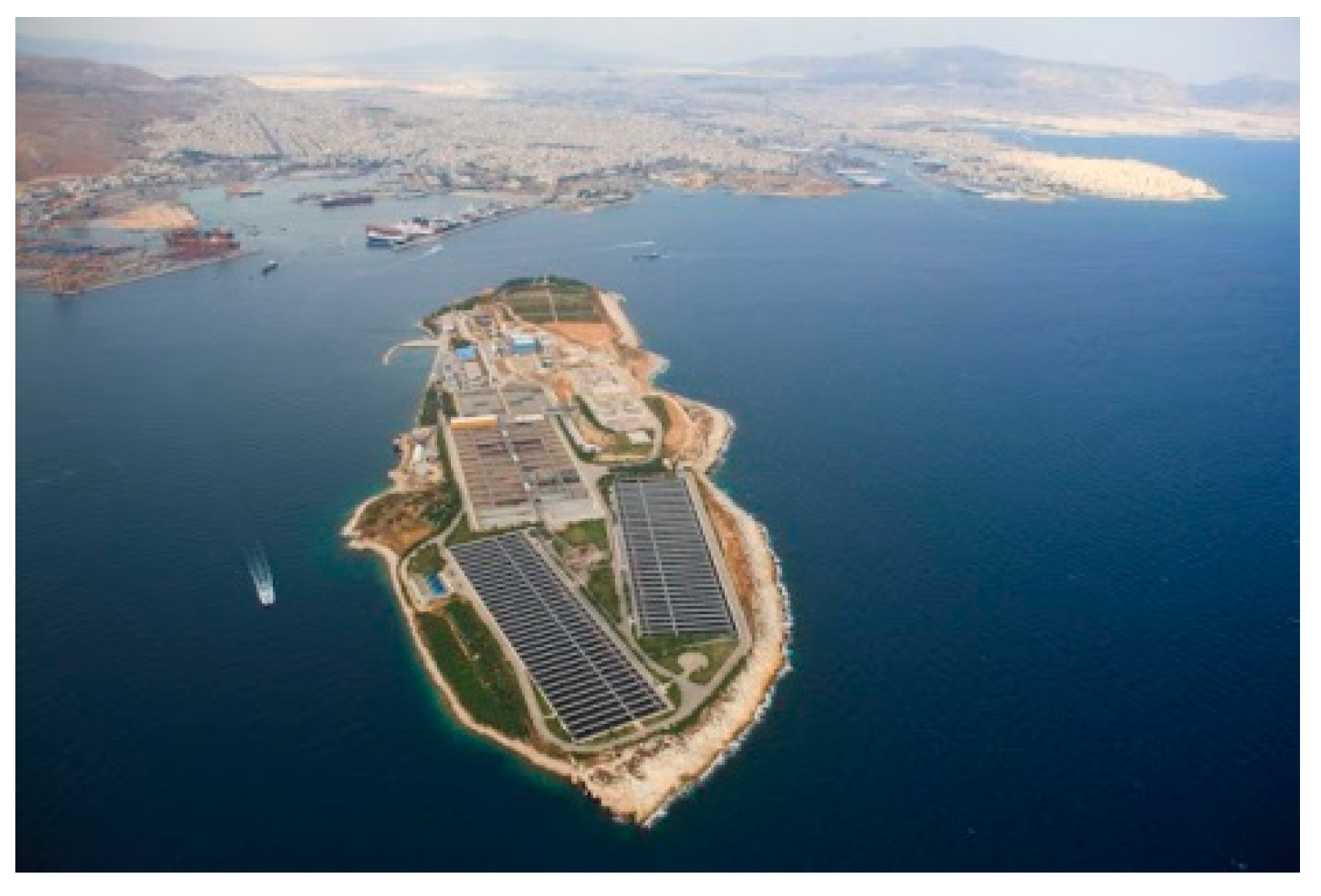
| 1994 | Psyttalia | 5,600,000 | The largest WWTP in Greece and among the largest in Europe [13] |
| 2003 | Psyttalia | 5,600,000 | Operation of the first large-scale biogas unit in WWTP [14] |
| 2007 | Psyttalia | 5,600,000 | The first WWTP operating sludge thermal drying treatment. (Evaporation capacity 34.4 tn/h) [14] |
| 2014 | DEYA Heraklion Crete (Finikia) | 200,000 | The first WWTP applying ΜBR process [19] |
© 2020 by the authors. Licensee MDPI, Basel, Switzerland. This article is an open access article distributed under the terms and conditions of the Creative Commons Attribution (CC BY) license (http://creativecommons.org/licenses/by/4.0/).
Share and Cite
Prochaska, C.; Zouboulis, A. A Mini-Review of Urban Wastewater Treatment in Greece: History, Development and Future Challenges. Sustainability 2020, 12, 6133. https://doi.org/10.3390/su12156133
Prochaska C, Zouboulis A. A Mini-Review of Urban Wastewater Treatment in Greece: History, Development and Future Challenges. Sustainability. 2020; 12(15):6133. https://doi.org/10.3390/su12156133
Chicago/Turabian StyleProchaska, Charikleia, and Anastasios Zouboulis. 2020. "A Mini-Review of Urban Wastewater Treatment in Greece: History, Development and Future Challenges" Sustainability 12, no. 15: 6133. https://doi.org/10.3390/su12156133
APA StyleProchaska, C., & Zouboulis, A. (2020). A Mini-Review of Urban Wastewater Treatment in Greece: History, Development and Future Challenges. Sustainability, 12(15), 6133. https://doi.org/10.3390/su12156133

