Assessing the Effects of Biochar on the Immobilization of Trace Elements and Plant Development in a Naturally Contaminated Soil



Abstract
1. Introduction
2. Materials and Methods
2.1. Biochar Samples
2.2. Soil Samples
2.3. Physical and Chemical Characteristics
Fourier Transform-Infrared Spectroscopy (FT-IR)
2.4. Cu2+ and Pb2+ Adsorption Tests
2.5. Development of Brassica rapa Pekinensis: A Pot Experiment with Trace Element Contaminated Soils
2.5.1. Soil Analysis
2.5.2. Plant Germination and Development
2.6. Data Analysis
3. Results and Discussion
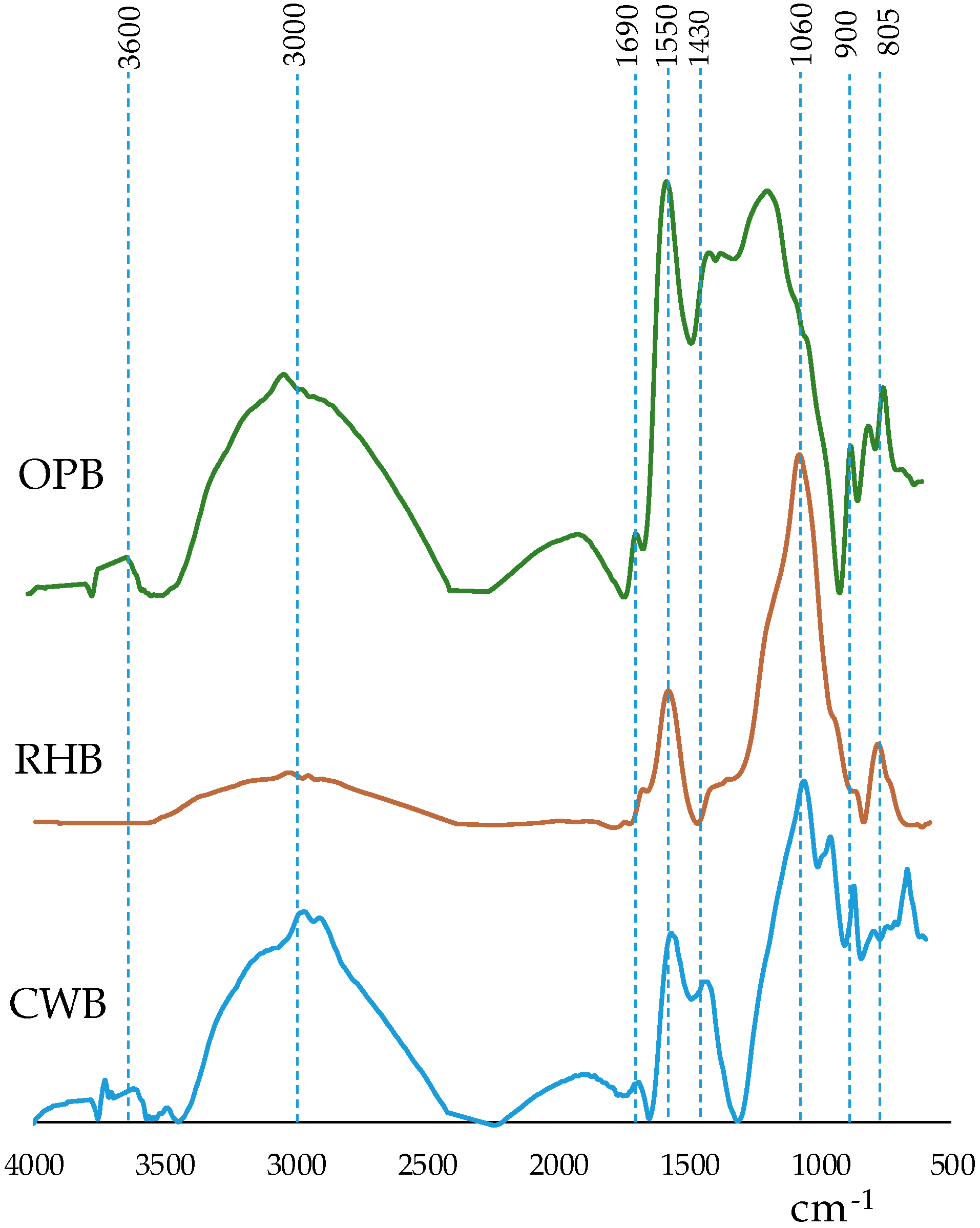
3.1. Biochar Properties
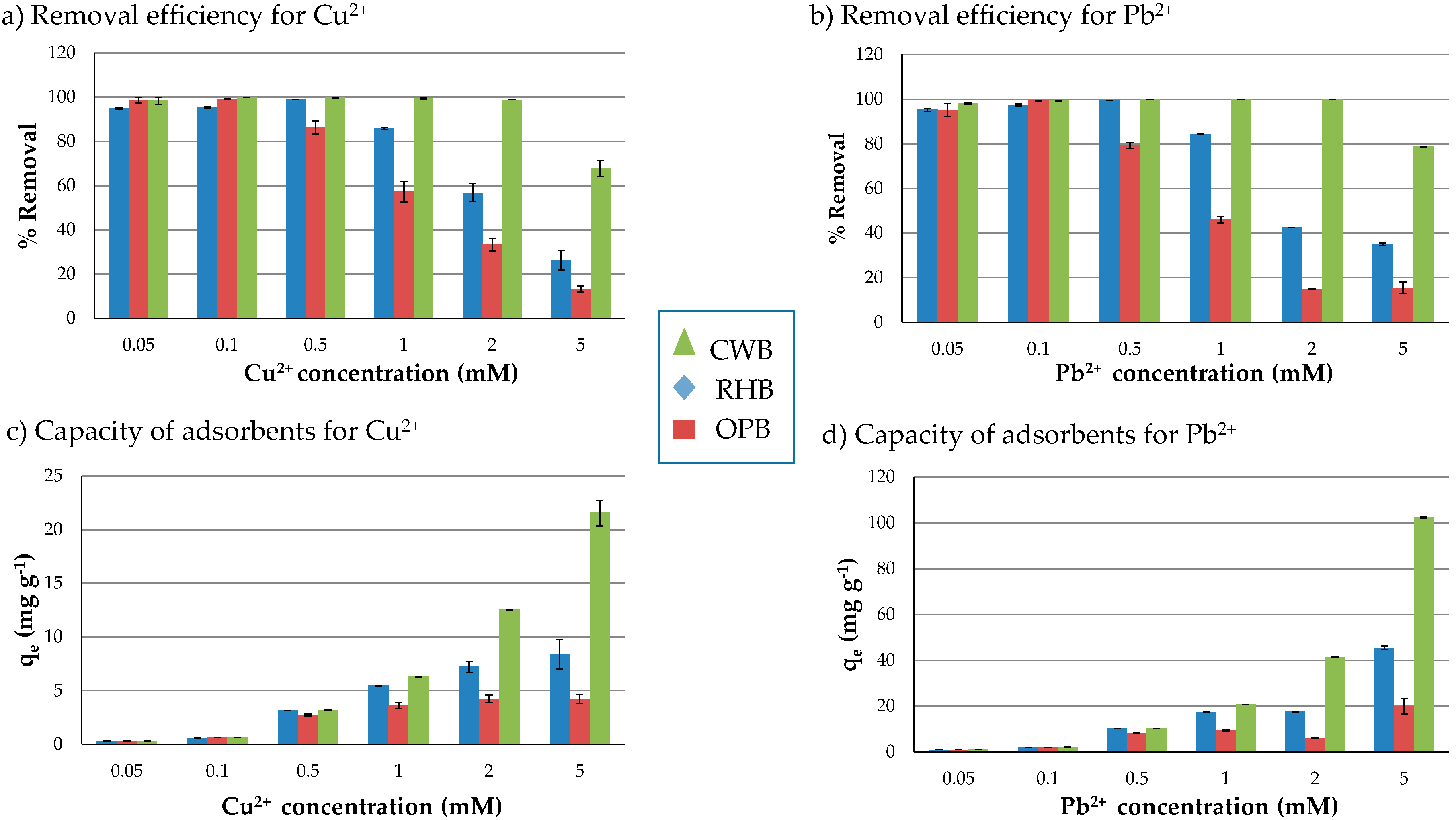
3.2. Cu2+ and Pb2+ Adsorption Capacity of Biochars
Isotherm Models in Adsorption Tests
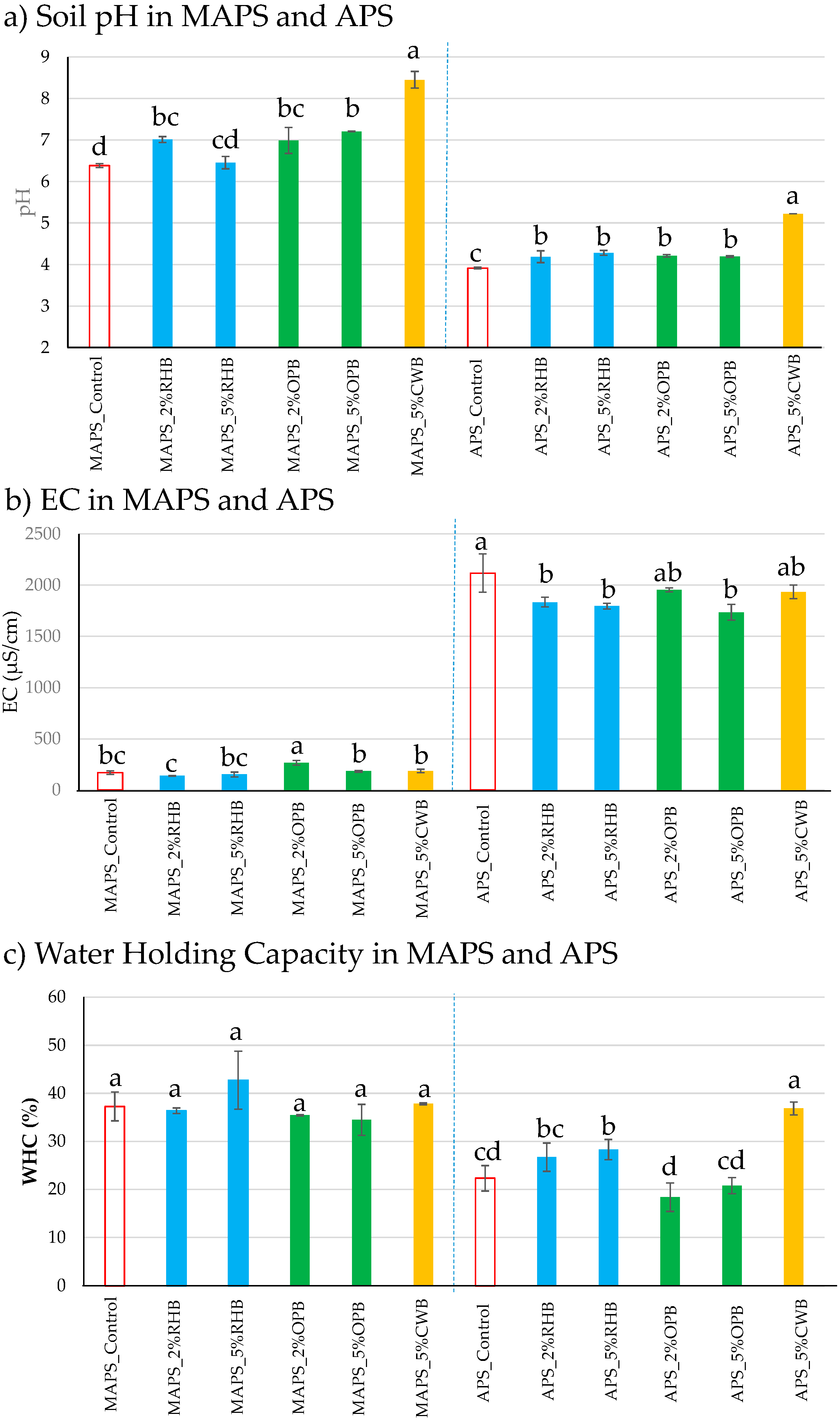
3.3. Effects of Biochar Amendments on Soil Properties
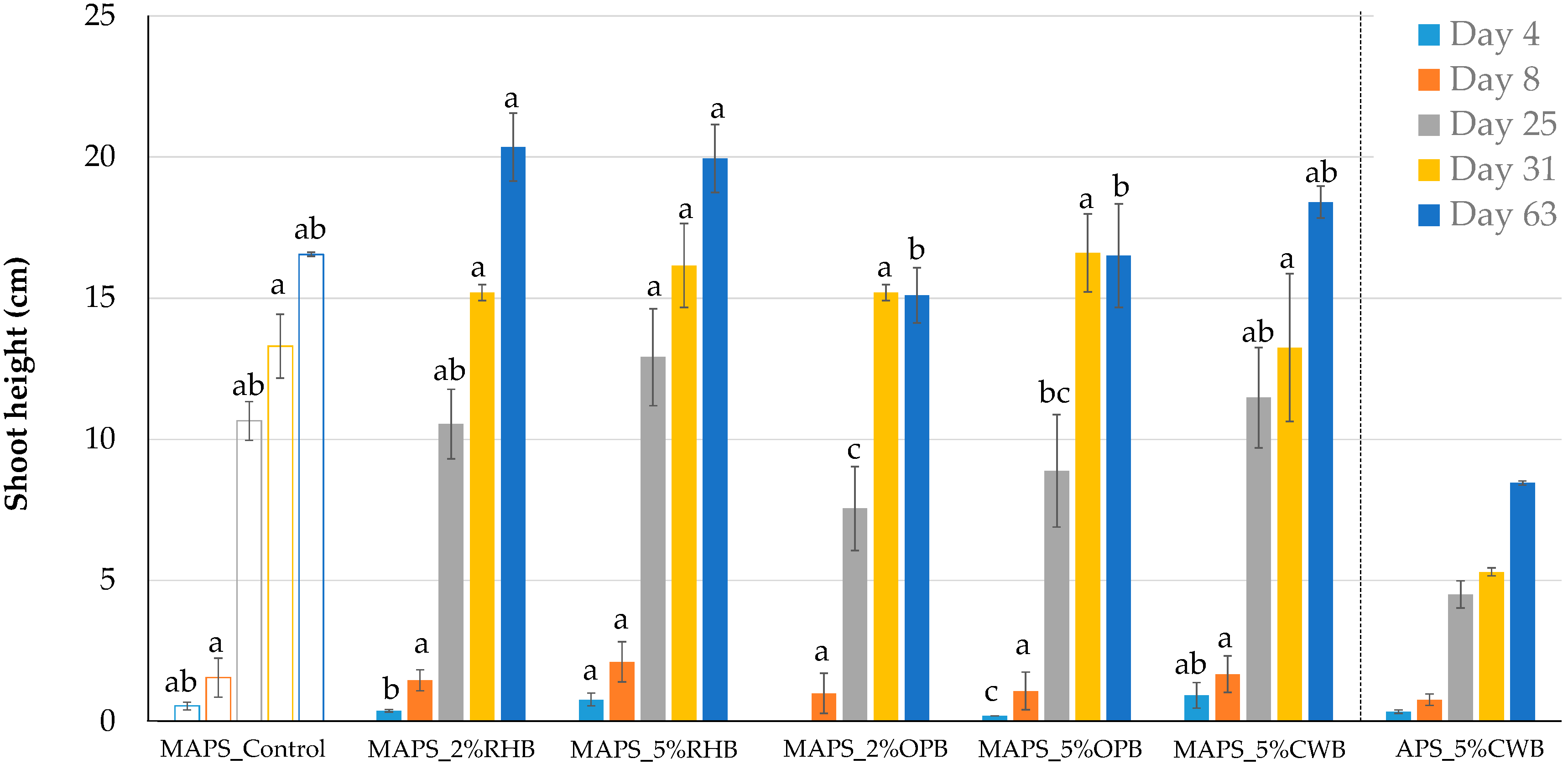
3.4. Effect of Biochar Amendments on Plant Germination and Growth
4. Conclusions
Author Contributions
Funding
Acknowledgments
Conflicts of Interest
References
- Suman Raj, D.S.; Aparna, C.; Rekha, P.; Bindhu, V.H.; Anjaneyulu, Y. Stabilization and solidification technologies for the remediation of contaminated soils and sediments: An overview. Land Contam. Reclamat. 2005, 13, 23–48. [Google Scholar] [CrossRef]
- Madejón, P.; Domínguez, M.T.; Gil-Martínez, M.; Navarro-Fernández, C.M.; Montiel-Rozas, M.M.; Madejón, E.; Murillo, J.M.; Cabrera, F.; Marañón, T. Evaluation of amendment addition and tree planting as measures to remediate contaminated soils: The Guadiamar case study (SW Spain). Catena 2018, 166, 34–43. [Google Scholar] [CrossRef]
- De la Rosa, J.M.; Paneque, M.; Miller, A.Z.; Knicker, H. Relating physical and chemical properties of four different biochars and their application rate to biomass production of Lolium perenne on a Calcic Cambisol during a pot experiment of 79 days. Sci. Total Environ. 2014, 499, 175–184. [Google Scholar] [CrossRef]
- Paneque, M.; De la Rosa, J.M.; Franco-Navarro, J.D.; Colmenero-Flores, J.M.; Knicker, H. Effect of biochar amendment on morphology, productivity and water relations of sunflower plants under non-irrigation conditions. Catena 2016, 147, 280–287. [Google Scholar] [CrossRef]
- Amin, M.T.; Alazba, A.A.; Shafiq, M. Removal of Copper and Lead using Banana Biochar in Batch Adsorption Systems: Isotherms and Kinetic Studies. Chem. Eng. J. Arab. J. Sci. Eng. 2018, 43, 5711–5722. [Google Scholar] [CrossRef]
- Zhao, J.J.; Shen, X.-J.; Domene, X.; Alcañiz, J.-M.; Liao, X.; Palet, C. Comparison of biochars derived from different types of feedstock and their potential for heavy metal removal in multiple-metal solutions. Sci. Rep. 2019, 9, 9869. [Google Scholar] [CrossRef]
- Campos, P.; Miller, A.Z.; Knicker, H.; Costa-Pereira, M.F.; Merino, A.; De la Rosa, J.M. Chemical, physical and morphological properties of biochars produced from agricultural residues: Implications for their use as soil amendment. J. Waste Manag. 2020, 105, 256–267. [Google Scholar] [CrossRef]
- Boehm, H.P. Surface oxides on carbon and their analysis: A critical assessment. Carbon 2002, 40, 145–149. [Google Scholar] [CrossRef]
- Liu, Z.G.; Zhang, F.S. Removal of lead from water using biochars prepared from hydrothermal liquefaction of biomass. J. Hazard. Mater. 2009, 167, 933–939. [Google Scholar] [CrossRef]
- Chen, X.; Chen, G.; Chen, L.; Chen, Y.; Lehmann, J.; McBride, M.B.; Hay, A.G. Adsorption of copper and zinc by biochars produced from pyrolysis of hardwood and corn straw in aqueous solution. Bioresour. Technol. 2011, 102, 8877–88884. [Google Scholar] [CrossRef]
- Agegnehu, G.; Bird, M.I.; Nelson, P.N.; Bass, A.M. The ameliorating effects of biochar and compost on soil quality and plant growth on a Ferralsol. Soil Res. 2015, 53, 1–12. [Google Scholar] [CrossRef]
- Atkinson, C.J.; Fitzgerald, J.D.; Hipps, N.A. Potential mechanisms for achieving agricultural benefits from biochar application to temperate soils: A review. Plant Soil 2010, 337, 1–18. [Google Scholar] [CrossRef]
- Wood, J.L.; Liu, W.; Tang, C.; Franks, A.E. Microorganisms in heavy metal bioremediation: Strategies for applying microbial-community engineering to remediate soils. AIMS Bioeng. 2016, 3, 211–229. [Google Scholar] [CrossRef]
- Jiang, J.; Xu, R.-K.; Jiang, T.-Y.; Li, Z. Immobilization of Cu(II), Pb(II) and Cd(II) by the addition of rice straw derived biochar to a simulated polluted Ultisol. J. Hazard. Mater. 2012, 229, 145–150. [Google Scholar] [CrossRef] [PubMed]
- Antonangelo, J.A.; Zhang, H. Heavy metal phytoavailability in a contaminated soil of northeastern Oklahoma as affected by biochar amendment. Environ. Sci. Pollut. Res. 2019, 26, 33582–33593. [Google Scholar] [CrossRef]
- FAOSTAT. Crops Production. 2014. Available online: http://www.fao.org/faostat/en/#data/QC (accessed on 15 June 2020).
- Dissanayake, D.K.R.P.L.; Dharmakeerthi, R.S.; Karunarathna, A.K.; Dandeniya, W.S. Changes in Structural and Chemical Properties of Rice Husk Biochar Co-pyrolysed with Eppawala Rock Phosphate. J. Sustain. Trop. Agric. Res. 2018, 30, 19–31. [Google Scholar] [CrossRef]
- Agencia Española de Meteorología, AEMET. 2020. Available online: https://datosclima.es/Aemet2013/Tempestad2013 (accessed on 30 June 2020).
- Soil Survey Staff. Keys to Soil Taxonomy, 12th ed.; USDA-Natural Resources Conservation Service: Washington, DC, USA, 2014. [Google Scholar]
- Veihmeyer, F.J.; Hendrickson, A.H. The moisture equivalent as a measure of the field capacity of soils. Soil Sci. 1931, 32, 181–193. [Google Scholar] [CrossRef]
- Rice, E.W.; Baird, R.B.; Eaton, A.D.; Clesceri, L.S. Standard Methods for the Examination of Water and Wastewater, 22nd ed.; American Public Health Association, American Water Works Association, Water Environment Federation: Washington, DC, USA; Denver, CO, USA; Alexandria, VA, USA, 2012. [Google Scholar]
- EBC. European Biochar Certificate-Guidelines for a Sustainable Production of Biochar; European Biochar Foundation (EBC): Arbaz, Switzerland, 2012; Available online: http://www.europeanbiochar.org/en/download (accessed on 19 April 2019).
- Woldetsadik, D.; Drechsel, P.; Keraita, B.; Marschner, B.; Itanna, F.; Gebrekidan, H. Effects of biochar and alkaline amendments on cadmium immobilization, selected nutrient and cadmium concentrations of lettuce (Lactuca sativa) in two contrasting soils. SpringerPlus 2016, 5, 397. [Google Scholar] [CrossRef]
- Hiscox, J.D.; Israelstam, G.F. A method for the extraction of chlorophyll from leaf tissue without maceration. Can. J. Bot. 1978, 57, 1332–1334. [Google Scholar] [CrossRef]
- Wellburn, A.R. The spectral determination of chlorophylls a and b, as well as total carotenoids, using various solvents with spectrophotometers of different resolution. J. Plant Physiol. 1994, 144, 307–313. [Google Scholar] [CrossRef]
- Varela Milla, O.; Rivera, E.B.; Huang, W.-J.; Chien, C.-C.; Wang, Y.-M. Agronomic properties and characterization of rice husk and wood biochars and their effect on the growth of water spinach in a field test. J. Soil Sci. Plant Nutr. 2013, 13, 251–266. [Google Scholar] [CrossRef]
- James, R.A.; Yuan, W.; Boyette, M.D.; Wang, D.; Kumar, A. Characterization of biochar from rice hulls and wood chips produced in a top-lit updraft biomass gasifier. Trans. ASABE 2016, 59, 749–756. [Google Scholar] [CrossRef]
- Pariyar, P.; Kumari, K.; Kumar Jain, M.; Jadhao, P.S. Evaluation of change in biochar properties derived from different feedstock and pyrolysis temperature for environmental and agricultural application. Sci. Total Environ. 2020, 713, 136433. [Google Scholar] [CrossRef] [PubMed]
- Jindo, K.; Mizumoto, H.; Sawada, Y.; Sanchez-Monedero, M.A.; Sonoki, T. Physical and chemical characterization of biochars derived from different agricultural residues. Biogeosciences 2014, 11, 6613–6621. [Google Scholar] [CrossRef]
- Yenisoy-Karakas, S.; Aygün, A.; Günes, M.; Tahtasakal, E. Physical and chemical characteristics of polymerbased spherical activated carbon and its ability to adsorb organics. Carbon 2004, 42, 477–484. [Google Scholar] [CrossRef]
- Hernandez-Maglinao, J.; Capareda, S.C. Improving the Surface Areas and Pore Volumes of Bio-char Produced from Pyrolysis of Cotton Gin Trash via Steam Activation Process. Int. J. Eng. Sci. 2019, 3, 15–18. [Google Scholar]
- Phuong, D.T.; Miyanishi, T.; Okayama, T.; Kose, R. Pore characteristics & adsorption capacities of biochars derived from rice residues as affected by variety and pyrolysis temperature. Am. J. Innov. Res. Appl. Sci. 2016, 2, 179–189. [Google Scholar]
- Singh, B.; Singh, B.P.; Cowie, A.L. Characterization and evaluation of biochars for their application as a soil amendment. Aust. J. Soil Res. 2010, 48, 516–525. [Google Scholar] [CrossRef]
- Uras, Ü.; Carrier, M.; Hardie, A.G.; Knoetze, J.H. Physico-chemical characterization of biochars from vacuum pyrolysis of South African agricultural wastes for application as soil amendments. J. Anal. Appl. Pyrol. 2012, 98, 207–213. [Google Scholar] [CrossRef]
- Li, M.; Liu, W.; Lou, Z.; Wang, Y.; Zhang, Y.; Qian, G. Method to Characterize Acid-Base Behavior of Biochar: Site Modeling and Theoretical Simulation. Sustain. Chem. Eng. 2014, 2, 2501–2509. [Google Scholar] [CrossRef]
- Chun, Y.; Sheng, G.Y.; Chiou, C.T.; Xing, B.S. Compositions and sorptive properties of crop residue-derived chars. Environ. Sci. Technol. 2004, 38, 4649–4655. [Google Scholar] [CrossRef] [PubMed]
- Francioso, O.; Sanchez-Cortez, S.; Roldán, M.E.; Certini, G. Structural characterization of charcoal size-fractions from a burnt Pinus pinea forest by FT-IR, Raman and surface-enhanced Raman spectroscopies. J. Mol. Struct. 2011, 994, 155–162. [Google Scholar] [CrossRef]
- Soltani, N.; Bahrami, A.; Pech-Canul, M.I.; González, L.A. Review on the physicochemical treatments of rice husk for production of advanced materials. Chem. Eng. J. 2015, 264, 899–935. [Google Scholar] [CrossRef]
- El-Ashtoukhy, E.-S.Z.; Amin, N.K.; Abdelwahab, O. Removal of lead (II) and copper (II) from aqueous solution using pomegranate peel as a new adsorbent. Desalination 2008, 223, 162–173. [Google Scholar] [CrossRef]
- Samsuri, A.W.; Sadegh-Zadeh, F.; She-Bardan, B.J. Characterization of biochars produced from oil palm and rice husks and their adsorption capacities for heavy metals. Int. J. Environ. Sci. Technol. 2014, 11, 967–976. [Google Scholar] [CrossRef]
- Inyang, M.I.; Gao, B.; Yao, Y.; Xue, Y.; Zimmerman, A.; Mosa, A.; Pullammanappallil, P.; Sik Ok, Y.; Cao, X. A review of biochar as a low-cost adsorbent for aqueous heavy metal removal. Crit. Rev. Environ. Sci. Technol. 2016, 46, 406–433. [Google Scholar] [CrossRef]
- Xu, X.; Cao, X.; Zhao, L. Comparison of rice husk- and dairy manure-derived biochars for simultaneously removing heavy metals from aqueous solutions: Role of mineral components in biochars. Chemosphere 2013, 92, 955–961. [Google Scholar] [CrossRef]
- Pellera, F.-M.; Giannis, A.; Kalderis, D.; Anastasiadou, K.; Stegmann, R.; Wang, J.-Y.; Gidarakos, E. Adsorption of Cu (II) ions from aqueous solutions on biochars prepared from agricultural by-products. J. Environ. Manag. 2012, 96, 35–42. [Google Scholar] [CrossRef]
- Thirumavalavan, M.; Lai, Y.L.; Lee, J.F. Fourier transform infrared spectroscopic analysis of fruit peels before and after the adsorption of heavy metals ions from aqueous solution. J. Chem. Eng. Data 2011, 56, 2249–2255. [Google Scholar] [CrossRef]
- Wu, Q.; Xian, Y.; He, Z.; Zhang, Q.; Wu, J.; Yang, G.; Zhang, X.; Qi, H.; Ma, J.; Xiao, Y.; et al. Adsorption characteristics of Pb(II) using biochar derived from spent mushroom substrate. Sci. Rep. 2019, 9, 15999. [Google Scholar] [CrossRef]
- Chintala, R.; Mollinedo, J.; Schumacher, T.E.; Malo, D.D.; Julson, J.L. Effect of biochar on chemical properties of acidic soil. Arch. Agron. Soil Sci. 2014, 60, 393–404. [Google Scholar] [CrossRef]
- Si, L.; Xie, Y.; Ma, Q.; Wu, L. The Short-Term Effects of Rice Straw Biochar, Nitrogen and Phosphorous Fertilizer on Rice Yield and Soil Properties in a Cold Waterlogged Paddy Field. Sustainability 2018, 10, 537. [Google Scholar] [CrossRef]
- Bista, P.; Ghimire, R.; Machado, S.; Pritchett, L. Biochar Effects on Soil Properties and Wheat Biomass vary with Fertility Management. Agronomy 2019, 9, 623. [Google Scholar] [CrossRef]
- Ondrasek, G.; Rengel, Z. The Role of Soil Organic Matter in Trace Element Bioavailability and Toxicity. In Abiotic Stress Responses in Plants; Ahmad, P., Prasad, M., Eds.; Springer: New York, NY, USA, 2011. [Google Scholar] [CrossRef]
- Alotaibi, K.D.; Schoenau, J.J. Addition of Biochar to a Sandy Desert Soil: Effect on Crop Growth, Water Retention and Selected Properties. Agronomy 2019, 9, 327. [Google Scholar] [CrossRef]
- Al-Wabel, M.I.; Usman, A.R.; Al-Farraj, A.S.; Ok, Y.S.; Abduljabbar, A.; Al-Faraj, A.I.; Sallam, A.S. Date palm waste biochars alter a soil respiration, microbial biomass carbon, and heavy metal mobility in contaminated mined soil. Environ. Geochem. Health 2017, 1–18. [Google Scholar] [CrossRef]
- Soil Survey Division Staff. Soil Survey Manual. Soil Conservation Service; Agriculture Handbook 18; U.S. Department of Agriculture: Washington, DC, USA, 1993.
- Yu, O.-Y.; Raichle, B.; Sink, S. Impact of biochar on the water holding capacity of loamy sand soil. Int. J. Energy Environ. Eng. 2013, 4, 44. [Google Scholar] [CrossRef]
- Abdul Halim, N.S.; Abdullah, R.; Karsani, S.A.; Osman, N.; Panhwar, Q.A.; Ishak, C.F. Influence of Soil Amendments on the Growth and Yield of Rice in Acidic Soil. Agronomy 2018, 8, 165. [Google Scholar] [CrossRef]
- Song, S.; Arora, S.; Laserna, A.K.C.; Shen, Y.; Thian, B.W.Y.; Chin Cheong, J.; Tan, J.K.T.; Chiam, Z.; Lee Fond, S.; Ghosh, S.; et al. Biochar for urban agriculture: Impacts on soil chemical characteristics and on Brassica rapa growth, nutrient content and metabolism over multiple growth cycles. Sci. Total Environ. 2020, 727, 138742. [Google Scholar] [CrossRef]
- Liopa-Tsakalidi, A.; Barouchas, P.E. Effects of biochar of pepperoncini (Capsicum annuum L cv. Stavros) germination and seedling growth in two soil types. Aust. J. Crop Sci. 2017, 11, 264–270. [Google Scholar] [CrossRef]
- Solaiman, Z.M.; Murphy, D.V.; Abbott, L.K. Biochars influence seed germination and early growth of seedlings. Plant Soil 2012, 353, 273–287. [Google Scholar] [CrossRef]
- Paneque, M.; Knicker, H.; Kern, J.; De la Rosa, J.M. Hydrothermal Carbonization and Pyrolysis of Sewage Sludge: Effects on Lolium perenne Germination and Growth. Agronomy 2019, 9, 363. [Google Scholar] [CrossRef]
- Hashmi, S.; Younis, U.; Danish, S.; Muhammad Munir, T. Pongamia pinnata L. Leaves Biochar Increased Growth and Pigments Syntheses in Pisum sativum L. Exposed to Nutritional Stress. Agriculture 2019, 9, 153. [Google Scholar] [CrossRef]
- Danish, S.; Ahmad Tahir, F.; Khalid Rasheed, M.; Ahmad, N.; Arif Ali, M.; Kiran, S.; Younis, U.; Irshad, I.; But, B. Effect of foliar application of Fe and banana peel waste biochar on growth, chloyophyll content and accessory pigments synthesis in spinach under chromium (IV) toxicity. Open Agric. 2019, 4. [Google Scholar] [CrossRef]
- Chrysargyris, A.; Prasad, M.; Kavanagh, A.; Tzortzakis, N. Biochar Type and Ratio as a Peat Additive/Partial Peat Replacement in Growing Media for Cabbage Seedling Production. Agronomy 2019, 9, 693. [Google Scholar] [CrossRef]
- Swagathnath, G.; Rangabhashiyam, S.; Murugan, S.; Balasubramanian, P. Influence of biochar application on growth of Oryza sativa and its associated soil microbial ecology. Biomass Convers. Bioref. 2019, 9, 341–352. [Google Scholar] [CrossRef]



| Total Content of Trace Elements (mg kg−1) | |||||||||||||||
|---|---|---|---|---|---|---|---|---|---|---|---|---|---|---|---|
| pH | WHC (%) | Ash (%) | C (g kg−1) | N (g kg−1) | C/N | Na | Ba | Cd | Cu | Fe | Ni | Pb | Sr | Zn | |
| MAPS | 6.5 ± 0.1 | 51.5 ± 1.2 | 94.9 ± 0.9 | 17 ± 1 | 2.0 ± 0.7 | 8 | 301.7 | 93.3 | 1.56 | 215.5 | 36945.7 | 15.6 | 156.5 | 38.6 | 293.5 |
| APS | 3.6 ± 0.1 | 32.7 ± 2.4 | 94.7 ± 0.7 | 8 ± 0 | 0.9 ± 0.4 | 8 | 698.0 | 47.1 | 1.28 | 240.6 | 53023.3 | 15.6 | 569.0 | 53.7 | 249.3 |
| Treatment/Code | Soil | Biochar Dose | Feedstock | Pyrolysis Conditions |
|---|---|---|---|---|
| MAPS_Control | Moderately acid polluted soil | - | ||
| MAPS_2%RHB | Moderately acid polluted soil | 2% | Rice husk | 500 °C, 12 min |
| MAPS_5%RHB | Moderately acid polluted soil | 5% | Rice husk | 500 °C, 12 min |
| MAPS_2%OPB | Moderately acid polluted soil | 2% | Olive pit | 500 °C, 12 min |
| MAPS_5%OPB | Moderately acid polluted soil | 5% | Olive pit | 500 °C, 12 min |
| MAPS_5%CWB | Moderately acid polluted soil | 5% | Wood chips | 620 °C, 20 min |
| APS_Control | Acid polluted soil | - | ||
| APS_2%RHB | Acid polluted soil | 2% | Rice husk | 500 °C, 12 min |
| APS_5%RHB | Acid polluted soil | 5% | Rice husk | 500 °C, 12 min |
| APS_2%OPB | Acid polluted soil | 2% | Olive pit | 500 °C, 12 min |
| APS_5%OPB | Acid polluted soil | 5% | Olive pit | 500 °C, 12 min |
| APS_5%CWB | Acid polluted soil | 5% | Wood chips | 620 °C, 20 min |
| TC (%) | TH (%) | TN (%) | O (%) | H/Cat | O/Cat | C/N | Ash Content (%) | pH | WHC (%) | SSA-BET (CO2, m2 g−1) | Iodine Index (mg g−1) | Total Basicity (meq g−1) | Total Acidity (meq g−1) | |
|---|---|---|---|---|---|---|---|---|---|---|---|---|---|---|
| CWB | 75.7 ± 0.3 | 1.80 ± 0.02 | 0.30 ± 0.06 | 18.7 ± 0.23 | 0.3 | 0.19 | 252 | 3.5 ± 0.7 | 9.95 ± 0.18 | 243 ± 39 | 403 | 149 | 0.95 ± 0.06 | 1.69 ± 0.15 |
| RHB | 53.7 ± 0.1 | 1.61 ± 0.02 | 0.51 ± 0.24 | 9.48 ± 0.22 | 0.4 | 0.13 | 106 | 34.7 ± 0.5 | 10.10 ± 0.01 | 595 ± 22 | 292 | 180 | 0.51 ± 0.01 | 1.70 ± 0.12 |
| OPB | 92.7 ± 0.2 | 2.52 ± 0.06 | 0.16 ± 0.09 | 3.58 ± 0.44 | 0.3 | 0.03 | 585 | 1.0 ± 0.3 | 9.34 ± 0.09 | 70 ± 13 | 473 | 123 | 0.05 ± 0.03 | 0.17 ± 0.01 |
| Isotherm Model | Parameter | Units | Cu2+ | Pb2+ | ||||
|---|---|---|---|---|---|---|---|---|
| RHB | OPB | CWB | RHB | OPB | CWB | |||
| Linear Freundlich | Kf | (mg g−1) (L mg−1)1/n | 1.47 | 1.17 | 4.83 | 3.57 | 2.29 | 13.36 |
| n | 2.58 | 3.44 | 2.24 | 2.77 | 3.67 | 2.63 | ||
| R2 | 0.7277 | 0.9138 | 0.7257 | 0.7095 | 0.7966 | 0.416 | ||
| Linear Langmuir | Q0 | mg g−1 | 30.77 | 17.79 | 58.82 | 19.34 | 19.12 | 77.52 |
| b | L mg−1 | 0.10 | 0.15 | 0.22 | 0.14 | 0.01 | 0.23 | |
| R2 | 0.9993 | 0.9970 | 0.9991 | 0.9994 | 0.6781 | 0.9975 | ||
| Temkin | B | 1.07 | 0.51 | 2.54 | 2.16 | 1.55 | 12.18 | |
| b | J mol−1 | 2305.75 | 4834.79 | 975.11 | 1149.03 | 1598.80 | 203.33 | |
| A | L g−1 | 14.01 | 46.70 | 46.81 | 19.23 | 7.67 | 18.46 | |
| R2 | 0.9405 | 0.9989 | 0.963 | 0.8003 | 0.6674 | 0.7906 | ||
| Dubinin–Radushkevich (DRK) | Qm | mg g−1 | 0.01 | 0.00 | 0.01 | 0.03 | 0.01 | 0.10 |
| b | mol2 kJ−2 | −0.132700 | −0.039100 | −0.030700 | −0.0000003 | −0.0000001 | −0.0000001 | |
| E | J mol−1 | 1.94 | 3.58 | 4.04 | 1290.99 | 2672.61 | 2236.07 | |
| R2 | 0.8909 | 0.9735 | 0.6753 | 0.7256 | 0.4165 | 0.4997 | ||
| Germination and Plant Survival (%) | Chl a (mg g−1 FW) | Chl b (mg g−1 FW) | Total chl (mg g−1 FW) | ||||||||
|---|---|---|---|---|---|---|---|---|---|---|---|
| Day 4 | Day 8 | Day 19 | Day 25 | Day 31 | Day 31 | Day 63 | Day 31 | Day 63 | Day 31 | Day 63 | |
| MAPS_Control | 67 ± 33 ab | 100 ± 0 a | 100 ± 0 a | 89 ± 19 a | 89 ± 19 a | 0.30 ± 0.10 a | 0.16 ± 0.03 a | 0.16 ± 0.05 a | 0.12 ± 0.04 a | 0.46 ± 0.14 a | 0.29 ± 0.07 a |
| MAPS_2%RHB | 42 ± 14 b | 83 ± 14 ab | 83 ± 14 ab | 83 ± 14 ab | 83 ± 14 ab | 0.28 ± 0.04 ab | 0.17 ± 0.02 a | 0.13 ± 0.02 ab | 0.15 ± 0.01 a | 0.32 ± 0.05 ab | 0.32 ± 0.04 a |
| MAPS_5%RHB | 100 ± 0 a | 100 ± 0 a | 100 ± 0 a | 100 ± 0 a | 100 ± 0 a | 0.21 ± 0.03 ab | 0.17 ± 0.07 a | 0.11 ± 0.01 ab | 0.16 ± 0.05 a | 0.28 ± 0.09 ab | 0.32 ± 0.12 a |
| MAPS_2%OPB | 0 ± 0 c | 17 ± 29 c | 17 ± 29 c | 17 ± 29 c | 17 ± 29 c | n.d. | 0.17 ± 0.04 a | n.d. | 0.18 ± 0.04 a | n.d. | 0.35 ± 0.08 a |
| MAPS_5%OPB | 17 ± 29 bc | 50 ± 25 bc | 42 ± 14 bc | 42 ± 14 bc | 42 ± 14 bc | 0.26 ± 0.04 ab | 0.17 ± 0.04 a | 0.13 ± 0.01 ab | 0.18 ± 0.03 a | 0.39 ± 0.04 a | 0.35 ± 0.07 a |
| MAPS_5%CWB | 89 ± 19 a | 100 ± 0 a | 100 ± 0 a | 100 ± 0 a | 100 ± 0 a | 0.11 ± 0.01 b | 0.19 ± 0.04 a | 0.06 ± 0.01 b | 0.18 ± 0.04 a | 0.17 ± 0.00 b | 0.37 ± 0.09 a |
| APS_5%CWB | 44 ± 19 | 78 ± 19 | 78 ± 19 | 78 ± 19 | 78 ± 19 | 0.19 ± 0.01 | 0.11 ± 0.01 | 0.11 ± 0.01 | 0.12 ± 0.02 | 0.30 ± 0.01 | 0.23 ± 0.03 |
| Dry Weight Biomass (g) | Dry Weight Roots (g) | Root-to-Shoot Ratio | ||||
|---|---|---|---|---|---|---|
| Day 31 | Day 63 | Day 31 | Day 63 | Day 31 | Day 63 | |
| MAPS_Control | 0.17 | 0.22 ± 0.01 ab | 0.004 | 0.057 ± 0.042 | 0.02 | 0.26 |
| MAPS_2%RHB | 0.20 | 0.24 ± 0.02 ab | 0.075 | 0.036 ± 0.018 | 0.37 | 0.15 |
| MAPS_5%RHB | 0.45 | 0.36 ± 0.03 a | 0.068 | 0.157 ± 0.045 | 1.53 | 0.44 |
| MAPS_2%OPB | n.d. | 0.10 ± 0.02 b | n.d. | 0.007 ± 0.029 | n.d. | 0.07 |
| MAPS_5%OPB | 0.06 | 0.13 ± 0.03 b | 0.033 | 0.033 ± 0.018 | 0.53 | 0.26 |
| MAPS_5%CWB | 0.26 | 0.32 ± 0.02 a | 0.051 | 0.140 ± 0.024 | 0.20 | 0.44 |
| APS_5%CWB | n.d. | 0.03 ± 0.01 | 0.001 | 0.010 ± 0.001 | n.d. | 0.35 |
© 2020 by the authors. Licensee MDPI, Basel, Switzerland. This article is an open access article distributed under the terms and conditions of the Creative Commons Attribution (CC BY) license (http://creativecommons.org/licenses/by/4.0/).
Share and Cite
Campos, P.; De la Rosa, J.M. Assessing the Effects of Biochar on the Immobilization of Trace Elements and Plant Development in a Naturally Contaminated Soil. Sustainability 2020, 12, 6025. https://doi.org/10.3390/su12156025
Campos P, De la Rosa JM. Assessing the Effects of Biochar on the Immobilization of Trace Elements and Plant Development in a Naturally Contaminated Soil. Sustainability. 2020; 12(15):6025. https://doi.org/10.3390/su12156025
Chicago/Turabian StyleCampos, Paloma, and José María De la Rosa. 2020. "Assessing the Effects of Biochar on the Immobilization of Trace Elements and Plant Development in a Naturally Contaminated Soil" Sustainability 12, no. 15: 6025. https://doi.org/10.3390/su12156025
APA StyleCampos, P., & De la Rosa, J. M. (2020). Assessing the Effects of Biochar on the Immobilization of Trace Elements and Plant Development in a Naturally Contaminated Soil. Sustainability, 12(15), 6025. https://doi.org/10.3390/su12156025