1. Introduction
The global food system requires enormous inputs of natural resources. In the United States, the food system accounts for 20% of energy use, 50% of freshwater consumption, and as much as 13% of greenhouse gas emissions [
1]. Despite the high levels of embodied water and energy, an alarming fraction of food is wasted, with 30–40% of food produced never consumed by humans [
1]. Because of the severe system inefficiencies, food waste has been recognized as a significant problem demanding urgent action, and many regions now restrict food waste treatment in landfills and publicly owned treatment works (POTW). However, to enable food waste generators to comply with increasingly strict waste management regulations, alternatives that are more environmentally, economically, and socially sustainable need to be developed and deployed at scale.
Much of the recent food waste valorization research has focused on systems that produce secondary food products, fertilizers, chemicals or fuels [
2,
3,
4]. These systems in principle can extract greater value from food waste material than the incumbent technologies, but only a few have moved beyond lab-scale validation. Their economic potential is based upon operation of large, centralized facilities that may present other sustainability challenges, such as the greenhouse gas emissions associated with truck transport. Much less effort has been applied to developing food waste management options that offer economic viability at the scale of a single commercial food waste generator.
Some prior research has investigated the potential of dehydration as a means of upcycling food waste, mainly in the context of animal feed production [
5,
6]. Hall [
7] conducted a comprehensive analysis of food waste conversion in a centralized animal feed production plant and reported that net greenhouse gas emissions can be significantly reduced by displacing conventional animal feed, even when the incoming feedstock requires a large energy input for drying. Sotiropoulos and co-workers [
8,
9,
10,
11] investigated food waste dehydration at the residential scale in Greece and reported an average mass reduction of approximately 70% with the associated energy cost being lower than for conventional food waste treatment. The low water content of the post-dehydration material was also found to slow decomposition and minimize odors, thus enabling less frequent waste collection [
8]. Moreover, it was determined that the physical and chemical properties of the dried food material give it potential as a feedstock for value-added products like compost and biofuels (biomethane and bioethanol). Karthikeyan et al. [
12] documented how dehydration and other pretreatment methods can enhance the performance of anaerobic digestion and dark fermentation processes. By suppressing premature decomposition, the carbon content of the base substrate was preserved while minimizing the presence of unwanted microorganisms and contributing to higher methane and hydrogen yields. Despite the clear advantages of both dehydration and mechanical pretreatment (i.e., grinding to reduce particle size and increase surface area), Karthikeyan et al. [
12] have also acknowledged that most published literature is based on laboratory-scale experiments, and more data are needed at pilot scale in combination with comprehensive energy and economic assessments.
There may be value in dehydration at the source of food waste generation to reduce mass and transport costs for downstream upcycling processes such as animal feed production, composting, or anaerobic digestion. Moreover, enhanced economic and social sustainability benefits may be created by enabling the food waste generator to extract additional value from materials that are part of their own operation. For example, Sotiropoulos et al. [
13] have demonstrated the potential of distributed management of residential food waste resources through the combination of dehydration and simultaneous saccharification and fermentation (SSF). Balaskonis et al. [
11] conducted an economic analysis of household-scale food waste dehydration deployed throughout a major Greek municipality, and determined that savings in the order of 6 million euros could be achieved relative to the conventional landfilling system.
In this paper, we have extended the prior research on food waste dehydration by assessing waste streams obtained at different stages of the food supply chain, including two food manufacturers, a retail grocery store, and four food service operations (cafeteria, food bank, restaurant and hospital). Moreover, the characteristics of these diverse food waste resources were quantified to understand their potential for valorization after dehydration in a variety of end-use applications: fertilizer, compost, biochar, fish feed, cattle feed and pelletized fuel. For each food waste material tested, our objective was to assess a wide variety of potential valorization pathways as opposed to acquiring extensive data relevant to a single pathway. Therefore, the quantitative analysis presented below was not based on large sample populations, but rather was intended to identify opportunities for potential economic value of dehydrated food waste, and thereby encourage future research and development efforts. The novelty of our research stems from the wide variety of food waste resources dehydrated and multiple potential end-uses considered for each, based on evaluation of the results of an extensive 37-parameter characterization test suite described below and in the
Supplementary Materials file.
3. Results and Discussion
3.1. End Use Application Assessment
Based primarily on literature research, we investigated several potential end markets for the dehydrated food waste, including use directly as fertilizer replacement, feedstock for composting, direct or supplemental animal feed, pelletized fuel, and input for pyrolysis to produce biochar.
Table S5 provides the descriptions of the input and output materials from each of the original five sources.
This section discusses the results in the context of potential end uses of the dehydrated food waste products.
Table 2,
Table 3,
Table 4,
Table 5,
Table 6 and
Table 7 are each specific to one end-use application. The key parameters for that application are listed in the left-most column, and test results for each of the dehydrated samples run are listed in their corresponding columns. Values are bolded if they fall within the optimal range of values for that parameter in the given application, and each is discussed in more detail in the narrative of its respective section. Analytical methods applied for the 37 parameters measured in this study are described in
Table S6.
3.2. Fertilizer
The first end use investigated was using the dehydrated food waste directly as a fertilizer substitute. Fertilizers, unlike soil amendments, are used purely for their nutrient content, which includes both macro- and micronutrients. There are six macronutrients that plants require, and three of these (carbon, hydrogen, and oxygen) are provided by air and water. The remaining three (nitrogen, phosphorous, and potassium) are provided by soil, and are therefore key parameters labelled on commercially available fertilizers [
15]. Calcium, magnesium, and sulfur are also required for plant growth, though they are needed in much smaller amounts [
15]. In addition to the nutrient requirements of soil, pH and moisture content are two key chemical and physical characteristics of soil that are also important for healthy plant growth. Macronutrients are denoted in fertilizer products by displaying the percentage of the nutrient by weight in the fertilizer. For example, a fertilizer with an NPK of 10-5-10 has 10% N, 5% P, and 10% K content by weight. However, nutrient requirements for crops are typically displayed in units of mass, which indicates the physical amount of a nutrient that a plant will take up during its growth period. Therefore, the amount of fertilizer to be added to a crop depends on the total mass of the nutrient needed, the concentration of that nutrient in the fertilizer, and the amount of that nutrient already present in the soil.
Though the types of macronutrients required are fairly consistent across plant types, the target level of each of these parameters can change depending on the type of crop being grown. For example, growing rice would require a fertilizer highest in K in comparison to a fertilizer used to grow soybeans, which would require higher N content. It is apparent that the desired NPK ratio of a given fertilizer depends heavily on the target end application. For more general use, on a household or recreational gardening level, an “all purpose” fertilizer is often used, which commonly has a 5-5-5 NPK ratio. The relevant results from the dehydrated food waste testing are compared to an all-purpose fertilizer, as summarized in
Table 2. None of the dehydrated output materials showed optimal NPK levels to be used directly as a fertilizer. Of the NPK values, nitrogen showed the highest value, while phosphorus and potassium levels were consistently well below the optimal values.
Because the Ecovim-66 dehydration system output nutrient levels were lower than what is typically required for a fertilizer, more material could be added to supply the necessary mass of nutrient required. Though theoretically possible, this is not ideal, because a plant needs the nutrients concentrated within an area where they can be reached. If the concentrations are too low, the area the plant would need to cover to absorb those nutrients becomes too large, leading to malnourishment. Thus, the nutrient levels measured in the dehydrated food waste streams indicated that they would not be suitable for use directly as a fertilizer.
In addition to nutrient levels, pH was considered, because it is directly related to plant health and the ability for microbial activity to thrive in soils. The majority of plants grow best in soils that are slightly acidic to neutral, with pH values between 5.5 and 7 (see
Table S7). Comparing the ideal soil pH to the measured pH for the dehydrated food output, it was found that most of the dehydrated foods had pH values below the optimal range, indicating that they are too acidic for most plant growth. However, the tofu processing waste did show a pH value within the optimal range. It should be noted that certain plants, such as blueberries, require more acidic soils than average and will do well in a pH range of 4.5–5.5 [
16], which is where most of the dehydrated food waste pH values fell.
3.3. Feedstock for Composting
Composting of dehydrated food waste material was also investigated as a follow-on process to dehydration. Key parameters for successful composting include carbon, nitrogen, moisture content, and pH levels (
Table 3). The microbes that perform the composting process of breaking down the organic material require a ratio of approximately 25–30 parts carbon to one part nitrogen, or a C:N ratio of 25–30:1 [
17]. When this C:N ratio is achieved, the microbes are most efficient in breaking down the organic material. If the C:N ratio is too high, the composting process can slow down significantly. If it is too low, the microbes are not able to use all the nitrogen and it is emitted to the atmosphere in the form of ammonia, causing an unpleasant smell. The optimum moisture content is also determined by the microbes that break the material down, which require a moisture content between 40–65% [
18]. Too high a moisture content may cause the compost to convert to an anaerobic reaction, producing an unpleasant smell, whereas moisture content that is too low will limit the microbial activity and slow the process down.
Based on these results, dehydrated food waste is not an ideal input for composting on its own. However, it could be composted if mixed with other organics. In fact, most compost feedstocks are not exact matches for composting alone, but instead need to be combined with materials to obtain the correct balance of carbon, nitrogen, and moisture content. For example, yard waste, which is high in carbon content and low in moisture content, can be combined with raw food waste, which is high in nitrogen and moisture content to produce a successful compost.
3.4. Pyrolysis (Biochar Production)
The dehydrated food waste material was also analyzed for its potential use as a pyrolysis feedstock to produce biochar. Pyrolysis is a thermochemical process that essentially heats biomass material (in this case food waste) to a high temperature in the absence of oxygen [
19]. Biochar is one of the main products of pyrolysis, with syngas and bio-oil being others. It is very similar to charcoal and typically used as a soil amendment. Depending on the feedstock and intended end use, the pyrolysis process can be optimized to favor one of the three aforementioned outputs. To move toward a closed-loop food system, pyrolysis used to process nutrient-rich organics usually optimizes the biochar portion so that the nutrients can be recycled back into the food chain through use as a soil amendment while also adding stability and water retention properties [
20].
Like the previous applications discussed, ideal characteristics of biochar depend strongly on the intended application. For example, if a soil has high pH, then biochar with a low pH would be beneficial to balance the alkalinity. If the user wants to increase water retention of the soil, high-surface area biochar is preferable. However, consistency of the pyrolysis input material is the most significant factor when producing biochar because the pyrolysis process is tailored to fit the specific characteristics of the feedstock. This means that pyrolyzing mixed food waste on a large scale would be difficult, while homogeneous waste streams (such as from a food processor) may prove better fits for pyrolysis [
21]. Water content can be high in certain feedstocks, such as food. The higher the water content, the more thermal energy that is needed. Therefore, a drying stage could be integrated upstream of the pyrolysis process and make use of the available waste heat. Based on this, a threshold of 15% moisture content was chosen as the optimal range [
22]. As seen in
Table 4, six of the seven dehydrated materials tested fell below that moisture level.
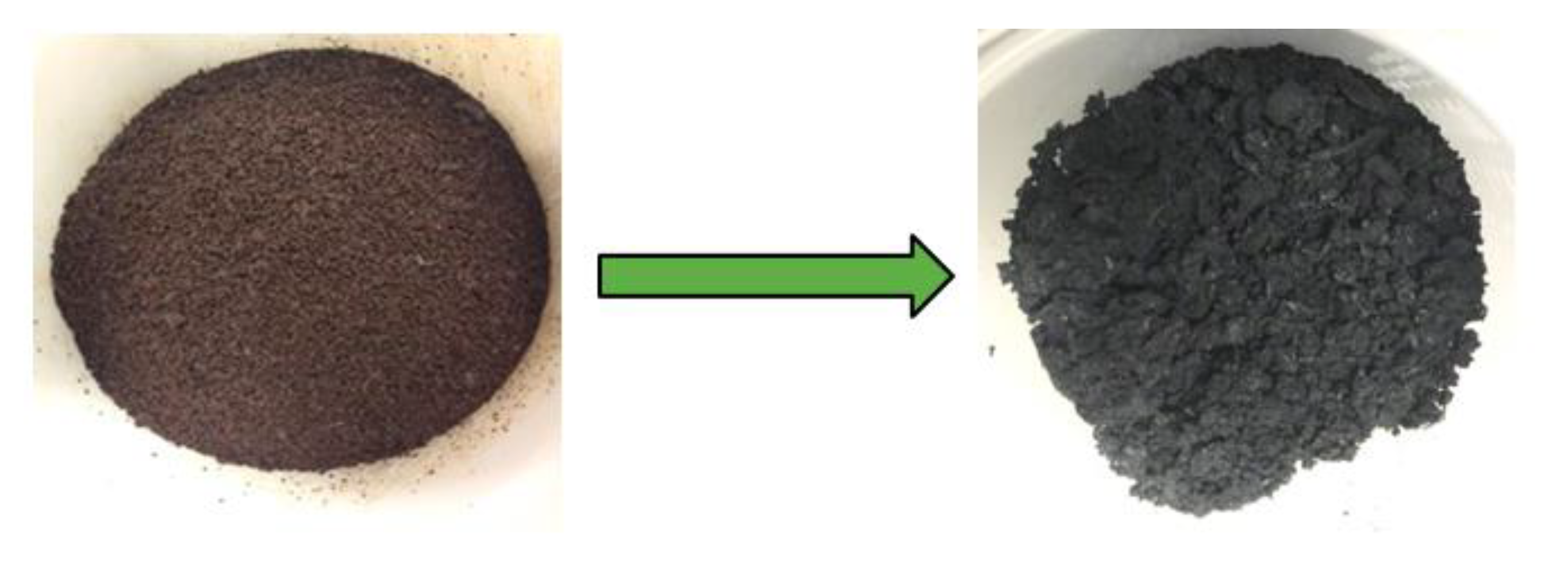
To examine this application further, we produced biochar with a sample of the dehydrated food waste material from the university cafeteria. The material was heated at a rate of 5 °C per minute up to 500 °C where it was then held at constant temperature for one hour. The pyrolysis process produced a biochar yield of 25 ± 0.4% by weight. A photo of the dehydrated food input and resulting biochar output can be seen in
Figure 3. Based on these results, it was concluded that dehydrated food waste can be used to produce biochar and then potentially applied as a soil amendment, depending on the content of certain constituents including sodium, chlorine, and sulfur. Concerns of consistency imply that the mixed food waste would be better for small-batch biochar production, whereas food processing waste, which is much more homogeneous, could be better suited for commercial scale biochar production.
3.5. Fish Feed
Different types of fish require feed with different nutrient levels, and these change throughout the lifespan of the animal as well. However, there is still a range within which most feed requirements will fall, as outlined below in
Table 5. In general, fish are fed either complete diets or supplemental diets, the former being necessary for most farm-raised fish because they are not able to forage freely on natural feeds. For fish raised in environments with access to natural food (e.g., ponds or outdoor raceways), feed is designed only to supplement the naturally available food, and requires a lower nutrient content, usually with a focus on providing extra protein, carbohydrates, and lipids [
23].
Complete diets will contain the ideal levels of protein, lipids, carbohydrates, minerals, phosphorous, and water, which make up the essential ingredients in fish feed [
23].
Table 5 compares the optimal ranges of these essential ingredients to the results measured for each dehydrated output material. The dehydrated foods generally matched well with the required levels of nutrients for fish feed. Three sources (cafeteria, hospital, and tofu processor) satisfied five of the six categories and one source (grocery store) satisfied all six. The category that was most frequently mismatched was carbohydrate levels, where the outliers showed higher levels than required.
One category to note is protein content, as it is usually the most expensive ingredient in fish feed. Even though all the dehydrated foods fell within the optimal range of 18–50%, they were consistently at the lower end of the spectrum, ranging between about 18–27%. Most aquaculture feeds fall above this range for specific fish, but that is also largely dependent on the environment in which they are reared (high vs. low density) and what kind of diet they have (omnivorous, herbivorous, or carnivorous) [
23].
A recent trend shows an increased use of lipids in fish foods, in large part to try to offset costs of protein, so the levels of lipids in most of the dehydrated foods showed encouraging levels [
23]. Although found in almost all fish feed, carbohydrates are not essential to aquaculture diets as they are an inexpensive source of energy. Because of this, the higher levels of carbohydrates found across most of the dehydrated food waste outputs are not of major concern.
In addition, there has been a push in recent years to identify alternative feeds for aquaculture, as indicated by the joint report authored by the National Oceanic and Atmospheric Administration (NOAA) and the United States Department of Agriculture (USDA) entitled The Future of Aquafeeds [
24]. This paper is part of the ongoing Alternative Feeds Effort, launched in 2007 by NOAA and USDA. The industry is searching for cost-effective solutions for providing farmed fish with the required nutrients without the use of fish meals and oils. Based on the preliminary results found in this study, dehydrated food waste could provide an alternative.
3.6. Cattle Feed
The results compiled for the dehydrated food waste outputs were also compared to nutrient requirements for cattle feed, which vary significantly among animals, and are influenced by age, weight, stage of production, rate of growth, environmental conditions, breed, gender, and other factors [
25]. However, nutrient requirements can reasonably be found based on three categories of information: the type of cow (e.g., heifer or beef), the production period (gestating, lactating, and post-partum), and the average body weight [
26].
Table 6 below summarizes this information alongside the optimal ranges relative to the nutritional needs of cattle.
As is seen in
Table 6, the nutrient requirements are best met by the food bank and juice processor. Macronutrients are mostly met as those optimal ranges are actually suggested minimums [
25,
27,
28]. Microminerals are of concern, as few sources fall within what we considered optimal ranges using cattle feed requirements [
27,
28]. From the four relevant attributes at the top of
Table 6, it seems that our feedstocks had too much energy and protein for appropriate cattle thresholds, though these numbers could be manipulated by blending different feedstocks. Therefore, while dehydrated food waste is a good base material for macronutrients, it would need to be supplemented for microminerals and closely monitored for protein and energy content.
3.7. Pelletized Fuel
We further investigated the energy content of the dehydrated food waste in terms of heating potential if used as a pelletized fuel. This was performed by testing the material for gross caloric value, also referred to as higher heating value (HHV), with units of MJ/kg (
Table 7). Cherry pits were another waste stream that was identified, along with the juice processing waste mentioned in the previous sections. However, the pits were only tested for energy content and are therefore only included in the pelletized-fuel data summary.
It was observed that six of the eight materials showed HHVs greater than those found in typical pelletized fuels. We did not perform testing of the dehydrated food output in a pellet stove, and therefore cannot conclude whether the food waste would give off an odor when burned. Of the materials analyzed, cherry pits proved to be best suited for an end use of pellet fuel because they would provide a consistent, homogeneous waste stream with an already established market. However, on a pure energy-per-weight basis, nearly all the dehydrated food wastes analyzed could be used as pellet fuels, with only juice processor waste having HHV significantly below the minimum 18.61 MJ/kg value based on the U.S. standard, which is in the same range as several European standards [
29].
3.8. Variability Assessment
The results from both the input and output parameters were analyzed to understand how dehydration of the food waste affected the variability of the output material properties. Since consistency is a key factor when considering the end use of the dehydrated food waste, it was important to understand if a highly variable input could be dehydrated to reduce the variability.
Fourteen key parameters were analyzed for the variability assessment, based on characteristics important for the end uses investigated. These can be seen in the first column in
Table 8. Percent variability was first analyzed for the input and output materials alone by dividing the difference between the maximum and minimum measured value for that parameter by the average measured value. This analysis was performed by identifying the maximum and minimum measured value for a given parameter within each input and output report. A difference was then calculated, which was divided by the average of the five values in each category. For example, the maximum measured value of crude protein of the inputs from all five sources was 7, while the minimum value was 2.7, resulting in a difference of 4.3 (row 2, column 2,
Table 8). The average crude protein across all five sources was 5.28. So, dividing 4.3 by 5.28, we find a percent difference of 81% (row 2, column 3,
Table 8). This calculation was performed for all 14 parameters for the inputs as well as outputs. These percentages represent the variability across all five sources of food waste in terms of the 14 parameters analyzed. To analyze how this variability changed after dehydration, the percent difference of the output was subtracted from that of the input for each parameter (column 6,
Table 8). A positive percentage indicates that the variability decreased from input to output, whereas a negative percentage indicates the variability increased. As can be seen in
Table 8, the variability was decreased in 10 of the 14 parameters analyzed. Thus, it is reasonable to conclude that the Ecovim-66 system decreased the variability of the food waste for most parameters considered.
One other food waste study found similar parameters that fall within the ranges we show (see
Table S8). Balaskonis et al. [
11] found that with three household food waste dehydrators, 70–78% mass reductions were achieved; our analysis found 69–91% mass reductions across five food sources. Volatile Solids (VS) for Balaskonis et al. [
11] ranged from 85–95% for dehydrated output; our study averaged 79–93%. The pH values for Balaskonis et al. [
11] were slightly higher, ranging from 4.71 to 5.58; our pH levels for five out of the seven sources ranged from 4.5 to 4.8. This variation could reasonably be explained by the specific composition of food waste and the acidity of different materials being dehydrated. As we witnessed, the pH levels of the liquid running out of the machine were lower to start, so as the material dried, it became less acidic. Finally, the total organic carbon (TOC) average for our study was 48.1% excluding food processors; Balaskonis et al. [
11] found a range of 47.6–54.9% TOC across three dehydrators. These parameters show that other researchers have found similar results to ours which lends further credence to our work.
4. Conclusions
The bulk of the food waste dehydration analysis focused on characterizing various materials to better understand how the variability of the inputs affects the variability in the outputs, and to investigate alternative uses for the dehydrated food waste. The analysis of the end markets indicated that dehydrated food waste was suitable for approximately half of the end uses analyzed. Based on the parameters tested, the dehydrated material was analyzed for its suitability for use as a fertilizer, input to composting, several types of animal feed, pelletized fuel, as well as input to pyrolysis to produce biochar. Of these end uses, fish feed, pelletized fuel, and biochar were the best-suited end uses. The materials showed nutrient levels that were well matched to fish feed in particular. The macronutrients required for cattle feed were also well matched with most of the dehydrated food wastes.
Most of the dehydrated materials showed high energy density, meaning that the MJ/kg of the materials was quite high, lending itself well to being an effective substitute for pelletized fuel. Of the dehydrated materials, cherry pits were most suited for this application because the opportunity to be used in a higher value scenario (e.g., animal feed) is much lower in comparison to the mixed food waste. Additionally, considering that there is an established market for cherry pits as pellet fuel, this is an attractive option. The dehydrated food waste also showed promise as an input material for pyrolysis.
The two applications having to do with agriculture (fertilizer or input for compost) were not well matched to the measured characteristics of the dehydrated food waste, though the dehydrated food could be composted if mixed with the appropriate organics. Low pH values presented a significant challenge in this area, as they consistently fell below the necessary range of soil pH required for the majority of plants. Moreover, even the best suited end uses come with barriers. In every case, consistency in the properties of the dehydrated food waste presented the largest challenge, which is critical if the material is to be sold on a commercial level. Even though the dehydration process generally decreased variability of the material properties, variation was still found between dehydrated outputs from different mixed food wastes. For animal feed, this concern can be mitigated by working directly with local farms rather than commercially selling a product. In addition, laws related to animal feeding in New York State prohibit post-consumer food of any kind from being fed to animals, so extra care would need to be taken by the customer to properly separate food if the desired end use is to produce animal feed.
Food waste dehydration provides a unique food waste management solution that should be considered as a viable alternative to the established pathways of direct composting and anaerobic digestion. In addition to providing a compact and simple to use on-site solution, it mitigates concerns of storing raw food waste, which can be of concern, especially in urban or vermin-prone environments. This also allows for the flexibility of less frequent pick-ups. Thus, producing a product from organic waste that can be sold and utilized in a more beneficial way than pure landfilling is an outcome that more institutions can strive for by utilizing food waste dehydration technologies.