

You are currently viewing a new version of our website. To view the old version click .
Sustainability
  • Article
  • Open Access

28 June 2020

Outward FDI and Entrepreneurship: The Case of China


,
,
,
and
1
Business School, University of Shanghai for Science and Technology, Shanghai 200093, China
2
Whitman School of Management, Syracuse University, Syracuse, NY 13244, USA
*
Authors to whom correspondence should be addressed.
This article belongs to the Section Economic and Business Aspects of Sustainability

Abstract

Outward foreign direct investment (OFDI) from developing countries, like China, has been growing significantly so far. However, there is surprisingly little research on the effects of OFDI on the home county’s entrepreneurship. In this paper, we initially examine the characteristics of China’s OFDI during the country’s economic reform and opening up. We subsequently test for the hypothesis that Chinese OFDI, along with the Chinese entrepreneurial institutional environment and inward FDI, impacted entrepreneurial activities from the year of 2004 to 2015. We find that OFDI has an inverted “U” effect on entrepreneurial activities, and that the impacts of inward FDI as well as the foreign trade are different in the coastal and non-coastal cities. We conclude by discussing the implications of our findings for researchers and policymakers as well as the limitations of our data.

1. Introduction

As the Chinese strategy for international expansion is developing, China’s outward foreign direct investment (OFDI) increased dramatically with Chinese enterprises’ growth. In 2004, China became the world’s largest recipient of FDI [1]. However, China’s outward direct investment was 158.29 billion USD, and went down by 19.3% in 2017. It registered negative growth for the first time since China publicly released its annual statistics from 2003, although it was still the second highest in its history, accounting for more than 10% of the global total OFDI. China’s outward investment continues to play an important role in global FDI market, ranking the third behind US and Japan in the volume of investment flows. Spurred by China’s large quantity of foreign exchange reserves, it seemed to be a fortuitous time for Chinese enterprises to engage in overseas investment. To be sure, China is still a developing country, with its OFDI stock still relatively low [2]. Although much research has examined the motivation for China’s OFDI, the influence and benefits of Chinese OFDI during the economic transition are still not clearly determined, and are main goal of our study.
According to the general theory of FDI, built largely on the experience of investors of industrialized countries [3], firms engaging in OFDI should possess monopolistic advantages [4]; alternatively, they should enjoy firm-specific or ownership-specific advantages [5]. Dunning [6,7,8] used an eclectic paradigm to explain the importance of ownership during FDI, that known as the Ownership-Location-International Model(OLI), to the motivations of FDI by foreign-market-seeking FDI, efficiency-seeking FDI, and resource-seeking FDI. Lall [9] reports that India’s technological advantage has served as the motivation behind its OFDI. All of these traditional theories emphasize that firms should take advantage of their distinctive competitiveness in knowledge assets or material assets so they can profit by investing in less-developed countries. Unlike the traditional strategic asset-exploitation FDI model, emerging market economies can acquire knowledge and technology in conjunction with the reverse spillover effect of their OFDI in advanced countries [10,11,12]. Since knowledge and technology along with economic development contribute to innovation, and since innovation implies entrepreneurial activity [13], we believe China’s OFDI also has an influence on Chinese entrepreneurship.
A large number of research studies concerning China’s outward FDI were motivated by its growth and the government policy. Most of the literature is concerned with the motivations and determination of OFDI [3,14,15,16,17] and the effects of OFDI on exports, technology, industry structure, and productivity of the country [18,19,20]. Certain studies have examined FDI’s effect on the host country’s entrepreneurship [21,22,23]. There is little evidence, however, regarding OFDI’s potential economic consequences, such as its effect on the home country’s entrepreneurship [24]. Entrepreneurship is considered one of the most efficient and robust economic driving forces for economic transformation and development, especially in countries reforming or reconstructing their systems, fostering wealth creation and innovation [13,25]. Still, a macroeconomic study of the overall impact of outward FDI on the home country‘s entrepreneurial activities in a transitional period has not been conducted yet. Studies on aspects of OFDI from transition economies within the international business literature are incomplete without consideration of its impact on home countries’ entrepreneurship, which has been shown to play a critical role in fostering economic growth, technology transfer, new market development, and enterprise restructuring [23].
Our study extends the international business literature by first examining the relationship between OFDI and total entrepreneurial activities in the home country and focuses on answering two research questions within the context of the Chinese economy:
(1)
What are influences and benefits of the Chinese OFDI with respect to the domestic entrepreneurship in China with the special characteristics of Chinese OFDI growth during the transition?
(2)
How do the other related important factors, such as the institutional environment, inward foreign investment, unemployment, and international trade, affect the enterprise entrepreneurship?
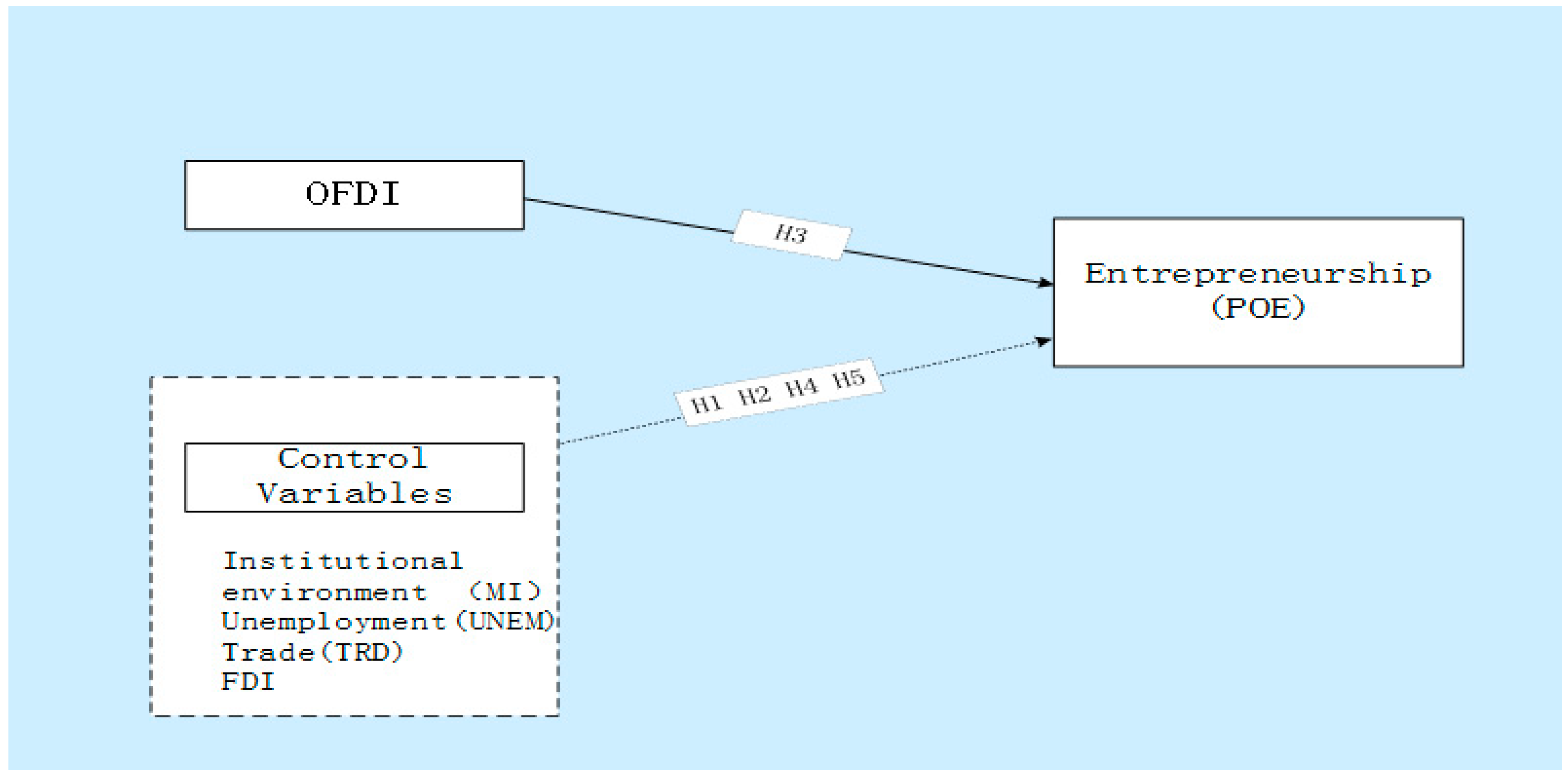
To answer these questions, we initially provide the background and characteristics of Chinese OFDI and the institutional environment of Chinese OFDI developed during the transition. Subsequently, we build a conceptual model, present the hypotheses to be tested, and elaborate on the impact of outward FDI and inward FDI on enterprises’ entrepreneurial activity. In the ensuing section, we report on our methodology and results; we use official data of 30 Chinese regions from 2004 to 2015 to test the stated hypotheses. We find that Chinese OFDI indeed distinctively and differently influences domestic entrepreneurship with the developing Chinese economy, especially before the year of 2008 in the coastal areas. In Section 4, we present a discussion and implications. Finally, we comment on limitations of our work and potential for future research.

3. Data and Methodology

3.1. The Model

Our discussion suggests the following general log-linear model:
S E i t = f ( O F D I i t , X i t )
The data are transformed into natural logarithms to eliminate the influence of heteroscedasticity and to reduce the effect of data fluctuations. Here, SE represents entrepreneurship as measured by the number of privately owned enterprises, and OFDI presents Chinese outward foreign direct investment; X is the vector of control variables; i represents China’s provinces; t represents the time of the data.

3.2. Data and Variables

The data for this study are provincial statistics collected from the Chinese National Bureau of Statistics (Chinese Statistics Year Books, 2004–2015). The dependent variable of entrepreneurship is measured by the number of privately owned enterprises (POEs). The definition of entrepreneurship is certainly a complex one. In the Chinese context, some researchers define entrepreneurship as new business measured in terms of new private companies, while others consider this definition as narrow and lacking consideration of entrepreneurial willingness [58]. Zhang and Li [59] focused on private companies to analyze corporate entrepreneurial activities. Moreover, the Chinese government always encourages local entrepreneurship by simply measuring the number of private enterprises, as described in a paper about young people’s entrepreneurship, using the number of privately registered enterprises [60]. We describe entrepreneurship here as entrepreneurial activity revealed by means of entrepreneurs’ behavior in starting a new business and being willing to run it in pursuit of the entrepreneurial spirit. Private enterprises refer to profit-making economic organizations established by natural persons or controlled by natural persons on the basis of wage labor, in accordance with No. 9 Article of Regulations on the classification of enterprise registration types issued by the National Bureau of Statistics and the State Administration for Industry and Commerce (National (1998) No. 200 on 28th August, 1998). In China, the concept of private enterprise and entrepreneurship are closely aligned, so the number of private enterprises was used to represent entrepreneurship. In addition, we use the OFDI stock as the independent variable. China’s OFDI changed very slowly before 2003; therefore, we use data from 2004 to 2015 to test our hypothesis.
We also use selected control variables. We use the marketization index (MI) for China’s provinces (2004–2015), published by the National Economic Research Institute (NERI) [61] as a control variable to indicate the institutional environment in China. One important component of this index is government–market relations, shaped by the institutional environment towards private enterprise development during transition. In addition, inward foreign investment (FDI), unemployment (UNEM), and international trade (TRD) were included as control variables because they potentially help Chinese enterprises to develop international business skills, positively impact entrepreneurial activity, and contribute to economic growth and development.
The resulting model is:
P O E i t = β 0 + β 1 O F D I i t + β 2 T R D i t + β 3 F D I i t + β 4 U N E M i t + β 5 M I i t + δ .
In this equation, i represents provinces and t represents years. In order to eliminate the influence of heteroscedasticity and improve the accuracy of the model, the logarithmic treatment is adopted for the key variables, such as POE, OFDI, FDI, and TRD. Meanwhile, considering the effect of GDP on entrepreneurial activity, we use the lnOFDI/lnGDP, lnFDI/lnGDP, and lnTRD/lnGDP.

3.3. Data Analysis and Results

Table 1 shows the descriptive statistics of the samples. Panel A is the distribution of variables. Panel B divides the samples into two sub-samples of non-coastal provinces and coastal provinces. The t-test shows that, except for the unemployment rate, all the other variables have significant differences at the 1% level.
Table 1. Descriptive statistics.
Table 2 presents correlations for all variables included in the model. As a result, entrepreneurship (POE) has a strong positive correlation with OFDI (r = 0.422, p < 0.05), FDI (r = 0.541, p < 0.05), TRD (r = 0. 306, p < 0.05), and MI (r = 0.688, p < 0.05), but is not correlated with unemployment rate (r = 0.036, p > 0.1). To check for multicollinearity, variance inflation factors (VIF) for all regression models are computed. In accordance with Deng et al. [62], we conclude that we do not have a multicollinearity issue, since the VIF for all variables is below 5.
Table 2. Correlation coefficient.
The model is estimated using fixed-effect and random-effect Ordinary Least Squares (OLS) regressions. In order to reduce the influence of non-independence on parameter estimation, the random effect model was used to estimate the effects of the independent variables [63].
In Table 3, we first test H1–H5 using provincial data from 2004–2008 and the number of privately owned enterprises (POEs) as the dependent variable. Table 3 presents the results. Model 1 is the baseline model with control variables; the market index shows a strong positive effect on the number of privately owned enterprises (p < 0.01) and the unemployment rate has a positive effect on the privately owned enterprises number, but it is not significant. In Model 2, OFDI is inserted, and shows a strong positive effect on the number of privately owned enterprises (p < 0.01). When the control variables of foreign direct investment (FDI) and total foreign trade (TRD) are inserted one by one into Model 3 and Model 4, along with OFDI, OFDI still shows strong positive effect on the number of privately owned enterprises (p < 0.01 and p < 0.01, respectively). FDI is not significant in Model 3, but shows great relation with the number of privately owned enterprises in Model 4 (p < 0.05). Total foreign trade shows a negative, statistically significant effect on the number of privately owned enterprises (p < 0.01). In Model 4, all variables are included; institutional environment is highly significant, providing support for H1; FDI is significant in some parts, which partly supports H2. OFDI is significant and has the expected positive sign, lending support to H3. Trade is negatively correlated with the number of privately owned enterprises, which does not support H4. Unemployment (UNEM) shows a partially significant effect on the number of privately owned enterprises (POE) (p < 0.05), providing partial support for H5. The outbreak of the financial crisis in 2008 had a great impact on the global entrepreneurship pattern. In order to verify the economic cycle effect, this paper collected relevant data of provinces from 2009 to 2015 for in-depth comparative analysis.
Table 3. Random effect of OLS for all provinces (2004–2008).
Table 4 shows the regression results of related variables between 2009 and 2015, which are significantly different from Table 3. Among them, OFDI shows a negative correlation with domestic entrepreneurship from 2009 to 2015, and the impact of FDI on domestic entrepreneurship is not significant.
Table 4. Random effect of OLS for all provinces (2009–2015).
In order to ensure the stability of the test results and further test the differences in the effects of foreign investment in the regions, the data collected in this paper were divided into coastal areas and non-coastal areas for testing according to Brun et al. [64]. In Table 5, we show the test results for coastal and non-coastal provinces in two economic periods, namely 2004–2008 and 2009–2015. In Model 1, between 2004 and 2008, OFDI had a significant positive impact on entrepreneurial activities in both coastal and non-coastal areas (p < 0.01, p < 0.01, respectively). In Model 2, we also check for robustness of the effect of OFDI on the number of privately owned enterprises by inserting data from 2009 to 2015.The results are similar to those obtained nationwide between 2009 and 2015. OFDI in both coastal and non-coastal areas does not have significant effect on the number of privately owned enterprises. Meanwhile, the impact of FDI on the number of privately owned enterprises is not significant in the coastal provinces, but has a positive effect on non-coastal provinces (p < 0.01). The trade variable is not significant in either coastal provinces or non-coastal provinces.
Table 5. Random-effect OLS for coastal provinces and non-coastal provinces in China.

4. Discussion and Implications

Regression analysis shows that OFDI does not have a simple positive influence on domestic entrepreneurial activities, which indicates obvious economic cycle volatility; the impact of inward foreign direct investment on domestic entrepreneurial activities also shows regional differences, and international trade does not have a significant impact on domestic entrepreneurial activities per our hypothesis.
First of all, the regression results support our hypothesis; outward foreign direct investment has a positive promotion effect on domestic entrepreneurial activity in the growing status of the economic cycle, but, when the economic boom began to decline after the outbreak of the financial crisis in 2008, the pull function of outward foreign direct investment on domestic entrepreneurial activity during the 2009–2015 period is not significant. To ensure the robustness of our conclusions, we tested the data by province. The result is consistent with the previous conclusion. In particular, from 2004 to 2008, outward foreign direct investment in coastal areas played a significant role in promoting the coastal areas’ entrepreneurial activity. However, during the domestic economic recovery period following the global financial crisis, the pull function of outward foreign direct investment on entrepreneurship became less obvious, while the changes in the coastal cities and non-coastal cities were obvious. We believe that this may also be related to the utility cycle of OFDI, which has an inverted “U” effect on domestic entrepreneurial activities. At present, the utility of OFDI declines and is ready to enter the declining stage.
Second, we found that the effect of FDI on domestic entrepreneurial activity is not consistent with our expectations. According to the results, foreign direct investment has no obvious impact on entrepreneurship in coastal cities. On the contrary, foreign direct investment has a significant positive impact in non-coastal cities. Further research suggests that this may be related to interregional financial abundance. In coastal cities, the economic and financial development is more favorable for entrepreneurship in terms of the wide choice of capital sources, such as bank loans, private funds, and local governments’ support. In contrast, there is a relative lack of entrepreneurial capital sources in non-coastal areas. Local enterprises there also make full use of foreign direct investment as a source of capital investment, which is also strongly encouraged by non-coastal local governments. Thus, this may result in regional differences in the stimulation effect of FDI on entrepreneurial activities.
Third, the institutional environment, which is generally considered to be an important factor during China’s transition, consistently shows a strong effect on entrepreneurial activities of private businesses. It also suggests that entrepreneurs in developing countries, such as China, should possess the ability to overcome obstacles by understanding government policy. Moreover, economic liberalization and marketization have led to business environments that encourage innovative entrepreneurship [65]. Chinese policymakers are currently trying to undertake economic reform to make the socialist market more market-oriented and influence Chinese OFDI through regulations and guidelines. Therefore, during this transitional period, government intervention and guidance are tolerated and may even play a constructive role. Spencer [45] gives another explanation: Regulatory institutions have a negative association with entrepreneurial activities, that is, when regulatory institutions are strong, individuals appear to be pushed away from entrepreneurship. This may be explained by the different types of regulatory and economic frameworks in different countries. Since policymakers aim at fostering domestic entrepreneurship, it is very important for them to undertake pro-active measures [66], including support for education, training, and entrepreneurial ventures, especially for technology and innovation entrepreneurship. Since 1978, a number of pro-active policy measures have been introduced to support private sector development in China, but more effective government policies are still needed to reduce non-productive entrepreneurial activities to avoid rent-seeking and to develop the capacity of local entrepreneurs to absorb knowledge and technology from their international partners. Furthermore, a positive institutional environment that includes policy stabilization, effectiveness, and consistency of regulations and laws enables individuals to anticipate less uncertainty regarding their entrepreneurial activities.
Fourth, the impact of total international trade on domestic entrepreneurial activities is also different from what we expected. In general, the impact of trade on entrepreneurial activities in coastal areas and non-coastal areas is not significant. Specifically, trade provided a temporary stimulus for entrepreneurship in non-coastal areas from 2004 to 2008, which was not significant after the outbreak of the financial crisis. We think it has to do with domestic policy in recent years. With the deepening of economists’ research on national economy, the government began to attach importance to the role of domestic consumption in driving the economy and began to advocate for national consumption. Trade not only increases national income, but also promotes national consumption. According to previous studies, there is a certain substitution effect between national consumption and national investment. As a kind of national investment, the promotion effect of trade on entrepreneurship is replaced by national consumption, so the promotion effect of trade on entrepreneurship is not significant.
Fifth, the unemployment rate has played a significant role in promoting domestic entrepreneurship. According to our regression test, from 2009 to 2015, at the national level, the unemployment rate had a positive impact on the development of domestic entrepreneurial activities. Since 2004, China has relaxed the regulations on private enterprises’ participation in foreign investment, expanded the business scope of enterprises, and provided more options for enterprises to explore the market. In recent years, with the better institutional entrepreneurial environment and people’s understanding of entrepreneurial activities, as well as the improvement of respect for entrepreneurs, entrepreneurship has gradually become one of the main choices for people to find jobs, especially for the unemployed, and the increase of the unemployment rate will promote entrepreneurial activities in China.

5. Contributions

Our study contributes to the theory of foreign investment: First, our study extends the international business research by innovatively examining the relationship between OFDI and entrepreneurship in the home country. Encouraged by the Chinese government’s policy of “widespread entrepreneurship”, with the business start-ups by the general public, entrepreneurship has already become a new driving force for the country’s economic development. In this context, it has significant meaning to study the influence of the foreign investment on entrepreneurship. In addition, our study verifies the positive effect of institutional environment on enterprise entrepreneurship, thus providing an empirical basis and reference for the government to improve the business environment. Finally, our paper confirms that the increase of unemployment rate will lead to the promotion of entrepreneurial activities if people can better understand and recognize the opportunities of entrepreneurial activities. All the implications of our findings can help further related research and policymaking in the future.

6. Limitations and Future Research

In this paper, we provided a framework for the analysis of entrepreneurial activities through examination of the effects of Chinese OFDI during the transition. This study is limited by the lack of sufficient data, since research on Chinese entrepreneurship is at its nascent stage, and entrepreneurial activities may include more aspects than what we examined in the paper [67]. There is a need for more data to be collected in the future to explore the effects of OFDI on Chinese necessity-driven and opportunity-driven entrepreneurial activities. In addition, because the level of economic development can function as a “pull” factor on entrepreneurial activity and increase a country’s international involvement in the form of OFDI, FDI, and international trade, these will ultimately contribute to further economic growth and development. Finally, to achieve the objectives of this study, we simplified our research methodology by standardizing our data through division by regional GDP in order to reduce the interaction effects. In the future, a more comprehensive model and data may be needed to more adequately address these interactions.

Author Contributions

Conceptualization, L.S., P.K.; methodology, P.K., L.S.; software, J.L.; formal analysis, L.S., F.W., J.L.; resources, X.Z.; data curation, L.S., F.W.; writing—original draft preparation, L.S. and P.K.; writing—review and editing, L.S., P.K., F.W., X.Z. and J.L.; supervision, L.S., P.K.; funding acquisition, P.K. All authors have read and agreed to the published version of the manuscript.

Funding

The publication has been supported by SU.

Conflicts of Interest

The authors declare no conflict of interest.

References

  1. United Nations Conference on Trade and Development (UNCTAD). Unctad’s World Investment Report 2004: The Shift towards Services. Available online: https://journals.sagepub.com/doi/abs/10.1177/0015732515050105 (accessed on 16 June 2020).
  2. Ministry of Commerce of the People’s Republic of China (MOFCOM). Statistical Bulletin of China’s Outward Foreign Direct Investment. 2017. Available online: http://images.mofcom.gov.cn/hzs/201810/20181029160118046.pdf (accessed on 16 June 2020).
  3. Buckley, P.J.; Clegg, J.; Wang, C. The Impact of Inward FDI on the Performance of Chinese Manufacturing Firms. J. Int. Bus. Stud. 2007, 33, 637–655. [Google Scholar] [CrossRef]
  4. Hymer, S.H. The International Operations of National Firms: A Study of Direct Foreign Investment. Available online: https://www.journals.uchicago.edu/doi/10.1086/260628 (accessed on 16 June 2020).
  5. Dunning, J.H. American Investment in British Manufacturing Industry; George Allen & Unwin Ltd: London, UK, 1958. [Google Scholar]
  6. Dunning, J.H. Toward an Eclectic Theory of International Production: Some Empirical Tests. J. Int. Bus. Stud. 1980, 11, 9–31. [Google Scholar] [CrossRef]
  7. Dunning, J.H. Multinational Enterprises and the Global Economy; Addison Wesley: Hoboken, NJ, USA, 1993. [Google Scholar]
  8. Dunning, J.H. The Eclectic (OLI) Paradigm of International Production: Past, Present and Future. Int. J. Econ. Bus. 2001, 8, 173–190. [Google Scholar] [CrossRef]
  9. Lall, S. Determinants of R&D in an LDC: The Indian Engineering Industry. Econ. Lett. Elsevier 1983, 13, 379–383. [Google Scholar]
  10. Cantwell, J. The Globalization of Technology: What Remains of the Product Cycle Model? Camb. J. Econ. 1995, 19, 155–174. [Google Scholar]
  11. Teece, D.J. Competition, Cooperation, and Innovation. J. Econ. Behav. Organ. 1992, 18, 1–25. [Google Scholar] [CrossRef]
  12. Siotis, G. Foreign Direct Investment Strategies and Firms’ Capabilities. J. Econ. Manag. Strategy 1999, 8, 251–270. [Google Scholar] [CrossRef]
  13. Global Entrepreneurship Monitor (GEM) 2010 Global Report. Available online: https://www.gemconsortium.org/report/gem-2010-global-report (accessed on 16 June 2020).
  14. Huang, Y.P.; Wang, B. Chinese Outward Direct Investment: Is There a China Model? China World Econ. 2011, 19, 1–21. [Google Scholar] [CrossRef]
  15. Salidjanova, E. Going out: An Overview of China’s outward Foreign Direct Investment. 2011. Available online: https://www.uscc.gov/sites/default/files/Research/GoingOut.pdf (accessed on 16 June 2020).
  16. Wei, Z.Y. The Literature on Chinese Outward FDI. Multinatl. Bus. Rev. 2010, 18, 73–112. [Google Scholar] [CrossRef]
  17. Lu, J.Y.; Liu, X.H.; Wright, M.; Filatochev, I. International experience and FDI location choices of Chinese firms: The moderating effects of home country government support and host country institutions. J. Int. Bus. Stud. 2014, 45, 428–449. [Google Scholar] [CrossRef]
  18. Liu, H.; Li, K. Strategic Implications of Emerging Chinese Multinationals: The Haier case study. Eur. Manag. J. 2002, 20, 699–706. [Google Scholar] [CrossRef]
  19. Robert, E.L. Home- and Host-Country Effects of Foreign Direct Investment. Available online: https://www.nber.org/chapters/c9543 (accessed on 16 June 2020).
  20. Zhang, H. China’s Outward Foreign Direct Investment: Theories and Strategies; Enrich Professional Publishing: Honolulu, HI, USA, 2015. [Google Scholar]
  21. De Backer, K.; Sleuwaegen, L. Does Foreign Direct Investment Crowd Out Domestic Entrepreneurship? Rev. Ind. Organ. 2003, 22, 67–84. [Google Scholar] [CrossRef]
  22. Ramondo, N. Foreign Plants and Industry Productivity: Evidence from Chile. Scand. J. Econ. 2009, 111, 789–809. [Google Scholar] [CrossRef]
  23. Ayyagari, M.; Kosová, R. Does FDI Facilitate Domestic Entrepreneurship? Evidence from the Czech Republic. Available online: http://www.cerge-ei.cz/pdf/events/papers/061211_t.pdf (accessed on 16 June 2020).
  24. Herzer, D. The Long-run Relationship between Outward Foreign Direct Investment and Total Factor Productivity: Evidence for Developing Countries. J. Dev. Stud. 2011, 47, 767. [Google Scholar] [CrossRef]
  25. He, X.D. The Development of Entrepreneurship and Private Enterprise in the People’s Republic of China and its Relevance to Transitional Economics. J. Dev. Entrep. 2008, 14, 39–58. [Google Scholar]
  26. International Monetary Fund (IMF). 2000 Transition Economies: An IMF Perspective on Progress and Prospects. Available online: https://www.imf.org/external/np/exr/ib/2000/110300.htm (accessed on 16 June 2020).
  27. Vijay, G.; Chris, T. Reverse Innovation; Harvard Business School Publishing: Boston, MA, USA, 2012. [Google Scholar]
  28. Fosfuri, A.; Motta, M. Multinationals without Advantages. Scand. J. Econ. 1999, 101, 617–630. [Google Scholar] [CrossRef]
  29. Driffield, N.; Love, J.H. Foreign Direct Investment, Technology sourcing and Reverse Spillovers. Manch. Sch. 2003, 71, 659–672. [Google Scholar] [CrossRef]
  30. Dunning, J.H.; Lundan, S.M. Multinational Enterprises and the Global Economy; Edward Elgar Publishing Ltd: Cheltenham, UK, 2008. [Google Scholar]
  31. United Nations Conference on Trade and Development (UNCTAD). World Investment Report 2011: Non-Equity Modes of International Production and Development. Available online: https://unctad.org/en/PublicationsLibrary/wir2011_en.pdf (accessed on 16 June 2020).
  32. Tirupati, D. Role of technological innovations for competitiveness and entrepreneurship. J. Entrep. 2008, 17, 103–115. [Google Scholar] [CrossRef]
  33. Li, J.; Strange, R.; Ning, L.; Sutherland, D. Outward foreign direct investment and domestic innovation performance: Evidence from China. Int. Bus. Rev. 2016, 25, 1010–1019. [Google Scholar] [CrossRef]
  34. Driffield, N.; Chiang, M. The Effects of Offshoring to China: Reallocation, Employment and Productivity in Taiwan. Int. J. Econ. Bus. 2009, 16, 19–38. [Google Scholar] [CrossRef]
  35. Kimura, F.; Kiyota, K. Exports, FDI and Productivity: Dynamic Evidence from Japanese Firms. Rev. World Econ. 2006, 142, 695–719. [Google Scholar] [CrossRef]
  36. United Nations Conference on Trade and Development (UNCTAD). World Investment Report 2006: FDI from Developing and Transition Economies: Implications for Development. Available online: https://unctad.org/en/pages/PublicationArchive.aspx?publicationid=709 (accessed on 16 June 2020).
  37. United Nations Conference on Trade and Development (UNCTAD). World Investment Report 2013: Global Value Chains: Investment and Trade for Development. Lab. Anim. Sci. 2013, 35, 272–279. [Google Scholar]
  38. Cuyvers, L. The Effects of Belgian Outward Direct Investment in European High-wage and Low-wage Countries on Employment in Belgium. Int. J. Manpow. 2011, 32, 300–312. [Google Scholar] [CrossRef]
  39. Subhanij, T.; Annonjarn, C. Thai Outward Foreign Direct Investment: Trends, Patterns and Determinants. Available online: https://papers.ssrn.com/sol3/papers.cfm?abstract_id=2565023 (accessed on 16 June 2020).
  40. Boddewyn, J.B. Political Aspects of MNE Theory. J. Int. Bus. Stud. 1988, 19, 341–363. [Google Scholar] [CrossRef]
  41. Luo, Y. How Emerging Market Governments Promote Outward FDI: Experience from China. J. World Bus. 2010, 45, 68–79. [Google Scholar] [CrossRef]
  42. Wu, J.; Ma, Z.; Liu, Z.; Kwok Lei, C. A contingent view of institutional environment, firm capability, and innovation performance of emerging multinational enterprises. Ind. Mark. Manag. 2019, 82, 148–157. [Google Scholar] [CrossRef]
  43. Commons. The Economics of Collective Action; University of Wisconsin Press: Madison, WI, USA, 1950. [Google Scholar]
  44. Scott, W.R. Institutions and Organizations; Sage: Thousand Oaks, CA, USA, 1995. [Google Scholar]
  45. Spencer, J.W. The Relationship among National Institutional Structures, Economic Factors, and Domestic Entrepreneurial Activity: A Multicounty Study. J. Bus. Res. 2004, 57, 1098–1107. [Google Scholar] [CrossRef]
  46. Welsh, D.H.B.; Carraher, S.M. An examination of the relationship between the mission of the university, the business school, and the entrepreneurship center: An application of Chandler’s strategy and structure hypothesis. J. Appl. Manag. Entrep. 2009, 14, 25. [Google Scholar]
  47. Barbosa, N.; Eiriz, V. The Role of Inward Foreign Direct Investment on Entrepreneurship. Int. Entrep. Manag. 2009, 5, 319–339. [Google Scholar] [CrossRef]
  48. Globerman, S. Foreign Direct Investment and “Spillover” Efficiency Benefits in Canadian Manufacturing Industries. Can. J. Econ. 1979, 12, 42–56. [Google Scholar] [CrossRef]
  49. Kokko, A. Technology, market characteristics, and spillovers. J. Dev. Econ. 1994, 43, 279–293. [Google Scholar] [CrossRef]
  50. Havranek, T.; Irsova, Z. Estimating Vertical Spillovers from FDI: Why Results Vary and What the True Effect Is. J. Int. Econ. 2011, 85, 234–244. [Google Scholar] [CrossRef]
  51. Orlic, E.; Hashi, I.; Hisarciklilar, M. Cross sectoral FDI spillovers and their impact on manufacturing productivity. Int. Bus. Rev. 2018, 27, 777–796. [Google Scholar] [CrossRef]
  52. Ravikumar, B.; Santacreu, A.M.; Sposi, M.J. Capital Accumulation and Dynamic Gains from Trade. Available online: https://economicdynamics.org/meetpapers/2017/paper_915.pdf (accessed on 16 June 2020).
  53. Grossman, G. International Trade, Foreign Investment, and the Formation of the Entrepreneurial Class. Am. Econ. Rev. 1984, 74, 605–614. [Google Scholar]
  54. Brodzicki, T.; Márquez-Ramos, L.; Umiński, S. The Investigation into Determinants of Regional Exports Base: Panel Analysis for Spanish and Polish Regions. Entrep. Bus. Econ. Rev. 2018, 6, 135–151. [Google Scholar] [CrossRef]
  55. Storey, D.J. The birth of new firms—does unemployment matter?. A review of the evidence. Small Bus. Econ. 1991, 3, 167–178. [Google Scholar] [CrossRef]
  56. Meager, N. Does Unemployment Lead to Self-employment? Small Bus. Econ. 1992, 4, 87–103. [Google Scholar] [CrossRef]
  57. Amorós, J.E.; Felzensztein, C.; Gimmon, E. Entrepreneurship in peripheral versus core regions: Lessons from Chile. Front. Entrep. Res. 2010, 30, 1. [Google Scholar]
  58. Zhang, X.J. Research on the interaction between entrepreneurship and innovation based on the analysis of two entrepreneurial measurement methods. J. Xi’an Pet. Univ. Soc. Sci. Ed. 2017, 26, 46–52. [Google Scholar]
  59. Zhang, Y.L.; Li, Q.W. Corporate entrepreneurial activity and organizational performance: The empirical research based on China’s growing private enterprises. Sci. Res. Manag. 2005, 26, 28–39. [Google Scholar]
  60. Gu, H.T. Reflections on the Model of Guiding Young People to Join in Entrepreneurship. Zhenjiang Soc. Sci. 2011, 4, 52. [Google Scholar]
  61. Fan, G.; Wang, X.L.; Zhu, H.P. Marketization Index Report in China: Marketization Process across Regions; Economic Science Press: Beijing, China, 2009. [Google Scholar]
  62. Deng, Z.; Yan, J.; van Essen, M. Heterogeneity of political connections and outward foreign direct investment. Int. Bus. Rev. 2018, 27, 893–903. [Google Scholar] [CrossRef]
  63. Zhang, J.; Zhang, Y.L. Chairman-CEO Heterogeneity, Power Differential, Rapport and Organizational Performance. Manag. World 2016, 1, 110–120. [Google Scholar]
  64. Brun, J.F.; Combes, J.L.; Renard, M.F. Are there spillover effects between coastal and noncoastal regions in China? China Econ. Rev. 2002, 13, 161–169. [Google Scholar] [CrossRef]
  65. Dana, L.P.; Churchill, N.C. Entrepreneurship and Venture Creation: An International Comparison of Five Commonwealth Nations. Front. Entrep. Res. 1987, 7, 573–583. [Google Scholar]
  66. Baliamoune-Lutz, M. Policy and Institutional Reform and Entrepreneurship in Developing Countries. Available online: https://link.springer.com/content/pdf/10.1057%2F9780230295155_9.pdf (accessed on 16 June 2020).
  67. Global Entrepreneurship Monitor (GEM) 2020 Global Report. Available online: https://www.gemconsortium.org/file/open?fileId=50443 (accessed on 16 June 2020).

Article Metrics

Citations

Article Access Statistics

Multiple requests from the same IP address are counted as one view.