

Circuit Training during Physical Education Classes to Prepare Cadets for Military Academies Tests: Analysis of an Educational Project


 and
and
Abstract
1. Introduction
1.1. The Operative Context
1.2. Aim of The Study
2. Materials and Methods
2.1. Participants
2.2. Functional-Quantitative Approach, Product Referred
2.2.1. Experimental Protocol
2.2.2. BPT
2.2.3. CMJ
2.2.4. Yo-Yo IRL1
2.2.5. CTT
2.2.6. MT
2.2.7. Session-RPE
2.2.8. Nasa Task Load Index (Nasa TLX)
2.2.9. Training Interventions
2.3. Phenomenological-Qualitative Approach, Process Referred
2.3.1. Pedagogical Principles
2.3.2. Criteria and Empirical Observation Sheets
2.3.3. Interviews with Students
2.4. Statistical Analysis
3. Results
3.1. Functional-Quantitative Approach, Product Referred
3.1.1. Bench Press Test, CMJ, Yo-Yo IRL1, Circuit Training Test, Military Tests
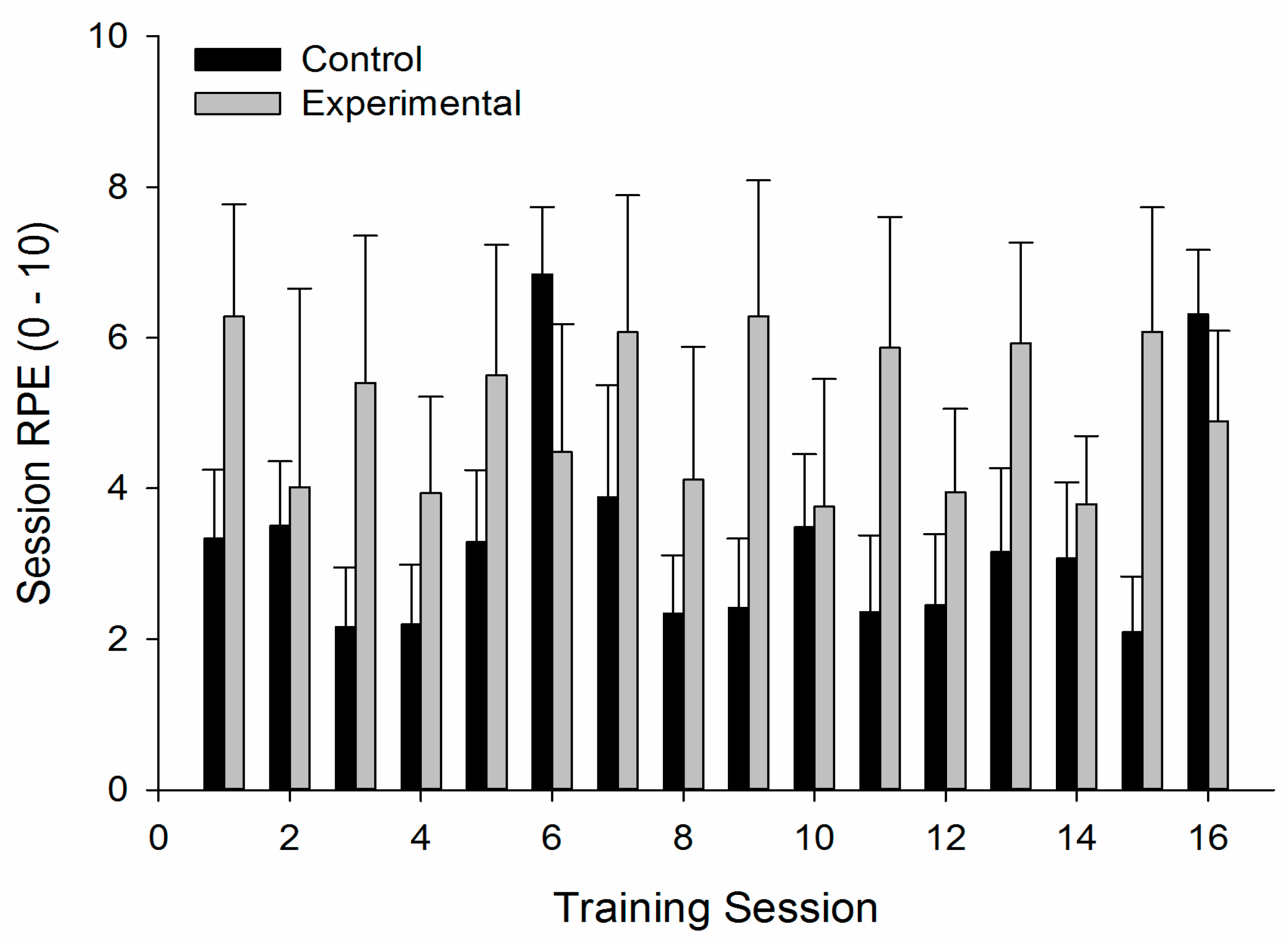
3.1.2. Session-RPE
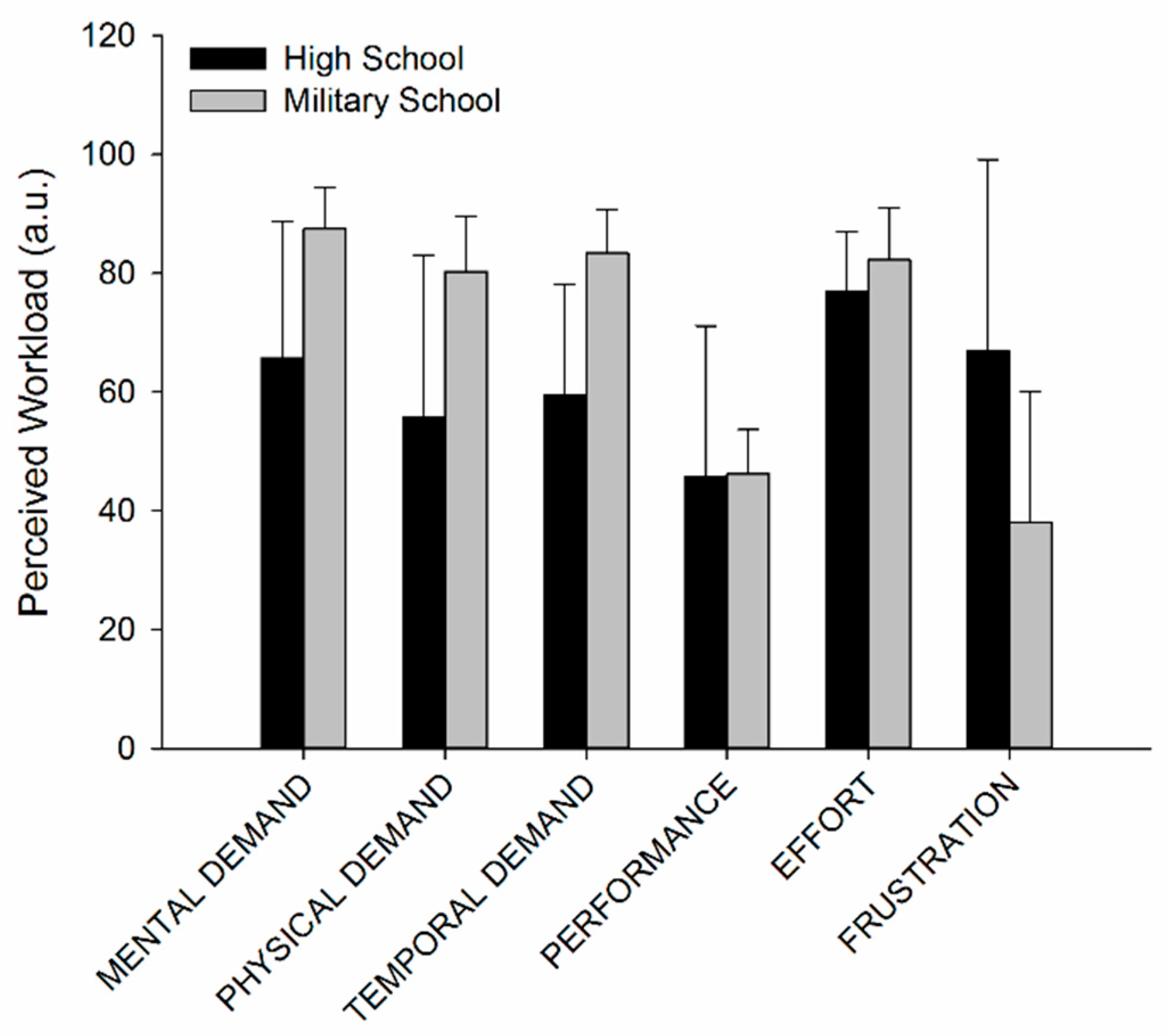
3.1.3. Nasa TLX
3.2. Phenomenological-Qualitative Approach, Process Referred
4. Discussion
4.1. Functional-Quantitative Approach, Product Referred
4.2. Phenomenological-Qualitative Approach, Process Referred
5. Conclusions
Author Contributions
Funding
Conflicts of Interest
Appendix A
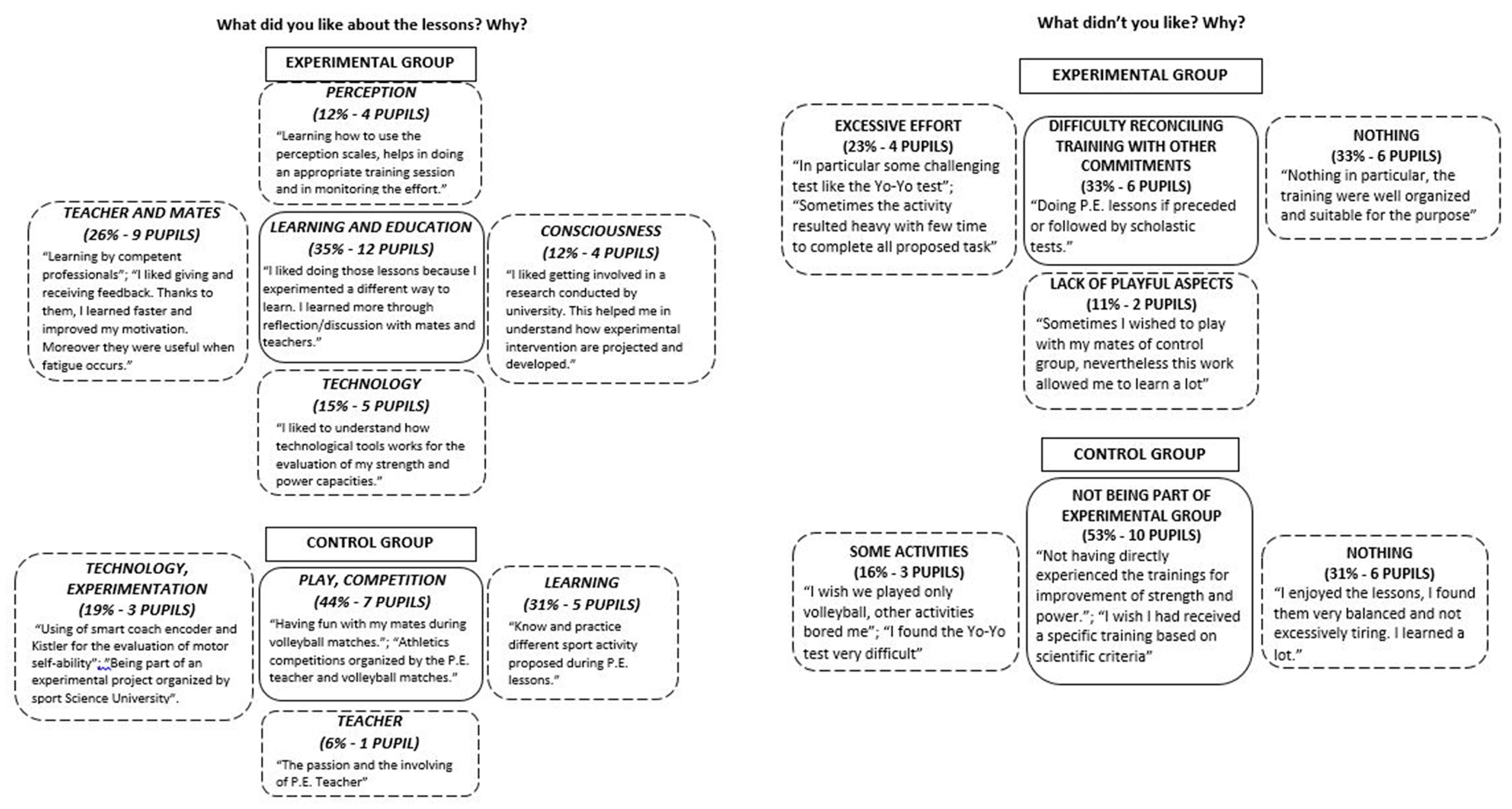
References
- Heinrich, K.M.; Spencer, V.; Fehl, N.; Carlos Poston, W.S. Mission essential fitness: Comparison of functional circuit training to traditional Army physical training for active duty military. Mil. Med. 2012, 177, 1125–1130. [Google Scholar] [CrossRef] [PubMed]
- Roy, T.C.; Springer, B.A.; McNulty, V.; Butler, N.L. Physical fitness. Mil. Med. 2010, 175, 14–20. [Google Scholar] [CrossRef]
- Moreno, M.R.; Dulla, J.M.; Dawes, J.J.; Orr, R.R.M.; Cesario, K.; Lockie, R.G. Lower-body power and its relationship with body drag velocity in law enforcement recruits. Int. J. Exerc. Sci. 2019, 12, 847–858. [Google Scholar]
- Hunt, W.A.; Wittson, C.L.; Harris, H.I. The screen test in military selection. Psychol. Rev. 1944, 51, 37. [Google Scholar] [CrossRef]
- Whitehead, M. The concept of physical literacy. Eur. J. Phys. Educ. 2001, 6, 127–138. [Google Scholar] [CrossRef]
- Castoldi, M. Progettare Per Competenze; Carocci: Roma, Italy, 2011. [Google Scholar]
- Pellerey, M. Le Competenze Individuali e Il Portfolio; Etas: Milano, Italy, 2004. [Google Scholar]
- Mariani, L.; Pozzo, G. Stili, strategie e strumenti nell’apprendimento linguistico. In Imparare a imparare. Insegnare a imparare; La Nuova Italia, Collana LEND: Firenze, Italy, 2002. [Google Scholar]
- Reason, P.; Rowan, J. Human Inquiry: A Sourcebook of New Paradigm Research; John Wiley & Sons: Hoboken, NJ, USA, 1981. [Google Scholar]
- Glatthorn, A.A. Performance Standards and Authentic Learning; Eye on Education: Larchmont, NY, USA, 1999. [Google Scholar]
- Bosquet, L.; Porta-Benache, J.; Blais, J. Validity of a commercial linear encoder to estimate bench press 1 RM from the force-velocity relationship. J. Sports Sci. Med. 2010, 9, 459. [Google Scholar]
- Markovic, G.; Dizdar, D.; Jukic, I.; Cardinale, M. Reliability and factorial validity of squat and countermovement jump tests. J. Strength Cond. Res. 2004, 18, 551–555. [Google Scholar]
- Castagna, C.; Impellizzeri, F.M.; Rampinini, E.; D’Ottavio, S.; Manzi, V. The Yo–Yo intermittent recovery test in basketball players. J. Sci. Med. Sport 2008, 11, 202–208. [Google Scholar] [CrossRef]
- Krustrup, P.; Mohr, M.; Amstrup, T.; Rysgaard, T.; Johansen, J.; Steensberg, A.; Pedersen, P.K.; Bangsbo, J. The yo-yo intermittent recovery test: Physiological response, reliability, and validity. Med. Sci. Sports Exerc. 2003, 35, 697–705. [Google Scholar] [CrossRef]
- Haddad, M.; Stylianides, G.; Djaoui, L.; Dellal, A.; Chamari, K. Session-RPE method for training load monitoring: Validity, ecological usefulness, and influencing factors. Front. Neurosci. 2017, 11, 612. [Google Scholar] [CrossRef]
- Hoonakker, P.; Carayon, P.; Gurses, A.P.; Brown, R.; Khunlertkit, A.; McGuire, K.; Walker, J.M. Measuring workload of ICU nurses with a questionnaire survey: The NASA Task Load Index (TLX). IIE Trans. Healthc. Syst. Eng. 2011, 1, 131–143. [Google Scholar] [CrossRef]
- Foster, C.; Florhaug, J.A.; Franklin, J.; Gottschall, L.; Hrovatin, L.A.; Parker, S.; Doleshal, P.; Dodge, C. A new approach to monitoring exercise training. J. Strength Cond. Res. 2001, 15, 109–115. [Google Scholar] [PubMed]
- Impellizzeri, F.M.; Rampinini, E.; Coutts, A.J.; Sassi, A.; Marcora, S.M. Use of RPE-based training load in soccer. Med. Sci. Sports Exerc. 2004, 36, 1042–1047. [Google Scholar] [CrossRef]
- Meyer, J. Using qualitative methods in health related action research. BMJ 2000, 320, 178–181. [Google Scholar] [CrossRef]
- EUR-lex. Available online: https://eur-lex.europa.eu/legal-content/IT/TXT/?uri=CELEX%3A32018H0604%2801%29 (accessed on 23 June 2020).
- www.gazzettaufficiale.it. Available online: https://www.gazzettaufficiale.it/eli/id/2010/12/14/010G0232/sg (accessed on 23 June 2020).
- Patterson, P.; Faucette, N. Children’s attitudes toward physical activity in classes taught by specialist versus nonspecialist PE teachers. J. Teach. Phys. Educ. 1990, 9, 324–331. [Google Scholar] [CrossRef]
- Siedentop, D.; Tannehill, D. Developing teaching skills in physical education; Mayfield Pub Co: Mountain View, CA, USA, 1999. [Google Scholar]
- Siedentop, D. Aprender a Enseñar La Educación Física; Editorial INDE: Barcelona, Spain, 1998. [Google Scholar]
- Bellack, A.; Kliebard, H.; Hyman, R.; Smith, F. The Language of the Classroom; Teachers College. Columbia University Press: New York, NY, USA, 1966. [Google Scholar]
- Lincoln, Y.S.; Guba, E.G. Naturalistic Inquiry; SAGE Publications: Thousand Oaks, CA, USA, 1985. [Google Scholar]
- Hill, C.E.; Knox, S.; Thompson, B.J.; Williams, E.N.; Hess, S.A.; Ladany, N. Consensual qualitative research: An update. J. Couns. Psychol. 2005, 52, 196. [Google Scholar] [CrossRef]
- Corbin, J.; Strauss, A. Basics of Qualitative Research: Techniques and Procedures for Developing Grounded Theory; SAGE Publications: San Jose State University, CA, USA, 2014. [Google Scholar]
- Hopkins, W.G.; Marshall, S.W.; Batterham, A.M.; Hanin, J. Progressive Statistics for Studies in Sports Medicine and Exercise Science. Med. Sci. Sports. Exerc. 2009, 41, 3–13. [Google Scholar] [CrossRef]
- Hopkins, W.G. Estimating sample size for magnitude-based inferences. Sportscience. 2006, pp. 63–70. Available online: Sportsci.org/2006/wghss.htm (accessed on 1 June 2020).
- Dugnani, S.; Invernizzi, P.L. Progettare in Educazione Fisica e Nella Scienze Motorie; Carabà: Pozzo d’Adda, Italy, 2013. [Google Scholar]
- Chelly, M.S.; Hermassi, S.; Aouadi, R.; Shephard, R.J. Effects of 8-week in-season plyometric training on upper and lower limb performance of elite adolescent handball players. J. Strength Cond. Res. 2014, 28, 1401–1410. [Google Scholar] [CrossRef]
- Andre, M.J.; Fry, A.C.; McLellan, E.; Weiss, L.W.; Moore, C.M. Acute effects of static stretching on bench press power and velocity in adolescent male athletes. Int. J. Sports Sci. Coach. 2014, 9, 1145–1152. [Google Scholar] [CrossRef]
- Babu, M.S.; Kumar, P.P. The effect of selected circuit training exercises on sprinters of high school girls. Int. J. Sci. Res. 2013, 2, 401–407. [Google Scholar]
- Giannaki, C.D.; Aphamis, G.; Tsouloupas, C.N.; Ioannou, Y.; Hadjicharalambous, M. An eight week school-based intervention with circuit training improves physical fitness and reduces body fat in male adolescents. J. Sports Med. Phys. Fit. 2016, 56, 894–900. [Google Scholar]
- Cormie, P.; McGuigan, M.R.; Newton, R.U. Adaptations in athletic performance after ballistic power versus strength training. Med. Sci. Sports Exerc. 2010, 42, 1582–1598. [Google Scholar] [CrossRef] [PubMed]
- Hartmann, H.; Bob, A.; Wirth, K.; Schmidtbleicher, D. Effects of different periodization models on rate of force development and power ability of the upper extremity. J. Strength Cond. Res. 2009, 23, 1921–1932. [Google Scholar] [CrossRef] [PubMed]
- Chtara, M.; Chaouachi, A.; Levin, G.T.; Chaouachi, M.; Chamari, K.; Amri, M.; Laursen, P.B. Effect of concurrent endurance and circuit resistance training sequence on muscular strength and power development. J. Strength Cond. Res. 2008, 22, 1037–1045. [Google Scholar] [CrossRef] [PubMed]
- Hudd, S.S.; Dumlao, J.; Erdmann-Sager, D.; Murray, D.; Phan, E.; Soukas, N.; Yokozuka, N. Stress at college: Effects on health habits, health status and self-esteem. Coll. Stud. J. 2000, 34, 217. [Google Scholar]
- Hug, M.; Mullis, P.E.; Vogt, M.; Ventura, N.; Hoppeler, H. Training modalities: Over-reaching and over-training in athletes, including a study of the role of hormones. Best Pract. Res. Clin. Endocrinol. Metab. 2003, 17, 191–209. [Google Scholar] [CrossRef]
- Rapolienė, L.; Razbadauskas, A.; Jurgelėnas, A. The reduction of distress using therapeutic geothermal water procedures in a randomized controlled clinical trial. Adv. Prev. Med. 2015, 2015, 749417. [Google Scholar] [CrossRef][Green Version]
- Bartholomew, J.B.; Stults-Kolehmainen, M.A.; Elrod, C.C.; Todd, J.S. Strength gains after resistance training: The effect of stressful, negative life events. J. Strength Cond. Res. 2008, 22, 1215–1221. [Google Scholar] [CrossRef] [PubMed]
- Slavin, R.E. Cooperative learning and the cooperative school. Educ. Leadersh. 1987, 45, 7–13. [Google Scholar]
- Dyson, B. Cooperative learning in an elementary physical education program. J. Teach. Phys. Educ. 2001, 20, 264–281. [Google Scholar] [CrossRef]
- Goodwin, M.W. Cooperative learning and social skills: What skills to teach and how to teach them. Interv. Sch. Clin. 1999, 35, 29–33. [Google Scholar] [CrossRef]
- Herrmann, K.J. The impact of cooperative learning on student engagement: Results from an intervention. Act. Learn. High. Educ. 2013, 14, 175–187. [Google Scholar] [CrossRef]
- Ryan, R.M.; Deci, E.L. Intrinsic and extrinsic motivation from a self-determination theory perspective: Definitions, theory, practices, and future directions. Contemp. Educ. Psychol. 2020, in press. [Google Scholar] [CrossRef]
- Kalajas-Tilga, H.; Koka, A.; Hein, V.; Tilga, H.; Raudsepp, L. Motivational processes in physical education and objectively measured physical activity among adolescents. J.Sport Health Sci. 2019. [Google Scholar] [CrossRef]


| Tests | Parameters of Eligibility | Scoring Parameters | Maximal Score (n Points) | |
|---|---|---|---|---|
| MEN | 2000 m run | Time limit: 9 min. | 0.025 points for each second less (maximum 60 s) than the maximum time. | 1.5 |
| Simulation of lifting the mortar bomb from 120 mm. Weight: 18.86 kg (LB). | Minimum 6 repetitions. Time limit: 60 s. | 0.25 points for each further lift (up to a maximum of 12 in addition to the minimum). | 3 | |
| Transport of the Wounded 70 kg (TW). | Time limit: 60 s on a 20 m shuttle. | 0.075 points for each second less (up to a maximum of 40 s less). | 3 | |
| 4 m rope climb (RC). | Time limit: 30 s. | Below 10 s: 1.5 points; from 10 to 20 s: 1 point; from 20 to 30 s: 0.5 points. | 1.5 | |
| Simulation of the loading of a 20-kg machine gun (LMG). | Minimum 6 repetitions. Time limit 60 s. | 0.125 points for each further traction (up to a maximum of 24 in addition to the minimum). | 3 | |
| High jump (HJ). | Minimum height: 1.20 m (maximum 2 trials for each height). | Height 1.40 m: 1.5 points; height 1.30 m: 1 point; height 1.20 m: 0.5 points. | 1.5 | |
| WOMEN | 2000 m run. | Time limit: 10 min. | 0.025 points for each second less (maximum 60 s) than the maximum time. | 1.5 |
| Simulation of lifting the mortar bomb from 120 mm. Weight: 18.86 kg (LB). | Minimum 4 repetitions. Time limit: 80 s. | 0.25 points for each further lift (up to a maximum of 12 in addition to the minimum). | 3 | |
| Transport of the Wounded 70 kg (TW). | Time limit 80 s on a 20 m shuttle. | 0.1 points for each second less (up to a maximum of 30 s less). | 3 | |
| 4 m rope climb (RC). | Time limit 4 s. | Below 20 s: 1.5 points; from 20 to 30 s: 1 point; from 30 to 40 s: 0.5 points. | 1.5 | |
| Simulation of the loading of a 10-kg machine gun (LMG). | Minimum 4 repetitions. Time limit: 80 s. | 0.125 points for each further traction (up to a maximum of 24 in addition to the minimum). | 3 | |
| High jump (HJ). | Minimum height: 1 m (maximum 2 trials for each height). | Height 1.20 m: 1.5 points; height 1.10 m: 1 point; height 1 m: 0.5 points. | 1.5 |
| Title of Disciplinary Learning Unit | Research-Action as a Basic Element of an Innovative School Motor Culture. |
|---|---|
| European skills developed | Digital skills; learning to learn; social and civic skills; initiative spirit and entrepreneurship; awareness and cultural expression. |
| Citizenship skills developed to create a competent student | Learning to learn; designing; communicating; collaborating and participating; acting independently and responsibly; problems solving; identifying links and relationships; acquiring and interpreting information. |
| Learning objectives (Ministerial Italian School Program) | Self-perception and functional development of motor skills; health, wellness and prevention; relationship with the natural and technological environment. |
| Goals for the development of competences (Ministerial Italian School Program) | Awareness of your body through the stimulation of motor skills both as a specific objective and as a condition for reaching higher levels of ability and motor performance; knowing how to act responsibly, reasoning about what you are putting into action and being able to analyze your own and others’ performance, identifying positive and negative aspects; working both in group and individually to learn cooperating with others following shared rules for a common goal; acquiring knowledge of methods, work techniques and experiences for the purpose of acquiring the awareness and the ability to organize autonomously one’s own physical development and maintenance plan with the goal of a performance; maturing the need to reach and maintain an adequate level of psychophysical fitness to be able to face every day needs as study, future work, sport and leisure; acquiring opportunities to be familiarized with and practice the use of innovative technologies and tools applicable to activities and other disciplines. |
| Reality task (based on military academy test) | The reality task was used to create a learning situation that aimed to develop abilities in an experimental way. The reality task, regardless of results, highlights multi-disciplinary theoretical references that corroborate the student experience and knowledge. Adding an appropriate reflective activity to this process, the reality task gives a greater value to learning that would not be possible with an aseptic research without a direct and reflective involvement of the students. |
| Research-action | The style of teaching assets based on comparison of ideas and strategies represents a useful element to activate the cognitive tools intended to direct the subjects to a process of research-action in which they feel empowered and like leaders. This is a “research in the research”, with the objective of a project for the creation of high cultural and professional profiles that can adapt situationally to the requests for a double and complex reality, the military and the high school, in which body culture plays a relevant role. |
| Specific learning objectives: knowledge | Knowing the possible interactions between the different components influencing motor performance; knowing the effects of the practice exercises; knowing technological tools useful for a precise monitoring of the motor capabilities to develop; knowing the criteria followed in experimental research; knowing the criteria for organizing a motor project aimed at performance; knowing the relationship between the qualities developed through the training and performance of military tests also through analyzing scientific literature. |
| Specific learning objectives: skills | Ability based on the capacity to perceive your body and recognize fatigue, analyzing the effects of training through the use of perception of effort stairs; using consciously and appropriately the exercises useful to develop the different capacities; recognizing the methodological path adopted in the research; ability to perform correctly the monitoring exercises; ability based on the capacity to perform exercises correctly and safely to avoid injury and micro-traumas during exercises; ability based on the capacity for adequate work in an appropriate manner and adequate organization of training sessions; ability to organize work according to the environment in which we act, the time available and the objectives; ability to adopt the specific procedures for work in circuit and with weights; ability to relate with the technological environment in the use of specific tools for monitoring strength and power of lower and upper limbs. |
| Cultural axes involved (chosen in the Ministerial Italian School Program) | Mathematical axis: knowing how to analyze data and interpret them, developing deductions and reasons with the aid of graphical representations, consciously using potentiality offered by specific informatics applications.Scientific-technological axis: observing, describing and analyzing phenomena belonging to reality and recognizing systems and complex concepts in various forms. Being aware of the potentialities and limitations of technology in the cultural and social context in which they are applied.Social-historical axis: understanding the change and diversity in historical times of the body concept in a diachronic dimension through the comparison between periods and in a synchronous dimension between different cultural areas. |
| Mean ± SD | Magnitude-Based Inference | Effect Size (Cohen’s d) | ||||||||||||
|---|---|---|---|---|---|---|---|---|---|---|---|---|---|---|
| Test | Variable | CG Pre | EG Pre | CG Post | EG Post | CG Pre vs. EG Pre | CG Post vs. EG Post | CG Pre vs. CG Post | EG Pre vs. EG Post | Effect | CG Pre vs. EG Pre | CG Post vs. EG Post | CG Pre vs. CG Post | EG Pre vs. EG Post |
| Bench press test | P (W) | 260.7 ± 104.5 | 263.7 ± 93.4 | 264.9 ± 108.7 | 265.5 ± 89.8 | Possibly trivial | Possibly trivial | Very likely trivial | Most likely trivial | Very likely trivial | 0.03 | 0.01 | 0.05 | 0.03 |
| F (N) | 37.3 ± 13.0 | 37.0 ± 10.4 | 38.5 ± 13.8 | 36.8 ± 9.8 | Possibly trivial | Possibly trivial | Most likely trivial | Possibly positive | Possibly positive | −0.03 | −0.15 | 0.13 | −0.01 | |
| CMJ | PPO (W) | 3012.2 ± 589.9 | 3264.5 ± 877.2 | 3038.7 ± 593.8 | 3219.8 ± 736.0 | Unclear | Unclear | Most likely trivial | Very likely trivial | Unclear | −0.29 | −0.20 | −0.09 | 0.08 |
| F (N) | 1690.1 ± 305.8 | 1769.8 ± 322.6 | 1583.2 ± 250.8 | 1741.3 ± 326.4 | Possibly positive | Likely trivial | Possibly positive | Possibly positive | Possibly positive | 0.25 | 0.54 | −0.54 | −0.12 | |
| JH (cm) | 40.7 ± 7.1 | 41.0 ± 7.6 | 39.3 ± 7.1 | 39.5 ± 7.40 | Possibly positive | Very likely trivial | Possibly positive | Possibly positive | Most likely trivial | 0.05 | 0.02 | −0.26 | −0.29 | |
| Yo-Yo IRL1 | Distance (m) | 924.2 ± 475.5 | 1120.0 ± 585.2 | 753.7 ± 364.5 | 972.2 ± 460.0 | Possibly positive | Likely positive | Possibly positive | Likely positive | Likely trivial | 0.36 | 0.52 | −0.57 | −0.40 |
| Mean ± SD | Magnitude-Based Inference | Effect Size (Cohen’s d) | ||||||||||||
|---|---|---|---|---|---|---|---|---|---|---|---|---|---|---|
| Test | Variable | CG Pre | EG Pre | CG Post | EG Post | CG Pre vs. EG Pre | CG Post vs. EG Post | CG Pre vs. CG Post | EG Pre vs. EG Post | Effect | CG Pre vs. EG Pre | CG Post vs. EG Post | CG Pre vs. CG Post | EG Pre vs. EG Post |
| Circuit Training Test | TIM (rep) | 62.0 ± 13.2 | 58.3 ± 18.0 | 66.8 ± 14.3 | 70.4 ± 17.2 | Very Likely Trivial | Unlikely Positive | Very Likely Trivial | Possibly Positive | Likely Trivial | −0.01 | 0.41 | 0.43 | 0.98 |
| SR (rep) | 8.2 ± 1.4 | 7.9 ± 1.5 | 8.8 ± 1.2 | 9.0 ± 1.0 | Very Likely Trivial | Possibly Positive | Possibly Positive | Likely Positive | Likely Trivial | 0.04 | 0.42 | 0.67 | 1.39 | |
| SU (rep) | 44.5 ± 9,4 | 43.0 ± 9.4 | 51.0 ± 7.3 | 48.5 ± 6.9 | Most Likely Trivial | Most Likely Trivial | Likely Positive | Likely Positive | Most Likely Trivial | −0.04 | −0.22 | 1.08 | 1.09 | |
| PU (rep) | 37.4 ± 15.9 | 38.5 ± 12.9 | 46.1 ± 15.2 | 45.2 ± 15.1 | Possibly Positive | Possibly Positive | Possibly Positive | Possibly Positive | Very Likely Trivial | 0.39 | 0.28 | 0.69 | 0.78 | |
| SQ (rep) | 20.9 ± 7.1 | 17.8 ± 6.6 | 23.9 ± 5.7 | 24.0 ± 8.0 | Possibly Negative | Likely Trivial | Likely Positive | Possibly Positive | Likely Trivial | −0.28 | 0.07 | 0.70 | 1.08 | |
| PLU (rep) | 11.5 ± 9.6 | 10.1 ± 7.5 | 14.9 ± 10.9 | 13.4 ± 8.5 | Likely Trivial | Likely Trivial | Likely Positive | Likely Positive | Likely Trivial | −0.03 | 0.03 | 0.32 | 0.52 | |
| Mean ± SD | Magnitude-Based Inference | Effect Size (Cohen’s d) | ||||||||||||
|---|---|---|---|---|---|---|---|---|---|---|---|---|---|---|
| Test | Variable | CG Pre | EG Pre | CG Post | EG Post | CG Pre vs. EG Pre | CG Post vs. EG Post | CG Pre vs. CG Post | EG Pre vs. EG Post | Effect | CG Pre vs. EG Pre | CG Post vs. EG Post | CG Pre vs. CG Post | EG Pre vs. EG Post |
| Military Tests | 2000 m run (s) | 529.5 ± 55.8 | 515.1 ± 42.9 | 494.1 ± 52.4 | 451.5 ± 136.4 | Very Likely Trivial | Very Likely Trivial | Possibly Negative | Possibly Negative | Very Likely Trivial | −0.29 | −0.39 | −0.91 | −0.89 |
| LB (rep) | 13.39 ± 6.96 | 13.58 ± 6.85 | 6.79 ± 8.35 | 10.00 ± 8.57 | Unclear | Likely Trivial | Most Likely Trivial | Most Likely Trivial | Very Likely Trivial | −0.04 | −0.11 | 0.01 | 0.41 | |
| TW (s) | 33.8 ± 6.9 | 34.1 ± 10.0 | 27.9 ± 6.5 | 28.4 ± 9.1 | Likely Trivial | Likely Trivial | Likely Negative | Possibly Negative | Likely Trivial | 0.03 | 0.06 | 0.08 | 0.03 | |
| RC (s) | 19.14 ± 6.71 | 17.84 ± 5.92 | 19.37 ± 7.51 | 16.93 ± 5.47 | Likely Trivial | Possibly Negative | Most Likely Trivial | Most Likely Trivial | Most Likely Trivial | −0.23 | −0.49 | 0.06 | −0.25 | |
| LMG (rep) | 18.3 ± 6.6 | 23.5 ± 5.1 | 23.5 ± 5.5 | 25.2 ± 6.3 | Possibly Positive | Likely Trivial | Likely Positive | Very Likely Trivial | Possibly Negative | 0.90 | 0.28 | 0.01 | 0.03 | |
| HJ (cm) | 128.2 ± 15.4 | 129.4 ± 10.7 | 130.9 ± 13.8 | 133.1 ± 10.1 | Likely Trivial | Likely Trivial | Most Likely Trivial | Most Likely Trivial | Likely Trivial | 0.09 | 0.24 | −0.10 | 0.09 | |
| TS | 8.92 ± 2.25 | 9.39 ± 2.36 | 6.93 ± 3.38 | 8.71 ± 3.71 | Likely Trivial | Possibly Positive | Likely Negative | Likely Trivial | Likely Trivial | 0.20 | 0.50 | 0.69 | 0.22 | |
| MD | PD | TD | P | E | F | |
|---|---|---|---|---|---|---|
| Military school students | 87.5 ± 6.8 | 80.3 ± 9.2 | 83.4 ± 7.2 | 46.3 ± 7.4 | 82.2 ± 8.8 | 38.1 ± 21.9 |
| High school students | 65.8 ± 23.0 | 55.8 ± 27.4 | 59.6 ± 18.5 | 45.8 ± 25.4 | 76.9 ± 10.1 | 66.9 ± 32.2 |
| MBI Comparisons | Likely positive | Likely positive | Very Likely positive | Unlikely positive | Possibly positive | Possibly positive |
| ES (Cohen’s d) | 1.34 | 1.26 | 1.77 | 0.03 | 0.56 | −1.07 |
| Motivation | Understanding | Collaboration | |||||||
|---|---|---|---|---|---|---|---|---|---|
| Day 1 | Day 2 | Day 3 | Day 1 | Day 2 | Day 3 | Day 1 | Day 2 | Day 3 | |
| Observer 1 | Yes 75% No 25% | Yes 75% No 25% | Yes 75% No 25% | Yes 75% No 25% | Yes 81% No 19% | Yes 75% No 25% | Yes 81% No 19% | Yes 88% No 12% | Yes 81% No 19% |
| Observer 2 | Yes 75% No 25% | Yes 81% No 19% | Yes 69% No 31% | Yes 81% No 19% | Yes 88% No 12% | Yes 75% No 25% | Yes 88% No 12% | Yes 88% No 12% | Yes 81% No 19% |
| Observer 3 | Yes 75% No 25% | Yes 75% No 25% | Yes 81% No 19% | Yes 81% No 19% | Yes 75% No 25% | Yes 75% No 25% | Yes 94% No 6% | Yes 88% No 12% | Yes 88% No 12% |
| Days Mean | Yes 76% No 24% | Yes 78% No 22% | Yes 86% No 14% | ||||||
© 2020 by the authors. Licensee MDPI, Basel, Switzerland. This article is an open access article distributed under the terms and conditions of the Creative Commons Attribution (CC BY) license (http://creativecommons.org/licenses/by/4.0/).
Share and Cite
Invernizzi, P.L.; Signorini, G.; Pizzoli, M.; Alberti, G.; Formenti, D.; Bosio, A. Circuit Training during Physical Education Classes to Prepare Cadets for Military Academies Tests: Analysis of an Educational Project. Sustainability 2020, 12, 5126. https://doi.org/10.3390/su12125126
Invernizzi PL, Signorini G, Pizzoli M, Alberti G, Formenti D, Bosio A. Circuit Training during Physical Education Classes to Prepare Cadets for Military Academies Tests: Analysis of an Educational Project. Sustainability. 2020; 12(12):5126. https://doi.org/10.3390/su12125126
Chicago/Turabian StyleInvernizzi, Pietro Luigi, Gabriele Signorini, Maurizio Pizzoli, Giampietro Alberti, Damiano Formenti, and Andrea Bosio. 2020. "Circuit Training during Physical Education Classes to Prepare Cadets for Military Academies Tests: Analysis of an Educational Project" Sustainability 12, no. 12: 5126. https://doi.org/10.3390/su12125126
APA StyleInvernizzi, P. L., Signorini, G., Pizzoli, M., Alberti, G., Formenti, D., & Bosio, A. (2020). Circuit Training during Physical Education Classes to Prepare Cadets for Military Academies Tests: Analysis of an Educational Project. Sustainability, 12(12), 5126. https://doi.org/10.3390/su12125126